Deep Multi-Modal Transfer Learning for Augmented Patient Acuity Assessment in the Intelligent ICU - Frontiers
←
→
Page content transcription
If your browser does not render page correctly, please read the page content below
ORIGINAL RESEARCH
                                                                                                                                                published: 22 February 2021
                                                                                                                                           doi: 10.3389/fdgth.2021.640685

                                               Deep Multi-Modal Transfer Learning
                                               for Augmented Patient Acuity
                                               Assessment in the Intelligent ICU
                                               Benjamin Shickel 1,2 , Anis Davoudi 2,3 , Tezcan Ozrazgat-Baslanti 2,4 , Matthew Ruppert 2,4 ,
                                               Azra Bihorac 2,4 and Parisa Rashidi 1,2,3*
                                               1
                                                Department of Computer and Information Science and Engineering, University of Florida, Gainesville, FL, United States,
                                               2
                                                Precision and Intelligent Systems in Medicine (PRISMAP), University of Florida, Gainesville, FL, United States, 3 Department
                                               of Biomedical Engineering, University of Florida, Gainesville, FL, United States, 4 Department of Medicine, University of
                                               Florida, Gainesville, FL, United States

                                               Accurate prediction and monitoring of patient health in the intensive care unit can inform
                                               shared decisions regarding appropriateness of care delivery, risk-reduction strategies,
                                               and intensive care resource use. Traditionally, algorithmic solutions for patient outcome
                                               prediction rely solely on data available from electronic health records (EHR). In this pilot
                                               study, we explore the benefits of augmenting existing EHR data with novel measurements
                           Edited by:
                                               from wrist-worn activity sensors as part of a clinical environment known as the Intelligent
                         Ira L. Leeds,         ICU. We implemented temporal deep learning models based on two distinct sources
             Johns Hopkins University,         of patient data: (1) routinely measured vital signs from electronic health records, and
                       United States
                                               (2) activity data collected from wearable sensors. As a proxy for illness severity, our
                      Reviewed by:
                 Keng-Hwee Chiam,              models predicted whether patients leaving the intensive care unit would be successfully
   Bioinformatics Institute (A*STAR),          or unsuccessfully discharged from the hospital. We overcome the challenge of small
                           Singapore
           Paraskevi Papadopoulou,
                                               sample size in our prospective cohort by applying deep transfer learning using EHR
 American College of Greece, Greece            data from a much larger cohort of traditional ICU patients. Our experiments quantify
                  *Correspondence:             added utility of non-traditional measurements for predicting patient health, especially
                         Parisa Rashidi        when applying a transfer learning procedure to small novel Intelligent ICU cohorts of
                 parisa.rashidi@ufl.edu
                                               critically ill patients.
                    Specialty section:         Keywords: machine learning, deep learning, transfer learning, intensive care unit, electronic health records,
          This article was submitted to        intelligent ICU
                Personalized Medicine,
                a section of the journal
              Frontiers in Digital Health
                                               1. INTRODUCTION
       Received: 11 December 2020
        Accepted: 02 February 2021             Patients admitted to a hospital’s intensive care unit (ICU) have life-threatening conditions or the
       Published: 22 February 2021             propensity to develop them at any moment. An estimated 5.7 million adults are admitted to ICUs
                              Citation:        in the United States annually, and their precarious and often rapidly-changing state of health
                Shickel B, Davoudi A,          necessitates increased monitoring and hospital resources that costs the U.S. healthcare system more
      Ozrazgat-Baslanti T, Ruppert M,
                                               than 67 billion dollars every year (1).
 Bihorac A and Rashidi P (2021) Deep
     Multi-Modal Transfer Learning for
                                                  A typical ICU stay occurs in an environment of high-frequency patient monitoring involving
            Augmented Patient Acuity           a wide variety of physiological measurements such as vital sign tracking, bedside nursing
    Assessment in the Intelligent ICU.         assessments, and laboratory test results. These clinical data points serve as a window into
        Front. Digit. Health 3:640685.         patient illness severity, and taken over time can indicate improving or worsening physiological
     doi: 10.3389/fdgth.2021.640685            health. The robust clinical data generated during an ICU stay can aid caregivers in diagnosis

Frontiers in Digital Health | www.frontiersin.org                                     1                                           February 2021 | Volume 3 | Article 640685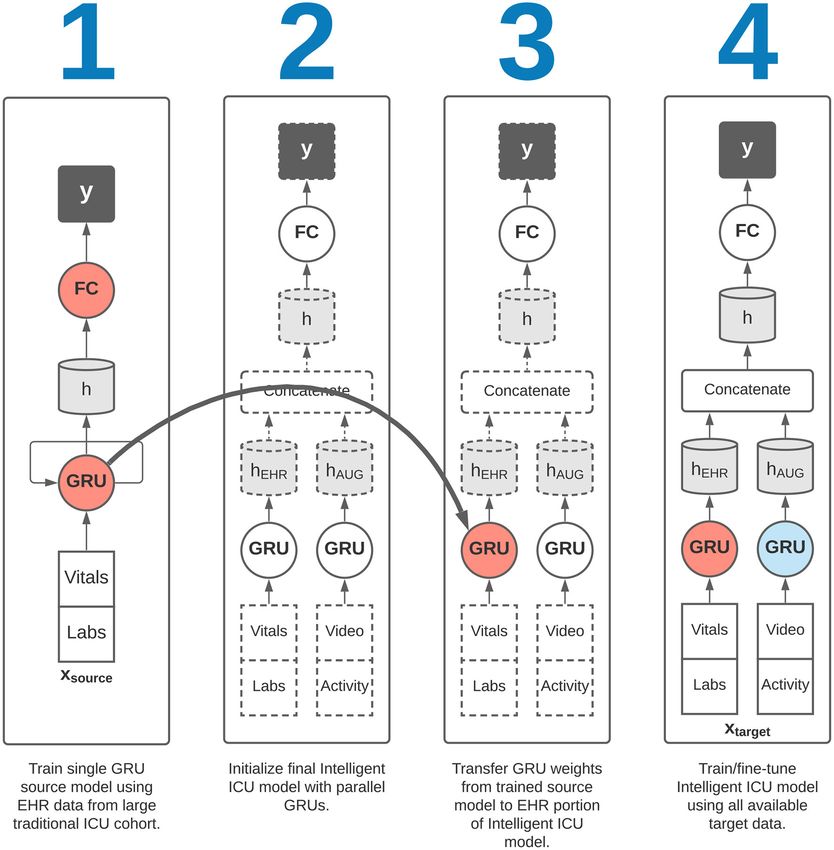
Shickel et al.                                                                                                          Intelligent ICU Transfer Learning

and influence clinical decision-making regarding medication                  EHR-based data with patient-worn accelerometer sensors,
administration, appropriateness of clinical procedures and                   room-equipped light and sound sensors, and a patient-facing
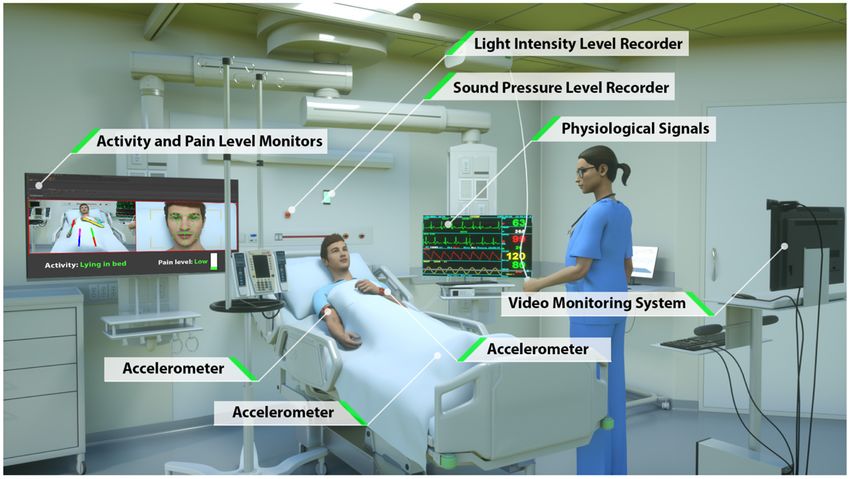
surgery, and duration and resource requirement of intensive care.            camera (26) (Figure 1). Their initial pilot study demonstrated
   The rich data associated with a typical ICU stay is routinely             the positive impact of these novel clinical data streams in
captured in modern electronic health record (EHR) systems. As                characterizing delirium in a small prospective cohort of ICU
of 2017, more than 99% of U.S. hospitals use some form of                    patients. While these non-traditional ICU data sources have
EHR (2). These longitudinal systems store a large magnitude                  shown promise for improving modeling of critically ill patients,
of patient information including demographics and admission                  Intelligent ICU rooms equipped with pervasive sensors are still
information, vital signs, diagnoses and procedures, laboratory               in early stages of research.
tests, prescriptions and medications, bedside assessments, clinical              In this study, we build upon the work of Davoudi et al. by
notes, and more. While inherently useful for care delivery and               utilizing the data generated by Intelligent ICUs for automated
administrative hospital tasks like billing, EHR systems also                 patient acuity assessment using deep learning techniques. In
function as a rich source for more automated data-driven patient             particular, we show that by augmenting existing EHR data with
monitoring applications.                                                     continuous activity measurements via wrist-worn accelerometer
   Given the potential for health instability commonly associated            sensors, models are better able to capture illness severity by way
with patients undergoing intensive care, the timely and accurate             of more accurate predictions of hospital discharge disposition.
assessment of illness severity is invaluable and can inform                  We overcome the issue of small sample size in the Intelligent
shared decision-making among patients, families, and providers.              ICU cohorts by employing transfer learning techniques, where
Traditionally, overall patient acuity can be measured using                  learned knowledge and representations from a much larger
a variety of manual, threshold-based scoring systems such                    cohort of EHR-only patients is used as a starting point for
as Sequential Organ Failure Assessment (SOFA) (3), Acute                     subsequent incorporation of the non-traditional data streams. By
Physiology And Chronic Health Evaluation (APACHE) (4),                       combining transfer learning with augmented ICU monitoring,
Simplified Acute Physiology Score (SAPS) (5, 6), Modified                    our work demonstrates the utility, efficacy, and future promise
Early Warning Score (MEWS) (7), and others. More recently,                   for using Intelligent ICUs for more personalized and accurate
clinical informatics research has demonstrated the validity and              illness severity assessments.
accuracy of more automated machine learning approaches using
the rich data from EHR systems (8–12). In particular, modern
algorithmic techniques using deep learning have been shown to                2. MATERIALS AND METHODS
outperform traditional bedside severity scores for predicting in-
hospital mortality as a proxy for real-time patient acuity (13).
                                                                             2.1. Study Aims
                                                                             The primary goal of our study is to characterize the effectiveness
Automated approaches for assessing patient illness severity can
                                                                             of augmenting traditional EHR patient data with a novel
help eliminate reliance on overburdened providers, improve the
                                                                             Intelligent ICU data source as it pertains to patient acuity
precision of personalized acuity estimates, and be computed in
                                                                             assessment using machine learning techniques. Specifically, we
real-time when combined with streaming EHR platforms.
                                                                             combine datasets consisting of several common vital signs with
   One potential disadvantage of automated patient monitoring
                                                                             continuous measurements from a wrist-worn activity sensor,
solutions is that such systems are limited to physiological data
                                                                             and use these augmented datasets to make predictions of a
that is recorded in EHR databases. This common paradigm
                                                                             patient’s eventual successful or unsuccessful hospital discharge
omits important aspects of patient care, including environmental
                                                                             as a proxy for illness severity. In this study, we consider a
factors (such as noise, light, and sleep), facial expressions that can
                                                                             discharge to home or rehabilitation facility as successful, with in-
indicate pain, agitation, or affective state, and aspects of patient
                                                                             hospital mortality or transfer to another hospital or hospice being
mobility and functional status.
                                                                             considered unsuccessful.
   Currently, patient pain can be measured by scoring systems
                                                                                Our second aim is the evaluation of transfer learning as a
such as the Non-Verbal Pain Scale (NVPS) (14) and the
                                                                             solution to cope with the issue of small sample size in our
Defense and Veterans Pain Rating Scale (DVPRS) (15), and
                                                                             prospective Intelligent ICU patient cohort. We hypothesized that
patient activity can be assessed by scoring systems such as the
                                                                             building upon algorithmic patient representations from a much
Progressive Upright Mobility Protocol (PUMP) Plus (16) and the
                                                                             larger cohort of traditional ICU stays would result in improved
ICU Mobility Scale (IMS) (17). However, these manual scores
                                                                             predictive performance in the smaller cohort of interest.
are much less granular than the corresponding physiological
measurements and require either self-reporting or repetitive
observations by ICU staff (18, 19). The reduced frequency and                2.2. Study Cohorts
granularity of these types of patient data can hinder timely                 Our primary cohort of interest, which we refer to as the
intervention strategies (20–25).                                             Intelligent ICU cohort, includes 51 distinct ICU admissions
   To overcome the limitations of current approaches to                      at University of Florida Health between September 2015 and
automated patient monitoring, recent studies have begun to                   February 2020. These intensive care episodes were made up of
explore the benefits of intensive care units augmented with                  51 unique patients undergoing 51 unique hospital encounters,
continuous and pervasive sensing technology. In a study dubbed               and occurred within specialized intensive care units outfitted
the Intelligent ICU, Davoudi et al. augmented traditional                    with several unconventional monitoring systems (Figure 1). The

Frontiers in Digital Health | www.frontiersin.org                        2                                    February 2021 | Volume 3 | Article 640685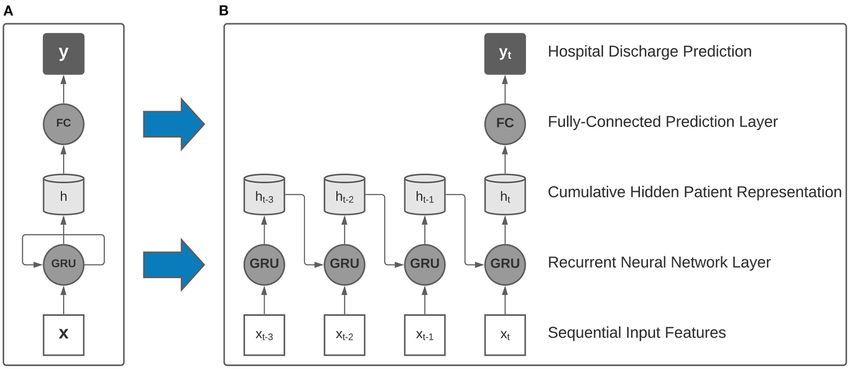
Shickel et al.                                                                                                                                Intelligent ICU Transfer Learning

  FIGURE 1 | Intelligent ICU room introduced by Davoudi et al. (26). In this study, we augment traditional vital signs from electronic health records with novel activity
  data from wrist-worn accelerometer sensors.

Intelligent ICU cohort included 33 successful discharges (64.7%)                          We extracted measurements from the entirety of each ICU stay,
and 18 unsuccessful discharges (35.3%).                                                   thus each vital sign sequence was variable length based on the
   For transfer learning experiments, we constructed a much                               number of hours a patient was in the ICU.
larger second cohort of 48,400 distinct ICU admissions occurring
at University of Florida Health between January 2011 and July
                                                                                          2.3.2. Intelligent ICU Data
2019. We refer to these admissions as the Conventional ICU
                                                                                          The novel environmental and pervasive sensing technology
cohort, as it comes from standard intensive care units that
                                                                                          was unique to the 51 ICU stays occurring in our Intelligent
contain only the data available in typical EHR systems. These ICU
                                                                                          ICU cohort. Among all available non-traditional data sources
admissions included 32,184 patients undergoing 45,147 unique
                                                                                          (Figure 1), in this pilot study we opted to explore the added
hospital encounters. The Conventional ICU cohort included
                                                                                          utility of wrist-worn activity sensors. Since this is the first study
36,392 successful discharges (75.2%) and 12,008 unsuccessful
                                                                                          of its kind, we intentionally chose to limit the inclusion of novel
discharges (24.8%).
                                                                                          data sources as a starting point for exploring and discussing the
   This study was approved by University of Florida Institutional
                                                                                          potential benefits of Intelligent ICU rooms for enhanced patient
Review Board by IRB 201900546. A summary and comparison of
                                                                                          acuity assessment. While, we provide a brief summary of the
admission and demographic descriptors for each cohort is shown
                                                                                          technology and data streams contained within Intelligent ICUs,
in Table 1.
                                                                                          we refer interested readers to the work of Davoudi et al. (26) for
                                                                                          a more comprehensive overview.
2.3. Data Extraction and Processing                                                           Patient activity data was collected from an Actigraph GT3X
2.3.1. Traditional EHR Data                                                               sensor (ActiGraph, LLC. Pensacola, Florida) placed on the
Whether receiving care in an Intelligent ICU or conventional                              patient’s dominant wrist when possible, and on the opposite wrist
ICU room, all patients have the same set of data recorded into                            when medical devices prevented ideal placement. These sensors
their electronic health records. In this study, for both cohorts we                       generate activity based on magnitude of wrist motion (27) and
extracted all ICU measurements of six commonly recorded vital                             sample at a frequency of 100 Hz. In this study, we aggregated
signs: diastolic blood pressure, systolic blood pressure, heart rate,                     accelerometer data into 24-h intervals, and extracted nine
respiratory rate, oxygen saturation (SpO2), and temperature.                              statistical features from each consecutive 24-h window after ICU
   A multivariate time series of vital signs was constructed                              admission. These features included minimum, maximum, mean,
for each ICU stay by temporally ordering measurements and                                 variance, standard deviation, immobile count, interquartile range
resampling to a fixed 1-h frequency, where the mean value was                             (IQR), root mean square of successive differences (RMSSD), and
taken if multiple measurements existed in the same 1-h window.                            standard deviation of RMSSD.

Frontiers in Digital Health | www.frontiersin.org                                     3                                            February 2021 | Volume 3 | Article 640685
Shickel et al. Intelligent ICU Transfer Learning
TABLE 1 | Summary of Intelligent ICU and Conventional ICU cohorts. TABLE 2 | Summary of features used in our experiments.
Descriptor Intelligent ICU Conventional ICU Intelligent ICU Conventional ICU
Feature
(n = 51) (n = 48,400) (n = 51) (n = 48,400)
Median (25th, 75th) Median (25th, 75th)
Patients, n 51 32,184
Hospital encounters, n 51 45,147 Vital signs
Hospital length of stay (days), median 14.9 (9.0, 21.7) 7.3 (4.2, 12.9) Diastolic blood pressure, mmHg 62.3 (53.0, 73.0) 63.0 (54.0, 73.0)
(25th, 75th) Systolic blood pressure, mmHg 123.0 (110.0, 139.0) 121.0 (107.0, 137.5)
Successful hospital discharge, n (%) 33 (64.7) 36,392 (75.2) Heart rate, beats/min 91.0 (80.0, 103.0) 85.0 (74.0, 97.0)
Unsuccessful hospital discharge, n (%) 18 (35.3) 12,008 (24.8) Respiratory rate, breaths/min 18.3 (15.0, 22.5) 18.0 (15.0, 21.0)
ICU stays, n 51 48,400 Oxygen saturation (SpO2), % 98.0 (95.0, 100.0) 97.0 (95.0, 99.0)
ICU length of stay (days), median (25th, 10.3 (6.4, 13.9) 3.0 (1.6, 6.0) Temperature, ◦ C 37.0 (36.7, 37.5) 36.9 (36.7, 37.3)
75th)
Age (years), median (25th, 75th) 63.2 (43.3, 73.0) 61.2 (48.8, 70.9) Wrist activity, action counts
Body mass index, median (25th, 75th) 27.3 (22.9, 33.2) 27.1 (23.1, 32.1) Minimum 0.0 (0.0, 0.0) N/A
Charlson comorbidity index, median 2.0 (0.0, 4.0) 2.0 (0.0, 4.0) Maximum 62.7 (39.5, 97.1) N/A
(25th, 75th) Mean 2.9 (1.2, 6.3) N/A
Sex Variance 58.6 (16.3, 135.5) N/A
Female, n (%) 18 (35.3) 20,188 (44.7) Standard deviation 7.7 (4.0, 11.6) N/A
Male, n (%) 33 (64.7) 24,959 (55.3) IQR 1.8 (0.0, 8.0) N/A
Race RMSSD 7.1 (4.2, 11.6) N/A
White, n (%) 44 (86.3) 34,702 (76.9) RMSSD standard deviation 1.0 (0.9, 1.1) N/A
Black, n (%) 5 (9.8) 7,615 (16.9) Number immobile 0.6 (0.4, 0.8) N/A
Other, n (%) 2 (3.9) 2,830 (6.2)
Ethnicity
Hispanic, n (%) 1 (2.0) 1,677 (3.8)
Not Hispanic, n (%) 50 (98.0) 42,989 (96.2)
development set of each individual experiment. Any missing
Language
extracted feature values in the resulting sequences were imputed
English, n (%) 51 (100.0) 44,396 (98.3)
with the previous sequence value, if it existed, otherwise with
Non-English, n (%) 0 (0.0) 751 (1.7)
the feature median based on each experiment’s development
Marital status
set. Finally, each feature was standardized to zero mean and
Married, n (%) 24 (55.8) 20,513 (48.3)
unit variance based on values from the development set of
Single, n (%) 14 (32.6) 13,606 (32.1)
each experiment.
Divorced, n (%) 2 (4.7) 4,149 (9.8)
Widowed, n (%) 1 (2.3) 3,341 (7.9)
Separated, n (%) 2 (4.7) 545 (1.3)
Life partner, n (%) 0 (0.0) 292 (0.7)
2.4. Models
In this study, we employ single-layer recurrent neural networks
Provider
(RNN), a class of deep learning algorithms that are well-suited to
Medicare, n (%) 27 (57.5) 23,203 (53.9)
processing sequential data and have been validated in literature
Private insurance, n (%) 13 (27.7) 10,707 (24.9)
as accurate clinical models for patient acuity assessment (13). In
Medicaid, n (%) 4 (8.5) 6,612 (15.4)
particular, our RNN models utilize gated recurrent units (GRU)
Uninsured, n (%) 3 (6.4) 2,550 (5.9)
and a linear prediction layer that is used to make a discharge
Smoking status
prediction after processing each 24-h data window (Figure 2). As
Smoker, n (%) 7 (15.6) 8,514 (21.1)
each sequential window’s features are made available, the model
Former smoker, n (%) 21 (46.7) 15,779 (39.1)
learns a real-time cumulative representation of patient state that
Never smoker, n (%) 17 (37.8) 16,060 (39.8)
is used to predict patient illness severity.
Our study involved the training of two distinct families
of recurrent neural networks that were designed to handle
either only traditional ICU data, or traditional data augmented
A summary of all features used in our models for both the with the multi-modal Intelligent ICU data. When using the
Intelligent ICU and Conventional ICU cohorts is shown in augmented dataset of both EHR and Intelligent ICU data, we
Table 2. utilized a parallel RNN architecture comprised of two recurrent
neural networks that independently processed each data source
2.3.3. Final Data Preprocessing on separate time scales, with the concatenation of hidden
For both sequences of patient data, outliers were capped at the representations passed to the linear prediction layer for assessing
1st and 99th percentiles, with cutoff points determined by the final predicted hospital discharge status.
Frontiers in Digital Health | www.frontiersin.org 4 February 2021 | Volume 3 | Article 640685Shickel et al. Intelligent ICU Transfer Learning
FIGURE 2 | Collapsed (A) and expanded (B) view of a single-layer recurrent neural network with gated recurrent units (GRU) used as building blocks in our model.
After processing multi-resolution sequences of vital signs and activity sensor data, a final hospital discharge prediction was made using the final hidden representation.
2.5. Experiments initialized the RNN weights and biases in the EHR portion of
Corresponding to our aims in section 2.1, we sought to evaluate the Intelligent ICU models using the final trained RNN weights
the effectiveness of augmenting traditional EHR data with and biases from the Conventional ICU models (Figure 3). The
Intelligent ICU data for making predictions of eventual successful Intelligent ICU models were then trained as normal using the
or unsuccessful hospital discharge in our cohort of patients data available in the target Intelligent ICU cohort, in a process
undergoing care in Intelligent ICU rooms. Given the small known in transfer learning literature as fine-tuning. In both
sample size of our Intelligent ICU cohort (n = 51), we also transfer learning experiments, only the final RNN designed
sought to explore the potential benefits of applying the technique to process EHR data was initialized with pre-trained weights,
of transfer learning, whereby a source model, typically trained as the Conventional ICU cohort did not contain any novel
on a larger dataset, is used to initialize a smaller model that is data sources. Consequently, the final RNN for processing the
subsequently fine-tuned on the smaller dataset of interest. In novel data sources was always trained starting with randomly
our transfer learning experiments, we first trained a recurrent initialized values.
neural network on the Conventional ICU cohort (n = 48,400), All experiments on the target Intelligent ICU cohort were
and transferred its internal RNN weights and biases to a separate performed using 100 repeated trials of randomized five-fold
model for predicting illness severity in the Intelligent ICU cohort. cross-validation stratified by discharge target labels. Within each
This transfer learning process is shown in Figure 3. of the 100 cross-validation experiments, we retained the mean
This study includes four experimental variants designed to area under the receiver operating characteristic curve (AUROC)
evaluate our study aims, all using the same discharge disposition across all five validation set folds. 95% confidence intervals
targets. All results are reported on the target cohort of 51 ICU were obtained based on percentiles from these 100 averaged
encounters occurring in Intelligent ICU rooms. AUROC results. When training the large source model on the
First, we sought to evaluate predictive performance in the Conventional ICU cohort, we used the final chronological 20% of
target cohort without the application of transfer learning. The ICU stays as validation data, and obtain confidence intervals via
first of these experiments involved the training of a single RNN 100 bootstrapped iterations based on validation set predictions.
model on only the EHR data available in the target cohort. Next, When training a deep learning model, we used a random 20%
we performed a similar experiment using a parallel RNN model of the development set for early stopping. Our deep learning
with both the EHR and Intelligent ICU data available in the models used hidden units of 128 dimensions across all layers, and
target cohort. These two experimental settings were designed to were trained in batches of 32 samples with an Adam optimizer
characterize potential benefits of augmenting traditional EHR with learning rate 10−3 and L2 weight decay of 10−3 . All layers
data with more novel Intelligent ICU data streams. used 25% dropout.
We then repeated the above two experiments in conjunction
with a transfer learning procedure. In each of these two transfer 3. RESULTS
learning experiments, we first trained a single RNN model on
the EHR data from the large Conventional ICU cohort of 48,400 Training the single RNN model on 80% of the large Conventional
ICU stays. Upon completion of training this source model, we ICU cohort and evaluating on the remaining 20% validation set
Frontiers in Digital Health | www.frontiersin.org 5 February 2021 | Volume 3 | Article 640685Shickel et al. Intelligent ICU Transfer Learning FIGURE 3 | Overview of transfer learning procedure. Our final Intelligent ICU model incorporates pre-trained representational knowledge from a source deep learning model trained only on electronic health records data from a large cohort of traditional ICU stays (n = 48,400). resulted in an AUROC of 0.752 (95% CI: 0.743–0.763). This resulted in an AUROC of 0.828 (95% CI: 0.557–0.951). The trained model was used in all later transfer learning experiments, transfer learning model using the augmented dataset of EHR where the recurrent weights and biases were transferred to the and Intelligent ICU data sources resulted in an AUROC of final Intelligent ICU model as shown in Figure 3. 0.915 (95% CI: 0.772–0.975). The single-cohort and single-RNN Intelligent ICU model Results for all experimental settings are summarized in using EHR data alone resulted in an AUROC of 0.734 Table 3. (95% CI: 0.622–0.830). Augmenting the input data with both novel Intelligent ICU data sources and combining 4. DISCUSSION with the parallel RNN model resulted in an AUROC of 0.743 (95% CI: 0.644–0.842). In this study, we have provided the first attempts at incorporating After the application of transfer learning using the model cutting-edge pervasive sensing technology for patient monitoring trained on the Conventional ICU cohort, the single-RNN and precise acuity assessments in the intensive care unit. Based model using only EHR data from the Intelligent ICU cohort on data from the Intelligent ICU environment of Davoudi et al. Frontiers in Digital Health | www.frontiersin.org 6 February 2021 | Volume 3 | Article 640685
Shickel et al.                                                                                                                      Intelligent ICU Transfer Learning

TABLE 3 | Hospital discharge prediction results for all experimental settings.           emphasis on the fact that absolute accuracy in the smaller cohort
                                                                                         was greater than in the larger Conventional ICU cohort, which
Target cohort      Input data               Training scheme AUROC (95% CI)
                                                                                         we partially attribute to sample size disparities. Instead, we focus
Conventional ICU EHR data                      Single cohort   0.752 (0.743–0.763)       on the relative performance increase in the same Intelligent ICU
                                                                                         cohort, which clearly show the benefits of transfer learning in
Intelligent ICU    EHR data                    Single cohort   0.734 (0.622–0.830)       clinical situations where samples are not readily available.
Intelligent ICU    EHR + Intelligent data      Single cohort   0.743 (0.644–0.842)          Maximum overall performance was achieved when combining
                                                                                         traditional EHR data with the novel Intelligent ICU data
Intelligent ICU    EHR data                  Transfer learning 0.828 (0.557–0.951)       and a transfer learning approach (AUROC: 0.915 [95% CI:
Intelligent ICU    EHR + Intelligent data Transfer learning 0.915 (0.772–0.975)          0.772–0.975]). These results indicate the utility of augmenting
                                                                                         traditional EHR data with pervasive sensing, and suggest that
                                                                                         further research and incorporation of even more novel data
(26), we explored the performance impact of augmenting deep                              streams could be beneficial to the real-time acuity estimation of
learning models with two novel data streams for the prediction                           critically ill patients. These results indicate the power of applying
of successful vs. unsuccessful hospital discharge as a measure of                        transfer learning in clinical settings with small patient cohorts.
patient illness severity.                                                                It was only when using transfer learning that the predictive
    Several important takeaways can be gleaned from the                                  benefits of augmented patient data truly became apparent.
performance results summarized in Table 3. When comparing                                Similar to the experiments using only EHR data, we focus
single-cohort models trained on EHR data alone, the model                                on the relative performance increase compared with the same
trained on the larger Conventional ICU cohort of 48,400 ICU                              augmented dataset in the Intelligent ICU cohort, which show
stays relatively outperformed a similar model trained on the                             clear benefits for using transfer learning to properly initialize
much smaller Intelligent ICU cohort of 51 ICU stays (AUROC:                              model weights corresponding to electronic health record data
0.752 [95% CI: 0.743–0.763] vs. 0.734 [95% CI: 0.622–0.830]).                            from a much larger cohort of conventional ICU patients.
While not unexpected given the large disparity in cohort sample                             In all experiments using our target Intelligent ICU cohort of
sizes, the relatively small magnitude of difference between the                          51 ICU stays, the wide AUROC confidence intervals underscore
cohorts is an interesting outcome, as one might expect an                                the large variability among the repeated applications of cross-
even larger discrepancy in model accuracy. While potentially                             validation. This was not unexpected given the very small size of
attributable to a variety of factors, these results might suggest                        the Intelligent ICU cohort, especially when used with complex
clear input patterns associated with improving or worsening                              deep learning model architectures. However, when averaged
health condition that yield diminishing returns as the sample size                       over 100 repeated cross-validation trials, a more clear picture
exponentially increases.                                                                 begins to emerge: predictive power is increased both when
    Given the results in Table 3, it is also clear that augmenting                       augmenting traditional vital signs with activity data, and when
traditional EHR data with novel activity features in our                                 applying transfer learning, with optimal results achieved after
single-cohort Intelligent ICU model marginally improved its                              implementing both techniques. We present these results as
predictive performance (AUROC: 0.743 [95% CI: 0.644–0.842]                               a pilot study indicating the feasibility of applying transfer
vs. 0.734 [95% CI: 0.622–0.830]).                                                        learning to small cohorts of patients monitored with non-
    Model accuracy was greatly improved using both input                                 traditional data streams. While the small sample size of our
dataset variants after the application of transfer learning. When                        target Intelligent ICU cohort is less than ideal, we speculate
considering EHR data alone, transfer learning increased model                            that relative performance increases within the same cohort show
accuracy from an AUROC of 0.734 (95% CI: 0.622–0.830) to                                 future promise for more extensive studies once more Intelligent
an AUROC of 0.828 (95% CI: 0.557–0.951). Compared with                                   ICU data becomes available.
the results yielded by the single-cohort model in the large                                 Intelligent ICU rooms such as those used in our study are
Conventional ICU cohort (AUROC: 0.752 [95% CI: 0.743–                                    unfortunately rare in practice. However, we feel that pervasive
0.763]), the final accuracy of the Intelligent ICU cohort was much                       sensing could play an important role in developing a more
higher. We speculate that these performance improvements                                 comprehensive and personalized representation of patient health,
point to the power of proper weight initialization in deep learning                      and we expect additional types of novel patient monitoring to
models, especially for clinical applications using relatively small                      become more common in future automated patient monitoring
patient cohorts. We note that although transfer learning with                            applications. Our preliminary results in predicting successful
EHR data alone resulted in substantial gains in model accuracy                           or unsuccessful hospital discharge using a subset of available
over the model trained on the large Conventional ICU cohort,                             Intelligent ICU data streams demonstrate the power of non-
the prediction confidence interval in the small Intelligent ICU                          traditional patient data. As these novel clinical environments
cohort was much wider (95% CI: 0.557–0.951 vs. 0.743–0.763),                             become more prevalent, our results also show the necessity of
highlighting the large variability among the cross-validation                            transfer learning approaches to jump-start models using these
repetitions. We speculate that this instability was due to the small                     small augmented cohorts.
size of the prediction cohort (n = 51). Given that this is a pilot                          Non-traditional patient monitoring data that is not
study demonstrating transfer learning feasibility, we place less                         routinely measured in electronic health records as part of

Frontiers in Digital Health | www.frontiersin.org                                    7                                    February 2021 | Volume 3 | Article 640685
Shickel et al. Intelligent ICU Transfer Learning
a typical hospital encounter provides a unique opportunity ETHICS STATEMENT
for enhancing clinical decision-making. As we have shown,
the accuracy of automated methods for assessing illness The studies involving human participants were reviewed
severity can be improved when considering such types of and approved by University of Florida Institutional Data
novel sensing data. As pervasive sensing becomes more Access/Ethics Committee.
common in traditional intensive care settings, modern machine
learning approaches can begin to better understand inherent AUTHOR CONTRIBUTIONS
patterns of data such as patient activity, facial expressions,
environmental factors, and more. Augmented patient data BS, AD, TO-B, MR, and AB had full access to the data in
can improve clinical decisions such as allocation of clinical the study and take responsibility for the integrity of the data
resources, altering the characteristics of the ICU room and the accuracy of the data analysis. Study design performed
environment, and can help provide objective measures of a by BS, AD, and PR. Conception of and data collection from
patient’s affective state and activity that can better inform the Intelligent ICU performed by AD, TO-B, AB, and PR.
clinical caregivers regarding appropriateness of medications Analyses were performed by BS. Manuscript was drafted by
or procedures. BS and PR. Study supervision was performed by PR and
This study was limited by the use of data from a single AB. All authors contributed to the acquisition, analysis, and
institution. Additionally, only a subset of EHR data and interpretation of data. All authors contributed to critical revision
Intelligent ICU data was used in this preliminary study. of the manuscript for important intellectual content.
Future work will incorporate all available novel sensing
and EHR data, and will focus on even more granular FUNDING
illness severity estimations using higher frequency sensor
measurements without aggregation to generate predictions on AB, PR, and TO-B were supported by the National Institute of
hourly or sub-hourly time scales. As temporal deep learning General Medical Sciences of the National Institutes of Health
techniques continue to evolve, we believe their application to a under Award Number R01 GM110240. AB and PR were
wide array of both conventional EHR and sensor-based patient supported by the National Institute of Biomedical Imaging and
health data will lead to large improvements in clinical decision- Bioengineering under Grant 1R21EB027344. PR was supported
making and patient outcomes as health trajectories become in part by the NSF CAREER under Grant 1750192. TO-B
more accurately predicted and monitored using a more complete was supported by the National Institute of Diabetes and
perspective on patient health. Digestive and Kidney Diseases, National Institutes of Health
Grant K01 DK120784.
DATA AVAILABILITY STATEMENT
ACKNOWLEDGMENTS
The data analyzed in this study is subject to the following
licenses/restrictions: UFHealth cohort data are available from the The authors acknowledge Gigi Lipori, MBA for assistance with
University of Florida Institutional Data Access/Ethics Committee data retrieval, and the University of Florida Integrated Data
for researchers who meet the criteria for access to confidential Repository (IDR) and the UF Health Office of the Chief Data
data and may require additional IRB approval. Requests to access Officer for providing the analytic data set for this project. The
these datasets should be directed to https://www.ctsi.ufl.edu/ Titan X GPU partially used for this research was donated by the
about/research-initiatives/integrated-data-repository/. NVIDIA Corporation.
REFERENCES 5. Metnitz PGH, Moreno RP, Almeida E, Jordan B, Bauer P, Campos RA, et al.
SAPS 3-From evaluation of the patient to evaluation of the intensive care unit.
1. Halpern NA, Pastores SM. Critical care medicine in the United States 2000– Part 1: objectives, methods and cohort description. Intens Care Med. (2005)
2005: an analysis of bed numbers, occupancy rates, payer mix, and costs. Crit 31:1336–44. doi: 10.1007/s00134-005-2762-6
Care Med. (2010) 38:65–71. doi: 10.1097/CCM.0b013e3181b090d0 6. Moreno RP, Metnitz PGH, Almeida E, Jordan B, Bauer P, Campos
2. Pedersen CA, Schneider PJ, Scheckelhoff DJ. ASHP national survey of RA, et al. SAPS 3 - From evaluation of the patient to evaluation of
pharmacy practice in hospital settings: prescribing and transcribing - 2016. the intensive care unit. Part 2: development of a prognostic model for
Am J Health Syst Pharm. (2017) 74:1336–52. doi: 10.2146/ajhp170228 hospital mortality at ICU admission. Intens Care Med. (2005) 31:1345–55.
3. Vincent JL, Moreno R, Takala J, Willatts S, De Mendonca A, Bruining H, doi: 10.1007/s00134-005-2763-5
et al. The SOFA (Sepsis-related Organ Failure Assessment) score to describe 7. Love N, Wrightson J, Walsh S, Keeling N. The value of Modified Early
organ dysfunction/failure. On behalf of the Working Group on Sepsis-Related Warning Score (MEWS) in surgical in-patients : a prospective observational
Problems of the European Society of Intensive Care Medicine. Intens Care study. Ann R Coll Surg Engl. (2006) 88:571–5. doi: 10.1308/003588406X130615
Med. (1996) 22:707–10. doi: 10.1007/BF01709751 8. Shickel B, Tighe PJ, Bihorac A. Deep EHR: a survey of recent advances in
4. Zimmerman JE, Kramer Aa, McNair DS, Malila FM. Acute deep learning techniques for electronic health record (EHR) analysis. IEEE J
Physiology and Chronic Health Evaluation (APACHE) IV: hospital Biomed Health Inform. (2018) 22:1589–604. doi: 10.1109/JBHI.2017.2767063
mortality assessment for today’s critically ill patients. Crit Care 9. Lipton ZC, Kale DC, Elkan C, Wetzell R. Learning to diagnose with LSTM
Med. (2006) 34:1297–310. doi: 10.1097/01.CCM.0000215112. recurrent neural networks. In: 4th International Conference on Learning
84523.F0 Representations. San Juan (2016).
Frontiers in Digital Health | www.frontiersin.org 8 February 2021 | Volume 3 | Article 640685Shickel et al. Intelligent ICU Transfer Learning
10. Choi E, Schuetz A, Stewart WF, Sun J. Using recurrent neural network models 20. Brown H, Terrence J, Vasquez P, Bates DW. Continuous monitoring in an
for early detection of heart failure onset. J Am Med Inform Assoc. (2017) inpatient medical-surgical unit: a controlled clinical trial. Am J Med. (2014)
24:361–70. doi: 10.1093/jamia/ocw112 127:226–32. doi: 10.1016/j.amjmed.2013.12.004
11. Rajkomar A, Oren E, Chen K, Dai AM, Hajaj N, Liu PJ, et al. Scalable and 21. Kipnis E, Ramsingh D, Bhargava M, Dincer E, Cannesson M, Broccard A, et al.
accurate deep learning for electronic health records. NPJ Digit Med. (2018) Monitoring in the intensive care. Crit Care Res Pract. (2012) 2012:473507.
1:18. doi: 10.1038/s41746-018-0029-1 doi: 10.1155/2012/473507
12. Kim SY, Kim S, Cho J, Kim YS, Sol IS, Sung Y, et al. A deep learning model 22. To KB. Common complications in the critically ill patient. Surg Clin. (2012)
for real-time mortality prediction in critically ill children. Crit Care. (2019) 92:1519–57. doi: 10.1016/j.suc.2012.08.018
23:1–10. doi: 10.1186/s13054-019-2561-z 23. Wollschlager CM, Conrad AR. Common complications
13. Shickel B, Loftus TJ, Adhikari L, Ozrazgat-Baslanti T, Bihorac A, in critically ill patients. Disease Month. (1988) 34:225–93.
Rashidi P. DeepSOFA: a continuous acuity score for critically ill patients doi: 10.1016/0011-5029(88)90009-0
using clinically interpretable deep learning. Sci Rep. (2019) 9:1879. 24. Rubins HB, Moskowlte MMA. Complications of Care in a Medical Intensive
doi: 10.1038/s41598-019-38491-0 Care Unit. J Gen Intern Med. (1990) 5:104–9. doi: 10.1007/BF02600508
14. Payen JF, Gélinas C. Measuring pain in non-verbal critically ill patients: which 25. Desai SV, Law TJ, Needham DM. Long-term complications of critical care.
pain instrument? Crit Care. (2014) 18:554. doi: 10.1186/s13054-014-0554-5 Crit Care Med. (2011) 39:371–9. doi: 10.1097/CCM.0b013e3181fd66e5
15. Buckenmaier III CC, Galloway KT, Polomano RC, McDuffie M, Kwon N, 26. Davoudi A, Malhotra KR, Shickel B, Siegel S, Williams S, Ruppert M, et al.
Gallagher RM. Preliminary validation of the defense and veterans pain Intelligent ICU for autonomous patient monitoring using pervasive sensing
rating scale (DVPRS) in a military population. Pain Med. (2013) 14:110–23. and deep learning. Sci Rep. (2019) 9:8020. doi: 10.1038/s41598-019-44004-w
doi: 10.1111/j.1526-4637.2012.01516.x 27. Sasaki JE, John D, Freedson PS. Validation and comparison of
16. Titsworth WL, Hester J, Correia T, Reed R, Guin P, Archibald L, et al. The ActiGraph activity monitors. J Sci Med Sport. (2011) 14:411–6.
effect of increased mobility on morbidity in the neurointensive care unit. J doi: 10.1016/j.jsams.2011.04.003
Neurosurg. (2012) 116:1379–88. doi: 10.3171/2012.2.JNS111881
17. Tipping CJ, Bailey MJ, Bellomo R, Berney S, Buhr H, Denehy L, et al. The Conflict of Interest: The authors declare that the research was conducted in the
ICU mobility scale has construct and predictive validity and is responsive. absence of any commercial or financial relationships that could be construed as a
a multicenter observational study. Ann Am Thorac Soc. (2016) 13:887–93. potential conflict of interest.
doi: 10.1513/AnnalsATS.201510-717OC
18. Parry SM, Granger CL. Assessment of impairment and activity limitations Copyright © 2021 Shickel, Davoudi, Ozrazgat-Baslanti, Ruppert, Bihorac and
in the critically ill: a systematic review of measurement instruments Rashidi. This is an open-access article distributed under the terms of the Creative
and their clinimetric properties. Intens Care Med. (2015) 41:744–62. Commons Attribution License (CC BY). The use, distribution or reproduction in
doi: 10.1007/s00134-015-3672-x other forums is permitted, provided the original author(s) and the copyright owner(s)
19. Thrush A, Rozek M, Dekerlegand JL. The clinical utility of the functional are credited and that the original publication in this journal is cited, in accordance
status score for the intensive care acute care hospital: a prospective cohort with accepted academic practice. No use, distribution or reproduction is permitted
study. Phys Therapy. (2012) 92:1536–45. doi: 10.2522/ptj.20110412 which does not comply with these terms.
Frontiers in Digital Health | www.frontiersin.org 9 February 2021 | Volume 3 | Article 640685You can also read


