Zero-Dynamics Attack on Wind Turbines and Countermeasures Using Generalized Hold and Generalized Sampler - MDPI
←
→
Page content transcription
If your browser does not render page correctly, please read the page content below
applied
                sciences
Article
Zero-Dynamics Attack on Wind Turbines and Countermeasures
Using Generalized Hold and Generalized Sampler
Daehan Kim             , Kunhee Ryu          and Juhoon Back *

                                         School of Robotics, Kwangwoon University, Seoul 01897, Korea; 2018124101@kw.ac.kr (D.K.);
                                         ryuhhh@kw.ac.kr (K.R.)
                                         * Correspondence: backhoon@kw.ac.kr

                                         Abstract: Most wind turbines are monitored and controlled by supervisory control and data acqui-
                                         sition systems that involve remote communication through networks. Despite the flexibility and
                                         efficiency that network-based monitoring and control systems bring, these systems are often threat-
                                         ened by cyberattacks. Among the various kinds of cyberattacks, some exploit the system dynamics
                                         so that the attack cannot be detected by monitoring system output, the zero-dynamics attack is one of
                                         them. This paper confirms that the zero-dynamics attack is fatal to wind turbines and the attack can
                                         cause system breakdown. In order to protect the system, we present two defense strategies using a
                                         generalized hold and a generalized sampler. These methods have the advantage that the zeros can be
                                         placed so that the zero dynamics of the system become stable; as a consequence, the zero-dynamics
                                         attack is neutralized. The effects of the countermeasures are validated through numerical simulations
                                         and the comparative discussion between two methods is provided.

                                         Keywords: wind energy; system security; zero-dynamics attack


                                         1. Introduction
Citation: Kim, D.; Ryu, K.; Back, J.
                                               Wind energy has been recognized as one of the major renewable energy sources for
Zero-Dynamics Attack on Wind
                                         over two decades. As of 2019, the global wind power capacity reaches 60 GW, including
Turbines and Countermeasures Using
                                         onshore and offshore plants [1]. Nowadays, it is typical to install multiple turbines in the
Generalized Hold and Generalized
Sampler. Appl. Sci. 2021, 11, 1257.
                                         same area where wind energy is abundant, this is called a wind farm. To manage a wind
https://doi.org/10.3390/
                                         farm consisting of several to hundreds of turbines efficiently, a network-based monitoring
app11031257                              and control scheme is needed, such as supervisory control and data acquisition (SCADA)
                                         systems. By virtue of SCADA systems, it is possible to acquire the condition of the wind
Received: 30 November 2020               turbines installed over a wide area and manage them efficiently.
Accepted: 25 January 2021                      However, network-based control and monitoring systems, including SCADA systems,
Published: 29 January 2021               are frequently targeted by cyberattacks due to the presence of the network. Recently, several
                                         attempts of cyberattacks on network-controlled plants have been reported, including a
Publisher’s Note: MDPI stays neutral     German steel mill [2], Iranian and American nuclear facilities [3], Ukrainian power plant [4],
with regard to jurisdictional clai-ms    among others. These cases imply that many systems using network-based control and
in published maps and institutio-nal     monitoring systems, including the wind turbine systems, are not free from cyberattacks.
affiliations.                            In order to secure the networked control systems from possible cyberattacks, researches on
                                         cyberattacks and defense strategies have drawn attention, see, e.g., [5–8], surveys [9–11]
                                         and the references therein.
Copyright: © 2021 by the authors. Li-
                                               Cyberattacks on systems controlled through networks can be classified into two
censee MDPI, Basel, Switzerland.
                                         categories, model-free attacks and model-based attacks. The model-free attacks are basically
This article is an open access article
                                         accomplished in the form of overloading the system through superfluous requests or
distributed under the terms and con-     stealing information from network lines. A most well-known model-free attack is DoS
ditions of the Creative Commons At-      (denial-of-service) [12]. An attacker running DoS may overload or possess the network
tribution (CC BY) license (https://      and system resources by sending numerous requests to the target system, disturbing the
creativecommons.org/licenses/by/         normal operation of systems. DDoS (distributed denial-of-service) [13], which conducts
4.0/).                                   DoS attacks in a distributed form, and PSDoS (power save denial-of-service) [14] methods

Appl. Sci. 2021, 11, 1257. https://doi.org/10.3390/app11031257                                             https://www.mdpi.com/journal/applsci
Appl. Sci. 2021, 11, 1257 2 of 20
that can conduct DoS attacks with relatively small attack resources, are variants of DoS.
Eavesdropping [15] is another instance of model-free attacks, which is accomplished by
occupying part of the network lines. The eavesdroppers collect information by intercepting
data or signals that are sent over the network. A Replay attack [16] is performed by
combining the above two attacks. An attacker running the replay attack steals data being
transmitted and sends it to the system repeatedly, pretending that the requests are from the
valid user.
The model-based attacks are another category of cyberattack that include covert
false-data injection attacks [17], zero-dynamics attacks (ZDAs) [8], robust zero-dynamics
attacks [18], and pole-dynamics attacks [19]. An attacker performing the covert false-
data injection attack, targeting a system that has known dynamics, can make the remote
monitoring system or controller recognize that the system is under normal operation,
even though it is not. ZDA is another model-based attack that manipulates the input signal
only with the knowledge of the system dynamics. The attacker of ZDA can make the
internal states of the system become unbounded while making the impact of the attack
hardly visible on the output. The pole-dynamics attack is an attack that a malicious signal is
injected into the output of the system. One of the major features of the model-based attack
is that it allows more sophisticated and clever attacks. The attack signals, generated by
using knowledge of the target systems, lead the remote monitoring system to be mistaken
as a normal operation, which implies that the attacks are stealthy.
In this paper, we are particularly interested in the zero-dynamics attack on wind
turbine systems. ZDA is known as one of the most fatal cyberattacks and this is mainly
because the attack exploits the system model and very hard to detect. This attack requires a
high level of model knowledge and has the character of disruption resources in the attack
space of [8]. Suppose that a dynamic system that is represented by a transfer function and
is stabilized by a controller, e.g., Proportional–Integral–Differential (PID) type. If the zero
dynamics (which corresponds to the zeros of the transfer function) is unstable, then there
exists an input signal that drives some internal variable of the system to be unbounded
while unnoticed by monitoring the system output. Exploiting this fact, one can construct
an undetectable cyberattack by copying the zero dynamics of the system. If this attack
is applied to the system, then, by stability, the internal variable will approach the attack
signal while the change of the output can hardly be detected [8].
As one might have noticed, ZDA is ineffective if the system has stable zero dynamics,
since the attack is generated from a copy of the zero dynamics and thus converges to
zero, meaning that the attack signal diminishes. Unfortunately, this does not mean that
this system is safe from ZDA. In fact, most of the modern control systems are operated
by digital controllers and it is quite often the case that the sampled-data system of the
original continuous-time system has unstable zero dynamics; if the system has a relative
degree greater than two, then at least one zero is unstable [20]. This means that even if
the continuous-time system has stable zero dynamics, it can happen under ZDA that the
sampled output remains constant while its continuous counterpart or some internal states
diverge. In the first part of this paper, we demonstrate that the sampled-data model of the
wind turbine system has unstable zero dynamics and thus, is vulnerable to ZDA; a ZDA is
constructed so that the generator angular velocity diverges but its sampled values remain
almost constant. Thus, from the input/output data of the wind turbine collected by the
SCADA system, the system appears to be operating normally until some variable of the
system reaches its hardware limit.
Recognizing the lethality of ZDA, several strategies to protect the system have been
developed [7,21–24]. Authors in [7] proposed defense strategies to defend against such an
attack by modifying the system structures including the input gain matrix, output matrix,
and the system matrix. For example, the input gain matrix can be modified by adding and
removing actuators or by introducing a perturbation. In [21], a modulation-matrix-based
detection method was proposed, which is another structure-modifying method. These
methods focus on the fact that the modification of the system structure leads to a change inAppl. Sci. 2021, 11, 1257 3 of 20
zero dynamics. If the attacker does not know about the change of the system and injects
the attack signal generated based on the system before the modification, the effect of the
attack can be detected. However, if the attacker knows the modified system’s information,
a stealthy attack is still possible. Thus, the information on the modified system should
be hidden.
Another defense strategy is to make all zeros of the system become stable. Since ZDA
is effective to a system that has at least one unstable zero, the methods under this strategy
focus on proactively blocking the threat of attacks. Provided that the zero dynamics is
stable, the attack signal based on the dynamics converges to zero. In [25], authors proposed
an attack neutralizing method by measuring the output several times during one sampling
interval. Then, the lifted system with new measurements has no unstable zero.
Recently, a generalized hold (GH)-based zero-assignment method was introduced
in [23], and a method with a generalized sampler (GS) was proposed in [24]. The GH is an
interfacing device between discrete-time signals and continuous-time signals, generating a
continuous-time signal based on the predetermined hold function (or weights). By using
GH instead of zero-order hold (ZOH), the zeros of the plant can be located in the stable
region [20]. However, the GH-based defense method may cause undesirable intersample
behavior, since the signal generated by GH is typically uneven.
The strategy employing GS is a more recently introduced method that overcomes the
shortcomings of intersample behavior of the GH-based defense method. The GS constructs
a new output by taking a weighted average of multiple output measurements from one
sampling interval [20,24], replacing the simple sampler. It is shown that the zeros can be
assigned arbitrarily by using GS, hence, it can be used as a countermeasure against ZDA.
Since the operation of GS does not affect the plant input, undesirable intersample behavior
no longer occurs. The output of GS, however, may differ from that of a simple sampler and
can be sensitive to the sensor noise.
Most recently, cyberattacks including ZDA and their countermeasures are developed
for more general systems having multiple agents. In [26], the concept of ZDA is generalized
to a cooperative attack on multiagent systems considering network switching and a defense
strategy involving the design of a series of network switching and the Luenberger observer
has been proposed. In addition, the detection of cyberattacks including the false-data
injection attack and replay attack is studied and applied to DC microgrids in [27], where the
Luenberger observer and the unknown input observer are used to estimate the states of an
agent and its neighbors.
In this paper, we apply two security strategies based on GH and GS to wind turbine
systems. Firstly, a GH is designed so that all the zeros of the sampled-data model of the wind
turbine system are located inside the unit circle. It is shown through numerical simulations
that the presence of the ZDA that has been designed using the unstable sampling zero is
revealed shortly after the attack is injected. The effect of GH on the intersample behavior of
the generator angular velocity is also discussed. Secondly, we shift the unstable sampling
zero into the stable region by employing the GS, which reveals the presence of ZDA clearly.
It is emphasized that the undesirable intersample behavior does not appear anymore.
In addition to this advantage, the numerical simulations demonstrate that sensitivity to
noise can be reduced substantially by properly choosing the zeros.
The rest of this paper is organized as follows. In Section 2, we briefly describe the
wind turbine’s modeling. Section 3 addresses that the digitally controlled wind turbine
system is vulnerable to ZDA. Section 4 briefly explains how to change the zeros of a system
by using GH and GS. In Section 5, we apply the design of GH and GS against ZDA and
demonstrate that ZDA can be neutralized via numerical simulations. Finally, Section 6
concludes the paper.
2. Dynamic Model of Wind Turbine
In this section, we briefly review the dynamics of a wind turbine. Key components
of a wind turbine are the rotor blade, drivetrain, generator, and interface to the main grid.Appl. Sci. 2021, 11, 1257 4 of 20
The rotor blade is modeled as a static function that produces the mechanical torque Ta that
is applied to the drivetrain. We model the drivetrain as a dynamic system with three state
variables. The dynamics of the generator are not considered but it is assumed that it can
apply generating torque Tg to the drivetrain.
Based on the wind turbine model, we derive a linear model and its discrete-time
approximation around an operating point. Through numerical simulations, it is seen that
the closed-loop system converges to the steady state under constant wind speed.
2.1. Dynamic Model of Wind Turbine
The drivetrain can be modeled as a two-inertia system in which rotor blades and
generator are combined in one axis through a gearbox. Since the moment of inertia of
the rotor blade is very high, the influence of the moment of inertia on the gearbox can be
neglected [28]. Therefore, the influence of the gearbox is reflected on the generator side,
and the wind turbine is expressed as a two-inertia model. Assuming that the shaft is thin
and long, a two-inertia system can be modeled as a system with torsion, connected by
a spring and a damper. It is assumed that the rotor has inertia Jr and the generator has
inertia Jg . They are connected through a torsional spring with spring constant Ksh and a
torsional damper with damping constant Dsh , as illustrated in Figure 1. The aerodynamic
torque applied to the drivetrain is denoted by Ta and the generator torque is denoted
by Tg . Tsh stands for the torsional torque developed in the shaft. ωr and ω g are the angular
velocities corresponding to rotor and generator, respectively. For other types of drivetrain
models, see, e.g., [29–33].
r Tsh
Ksh g
Ta Tg
Jr Jg
Dsh
Figure 1. Two-inertia model of the drivetrain.
The dynamics of the drivetrain are derived as [34]
Ta = Jr ω̇r + Tsh
Tsh = Jg ω̇ g + Tg (1)
Tsh = Qs + Qd = Ksh (θr − θ g ) + Dsh (ωr − ω g ).
We define the state vector x = [ωr , ω g , Qs ]> and express the dynamics (1) in the state
space as
ẋ = As x + Bs u
(2)
y = Cs x,
where u = [ Ta , Tg ]> is the input; y is the system output; and As , Bs , Cs are system matrices
given by
− Dsh /Jr Dsh /Jr −1/Jr 1/Jr 0
As = Dsh /Jg − Dsh /Jg 1/Jg , Bs = 0 −1/Jg , Cs = 0 1 0 .
Ksh −Ksh 0 0 0Appl. Sci. 2021, 11, 1257 5 of 20
The turbine power Pt of the wind turbine and aerodynamic torque Ta applied to the
wind turbine are given by
1
Pt = ρπR2 C p (λ, β)V 3
2 (3)
1 3 2
Ta = ρπR Cq (λ, β)V ,
2
where ρ is the air density, R is the radius of the blade, V is the wind speed, C p (λ, β) is the
power coefficient, and Cq (λ, β) is the torque coefficient. C p (λ, β) and Cq (λ, β) depend on
the tip-speed-ratio (TSR) λ defined by λ = ωr R/V and the pitch angle β [31,32,35]; C p and
Cq are related as Cq = C p /λ. We take a widely used model of C p given by
1 1
C p (λ, β) = c1 c 2 − c 3 β − c 4 β − c 6 e − c7 Λ ,
c5
(4)
Λ
1
where the parameter Λ is defined as
1 1 0.035
= − ,
Λ λ + 0.08β 1 + β3
and c1 , . . . , c7 are constants that depend on system parameters [34,36]. Since C p (λ, β) is
related to the wind-rotor aerodynamic characteristics [37], the numerical values of c1 , . . . , c7
depend on the wind turbine under consideration. In this paper, the parameters of the
T-100 of Argolabe. S.L. Engineering Company are used, where C p,max is 0.4728 and λ is
6 [38]. The C p (λ, β) curve is extracted from Matlab/Simulink simulations with zero pitch
angle (β = 0◦ ). Through simulations, the parameters of c1 , . . . , c7 are chosen as c1 = 0.29,
c2 = 115, c3 = 0.5, c4 = 0, c5 = 0, c6 = 6, and c7 = 13.1.
2.2. Discrete-Time Linear Model
Most modern control systems are controlled by digital devices. One of the well-
established procedures to develop controllers is based on discretization of the system
model. In this subsection, we first linearize the wind turbine system (2) with Ta given by
(3) around a point of the rated power operation and then discretize under the assumption
that ZOH at the actuator side and simple sampler (SS) at the sensor side are used. It
is emphasized that this discrete linear model containing unstable zeros can be used to
generate an undetectable cyberattack, which will be discussed in the later part of this paper.
It is observed that the aerodynamic torque Ta given in (3) is a nonlinear function of
ωr and V, and it can be linearized around an operating point (ω̄r , V̄ ) (the rated power
point) [30,34] as
T̂a = k ωr (ω̄r , V̄ )ω̂r + kV (ω̄r , V̄ )V̂, (5)
where ω̄r and V̄ are the values of ωr and V at the operating point, ω̂r = ωr − ω̄r , V̂ = V − V̄,
and T̂a = Ta − T̄a (T̄a is the aerodynamic torque at the operating point). The gains k ωr and
kV are given by
∂Ta 1 ∂Cq
k ωr (ω̄r , V̄ ) = ρπR4 V̄
=
∂ωr
(ω̄r ,V̄ ) 2 ∂λ (ω̄r ,V̄ )
∂Ta 1 3 ∂Cq
kV (ω̄r , V̄ ) = = ρπR V̄ 2Cq − λ .
∂V (ω̄r ,V̄ ) 2 ∂λ (ω̄r ,V̄ )
Substituting (5) to the dynamics (2), a linearized state-space model is obtained as
x̂˙ = Âs x̂ + B̂s û + B̂V V̂
(6)
ŷ = Cs x̂,Appl. Sci. 2021, 11, 1257 6 of 20
where x̂ = [ω̂r , ω̂ g , Q̂s ]; û = T̂g ; and the matrices Âs , B̂s , B̂V , and Cs are given by
(k ωr − Dsh )/Jr Dsh /Jr −1/Jr 0
Âs = Dsh /Jg − Dsh /Jg 1/Jg , B̂s = −1/Jg
Ksh −Ksh 0 0
kV /Jr
B̂V = 0 , Cs = 0 1 0 .
0
From this linear model, the transfer function from T̂g to ω̂ g is computed as
ω̂ g (s) b2 s2 + b1 s + b0
G (s) = =− , (7)
T̂g (s) a3 s3+ a2 s2 + a1 s + a0
where
a3 = Jr Jg , a2 = Dsh ( Jr + Jg ) − k ωr (ω̄r , V̄ ) Jg
a1 = Ksh ( Jr + Jg ) − k ωr (ω̄r , V̄ ) Dsh , a0 = −k ωr (ω̄r , V̄ )Ksh
b2 = Jr , b1 = Dsh − k ωr (ω̄r , V̄ ), b0 = Ksh .
From the linearized model (6), we derive a discrete-time model for the purpose of
controller design. Let Ts be the sampling time and suppose that the control input uk is
determined by a digital controller and the actual control input û(t) is generated via ZOH
so that û(t) = ûk for kTs ≤ t < (k + 1) Ts , where k is a non-negative integer. The measured
output that is transmitted to the controller is sampled at each sampling time kTs , we call this
sampling device a simple sampler, and this sampled output is denoted by ŷk . Assuming
the wind turbine is at steady state under constant wind speed, we have the following
discrete-time linear model
x̂k+1 = Âd x̂k + B̂d ûk
(8)
ŷk = Cd x̂k ,
RT
where x̂k = x̂ (kTs ) is the state vector, Âd = e Âs Ts , B̂d = 0 s e Âs (Ts −τ ) B̂s dτ, and Cd = Cs . It
is noted that this model is an exact discretization of the continuous-time model (6).
We use a PI-type digital controller with sampling time Ts whose discrete-time transfer
is given by
Ts
CPI (z) = K P + K I ,
z−1
where K P and K I are the proportional gain and integral gain, respectively. The discrete
control input signal ûk is computed from the relation ûk = Z −1 (CPI (z)(0 − Ŷ (z)) where
Ŷ (z) is the z-transform of ŷk .
2.3. Wind Turbine Simulation Model and Its Behavior under Normal Condition
We take a small size wind turbine whose system parameters, summarized in Table 1,
are taken from [33] and the data-sheet of the T-100 wind turbine of Argolabe S.L. Engi-
neering Company [38]. It is a horizontal axis wind turbine and is designed for distributed
generation and (or) electric self-consumption applications, connected to a power grid.
According to the data-sheet, the shaft of the rotor and the generator are connected by a
gearbox, but by including the gearbox in the inertia of the generator, it can be modeled as a
two-inertia model connected by one shaft with torsion, as shown in Figure 1.
Figure 2 is the result of the turbine behavior simulation obtained using the simulation
tool Matlab/Simulink. As shown in Figure 2a, wind speed is simulated with the numerical
data described under the scenario that the wind speed changes from 0 to 10.5 m/s and
reaches 10.5 m/s at 100 s. Figure 2b shows the generated power calculated using (3), it is
observed that the generated power in the turbine changes according to the wind speed (V)
and power coefficient (C p ) and that the generated power reaches its maximum after aboutAppl. Sci. 2021, 11, 1257 7 of 20
200 s. The maximum power is about 133 kW. Figure 2c shows the response of the power
coefficient (C p ), which reaches 0.4724 after about 200 s. The generator angular velocity (ω g )
and rotor angular velocity (ωr ) are plotted in Figure 2d. According to the specifications [38],
the rated speed of the rotor is 5.6 rad/s and the gear ratio is 22.2. Using this information,
the generator speed ω g is plotted considering the gear ratio, of which the rated value is
124.32 rad/s. A PI controller is used to control the angular velocity of the generator and the
gains are chosen as K p = 400 and K I = 600. In Figure 2d, as the wind speed changes—as
shown in Figure 2a—it is observed that the generator angular velocity reaches 124.32 rad/s
after 200 s so that the rotor angular velocity reaches its rated value.
10
8
Wind speed (m/s)
6
4
2
0
0 50 100 150 200 250 300 350 400
Time (s)
(a) Wind speed profile.
150
100
Power (kW)
50
0
0 50 100 150 200 250 300 350 400
Time (s)
(b) Generated power.
0.5
0.4
Power coefficient
0.3
0.2
0.1
0
0 50 100 150 200 250 300 350 400
Time (s)
(c) Power coefficient.
200
Angular velocity (rad/s)
150
100
50
0
0 50 100 150 200 250 300 350 400
Time (s)
(d) Angular velocities: generator (red), rotor (blue).
Figure 2. Response of the wind turbine under constant wind speed.Appl. Sci. 2021, 11, 1257 8 of 20
Table 1. Model parameters of a small-sized wind turbine.
Jr Jg Ksh R λopt C p,max
30,375 kg·m2 151 kg·m2 0.31×10⁶ N·m/rad 11.25 m 6 47.24%
It is noted that the steady state behavior of this wind turbine is obtained under
the condition that no cyberattack has been injected. In what follows, we consider the
case where the system is under a ZDA that is obtained from this steady state condition
(i.e., the information on the operating point) and show that the presence of the attack
cannot be detected for a considerably long time interval.
3. Zero-Dynamics Attack on Wind Turbine
Thanks to the development of communication and computing technology, modern
wind turbine systems are generally operated by remote control and monitoring systems
such as SCADA systems [39–41]. Operating wind power generators using the SCADA
system enables efficient monitoring and control over wide areas such as wind farms [42,43].
An operator of the SCADA system can comprehensively manage the system based on the
signals delivered through the network such as rotor and generator speed, wind speed, and
generator torque; see, e.g., [39,40] for details. For the reasons discussed above, the network-
based monitoring (or controlling) systems bring an advantage in terms of efficient manage-
ment of the system. Through a communication network, multiple wind turbines installed
in a wide area can be managed in one place, which can result in reduced manpower and
immediate state monitoring [44,45].
However, there are also problems with network usage, such as vulnerabilities to
cyberattack. If a large area is connected through communication lines, the number of paths
through which an attacker with a malicious purpose can inject signals into the system may
increase [46–48]. In fact, many studies on cyberattacks using these vulnerabilities have been
conducted recently [8,49], such as data integrity attack [6], false-data injection attack [50],
ZDA [7], etc. Among these cyberattacks, ZDA is one of the sophisticated cyberattacks based
on system dynamics [23,24].
Consider a wind turbine system that operates as shown in Figure 3. The turbine
receives control input from a remote controller and feeds the system state back to the
controller through a network. ZDA becomes possible by occupying the network line
between the controller and target system.
Figure 3. Schematic of remotely monitored and controlled wind turbine systems subject to zero-
dynamics attacks. ZDA—zero-dynamics attack; SCADA—supervisory control and data acquisition.
Assume that the attacker who has taken control of the network line knows the model
information of the system and can add the attack signal ak to the controller output, as shown
in Figure 4. Then, using the system model, the attacker can generate a sophisticated attack
signal that enables the discrete-time output signal to pretend that the system is operat-
ing normally but make the internal state actually unbounded [51,52]. The mathematical
explanation for the zero-dynamics attack is as follows:Appl. Sci. 2021, 11, 1257 9 of 20
ZOH
Wind Turbine PI
Drive Train SS Controller
Figure 4. Wind turbine control system under the zero–dynamics attack at the actuator side. ZOH—
zero-order hold; SS—simple sampler; PI—Proportional–Integral.
From (8), the dynamics of the wind turbine under ZDA becomes
x̂k+1 = Âd x̂k + B̂d (ûk + ak )
(9)
ŷk = Cd x̂k ,
where ak is the attack signal of ZDA. The attack signal ak is generated from a dynamic
system which is identical to the zero dynamics of the system. We recall that the zero
dynamics of the system (9) can be identified by rewriting it in the normal form [53]
given by
ηk+1 = Sd ηk + Pd ξ k , ηk ∈ R2
ξ k+1 = ψd> ηk + φd ξ k + gd (ûk + ak ), ξ k ∈ R (10)
ŷk = ξ k ,
where the dynamics of ξ k explains how the input uk directly affects the system output
(ŷk+1 explicitly depends on uk ) and that of ηk describes the internal behavior of the sys-
tem. The dynamics ηk+1 = Sd ηk is called the zero dynamics and the eigenvalues of Sd
correspond to the zeros of the system (9).
The attack signal ak of ZDA is generated from a dynamic system given by
1 >
ak = − ψ z , z k + 1 = Sd z k , (11)
gd d k
where zk ∈ R2 is the state of attack generator. It is noted that the attack is constructed using
the system parameters such as Sd , ψd , and gd .
Now, we investigate the behavior of the closed-loop system under ZDA. Firstly,
the controller CPI (z) represented in the state space
ck+1 = ck + ek , ek = −ŷk
ûk = k I ck + k P ek ,
has been designed so that the closed-loop system under no ZDA is stable, as demonstrated
in Section 2.3, namely, the matrix ÂCL shown below is Schur.
Sd Pd 0
ÂCL = ψd> φd − gd k P gd k I . (12)
0 −1 1
When the attack ak generated by (11) is injected into system (10) (it is equivalent to
system (9)), we can derive
η k +1 Sd Pd 0 0 ηk
ξ k +1 ψ > φd − gd k P gd k I >
−ψd ξ k
d
c k +1 = 0
,
−1 1 0 ck
z k +1 0 0 0 Sd zkAppl. Sci. 2021, 11, 1257 10 of 20
from which one has
η k +1 − z k +1 ηk − z k
ξ k +1 = ÂCL ξ k .
c k +1 ck
Since ÂCL given in (12) is Schur, there exist κ > 0 and λ with |λ| < 1 such that
ηk − z k η0 − z 0
ξ k ≤ κλk ξ 0 . (13)
ck c0
This relation implies that under a ZDA, the internal state ηk converges to the state of
ZDA, while other states ξ k and ck converge to zero.
It is remarkable that the relation (13) holds regardless of the stability of the zero
dynamics. Hence, if Sd is unstable, then the internal state ηk diverges whenever z0 depends
on an unstable eigenvector of Sd , while this behavior cannot be observed by monitoring
the signal (ξ k , ck ).
Unfortunately, the wind turbine system (8) has an unstable zero when the sample
time Ts belongs to some region. Figure 5a shows the locus of the zeros with respect to the
sampling time from Ts = 0.001 s to Ts = 0.1 s. When Ts = 0.001 s, two zeros are located
near 1, as depicted by the crosses. When Ts increases and then becomes 0.08 s, z2 is located
outside the unit circle. The blue and red circles on the real axis in Figure 5a indicate the
location of two zeros when Ts = 0.1 s. As shown in Figure 5b, if Ts ∈ [0.08, 0.13] s, at least
one zero is located outside the unit circle.
2 106
1.5
104
1
0.5
102
0
100
-0.5
-1 unit circle
10-2
-1.5
-2 10-4
-2 -1.5 -1 -0.5 0 0.5 1 1.5 2 0 0.05 0.1 0.15 0.2
(a) (b)
Figure 5. (a) Locus of discrete-time zeros and (b) the magnitude of them with respect to the sampling time Ts .
Suppose that Ts belongs to the region where the wind turbine has an unstable zero.
When the attack (11) is injected, the rotor angular velocity ωr and the (spring) torsional
torque Qs will diverge while the generator angular velocity ω g and the controller state
ck converge to zero. This can be interpreted so that the attack intentionally moves two
components (ωr and Qs ) of the operating point but leaves ω g at the normal operating point
and deceives the controller as if all components remain unchanged.
Under the situation described in Figure 4, the effect of ZDA on the wind turbine
system is presented. Since the system is of nonminimum phase when Ts = 0.1 s, the attack
signal diverges for an appropriately chosen initial condition as shown in Figure 6, and
it is expected that the internal states also diverge. Suppose that the hacker injected ak
through the communication network at t = 0. Let ω̂ g,Th be a threshold that the steadyAppl. Sci. 2021, 11, 1257 11 of 20
state value of ω̂ g should not exceed (the dotted line in Figure 7a and ω̂ g,Th = 0.18 rad/s),
in other words, if |ω̂ g | > ω̂ g,Th , the monitoring system determines that a fault has occurred
or an attack has been injected. As can be seen in Figure 7a, the continuous-time output
y(t) = ω g (t)—the generator speed—becomes unbounded, while the discrete-time signal
yk = ω g,ZOH that is transmitted to the controller and the SCADA system remain almost
unchanged, indicating that the wind turbine still operates normally.
Meanwhile, the attack also affects the generated power and internal state. Figure 7b,c
show the responses of the internal states ωr and Qs , respectively, and it is observed that ωr
and Qs become unbounded. In addition, the generated power under ZDA decreases, as
shown in Figure 7d.
500
Attack signal
0
-500
-1 0 1 2 3 4 5
Time (s)
Figure 6. Zero-dynamics attack ak signal when Ts = 0.1 s.
126
Angular velocity (rad/s)
125.5
125
124.5
-1 0 1 2 3 4 5
Time (s)
(a) ZDA on the wind turbine system and its stealthiness.
5.61
Angular velocity (rad/s)
5.605
5.6
5.595
5.59
-1 0 1 2 3 4 5
Time (s)
(b) Internal state response under ZDA: ωr .
Figure 7. Cont.Appl. Sci. 2021, 11, 1257 12 of 20
24
23.5
23
22.5
22
21.5
21
-1 0 1 2 3 4 5
Time (s)
(c) Internal state response under ZDA: Qs .
130
128
Power (kW)
126
124
122
120
-1 0 1 2 3 4 5
Time (s)
(d) Generated power under ZDA.
Figure 7. Responses of the wind turbine under ZDA: with ZOH and SS.
4. Two Countermeasures against Zero-Dynamics Attack
ZDA becomes effective when the discrete-time system has an unstable zero and, as
discussed in Section 3, it can happen even if the continuous-time system has stable zero
dynamics. Among several countermeasures to ZDA, we introduce two strategies that share
the same idea, shifting zeros. These approaches are based on the fact that the zeros of the
discrete-time system can be arbitrarily assigned if the ZOH is replaced by a generalized
hold (GH) or if a generalized sampler (GS) is used instead of SS [20]. Applications of
these ideas to security problems are reported in [23,24], and in this section, we apply these
approaches to wind turbine systems.
4.1. Generalized-Hold-Based Strategy
GH has been introduced in [20] and involves a function h g (t), the so-called hold
function that is defined as a piecewise continuous function h g so that the actual input
applied to the system is given by
∞
û(t) = ∑ h g (t − kTs )ûk .
k=−∞
If a GH having a hold function h g (t) is used instead of ZOH, the sampled-data model
of wind turbine system (6) under constant wind speed V̄ (so that V̂ = 0) and ZDA becomes
x̂k+1 = Âd x̂k + B̂g (ûk + ak )
(14)
ŷk = Cd x̂k ,
RT
where Âd = e Âs Ts , B̂g = 0 s e Âs (Ts −τ ) B̂s h g (τ )dτ, and Cd = Cs . The discrete-time transfer
function from the generator torque ûk (= T̂g ) (equivalently from the attack ak ) to generator
angular velocity ŷk (= ω̂ g ), denoted by Gd (z), is then given by
Gd (z) = Cd (zI − Âd )−1 B̂g . (15)Appl. Sci. 2021, 11, 1257 13 of 20
It is emphasized that since ( Âs , B̂s ) is controllable, one can always find a hold function
h g so that the zeros of Gd (z) can be placed anywhere in the complex plane [20,23].
Let zd,1 and zd,2 be the desired zeros located inside the unit circle and k d be a gain.
The problem is to find B̂g such that the transfer function Gd (z) has desired zeros and gain,
i.e., the following identity holds
(z − zd,1 )(z − zd,2 )
Gd (z) = Cd (zI − Âd )−1 B̂g = k d =: Gd∗ (z).
det(zI − Âd )
Let det(zI − Âd ) = z3 + d2 z2 + d1 z + d0 . Then, Gd∗ (z) can be realized in the control
canonical form [54] given by
x̄k+1 = Acon x̄k + Bcon ūk
(16)
ȳk = Ccon x̄k ,
where
0 1 0 0
Acon = 0 0 1 , Bcon = 0, Ccon = k d zd,1 zd,2 −k d (zd,1 + zd,2 ) k d .
− d0 − d1 − d2 1
Equating the Markov parameters of the two transfer functions, one has
Cd Âdk B̂g = Ccon Acon
k
Bcon , k = 0, 1, . . . ,
from which B̂g is determined by
−1
Cd Ccon
B̂g = Cd Âd Ccon Acon Bcon , (17)
Cd Â2d Ccon A2con
where the invertibility is assured by the observability of ( Âd , Cd ).
As discussed in [20,23], one candidate of GH is to use a piecewise constant function
given by
(i − 1) Ts iTs
h g ( t ) = hi , ≤t< , i = 1, . . . , N,
N N
where hi are constant gains and N is the number of subintervals. It can be shown that the
gains hi and the vector B̂g are related as
N Z lTs
∑ hl
N
B̂g = (l −1) Ts
e Âs (Ts −τ ) B̂s dτ (18)
l =1 N
and this can be rewritten as
h i
N −1
B̂g = Ad,N Bd,N ··· Ad,N Bd,N Bd,N h =: Cd,N h,
where h = [h1 , . . . , h N ]> and
Z Ts
Âs TNs N Ts
Ad,N = e , Bd,N = e Âs ( N −τ ) B̂s dτ.
0
The hold gains are then computed as
†
h = Cd,N B̂g . (19)Appl. Sci. 2021, 11, 1257 14 of 20
For more details on the derivation, see [23].
4.2. Generalized-Sampler-Based Approach
By GS, we mean a device that generates a discrete-time signal y̆k from a continuous-
time signal y(t) in a way that N measurements (i.e., generator angular velocity) y( N1 Ts +
(k − 1) Ts ), y( N2 Ts + (k − 1) Ts ), . . . , y(kTs ) are taken from the sampling interval ((k − 1) Ts , kTs ]
and a weighted average of them is computed as
N
i
y̆k = ∑ wi y Ts + (k − 1) Ts , (20)
i =1
N
where w1 , . . . , w N are weights for GS.
Similar to the case of GH, we can rewrite the system (6) under constant wind speed
and ZDA as
x̂k = Âd x̂k−1 + B̂d (ûk−1 + ak−1 )
(21)
y̆k = C̆d x̂k−1 + D̆d (ûk−1 + ak−1 ),
where Z Ts
Âd = e Âs Ts , B̂d = e Âs (Ts −τ ) B̂s dτ
0
N N i
N Ts
Z
i i
C̆d = ∑ wi Cd e Âs N Ts , D̆d = ∑ wi Cd 0
e Âs ( N Ts −τ ) B̂s dτ.
i =1 i =1
From (21), we can compute the transfer function from ûk to ŷk as
Gd (z) = z−1 (C̆d (zI − Âd )−1 B̂d + D̆d ). (22)
Note that C̆d and D̆d contain the sampler weights w1 , · · · , w N of GS, which are design
parameters. If the weights are chosen appropriately, it is expected that the numerator
of the transfer function (22) can be chosen as desired. In fact, this is true under mild
assumptions [24].
Let zd,1 , zd,2 , and zd,3 be the desired zeros whose magnitudes are less than 1. We want
to find the weights of GS such that the transfer function Gd (z) becomes identical to
(z − zd,1 )(z − zd,2 )(z − zd,3 )
Gd∗ (z) = k d z−1 , (23)
det(zI − Âd )
where k d is a high-frequency gain. To proceed, let c0 , c1 , c2 be such that (z − zd,1 )(z −
zd,2 )(z − zd,3 ) = z3 + c2 z2 + c1 z + c0 . We first find C̆d and D̆d , then determine the weights
wi . As in the case of GH, we realize (23) in the control canonical form given by
x̄k = Acon x̄k−1 + Bcon ūk−1
ȳk = Ccon x̄k−1 + Dcon ūk−1 ,
where Acon and Bcon are identical to those of (16), and
Ccon = k d (c0 − d0 ) k d (c1 − d1 ) k d (c2 − d2 ) , Dcon = k d .
From the fact that two transfer functions Gd (z) and Gd∗ (z) are identical if and only if
D̆d = Dcon
k k
C̆d Âd B̂d = Ccon Acon Bcon , k = 0, 1, . . . ,Appl. Sci. 2021, 11, 1257 15 of 20
we have, from the controllability of ( Âd , B̂d ),
−1
A2con Bcon B̂d Â2d B̂d
C̆d = Ccon Bcon Acon Bcon Âd B̂d
D̆d = k d .
With C̆d and D̆d obtained above, it follows from the relation between the weights and
(C̆d , D̆d ) that
1 R 1 Ts 1
Cd e Âs N Ts Cd 0N e Âs ( N Ts −τ ) B̂s dτ
2 R 2 Ts 2
Cd e Âs N Ts Cd 0N e Âs ( N Ts −τ ) B̂s dτ
C̆d D̆d = w .. .. =: wM,
. .
 T
R Ts Âs ( Ts −τ )
Cd e s s Cd 0 e B̂s dτ
and the weights are computed as
D̆d M† ,
w = C̆d (24)
where M† is the pseudo-inverse of M. For more details, see [24].
5. Evaluation of Countermeasures against ZDA
In this section, we apply the theory given in Section 4 and demonstrate that the
two countermeasures that can shift the zeros into the stable region effectively reveal the
presence of ZDA. Although both approaches work well in ideal situations, they also face
challenges arising from practical issues such as nonlinearities and measurement noise.
These issues are also discussed through intensive numerical simulations.
Following the procedure described in Section 4, a GH is designed so that the discrete-
time system has zeros at zd,1 = 0.1 and zd,1 = 0.9. We use a piecewise constant hold
function with three subintervals (N = 3) and the hold gain is h = [2.155, −0.577, 1.422]> .
The sampling time is given by Ts = 0.1 s. Figure 8 shows the behavior of the system under
the ZDA (11) that has been designed using the system parameters Sd , gd , and ψd assuming
that ZOH and SS are used to interface analog and digital signals. The attack is injected
when the system is at a steady state (rated power point). It is seen that the generator
angular velocity ω g (t) starts oscillating with increasing magnitude and this is captured by
the sampled output ω g (kTs ) (denoted as ω g,GH in the figure) when GH is used, while the
sampled output under ZOH remains almost unchanged. It is noted that the signal ω g,ZOH
also diverges as time goes to infinity but very slowly compared to ω g,GH , which means
that it is practically meaningless to use ω g,ZOH as a monitoring signal for the purpose of
attack detection. This comes from the nonlinearity of the wind turbine; the diverging attack
signal makes the state variables escape the region where the linear approximation is valid.
It is well known that even though a GH can shift the zeros to desired locations, it
may induce a violent transient between sampling instants [20]. Typically, this can happen
when the pattern associated to the GH has a large transition. For example, consider the GH
designed above and suppose that the control input generated by the GH using uk = T̄g ,
shown in Figure 9a, is applied to the wind turbine. Then, as can be seen in Figure 9b,
the sampled output ω g,GH seems to converge to a constant, but its continuous-time coun-
terpart oscillates severely, and this can happen even if no attack is injected.Appl. Sci. 2021, 11, 1257 16 of 20
126
Angular velocity (rad/s)
125.5
125
124.5
-1 0 1 2 3 4 5
Time (s)
(a)
5.61
Angular velocity (rad/s)
5.605
5.6
5.595
5.59
-1 0 1 2 3 4 5
Time (s)
(b)
50
40
30
20
10
0
-10
-20
-30
-40
0 1 2 3 4 5
Time (s)
(c)
Figure 8. Response of the wind turbine under ZDA, generalized hold (GH) with desired zeros 0.1 and 0.9. (a) Response of
system output (generator angular velocity), continuous-time signal ω g,GH (t) and its sampled signal ω g,GH . For comparison,
ω g,ZOH (identical to Figure 7a) is also drawn. (b) Response of internal variable, ωr . (c) Response of internal variable, Qs .
300 1000
250 800
Angular velocity (rad/s)
200 600
Torque (kNm)
150 400
100 200
50 0
0 -200
-50 -400
-100 -600
199 199.2 199.4 199.6 199.8 200 199 199.2 199.4 199.6 199.8 200
Time (s) Time (s)
(a) (b)
Figure 9. (a) Control input generated by a GH; (b) generator angular velocity ω g (t) and its sampled signal ω g,GH .
The possibly undesirable intersample behavior can be avoided by using GS instead of
SS at the output side and using ZOH at the input side. To demonstrate this, we follow theAppl. Sci. 2021, 11, 1257 17 of 20
design described in Section 4 to obtain a GS with N = 4 and w = [−28.252, 58.5731, −70.906,
41.5846] so that the zeros are placed at zd,1 = 0.1, zd,2 = 0.9, and zd,3 = 0. Figure 10 shows
that the presence of ZDA can be detected by monitoring the signal ω g,GS , which is the
output of the GS. In the simulation, the same ZDA injected in the case of GH is used. It is
emphasized that the behavior of the internal states are the same as the case with ZOH and
SS shown in Figure 7, and it is free of violent intersample behavior possibly induced by
a GH.
126
Angular velocity (rad/s)
125.5
125
124.5
-1 0 1 2 3 4 5
Time (s)
Figure 10. ZDA detection using a generalized sampler (GS).
In practice, the noise of measurements is always present and if the weights of GS
are very large, then the noise will be amplified, leading to a false alarm. To demonstrate
this, suppose that the measurement ω g (t) is contaminated by noise and consider two
designs of GS: GS1 with w = [−28.252, 58.5731, −70.906, 41.5846] and zd,1 = 0.1, zd,2 = 0.9,
zd,3 = 0; GS2 with w = [−8.924, 18.983, −22.903, 13.844] and zd,1 = 0.1, zd,2 = 0.7, zd,3 = 0.
Figure 11 shows the effect of the measurement noise under the same setting of Figure 10.
The sampled output of GS y̆k is denoted by ω g,GS in the figure. In Figure 11a, some of the
sampled outputs of GS ω g,GS1 exceed the threshold although no attack signal is injected,
leading to a false alarm. On the contrary, Figure 11b shows that GS2 with relatively smaller
weights is less affected by measurement noise.
126
Angular velocity (rad/s)
125.5
125
124.5
-3 -2 -1 0 1 2 3 4 5
Time (s)
(a) False alarm due to measurement noise.
126
Angular velocity (rad/s)
125.5
125
124.5
-3 -2 -1 0 1 2 3 4 5
Time (s)
(b) False alarm removed with reduced sampler weight.
Figure 11. GS simulation with measurement noise.Appl. Sci. 2021, 11, 1257 18 of 20
Since the sampler weights depend on the location of desired zeros, we numerically
investigate how they are related. With N and zd,3 fixed as N = 4 and zd,3 = 0, the desired
zeros zd,1 , zd,2 are selected from (−1, 1) × (−1, 1) and the corresponding sampler weights
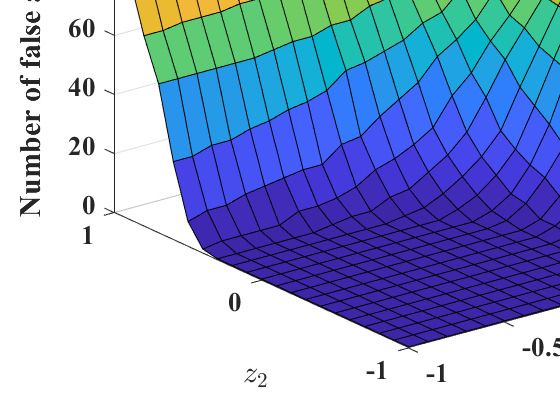
are determined. The result is shown in Figure 12a. In addition, by doing the simulation
with the designed GS, we count the number of false alarms, see Figure 12b. It is observed
that the number of false alarms is roughly proportional to the norm of sampler weights,
and this explains why GS2 is less sensitive to measurement noise.
(a) Norm of sampler weight w. (b) Number of false alarms.
Figure 12. Effect of the location of desired zeros on the size of sampler weight and the number of false alarms.
6. Conclusions
In this paper, we study the security problem on wind turbines that are controlled
and monitored through the communication network. It is shown that at the rated power
point, the linearized discrete-time model of the wind turbine has an unstable zero for a
range of sampling periods, which means that wind turbines that are digitally controlled are
vulnerable to zero-dynamics attacks. In order to increase security against ZDA, two coun-
termeasures based on generalized hold and generalized sampler have been proposed with
detailed design procedures, and through numerical simulations, it is shown that these
approaches make ZDA ineffective. Practical issues such as nonlinearities and measurement
noise are discussed in detail.
We are currently working on a robust and optimal design of the proposed strate-
gies, which are challenging research topics. Validation of the proposed approaches using
more realistic models or software and simultaneous design of two components are also
interesting future research topics.
Author Contributions: Idea development and analysis, D.K. and K.R.; writing—original draft,
D.K. and K.R.; supervision, J.B. All authors have read and agreed to the published version of
the manuscript.
Funding: This work was supported by the Korea Institute of Energy Technology Evaluation and
Planning(KETEP) grant funded by the Korea government (MOTIE) (20204030200010, Graduate Track
for Core Technologies of Wind Power System Engineering) and the Research Grant of Kwangwoon
University in 2019.
Institutional Review Board Statement: Not applicable.
Informed Consent Statement: Not applicable.
Data Availability Statement: Not applicable.
Conflicts of Interest: The authors declare no conflict of interest.Appl. Sci. 2021, 11, 1257 19 of 20
References
1. International Renewable Energy Association. Future of Wind: Deployment, Investment, Technology, Grid Integration and Socio-Economic
Aspects (A Global Energy Transformation Paper); International Renewable Energy Agency: Abu Dhabi, United Arab Emirates, 2017.
2. Lee, R.M.; Assante, M.J.; Conway, T. German steel mill cyber attack. Ind. Control. Syst. 2014, 30, 62.
3. Kesler, B. The vulnerability of nuclear facilities to cyber attack. Strateg. Insights 2011, 10, 15–25.
4. Alert, I.C. Cyber-Attack against Ukrainian Critical Infrastructure; Tech. Rep. ICS Alert (IR-ALERT-H-16-056-01); Cybersecurity
Infrastruct. Secur. Agency: Washington, DC, USA, 2016.
5. Cárdenas, A.A.; Amin, S.; Lin, Z.S.; Huang, Y.L.; Huang, C.Y.; Sastry, S. Attacks Against Process Control Systems: Risk Assessment,
Detection, and Response. In Proceedings of the 6th ACM Symposium on Information, Computer and Communications Security
(ASIACCS ’11), Hong Kong, China, 22–24 March 2011; pp. 355–366.
6. Sridhar, S.; Manimaran, G. Data integrity attacks and their impacts on SCADA control system. In Proceedings of the IEEE PES
General Meeting, Providence, RI, USA , 25–29 July 2010; pp. 1–6. [CrossRef]
7. Teixeira, A.; Shames, I.; Sandberg, H.; Johansson, K.H. Revealing stealthy attacks in control systems. In Proceedings of the 2012
50th Annual Allerton Conference on Communication, Control, and Computing (Allerton), Monticello, IL, USA, 1–5 October 2012;
pp. 1806–1813.
8. Teixeira, A.; Shames, I.; Sandberg, H.; Johansson, K.H. A secure control framework for resource-limited adversaries. Automatica
2015, 51, 135—148. [CrossRef]
9. Ding, D.; Han, Q.L.; Ge, X.; Wang, J. Secure state estimation and control of cyber-physical systems: A survey. IEEE Trans. Syst.
Man Cybern. Syst. 2020, 51, 176–190. [CrossRef]
10. Mahmoud, M.S.; Hamdan, M.M.; Baroudi, U.A. Modeling and control of cyber-physical systems subject to cyber attacks: a survey
of recent advances and challenges. Neurocomputing 2019, 338, 101–115. [CrossRef]
11. Giraldo, J.; Urbina, D.; Cardenas, A.; Valente, J.; Faisal, M.; Ruths, J.; Tippenhauer, N.O.; Sandberg, H.; Candell, R. A survey of
physics-based attack detection in cyber-physical systems. ACM Comput. Surv. (CSUR) 2018, 51, 1–36. [CrossRef]
12. Wood, A.D.; Stankovic, J.A. Denial of service in sensor networks. Computer 2002, 35, 54–62. [CrossRef]
13. Mallikarjunan, K.N.; Muthupriya, K.; Shalinie, S.M. A survey of distributed denial of service attack. In Proceedings of the 2016
10th International Conference on Intelligent Systems and Control (ISCO), Coimbatore, India, 7-8 January 2016; pp. 1–6.
14. Agarwal, M.; Purwar, S.; Biswas, S.; Nandi, S. Intrusion detection system for PS-Poll DoS attack in 802.11 networks using real
time discrete event system. IEEE/CAA J. Autom. Sin. 2016, 4, 792–808. [CrossRef]
15. Li, X.; Wang, Q.; Dai, H.N.; Wang, H. A novel friendly jamming scheme in industrial crowdsensing networks against eavesdrop-
ping attack. Sensors 2018, 18, 1938. [CrossRef]
16. Malladi, S.; Alves-Foss, J.; Heckendorn, R.B. On Preventing Replay Attacks on Security Protocols; Technical Report; Idaho University
Moscow Department of Computer Science: Moscow, Idaho, 2002.
17. Schellenberger, C.; Zhang, P. Detection of covert attacks on cyber-physical systems by extending the system dynamics with an
auxiliary system. In Proceedings of the 2017 IEEE 56th Annual Conference on Decision and Control (CDC), Melbourne, Australia,
12–15 December 2017; pp. 1374–1379. [CrossRef]
18. Park, G.; Shim, H.; Lee, C.; Eun, Y.; Johansson, K.H. When adversary encounters uncertain cyber-physical systems: Robust
zero-dynamics attack with disclosure resources. In Proceedings of the 2016 IEEE 55th Conference on Decision and Control (CDC),
Las Vegas, NV, USA, 12–14 December 2016; pp. 5085–5090.
19. Jeon, H.; Eun, Y. A Stealthy Sensor Attack for Uncertain Cyber-Physical Systems. IEEE Internet Things J. 2019, 6, 6345–6352.
[CrossRef]
20. Yuz, J.I.; Goodwin, G.C. Sampled-Data Models for Linear and Nonlinear Systems; Springer: London, UK, 2014.
21. Hoehn, A.; Zhang, P. Detection of covert attacks and zero dynamics attacks in cyber-physical systems. In Proceedings of the 2016
American Control Conference (ACC), Boston, MA, USA, 6–8 July 2016; pp. 302–307.
22. Naghnaeian, M.; Hirzallah, N.; Voulgaris, P.G. Dual rate control for security in cyber-physical systems. In Proceedings of the 2015
54th IEEE Conference on Decision and Control (CDC), Osaka, Japan, 15–18 December 2015; pp. 1415–1420. [CrossRef]
23. Kim, J.; Back, J.; Park, G.; Lee, C.; Shim, H.; Voulgaris, P.G. Neutralizing zero dynamics attack on sampled-data systems via
generalized holds. Automatica 2020, 113, 108778. [CrossRef]
24. Kim, D.; Ryu, K.; Back, J. Security Enhancement of Sampled-Data Systems: Zero Assignment via Generalized Sampler. In Pro-
ceedings of the 21st IFAC World Congress 2020, Berlin, Germany, 12–17 July 2020.
25. Naghnaeian, M.; Hirzallah, N.; Voulgaris, P.G. Security via multirate control in cyber–physical systems. Syst. Control. Lett. 2019,
124, 12—18. [CrossRef]
26. Mao, Y.; Jafarnejadsani, H.; Zhao, P.; Akyol, E.; Hovakimyan, N. Novel stealthy attack and defense strategies for networked
control systems. IEEE Trans. Autom. Control. 2020, 65, 3847-3862 [CrossRef]
27. Gallo, A.J.; Turan, M.S.; Boem, F.; Parisini, T.; Ferrari-Trecate, G. A distributed cyber-attack detection scheme with application to
DC microgrids. IEEE Trans. Autom. Control. 2020, 65, 3800–3815. [CrossRef]
28. Singh, M.; Santoso, S. Dynamic Models for Wind Turbines and Wind Power Plants; Technical Report; National Renewable Energy
Laboratory (NREL): Golden, CO, USA, 2011.
29. Lubosny, Z.; Lubosny, Z. Wind Turbine Operation in Electric Power Systems: Advanced Modeling; Springer: Berlin/Heidelberg,
Germany, 2003.Appl. Sci. 2021, 11, 1257 20 of 20
30. Bianchi, F.D.; De Battista, H.; Mantz, R.J. Wind Turbine Control Systems: Principles, Modelling and Gain Scheduling Design; Springer
Science & Business Media: Berlin/Heidelberg, Germany, 2006.
31. Georg, S.; Schulte, H.; Aschemann, H. Control-oriented modelling of wind turbines using a Takagi-Sugeno model structure.
In Proceedings of the 2012 IEEE International Conference on Fuzzy Systems, Brisbane, Australia, 10–15 June 2012; pp. 1–8.
32. Simani, S. Overview of modelling and advanced control strategies for wind turbine systems. Energies 2015, 8, 13395–13418.
[CrossRef]
33. Ansoategui, I.; Zulueta, E.; Fernandez-Gamiz, U.; Lopez-Guede, J.M. Mechatronic Modeling and Frequency Analysis of the Drive
Train of a Horizontal Wind Turbine. Energies 2019, 12, 613. [CrossRef]
34. Novak, P. On the Modelling and Partial-Load Control of Variable-Speed Wind Turbines; Technical Report; Chalmers University of
Technology, Göteborg, Sweden, August 1995.
35. Kim, K.H.; Van, T.L.; Lee, D.C.; Song, S.H.; Kim, E.H. Maximum output power tracking control in variable-speed wind turbine
systems considering rotor inertial power. IEEE Trans. Ind. Electron. 2012, 60, 3207–3217.
36. Manyonge, A.W.; Ochieng, R.; Onyango, F.; Shichikha, J. Mathematical modelling of wind turbine in a wind energy conversion
system: Power coefficient analysis. Appl. Math. Sci. 2012, 6, 4527–4536.
37. Dai, J.; Hu, Y.; Liu, D.; Wei, J. Modelling and analysis of direct-driven permanent magnet synchronous generator wind turbine
based on wind-rotor neural network model. Proc. Inst. Mech. Eng. Part A J. Power Energy 2012, 226, 62–72. [CrossRef]
38. Available online: https://www.argolabe.es/100kw-windturbine.html (accessed on 28 January 2021).
39. Maldonado-Correa, J.; Martín-Martínez, S.; Artigao, E.; Gómez-Lázaro, E. Using SCADA Data for Wind Turbine Condition
Monitoring: A Systematic Literature Review. Energies 2020, 13, 3132. [CrossRef]
40. Pandit, R.; Infield, D. Gaussian process operational curves for wind turbine condition monitoring. Energies 2018, 11, 1631.
[CrossRef]
41. Yang, W.; Court, R.; Jiang, J. Wind turbine condition monitoring by the approach of SCADA data analysis. Renew. Energy 2013,
53, 365–376. [CrossRef]
42. Sun, P.; Li, J.; Wang, C.; Lei, X. A generalized model for wind turbine anomaly identification based on SCADA data. Appl. Energy
2016, 168, 550–567. [CrossRef]
43. Zaher, A.; McArthur, S.; Infield, D.; Patel, Y. Online wind turbine fault detection through automated SCADA data analysis. Wind.
Energy Int. J. Prog. Appl. Wind. Power Convers. Technol. 2009, 12, 574–593. [CrossRef]
44. Qiu, Y.; Feng, Y.; Tavner, P.; Richardson, P.; Erdos, G.; Chen, B. Wind turbine SCADA alarm analysis for improving reliability.
Wind Energy 2012, 15, 951–966.
45. Tautz-Weinert, J.; Watson, S.J. Using SCADA data for wind turbine condition monitoring—A review. IET Renew. Power Gener.
2016, 11, 382–394. [CrossRef]
46. Smith, R.S. Covert misappropriation of networked control systems: Presenting a feedback structure. IEEE Control. Syst. Mag.
2015, 35, 82–92.
47. Mo, Y.; Weerakkody, S.; Sinopoli, B. Physical authentication of control systems: Designing watermarked control inputs to detect
counterfeit sensor outputs. IEEE Control. Syst. Mag. 2015, 35, 93–109.
48. Canaan, B.; Colicchio, B.; Ould Abdeslam, D. Microgrid Cyber-Security: Review and Challenges toward Resilience. Appl. Sci.
2020, 10, 5649. [CrossRef]
49. Pasqualetti, F.; Dörfler, F.; Bullo, F. Attack detection and identification in cyber-physical systems. IEEE Trans. Autom. Control. 2013,
58, 2715–2729. [CrossRef]
50. Teixeira, A.; Dán, G.; Sandberg, H.; Johansson, K.H. A cyber security study of a SCADA energy management system: Stealthy
deception attacks on the state estimator. IFAC Proc. Vol. 2011, 44, 11271–11277. [CrossRef]
51. Park, G.; Lee, C.; Shim, H.; Eun, Y.; Johansson, K.H. Stealthy adversaries against uncertain cyber-physical systems: Threat of
robust zero-dynamics attack. IEEE Trans. Autom. Control. 2019, 64, 4907–4919. [CrossRef]
52. Teixeira, A.; Pérez, D.; Sandberg, H.; Johansson, K.H. Attack models and scenarios for networked control systems. In Proceedings
of the 1st International Conference on High Confidence Networked Systems, Beijing, China, 17–18 April 2012; pp. 55–64.
53. Khalil, H.K. Nonlinear Systems, 3rd ed.; Prentice-Hall: Upper Saddle River, NJ, USA, 2002.
54. Chen, C.T. Linear System Theory and Design, 4th ed.; Oxford University Press: New York, NY, USA, 2013.You can also read


