Aborichthys uniobarensis, a new species of river loach Cypriniformes
←
→
Page content transcription
If your browser does not render page correctly, please read the page content below
Asian Journal of Conservation Biology, July 2021. Vol. 10 No. 1, pp. 3-9                    AJCB: FP0148/63277
ISSN 2278-7666 ©TCRP Foundation 2021                                     https://doi.org/10.53562/ajcb.ASHI9566

Research Article

  Aborichthys uniobarensis, a new species of river loach (Cypriniformes:
             Nemacheilidae) from Arunachal Pradesh, India
            Prasanta Nanda1, Krima Queen Machahary2, Lakpa Tamang2*, Debangshu Narayan Das2
           1
            Department of Zoology, Dera Natung Govt College, Itanagar, Arunachal Pradesh-791 113,India
      2
        Department of Zoology, Rajiv Gandhi University, Rono Hills, Doimukh, Arunachal Pradesh-791112, India

     (Received: July 14, 2020; Revised: January 27 , 2021; Accepted: March 10, 2021; Published: March 17, 2021)

                                                      ABSTRACT
   A new species of nemacheilid loach, Aborichthys uniobarensis, is described from the Senkhi stream, upper
   Brahmaputra basin in Arunachal Pradesh, northeastern India. Aborichthys uniobarensis is distinguished from all
   congeners by the presence of 6–14 fused oblique bars along the dorso-lateral margin of the body, 21–28 oblique
   bars along the flank, vent closer to the snout tip than to the caudal fin base and caudal fin oval shaped with upper
   half more extended than lower.
   Key words: Cypriniformes, Eastern Himalaya, Brahmaputra River, Northeastern, India.

INTRODUCTION                                                      MATERIALS AND METHODS
The nemacheilid genus Aborichthys Chaudhuri 1913                  Sampling of fishes was done using cast net with 2 m
inhabit moderate to fast flowing rivers, streams and hill         diameter and 7 mm meshes. Collected fishes were
drainage comprises gravelly bed (Hora, 1925) and its              freshly fixed in 10% formaldehyde in the beginning and
distributional range is confined to Ganga-Brahmaputra             then preserved in 70% ethanol. Counts and measure-
drainage of northeastern India, Bhutan and Putao in               ments were made point - to- point with a digital caliper
Myanmar (Kosygin et al., 2019; Shangningam et al.,                on the left side of the specimens to the nearest 0.1 mm.
2019). They are characterized in having an elongate and           Counts and measurements follow Kottelat (1990) or self
slender body almost of parallel profiles from occiput to          -explanatory. Dorsal and lateral head lengths and
caudal-fin base, paired fins horizontally placed; dorsal          measurements of body parts are given as proportions of
fin situated slightly behind pelvic fins; vent situated           standard length (SL). Sub-units of the head are
close behind pelvic girdle; pelvic fins extending beyond          expressed as proportions of lateral head length (HL).
the vent; more or less rounded to emarginated caudal              Fin rays, cephalic lateralis sensory pores and scales
fin, with brown to back concentric rings; two black
                                                                  were counted under a stereoscopic stereo-zoom micro-
ocellus– one at the upper extremity of basicaudal bar
                                                                  scope Magnus MS 24. Asterisk mark (*) after meristic
and another at the dorsal-fin origin; all fins considerably
                                                                  value indicate holotype value.
separated; flank consisting of oblique bars directed
                                                                            The holotype is deposited in Estuarine
dorsad to ventrad (Hora, 1921, 1925; Chaudhuri, 1913;
Kottelat, 1990) and usually presence of dorsal and                Biology Regional Centre (EBRC), Zoological Survey of
ventral adipose crests (Shangningam et al., 2019).                India (ZSI), Gopalpur, Orissa, India and paratypes in
          In addition to two recently described species by        the Museum of Dera Natung Govt. College (DNGC),
Shangningam et al. (2019), the number of species raised           Itanagar, Arunachal Pradesh.
to eleven viz. A. kempi Chaudhuri, 1913, A. elongatus
Hora, 1921, A. garoensis Hora, 1921, A. tikaderi                  TAXONOMY
Barman, 1984, A. waikhomi Kosygin, 2012, Aborichthys              Aborichthys uniobarensis sp. nov.
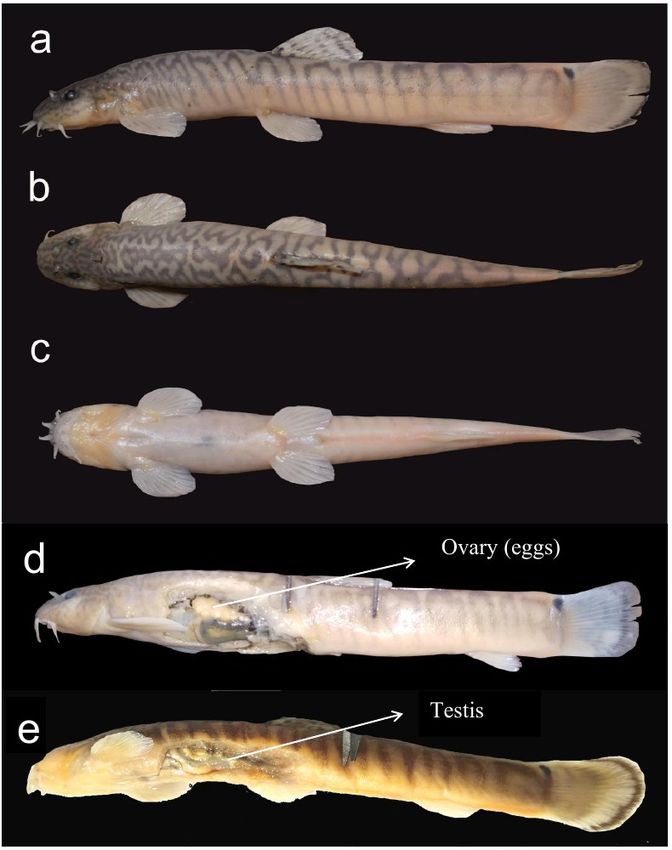
cataracta Arunachalam et al., 2014 and A. verticauda              (Figure 1a-e)
Arunachalam et al., 2014, A. kailashi Shangningam et
al. 2019, A. pangensis Shangningam et al. 2019, A.                Holotype: EBRC/ZSI/F 12607, male, 83.9 mm SL;
iphipaniensis Kosygin et al., 2019 and A. boutanensis             Senkhi stream, near Police Colony, Vivek Vihar, Itana-
(Griffith and McClelland 1842).                                   gar (27°4'N, 93°35'E), 218 m asl, upper Brahmaputra
          During a recent ichthyological survey in the            River basin, Papum pare District, Arunachal Pradesh;
Senkhi stream, specimens of Aborichthys were obtained.            India, Tamang & Nanda. 15 December, 2019.
Further detailed study revealed that they represent an
                                                                  Paratypes: DNGC F 05, 9 (5 males and 4 females),
undescribed species, which is herein described as
                                                                  51.0–82.5 mm SL, same data as holotype.
Aborichthys uniobarensis, new species.

*Corresponding Author’s E-mail: lakpatamang@rediffmail.com
                                                              3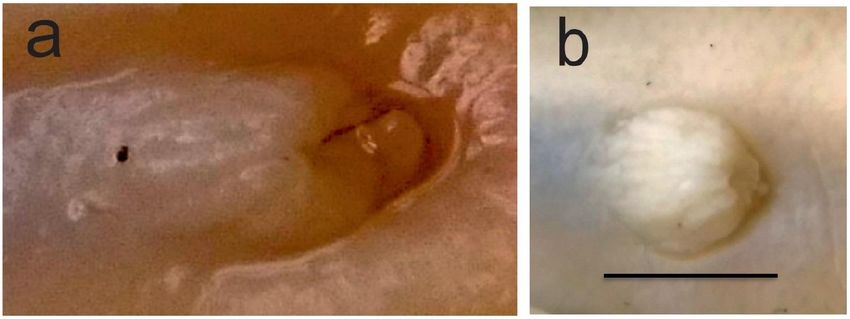
Nanda et al.

 Figure 1. Aborichthys uniobarensis sp. nov., EBRC/ZSI/F 12607, holotype (male), 83.9 mm; a, lateral, b, dorsal,
 and c, ventral views; d, DNGC 05, paratype (female), 75.0 mm SL; e, DNGC 05, paratype (male), 82.5 mm SL.

Diagnosis                                                       caudal fin oval shaped with upper half more extended
Aborichthys uniobarensis is diagnosed from all                  than lower, and comprised of two concentric black to
congeners by the presence of 6–14 fused oblique bars            light brown bars in male.
along the dorso-lateral margin of the body (vs. rarely
fused). Further, it chiefly differs from all congeners by       Description
the following combination of characters: 21–28 oblique          For general appearance see Figure 1. Morphometric data
bars on the body, dorsal and ventral adipose crests low,        are presented in Table 1. Body elongated and slender,
vent closer to the snout tip than to the caudal-fn base,        body between pectoral fin and posterior tip of dorsal fin

                                                                                   AJCB Vol. 10 No. 1, pp. 3–9, 2021
                                                            4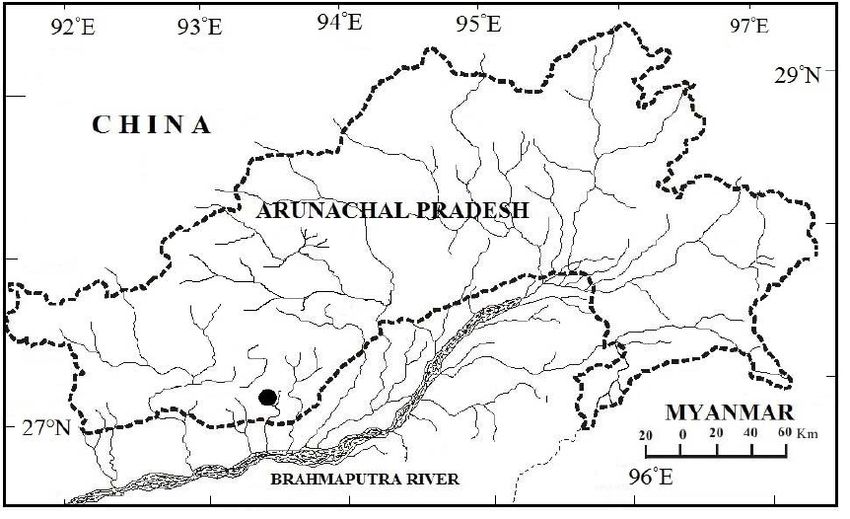
A new species of river loach from Arunachal Pradesh

Table 1. Morphometric data of Aborichthys uniobarensis, sp. nov

                                                       Holotype            Range                Mean±SD
Standard length (mm)                                   83.9                51–83.9              69.7±10.4
% Standard Length
Lateral head length                                    17.9                16.7–21.6            18.4±1.5
Dorsal head length                                     14.3                13.1–17.1            15.1±1.4
Head width (max)                                       12.2                12.1–14.4            13.1±0.8
Head depth at nape                                     8.3                 8.2–10.8             9.4±0.9
Body depth at dorsal-fin origin                        11.2                9.7–13.5             11.7±1.0
Body width at dorsal-fin origin                        9.8                 9.7–11.8             10.6±0.8
Predorsal length                                       45.3                45.3–52.0            47.7±2.0
Prepectoral length                                     16.7                16.4–19.7            17.5±1.2
Prepelvic length                                       41.7                41.7–49.2            45.6±2.5
Preanal length                                         73.9                67.2–81.3            75.7±4.2
Pectoral-fin length                                    13.0                13.0–18.4            15.4±2.0
Dorsal-fin length                                      13.6                13.1–17.1            14.9±1.3
Dorsal-fin base length                                 10.1                6.8–11.5             9.3±1.4
Pelvic-fin length                                      12.6                12.4–15.9            14.1±1.4
Pelvic-fin base length                                 3.0                 2.7–39               3.2±0.3
Anal-fin length                                        12.5                10.8–15.0            13.3±1.4
Anal-fin base length                                   6.0                 2.7–7.8              5.6±1.3
Caudal-fin length                                      16.7                16.0–20.0            17.9±1.4
Caudal peduncle length                                 20.0                15.4–20.5            18.5±1.8
Caudal peduncle depth                                  10.1                8.6–11.8             10.1±0.8
Pectoral to pelvic-fin origin                          25.3                25.3–33.8            28.8±2.4
Pectoral to anal-fin origin                            57.8                56.8–79.9            61.8±6.7
Pelvic origin to anal-fin origin                       30.4                28.6–34.7            30.7±1.6
Pectoral-fin origin to vent                            36.5                36.5–44.5            40.1±2.4
Pelvic-fin origin to vent                              11.3                9.5–12.0             11.0±0.8
Vent to anal-fin origin                                20.5                17.1–22.8            19.5±1.6
Snout tip to vent                                      52.4                52.4–59.9            56.1±2.7
Vent to caudal-fin base                                46.5                41.3–46.5            43.7±1.8
Anal-fin origin to caudal-fin base                     26.3                17.6–26.8            24.6±2.6
Tip of anal-fin to caudal-fin base                     13.2                6.7–14.4             11.2±2.3
% Pelvic to anal-fin origin
Vent to anal-fin origin                                67.5                60.0–67.5            63.3±2.8
Vent to pelvic-fin origin                              37.3                30.9–38.9            35.9±2.4
% Lateral head length
Head depth                                             46.7                45.5–57.4            51.4±4.4
Upper jaw length                                       26.7                24.6–32.8            28.6±2.7
Lower jaw length                                       20.0                17.8–24.6            21.7±2.3
Snout length                                           42.0                34.7–53.1            42.5±5.7
Prenasal length                                        23.3                18.2–32.0            26.2±3.8
Eye diameter                                           14.0                10.2–19.7            14.3±3.0
Inter-orbital width                                    26.7                25.0–33.3            29.3±2.9
Inter-narial width                                     16.7                16.2–22.7            17.6±2.1
Head width (max)                                       68.0                63.6–75.4            71.4±3.8
Mouth width                                            40.0                29.7–40.0            36.3±3.2
Head depth at nostril                                  31.3                28.2–40.0            33.4±3.6
Head depth at pupil                                    40.0                36.4–49.2            43.4±3.8
Medial rostral barbel length                           18.7                18.7–25.4            22.5±2.6
Lateral rostral barbel length                          20.0                16.8–24.6            21.0±2.6
Maxillary barbel length                                19.3                15.0–23.1            18.5±2.7
Caudal peduncle length/caudal peduncle depth           2.0                 1.4–2.3              1.8±0.3
% Caudal peduncle length
Caudal peduncle depth                                  50.6                44.4–70.0            55.5±8.6

                                                                             AJCB Vol. 10 No. 1, pp. 3–9, 2021
                                                       5
Nanda et al.
Figure 2. cephalic lateralis sensory pores: a–b, EBRC/ZSI/F 12607, holotype, male, 83.9 mm SL showing sensory pores.
cylindrical in cross section and thereafter compressed each in front of nares (Figure 2b). Other pores could not
posteriorly. Dorsal profile evenly rising from snout tip to be examined because of indistinctiveness.
occiput, then horizontal up to point at vertical through tip Dorsal fin with 2 simple and 7½ branched rays,
of anal fin, thereafter, very gently raising upto caudal fin last two rays originating from the same pterygiophore,
base and confluent with caudal fin. Ventral profile inserted slightly posterior to pelvic-fin origin and at verti-
almost horizontal to anal-fin origin, then gently rising up cal almost mid of pectoral and anal-fin origins, nearer to
to its posterior end, thereafter, again very gently raising snout tip (45.3–52.0 % SL) than to caudal-fin base (50.7–
and confluent with caudal fin, dorsal and ventral adipose 54.7 % SL). Pectoral fin oval-shaped, horizontally
crest significantly low (Figure 1d) and negligible in placed, with 1 unbranched ray, 9(3), 10*(7) branched
young specimens. rays, tip extending to middle between pectoral- and
Head triangular when viewed dorsally and pelvic-fin origin or sometime slightly exceeding. Pelvic
depressed, length 4.6–6.0 times its standard length, width fin oval shaped, horizontally placed, with 1 unbranched
greater than height, length slightly shorter than caudal fin ray and 7*(8) or 8 (2) branched rays, tip surpassing
in one paratype, almost equal in other 6 male and 3 fe- beyond vent, situated at vertical slightly anterior to dorsal
male paratypes, but longer than all other fins, lateral -fin origin, origin closer to pectoral-fin origin than
head length longer than dorsal, dorsal profile evenly anal-fin origin in 6 specimens and in the middle in 4
slope, and ventral flattened. Snout obtusely pointed in specimens. Pelvic-fin base with a small fleshy axillary
dorsal view. Eyes moderate to large 10.2–19.7 % HL, lobe. Anal fin elongate, with 2 unbranched and 5½
dorsally situated, closer to tip of snout than to posterior branched rays, last two rays originating from the same
extremity of opercle, not visible from ventral. Nostril pterygiophore, anterior margin slightly convex, posterior
closer to eye than to tip of snout, nares separated by tri- and distal margin straight, its tip separated by a distance
angular membrane flap dividing it into two parts; anteri- of 6.7–14.4 %SL from caudal-fin base, distance wider in
or nare tubular, attached with membrane flap, membrane male and closer in female. Caudal fin with 1 unbranched
flap raised up and slightly twisted, posterior nare roughly ray each on upper and lower end and 16*(7), 17 (1) or 15
oval shaped, and anteriorly pointed. (2) branched rays, all rays segmented, upper procurrent
Barbels three pairs: one pair maxillary and two with 6(7), 5(2), 4*(1) rays and lower with 3*(5) and 4(5)
pairs rostral, mostly longer than eye. Inner rostral barbel rays, rays indistinct and fleshy. Caudal peduncle 1.4–2.3
reaching posterior margin of knob of lower lip, but not times of its depth. Vent situated very closer to pelvic-fin
reaching base of maxillary barbel, whereas outer rostral origin than anal-fin origin, and closer to caudal-fin than
barbel reaching maxillary barbel base, maxillary barbel to snout tip.
at vertical reaching to middle of eye or slightly exceed,
but do not reaching to posterior margin. Color in preservative
Body embedded with minute cycloid scales, In 70 % ethanol, body background beige, flank with 21–
absent on ventral surface between isthmus and level of 28 thin to moderate oblique brown bars, of which 6–14
posterior end of pectoral-fin base, scales indistinct and paired bars fused along dorso-lateral margin of body;
deeply embedded on abdominal region. Lateral line com- rarely 1–3 bars single, interspaces wider than bars, 3–4
plete with 34–65 pores, of these 18–32 pores closely set, anterior bars irregular. Dorsum of body between occiput
externally visible, extending mostly before pelvic-fin and dorsal fin with a median brown stripe consisting
origin, rest 16–33 pores beyond distantly placed. Head creamy blotches or spots along the middle, blotches or
sensory pores: double rows of infraorbital pores, first spots feebly seen in younger specimens. Dorsum of head
row with 10-11 and second row with 9-10 pores, creamy consist of brown elongate, spots and irregular
temporal 4 (Figure 2a); supraorbital 4-5, occipital 5, markings, usually three rows of brown stripes- one in
series of 7-9 small pores surrounding nares, 4-5 small front of nare and two in front of orbit. Cheek creamy
pores anterodorsal to nares, and 2 independent pores with short brown irregular marks and spots; operculum
AJCB Vol. 10 No. 1, pp. 3–9, 2021
6A new species of river loach from Arunachal Pradesh
Figure 3. a, Aborichthys uniobarensis sp. nov., EBRC/ZSI/F 12607, holotype (male), 83.9 mm, showing elongate
anus and large urogenital papilla; b, DNGC 05, paratype (female), 70.0 mm SL, showing rounded anus and small
urogenital papilla (bar = 2 mm).
Figure 4. Map of Arunachal Pradesh showing type locality of Aborichthys uniobarensis, Senkhi stream at
Police Colony, Itanagar.
region mostly with irregular brown marks.Ventral region (Figure 1d & e). Anal fin tip is distantly separated from
of head yellowish to cream; chest to caudal base creamy, caudal base in males, whereas separated closely in
with a light orange longitudinal mid line between anus females. Males have elongated anus and large conical
and anal-fin origin, but absent in three female specimens. urogenital papilla, whereas females have rounded and
Inter-radial membranes of dorsal, pectoral, pelvic and small conical urogenital papilla (Figure 3a & b).
anal fins hyaline and radial with thin melanophores. Moreover, being a longer body in male, pelvic fin and
Dorsal fin with 3–5 rows of brown spots and one dark pectoral-fin origins closer than anal-fin origin, whereas
brown ocellus at its base. Pectoral and pelvic fins dorsal- equidistant or slightly closer to anal-fin origin than
ly plain. Caudal fin with two concentric bars in male– pectoral-fin origin in female.
subdistal bar black, inner bar light brown appear as broad
oval patch, whereas 3–4 light brown bars in female, rest Distribution and habitat: Presently, Aborichthys
hyaline to light brown (Figure 1a & d). In live, caudal uniobarensis is known from Senkhi stream, near Police
peduncle and fin pinkish. colony, Vivek Vihar, Itanagar, Papum pare District,
Sexual dimorphism: Males exhibit longer body Arunachal Pradesh (Figure 4). We expect its distribution
with dark pinkish caudal fin and peduncle region, where- in other surrounding drainages about a radius of 30 km. It
as short body with light pinkish in females. In males, the flows southwest from Senkhi Valley up to Dera Natung
caudal fin is slightly rounded with two black to light Govt College and then turns eastward, which eventually
brown concentric rings, while truncate to obliquely trun- falls in Pare River after covering about 30 km just before
cated caudal fin with 3–4 narrow light brown bars RCC bridge at Doimukh, which connect to Dikrong
AJCB Vol. 10 No. 1, pp. 3–9, 2021
7Nanda et al.
River. Further, Dikrong River eventually confluence caudal peduncle depth (8.6–11.8% SL vs. 12.7–13.7);
with Brahmaputra River in Assam. River bed comprised from A. iphipaniensis in having more vertical bars along
of various sizes of stones-mostly medium sized boulders, the body (21–28 vs. 33–35), a greater predorsal (45.3–
and mixture of pebbles, cobbles, sands and large 52.0 % SL. vs. 42.4–44.4), shorter caudal peduncle (15.4
boulders. The water in the stream was cool, clear and –20.5 % SL vs. 21.5–23.3), shorter vent to caudal base
moderate to fast flowing. Riparian vegetation in the type distance (41.3–46.3 % SL vs. 52.0–56.2), and longer
locality mostly replaced by human settlement in the left distance between snout tip and vent (52.4–59.9% SL vs.
and right side comprises of grasses, shrubs and small 44.2−48.3).
trees, over steep hill slope. Other associated fish collect- Further, it differs from other congeners except
ed were, Cyprinidae: Opsarius bendelisis, Opsarius A. boutanensis and A. kempi in having a fewer oblique
barna, Raiamas bola, Devario aequipinnatus, Tor bars along the body (21–28 vs. 31–33 in A. elongatus; 32
putitora, Garra birostris, Garra annandalei, Neo- –35 in A. cataracta; 30–35 in A. verticauda; 28–36 in
lissochilus hexagonolepis, Chagunius chagunio; A. kailashi; and 34–38 in A. pangensis), and more (21–28
Psilorhynchidae: Psilorhynchus balitora; Nemacheilidae: vs. 12–16 in A. waikhomi). Among congeners,
Schistura sp., Sisoridae: Pseudolaguvia sp, Glyptothorax Aborichthys uniobarensis shares with A. kempi, A.
sp. iphipaniensis and A. kailashi in having oval-shaped cau-
dal fin, of which upper half is considerably more extend-
Etymology: The species name is from the Latin unio
ing than lower half, causing an oblique distal margin with
means ‘fuse or meet‘, and barensis refer to vertical
two concentric rings. However, Aborichthys uniobarensis
oblique bars along the body, in allusion to most of the
is further: distinguished from A. kempi in having lower
paired bars dorsally fused. A noun in apposition.
and shorter (vs. higher and longer) dorsal adipose crests
in male, from A. kailashi in having the mouth moderately
DISCUSSION (vs. widely) arched, oblique bars on body widely (vs.
Until now, eleven species of Aborichthys are known to narrowly) interspaced; dorsal and ventral adipose crests
occur throughout eastern Himalaya region, viz., on caudal peduncle lower, short and thick (vs. higher,
A. boutanensis, A. kempi, A. elongatus, A. garoensis, longer and thin), a deeper body (9.7–13.5 % SL vs.
A. tikaderi, A. cataracta, A. verticauda, A. waikhomi, 7.5–9.2), a longer caudal- (16.0–20.0 % SL vs. 14.0–
A. iphipaniensis, A. kailashi, and A. pangensis (Kosygin 15.2), pectoral- (13.0–18.4 % SL vs. 10.7–13.4) and
et al., 2019; Shangningam et al., 2019). Aborichthys pelvic fins (12.4–15.9 % SL vs. 10.9–12.4), and a larger
uniobarensis is distinguished from all congeners in eye (10.2–19.7 % SL vs. 8–10). Aborichthys uniobaren-
having the most of the paired oblique bars fused along sis differs from A. boutanensis in having lower (vs.
the dorso-lateral margin of the body (vs. rarely fused in higher) dorsal and ventral adipose crests on caudal
other congeners). Aborichthys uniobarensis is character- peduncle (compare Figure1a with Thoni & Hart, 2015;
ized in having position of the vent closer to the snout tip Figure 1 a, holotype BMNH1860.3.14.775, 104.7 mm
than to the caudal-fin base as similar to A. garoensis, A. SL), and fewer branched pectoral-fin rays (9–10 vs. 12).
tikaderi and A. iphipaniensis. As per the sketch diagram Aborichthys uniobarensis can be further distin-
of Aborichthys garoensis (text Figure 1) illustrated by guished from A. elongatus, A. waikhomi, A. verticauda,
Hora (1921) the patterns of vertical bars on body and an and A. pangensis in having caudal fin oval shaped, with
elongate anus shares with A. uniobarensis. However, the slight dorso-ventrally directed oblique distal margin (vs.
number of bars beyond dorsal fin tip is about 14, where- circularly rounded in A. elongatus; truncated in
as mostly 9–10 (8) and rarely 12 (2) in case of A. A. waikhomi; A. verticauda and A. pangensis (Figure 1a
uniobarensis. This might have resulted that the number with Kosygin, 2012: Figure 5 a,b,f; Arunachalam et al.,
of bars in A. garoensis is higher 32–33 than A. 2014: Figure 4a; Shangningam et al., 2019: Figure 3 for
uniobarensis 21–28. Further, the type locality of A. pangensis). It further differs from A. elongatus in hav-
A. garoensis is far away (Garo Hills, Assam= Meghala- ing wider interorbital space (25.0–33.3% HL vs. 22.2–
ya) towards south covering a geographical distance of 22.30), longer distance between vent and anal-fin origin
about 512 km which was collected at an altitude of 1200- (17.1–22.8% SL vs. 13.5–14.3), longer distance between
1500 feet, whereas A. uniobarensis were obtained from vent and caudal-fin base (41.3–46.5% SL vs. 38.3–39.1);
an altitude of 720 feet. Further, Aborichthys uniobarensis from A. waikhomi in having shallow body (9.7–13.5%
is distinguished from A. garoensis in having longer SL vs. 12.8–15.8); from A. verticauda in having a greater
prepectoral (16.4–19.7% SL vs. 14.6–16.3); more prepectoral (16.4–19.7% SL vs. 20.0–24.2), distance
forward position of vent (distance between vent and between tip of pectoral- and pelvic fin origins equal (vs.
caudal-fin base 41.3–46.5% SL vs. 47.5–49.2); greater less than) length of pectoral fin; and from A. cataracta in
interorbital space (25.0–33.3% HL vs. 23.3–23.6) and having greater distance between pectoral- and anal-fin
narrower mouth (29.7–40.0% HL vs. 42–46.6); from origins (56.8–79.9% SL vs. 50.3–56.8), fewer (10 vs. 15)
A. tikaderi in having higher number (21– 28 vs. 16–20) oblique bars beyond end of dorsal fin even in large
vertical bars on the body, oval shaped caudal fin with specimen 83.7 mm SL (compare Figure 1a with
upper half more extending than lower (vs. almost Arunachalam et al., 2014; Figure 1a).
circularly rounded in A. tikaderi; Figure 1a with Distinguishing sexual dimorphic characters of
Kosygin, 2012: Figure 5e), a greater prepectoral (16.4– Aborichthys uniobarensis mentioned above is further
19.7% SL vs. 14.9–16.2), pectoral to pelvic fin origin supported by Aborichthys kempi (topotype), RGUMF
(25.3–33.8 vs. 22.6–24.7), pectoral-fin origin to vent 0517, male, 110.0 mm SL and RGUMF 0517, female,
(36.5–44.5 vs. 30.4– 33.1), pelvic fin to vent (9.5– 12.0 74.5 mm SL. Hence, we assume that the individual hav-
vs. 6.6–7.4), snout tip to vent (52.4– 59.9 vs. 45.8– 51.6), ing elongate body and oval shaped caudal fin with two
pectoral to anal fin origin (56.8–79.9 vs. 47.1–50.6) and black to light brown concentric rings are males, whereas
pelvic to anal-fin origin (28.6–34.7 vs. 22.3–28.4), a short body and truncate to slightly rounded with 3–4
shorter caudal fin (16.0–20.0 vs. 20.2–21.2) and lesser cross bars are females.
.
AJCB Vol. 10 No. 1, pp. 3–9, 2021
8A new species of river loach from Arunachal Pradesh
Comparative material REFERENCES
Aborichthys kempi, topotype, 6 specimens, 67.1–110 mm Arunachalam, M., Raja, M., Malaiammal, P. and R.L.
SL, RGUMF 0517, 05.ii.2020, Egar stream between Mayden 2014. New species of Aborichthys
Rottung and Renging village, Arunachal Pradesh, India, (Cypriniformes: Balitoridae) from Arunachal
Coll. O. Ering. Pradesh, India. Species 7: 33–47.
A. waikhomi, paratypes, 3 specimens, 61.0–66.5 Barman, R.P. 1984 . A new cobitid fish of the genus
mm SL, V/APRC/ZSI/P-519, 05.xi.2009, a stream of Aborichthys Chaudhuri (Pisces: Cobitidae) from
Noa-Dihing river near Hornbill camp, Namdapha, Aru- India. Journal of Bombay natural History Socie-
nachal Pradesh, India, Coll. J.K. De & party.Additional ty 81 (3): 680–683.
data from Kosygin, 2012. Chaudhuri, B.L. 1913. Zoological result of the Abor ex-
A. iphipaniensis, paratypes, 3 specimens, 107.5 pedition.1911-1912. XVIII.Fish.Records of the
–120.8 mm SL, ZSI/V/APRC/P-1659, 4.iv.2016, Indian Museum 8: 243–258.
Iphipani River at Roing, Lower Dibang Valley, Brahma- Hora, S.L. 1921. On some new or rare species of fish
putra River basin, Arunachal Pradesh, India, coll. S. De- from the Eastern Himalayas.Records of the Indi-
vi and party. Additional data from Kosygin et al., 2019. an Museum 22(5): 731–744, pl. 1.
A. kailashi, paratypes, 2 specimens, 89-113 mm Hora, S.L. 1925. Notes on fishes in the Indian museum.
SL, ZSI/V/ APRC/P 786, 09.xi. 2013, Pange River at VIII. On the loaches of the genus Aborichthys
Arolenching, Ziro, Lower Subansiri district, Arunachal Chaudhuri. Records of the Indian Museum 27
Pradesh, India, Coll. B. Sinha & party. Additional data (3): 23–236.
from Shangningam et al., 2019. Kosygin, L. 2012. Aborichthyswaikhomi, a new species
A. cataracta, paratype, 1 specimen, 92.6 mm of fish (Teleostei: Nemacheilidae) from Aruna-
SL, ZSI/SRS F 8575, 18.vi.2011, stream joining with chal Pradesh. Records of the Zoological Survey
Ranga River, Hong Village, Lower Subansiri district, of India 112(1): 49–55.
Arunachal Pradesh, India, Coll. M. Arunachalam & par- Kosygin, L., Gurumayum, S.D., Singh, P. and B.R.
ty. Additional data from Arunachalam et al., 2014. Chowdhury 2019. Aborichthys iphipaniensis, a
A. verticauda, paratype, 1 specimen, 65.6 mm new species of loach (Cypriniformes: Nema-
SL, ZSI/SRS F 8579, 17.vi.2011, a tributary of Ranga cheilidae) from Arunachal Pradesh, India. Uttar
River) 7 km away from Hola camp, Lower Subansiri Pradesh Journal of Zoology 39(2): 69–75.
district, Arunachal Pradesh, India, Coll. M. Arunacha- Kottelat, M. 1990. Indochinese nemacheilines, a revision
lam & party. Additional data from Arunachalam et al., of nemacheiline loaches (Pisces: Cypriniformes)
2014. of Thailand, Burma, Laos, Cambodia and south-
Data for A. boutanensis from Thoni & Hart, ern Vietnam.Verlag, Dr. Friedrich Pfiel, Mun-
2015; for A. elongatus, A. tikaderi, A. garoensis from chen, 261 pp.
Arunachalam et al., 2014 and Shangningam et al., 2019 Shangningam, B., Kosygin, L., Sinha, B. and S.D.
and Kosygin et al., 2019; for A. pangenesis from Gurumayum2019.Aborichthyskailashi and A.
Shangningam et al., 2019; for A. cataracta and A. verti- pangensis (Cypriniformes: Nemacheilidae), two
cauda from Arunachalam et al., 2014. new species from Arunachal Pradesh, India.
Ichthyological Exploration of Freshwaters 1–10.
ACKNOWLEDGEMENT https://doi.org/10.23788/IEF-1123
Thoni, R.J., Hart R. 2015. Repatriating a lost name: notes
We are grateful to Dr. N.T. Rikam, Principal, DNGC,
on McClelland and Griffith’s Cobitisboutanen-
Itanagar for providing laboratory facilities. Thanks to
sis (Cypriniformes: Nemacheilidae). Zootaxa
Department of Zoology, RGU, for providing access to
3999 (2): 291–294.
topotype of Aborichthys kempi.
AJCB Vol. 10 No. 1, pp. 3–9, 2021
9You can also read


