Acceptability and Effectiveness of Artificial Intelligence Therapy for Anxiety and Depression (Youper): Longitudinal Observational Study - Journal ...
←
→
Page content transcription
If your browser does not render page correctly, please read the page content below
JOURNAL OF MEDICAL INTERNET RESEARCH                                                                                                       Mehta et al

     Original Paper

     Acceptability and Effectiveness of Artificial Intelligence Therapy
     for Anxiety and Depression (Youper): Longitudinal Observational
     Study

     Ashish Mehta1, BA; Andrea Nicole Niles2, PhD; Jose Hamilton Vargas2, MD; Thiago Marafon2, MSc; Diego Dotta
     Couto2, MSc; James Jonathan Gross1, PhD
     1
      Department of Psychology, Stanford University, Stanford, CA, United States
     2
      Youper, Inc, San Francisco, CA, United States

     Corresponding Author:
     Ashish Mehta, BA
     Department of Psychology, Stanford University
     Building 420
     450 Jane Stanford Way
     Stanford, CA, 94305
     United States
     Phone: 1 650 724 5436
     Email: ashm@stanford.edu

     Abstract
     Background: Youper is a widely used, commercially available mobile app that uses artificial intelligence therapy for the
     treatment of anxiety and depression.
     Objective: Our study examined the acceptability and effectiveness of Youper. Further, we tested the cumulative regulation
     hypothesis, which posits that cumulative emotion regulation successes with repeated intervention engagement will predict
     longer-term anxiety and depression symptom reduction.
     Methods: We examined data from paying Youper users (N=4517) who allowed their data to be used for research. To characterize
     the acceptability of Youper, we asked users to rate the app on a 5-star scale and measured retention statistics for users’ first 4
     weeks of subscription. To examine effectiveness, we examined longitudinal measures of anxiety and depression symptoms. To
     test the cumulative regulation hypothesis, we used the proportion of successful emotion regulation attempts to predict symptom
     reduction.
     Results: Youper users rated the app highly (mean 4.36 stars, SD 0.84), and 42.66% (1927/4517) of users were retained by week
     4. Symptoms decreased in the first 2 weeks of app use (anxiety: d=0.57; depression: d=0.46). Anxiety improvements were
     maintained in the subsequent 2 weeks, but depression symptoms increased slightly with a very small effect size (d=0.05). A
     higher proportion of successful emotion regulation attempts significantly predicted greater anxiety and depression symptom
     reduction.
     Conclusions: Youper is a low-cost, completely self-guided treatment that is accessible to users who may not otherwise access
     mental health care. Our findings demonstrate the acceptability and effectiveness of Youper as a treatment for anxiety and depression
     symptoms and support continued study of Youper in a randomized clinical trial.

     (J Med Internet Res 2021;23(6):e26771) doi: 10.2196/26771

     KEYWORDS
     digital mental health treatment; acceptability; effectiveness; anxiety; depression

                                                                               mental health conditions are anxiety and depression, jointly
     Introduction                                                              termed “emotional disorders,” and these impact 34% and 21%
     Nearly half the people in the United States will have a mental            of people in the United States, respectively [3]. Despite the
     disorder at some point during their life span [1,2], and many             availability of effective treatments for emotional disorders, most
     more will have subthreshold symptoms. The most frequent                   people in need of treatment will not receive it [4]. Researchers

     https://www.jmir.org/2021/6/e26771                                                                 J Med Internet Res 2021 | vol. 23 | iss. 6 | e26771 | p. 1
                                                                                                                      (page number not for citation purposes)
XSL• FO
RenderX
JOURNAL OF MEDICAL INTERNET RESEARCH Mehta et al
have found that both structural (eg, financial, availability) and Administration, and the European Medicines Agency, who have
attitudinal barriers (eg, desire to handle problems independently) called for real-world evidence on interventions [18-20]. This
prevent patients from seeking mental health treatment [5]. Fully call arises from the recognition of external validity shortcomings
automated mental health intervention apps offer the promise of in RCTs due to factors such as inclusion criteria and differences
overcoming these barriers. By obviating the need for a trained in treatment adherence [21-23]
clinician, the cost of treatment can be reduced by orders of
First, RCTs may be composed of different populations than
magnitude and can be delivered to anyone with access to the
those that naturally seek digital mental health treatment.
internet. Moreover, fully automated treatments provide a means
Participants in RCTs are acquired through recruiting efforts and
to treat patients who are uncomfortable seeking help from
are then selected based on specific inclusion criteria. For
another person.
example, participants in RCTs may be required to meet a
One particularly promising type of digital mental health minimum threshold of depression symptoms [10]. In the real
intervention is a mobile app that can be installed on a person’s world, digital mental health treatment (often distributed via
mobile device. The Apple and Google Play stores organize these smartphone app stores) is available to anyone with a smartphone
apps, centralizing the location where interventions can be and users span the range of depression symptomatology levels.
accessed and allowing users to vet apps by reviewing their Thus, the distribution of potential app users may or may not
descriptions in the store and reading user reviews. Once installed match the distribution of participants seen in the small body of
on a person’s phone, the mobile app medium makes it possible existing literature on self-guided digital mental health. Further,
for people to access interventions anytime and anywhere. This it is plausible that participants who enroll in clinical mental
opportunity has not been overlooked. Recent figures tally over health trials are more comfortable with seeking external mental
10,000 mental health apps available to consumers [6]. However, health care than are users that discreetly download an app on
while the options for mental health treatment apps are at an their phone. Since targeting populations who carry stigma
all-time high, there is little research on the acceptability of against seeking mental health care is an important goal and
available app-based treatments and whether they can actually potential advantage of this technology, it is important that the
reduce symptoms of psychopathology. In particular, mobile populations being studied have equivalent attitudes to the
apps that are completely self-guided, and hence maximally population of potential users.
accessible and scalable, are especially understudied. That said,
Second, treatment adherence in RCTs may systematically differ
a significant portion of the literature supports the efficacy of
from real-world app usage because of the different experience
self-guided cognitive behavioral therapy administered via the
that a participant in a clinical trial has compared to a user who
internet, which patients may or may not be able to access on
downloads an app. In clinical trials, participants are often paid
mobile phones depending on the intervention [7,8]. Thus, the
money to participate. Paid participants may feel a social
potential for mobile apps to demonstrate similar efficacy is
obligation to adhere to the treatment plan. However, in real life,
promising. The present study aimed to assess the acceptability
where app-based treatment is a completely individual
and effectiveness of a self-guided intervention app called Youper
experience, it is unclear whether adherence will be equivalent.
that targets emotional disorders.
Moreover, RCTs require, at minimum, an initial contact with
Although few in number, a handful of randomized controlled study coordinators and sometimes additional contacts throughout
trials (RCTs) examining fully self-guided mental health the study. As contact with a treatment provider is known to
intervention apps have shown promise. One mobile cognitive increase adherence, this initial contact could boost levels of
behavioral therapy intervention similar to Youper that employs engagement [24]. Because the degree to which one engages and
a humanlike, chatbot interface found that college students adheres to a treatment is related to treatment success [7], it is
experienced significantly reduced depression symptoms over critical that we supplement evidence gained from RCTs with
the course of 2 weeks [9]. A number of RCTs have demonstrated an understanding of how treatment recipients organically
the efficacy of self-guided mobile treatment programs for experience the app in the real world.
depression, including 1 testing problem-solving therapy and
We define artificial intelligence (AI) therapy as a digital and
cognitive training [10], 3 testing cognitive behavioral therapy
fully automated, mobile, psychological treatment program that
interventions [11-13], and 1 testing acceptance-based therapy
uses a conversational interface to deliver just-in-time adaptive
[14]. Small-scale observational studies have also shown positive
interventions. The 3 key features that set AI therapy apart from
results for self-guided app-based treatments for symptoms of
traditional digital intervention approaches are (1) the use of a
depression and anxiety [15,16].
conversational (chatbot) interface, (2) inclusion of just-in-time
Although these studies are promising, the evidence on interventions, and (3) adaptation and personalization. A primary
self-guided digital mental health treatment is limited by small goal of this study is to test whether AI therapy has potential as
sample sizes obtained almost exclusively via RCTs. RCTs are a viable treatment approach.
considered the gold standard of evidence and play an
An additional goal of this study is to test the theoretical model
indispensable role in assessing the efficacy of medical
underlying the just-in-time approach, which is a critical feature
interventions. However, real-world evidence provides a
of AI therapy. Although just-in-time approaches have been used
necessary complement to understanding the impact of an
to target health behaviors, such as alcohol use, smoking, and
intervention in the context that it will be received [17]. This
obesity, only a small number of studies have described this
fact has been acknowledged by numerous government bodies
approach in relation to emotional disorders [25,26].
including the National Institute of Health, the Food and Drug
https://www.jmir.org/2021/6/e26771 J Med Internet Res 2021 | vol. 23 | iss. 6 | e26771 | p. 2
(page number not for citation purposes)
XSL• FO
RenderXJOURNAL OF MEDICAL INTERNET RESEARCH Mehta et al
Just-in-time interventions are designed to help the user manage diagnoses, current psychotropic medications, and concurrent
moment-to-moment challenges that accumulate to negatively therapy, could predict symptom reduction over time.
impact broader mental health functioning and produce symptoms
of psychiatric disorders. Thus, just-in-time interventions target Methods
a proximal outcome that is theorized to accumulate over time
to impact a longer-term outcome. In the case of anxiety and Participants
depression symptoms, emotion dysregulation is theorized to be Participants were Youper subscribers (ie, users who paid for
a proximal cause for the manifestation of symptoms as well as full access to Youper) who downloaded the app between March
a target for intervention [27,28]. Consistent with this hypothesis, 4, 2020, and July 10, 2020. This time frame was selected
a prior study of a just-in-time intervention for depression showed because Youper was relatively stable during this period (ie, no
that it had promising impacts on depressive symptoms, albeit significant updates or changes to the intervention were deployed
in a sample with just 10 people [25]. Following this theoretical during this time). Subscribers paid US $44.99 to have unlimited
work, we hypothesized that users who repeatedly succeed in access to Youper’s interventions for 1 year. Users who did not
regulating negative emotions by engaging just-in-time digital subscribe were only able to access the emotion regulation
mental health interventions will experience long-term symptom interventions once as part of a free sample, and therefore, were
reduction through accumulation of these regulation successes. not included in this analysis.
We call this the cumulative regulation hypothesis. In addition
to assessing AI therapy’s effectiveness for symptom reduction, Of 5943 users who completed at least one symptom measure
the current study will test the cumulative regulation hypothesis in the study timeframe, 76.01% (n=4517) agreed for their data
by testing the association between the accumulation of to be used for research, leaving a useable sample of 4517
successful emotion regulation efforts with symptom reduction participants. The sample was composed of 81.62% women
over time. (n=3687), 14.15% men (n=639), and 3.43% nonbinary
individuals (n=155), and the average age of participants was
In this paper, we examine the acceptability and effectiveness 28.73 years (SD 9.63). Additional participant demographics
of AI therapy as it is implemented in a smartphone app called and clinical characteristics are presented in Table 1. Participants
Youper. Our study had 3 aims. First, we explored the completed symptom assessments at baseline (T0; within 3 days
acceptability of Youper by analyzing user ratings and retention of subscribing to Youper), 2 weeks after baseline (T1), and 4
metrics. Second, we examined effectiveness by measuring the weeks after baseline (T2). Assessments were available to users
reduction in anxiety and depression symptoms in the first month every 14 days, and the majority of users completed their
of app use. We hypothesized that users of Youper would assessments within 3 days of them becoming available.
experience a reduction in anxiety and depression symptoms Participants received access to anxiety or depression symptom
during this time period. Third, we tested the cumulative measures based on their responses to screening questions.
regulation hypothesis by examining the longitudinal relationship Symptom measures were administered if they endorsed a history
between success in downregulating acute negative emotion in of being diagnosed with clinical anxiety or depression, or if
Youper conversations and clinical symptoms. We hypothesized they reported elevated anxiety or depression symptoms on
that within-session emotion regulation success during Youper 2-item screening measures. Participants could receive only an
engagements would predict greater reductions in anxiety and anxiety measure, only a depression measure, or both depending
depression symptoms. Finally, in exploratory analyses, we on their responses to the screening items. Throughout the course
examined whether demographics, including gender and age; of the measurement period, participants engaged in emotion
and clinical characteristics, including the number of self-reported regulation interventions at their discretion when emotional
episodes arose.
https://www.jmir.org/2021/6/e26771 J Med Internet Res 2021 | vol. 23 | iss. 6 | e26771 | p. 3
(page number not for citation purposes)
XSL• FO
RenderXJOURNAL OF MEDICAL INTERNET RESEARCH Mehta et al
Table 1. Additional demographic and clinical characteristics (N=4517).
Variable Value, n (%)
Occupation
Employed full time 2221 (49.17%)
Work and attend school 708 (15.67%)
Student full time 493 (10.91%)
Unemployed 420 (9.30%)
Freelancer or work part time 397 (8.79%)
Homemaker 149 (3.30%)
No response 93 (2.06%)
Retired 36 (0.80%)
Operating system
iOS 4038 (89.40%)
Android 479 (10.60%)
Talked to a doctor about emotional health
Yes 3559 (78.79%)
No 954 (21.12%)
Self-reported diagnosesa,b
Anxiety disorder 2479 (54.88%)
Depressive disorder 2412 (53.40%)
Any diagnosis 2994 (66.28%)
Current treatment typec
Prescribed medication 1904 (42.15%)
Psychotherapy 1196 (26.48%)
Prescribed medication or psychotherapy 2161 (47.84 %)
a
Users were only asked about diagnoses if they reported talking to a doctor about their emotional health (n=3559).
b
Mean number of diagnoses=2.82 (SD 1.47).
c
Users were only asked about treatment if they reported a diagnosis (n=2994).
The goal of each conversation is to help the user learn adaptive
Youper Intervention emotion regulation skills. If the user is experiencing a negative
Youper is a novel intervention approach that aims to enhance emotion, the skill targets the current emotion. If the user is
the user’s emotion regulation skills using empirically supported experiencing a positive emotion, the skill encourages
treatments for anxiety and depression. Although the emotion upregulation of that emotional state. If the user is in a neutral
regulation strategies employed in Youper have precedent in state, the skills encourage practice of activities that promote
existing treatment protocols for anxiety and depression, the emotionally adaptive behaviors and attentional and cognitive
adaptation of these interventions to help a user manage control. Youper primarily uses just-in-time interventions
emotional distress at the present moment is novel. Youper’s (delivered at the moment of need) to help users practice and
intervention is delivered via a conversational (ie, chat) interface learn skills for emotion regulation. Youper’s interventions target
and is entirely automated. Youper primarily uses a decision tree the 3 categories of treatment mechanisms defined by the
to select its responses to the user input. Each interaction with common elements framework [29].
Youper is called a “conversation.” Conversations follow a
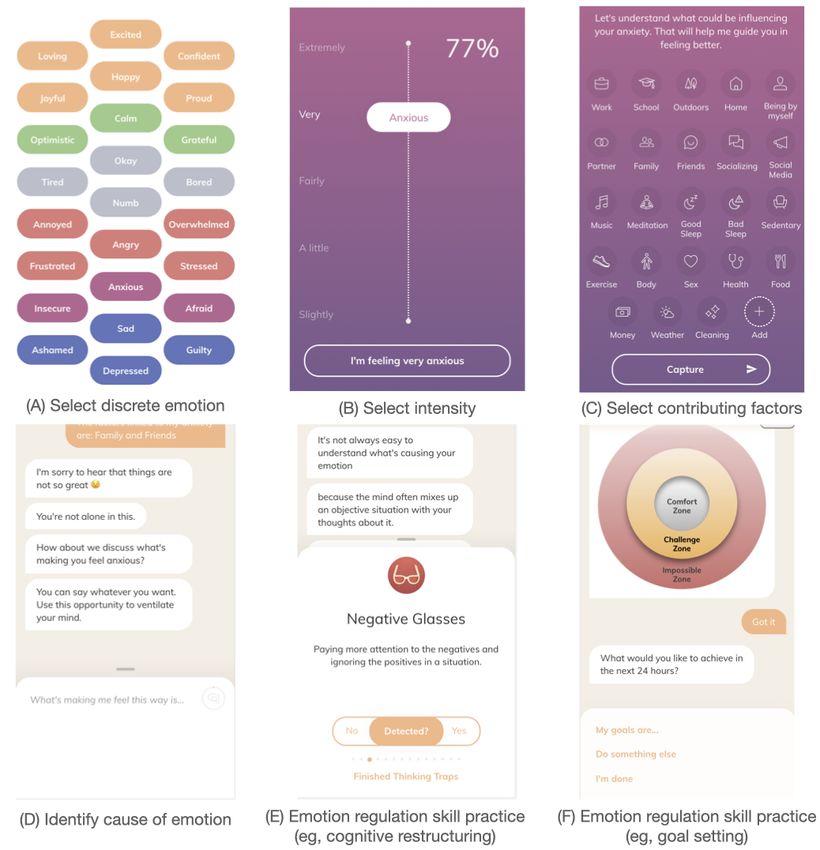
prespecified sequence (see Figure 1 for examples): identify The common elements framework provides a review of common
current emotion and intensity (0%-100%), select contributing elements across cognitive and behavioral therapies inclusive of
factors from a prespecified list, complete an open text entry both traditional (cognitive therapy, behavioral activation) and
about what is causing the current mood, complete emotion third-wave (acceptance and commitment therapy, dialectical
regulation skill practice for a negative mood or wellness practice behavior therapy) approaches. They identify 3 mechanistic
for a positive mood (see Table 2), and identify current emotion targets common to multiple effective therapies, including
and intensity (0%-100%). attention change (improving attentional focus and flexibility),
cognitive change (improving ability to change perspective on
https://www.jmir.org/2021/6/e26771 J Med Internet Res 2021 | vol. 23 | iss. 6 | e26771 | p. 4
(page number not for citation purposes)
XSL• FO
RenderXJOURNAL OF MEDICAL INTERNET RESEARCH Mehta et al
an event), and context engagement (engaging new internal and empirical support for the efficacy of each of these targets in
external contexts to counteract maladaptive patterns). Youper’s enhancing emotion regulation and reducing symptoms of
interventions aim to increase emotion regulation skills by emotional disorders [30-36].
targeting these common elements. For example, Youper includes
Each intervention is described in Table 2. Each skill follows a
interventions to increase attentional control such as mindfulness,
series of steps modeled after existing treatment manuals or
cognitive change such as cognitive restructuring or gratitude
research protocols. Skills practice includes a variety of formats
journaling, and context engagement via behavioral activation
including open-text entry following a prompt, graphical user
exercises. The common elements framework was used to guide
interfaces, written content delivered via the chat, and audio.
the development of Youper’s interventions due to the extensive
Figure 1. Example interaction with Youper. Users start by reporting a discrete emotion (A) and the intensity (B) which they feel the emotion. They
then report which factors contributed to the emotion (C) and describe the precipitating event (D). Next, they proceed through a randomly selected
intervention (eg, E or F) from the list (see Table 2). Finally, they report their discrete emotional state again and the intensity which they feel that emotion
(A and B).
https://www.jmir.org/2021/6/e26771 J Med Internet Res 2021 | vol. 23 | iss. 6 | e26771 | p. 5
(page number not for citation purposes)
XSL• FO
RenderXJOURNAL OF MEDICAL INTERNET RESEARCH Mehta et al
Table 2. Emotion regulation change process targets and interventions.
Change process with interventions Description
Context engagement
Behavioral activation 1. Selecting a rewarding or social activity from a list
2. Psychoeducation about action/motivation cycle
3. Setting a goal to complete the activity
Goal setting 1. Psychoeducation about setting challenging, specific goals
2. Identifying a goal
3. Setting a reminder to check about goal completion
Problem solving 1. Identifying the problem
2. Identifying a goal
3. Brainstorming solutions
4. Selecting a solution and setting a goal
Attention change
Mindfulness 1. Selection from a list of audio-recorded mindfulness exercises such as
following the breath, progressive muscle relaxation, and mindfulness of
thoughts
Sleep relaxation 1. Visualization of calming scenery
2. Selection from a list of different types of white noise
Cognitive change
Acceptance 1. Practicing accepting negative thoughts and feelings without trying to
change them
2. Planning to engage in value-driven behavior
Cognitive restructuring 1. Identifying thoughts
2. Identifying cognitive distortions
3. Examining evidence
4. Identifying alternative thoughts
Gratitude journaling 1. Identification of things for which the user is grateful
Self-compassion 1. Identification of how the user would treat a friend dealing with difficult
emotions
2. Identification of how to treat oneself with the same compassion
and is frequently used as a general measure of overall anxiety
Measures symptoms. It has demonstrated excellent psychometrics with a
Acceptability Measures Cronbach α of .92 and a sensitivity and specificity of 89% and
82%, respectively, for classifying generalized anxiety [37].
User Ratings Depression symptoms were measured using a modified version
To assess acceptability of the Youper intervention, we asked of the Patient Health Questionnaire-9 (PHQ-9) with the
users to provide a rating of the app using a 5-star scale. Users suicide-related item removed and 1 of the items divided into 2
were given the following prompt: “I’d love to know how our separate items [38]. Specifically, the item that asks if the
journey together is going so far.” Users then provided their respondent “has been moving slowly or has been fidgety and
rating of Youper by selecting a number of stars ranging from 1 restless” was divided into an item about “moving slowly” and
to 5. Users then were asked to provide feedback using an open another item about “being fidgety and restless.” The PHQ-9 is
text box. a widely used measure of depression symptom severity with
excellent psychometrics. The PHQ-9 has a Cronbach α of .89
Retention
and has both a sensitivity and a specificity of 88% for classifying
Retention was measured as the proportion of Youper subscribers major depression. In our slightly modified PHQ, we observed
who engaged with the app during week 1, 2, 3, and 4 after a comparable Cronbach α of .84 (95% CI 0.83-0.85) indicating
subscription, as well as the average number of conversations good reliability.
that users had during each of these weeks.
Predictors of Symptom Reduction
Anxiety and Depression Symptoms
Within-Session Emotion Regulation
Anxiety symptoms were measured using the 7-item generalized
anxiety disorder measure (GAD-7) [37]. The GAD-7 is a widely To test the cumulative regulation hypothesis, we derived a
used measure of generalized anxiety disorder symptom severity measure of cumulative emotion regulation success. At the
https://www.jmir.org/2021/6/e26771 J Med Internet Res 2021 | vol. 23 | iss. 6 | e26771 | p. 6
(page number not for citation purposes)
XSL• FO
RenderXJOURNAL OF MEDICAL INTERNET RESEARCH Mehta et al
beginning of each Youper conversation, users selected their Demographic and Clinical Characteristics
current emotion from a list of possible emotions as well as the We examined both demographic and clinical characteristics as
intensity of that emotion (see Figure 1). Users who selected a predictors of symptom reduction. Demographic characteristics
negative emotion were also asked to report their emotion at the included age (continuous) and gender (multinomial; man,
end of the conversation with Youper. We classified cases where woman, and nonbinary). Clinical characteristics included
users started with a negative emotion and ended with either a number of self-reported diagnoses (continuous), whether the
positive emotion or with a less intense negative emotion as a user was currently taking psychotropic medication (binary), and
within-session emotion regulation “success.” We classified whether the user was currently receiving psychotherapy (binary).
cases where users reported a worsening or unchanging negative
emotion as a “failure to regulate.” To calculate a measure of Statistical Analyses
cumulative within-session regulation success, we computed the
Aim 1: Acceptability
proportion of cases classified as a success out of all
conversations that started with a negative emotion. We report descriptive statistics for user retention and app ratings.
As discrete negative emotion words encode different emotional Aim 2: Effectiveness
intensities, we scaled the numeric self-reported emotional To estimate symptom reduction as a function of time, we fit
intensity according to an intensity scale factor corresponding piecewise multilevel models in R (version 4.0.2; The R
to the discrete emotion the user selected. To derive the intensity Foundation for Statistical Computing) using the package
scale factor for each discrete emotion, we first obtained “lmerTest” (version 3.1-2) [41]. Consistent with prior work, we
normative valence and arousal ratings from a database of words selected a piecewise approach to capture a typical pattern of
that have been rated on a scale of 1 to 9 by a large sample of symptom reduction observed in treatment studies where
participants [39]. Next, we subtracted a constant (C=6) from symptoms initially decrease sharply and then level out as time
the normative valence ratings, chosen so that all negative progresses [42-47]. In these models, we regressed the symptom
valence words would have negative-valued ratings and positive outcome measure (GAD-7 score or PHQ score) onto the number
valence words would have positive ratings. To compute the of days since subscribing to the app.
intensity scale factor for each emotion word, we took the square
We selected multilevel models because our outcome measures
root of the sum of the squared valence and arousal ratings (ie,
were nested within individuals as a result of repeated
the L2 norm). This decision was premised on the assumption
measurement at multiple timepoints. Multilevel models allow
that emotion intensity is a composite of valence and arousal
for the estimation of within-subject effects. Further, when fit
[40]. Finally, we multiplied the self-reported numeric intensity
with maximum likelihood, multilevel models allow for the
by the intensity scale factor for the given emotion to obtain a
inclusion of participants with incomplete data without deletion
scaled emotion intensity rating that could be compared across
or imputation and produces unbiased estimates for model
discrete emotion categories.
parameters [48,49]. As per guidelines for randomized clinical
The scaling procedure had the effect of incorporating both the trials, we conducted an intent-to-treat analysis, including all
intensity of the emotion word and the self-reported numeric participants who had at least one assessment [50-53]. As
intensity into a single value which could be used to assess discussed by Gupta [51], “intent-to-treat analysis avoids
emotion regulation success pre- to postintervention. For overoptimistic estimates of the efficacy of an intervention
example, without scaling, a participant that went from a rating resulting from the removal of non-compliers by accepting that
of “75 annoyed” to “70 angry” would be erroneously classified noncompliance and protocol deviations are likely to occur in
as an instance of successful downregulation of negative emotion, actual clinical practice.” We estimated the reduction of
despite the higher intensity imbued in the word “angry.” With symptoms from T0 to T1 and from T1 to T2. We used a
scaling, “75 annoyed” would translate to “–383” and “70 angry” breakpoint at 14 days, as participants’ second of 3 symptom
would translate to “–482,” and the increase in magnitude of measurements was available to be completed 14 days after the
negative emotion would result in a classification of failure to first measurement. Because not all participants completed
regulate. However, if the participant went from “75 annoyed” assessments immediately when they were available, we chose
to “30 angry,” the “30 angry” rating would be scaled to “–207,” to treat time as a continuous predictor in our analysis rather than
and the instance would be classified as a regulatory success. simply grouping observations into time points at T0, T1, and
This procedure allowed us to use both the text information and T2. This approach allowed us to keep all information that we
numeric information in our assessment of success or failure to had about the time that had elapsed from baseline and was more
regulate emotions. As a check of robustness, we ran all analyses conservative because it did not assume that a change occurring
without the scaling procedure, and the results were substantively more than 14 days after baseline was occurring exactly at 14
similar. To be conservative, we ultimately dichotomized these days.
scaled scores into regulation successes and failures because,
The models included 2 fixed effect parameters: one which
despite appearing to have a continuous measure of emotion
estimated the slope of symptom reduction from the start of using
regulation success, we were not confident that these scores truly
Youper to 14 days later, and another which estimated the slope
represented precise gradations along a continuum.
of symptom reduction from the 14-day mark onward.
Additionally, we included a random intercept term for each
participant. We calculated Cohen d effect sizes by dividing the
https://www.jmir.org/2021/6/e26771 J Med Internet Res 2021 | vol. 23 | iss. 6 | e26771 | p. 7
(page number not for citation purposes)
XSL• FO
RenderXJOURNAL OF MEDICAL INTERNET RESEARCH Mehta et al
mean difference in symptom levels by the square root of the was in therapy (binary) as individual difference predictors of
sum of the participant-level intercept variance and the residual symptom reduction.
variance [54].
Aim 3: Cumulative Regulation Hypothesis
Results
To test the cumulative regulation hypothesis (ie, whether Aim 1: Acceptability
cumulative emotion regulation success within conversations
predicted subsequent psychopathology symptoms), we fit User Ratings
longitudinal path analysis models for each of the 2 symptom On the 5-point star rating scale, the median Youper rating was
measures (GAD-7 and PHQ) in the R package, “lavaan” (version 5 and the mean was 4.36 (SD 0.84). Out of 3667 users who
0.6-6) [55]. We fit these models using full information maximum rated the app, 56.09% (n=2057) gave a 5-star rating, 26.89%
likelihood and allowed the covariances between exogenous (n=986) gave 4 stars, 14.97% (n=549) gave 3 stars, 1.31%
variables to be freely estimated [56]. This method enabled us (n=48) gave 2 stars, and 0.74% (n=27) gave 1 star. The mean
to conduct an intent-to-treat analysis, including all participants conversation number at which users provided a rating was
that had a measurement for at least one variable included in the conversation 1.40, and the SD was 4.03.
model. In these models, we estimated all autoregressive paths
Retention
and lagged paths from emotion regulation success to subsequent
clinical symptoms. Specifically, each path analysis model Of the 4517 users who subscribed to Youper between March
consisted of 3 regression equations. In the first equation, we 4, 2020, and July 10, 2020, 90.75% (n=4099) were still using
regressed the T1 symptom outcome onto the T0 symptom Youper in week 1, 60.44% (n=2730) were using in week 2,
outcome and the proportion of within-session regulation 51.78% (n =2339) were using in week 3, and 42.66% (n=1927)
successes between T0 and T1 (ie, the proportion of negative were using in week 4 after subscription. The average numbers
emotions that were successfully regulated of the total number of conversations users had in weeks 1, 2, 3, and 4 were 6.50
of negative emotion regulation attempts). In the second equation, (SD 6.74), 3.08 (SD 4.50), 2.36 (SD 3.98), and 2.04 (SD 3.83),
we regressed the proportion of within-session regulation respectively. Across the whole 4-week period, users engaged
successes between T1 and T2 onto the proportion of in an average of 13.98 conversations (SD 16.89).
within-session regulation successes between T0 and T1. Finally, Aim 2: Effectiveness
we regressed the T2 symptom outcome onto the T1 symptom
outcome and the proportion of within-session regulation Anxiety
successes between T1 and T2. (See Figure 3 for an illustration Results are displayed in Figure 2. Participants (Nparticipants=4144;
of paths with standardized coefficients.) Nobservations=7093) experienced a significant reduction in anxiety
Exploratory Analyses: Clinical and Demographic symptoms from T0 to T1 (b=–0.21; bootstrapped 95% CI –0.22
Predictors to –0.19; PJOURNAL OF MEDICAL INTERNET RESEARCH Mehta et al
Figure 2. Symptom reduction over time in the full sample. The gray shaded region indicates bootstrapped SEs. Model details are described in the
Results for Aim 2.
SEs) at day 0, day 14, and day 28 were 14.41 (SE 0.10), 11.61
Depression (SE 0.14), and 11.90 (SE 0.13), respectively. These differences
Results are displayed in Figure 2. Participants (Nparticipants=3992; equate to a Cohen d of 0.46 between day 0 and day 14, 0.42
Nobservations=6685) experienced a significant reduction in between day 0 and day 28, and 0.05 between day 14 and day
depression symptoms from T0 to T1 (b=–0.20; bootstrapped 28. When analyses were conducted only on participants who
95% CI –0.22 to –0.18; PJOURNAL OF MEDICAL INTERNET RESEARCH Mehta et al
that symptoms no longer significantly increased between T1 Anxiety
and T2 (P=.08 and P=.15, respectively). To examine the effect of regulatory success within Youper
Aim 3: Cumulative Regulation Hypothesis sessions on anxiety symptoms, we fit a longitudinal path analysis
model (Nparticipants=4284; see Figure 3 for ns for each variable).
Preliminary Analyses The model had good fit characteristics as indicated by a
We first examined the probability that users would successfully significant chi-square value and standard fit statistics
regulate their emotion within a conversation with Youper. As (X24=60.84; PJOURNAL OF MEDICAL INTERNET RESEARCH Mehta et al
Age and Gender within-conversation emotion regulation success would predict
The interaction effects of time using Youper with age on anxiety symptom reduction.
(Nparticipants=4143; Nobservations=7090) and depression Findings indicated that users were well retained and provided
(Nparticipants=3991; Nobservations=6683) symptoms were not high ratings of Youper (median 5/5). As hypothesized, users
significant from T0 to T1 (Panxiety=.77; Pdepression=.39) or from showed significant reductions in symptoms in the first 2 weeks
T1 to T2 (Panxiety=.54; Pdepression=.43) in the piecewise regression of using Youper with sustained improvements through 4 weeks
models. from initial download. Finally, consistent with the cumulative
regulation hypothesis, greater frequency of within-conversation
The interaction effects of time using Youper with gender on emotion regulation successes significantly predicted greater
anxiety (Nparticipants=4144; Nobservations=7093) and depression reductions in anxiety and depression. Although no demographic
(Nparticipants=3992; Nobservations=6685) symptoms were not predictors emerged, users with more self-reported diagnosed
significant from T0 to T1 (Panxiety-male=.74; Panxiety-nonbinary=.44; psychiatric conditions showed a slight return of depression
Panxiety-not-informed=.99; Pdepression-male=.16; Pdepression-nonbinary=.32; symptoms between 2 and 4 weeks from first subscribing to
Pdepression-not-informed=.37) or from T1 to T2 (Panxiety-male=.40; Youper.
Panxiety-nonbinary=.28; Panxiety-not-informed=.17; Pdepression-male=.89; Acceptability and Effectiveness
Pdepression-non-binary=.70; Pdepression-not-informed=.25) in the piecewise Because retention poses a significant challenge for entirely
regression models. unguided treatment programs, our finding that 60.44%
(2730/4517) of users continued to engage with the app in the
Number of Self-reported Diagnoses
second week and 42.66% (1927/4517) of users continued to
The interaction effects of the number of self-reported diagnoses engage with the app in the fourth week after initial download
with time using Youper on anxiety symptoms (Nparticipants=2679; is promising. Although there are no clearly established metrics
Nobservations=4661) was not significant from T1 to T2 (P=.08), of retention for mobile apps, a recent paper examining retention
and not significant from T0 to T1 (P=.59). among different mobile apps showed that Youper had the highest
“stickiness” (measured by the ratio of active users to downloads
There was a significant interaction effect of number of
in a given month) compared to any other treatment app for
self-reported diagnoses with time using Youper on depression
anxiety and depression [57]. Because Youper users experienced
symptoms from T1 to T2 (Nparticipants=2738; Nobservations=4589;
symptom improvements on average within the first 2 weeks of
b=0.02; bootstrapped 95% CI 0.007-0.04; P=.006), but not from app use, with the present retention rate, it is likely that a large
T0 to T1 (P=.78). This indicated that users with more diagnoses portion of users will stick with the app long enough to
regressed modestly towards their baseline level of depression experience some positive effects. It is also notable that the
in the latter half of the treatment, whereas users with fewer median satisfaction rating given by users was 5 out of 5. Taken
diagnoses retained the treatment benefit. together, these findings indicate that Youper has great potential
Medication and Therapy as a highly acceptable and adequately engaging digital treatment
program.
There were no significant interaction effects of taking prescribed
medication with time using Youper on anxiety (Nparticipants=2719; Youper users showed a moderate effect size reduction for
Nobservations=4733) or depression (Nparticipants=2776; anxiety (d=0.57) and depression (d=0.46) within 2 weeks of
Nobservations=4654) symptoms from T0 to T1 (Panxiety=.32.; starting app use. The reduction in anxiety symptoms was
maintained through the 4-week period (day 0 to day 28: d=0.60).
Pdepression=.72) or from T1 to T2 (Panxiety=.57; Pdepression=.66).
The reduction in depression symptoms was maintained through
There were no significant interaction effects of receiving the 4-week period (day 0 to day 28: d=0.42) although depression
psychotherapy with time using Youper on anxiety increased slightly, but significantly, between weeks 2 and 4.
(Nparticipants=2719; Nobservations=4733) or depression These effect sizes are comparable to those found in RCTs of
(Nparticipants=2776; Nobservations=4654) symptoms from T0 to T1 other commercially available mobile apps tested for a similar
(Panxiety=.66; Pdepression=.87) or from T1 to T2 (Panxiety=.65; duration [9-11,58], suggesting that the AI therapy approach is
viable for further testing in a randomized clinical trial. Youper
Pdepression=.52).
users also had high success at regulating their negative emotions
with each conversation. Given the low cost and potential for
Discussion broad dissemination of Youper, these findings are particularly
exciting, as they provide preliminary evidence of Youper’s
Summary
effectiveness as an emotion regulation tool and a transdiagnostic
The present study had 3 aims. First, we examined the treatment. It is important to note, however, that the final mean
acceptability of Youper AI therapy by assessing user ratings PHQ score of 11.9 still fell in the moderate severity range. Thus,
and retention metrics among subscribers. Second, we tested as we begin to understand the mechanisms of the AI therapy
whether there were significant reductions in anxiety and approach and gain greater understanding of how to maximize
depression symptoms. Third, we examined the cumulative user engagement, we are hopeful that effects on symptom
regulation hypothesis, which predicts that the frequency of reduction will continue to improve.
https://www.jmir.org/2021/6/e26771 J Med Internet Res 2021 | vol. 23 | iss. 6 | e26771 | p. 11
(page number not for citation purposes)
XSL• FO
RenderXJOURNAL OF MEDICAL INTERNET RESEARCH Mehta et al
Youper’s symptom reduction, retention, and satisfaction ratings Limitations and Future Directions
are notable because they were demonstrated in a real-world Despite many strengths, our study had a few limitations. First,
setting. Although highly controlled feasibility pilot trials allow because these data were not collected as part of a research study,
determination of causal inference, these studies may not be we did not have a control group, making it impossible to
generalizable to real-world settings and may fail to address determine whether symptom reduction was simply due to the
issues of external relevance and dissemination [59]. Our analysis passage of time. However, given that effect sizes for symptom
included a very large sample of Youper users who voluntarily reduction that we found are comparable to those found in RCTs
downloaded and purchased the Youper program. Unlike in of other mobile app programs that showed significant differences
typical research settings, users were not recruited to participate between active treatment groups and wait list controls [9-11,58],
or compensated for their assessments or for providing their it is unlikely that these effects can be explained by spontaneous
feedback during their participation. Observed retention rates remission. Second, because this was an observational study, we
and symptom reduction therefore have already been shown in used the symptom data that were available to us, which included
a real-world setting and population. only self-report measures. Although we used validated measures,
Cumulative Regulation Hypothesis solely relying on self-report does not give a complete picture
of the impact of Youper on clinical symptoms and overall
The finding that cumulative within-session emotion regulation
functioning that could be more thoroughly assessed via clinical
was strongly predictive of symptom reduction provides
interviews. Third, this study included only 2 brief measures as
preliminary evidence for a potential mechanism of the AI
outcomes: the PHQ and the GAD-7. Although these measures
therapy just-in-time intervention approach. Youper is theorized
are widely used and show excellent psychometric properties,
to enact its effects by enhancing emotion regulation skills via
additional measures of anxiety, depression, and other purported
-in-time interventions. Thus, more effective emotion regulation
outcome targets, such as quality of life and functioning, could
sessions would indicate progress towards enhanced general
help us better understand Youper’s effectiveness. Fourth,
emotion regulation skills and ultimately, symptom reduction.
47.84% (2161/4517) of Youper users were concurrently taking
Therefore, it is promising that the effectiveness of the emotion
medication or engaging in therapy, meaning that it is possible
regulation practice predicts the longer-term impacts of app use
symptom reduction resulted from participation in these other
on symptom reduction. Although these results provide initial
treatments rather than Youper (although concurrent treatment
support for the theorized model underlying Youper’s treatment
was not a significant moderator of symptom reduction). Finally,
approach, randomization is critical for rigorously testing
our emotion regulation measure was not designed to assess the
within-session emotion regulation as a mediator of symptom
magnitude of emotion regulation success, meaning that our
reduction.
metric included only success or failure with each conversation.
Predictors of Symptom Reduction These limitations should be addressed in future studies that
Interestingly, no demographic predictors of symptom reduction include a control group, that assess symptoms using
emerged. These findings are largely consistent with the existing clinician-administered measures, that include a broader array
literature where demographic features rarely predict symptom of self-report measures, and that use more precise measures of
reduction [60-67]. These findings are promising, suggesting emotion regulation success.
that digital treatment programs can be broadly disseminated Conclusions
with similar potential benefit across demographic groups. The
This study provides preliminary evidence for Youper’s
number of comorbid diagnoses was a significant predictor of
acceptability in a real-world setting that is unfettered by the
response such that users who reported more diagnosed mental
constraints of highly controlled clinical trials. It also provides
health conditions showed a slight return of depression symptoms
evidence of Youper’s effectiveness as an entirely unguided
between 2 and 4 weeks from the first subscription date. These
intervention for anxiety and depression. Finally, we
findings are consistent with prior literature showing poorer
demonstrated that Youper’s effects on symptom reduction may
outcomes with greater comorbidity in depression treatment
be explained by repeated within-session emotion regulation
[68-70]. Users with more diagnosed conditions likely have a
successes, providing preliminary support for the process by
more severe clinical presentation, meaning that an entirely
which a just-in-time intervention can be effective for the
self-guided program may be less effective for this group. The
treatment of emotional disorders. Our results highlight the
finding that concurrent medication and therapy did not
potential impact of Youper as a low-cost, light-touch,
significantly impact symptom reduction suggests that the
transdiagnostic intervention for anxiety and depression that can
demonstrated effects of Youper on symptoms are unlikely to
be broadly disseminated to improve mental health for millions
be explained by concurrent treatment, and that participating in
of people around the world.
other treatments alongside Youper does not hinder its effects.
Conflicts of Interest
Authors ANN, JHV, TM, and DDC are employees of Youper and shareholders in the company. AM and JJG have no conflicts
of interest to declare.
References
https://www.jmir.org/2021/6/e26771 J Med Internet Res 2021 | vol. 23 | iss. 6 | e26771 | p. 12
(page number not for citation purposes)
XSL• FO
RenderXJOURNAL OF MEDICAL INTERNET RESEARCH Mehta et al
1. Kessler RC, Chiu WT, Demler O, Merikangas KR, Walters EE. Prevalence, severity, and comorbidity of 12-month DSM-IV
disorders in the National Comorbidity Survey Replication. Arch Gen Psychiatry 2005 Jun;62(6):617-627 [FREE Full text]
[doi: 10.1001/archpsyc.62.6.617] [Medline: 15939839]
2. World Health Organization. The World Health Report 2001: Mental Health: New Understanding, New Hope. Geneva,
Switzerland: World Health Organization; 2001.
3. Kessler R, Petukhova M, Sampson N, Zaslavsky A, Wittchen HU. Twelve-month and lifetime prevalence and lifetime
morbid risk of anxiety and mood disorders in the United States. Int J Methods Psychiatr Res 2012 Sep;21(3):169-184 [FREE
Full text] [doi: 10.1002/mpr.1359] [Medline: 22865617]
4. Kohn R, Saxena S, Levav I, Saraceno B. The treatment gap in mental health care. Bull World Health Organ 2004
Nov;82(11):858-866 [FREE Full text] [Medline: 15640922]
5. Mojtabai R, Olfson M, Sampson NA, Jin R, Druss B, Wang PS, et al. Barriers to mental health treatment: results from the
National Comorbidity Survey Replication. Psychol Med 2011 Aug;41(8):1751-1761 [FREE Full text] [doi:
10.1017/S0033291710002291] [Medline: 21134315]
6. Torous J, Roberts LW. Needed innovation in digital health and smartphone applications for mental health: transparency
and trust. JAMA Psychiatry 2017 May 01;74(5):437-438. [doi: 10.1001/jamapsychiatry.2017.0262] [Medline: 28384700]
7. Karyotaki E, Riper H, Twisk J, Hoogendoorn A, Kleiboer A, Mira A, et al. Efficacy of self-guided internet-based cognitive
behavioral therapy in the treatment of depressive symptoms: A meta-analysis of individual participant data. JAMA Psychiatry
2017 Apr 01;74(4):351-359. [doi: 10.1001/jamapsychiatry.2017.0044] [Medline: 28241179]
8. Spek V, Cuijpers P, Nyklícek I, Riper H, Keyzer J, Pop V. Internet-based cognitive behaviour therapy for symptoms of
depression and anxiety: a meta-analysis. Psychol Med 2007 Mar;37(3):319-328. [doi: 10.1017/S0033291706008944]
[Medline: 17112400]
9. Fitzpatrick KK, Darcy A, Vierhile M. Delivering cognitive behavior therapy to young adults with symptoms of depression
and anxiety using a fully automated conversational agent (Woebot): A randomized controlled trial. JMIR Ment Health 2017
Jun 06;4(2):e19 [FREE Full text] [doi: 10.2196/mental.7785] [Medline: 28588005]
10. Arean PA, Hallgren KA, Jordan JT, Gazzaley A, Atkins DC, Heagerty PJ, et al. The use and effectiveness of mobile apps
for depression: results from a fully remote clinical trial. J Med Internet Res 2016 Dec 20;18(12):e330 [FREE Full text]
[doi: 10.2196/jmir.6482] [Medline: 27998876]
11. Moberg C, Niles A, Beermann D. Guided self-help works: randomized waitlist controlled trial of Pacifica, a mobile app
integrating cognitive behavioral therapy and mindfulness for stress, anxiety, and depression. J Med Internet Res 2019 Jun
08;21(6):e12556 [FREE Full text] [doi: 10.2196/12556] [Medline: 31199319]
12. Roepke AM, Jaffee SR, Riffle OM, McGonigal J, Broome R, Maxwell B. Randomized controlled trial of superbetter, a
smartphone-based/internet-based self-help tool to reduce depressive symptoms. Games Health J 2015 Jun;4(3):235-246.
[doi: 10.1089/g4h.2014.0046] [Medline: 26182069]
13. Birney AJ, Gunn R, Russell JK, Ary DV. Moodhacker mobile web app with email for adults to self-manage mild-to-moderate
depression: randomized controlled trial. JMIR Mhealth Uhealth 2016 Jan 26;4(1):e8 [FREE Full text] [doi:
10.2196/mhealth.4231] [Medline: 26813737]
14. Tighe J, Shand F, Ridani R, Mackinnon A, De La Mata N, Christensen H. Ibobbly mobile health intervention for suicide
prevention in Australian Indigenous youth: a pilot randomised controlled trial. BMJ Open 2017 Jan 27;7(1):e013518 [FREE
Full text] [doi: 10.1136/bmjopen-2016-013518] [Medline: 28132007]
15. Inkster B, Sarda S, Subramanian V. An empathy-driven, conversational artificial intelligence agent (Wysa) for digital
mental well-being: real-world data evaluation mixed-methods study. JMIR Mhealth Uhealth 2018 Nov 23;6(11):e12106
[FREE Full text] [doi: 10.2196/12106] [Medline: 30470676]
16. Miller CB, Gu J, Henry AL, Davis ML, Espie CA, Stott R, et al. Feasibility and efficacy of a digital CBT intervention for
symptoms of generalized anxiety disorder: a randomized multiple-baseline study. J Behav Ther Exp Psychiatry 2021
Mar;70:101609. [doi: 10.1016/j.jbtep.2020.101609] [Medline: 32950939]
17. Monti S, Grosso V, Todoerti M, Caporali R. Randomized controlled trials and real-world data: differences and similarities
to untangle literature data. Rheumatology (Oxford) 2018 Oct 01;57(57 Suppl 7):vii54-vii58. [doi:
10.1093/rheumatology/key109] [Medline: 30289534]
18. Food and Drug Administration. Developing a framework for regulatory use of real-world evidence. govinfo. URL: https:/
/www.govinfo.gov/content/pkg/FR-2017-07-31/pdf/2017-16021.pdf [accessed 2021-01-26]
19. Arlett P. Update on Real World Evidence Data Collection. European Medicines Agency. 2016 Mar. URL: https://ec.
europa.eu/health/sites/health/files/files/committee/stamp/2016-03_stamp4/4_real_world_evidence_ema_presentation.pdf
[accessed 2021-01-26]
20. HTA 101: Introduction to health technology assessment internet. U.S. National Library of Medicine. URL: https://www.
nlm.nih.gov/nichsr/hta101/ta10103.html [accessed 2012-01-25]
21. Travers J, Marsh S, Williams M, Weatherall M, Caldwell B, Shirtcliffe P, et al. External validity of randomised controlled
trials in asthma: to whom do the results of the trials apply? Thorax 2007 Mar 01;62(3):219-223 [FREE Full text] [doi:
10.1136/thx.2006.066837] [Medline: 17105779]
https://www.jmir.org/2021/6/e26771 J Med Internet Res 2021 | vol. 23 | iss. 6 | e26771 | p. 13
(page number not for citation purposes)
XSL• FO
RenderXJOURNAL OF MEDICAL INTERNET RESEARCH Mehta et al
22. Fortin M, Dionne J, Pinho G, Gignac J, Almirall J, Lapointe L. Randomized controlled trials: do they have external validity
for patients with multiple comorbidities? Ann Fam Med 2006;4(2):104-108 [FREE Full text] [doi: 10.1370/afm.516]
[Medline: 16569712]
23. Carls GS, Tuttle E, Tan R, Huynh J, Yee J, Edelman SV, et al. Understanding the gap between efficacy in randomized
controlled trials and effectiveness in real-world use of GLP-1 ra and DPP-4 therapies in patients with type 2 diabetes.
Diabetes Care 2017 Nov 11;40(11):1469-1478. [doi: 10.2337/dc16-2725] [Medline: 28801475]
24. Alfonsson S, Olsson E, Linderman S, Winnerhed S, Hursti T. Is online treatment adherence affected by presentation and
therapist support? A randomized controlled trial. Computers in Human Behavior 2016 Jul;60:550-558. [doi:
10.1016/j.chb.2016.01.035]
25. Burns MN, Begale M, Duffecy J, Gergle D, Karr CJ, Giangrande E, et al. Harnessing context sensing to develop a mobile
intervention for depression. J Med Internet Res 2011 Aug 12;13(3):e55 [FREE Full text] [doi: 10.2196/jmir.1838] [Medline:
21840837]
26. Ghandeharioun A, McDuff D, Czerwinski M, Rowan K. EMMA: an emotion-aware wellbeing chatbot. In: arXiv. 2019
Presented at: 8th International Conference on Affective Computing and Intelligent Interaction (ACII); 2019 Sept 3-6;
Cambridge, UK p. 1-7 URL: http://arxiv.org/abs/1812.11423 [doi: 10.1109/acii.2019.8925455]
27. Hofmann S, Sawyer A, Fang A, Asnaani A. Emotion dysregulation model of mood and anxiety disorders. Depress Anxiety
2012 May;29(5):409-416 [FREE Full text] [doi: 10.1002/da.21888] [Medline: 22430982]
28. Sheppes G, Suri G, Gross JJ. Emotion regulation and psychopathology. Annu Rev Clin Psychol 2015 Mar 28;11(1):379-405.
[doi: 10.1146/annurev-clinpsy-032814-112739] [Medline: 25581242]
29. Mennin DS, Ellard KK, Fresco DM, Gross JJ. United we stand: emphasizing commonalities across cognitive-behavioral
therapies. Behav Ther 2013 Jun;44(2):234-248 [FREE Full text] [doi: 10.1016/j.beth.2013.02.004] [Medline: 23611074]
30. Barlow D, Farchione TJ, editors. Unified Protocol for Transdiagnostic Treatment of Emotional Disorders: Therapist Guide
(2nd ed.). New York: Oxford University Press; 2018.
31. Beck AT, Rush AJ, Shaw BF, Emery G. Cognitive Therapy of Depression. New York: Guilford Press; 1979.
32. Chambers R, Lo BCY, Allen NB. The impact of intensive mindfulness training on attentional control, cognitive style, and
affect. Cogn Ther Res 2007 Feb 23;32(3):303-322. [doi: 10.1007/s10608-007-9119-0]
33. Craske MG, Kircanski K, Zelikowsky M, Mystkowski J, Chowdhury N, Baker A. Optimizing inhibitory learning during
exposure therapy. Behav Res Ther 2008 Jan;46(1):5-27. [doi: 10.1016/j.brat.2007.10.003] [Medline: 18005936]
34. Forman EM, Herbert JD, Moitra E, Yeomans PD, Geller PA. A randomized controlled effectiveness trial of acceptance
and commitment therapy and cognitive therapy for anxiety and depression. Behav Modif 2007 Nov 26;31(6):772-799. [doi:
10.1177/0145445507302202] [Medline: 17932235]
35. Lohr JM, Olatunji BO, Sawchuk CN. A functional analysis of danger and safety signals in anxiety disorders. Clin Psychol
Rev 2007 Jan;27(1):114-126. [doi: 10.1016/j.cpr.2006.07.005] [Medline: 16997437]
36. Roemer L, Williston SK, Rollins LG. Mindfulness and emotion regulation. Current Opinion in Psychology 2015 Jun;3:52-57.
[doi: 10.1016/j.copsyc.2015.02.006]
37. Spitzer RL, Kroenke K, Williams JBW, Löwe B. A brief measure for assessing generalized anxiety disorder: the GAD-7.
Arch Intern Med 2006 May 22;166(10):1092-1097. [doi: 10.1001/archinte.166.10.1092] [Medline: 16717171]
38. Kroenke K, Spitzer RL. The PHQ-9: a new depression diagnostic and severity measure. Psychiatric Annals 2002 Sep
01;32(9):509-515. [doi: 10.3928/0048-5713-20020901-06]
39. Warriner AB, Kuperman V, Brysbaert M. Norms of valence, arousal, and dominance for 13,915 English lemmas. Behav
Res Methods 2013 Dec 13;45(4):1191-1207. [doi: 10.3758/s13428-012-0314-x] [Medline: 23404613]
40. Russell JA. A circumplex model of affect. Journal of Personality and Social Psychology 1980;39(6):1161-1178. [doi:
10.1037/h0077714]
41. Kuznetsova A, Brockhoff PB, Christensen RHB. Package: tests in linear mixed effects models. J. Stat. Soft 2017;82(13):1-26.
[doi: 10.18637/jss.v082.i13]
42. Craske MG, Niles AN, Burklund LJ, Wolitzky-Taylor KB, Vilardaga JCP, Arch JJ, et al. Randomized controlled trial of
cognitive behavioral therapy and acceptance and commitment therapy for social phobia: outcomes and moderators. J Consult
Clin Psychol 2014 Dec;82(6):1034-1048 [FREE Full text] [doi: 10.1037/a0037212] [Medline: 24999670]
43. Roy-Byrne P, Craske MG, Sullivan G, Rose RD, Edlund MJ, Lang AJ, et al. Delivery of evidence-based treatment for
multiple anxiety disorders in primary care: a randomized controlled trial. JAMA 2010 May 19;303(19):1921-1928 [FREE
Full text] [doi: 10.1001/jama.2010.608] [Medline: 20483968]
44. Niles AN, Craske MG, Lieberman MD, Hur C. Affect labeling enhances exposure effectiveness for public speaking anxiety.
Behav Res Ther 2015 May;68:27-36. [doi: 10.1016/j.brat.2015.03.004] [Medline: 25795524]
45. Wolitzky-Taylor K, Niles AN, Ries R, Krull JL, Rawson R, Roy-Byrne P, et al. Who needs more than standard care?
Treatment moderators in a randomized clinical trial comparing addiction treatment alone to addiction treatment plus anxiety
disorder treatment for comorbid anxiety and substance use disorders. Behav Res Ther 2018 Aug;107:1-9. [doi:
10.1016/j.brat.2018.05.005] [Medline: 29800622]
https://www.jmir.org/2021/6/e26771 J Med Internet Res 2021 | vol. 23 | iss. 6 | e26771 | p. 14
(page number not for citation purposes)
XSL• FO
RenderXYou can also read


