Centre Officiating Booklet - 2020-2021 Incorporating Rules of Competition, Centre Level Standard Events, Equipment Specifications, Officiating ...
←
→
Page content transcription
If your browser does not render page correctly, please read the page content below

2020-2021
      Centre Officiating
          Booklet

           Incorporating
      Rules of Competition,
   Centre Level Standard Events,
    Equipment Specifications,
      Officiating Processes.

Little Athletics Association of Victoria
              Incorporated

           Released: October 2020
Little Athletics Victoria - Centre Officiating Booklet

                                    TABLE OF CONTENTS

CENTRE LEVEL STANDARD EVENTS TABLE 2020-2021 ............................................. 3
PREFACE ................................................................................................................ 4
YOUR ROLE AS AN OFFICIAL ................................................................................... 4
MANAGING & COMMUNICATING .......................................................................... 5
STARTING............................................................................................................... 6
MULTI-CLASS ATHLETES – RUNNING EVENTS ......................................................... 8
TIMEKEEPING ......................................................................................................... 9
PLACE JUDGING ................................................................................................... 11
HURDLES .............................................................................................................. 12
MULTI-CLASS ATHLETES - HURDLES ...................................................................... 13
TRACK UMPIRING ................................................................................................ 13
COURSE MARSHALL ............................................................................................. 15
RELAYS – 4X100, 4X200, SWEDISH MEDLEY (100,300,200,400) ............................. 16
RACE WALKING .................................................................................................... 18
HIGH JUMP .......................................................................................................... 21
LONG JUMP ......................................................................................................... 24
TRIPLE JUMP ........................................................................................................ 27
MULTI-CLASS ATHLETES – JUMPING EVENTS ........................................................ 29
DISCUS ................................................................................................................. 30
SHOT PUT............................................................................................................. 32
JAVELIN................................................................................................................ 34
ATHLETES WITH A DISABILITY – THROWING EVENTS ............................................ 36
EQUIPMENT SPECIFICATIONS ............................................................................... 37
GENERAL TIPS FOR MULTI-CLASS ATHLETICS AND INCLUSION .............................. 38
OTHER RESOURCES .............................................................................................. 38

Released: October 2020                                                                                                  Page 2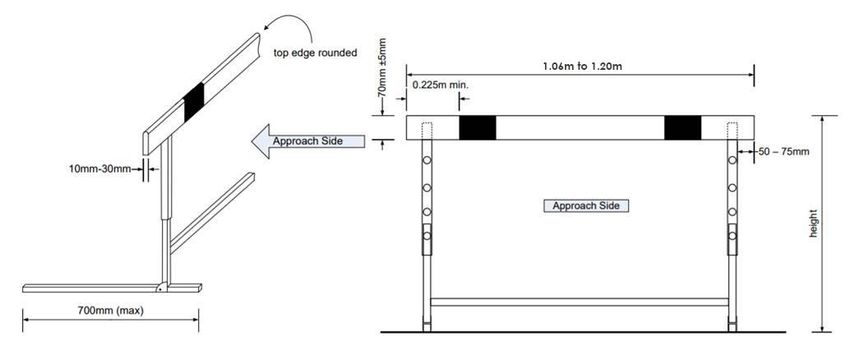
Little Athletics Victoria - Centre Officiating Booklet

Centre Level Standard Events Table 2020-2021

Released: October 2020                                                                       Page 3
Little Athletics Victoria - Centre Officiating Booklet

PREFACE
This booklet is aimed at parents & volunteers who have shown an interest in assisting Centres to run
their weekly Little Athletics Competitions. It outlines basic processes and rules of the various events
provided at Centres at their weekly competitions.
The booklet is designed to accomplish three aims:
Firstly, to introduce parents & volunteers to the rules and events offered at Little Athletics.
Secondly, to provide a basic toolkit of knowledge to conduct activities at a Little Athletics Centre.
Thirdly, and more importantly, it aims to provide an indication of the spirit in which the rules should
be applied and how the activities are delivered at Centre level competitions.
Information in this booklet is relevant for U6 – U16 athletes.
We thank you for your time and effort in volunteering to help the children participate in this exciting
sport. Your contribution is very much appreciated.
Enjoy your involvement with Little Athletics and good luck.

YOUR ROLE AS AN OFFICIAL
You may think that your role as an Official at your local Little Athletics Centre is to officiate the rules
of the event. Your role is much more than this. Primarily, your role as an Official is to:
•     Facilitate the opportunity for children to compete, have a go and enjoy athletics.
•     Ensure that all children are safe.
•     Help all children improve.
•     Create a fun environment to which children will want to return.

Officiating junior sport is not the same as officiating senior sport. It is extremely important that
everybody associated with Little Athletics is very clear with this point. Children are not little adults.
The differences are:
•     Officials at junior sport need to apply the rules to match the skill levels of the child and the
      activity.
•     The simpler the skill level, the simpler and more relaxed are the rules and their interpretations.
•     Be consistent, fair and objective when making decisions, giving the benefit of the doubt to
      the child.
•     Be courteous when making decisions, use it as a learning experience for the child. If they
      have done something the wrong way, show them the right way and give them another
      attempt.
•     Compliment and encourage all participants – officials are role models and a source of
      confidence building for a child.
•     Ensure that the activity is conducted within "the spirit of the game" and that sportsmanship
      underpins all actions.
•     Always remember that officials in junior sport have a big responsibility. As a child’s first foray
      into organised sport, a positive experience will help set in place a lifetime of involvement.
      Likewise, a negative experience can severely impact on that child’s involvement in any
      future physical activity.
•     Understand your obligations and responsibilities regarding Child Safety and your conduct as
      an official.
•     There are codes of conducts for both officials and for child safety that all volunteers should
      be aware of.

The Child safe standards information is provided at the back of this booklet, however to access the
Child Safe Code of Conduct, go to the LAVic website, www.lavic.com.au / Child Safe.

Released: October 2020                                                                                         Page 4
Little Athletics Victoria - Centre Officiating Booklet MANAGING & COMMUNICATING Through completing the Introduction to Officials Course and reviewing this booklet, volunteers should have the knowledge and competence to conduct a Centre Level event at Little Athletics. However, this only covers the technical aspect of running an activity; a more important aspect is being able to manage and communicate with groups of children and other volunteers. Managing & Communicating with Children There are several points to remember when officiating children: Communication Children are not little adults. Children do not respond to instructions in the same way adults do. Instructions must be clear, simple and have practical meanings. Do not leave the interpretations of instructions up to the child. Think about the words you use. In understanding a message, adults can use a range of skills that are not available to children. Adults can interpret words in the context of the message / situation, watch your body language and gestures and draw from past experiences. Children often, take the verbal word literally. The words you use should reflect literally what your message is. Always be encouraging, children are very good at remembering experiences. If they break a rule, be encouraging, supportive and directional in the language you use. Officiating should be a form of instruction on how to do it right. Sarcasm or being critical in a joking way is not something that children have learnt to interpret well; it should not be used. Managing Groups of Children Points to remember: Children want to be active; asking them to stand quietly in line for periods of time to await their turn is not often successful. Try and keep them active when it is not their turn. As an example, you can provide them with basic practice drills or warm up activities for the event. Do not try to do it all by yourself, encourage parents to become involved. Every child is to be supervised the whole time. Do not allow children to wander off. Managing & Communicating with Other Volunteer Helpers As an Official, you will often find yourself as the person conducting the event. You will have other volunteers to help you with the tasks of officiating. Communication Communicating with the other assisting volunteers is very important. Points to remember are: Before the start of the event, explain that the level of officiating will match the skill level and age of the children. Set the tone for how the activity will be conducted and how relaxed rule interpretations are. Be clear with any points that may be subjective, e.g. the Shot Put action, so that all officiating is consistent. Explain the roles of the helpers and the exact tasks you would like them to do. Do not assume they already know. People are sometimes reluctant to ask for help if they feel it is embarrassing to be naive. Be friendly, everybody is there to enjoy themselves. Managing Always thank people for their assistance and point out the fact it is through their effort the children will have / had an enjoyable experience. People like to feel appreciated. Do not lump responsibility onto people who do not have the knowledge or experience in a certain field. It can cause all kinds of problems and will usually result in potential volunteers being lost. Take the time to get to know new volunteers. Allow and encourage new helpers to make suggestions. Do not enforce things just because that’s the way it’s always been done. Released: October 2020 Page 5
Little Athletics Victoria - Centre Officiating Booklet

STARTING
Note: Within Little Athletics Victoria there is a Starters Working Party. This Working Party is responsible
      for the further education of starters, by conducting seminars. Should you be interested in
      learning more about starting races, you can contact the Starters Working Party through the
      LAVic Office.
Starters Safety Issues
•     Noise hazard: Caused by the firing of "Cap Guns" means that good quality industrial ear
      plugs/muffs must always be used.
•     Fire Hazard: The "Caps" used in starting guns are a potential fire hazard and must only be
      carried in a suitable container such as a leather pouch, plastic, or wooden box.
Equipment
•     Stand: To provide an elevated position and view of all lanes, ideally a stand should always be
      used but this may not be the case at all Centres or for all events.
•     Starting Device: Where an electronic starting device is being used ensure it is in good working
      order (including sufficient batteries) and is connecting correctly to the timing device being
      used. Where a gun (and caps), are being used, the gun should be reloaded with caps after
      every start.
•     Whistle: As a warning device that start procedure is about to begin.
•     Ear Plugs: Of good quality as guns are noise hazards.
•     Flash Board: Dark background to make smoke detection easier.
•     Communication Device: For contacting other officials such as Timekeepers, etc.
•     PA system: To ensure that all athletes can hear starter’s instructions particularly for events
      using "staggered" starts, e.g., 400m.
•     Identifying Colour / Uniform: Approved Polo Top/ vest with optional cap.
      Note: For Starters at Centre level the polo top can be an identifiable vest.
      and for Region & State events this will be the LAVic red polo top and cap.
Location of Starter
•     Straight Line: (Laned events up to and including 100m). Located on the infield slightly in front
      of the athletes to enable all to be viewed at the narrowest practical angle.
•     Staggered Start: (Laned events up to and including 800m). Located in a position so that all
      athletes are in one line of vision, may need voice amplification to enable athletes to hear
      starter.
•     Curve Line: (Unlaned events). Like above but may need to be in different position to enable
      all athletes to be viewed clearly depending on whether the start is on a bend or in the
      straight.
Note: When the Starter moves to a new position, they need to check with the Timekeepers to
      ensure that they are clearly visible.
Function
•     To ensure that each start is fair and gives each athlete an equal opportunity to perform to the
      best of their ability.
•     To control, alone or with the assistance of Recall Starter, all aspects of starting to achieve the
      above.
•     Alone or with the support of Recall Starter and/or Starters Assistant allocate athletes to heats
      and lanes.
•     Alone or with the assistance of Recall Starter nominate athlete(s) who have made a false
      start "break" and issue a "warning".

Released: October 2020                                                                                        Page 6
Little Athletics Victoria - Centre Officiating Booklet
Starting Procedure
• Starter indicates procedure is about to commence by blowing a whistle, then the start
commands as follows:
• For laned events: "On Your Marks", "Set", "Start Signal"
• For unlaned events (including the 800m started in lanes):
"On Your Marks", "Start Signal"
Note: Some Centre’s run unlaned events for younger age groups.
• All athletes can perform a standing start for all track events, from U6 – U16.
U11 - U16 athletes may use starting blocks if performing a crouch start.
Please Note: It is recommended that athletes perform a standing start until they are proficient
at crouch starts and then the use of blocks. While U11 athletes can use blocks, most struggle
with performing correct crouch starts using blocks, until their U13 or U14 year.
• It is permissible for the athletes’ head and torso to be past the plane of the start line.
• The start signal is not given until the Starter is satisfied that all athletes are steady. If the waiting
time for athletes to be steady becomes excessive the command "Stand Up" may be given,
this command cancels the start procedure. Additionally, obstructions on the track or issues
with the starting gun may require the command "Stand up" to be given.
• If a false start occurs, i.e., one or more athletes gain an advantage ("break" or "fly") a second
"Start Signal" is fired to abort the start ("false start" or "recall" signal).
• The athletes who committed the false start are warned by the Starter and/or Recall Starter, a
second false start by any previously warned athlete shall lead to their disqualification.
Note: The number of false starts that leads to disqualification can vary across Centres.
At Region & State, athletes are disqualified after 2 false starts, 3 at the Combined Events.
Recall Starter
Function
• To assist the Starter in all aspects of starting as follows:
• Issue signals that indicate the readiness or otherwise of the athletes allocated to them.
• Issue a second "Start Signal" to abort the start if one of their allocated athletes gains an unfair
advantage, "false starts".
• One or more Recall Starters may operate to assist the Starter. Ideally for staggered starts there
should be at least two. Recall Starters are placed so they can see each athlete allocated to
them.
• Alone or with the support of Starters Assistant return athletes to start line after a false start.
Starters Assistant
Function
• Controls the preparation of the athletes in an event (heat or final) in readiness for passing
onto the Starter.
Duties
• Allocate athletes to heats as follows:
• Count athletes to determine number & size of heats as required, e.g., for 100m - 17 athletes =
2 x 6 & 1 x 5.
• Allocate athletes to heats according to selection criteria, e.g. graded or random.
• Allocate athletes to lanes, e.g. randomly according to a list, or by the drawing of lane
numbers.
• As required, either alone or with the assistance of Recall Starter return athletes to start line
after a false start.
• Assemble athletes up to three metres behind the start line, signal to the Starter that all is
ready.
• Ensure the first athletes in a Relay event have a baton.
Released: October 2020 Page 7Little Athletics Victoria - Centre Officiating Booklet
MULTI-CLASS ATHLETES – RUNNING EVENTS
Hearing Impairment
• At a higher level of competition, a light box can be used to start a race. The box flashes 3
different colours to indicate ‘on your marks’, ‘set’ and ‘go’.
• At a Little Athletics level, these light boxes may not be easy or necessary to obtain. Instead,
an official standing near to starter could give hand signals to start the race. For example,
left hand up ‘on your marks’, both hands up ‘set’ and both hands down quickly ‘go’.
• Another alternative is to have a parent or official standing behind the athlete and simply
tap them on the shoulder when the gun goes.
Intellectual Impairment
• As per LAVic rules, any athlete may complete a standing start.
Visual Impairment
• Athletes with complete blindness or a reasonable level of visual impairment, run with a
guide (parent, guardian, or Centre official).
• At a National level, a tether is held by both the athlete and guide.
• At a Centre level the athlete and guide can simply hold hands or use a piece of rope as a
tether.
• When starting races, ensure the blind athlete is close to the starter so they hear instructions
and the sound of the gun clearly.
Physical Impairment - Amputees, Cerebral Palsy & other limb deficiencies
• If an athlete is not physically able or comfortable completing the same distances as the rest
of the age group, it may be modified. For example, complete the first lap of the 800m event
only and record a result for 400m.
• As per LAVic rules, any athlete may complete a standing start.
• Athletes with physical impairments may have trouble staying inside the lines in landed
events. Provide leniency for this.
• If an athlete feels uncomfortable, allow a guide or parent to complete the race beside
them.
Physical Impairment - Wheelchair Racing
• At Little Athletics, athletes do not need to compete in the 3 wheeled racing chairs, they
may compete in their standard day chair.
• Wheelchair racing is conducted the same way as able-bodied events with respect to start
lines, lanes and cross over points.
• In Little Athletics athletes racing in wheelchairs may compete with able bodied athletes but
all should be instructed to be extra careful of other athletes around them. Wheelchair
athletes will generally be slower than the others at the start of the race but will speed up
throughout.
Released: October 2020 Page 8Little Athletics Victoria - Centre Officiating Booklet
TIMEKEEPING
Function
• To measure the elapsed time between the start and the finish of an event conducted on a
track or course.
Note: If Place Judges are being used, Timekeepers will not act as Place Judges.
Definitions
Start: The first sign of a visual signal or smoke from the starting device.
Finish: When any part of the athlete’s torso reaches the plane of the finish line.
Torso: Any part of the body (as distinct from the head, neck, arms, legs, hands, or feet).
Officials Required
• Depends on the type of event, i.e., laned or unlaned, the equipment in use and the
associated finishing system employed, i.e., manual (buttons) or automatic (gates), or fully
integrated photo finish.
• Ideally, three Timekeepers record results for first place in manual timing. How these three
performances are taken will vary depending on what timing equipment is in use and whether
the event is laned or unlaned/course.
• If the three performances differ, the middle time is accepted as the "performance" for
recording and record purposes.
Preparation
• Become familiar with the operation of the timing device and practice a few times (see Types
of Timing Equipment).
• Clarify which race and what place you are timing, always be alert. The Chief Timekeeper will
normally advise when the start is imminent.
Duties of Chief Timekeeper
• Ensure that Timekeepers are placed in a suitable position
• Know what place to time
• Are in line with the finish line
• Have a good view of all lanes
• Have a clear view of the starter.
• For laned events timekeepers are usually in an elevated position on a stand at least five
metres from the track.
• For unlaned events, all timekeepers will operate from the same side of the track and will be in
line with the finish line, and if available in an elevated position.
• Communicate with the Chief Starter or "Track Official" when timekeepers are in position and
ready.
Types of Timing Equipment
• Standard: Simple stop/start device may have a third button for resetting otherwise successive
presses of the stop button causes the watch to reset.
• Lap Timer: Similar to a stopwatch but has a third button for lap-timing, which when pressed
stops the watch and when pressed again picks up the running time. Can be used to time two
children with the lap button timing the first and the stop button timing the second. When the
lap button is pressed again the watch shows the time that the stop button is pressed.
• Multi-Function: A further variation of the "lap timer" which can record and store many times
that can be recalled after the finish of the event. Some versions have an integral printer
attachment for printing out the times of all athletes either as each time is recorded or after
the event has finished.
Released: October 2020 Page 9Little Athletics Victoria - Centre Officiating Booklet
• Timing Machine: Many variations exist, most of which can be started either by the starting
device and/or manually (by an operator). These devices are typically stopped by each
timekeeper pressing a button on individual leads or mounted in a bar (button bar) or by the
use of "gates" which automatically detect the "torso" crossing the line using multiple electronic
beams. Some of the devices can capture ten performances in performance or lane order.
Some have printers attached for printing out the results.
When in use these devices require an operator to reset the device and the operator may also
be required to manually transcribe the performances (Time Recorder).
Laned Track Events (Manual Timing)
Using Stop Watches:
• Hold it between the thumb and forefinger with forefinger on the button. Hold the watch still to
eliminate waste motion.
• Always look at your watch prior to the event start to ensure that it has been reset after the
previous event or following a false start.
• Never reset your watch after capturing a performance without prior agreement being
reached with either the Chief Timekeeper or all other timekeepers.
Using Timing Machines:
• Keep thumb (for individual buttons) or index finger for button bars) on button. There is no reset
ability for the timekeeper; this is handled by the operator. Take care with pressing the button
as successive pressing of the button may cause the earlier time to be overwritten by the latter
one.
• With about 30 metres of the race still to run note the identity of the athlete in the place you
are timing and prepare to stop the watch. Do not anticipate the finish.
Unlaned/Course Events (Running Watch)
• In unlaned (distance) or course (cross-country) events it is not necessary or practical to time
each runner individually.
• Using Stop Watches: One timekeeper may use two watches and as the winner finishes, one
watch is stopped for an accurate measurement of first across the line and the second watch
is kept running and as each other athlete crosses the line, times are called by the Timekeeper
and recorded by a Time Recorder standing next to the Timekeeper. Alternately only a single
watch may be used, and all times called to the Time Recorder.
• Using Multi-Function Watches: One watch can be used to record and store all results with
each result subsequently recalled and relayed to the Time Recorder or if the watch has an
integral printer the times are recorded and printed as each athlete crosses the line. Once the
last athlete has finished the printout is then given to the Time Recorder to process.
• Use of a Multi-Function watch provides more accurate times as the "running watch"
technique usually means that times are recorded to 1 second rather that 1/100 secs which is
the standard for State Championships.
Released: October 2020 Page 10Little Athletics Victoria - Centre Officiating Booklet
PLACE JUDGING
Function
• To determine the order in which athletes cross the finish line in a track/course event.
Note: The decisions of Judges take precedence over those of Timekeepers in respect to finishing
order.
Definitions
• Finish: When any part of the athlete’s torso reaches the plane of the nearer edge of the finish
line.
• Torso: Any part of the body (as distinct from the head, neck, arms, legs, hands or feet).
• Finish Line: A vertical plane across all lanes, can be marked by a vertical post on the inside
and outside of the track.
• Dead Heat/Tie: When the appropriate judges agree that the torso of two or more athletes
reaches the finish line together.
Priority of Nomination
• Laned Events: Ideally there should be one Judge for each athlete plus the Chief Judge. The
Chief Judge selects first across the line, the next Judge selects first and second, the next
selects second and third, etc.
• If there is a dispute between the Judges, e.g., two Judges claim the same athlete; the
selection of Judge for the higher "place" has priority.
• Should such a situation arise the Chief Judge may ask other Judges to nominate their
selections and by a process of elimination determine which athletes are unclaimed.
Duties of Chief Judge
• Ensure that Judges are placed in a suitable position.
• Know what place(s) to judge and understand "priority of nomination".
• Be in line with the finish line.
• Have a good view of all lanes.
• Have a clear view of the track. For laned events Judges are usually in an elevated position on
a stand at least 5 metres from the track.
• Communicate with the Chief Starter or Track Official when Judges are in position and ready.
• Communicate with the Chief Timekeeper.
Note
• The single function of Judges may vary depending on the type of meeting, at which they are
Officiating, e.g., at normal Centre competition, Timekeepers may also perform the role of
Judges.
• Where an Official has a dual role of Judge and Timekeeper it is important that the Official
does not lose sight of "their" athlete until identity is clearly established.
Released: October 2020 Page 11Little Athletics Victoria - Centre Officiating Booklet
HURDLES
Preparation for Event
• Ensure adequate numbers of Hurdles (flights) are on the track at the correct distance apart
and at the correct height for the age group, (according to specifications on pg. 37).
• Check the track conditions. In wet conditions, grass tracks can become very slippery, which
can make Hurdles a very dangerous event for the athletes. Safety is paramount in all events.
Equipment
• The hurdles should be made of metal with the top crossbar of wood or other suitable
material, with two feet and two uprights supporting the crossbar.
• Refer to specifications below for details of construction.
General Rules
• The feet of the hurdle will be at right angles to the crossbar and will be placed on the track,
so that the edge of the crossbar nearest the approaching athlete coincides with the track
marking nearest the athlete.
• All races will be run in lanes and each athlete shall go over each hurdle and keep to their
own lane throughout the race.
• An athlete shall also be disqualified if:
• An athlete trails a foot or leg below the horizontal plane of the top of any hurdle at the instant
of clearance.
• An athlete knocks down or displaces any hurdle by hand, body, or the upper side of the lead
leg.
• An athlete directly or indirectly knocks down or displaces a hurdle in their or in another lane in
such a manner that there is effect or obstruction upon any other athletes in the race and/or
another rule is also infringed.
• Provided the above does not occur, the unintentional knocking down of hurdles will not result
in disqualification, nor prevent a record being set. Additionally, if the hurdle is not displaced
or its height lowered in any manner including tilting in any direction, an athlete may go over
the hurdle in any manner.
• It is recommended that officials allow athletes a practice run of two flights before each heat.
For older athletes, best/safe practice is to lower the third flight of hurdles so the athletes
travelling at the higher speed do not run into them.
Officials required
Officials/Umpires are required to observe from directly down the track for any lane infringements, or
to notice any interference with other athletes. Additionally, Officials/Umpires adjacent to the hurdle
flights are required to observe athletes when they are attempting to clear the hurdles for
infringements.
Collapsible Hurdles
• The hurdles must be made of metal or some other suitable material with the top bar of
wood or other suitable material. Hurdles must consist of two feet and two uprights
supporting a rectangular frame reinforced by one or more cross bars, the uprights to be
fixed at the extreme end of each base. (See below Diagram). The hurdle must be
adjustable in height for each event.
• Hurdles must be of the collapsible type. (Collapsible type means when a hurdle is knocked
down it lays flat on the track without any part of the hurdle protruding).
Released: October 2020 Page 12Little Athletics Victoria - Centre Officiating Booklet
Collapsible Hurdle dimensions.
MULTI-CLASS ATHLETES - HURDLES
Hurdle events can be difficult for some Multi-Class athletes, please check prior to scheduling the
events and confirm if any modifications need to be made with heights and spacings.
TRACK UMPIRING
Function
• To ensure that each athlete is given an equal opportunity to compete fairly and perform to
the best of their ability.
• To act as another pair of eyes for the Referee.
• Report any infringements without fear or favour and without authority to make a final
decision.
Equipment
• White Flag or approved method: used to signify "all clear"
• Yellow Flag or approved method: used to signify an "infringement"
• Clipboard: for holding "Infringement forms" for noting details of infringements
List of Possible Infringements
Competition Area
• Receiving assistance from inside the competition area or leaving the immediate competition
area.
Note: Athletes may communicate with anyone outside the competition area, so long as it does not
disrupt the event
• Receiving assistance using any type of device that can communicate with others.
• Physical pacing by persons not currently participating in the event.
For Laned Events
• Running out of lane.
• Off Track "excursion" (infield or outside).
• Interfering with another athlete such as, jostling, pushing, tripping, cutting off, obstructing,
locking, or waving arms.
Released: October 2020 Page 13Little Athletics Victoria - Centre Officiating Booklet
For Hurdles
• Arms/legs into adjoining lanes and interfering with another athlete.
• Legs passing outside of hurdles (lanes 1 & 8).
• Lead / Trail leg passing below the hurdle in the case of 200 / 300m hurdles where some of the
hurdles are staggered.
• Falling into adjoining lane and interfering with another athlete.
• Knocking down or displacing any hurdle by hand, body, or upper side of the lead leg.
For Unlaned Events
• Interfering with another athlete such as, jostling, pushing, tripping, cutting off, obstructing,
locking or waving arms.
Note: Umpires perform the same duties during a Race Walking event; however they cannot
adjudicate on the rules of Race Walking.
• Off Track "excursion" (infield or outside).
For Relays
• Dropping the baton.
Note: Once dropped, the baton may only be picked up by the athlete who dropped it. Dropping
the baton alone is not an infringement.
• Out of lane or off track to recover baton.
Note: Athletes can leave their lane or the course to retrieve the dropped baton, however they must
exit and then re-enter at the same point, to not decrease the distance covered. Athletes
must not interfere with any other athlete whilst retrieving their dropped baton.
• Out of lanes prior to breakline.
• Interference during Takeover or after baton change.
• Receiving the baton before or after the Takeover zone.
• Commencing outside of the Takeover zone.
• Interfering with another athlete such as, jostling, pushing, tripping, cutting off, obstructing,
locking or waving arms.
Note: Some of the Relay infringements may fall into the Takeover zone Officials area of
responsibility, but if noted they should be reported to the Referees or Chief Umpire.
Indicating "Infringements"/"All Clear"
• When all athletes have passed your location and:
No infringements have occurred: raise the white flag or approved method, to give the "all
clear" to the Chief Umpire.
Wait for acknowledgment by the Chief Umpire before lowering flag or approved method.
Infringements have occurred: raise the yellow flag or approved method, and keep it raised
until the Chief Umpire acknowledges, then proceed to the location of the infringement on
the track and fill in the infringement form. A Referee or an Assistant will collect the report from
you.
Chief Umpire will keep yellow flag raised until report is taken and passed to the Referee.
Duties of Chief Umpire
• Instruct each Track Umpire as to the duties.
• Indicate placement of each Track Umpire.
• Ensure that all Track Umpires are visible.
• Act as coordinator for all infringement signalling.
Released: October 2020 Page 14Little Athletics Victoria - Centre Officiating Booklet
COURSE MARSHALL
Function
• To ensure that each athlete is given an equal opportunity to compete fairly and perform to
the best of their ability.
• Ensure the athletes are directed where required along the course.
• Ensure any turns or loops on the course are clearly marked to avoid confusion by the athletes.
• Act as another pair of eyes for the Referee.
• Report any infringements without fear or favour and without authority to make final decisions.
• Ensure the safety of athletes, calling first aid if an athlete needs medical attention.
• Note the number of athletes passing your checkpoint, report to the Meet Manager /
Competition Director once they have all passed to ensure athletes are not missing on the
course.
Equipment
• Communication Device: To contact Referee, Chief of Officials or Meet Manager.
• Clipboard: for holding Infringement Forms for noting details of infringements
List of Possible Infringements include:
Competition Area
• Receiving assistance from inside the competition area or leaving the immediate competition
area.
Note: Athletes may communicate with anyone outside the competition area, so long as it doesn’t
disrupt the event
• Receiving assistance using any type of device that can communicate with others.
• Physical pacing by persons not currently participating in the event.
• Interfering with another athlete such as, jostling, pushing, tripping, cutting off, obstructing,
locking, or waving arms.
• Off Track "excursion" (infield or outside).
• Cutting corners.
Released: October 2020 Page 15Little Athletics Victoria - Centre Officiating Booklet
RELAYS – 4x100, 4x200, Swedish Medley (100,300,200,400)
Preparation for Event
• Ensure that all aspects of the Track and Takeover zones are safe for athletes.
• Ensure the athletes are aware of the Takeover zone in which the baton must be passed.
Definitions
• Takeover zone: They are 30m in length and one lane in width, in which the baton must be
passed for the laned changes. They are 20m in length for unlaned changes.
• Check Mark: A marker placed within a lane, clear of the lines to assist the athletes. These
can only be used in laned changes.
• Breakline: The point where the athletes may leave their respective lanes (2nd runner in
Swedish Medley and 3rd runner in the 4 x200).
Equipment
• Baton: smooth hollow tube, circular in cross section, made of a rigid material.
• White Flags or approved method: White flag to signal 'all clear'
• Yellow Flags or approved method: To indicate ‘infringement’ has taken place.
Officials Required
• Officials at each end of the Takeover zone are referred to as Takeover zone Umpires. The
more Takeover zone Umpires available, the easier it is to officiate, as athletes are spread
across 8 lanes and regularly arriving/leaving the Takeover zone together.
General Rules
• The baton must be carried in the hand during the event, no gloves or substance to achieve a
better grip is allowed.
• Athletes commence running from inside the Takeover zone. The baton passing takes place
within the Takeover zone. The position of the baton is decisive, not the athlete’s body, head,
feet or legs.
• If the baton is dropped, it must be picked up by the athlete, who dropped it, not by another
athlete in the same team or any other person.
• Assistance to athletes in the form of pacing, pushing off or other methods is not allowed and
may lead to team disqualification.
• Athletes are not to run more than one section (leg) of a relay.
• Only in those sections (legs) run in lanes, athletes may use a check mark.
Laned & Unlaned Takeover zones
Laned (4x100, 1st & 2nd changes in 4x200 & 1st change in Swedish Medley)
• The passing of the baton commences when both athletes are in contact with the baton – this
contact must occur inside the Takeover zone and is completed when the baton is in the
hand of the receiving athlete only. The passing of the baton must not occur outside the
takeover zone.
• Athletes should remain in their lanes after passing the baton until the track is clear to avoid
obstructing other athletes.
Unlaned (2nd & 3rd changes in Swedish Medley & 3rd change in 4x200)
• Athletes are lined up in lane draw order (inside to out) on a line three metres inside the
beginning of the Takeover zone. The line is indicated by the placement of cones on the inside
and outside of the track.
• The awaiting athletes must maintain their order and must not exchange positions at the
beginning of the takeover zone.
Note: Officials are not to physically assist athletes during unlaned changeovers; however, they are
there to direct the athletes.
Released: October 2020 Page 16Little Athletics Victoria - Centre Officiating Booklet
Position of Breaklines
• The position of the breakline is different depending on the event:
- 4x200m: at the beginning of the back straight on the third leg of the event.
- Swedish Medley: at the beginning of the front straight on the second leg of the event.
Reporting Procedures for Officials
• If an infringement is noted at a Takeover zone, the Official/Umpire will raise a yellow flag or
approved method and report it to the Referee. Any infringements observed by Officials
should be noted on a pre-printed form and collected by the Referee to adjudicate on the
infringement.
Start – Swedish Medley
Takeover Zone 2 Takeover Zone 1
4x100m change 2 4x100m change 1
4x200m change 1&3 4x200m break line
Swedish Medley change 2
Takeover Zone 3
4x100m change 3 Takeover Zone 4 & Finish
Swedish Medley change 1 4x200m change 2
Swedish Medley breakline Swedish Medley change 3
Starting Positions Start/Finish
4x100m – on 400m stagger start lines.
4x200m – on 4x400m stagger start lines.
Swedish Medley – on 200m stagger start lines.
End of Takeover Zone
Beginning of Takeover
Zone
TAKEOVER ZONE
30 metres - laned
Incoming Zone Line RUNNING DIRECTION Outgoing Zone Line
Released: October 2020 Page 17Little Athletics Victoria - Centre Officiating Booklet
RACE WALKING
Within Little Athletics Victoria there is a Race Walking Working Party. They are responsible for further
education and accreditation of Race Walking Judges. To become a Walk Judge, you must pass
specific exams. Further details and contact are through the LAVic Office.
Definition
Race Walking is a progression of steps so taken that the walker makes contact with the ground, so
that no visible (to the human eye) loss of contact occurs. The advancing leg must be straightened,
(i.e. not bent at the knee) from the moment of first contact with the ground until the vertical upright
position.
Equipment
• Walk Jackets or Numbers: Each venue should have enough numbered Walk Jackets or
numbers to be able to conduct two consecutive events. Walk Jackets may be of one colour
or of two different coloured sets with preferably sequential numbering.
• Judging Pads: Each Walk Judge should be issued with a walk judge's pad for recording
Yellow paddles and Red cards for each event. Walk judging slips are handed to the Chief
Walk Judge (or their assistant) at the conclusion of the event.
• Chief Walk Judge's Sheet: Each event requires a Chief Walk Judge's Master Sheet. An
example may be obtained from the Office. The Chief Walk Judge is responsible for collating
appropriate details based on reports received from the other walk judges. The completed
Chief Walk Judge's Sheet indicates the total yellow paddles and red cards received by each
athlete. The Chief Walk Judge then speaks to the athletes at the end of the race and advises
if any disqualifications have occurred. Having signed the sheet, the Chief Walk Judge
forwards numbers of the disqualified athletes to the recorders.
Race Walking Rules
There are two basic rules in Race Walking:
• Contact: The athlete must never have both feet off the ground at once.
• Knees: The advancing leg must be straightened (not bent at the knee) from when the foot
first makes contact with the ground until the vertical upright position.
Methods of issuing a Yellow Paddle or Red Card
Walk Judges give:
• Verbal Yellow Paddles: for all age groups and where possible show the athlete a yellow
paddle indicating the offence along with the verbal caution.
• Verbal Red Cards: up to and inclusive of the U11 age group.
• Non-Verbal Red Cards: for U12 and above age groups.
A Walk Judge may Yellow Paddle an athlete twice, once for Contact and once for Knees. However,
they cannot issue 2 for Knees or 2 for Contact.
Examples: U9 – U11 athletes – Verbal Yellow Paddles & Red cards
• Number 15: Caution ‘Knees’ - where possible show the Yellow paddle of the offence.
• Number 15: Caution ‘Contact’ - where possible show the Yellow paddle of the offence.
• Number 6: Red Card ‘Knees’
• Athlete No 15 has received two Yellow paddles from the same Walk Judge: one for Knees
and one for Contact.
Walk distances for each age group
U6-U7: Not allowed at any level
U8: up to 700 mts – Centre level only
U9: 700 mts – all levels
U10 – U11: 1100 mts – all levels
U12 & above: 1500 mts – all levels
Released: October 2020 Page 18Little Athletics Victoria - Centre Officiating Booklet
Process
1. If a Walk Judge suspects there is the possibility of an athlete infringing the rules, the Walk
Judge:
(a) Issues a Yellow paddle informing the athlete immediately, "Number 15 Caution – Knees".
(b) Record this Yellow paddle on your Walk Judges slip.
(c) Hand the Walk Judges slip to the Chief Walk Judge as soon as the event is completed.
2. If a Walk Judge notices a definite infringement the Walk Judge should:
(a) Issue a Verbal Red Card (up to & including U11 age group), "Number 10 Red Card –
Contact". All other age groups, the Red Card is silent, and the athletes are not
informed.
(b) Record the Red Card listing the athlete’s number and type of infringement on the
judging slip.
(c) Hand the Walk Judges slip to the Chief Walk Judge as soon as the event is completed.
Note
1. If in doubt, give the benefit of any doubt to the athlete. If the Walk Judge cannot form a
definite opinion on an infringement, they should not penalise the athlete.
2. It is essential that the advancing foot be in contact with the ground before the rear foot is
lifted.
3. Each Walk Judge may Yellow paddle (Caution) an athlete once for loss of contact & bent
knee. These Yellow paddles do not count towards disqualification.
4. Each Walk Judge may only Red Card the same athlete once.
5. The Chief Walk Judge is normally the highest graded Walk Judge officiating.
6. The Chief Walk Judge is the ONLY Judge who informs the athlete of their disqualification.
7. Each Walk Judge must hand in their Judge’s slip to the Chief Walk Judge as soon as the
event has finished.
8. Decisions of the Judging Panel are final.
9. When there are less than 4 Walk Judges the number of Red Cards for disqualification of an
athlete is in the table below, otherwise three Red cards are required for disqualification.
Released: October 2020 Page 19Little Athletics Victoria - Centre Officiating Booklet
10. It is best to view an athlete from side on, not from behind
11. In certain circumstances Walk Judges may not be able to stand on the outer edge of the
track, e.g., when hurdles are in progress. However, it is ideal to stand in lanes 5-8 to gain the
best view.
12. Do not pre-Judge any athlete & do not be biased.
13. Walk Judges must not confer with each other regarding their opinions (Yellow Paddles/Red
cards) of athletes.
14. The Chief Walk Judge (or their Assistant) must instruct athletes on the rules of Race Walking
and conduct of the event, prior to the start.
15. Walk Judges should be placed for maximum coverage of the track. Suggested positions are
as diagram below:
Judging Sectors on Track
700m
1100m
1500m
Start
Chief Judge
Proper Area of Observation
Athlete(s) in lane one
6–9
Metres
48°
Judge in lane 5-8
Disqualifications
The maximum number of Walk Judges for a track event is six. The following should apply:
No. of Walk Judges No. of Red Cards for Disqualification
2 or 3 2
4-6 3
Released: October 2020 Page 20Little Athletics Victoria - Centre Officiating Booklet
HIGH JUMP
Preparation for Event
• Ensure that all aspects of landing area and run up are safe for the athletes.
• Ensure that the brackets that support the crossbars are facing the opposite upright.
• Allow athletes a practice jump(s) to check their run up if possible.
• Set bar at correct starting height (see measuring bar height below).
• The uprights and landing area should be designed so that there is a clearance of at least
100mm between them to avoid displacement of the crossbar through movement of the
landing bag making contact with the uprights.
Event Safety
• The uprights may be moved during a competition only if the Judge in consultation with the
Chief of Officials or Referee considers the take-off or landing area has become dangerous.
• The landing area should be maintained in a safe condition. If several small bags are used,
then it should be regularly checked to ensure that there are no gaps.
• It is also good practice to place smaller mats at the back and ends of landing area.
Equipment
• Uprights: x 2 fitted with a suitable adjustable bracket for holding crossbar
• Crossbar: (circular in cross section) with square mounting blocks at each for resting bar on
brackets
• Measuring Stick: or tape
• Landing Bag: minimum of 500mm thick (recommended)
• Scissor Bag: 150mm – 300mm thick
• Broom: For keeping Run-up area clean
• Marker/s: For athletes to mark their run-up (tape) - allowed 2 markers.
• Stopwatch: To time athlete trials.
Officials Required
• Two officials at the uprights: to return the crossbar to the supports.
• One official to judge the jump: this official is the Chief Official for this event
• One official to record, time and call up the next athlete.
Measuring the Crossbar Height
• The height is checked with the measuring stick perpendicular to the ground to the top of the
lowest point of the crossbar, i.e., the middle. The height of the crossbar at the uprights is also
taken to ensure that the bar is level. Knowing the difference, i.e., "sag" of the bar is useful
when raising the bar as the height at the uprights will be higher than in the middle.
General Rules
U8 – U10 Scissors
• The Scissor technique is the only allowable technique performed in High Jump for the Under 8,
9 & 10 age groups.
• The athletes must take off from one foot, clear the bar in a predominately vertical position
and the first contact made on the landing area must be made by one or both feet.
• It shall be a valid scissor jump if all other relevant high jump rules are adhered to, and:
a) The head of the competitor does not go over the bar before the leading foot (the foot of
the leg closest to the bar at take-off).
b) The head of the competitor is not below the buttocks when the buttocks clear the bar,
and
c) The competitor’s feet touch the mat before any other part of the body.
Released: October 2020 Page 21Little Athletics Victoria - Centre Officiating Booklet
U8 – U16 – all athletes
• Prior to the competition the judges will announce to the athletes the starting height.
• An athlete may commence jumping at any height above the starting height.
• An athlete may pass at any height; they do not have to attempt every height,
(recommended).
• An athlete may pass on the second or third trial at a particular height (after failing the first or
second time) and still jump at a subsequent height.
• Three consecutive failures regardless of the height will eliminate the athlete.
• At the end of the round the bar should be raised in 5cm increments. When there are 4 or less
athletes remaining, the increments will be 2cms.
• The final athlete may continue to jump, at height rises agreed with the Chief Judge or
Referee, until the athlete has three consecutive failures.
• An athlete may approach the bar from any angle, they must take-off from one foot only.
• If the bar falls after an athlete has landed and left the mat, it may still be considered a failure.
It is the decision of the judge as to whether contact by the athlete or some other factor
caused the bar to fall, i.e. Wind gusts.
• If the athlete touches the ground including the landing area beyond the vertical plane
through the nearer edge of the crossbar, either between or outside the uprights with any part
of his body, without first clearing the bar it is considered a failure. However, if when the
athlete jumps, they touch the landing area with their foot and in the opinion of the Judge, no
advantage is gained, the jump for that reason should not be considered a failure
• If the athlete touches the crossbar or the vertical section of the uprights when running up
without jumping, it is considered a failure. The rule does not apply to touching a base plate.
• If an athlete fails to commence an attempt within 60 seconds of their name being called by
the Official in charge, a failure will be recorded. An athlete may abort an attempt (baulk) as
many times as they like provided that the final attempt is commenced in 60 seconds.
• When there are only two or three athletes left, the time allowed is 1 min 30 seconds and when
only one athlete is left the time allowed is 3 minutes.
In the case of consecutive trials, athletes are allowed 2 minutes.
These are maximum times and athletes are encouraged not to delay the event.
Starting Heights for State Track & Field Championships
AGE U9 U10 U11 U12 U13 U14 U15 U16
GIRLS 0.85 0.90 1.05 1.15 1.20 1.25 1.30 1.35
BOYS 0.90 1.00 1.15 1.25 1.30 1.35 1.40 1.45
• Regions Track & Field Carnivals starting heights will be 10cm below State.
• Centres use age and skill appropriate starting heights.
Recording:
• O indicates a Clearance or valid jump.
• X indicates a Failure
• − indicates a Pass or "Did not attempt at that height "
Athlete 1.05 1.10 1.15 1.20 1.25 1.30 1.33
A − XO O XO O XXO XXX
B O O O X− XO XXO XXX
C O O X− O XXO XXO XXX
D O X− O XXO XXO XO XXX
E X− X− X
Released: October 2020 Page 22Little Athletics Victoria - Centre Officiating Booklet
Determining the Results
• The athlete who clears the greatest height is the winner.
• If there is a tie:
(a) The athlete with the lowest number of jumps at the height at which the tie occurs will be
awarded the higher place.
(b) If the tie still remains, the athlete with the lowest total of failures throughout the
competition up to and including the height last cleared will be awarded the higher
place.
(c) If the athletes are still equal after the application of the above rule (a) & (b), the
athletes concerned will be awarded the same place; there is no jump off for any
placings including first place.
Athlete 1.05 1.10 1.15 1.17 1.19 1.21 1.23
A − XO O XO O XXO XXX
B O O O X− XO XXO XXX
C O O X− O XXO XXO XXX
D O X− O XXO XXO XO XXX
E X− X− X
Athlete Best Failures Place
A 1.21 4 E2
B 1.21 4 E2
C 1.21 5 4
D 1.21 1
E NM NM
• All cleared 1.21mt and all failed at 1.23mt.
• D wins with the lowest number of attempts at 1.21mt, only 2
• A & B are equal 2nd with a total of 4 failures. C is 4th with a total of 5 failures.
• Results will always show "NM" when an athlete fails to record a valid trial.
Released: October 2020 Page 23Little Athletics Victoria - Centre Officiating Booklet
LONG JUMP
Preparation for Event
• Ensure sand in the pit is level with run-up.
• Sand may need to be watered if it is dry.
• Allow athletes a practice jump(s) to check their run up if possible.
• Markers (max 2) are to be available/distributed to all athletes to mark their run-up.
• The distance from the edge of the take-off area to the nearer edge of the pit for:
o U6-U10: shall be a maximum of 0.5mt.
o U11-U16: shall be between 1-2mts.
Event Safety
• Before first event of the day, the pit needs to be carefully dug over to loosen sand and whilst
turning and levelling sand an inspection and removal of objects such as sticks, stones, etc. to
avoid injury to the athletes.
Equipment
• Take-off area: (mat, sand, tape, or board):
U6-U10 0.5mt (500mm) mat with thin layer of sand
U11 and above 0.2mt (200mm) Tape / board
Note: If the runway is less than 1.22mts wide, the width of the mat should be reduced to the width
of the runway
• Tape Measures: 1 for measuring (20 metres), 1 for Run ups (50metres)
• Rake/Broom: To level the landing area sand after each trial
• Broom: For keeping Runway clear of sand
• Shovel: For digging over landing area and moving sand
• Bucket/Hose/Watering Can: For keeping sand damp
• Hand Brush: To sweep take-off area after each jump
• Spike: To hold zero end of tape at the nearest edge of the mark made by the athlete on
landing.
• Recording Sheet: For recording all performances
• Marker: For athletes to mark the start point of their run-up, an additional (longer) tape may
be made available for use by the athletes to measure their run-up
Officials Required
• One official at take-off area. Tasks include watching for foul jumps, measuring. (see
measuring the jump)
• Two officials at side of pit. Tasks include finding break (imprint) made in sand (see measuring
the jump) and raking & levelling the sand in the pit.
• One official for recording, calling next athlete and timing.
Number of Trials
• Each athlete is entitled to a maximum of 3 trials, differences may apply at Centres and
Region / State events and some athletes may have 4 trials if a top 8 is conducted.
• Centres can schedule less trials, if programming restrictions such as twilights, or other
constraints limit the available time to conduct the full program.
Released: October 2020 Page 24Little Athletics Victoria - Centre Officiating Booklet
General Rules
• The athletes fail if they employ any form of somersaulting.
• Once competition has begun, athletes are not permitted to use the competition runway for
practice purposes.
Trials
• The athlete must place take-off foot on or before the take-off area nearer to the landing
area. If any part of foot/shoe breaks the vertical plane of the front edge of the take-off area,
or if the entire foot is outside either end of the take-off area then it is a failure / invalid trail and
recorded as a "No Jump".
• Markers may not be placed on runway but may be placed alongside the runway.
• Markers are not permitted in the landing area/pit.
• If during the run-up, an athlete touches the ground beyond the take-off line with any part of
the body, whether running up with or without jumping; it will be deemed a trial even if it is not
completed. This will be recorded as a "No Jump".
• If after completing the jump an athlete walks back through the landing area towards the
take-off area it is a 'No Jump'.
• In the course of landing an athlete must not touch the ground outside the landing area
nearer to the take-off point than the nearest break (imprint) in the landing area.
• If an athlete fails to commence an attempt within 60 seconds of their name being called by
the Official in charge, a failure will be recorded.
In the case of an athlete having consecutive trials, 2 minutes is allowed.
Measuring the Jump
• All jumps must be measured from the nearest break in the landing area made by any part of
the body to the front edge of the imprint made by the take-off foot (U6-U10) or to the take-off
line or its extension (U11 and above). The selected point is marked by the spike and the zero
end of the tape is held at the spike.
• In the case of an (U6-U10) athlete taking off before reaching the take-off area, the jump is
measured from the nearest break in the landing area made by any part of the body to the
back edge of the take-off area. The measurement must be taken perpendicular to the back
of the take-off area or its extension.
• The tape is drawn tight and the distance is recorded to the nearest centimetre below the
distance measured unless the reading is a whole centimetre.
U6-U10’s U6-U10’s U11 and above
Measure to actual Measure to back of Measure to take-off
take-off position if take-off mat or its line or its extension and
imprint on mat extension and measure
measure perpendicular
perpendicular if takes
off before take-off mat
Released: October 2020 Page 25You can also read


