Comparing customer service: mobile, home broadband and landline - Comparing Service Quality
←
→
Page content transcription
If your browser does not render page correctly, please read the page content below

Comparing
   customer service: mobile,
home broadband and landline
                     Comparing Service Quality

                               Updated 25 September 2020
          Welsh translation available - Cymharu Ansawdd Gwasanaeth
Overview
This is Ofcom’s fourth annual report on how service levels compare in telecoms. We publish it to
help people make informed decisions about which provider is best for them as part of our work to
ensure fairness for customers.

By shining a light on the performance of the UK’s main mobile, broadband and home phone
providers, this report allows people to look beyond the price and see what level of service they can
expect from different providers. It also acts as an incentive for providers to improve their customer
service.

This report covers customer experiences in 2019 and customer satisfaction levels in January 2020,
before the Covid-19 pandemic came to the UK. The pandemic is likely to have affected the levels of
service received by telecoms customers (in areas such as new services and repair times) and this
impact will be covered in our next annual report, to be published in 2021.

What we have found
•      Overall customer satisfaction with all three services (mobile, home broadband and landline)
       was in line with the previous year. 1 However, there have been improvements in some areas.
       For example, complaints to us about telecoms companies continued to fall, as did the proportion
       of engineer appointments that were missed. New lines were being installed more quickly than in
       2018, on average.

•      However, other aspects of customer service did not improve, and average call waiting times
       increased. This is important, as phone calls remain the most common method of contacting
       providers.

•      There was little variation in customer satisfaction between providers for each service. But
       Tesco Mobile customers had higher than average satisfaction for mobile and Plusnet had higher
       than average satisfaction for broadband, as did BT for landline.

•      Mobile users were happier overall with their service than broadband and landline customers.
       They were more likely to recommend their provider to a friend, and less likely to have a reason
       to complain, than either landline or home broadband customers. 2

•     In 2019, 87% of new landline and broadband orders were delivered on the agreed date, and it
      took an average of 11 days to get a new service installed (four days less than in 2018). Most
      providers took an average of two days to resolve faults where there was a total loss of service,
      and the majority were able to resolve nine out of ten of these faults within a week.

1
    Customer satisfaction measured in January 2020 and compared with January 2019.
2
    In 2019, landline customers were less likely to have a reason to complain than broadband customers.

                                                        1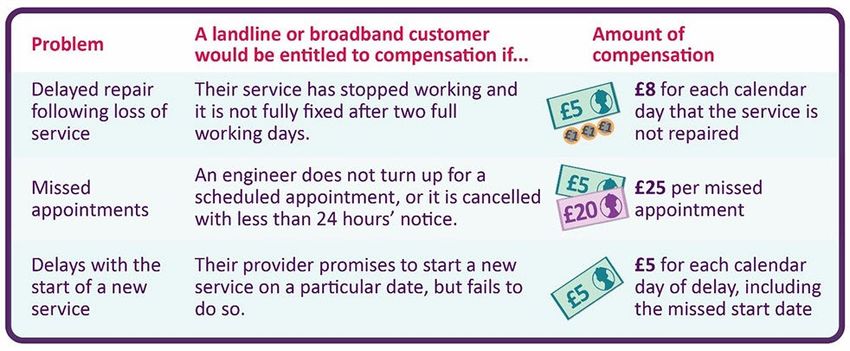
•    The automatic compensation scheme has resulted in an increase in the amount of
           compensation paid to landline and broadband customers when things go wrong. Five
           providers: – BT, Sky, TalkTalk, Virgin Media and Zen Internet – signed up to the scheme when it
           launched. Together they paid over £20.7m in automatic compensation over the six months
           between July and December 2019.

      The information in this report has been collected through our own research, directly from the larger
      telecoms providers, and from third parties. The high-level findings in this report are supported by an
      interactive data tool, which provides detailed information on how providers compare across all the
      data sets we have collected.

      Mobile phones 3
      Summary

                            Average
                            mobile           BT        EE
                                                            Giff Gaff        ID Mobile

                                                                                                O2
                                                                                                      Sky
                                                                                                             Tesco Mobile
                                                                                                                             ThreeMobile   Virgin Media    Vodafone

Satisfaction with
                             93%      N/A         93%       95%             N/A          93%         N/A    97%↑            89%            93%            90%
service overall

Customers with
                            3% ↓      3%          2%        2%              N/A          1% ↓        N/A     3%             6% ↑           3%             3%
a reason to complain

Overall satisfaction with
                             58%      N/A         59%       65%             N/A          59%         N/A    59%             60%            51%            52%
complaint handling

Average call
                            1:18 ↑    0:34        0:57      N/A             1:43         0:43        2:06   0:35            2:37           1:35           1:12
waiting time (mm:ss)

Ofcom complaints per
                             13 ↓     21           7        N/A             10            9          11         3            15            27             26
100,000 subscribers

      ↑↓ Significantly higher or lower than the previous year (2018) for all data sources with the exception of
      Customer Satisfaction tracker, for which the previous year was 2019.
        XX Statistically significantly better than the sector average at the 95% confidence level for market research
      results / top performer for MI data.
        XX Statistically significantly worse than the sector average at the 95% confidence level for market research
      results / bottom performers for MI data.

           •    As in 2018, more than nine in ten mobile customers (93%) were satisfied with the overall
                service provided. Compared to the previous year, Tesco Mobile customers were more
                satisfied with their overall service. 4

      3
        For definitions and methodology, see relevant report section and Annexes 1 and 3. Giffgaff does not have a
      call centre and it does not meet the market share threshold to be included in Ofcom’s published complaints
      data. Ofcom’s market research includes UK communications providers with a market share of c.4% or more.
      There are exceptions; providers that do not meet this level have been reported on if the base sizes are
      sufficient.
      4 Tesco Mobile and giffgaff use the O2 network and Virgin Mobile uses the EE network. Differences in

      satisfaction with network performance compared to these networks may be due to different geographic
      distribution of customers or, potentially, a halo effect.

                                                                        2
•    The average amount of time spent by mobile customers in a call queue was 1 minute 18
                seconds in 2019 (up by 25 seconds). Of the major mobile providers, the shortest average
                waiting time was from BT Mobile, at 34 seconds, while the longest was from Three, at 2
                minutes 37 seconds.
           •    We again received the fewest complaints (per 100k pay-monthly mobile subscribers, and of
                the major mobile providers) about Tesco Mobile in 2019 (three per 100k subscribers for
                pay-monthly mobile services, compared to an average of 13), while Virgin Mobile and
                Vodafone generated the most (at 27 and 26 per 100k subscribers).
           •    In line with 2018, nearly six in ten mobile customers who complained to their provider
                were satisfied with how the complaint was handled. 5 In 2019 Vodafone and Virgin Mobile
                customers were less likely than average to be satisfied.

      Home broadband and phone 6
      Summary: Home broadband

                              Average
                             broadband      BT        EE
                                                             K COM
                                                                      PlusNet
                                                                                Post Office
                                                                                                    Sky   TalkTalk
                                                                                                                     Virgin Media      Vodafone

Satisfaction with
                                85%        86%      88%      N/A      93%       N/A           86%         78%        85%            N/A
service overall

Customers with
                                12%        10%      15%      N/A      14%       10%           12%         14%        14%            12%
a reason to complain

Overall satisfaction with
                              53%↑       ↑57% ↑66%           N/A      49%       N/A           ↑62%        44%        46%            N/A
complaint handling

Average call
                              2:10 ↑      0:55     0:26     0:54      3:48      1:12          2:28        0:39       4:26           2:16
waiting time (mm:ss)

Ofcom complaints per
                               52 ↓        50       22       N/A      100          37          21         87          60            115
100,000 subscribers

      ↑↓ Significantly higher or lower than the previous year (2018) for all data sources with the exception of
      Customer Satisfaction tracker, for which the previous year was 2019.
        XX Statistically significantly better than the sector average at the 95% confidence level for market research
      results / top performers for MI data.
        XX Statistically significantly worse than the sector average at the 95% confidence level for market research
      results / bottom performer for MI data.

      5
        Complaints -handling fieldwork was conducted between 4 December 2019 and 6 January 2020 and asked
      about complaints made in the past six months (between June 2019 and January 2020).
      6
        For definitions and methodology, see relevant report section and annex; call waiting times are calculated for
      landline and broadband services together; Ofcom’s market research includes UK communications providers
      with a market share of c.4% or more. Where providers are not included in the market research this is due to
      their not meeting the inclusion criteria. There are some exceptions: providers which do not meet this criterion
      have been reported on if base sizes allow.

                                                              3
Summary: Landline

                              Average
                              landline      BT        EE
                                                             K COM
                                                                      PlusNet
                                                                                Post Office
                                                                                                    Sky   TalkTalk
                                                                                                                     Virgin Media        Vodafone

Satisfaction with
                                85%        90%      82%      N/A      83%       N/A           88%         83%        77%            N/A
service overall

Customers with
                                4%         4%       5%       N/A       6%         8%           3%         3%↓        3%             4%
a reason to complain

Overall satisfaction with
                                54%        54%      59%      N/A      52%       N/A           ↑60%        44%        49%            N/A
complaint handling

Average call
                              ↑2:10       0:55     0:26     0:54      3:48      1:12          2:28        0:39       4:26           2:16
waiting time (mm:ss)16

Ofcom complaints per
                               ↓38         31       17       N/A        78         34          18         69          49            65
100,000 subscribers

      ↑↓ Significantly higher or lower than the previous year (2018) for all data sources with the exception
      o6Customer Satisfaction tracker, for which the previous year was 2019.
        XX Statistically significantly better than the sector average at the 95% confidence level for market research
      results / top performers for MI data.
        XX Statistically significantly worse than the sector average at the 95% confidence level for market research
      results / bottom performers for MI data.

           •    Overall satisfaction with landline and home broadband was unchanged since the previous
                year (both at 85% this year). Overall satisfaction with broadband was higher than average
                among Plusnet customers and lower than average among TalkTalk customers. Overall
                satisfaction with landline was higher among BT customers and lower among Virgin Media
                customers, compared to the average.
           •    In 2019, the average time customers had to wait in a call queue for landline and
                broadband providers was 2 minutes 10 seconds (up 33 seconds on 2018). EE had the
                shortest average waiting time, at 26 seconds, while Virgin Media had the longest, at 4
                minutes 26 seconds.
           •    Among the major fixed telecoms providers, the average number of landline and of
                broadband complaints to Ofcom per 100k customers fell in 2019. Sky had the fewest
                broadband complaints (21 per 100k subscribers compared to an average of 52) and EE had
                the fewest landline complaints (17 per 100k compared to an average of 38). Vodafone had
                the most complaints for broadband (115 per 100k) and Plusnet had the most for landline (78
                per 100k).
           •    Compared to 2018, home broadband customers were more likely to be satisfied with how
                their complaint was handled, up four percentage points to 53% in 2019, driven by
                improvements from BT, EE and Sky. EE and Sky broadband customers were more likely than
                average to be satisfied with how their complaint was handled, while TalkTalk and Virgin

                                                              4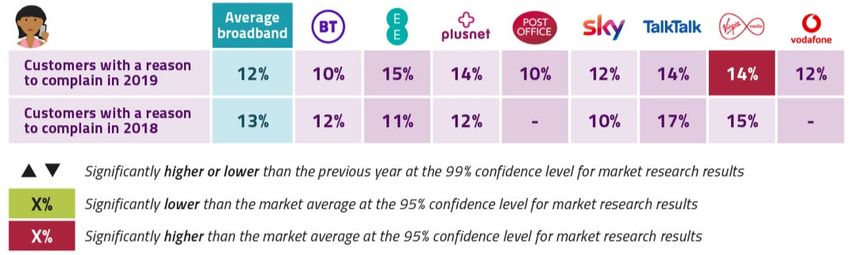
Media customers were less likely than average to be satisfied. For landline services, Sky
        customers were more likely than average to be satisfied with how their complaint was
        handled and TalkTalk customers were less likely.
    •   In 2019, 87% of customers received a new landline or broadband order by the date agreed,
        and on average 7 it took 11 days to get a new service installed (down by four days since
        2018).
    •   For the first time we have data from providers about how they manage faults. Across all
        fixed-line providers, about 46 faults were reported per 1,000 customers per month. Where
        there was a total loss of service, most providers took an average of two days to resolve
        faults 8, and the majority of providers were able to repair nine in ten total loss of service
        faults within a week.

We are working to help improve service quality for telecoms
customers
We have an ongoing programme of work to improve quality of service and to make sure customers
can access high quality, reliable services. Our work means telecoms customers are benefiting from
improvements in the delivery of new service installations and repairs or compensation if things go
wrong. Since our last service quality report, we have:

    •   carried out a review of the first year of the voluntary automatic compensation scheme. This
        shows that the scheme is operating as intended with landline and broadband customers are
        getting more compensation when things go wrong and without having to ask for it; 9

    •   evaluated our intervention with Openreach to improve its service standards. This evaluation
        shows that as a result of our intervention the service quality levels for on-time installations
        and repairs has improved for almost all services using Openreach; 10 and

    •   launched our ‘Fairness for Customers’ commitments, which major broadband, phone and
        pay-TV companies have signed up to.11 These include a commitment for customers’ services
        to work as promised and to be reliable, and for providers to respond and fix problems
        promptly and to help their customers.

7
  Using the median as a measure of the average as the mean is skewed by outliers
8
  Using the median as a measure of the average as the mean is skewed by outliers
9
  Ofcom, 2020. Improving compensation for landline and broadband customer: Review of the automatic
compensation scheme.
10
   Ofcom, May 2020. Improving broadband and landline standards
11
   https://www.ofcom.org.uk/about-ofcom/latest/media/media-releases/2019/broadband-and-phone-firms-
put-fairness-first

                                                   5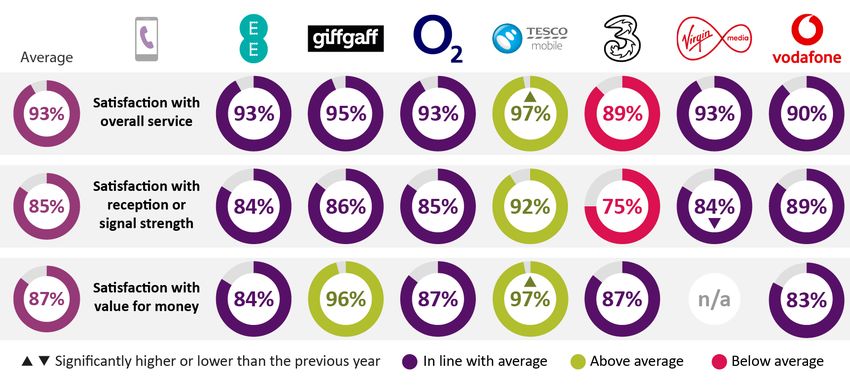
Comparison with other sectors
Mobile customers’ satisfaction with their overall service was in line with that for bank current
accounts and higher than for gas, electricity, landline and broadband. Broadband and landline
customers’ satisfaction with their overall service was in line with that for gas and electricity and
below that for mobile and for bank current accounts.
Figure 1: Overall satisfaction with services from communications providers, compared to current
account and energy providers

Source: Ofcom Customer Satisfaction Tracker 2020 (see Note A in Annex 1 for more details)

                                                     6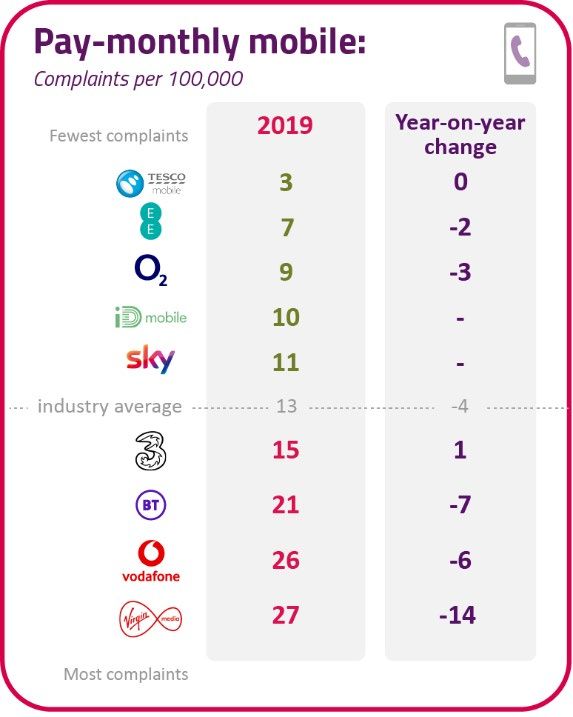
Contents

Overview............................................................................................................ 1
  Mobile phones .................................................................................................................................... 2
  Home broadband and phone .............................................................................................................. 3
  We are working to help improve service quality for telecoms customers ......................................... 5
  Comparison with other sectors........................................................................................................... 6

Residential mobile services ................................................................................ 8
  Satisfaction.......................................................................................................................................... 8
  Customer service ................................................................................................................................ 9
  Call waiting time and abandonment rates........................................................................................ 10
  Reasons to complain and numbers of complaints ............................................................................ 11
  Complaints to Ofcom ........................................................................................................................ 12
  Complaints handling ......................................................................................................................... 13

Residential broadband and landline services ................................................... 14
  Satisfaction........................................................................................................................................ 14
  Customer service .............................................................................................................................. 16
  Call waiting time and abandonment rates........................................................................................ 17
  Reasons to complain and numbers of complaints ............................................................................ 18
  Complaints to Ofcom ........................................................................................................................ 19
  Complaints handling ......................................................................................................................... 20

Fixed line: new services and repairs ................................................................. 23
  Getting a new service........................................................................................................................ 23
  Number of Faults .............................................................................................................................. 25
  Fault repair times .............................................................................................................................. 26
  Missed appointments ....................................................................................................................... 28
  Automatic compensation scheme .................................................................................................... 29

Annex 1: Consumer research source details .................................................... 32

                                                                           7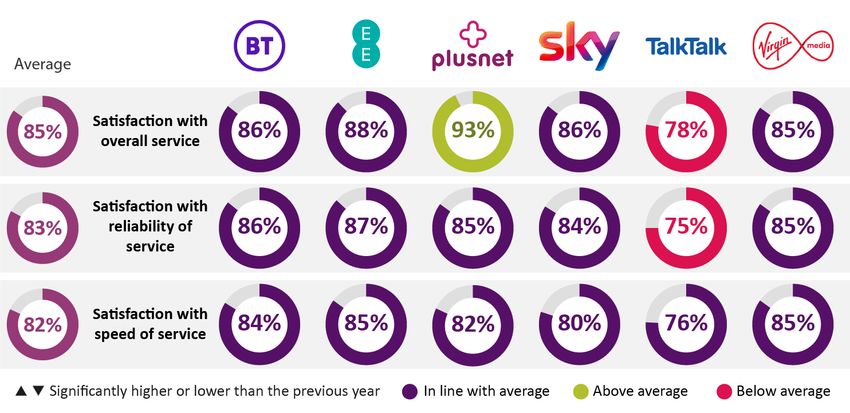
Residential mobile
                                                   services
Satisfaction
Overall satisfaction, and satisfaction with               with their reception or signal strength than in
reception or signal strength, 12 were lower               the previous year.
than average among Three customers and
higher than average among Tesco Mobile                    Satisfaction with the overall service reception
                                                          or signal strength, and value for money, were
customers, while satisfaction with value for
money was higher than average among                       in line with the previous year. Where
giffgaff and Tesco Mobile customers. Tesco                customers were dissatisfied, 13 the main cause
Mobile customers were more satisfied with                 was poor reception or coverage (70%),
their overall service (97% compared with 90%              followed by the mobile service being too
the year before) and with value for money                 expensive or not good value for money (21%),
(97% compared with 92% the year before).                  also in line with the previous year.
Virgin Mobile customers were less satisfied
Figure 2: Satisfaction with mobile service

Source: Ofcom Customer Satisfaction Tracker 2020 (see Note B in Annex 1 for more details)

12
   Tesco Mobile and giffgaff use the O2 network           different geographic distribution of customers or
and Virgin Mobile uses the EE network. Differences        potentially a ‘halo effect’.
in satisfaction with network performance                  13
                                                             3% said they were dissatisfied with their mobile
compared to these networks may be due to                  service overall.

                                                      8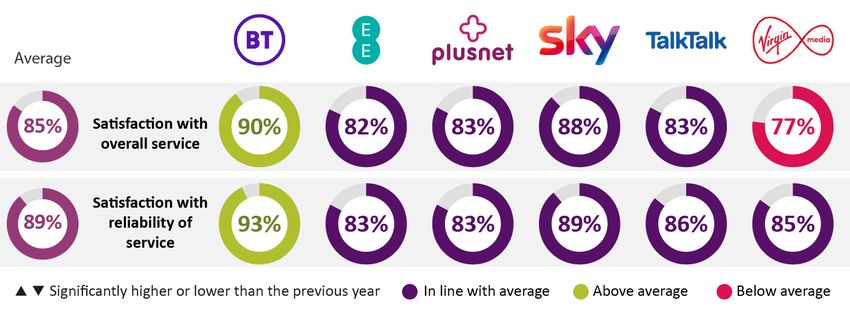
EE and Three customers were less likely than                Figure 3: Recommend to a friend: mobile
average to recommend their provider to a                    providers
friend, 14 while giffgaff and Tesco Mobile                                                     2019                                  2020
customers were more likely to do so. 15
                                                                  More likely to
For Three customers this aligned with lower                        recommend
                                                                                                GiffGaff, Tesco Mobile                GiffGaff, Tesco Mobile

levels of overall satisfaction, and for Tesco
Mobile customers, with higher levels of
overall satisfaction, while both EE and giffgaff                 Mobile average

customers reported average levels of                                                                                                O2, Vodafone, Virgin Media

satisfaction. However, willingness to
                                                                                     EE, O2, Three mobile, Vodafone, Virgin Media

                                                                   Less likely to
recommend may also have been linked to
                                                                   recommend
satisfaction with value for money, which was                                                                                             EE, Three Mobile

                                                            Source: Ofcom Customer Satisfaction Tracker 2019
higher among both giffgaff (96%) and Tesco
                                                            and 2020 (see Note C in Annex 1 for more details)
Mobile (97%) customers compared to the
average (87%).

Customer service
In 2019 all the major mobile providers offered              Figure 4: Customer contacts with mobile
phone calls, webchat, letter, email and online              providers, by channel: 2019
contact forms as ways in which their
customers could contact them, as well as
through social media. Overall, phone calls
were the most popular method of customer
contact 16 with major mobile providers,
accounting for 80% of contacts during the
year, followed by webchat at 19%.
                                                            Source: Ofcom / provider data, 2019. 17
                                                            Note: Due to changes in definitions this data is not
                                                            directly comparable to last year as it includes
                                                            incoming contacts from prospective customers.

14
   Net Promoter ScoreTM (NPSTM), see Annex 2 for            16
                                                               By ‘customer contact’ we mean a recorded
further details on how this metric is calculated.           instance when a residential customer or potential
Full results can be found in the data tables [Ofcom         customer interacts with a customer services agent
Customer Satisfaction Tracker 2020]                         or other employee to make an enquiry or
15                                                          complaint about their residential mobile service.
   The average ‘recommend to a friend’ score in
the mobile market was 25 The scores for individual          We have excluded interactions with mobile
                                                            applications as it is not possible to measure the
providers were as follows: EE (17), giffgaff (52), O2
                                                            number of interactions with a customer services
(30), Tesco Mobile (44), Three (10), Virgin Mobile
                                                            agent that originated within a mobile application.
(26) and Vodafone (27). Scores that were between            17
                                                               The figure shown for ‘email’ also includes
0 and 50 and are considered ‘good’ based on                 customer contacts by online contact form.
global NPSTM standards, while scores over 50 are
considered ‘excellent’.

                                                        9
In 2019, all the major mobile providers had a Call waiting time and
dedicated mobile application for their
customers. These apps enabled customers to
abandonment rates
view their bills, payment plans, tariff or The average amount of time spent by mobile
bundle changes and usage statistics (e.g. data customers in a call queue was 1 minute 18
use), and often offered a ‘self-serve’ option seconds in 2019 (up 25 seconds on 2018). Of
for answering queries. O2, Virgin Media and the major mobile providers, the shortest
Vodafone allowed customers to contact them average wait was for BT (34 seconds), while
via in-app messaging. Three had the longest average waiting time (2
Mobile providers also reported responding to minutes 37 seconds).
customer contacts via social media. Facebook Around 6.5% of calls to major mobile service
and Twitter were the most frequently used providers ended while the customer was
platforms, while BT Mobile, EE, Tesco Mobile waiting in a queue. Of those who submitted
and O2 also responded to customers via comparable data, 18 BT had the lowest
Instagram. abandonment rate, while Three had the
highest. Among those whose data were not
comparable, both O2 and Tesco Mobile had
improved since the previous year, while Virgin
Mobile’s abandonment rate had worsened.
Figure 5: Average call waiting times, by provider: 2019
Source: Ofcom / provider data, 2019.
Note: Some providers 19 were not able to provide comparable data. Abandonment average not comparable with
2018. 20
18
BT Mobile, EE, Three, Vodafone, Sky Mobile and information about their performance compared to
iD Mobile. the previous year has been included.
19
Lycamobile excluded as unable to provide 20
Not comparable with 2018 due to reduced
comparable data. O2, Tesco Mobile and Virgin number of providers included in the calculation to
Mobile unable to provide comparable data about ensure only comparable rates are used.
the percentage of calls that ended, so only
10Reasons to complain and The most common reason to complain was
that mobile services were not performing
numbers of complaints satisfactorily (61% of those who had reason to
Three per cent of mobile customers said they complain), either because of poor connection
had a reason to complain about their mobile quality, loss of service, or text or voice mails
service or supplier 21, down one percentage delivered late. This was followed by billing,
point since 2018. pricing or payment issues (24%). The
proportion of mobile customers who had a
Customers of Three were more likely than reason to complain about a problem relating
average to have had a reason to complain in to installation and/ or set-up of their device
2019, and this likelihood was up since 2018 fell from 5% in 2018 to 1% in 2019.
(6% vs. 2%), although this may be because
Three suffered a major network outage in
October 2019. O2 customers were less likely
than average to have a reason to complain in
2019, and less likely than in 2018. 22
Figure 6: Proportion of mobile customers who had a reason to complain in the past 12 months,
(whether or not they went on to make a complaint), by provider
Source: Ofcom Comparing Service Quality research 2019: Reasons to complain (see Note D in Annex 1 for more
information)
21
Reasons to complain fieldwork conducted 22
O2 suffered a network outage on 6 December
between 8 January 2020 and 28 January 2020 and 2018 which affected all operators using their
asked about reasons to complain in the past 12 network. This led to more O2 customers having a
months (between January 2019 and January 2020). reason to complain than the industry average in
2018, and compared with 2017.
11Complaints to Ofcom
Figure 7: Pay-monthly mobile complaints per
For the third consecutive year, Tesco Mobile 100k subscribers: 2019 23
generated the fewest complaints in 2019
(three per 100k subscribers for pay-monthly
mobile services), while Virgin Mobile and
Vodafone generated the most complaints per
100k subscribers (at 27 and 26 respectively).
In 2019, the average number of complaints
per 100k subscribers across all the major
providers fell from 17 to 13 complaints per
year.
Source: Ofcom CCT data (Q1 2019 – Q4 2019)
Notes: All figures are rounded to the nearest whole number; the industry average relates only to the providers
included in the analysis. The actual measurable difference between Virgin Media and Vodafone’s pay-monthly
mobile complaints per 100k subscribers is less than one, so their results should be considered comparable.
23
Ofcom reports on the number of complaints on pay-as-you-go mobile services, about which it
generated by the major mobile providers for pay- receives low volumes of complaints in comparison
monthly services each quarter but does not report with other services.
12Complaints handling
In 2019, Virgin Mobile and Vodafone customers in 2018. 24 Nearly six in ten mobile
customers were less likely than average to be customers who made a complaint to their
satisfied with how their complaint was provider in 2019 were satisfied with how their
handled, as was the case for Virgin Mobile complaint was handled, in line with 2018.
Figure 8: Overall satisfaction with mobile complaints handling
Source: Ofcom Customer complaints research: Quality of service 2018 and 2019 (see Note E in Annex 1 for more
information)
The proportion of mobile complaints that of this improvement was an increase in the
were completely resolved on first contact proportion of complaints to O2 that were
with the provider increased in 2019, up three resolved on first contact (48%, up from 39% in
percentage points since 2018. The main driver 2018).
Figure 9: Proportion of mobile complaints resolved on first contact
Source: Ofcom Customer complaints research: Quality of service 2018 and 2019 (see Note F in Annex 1 for more
information)
24
In 2018 satisfaction with complaint handling
among Vodafone customers was in line with the
average.
13Residential broadband and
landline services
Satisfaction
Overall satisfaction was higher among Where customers said they were dissatisfied 25
Plusnet broadband customers and lower with their home broadband service, the top
among TalkTalk broadband customers, two reasons were slow speeds, or speed not
compared to the average. TalkTalk broadband
as advertised (50%), and poor or unreliable
customers were also less satisfied than
average with the reliability of their service. connectivity (40%), in line with the previous
year.
Figure 10: Satisfaction with home broadband service
Source: Ofcom Customer Satisfaction Tracker 2020 (see Note G in Annex 1 for more information)
25
8% of customers said they were not satisfied
with their broadband service overall
14TalkTalk customers were less likely than Overall satisfaction was higher among BT
average to recommend their broadband landline customers and lower among Virgin
provider to a friend, which is consistent with Media landline customers, compared to the
the lower than average levels of satisfaction
average. BT customers were also more likely
reported by TalkTalk broadband customers. 26
than average to be satisfied with the reliability
Figure 11: Recommend to a friend: of their landline service.
broadband providers
Overall satisfaction with landline services and
2019 2020 satisfaction with the reliability of the service
More likely to none were in line with the previous year. Where
None
recommend
customers said they were dissatisfied, 27 the
top two reasons were ‘poor or unreliable
connectivity’ (45%) and ‘the service is too
Broadband expensive or not good value for money’
average (26%), in line with the previous year.
BT, EE, PlusNet, Sky, Virgin Media BT, EE, PlusNet, Sky, Virgin Media
Less likely to
recommend TalkTalk TalkTalk
Source: Ofcom Customer Satisfaction Tracker 2020
(see Note H in Annex 1 for more information)
Figure 12: Satisfaction with landline service
Source: Ofcom Customer Satisfaction Tracker 2020 (see Note I in Annex 1 for more information)
26
The average ‘recommend to a friend’ score in global NPS standards, while TalkTalk’s score was
the broadband market was 12. BT (12), EE (17), below 0 (-5).
Plusnet (15), Sky (9) and Virgin Media (19) have 27
3% of customers said they were not satisfied
‘recommend to a friend’ scores that are between 0 with their landline service overall.
and 50 and therefore considered ‘good’ based on
15All landline providers had ‘recommend to a Figure 13: Recommend to a friend: landline
friend’ scores that are considered ‘good’ 28 providers
(ranging from 5 to 27). Each landline provider 2019 2020
had a score that was in line with the industry More likely to
- -
average, with none significantly higher or recommend
lower than the average.
Landline
average
BT, EE, PlusNet, Sky, Virgin Media
BT, EE, PlusNet, Sky, Virgin Media, TalkTalk
Less likely to
recommend TalkTalk
Source: Ofcom Customer Satisfaction Tracker 2020
(see Note J in Annex 1 for more information)
Customer service
Phone calls were the most popular method of Figure 14: Customer contacts by
contact 29 across all of the major landline and channel, landline and home broadband
broadband providers in 2019, accounting for provider: 2019
an average of 87% of customer contacts,
followed by webchat at 8%.
Source: Ofcom / provider data, 2019. 30
Note: Due to changes in definitions this data is not
directly comparable to last year as it includes
incoming contacts from prospective customers
28
The average ‘recommend to a friend’ score in complaint about their residential mobile service.
the landline market was 12. All landline providers We have excluded interactions with mobile
have scores that are between 0 and 50 and applications as it is not possible to measure the
therefore considered ‘good’ based on global number of interactions with a customer services
NPSTM standards; BT (19), EE (11), Plusnet (27), agent that originated within a mobile application.
Sky (10), TalkTalk (9) and Virgin Media (5). 30
The figure shown for ‘email’ also includes
29
By ‘customer contact’ we mean a recorded customer contacts by online contact form. ‘Other’
instance when a residential customer or potential communication methods include text messaging
customer interacts with a customer services agent and Facebook Messenger
or other employee to make an enquiry or
16As with the mobile providers, most of the Call waiting time and
major landline and broadband providers
(except Plusnet and Post Office) offered their
abandonment rates
customers a dedicated mobile app in 2019, The average time customers had to wait in a
with a variety of functions. All the providers call queue for broadband and landline
with mobile applications reported payments providers was 2 minutes 10 seconds (up by 33
and bills as features of the app, and the ability seconds since 2018). EE had the shortest
to view usage statistics was a feature of most average waiting time, at 26 seconds, while
providers’ apps. The apps provided by Virgin Media had the longest, at 4 minutes 26
TalkTalk, Sky and Virgin Media allowed seconds. Generally, the shorter the call
customers to arrange repairs and services waiting time, the lower the proportion of
such as rescheduling call-out appointments. abandoned calls.
TalkTalk, Virgin Media and Vodafone also
allowed contact via in-app messaging. In 2019 6.9% of calls to major landline and
fixed broadband providers ended while the
Most landline and broadband providers customer was waiting in a queue. Of the
responded to customer contacts made over providers which submitted comparable
social media; Facebook and Twitter were the data, 31 EE had the lowest rate of call
most frequently used platforms. More abandonment (1.7%) and Sky had the highest
providers responded to customers via (15.9%). Of those which did not submit
Instagram than last year, with BT, EE, KCOM comparable data, TalkTalk and Virgin Media’s
and TalkTalk using this platform. Post Office abandonment rate had worsened since the
was the only landline and broadband provider previous year.
in our analysis which did not respond to
customers via social media.
Figure 15: Average call waiting times, landline and fixed broadband providers: 2019
Source: Ofcom / provider data, 2019. Note: Some providers 32 were not able to provide comparable
data. Abandonment average not comparable with 2018. 33
31
BT, EE, KCOM, Plusnet, Post Office, Sky and performance compared to the previous year has
Vodafone been included.
32
TalkTalk and Virgin Media were unable to 33
Not comparable with 2018 due to reduced
provide comparable data about the percentage of number of providers included in the calculation to
calls that ended, so only information about their ensure only comparable rates are used.
17Reasons to complain and numbers of complaints
Twelve per cent of broadband customers had The proportion of customers with a reason to
a reason to complain in 2019, in line with complain about a repair to their broadband
2018. Virgin Media customers were more service – for example if a repair did not take
likely than average to have a reason to place on time or at all, or the repair didn’t
complain about their broadband service in solve the problem ̶ has increased (from 3% in
2019. 2018 to 6% in 2019). This was driven by an
increase in the proportion of Virgin Media
The most common reason for customers to customers with a reason to complain about a
complain about their home broadband was repair to their broadband service in 2019
service issues such as slow broadband speeds (10%, compared to 3% in 2018).
and intermittent or total loss of service (at
80%), followed by billing, pricing or payment
issues (15%).
Figure 16: Proportion of broadband customers who had a reason to complain in the past 12
months, (whether or not they went on to make a complaint), by provider 34
Source: Comparing Service Quality research 2019: Reasons to complain (see Note K in Annex 1 for more
information)
The proportion of landline customers with a followed by billing, pricing or payment issues
reason to complain was 4% in 2019. (26%).
The most common reasons for customers to TalkTalk customers were less likely to have a
complain about their landline service related reason to complain about their landline
to service issues such as loss of service (55%), service in 2019 than in 2018.
34
Virgin Media is marked as higher than average at 14% while TalkTalk, EE and Plusnet are not, because their
results are not statistically significantly different from the average due to smaller base sizes.
18Figure 17: Proportion of landline customers who had a reason to complain in the past 12 months,
(whether or not they went on to make a complaint), by provider
Source: Ofcom Comparing Service Quality research 2019; Reason to complain (see Note L in Annex 1 for more
information)
Complaints to Ofcom
In 2019, Sky and EE generated the fewest complaints per 100k subscribers, while
broadband complaints to Ofcom per 100k Plusnet had the most landline complaints.
subscribers per year (Sky generated the
Among the major fixed telecoms providers,
fewest for the third consecutive year), while
for landline, EE generated the fewest the average number of landline and of
complaints to Ofcom per 100k subscribers. broadband complaints per 100k customers fell
in 2019 (from 43 to 38 for landlines and 58 to
Vodafone had the most home broadband
52 for broadband).
Figure 18: Fixed broadband and landline complaints per 100k subscribers: 2019
Source: Ofcom CCT data (Q1 2019 – Q4 2019).
Notes: All figures are rounded to the nearest whole number; the industry average relates only to the providers
included in the analysis in a particular year. The actual measurable difference between Sky and EE’s number of
fixed broadband complaints per 100k customers was less than one, so their results should be considered
comparable; Vodafone’s market share was not above the threshold for inclusion throughout 2018.
19Complaints handling
Broadband customers were more likely than In 2019, EE and Sky customers were more
in 2018 to be satisfied with how their likely than average to be satisfied with the
complaint was handled, up from 49% to 53%. way their complaint was handled, while
This can be attributed to increased levels of TalkTalk and Virgin Media customers were
satisfaction with complaints handling among less likely to feel this way
BT, EE and Sky customers, due to
improvements in the way these companies
dealt with complaints about service issues
such as slow speeds or intermittent
connection. 35
Figure 19: Overall satisfaction with broadband complaints handling
Source: Ofcom Customer complaints research: Quality of service 2018 and 2019 (see Note M in Annex 1 for
more information)
Broadband complaints were more likely than TalkTalk customers were less likely than
in 2018 to be completely resolved36 on first average to say their complaint was completely
contact with their provider (37% compared resolved on first contact with their provider,
to 32%); a return to 2017 levels. The increase while EE and Sky customers were more likely
in the proportion of broadband complaints than average to say this.
completely resolved on first contact in 2019
was attributable to improvements made by
BT, EE and Sky.
35
In the complaints-handling tracker, we ask about connection), and repairs and installation (such as
satisfaction with the handling of three broad types time taken to repair or install a service).
of complaint for each market (broadband, landline 36
Interviewing was conducted between 4
and mobile): billing and customer service issues December 2019 and 6 January 2020 and
(such as incorrect bill or dissatisfaction with complaints would have been made between June
customer service from a previous contact), service 2019 and January 2020. The timing of the
issues (such as slow speeds or intermittent complaint (during the six-month period) and the
resolution is not comparable across respondents.
20Figure 20: Proportion of broadband complaints resolved on first contact
Source: Ofcom Customer complaints research: Quality of service 2018 and 2019 (see Note N in Annex 1 for
more information)
Sky landline customers were more likely than Sky customers’ satisfaction with how their
average to be satisfied with how their landline complaints were handled had
complaint was handled, while TalkTalk increased since 2018.
landline customers were less likely than
average to feel this way. Overall satisfaction
with landline complaint handling was in line
with 2018.
Figure 21: Overall satisfaction with landline complaints handling
Source: Ofcom Customer complaints research: Quality of service 2018 and 2019 (see Note O in Annex 1 for
more information) * = Low base size (under 100)
21TalkTalk and Plusnet landline customers Just over four in ten landline customers who
were less likely than average to say their made a complaint to their provider said their
complaint had been completely resolved on complaint had been completely resolved on
first contact, while Sky landline customers
first contact, in line with 2018.
were more likely to say this.
Figure 22: Proportion of landline complaints resolved on first contact
Source: Ofcom Customer complaints research: Quality of service 2018 and 2019 (see Note P in Annex 1 for more
information)
* = Low base size (under 100)
22Fixed line: new
services and repairs
Getting a new service 37
Overall, providers reported that 87% of all On average, it took 11 days to complete a
landline and broadband orders were new landline or broadband order (either a
delivered by the date agreed with the new service, home move or a change to
customer in 2019. 38 When a customer was service), four days faster than last year. On
moving home and staying with the same average, it took a day longer to deliver a new
provider, 86% of these types of orders were service in rural areas than in urban areas.
delivered by the agreed date.
Figure 23: Average time to deliver a service, from order to delivery (days)
Source: Ofcom / provider data, 2019.
The type of new service ordered can affect Changing the service received from an
the time taken to deliver the service. The existing supplier is the quickest of these
changes can be categorised as: processes. Home moves typically take the
longest. However, there was significant
• obtaining a service from a new variation between providers. Virgin Media
provider; was the quickest across all three types, while
• moving to a new house and staying Post Office was slower than average. Plusnet
with the same provider; and was the slowest at delivering a new service
• changing the service provided by an when customers move house.
existing supplier (such as moving to a
higher-speed broadband service).
37
For further details on the providers included and the methodology used see Annex 3.
38
This data is not directly comparable with last year as it does not include all rearranged appointments
23The average time to change provider is 14 providers that use the Openreach and KCOM
days. It is unlikely to fall significantly below 14 networks. 39 Most providers take a similar
days as Ofcom rules specify a minimum amount of time to complete a switch.
transfer period for most switches between
Figure 24: Average time to change a service, home move and switch provider (days)
Source: Ofcom / provider data, 2019
Landline and broadband providers completed low install base compared to other
a large majority of orders within four weeks. A technologies.
small minority of orders took more than four
weeks to be delivered. In 2019, 4% of orders Figure 25: Average time to deliver a service,
by technology (days)
(about 300,000 in total) took more than four
weeks to be delivered, while less than 1% of Average
Technology
new installations took more than eight weeks delivery days
to be completed. Providers reported that
when installations took longer than four
ADSL 15
weeks, this was often because of street works FTTC 12
(road opening issues, permission to dig) or
issues with building the network to the Cable (DOCSIS) 7
customer’s home (problems with access to
land and property, such as getting landlord Cable (DOCSIS over Fibre) 13
permission).
FTTP 13
On average, full-fibre services were delivered
in a similar timeframe as other broadband Landline PSTN 17
services. Full-fibre is still a relatively new
deployment technology and has a more Landline VoIP 25
complex installation process and a relatively Source: Ofcom / provider data, 2019
39
Switches between providers using the including between networks (e.g. from Openreach
Openreach or KCOM copper (including FTTC) to Virgin Media) and to/from full-fibre, are
networks take at least ten working days. This gives currently under review.
time for customers to ‘stop the switch’ if they have https://www.ofcom.org.uk/consultations-and-
not agreed to it or have changed their mind (e.g. if statements/category-1/proposals-to-implement-
they are told they need to pay an early new-eecc
termination charge). The rules for switching,
24Number of Faults
Across the industry, providers received about 46 reported faults 40 per 1,000 fixed line broadband
and landline customers per month during the relevant reporting period. 41
Figure 26: Reported faults per 1000 customers per month, by provider
Source: Ofcom / provider data, July-Dec 2019
Note: EE, Post Office and KCOM data are based on Sept to December.
Not all faults are the result of a failure or voice service (if no broadband is taken) or
degradation of the provider’s network or both voice and broadband services, rather
service. Sometimes the cause of the fault is in than solely the broadband service. It is also
the customer’s own home (or an area for the case that in-home issues related to
which they are responsible), such as problems devices or signal interference are more likely
with in-home wiring or misconnections to affect broadband performance than
between devices. On average, just under half landline performance.
of fixed-line faults reported to providers
Figure 27: Proportion of identified causes of
were identified to be within the customer
reported faults, by responsibility
domain (Figure 27). The others were the
result of a failure of the provider’s network or Customer Not customer
Service
domain domain
service, or where a specific cause could not be
conclusively established.
Broadband 50% 50%
faults
Broadband faults were split equally between
those that were found to be the customer’s ‘Voice’ or ‘voice 40% 60%
responsibility and those that were the and broadband’
provider’s responsibility. However, of the faults
faults that related to voice, or voice and
broadband services, fewer were considered All faults 49% 51%
to be in the customer’s domain. This may be
because physical network faults on a landline
Source: Ofcom / provider data, 2019
(e.g. damage) are more likely to affect the
40
A fault can be anything that a customer reports to a provider regarding the degradation or even complete
failure of the service. See Annex 3 for more details.
41
Most providers submitted data for July to December 2019. EE and KCOM’s data cover September to
December. Methodology Annex 3 describes the reporting periods in more detail.
25Fault repair times
There was little variation in the time taken to Three-quarters of total loss of service (TLOS)
fix faults where there was a total loss of faults were not considered to be the
service (TLOS). Almost all of the providers customer’s responsibility.
included in our analysis took an average of
two days or less to resolve these faults. 42
Figure 28: Average (median) 43 time taken to repair/resolve TLOS faults
Source: Ofcom / provider data, 2019.
*KCOM data only relates to TLOS faults that required an engineer visit.
Most providers were able to fix nine out of engineer needs to be dispatched to
ten faults within a week. Long resolution/ investigate, either to the customer’s property
repair times might be because the operator or to somewhere else in the provider’s
needs access to a building or permission to dig network (such as a street cabinet). Fault
up the street to repair cables. The time taken resolution typically took almost two days
to fix a fault can depend on whether an longer when an engineer was required.
Figure 29: Distribution of repair times, by provider
Source: Ofcom / provider
data, 2019
Note: KCOM is excluded
from this analysis as its
data only relates to TLOS
faults that required an
engineer visit.
42
To ensure consistency and comparability reporting fault repairs. Further information on the
between providers, we used a stricter definition of data gathered and the definitions used can be
a fault: a total loss of service (TLOS). This excluded found in the Methodology Annex 3.
issues such as intermittent faults or where 43
The median repair time is the value (duration) at
broadband speeds have degraded, to avoid the midpoint: Half of the repair times will be lower
subjective judgements by the providers when than this value; the other half longer.
26Of the Virgin Media faults that were fixed on result in multiple customer fault reports, but
the same day, around two-thirds were due to may be quickly resolved remotely without the
broadband outages where multiple customers need to send an engineer. This might explain
reported faults in the same locality. This may the slightly higher reported fault rate (Figure
be due to the way in which broadband 26), yet faster resolution times (Figures 28
services are delivered over Virgin Media’s and 29) and lower re-contact rates (Figure 31
predominantly cable broadband network. A below) below) for Virgin Media customers.
single fault in the local access system can
Figure 30: Distribution of repair times with / without engineer visit
Source: Ofcom / provider data, 2019
Note: Excludes KCOM.
The time taken to fix a fault can also depend The majority of faults were fixed at the first
on the type of service that has stopped attempt. On average, customers had to re-
working. Voice and voice and broadband contact their provider regarding around one
faults took a day longer to fix than in ten faults, with notable variations between
broadband-only faults and, as noted above, providers. 44
they were more often found to be caused by
issues in the provider’s domain.
44
The data captured whether the customer re- within 48 hours of the first recording of
contacted the provider regarding the same fault completion.
27Figure 31: Proportion of re-contacts within 48 hours, by operator
Source: Ofcom / provider data, 2019
* KCOM is excluded from this analysis as its data only relates to TLOS faults that required an engineer visit;
TalkTalk did not provide any re-contact data.
Missed appointments
Time slots for installations offered by three-hour slots to customers, either Monday
providers were broadly consistent in 2019, as to Friday or Monday to Saturday. TalkTalk also
many providers used Openreach’s standard offered two- to three-hour time slots, while
Monday to Friday 8am-1pm or 1pm-6pm KCOM and Virgin Media offered three- to
time slots. Virgin Media offered the same four-hour time slots using their own
slots using its own engineers. KCOM also used engineers. While most providers offered
its own engineers and offered two- and four- engineer visits between 7am and 8pm, EE,
hour slots, while BT additionally offered Virgin Media, and KCOM engineers were
premium slots (7am to 8am and 6pm to 8pm). available for fewer hours of the day.
Providers all offered shorter timeslots for The proportion of missed appointments by
fault repairs in some circumstances. In Openreach engineers has fallen significantly
addition to using Openreach’s standard time since reporting started in 2016, for both
slots, most operators also used third-party installations and repairs. 45
Qube or Enjoy engineers who offered two- to
Figure 32: Proportion of missed appointments by Openreach, by appointment type
Openreach network 2016 2017 2018 2019
Installation 3.6% 1.9% 1.9% 1.4%
Repair 2.8% 1.8% 1.8% 1.5%
Source: Ofcom analysis of provider data, 2019.
Notes: 2018 and 2019 data were derived from information provided by Openreach whereas data for previous
years were collected only from operators. As a result, data are not directly comparable between these years.
45
Next year we will also report on missed
appointments by non-Openreach engineers.
28In 2019, Virgin Media missed 0.7% of all engineer appointments for installations, up from 0.1% in
2018. The proportion of engineer-missed repair appointments increased from 0.4% in 2018 to 1.7%
in 2019. 46 KCOM missed 0.1% of installation appointments and 3.5% of repairs in 2019.
Figure 33: Proportion of missed appointments by Virgin Media, by appointment type: 2016-2019
Virgin Media network 2016 2017 2018 2019
Installation 0.6% 0.4% 0.1% 0.7%
Repair 0.2% 0.3% 0.4% 1.7%
Source: Ofcom analysis of provider data, 2019.
Automatic compensation scheme
The automatic compensation scheme has appropriate redress when they experience
generated more compensation for landline problems with their service. The scheme
and broadband customers when things go requires that signatories pay compensation,
wrong. Launched in April 2019, the automatic without the customer having to ask for it, for
compensation scheme for residential delayed repairs following a loss of service,
broadband and landline customers was missed repair or provision appointments, and
designed to ensure that customers receive delays to the start of a new service. 47
Five providers – BT, Sky, TalkTalk, Virgin over £20.7m in automatic compensation
Media and Zen Internet – signed up to the between July and December 2019. 48 This is
scheme when it launched. Together they paid notably higher than the compensation all
46
As per previous reports, Openreach defines an appointment as missed if the engineer does not arrive during
the originally agreed slot or arrives before the agreed slot without the prior agreement of the customer,
whereas Virgin Media classes an appointment as missed if it does not take place on the scheduled day.
47
Paragraph 40 of the automatic compensation scheme specifies the exceptional circumstances in which
signatories are not obligated to pay automatic compensation. Ofcom analysis of data provided by BT, Sky,
TalkTalk and Virgin Media suggests that in 2019 the most commonly cited exception was that the customer is
at fault for the service failure or prevents the service issue from being resolved.
48
BT, Sky, TalkTalk, Virgin Media and Zen Internet response to formal information request dated 6 June 2020.
29providers were paying out before the scheme (particularly on delayed repairs) over the last
was introduced. We estimated landline and few years. 50
broadband customers were receiving £8m in
compensation over an equivalent six-month Figure 34 shows how much compensation was
period for loss of service incidents, missed paid for each service issue between July and
appointments, and delayed provisions. 49 In December 2019. These figures do not include
addition, we note that this increase in any compensation that was paid over and
above what is required under the scheme.
compensation is despite significant
improvements in Openreach quality of service
Figure 34: Amount of automatic compensation paid
Amount of automatic compensation paid July-
Service issue
December 2019
Delayed repair following loss of service £9.7m
Missed appointments £1.6m
Delayed provision of a new service £9.5m
Source: Ofcom analysis of provider data, 2019
Almost 600,000 automatic compensation automatic compensation without having to
payments were made in July to December ask for it. This is higher than the estimated
2019. 51 Figure 35 shows that in 2019 there number of compensation payments paid for
were more almost 600,000 incidents of either an equivalent six-month period before the
loss of service, delayed provision or missed scheme was introduced. 52
appointments for which a customer received
49
£5.9m for loss of service incidents; £1.9m for 51
BT, Sky, TalkTalk, Virgin Media and Zen Internet
delayed provisions; and £0.4m for missed response to formal information request dated 6
appointments. Ofcom, March 2017. Automatic June 2020.
Compensation: Protecting consumers from 52
440,000 payments for loss of service incidents;
quality of service problems, page 77, converted 20,000 payments for missed appointments; and
from annual to six-month averages. Figures 80,000 payments for delayed provisions. Ofcom,
represent averages across the period Q3 2014 to March 2017. Automatic Compensation: Protecting
Q2 2016. Loss of service payments include consumers from quality of service problems, page
compensation paid for a loss of service that was 77, converted from annual to six-month averages.
repaired within two working days. Figures represent averages across the period Q3
50
For further details on improvements in 2014 to Q2 2016. Loss of service payments
Openreach service quality see Ofcom, 2020, includes compensation paid for a loss of service
Improving broadband and landline standards: A that was repaired within two working days.
review of how Ofcom’s service quality rules have
affected Openreach’s service level performance.
30Figure 35: Number of automatic compensation payments made
Volume of automatic compensation payments
Service issue
July – December 2019
Delayed repair following loss of service 309,000
Missed appointments 59,000
Delayed provision of a new service 228,000
Source: Ofcom analysis of provider data, 2019. All figures are rounded to the nearest 1,000.
Ofcom analysis of the data provided found under the scheme. Further details of our
that the amount of compensation signatories assessment of the scheme can be found in our
paid in these instances is in line with the review of the automatic compensation
values signatories are required to pay out scheme, published alongside this report. 53
53
Ofcom, 2020. Improving compensation for
landline and broadband customer: Review of the
automatic compensation scheme.
31You can also read


