DIGITAL CONSUMER INSIGHTS 2018 - Convenience, Privacy and the Consumer Fraud Response Cycle - Experian
←
→
Page content transcription
If your browser does not render page correctly, please read the page content below

DIGITAL CONSUMER
     INSIGHTS 2018
    Convenience, Privacy and
        the Consumer Fraud
             Response Cycle
04 UNDERSTANDING DIGITAL CONSUMERS’ ATTITUDES AND BEHAVIOURS
   TOWARD FRAUD
05     The Consumer Fraud Response Cycle

06 DIGITAL VOYAGERS AND DIGITAL PRAGMATISTS
07     The Trade-offs in Consumer Decision-making

09 DESIRE FOR CONVENIENCE
10     The Interplay of Convenience and Fraud
11     Higher Digital Consumption: A Calculated Risk
12     Frictionless Payments for a Better Customer Experience?
13     Encouraging Signs for Biometrics

14 PROPENSITY TO SHARE PERSONAL DATA
15     In a Privacy-Guarded World
16     To Share or Not to Share?
17     Consumers are Selective about What They Share and with Whom
18     Better Fraud Protection is Highly Valued
19     Consumers: A Source of Selective Truth

20 RISK PERCEPTION
21     The Shifting Line of Defence
22     In the Absence of Alternatives
23     How Consumers View Fraud Management Competencies
24     Consumer Precautionary Measures: Non-conclusive Impact to Fraud Reduction

25 WHERE THE DIGITAL VOYAGE ENDS… OR REALLY BEGINS
26     From Reactive to Proactive Fraud Management
27     5 Best Practices of a Multi-Layered Approach
28     Impetus to Act Now in the Future of Commerce

Page 2 | Digital Consumer Insights 2018

bsorbing indefensible fraud losses to appease consumers
    ironically costs businesses their brand and customers’ trust.

 The results from the latest Experian-IDC study show that the prevailing practice to bear the
 cost of fraudulent transactions is no longer a solution to mitigating digital fraud risks and
 losses. Against the rising trend of digitalisation, businesses are challenged to accurately
 identify and verify the authenticity of digital transactions.

 When fraudulent transactions occur, customers fall into what IDC terms as a consumer fraud
 response cycle. There are 3 dimensions that define this response cycle: their desire for
 convenience, their propensity to share personal data, and their risk perception.

The reality is that consumers, in the aftermath of fraud incidents, adjust their
perceptions and behaviours. Left unmanaged, they are likely to spiral into a vicious
response cycle that can counteract the effectiveness of the fraud measures taken
by businesses.

 The vicious cycle manifests in two ways – further defined by the two consumer clusters that
 our study identified – Digital Voyagers and Digital Pragmatists. These two groups differ in the
 ways they make trade-offs; each set of trade-offs is reinforced by differing risk attitudes and
 perceptions, resulting in two different sets of outcomes: escalating fraud losses as Digital
 Voyagers increase their digital consumption, or lost revenue opportunities as Digital
 Pragmatists switch to competitors who do better at fraud management.

 This report takes a closer look at how Asia-Pacific businesses fare in fraud management,
 through their customers’ eyes. We conclude that businesses can, and must, improve user
 authentication and experience as well as increase verification accuracy through measures
 such as biometric security and data sharing. To protect brand trust, businesses must adopt
 a multi-layered fraud management strategy comprising customer engagement, real-time
 data-centricity, and industrial/regulatory collaboration. The proliferation of digital business
 models foretells increasing revenue share from digital products and services; those who
 can forewarn fraud before their customer does, will gain consumer trust and reap the most
 benefits.

 “We do not think there is one single solution to eliminate fraud.
 Everyone needs to play a part.”
 ~ Retailer in Asia

                                                                               Digital Consumer Insights 2018 | Page 3
UNDERSTANDING DIGITAL
CONSUMERS’ ATTITUDES AND
BEHAVIOURS TOWARD FRAUD
    hrough the report’s online survey covering 3,200 respondents across 10 countries in Asia-Pacific, we identified
    9 behavioural characteristics and 3 dimensions relating to fraud incidence and fraud mitigation strategies.

                DESIRE FOR                         PROPENSITY TO                               RISK
               CONVENIENCE                          SHARE DATA                              PERCEPTION
    Consumers’ choice of channel              The more loosely personal                 Consumers who have
    hinges on the convenience and          information is shared, the more          experienced fraud — directly
    security factors as well as user        susceptible consumers are to            or indirectly — are more likely
              experience.                    data leaks and identity theft.         to stay away from unsecured
                                                                                     transaction environments.

          Consumption of                        Receptiveness to use                    Guardedness against
          digital services                      personal information for                personal data at risk
                                                fraud detection

          Adoption of mobile                    Receptiveness to reuse                  Tolerance to fraud
          payment                               personal data between                   incidence
                                                businesses

          Adoption of biometrics                                                        Perceived effectiveness of
                                                Quality of data submitted
          for commercial use                                                            how organisations handle
                                                                                        fraud

Page 4 | Digital Consumer Insights 2018
THE CONSUMER FRAUD
    RESPONSE CYCLE
         he report also draws correlation between the 9 consumer behavioural characteristics and fraud occurrence:
         70% or higher reflects a high level of correlation but does not necessarily mean causation. There is a two-
         way dynamic relationship between consumers’ actions and fraud risk exposure in that consumer actions can
         affect one’s level of fraud exposure, and conversely fraud exposure can also trigger consumer behaviours.

         The interplay of the 3 dimensions further illustrates the consumer fraud response cycle, providing businesses
         with a holistic view of how consumers’ attitudes in one dimension drives behaviours in the others.

                               92     %
                                                                                                78     %
                                             Consumption                                                         Receptiveness to
                                             of digital                                                          use personal data
                                             services                                                            for better fraud
                               Correlation                                                      Correlation      detection

     78
                   Positive experience
              %
                                                                                                                             80         %   Data quality
                   with mobile
                                                                                                                                            (demographics
                   payment
     Correlation                                                                                                                            e.g., age)
                                                                                                                              Correlation

80                                                                                                                       89%
                                                                                                                                        Receptiveness to
       %      Adoption of
              biometrics for                                                                                                            reuse personal data
              commercial use                                                                                                            between businesses
Correlation                                                                                                              Correlation

 How does fraud exposure relate                                                                                            How does a high or low level of
 to one’s adoption of biometric                                                                                            fraud exposure relate to one’s
 security measures?                                                                                                        willingness to share data with
                                                                                                                           businesses?

                           73                                                              46%
                                             Tolerance to
                                      %      fraud incidence
                                                                                                              Perceived effectiveness
                                                                                                              of how organisations
                                             - perception                                                     handle fraud
                           Correlation                                                     Correlation

                                                               22%
                                                                             Guardedness
                                                                             against personal
                                                                             data at risk
                                                               Correlation
                                                                Do consumers’ precautionary
                                                                measures alone mitigate one’s
                                                                fraud risks?

                                                                                                                             Digital Consumer Insights 2018 | Page 5
DIGITAL VOYAGERS AND
DIGITAL PRAGMATISTS
Further analysis of the
consumer fraud response
cycle revealed two consumer
segments.
The behavioural differences of Digital
Voyagers and Digital Pragmatists — and
how they result in higher or lower fraud
exposure — help businesses understand
the effectiveness of their fraud mitigation
strategies. We will delve into the 3 dimensions
in the following sections.

Page 6 | Digital Consumer Insights 2018

DIGITAL VOYAGERS AND DIGITAL PRAGMATISTS

THE TRADE-OFFS IN CONSUMER
DECISION-MAKING
 igital Voyagers and Digital Pragmatists differ in their trade-off decisions along the 3 dimensions of the fraud
 response cycle. Digital Voyagers’ desire for convenience outweigh their fraud risk perceptions, while a high
 fraud risk perception drives risk avoidance in Digital Pragmatists.

  DIGITAL VOYAGERS                                                      DIGITAL PRAGMATISTS

                         Higher consumption of                  Fraud is not acceptable
                         digital services                       Higher tendency to switch
                         Higher adoption of mobile              providers in the event of fraud
                         payment
     Desire for                                                                                             Risk
    convenience                                                                                          perception
                         Higher willingness to share            Lower willingness to share data
                         data to get better experience          to get better experience
                         Lower quality of submitted             Higher quality of submitted
                         data                                   data
   Propensity to                                                                                       Propensity to
  share personal                                                                                      share personal
       data                                                                                                data
                         Lower tendency to switch               Lower consumption of digital
                         providers in the event of fraud        services
                                                                Lower adoption of mobile
                                                                payment
       Risk                                                                                              Desire for
    perception                                                                                          convenience

                Increased                                                                    Digital
             fraud exposure                                                            Pragmatists turn
              does not put a        How Digital Voyagers and Digital                 to safer alternatives
           damper on Digital                                                              to minimise
            Voyagers’ digital         Pragmatists behave point to                       their fraud risk
              consumption          unsustainable business economics.                       exposure
                                        How businesses manage fraud in
                                  accordance to these 3 dimensions affect their
 Business impact        ability to balance between fraud management effectiveness                   Business impact
                    and maximising revenue potential. Neglect in one or more of these
                      dimensions triggers one of the two cycles of fraud responses.

      HIGHER                                                                                                 LOST
      FRAUD                                                                                                 DIGITAL
      LOSSES                                                                                               REVENUE

                                                                                           Digital Consumer Insights 2018 | Page 7
DIGITAL VOYAGERS AND DIGITAL PRAGMATISTS

W      hile the survey results also reveal general segmentation at a country level (Japan, New Zealand, Australia,
       Hong Kong and Singapore as Digital Pragmatists; Thailand, China, India, Indonesia and Vietnam as Digital
       Voyagers), the two segments are in essence a continuum of shifting consumer behaviours within the consumer
       fraud response cycle. The reality is that consumers shift between the two segments, varying by context.

           Low risk              Low         Less risk                   High risk     Guarded in      Security
          perceptions       cautiousness     adverse                    perceptions   data sharing     trumps
                           in data sharing                                                           convenience

                        Percentage of respondents
                        who have directly experienced
                        fraud

                    Like seafaring pioneers, Digital Voyagers explore and seek discoveries before
                            eventually settling down in new lands as Digital Pragmatists.

Page 8 | Digital Consumer Insights 2018
DESIRE FOR
CONVENIENCE
The convenience dimension
is represented by three
behaviours: consumption of
digital services, perceived
convenience of mobile
payment, and biometric
adoption.

                              Digital Consumer Insights 2018 | Page 9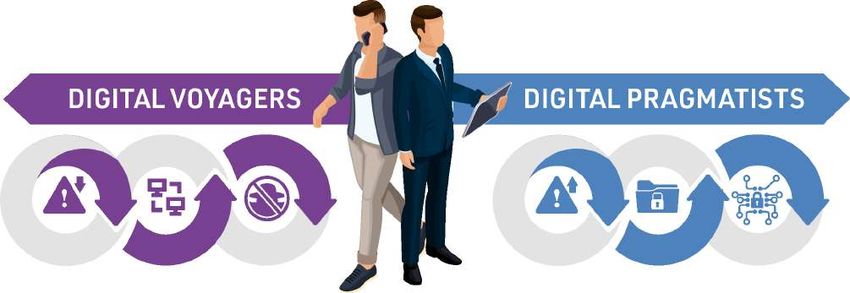
DESIRE FOR CONVENIENCE

THE INTERPLAY OF
CONVENIENCE AND FRAUD
    he more consumers choose convenience through digital channels, the greater is the fraud exposure
    for both consumers and businesses.

Consumers who have higher fraud exposure (Digital Voyagers) also have a higher propensity to
adopt convenient security measures such as biometrics. This points to opportunities for businesses to
improve their fraud mitigation measures.

                                  Where Digital Voyagers and Digital Pragmatists differ

                                 Consumption               Positive experience           Adoption of
                                 of digital                with mobile                   biometrics for
                                 services                  payment                       commercial use

                                     DIGITAL VOYAGERS                              DIGITAL PRAGMATISTS

                         Consumption of                  Adoption of mobile                 Adoption of biometrics in
                         digital services1             payment and perceived                   commercial apps3
                                                           convenience2
                                     78%                              65%                                    17%
                                     62%                              49%                                    9%

We asked respondents about:
1
  Their purchase frequency of groceries, F&B, beauty, fashion, electronics, travel, app downloads and improvement items via online channels.
2
 Their frequency of adoption of micro/mobile payment solutions such as contactless cards and in-app mobile wallets.
3
 Their openness to using biometrics such as fingerprint, face recognition and iris scanning for user authentication.

Page 10 | Digital Consumer Insights 2018
DESIRE FOR CONVENIENCE
HIGHER DIGITAL CONSUMPTION:
A CALCULATED RISK
ncreasing digital transactions translates into increasing fraud exposure for businesses. In the case of
fraudulent transactions, consumers are often covered through chargeback protection, which transfers the
fraud loss to either the issuing banks, payment processors or retailers (liability shift rules vary with mode
of payment).
With consumers expecting counterparty
businesses to be responsible for fraudulent
The rise of the Next Billion consumers in emerging Asia
transactions, implicitly, businesses become
and the associated surge in mobile Internet connections
responsible for the increasing fraud
continue to alter shopping patterns in the region.
exposure which consumers open themselves
to. Vietnam is aiming to reduce cash transactions to become
a 90% cashless economy by 2020. The nation has its
Aside from the financial impact, one Chinese work cut out for itself as it navigates the complexities
online retailer notes “there is impact on and challenges of creating sustainable and secure digital
brand reputation as fraud happens when payments.
consumers are transacting through our Web
site”.
80%
70%
60%
50%
28%
of respondents in Vietnam
40%
have experienced fraud
compared to 6% in Japan
30%
20%
10%
0%
Japan New Australia Hong Singapore Thailand China India Indonesia Vietnam
Zealand Kong
Consumption of digital services1 Fraud experienced2
We asked respondents about:
1
Their online purchase frequency of groceries, F&B, beauty, electronics, travel, and app downloads
2
Their direct/indirect encounters with fraud in the past 12 months
Digital Consumer Insights 2018 | Page 11DESIRE FOR CONVENIENCE
FRICTIONLESS PAYMENTS FOR A
BETTER CUSTOMER EXPERIENCE?
cross the region, 63% of those who have adopted mobile payments consider such payment
options highly convenient. Mobile payment adoption is markedly higher in developing markets due
to the accessibility and convenience afforded by mobile services such as online ticketing, mobile
gaming, bill payment, fund transfers, ride-hailing, and food delivery.
To encourage market penetration, many digital platform businesses have launched accompanying
payment wallets for a seamless payment experience. In particular, consumers in developing markets
are early adopters of digital wallets; for the unbanked segment, it is one of the limited means to access
digital products and services.
Indonesia:
Adoption of mobile One of the fastest-growing ecommerce
payment and perceived markets in the world, Indonesia shares
similarities of China’s early days in
convenience
that inefficiencies in the traditional
retail infrastructure and the vast
70% geographical distances spur online
China: spending. The emergence of digital
Chinese consumers’ high mobile payment adoption is wallets such as Go-Jek Pay and
60%
driven by payment giants Alipay and WeChat. Alipay GrabPay, along with digital services
reports 520 million online and mobile payment users1 from Tokopedia, Traveloka and Lazada,
while WeChat owner Tencent has reported that its are driving consumers toward digital
50%
active mobile payment accounts and daily payment consumption.
transaction volume both exceeded 600 million at the
end of December 20162.
40%
30%
20%
10%
0%
Japan New Australia Hong Singapore Thailand China India Indonesia Vietnam
Zealand Kong
Adoption of Mobile Payment Agree that mobile payment is convenient
Positive outlook for mobile wallets
Sharing economy services and new mobile payments options will grow in tandem as consumers demand a
seamless payment experience and countries across the region strive to become cashless economies.
IDC: eWallet solutions are expected to be the fastest-growing and most important form of online payment
in the years ahead. In Southeast Asia alone, eWallet gross transaction value (GTV) is expected to grow from
US$6.5 billion in 2016 to US$24.4 billion in 2021, at a CAGR of over 30.3%.
1
Source: Tencent Research Institute’s 2017 Mobile Payment Usage in China Report
2
Source: WeChat Website
Page 12 | Digital Consumer Insights 2018DESIRE FOR CONVENIENCE
ENCOURAGING SIGNS FOR
BIOMETRICS
merging biometric security solutions are designed to address both areas of improved user
experience and stronger authentication, but are consumers willing to adopt the technology?
57%
Almost 4 times as many consumers 13% Respondents comfortable with use of biometrics
in non-commercial scenarios (e.g., government,
(57%) are comfortable to use biometrics airport customs, or the company they work for)
security in government/noncommercial Respondents comfortable with use of biometrics in
applications than commercial ones. commercial scenarios
Nearly twice as many Digital Voyagers (17%) than Digital Pragmatists (9%) are comfortable to use
biometrics security in commercial applications. This spells opportunities for businesses to:
Partner with trusted governmental agencies in the use of national
IDs for user authentication and verification. There are at least 6
national ID projects happening across Asia-Pacific to date.
Leverage on early adopter consumer attitudes toward biometrics.
For example, Citi Hong Kong launched a voice biometrics
authentication feature for its consumer banking clients, while
Alibaba is piloting facial recognition-based payments in China.
Countries where consumer respondents are more ready to adopt biometrics in
commercial applications
21%
India 18% 18%
China Vietnam
15%
Thailand
11%
Indonesia
9%
Digital Pragmatists
Guangzhou, China:
All eyes are on a new digital ID project backed by China’s
13.5 MILLION Ministry of Public Security. The ambitious project set to roll
out in 2018 will pave the way for 13.5 million residents of
Chinese residents
Nansha District in Guangzhou to use smartphones and facial
recognition technology to link their national ID cards with their
WeChat accounts.
Digital Consumer Insights 2018 | Page 13PROPENSITY TO SHARE PERSONAL DATA We look at consumers’ risk perception when it comes to sharing personal data and how it relates to fraud. Page 14 | Digital Consumer Insights 2018
PROPENSITY TO SHARE PERSONAL DATA

IN A PRIVACY-GUARDED WORLD
   onsumers are willing to share accurate personal data if they see enough value to justify the
   disclosure. The persistence of intentional nondisclosures and data errors indicates that
   businesses need to view data as strategic assets. Increasingly, customer data may not come
   “free”, either in the form of data cleansing cost, or cost to acquire these data from third parties.

                               Where Digital Voyagers and Digital Pragmatists differ

                   Receptiveness to reuse              Receptiveness to use               Data quality
                   personal data                       personal data for                  (demographics
                   between businesses                  better fraud detection             e.g., age)

                                 DIGITAL VOYAGERS                                  DIGITAL PRAGMATISTS

                  Receptiveness to reuse                Receptiveness to use                        Data quality
                  personal data between                personal data for better                    (demographic
                       businesses1                        fraud detection2                         information)3

                                 88%                                   51%                                  25%
                                 65%                                   32%                                  12%

We asked respondents about:
1
  Their willingness to reuse existing personal data with other business entities.
2
  Their willingness to use existing personal data for better fraud management
3
  Whether they have made a mistake when submitting personal data (e.g., age, gender, marital status, and income level)

                                                                                                            Digital Consumer Insights 2018 | Page 15
PROPENSITY TO SHARE PERSONAL DATA
TO SHARE OR NOT TO SHARE?
W hat do consumers feel about reusing their existing digital accounts?
78%
of consumers are open to reuse their personal data
when transacting with new businesses, with Digital
Voyagers showing higher propensity to do so.
Will not reuse
49% Digital Digital 22% personal data/
29%
Voyagers Pragmatists digital identities
94% 91% 88% 85% 80% 78% 72% 62% 61% 60%
China Vietnam India Indonesia Thailand Hong Singapore Australia Japan New
Kong Zealand
Country percentages denote % of respondents in respective countries
Specifically, they are most agreeable to reuse
existing digital accounts for businesses with
prevailing relationships. For example, reusing their
account information from one bank with
42%
37%
31%
another bank.
REUSE ID FROM SIMILAR SERVICE PROVIDERS
In addition, when reusing their ID from government
e-services, consumers are most comfortable
with banks receiving their information held at
32%
18%
13%
government agencies.
REUSE ID FROM GOVERNMENT E-SERVICES
Banks/financial institutions Telcos Retailers
Consumers’ risk perceptions around data privacy are reduced when:
There is a credible stake-holding business with which they have existing relationships with, AND
Consumers deem the information exchange to be used fair in exchange for relevant products and services.
The increased reuse of personal data between businesses of the same type helps validate the efforts of
businesses looking at or investing in the use of blockchain and open API technology in further fortifying
the trust to businesses through technologies.
Page 16 | Digital Consumer Insights 2018PROPENSITY TO SHARE PERSONAL DATA
CONSUMERS ARE SELECTIVE ABOUT
WHAT THEY SHARE AND WITH WHOM
onsumers place varying degrees of value on their personal information in context to their digital
relationship with businesses. In terms of their basic personal data1, about 66% of consumers show
tendencies to share information with different business types. However, for highly guarded data2,
and demographic information3, the willingness to share markedly drops, while consistently showing
more trust towards banks and insurance companies.
% comfortable with sharing % comfortable with sharing % comfortable with sharing
basic personal data1 highly guarded personal data2 demographic data3
66% 12% 14%
67% 20% 15%
64% 41% 29%
Retailers Telcos Banks
Businesses need to communicate value The PromptPay project in Thailand,
in the exchange of personal information. spearheaded by the country’s central
When requesting for personal information bank, focuses on the integration of
not related to a transaction, consumers customer bank account numbers with
should be educated on the information to the national identification (ID) and
be used and/or shared with third parties. mobile phone numbers.
In Singapore, the Ministry of Finance and the Government Technology
Among the three types of businesses,
Agency (GovTech) have launched MyInfo, a personal data platform that
financial services firms are in a better contains government-verified personal details. The Monetary Authority
position to implement Super ID for of Singapore (MAS) is embarking on a pilot that will expand the MyInfo
universal authentication. A public-private service to the financial industry for more efficient know-your-customer
collaboration could further increase (KYC) processes.
consumer trust.
1
Basic personal data refers to name, email accounts, and phone numbers
2
Highly guarded personal data refers to biometrics, account numbers and passport numbers.
3
Demographic personal data refers to marital status, income level, age group, and education level.
Digital Consumer Insights 2018 | Page 17PROPENSITY TO SHARE PERSONAL DATA
BETTER FRAUD PROTECTION IS
HIGHLY VALUED
hen it comes to sharing their personal data for fraud detection, both Digital Voyagers and Digital
Pragmatists recognise its value. However, more Digital Voyagers can readily see value in data reuse
to combat fraud.
Consumers who face larger threats from fraudsters are more willing to exchange personal information
to fight fraud together with businesses. Organisations should leverage Digital Voyagers’ openness to
drive data-driven fraud detection measures.
% of respondents willing to share their personal
data for... (acceptance level 4 or 5)
Activation of new
services 41%
We asked respondents to rate their level
Personalised of acceptance to share their personal
data with business entities (banks,
recommendations 36% telecom providers, and retailers) in
and offers
exchange for different services. (1:
Strongly unacceptable, to 4: acceptable,
Personalised and 5: strongly acceptable)
experiences 33%
(service,time, venue)
Accurate profiling for
fraud detection 43% Asia-Pacific Average
50%
56 % 51%
Thailand
Vietnam
% of
respondents
China
45%
Indonesia
37%
New Zealand
36%
Singapore
53%
India
41%
Australia
31%
Hong Kong
19%
Japan
Page 18 | Digital Consumer Insights 2018PROPENSITY TO SHARE PERSONAL DATA
CONSUMERS:
A SOURCE OF SELECTIVE TRUTH
bout 5% of consumers have intentionally submitted inaccurate information to avoid information
disclosure, while 20% of respondents have made errors in their data submission, including basic
personal data, highly guarded personal data, and demographic data.1
Consumers’ intentional non-disclosure of information exacerbates businesses’ challenge in
accurately verifying genuine customers and identifying imposters and fraudsters. In the fight against
fraud, businesses must explore third-party sources of consumer data to improve customer verification
accuracy.
Intentional non-disclosure: Consumers in Japan (8%) most
guarded compared to rest of countries (4-7%)
30%
20%
10%
0%
Japan New Australia Hong Singapore Thailand China India Indonesia Vietnam
Zealand Kong
Fraud experienced Intentional Non-disclosure
Data input errors are higher in Thailand, Indonesia and Vietnam
90%
80%
70%
60%
50%
40%
30%
20%
10%
0%
Japan New Australia Hong Singapore Thailand China India Indonesia Vietnam
Zealand Kong
Basic personal data Guarded personal data Demographic data
Digital Consumer Insights 2018 | Page 19RISK PERCEPTION Fraud is unacceptable, yet consumers tolerate it. What are consumers’ view of fraud and what are their risk perceptions? Page 20 | Digital Consumer Insights 2018
RISK PERCEPTION

THE SHIFTING LINE OF DEFENCE
   he discrepancies between consumers’ fraud expectations and reactions highlight the continuous trade-offs
   between convenience and fraud risk.
In dealing with Digital Pragmatists, businesses have a lower margin of error. Despite absorbing reported fraud
losses, there is still risk of losing customers as they are more likely to switch providers when fraud occurs.

With Digital Voyagers, their coping mentality signifies a risk transfer from consumers to businesses that continue
to absorb fraud losses due to indefensible chargeback claims. Without effective fraud mitigation measures to
handle digital transaction growth, businesses risk higher incidence and value of fraud losses.

                                Where Digital Voyagers and Digital Pragmatists differ

                       Guardedness                           Perceived effectiveness               Tolerance to fraud
                       against personal                      of how organisations                  incidence
                       data at risk                          handle fraud                          - perception

                                  DIGITAL VOYAGERS                                   DIGITAL PRAGMATISTS

              Tolerance                            Tolerance                     Perceived effectiveness                      Guardedness
        to fraud incidents -                  to fraud incidents –                of how organisations                       against personal
             perception1                            reaction2                         handle fraud3                            data at risk4

                    22%                                  52%                                     48%                                     18%
                    14%                                  43%                                     38%                                     19%

We asked respondents about:
1-2
    Their tolerance of fraud and the likelihood of switching to another service provider after encountering fraud incidents
3
 Their perceptions of how retailers, telecom providers, and financial services firms mange fraud incidences
4
 Their concerns about the possible exposure of personal data to fraudsters when engaging in digital activities over public networks (e.g. WiFi)

                                                                                                              Digital Consumer Insights 2018 | Page 21
RISK PERCEPTION
IN THE ABSENCE OF ALTERNATIVES
raud is unacceptable, yet consumers tolerate it. A majority (82%) of respondents find fraud
unacceptable, yet in the event of fraud, only 51% will switch or cancel with their current service
providers – showing that consumers are tolerating fraud despite their perceptions about it.
% OF RESPONDENTS WHO PERCEIVE FRAUD AS NOT ACCEPTABLE
100%
Respondents will continue to
75% 30% 35 % 28% stay with service provider even
when fraud happens.
50%
53% 55%
45 %
25%
Fraud is not acceptable but tolerate it
Likely to switch/cancel service
0%
Banks Telcos Retailers
In addition, fraud tolerance coincides with higher exposure to fraud incidents. In general, Digital Voyagers have
higher fraud tolerance, accompanied with higher fraud exposures.
DIGITAL VOYAGERS DIGITAL PRAGMATISTS
FRAUD TOLERANCE (% OF RESPONDENTS)
65%
46% 49%
48% 44%
45% 40%
66 %
57% 61% 36% 36%
58 % 36%
58% 56%
55% 50%
43 % 49%
63%
54% 50%
44% 46% 51% 43%
38% 41% 36%
Thailand China India Indonesia Vietnam Japan Australia New Hong Singapore
Zealand Kong
Fraud tolerance with retailers1 Fraud tolerance with telcos1
Fraud tolerance with banks1 Fraud incidents2
1
We asked respondents their acceptance level of fraud occurrence with retailers, telcos, and banks/insurance companies
(Note: fraud tolerance sum more than 100% as question repeats across different business types)
2
Respondents’ personal fraud encounter(s), or through family and friends in the last 12 months.
Page 22 | Digital Consumer Insights 2018RISK PERCEPTION
HOW CONSUMERS VIEW FRAUD
MANAGEMENT COMPETENCIES
ow effective are businesses’ fraud management, really? Less than half or 48% of Asia-Pacific consumers
are satisfied with the way businesses have handled fraud incidents.
Consumers’ perceived effectiveness of how businesses handle fraud among
Digital Voyagers and Digital Pragmatists
60% 46% 49%
56% 39% 38%
Perceived effectiveness of Perceived effectiveness of how Perceived effectiveness of
how banks handle fraud telecom providers handle fraud how retailers handle fraud
How businesses fare in customer satisfaction upon the occurrence of fraud
71% 29% 28%
in New Zealand in Japan are in Hong Kong
are satisfied satisfied with are satisfied
with banks telcos with retailers
In another survey, businesses rated themselves moderately well in their fraud management capabilities1, but
regardless of how well they might think they are doing, the message here is that businesses cannot afford to
be complacent.
Financial Services Telco Retail
When asked to rate their speed in fraud 34% of telecom providers surveyed Online retailers rated themselves 3.6
detection capabilities, financial services believe that they do not have a clearly in customer experiences in cases of
firms gave themselves a rating of 3.6 defined ROI for capabilities that provide a fraud. Yet incidents and chargeback
out of 5. single customer view. requests are manually investigated.
Source: Fraud Management Insights 2017
1
Digital Consumer Insights 2018 | Page 23RISK PERCEPTION
CONSUMER PRECAUTIONARY MEASURES:
NON-CONCLUSIVE IMPACT TO FRAUD REDUCTION
hen it comes to supplying personal data in a high-risk environment, such as using a public WiFi
network, only 19% of respondents would refrain from it, suggesting there is no indication that the
level of guardedness has impact on fraud exposure.
Both consumers in Japan (12%)
Consumers in other
and Indonesia (14%) are the least
countries are more uniform
cautious in providing personal
in this regard, at around
data over public networks. Yet
21% being cautious when
the percentage of Indonesia’s
transacting in high-risk
consumers who have experienced
environments.
fraud is 4 times that of their
Japanese counterparts.
30%
25%
20%
15%
10%
5%
0%
Japan New Australia Hong Singapore Thailand China India Indonesia Vietnam
Zealand Kong
Guarded against data theft in high-risk scenarios Fraud experienced
While consumers are an integral part of fraud management, businesses should not depend solely on consumers’
actions but instead take a leading role to minimise fraud occurrences.
Page 24 | Digital Consumer Insights 2018WHERE THE DIGITAL VOYAGE
ENDS… OR REALLY BEGINS
It’s time for a paradigm shift
in fraud management.
Digital Consumer Insights 2018 | Page 25FROM REACTIVE TO PROACTIVE
FRAUD MANAGEMENT
eactive fraud management does not address consumers’ risk perception and could set businesses
into a vicious cycle of high fraud losses and lost business opportunities. That said, our research
reveals a silver lining.
Consumers are not only eager to consume digital products and services, they willingly share
personal information in support of better fraud management when dealing with trusted entities. This
underlines the impetus for businesses to leverage technology to develop a virtuous cycle of trust,
data sharing, and increased convenience.
Whether it is biometrics, alternative data services, or blockchain, it is important
to recognise that the fraud landscape is constantly evolving, and so are consumer
behaviours and expectations.
Different industries face different challenges and consumer expectations. For
example, banks are subjected to higher standards of industry regulatory
compliance compared to retailers. Online commerce adoption in Australia
is high, although consumers remain conservative when it comes to
sharing personal data. Disruptive new technology and innovations
in areas like mobile payments are also presenting new opportunities
and challenges to businesses in ensure secure transactions.
Consumer trust is a direct reflection of a business’ ability to manage and handle fraud. And protecting
this trust requires proactive fraud management.
As we have shown in the earlier chapters, a Digital Voyager can behave like a Digital Pragmatist, and vice
versa, impacting a business’ ongoing and future revenue.
Managing all the above is equivalent to hitting a moving target, and a silver bullet simply does not exist.
Page 26 | Digital Consumer Insights 20185 BEST PRACTICES OF A
MULTI-LAYERED APPROACH
Adopt a proactive mindset
Reactive mitigations to fraud is costly
and can be disastrous in today’s
fast-paced digital economy.
The journey begins now as the layers
of managing fraud cannot be built
overnight.
Collaborate
Work with fraud management
experts to leverage industry-
leading processes and
sophisticated tools that can scale
to meet increasing fraud threats
and business growth (e.g.,
machine learning and blockchain- Connect with regulators
based identity management). Engage regulators in conversations
on regulations and policies that can
empower businesses and consumers
to prevent fraud.
Aim for an effective
360-degree view of the
customer
Become customer-centric
across multiple channels. Adopt
omnichannel aggregation and
integration to understand
real-time customer transactions. Empower your customers
Technology is only part of the equation
when it comes to fraud management.
A combination of enabling customers
to understand how they can protect
themselves to building a relationship
of fraud management partnership with
transparency.
Digital Consumer Insights 2018 | Page 27IMPETUS TO ACT NOW IN
THE FUTURE OF COMMERCE
igital native companies such as Lazada, FoodPanda and Traveloka are reshaping consumers’ value
perceptions with digital products/services and business model innovations. Beyond traditional
products and services, these businesses offer new value propositions – increased convenience,
choice, personalisation, and on-demand access to localised products and services – making life
simpler and easier for consumers.
IDC expects that by 2019, all digitally transformed organisation will generate at least 45% of their
revenue from “Future of Commerce” business models. Consumers’ demand for convenience will
continue to grow as they come to trust and depend on these digital services.
SHIFTING VALUE PROPOSITIONS
DIGITAL FUTURE OF
ECOMMERCE COMMERCE COMMERCE
Direct-to- Multi-sided Outcome-based
consumer value exchange commerce
BUSINESS MODELS
Branded e-Store Me-commerce Real-time value chains
Online marketplace Sharing economy Information-based
O2O commerce products and services
Outcome-based
monetisation
Product accessibility Local discovery 1-to-1 customer
Convenience On-demand availability relationship at scale
For most organisations, the share of revenue from digital products and services is expected to take on
increasing weightage.
Underlying the backdrop of increased convenience and 1-to-1 customer intimacy, is the implicit trust
for organisations. Businesses pushing for the penetration of digital product and services must start
building on that trust today.
Are you ready with a better
response to the consumer
fraud challenge?
Page 28 | Digital Consumer Insights 2018ABOUT EXPERIAN
Experian is the world’s leading global information services company. During life’s big moments – from
buying a home or a car, to sending a child to college, to growing a business by connecting with new
customers – we empower consumers and our clients to manage their data with confidence. We help
individuals to take financial control and access financial services, businesses to make smarter decisions
and thrive, lenders to lend more responsibly, and organisations to prevent identity fraud and crime.
We have more than 16,000 people operating across 37 countries and every day we’re investing in new
technologies, talented people and innovation to help all our clients maximise every opportunity. We are
listed on the London Stock Exchange (EXPN) and are a constituent of the FTSE 100 Index.
Learn more at www.experianplc.com or visit our global content hub at our global news blog for the latest
news and insights from the Group.
Contact:
Sean Yeo
T: +65 6593 7597
E-mail: sean.yeo@experian.com
Digital Consumer Insights 2018 | Page 29ABOUT IDC International Data Corporation (IDC) is the premier global provider of market intelligence, advisory services, and events for the information technology, telecommunications and consumer technology markets. IDC helps IT professionals, business executives, and the investment community make fact-based decisions on technology purchases and business strategy. More than 1,100 IDC analysts provide global, regional, and local expertise on technology and industry opportunities and trends in over 110 countries worldwide. For 50 years, IDC has provided strategic insights to help our clients achieve their key business objectives. IDC is a subsidiary of IDG, the world’s leading technology media, research, and events company. Contact: Isabelle Chan T: +65 6829 7757 E-mail: ichan@idc.com Page 30 | Digital Consumer Insights 2018
You can also read


