Grapevine (Vitis vinifera L.) varietal assortment and evolution in the Marche region (central Italy)
←
→
Page content transcription
If your browser does not render page correctly, please read the page content below
Received: 25 February 2021 y Accepted: 23 June 2021 y Published: 9 July 2021
DOI:10.20870/oeno-one.2021.55.3.4628

Grapevine (Vitis vinifera L.) varietal assortment
and evolution in the Marche region (central Italy)

    Manna Crespan1*, Daniele Migliaro1, Simone Larger2, Massimo Pindo2, Massimo Palmisano3, Alvise Manni4,
    Elisa Manni5, Enzo Polidori6, Francesco Sbaffi5, Quintilio Silvestri6, Oriana Silvestroni7, Riccardo Velasco1,
    Settimio Virgili6 and Giuseppe Camilli6
    1
      CREA Research Centre of Viticulture and Enology, 31015 Conegliano, Treviso, Italy
    2
      Unit of Computational Biology, Research and Innovation Centre, Fondazione Edmund Mach, 38010
    San Michele all’Adige, Trento, Italy
    3
      Department of Engineering and Architecture, University of Trieste, 34127 Trieste, Italy
    4
      Marche history scholar, 62012 Civitanova Marche, Italy
    5
      I.I.S., Istituto Istruzione Superiore «Morea Vivarelli», 60044 Fabriano, Ancona, Italy
    6
      ASSAM, Agenzia Servizi Settore Agroalimentare Marche, 60027 Osimo, Ancona, Italy
    7
      Università Politecnica delle Marche, Italy, Dipartimento di Scienze Agrarie, Alimentari e Ambientali, Ancona,
    Italy

    *corresponding author: manna.crespan@crea.gov.it
     Associate editor: Mario Pezzottia b s t

    abstract
Italy is one of the richest countries in terms of grapevine varietal assortment, and the Marche region in central Italy has
an ancient winegrowing tradition. Increasing interest in autochthonous grapevine varieties prompted efforts to recover
and identify local minor germplasm also in this region, and to search for pedigree relationships and determine the
evolution of varietal assortment. In the present study this was done using nuclear and chloroplast microsatellite markers
and SNP markers from the Vitis18kSNP chip. Eighteen new genotypes were found, of which seventeen belonged to
well-known, less known and even unknown vines found to be specific to the Marche region. The rearranged pedigree
highlighted the complex intertwining relationships between Marche varieties. Second-degree relationships were also
derived. Some minor Marche varieties have increased the number of parent-offspring related members of Garganega,
Sangiovese, Crepolino/Visparola and Sciaccarello, which are varieties already recognised as founders or recurrent
parents of many Italian cultivars. Crepolino/Visparola was shown to be a key variety in the evolution of the Marche
varietal assortment, having played the role of parent and grandparent, as explained by the presence of this genotype in
the region in ancient times. Surprisingly, Semidano, a well-known Sardinian variety, played a clear role as parent or
grandparent of three minor Marche varieties, testifying to its presence in central Italy in ancient times. Incrocio Bruni
54 was confirmed as an offspring of Sauvignon and Verdicchio, as declared by the breeder. The parentage of Lacrima
was completed: this variety was found to be a spontaneous cross between Nera Rada and Aleatico.
A dendrogram of genetic similarity clearly resembled the groups defined with the pedigree reconstruction and it
gave an indication of the genetic similarity of the varieties excluded from the strictest parentage links. a c t
    keywords
Italian grapevine germplasm, variety identification, old autochthonous varieties, pedigree relationships, microsatellite
markers (SSR markers), Single Nucleotide Polymorphism (SNP markers)

OENO One 2021, 3, 17-37                                            © 2021 International Viticulture and Enology Society - IVES   17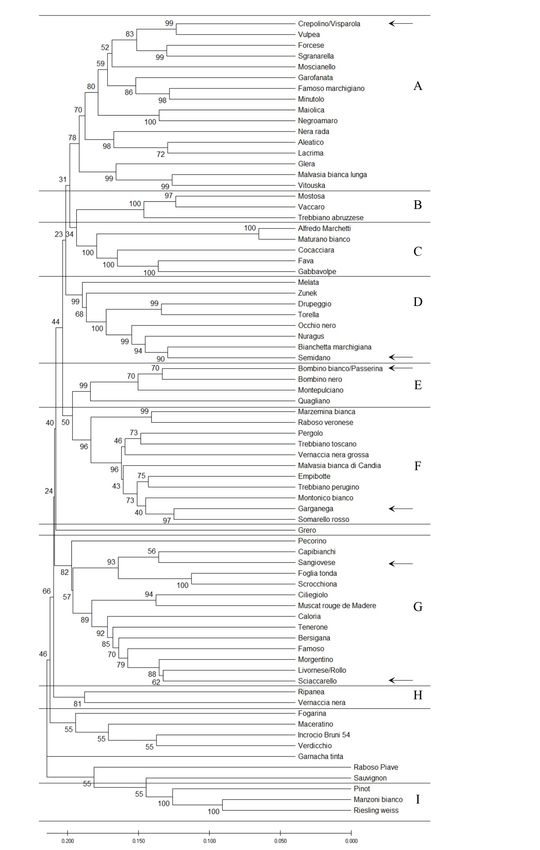
Manna Crespan et al.

                 INTRODUCTION                                      resources for their conservation, characterisation
                                                                   and potential future exploitation. Over the period
Italy is one of the richest countries in terms of                  1990-2012, some local, national and international
grapevine varietal assortment, with almost 600                     grapevine varieties were evaluated and the most
cultivars used in wine production registered                       interesting ones were registered in the Italian
in the Italian National Catalogue of Grapevine                     National Catalogue of Grapevine Varieties, like
Varieties (http://catalogoviti.politicheagricole.it).              Vernaccia nera grossa in 2008 and Garofanata in
The origin of the cultivated varieties can be                      2013 (http://catalogoviti.politicheagricole.it). In
determined by reconstructing their kinship;                        2014, a larger recovery programme was set up:
indeed, in the wine supply chain, describing a                     more than one hundred grapevine samples were
wine through the synergy between cultivation,                      collected in the Marche region and genotyped with
quality and cultural issues is becoming                            microsatellite (SSR) markers to speed up their
increasingly important. The Marche region in                       identification. Indeed, classical ampelographic
central Italy and overlooking the Adriatic Sea                     identification is often difficult due to high varietal
has an ancient winegrowing tradition. In light of                  variability, often combined with poor vine health.
increasing consumer interest in local products,                    Later, rare and unexplored genetic resources were
research on local grapevine germplasm and its                      preserved in a dedicated germplasm repository;
conservation and exploitation play an important                    a search for verbal and written information on
role in supporting the economic sustainability of                  these poorly known grapevines was also made.
farms. Viticulture is an important sector in the                   Pedigree studies were then implemented on
Marche region, with approximately 17,300 ha                        varieties cultivated in the Marche region, in
of vineyards and wine production of around one                     which 12 nuclear and 8 chloroplast SSRs were
million hectolitres (https://www.assoenologi.it/                   combined with SNPs from the Vitis18kSNP array.
wp-content/uploads/2020/09/report_previsioni_                      The very large number of point mutations in the
vendemmiali.pdf). Even if fifty-six grapevine                      grapevine genome make SNP (Single Nucleotide
varieties are suitable for cultivation in the Marche,              Polymorphism) markers a powerful tool with
only six are grown in over 70 % of the region’s                    many applications. Next generation sequencing
vineyards, namely Sangiovese, Montepulciano,                       provided hundreds of thousands of SNP markers
Verdicchio,      Trebbiano       Toscano/Biancame,                 in the whole Vitis spp. genome. A first Vitis chip
Passerina and Pecorino. The first two varieties are                array, the Vitis9kSNP, was developed in 2010
used to produce the renowned Rosso Piceno wines                    (Myles et al., 2010), with 9,000 SNP detected
and the third the Verdicchio dei Castelli di Jesi                  in 11 Vitis vinifera L. varieties and six wild Vitis
wines; together, these three varieties account for                 species. The GrapeReSeq Consortium developed
more than 50 % of the Marche appellation wines.                    a new one, the Vitis18kSNP, obtaining around
                                                                   18,000 SNPs from 47 V. vinifera varieties,
Significant efforts have been made to recover                      12 wild Vitis species and 5 Muscadinia rotundifolia
and identify local minor grapevine germplasm                       varieties (Le Paslier et al., 2013). This tool is used
in many Italian regions, like Apulia, Campania,                    in pedigree studies as it contributes to finding new
Emilia Romagna, Friuli Venezia Giulia, Liguria,                    relationships, and it confirms or questions those
Sardinia, Sicily, Tuscany (Costantini et al., 2005;                found using only SSRs (Myles et al., 2011; Ruffa
De Mattia et al., 2007; Torello Marinoni et al.,                   et al., 2016; Laucou et al., 2018; De Lorenzis
2009; Carimi et al., 2010; Crespan et al., 2011;                   et al., 2019; Crespan et al., 2020; Raimondi
De Lorenzis et al., 2014; Schneider et al., 2014;                  et al., 2020; D’Onofrio et al., 2021). Indeed,
Mercati et al., 2016; D’Onofrio et al., 2016;                      the Vitis18kSNP surpasses SSRs, because it can
Gristina et al., 2017; Pastore et al., 2020), and                  provide information on thousands of points in the
variety pedigrees have been reconstructed for the                  genome in just one analysis, making up for their
most widespread and renowned ones and for those                    very low polymorphism.
having local importance, helping to unravel the
intricate skein of the structure of Italian grapevine                    MATERIALS AND METHODS
populations (Di Vecchi-Staraz et al., 2007; Ruffa                  1. Plant material obtained during a sampling
et al., 2016; Crespan et al., 2020; Raimondi                       campaign in the Marche region, nSSR
et al., 2020; D’Onofrio et al., 2021). Similar efforts             genotyping and varietal identification
have been made in the Marche region, because the
resulting knowledge is very useful in science and                  One hundred and twenty-two vines were sampled
has cultural and marketing appeal. Since 1990,                     in the Marche region and preserved in the ASSAM
ASSAM has recovered local grapevine genetic                        repository (Table 1); the sampling sites are

18   © 2021 International Viticulture and Enology Society - IVES                                   OENO One 2021, 3, 17-37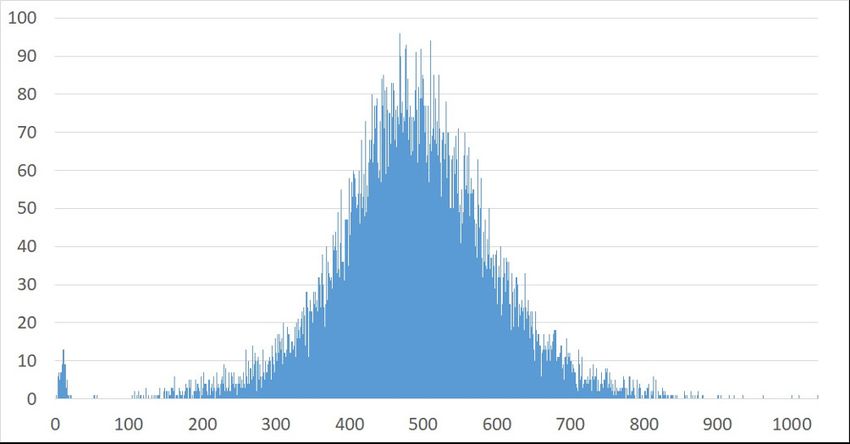
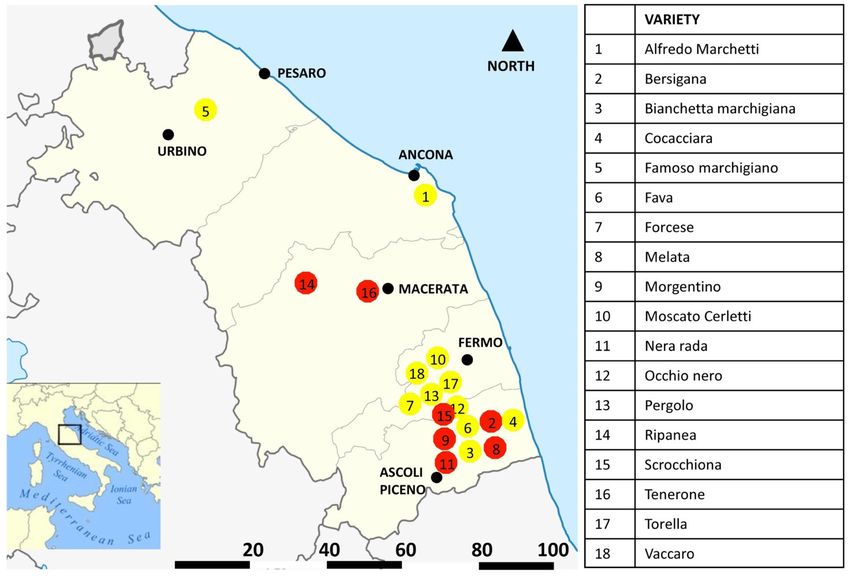
FIGURE 1. Sites of recovery in Marche region of the 18 grapevine varieties lacking the SSR profile in the
VIVC, which are not yet enrolled in the Italian catalogue and in bold in Table 1.
Circle colours correspond to accession berry colour, black (red circles) or white (yellow circles).

indicated when available and reported in Figure 1                     genotyped samples were identified using the CREA
for the accessions not listed or lacking an SSR                       Viticulture and Enology molecular database, the
profile in the Vitis International Variety Catalogue                  available literature and the Vitis International
(VIVC), or for those not enrolled in the Italian                      Variety Catalogue (VIVC, http://www.vivc.de).
catalogue.
                                                                      2. Plant material selected for pedigree study
Often these vines did not have a varietal name and
thus generic names were used for the samples,                         A selection of sixty-seven grapevine varieties
referring, for example, to a vine trait, like grape                   from two Italian repositories (CREA Viticulture
colour or shape, or to the plant owner’s name.                        and Enology and ASSAM) were analysed for
                                                                      pedigree relationship reconstruction (Table 2).
Genomic DNA was roughly extracted and                                 From the results of the sampling campaign carried
genotyped with 12 nuclear SSR (nSSR) markers,                         out on Marche Vitis germplasm, 36 Vitis vinifera
including the nine used internationally for                           varieties used in wine production were selected
grapevine identification (VVS2, VVMD5,                                and analysed for the reconstruction of pedigree
VVMD7, VVMD25, VVMD27, VVMD28,                                        relationships, along with other known grapevine
VVMD32, VrZAG62, VrZAG79) (Maul et al.,                               varieties of interest to the Marche region (Aleatico,
2012), plus ISV2 (VMC6e1), ISV4 (VMC6g1)                              Garnacha tinta, Lacrima, Incrocio Bruni 54,
and VMCNG4b9 (Migliaro et al., 2013).                                 Malvasia bianca lunga and Vernaccia nera); a
Fluorescent primers and an ABI3130xl genetic                          total of 42 varieties were thus selected (in bold in
analyser (Applied Biosystems, Foster City, CA)                        Table 2). This list also includes 25 other varieties,
were used to produce the nSSR profiles. Allele                        which were selected for possible PO relationships
calling was performed with GeneMapper software                        by screening around 4,000 unique SSR profiles
version 5.0, with a homemade bin set obtained                         present in the CREA-Viticulture and Enology
from reference varieties. The SSR profiles of all                     molecular database (partially published).

OENO One 2021, 3, 17-37                                                 © 2021 International Viticulture and Enology Society - IVES   19
Manna Crespan et al.

TABLE 1. Samples obtained during a sampling campaign in the Marche region. VIVC: Vitis International
Variety Catalogue; IC: Italian Catalogue.
                                                                                                                 VIVC
                                                   Recovery or                                                               IC
             Sample name                                                        Variety name                    variety
                                                  Sampling site                                                             code
                                                                                                                number
          Bianca (D'Onofrio)                         Pedaso                   Afus Ali (Regina)                   122        527
          Uva bianca (Zaghi)                          Sirolo                 Alfredo Marchetti
Negrì o Neretto di Piobbico (Ulivello)               Sarnano
                                                                                   Barbera                        974         19
      Rossa acino ovale (Rossi)                     Falerone
               Bersigana                       ASSAM repository                  Bersigana
              Cacciù nero                      ASSAM repository                 Besgano nero                     1284
              Bianchetta                       ASSAM repository           Bianchetta marchigiana
         Pagadebito (Spreca)                        Lapedona
             Passerina F9                      ASSAM repository
                                                                          Bombino bianco/Passerina               1533      32/181
      Uva bianca 1907 (Amadio)                    Campofilone
              Uva D'oro                        ASSAM repository
        Moscato nero (Ubaldi)                  Montefalcone App.                  Cardinal                       2091        507
       Bianca fienile (Silvestri)                  Cossignano         Chasselas blanc (Chasselas dorato)         2473        509
          Morettone (Remia)                       Montegiorgio
            Cimiciola F38                      ASSAM repository
         Gaglioppa (Capecci)                      Ripatransone                    Ciliegiolo                     2660         62
              Morettone                        ASSAM repository
         Morettone (Capecci)                      Ripatransone
        Centenaria (Sgariglia)                     Acquaviva         Cornichon blanc (Pizzutello bianco)         16448       524
              Cocacciara                       ASSAM repository
      Fondazione fico (o pozzo?)              Montefiore dell'Aso                Cocacciara
       Pianta 2 porcile (Beato)                    Montelparo
                Famoso                            Urbino (PU)               Famoso marchigiano
                 Fava                          ASSAM repository                     Fava
          Forcese (Capecci)                       Ripatransone
           Forcese (Ubaldi)                    Montefalcone App.                   Forcese
               Forconese                       ASSAM repository
              Cotrognone                       ASSAM repository
         Moscatellone (Duri)                      Serrapetrona                   Garofanata                      24957       463
        Uva Bianca (Serboni)                      Serrapetrona
      S. Maria/Luglia (Ulivello)                  Monte Urano                       Italia                       5582        514
        Tintorino (Montalbini)                       Arcevia                       Jacquez                       5627
                                                                          Koenigin der weingarden                6350        528
        Uva Luglia (Ulivello)                      Montelparo
                                                                            (Regina dei vigneti)
 Luglia/Lugliola/S. Maria (Milanesi)           Montefalcone App.    Luglienga bianca (Sant’Anna di Lipsia)       6982        544
        Bianca strada (Orlandi)                     Villa Tara
      Fondazione strada grande                Montefiore dell'Aso                Maceratino                      7023        124
          Trebbiano (Spreca)                        Lapedona

20   © 2021 International Viticulture and Enology Society - IVES                                           OENO One 2021, 3, 17-37
Gallioppo (Silvestri) Cossignano
Gallioppo 75 ASSAM repository
Maiolica 7136 126
Gallioppo GE ASSAM repository
Gallioppo GE F12 I9 P2 ASSAM repository
Malvasia bianca lunga (La Pila) Montegiorgio
Malvasia? (Montalbini) Arcevia
P1 (Scarabotti ) Recanati
P2 (Scarabotti) Recanati Malvasia bianca di Candia 23555 131
San Niccolò TOR 1 (ITAS Vivarelli) Fabriano
San Niccolò TOR 2 (ITAS Vivarelli) Fabriano
San Niccolò TOR 4 (ITAS Vivarelli) Fabriano
Sangiovese (ITAS Macerata) Macerata Malvasia di Casorzo 7264 134
Bianca resistente (Anselmi) Monte San Martino Malvasia istriana 7269 138
Premotico (Milanesi) Montefalcone App.
Ulpetta nuova (Sgariglia) Acquaviva
Maturano bianco 23347 424
Ulpetta vecchia (Sgariglia) Acquaviva
Uva cane ASSAM repository
Melata Savini 2 (Silvestri) Cossignano
Melata
(Uva) Melata ASSAM repository
Granarello ASSAM repository Merlot 7657 146
Rossa foglia (Mattei Verde) Arcevia Montepulciano 7949 150
Chiapparù ASSAM repository
Montonico bianco 7960 151
Uva Regno ASSAM repository
(Uva) Moie ASSAM Petritoli Morgentino
Uva Moscata p 2 Rossi Falerone Moscato Cerletti
Bianca (Zanoni) Pedaso
Moscatello Francese (Ulivello) Monte Urano Muscat of Alexandria (Zibibbo) 8241 343
Pianta secolare (Maranesi) Petritoli
Bianca Chiesa S. Domenico Ancona Moscato di Terracina 8053 281
Malvasia Candia (La Pila) Montegiorgio Moscato giallo 8056 154
Moscatello N. Montefalcone loc. Faveto Muscat rouge de Madere 8249
Moscianino ASSAM repository Moscianello 26683 889
Bianca ASSAM repository
Cacciù bianco 78/6 ASSAM repository
Cacciù bianco (Botticelli) Montottone
Mostosa 8075 157
Cacciu bianco (Spreca) Lapedona
Fondazione casa Montefiore dell'Aso
Mostosa 49 ASSAM repository
(Uva) nera rada ASSAM repository Nera rada
Uva rossa (Iena) Porto S. Elpidio Nerello mascalese 8480 165
Occhio nero ASSAM repository Occhio nero
Vissanello (Orlandi) Villa Tara Pecorino 9072 184
Pergolo (Vitali) Montalparo Pergolo
OENO One 2021, 3, 17-37 © 2021 International Viticulture and Enology Society - IVES 21Manna Crespan et al.
Pianta 4 (Giammarini) Marina Palmense
Petit Bouschet 1619
Rossa foglia (Mattei Rossa) Arcevia
Cornetta? (Ulivello) Magliano di Tenna Pizzutello nero 9524
Pianta 1 (Giammarini) Marina Palmese
Plavina crna 9557 893
Pianta 2 (Giammarini) Marina Palmese
Cacciù nero ASSAM repository
Ripanea
Uva Rossa (Serboni) Serrapetrona
Balsamina ASSAM repository
Pianta 1 entrata (Beato) Montelparo
Sangiovese 10680 218
Sangiovese Ripatransone
Uva Rosata pianta 3 (Rossi) Falerone
Rossa croccante ASSAM repository Scrocchiona
Ciciu ASSAM repository
Ciciu F42 ASSAM repository
Cimicino ASSAM repository
Sgranarella 26656 900
Pianta 3 bosco 1 (Beato) Montelparo
Pianta 4 bosco 2 (Beato) Montelparo
Pianta 5 bosco 3 (Beato) Montelparo
Grugnintì (Fattobene) campo Pollenza
Tenerone
Grugnintì (Fattobene) argine Pollenza
Tinturina (Ubaldi) Montefalcone App.
Terrano 12374 233
Uva nera (Virgili) Monte San Martino
(Uva) torella (Piermarini) Ortezzano Torella
San Niccolò DA 1 (ITAS Vivarelli) Fabriano
Trebbiano toscano 12628 244
Uva Fico ASSAM repository
Vite Bastarda (Ulivello) Monte Urano Uva Tosca 12836 249
Cacciù (Capecci) Ripatransone
Vaccaro ASSAM repository Vaccaro
Vaccù ASSAM repository
Bianca precoce (Colasanti) ASSAM repository
Verdicchio 12963 254
Vummì ASSAM repository
Bordoletto (Duri) Serrapetrona Vernaccia di S. Gimignano 12998 261
Brugentile ASSAM repository
Brugentile N1 Cerreto d’Esi Vernaccia nera grossa 23042 415
Brugentile Casanao 2 Coccore
Uva francese (Ulivello) Fermo
Uva Bianca pianta 1 (Rossi) Falerone
Villard blanc 13081
Bianca resistente (Cossignani) Montefiore dell'Aso
Bianca (Potentini) Porto Recanati
Uva Bianca (Marchetti) Cupra Marittima
Zivì (Milanesi) Montefalcone App. Zunek 17739
Zivì F41 ASSAM repository
The recovery site is indicated, when available. The prime names of the varieties in the VIVC are shown in the "Variety name"
column, and, when different, the name as registered in the IC is in brackets. The names of the 18 varieties lacking the SSR profile
in the VIVC and not yet enrolled in the IC are in bold.
22 © 2021 International Viticulture and Enology Society - IVES OENO One 2021, 3, 17-37The search for compatible trios (parents and All the samples were genotyped using the
offspring) and duos (parent-offspring) was done Infinium® II Vitis18k SNP array, which comprises
based on 9 to 12 nSSRs in the CREA Viticulture 18,071 SNPs (GrapeReSeq Consortium, Illumina),
and Enology database with Cervus 3.0 (Kalinowski following the Infinium® HD Assay Ultra protocol
et al., 2007) and GenAlEx 6.5 software (Peakall (Illumina Inc., San Diego, CA). The samples were
and Smouse, 2012), and in the VIVC using the scanned using an Illumina HiScan.
“Relationships based on nine microsatellites” tool.
The varieties which proved to be possible members 4. Data processing for parentage relationships
of trios or duos were included in the sample set.
For the SNP data analysis, a no-call threshold
Termarina and Verano accessions belonging to
of 0.15 was applied as a GenCall cutoff using
the Sciaccarello variety were both included to
GenomeStudio Genotyping Module v2.0 of
evaluate possible SNP polymorphisms, given their
ILLUMINA. The SNP selection was performed
big phenotypic differences in grape morphology;
with ASSIsT (Automatic SNP ScorIng Tool)
Termarina is a parthenocarpic somatic variant of
software (Di Guardo et al., 2015) v. 1.02, applying
Sciaccarello and Verano shows the seeded, wild-
the default parameters for germplasm material. No
type form (Crespan et al., 2016). Three parent-
parent-child trios with well-established parent- pedigree or map information was given. A larger set
parent-offspring relationships were added for the of 192 unique genotypes, mainly comprising Italian
evaluation of Mendelian incompatibilities and varieties, was used to obtain a more consistent
statistical comparisons: Manzoni bianco = Pinot SNP classification into the groups obtained with
x Riesling weiss (Grando and Frisinghelli, 1998; the software; only Robust, OneHomozygRare_
Cipriani et al., 2010.), Raboso Veronese = Raboso HWE and OneHomozygRare_notHWE SNPs
Piave x Marzemina bianca (Crespan et al., 2006), were retained, as reported in Crespan et al. (2021).
and Vitouska = Malvasia bianca lunga x Glera 4.1. IBS/IBD estimation
(Crespan et al., 2007).
The filtered SNPs were used to prepare ‘map’ and
3. Genomic DNA extraction and genotyping ‘ped’ files for analysis with PLINK v1.09 software
with chloroplast SSR and SNP markers for the (Purcell et al., 2007) (http://pngu.mgh.harvard.
pedigree study edu/purcell/plink). Identical by state (IBS) and
Genomic DNA was extracted from young Identical by Descent (IBD) indexes were estimated
freeze-dried leaves from the samples listed in for pairs of samples, using the parameters for PO
Table 2 using the QIAGEN DNeasy 96 Plant relationships, namely Z0, Z1, Z2 and PI-HAT with
Kit (QIAGEN GmbH, Hilden, Germany) and reference indexes of 0, 1, 0 and 0.5 respectively.
according to the manufacturer’s protocols with 4.2. Mendelian inconsistencies
the following modifications: AP1 buffer was
added with 1.6 % PVP40 (Sigma Aldrich) and Mendelian inconsistencies between pairs of
the samples were incubated at 65 °C for 5 min; samples were computed on the larger set of
the DNA was eluted in milliQ water at 65 °C. 192 unique genotypes by searching for PO related
The DNA was quantified with Quant-iT™ varieties. First degree related genotypes were then
PicoGreen™ dsDNA Assay Kit (ThermoFisher combined in all parent-parent-offspring trios and
Scientific) by Synergy2 Fluorometer (Biotek). related Mendelian inconsistencies were computed.
DNA quality was checked on an Agilent 2200 Home-made algorithms were written in Excel
Tapestation (Agilent Technologies, CA) using the Visual Basic for Application (VBA) to perform
DNA genomic ScreenTape (Agilent Technologies) these computations.
for DNA integrity detection, and the NanoDrop
8000 Spectrophotometer (Thermo Scientific, MA) 4.3. Full-sib relationships
for 260/230 and 260/280 ratios evaluation.
Possible full-sib relationships were evaluated
A check for correct sampling was performed on using Colony software version 2.0.6.5 (July
these DNAs using four nSSR (VVS2, VVMD5, 30, 2018), which is freely available at https://
VrZAG79 and VVMD28). Chlorotypes were www.zsl.org/science/research-projects/software.
assessed with eight chloroplast SSR markers Both nSSR and SNP markers were used as data
(Arroyo-Garcia et al., 2006). Two multiplex PCR input, and parentage relationships were inferred
were organised using fluorescent primers and SSR by combining PLINK information, 12 SSRs and
allele calling was performed as described for the Mendelian inconsistencies. The following main
nSSRs. settings were applied: markers error rate 0.00001,
OENO One 2021, 3, 17-37 © 2021 International Viticulture and Enology Society - IVES 23Manna Crespan et al.
no sibship prior indicator, one medium run, FL The name ‘Alfredo Marchetti’ was assigned to
(full likelihood) analysis method and medium Uva bianca Zaghi after the noble, ancient owner
precision when calculating FL. of the villa in Sirolo where this vine was found.
Scrocchiona is the dialectal translation of the
5. Genetic similarity generic name ‘Uva croccante’ (meaning crispy
grape). Ripanea comes from the nickname of Mister
MEGA X software version 10.1.8 (Kumar et al.,
Serboni, Ripanè, meaning the one who works
2018) was used to obtain an unrooted dendrogram
on ‘steep slopes’ (‘ripe’ in Italian). Morgentino,
of genetic similarity using the 8,770 ASSIsT-
Moscato Cerletti and Tenerone were assigned
selected SNP markers. Pairwise genetic distances according to the CREA Viticulture and Enology
were computed using the Kimura 2-parameter SSR molecular database. The identification results
method. Missing data were removed for each are summarised in Table 1.
sequence pair, using the ‘pairwise deletion’ option.
A dendrogram of genetic similarity was obtained Among the 61 genotypes recovered in the
using the Unweighted Pair-Group Arithmetic sampling campaign, 8 table grape varieties were
Average Method (UPGMA). A bootstrap test of found (Afus Ali, Cardinal, Chasselas blanc,
2,000 replicates was used to define the percentage Cornichon blanc, Italia, Koenigin der weingarden,
of replicate trees in which the associated genotypes Luglienga bianca, and Pizzutello nero), as well
clustered together; these values were shown next to as two hybrids (Jacquez and Villard blanc). The
the branches. Only branches with bootstrap values remaining 51 genotypes included not only wine
higher than 75 were taken into consideration. varieties from other Italian regions (Barbera,
Nerello mascalese, Terrano, Uva tosca), but also
RESULTS from countries on the other side of the Adriatic
In the first part of this study, a sampling campaign Sea, like the Croatian Plavina crna and the
on the minor local grapevine germplasm grown Slovenian Zunek. Five Muscats were recognised:
the reknown and worldwide Muscat of Alexandria
in the Marche region was performed for vine
and the Italian Moscato di Terracina, Moscato
cultivar identification supported by SSR profiles.
giallo and Muscat rouge de Madere. It was a big
In the second part, the pedigree relationships of
surprise to also find Moscato Cerletti, concealed as
42 varieties of interest to the Marche region (17 of
an unknown vine with a muscat flavour. Moscato
them being new entries identified in the first part
Cerletti was obtained by Baron Antonio Mendola
of this study) were evaluated also in comparison of Favara (Sicily) in 1870 during his breeding
with an additional 25 potentially PO-related activities and was selected and praised as a very
varieties based on 9-12 SSR markers, thus totaling nice table grape; however, it was thought to have
67 varieties. disappeared in Italy (Antonio Sparacio, personal
1. Identification of the vines recovered during communication).
surveys 1990-2020 The most frequently found wine varieties were
The 30-year sampling campaign in the Marche Malvasia bianca di Candia (7 samples), Mostosa
region made it possible to find and preserve in (6), Sgranarella (6), Ciliegiolo (5), followed by
the ASSAM repository 122 accessions of Vitis Bombino bianco/Passerina, Maiolica, Maturano
showing 61 different SSR profiles. Forty-three bianco and Sangiovese with 4 samples. All these
profiles were shared with the Vitis International are Italian varieties, most of them already well
known, except for Sgranarella, which was enrolled
Variety Catalogue (VIVC), allowing the name of
in the Italian Catalogue in 2019 (http://catalogoviti.
the variety and the corresponding code number
politicheagricole.it). Three Cacciù bianco samples
to be confirmed or assigned. The remaining
were collected in the survey, and all corresponded
18 genotypes, except for Moscato Cerletti,
to Mostosa. Cacciù nero, however, was shown to
are new and possibly local Marche grapevine be a homonym of at least two different varieties,
germplasm. The names assigned to 12 of them are Besgano nero and Ripanea. The correspondence
those indicated during the survey phase, including between the Marche Gallioppo (not to be confused
the names ‘Bianchetta marchigiana’ and ‘Famoso with Gaglioppo of Calabria) and Maiolica was
marchigiano’, which were assigned to distinguish confirmed.
these varieties from other Bianchettas (like
Bianchetta genovese and Bianchetta trevigiana) Additional information was retrieved by
and from the muscat flavoured Famoso from the comparison with the CREA Viticulture and
Emilia-Romagna region respectively. Enology SSR molecular database, showing a
24 © 2021 International Viticulture and Enology Society - IVES OENO One 2021, 3, 17-37TABLE 2. List of the 67 varieties used for the pedigree study.
Berry Country of
ID Variety name Accession name Repository
colour origin
1 Aleatico Vernaccia di Pergola B CREA Italy
2 Alfredo Marchetti Bianca Zaghi W ASSAM Italy
3 Bersigana Bersigana B ASSAM Italy
4 Bianchetta marchigiana Bianchetta W ASSAM Italy
5 Bombino bianco/Passerina Bombino bianco W CREA Italy
6 Bombino nero Bombino nero B CREA Italy
7 Caloria Caloria B CREA Italy
8 Capibianchi Capibianchi B CREA Italy
9 Ciliegiolo Ciliegiolo B CREA Italy
10 Cocacciara Cocacciara W ASSAM Italy
11 Crepolino/Visparola Scacco W CREA Italy
12 Drupeggio Drupeggio Deruta W CREA Italy
13 Empibotte Borbottone W CREA Italy
14 Famoso Famoso W CREA Italy
15 Famoso marchigiano Famoso marchigiano W ASSAM Italy
16 Fava Uva Fava W ASSAM Italy
17 Fogarina Fogarina B CREA Italy
18 Foglia tonda Foglia tonda B CREA Italy
19 Forcese Forcese W ASSAM Italy
20 Gabbavolpe Gabbavolpe W CREA Italy
21 Garganega Garganega W CREA Italy
22 Garnacha tinta Alicante B CREA Spain
23 Garofanata Garofanata W CREA Italy
24 Grero Grero B CREA Italy
25 Incrocio Bruni 54 Incrocio Bruni 54 W CREA Italy
26 Lacrima Lacrima di Morro d'Alba B CREA Italy
27 Livornese/Rollo Livornese W CREA Italy
28 Maceratino Maceratino W CREA Italy
29 Maiolica Gallioppo marchigiano B CREA Italy
30 Malvasia bianca di Candia Malvasia bianca di Candia W CREA Italy
31 Malvasia bianca lunga Malvasia bianca lunga W CREA Italy
32 Maturano bianco Maturano bianco W CREA Italy
33 Melata Uva melata R ASSAM Italy
34 Minutolo Minutolo W CREA Italy
35 Montepulciano Montepulciano B CREA Italy
36 Montonico bianco Montonico bianco W CREA Italy
37 Morgentino (Uva) Moie P ASSAM Italy
38 Muscat rouge de Madere Moscato violetto R CREA Italy
39 Moscianello Moscianino W ASSAM Italy
40 Mostosa Mostosa W CREA Italy
OENO One 2021, 3, 17-37 © 2021 International Viticulture and Enology Society - IVES 25Manna Crespan et al.
41 Negroamaro Negroamaro B CREA Italy
42 Nera rada (Uva) nera rada B ASSAM Italy
43 Nuragus Nuragus W CREA Italy
44 Occhio nero Occhio nero W ASSAM Italy
45 Pecorino Pecorino W CREA Italy
46 Pergolo Pergolo W ASSAM Italy
47 Quagliano Quagliano B CREA Italy
48 Ripanea Uva rossa (Serboni) B ASSAM Italy
49 Sangiovese Sangiovese B CREA Italy
50 Sauvignon Sauvignon W CREA France
51 Sciaccarello Verano B CREA Italy
52 Sciaccarello Termarina B CREA Italy
53 Scrocchiona Rossa croccante B ASSAM Italy
54 Semidano Semidano W CREA Italy
55 Sgranarella Vesprino W CREA Italy
56 Somarello rosso Somarello rosso R CREA Italy
57 Tenerone Grugnintì R ASSAM Italy
58 Torella (Uva) Torella Piermarini W ASSAM Italy
59 Trebbiano abruzzese Trebbiano abruzzese W CREA Italy
60 Trebbiano perugino Trebbiano perugino W CREA Italy
61 Trebbiano toscano Trebbiano toscano W CREA Italy
62 Vaccaro Vaccaro W ASSAM Italy
63 Verdicchio Verdicchio W CREA Italy
64 Vernaccia nera Vernaccia nera B CREA Italy
Vernaccia nera grossa (di
65 Vernaccia nera grossa B CREA Italy
Cerreto)
66 Vulpea Quaiara B CREA Austria
67 Zunek Zivì W ASSAM Slovenia
Additional varieties
68 Glera W CREA Italy
69 Manzoni bianco W CREA Italy
70 Marzemina bianca W CREA Italy
71 Pinot CREA France
72 Raboso Piave B CREA Italy
73 Raboso veronese B CREA Italy
74 Riesling weiss W CREA Germany
75 Vitouska W CREA Italy
Berry colour: B = black, W = white, R = red, P = pink. CREA: CREA Viticulture and Enology, Susegana (TV), Italy;
ASSAM: ASSAM, Petritoli (FM), Italy. The 42 varieties of interest to the Marche region are highlighted in bold.
Additional 8 varieties with known pedigree relationships were used as references and are listed in italics at the end of the table (ID
68-75).
26 © 2021 International Viticulture and Enology Society - IVES OENO One 2021, 3, 17-37greater diffusion than previously known for The 8,770 SNP profiles related to the 74 unique
some minor genotypes: i) additional synonyms varieties are reported in Table S3.
of Sgranarella are Vesprino (still used in Marche
Region), and Rosciolo (used in the nearby Lazio 2.1. Duos and trios
region), and ii) Grugnintì is a synonym for the The same pairs of first-degree related varieties
Tuscan Boggione rosso and Tenerone; Tenerone were recognised using PLINK parameters and
was chosen as the prime name for this genotype Mendelian inconsistencies computation (Table 3).
due to the ampelographic description given by The Z1 PLINK parameter was between 0.8334
Bandinelli et al. (2005). and 1.
No differences were found between the SNP The distribution of Mendelian inconsistencies for
profiles of Verano, the seeded form of Sciaccarello, all pairs of genotype combinations (computed on
and Termarina, the partenocarpic somatic variant. 192 unique genotypes) is shown in Figure 2: a clear
2. Parentage relationships Gaussian curve is represented, referring to non-
PO related varieties. However, a well separated,
In the pedigree studies on the sixty-seven small group of pairs outside the Gaussian curve
grapevine cultivars, 66 different SSR and SNP and located on the left side of the figure can be
profiles were found, thus further supporting seen; this small group is in strong agreement with
the molecular synonymy between Sciaccarello the presence of PO relationships and shows the
and Termarina. The nSSR profiles and related inconsistencies found for PO related varieties,
chlorotypes of these 67 varieties and of the eight with a maximum of 22 mismatching loci, while
additional ones are reported in Table S1. All the for the pairs inside the Gaussian distribution the
varieties were univocally identifiable with the Mendelian inconsistencies were from 53 onwards.
14 SNP set selected by Laucou et al., 2018, except
for Sciaccarello and Termarina, whose profiles are A complex network of first- and second-degree
provided in Table S2. relationships was found.
The Scacco accession of CREA-Viticulture and Table 3 shows that some varieties were found
Enology shared the same SSR profile as the to be PO related to more than one other variety:
Tuscan Crepolino described by Armanni et al. Garganega shows the highest number of PO
(2008) and the Sicilian Visparola (Carimi et al., relationships (10), then Crepolino/Visparola (6),
2010; De Lorenzis et al., 2014). Scacco was also Sciaccarello (6), Semidano (4), Sangiovese (3) and
analysed by Pastore et al. (2020) as a cultivar Mostosa (2); seven pairs of PO related varieties
grown in Emilia Romagna where it is known were also found.
under the synonym Rossola (Tebano). Therefore, First degree related varieties, selected according to
this genotype was shown to have a range spreading the MI on duos, were then compared in all possible
from southern to northern Italy. Given that the parent-parent-offspring combinations and the MI
only available ampelographic description for this were computed accordingly. The distribution of
variety is Crepolino, and that previous pedigree the MI on trios is reported in Figure 3.
relationships are related to Visparola (D’Onofrio
et al., 2021), the combination of these two names, A group of trios with a maximum of 37 MI was
Crepolino/Visparola, is used hereafter for this shown to be well separated from the others at
genotype. 268 MI onwards; the three parent-parent-offspring
combinations used as reference also fall into this
Excluding the eight additional varieties listed in little group (Table 4).
Table S1 from the computation, three chlorotypes,
A, C and D, were found with large differences in One selfing and six trios were established based
frequency: type D was prevalent (75.8 %; 50/66), on PLINK parameters for PO relationships
followed by type A (21.2 %; 14/66) and type C combined with 12 SSR data and MI in comparison
(only 3.0 % 2/66). with the three well-established parent-parent-
child relationships used as references (Table 4 and
SNP pruning performed with ASSIsT software Figure 4).
retained 8,770 SNP out of 18,071 (48.53 %):
3,407 were classified as Robust (18.9 %), 2,784 Chlorotypes helped in some cases to establish the
as OneHomozygRare_HWE (15.4 %) and 2,579 sexual role played by the parents in generating
as OneHomozygRare_NotHWE (14.3 %). their offspring. Alfredo Marchetti was found
OENO One 2021, 3, 17-37 © 2021 International Viticulture and Enology Society - IVES 27Manna Crespan et al.
TABLE 3. Duos: parent-offspring (PO) relationships inferred with PLINK parameters and Mendelian
inconsistencies (MI).
PLINK parameters
First variety Second variety MI Reference literature
Z0 Z1 Z2 PI_HAT
Famoso marchigiano 0.0109 0.9853 0.0038 0.4964 6 present paper
Forcese 0.0237 0.8722 0.1041 0.5402 13 present paper
Crepolino/ Maiolica 0.018 0.982 0 0.491 10 D’Onofrio et al., 2021
Visparola Minutolo 0.0146 0.9551 0.0303 0.5079 8 Lacombe et al., 2013
Vesprino 0.0218 0.9594 0.0188 0.4985 12 present paper
Vulpea 0.0218 0.8395 0.1387 0.5584 12 D’Onofrio et al., 2021
Famoso
Garofanata 0.0091 0.942 0.0489 0.5199 5 present paper
marchigiano
Fava Gabbavolpe 0.0218 0.9506 0.0275 0.5028 12 present paper
Forcese Moscianello 0.0218 0.9612 0.017 0.4976 12 present paper
Empibotte 0.0255 0.8927 0.0818 0.5282 14 Crespan et al., 2008
Forcese 0.0164 0.91 0.0736 0.5286 9 present paper
Malvasia bianca di
0.0109 0.925 0.0641 0.5266 6 Di Vecchi-Staraz et al., 2007
Candia
Marzemina bianca 0.0309 0.9613 0.0077 0.4884 17 Crespan et al., 2008
Garganega Montonico bianco 0.0109 0.9279 0.0611 0.5251 6 Crespan et al., 2008
Pergolo 0.0091 0.9202 0.0707 0.5308 5 present paper
Somarello rosso 0.0109 0.8704 0.1187 0.5539 6 Di Vecchi-Staraz et al., 2007
Trebbiano perugino 0.0291 0.9517 0.0192 0.495 16 present paper
Trebbiano toscano 0.0182 0.9815 0.0003 0.4911 10 Di Vecchi-Staraz et al., 2007
Vernaccia nera grossa 0 1 0 0.5 9 present paper
Maiolica Negroamaro 0.0146 0.9577 0.0277 0.5066 8 D’Onofrio et al., 2021
Montepulciano Bombino bianco 0.0218 0.9393 0.0389 0.5085 12 Lacombe et al., 2013
Bersigana 0.0146 0.9633 0.0222 0.5038 8 present paper
Caloria 0.0237 0.95 0.0263 0.5013 13 Di Vecchi-Staraz et al., 2007
Famoso 0 1 0 0.5 7 D’Onofrio et al., 2021
Sciaccarello
Tenerone 0 1 0 0.5 13 present paper
Livornese/Rollo 0.0127 0.9348 0.0524 0.5198 7 Di Vecchi-Staraz et al., 2007
Muscat rouge de Madere 0.0109 0.9891 0 0.4946 6 Di Vecchi-Staraz et al., 2007
Capibianchi 0.0218 0.9513 0.0268 0.5025 12 Di Vecchi-Staraz et al., 2007
Sangiovese Foglia tonda 0.02 0.9207 0.0593 0.5197 11 Crespan et al., 2008
Scrocchiona 0.0197 0.9803 0 0.4901 11 present paper
Bianchetta marchigiana 0.0164 0.9016 0.082 0.5328 9 present paper
Drupeggio 0.0146 0.9646 0.0208 0.5031 8 present paper
Semidano
Nuragus 0.0146 0.9349 0.0505 0.518 8 present paper
Occhio nero 0.0091 0.9485 0.0424 0.5167 5 present paper
Torella Drupeggio 0.0255 0.9252 0.0493 0.5119 14 present paper
Trebbiano abruzzese 0.0182 0.8962 0.0856 0.5337 10 present paper
Mostosa
Vaccaro 0.0273 0.8334 0.1393 0.556 15 present paper
Verdicchio Maceratino 0.02 0.976 0.0039 0.492 11 Lacombe et al., 2013
Expected values for PO relationships: Z0 = 0, Z1 = 1, Z2 = 0, PI_HAT = 0.5.
28 © 2021 International Viticulture and Enology Society - IVES OENO One 2021, 3, 17-37FIGURE 2. Distribution of Mendelian inconsistencies computed on pairs of samples in the larger set of
192 unique genotypes.
FIGURE 3. Distribution of Mendelian inconsistencies computed on first degree related genotypes
combined in all possible parent-parent-offspring trios.
to be derived from selfing of Maturano bianco. No reliable full-sibs were found using Colony
Bombino nero was confirmed to be the progeny software.
of Bombino bianco × Quagliano (Bergamini
3. Dendrogram of genetic similarity
et al., 2016); Ciliegiolo was a spontaneous cross
between Sangiovese and Muscat rouge de Madere; A dendrogram of genetic similarity was produced
Forcese derived from Garganega × Crepolino/ by applying the UPGMA method on all the
Visparola; Incrocio Bruni 54 was confirmed genotypes selected for parentage studies, including
as a cross between Verdicchio and Sauvignon; additional reference varieties for known trios,
Lacrima derived from Aleatico × Nera rada, and totalling 74 unique SNP genotypes; nine clusters
finally Morgentino was a cross between Forcese were found with bootstrap values higher than 75
and Sciaccarello. (Figure 5).
OENO One 2021, 3, 17-37 © 2021 International Viticulture and Enology Society - IVES 29Manna Crespan et al.
TABLE 4. Trios selected by combining PLINK parameters data for PO relationships using 8770 SNP
ASSIsT-selected, 12 SSRs and Mendelian inconsistencies (MI).
Reference
PLINK parameters MI
Offspring First candidate Second candidate literature
Z0 Z1 Z2 PI_HAT
present
Alfredo Marchetti Maturano bianco Maturano bianco 0.0036 0.2891 0.7073 0.8518 2
paper
Bombino bianco 0.0091 0.9459 0.045 0.518
Bergamini
Bombino nero Quagliano 0.0237 0.9461 0.0302 0.5033
et al., 2016
Bombino bianco Quagliano 18
Sangiovese 0.0218 0.978 0.0002 0.4892
Muscat rouge de Di Vecchi-
0.0237 0.9596 0.0168 0.4965
Ciliegiolo Madere Staraz et al.,
Muscat rouge de 2007
Sangiovese 24
Madere
Garganega 0.0164 0.91 0.0736 0.5286
present
Forcese Crepolino 0.0237 0.8722 0.1041 0.5402
paper
Garganega Crepolino 22
Verdicchio 0.0382 0.9361 0.0257 0.4937
present
Incrocio Bruni 54 Sauvignon 0.0255 0.9672 0.0072 0.4909
paper
Verdicchio Sauvignon 35
D’Onofrio
Aleatico 0.0182 0.8999 0.0819 0.5319
et al., 2021
Lacrima
Nera rada 0.0219 0.9064 0.0718 0.5249 present
Aleatico Nera rada 22 paper
Forcese 0 1 0 0.5
present
Morgentino Sciaccarello 0.0255 0.9275 0.047 0.5108
paper
Forcese Sciaccarello 26
Reference trios
Pinot 0.0109 0.9871 0.002 0.4955 Grando and
Manzoni bianco Riesling weiss 0.0401 0.8672 0.0927 0.5263 Frisighelli,
Pinot Riesling weiss 22 1998
Raboso Piave 0 1 0 0.5
Crespan
Raboso veronese Marzemina bianca 0.0252 0.9748 0 0.4874
et al., 2006
Raboso Piave Marzemina bianca 31
Malvasia bianca
0.0273 0.8543 0.1184 0.5456
lunga
Crespan
Vitouska Glera 0.0164 0.9155 0.0682 0.5259
et al., 2007
Malvasia bianca
Glera 24
lunga
30 © 2021 International Viticulture and Enology Society - IVES OENO One 2021, 3, 17-37Group A is the largest group (16 members), nine like Garganega, Sangiovese and Sciaccarello (Di
of the members being first or second degree Vecchi-Staraz et al., 2007; Crespan et al., 2008;
related and the reference variety being Crepolino/ Lacombe et al., 2013), increased their PO related
Visparola. Group G is the second largest group members. The long list of varieties which are PO
(14 members), with two reference varieties, related with Garganega testifies and confirms
Sangiovese and Sciaccarello. The group of the role of founder that is played by this very
Garganega, F, has 11 members; the group of ancient cultivar from northern to southern Italy.
Semidano, D, has 8 members and the smallest The molecular data supports previous findings
groups, B, C, E, H, I, have from 5 to 2 members. related to Empibotte, Malvasia bianca di Candia,
Montonico bianco, Somarello rosso, Trebbiano
DISCUSSION
perugino, Trebbiano toscano and adds two local
Sixteen genotypes were shown to be local Marche Marche varieties to the list, Pergolo and Vernaccia
varieties/vines which were previously either nera grossa. Very little information is available
poorly known or completely unknown: Alfredo for Pergolo. Costanzo Felici da Piobbico (1525-
Marchetti, Bersigana, Bianchetta marchigiana, 1585, in Felici, 1986) cites a grapevine named
Cocacciara, Famoso marchigiano, Fava, Forcese, “la pergola”; the Ampelographic Bulletin number
Melata, Morgentino, Nera rada, Occhio nero, XVI (1883) mentions the Pergolo as being one of
Pergolo, Ripanea, Scrocchiona, Torella and the varieties spread over the Appignano, Venarotta
Vaccaro. The rearranged pedigree highlighted the and Ascoli Piceno area; and oral sources cite
complex intertwining of relationships between the Pergolo as a variety found in Montelparo and
Marche varieties. No putative full sibs were found, Santa Vittoria in Matenano (Fermo province).
indicating not only that there is a large number of
missing vines necessary to complete the puzzle, Vernaccia nera grossa, locally named Vernaccia
but also the liveliness of local wine growers in Cerretana, was recovered in old tree lines in the
selecting new varieties. municipality of Cerreto d’Esi (Macerata province)
and neighbouring areas; it was enrolled in the
Some varieties already recognised as founders Italian Catalogue in 2008. The oldest available
or recurrent parents of many Italian cultivars, citation of this variety is as a local cultivar in the
FIGURE 4. Reconstruction of the pedigree of the Marche varieties.
The chlorotypes (in brackets) are codified in letters according to Arroyo-García et al. (2006). Solid lines indicate the links inferred
with present molecular data or the confirmation of previous findings. Arrows show the cross direction when possible. Well-known
information from the literature not provided in this paper is represented as dotted lines.
OENO One 2021, 3, 17-37 © 2021 International Viticulture and Enology Society - IVES 31Manna Crespan et al. 32 © 2021 International Viticulture and Enology Society - IVES OENO One 2021, 3, 17-37
FIGURE 5. Unrooted optimal dendrogram for 74 varieties using the UPGMA method and a bootstrap
test of 2,000 replicates (related values are shown next to the branches).
Pairwise distances were computed using the Kimura 2-parameter method. The analyses were conducted in MEGA X.
Ampelographic Bulletin number X (1877) by Nuragus was cited for the first time in 1837
Professor Carlo Morbelli. It spread moderately (Nieddu, 2011). The first-degree relationship
thoughout the Fabriano area towards the end of between them is not surprising, also given their
the 19th century, then its importance waned, and morphological resemblance. Even if inexplicable
it was neglected in the viticulture reconstitution at present, molecular data give clear evidence
phase after the Second World War. of the role played by Semidano in the birth of
Bianchetta marchigiana and Occhio nero, which
Our data confirm the following varieties to be PO are two Marche varieties, and of Drupeggio, a
related with Sangiovese: Capibianchi and Foglia variety shared by the nearby regions of Tuscany,
tonda, and add a new one, Scrocchiona. Lazio and Umbria, and which in turn is PO related
to Torella. The place of origin of some Sardinian
Six varieties were PO related with Sciaccarello,
varieties is still unclear and debated; for example,
of which the new entries were Bersigana and
Spergola, a variety grown in the northern part of
Famoso. The only citation of Bersigana grapes
the Italian Apennine area, was discovered to be
is very recent and comes from the poet Umberto
synonymous with the more renowned Sardinian
Piersanti (2008). Famoso marchigiano was at
Vernaccia di Oristano, and recent pedigree studies
risk of extinction, but was recovered from an
confirm that this genotype was imported into
old vineyard in Pesaro area by the winemaker
Sardinia from the Italian mainland (Raimondi
Giancarlo Soverchia in the 1980s. Famoso
et al., 2020; D’Onofrio et al., 2021).
marchigiano, described as a synonym of Uva della
Madonna in 1872 (De Bosis, 1873), was briefly No information is available on Bianchetta
described in the Amphelographic Bullettin number marchigiana. Occhio nero may correspond to an
VI (1876) as being one of the main, white-berried old Marche variety called Occhietto bianco, which
varieties of the Pesaro Urbino province. is briefly described in the VII Ampelographic
Bulletin (1877). The cultivar Torella (meaning
Crepolino/Visparola was shown to be a key variety
‘little bull’) was grown for a long time in the
in the evolution of the Marche varietal assortment, countryside of Ortezzano (Fermo province) by the
having played the role of parent and grandparent, Piermarini family. Its name refers to a Piermarini
which can be explained by the ancient presence ancestor called "bull" (‘toro’ in the Italian
of this genotype in the region. Nowadays, it is language) due to his strength when carrying bags
highly threatened (only one vine was found during of wheat and also to the large and compact clusters
sampling not included in this study) in Marche, of the grape, which comprises big, sweet and
but some plants are still grown in Tuscany, Sicily aromatic berries suitable for being dried.
and Emilia Romagna. Crepolino/Visparola is
also PO related with Vulpea. Vulpea was already The Alfredo Marchetti vine is a rare case of selfing.
recognised as a parent of many other varieties, Its parent is Maturano bianco, a well-known
especially in the Friuli Venezia Giulia region variety autochthonous of the Latium region, and
(Crespan et al., 2020), as well as in Croatia (Žulj also grown in the Marche region under different
Mihaljević et al., 2020), and its country of origin names, like Uva d’oro, Premotico and Ulpetta.
is thought to be Austria. The presumed origin The trunk of this vigorous, ungrafted vine grows
of Crepolino/Visparola is ascribed to Greece, inside the walls of a noble house in Sirolo (Ancona)
because of its full-sib relationship with the Greek up to the second floor, and the roots reach below
cultivar Augustiatis (D’Onofrio et al., 2021). the underground tanks. It can be assumed that a
Crepolino/Visparola could then have spread along grape seed brought by some animal, probably a
two different routes from the south of the Balkans bird, was dropped and generated this special vine.
to Austria and from Sicily to the north of the
Italian peninsula. The presence of its progeny in Incrocio Bruni 54 was confirmed as an offspring
the Marche region supports the second route. of Sauvignon and Verdicchio, which was obtained
in 1936, as declared by the breeder, and enrolled in
Semidano and Nuragus are two well-known the Italian catalogue in 1971. This result invalidates
Sardinian varieties which are, to our knowledge, the claim in Cipriani et al. (2010) that Incrocio
not grown outside of the island. The first historical Bruni 54 is the offspring of Aleatico × Lacrima,
report on Semidano dates back to 1870, while because the accession considered in that paper,
OENO One 2021, 3, 17-37 © 2021 International Viticulture and Enology Society - IVES 33Manna Crespan et al.
namely ‘Selezione Bruni 54’ from the CREA-VE Combined clusters and second-degree relationships
repository, did not correspond to the true Incrocio are the result of Garganega, Crepolino/Visparola
Bruni 54. In 2010, only 12 ha were cultivated with and Sciaccarello crossed in different combinations
Incrocio Bruni 54 throughout the Marche region - often with still unknown vines - that gave rise
(ISTAT 2010), but interest in growing this cultivar to new varieties; for example, Forcese is the
is increasing due to the excellent structure and offspring of Garganega and Crepolino/Visparola;
peculiar sensorial profile (spicy hints of aromatic in turn Forcese was crossed with Sciaccarello to
herbs) of its wine, which is different to that of both produce Morgentino. Morgentino is listed in the
its parents. Ampelographic Bulletin number XVI (1883) as
Brugnentino, Moglia or Uva Moglia in Montelparo
Maceratino was shown to be another progeny area, Servigliano, Santa Vittoria in Matenano and
of Verdicchio and to probably be a spontaneous other synonyms in Ascoli Piceno province.
cross. First cited by Rastelli (1808) and Brignoli
(1809) as Maceratese, Maceratino was described Garofanata, described during the ampelographic
by Santini (1875) as having a long list of exhibition held in Ancona in 1872 (De Bosis,
synonyms, like Montecchiese, Greco Maceratese, 1873), was shown to be second degree-related
Greco Montecchiese, Matelicano, Ribona and to Crepolino/Visparola through Famoso
Verdicchio sirolese among others. This long list marchigiano.
testifies to its ancient and diffuse presence in the
Marche region. Its resemblance to Verdicchio had Crepolino/Visparola is a variety of central and
already been noted both for its ampelographic southern Italy. It is PO related to the Marche
and oenological traits; therefore, the molecular varieties Famoso marchigiano, Forcese and
data confirm previous observations. Maceratino Sgranarella, as well as to Maiolica (central Italy),
is currently quite successful as a result of new and the Apulian Minutolo. These findings are
interest in the “Ribona” appellation. evidence that Crepolino/Visparola was more
common in the past than it is today. Maiolica is
Mostosa and Trebbiano abruzzese are widespread in Tuscany, where it was rediscovered
morphologically very similar and shown to be as Sanforte and enrolled a second time with this
PO related; Mostosa is also first degree related name in the Italian Catalogue.
to Vaccaro. Little is known about Vaccaro: it
was cited in the Ampelographic Bulletin number The Marche Gallioppo is one of the recognised
XVI (1883) as being one of the varieties of the synonyms of Maiolica, and it was widespread in the
Ascoli Piceno province, and oral testimonies Marche in the 19th century. Maiolica was shown
have referred to this variety as being grown in the to be PO related to Negroamaro, an autochthonous
Campofilone and Ortezzano areas. Apulian variety not cultivated outside that region;
this link and others already reported by D’Onofrio
The pedigree of Lacrima was completed: et al. (2021) highlight that Maiolica was more
Aleatico had already been identified as one parent widespread in southern Italy in the past. The link
(D’Onofrio et al., 2021) and as a result of the between Marche and Apulia is also clear from the
chlorotype polymorphism in the present study, synonymy between Bombino bianco (Apulia) and
it was possible to determine its role as father; Passerina (Marche).
our data also identified the mother, Nera Rada,
a previously unknown vine. It is worth noting The nine groups in the dendrogram clearly resemble
that Aleatico is locally known as Vernaccia di those suggested by pedigree reconstruction
Pergola. The muscat flavour of Lacrima was and indicate a genetic similarity in the varieties
clearly inherited from Aleatico, which, in turn, is excluded from the strictest parentage links. Group
one of the numerous offspring of Moscato bianco. A refers to the varieties found to be first or second
The survey conducted by the ampelographic degree linked to Crepolino/Visparola, except for
commission in the late 1800s in the Marche Morgentino, which is clustered with its second
region showed a widespread presence of Aleatico parent, Sciaccarello. The inclusion of Glera,
in all the provinces of this region. No information Malvasia bianca lunga and Vitouska is easily
was found for Nera Rada. Nowadays Aleatico is explained, because Glera is one of the numerous
mainly cultivated in the Cesano Valley and more offspring of Vulpea (Crespan et al., 2020). Group
precisely in the Pergola area (Pesaro and Urbino A also comprises varieties that, at a first glance,
province); it is the main grape variety used in the seem completely unrelated, such as Lacrima
“Pergola” appellation wines, and is characterised and its parents; their association with the group
by a rose and cherry flavour. suggests a missing, still unknown link.
34 © 2021 International Viticulture and Enology Society - IVES OENO One 2021, 3, 17-37Group G clearly assembles the same varieties Sector, under the Regional Law of 3 June 2003,
already linked by strict parentage relationships no. 12 “Protection of animal and plant genetic
to Sangiovese or Sciaccarello; most of them are resources of the Marche region”.
commonly assigned to central Italy grapevine
germplasm. Pecorino is the only one that REFERENCES
escaped pedigree reconstruction; its place in the Armanni, A.B., Stanzione, G., & Storchi, P. (2008).
dendrogram suggests this variety also belongs to Crepolino. In: Il germoplasma viticolo della Toscana. 2.
central Italy, even if there is a missing link. Vitigni ad uva bianca. ARSIA Regione Toscana, 74–78.
Cluster D, with Semidano as the most Arroyo-García, R., Ruiz-García, L., Bolling, L., Ocete,
R., López, M.A., Arnold, C., Ergul, A., Söylemezoğlu,
representative variety, surprisingly groups two
G., Uzun, H.I., Cabello, F., Ibáñez, J., Aradhya, M.K.,
additional varieties beyond the expected ones: Atanassov, A., Atanassov, I., Balint, S., Cenis, J.L.,
Melata and Zunek. Zunek has been recovered in Costantini, L., Goris-Lavets, S., Grando, M.S., Klein,
the Marche as Zivì, a denomination present in the B.Y., McGovern, P.E., Merdinoglu, D., Pejić, I., Pelsy,
Ampelographic Bulletin number XI (1879) of a F., Primikirios, N., Risovannaya, V., Roubelakis-
variety grown in the province of Macerata, which Angelakis, K.A., Snoussi, H., Sotiri, P., Tamhankar,
was was not held in high esteem. S., This, P., Troshin, L., Malpica, J.M., Lefort, F., &
Martinez-Zapater, J.M. (2006). Multiple origins of
Group C is another solid group which is 100 % cultivated grapevine (Vitis vinifera L. ssp. sativa)
supported by bootstrap values. Group C links based on chloroplast DNA polymorphisms. Mol.
Maturano bianco and its selfing progeny Alfredo Ecol. 15(12), 3707–14. https://doi.org/10.1111/j.1365-
Marchetti to Cocacciara, Fava and Gabbavolpe. In 294X.2006.03049.x
the Ampelographic Bulletin number XVI (1883) Bandinelli, R., Boselli, M., & Pisani, P.L. (2005).
Cocacciara and Uva Fava are listed as varieties of Tenerone. In: Il germoplasma viticolo della Toscana. 1.
the Ascoli Piceno and Fermo provinces. Vitigni ad uva nera. ARSIA Regione Toscana, 242–245.
Bergamini, C., Perniola, R., Cardone, M.F., Gasparro,
Grero is the only stand alone variety. M., Pepe, R., Caputo, A.R., & Antonacci, D. (2016).
CONCLUSIONS The molecular characterization by SSRs reveals a new
South Italian kinship and the origin of the cultivar Uva
One third of the ampelographic assortment of di Troia. Springerplus, 5, 1562. https://doi.org/10.1186/
Marche is characteristic of this region. It originated s40064-016-3228-8
partly from already well-known founders or Brignoli, B. (1809). Istruzione sul miglioramento
main parents, like Sangiovese, Garganega and de’ vini del dipartimento del Metauro. Ancona, Per
Sciaccarello, and partly from a recently discovered Arcangelo e figlio Sartori.
founder for this region, Crepolino/Visparola. Carimi, F., Mercati, F., Abbate, L., & Sunseri, F.
A surprising link with the Sardinian Semidano (2010). Microsatellite analyses for evaluation of
was revealed by the molecular analyses, but no genetic diversity among Sicilian grapevine cultivars.
information is available at this time to explain this Genet. Resour. Crop Evol., 57, 703–719. https://doi.
finding. Incrocio Bruni 54 was confirmed to be the org/10.1007/s10722-009-9506-3
progeny of Verdicchio and Sauvignon, as declared Cipriani, G., Spadotto, A., Jurman, I., Di Gaspero, G.,
by the breeder. Crespan, M., Meneghetti, S., Frare, E., Vignani, R.,
Cresti, M., Morgante, M., Pezzotti, M., Pè, E., Policriti,
Given previous experiences, like for Pecorino and A., Testolin, R. (2010). The SSR-based molecular
more recently for Garofanata, we are confident profile of 1005 grapevine (Vitis vinifera L.) accessions
that local grapevine biodiversity, with its territorial uncovers new synonymy and parentages, and reveals
exclusivity and qualitative characteristics, can be a large admixture amongst varieties of different
a valuable resource for farms that need to create geographic origin. Theor. Appl. Genetics, 121(8):
new marketing spaces within an increasingly 1569–1585. https://doi.org/10.1007/s00122-010-1411-
demanding and competitive market. Shortly 9
ASSAM and CREA will proceed with the Costantini, L., Monaco, A., Vouillamoz, J.F., Forlani,
ampelographic, agronomic and oenological M., & Grando, M.S. (2005). Genetic relationships
characterisation of the still undescribed varieties among local Vitis vinifera cultivars from Campania
to identify the best performing ones that may (Italy). Vitis, 44(1), 25–34. https://doi.org/10.5073/
eventually be enrolled in the Italian Catalogue. vitis.2005.44.25-34
Crespan, M., Cancellier, S., Chies, R., Giannetto,
Acknowledgements: This research was funded S., Meneghetti S. (2006). Individuati i genitori del
by ASSAM, Marche Region Agency for Agri-food Raboso veronese: una nuova ipotesi sulla sua origine
OENO One 2021, 3, 17-37 © 2021 International Viticulture and Enology Society - IVES 35You can also read


