IZM63 / IN63 low voltage air circuit breaker - Instruction Manual MN013014EN - Eaton
←
→
Page content transcription
If your browser does not render page correctly, please read the page content below
Instruction Manual MN013014EN

IZM63 / IN63 low voltage air circuit breaker

                            IZM63 / IN63
Instruction Manual MN013010SC
Purpose Safety
This instruction booklet is expressly intended to cover the All safety codes, safety standards, and/or regulations must
installation, operation, and maintenance of IZM63 air circuit be strictly observed in the installation, operation, and main-
breakers. These circuit breakers may be supplied as part of tenance of this equipment.
complete switchboard assemblies or as separate compo-
nents. This booklet applies only to the circuit breaker and
(if drawout) its mating cassette. In the case of fixed circuit WARNING
breakers, certain sections of this leaflet, referring to such The warnings and cautions included as part of the pro-
items as position interlocks and the drawout mechanism, cedural steps in this leaflet are for personnel safety and
will not apply. protection of equipment from damage. An example of a
Trip units associated with the IZM Air circuit breakers will be typical warning label heading is shown above to famil-
addressed in a general manner in this leaflet. Specific trip iarize personnel with the style of presentation. This will
unit details and time-current characteristic curves are help to ensure that personnel are alert to warnings. In
covered in separate documents specific to the trip units. addition, cautions are all uppercase and boldface.
IZM circuit breaker accessory items are not discussed in All possible contingencies that may arise during installation
this leaflet. Field installation instructions for such items, operation or maintenance, and all details and variations
however, are covered in individual instruction leaflets specif- of this equipment, do not purport to be covered by these
ic to the accessory. instructions. If further information is desired by purchaser
regarding particular installation, operation, or maintenance of
This information is also available from the Eaton Web site at particular equipment, contact the local Eaton representative.
www.eaton.com
For application information, consult Eaton or see applica-
ble Product Guides, Technical Documents, and Industry
Standards.
ii IZM63 / IN63 low voltage air circuit breaker MN013014EN May 2021 www.eaton.com.cnInstruction Manual MN013010SC
Contents
SECTION 1: INTRODUCTION . . . . . . . . . . . . . . . . . . . . . . . . . . . . . . . . . . . . . . . . . . . . . . . . . . . . . 1
1-1 General information. . . . . . . . . . . . . . . . . . . . . . . . . . . . . . . . . . . . . . . . . . . . . . . . . . . . . . . . . . . . . 1
1-2 Safety features. . . . . . . . . . . . . . . . . . . . . . . . . . . . . . . . . . . . . . . . . . . . . . . . . . . . . . . . . . . . . . . . . 2
1-3 Safe practices. . . . . . . . . . . . . . . . . . . . . . . . . . . . . . . . . . . . . . . . . . . . . . . . . . . . . . . . . . . . . . . . . . 2
1-4 Qualified personnel . . . . . . . . . . . . . . . . . . . . . . . . . . . . . . . . . . . . . . . . . . . . . . . . . . . . . . . . . . . . . 2
SECTION 2: RECEIVING, HANDLING, AND INSTALLATION . . . . . . . . . . . . . . . . . . . . . . . . . . . . . 3
2-1 General information. . . . . . . . . . . . . . . . . . . . . . . . . . . . . . . . . . . . . . . . . . . . . . . . . . . . . . . . . . . . . 3
2-2 Suggested tools. . . . . . . . . . . . . . . . . . . . . . . . . . . . . . . . . . . . . . . . . . . . . . . . . . . . . . . . . . . . . . . . 3
2-3 Unpacking circuit breaker . . . . . . . . . . . . . . . . . . . . . . . . . . . . . . . . . . . . . . . . . . . . . . . . . . . . . . . . 3
2-3.1 Storing circuit breaker . . . . . . . . . . . . . . . . . . . . . . . . . . . . . . . . . . . . . . . . . . . . . . . . . . . . . . 3
2-4 Lifting circuit breaker. . . . . . . . . . . . . . . . . . . . . . . . . . . . . . . . . . . . . . . . . . . . . . . . . . . . . . . . . . . . 4
2-5 Circuit breaker inspection . . . . . . . . . . . . . . . . . . . . . . . . . . . . . . . . . . . . . . . . . . . . . . . . . . . . . . . . 4
2-6 Adapting cassette . . . . . . . . . . . . . . . . . . . . . . . . . . . . . . . . . . . . . . . . . . . . . . . . . . . . . . . . . . . . . . 5
2-6.1 Rejection interlocks . . . . . . . . . . . . . . . . . . . . . . . . . . . . . . . . . . . . . . . . . . . . . . . . . . . . . . . . 5
2-6.2 Installing secondary jumpers . . . . . . . . . . . . . . . . . . . . . . . . . . . . . . . . . . . . . . . . . . . . . . . . . 5
2-7 Installing drawout circuit breaker. . . . . . . . . . . . . . . . . . . . . . . . . . . . . . . . . . . . . . . . . . . . . . . . . . . 6
2-7.1 Circuit breaker positioning . . . . . . . . . . . . . . . . . . . . . . . . . . . . . . . . . . . . . . . . . . . . . . . . . . . 6
2-7.2 Levering circuit breaker . . . . . . . . . . . . . . . . . . . . . . . . . . . . . . . . . . . . . . . . . . . . . . . . . . . . . 8
2-8 Fixed circuit breaker. . . . . . . . . . . . . . . . . . . . . . . . . . . . . . . . . . . . . . . . . . . . . . . . . . . . . . . . . . . . . 11
2-9 Circuit breaker operation. . . . . . . . . . . . . . . . . . . . . . . . . . . . . . . . . . . . . . . . . . . . . . . . . . . . . . . . . 11
2-10 Technical data . . . . . . . . . . . . . . . . . . . . . . . . . . . . . . . . . . . . . . . . . . . . . . . . . . . . . . . . . . . . . . . . 12
SECTION 3: CIRCUIT BREAKER DESCRIPTION AND OPERATION . . . . . . . . . . . . . . . . . . . . . . 15
3-1 Introduction. . . . . . . . . . . . . . . . . . . . . . . . . . . . . . . . . . . . . . . . . . . . . . . . . . . . . . . . . . . . . . . . . . 15
3-2 Basic circuit breaker assembly . . . . . . . . . . . . . . . . . . . . . . . . . . . . . . . . . . . . . . . . . . . . . . . . . . . 19
3-3 Operating mechanism. . . . . . . . . . . . . . . . . . . . . . . . . . . . . . . . . . . . . . . . . . . . . . . . . . . . . . . . . . 19
3-3.1 Manual operation . . . . . . . . . . . . . . . . . . . . . . . . . . . . . . . . . . . . . . . . . . . . . . . . . . . . . . . . . 20
3-3.2 Electrical operation . . . . . . . . . . . . . . . . . . . . . . . . . . . . . . . . . . . . . . . . . . . . . . . . . . . . . . . 20
3-3.3 Anti-pump feature . . . . . . . . . . . . . . . . . . . . . . . . . . . . . . . . . . . . . . . . . . . . . . . . . . . . . . . . 20
3-4 Electronic tripping system. . . . . . . . . . . . . . . . . . . . . . . . . . . . . . . . . . . . . . . . . . . . . . . . . . . . . . . 21
3-4.1 Microprocessor-based trip unit . . . . . . . . . . . . . . . . . . . . . . . . . . . . . . . . . . . . . . . . . . . . . . 21
3-4.2 Rating plug . . . . . . . . . . . . . . . . . . . . . . . . . . . . . . . . . . . . . . . . . . . . . . . . . . . . . . . . . . . . . 21
3-4.3 Current sensors . . . . . . . . . . . . . . . . . . . . . . . . . . . . . . . . . . . . . . . . . . . . . . . . . . . . . . . . . . 21
3-4.4 Frame rating module . . . . . . . . . . . . . . . . . . . . . . . . . . . . . . . . . . . . . . . . . . . . . . . . . . . . . . 21
3-4.5 Trip actuator . . . . . . . . . . . . . . . . . . . . . . . . . . . . . . . . . . . . . . . . . . . . . . . . . . . . . . . . . . . . . 22
3-4.6 Fixed high instantaneous non-adjustable trip . . . . . . . . . . . . . . . . . . . . . . . . . . . . . . . . . . . 22
3-4.7 Non-automatic device . . . . . . . . . . . . . . . . . . . . . . . . . . . . . . . . . . . . . . . . . . . . . . . . . . . . . 22
3-5 Secondary contacts and connection diagrams . . . . . . . . . . . . . . . . . . . . . . . . . . . . . . . . . . . . . . . 22
IZM63 / IN63 low voltage air circuit breaker MN013014EN May 2021 www.eaton.com.cn iiiInstruction Manual MN013010SC
SECTION 4: DIMENSIONAL DRAWINGS . . . . . . . . . . . . . . . . . . . . . . . . . . . . . . . . . . . . . . . . . . . 24
SECTION 5: PROTECTIVE CHARACTERISTIC CURVES . . . . . . . . . . . . . . . . . . . . . . . . . . . . . . . 32
SECTION 6: WIRING DIAGRAMS . . . . . . . . . . . . . . . . . . . . . . . . . . . . . . . . . . . . . . . . . . . . . . . . . 43
SECTION 7: INSPECTION AND MAINTENANCE . . . . . . . . . . . . . . . . . . . . . . . . . . . . . . . . . . . . . 51
7-1 General. . . . . . . . . . . . . . . . . . . . . . . . . . . . . . . . . . . . . . . . . . . . . . . . . . . . . . . . . . . . . . . . . . . . . . 51
7-2 General cleaning recommendations . . . . . . . . . . . . . . . . . . . . . . . . . . . . . . . . . . . . . . . . . . . . . . . 51
7-3 When to inspect. . . . . . . . . . . . . . . . . . . . . . . . . . . . . . . . . . . . . . . . . . . . . . . . . . . . . . . . . . . . . . . 51
7-4 What to inspect. . . . . . . . . . . . . . . . . . . . . . . . . . . . . . . . . . . . . . . . . . . . . . . . . . . . . . . . . . . . . . . 51
7-4.1 Functional field testing . . . . . . . . . . . . . . . . . . . . . . . . . . . . . . . . . . . . . . . . . . . . . . . . . . . . 52
7-4.2 Arc chute inspection . . . . . . . . . . . . . . . . . . . . . . . . . . . . . . . . . . . . . . . . . . . . . . . . . . . . . . 52
7-4.3 Primary contact inspection . . . . . . . . . . . . . . . . . . . . . . . . . . . . . . . . . . . . . . . . . . . . . . . . . 53
SECTION 8: TROUBLESHOOTING . . . . . . . . . . . . . . . . . . . . . . . . . . . . . . . . . . . . . . . . . . . . . . . . 55
8-1 Introduction. . . . . . . . . . . . . . . . . . . . . . . . . . . . . . . . . . . . . . . . . . . . . . . . . . . . . . . . . . . . . . . . . . 55
iv IZM63 / IN63 low voltage air circuit breaker MN013014EN May 2021 www.eaton.com.cnSection 1: Introduction
Section 1: Introduction When withdrawn on captive compartment cassette exten-
sion rails, IZM63 / IN63 circuit breakers can be inspected,
accessory items added, and minor maintenance performed.
The inside of the compartment can also be inspected with
1-1 General information the circuit breaker on its extension rails.
The IZM63 / IN63 air circuit breaker is a fixed or drawout air
circuit breaker design using an electronic tripping system.
It is designed and tested for use at nominal voltages of NOTICE
AC380/415V, 440V and 500/690V. IZM63 / IN63 circuit Please read and understand these instructions before
breakers are available with continuous current ratings from attempting to unpack, install, operate, or maintain this
5000 to 6300A. The withdrawable & fixed frame sizes have equipment. Study the breaker and its mechanism carefully
common height and depth dimensions. The circuit breaker before attempting to operate it on an energized circuit.
nameplate provides complete rating information. All IZM63
circuit breakers are 100% rated, and are built and tested in
an ISOT 9002 certified facility to applicable IEC and BS WARNING
standards (Figure 1-2).
IZM63 / IN63 circuit breakers should not under any cir-
IZM63 / IN63 circuit breakers use a rigid frame housing of cumstances be applied outside their nameplate ratings.
engineered thermoset composite resins, which has Operation outside of these ratings could result in death,
high-strength structural properties, excellent dielectric bodily injury, or property damage.
characteristics, and arc-tracking resistance.
The drawout IZM63 / IN63 circuit breaker is a through-
the-door design having three breaker positions with the
compartment door closed (CONNECT, TEST, DISCONNECT)
and one position out of its compartment on extension rails
(REMOVE). The operating mechanism is a two-step stored
energy mechanism, either manually or electrically operated.
IZM63
Figure 1-1 IZM63 / IN63 low voltage circuit breakers (5000-6300A)
IZM63 / IN63 low voltage air circuit breaker MN013014EN May 2021 www.eaton.com.cn 1Section 1: Introduction
1-2 Safety features WARNING
IZM63 / IN63 circuit breakers and associated drawout equip-
ment are manufactured with built-in interlocks and safety-re- Type IZM63 / IN63 circuit breakers are robust and are
lated features. They are provided to reduce hazards to oper- provided with safety features. nevertheless, the voltages,
ating personnel and provide proper operating sequences. currents, and power levels available in and around this
equipment when it is in operation are extremely danger-
ous and could be fatal. under no circumstances should
interlocks and other safety features be made inoperative,
A IZM63H3-V63W-1 as this may result in death, bodily injury, or property
damage.
B 6300A 1-3 Safe practices
To protect personnel associated with the installation,
operation, and maintenance of this equipment, the following
practices must be followed:
C 1. Only qualified electrical personnel familiar with the
equipment, its operation, and the associated haz-
ards should be permitted to work on the equipment.
Additionally, only qualified personnel should be
permitted to install or operate the equipment.
2. Always be certain that the primary and secondary
D circuits are de-energized or the circuit breaker is
removed to a safe work location before attempting any
maintenance.
21 3. For maximum safety, only insert a completely assem-
bled breaker into an energized cell.
4. Always ensure that drawout circuit breakers are in one
of their designed cell positions, such as CONNECT,
TEST, DISCONNECT, or REMOVE. A circuit breaker per-
A) Low Voltage Air Circuit Breaker Family Name mitted to remain in an intermediate position could result
B) Breaker Family Size in Amperes in control circuits being improperly connected, resulting
C) Interrupting Capacity Rating in electrical failures.
D) Factory Equipped Accessories
1-4 Qualified personnel
For the purpose of operating and maintaining low voltage air
Figure 1-2 Typical IZM63 / IN63 nameplate
circuit breakers, a person should not be considered qualified
if the individual is not thoroughly trained in the operation of
the circuit breaker and how it interfaces with the assembly
in which it is used.
For the purpose of installing and inspecting circuit breakers
and their associated assembly, a qualified person should
also be trained with respect to the hazards inherent to
working with electricity and the proper way to perform such
work. The individual should be able to de-energize, clear, and
tag circuits in accordance with established safety practices.
2 IZM63 / IN63 low voltage air circuit breaker MN013014EN May 2021 www.eaton.com.cnSection 2: Receiving, handling, and installation
Section 2: Receiving, handling, and
installation
2-1 General information
IZM63 / IN63 air circuit breakers, when supplied as part
of an assembly, may be shipped already installed in their
respective breaker compartments. Receiving and handling
of this equipment is addressed in an assembly instruction
manual supplied with the assembled equipment. This
instruction booklet applies to only the circuit breakers.
Shipping
2-2 Suggested tools clamp
A large number of different tools are not required to properly
install and maintain circuit breakers. The following tools are,
however, suggested:
• Flat-blade screwdriver Figure 2-1 Shipping clamps for drawout circuit breaker
• Phillips head screwdriver
• 3/8-inch socket (ratchet) wrench On empty cassettes, remove the four or five lag screws
and/or machine screws that pass through the floor pan of
• 10 mm socket the cassette holding it to the wooden pallet. On drawout
• 17 mm socket breakers shipped in a cassette, first remove the breaker
from the cassette using the levering mechanism and
• Secondary wiring removal tool drawout rails. After the breaker is removed, the machine
screws passing through the floor pan can be removed. On
fixed breakers, remove the lag screws passing through the
2-3 Unpacking circuit breaker mounting feet that hold the breaker to the pallet. Circuit
Before beginning to unpack new IZM63 / IN63 circuit breakers are designed to be easily lifted from the wooden
breakers, read and understand these directions. Following pallet using an appropriate lifting yoke and an overhead or a
the directions will ensure that no damage is caused. portable lifting device.
Shipping containers should be inspected for obvious signs
of rough handling and/or external damage incurred during 2-3.1 Storing circuit breaker
the transportation phase. Record any observed damage for
reporting to the transportation carrier and Eaton, once the If it is necessary to store a circuit breaker before installation,
inspection is completed. do so in its original shipping container. Keep the circuit
breaker in a clean dry place. Ensure that there is ample air
All reports and claims should be as specific as possible and circulation and heat, if necessary, to prevent condensation. It
include the order number and other applicable nameplate is very important that the circuit breaker not be exposed to
information. Every effort is made to ensure that circuit dirt or moisture.
breakers arrive at their destination undamaged and ready
for installation. Care should be exercised, however, to
protect the breakers from impact at all times. Do not NOTICE
remove protective packaging until the breakers are ready for A circuit breaker that has been stored for any length of time
inspection, testing, and/or installation. should be operated a minimum of five times before it is
When ready to inspect and install the circuit breaker, placed in service.
carefully remove the banding straps and lift off the
cardboard box. Remove any additional packing material and
internally packed documentation. The circuit breaker and/or
cassette are mounted to a wooden shipping pallet.
On drawout circuit breakers shipped without a cassette, two
shipping clamps hook into the breaker side plates and are
held to the pallet with four lag screws (Figure 2-1). Remove
the lag screws and clamps. Save the screws and clamps for
future shipment of the breaker.
IZM63 / IN63 low voltage air circuit breaker MN013014EN May 2021 www.eaton.com.cn 3Section 2: Receiving, handling, and installation
2-4 Lifting circuit breaker Table 2-1 IZM63 basic circuit breaker weights
CAUTION Weights (kg) Weights (kg)
Fixed Drawout
Do not attempt to lift circuit breakers with ordinary crane
hooks, ropes, chains, or other such devices. Failure to follow Breaker model 3P 4P 3P 4P
this caution could result in damage to vital parts, such as arc IZM63N…50… 125.20 163.30 157.40 200.00
chutes, barriers, and wiring or the entire circuit breaker. IZM63N…63… 125.20 163.30 157.40 200.00
IZM63H…50… 125.20 163.30 157.40 200.00
To closely examine, install, or just become more familiar with IZM63H…63… 125.20 163.30 157.40 200.00
the circuit breaker, carefully lift and place the circuit breaker
on a solid work surface capable of handling the circuit break-
er’s weight (Table 2-1) or on the captive drawout extension
rails of the breaker compartment. This is accomplished by
using the appropriate lifting yoke and lifter. The lifting yoke
consists of two steel hooks specially shaped to hook under
the integral molded lifting handles on both sides of the cir-
cuit breaker. Every effort should be made during lifting to
minimize circuit breaker swing and tilt.
If the circuit breaker is to be lifted onto compartment exten-
sion rails, follow the instructions in Section 2-7, “Installing
drawout circuit breaker.”
2-5 Circuit breaker inspection
All circuit breakers, once removed from their shipping
containers, should be visually inspected for any obvious
damage.
The current rating of the rating plug installed in the trip unit
should match the current rating of the sensors mounted
on the lower primary stabs of the circuit breaker. Check
to make sure that this match exists. The sensor rating can
be viewed through the viewing windows at the rear of the
circuit breaker (Figure 2-2).
4 IZM63 / IN63 low voltage air circuit breaker MN013014EN May 2021 www.eaton.com.cnSection 2: Receiving, handling, and installation
Molded rail supports
Extension rail cutout
Figure 2-2 Rear view showing current sensor rating Figure 2-3 One side of drawout circuit breaker properly
through viewing window seated on extension rail
2-6 Adapting cassette The rejection interlocks are steel pins in the floor of the
Drawout circuit breaker cassettes are built and shipped in circuit breaker cassette. As the circuit breaker is pushed
a “basic” configuration that can be adapted in the field to into the structure, the mating pins on the bottom of the
mate with specific circuit breakers. Specifically, the rejection circuit breaker move past a set of corresponding pins in the
interlock must be configured to the specific circuit breaker cassette if the circuit breaker and cassette are compatible.
to be mated with the cassette, and the automatic secondary If the circuit breaker and the cassette are mismatched, the
connections may have to be installed or upgraded. These rejection pins will block the insertion of the circuit break-
operations are described in the following sections. er into the cassette before the levering-in mechanism is
engaged.
Before attempting to push the circuit breaker into the
2-6.1 Rejection interlocks DISCONNECT position, compare the positioning of rejection
Within any one physical frame size, the drawout circuit interlock pins in the cassette with the information supplied
breakers come in a variety of continuous current and on the circuit breaker’s nameplate. Proceed if the circuit
interruption ratings, some of which are incompatible with breaker and the cassette are compatible.
others. Double-wide circuit breakers also come with several
phase sequence options that are also incompatible. To
prevent the insertion of circuit breakers with (1) inadequate 2-6.2 Installing secondary jumpers
interrupting capability, (2) with physically incompatible On drawout and fixed circuit breakers, the automatic
primary disconnects, or (3) with an incompatible phase secondary connector between the circuit breaker and the
sequence, rejection interlock key plates are provided on cassette is coming as a complete set of control circuit
both the circuit breaker and the cassette. The key plate terminals (Terminal blocks and jumpers wires installed);
on the circuit breaker is pre-assembled at the factory; but These parts can be ordered separately and installed by the
the cassette-side rejection plate and key pattern must be customer well. If the necessary connections are not pre-
assembled and installed by the switchboard builder. installed, please contact an Eaton representative. These
kits can also be used to add additional secondary wiring to
CAUTION upgrade circuit breakers in the field.
Do not disable rejection interlocks. Doing so and using a
lower capacity circuit breaker in an incompatible cassette
could result in an electrical fault that could result in death,
bodily injury, and/or equipment damage.
IZM63 / IN63 low voltage air circuit breaker MN013014EN May 2021 www.eaton.com.cn 5Section 2: Receiving, handling, and installation
2-7 Installing drawout circuit breaker 2-7.1 Circuit breaker positioning
In structures equipped for drawout circuit breakers, a bolted- The IZM63 / IN63 drawout circuit breaker has four normal
in cassette with movable extension rails supports the circuit positions:
breaker. The extension rails must first be pulled all the way
out. Once the rails are fully extended, the circuit breaker can • REMOVE (withdrawn) (Figure 2-4)
be carefully placed on the extension rails. • DISCONNECT (Figure 2-5)
• TEST (Figure 2-6)
CAUTION
• CONNECT (Figure 2-7)
It is important to take great care when placing a drawout cir-
cuit breaker on its extension rails. If the circuit breaker is not The REMOVE position is a position outside the compart-
properly seated on the extension rails, it could fall from the ment on the cassette’s drawout rails where the circuit
rails, causing equipment damage and/or bodily injury. breaker is not engaged with the levering mechanism. The
DISCONNECT, TEST, and CONNECT, positions are reached
Carefully lower the circuit breaker down onto the extension by means of the levering mechanism.
rails. Be certain that the circuit breaker’s four molded dra-
wout rail supports are fully seated in the extension rail With the breaker solidly positioned on the cassette’s
cutouts on both sides (Figure 2-3). Do not remove the extension rails and levering-in mechanism in the
lifting yoke from the circuit breaker until it is properly DISCONNECT position, carefully and firmly push the circuit
seated on the rails. breaker into the compartment as far as it will go. The outer
(recessed) portion of the circuit breaker faceplate should
Once the circuit breaker is on the extension rails and the align with the GREEN target line (labeled DISC) on the inside
lifting yoke is removed, proceed with the rest of the circuit top-left wall of the cassette (Figure 2-8).
breaker installation.
Compartment Secondary Connection
Front Door Not Made Rear of
Compartment
Circuit
Primary
Breaker
Connections
Side View
Not Made
Circuit Breaker Out
of Compartment On
Extension Rails • No Electrical Connections Made
• Breaker On Extension Rails
• Remove or Inspection Position
Figure 2-4 REMOVE position
6 IZM63 / IN63 low voltage air circuit breaker MN013014EN May 2021 www.eaton.com.cnSection 2: Receiving, handling, and installation
Secondary Connection
Not Made
Rear of
Compartment
Compartment
Front Door
Circuit Primary
Breaker Connections
Side View Not Made
• Only Ground Connection Made
• Breaker Still Behind Door
• Typical Storage Position
Figure 2-5 DISCONNECT Position
Secondary
Connection Made
Rear of
Compartment
Compartment
Front Door
Circuit
Breaker Primary
Side View Connections
Not Made
• Breaker and Trip Unit Testing
• Primary Connection Not Made
• Secondary and Ground Connections Made
Figure 2-6 TEST position
IZM63 / IN63 low voltage air circuit breaker MN013014EN May 2021 www.eaton.com.cn 7Section 2: Receiving, handling, and installation
Secondary
Connection Made
Rear of
Compartment
Compartment
Front Door
Circuit
Breaker Primary
Side View Connections
Made
• Full Breaker Operation
• Primary, Secondary, and Ground Connections Made
• Fully Racked into Cassette (compartment)
Figure 2-7 CONNECT position
CAUTION 2-7.2 Levering circuit breaker
The circuit breaker is now ready to be levered. With the
Make certain that the circuit breaker is fully inserted into its circuit breaker OPEN, the levering device access door can
compartment before any attempt is made to lever the circuit be raised. The levering device is hand operated using a
breaker. Attempting to lever the circuit breaker in before it is standard 3/8-inch square drive and ratchet, which is not
fully positioned inside its compartment can result in damage provided (Figure 2-9). As long as the levering access door
to both the circuit breaker and the compartment. is raised, the circuit breaker is held trip-free. Begin by
rotating the levering-in screw to the full counterclockwise
(DISCONNECT) position.
Close the compartment door and begin levering the break-
er into its different positions using a clockwise ratcheting
motion. The circuit breaker can be levered with the compart-
ment door open or closed, but it is advisable to close the
door prior to levering.
The position of the circuit breaker within its compartment is
indicated by color-coded position indicators (red = Connect,
yellow = Test, green = Disconnect) (Figure 2-12). When
the circuit breaker is levered fully to the DISCONNECT or
CONNECT position, the levering shaft hits a hard stop; do
not exceed 34.2 Nm of torque or the levering mechanism
may be damaged. To remove the circuit breaker from its
compartment, follow the procedure just described using a
counterclockwise ratcheting motion.
NOTICE
The circuit breaker mechanism is interlocked such that
charged closing springs are automatically discharged if the
circuit breaker is levered into or out of the cell. Discharge
Figure 2-8 Cassette label showing disconnected, test, takes place between the DISCONNECT and the TEST
and connected position of recessed cover position.
8 IZM63 / IN63 low voltage air circuit breaker MN013014EN May 2021 www.eaton.com.cnSection 2: Receiving, handling, and installation
Drawout cassette Drawout circuit breaker dimensions
A drawout circuit breaker is used in combination with a fixed The drawout circuit breaker connects to the fixed primary
drawout cassette (Figure 2-9); the drawout circuit breaker is stabs of the drawout cassette through the primary finger
equipped with automatic primary disconnects (Figure 2-10). clusters attached to the rear of the circuit breaker. Two dif-
The cassette provides all of the necessary interfaces to the ferent frame sizes cover all circuit breakers from an overall
drawout circuit breaker, including automatic primary and sec- dimensional standpoint.
ondary connections. For the IEC circuit breaker, a cassette
style using horizontal stabs and horizontal customer busbar
terminals is available as standard (Figure 2-11). The cassette
terminal connections can be adapted to vertical busbar
connections with a variety of optional vertical adapters.
Mounting locations for cell (TOC) switches, safety shutters,
mechanical interlocks, and key interlocks are provided on the
cassette.
Figure 2-9 Drawout circuit breaker in cassette Figure 2-10 Drawout circuit breaker with automatic pri-
mary disconnects
IZM63 / IN63 low voltage air circuit breaker MN013014EN May 2021 www.eaton.com.cn 9Section 2: Receiving, handling, and installation
4
3
6
(Front View)
9
2
1 Extension Rails 2
2 Extension Rail Cutout 9
1 1
3 Secondary Plug-in Connectors 7
4 Secondary Terminal Blocks 8
5 Arc Hood
6 Optional Cell (TOC) Switch
4
7 Optional Key Interlock
8 Earthing Bar 5
9 Open Safety Shutters
10 Primary Terminals
6
(Rear View)
10
7
10
Figure 2-11 Drawout cassette features (front and rear views)
10 IZM63 / IN63 low voltage air circuit breaker MN013014EN May 2021 www.eaton.com.cnSection 2: Receiving, handling, and installation
Mounting foot
Figure 2-12 Levering position indication Figure 2-13 Typical fixed circuit breaker
2-8 Fixed circuit breaker
The fixed-type circuit breaker differs from the drawout ver-
sion in that it has no levering device, primary disconnects,
and secondary disconnects (Figure 2-13). In addition, a fixed
circuit breaker does not have a standard feature to hold the
breaker in a trip-free position. Fixed circuit breakers can be
mechanically interlocked using either the optional key inter- Vertical
lock (that is mounted through the front panel) or with Horizontal connection
optional cable interlocks that operate on the tripper bar connection
(Figure 3-1).
Circuit breaker terminals have holes for making bolted hor-
izontal primary bus connections. Adapters are available for
making vertical primary bus connections. Secondary con-
nections can be made through standard terminal blocks or a
special connector compatible with the drawout circuit break-
er’s type secondary connector. Both secondary connection
devices are mounted at the top front of the circuit breaker.
The fixed circuit breaker frame has two mounting feet,
one on each side, to permit the fixed circuit breaker to be
securely mounted. Each mounting foot has two slotted
mounting holes that are used to bolt the circuit breaker
securely in place. Use either M10 or 3/8-inch bolts for this
purpose. Refer to the dimensional drawings referred to in Figure 2-14 Fixed circuit breaker with available vertical
Section 5 “Fixed circuit breakers” for circuit breaker and bus adapter
stab dimensions.
NOTICE startup. To check circuit breaker operation, follow the oper-
ational procedures outlined in Section 3 for both manually
Refer to the circuit breaker weights in table 2-1 to ensure
operated and electrically operated circuit breakers.
that the panel on which a fixed circuit breaker is to be
mounted is capable of supporting the weight.
Fixed circuit breaker dimensions
2-9 Circuit breaker operation The standard fixed circuit breaker is supplied with
Circuit breakers should be operated manually and/or elec- horizontally mounted primary connections (Figure 2-14).
trically before they are put into service. This can be done Optional vertical primary adapters are available for different
during the installation process or some later date prior to bus configurations.
IZM63 / IN63 low voltage air circuit breaker MN013014EN May 2021 www.eaton.com.cn 11Section 2: Receiving, handling, and installation
2-10 Technical data
Ambient temperature
Derating coefficients are given in the table below when the circuit breaker is operating at different internal ambient tempera-
tures inside the panel. The ambient temperature inside the panel is determined with IEC8900, calculation methods or
equivalent methods.
Rated currents of the circuit breakers at different ambient temperature
Continuous Ambient temperature (°C)
current A
Breaker model 40 45 50 55 60 70
IZM63 5000A 5000 5000 5000 5000 5000 5000
IZM63 6300A 6300 6300 6200 6000 5600 5100
Bus bar dimensions
The bus bar sizes are shown in the table below. This table uses data specified by IEC 60947-1 or obtained by Eaton in their
circuit breaker testing. They are 3-meter-long bus bars with the faces vertical and painted flat black. For other bus bar config-
urations, larger bus bar sizes may be required or the breaker may have to be de-rated. Refer to the table (Rated currents of
the circuit breakers at different ambient temperature) presented in this section for de-rating information at higher ambient
temperature. Two example diagrams are recommended below.
Max. operating current A Circuit breaker frame size Recommended bus bar quantities and sizes
(ambient temperature 40°C) (IZM63) (mm) (In)
5000 50 (5) 10 x 100 (5) .25 x 6
6300 63 (6) 10 x 100 (6) .25 x 6
(T) (5mm)
) ) T = Thickness of bus bar
(W m
(60m w = Width of bus bar
2 stacked 5mm × 60 mm bus bars to carry 800A
Example 1 Example 2
12 IZM63 / IN63 low voltage air circuit breaker MN013014EN May 2021 www.eaton.com.cnSection 2: Receiving, handling, and installation
Derating factors
IZM63 / IN63 circuit breakers can be applied at their full voltage and current ratings up to a maximum attitude of 2000 meters
above sea level. When installed at higher attitudes, the ratings are subject to correction factors. Rated short-circuit current is
not affected as long as the voltage is rated in accordance with the table below.
Power consumption data
It is recommended to use IZM63 / IN63 resistance and power consumption data table, calculated to IE (890) temperatures.
Altitude derating factors IZM63 / IN63 resistance and power consumption data
Altitude (m) Voltage Current Breaker frame RDC RDC AC watt loss AC watt loss
correction correction (mW/pole) (mW/pole) (3 pole sum) (3 pole sum)
2000 1.000 1.000 Fixed type Drawout type Fixed type Drawout type
2150 0.989 0.998 IZM63N3..V/P50 4 10 400 1000
2300 0.976 0.995 IZM63H3..V/P50 4 10 400 1000
2450 0.963 0.993 IZM63N3..V/P63 4 10 620 1550
2600 0.950 0.990 IZM63H3..V/P63 4 10 620 1550
2750 0.933 0.987 Based on RAC/RDC = 1.30, the total loss is under the full rated current.
2900 0.917 0.983
3050 0.900 0.980
3200 0.883 0.977
3350 0.867 0.973
3500 0.850 0.970
3650 0.833 0.967
3800 0.817 0.963
3950 0.800 0.960
5000 0.700 0.940
IZM63 / IN63 low voltage air circuit breaker MN013014EN May 2021 www.eaton.com.cn 13Section 2: Receiving, handling, and installation
Electrical clearance
The following information about electrical clearance is intend-
ed to provide a guideline for the installation of fixed type or
drawout type circuit breakers in an enclosure. The diagram
and related dimensions can be used for reference.
Electrical clearance dimension (mm)
Breaker Enclosure To insulated To grounded With cell
type clearance surface metal surface switch or
locking
facilities
Withdrawable A 0 0 0
B 25 25 25/75
Fixed A 150 250 -
B 30 70 -
Recommended safety clearances
100
A A
Cell switch
(optional)
B B
Locking facilities
(optional)
Ventilation openings
(do not cover!)
Recommended enclosure clearance and ventilation
The typical enclosure drawing and dimension table is intend- W Top or rear vent
ed as a guideline for designing a circuit breaker enclosure. V
The enclosure dimensions and required ventilation openings
should be considered at the designing phase.
Recommended enclosure/ventilation opening dimen- H
sions
W Width Width of cassette + 75 mm
H Height 550 mm
D Depth 450 mm (front control panel bay)
V Ventilation holes 320 cm² (4000-6300A) D
V
Rear or lower vent
14 IZM63 / IN63 low voltage air circuit breaker MN013014EN May 2021 www.eaton.com.cnSection 3: Circuit breaker description and operation
Section 3: Circuit breaker description and Double-wide frame circuit breakers use six (or eight) sets of
rear primary connections; these circuit breakers are available
operation from the factory with several different phase sequences.
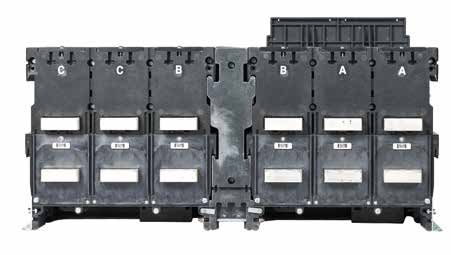
The phase sequence is also labeled on the rear of the circuit
breaker (Figure 3-3). For drawout breakers, phase sequence
3-1 Introduction labels are also supplied with the cassette and must be
IZM63 / IN63 circuit breakers are available in two physical applied by the switchgear builder. Circuit breakers with dif-
frame sizes and in both drawout and fixed mounting config- ferent phase sequences are not interchangeable. Drawout
urations (Figure 3-1 and Figure 3-2). A majority of features breakers with differing phase sequence are prevented from
are common to both configurations, and will be discussed insertion into the cassette by properly assembled rejection
in this section. The mounting features unique to the drawout key plates (see Section 2-6.1).
and the fixed configurations will be covered individually in
Sections 4 and 5 respectively.
Controls and indicators for both drawout and fixed circuit
breakers are functionally grouped on the front of the circuit
breaker. The front escutcheon (faceplate) covers all
continuous current ratings through 6300A.
6 Primary disconnect finger cluster
1
7 Arc chamber
5
8 8 Tripper bar
9 Levering device bearing plate
4
10 Padlockable levering device access door
3 11 Circuit breaker nameplate
11
10
9
2 1
5
7
6
1 Baffled arc chute cover
4
2 Secondary disconnects (contacts)
3 Faceplate (front cover)
4 Drawout rail supports
5 Integral lifting handle
6
9
Figure 3-1 Typical double-wide drawout circuit breaker features (front and rear views)
IZM63 / IN63 low voltage air circuit breaker MN013014EN May 2021 www.eaton.com.cn 15Section 3: Circuit breaker description and operation
1 6 Fixed primary terminal
(with optional vertical adapter)
7 Arc chamber
4
10 8 Mounting foot
9 Circuit breaker nameplate
10 Tripper bar
9 3
8 2
1
4
1 Baffled arc chute cover 7
2 Secondary disconnect 6
5
3 Faceplate (front cover)
4 Integral lifting handle
5 Fixed horizontal primary terminal
Figure 3-2 Typical fixed circuit breaker features (front and rear views)
16 IZM63 / IN63 low voltage air circuit breaker MN013014EN May 2021 www.eaton.com.cnSection 3: Circuit breaker description and operation
1
4
10
3 6 Arc chamber
8
7 Mounting foot
8 Circuit breaker nameplate
7
9 Phase identification labels
10 Tripper bar
2
1
1 Baffled arc chute cover
4
2 Secondary contact connector
3 Faceplate (front cover) 6 9 9 9 9 10
4 Integral lifting handle
5 Fixed vertical primary terminals 5
(with optional vertical adapter)
7
Figure 3-3 Typical double-wide standard frame fixed circuit breaker features (front and rear views)
IZM63 / IN63 low voltage air circuit breaker MN013014EN May 2021 www.eaton.com.cn 17Section 3: Circuit breaker description and operation
2
3 1
4 5
6 7
14
13 8
9
11
10
1 Trip flag (pop-out indicator) 8 Manual charge handle
2 Three accessory windows 9 Optional operation counter
3 Trip unit 10 Padlockable levering device access door for drawout breaker
4 Contact status (open-close) 11 Color-coded breaker position indicator
5 Spring status (charged-discharged) 12 Nameplate
6 Manual OFF button (push) 13 Trip unit test port
7 Manual ON button (push) 14 Trip unit cover. Plastic cover is provided which allows the
settings to be viewed but not changed.
Figure 3-4 Typical double-wide drawout circuit breaker front cover
18 IZM63 / IN63 low voltage air circuit breaker MN013014EN May 2021 www.eaton.com.cnSection 3: Circuit breaker description and operation
3-2 Basic circuit breaker assembly
2 (Case)
IZM63 circuit breakers use a rigid frame housing construc- 1 (Front cover)
tion of engineered thermoset composite resins. This con-
struction provides high-strength structural properties, excel-
lent dielectric characteristics, and resistance to arc tracking.
The three-piece construction approach provides support
while isolating and insulating power conductors.
A two-piece engineered thermoset composite resin case
encloses current paths and arc chambers. The chambers act
to channel arc gases up and out of the circuit breaker during
interruption.
The operating mechanism sits on the front of the case and is
electrically isolated and insulated from current contact struc-
tures. It is covered by an insulating front cover.
3-3 Operating mechanism
The IZM63 / IN63 operating mechanism is based on the
proven cam and spring design. It is easily accessed by
removing few cover screws and the front cover (Figure
3-6). The mechanism is a two-step stored energy mecha-
nism. Potential energy is stored to close the circuit breaker. Figure 3-5 Typical construction (right side view)
Sufficient energy to open the circuit breaker remains avail-
able after a closing operation.
1 Secondary wiring points
1
2 Field installable accessories
(3 maximum)
3 Trip unit 2
4 Electric charging motor
3
5 Manual charge handle 5
6 Operations counter (optional)
7 Padlockable levering device
access door
6
8 Breaker position indicator 4
8
7
Figure 3-6 Electrically operated drawout circuit breaker with front cover removed
IZM63 / IN63 low voltage air circuit breaker MN013014EN May 2021 www.eaton.com.cn 19Section 3: Circuit breaker description and operation
3-3.1 Manual operation 3-3.2 Electrical operation
On manually operated circuit breakers, the closing spring For electrically operated circuit breakers, the springs are
can only be charged manually. To manually charge the spring, normally charged through the use of an electrical operator
insert one finger in the recess behind the charging handle (Figure 3-8). The springs can, however, be charged manually
and pull out. This permits a gloved hand to grasp the handle as just described in the previous paragraph(Figure 3-7).
and begin charging. It takes from five to seven downward
strokes on the charging handle to complete the manual Like the manually operated circuit breaker in the previous
charging process. It is possible to manually recharge the paragraph, electrically operated circuit breakers can also
spring immediately after closing the circuit breaker and be manually closed and opened through the use of the
before it has been tripped open. Standard manually operated front-mounted Manual ON and Manual OFF buttons.
circuit breakers are closed and opened by hand using the An electrically operated circuit breaker from the factory is
Manual ON and Manual OFF buttons respectively located on also equipped as standard with a spring release to close the
the front of the circuit breaker (Figure 3-4). circuit breaker electrically. An optional shunt trip and under-
Performing either operation is accomplished by pressing and voltage release are also available to trip (open) an electrically
releasing the appropriate button. Access to these pushbut- operated circuit breaker. Refer to Section 4-1 for more details
tons can be limited by the use of an optional, padlockable on both standard and optional devices.
cover. In addition, complete access to the ON button can be
prevented with an optional prevent close cover. The status of
the springs and the primary contacts is always indicated in
3-3.3 Anti-pump feature
an indicator window just above the pushbuttons. The circuit breaker has both mechanical and electrical
antipump features. If the circuit breaker is closed on a
Electrically operated optional devices are available to auto- fault condition (and trips open while the CLOSE signal is
matically close or trip a manually operated circuit breaker. An maintained), using either the mechanical pushbutton or
electrical spring release is available to close a manually oper- the electrical close coil, it will not make another attempt to
ated circuit breaker. Two optional devices, a shunt trip, and close until the close command is removed and reapplied.
an undervoltage release, are available to automatically trip For electrical closing, a Latch Check Switch (LCS) option
(open) a manually operated circuit breaker. These optional is available (see “Plug-in electrical accessories” on page
devices can be installed easily in the field. For more details 35) that will block the application of the electrical close
on these devices, refer to Section 4-1 and 4-2 in this booklet. command until the breaker is ready to close (Section 4-1).
An electrical operator that is used to charge the closing
spring automatically can be added to a manually operated
circuit breaker in the field (Figure 3-8). Manually operated cir-
cuit breakers are pre-wired to accept this addition.
Figure 3-7 Electrical motor operator to charge closing Figure 3-8 Charging motor can be installed in the field
spring (installed)
20 IZM63 / IN63 low voltage air circuit breaker MN013014EN May 2021 www.eaton.com.cnSection 3: Circuit breaker description and operation
3-4 Electronic tripping system Table 3.1 Series PXR trip units.
Series IZM63 / IN63 circuit breakers use a three-part tripping Functions PXR 20 PXR 25
system: LSIG protection Yes Yes
• Microprocessor-based trip unit connected to a frame rat- Disable (I) Yes Yes
ing module; GF protection Option Option
• Rogowski coil type current sensors; and GF alarm Option Option
• Trip actuator. Display Yes Yes
Programmable No No
All three parts of the tripping unit are discussed here in
general. For detailed information pertaining to the different Current metering Yes Yes
available trip unit models and other breaker or accessory Power/energy metering No Yes
information, refer to PXR release instruction leaflet. Power quality metering No No
See important frame rating module information on next Communication Yes Yes
page regarding the tripping system.
3-4.1 Microprocessor-based trip unit 3-4.2 Rating plug
Series IZM63 / IN63 circuit breakers utilize the PXR family of
A rating plug is not required with PXR trip units. See frame
electronic trip units whose main features are summarized in
rating module description.
Table 3.1.
The electronic trip units are self-powered devices. The pro-
tection settings can be set from the front panel. When the 3-4.3 Current sensors
circuit breaker is closed, no external power is required to Rogowski coil type current sensors are installed on the
operate their protective systems. Current signal levels and load terminals at the bottom rear of the circuit breaker. The
the control power are derived from the current sensors. All sensors furnish the trip unit with a signal and the energy
trip units are true RMS current sensing devices. required to trip the circuit breaker.
A functional local test of the trip unit’s primary electronic cir- An external neutral current sensor is available for customer
cuitry and the circuit breaker’s mechanical tripping action can installation, and must be ordered separately.
be performed through the trip unit’s USB receptacle.
3-4.4 Frame rating module
The PXR frame rating module is mounted just behind the trip
unit and stores data related to the breaker’s ratings (includ-
ing the maximum continuous RMS current), manufacturing
information, and health of the breaker frame.
The interchangeable trip unit attaches to the permanent
frame rating module. Since the PXR trip unit no longer
requires a fixed type rating plug, the continuous current (In)
rating is factory programmed in the frame rating module.
The programmed value of In is shown on the trip unit’s
LCD display and printed on the Battery cover at the lower
right corner of the trip unit. The In rating displayed and pro-
grammed will be equal to or less than the breaker frame’s
maximum rated current as listed on the nameplate.
The breaker’s In rating can be re-programmed by interfacing
with the USB port on the trip unit. Please contact your Eaton
sales representative for details on proper re-programming of
Figure 3-9 Installed PXR trip unit the trip unit.
IZM63 / IN63 low voltage air circuit breaker MN013014EN May 2021 www.eaton.com.cn 21Section 3: Circuit breaker description and operation
Frame rating modules installed on series 3-4.7 Non-automatic device
IZM63 / IN63 air circuit breakers with PXR are perma-
Series IZM63 / IN63 is available in a non-automatic configura-
nent and SHOULD NEVER BE REMOVED. The frame
tion. It is derived from the corresponding IZM63 / IN63 auto-
rating module battery cover with printed In rating should
matic breaker but does not include the trip unit, Rogowski
not be changed without proper reprogramming of the
coil type current sensors, and the high instantaneous trip
trip unit. The In rating programmed from the factory
feature. The overall dimensions and the capability of mount-
is displayed in the lower left hand corner of the LCD
ing most accessory items are maintained. Non-automatic
screen whenever power is applied to the trip unit. The
device are tested in keeping with IEC 60947-2 requirements.
In displayed on the LCD reflects the actual In rating of
the breaker, while the value on the battery cover is for
reference only when the LCD is not powered. The In rat- 3-5 Secondary contacts and connection diagrams
ing displayed on the LCD screen and In rating printed on
A maximum of 96 secondary wiring connection points are
the frame rating module battery cover MUST ALWAYS
available on the standard frame circuit breaker each dedicat-
AGREE.
ed to a specific function. The wiring points are finger safe
with no more than two wires per terminal.
3-4.5 Trip actuator
The low-energy trip actuator is a small electromagnetic
device that provides the necessary mechanical force to ini-
tiate the tripping action of the circuit breaker. The electronic
trip unit provides a pulse to the coil of the trip actuator,
allowing the mechanical tripping action to take place. The trip
actuator is reset by the operating mechanism.
3-4.6 Fixed high instantaneous non-adjustable trip
Series IZM63 circuit breakers have a fixed instantaneous
non-adjustable setting. This fixed instantaneous trip will initi-
ate a trip at a high current peak which depends on the circuit
breaker type and rating. This setting is always active, regard-
less of the instantaneous setting.
1 3 5 7 9 11 13 15 17 19 21 23 25 27 29 31 33 35 37 39 41 43 45 47
ZCOM
CMM1
2CMM
CMM3
2CMM
MODG
OT1C
PTVC
OT1B
MODB
ARCO
OT2C
N1
ALMC
E01 +
+ 24V
PTVA
G1
ALM2
ZIN
E02
OT1M
OT2B
SC
2CMM
N2
2CMM
OT2M
CMM2
MODB
PTVN
PTVB
AGND
CMM4
ARCO
G2
ALM1
ALM3
ARMS
ARCO
ZOUT
-
2 4 6 8 10 12 14 16 18 20 22 24 26 28 30 32 34 36 38 40 42 44 46 48
49 51 53 55 57 59 61 63 65 67 69 71 73 75 77 79 81 83 85 87 89 91 93 95
C2
C3
B1
C1
C4
C5
B3
C6
B5
C11
C7
C8
C10
B11
C12
LCC
UV1+
SR1
B7
C9
B9
LCB
ST1
A1
A2
UV2
SR2
B2
LCM
A4
A5
B10
A11
A12
A3
B4
ST2
B6
A6
A8
A10
B12
A7
B8
A9
- -
50 52 54 56 58 60 62 64 66 68 70 72 74 76 78 80 82 84 86 88 90 92 94 96
Figure 3-10 Secondary connector top view
22 IZM63 / IN63 low voltage air circuit breaker MN013014EN May 2021 www.eaton.com.cnSection 3: Circuit breaker description and operation
Drawout type circuit breakers:
Compatible secondary plug-in connectors are mounted on
the top front portion of the drawout cassette (Figure 3-11).
These connectors match and plug into the circuit breaker
mounted connectors. Contact points are wired from the
cassette’s plug-in connectors to cassette mounted terminal
blocks. The terminal blocks are also mounted on the top
front portion of the cassette. The secondary terminals have
finger-proof hinged covers with small holes for probe testing.
Fixed type circuit breakers:
There are two secondary connection options:
(1) Without terminal block
Figure 3-11 Cassette-mounted secondary wiring
(2) With terminal block
1. Without terminal block—If a terminal block for customer
use is not required, the circuit breaker is supplied with
both plug-in connectors (male and female) just described
in the two previous paragraphs. The plug-in connectors
are joined and attached to the top portion of the circuit
breaker. The customer can plug secondary wiring with
crimp-on connectors into the back of the plug-in connec-
tors; subsequently the connections to the circuit breaker
can be quickly joined or separated as required.
2. With terminal block—For those customers preferring
to wire to a terminal block, terminal blocks with fin-
Secondary terminal AMP secondary
ger-proof hinged covers are added to the secondary
wiring removal tool
configuration just described for a fixed circuit breaker
“without a terminal block.” The terminal blocks are wired
to the plug-in connectors and also permanently attached Figure 3-12 AMP secondary wiring removal tool
to the upper rear portion of the circuit breaker.
A standard tool is available from the plug-in connector man-
ufacturer (AMP) to facilitate the removal of secondary wiring
from a plug-in connector, or contact Eaton for assistance
(Figure 3-12). The connector halves must be separated to
use this tool.
IZM63 / IN63 low voltage air circuit breaker MN013014EN May 2021 www.eaton.com.cn 23Section 4: Dimensional drawings IZM63 / IN63 fixed type dimensions and horizontal board dimensions (3P, 5000~6300A) 24 IZM63 / IN63 low voltage air circuit breaker MN013014EN May 2021 www.eaton.com.cn
Section 4: Dimensional drawings

IZM63 / IN63 fixed type dimensions and horizontal board dimensions (4P, 5000~6300A)

                                   IZM63 / IN63 low voltage air circuit breaker MN013014EN May 2021 www.eaton.com.cn   25
Section 4: Dimensional drawings
IZM63 / IN63 fixed type panel cutout and external vertical board dimensions (3P and 4P, 5000~6300A)
mounting hole
Door panel
Door cut out
Max. distance to
isolation surface
Door panel mounting hole
Door cut out
26 IZM63 / IN63 low voltage air circuit breaker MN013014EN May 2021 www.eaton.com.cnSection 4: Dimensional drawings
IZM63 / IN63 Withdrawable Type Dimensions (3P and 4P, 5000~6300A)
d e
f
Notes: de Drawer switch position f Recommended minimum mounting space
IZM63 / IN63 low voltage air circuit breaker MN013014EN May 2021 www.eaton.com.cn 2728
6.50
165.10
11.50
292.10
Door cut out
Mounting hole
19
Test position Connected position
Section 4: Dimensional drawings
Disconnected position
Withdrawn position
Mounting hole
Door cut out
Mounting hole
0
12.7
54
Mounting hole
76.2
Front View Right View
527.1
IZM63 / IN63 low voltage air circuit breaker MN013014EN May 2021 www.eaton.com.cn
IZM63 / IN63 withdrawable type panel cutout dimensions (3P and 4P, 5000~6300A)
Panel cutout size and circuit breaker position
Note:
1. Mperial dimensions are Inches on top metric dimensions are [mm] bottom.
2. All dimensions are reference only
3. Tolerance range is shown as follow:Required mounting locations
Ø11
6 places
384.1
Preferred mounting positioning
Ø11
6 places
10.2
177.8 177.8 120.7 177.8 177.8
38.1
Mounting plane
Rear view 210
621.5 143.2 Mounting plane
Optional mounting locations
Ø.32
[Ø8.2]
2 places
Earth contact access hole
Ø22.4
25.4 279.4
Optional earth bus mounting 231.9
location. replace existing Required mounting
25.4
with M8x25 hex. bolts for locations
use with 1/4 ( 6mm) bus Ø.32
[Ø8.2]
4 places
IZM63 / IN63 withdrawable type cassette dimensions and mounting dimensions (3P, 5000~6300A)
4 x 8.9 6.4 4 x 19.1
322.5 153.6 4 x 13.5
322.5
IZM63 / IN63 low voltage air circuit breaker MN013014EN May 2021 www.eaton.com.cn
50.3
Bottom view
3 pole mounting locations
29
Section 4: Dimensional drawings30
Ø11
6 places
Section 4: Dimensional drawings
384.1
Preferred mounting positioning
Ø11
6 places
10.2
241.3 241.3 120.7 241.3 241.3
38.1
Rear view Mounting plane
337
475.5 475.5
127.8 41.6 Mounting plane
Preferred mounting positioning
Ø8.2
4 places
Earth contact access hole 25.4
Ø22.4 25.4 279.3
IZM63 / IN63 low voltage air circuit breaker MN013014EN May 2021 www.eaton.com.cn
231.9 Required mounting
locations
Ø8.2
Optional earth bus mounting 4 places
location. replace existing 4 x 13.3
with M8x25 hex. bolts for
6.4 4 x 19.1
use with 1/4 ( 6mm) bus 4 x 8.9
50.3
351.4 350 351.3
IZM63 / IN63 withdrawable type cassette dimensions and mounting dimensions (4P, 5000~6300A)
Bottom view 4 pole mounting locationsSection 4: Dimensional drawings
IZM63 / IN63 withdrawable type cassette horizontal board wiring dimensions (3P - 5000~6300A)
Maximum distance 101.6
Busbar fixture
Item
IZM63 / IN63 low voltage air circuit breaker MN013014EN May 2021 www.eaton.com.cn 31Section 5: Protective characteristic curves
Section 5: Protective Characteristic Curves
IZM63 / IN63...V(P)...PXR20/25 Long Delay(L) and Short Delay(S) Curves
L-Protection: I²t-Characteristic curve and S-Protection: Flat characteristic curve
10000
9000
8000
7000
6000
5000
4000
3000
2000
1000
900
800
700
600
500
400
300
200
100
90
80
70
60
50
Time in Seconds
40
30
24
20
15
10
9 0.5
8 1
7 7
6
5
4 10
2 4 2
3
2 3
2
1 7
1 4 5
.9
.8 1.5
.7 8
.6 2.5
.5 0.5
.4
0.4
.3
6 0.3
.2
0.2
.1 3
.09
.08 0.1
.07
.06
.05
.04
.03
0
.02
.01
100
10
20
30
40
50
60
70
80
90
1
2
3
4
5
6
7
8
9
.1
.2
.3
.4
.5
.6
.7
.8
.9
Current in Multiples of Long Delay Pickup (Ir)
Notes:
1. Short slope: Flat, the actual pickup point has 100% ±10% tolerance.
2. Long delay I²T slopes flattens out at 6x of Ir.
3. Short time delay from 0(50ms) to 0.5s, with +0 / -80ms tolerance except 0.1s and 0s setting
0.1s setting, trip time is 0.06s to 0.1s
0s settting, nominal clear time is 60ms with auxiliary power and 120ms without.
4. If long delay thermal memory is enabled, trip times may be shorter than indicated in this chart.
5. Curves applies from -20°C to +70°C ambient. Temperatures above +85°C will cause over temperature trip.
6. This curve is for 50Hz, 60Hz applications.
7. These curves are comprehensive for series IZM63 / IN63 circuit breakers including all frame sizes, ratings, and constructions.
The total clearing times shown include the response time for trip unit, the breaker opening and the interruption of the current
32 IZM63 / IN63 low voltage air circuit breaker MN013014EN May 2021 www.eaton.com.cnYou can also read


