Low-Resource Neural Machine Translation Improvement Using Source-Side Monolingual Data
←
→
Page content transcription
If your browser does not render page correctly, please read the page content below
applied
             sciences
Article
Low-Resource Neural Machine Translation Improvement Using
Source-Side Monolingual Data
Atnafu Lambebo Tonja                     , Olga Kolesnikova * , Alexander Gelbukh                 and Grigori Sidorov

                                           Instituto Politécnico Nacional (IPN), Centro de Investigación en Computación (CIC), Mexico City 07738, Mexico
                                           * Correspondence: kolesnikova@cic.ipn.mx

                                           Abstract: Despite the many proposals to solve the neural machine translation (NMT) problem of
                                           low-resource languages, it continues to be difficult. The issue becomes even more complicated when
                                           few resources cover only a single domain. In this paper, we discuss the applicability of a source-side
                                           monolingual dataset of low-resource languages to improve the NMT system for such languages. In
                                           our experiments, we used Wolaytta–English translation as a low-resource language. We discuss the
                                           use of self-learning and fine-tuning approaches to improve the NMT system for Wolaytta–English
                                           translation using both authentic and synthetic datasets. The self-learning approach showed +2.7 and
                                           +2.4 BLEU score improvements for Wolaytta–English and English–Wolaytta translations, respectively,
                                           over the best-performing baseline model. Further fine-tuning the best-performing self-learning
                                           model showed +1.2 and +0.6 BLEU score improvements for Wolaytta–English and English–Wolaytta
                                           translations, respectively. We reflect on our contributions and plan for the future of this difficult field
                                           of study.

                                           Keywords: Wolaytta–English NMT; English–Wolaytta NMT; low-resource NMT; self-learning;
                                           neural machine translation; monolingual data for low-resource languages; low-resource NMT

                                           1. Introduction
Citation: Tonja, A.L.;
Kolesnikova, O.; Gelbukh, A.;
                                                 Machine Translation (MT) is a conventional name for computerized systems that
Sidorov, G. Low-Resource Neural
                                           produce translation from one natural language to another, with or without human inter-
Machine Translation Improvement
                                           vention [1]. As computational activities become more mainstream and the internet opens
Using Source-Side Monolingual Data.        to a wider multilingual and global community, research and development in MT continue
Appl. Sci. 2023, 13, 1201. https://        to grow at a rapid rate [2]. Linguists and computer scientists have been working together
doi.org/10.3390/app13021201                on MT for the past few years and have made a lot of progress on this hard task. There have
                                           been numerous MT approaches developed, including rule-based and example-based and
Academic Editor:
                                           statistical machine translation (SMT), and neural machine translation (NMT) approaches [1].
Douglas O’Shaughnessy
                                           Recent advances in deep learning have led to the dominance of neural network-based meth-
Received: 9 November 2022                  ods in various subfields of artificial intelligence (AI), including NMT [3]. NMT is the
Revised: 7 January 2023                    current state-of-the-art approach in MT, and it learns from a huge dataset of source lan-
Accepted: 12 January 2023                  guage sentences and their translations in the target language [4]. Deep neural methods,
Published: 16 January 2023                 including NMT, need a lot of data and cannot be trained well in environments with few
                                           resources. Even though MT has come a long way in the last ten years, it has mostly been
                                           used for high-resource languages because neural networks need large corpora to train well.
                                                 Therefore, the success of NMT models is heavily dependent on the availability of
Copyright: © 2023 by the authors.
                                           extended parallel data, which can only be collected for a limited number of language
Licensee MDPI, Basel, Switzerland.
                                           pairs [5]. High translation quality has been achieved for high-resource language pairings,
This article is an open access article
                                           such as English–Spanish [6–8], English–French [6,8,9], English–Russian [6,8,9], and English–
distributed under the terms and
conditions of the Creative Commons
                                           Portuguese [8]. NMT systems perform poorly in low-resource environments due to the lack
Attribution (CC BY) license (https://
                                           of enough training data for those languages [10]. Low-resource languages are not as well
creativecommons.org/licenses/by/
                                           represented in digital spaces as high-resource languages, which makes it hard for people
4.0/).                                     who speak these languages to use the latest technologies in their daily lives, including

Appl. Sci. 2023, 13, 1201. https://doi.org/10.3390/app13021201                                                 https://www.mdpi.com/journal/applsci
Appl. Sci. 2023, 13, 1201                                                                                             2 of 19

                            effective NMT systems. In order to address this problem, researchers have proposed
                            several solutions, including multilingual NMT [11], transfer learning [12], exploiting related
                            languages [13], multimodal NMT [14], data augmentation [15], filtered pseudo-parallel
                            datasets [16], and meta-learning [17].
                                 However, most of the suggested approaches used high-resource languages for their
                            experiments, and to the best of our knowledge, no research has been performed using
                            source-side monolingual data of low-resource languages to improve NMT. Using Wolaytta–
                            English translation as a case study, we propose an efficient method for using such data
                            to improve the NMT performance in low-resource languages. We collected 40 k Wolaytta
                            monolingual data from several sources, such as Wolaytta Fana Radio, Wolaytta Wogeta
                            Radio, and Wolaytta textbooks and used them along with a Wolaytta–English parallel
                            dataset in two experiments: (i) training a model on the available Wolaytta–English parallel
                            dataset (our baseline model) and (ii) training the selected model from the baseline on
                            the combination of the authentic dataset and synthetic dataset with a self-learning and
                            fine-tuning approach following the procedure in [18].
                                 Our objective is to answer the following research questions:
                            •    Will relying solely on source-side monolingual data improve the NMT performance
                                 for a low-resource language?
                            •    Will monolingual data from a low-resource language improve the performance of
                                 NMT when English is used as the source language?
                                  To respond to the above questions and to explore the NMT performance in a low-
                            resource language, we focus on NMT for the Wolaytta–English language pair because this
                            language pair has parallel data only from the religion domain, and this fact also serves as
                            an illustration of how difficult it is to compile a parallel dataset for a low-resource language.
                            Wolaytta is a language spoken in the southern part of Ethiopia, with few or no digital
                            resources [19]; a more detailed description can be found in Section 3.
                                  In this paper, we investigate NMT training from a dataset perspective for low-resourced
                            languages. We specifically examine the effects of using low-resource language source-side
                            monolingual data on improving the NMT and the most effective ways to use such data. As
                            a result, the contributions of our work are the following:
                            •    We thoroughly investigated the usability of a source-side monolingual dataset for
                                 low-resource languages to improve NMT.
                            •    We found a good way to combine a synthetic parallel dataset with an authentic parallel
                                 dataset when training an NMT model for low-resource languages.
                            •    We developed a good training method for fine-tuning NMT models that were trained
                                 on a mixed set of synthetic and authentic datasets.
                            •    We made our training scripts and the monolingual and parallel datasets available
                                 for public use. Specifically, the datasets can be used in the future as a benchmark for
                                 Wolaytta–English machine translation tasks.
                                  The rest of the article is organized as follows: Section 2 describes previous research
                            related to this study; Section 3 describes the Wolaytta language; Section 4 gives some
                            statistics of our dataset; Section 5 explains our proposed methodology; Section 6 presents
                            the experimental results, and Section 7 includes a detailed analysis of our results. Finally,
                            Section 8 concludes the paper and sheds some light on possible future work.

                            2. Related Work
                                  Researchers have recently come up with a lot of ideas for how to improve NMT
                            for languages with few resources. One way to improve the NMT system, especially for
                            languages with few resources, is to use monolingual data and parallel datasets. In this
                            section, we explore related studies performed for different languages using monolingual
                            datasets as an additional source to improve NMT systems for low-resource languages.
                            Laskar et al. [20] proposed utilizing monolingual data via pretrained word embeddings
                            in transformer model-based neural machine translation to tackle the parallel dataset prob-
Appl. Sci. 2023, 13, 1201 3 of 19
lem in bidirectional Tamil–Telugu NMT. The authors used GloVe [21] to pre-train word
embedding on the monolingual corpora and used them in the transformer model during
the training process. Their model achieved a BLEU score of 4.05 for both Tamil–Telugu and
Telugu–Tamil translations, respectively. Marie et al. [22] proposed a new method to gener-
ate large synthetic parallel data by leveraging very small monolingual data in a specific
domain. They fine-tuned a pre-trained GPT-2 model on small in-domain monolingual data
and used the resulting model to generate a large amount of synthetic in-domain monolin-
gual data. Then, they performed a back translation to generate synthetic in-domain parallel
data. Their results on the English–German, English–French, and English–Japan pairs and
five domains showed improvements in BLEU for all configurations when using synthetic
data to train NMT. Tars et al. [23] proposed a multilingual training approach, which can be
improved by leveraging monolingual data to create synthetic bilingual corpora using the
back translation method to improve low-resource machine translation. Their multilingual
learning strategy and synthetic corpora increased the translation quality for language pairs
from the Estonian and Finnish geographical regions.
Sennrich et al. [24] utilized monolingual data to improve the performance of the NMT
model for the English–German and Turkish–English language pairs. They created synthetic
parallel data by translating target language monolingual data into the source language.
Then, their initial target–source MT system was trained on the available parallel data. After
training, the system translated the monolingual dataset from the source language into the
target language to obtain the back-translated data. Next, Sennrich et al. [24] trained the final
source–target NMT system by mixing the back-translated data with the original parallel
data. Finally, the researchers achieved significant gains on the WMT-15 English–German
task with a +2.8–3.7 BLEU improvement and on the low-resource IWSLT-14 Turkish–
English task with a +2.1–3.4 BLEU improvement. Jiao et al. [25] proposed self-training
sampling with monolingual data uncertainty for NMT to improve the sampling procedure
by selecting the most informative monolingual sentences to complement the parallel data.
Using the bilingual lexicon generated from the parallel data, they calculated the uncertainty
of monolingual sentences. They suggested that emphasizing the learning of uncertain
monolingual sentences improves the translation quality of high-uncertainty sentences and
benefits the prediction of low-frequency words on the target side. The results of their
experiments on large WMT English–German and English–Chinese datasets show that the
proposed method improved the performance of NMT.
Dione et al. [26] utilized subword segmentation, back translation, and the copied
corpus methods to improve the NMT performance of bidirectional Wolof–French trans-
lation. When back translation and the copied corpus were used together, the quality of
the translation from Wolof to French showed improvement in both directions. Pham [27]
proposed the use of the Google Translate application as a reverse MT method to improve
the quality of monolingual texts for back translation in the English–Vietnamese language
pair. Compared to the baseline approach for English–Vietnamese NMT, their proposed
approach raised the BLEU score by 16.37 points. Ngo et al. [28] proposed extracting vocab-
ulary from the original bilingual corpus’s target text and generating artificial translation
units by tagging each standard translation with a label. Then, they concatenated the syn-
thetic corpus with the native corpus for training NMT systems. Their proposed approach
demonstrated improvements of +1.8 and +1.9 in the BLEU scores for Chinese–Vietnamese
and Japanese–Vietnamese translation tasks, respectively.
Table 1 gives a summary of the related works that used monolingual datasets to
improve the NMT system for the different language pairs discussed above. The language
pairs in the papers have more resources than the language we chose for this study because
they are more common in the digital space and have larger parallel corpora. The monolin-
gual datasets used in the reviewed papers were easy to collect, but this is not the case for
languages such as Wolaytta.Appl. Sci. 2023, 13, 1201 4 of 19
Table 1. Review of different machine translation systems that used monolingual datasets.
Monolingual Data
Approach
Publication Parallel Monolingual Dataset Used
Reference Language Pairs Used
Year Dataset Size Size Source- Target-
Side Side
Ta (315 M),
2021 Laskar et al. [20] Tamil(ta)–Telugu(te) 43K 4 4 Transformer
Te (478 M)
English(en)-German(de),
En-De (5.1 M), En-Fr
2021 Marie et al. [22] English(en)-French(fr), En (2.98 M) 6 4 Transformer
(32.7 M), En-Ja (3.9 M)
English(en)-Japan(ja)
Et-Fi (2.6 M), Et (125 K),
English(en)-German(de), Fi-Sma (3 k), Fi (125 k),
2021 Tars et al. [23] English(en)-French(fr), Et-Vro (30 k), Vro (168 k), 4 4 Transformer
English(en)-Japan(ja) Fi-Sme (109 K), Sme (40 K),
Sme-Sma (3.7 M) Sma (60 K)
English(en)-German(de), En-De (4 M), En (118 M)-De (160 M),
2021 Sennrich et al. [24] 4 4 Transformer
English(en)-Turkish(tr) En-Tr (320 K) En (3 M)-Tr
English(en)-German(de), En-De (36.8 M), En-De (40 M),
2021 Jiao et al. [25] 4 4 Transformer
English(en)-Chinese(zh) En-Zh (22.1 M) En-Zh (20 M)
Wo (35 K),
2022 Dione et al. [26] French(fr)-Wolof(wo) 78 k 4 4 Transformer
Fr (39 K)
2022 Pham [27] English(en)-Vietnamese(vi) 133 k 300 K Vi 6 4 Transformer
Chinese(zh)-Vietnamese(vi), Zh-Vi (24.4 M), Ja-Vi Za (27 M),
2022 Ngo et al. [28] 4 6 Transformer
Japanese(ja)-Vietnamese(vi) (24.5 M) Ja (27 M)
In this paper, we test whether a monolingual dataset of a low-resource language can
be used to improve NMT by running experiments on language pairs with small corpora.
We explore ways to generate target-side synthertic data for NMT using a small amount of
the source-side monolingual dataset and parallel dataset. In our experiments, we followed
the training approach of Sennrich et al. [24] to generate synthetic data and train the model
on mixed datasets in a self-learning fashion.
3. Overview of the Wolaytta Language
We added this section to show the difference between the Wolaytta language and
English in terms of morphology, phonology, writing system, and word order. We hope this
helps the reader to understand the languages we are using and how difficult it is to work
on low-resource and morphologically complex languages in the area of NMT.
Wolaytta refers to the people, language, and area located in the Wolaytta Zone of
southern Ethiopia [29]. The Wolaytta language is one of the languages in the Ometo group,
which belongs to the Omotic branch of the Afroasiatic family (or phylum). In addition
to the Wolaytta Zone, it is spoken in Addis Ababa city and in other border areas, such as
Gamo, Gofa, and Dawuro. The natives refer to their language as Wolayttattuwa, although it
is also referred to as Wolaytta doonna or Wolaytta Kaalaa.
It is used as a primary school medium of instruction and as a secondary and high
school subject. Currently, the Wolaytta language is offered as a subject in the Bachelor’s
program at Wolaytta Sodo University, Sodo, Ethiopia (http://www.wsu.edu.et/). In the
Wolaytta Zone, this language is used in government offices as the language of work and
communication.Appl. Sci. 2023, 13, 1201 5 of 19
3.1. Phonolog
3.1.1. Vowels
Wolaytta has five vowel phonemes, each of them in both long and short variants [30].
3.1.2. Consonants
Wolaytta has the following consonant phonemes: voiceless (p, t, k, P, s, sh, h, nh, and c),
voiced (b, d, g, z, zh, j, m, n, r, l, w, and y), and glottalized (P, T, K, C, D, L, M, and N) [29,30].
3.1.3. Writing System
The Wolaytta language employs a Latin-based alphabet with twenty-nine fundamental
letters, of which five (‘i’, ‘e’, ‘a’, ‘o’, and ‘u’) are vowels, twenty-four (‘b’, ‘c’, ‘d’, ‘f’, ‘g’, ‘h’,
‘j’, ‘k’, ‘l’, ‘m’, ‘n’, ‘p’, ‘q’, ‘r’, ‘s’, ‘t’, ‘v’, ‘w’, ‘x’, ‘y’, ‘z’, and ‘P’) are consonants, and seven
pair letters fall together (a combination of two consonant characters ‘ch’, ‘dh’, ‘ny’, ‘ph’, ‘sh’,
‘ts’, and ‘zh’) [27–29]. Numerous textbooks are being produced in the Latin alphabet [31],
reflecting the alphabet’s widespread use in the mother-tongue of the school system.
3.2. Morphology
Wolaytta is a language with one of the most complex morphological systems and is
categorized as an agglutinative type, similarly employing both morphological inflection
and derivation like other languages of this kind, leading to a huge number of variations for
a single word [30,31]. Wolaytta only depends on suffixes to form different forms of a given
word. siiqa (‘love’), including siiqa (‘love it’), siiqa-asa (‘you love’), siiqa-asu (‘she loves’),
siiqa-da (‘fall in love’), siiqa-dasa (‘you loved’), siiqa-dii (‘do you love’), siiq-idda (‘while
loving’), siiqa-is (‘i love’), siiq-oosona (‘they love’), and siiq-ida (‘by loving’), are examples
of morphological richness. These forms are derived from the root siiqa ‘love’ by adding the
suffixes -asa, -asu, -idda, -is, and -ida. Among the word formation patterns in Wolaytta, the
common one is suffixation, in which words are frequently created by combining two or
more suffixes [29]. By adding one suffix on top of another, we make a long word that often
has as much meaning and grammar as a whole English phrase, clause, or even sentence.
For example, (i) he-g-aa-dan (‘like’) formed by adding three (-g, -aa, and -dan) suffixes to
the root word he (‘that’), (ii) bochch-enn-aa-dan (‘don’t touch’) formed by adding three
(-enn, -aa, and -dan) suffixes to the root word bochcha (‘touch’). Because of the intricate
nature of its grammatical structure, a single Wolaytta word may have a very wide variety
of different meanings when translated into other languages.
3.2.1. Nouns
Wolaytta nouns are divided into four groups based on the endings they take in
inflection [29–31]. The nouns ending in ‘-a’ in the absolute case and with the action on
their last syllable belong to the first class, for example, aawwa (‘sun’) and tuma (‘truth’).
Nouns with their absolute case ending ‘-iya’ and the accent on their penultimate syllable
make up the second class, for example, xalliya (‘medicine’), ogiya (‘road’), and siniya
(‘cup’). Nouns ending in ‘-uwa’ in their absolute case constitute the third class, for example,
ossuwa (‘work’) and giduwa (‘center’). The forth class consists of nouns ending in ‘-(i)yo’
in their absolute case. The letters mainly include terms referring to female living beings,
for example, naPP-yo or na”-yo (‘the girl’) and machas-iyo (‘the wife’).
3.2.2. Gender
Like many other languages, Wolaytta nouns exhibits two genders: masculine and
feminine [29–31]. Nouns belonging to the fourth class are feminine, while the nouns
belonging to the other three classes are masculine. The feminine ones differ from the
masculine ones by their endings; the former are characterized by the ending ‘-o’ in the
absolute case and the latter by the ending ‘-a’ in the absolute case. Additionally, if nouns
are used as a subject, they are marked with ‘-iy’ for the feminine and ‘-ay’ for the masculine.Appl. Sci. 2023, 13, 1201 6 of 19
There are a few exceptions, such as possessive pronouns and some demonstratives, which
may only have forms for one gender or the other.
3.2.3. Number
According to Wakasa [29] and Hirut [30], the Wolaytta noun system has two numbers:
singular and plural. Most nouns have a singular form, and the plural form is formed by
adding a suffix to the singular form. Wolaytta forms the plural of nouns by means of a
morpheme ‘-tv’, where ‘-v’ represents a final vowel, which changes according to the case
inflection of the plural itself. In the absolute case, ‘-v’ corresponds to ‘-a’: dorssa (‘sheep’)
and desha (‘goat’); thus, the plural marker is ‘-ta’: dorssa-ta (‘sheep’) and desha-ta (‘goats’) in
that case.
3.3. Articles
Wolaytta does not require articles in front of nouns. The meaning usually represented
by the definite article in other languages is rendered by dropping the last vowel of the noun
and adding the suffix -ti [32]. For example, ‘sheep’ is dorssa and (‘the sheep’) is dorssa –ti,
‘dog’ is kana, and (‘the dogs’) is kana-ti.
3.4. Syntax
The Wolaytta language employs Subject–Object–Verb (SOV) [31] word order. For
example, in the sentence Bakali ketta kexiis, Bakali (‘Bekele’) is the subject; ketta (‘house’)
is the object, and kexiis (‘built’) is the verb. In English, the typical sentence structure is
Subject–Verb–Object (SVO); therefore, the above Wolaytta sentence is translated as “Bekele
built a house”.
3.5. Punctuation
Except for apostrophes, Wolaytta and English use the same punctuation marks with the
same function except for the apostrophe. In Wolaytta, the apostrophe is used to indicate the
glottal stop symbol ‘P’ [29]. For example, loPP o (‘good’) written using a double apostrophe,
such as lo”o, beP aa (‘see’), can be written as be’aa.
4. Dataset
We utilized parallel datasets for Wolaytta–English from the Tonja et al. [19] study and
collected a monolingual Wolaytta dataset from several sources, such as Wolaytta Fana
Radio, Wolaytta Wogeta Radio, and Wolaytta text books. Table 2 depicts the parallel and
monolingual datasets used in this study and their distribution in terms of the number of
parallel and monolingual sentences, types, tokens, and vocabulary size.
Table 2. Wolaytta–English parallel and Wolaytta monolingual dataset distribution.
Languages Sentences Tokens Types Vocabulary Size
English 763,083 19,736 11,130
30,495
Wolaytta 511,426 54,825 22,706
Wolaytta monolingual 40 k 496,251 70,289
As Table 2 shows, our final dataset contains 30 k parallel sentences for the Wolaytta–
English language pair and 40 k monolingual dataset for Wolaytta. In the Wolaytta–English
parallel dataset, there are 19,736 unique words in English, 54,825 unique words in Wolaytta,
and 70,289 unique words in the Wolaytta monolingual dataset.
Comparing unique words in the parallel dataset, Wolaytta has about three times
more words than English. This is due to the morphological inflection and derivation of
the Wolaytta language, which leads to a huge number of variations for a single word.
Comparing the Wolaytta parallel dataset and the Wolaytta monolingual dataset, in the
same way, the latter has about twice as many words as the parallel dataset.gual dataset.
Comparing unique words in the parallel dataset, Wolaytta has about three times
more words than English. This is due to the morphological inflection and derivation of
the Wolaytta language, which leads to a huge number of variations for a single word.
Appl. Sci. 2023, 13, 1201 Comparing the Wolaytta parallel dataset and the Wolaytta monolingual dataset, in7 the of 19
same way, the latter has about twice as many words as the parallel dataset.
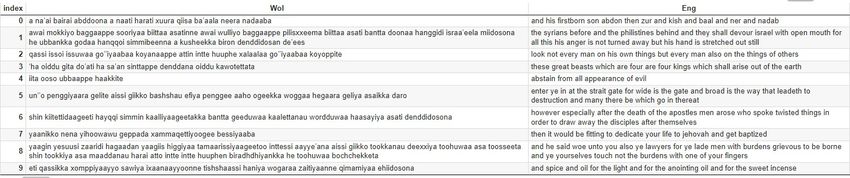
Error! Reference source not found. and 2 show the most common tokens in the par-
allel and monolingual
Figures 1 and 2 show datasets, respectively.
the most common tokensParallel
in and monolingual
the parallel Wolaytta data,
and monolingual as
datasets,
shown in Error! Reference source not found.a and 2, share the most
respectively. Parallel and monolingual Wolaytta data, as shown in Figures 1a and 2, share common words re-
gardless
the mostofcommon
the domain.words The Wolaytta–English
regardless parallel
of the domain. Thedataset belongs to the
Wolaytta–English religion
parallel do-
dataset
main,
belongsbuttothetheWolaytta
religion monolingual
domain, but the dataWolaytta
belong to the sports, news,
monolingual and education
data belong do-
to the sports,
mains. For example,
news, and educationwordsdomains. such as,example,
For a (‘she’),words
ha (‘this’),
such ba
as, (‘go’), i (‘he’),
a (‘she’), he (‘that’),
ha (‘this’), eta i
ba (‘go’),
(‘them’),
(‘he’), he ta (‘me’),etane(‘them’),
(‘that’), (‘you’), tagishawi
(‘me’),(‘because
ne (‘you’),of’), deiya(‘because
gishawi (‘have’), of’),
issi (‘one’), and mala
deiya (‘have’), issi
(‘similar’) appear in both datasets, but words such as Xoossaa (‘God’),
(‘one’), and mala (‘similar’) appear in both datasets, but words such as Xoossaa (‘God’), israaeela (Israel’),
and godai(Israel’),
israaeela (’The God’) are not
and godai found
(’The God’) in are
thenot
Wolaytta
found in monolingual
the Wolaytta data because these
monolingual data
words
becausearethese
onlywords
used inare theonly
religion
used domain.
in the religion domain.
(a) (b)
Appl. Sci. 2023, 13, x FOR PEER REVIEW
Figure 8 of 20
Figure1.1.Fifty
Fiftymost
mostcommon
commonwords
wordsininthe
theparallel
parallelcorpora.
corpora.(a)
(a)Wolaytta
Wolayttaparallel
paralleldata;
data;(b)
(b)English
English
parallel
paralleldata.
data.
Figure 2.
Figure 2. Fifty
Fifty most
most common
common words
words in
in Wolaytta
Wolayttamonolingual
monolingualdata.
data.
Error! Reference
Figure source
3 depicts the wordnot found.
count per depicts
sentencethe
in word count per
the parallel sentence
datasets in the
for each ofpar-
the
allel datasets for each of the languages.
languages. From the combined diagram of From the combined
Wolaytta and English parallel dataand
diagram of the Wolaytta in
English4,parallel
Figure datahow
it is evident in Error! Reference
different source
Wolaytta not found.,
and English it islengths
sentence evidentare.
how different
Wolaytta and English sentence lengths are.Figure 2. Fifty most common words in Wolaytta monolingual data.
Error! Reference source not found. depicts the word count per sentence in the par-
allel datasets for each of the languages. From the combined diagram of the Wolaytta and
Appl. Sci. 2023, 13, 1201 parallel data in Error! Reference source not found., it is evident how different
English 8 of 19
Wolaytta and English sentence lengths are.
Appl. Sci. 2023, 13, x FOR PEER REVIEW 9 of 20
(a) (b)
Appl. Sci. 2023, 13, x FOR
Figure PEER REVIEW
3. Sentence word
Figurecount in (a)word
3. Sentence Wolaytta
count inand (b) English
(a) Wolaytta parallel
and (b) Englishdatasets. As canAs
parallel datasets. becan
observed
be observed 9 of 2
in (a,b), the word count per
in (a,b), thesentence in per
word count Wolaytta
sentenceand English
in Wolaytta is English
and withinisthe range
within the [2–40].
range [2–40].
Figure 4. Sentence word count in Wolaytta–English parallel dataset.
Error!
Figure
Figure 4.4.
Reference
Sentence
Sentence
source
word
word
notinfound.
count
count
and 6parallel
include
Wolaytta–English
in Wolaytta–English
some text samples from the parallel
parallel
dataset.dataset.
and monolingual datasets.
Table 3. Manually
Figures
Error! 5Reference translated
and 6 include somenot
source sample
text text
samples
found. for
from
and monolingual
the parallel
6 include some text
andtext Figure 6 from
monolingual
samples shows trans-
datasets.
the paralle
Table
lated 3 Manually
sample text translated
for the sample
Wolaytta text for Figure
monolingual 6 monolingual
dataset shown intext shows
Error! translated
Reference source
and monolingual datasets.
notsample
found..text for the Wolaytta monolingual dataset shown in Figure 6.
Table 3. Manually translated sample text for monolingual text Figure 6 shows trans
lated sample text for the Wolaytta monolingual dataset shown in Error! Reference sourc
not found..
Figure 5. Sample
Figure 5. Sampletexts
textsfrom
from Wolaytta–English parallel
Wolaytta–English parallel dataset.
dataset.
Figure 5. Sample texts from Wolaytta–English parallel dataset.Appl. Sci. 2023, 13, 1201 9 of 19
Figure 5. Sample texts from Wolaytta–English parallel dataset.
Figure 6. Sample
Figure 6. Sampletexts
textsfrom
from Wolaytta monolingual
Wolaytta monolingual dataset.
dataset.
Table 3. 3.
Table Manually
Manuallytranslated
translated sample textfor
sample text formonolingual
monolingualtexttext Figure
Figure 6. 6.
Wolayta
Wolayta Monolingual Equivalent Monolingual
Translation Equivalent
(Manually Translation (Manually Translated)
Translated)
So that the language and people put a victim one another, which resulted in the growth and death of it
So that the language and people put a victim one another, which resulted in the growth and death of it
she is saying that go to home whom not cleaning her mother-in-law dirty home
she is saying that go to homeMinute
whomor not cleaning
idea her mother-in-law dirty home
collection
Minute or idea collection Not only the sign of language but also the message it conveys
the rude father who saw it went to his home and said to his careless wife that our son we let him to keep cattle
Not only the sign of language but also the message it conveys
who stole black piece of powder and laid filling his mouth
the rude father who saw it went to hiskinds
different homeofand said toliterature
Wolaytta his careless wife that our son we let him to keep cattle who stole black
piece of powder and laid filling his mouth
answer as indicated in the paragraph
it must be based on the knowledge level of language reading culture that may or may not possible
different kinds of Wolaytta literature
answer as indicated in the paragraph
5. Methodology
it must be based on the knowledge level of language reading culture that may or may not possible
5. Methodology
In this section, we present our experimental pipeline. The first step is data prepro-
cessing, which is explained in Section 5.1. In Section 5.2, we discuss the hyper parameters
used in the experiments. In Section 5.4, we present the experimental architecture of our
NMT model followed by its detailed discussion. In Section 5.4.1, we go over the three
models we trained on the parallel data to choose our baseline models. Then, we show
how we used a source-side monolingual dataset and self-learning approach to improve
the performance of our best baseline model. We explore self-training on the source-side
monolingual (Wolaytta) dataset with the target-side synthetic (English) dataset and parallel
dataset in Section 5.4.2, and in Section 5.4.3, we discuss the final experimental approach.
Finally, in Section 5.5, we discuss the metrics used to evaluate our NMT models.
5.1. Data Preprocessing
Before training the NMT models with the datasets described in Section 4, we prepro-
cessed both monolingual and parallel data in the following steps: (i) removing the duplicate
sentences from the parallel dataset, (ii) converting all texts to lower case, (iii) removing
special characters from texts except the apostrophe symbol for the reason discussed in
Section 4 (Wolaytta uses the apostrophe (single quote) symbol to represent the glottal stop
symbol (P), (iv) tokenizing the source and target parallel sentences into subword tokens us-
ing Byte Pair Encoding (BPE) [33] representation, and (v) generating subword embeddings
as input to the positional encoder block of the transformer model.
5.2. Hyperparameters
For our experiments, we selected hyperparameters according to the models we used.
For the long short-term memory (LSTM) baseline model, as described in [34], we used
an embedding layer with an embedding vector size of 512, layers of LSTMs (encoder
and decoder) with 1000 neurons, and a dense layer with 1000 neurons with the Softmax
activation in the output layer and a dropout of 0.2. We trained the model in 25 k steps with
a batch size of 64. For a bidirectional long short-term memory (Bi-LSTM) model, we used a
similar embedding size of 512, layers of LSTMs (encoder and decoder) with 512 neurons,Appl. Sci. 2023, 13, 1201 10 of 19
and a dense layer with 1024 neurons with the Softmax activation in the output layer and a
dropout of 0.3. We trained the model in 25 k steps with a batch size of 64.
We chose the state-of-the-art transformer network proposed in [35], which consists
of an encoder with six layers and a decoder with six layers. We used a transformer-big
configuration from [36] in all experiments: the dimensions of the word embedding and the
inner feed-forward layers are 512 and 2048, respectively. The number of attention heads is
16, with a dropout of 0.2. We trained the model in 25k steps with a batch size of 3072.
All models were trained using the Adam optimizer [37] with 1 = 0.9 and 2 = 0.98
and the cross-entropy loss. The padding was masked when computing the loss. The
transformer used the learning rate scheduler defined in the original paper ’Attention is all
you need’ [35], while the LSTM and Bi-LSTM used a learning rate of 0.0001. The models
were saved at the steps that showed the best validation bilingual evaluation understudy
(BLEU) score.
5.3. Experimental Setting and Setup
We used the same environment as in [36] and trained all models in Google Colab Pro + [38]
with OpenNMT [39]. We employed BPE [33] subword tokenization, and the BPE representation
was chosen in order to remove vocabulary overlap during dataset combinations.
5.4. Experimental
Appl. Sci. 2023, 13, x FOR PEER REVIEW Architecture 11 of 20
Our experimental architecture is composed of three models, namely the baseline,
self-trained, and final NMT models as shown in Figure 7. Experimental architecture of
the Wolaytta–English
Wolaytta–English NMT NMT model.
model. TheThe detailed
detailed description
description of models
of the the models is discussed
is discussed in
in Sec-
Sections 5.4.1
tions 5.4.1 andand 5.4.2.
5.4.2. To train
To train the the baseline
baseline model,
model, we utilized
we utilized the available
the available Wolaytta–
Wolaytta–Eng-
English parallel
lish parallel dataset
dataset [19],[19],
and and to train
to train the self-trained
the self-trained model,model, we used
we used a combination
a combination of the
of the authentic parallel sentences, Wolaytta monolingual, and English synthetic
authentic parallel sentences, Wolaytta monolingual, and English synthetic datasets. datasets.
Fi-
Finally,
nally, wewefine-tuned
fine-tunedthetheself-trained
self-trained NMT
NMT model
model onon
thethe authentic
authentic parallel
parallel dataset
dataset to
to ob-
obtain
tain thethe final
final NMT
NMT model.
model.
Figure7.7.Experimental
Figure Experimentalarchitecture
architectureof
ofthe
theWolaytta–English
Wolaytta–EnglishNMT
NMTmodel.
model.
Theprocedure
The procedureconsists
consistsofof eight
eight steps
steps (described
(described in Sections
in Sections 5.4.15.4.1
and and 5.4.2).
5.4.2). StepStep
1: use1:
useparallel
the the parallel dataset,
dataset, train train the baseline
the baseline model; model;
StepsSteps
2 and23:and 3: generate
generate synthetic
synthetic EnglishEnglish
data;
data;4:Step
Step 4: combine
combine syntheticsynthetic and authentic
and authentic parallelStep
parallel datasets; datasets;
5: trainStep 5: train theNMT
the self-trained self-
trained NMT model in mixed data; Steps 6 and 7: fine-tune self-trained NMT model on
the authentic parallel dataset; Step 8: evaluate the final NMT model on test data.
5.4.1. Baseline
To select the best-preforming model for further experiments, we conducted threeAppl. Sci. 2023, 13, 1201 11 of 19
model in mixed data; Steps 6 and 7: fine-tune self-trained NMT model on the authentic
parallel dataset; Step 8: evaluate the final NMT model on test data.
5.4.1. Baseline
To select the best-preforming model for further experiments, we conducted three
baseline experiments using the authentic Wolaytta–English parallel dataset as depicted in
Step 1 in Figure 7. Experimental architecture of the Wolaytta–English NMT model. For our
baseline experiments, we used bidirectional LSTM encoder–decoders, transformer models,
and unidirectional LSTM encoder–decoders. The goal of this experiment was to identify
and select the model that outperformed on the authentic parallel dataset and then use the
selected model in the rest of the experiments.
• LSTM is a special type of recurrent neural network introduced to solve the problem
of vanishing and exploding gradients. This network also works better at keeping
long-distance connections and figuring out how the values at the beginning and end
of a sequence are related. LSTM only preserves information because the only input to
an LSTM unit has seen is from the past that is from previous units.
• Bi-LSTM is a recurrent neural network used primarily for natural language processing
(NLP). In contrast to standard LSTM, the input flows both ways, so the model can use
information from both sides of a sequence. So, it is a very useful tool for modeling
how words and phrases depend on each other in both directions of the sequence.
• Transformer is a type of artificial neural network architecture designed to solve the
problem of transforming input sequences into output sequences in deep learning
applications. It was proposed to take advantage of attention [35] and repetition
to handle dependencies between input and output data. This transduction model
employs self-attention to compute representations of its inputs and outputs, unlike
recurrent neural networks (RNNs), which use sequences. Due to this feature, the
transformer allows for much more parallelization than RNNs during training.
We used hyperparameters discussed in Section 5.2 for each baseline model. The
baseline models were trained using the parallel Wolaytta–English parallel dataset. From
the three baseline models, we then selected the best-preforming model to generate a
synthetic English dataset with the help of the Wolaytta monolingual dataset. We combined
the Wolaytta–English parallel dataset with the synthetic parallel dataset in the following
training steps as described in Section 5.4.2.
5.4.2. Self-Learning
In machine translation, a model is trained on parallel (authentic) data and then used
to translate a set of monolingual source sentences into the target language. This creates
pseudo-parallel (synthetic) training data. In the next step, the synthetic data are used to
train a better model by combining the pseudo-parallel data with the authentic parallel data.
The self-training approach was first introduced by Ueffing et al. [18] to improve phrase-
based statistical machine translation systems. In their work, they used a self-training system
to generate translations of a set of source data. Then, the confidence score of each of the
translated sentences was calculated, and based on these scores, reliable translations were
selected and further adopted as additional training data for improving the same system.
We applied the self-learning approach to train the best-preforming model from the
baseline models by combining the pseudo-parallel training data with the authentic parallel
data. In our scenario, the self-learning approach was implemented in the following ways
(more details can be found in Algorithm 1): in order to select the best-preforming model
from our baseline models, we trained three baseline NMT models Tm for languages X
and Y (X and Y represent Wolaytta and English, respectively) in the X → Y translation
direction using the authentic X–Y parallel dataset Pd. After training Tm, we generated the
target synthetic dataset Sd by translating the Wolaytta monolingual dataset Md using the
selected Tm from our baseline model. Then, we combined Md and Sd to form the syntheticAppl. Sci. 2023, 13, 1201 12 of 19
parallel dataset Sp. Finally, we trained a new X → Y translation on the combination of
both Pd and Sp datasets.
Algorithm 1 Self-learning approach.
Requires:
• Authentic parallel dataset: Pd
• Monolingual dataset: Md
• Target synthetic dataset: Sd
• Synthetic parallel dataset: Sp
• Languages: X, Y
• Translation model: Tm X → Y
Ensures:
Train Tm : X → Y on Pd
Generate Sd by translating Md using trained Tm : X → Y
Combine Md and Sd to form Sp
Train final Tm : X → Y on the combination of Pd and Sp
In our self-learning approach, we used in-domain, mixed validation sets to fine-tune
the parameters of the NMT model during training time, and evaluated its performance
using an in-domain test set.
5.4.3. Fine-Tuning
Transfer learning is one of the currently suggested approaches to improve the perfor-
mance of NMT for low-resource languages [12]. We applied transfer learning by fine-tuning
our self-trained NMT models using the parallel Wolaytta–English parallel dataset to obtain
our final NMT model. During fine-tuning, we used both self-trained NMT models with
in-domain and mixed validation sets.
5.5. Evaluation
We evaluated the performance of our model in terms of translation accuracy. There
are many evaluation techniques developed for such purpose: human evaluation, Bi-lingual
Evaluation Understudy (BLEU) score, National Institute of Standards and Technology
(NIST) score, Metric for Evaluation of Translation with Explicit Ordering (METEOR),
Translation Edit Rate (TER), and Character-level F-score (chrf).
5.5.1. BLEU Score
BLEU is an automatic metric based on n-grams [40]. It measures MT adequacy by
looking at word precision and MT fluency by calculating n-gram precisions, returning a
translation score with in the range [0, 1] or alternatively with a [0, 100] scale. We used
a particular implementation of BLEU, called SacreBLEU. It outputs dataset scores, not
segment scores. The greater the score, the closer the translation is to the reference. The
rationale behind BLEU is that high-quality translations will share many n-grams with
human translations [40].
BLEU is defined as 4
BLEU = BP4 × ∏ × pn
n =1
where pn measures the modified n-gram precision between a document with candidate
translations and a set of human-authored reference documents, and the brevity penalty BP
downscales the score for outputs shorter than the reference. BLEU measures the closeness
of the machine translation to the human reference translation taking into consideration the
translation length, word choice, and word order.Appl. Sci. 2023, 13, 1201 13 of 19
5.5.2. Translation Edit Rate (TER)
TER is a character-based automatic metric for measuring the number of edit operations
needed to transform the machine-translated output into a human-translated reference [41].
TER is defined as the minimum number of edits needed to change a hypothesis (i.e.,
translation) so that it exactly matches one of the references, normalized by the average
length of the references. Because we were concerned with the minimum number of edits
needed to modify the hypothesis, we measured only the number of edits to the closest
reference specifically [41]:
#edit average
TER = .
#o f re f erencewords
Possible edits include insertion, deletion, and substitution of single words as well as
shifts of word sequences. The dataset TER score is the total number of edits divided by the
total number of words and multiplied by 100. TER ranges from 0 to infinity. The greater
the score, the farther the translation is from the reference.
5.5.3. Character-Level F-Score (chrF)
chrF is a tool for the automatic evaluation of machine translation output based on
character n-gram precision and recall, enhanced with word n-grams [42]. It calculates the
F-score averaged on all the character and word n-grams, with character n-gram order set to
6 and word n-gram order set to 2. chrF score calculated as
CHRP × CHRR
(1 + β2) ,
β2 × CHRP + CHRR
where CHRP is the percentage of n-grams in the hypothesis, which have a counterpart
in the reference (character n-gram precision), and CHRR is the percentage of character
n-grams in the reference, which is also present in the hypotheses (character n-gram recall).
CHRP and CHRR are averaged over all n-grams, and β is the parameter to assign β times
more importance to recall than to precision. If β = 1, the precision and recall have the same
importance.
6. Results
In this section, we discuss the results of our experiments. In Section 6.1, we show
the results of our baseline NMT models in both Wolaytta–English and English–Wolaytta
translations. In Section 6.2, we present the results of the self-trained NMT models using
both synthetic and authentic datasets. Finally, in Section 6.3, we give the results of our final
fine-tuned NMT model on the authentic dataset.
6.1. Baseline
As discussed in Section 5.4.1, to select the best-performing model, we trained and
evaluated three baseline models on the authentic parallel dataset. Table 4 shows the BLEU,
chrF, and TER scores of the three baseline models in Wolaytta-English translation. It
can be seen in Table 4 that the best-performing baseline model is the transformer model.
Similarly, Table 5 shows that for the English-Wolaytta translation, the transformer model
outperformed the other models. In Section 7, we discuss the performance of the baseline
models in detail.
Table 4. BLEU, chrF, and TER scores of baseline models in Wolaytta–English translation.
Model (Wolaytta–English) BLEU (%) chrF TER Loss
LSTM 6.0 23.9 87.4 5.38
Bi-LSTM 6.7 24.7 86.6 5.30
Transformer 12.2 31.8 80.2 5.69Appl. Sci. 2023, 13, 1201 14 of 19
Table 5. BLEU, chrF, and TER scores of baseline models in English–Wolaytta translation.
Model (English–Wolaytta) BLEU (%) chrF TER Loss
LSTM 2.1 18.2 94.9 6.18
Bi-LSTM 2.8 20.5 95.0 7.28
Transformer 6.2 26.0 93.9 6.26
6.2. Self-Learning
As considered in Section 5.4.2, we selected the outperforming NMT model from our
baseline models and trained it on the combination of mixed (parallel and synthetic) dataset.
Tables 6 and 7 show the BLEU, chrF, and TER scores of the self-trained NMT models trained
on a combination of the authentic and synthetic parallel datasets for Wolaytta–English and
English–Wolaytta translation, respectively.
Table 6. BLEU, chrF, and TER scores of NMT models trained on the combination of synthetic and
authentic datasets for Wolaytta–English translation.
Model (English–Wolaytta) BLEU (%) chrF TER Loss
Transformer (mixed validation set) 14.7 34.7 78.1 3.72
Transformer (in-domain validation) 14.9 35.1 77.6 3.61
Table 7. BLEU, chrF, and TER scores of NMT models trained on the combination of synthetic and
authentic datasets for English–Wolaytta translation.
Model (English–Wolaytta) BLEU (%) chrF TER Loss
Transformer (mixed validation set) 8.4 30.3 89.7 6.62
Transformer (in-domain validation set) 8.6 30.6 88.9 6.98
6.3. Fine-Tuning
As shown in Section 5.4.3, to train the final NMT model, we fine-tuned the self-trained
NMT models in both in-domain and mixed validation sets using the authentic parallel
datasets. Tables 8 and 9 present the results of fine-tuning on the authentic parallel dataset
for Wolaytta–English and English–Wolaytta translations, respectively.
Table 8. BLEU, chrF, and TER scores of NMT models fine-tuned on the authentic dataset for Wolaytta–
English translation.
Model (English–Wolaytta) BLEU (%) chrF TER Loss
Fine-tuned (mixed validation set) 15.7 35.8 76.5 4.13
Fine-tuned (in-domain validation set) 16.1 36.0 74.5 3.53
Table 9. BLEU, chrF, and TER scores of NMT models fine-tuned in authentic dataset for English–
Wolaytta translation.
Model (English–Wolaytta) BLEU (%) chrF TER Loss
Fine-tuned (mixed validation set) 8.7 30.4 88.6 4.82
Fine-tuned (in-domain validation set) 9.0 31.8 86.1 4.51
7. Discussion
In this section, we discuss the performance of our NMT models. In Section 7.1, we
consider the performance of the three baseline NMT models followed by a discussion of
the performance of the self-trained NMT models in Section 7.2. Finally, in Section 7.3, we
discuss the performance of our final NMT model. To evaluate the performance of our NMT
models, we used BLEU, chrF, and TER automatic evaluation metrics. Higher BLEU andAppl. Sci. 2023, 13, 1201 15 of 19
chrF scores mean that a the translation is closer to the reference (test set), while a higher
TER score indicates that a the translation is farther from the reference (test set).
7.1. Baseline
Tables 4 and 5 show the results of our baseline experiments for Wolaytta–English
and English–Wolaytta translations, respectively. For Wolaytta–English translation, the
Uni-LSTM and Bi-LSTM models demonstrated 6.0 and 6.7 BLEU; 23.9 and 24.7 chrF;
and 87.4 and 86.6 TER scores, respectively. Based on these results, we can confirm that
the encoder–decoder Bi-LSTM model’s performance is better than that of the encoder–
decoder Uni-LSTM model, which is explained by the additional layer aggregation in Bi-
LSTM: this enabled the model to perform better than the Uni-LSTM. Similarly, for English–
Wolaytta translation, the Uni-LSTM and Bi-LSTM models showed 2.1 and 2.8 BLEU; 18.2
and 20.5 chrF; and 97.0 and 95.0 TER scores, respectively. The numbers make it evident
that the Bi-LSTM model’s performance is better than that of Uni-LSTM; the former took
advantage of the additional layer to predict a better reference than Uni-LSTM. Comparing
all the results in both encoder–decoder models, we see that the translation into English as
the target language was of better quality than the translation from English as the source
language; this is due to the morphological complexity of the Wolaytta language and the
technological favor of the model for a high-resource language.
Comparing the transformer model with both encoder–decoder models, the Trans-
former outperformed both models in both translations. For Wolaytta–English translation,
the transformer model showed a 12.2 BLEU score, which is two times greater than that
of the Bi-LSTM model; this shows that the input sequence processing technique and the
attention mechanism of the Transformer boosted the performance of the model compared
to the Uni-LSTM and Bi-LSTM models. In the latter models, we did not use an attention
mechanism, and the way they process the input sequence is different from that of the Trans-
former. The Uni-LSTM and Bi-LSTM models process sequences of symbol representations
step by step and separately, while the Transformer processes all the input sequences in one
step. Similarly for English–Wolaytta translation, the Transformer model showed a 6.2 BLEU
score, which is three times higher than that of Bi-LSTM. Observing the performance of the
transformer in both translations, we see that it is challenged when English is the source
language compared to when English is the target language.
Thus, from the three baseline models, the Transformer model outperformed the other
models; therefore, we selected the Transformer model for the rest of the experiments. As
we have already discussed, the goal of the baseline experiment was to choose the model
that works best for our experiments.
7.2. Self-Learning
Tables 6 and 7 present the results of the self-learning experiments for Wolaytta–English
and English–Wolaytta translations, respectively. We conducted two experiments to investi-
gate the impact of using source-side monolingual data to improve NMT for a low-resource
language, as discussed in Section 5.4.2. In the experiments, we combined synthetic and
authentic parallel datasets using two methods. In the first experiment, we used a mixed
validation set obtained by combining synthetic and authentic parallel datasets further
splitting the resulting dataset into training and validation sets in the ratio of 80:20, respec-
tively, and then we applied a test set from the authentic parallel dataset. In the second
experiment, after training the model with both synthetic and authentic parallel datasets,
we used validation and test sets from the same domain.
As we can see from the results, training the selected transformer model on a combina-
tion of synthetic and authentic parallel datasets showed an increment in the BLEU, chrF, and
TER scores of the NMT model in both translation directions. For Wolaytta–English transla-
tion, applying the self-learning approach in the mixed validation set and the in-domain
validation set showed 14.7 and 14.9 BLEU; 34.7 and 35.1 chrF; and 78.1 and 77.6 TER scores,
respectively. As it can be seen from the results, the model trained on a combination ofAppl. Sci. 2023, 13, 1201 16 of 19
synthetic and authentic parallel datasets and validated on an in-domain set outperformed
the model trained and validated on a mixed dataset by +0.2 BLEU, +0.4 chrF, and −0.5 TER
scores. This shows that using an in-domain validation set helped the NMT model fine-tune
hyperparameters during the training phase, which led to better performance than using a
mixed validation set. We observed that mixing synthetic and authentic parallel datasets
improved NMT quality by the +2.5–2.7 BLEU, +2.9–3.3 chrF, and −2.6–2.1 TER scores for
the Wolaytta–English translation compared with the baseline transformer model.
In the same way, applying the self-learning method to the mixed validation set and the
in-domain validation set produced 8.4 and 8.6 BLEU; 30.3 and 30.6 chrF; and 89.7 and 88.9
TER scores for English–Wolaytta translation, respectively. For the English–Wolaytta transla-
tion, the model trained on the in-domain validation set outperformed the model trained on
the mixed validation set. When the overall performance of the English–Wolaytta translation
was compared to the baseline transformer model, it was found that mixing synthetic and
authentic parallel datasets improved NMT quality by +2.2–2.4 BLEU, +4.3–4.6 chrF, and
−4.2–5 TER scores.
Therefore, based on the above results, we can say that utilizing only source-side
monolingual data improves the performance of NMT for Wolaytta as a low-resource
language in both translation directions if we combine synthetic and authentic parallel
datasets for training and use authentic datasets for validation and testing.
7.3. Fine-Tuning
We fine-tuned each selected model for up to 10k steps using early stopping on the
validation set, and we set the validation score threshold to stop training at BLEU score of
0.2 over the last four iterations. By using the authentic parallel datasets, we fine-tuned the
two models described in Section 7.2 to further improve the NMT performance of Wolaytta–
English translation in both directions. The results of the fine-tuning self-trained NMT
models for Wolaytta–English translation using mixed validation and in-domain validation
sets show 15.7 and 16.1 BLEU; 35.8 and 36.0 chrF; and 76.5 and 74.5 TER scores, respectively.
Fine-tuning the NMT models trained on authentic parallel datasets increased the NMT
quality by +0.8–1.2 BLEU, +0.7–0.9 chrF, and −1.1–3.1 TER scores compared to the NMT
models trained on a mix of authentic and synthetic parallel datasets.
In the same way, fine-tuning of the self-trained NMT models for English–Wolaytta
translation using mixed validation and in-domain validation sets led to 8.7 and 9.0 BLEU;
30.4 and 31.8 chrF; and 88.6 and 86.1 TER scores, respectively. This showed the improvement
of NMT quality by +0.3–0.6 BLEU, +0.2–1.2 chrF, and −0.9–2.8 TER scores over the top-
performing NMT model trained on the mixed dataset.
Based on the above results, we can say that using the authentic parallel dataset to
fine-tune NMT models trained on both synthetic and authentic data improves the NMT
performance in both directions for low-resource Wolaytta–English. The results of the test
sets show that fine-tuning the NMT models that were trained on in-domain validation sets
improves performance in both directions of translation.
7.4. Limitation of the Study
In this paper, we did not evaluate the confidence score, which is widely used in the
evaluation of translation quality. Further study of the translation qualities of monolingual
data sets before combining them with authentic datasets during the training phase would
improve the NMT performance only by sampling the dataset based on the confidence score.
In addition, the NMT system for low-resource languages would be better if it was possible
to use a monolingual dataset of a low-resource language in a multilingual setting.
8. Conclusions
In this paper, we studied whether a source-side monolingual dataset of a low-resource
language could be used to improve the NMT system for such language. As a low-resource
language translation example, we used the Wolaytta-English language pair. We used anYou can also read


