MODELLING CONSTRUCTION SCHEDULING CONSTRAINTS USING SHAPES CONSTRAINT LANGUAGE (SHACL) - European Council on Computing in Construction
←
→
Page content transcription
If your browser does not render page correctly, please read the page content below
2019 European Conference on Computing in Construction
                                                     Chania, Crete, Greece
                                                       July 10-12, 2019

     MODELLING CONSTRUCTION SCHEDULING CONSTRAINTS USING SHAPES
                    CONSTRAINT LANGUAGE (SHACL)
                                             Ranjith K. Soman1,2
                1
                  Centre for Systems Engineering and Innovation, Imperial College London, UK
                                   2
                                     The Alan Turing Institute, London, UK

                                                              .

                                                                  Researchers have used linked-data based approaches to
Abstract                                                          address the limitations of Building Information Modelling
This paper presents a new approach for modelling                  in terms of interoperability, linking across domains and
construction scheduling constraints using Shapes                  logical inferencing related to the product information in
Constraint Language. Current modelling approaches                 BIM (Liu et al., 2016; Pauwels et al., 2011; Pauwels et al.,
focuses on modelling precedence and discrete constraints          2017; Quattriniet al., 2017; Terkaj et al., 2017; Zhang and
at master planning or phase planning level and lacks the          Beetz, 2015, Zhang and Beetz , 2016) and for facility
ability to model complex constraints at look ahead                management (Kim et al., 2018; Lee et al., 2016; Terkaj et
planning level. Proposed modelling approach addresses             al., 2017). However, there has been insufficient attention
this limitation. Precedence constraints, discrete resource        to the construction stage, leaving issues of BIM during the
capacity constraints, disjunctive constraints and logical         construction stage relatively unexamined by researchers
constraints are modelled using shapes constraint language         that use linked-data.
for a simple lifting problem in this paper. The modelled
constraints were tested, and the constraints model was            4-Dimensional Building Information Model (4D BIM)
able to identify the violations effectively and produce a         integrates the time dimension into the BIM models and
validation report.                                                researchers have used this concept and integrated it into
                                                                  the construction workflows to measure the performance
Introduction                                                      (Huhnt et al., 2010; Subramanian et al., 2000). However,
Digitisation in the construction sector has led to                the data in these 4D models are not detailed to the process
generation of massive amounts of data from projects               level information and constraints. For instance, Han and
(Anumba et al., 2000; Whyte et al., 2016). Often these            Golparvar-Fard (2017) have stated that the current
data are siloed in disconnected databases (domain or              methods cannot document field issues for further analysis
vendor specific) (Dave et al., 2016) and methods to               as the 4D BIM’s “Model Breakdown Structure typically
integrate the siloed data has become highly relevant              does not match operational details or require creating
research problem in the construction sector. Incompatible         complicated namespaces which, without visual
data structures used during different phases of a                 representations, are difficult to communicate” (p. 1733).
construction project is found to be a major contributor to        In the same context, Giretti et al. (2012) had stated that
the existence of data silos (Čuš-Babič et al., 2014). To          they had to decompose the tasks into sub-tasks to
address this problem, researchers have proposed use of            determine causal relationships among the involved
Linked-data technologies and Resource Description                 variables so the whole progress could be estimated since
Framework (RDF) to represent information modelled in              there is no linear dependence between the resources
the construction sector (Beetz et al, 2009; Pauwels and           employed at every hour and the work progress. The level
Terkaj, 2016). Linked-data technologies offer a common            of detail of 4D BIM is often limited to the master planning
environment for linking and sharing data across                   or phase planning level and lacks the level of detail and
heterogeneous sources and domains without being limited           linkage required in the six weeks look ahead level. The
by the scope of underlying schemas of the source data             4D models lack the information on the relationships
(Zhang and Beetz, 2016). Linked-data technologies are             between the activities/ components/resources and the
built following the principles of Description Logics (DL)         constraints governing them. This limits the application of
which is a subset of first-order logic used extensively for       automatic schedulers using artificial intelligence.
representing structured knowledge (Baader et al., 2003).          This paper tries to address this limitation, related to the
RDF is a standard model/format for data interchange               lack of process level constraint codification, by modelling
based on the linked-data principles stated by Berners-Lee         the process level constraint information using Shapes
(2006). RDF enables data merging even when the                    Constraint Language (SHACL), based on linked-data
underlying schemas are different and supports the                 technology. The rest of this paper is divided into five
evolution of schemas.                                             sections: background, modelling constraint information

                                                      Page 351 of 490                            DOI:10.35490/EC3.2019.170
using SHACL, implementation, results and discussion, modelling language developed by the W3C working
and conclusions. group to model constraints against which RDF data could
be validated (Knublauchet al., 2017). This addresses the
Background limitation in linked-data technologies to define structural
This section provides background knowledge on constraints in an RDF graph due to the inherent Open
scheduling constraints and Shapes Constraint Language World Assumption in linked-data (Ekaputra et al., 2016).
which are used extensively in the subsequent sections of
A SHACL processor has two inputs. The first input into a
this paper.
SHACL processor is the data graph (data in RDF format)
Scheduling constraints containing the data to be validated against constraints.
Constraints are base concepts for scheduling as they The second input is the shapes graph which contains the
inform what can or cannot happen, or in other words what definition of constraint against which data is to be
can or cannot be scheduled at a point of time (Dechter and validated. Constraints in SHACL are called shapes. There
Cohen, 2003). From a functional point of view, are two types of shapes, a node shape and a property
construction schedules should ensure that the following shape. Node shapes declare constraints on a node (for
does not happen:- example, a class). Property shape declares constraints on
the attributes of a node through a path property. When a
i) Defy the laws of physics, data graph is validated against a shapes graph, a validation
ii) Assign resources (Machines, crew etc.) that are not result is produced. The validation report is an RDF graph
available or suitable to activities, and describing the conformance with the constraints. It details
the nodes that have passed the constraints and the ones
iii) No two construction processes should happen at the that failed (Gayoet al., 2017).
same space at the same time.
SHACL-SPARQL is an advanced feature of SHACL
These are formalized as scheduling constraints into which contains all the functionalities of SHACL Core and
precedence, discrete resource capacity and disjunctive in addition the expressive power of SPARQL-based
constraints by researchers (Morkos, 2014; Niederliński, constraints and an extension mechanism to declare new
2011). constraint components. SPARQL is a semantic query
Precedence constraints make sure that the principles of language to query the information from the RDF based
physics are not violated. This constraint is the basis of the heterogeneous data. It features an SQL-like syntax and
Critical Path Method (Darwiche et al., 1988; Donget al., can be used to query RDF triples that are maintained in
2013). These include constraints such as roof must be cast local files or triple stores (Harris et al., 2013).
after all the columns are cured, the third floor should be Modelling constraint information using
built after the second floor etc. These constraints don’t
validate or resolve the availability of resources.
SHACL
This section will describe the modelling of constraints
Discrete resource capacity constraints are used to solve explained in the previous section in the Shapes Constraint
constraints related to the availability and assignment of Language. The modelling of constraints in this section is
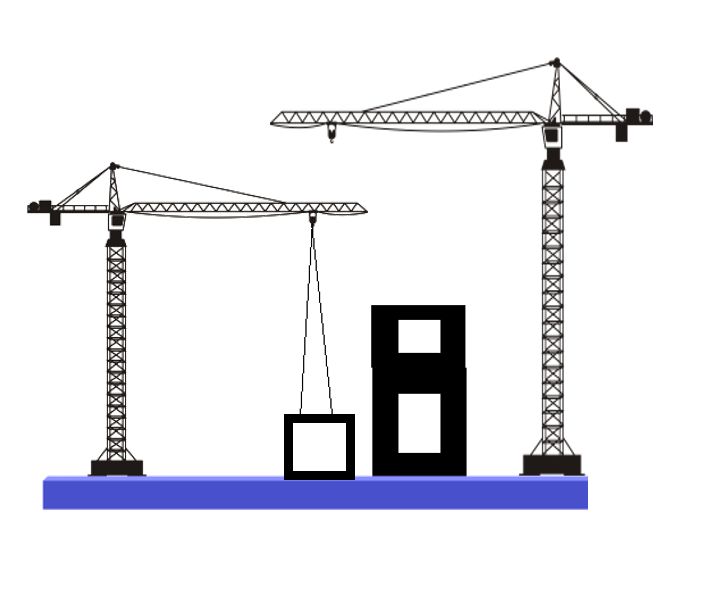
resources. They are called discrete, because the resource based on a simplified lifting process as shown in Figure 1.
may be available in numbers more than on, but in discrete There are three classes modelled for representing this
integer values. This constraint ensures that resources are process as shown in Figure 2. The classes have attributes
allocated according to availability. This constraint also which are data properties and object properties. Data
ensures that a discrete resource is not allocated to two properties are the attributes giving the information such as
activities at the same time. There is abundant research on start date, the weight of module etc. Object properties are
this constraint in areas such as resource levelling and the attributes which define the relationship of the object
resource constrained scheduling (El-Rayes and Jun, 2009; with another object.
Hu and Flood, 2012).
1. Process: It is the parent class and instances of this
Disjunctive constraints are constraints which states that class stores information related to the task
two activities cannot happen at the same time. These can including the start and end dates as data
be used to model spatial constraints (Baykan and Fox, properties, resources, module association,
1997), safety constraints etc. For example, there should precedence and disjunctive constraints as object
not be any activities in the vicinity of an excavation. properties.
In addition to the above constraints, Logical constraints 2. Crane: Instances of this class stores the
are needed to govern resource assignments. Although information related to the crane. For the current
cranes are designed to lift components, cranes have a paper, the scope of this class is limited to one
limitation on their capacity. It can only lift up to a certain attribute crane capacity modelled as a data
weight. These constraints should also be coded as property, in order to demonstrate the logical
constraints to make the schedule meaningful. constraint.
3. Module: Instances of this class stores information
Shapes Constraint Language (SHACL) related to the module. Module weight is the only
Shapes Constraint Language (SHACL) is a data attribute data property used.
Page 352 of 490Even though object relationships are not explicitly ?crane OntProcess:Cranecapacity ?cc. defined in module and crane classes, the inherent linking ?module OntProcess:Moduleweight ?mw. in the OWL applies the relationship defined in the process FILTER (?cc
violated. If it is violated, the user receives a message as     Discrete constraint
defined in sh:message. All the instances of the class           Discrete constraints are required in this problems setting
Process without an owl:happen_after property is ignored.        to ensure resources (cranes) are not assigned to two
If there are multiple precedence assignments, all the           processes at the same time. Since this is a constraint
processes are checked for constraint violations.                related to the resource, the constraint is modelled as a
Disjunctive constraint                                          node shape on the class Crane as given below.
Disjunctive constraints may be defined in this problem          Pairwise comparison feature of SPARQL is used to model
setting to make sure that one process shouldn’t take place      this constraint. As a first step, all the processes which are
while another process is happening. There are five cases        assigned the particular resource is shortlisted into pairs in
in which this might happen. Consider 2 processes,               the statements:
Process1 and Process 2 . The five cases where these two                  ?process1 OntProcess:hasResource $this.
processes overlap are:-                                                  ?process2 OntProcess:hasResource $this.
                                                                From this list of pairs, identical processes are removed
   i.    SD1
Table 1: Instances of the process class
Process
Crane
(metric ton)
capacity
Crane
Module
(metric ton)
Weight
Module
Start date
End date
Constraint
Precedence
constraint
Disjunctive
Process_1 Crane_1 12 Module_1 15 01/01/2019 02/01/2019
Process_2 Crane_2 18 Module_2 15 02/01/2019 03/01/2019 Process 1
Proce
ss
1,Pro
Process_3 Crane_2 18 Module_3 15 01/01/2019 05/01/2019 Process 1 cess 2
Implementation modelling, the same method can be applied to more
massive process datasets where it would be tedious to
The above process was implemented using open source
identify the violations. The data (RDF containing
Python Libraries RDFLib and pySHACL in a Jupyter
instances) and the shapes (RDF containing constraints) are
Notebook environment. The ontology for the process was
different components linked through the ontology of the
developed using Protégé(Musen, 2015). The instances
lifting process. More constraints can be added dynamically
used for testing are shown in Table 1. The results of the
to the shapes file, and the validation is done for the whole
same are presented in the next section.
data. This is an excellent advantage in construction to
Results and Discussion incorporate new constraints as they arise.
The results after the validation of the data graph against Also, as the constraints are coded in a machine-readable
shapes graph are given in Table 2. From the results in format (RDF), it is possible to do analytics and machine
Table 2, we can identify that there are constraint violations learning on this model too and derive insights for future
in Process 1, Process 3 and Crane 2. automation of constraint modelling.
In Process_1, the logical constraint was violated, and the Conclusion
message “Crane capacity should be greater than module
weight” was received as an output. This is an actual This paper describes a method to define construction
violation as Crane_1 with a capacity of 12 metric ton was scheduling constraints using Shapes Constraint Language.
assigned to Process_1 to lift Module_1 which has a mass Scheduling constraints such as Precedence constraints,
of 15 metric ton. discrete resource capacity constraints, disjunctive
constraints and logical constraints were modelled using
In Process_3, there are two violations which were reported shapes constraint language for a simple lifting problem in
in the messages “Disjunctive constraint is violated” and this paper. The modelled constraints were tested against a
“Precedence condition is violated”. Process_3 was assigned a data set of lifting processes, and the violation constraints
disjunctive constraint with Process_1 and Process_2.
model was able to identify the violations effectively and
However, Process_3 starts with Process_1 and ends after produce a validation report.
Process_2 which is a clear violation of the disjunctive
constraint. In addition, Process_3 was assigned a This paper demonstrated the capability of linked-data
precedence constraint with Process_1. This is again approach towards constraint validation for construction
violated as the start times of both processes are the same. scheduling problem. The described methodology could be
applied to a broader set of data to produce similar results.
For Crane_2, “Discrete constraint for the resource not However, that is beyond the scope of this paper. Authors
satisfied” was received as an output. This is true as the
are exploring methods to make the modelling of
Crane_1 was assigned to two processes Process_2 and constraints user-friendly by creating an intuitive UI. Also,
Process_3 at the same time. research is being done towards integration of this method
Hence from the above, we can conclude that the modelled to IFC OWL for automating look ahead planning.
constraints were able to detect the violations effectively.
Although the model represented here is very simplistic,
and the violations could be easily detected without any
Page 355 of 490Table 2: Output after constraint validation
Process Output
Process 1 Constraint Violation in SPARQLConstraintComponent (http://www.w3.org/ns/shacl#SPARQLCo
nstraintComponent):
Severity: sh:Violation
Source Shape: OntProcess:Process
Focus Node: OntProcess:Process_1
Value Node: OntProcess:Process_1
Source Constraint: [ sh:message Literal("Crane capacity should be greater than modul
e weight") ; sh:prefixes ; sh:select Lit
eral("SELECT $this
WHERE {
$this rdf:type OntProcess:Process.
$this OntProcess:hasResource ?crane.
$this OntProcess:hasAssociation ?module.
?crane OntProcess:Cranecapacity ?cc.
?module OntProcess:Moduleweight ?mw.
FILTER (?ccValue Node: OntProcess:Crane_2
Source Constraint: [ sh:message Literal("Discrete constrsint for the resource not
satisfied") ; sh:prefixes ; sh:select
Literal("SELECT $this
WHERE {
$this rdf:type OntProcess:Crane .
?process1 rdf:type OntProcess:Process.
?process2 rdf:type OntProcess:Process.
?process1 OntProcess:hasResource $this.
?process2 OntProcess:hasResource $this.
?process1 owl:hasEndDate ?ed1.
?process1 owl:hasStartDate ?sd1.
?process2 owl:hasEndDate ?ed2.
?process2 owl:hasStartDate ?sd2.
FILTER (!(?process1=?process2))
FILTER((?sd2pp.184–198. Pauwels, P., Van Deursen, D., Verstraeten, R., De Roo, J.,
De Meyer, R., Van De Walle, R., and Van
Harris, S., and Seaborne, A. Prud’hommeaux, E. (2013).
Campenhout, J. (2011). A semantic rule checking
SPARQL 1.1 query language. Available at
environment for building performance checking.
https://www.w3.org/TR/sparql11-query/ (Accessed:
Automation in Construction, 20(5), pp.506–518.
6 June 2019)
Quattrini, R., Pierdicca, R., and Morbidoni, C. (2017).
Hu, J., and Flood, I. (2012). A Multi-Objective Scheduling
Knowledge-based data enrichment for HBIM:
Model for Solving the Resource-Constrained Project
Exploring high-quality models using the semantic-
Scheduling and Resource Leveling Problems. In
web. Journal of Cultural Heritage, 28, pp.129–139.
Proceedings of the Computing in Civil Engineering
(2012) Reston, USA Subramanian, P. S., Songer, A. D., and Diekmann, J. E.
(2000). Visualizing Process Performance. In
Huhnt, W., Richter, S., Wallner, S., Habashi, T., and
Proceedings of Computing in Civil and Building
Krämer, T. (2010). Data management for animation
Engineering. Reston, USA1
of construction processes. Advanced Engineering
Informatics, 24(4), pp.404–416 Terkaj, W., Schneider, G. F., and Pauwels, P. (2017).
Reusing Domain Ontologies in Linked Building
Kim, K., Kim, H., Kim, W., Kim, C., Kim, J., and Yu, J.
Data : the Case of Building Automation and Control.
(2018). Integration of ifc objects and facility
Proceedings of the 8th Workshop Formal Ontologies
management work information using Semantic Web.
Meet Industry, Joint Ontology Workshops 2017,
Automation in Construction, 87, pp.173–187.
CEUR Workshop Proceedings, Bolazano-
Knublauch, H., Allemang, D., and Steyskal, S. (2017). Bozen,Italy .
SHACL Advanced Features. Available at ss
Whyte, J., Stasis, A., and Lindkvist, C. (2016). Managing
Lee, D.-Y., Chi, H., Wang, J., Wang, X., and Park, C.-S. change in the delivery of complex projects:
(2016). A linked data system framework for sharing Configuration management, asset information and
construction defect information using ontologies and “big data.” International Journal of Project
BIM environments. Automation in Construction, 68, Management, 34(2), pp.339–351.
pp.102–113.
Zhang, C., and Beetz, J. (2015). Model Checking on the
Lin, J. J., and Golparvar-Fard, M. (2016). Web-Based 4D Semantic Web: IFC Validation Using Modularized
Visual Production Models for Decentralized Work and Distributed Constraints.In: Proceedings of the
Tracking and Information Communication on 32nd CIB W78 Conference Eindhoven, The
Construction Sites. In Proceedings of the 2016 Netherlands,.
Construction Research Congress, pp. 1731–1741.
Zhang, C., and Beetz, J. (2016). Querying Linked Building
Liu, H., Lu, M., and Al-Hussein, M. (2016). Ontology- Data Using SPARQL with Functional Extensions. In:
based semantic approach for construction-oriented Proceedings of 11th European Conference on
quantity take-off from BIM models in the light-frame Product and Process Modelling, Limassol,Cyprussss
building industry. Advanced Engineering
Informatics, 30(2), pp.190–207.
Morkos, R. (2014). Operational efficiency frontier:
Visualizing, manipulating, and navigating the
construction scheduling state space with precedence,
discrete, and disjunctive constraints. Thesis.
Stanford University.
Musen, M. A. (2015). The protégé project: A Look Back
and a Look Forward. AI Matters, 1(4), pp.4–12.
Niederliński, A. (2011). A Quick and Gentle Guide to
Constraint Logic Programming Via ECLiPSe.3rd ed.
Gliwice :Jacek Skalmierski Computer Studio
Pauwels, P., de Farias, T. M., Zhang, C., Roxin, A., Beetz,
J., De Roo, J., and Nicolle, C. (2017). A performance
benchmark over semantic rule checking approaches
in construction industry. Advanced Engineering
Informatics, 33, pp.68–88.
Pauwels, P., and Terkaj, W. (2016). EXPRESS to OWL
for construction industry: Towards a recommendable
and usable ifcOWL ontology. Automation in
Construction, 63, pp.100–133.
Page 358 of 490You can also read


