Programming Self-Assembled Materials With DNA-Coated Colloids
←
→
Page content transcription
If your browser does not render page correctly, please read the page content below
REVIEW
                                                                                                                                         published: 19 July 2021
                                                                                                                                 doi: 10.3389/fphy.2021.672375

                                             Programming Self-Assembled
                                             Materials With DNA-Coated Colloids
                                             Tianran Zhang, Dengping Lyu, Wei Xu, Yijiang Mu and Yufeng Wang *

                                             Department of Chemistry, The University of Hong Kong, Hong Kong, China

                                             Introducing the concept of programmability paves the way for designing complex and
                                             intelligent materials, where the materials’ structural information is pre-encoded in the
                                             components that build the system. With highly tunable interactions, DNA-coated particles
                                             are promising building elements to program materials at the colloidal scale, but several
                                             grand challenges have prevented them from assembling into the desired structures and
                                             phases. In recent years, the field has seen significant progress in tackling these challenges,
                                             which has led to the realization of numerous colloidal structures and dynamics previously
                                             inaccessible, including the desirable colloidal diamond structure, that are useful for
                                             photonic and various other applications. We review this exciting progress, focusing in
                                             detail on how DNA-coated colloids can be designed to have a sophisticatedly tailored
                                             surface, shape, patches, as well as controlled kinetics, which are key factors that allow one
                                             to program in principle a limitless number of structures. We also share our view on how the
                                             field may be directed in future.
                           Edited by:
                                             Keywords: DNA colloidal crystals, patchy particle, anisotropic particle, programmable self-assembly, self-assembly
             Stefano Angioletti-Uberti,
             Imperial College London,
                      United Kingdom
                       Reviewed by:
                                             INTRODUCTION
             Bortolo Matteo Mognetti,
Université libre de Bruxelles, Belgium
                                             DNA exists in almost all living creatures. It carries the genetic information of life through sequences
                 W. Benjamin Rogers,         of nucleotides, which program the diverse and sophisticated structures and functions of
  Brandeis University, United States         biomolecules. Yet, to materials scientists, who are concerned with how to arrange synthetic
                  *Correspondence:
                                             building blocks of various forms (molecules, polymers, and particles) into well-defined, complex
                       Yufeng Wang           structures, DNA means something more [1–4]. DNA strands with complementary sequences can
                    wanglab@hku.hk           form duplexes, a process driven by Watson-Crick base pairing, which is specific, accurate, reversible,
                                             tunable in strength, and most importantly, programmable by the DNA sequences [5, 6]. DNA is thus
                    Specialty section:       an ideal candidate that, once introduced in synthetic materials, can precisely regulate the interactions
         This article was submitted to       between the material’s building components and dictate their structures [7–11]. This philosophy has
                   Soft Matter Physics,      been the cornerstone for DNA nanotechnology, which utilizes DNA and its special properties for
               a section of the journal      advancing materials design and engineering [2, 12–21].
                    Frontiers in Physics
                                                While DNA has been used alone or combined with a number of synthetic materials, its
        Received: 25 February 2021           integration with colloids to promote colloidal assembly has been of great interest for the soft matter
           Accepted: 25 May 2021
                                             community [4, 22–26]. Colloids are particles made from almost all compositions (metals,
           Published: 19 July 2021
                                             semiconductors, polymers, and oxides), with sizes ranging from several nanometers to several
                           Citation:         micrometers. The self-assembly of colloidal particles into superstructures holds much potential in
   Zhang T, Lyu D, Xu W, Mu Y and
                                             applications including plasmonic [27], photonics [28], catalysis [11], and sensing [29].
   Wang Y (2021) Programming Self-
    Assembled Materials With DNA-
                                             Conventionally, the word “colloids” specifically refers to particles that are micrometers or sub-
                    Coated Colloids.         micrometers in size, whereas “nanoparticles” are those generally below 100 nm. The size difference
             Front. Phys. 9:672375.          has distinguished colloids with nanoparticles when it comes to the interparticle interactions and its
    doi: 10.3389/fphy.2021.672375            range. For example, the range of DNA-mediated interaction between particles depends on the

Frontiers in Physics | www.frontiersin.org                                        1                                         July 2021 | Volume 9 | Article 672375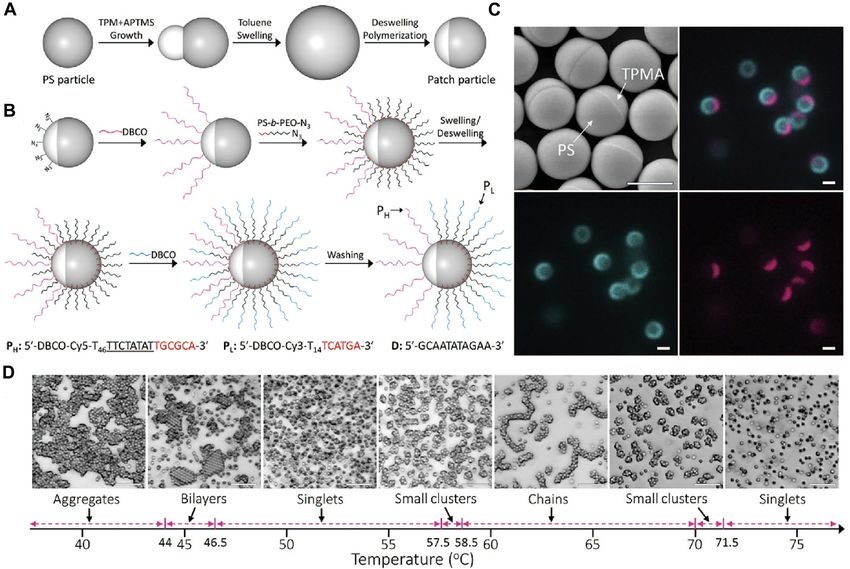
Zhang et al.                                                                                                         Programmable Self-Assembly of DNA-Coated Colloids

  FIGURE 1 | (A) Structure of lipid bilayer coated with DNA. (B) Coating SiO2 colloids with the DNA-functionalized lipid bilayer. (C) Colloids with mobile DNA strands.
  (D) Illustration of interaction between colloids. The mobile DNA bridges enable particles to roll while bound. (E) Singlet fraction of mobile DNA-coated colloids with
  different densities of DNA linker as a function of temperature, showing the broadened association/dissociation transition. Singlet fraction is defined as the fraction of
  unbound particles. Bright-field optical micrographs of colloidal assemblies with (F) 1.0-μm colloids, and (G) 2.0-μm colloids. Reproduced from ref. [50] with
  permission from the American Chemical Society, copyright 2013.

length of DNA, ranging from several nanometers to a few tens of                           directional and specific interactions, akin to the covalent
nanometers. It is a short-ranged interaction for 1-µm particles                           bonds of atoms and molecules. For example, these particles
but not so for 10-nm particles. In this context, while DNA was                            have shown to form “colloidal molecules” and “polymers”. In
introduced in the nanoparticle systems as early as 1996 by                                particular, the particles with four patches in a tetrahedral
tethering oligonucleotide strands on the nanoparticle surface                             geometry are the colloidal analogue of sp3 carbon atoms,
to cause particle assembly [30, 31], the utilization of DNA on                            which opened the possibility of making a diamond structure
colloids and for a similar purpose have been much delayed                                 of colloids and injected enormous excitement into the field.
[32–35].                                                                                  Compared to the close-packed FCC structure, a diamond
    Ideally, colloids coated with complementary DNA strands                               structure is of a four-fold coordination, having a packing
on the surface can assemble when the DNA form bridges.                                    fraction as low as 34%. When colloids several hundred
Although the interaction can be finely tuned by adjusting the                              nanometers in size are arranged this way, the assemblies
DNA sequence, the self-assembly of spherical colloids (e.g.,                              possess complete photonic band gaps in the visible
silica or polymer latex) only leads to structures analogous to                            wavelength and are potentially useful for photonic materials
those of metals (e.g., the face-centered cubic structure, or FCC)                         that many have dreamed of [40–43].
or ionic solids (e.g., cesium chloride). These structures can                                However, diamond and other interesting structures do not just
already be produced when capillary forces or Coulombic                                    appear when DNA-patchy particles are mixed in a jar and
forces are utilized [36, 37]. To fully program the assembled                              maintained at a comfortable temperature. It was not until very
structures to mimic the vast spectrum of atomic and                                       recently that He and Pine et al. [44] reported its successful
molecular crystals, additional information is necessary [38].                             formation (via the patchy particle approach). To arrive at this
In 2012, Wang and Pine et al. [39] introduced the concept of                              point, the community faced two grand challenges. First, the
“colloids with valence”, or DNA-coated patchy particles,                                  DNA-coated colloids had failed to crystallize, meaning that
which laid down the grounds for realizing diverse colloidal                               they generally formed kinetically arrested structures rather
structures found in atomic and molecular systems. In this                                 than the equilibrium assemblies [25, 35, 45–50]. Second, the
case, colloids with localized surface patches are fabricated, to                          directing information coded in the particle surface/shape is still
which DNA is site-specifically grafted. The anisotropic patch                              insufficient to program the desired structures. This paper
arrangement together with short-ranged DNA interaction                                    describes these challenges and reviews the important
provide essential information that endows colloids with                                   progresses in tackling them, which eventually allowed the

Frontiers in Physics | www.frontiersin.org                                            2                                               July 2021 | Volume 9 | Article 672375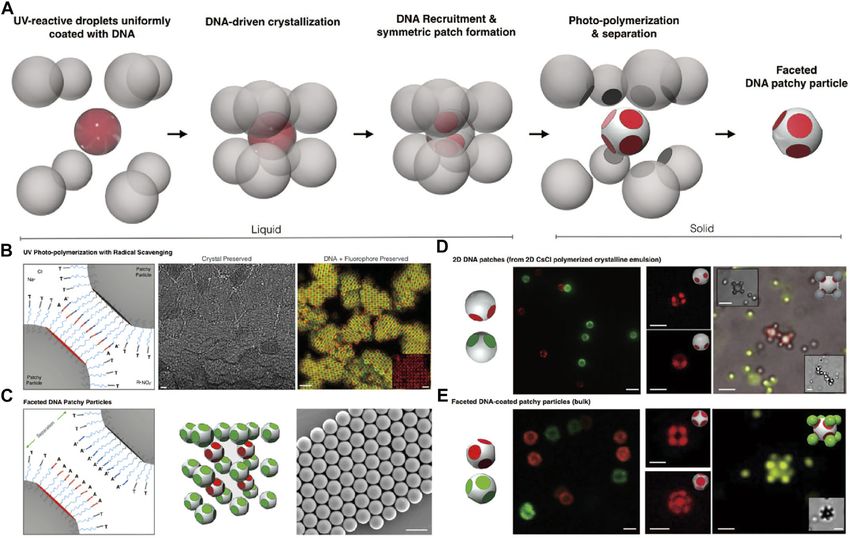
Zhang et al.                                                                                                 Programmable Self-Assembly of DNA-Coated Colloids

                                                                                      DNA coatings, among others [50, 54]. This had remained a
                                                                                      serious issue for more than ten years since DNA was first
                                                                                      introduced to colloids in around 2003 [32–35].
                                                                                          DNA-coated colloids condense at low temperatures by forming
                                                                                      DNA bridges and disperse at above the melting temperature [47].
                                                                                      The transition occurs within a sharp temperature window [55]. The
                                                                                      effective interaction between DNA-coated colloids has been
                                                                                      modeled by several groups [56–60]. Assuming F to be the
                                                                                      interparticle attractive potential, p to be the probability of a
                                                                                      DNA sticky strand forming a bridge, N to be the total number
                                                                                      of DNA strands on a colloid, k to be the Boltzmann constant, r to be
                                                                                      the particle separation distance and T to be the temperature, then
                                                                                      F(r)/kT ≈ − Np can be derived at the melting temperature (i.e., in
                                                                                      the weak binding regime when p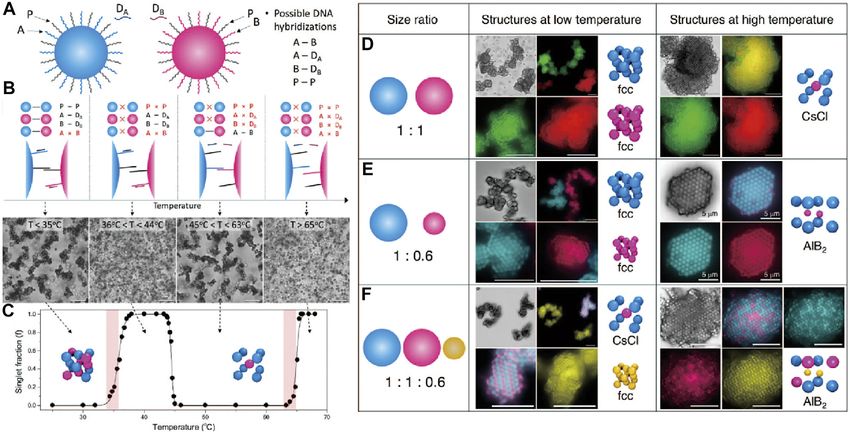
Zhang et al.                                                                                                        Programmable Self-Assembly of DNA-Coated Colloids

  FIGURE 3 | Schematic illustration of DNA-coated colloids and their crystals. (A) DNA is modified onto the colloids’ surface via strain-promoted azide-alkyne
  cycloaddition, SPAAC. A 40-60 base long polyT sequence serves as a flexible linker between the particle surface and the sticky ends. (B) The melting transition of DNA-
  coated colloids, indicated by the singlet fraction as a function of temperature. Cartoon and confocal fluorescence micrographs of (C) FCC lattice from 1.0-μm colloids
  functionalized with self-complementary sticky ends, (D) AB lattice (isostructural to CsCl) from 1.0-μm A and 1.0-μm B, (E) AB2 lattice (isostructural to AlB2) from
  1.0-μm A and 0.54-μm B colloids, and (F) AB6 lattice (isostructural to Cs6C60) from 1.5-μm A and 0.54-μm B colloids with hetero-complementary sticky ends. Scale
  bars, 5 μm. Reproduced from ref. [48] with permission from the Springer Nature, copyright 2015.

depends solely on the temperature. When the displacing strands are                       depending on the concentration and the symmetry of the linker. It
added, the enthalpy and the entropy changes of the displacement                          was interesting to find that the phase behavior becomes less
reactions depend on the sequence and the concentration of the                            dependent on the linker concentration when the asymmetry of
displacing strands, respectively. In other words, the magnitude of                       linker grows [64]. Xia and Ni et al. [67] formulated a mean-field
the hybridization between DNA-coated colloids can be                                     theory to simulate the self-assembly of colloids with mobile DNA
programmed by the displacing strands. If the displacing strands                          coating and free DNA linkers. They showed that the interaction
are chosen to make the enthalpy change of hybridization and                              between colloids mediated by DNA linker changes
displacement reaction the same, the temperature dependence of                            nonmonotonically as the concentration of linker increases, as
DNA-coated colloids can be eliminated. Thus, the colloidal                               the result of the competition between the entropies of various
crystallization via DNA interactions can be achieved over a                              species in the system.
broader range of temperature (Figure 2B). It was shown that                                 While the narrow temperature window was a big hurdle to
the melting transition of DNA-coated colloids is roughly as wide                         crystallize DNA-coated colloids, Wang, Weck, and Pine et al. [48]
as 10°C (Figure 2C). In addition, adding two types of displacing                         considered the problems from another perspective: surface
reactions allows the creation of a reentrant fluid phases                                 inhomogeneity. One hypothesis was that a high DNA coverage
(Figures 2D,E).                                                                          on colloids is needed, which can alleviate the possibly uneven
   Rogers et al. [62–66] further investigated the physical behavior                      DNA distribution and eliminate heterogeneity. Another
of the assembly of DNA-coated colloids mediated by free DNA                              hypothesis was that, because the DNA coating is very thin, the
strands. They argued that encoding information into the sequence                         surface of the colloids should be smooth. A rough colloid surface
and concentration of the free strands instead of the grafted strands                     may cause some DNA to be inaccessible, thus creating areas that
could overcome the problems conventional colloidal self-assembly                         other particles cannot explore during the crystallization. Based on
suffers, including uncollaborative mutual interactions and a                             the two assumptions, the authors developed a strategy to
limited number of interactions. For example, they found that                             synthesize azide-functionalized TPM colloids [TPM: 3-
the phase behavior of DNA-coated colloids can be altered by                              (Trimethoxysilyl)propyl methacrylate], to which DNA strands
adding free DNA strands for displacement reaction, as mentioned                          can be grafted using the strain-prompted azide-alkyne
above [62]. Then, using free DNA strands as the linkers to bridge                        cycloaddition reaction (SPAAC) (Figure 3A). The resulting
grafted DNA on colloids’ surface, they reported a reentrant melting                      colloids have a smooth surface, and more importantly, a DNA
transition upon increasing concentration of linker as well as the                        coating 5–25 times higher in the areal density than particles made
possibility to encode multiple interactions spontaneously [63]. In                       by previous methods [33, 45]. Due to the high DNA coverage, it
addition, colloidal crystals are constructed using free linker DNA,                      was also possible to shorten the DNA sticky ends to only four

Frontiers in Physics | www.frontiersin.org                                           4                                               July 2021 | Volume 9 | Article 672375
Zhang et al.                                                                                                       Programmable Self-Assembly of DNA-Coated Colloids

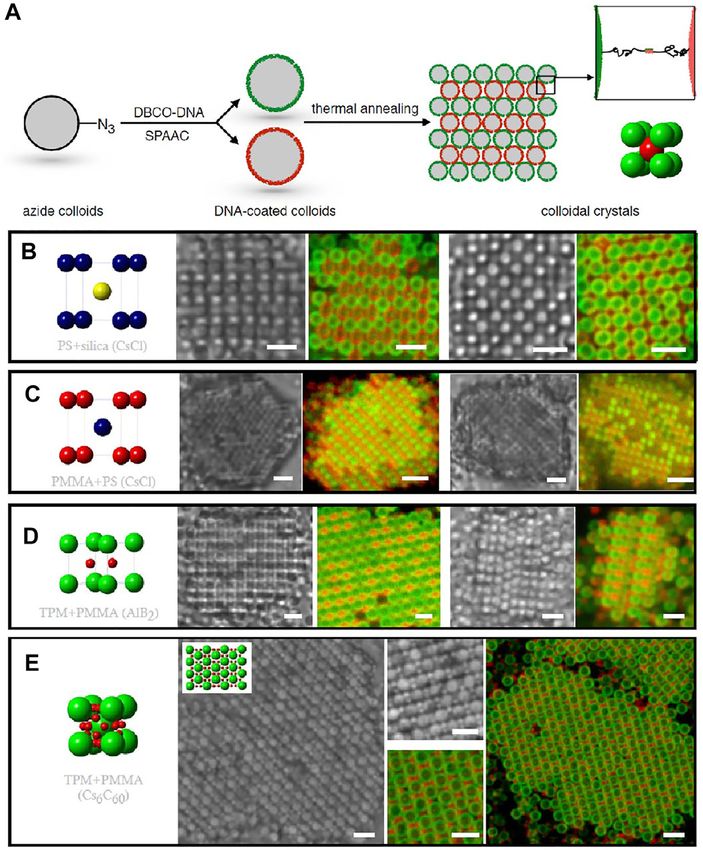
  FIGURE 4 | (A) Illustration of the crystallization of DNA-coated colloids. Cartoon, bright-field and confocal fluorescence micrographs of AB lattice (isostructural to
  CsCl) from (B) 1.0-μm PS and 1.0-μm silica colloids and (C) 1.0-μm PMMA and 1.0-μm PS colloids. (D) AB2 lattice (isostructural to AlB2) from 1.0-μm TPM and 500-nm
  PMMA colloids. (E) AB6 lattice (isostructural to Cs6C60) from 1.5-μm TPM and 500-nm PMMA colloids. Scale bars in (B–C), 2 μm. Scale bars in (D–E), 3 μm.
  Reproduced from ref. [70] with permission from the American Chemical Society, copyright 2015.

bases and still keep the melting temperature of particles at a                              With the capability to anneal, the crystal structures of DNA-
moderate temperature, between 44–46°C (Figure 3B). It is                                coated colloids can be further programmed by the particle types
generally agreed that high DNA coatings and short sticky ends                           and sizes. For example, FCC crystal lattice was obtained from the
can facilitate the kinetics of the system to reach equilibrium [23].                    assembly of colloids with a palindromic, self-complementary
For a given sticky end, a high coating increases the melting                            DNA sticky end (Figure 3C). Binary AB lattice (isostructural
temperature, which increases the dissociation rate of the DNA                           to CsCl) was obtained from the co-assembly of 1.0-µm A colloids
bridges and the diffusivity of particles. Rogers et al. believed that                   and 1.0-µm B colloids with hetero-complementary DNA sticky
for particles with fewer strands that bind strongly, the lifetime of                    ends (Figure 3D). AB2 lattice (isostructural to AlB2) was obtained
the DNA bonds may be large to slow down the rotational                                  from 1.0-µm A colloids and 0.54-µm B colloids (Figure 3E). AB6
diffusion of the particles [23]. Theoretical works have been                            lattice (isostructural to Cs6C60) was obtained from 1.5-µm A
recently developed to rationalize the experiment findings [64,                           colloids and 0.54-µm B colloids (Figure 3F). Moreover, the
68, 69]. For example, by using a simulation method that tracks the                      crystallization process is completed in minutes to hours (not
single binding and unbinding between complementary linkers,                             days), so the real time nucleation, growth, restructuring, and
Mognetti et al. proved that particles could move relative to each                       defect formation of bulk crystals of DNA-coated colloids could be
other while being cross-linked. Moreover, they clarified that the                        studied.
dissociation rate of the DNA bridges determines the colloid’s                               The significance of this work is that it unveiled the myth of the
diffusivity [68].                                                                       crystallization of DNA-coated colloids and allowed the verification

Frontiers in Physics | www.frontiersin.org                                          5                                              July 2021 | Volume 9 | Article 672375
Zhang et al.                                                                                                        Programmable Self-Assembly of DNA-Coated Colloids

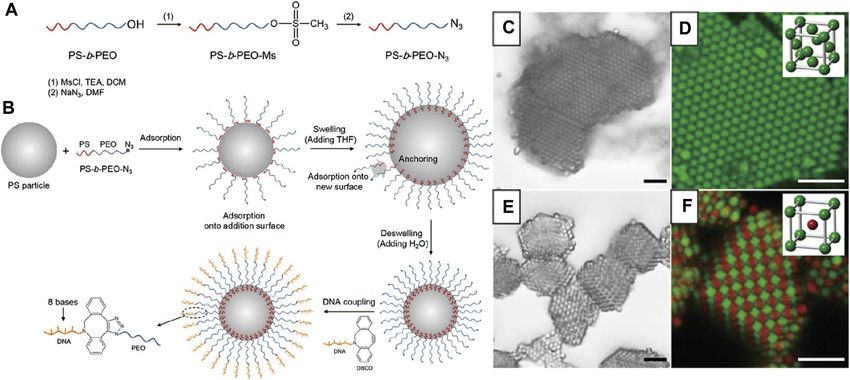
  FIGURE 5 | (A) The preparation of PS-PEO-N3. (B) Illustration of modification of PS-PEO-N3 and DNA on PS colloids. Bright-field and confocal fluorescence
  micrographs of (C, D) FCC lattice from PS colloids with self-complementary DNA (E, F) BCC lattice (or AB lattice) from A and B colloids with hetero-complementary DNA.
  Scale bars, 5 μm. Reproduced from ref. [71] with permission from the American Chemical Society, copyright 2015.

of various related hypotheses. For example, a smooth particle
surface is important; particles with a rough surface were tested
and they failed to crystallize [70]. It was also indicated that a
flexible backbone for the DNA brush on the surface is important,
as it allows the DNA sticky ends more freedom to explore
appropriate conformations to bind [35]. This is in stark
contrast with the crystallization of DNA-coated nanoparticles,
where double-stranded DNA is normally used [7].
   Subsequently, the crystallization was extended to other
commonly used particles, including those made from titanium
oxide, silica, polystyrene (PS), and poly (methyl methacrylate)
(PMMA) [70]. The synthetic procedures are revisited and
modified to achieve smooth particle surfaces and a dense layer
of DNA coating (Figure 4A). Although the maximum number of
DNA conjugated to different particles may vary, all particles
crystallized. Similarly, FCC lattice, AB lattice, AB2 lattice, and
AB6 lattice can be produced (Figures 4B–E). Instead of using
particles of the same type, particles with different compositions
were mixed to adopt predetermined spatial arrangements. For
example, PS colloids, which have a low index of refraction, are co-
assembled with titania colloids, which have a higher index of
refraction. In other words, one can program crystals from a
mixture of arbitrary colloids.
   The demand for high DNA coverage has later stimulated the                              FIGURE 6 | (A) Scheme of preparing high-density DNA-coated colloids.
development of new methods for functionalizing DNA on colloids.                           (B)The singlet fraction of particle as a function of temperature. (C) Colloidal
                                                                                          crystals of FCC lattice obtained and observed under bright-field microscope.
For example, Oh et al. [71] reported a swell-deswelling method,
                                                                                          Reproduced from ref. [73] with permission from the American Chemical
which introduced azide-modified polystyrene-b-polyethylene                                 Society, copyright 2020.
oxide (PS-PEO-N3) di-block copolymers onto PS colloids
(Figures 5A,B). The method was inspired by previous works by
Crocker et al. [35, 72] When the PS particles are plasticized with                       block copolymers are firmly trapped in the particles by anchoring
organic solvents, the PS blocks of the copolymer can insert into the                     the PS blocks in the particles’ polymer matrix. A high grafting
particles. As the particles de-swelled by solvent evaporation, the                       density was achieved because they become more concentrated

Frontiers in Physics | www.frontiersin.org                                           6                                               July 2021 | Volume 9 | Article 672375
Zhang et al.                                                                                                            Programmable Self-Assembly of DNA-Coated Colloids

  FIGURE 7 | (A) Colloids with three different types of DNA strands, labeled as A, B, and P; free strands for strands displacements are labeled as DA and DB. (B)
  Illustration of how colloids undergo several phase transitions when temperature is increased. (C) Bright-field micrographs and the singlet fraction show the phases of
  DNA-coated colloids as a function of temperature. (D–F) Cartoon, bright-field and confocal micrographs of crystals obtained. (D) Two types of colloids with size ratio 1:1,
  which form two separate FCC crystal at lower temperature and a CsCl crystal at higher temperature. (E) Two types of colloids with the size ratio of 1:0.6 form two
  separate FCC crystals at lower temperature and a AlB2 crystal at higher temperature. (F) Three types of colloids with the size ratio of 1:1:0.6 will form a CsCl crystal and
  FCC crystal at lower temperature and a AlB2 crystal at higher temperature. Scale bars, 10 μm. Reproduced from ref. [74] with permission from the American Chemical
  Society, copyright 2020.

  FIGURE 8 | (A) Preparation of DNA patchy colloids. (B–D) Electron and confocal fluorescence micrographs of clusters and patchy colloids. (E–I) “Colloidal
  molecules” assembled from patchy colloids. Bright-field and confocal micrographs of colloidal molecules are shown. The fluorescence comes from the dye-labelled
  streptavidin linked with DNA, showing that only the patches are modified. Scale bars in (B–D), 500 nm. Scale bars in (E–I), 2 μm. Reproduced from ref. [39] with
  permission from the Springer Nature, copyright 2012.

Frontiers in Physics | www.frontiersin.org                                              7                                                 July 2021 | Volume 9 | Article 672375
Zhang et al.                                                                                                               Programmable Self-Assembly of DNA-Coated Colloids

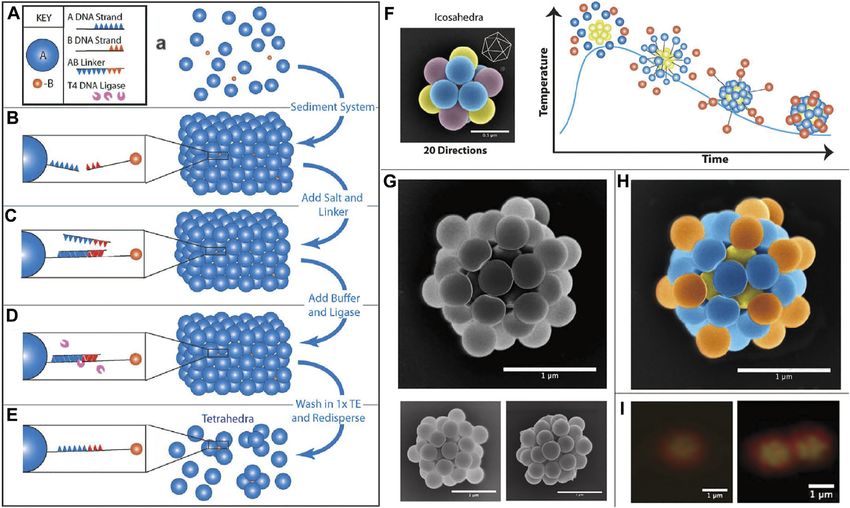
  FIGURE 9 | (A–E) Schematic procedure of making tetrahedra colloids via sedimentation and forming DNA bridges. (F) Directional bonding of icosahedral colloids
  with other colloids. (G) SEM images of decorated icosahedral colloids. (H) Colored SEM images of decorated icosahedral colloids. (I) Confocal images of a decorated
  icosahedral colloid (left) and two icosahedral colloids interacting with each other (right). Scale bars in (G–I), 1 µm. Scale bar in (F), 500 nm. Reproduced from ref. [79] with
  permission from the American Chemical Society, copyright 2015.

when the particles shrink during the deswelling. When DNA is                                  demonstrated multiple phase transitions and responsive
attached to the azide groups at the end of the PEO blocks by                                  multistep reorganization of DNA-coated colloids by using
SPAAC reaction, a high DNA areal density, 115,000 strands on a                                three different DNA strands that vary on the binding strength.
1.0-μm colloid, is realized (Figure 5B). Using these particles, the                           Free DNA strands are added to regulate the binding selectivity
authors obtained various single and binary crystals (Figures                                  between DNA-coated colloids via toehold-mediated strand
5C–F). The method has also been employed to coat DNA on                                       displacement [54]. For convenience, the DNA strands
PS particles with different surface charges; it works when the PS is                          modified on the colloid surface are noted as A, B, and P
slightly crosslinked (up to 10% crosslinking).                                                (Palindrome, self-complementary), while the free DNA strands
    Oh et al. [73] later reported another effective strategy to                               with complementary sequence to A and B strands are noted as DA
incorporate homogeneous and high-density DNA coatings                                         and DB respectively (Figure 7A). As shown in Figures 7B,C, the
onto colloids. As shown in Figure 6A, PS colloids with                                        binding strength of each duplex are designed as follows: A-B >
carboxylate groups are activated with 4-(4,6-Dimethoxy-1,3,5-                                 A-DA, B-DB > P-P. At 35°C, P-P, A-DA, B-DB duplexes coexist,
triazin-2-yl)-4-methylmorpholinium chloride (DMTMM). Then,                                    leading to amorphous aggregation. Increasing the temperature to
heterobifunctional polyethylene glycol (NH2-PEG-N3) is added                                  between 36 and 44°C, the P-P duplex will break, while the A-DA
to react with DMTMM-activated colloids through nucleophilic                                   and B-DB duplexes remained intact; dispersed singlet colloids
substitution. The azide terminal group on the PEG can undergo                                 were observed. As the temperature was increased to a range of 45
SPAAC reaction with DBCO-modified DNA strands. The                                             and 63°C, the A-DA and B-DB duplexes will break, leaving the A
obtained DNA-coated colloids have DNA coatings up to                                          strands hybridizing with B strands on the colloids; aggregation
1,100,000 DNA strands per 1-µm particle, equivalent with 1                                    will again form. When the temperature was raised up to 65°C, the
DNA/2.9 nm2, four times higher than the previous record                                       aggregation melts again as the A-B duplexes destabilize.
[35]. Regular colloidal crystallization is constructed from                                   Crystallization was observed at around 36 and 45°C. It is
particles fabricated by this method. The melting profile and                                   demonstrated that the colloidal superlattice can be
the obtained crystals are shown (Figures 6B,C).                                               programmed by both the size ratio of colloids and the
    The above reports focused on binary colloidal systems where                               temperature. For example, when the size ratio is 1:1, the FCC
only two types of DNA strands are employed. Oh et al. [74]                                    lattice will be favored at low temperature, while the CsCl lattice is

Frontiers in Physics | www.frontiersin.org                                                8                                                  July 2021 | Volume 9 | Article 672375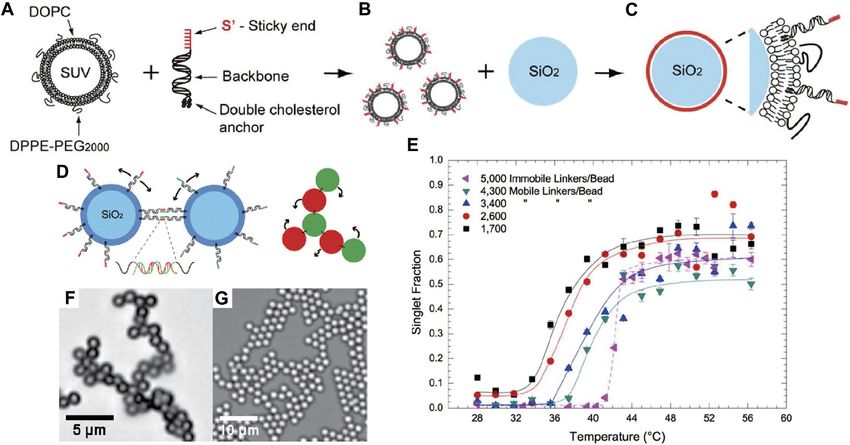
Zhang et al.                                                                                                          Programmable Self-Assembly of DNA-Coated Colloids

  FIGURE 10 | (A) The schematic procedure of producing faceted DNA patchy colloids. (B) Photo-polymerization of crystalline emulsion under UV lights (left). Bright-
  field micrograph of CsCl lattice of colloidal crystal after photo-polymerization (middle, scale bars, 10 μm). Confocal fluorescence micrograph of colloidal crystal shows
  that DNA fluorescence is preserved (right, scale bars, 5 μm). (C) Patches on colloids. SEM images of patchy colloids after photo-polymerization (right, scale bars, 2 μm).
  (D, E) Colloidal assemblies of patchy colloids with PS colloids via DNA interactions. Scale bars in (D), 2 μm. Scale bars in (E), 1 μm. Reproduced from ref. [80] with
  permission from the National Academy of Sciences, copyright 2020.

formed at high temperature (Figure 7D). Changing the size ratio                           ultimately program a much wider spectrum of structures,
to 1:0.6, the lattice at the high temperature changed from CsCl to                        including those found in atomic and molecular crystals. In
AlB2 (Figure 7E). When the third particle is introduced and their                         this section, we focus on how the anisotropic information is
size ratio is set to be 1:1:0.6, the CsCl lattice and FCC lattice co-                     introduced and how they play a vital role in diversifying the
exist at low temperature and convert to AlB2 lattice at a high                            assembled structures.
temperature (Figure 7F).                                                                      As mentioned, Wang, Weck, and Pine et al. [39] introduced
                                                                                          the DNA patchy colloids into the field, which are particles with
                                                                                          localized surface regions that are functionalized with DNA. The
INTRODUCING ANISOTROPIC                                                                   patchy particles are synthesized by a cluster-encapsulation
INFORMATION TO DNA-COATED                                                                 method, in which small clusters consisting of several
                                                                                          microspheres in symmetric configurations are encapsulated
COLLOIDS                                                                                  (Figures 8A,B). The encapsulation condition is controlled so
In parallel to the deepened understanding of DNA-mediated                                 that the vertices of the clusters are left out; they bear a different
colloidal interactions, the past decade has witnessed an explosion                        type of chemical group—in this case amidine—from the
in the type of colloids that can be synthesized, featuring                                encapsulating materials and serve as the chemical patches. The
anisotropic particles with non-spherical shapes [75] (e.g.,                               DNA with sticky ends is site-specifically coated on the patches via
cubes, rods, and triangular prisms), surface patches [76], or a                           a biotin-streptavidin-biotin linkage, where biotin molecules are
combination of both [52, 77]. Compared to the simple                                      conjugated to the amidine patch in advance (Figures 8A,C,D).
microspheres, these new particles possess extra information to                            The patches, with controlled numbers, adopted highly symmetric
guide the packing and assembly of particles, allowing access to                           positions around the particles, such as linear, triangular, or
structures with reduced symmetries and directionality. While                              tetrahedral, imitating the hybridized atomic orbitals, such as
DNA-coated spheres have already allowed access to numerous                                sp, sp2, or sp3 (Figure 8D). They have the ability to form
crystals, the integration of anisotropic particles with DNA can                           colloidal bonds with directionality (according to the patch

Frontiers in Physics | www.frontiersin.org                                            9                                                July 2021 | Volume 9 | Article 672375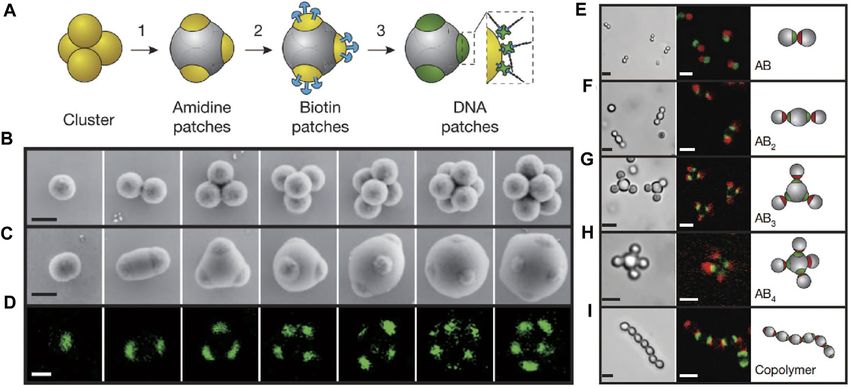
Zhang et al.                                                                                                          Programmable Self-Assembly of DNA-Coated Colloids

  FIGURE 11 | (A) Scheme for the preparation of the bifunctional colloids.                   FIGURE 12 | (A) The preparation of DNA-coated Janus colloids. (B–H)
  (B) Scheme of modification of two different DNA onto the patch and shell of                 The patchy particles assemble to form various colloidal superstructures
  the bifunctional colloids. (C) Melting curve of bifunctional colloids, represented         (chains and layers) depending on the size ratios between the patch and the
  with two types of TPM and their singlet fraction. Reproduced from ref.                     matrix. Cartoons, bright-field and confocal fluorescence micrographs
  [81] with permission from the American Chemical Society, copyright 2016.                   show these structures. The grey-scale pictures are obtained from bright-field
                                                                                             microscopy and the colored pictures are from confocal fluorescent
                                                                                             microscopy. Scale bars: 5 µm. Reproduced from ref. [82] with permission
                                                                                             from the Springer Nature, copyright 2019.
position) and specificity (due to the properties of DNA). A
number of colloidal structures, such as colloidal molecules and
polymers, are observed when DNA patchy particles are assembled                              cluster (Figures 9G–I) can be fabricated by mixing the clusters
(Figures 8E–I).                                                                             with spherical particles bearing complementary DNA. The
   The milestone work has stimulated much effort in developing                              symmetries of such ordered clusters can be altered by
various anisotropic particles coated with DNA. For example,                                 adjusting the size ratio of spherical colloids. For example,
Feng and Chaikin et al. [78] reported the fabrication of DNA                                tetrahedral and octahedral clusters were obtained when the
Janus colloid—essentially one-patch particles. DNA-coated                                   size ratio is approximately 4:1 and 2:1, respectively.
microspheres were allowed to bind to a DNA-functionalized                                       Also by using colloidal crystals as a template, Pine et al.
substrate. The binding is achieved via free DNA strands in the                              reported the synthesis of faceted DNA patchy particles
solution which simultaneously hybridize to the strands on the                               (Figure 10A) [80]. Deformable emulsion droplets were coated
particles and the substrate. A patch was created where the sphere                           with DNA strands and formed binary crystals. The DNA strands
touches the substrate and when the free DNA strands are                                     are mobile on the droplet surface and were recruited to the
permanently crosslinked to the DNA on the particles.                                        adhesion zones where the droplets touch and flatten, as shown in
   Crocker and co-workers [79] used colloidal crystals as the                               Figure 10B. DNA-patches are formed after solidification of
template to make DNA-functionalized clusters. A mixture of                                  droplets by rapid photo-polymerization under UV light
particles with two different sizes and complementary DNA                                    (Figure 10C). The obtained faceted DNA-patchy colloids
strands were subject to sedimentation, which induced the                                    show directional bonding with other DNA-coated spheres with
formation of colloidal crystals (FCC) (Figure 9A). The small                                complementary DNA strands (Figures 10D,E).
particles occupy the interstitial sites of the big particles, while they                        To build complex structures, a prerequisite is to introduce
also bind to the big particles by DNA hybridization (Figures                                multiple      interactions,  which       calls   for     orthogonal
9B,C). At this stage, T4 DNA ligase is employed to form covalent                            functionalization of patchy particles. Zheng et al. [81] designed
phosphodiester bonds to crosslink the hybridized DNA strands                                bifunctional patchy particles with two different DNAs, one
(Figure 9D). Further purification steps can break the                                        modified on the patches and the other on the matrix. To
sedimentation and clusters can be recovered (Figure 9E). The                                achieve this, chlorine-modified microspheres and clusters were
clusters obtained have DNA functionalized on the surface capable                            first fabricated, which was partially encapsulated with the TPM oil.
of directional bonding (Figure 9F), from which an icosahedral                               Methacrylate acid was introduced to the TPM oil before it

Frontiers in Physics | www.frontiersin.org                                             10                                             July 2021 | Volume 9 | Article 672375
Zhang et al. Programmable Self-Assembly of DNA-Coated Colloids
FIGURE 13 | (A) Preparation of Janus colloids composed of TPM and PS. (B) Illustration of modification of two different types of DNA on Janus colloids. (C) SEM
and confocal images of DNA-grafted patchy colloids. Different DNAs are labeled with different colors. Scale bars, 1 μm. (D) Assembly of DNA-coated patchy colloids
show different structures (aggregates, bilayers, chains and clusters) at different temperatures. Scale bars, 10 μm. Reproduced from ref. [83] with permission from the
American Chemical Society, copyright 2020.
solidified, resulting in bifunctional colloids with chloride on the size can be finely controlled by adjusting the ratio of TPM to PS.
patches and carboxylic acid on the matrix (Figure 11A). Then, two To functionalize DNA on the PS patches, the swelling-deswelling
different DNA strands were conjugated separately on bifunctional method previously mentioned was used. TPM is highly
colloids via orthogonal coupling reactions, SPAAC for the patches crosslinked and thus not functionalized. The Janus particles
and carbodiimide-mediated reaction for the matrix (Figure 11B). show cooperative assembly resulting in dimer chains, trimer
Microspheres coated with complementary DNA were then allowed chains, and bilayers depending on the Janus balance (patch/
to co-assemble with the bi-functional patchy particles. By tuning matrix ratio) as shown in Figures 12B–H. For example, when
the DNA sequences and the temperature, the patchy particles the ratio was in the range between 0.3 and 0.41, dimer chains were
assemble with one or two types of spheres (Figure 11C). favored, when the ratio is between 0.41 and 0.48, trimer chains
As the challenges for crystallization of DNA-coated spheres were formed, and when the ratio is between 0.6 and 0.68, bilayers
are tackled, Pine and coworkers aimed to explore equilibrium were observed. Here, the patchiness contains important
assemblies using DNA patchy particles. As smooth surfaces and information that programs the self-assembly behavior; the
high DNA areal density are needed, new methods for making DNA serves as a glue that allows the formation of equilibrium
patchy particles are developed. The crystallization of DNA Janus structures.
particles was first studied. A new scheme was designed so the Later, the above system has been modified to host two types of
Janus particles obtained had smooth surfaces and high DNA DNA [83]. A 60-bases DNA (PH) is introduced onto the TPM
coverage, needed for crystallization [82]. As Figure 12A shows, matrix, and a 20-bases DNA (PL) is coated on the PS patch
the synthesis begins with the partial encapsulation of PS (Figures 13A–C). Free DNA strands (D) are also introduced,
microspheres with TPM oil droplet. Toluene is then added to which can undergo strand displacement with the PH strands to
plasticize the PS particle, which becomes a liquid and phase alter the binding behavior of the particles. Specifically, the PH-PH
separates with the TPM oil phase. Removing the toluene followed duplexes are stronger than the PH-D duplexes, which are
by solidification of the TPM oil creates patchy particles. The patch stronger than PL-PL duplexes. This means that the self-
Frontiers in Physics | www.frontiersin.org 11 July 2021 | Volume 9 | Article 672375Zhang et al. Programmable Self-Assembly of DNA-Coated Colloids
FIGURE 14 | (A) Illustration of DNA-coated colloids. (B) The DNA interactions between colloids. (C) The bridge formed between colloids. (D) The double diamond
structure after self-assembly. (E-H) The confocal section of double diamond in different views. Scale bars, 2 μm. Reproduced from ref. [87] with permission from the
Springer Nature, copyright 2017.
assembly behavior of the patchy particles can be controlled by characterized for patch size), flower-like Kagome structures
temperature, which determines the preferred DNA duplexes that were formed when the annealing temperature was at 41–46°C
form, as well as by the anisotropic distribution of the DNA on the and brick-wall like structures were formed when they were
particle surface (Figure 13D). For example, at a low temperature annealed at 57–62°C; the two structures co-existed at 47–53°C.
(below 44°C), patchy colloids form amorphous aggregates via PL- When the patch size θ was changed to 70° and with depletion
PL hybridization; the PH is blocked by the D strands. Bilayer interaction, the quasi-2D superlattices were different. Orthogonal
structures are formed when the temperature is kept between 44.0 packed single or double-layer structures were mainly observed at
and 46.0°C. As temperature is increased, between 46.5 and 57.5°C, 42–46°C with 1.0 wt% of Pluronic F127, whereas wrinkled
where PL-PL hybridization is broken while the PH-D monolayer structures were the case at 46–50°C with 3.0 wt% of
hybridization remains intact, the patchy colloids disperse. Synperonic F108; the co-existence of both structures was found at
Further temperature increases could free PH strands from the 44–48°C with 1.8 wt% Pluronic F127. An empirical phase diagram
PH-D duplexes, and the PH-PH duplexes form to make patchy of the self-assembly of di-patch colloids was constructed to show
colloids aggregate again. Small clusters are observed between 57.5 how superlattices were influenced by various conditions.
and 58.5°C, while chain-like structures with or without branches As demonstrated, DNA patchy particles show unique,
have formed between 58.5 and 70°C. Small clusters form again directional self-assembly behavior enabling complex
between 70 and 71.5°C, and everything finally disperses when the structures programmed by the patch number, size, and
temperature is above 71.5°C. In this work, the information arrangement. Using particles with four patches in a
derived from the DNA sequences (both specificity and tetrahedral geometry, it is possible to achieve the colloidal
dynamic) and from the particle anisotropy is simultaneously diamond, one of the most desirable colloidal structures to
coded into the particle system, programming the temperature build photonic crystals with an optical band gap [40, 43].
dependent, reconfigurable self-assembly. Although the directional interaction is available, it is still
Next, two-dimensional (2D) superlattices can be programmed difficult to build colloidal diamonds from DNA patchy
by using patchy particles with two patches. Liu and Weck et al. [84] particles for two reasons. First, the formation of the diamond
demonstrated that quasi-2D colloidal superlattices were structure is entropically unfavored. The packing fraction of
constructed by ellipsoidal di-patch colloids via both depletion cubic diamond is 34% [85], much lower than close packing
and DNA-mediated interactions. The di-patch colloids were of spheres, which is 74% [86]. Second, amorphous liquid or gel
fabricated from PS-N3 dimer clusters via partial encapsulation with tetrahedral topology is more likely to occur during the
with TPM, followed by DNA modification via SPAAC. The assembly of tetrahedrally patched colloids.
assembled structures were determined by several factors, To overcome the mentioned difficulties, there have been two
including the patch size, the annealing temperature, and the proposals. One is to incorporate the lattice of diamond crystals
strength of the depletion interaction. For di-patch colloids with into a denser or more coordinated structure to avoid the
θ 86° (θ is defined as the half of the opening angle and problem of low filling fraction. Crocker et al. [87] explored
Frontiers in Physics | www.frontiersin.org 12 July 2021 | Volume 9 | Article 672375Zhang et al. Programmable Self-Assembly of DNA-Coated Colloids
FIGURE 15 | (A, B) Illustration of colloidal MgCu2 superlattice via DNA interactions. (C) Illustration of compression ratio rcc/2a (which indicates the degree of overlap
between constituent spheres). (D, E) Confocal images of colloidal MgCu2 superlattice. The inset image in (D) is obtained from SEM. Scale bar, 1 μm. Reproduced from
ref. [88] with permission from the Springer Nature, copyright 2017.
this route by using DNA-coated microspheres, which forms a experiments when annealing the system (Figures 15D,E). The
“double diamond” structure. Two slightly differently sized compression ratio has a great impact on the colloidal MgCu2
PS colloids (named “A” and “B”) are modified with two superlattice. For example, when the compression ratio is lower
different DNA strands that can both hybridize to a linker than one, MgCu2 structure was observed after slowly annealing.
strand (Figures 14A–C). Both “A” and “B” can assemble into However, no MgCu2 structure was observed when the
diamond crystals that interpenetrate each other, isomorphic to compression ratio was close to one. This phenomenon can be
the NaTl Zintl phase in atomic crystals (Figures 14D–H). explained by a geometric reason that a singlet sphere can form no
There are several empirical requirements for the formation of more than six bonds with surrounding tetrahedral clusters that
the “double diamond” superlattice. For example, the size ratio are uncompressed (compressed ratio equals one), while it can
of the “A” and “B” particles can be 0.96, 0.88, or 0.85 but cannot form up to twelve bonds with surrounding tetrahedral clusters
be 1. Also, strong unlike interactions, UAB >> UBB, and weak that are compressed, providing more binding energy to stabilize
interactions between the larger spheres, UBB > 0, should both the MgCu2 superlattice.
exist in the system. It is important to note that the attempt to The idea of using tetrahedral patchy particles to build the
simulate colloidal “double diamond” from a fluid phase diamond structure was recently realized by the He and Pine et al
has failed, indicating that the nucleate mechanism behind is [44]. In the atomic diamond, the adjacent sp3 carbons adopt a
unclear. staggered conformation due to steric effect. While in the previous
Alternatively, Ducrot and Pine et al. [88] coupled two low- design of patchy particles, no mechanism is available to control
coordinated architectures, the diamond and pyrochlore, into an the colloidal conformation, although they are four-fold
MgCu2 superlattice by co-assembling spherical colloids and coordinated. To address this problem, He, Sacanna, and Pine
tetrahedral clusters with complementary DNA (Figures designed patchy particles with retracted patches and a tetrahedral
15A–C). The morphology of tetrahedral cluster is shape. In brief, a tetrahedral cluster is designed where one single
characterized by the compression ratio rcc/2a, which indicates spherical colloid partially overlapped with four tetrahedrally
the degree of overlap between constituent spheres, as illustrated in coordinated spherical lobes. The center of each tetrahedral
Figure 15C. It was hypothesized that the co-nucleation of the two cluster is modified with DNA, serving as retracted patches
colloidal species with an attracting potential would lead to the (Figure 16A). Such a design ensures that, when the DNA-
formation of a MgCu2 structure. This idea is verified by Brownian modified patches reach each other and bind, the tetrahedral
dynamic simulation. Crystallites can be observed from lobes are oriented to the staggered conformation (Figure 16B).
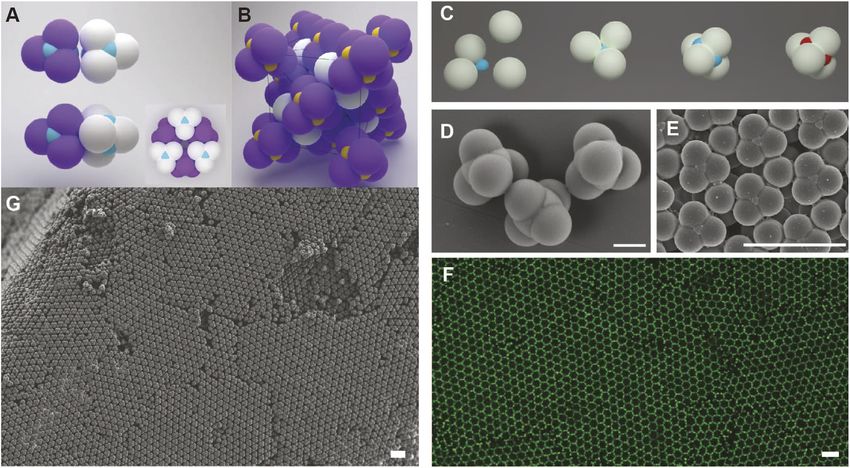
Frontiers in Physics | www.frontiersin.org 13 July 2021 | Volume 9 | Article 672375Zhang et al. Programmable Self-Assembly of DNA-Coated Colloids FIGURE 16 | (A) Illustration of colloidal cubic diamond via DNA-mediated assembly, where DNA is modified on the surface of the center part (blue) of each patchy particle. The tetrahedrally coordinated spherical lobes (purple and white) serve to control the orientation of particle to adopt a staggered conformation. (B) Unit cell of a colloidal cubic diamond. Preparation (C) and SEM images (D) of patchy colloids. (F) Confocal microscope image of colloidal cubic diamond (E–G) SEM images of colloidal cubic diamond. Scale bar of (D), 1 µm. Scale bars of (E–G), 5 m. Reproduced from ref. [44] with permission from the Springer Nature, copyright 2020. In other words, the particle lobes function to alter the orientation TPM have relatively lower refractive indices, of 1.6 and 1.4, during colloidal nucleation while the center part is the DNA- respectively, which is not enough to open up a photonic coated patch to stabilize the overall colloidal structure. bandgap. Therefore, using the colloidal systems described as The patchy particles were fabricated using a strategy called a template to make an inverse diamond structure by backfilling colloidal fusion, developed earlier by Gong and Sacanna et al the template with a high-refractive-index material such as TiO2 [89] (Figure 16C). First, solid non-crosslinked PS particles are will be promising in making future optic devices. Second, mixed with smaller TPM oil droplets. The stoichiometric produce the colloidal diamond in a large scale. The already- aggregation of PS particles around the TPM oil leads to the obtained colloidal diamond is of 80 µm in lateral dimension and tetrahedral cluster. THF is added to change the compression 40 µm in thickness. Strategies leading to large crystals should be ratio by deforming PS lobes. After evaporation of THF and applied for making optical waveguides, lasers, and other optical solidification of the TPM oil, patchy particles are obtained applications. (Figure 16D). Azide groups are modified on the TPM’s surface, followed by the introduction of DBCO-functionalized DNA (Figure 16C). After carefully controlled crystallization SUMMARY AND FUTURE PERSPECTIVES upon annealing, the colloidal diamond is obtained, as shown from the SEM and fluorescent images in Figures 16E–G. In summary, the structures of self-assembled materials by DNA- The photonic bandgap of the obtained diamond structure was coated colloids can be programmed according to the information calculated using MIT Photonic Bands software [90]. By changing encoded in the sequences of various DNA strands and the the compression ratio from 0.1 to 0.8, the colloidal cubic diamond morphology of the colloids. They are potentially useful for shows bandgap for the inverse lattice, i.e., structure defined by the further applications, for example, the next generation of void space of the colloidal diamond structure. The widest optical devices. Despite the great achievements, there are still bandgap is achieved around a compression ratio of 0.6. many challenges. First, the role of DNA in colloidal self-assembly Therefore, the colloidal cubic diamond has promising optical is not fully explored yet as it functions more like a “glue” to properties and a highly constrained and mechanically stable maintain the overall self-assembly structure. There is still space structure, suitable as a template for making high-dielectric- for the enhancement of DNA programmability in colloidal self- contrast photonic crystal with cubic diamond symmetry. assembly. For example, most systems only exploit two or three The next steps for fabricating photonic materials based on types of DNA strands, while multiple types of DNA strands are the method described are as follows. First, template the inverse engaged in the nanoparticle system to build intricate structures diamond structure with high refractive index materials. PS and [8]. It will be promising to see more complex self-assembled Frontiers in Physics | www.frontiersin.org 14 July 2021 | Volume 9 | Article 672375
Zhang et al.                                                                                                           Programmable Self-Assembly of DNA-Coated Colloids

structures by grafting multiple types of DNA strands onto the                               (NCTs), have been recently developed to overcome the
colloids and/or introducing free strands in the solution. Besides,                          weakness [96, 97]. Third, the self-assemblies obtained from
the DNA strands of the current studies are one dimensional,                                 DNA-coated colloids fall in the periodic crystal lattice, while
while investigations of more complex DNA structures such as                                 other structures [98–100], such as quasicrystals, have not been
DNA tiles and DNA origami are rare. DNA origami, for example,                               reported yet. Previous research has demonstrated the possibility
carry more information by having prescribed shape and binding                               to produce 2D quasicrystal from nanoparticles [101]. It will be
sites and thus have greater programmability in creating 3D                                  possible to build colloidal quasicrystal with DNA-coated colloids.
structures. The Gang group [91, 92], Shih group [93], and
Seeman group [94]had already reported interesting results in
this direction, though mostly focusing on nanoparticles. A                                  AUTHOR CONTRIBUTIONS
notable example is the use of tetrahedral origami cages to
direct spherical gold nanoparticles to form a diamond lattice                               TZ and YW wrote the manuscript. All authors discussed about
[95]. For colloids, the Chaikin and Seeman group have designed a                            the contents.
cross-shaped DNA origami to facilitate the formation of chiral
colloidal clusters with precision [9]. It can be expected that the
combination of spherical or patchy colloids with DNA tiles or                               FUNDING
origamis will be a new interesting way to construct ordered
assemblies with higher complexity. Second, whether the use of                               YW acknowledges support from the start-up fund of The
DNA can shed light on the use of other biomolecules or                                      University of Hong Kong. This project is also partially
biomolecular analogues, such as peptide, deserves further                                   supported by the Early Career Scheme (ECS) from the Research
attention. Only in saline buffer will the DNA-coated colloids                               Grants Council (RGC) of Hong Kong (Project number: 27303817),
self-assemble, which greatly limits its applications in other fields,                        General Research Fund (GRF) of the RGC of Hong Kong (Project
such as low-salt solution environments. DNA alternatives, such                              number: 17302820), and Croucher Innovation Award 2019
as peptide nucleic acids (PNA) and nanocomposite tectons                                    (Croucher Foundation, Hong Kong).

                                                                                             13. Andersen ES, Dong M, Nielsen MM, Jahn K, Subramani R, Mamdouh W,
REFERENCES                                                                                       et al. Self-assembly of a Nanoscale DNA Box with a Controllable Lid. Nature
                                                                                                 (2009) 459(7243):73–6. doi:10.1038/nature07971
  1. Chen J, and Seeman NC Synthesis from DNA of a Molecule with the                         14. Douglas SM, Dietz H, Liedl T, Högberg B, Graf F, and Shih WM Self-
     Connectivity of a Cube. Nature (1991) 350(6319):631–3. doi:10.1038/350631a0                 assembly of DNA into Nanoscale Three-Dimensional Shapes. Nature (2009)
  2. Rothemund PWK Folding DNA to Create Nanoscale Shapes and Patterns.                          459(7245):414–8. doi:10.1038/nature08016
     Nature (2006) 440(7082):297–302. doi:10.1038/nature04586                                15. Woo S, and Rothemund PWK Programmable Molecular Recognition Based
  3. Yin P, Hariadi RF, Sahu S, Choi HMT, Park SH, LaBean TH, et al.                             on the Geometry of DNA Nanostructures. Nat Chem (2011) 3(8):620–7.
     Programming DNA Tube Circumferences. Science (2008) 321(5890):                              doi:10.1038/nchem.1070
     824–6. doi:10.1126/science.1157312                                                      16. Udomprasert A, Bongiovanni MN, Sha R, Sherman WB, Wang T, Arora PS,
  4. Jones MR, Seeman NC, and Mirkin CA Programmable Materials and the                           et al. Amyloid Fibrils Nucleated and Organized by DNA Origami
     Nature of the DNA Bond. Science (2015) 347(6224):1260901. doi:10.1126/                      Constructions. Nat Nanotech (2014) 9(7):537–41. doi:10.1038/nnano.2014.102
     science.1260901                                                                         17. Veneziano R, Ratanalert S, Zhang K, Zhang F, Yan H, Chiu W, et al. Designer
  5. SantaLucia J A Unified View of Polymer, Dumbbell, and Oligonucleotide                        Nanoscale DNA Assemblies Programmed from the Top Down. Science
     DNA Nearest-Neighbor Thermodynamics. Proc Natl Acad Sci (1998) 95(4):                       (2016) 352(6293):1534. doi:10.1126/science.aaf4388
     1460–5. doi:10.1073/pnas.95.4.1460                                                      18. Tikhomirov G, Petersen P, and Qian L Fractal Assembly of Micrometre-Scale
  6. Xia T, SantaLucia J, Burkard ME, Kierzek R, Schroeder SJ, Jiao X, et al.                    DNA Origami Arrays with Arbitrary Patterns. Nature (2017) 552(7683):
     Thermodynamic Parameters for an Expanded Nearest-Neighbor Model for                         67–71. doi:10.1038/nature24655
     Formation of RNA Duplexes with Watson−Crick Base Pairs†. Biochemistry                   19. Yao G, Zhang F, Wang F, Peng T, Liu H, Poppleton E, et al. Meta-DNA
     (1998) 37(42):14719–35. doi:10.1021/bi9809425                                               Structures. Nat Chem (2020) 12(11):1067–75. doi:10.1038/s41557-020-0539-8
  7. Park SY, Lytton-Jean AKR, Lee B, Weigand S, Schatz GC, and Mirkin CA                    20. Pinheiro AV, Han D, Shih WM, and Yan H Challenges and Opportunities for
     DNA-programmable Nanoparticle Crystallization. Nature (2008) 451(7178):                     Structural DNA Nanotechnology. Nat Nanotech (2011) 6(12):763–72.
     553–6. doi:10.1038/nature06508                                                              doi:10.1038/nnano.2011.187
  8. Macfarlane RJ, Jones MR, Lee B, Auyeung E, and Mirkin CA Topotactic                     21. Zhang DY, and Seelig G Dynamic DNA Nanotechnology Using Strand-
     Interconversion of Nanoparticle Superlattices. Science (2013) 341(6151):                    Displacement Reactions. Nat Chem (2011) 3(2):103–13. doi:10.1038/
     1222–5. doi:10.1126/science.1241402                                                         nchem.957
  9. Ben Zion MY, He X, Maass CC, Sha R, Seeman NC, and Chaikin PM Self-                     22. Laramy CR, O’Brien MN, and Mirkin CA Crystal Engineering with DNA.
     assembled Three-Dimensional Chiral Colloidal Architecture. Science (2017)                   Nat Rev Mater (2019) 4(3):201–24. doi:10.1038/s41578-019-0087-2
     358(6363):633–6. doi:10.1126/science.aan5404                                            23. Rogers WB, Shih WM, and Manoharan VN Using DNA to Program the Self-
 10. Wang S, Du JS, Diercks NJ, Zhou W, Roth EW, Dravid VP, et al. Colloidal Crystal             Assembly of Colloidal Nanoparticles and Microparticles. Nat Rev Mater
     "Alloys". J Am Chem Soc (2019) 141(51):20443–50. doi:10.1021/jacs.9b11109                   (2016) 1(3):16008. doi:10.1038/natrevmats.2016.8
 11. Wang S, Park SS, Buru CT, Lin H, Chen PC, Roth EW, et al. Colloidal crystal             24. Joshi D, Bargteil D, Caciagli A, Burelbach J, Xing Z, Nunes AS, et al. Kinetic
     Engineering with Metal-Organic Framework Nanoparticles and DNA. Nat                         Control of the Coverage of Oil Droplets by DNA-Functionalized Colloids. Sci
     Commun (2020) 11(1):2495. doi:10.1038/s41467-020-16339-w                                    Adv (2016) 2(8):e1600881. doi:10.1126/sciadv.1600881
 12. He Y, Ye T, Su M, Zhang C, Ribbe AE, Jiang W, et al. Hierarchical Self-                 25. Di Michele L, Varrato F, Kotar J, Nathan SH, Foffi G, and Eiser E Multistep
     Assembly of DNA into Symmetric Supramolecular Polyhedra. Nature (2008)                      Kinetic Self-Assembly of DNA-Coated Colloids. Nat Commun (2013) 4:2007.
     452(7184):198–201. doi:10.1038/nature06597                                                  doi:10.1038/ncomms3007

Frontiers in Physics | www.frontiersin.org                                             15                                               July 2021 | Volume 9 | Article 672375
Zhang et al. Programmable Self-Assembly of DNA-Coated Colloids
26. Moon J, Jo I-S, Ducrot E, Oh JS, Pine DJ, and Yi G-R DNA-coated 49. Licata NA, and Tkachenko AV Dynamics of Particles with "Key-Lock"
Microspheres and Their Colloidal Superstructures. Macromol Res (2018) Interactions. Europhys Lett (2008) 81(4):48009. doi:10.1209/0295-5075/81/
26(12):1085–94. doi:10.1007/s13233-018-6151-8 48009
27. Mueller NS, Okamura Y, Vieira BGM, Juergensen S, Lange H, Barros EB, et al. 50. van der Meulen SAJ, and Leunissen ME Solid Colloids with Surface-Mobile
Deep strong Light-Matter Coupling in Plasmonic Nanoparticle Crystals. DNA Linkers. J Am Chem Soc (2013) 135(40):15129–34. doi:10.1021/
Nature (2020) 583(7818):780–4. doi:10.1038/s41586-020-2508-1 ja406226b
28. Wang J, Sultan U, Goerlitzer ESA, Mbah CF, Engel M, and Vogel N Structural 51. Macfarlane RJ, Lee B, Jones MR, Harris N, Schatz GC, and Mirkin CA
Color of Colloidal Clusters as a Tool to Investigate Structure and Dynamics. Nanoparticle Superlattice Engineering with DNA. Science (2011) 334(6053):
Adv Funct Mater (2019) 30(26):1907730. doi:10.1002/adfm.201907730 204–8. doi:10.1126/science.1210493
29. Elghanian R, Storhoff JJ, Mucic RC, Letsinger RL, and Mirkin CA Selective 52. Lu F, Yager KG, Zhang Y, Xin H, and Gang O Superlattices Assembled
Colorimetric Detection of Polynucleotides Based on the Distance-dependent through Shape-Induced Directional Binding. Nat Commun (2015) 6:6912.
Optical Properties of Gold Nanoparticles. Science (1997) 277(5329):1078–81. doi:10.1038/ncomms7912
doi:10.1126/science.277.5329.1078 53. Schade NB, Holmes-Cerfon MC, Chen ER, Aronzon D, Collins JW, Fan JA,
30. Mirkin CA, Letsinger RL, Mucic RC, and Storhoff JJ A DNA-Based Method et al. Tetrahedral Colloidal Clusters from Random Parking of Bidisperse
for Rationally Assembling Nanoparticles into Macroscopic Materials. Nature Spheres. Phys Rev Lett (2013) 110(14):148303. doi:10.1103/
(1996) 382(6592):607–9. doi:10.1038/382607a0 physrevlett.110.148303
31. Alivisatos AP, Johnsson KP, Peng X, Wilson TE, Loweth CJ, Bruchez MP, 54. Rogers WB, and Manoharan VN Programming Colloidal Phase Transitions
et al. Organization of ’nanocrystal Molecules’ Using DNA. Nature (1996) with DNA Strand Displacement. Science (2015) 347(6222):639–42.
382(6592):609–11. doi:10.1038/382609a0 doi:10.1126/science.1259762
32. Soto CM, Srinivasan A, and Ratna BR Controlled Assembly of Mesoscale 55. Mognetti BM, Leunissen ME, and Frenkel D Controlling the Temperature
Structures Using DNA as Molecular Bridges. J Am Chem Soc (2002) 124(29): Sensitivity of DNA-Mediated Colloidal Interactions through Competing
8508–9. doi:10.1021/ja017653f Linkages. Soft Matter (2012) 8(7):2213. doi:10.1039/c2sm06635a
33. Milam VT, Hiddessen AL, Crocker JC, Graves DJ, and Hammer DA DNA- 56. Biancaniello PL, Kim AJ, and Crocker JC Colloidal Interactions and Self-
driven Assembly of Bidisperse, Micron-Sized Colloids. Langmuir (2003) Assembly Using DNA Hybridization. Phys Rev Lett (2005) 94(5):058302.
19(24):10317–23. doi:10.1021/la034376c doi:10.1103/physrevlett.94.058302
34. Rogers PH, Michel E, Bauer CA, Vanderet S, Hansen D, Roberts BK, et al. 57. Rogers WB, and Crocker JC Direct Measurements of DNA-Mediated
Selective, Controllable, and Reversible Aggregation of Polystyrene Latex Colloidal Interactions and Their Quantitative Modeling. Proc Natl Acad
Microspheres via DNA Hybridization. Langmuir (2005) 21(12):5562–9. Sci (2011) 108(38):15687–92. doi:10.1073/pnas.1109853108
doi:10.1021/la046790y 58. Rogers WB, Sinno T, and Crocker JC Kinetics and Non-exponential Binding
35. Kim AJ, Biancaniello PL, and Crocker JC Engineering DNA-Mediated Colloidal of DNA-Coated Colloids. Soft Matter (2013) 9(28):6412. doi:10.1039/
Crystallization. Langmuir (2006) 22(5):1991–2001. doi:10.1021/la0528955 c3sm50593f
36. Leunissen ME, Christova CG, Hynninen A-P, Royall CP, Campbell AI, Imhof 59. Varilly P, Angioletti-Uberti S, Mognetti BM, and Frenkel D A General Theory
A, et al. Ionic Colloidal Crystals of Oppositely Charged Particles. Nature of DNA-Mediated and Other Valence-Limited Colloidal Interactions. J Chem
(2005) 437(7056):235–40. doi:10.1038/nature03946 Phys (2012) 137(9):094108. doi:10.1063/1.4748100
37. Hueckel T, Hocky GM, Palacci J, and Sacanna S Ionic Solids from Common 60. Angioletti-Uberti S, Varilly P, Mognetti BM, Tkachenko AV, and Frenkel D
Colloids. Nature (2020) 580(7804):487–90. doi:10.1038/s41586-020-2205-0 Communication: a Simple Analytical Formula for the Free Energy of Ligand-
38. Glotzer SC, and Solomon MJ Anisotropy of Building Blocks and Their Receptor-Mediated Interactions. J Chem Phys (2013) 138(2):021102.
Assembly into Complex Structures. Nat Mater (2007) 6(8):557–62. doi:10.1063/1.4775806
doi:10.1038/nmat1949 61. Angioletti-Uberti S, Varilly P, Mognetti BM, and Frenkel D Mobile Linkers
39. Wang Y, Wang Y, Breed DR, Manoharan VN, Feng L, Hollingsworth AD, on DNA-Coated Colloids: Valency without Patches. Phys Rev Lett (2014)
et al. Colloids with Valence and Specific Directional Bonding. Nature (2012) 113(12):128303. doi:10.1103/physrevlett.113.128303
491(7422):51–5. doi:10.1038/nature11564 62. Gehrels EW, Rogers WB, and Manoharan VN Using DNA Strand
40. Ho KM, Chan CT, and Soukoulis CM Existence of a Photonic gap in Periodic Displacement to Control Interactions in DNA-Grafted Colloids. Soft
Dielectric Structures. Phys Rev Lett (1990) 65(25):3152–5. doi:10.1103/ Matter (2018) 14(6):969–84. doi:10.1039/c7sm01722g
physrevlett.65.3152 63. Lowensohn J, Oyarzún B, Narváez Paliza G, Mognetti BM, and Rogers WB
41. John S Strong Localization of Photons in Certain Disordered Dielectric Linker-Mediated Phase Behavior of DNA-Coated Colloids. Phys Rev X (2019)
Superlattices. Phys Rev Lett (1987) 58(23):2486–9. doi:10.1103/physrevlett.58.2486 9(4):041054. doi:10.1103/physrevx.9.041054
42. Yablonovitch E Inhibited Spontaneous Emission in Solid-State Physics and 64. Lowensohn J, Hensley A, Perlow-Zelman M, and Rogers WB Self-Assembly
Electronics. Phys Rev Lett (1987) 58(20):2059–62. doi:10.1103/ and Crystallization of DNA-Coated Colloids via Linker-Encoded Interactions.
physrevlett.58.2059 Langmuir (2020) 36(25):7100–8. doi:10.1021/acs.langmuir.9b03391
43. Joannopoulos JD. Photonic Crystals : Molding the Flow of Light. 2nd ed.. 65. Rogers WB A Mean-Field Model of Linker-Mediated Colloidal Interactions.
Princeton: Princeton University Press (2008). J Chem Phys (2020) 153(12):124901. doi:10.1063/5.0020578
44. He M, Gales JP, Ducrot É, Gong Z, Yi G-R, Sacanna S, et al. Colloidal 66. Fang H, Hagan MF, and Rogers WB Two-step Crystallization and Solid-Solid
diamond. Nature (2020) 585(7826):524–9. doi:10.1038/s41586-020-2718-6 Transitions in Binary Colloidal Mixtures. Proc Natl Acad Sci USA (2020)
45. Dreyfus R, Leunissen ME, Sha R, Tkachenko A, Seeman NC, Pine DJ, et al. 117(45):27927–33. doi:10.1073/pnas.2008561117
Aggregation-disaggregation Transition of DNA-Coated Colloids: 67. Xia X, Hu H, Ciamarra MP, and Ni R Linker-mediated Self-Assembly of
Experiments and Theory. Phys Rev E Stat Nonlin Soft Matter Phys (2010) mobile DNA-Coated Colloids. Sci Adv (2020) 6(21):eaaz6921. doi:10.1126/
81(4 Pt 1):041404. doi:10.1103/physreve.81.041404 sciadv.aaz6921
46. Michele LD, and Eiser E Developments in Understanding and Controlling 68. Jana PK, and Mognetti BM Translational and Rotational Dynamics of
Self Assembly of DNA-Functionalized Colloids. Phys Chem Chem Phys Colloidal Particles Interacting through Reacting Linkers. Phys Rev E
(2013) 15(9):3115. doi:10.1039/c3cp43841d (2019) 100(6-1):060601. doi:10.1103/physreve.100.060601
47. Angioletti-Uberti S, Mognetti BM, and Frenkel D Re-entrant Melting as a 69. Lee-Thorp JP, and Holmes-Cerfon M Modeling the Relative Dynamics of
Design Principle for DNA-Coated Colloids. Nat Mater (2012) 11(6):518–22. DNA-Coated Colloids. Soft Matter (2018) 14(40):8147–59. doi:10.1039/
doi:10.1038/nmat3314 c8sm01430b
48. Wang Y, Wang Y, Zheng X, Ducrot E, Yodh JS, Weck M, et al. Crystallization 70. Wang Y, Wang Y, Zheng X, Ducrot É, Lee M-G, Yi G-R, et al. Synthetic
of DNA-Coated Colloids. Nat Commun (2015) 6:7253. doi:10.1038/ Strategies toward DNA-Coated Colloids that Crystallize. J Am Chem Soc
ncomms8253 (2015) 137(33):10760–6. doi:10.1021/jacs.5b06607
Frontiers in Physics | www.frontiersin.org 16 July 2021 | Volume 9 | Article 672375You can also read


