Review on Blue Perovskite Light-Emitting Diodes: Recent Advances and Future Prospects - Frontiers
←
→
Page content transcription
If your browser does not render page correctly, please read the page content below
MINI REVIEW
                                                                                                                                              published: 15 March 2021
                                                                                                                                       doi: 10.3389/fmats.2021.635025

                                               Review on Blue Perovskite
                                               Light-Emitting Diodes: Recent
                                               Advances and Future Prospects
                                               Chuangye Ge, Qianru Fang, Haoran Lin and Hanlin Hu *
                                               Hoffmann Institute of Advanced Materials, Shenzhen Polytechnic, Shenzhen, China

                                               Perovskite-based light-emitting diodes (PLEDs) have emerged as a promising alternative
                                               owning to the excellent optoelectronic properties including narrow emission linewidths, high
                                               photoluminescence quantum yield (PLQY), tunable emission wavelength, and high color
                                               purity. Over the past several years, significant progress has been obtained for green, red, and
                                               near-infrared PLEDs with a high external quantum efficiency (EQE) of over 20%. However, the
                                               development of blue PLEDs has been limited by several technical issues including poor film
                                               quality, inefficient device structure, higher trap density, and so on. To overcome these
                                               drawbacks with improved PLQY and EQE, we summarize and analyze the recent advances
                                               towards the development of three dimensional (3D), two dimensional (2D) and quasi-2D
                                               perovskites film employing composition and/or dimensional engineering. Moreover, the
                                               utilization of perovskite nanocrystals (PNCs) is also considered as a feasible strategy for
                          Edited by:
                                               the realization of high-performance blue PLEDs. We systematically evaluate the performance
                           Annie Ng,           of sky-blue, pure-blue and deep blue PLEDs based on different perovskite materials. Finally,
   Nazarbayev University, Kazakhstan
                                               future prospective are proposed to promote the development of efficient blue PLEDs.
                        Reviewed by:
                       Sajid Ali Ansari,       Keywords: blue light-emitting diodes (LEDs), metal halide perovskite, external quantum efficiencies, stability,
   King Saud University, Saudi Arabia          perovskite nanocrystal
           Ahmed Mourtada Elseman,
   Central Metallurgical Research and
         Development Institute, Egypt          INTRODUCTION
                  *Correspondence:
                            Hanlin Hu          Currently, metal halide perovskites has a general formula of ABX3 (A+  monovalent organic or
                 hanlin.hu@szu.edu.cn          inorganic cation, e.g., CH3NH3+ (MA+), CH(NH2)2+ (FA+), Cs+; B2+  divalent metal cation such as
                                               Pb2+, Sn2+, Zn2+: X−  halide anion, e.g., Cl−, Br−, I−, and SCN−) display outstanding optoelectronic
                    Specialty section:         properties including high charge carrier mobility, long excitation diffusion length, high absorption
         This article was submitted to         coefficient, narrow emission linewidth, tunable emission wavelengths from ultra-violet to near-infrared
                      Energy Materials,        (Kumawat et al., 2019; Hu et al., 2020; Lu and Wei, 2020). Particularly, the solution-processable
               a section of the journal        perovskite materials make them suitable for large-scale, cost-effective, optoelectronic applications such as
                  Frontiers in Materials
                                               solar cells (Ge et al., 2020), photodetectors (Ramasamy et al., 2016), X-ray detector (Chen P. et al., 2018),
      Received: 29 November 2020               amplified lasing (Wang et al., 2015), and light-emitting diodes (LEDs) (Chiba et al., 2018; Xing et al.,
       Accepted: 11 January 2021
                                               2018). In 2014, the first PLEDs operated at room temperature was developed by Tan et al. with EQE of
        Published: 15 March 2021
                                               0.76%, 0.1%, and 0.018% for near-infrared, red, and green emission, respectively (Tan et al., 2014).
                             Citation:            Thereafter, many strategies have been employed to improve the PLQY and EQE of PLEDs
Ge C, Fang Q, Lin H and Hu H (2021)
                                               through composition engineering (Leng et al., 2018; Tan et al., 2018), dimensional engineering (Chen
     Review on Blue Perovskite Light-
Emitting Diodes: Recent Advances and
                                               Q. et al., 2018; Xing et al., 2018), and the application of perovskite NCs (Braly et al., 2017; Guria et al.,
                    Future Prospects.          2017). Recently, high-performance PLEDs have been reported for the green, red and near-infrared
              Front. Mater. 8:635025.          emission with EQE of 20.3% (Lin et al., 2018), 21.3% (Chiba et al., 2018), and 20.7% (Cao et al., 2018),
     doi: 10.3389/fmats.2021.635025            respectively. The outstanding progress indicates a bright future for PLEDs in the applications of

Frontiers in Materials | www.frontiersin.org                                         1                                           March 2021 | Volume 8 | Article 635025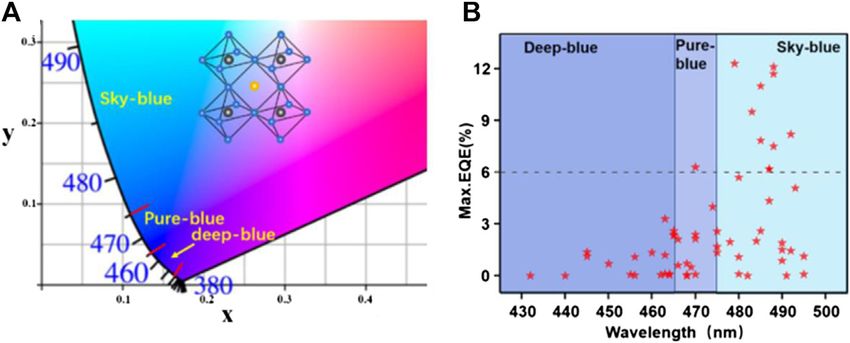
Ge et al.                                                                                                                               Blue Perovskite Light-Emitting Diodes

  FIGURE 1 | (A) Corresponding CIE coordinates for the EL spectrum; (B) Development of blue perovskite LEDs.

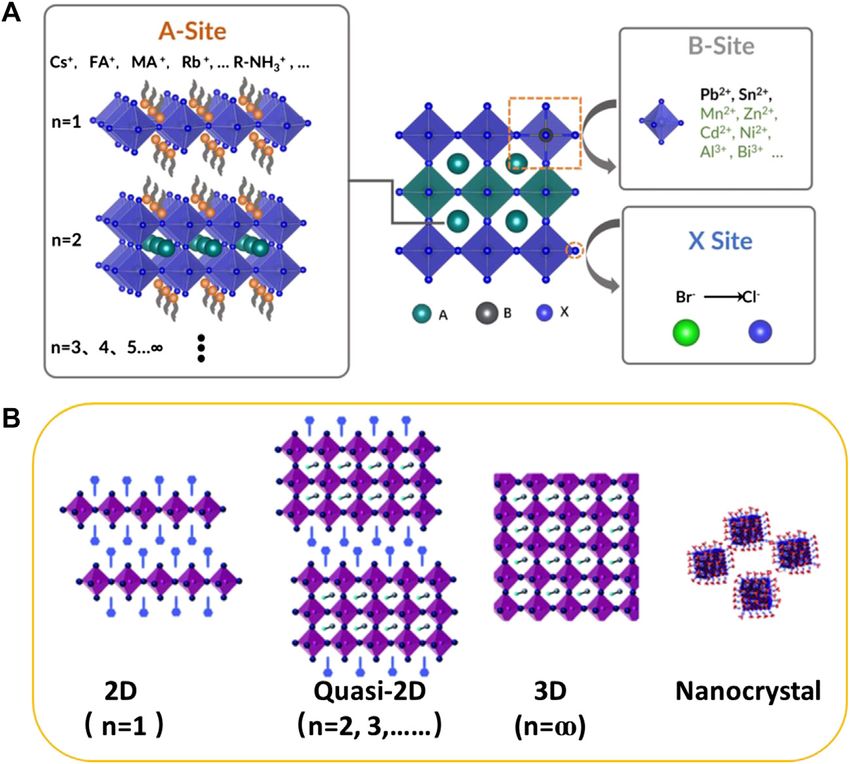
  FIGURE 2 | (A) Schematic illustration describing the regulation of A-, B- and X-site atoms of the perovskite to achieve blue luminescence. (B) Structure diagrams of
  2D, quasi-2D, 3D perovskite and perovskite nanocrystal for dimensional engineering of PLEDs.

displays and solid-state lighting. However, blue PLEDs, an                                 of perovskite NCs. Possible strategies are provided to stabilize the
important component for displays and lighting, show limited                                color of blue PLEDs and improve the PLQY of blue emissive
advancement. In this review, we categorize the recent advances of                          perovskites. Finally, the future prospective is proposed for
blue PLEDs into three sections based on kinds of the perovskite                            preparing high-performance blue PLEDs.
materials, including 3D perovskites, 2D or quasi-2D perovskites,
and perovskite nanocrystals (NCs). In each category, the
development of PLEDs with sky-blue, pure-blue and deep-blue                                RECENT ADVANCES OF PLEDS
emission (Figure 1A,B) are discussed by using compositional
engineering (Figure 2A) in which A-, B- and X-site doping,                                 3D Perovskite-Based Device
dimensional engineering (Figure 2B) by forming low-                                        Cl/Br doping is one of the most important approaches to fabricate
dimensional (2D and quasi-2D) perovskite, and the utilization                              3D blue PLEDs, and it was firstly proposed by Kumawat et al., in

Frontiers in Materials | www.frontiersin.org                                           2                                             March 2021 | Volume 8 | Article 635025
Ge et al.                                                                                                      Blue Perovskite Light-Emitting Diodes

2015 via the utilization of MAPb(Br1-XClX) (0 ≤ x ≤ 1), showing a           Two Dimensional (2D)/Quasi
significant blue shift when the content of Cl was increased from 0           Two-Dimensional (Quasi-2D) Perovskites
to 1 (Kumawat et al., 2015). They successfully fabricated PLEDs
with a brightness of 2 cd/m2 and a low EQE of 0.0001% when x
                                                                            Based PLEDs
                                                                            Mixing halide perovskites is not a perfect choice because of the
was 0.64 at room temperature. The poor performance can be
                                                                            color instability and phase separation caused by an electric field.
attributed to a low quality of the perovskite film and the emission
                                                                            Generally, the PLQY is low for the chloride-containing
quenching by [6,6]-Phenyl C61 butyric acid methyl ester (PCBM)
                                                                            perovskites due to the existence of a large number of halide
in the device. Many efforts have been made to enhance the EQE
                                                                            vacancies. To enhance the luminous efficiency, a quasi-2D
by improving the quality of perovskite films. A triple cations
                                                                            strategy involving long-chain ammonium ligands has been
strategy coupled with anti-solvent treatment was applied to
                                                                            developed. The molecular formula of quasi-two-dimensional
obtain uniform and pinhole-free film for blue PLEDs (Kim
                                                                            perovskite is (RNH3)2An−1BnX3n+1, where R is an aryl or alkyl
et al., 2017). A sky-blue PLED with the device structure (ITO/
                                                                            long chain group and n is the number of stacked perovskite
ZnO/Cs10(MA0.17FA0.83)100−xPbBr1.5Cl1.5/NPD(4,4-bis [N-(1-
                                                                            octahedron. Liang et al. developed on 2D perovskites-based blue
naphthyl)-N-phenylamino]biphenyl)/MoO3/Ag was assembled
                                                                            PLEDs for the first time by employing (PEA)2PbBr4 as the
by Kim et al., exhibiting a high brightness of 3,567 cd/m2 and
                                                                            emissive material, which displayed a light emission peak at
an EQE of 1.7%. The device exhibits stable EL spectra at different
                                                                            410 nm at room temperature with an EQE of 0.04% (Liang
bias voltages. Yuan and his co-workers systematically investigated
                                                                            et al., 2016). Cheng et al. proposed a sky-blue PLEDs of ITO/
the effect of five different A-site cations on the film morphology,
                                                                            ZnO/PEIE/(4-PBA)2PbBr4/TFB/MoO3/Al,                   (PEIE
crystal orientation, and photovoltaic performance (Yuan et al.,
                                                                            polyethylenimine ethoxylated, TFB  poly (9,9-dioctyl-
2020). They developed high-quality (Cs/Rb/FA/PEA/K)Pb(Cl/
                                                                            fluorene-co-N-(4-butylphenyl) diphenylamine), and 4-PBA
Br)3 (PEA  phenylethylammonium) based blue PLEDs and
                                                                            4-phenylbutylamine), showing a brightness of 186 cd/m2 and
obtained an EQEmax of 2.01% with a maximum brightness of
                                                                            an EQE of 0.015% (Cheng et al., 2017). Various long-chain
4,015 cd/m2. Therefore, it is an effective approach to tune the
                                                                            ligands such as 2-phenyl ethyl ammonium (PEA),
emission wavelength and which suggests that multiple cations can
                                                                            n-butylammonium (BA), ethyl ammonium (EA) and
diminish the phase segregation in mixed halide perovskites.
                                                                            oleylammonium (OLA) can serve as potential barriers in the
   To realize a pure-blue emission in the range of 465–475 nm, it is
                                                                            structure leading to a size reduction of the perovskite crystals.
necessary to introduce more amount of Cl than that for shy-blue
                                                                            Meanwhile, increased migration of blue light and enhanced
emission, which will bring more defects in the perovskite film,
                                                                            micelle binding energy are generated because of the quantum
leading to a lower PLQY. Meanwhile, it might cause phase
                                                                            confinement effect. It’s worth noting that the quenching and
separation of the mixed halides and a worse morphology of
                                                                            enrichment of the long-chain ligand amine will retard the carrier
perovskite film. Wang and his co-workers introduced RbX (X is
                                                                            transport of the blue PLEDs, leading to a very low EQE. A
Cl/Br) as a dopant in CsPbBr3 perovskite film (Li X.-L. et al., 2019).
                                                                            significant charge/energy transfer effect always exist in most of
Due to the smaller ion radius of Rb+, the bond between lead and
                                                                            the quasi-two-dimensional perovskite-based researches. Yang
halide is increased, leading to a shrink to the lattice. Due to the
                                                                            et al. prepared PEA2(FAPbBr3)n−1PbBr4 quasi-two-dimensional
synergistic effect of partial Cl doping and Rb+ substitution, the
                                                                            perovskite film which displayed the many luminescence peaks of
bandgap was expanded from 2.36 to 2.52 eV (RbBr-) and 2.65 eV
                                                                            2D perovskite with different n values in the PL spectrum.
(RbCl−) for the doped films. The incorporated RbX could not only
                                                                            However, only one pure green luminescence peak at 532 nm
dramatically improve the quality and surface coverage of the film
                                                                            was observed, indicating a very the presence of efficient charge/
but also increase the bandgap of the doped perovskite film to
                                                                            energy transfer in the quasi-2D perovskite, making it difficult to
achieve blue photoluminescence (PL) emission with an EQE of
                                                                            achieve blue emission (Yang et al., 2018). Xing et al. introduced
0.062%. Additionally, these blue PLEDs display good color
                                                                            dual organic small molecule phenethylamine bromide (PEABr)
stability.
                                                                            and isopropylammonium bromide (IPABr) based (IPA:PEA)2
   In terms of the deep-blue emission PLEDs, it becomes more
                                                                            (MA:Cs)n−1PbnBr3n+1 quasi 2D perovskite to reduce the charge/
difficult by using the system of MAPb(Br1−XClX), even
                                                                            energy transfer (Xing et al., 2018). They found that a certain
Sadhanala et al. reported a deep emission PLEDs with two
                                                                            amount of short-chain IPABr can reduce the Van der Waals
emission peaks at 425 and 450 nm without the detailed
                                                                            interaction among 2D perovskites to suppress the formation of
parameters of the device (Sadhanala et al., 2015). Rare works
                                                                            green-emitting 2D perovskites with n  1 or large n value, which
have been reported based on the application of 3D perovskite
materials for the following reasons: Firstly, there are a lot of            facilitated the formation of quasi 2D perovskite with n  2, 3, 4,
defects in MACl-based perovskite because it is relatively easy to           leading to a blue shift. Li et al. applied an X-position component
sublime and absorb moisture, these defects become carrier                   engineering to solve the charge/energy transfer problem (Li Z. et
recombination centers, resulting in a decrease of efficiency of              al., 2019). They increased the content of chloride to make the
radiative recombination and a reduced PLQY. Secondly,                       spectrum blue-shifted from about 523 nm (green light) to 485 nm
replacing MACl with inorganic chloride salt (such as CsCl),                 (sky blue). Then, PEABr was introduced to form a quasi-2D
the low dissolution makes it impossible to significantly increase            perovskite, which is beneficial for reducing the defect density and
the chlorine content in the perovskite, deep-blue light emission            improving PLQY. Based on these engineering, a high EQE up to
cannot be realized.                                                         5.7% and a maximum brightness of 3,780 cd m−2 was obtained

Frontiers in Materials | www.frontiersin.org                            3                                    March 2021 | Volume 8 | Article 635025
Ge et al. Blue Perovskite Light-Emitting Diodes
with further adjustment of the carriers recombination area. (2) Introduce a variety of large-size organic cations to regulate
Recently, Chu et al. introduced ethylamine cations into the the distribution of n-value for the quasi-2D perovskite. Yuan
quasi-2D PEA2(CsPbBr3)2PbBr4 perovskite system and found et al. employed a small diamine (1,4-bis(aminomethyl)
that ethylamine ions can partially replace Cs+ in the lattice of phenyl bromide) (P-PDABr2)) to the CsPbBr3 to obtain a
perovskite and thereby changing the Pb-Br orbital coupling and higher PLQY of quasi-2D perovskite with n 2 and n 4.
increasing the bandgap, realizing the color regulation in the However, the final light-emitting peak located at 477 nm,
emission range of 466–508 nm (Chu et al., 2020). The which was not in the pure blue light range (Yuan et al., 2019).
maximum EQE of the sky- blue devices is 12.1%, which is Then they introduced PEABr into the previous quasi-2D
currently the best performance in this field. Ren et al. system, and the distribution of n-value in the new system
proposed an effective approach to enhance the energy transfer with two different large-size organic cations was regulated
between quasi-2D perovskite layers of the perovskite film for again. The quasi-2D perovskite with n 2 and n 3
achieving high-performance PLEDs (Ren et al., 2020). They contribute mainly to the luminescence with improved
employed a bi-functional ligand of 4-(2-aminoethyl)benzoic PLQY. They got an EQE of 2.6% and 211 cd m−2 for the
acid (ABA) cation into the perovskite film to reduce the weak pure-blue PLED when n 3.
van der Waals gap between each perovskite layer and to promote (3) The introduction of inorganic additives to control the
the coupling of quasi-2D perovskite layers. Therefore, efficient distribution of n value. Pang et al. found that a certain
energy transfer in the perovskite films generated due to the amount of NaBr in PEA2Csn−1Pbn(ClxBr1−x)3n+1 can
enhanced interaction between coupled quasi-2D perovskite suppress the formation of 2D perovskites with low
layers. The introduced ABA can also simultaneously passivate luminescence properties with n 1 and promote those
the perovskite defects by reducing metallic Pb for a decreasing with n 2, 3, 4 to realize the redistribution of quasi-2D
loss of non-radiative recombination. Take the advantage of the perovskite (Pang et al., 2020). The performance of pure-blue
incorporated ABA, highly efficient blue PLEDs with EQE of LED based device has been greatly improved but the related
10.11% and long operational stability of 81.3 min were mechanism needs more study in the future.
achieved. Wang and his co-workers reported a dual emission
(473 and 485 nm) PLEDs based on (EA)2MAn–1PbnBr3n+1 and Although there are several reports about the application of
obtained an EQEmax of 2.6% (Wang et al., 2017). However, they quasi-2D perovskite to achieve deep-blue light emission, but the
found that multiple n values exist in the quasi-2D perovskite efficiency are very low. Congreve et al. introduced a small
crystals and it is challenging to control the n values accurately. butylamine molecule into MAPbr3 to prepare quasi-2D
Chen’s group studied the energy-transfer and charge-transfer Perovskite based PLED with an EQE of 0.0054% (Congreve
among crystals with different n values in quasi-2D PLEDs (Chen et al., 2017). By applying POEA into MAPbr3, Chen et al.
et al., 2018). Four distinct emission peaks were observed at 425, achieved a single EL emission peak at 462 nm, but the EQE
452, 452, and 505 nm, which corresponded to n 1, 2, 3, and 4 of was only 0.06% (Chen et al., 2017). Therefore, blue emission from
PA2(CsPbBr3)n–1PbBr4 (PA propylammonium), and the main quasi-two-dimensional Perovskite is not ideal at present. The
emission peak of 505 nm was attributed to the charge-transfer. main reasons can be summarized as below: Firstly, for the pure
Finally, a cyan PLED emitting at 505 nm with an EQEmax of 3.6% bromine system with a single halogen, the quasi 2D perovskite
was obtained. with n 1 and n 2 contribute mainly to the luminescence, these
Controlling the value of n is the main approach to realize the perovskites often have thermally induced exciton quenching,
pure blue emission which can be done by the pathways as below: resulting in a lower PLQY. Secondly, a large number of
insulating organic ligands are often introduced to obtain quasi
(1) Adjust the small-sized A-site cations to control the growth 2D perovskite with n 1 and n 2, this will greatly affect the
kinetics of the quasi-2D perovskite. Yantara et al. compared charge injection and transfer. Thirdly, the efficient charge/energy
the UV absorption and PL spectra of the quasi-2D perovskite transfer in quasi-2D perovskite leads to the photon emission from
based on three A-site cations with different solubility: MA+, the component with the minimum bandgap, which is not
FA+ and Cs+, when forming a quasi-two-dimensional conducive to the deep blue emission; Fourthly, the low
perovskite together with PBA+, and found that as the solubility of the Cl salts in dimethyl sulfoxide (DMSO) and
solubility of A-site ion decreasing, the absorption and PL N,N-Dimethylformamide (DMF) limits the possibility of
distribution of quasi-2D perovskite became narrow, regulating the composition (Zou et al., 2021).
corresponding to the formation of 2D perovskites with
medium n-values (Yantara et al., 2020). Considering that
the formation of small n-value components requires a large Colloidal Perovskite Nanocrystals (PNCs)
amount of organic small molecule additives (PBA+), they Based PLEDs
adjusted the ratio between PBA+, Cs+ and Pb2+, and applied Schmidt et al. reported the first PNCs-based PLED by using
anti-solvent processing methods to further accelerate the MAPbBr3 PNCs with good stability and high PLQY, a low EQE
nucleation process which further narrows the n value was obtained due to the poor morphology of the thin perovskite
distribution. Finally, they achieved a pure blue emission film (Schmidt et al., 2014). The first attempt on blue PNC-based
with the middle n-value component (n 3, 4), showing PLEDs was developed by Song et al., who used blue
the maximum EQE of 2.34% for the pure blue. CsPb(Br1−xClx)3 (0 < x < 1) prepared by the hot-injection
Frontiers in Materials | www.frontiersin.org 4 March 2021 | Volume 8 | Article 635025Ge et al. Blue Perovskite Light-Emitting Diodes
method to assemble a blue PLEDs with a turn-on voltage of 5.1 V of DMF or DMSO. Moreover, the quantum confinement effect
(at 1 cd/m2), an EQE of 0.07%, and the highest brightness of brought by nanometer size is also beneficial to the shifting of the
742 cd/m2 (Song et al., 2015). To enhance the performance of emission spectra of perovskite QDs to the deep blue zone. Song
blue PNC-LEDs, surface defects and ligand density of PNCs also et al. developed a deep blue LED device based on perovskite QDs
need to be optimized for better charge injection. Pan and co- for the first time in 2015 by hot injection of cesium stearate (CsSt)
workers conducted surface engineering for optimization of the into the PbBr2 solution, obtained pure inorganic perovskite QDs
ligand density to achieve better charge injection, which was based on CsPbBr3 (Song et al., 2015). Then, the X site was doped by
confirmed by treating the as-prepared PNCs with oleylamine a certain amount of chloride ions, showing a deep-blue emission at
and oleic acid using DDABC (didodecy dimethyl ammonium 455 nm with an EQEmax of 0.07% and a maximum brightness of
bromide chloride) through a ligand exchange strategy (Pan et al., 742 cd m−2. High density of defect state of perovskite QDs is the
2016). Ultimately, a sky-blue PLEDs) was achieved with a turn-on main barrier to enhance the PLQY and device performance. Wang
voltage of 3.0 V, an EQE of 1.9%, and a luminance of 35 cd/m2. et al. designed a core-shell structure based CsPbBr3@CsPbBrx to
The low turn-on voltage indicates that the improved charge reduce the loss of the radiative recombination and increase the
injection after ligand density optimization. Dong et al. re- PLQY up to 84% (Wang et al., 2018). Zhang et al. believed that the
treated the surface of CsPbBr3 quantum dots by adding traditional ligand exchange strategy might generate a large number
isopropylammonium bromide (IPABr) to the solution of of point defects at the surface of QDs, resulting in a non-radiative
CsPbBr3 quantum dots to modify the Br vacancy on the recombination central which will decrease the efficiency (Zhang
surface of quantum dots, forming an “anionic inner shell” et al., 2019). They chose thionyl halide to replace the starting
(Dong et al., 2020). Then, adding NaBr solution to replace organic ligand and fill the vacancies of the halogen ions for better
IPA+ on the surface by Na+, another “shell” composed of Na+ coordination with Pb2+. A deep Blue perovskite LED device was
and polar solvent molecules is formed on the outer surface. This assembled successfully with an EL peak at 460 nm and the EQEmax
“bipolar Shell” makes the ξ potential of quantum dots (QDs) can reach 1.35%. Yao and his co-workers applied a short-chain
present a higher positive potential and there are no long-chain calcium tributylphosphine oxide (Ca-TBPO) ligand to replace the
organic ligands around the QDs, therefore, the charge injection traditional long Chain organic ligands, which can effectively
characteristics of QDs are greatly improved. This strategy enables passivate the surface defects of CsPbCl3 and increase its PLQY
higher carrier mobility of over 0.01 cm2 V−1 s−1 with low defect from 48% to 75% (Yao et al., 2020). Next, adding a certain amount
state density and high PLQY (>90%). The maximum EQE of this of CaBr2 into the system to adjust its emission peak to 462 nm.
sky-blue PLEDs is 12.3%, which is the highest efficiency currently. Finally, an EQE of 3.3% was realized and which was the highest
Perovskite nanocrystal also can be used as pure blue emission efficiency for the current deep blue PLEDs. Migration of halogen
devices with high performance. Usually, only the perovskite ions is a common phenomenon in mixed-Cl/Br perovskites system
quantum dots (QDs) based on the mixed ABBbxCl3-x can reach for blue PLEDs, which cause the formation of Br-rich and Cl-rich
the pure-blue range. Thus, improving the quality of QDs becomes phases with voltage bias, leading to a green emission (Fang et al.,
the key to fabricate high-performance pure blue LED devices. It is 2019). As an effective approach, doping has been employed to
found that the cation doping of ABBbxCl3-x QDs is an effective improve the EQE and stability of PLEDs. Generally, another energy
method to improve its overall quality. Meng et al. prepared level forms between the conduction band and the valence band of
perovskite QDs based on (Rb0.33Cs0.67)0.42FA0.58PbBr1.75Cl1.25 the perovskite by doping with various elements, therefore
system were by hot injection of multiple A-site cations (Meng decreasing its color purity. However, Hou introduced a small
et al., 2019). They found that adding a certain amount of FABr to amount of Mn to increase the brightness and life time of the
the precursor solution could enhance the quantum confinement PL without showing the Mn-emission peak (Hou et al., 2018). For
effect and improve the film quality, while a small amount of Rb+- Mn-doped device, the EQE increased from 0.50% to 2.12% with a
doping could distort the lattice of perovskite and widen its higher PLQY and brightness and a narrower emission band. The
bandgap, achieved a high PLQY of 49.8%, and an EQE of B-site doping perovskites mentioned above possess several
0.61%. Additionally, Hou et al. improved the quality of advantages, including the spectra adjustability by mixed halides
perovskite QDs by the doping of B site cations with trace metal and the stability improvement by doping, to assure higher
ions of Mn2+ (Hou et al., 2018). They found that the doping of performance in blue PLEDs. The representative research results
Mn2+ could increase PLQY from 9% to 28% and improve the of PLEDs based on 3D, Quasi-2D perovskites and perovskite
stability of the QDs. However, the rapid energy transfer between nanocrystals are summarized in Table 1.
Mn2+ and perovskite QDs results in the luminescence of Mn2+ in
the long-wavelength region. Therefore, in the subsequent process
of synthesis, they carefully tuned the amount of Mn2+ by two-step PROSPECTIVE
ion exchange method to suppress self-luminescence, achieving a
high-performance pure-blue perovskite LED with a EL peak at We summarized the current advance of blue PLEDs and
466 nm and an EQEmax of 2.12%. discussed the issues in terms of color and long-term
Currently, using perovskite QDs is still the most important instability, poor PLQY, and device structure. We also provide
means for deep blue perovskite LEDs. The synthesis methods of strategies to stabilize the improved stability and the PLQE of blue
perovskite QDs could introduce a sufficient amount of Cl ions PLEDs. Decreasing the dimensionality and compositional
without considering the solubility of inorganic salts in the solvent engineering of mixed Br/Cl perovskites can be a very effective
Frontiers in Materials | www.frontiersin.org 5 March 2021 | Volume 8 | Article 635025Ge et al. Blue Perovskite Light-Emitting Diodes
TABLE 1 | Research progress of PLEDs based on 3D, Quasi-2D perovskites and perovskite nanocrystals.
Perovskite EL peak (nm) Lvmax (cdcm−2) EQEmax (%) Ref
3D perovskites Sky-blue Cs10(MA0.17FA0.83)100−xPbBr1.5Cl1.5 475 3,567 1.7 Kim et al. (2017)
(Cs/Rb/FA/PEA/K) Pb (Cl/Br)3 484 4,015 2.01 Yuan et al. (2020)
Pure-blue RbCl-CsPbBr3 468 112 0.062 Li et al. (2019)
Deep-blue MAPb(Br1−xClx)3 425, 450 --- --- Sadhanala et al. (2015)
Quasi-2D perovskites Sky-blue PEA2Csn–1Pbn(ClxBr1–x)3n+1 480 3,780 5.7 Li et al., (2019)
PEA2(CsPbBr3)2PbBr4 488 2,191 12.1 Chu et al. (2020)
Pure-blue PBA2(Cs/MA/FA)n–1PbnBr3n+1 465 144.9 2.34 Yantara et al. (2020)
P-PDA,PEACsn–1PbnBr3n+1 465 211 2.6 Yuan et al. (2019)
Deep-blue POEA2MAn−1PbnBr3n+1 462 1.26 0.06 Chen et al. (2017)
Perovskite Nanocrystal Sky-blue CsPbBr3 479 --- 12.3 Dong et al. (2020)
Pure-blue CsMnyPb1–yBrxCl3–x 466 245 2.12 Hou et al. (2018)
Deep-blue CsPbClxBr3−x 460 --- 1.35 Zhang et al. (2019)
approach to realize efficient and colour-stable blue emissive AUTHOR CONTRIBUTIONS
perovskites, which can be conducted together with the defects
passivation of perovskites employing additives. In addition, HH conceived the idea and reviewed the manuscript. CG wrote
emission quenching at the interfaces between ETL/HTL and the manuscirpt. QF and HL were involved the manuscript
the perovskite layer needs to be minimized. It is critical to discussion and correction.
improve the charge injection ability and control the injection
balance of electrons and holes by optimizing the structure of
PLEDs. Other than the efficiency, device operational lifetime and ACKNOWLEDGMENTS
spectra stability is also the main concern for blue PLEDs. It will
emerge as a promising candidate for f displays and lighting The financial support from National Natural Science Foundation
applications in future to develop PLEDs with high efficiency of China (62004129) is gratefully acknowledged and this work
and excellent stability. was also supported by Shenzhen Polytechnic.
Congreve, D. N., Weidman, M. C., Seitz, M., Paritmongkol, W., Dahod, N. S., and
REFERENCES Tisdale, W. A. (2017). Tunable light-emitting diodes utilizing quantum-
confined layered perovskite emitters. ACS Photon. 4 (3), 476–481. doi:10.
Braly, I. L., Stoddard, R. J., Rajagopal, A., Uhl, A. R., Katahara, J. K., Jen, A. K.-Y., 1021/acsphotonics.6b00963
et al. (2017). Current-induced phase segregation in mixed halide hybrid Dong, Y., Wang, Y. K., Yuan, F., Johnston, A., Liu, Y., Ma, D., et al. (2020). Bipolar-
perovskites and its impact on two-terminal tandem solar cell design. ACS shell resurfacing for blue LEDs based on strongly confined perovskite quantum
Energ. Lett. 2 (8), 1841–1847. doi:10.1021/acsenergylett.7b00525 dots. Nat. Nanotechnol. 15 (8), 668–674. doi:10.1038/s41565-020-0714-5
Cao, Y., Wang, N., Tian, H., Guo, J., Wei, Y., Chen, H., et al. (2018). Perovskite Fang, T., Zhang, F., Yuan, S., Zeng, H., and Song, J. (2019). Recent advances and
light-emitting diodes based on spontaneously formed submicrometre-scale prospects toward blue perovskite materials and light-emitting diodes. InfoMat
structures. Nature 562 (7726), 249–253. doi:10.1038/s41586-018-0576-2 1, 211–233. doi:10.1002/inf2.12019
Chen, P., Meng, Y., Ahmadi, M., Peng, Q., Gao, C., Xu, L., et al. (2018). Charge- Ge, C., Xue, Y. Z. B., Li, L., Tang, B., and Hu, H. (2020). Recent progress in 2D/3D
transfer versus energy-transfer in quasi-2D perovskite light-emitting diodes. multidimensional metal halide perovskites solar cells. Front. Mater. 7, 380.
Nano Energy 50, 615–622. doi:10.1016/j.nanoen.2018.06.008 doi:10.3389/fmats.2020.601179
Chen, Q., Wu, J., Ou, X., Huang, B., Almutlaq, J., Zhumekenov, A. A., et al. (2018). Guria, A. K., Dutta, S. K., Adhikari, S. D., and Pradhan, N. (2017). Doping Mn2+ in
All-inorganic perovskite nanocrystal scintillators. Nature 561 (7721), 88–93. lead halide perovskite nanocrystals: successes and challenges. ACS Energ. Lett. 2
doi:10.1038/s41586-018-0451-1 (5), 1014–1021. doi:10.1021/acsenergylett.7b00177
Chen, Z., Zhang, C., Jiang, X. F., Liu, M., Xia, R., Shi, T., et al. (2017). High- Hou, S., Gangishetty, M. K., Quan, Q., and Congreve, D. N. (2018). Efficient blue
performance color-tunable perovskite light emitting devices through structural and white perovskite light-emitting diodes via manganese doping. Joule 2 (11),
modulation from bulk to layered film. Adv. Mater. Weinheim 29 (8), 1603157. 2421–2433. doi:10.1016/j.joule.2018.08.005
doi:10.1002/adma.201603157 Hu, H., Qin, Mi., Fong, P. W. K., Ren, Z., Wan, X., Singh, M., et al. (2020).
Cheng, L., Cao, Y., Ge, R., Wei, Y.-Q., Wang, N.-N., Wang, J.-P., et al. (2017). Perovskite quantum wells formation mechanism for stable efficient perovskite
Sky-blue perovskite light-emitting diodes based on quasi-two-dimensional photovoltaics-A real-time phase-transition study. Advanced Materials 33 (7).
layered perovskites. Chin. Chem. Lett. 28 (1), 29–31. doi:10.1016/j.cclet.2016. doi:10.1002/adma.202006238
07.001 Kim, H. P., Kim, J., Kim, B. S., Kim, H.-M., Kim, J., Yusoff, A. R. b. M., et al. (2017).
Chiba, T., Hayashi, Y., Ebe, H., Hoshi, K., Sato, J., Sato, S., et al. (2018). Anion- High-efficiency, blue, green, and near-infrared light-emitting diodes based on triple
exchange red perovskite quantum dots with ammonium iodine salts for highly cation perovskite. Adv. Opt. Mater. 5 (7), 1600920. doi:10.1002/adom.201600920
efficient light-emitting devices. Nat. Photon 12 (11), 681–687. doi:10.1038/ Kumawat, N. K., Liu, X. K., Kabra, D., and Gao, F. (2019). Blue perovskite light-
s41566-018-0260-y emitting diodes: progress, challenges and future directions. Nanoscale 11 (5),
Chu, Z., Zhao, Y., Ma, F., Zhang, C. X., Deng, H., Gao, F., et al. (2020). Large cation 2109–2120. doi:10.1039/c8nr09885a
ethylammonium incorporated perovskite for efficient and spectra stable blue light- Kumawat, N. K., Dey, A., Kumar, A., Gopinathan, S. P., Narasimhan, K. L., and
emitting diodes. Nat. Commun. 11 (1), 4165. doi:10.1038/s41467-020-17943-6 Kabra, D. (2015). Band gap tuning of CH3NH3Pb(Br1-xClx)3 hybrid perovskite
Frontiers in Materials | www.frontiersin.org 6 March 2021 | Volume 8 | Article 635025Ge et al. Blue Perovskite Light-Emitting Diodes
for blue electroluminescence. ACS Appl. Mater. Inter. 7 (24), 13119–13124. impurity doping. Adv. Funct. Mater. 28 (29), 1801131. doi:10.1002/adfm.
doi:10.1021/acsami.5b02159 201801131
Leng, M., Yang, Y., Chen, Z., Gao, W., Zhang, J., Niu, G., et al. (2018). Surface Wang, Q., Ren, J., Peng, X. F., Ji, X. X., and Yang, X. H. (2017). Efficient sky-blue
passivation of bismuth-based perovskite variant quantum dots to achieve efficient perovskite light-emitting devices based on ethylammonium bromide induced
blue emission. Nano Lett. 18 (9), 6076–6083. doi:10.1021/acs.nanolett.8b03090 layered perovskites. ACS Appl. Mater. Inter. 9 (35), 29901–29906. doi:10.1021/
Li, X.-L., Cai, X., Ali, M. U., Su, S.-J., and Meng, H. (2019). Highly efficient thermally acsami.7b07458
activated delayed fluorescence yellow organic light-emitting diodes with a low Wang, S., Bi, C., Yuan, J., Zhang, L., and Tian, J. (2018). Original core–shell
efficiency roll-off. J. Mater. Chem. C 7 (26), 8063–8069. doi:10.1039/c9tc02383f structure of cubic CsPbBr3@Amorphous CsPbBrx perovskite quantum dots
Li, Z., Chen, Z., Yang, Y., Xue, Q., Yip, H. L., and Cao, Y. (2019). Modulation of with a high blue photoluminescence quantum yield of over 80%. ACS Energ.
recombination zone position for quasi-two-dimensional blue perovskite light- Lett. 3 (1), 245–251. doi:10.1021/acsenergylett.7b01243
emitting diodes with efficiency exceeding 5. Nat. Commun. 10 (1), 1027. doi:10. Wang, Y., Li, X., Song, J., Xiao, L., Zeng, H., and Sun, H. (2015). All-inorganic
1038/s41467-019-09011-5 colloidal perovskite quantum dots: a new class of lasing materials with favorable
Liang, D., Peng, Y., Fu, Y., Shearer, M. J., Zhang, J., Zhai, J., et al. (2016). Color-pure characteristics. Adv. Mater. 27 (44), 7101–7108. doi:10.1002/adma.201503573
violet-light-emitting diodes based on layered lead halide perovskite nanoplates. Xing, J., Zhao, Y., Askerka, M., Quan, L. N., Gong, X., Zhao, W., et al. (2018).
ACS Nano 10 (7), 6897–6904. doi:10.1021/acsnano.6b02683 Color-stable highly luminescent sky-blue perovskite light-emitting diodes. Nat.
Lin, K., Xing, J., Quan, L. N., de Arquer, F. P. G., Gong, X., Lu, J., et al. (2018). Commun. 9 (1), 3541. doi:10.1038/s41467-018-05909-8
Perovskite light-emitting diodes with external quantum efficiency exceeding 20 Yang, X., Zhang, X., Deng, J., Chu, Z., Jiang, Q., Meng, J., et al. (2018). Efficient
per cent. Nature 562 (7726), 245–248. doi:10.1038/s41586-018-0575-3 green light-emitting diodes based on quasi-two-dimensional composition and
Lu, J., and Wei, Z. (2020). The strategies for preparing blue perovskite light-emitting phase engineered perovskite with surface passivation. Nat. Commun. 9 (1), 570.
diodes. J. Semiconductors 41 (5), 051203. doi:10.1088/1674-4926/41/5/051203 doi:10.1038/s41467-018-02978-7
Meng, F., Liu, X., Cai, X., Gong, Z., Li, B., Xie, W., et al. (2019). Incorporation of Yantara, N., Jamaludin, N. F., Febriansyah, B., Giovanni, D., Bruno, A., Soci, C.,
rubidium cations into blue perovskite quantum dot light-emitting diodes via et al. (2020). Designing the perovskite structural landscape for efficient blue
FABr-modified multi-cation hot-injection method. Nanoscale 11 (3), emission. ACS Energ. Lett. 5 (5), 1593–1600. doi:10.1021/acsenergylett.0c00559
1295–1303. doi:10.1039/c8nr07907b Yao, J., Wang, L., Wang, K., Yin, Y., Yang, J., Zhang, Q., et al. (2020). Calcium-
Pan, J., Quan, L. N., Zhao, Y., Peng, W., Murali, B., Sarmah, S. P., et al. (2016). tributylphosphine oxide passivation enables the efficiency of pure-blue
Highly efficient perovskite-quantum-dot light-emitting diodes by surface perovskite light-emitting diode up to 3.3%. Sci. Bull. 65 (14), 1150–1153.
engineering. Adv. Mater. 28 (39), 8718–8725. doi:10.1002/adma.201600784 doi:10.1016/j.scib.2020.03.036
Pang, P., Jin, G., Liang, C., Wang, B., Xiang, W., Zhang, D., et al. (2020). Yuan, F., Ran, C., Zhang, L., Dong, H., Jiao, B., Hou, X., et al. (2020). A cocktail of
Rearranging low-dimensional phase distribution of quasi-2D perovskites for multiple cations in inorganic halide perovskite toward efficient and highly
efficient sky-blue perovskite light-emitting diodes. ACS Nano 14 (9), stable blue light-emitting diodes. ACS Energ. Lett. 5 (4), 1062–1069. doi:10.
11420–11430. doi:10.1021/acsnano.0c03765 1021/acsenergylett.9b02562
Ramasamy, P., Lim, D. H., Kim, B., Lee, S. H., Lee, M. S., and Lee, J. S. (2016). All- Yuan, S., Wang, Z. K., Xiao, L. X., Zhang, C. F., Yang, S. Y., Chen, B. B., et al. (2019).
inorganic cesium lead halide perovskite nanocrystals for photodetector Optimization of low-dimensional components of quasi-2D perovskite films for
applications. Chem. Commun. 52 (10), 2067–2070. doi:10.1039/c5cc08643d deep-blue light-emitting diodes. Adv. Mater. 31 (44), e1904319. doi:10.1002/
Ren, Z., Yu, J., Qin, Z., Wang, J., Sun, J., Chan, C. C. S., et al. (2020). High- adma.201904319
performance blue perovskite light-emitting diodes enabled by efficient energy Zhang, B. B., Yuan, S., Ma, J. P., Zhou, Y., Hou, J., Chen, X., et al. (2019). General
transfer between coupled quasi-2D perovskite layers. Adv. Mater. 33 (1), mild reaction creates highxly luminescent organic-ligand-lacking halide
e2005570. doi:10.1002/adma.202005570 perovskite nanocrystals for efficient light-emitting diodes. J. Am. Chem. Soc.
Sadhanala, A., Ahmad, S., Zhao, B., Giesbrecht, N., Pearce, P. M., Deschler, F., et al. 141 (38), 15423–15432. doi:10.1021/jacs.9b08140
(2015). Blue-green color tunable solution processable organolead chloride- Zou, G., Chen, Z., Li, Z., and Yip, H.-L. (2021). Blue perovskite light-emitting
bromide mixed halide perovskites for optoelectronic applications. Nano Lett. 15 diodes: opportunities and challenges. Acta Physico-Chimica Sinica, 2009002.
(9), 6095–6101. doi:10.1021/acs.nanolett.5b02369 doi:10.3866/PKU.WHXB202009002
Schmidt, L. C., Pertegás, A., González-Carrero, S., Malinkiewicz, O., Agouram, S.,
Mínguez Espallargas, G., et al. (2014). Nontemplate synthesis of CH3NH3PbBr3 Conflict of Interest: The authors declare that the research was conducted in the
perovskite nanoparticles. J. Am. Chem. Soc. 136 (3), 850–853. doi:10.1021/ja4109209 absence of any commercial or financial relationships that could be construed as a
Song, J., Li, J., Li, X., Xu, L., Dong, Y., and Zeng, H. (2015). Quantum dot light- potential conflict of interest.
emitting diodes based on inorganic perovskite cesium lead halides (CsPbX3).
Adv. Mater. Weinheim 27 (44), 7162–7167. doi:10.1002/adma.201502567 Copyright © 2021 Ge, Fang, Lin and Hu. This is an open-access article distributed
Tan, Z. K., Moghaddam, R. S., Lai, M. L., Docampo, P., Higler, R., Deschler, F., et al. under the terms of the Creative Commons Attribution License (CC BY). The use,
(2014). Bright light-emitting diodes based on organometal halide perovskite. distribution or reproduction in other forums is permitted, provided the original
Nat. Nanotechnol. 9 (9), 687–692. doi:10.1038/nnano.2014.149 author(s) and the copyright owner(s) are credited and that the original publication
Tan, Z., Li, J., Zhang, C., Li, Z., Hu, Q., Xiao, Z., et al. (2018). Highly efficient blue- in this journal is cited, in accordance with accepted academic practice. No use,
emitting Bi-doped Cs2 SnCl6 perovskite variant: photoluminescence induced by distribution or reproduction is permitted which does not comply with these terms.
Frontiers in Materials | www.frontiersin.org 7 March 2021 | Volume 8 | Article 635025You can also read


