Hematopoietic Stem Cells in Type 1 Diabetes - Frontiers
←
→
Page content transcription
If your browser does not render page correctly, please read the page content below
REVIEW
                                                                                                                                              published: 09 July 2021
                                                                                                                                    doi: 10.3389/fimmu.2021.694118

                                           Hematopoietic Stem Cells
                                           in Type 1 Diabetes
                                           Ida Pastore 1†, Emma Assi 2†, Moufida Ben Nasr 2,3†, Andrea Mario Bolla 1, Anna Maestroni 2,
                                           Vera Usuelli 2, Cristian Loretelli 2, Andy Joe Seelam 2, Ahmed Abdelsalam 2,
                                           Gian Vincenzo Zuccotti 1,4, Francesca D’Addio 1,2* and Paolo Fiorina 1,2,3*
                                           1 Division of Endocrinology, ASST Fatebenefratelli-Sacco, Milan, Italy, 2 International Center for T1D, Pediatric Clinical

                                           Research Center Romeo ed Enrica Invernizzi, DIBIC, Università di Milano, Milan, Italy, 3 Nephrology Division, Boston
                                           Children’s Hospital and Transplantation Research Center, Brigham and Women’s Hospital, Harvard Medical School, Boston,
                                           MA, United States, 4 Department of Pediatrics, Buzzi Children’s Hospital, Milan, Italy

                                           Despite the increasing knowledge of pathophysiological mechanisms underlying the onset
                                           of type 1 diabetes (T1D), the quest for therapeutic options capable of delaying/reverting
                                           the diseases is still ongoing. Among all strategies currently tested in T1D, the use of
                           Edited by:      hematopoietic stem cell (HSC)-based approaches and of teplizumab, showed the most
             Alexander Steinkasserer,      encouraging results. Few clinical trials have already demonstrated the beneficial effects of
University Hospital Erlangen, Germany
                                           HSCs in T1D, while the durability of the effect is yet to be established. Investigators are
                         Reviewed by:
    Kelen Cristina Ribeiro Malmegrim,
                                           also trying to understand whether the use of selected and better-characterized HSCs
         University of São Paulo, Brazil   subsets may provide more benefits with less risks. Interestingly, ex vivo manipulated
                          Fabio Grassi,
                                           HSCs showed promising results in murine models and the recent introduction of the
 Institute for Research in Biomedicine
                      (IRB), Switzerland   humanized mouse models accelerated the translational potentials of such studies and
                   *Correspondence:        their final road to clinic. Indeed, immunomodulatory as well as trafficking abilities can be
                          Paolo Fiorina    enhanced in genetically modulated HSCs and genetically engineered HSCs may be
    paolo.fiorina@childrens.harvard.edu
                    Francesca D’Addio
                                           viewed as a novel “biologic” therapy, to be further tested and explored in T1D and in other
             francesca.daddio@unimi.it     autoimmune/immune-related disorders.
†
 These authors share first authorship
                                           Keywords: type 1 diabetes, hematopoietic stem cells, autoimmune response, NOD mouse model,
                                           genetic modulation
                    Specialty section:
          This article was submitted to
              Immunological Tolerance
                        and Regulation,    INTRODUCTION
                a section of the journal
               Frontiers in Immunology     Hematopoietic stem cells (HSCs) have been extensively used as an effective therapeutic approach in
             Received: 12 April 2021       hematological malignancies and have demonstrated to be safe in human subjects (1). Over the last
             Accepted: 24 May 2021         10 years, several studies documented the extraordinary immunoregulatory properties of HSCs,
             Published: 09 July 2021       which render them a potential useful tool in the fight for immune-mediated diseases (2). Despite
                               Citation:   being in limited number in the circulating blood of healthy individuals, HSCs are extremely potent
        Pastore I, Assi E, Ben Nasr M,     and able to suppress the immune system response, as several in vitro and in vivo studies have shown
     Bolla AM, Maestroni A, Usuelli V,     (2). Based on these premises, the use of HSCs has been tested in numerous autoimmune diseases
Loretelli C, Seelam AJ, Abdelsalam A,
                                           such as type 1 diabetes (T1D), multiple sclerosis (MS), systemic sclerosis, systemic lupus
 Zuccotti GV, D’Addio F and Fiorina P
            (2021) Hematopoietic Stem
                                           erythematosus and Chron’s disease, with relevant benefits (3–6). Indeed, HSCs may reset the
               Cells in Type 1 Diabetes.   immune response, thus reshaping the chronic derangement of the immune system to a more self-
           Front. Immunol. 12:694118.      tolerant state (7, 8). Interestingly, it has been also demonstrated that the bone marrow-derived and
    doi: 10.3389/fimmu.2021.694118         blood HSCs are altered in some autoimmune conditions such as T1D and MS, with HSCs being

Frontiers in Immunology | www.frontiersin.org                                     1                                          July 2021 | Volume 12 | Article 694118
Pastore et al. Hematopoietic Stem Cells in Autoimmune Diabetes
scanty in the circulation and often unable to exploit their engineered for tolerogenic purposes such as those aimed at
immunoregulatory function (9–11). Here we are presenting inducing tolerance to autoantigens or at replacing genetic
major advances in the preclinical and clinical studies of HSCs alleles associated with increased disease susceptibility (23). In
in T1D. We report recent insights coming from novel T1D in view of this, some studies explored whether HSCs in diabetic
vivo research and provide an update on the most relevant clinical NOD mice are altered and might be fixed through genetic
studies that have been performed by using HSCs in human engineering or pharmacological modulation. Elevated levels of
subjects with T1D. In this perspective, we envision to consider CXCL12 (SDF-1) in bone marrow-HSCs of NOD mice have
HCSs as a novel “biologic”, which can be personalized and been suggested to alter trafficking of HSCs and Tregs in the
modeled, as a novel relevant therapeutic option in T1D. periphery, thus favoring the onset of T1D (24). The use of
ADAM3100, which antagonizes the CXCL12 receptor SDF-1,
was associated with increased mobilization of HSCs and T cells,
and delayed onset of experimental autoimmune diabetes in
HSCs IN TYPE 1 DIABETES: THE NOD mice (24). Recently, a defect in PDL-1 expression has
MURINE SCENARIO been demonstrated in HSCs of NOD mice, which was
associated with a reduced immunomodulatory function (9, 25).
The rationale behind the use of HSCs in autoimmune disease
Genetic and pharmacological modulation of PDL-1 on HSCs
such as T1D has been extensively studied in the last decade by
restored the HSCs immunomodulatory properties, reset the
taking advantage of the NOD mouse model. This mouse
immune balance and prevented the onset of T1D. In summary,
spontaneously develops autoimmune diabetes at the age of 12–
all the aforementioned studies support the use of ex vivo
15 weeks, with severe hyperglycemia (12, 13). However, signs of
manipulation of HSCs in the NOD mouse model as a
activation of the immune system against pancreatic islets are
successful tool to delay the onset of autoimmune diabetes.
already visible at 8–10 weeks of age when the NOD mouse shows
Genetic engineering of HSCs has been recently employed in a
insulitis with an abundant T cell infiltrate (12). Over the last two
humanized mouse model in which ex vivo manipulated human
decades, two major HSCs-based strategies have been pursued to
HSCs successfully restored the development of functional Tregs
prevent the onset of experimental autoimmune diabetes in
and rescued the autoimmune IPEX syndrome (26). Recently, the
murine models: (i) HSCs have been infused to induce mixed
introduction of the NOD-Rag1null IL2rgnull Ins2Akita (NRG-
chimerism and to re-establish the peripheral deletion of
Akita) mouse, a humanized mouse model available in diabetes
autoreactive T cells, (ii) HSCs have been genetically engineered
research which develops spontaneous hyperglycemia, fostered
to reshape the immune reservoir and facilitate tolerance towards
studies in the field (27, 28). This model, in which human
auto-antigens. The use of HSCs infusion was extremely
immune cells can be infused without being rejected, may be
successful in preventing diabetes onset in NOD mice through
extremely useful in testing the potency of newly genetically
the induction of a mixed chimerism. Indeed, a deletion of
engineered human HSCs in the diabetes prevention.
autoreactive T cells generated at the thymus level (14) as well
as the re-establishment of immune tolerance in the periphery
were obtained. Furthermore, in the presence of a tolerogenic
network between donor Regulatory T cells (Tregs) and host- HSCs IN TYPE 1 DIABETES:
donor dendritic cells (DCs), costimulatory pathways, particularly THE HUMAN LANDSCAPE
PDL-1, play a major role (15). However, the HSC-mediated
chimerism, despite effective in reshaping the autoimmune In the last 20 years, autologous hematopoietic stem cells
response, requires the use of myeloablative agents/approaches, transplantation (AHSCT) has been used in several clinical
which may further limit translational applications (16, 17). Given trials to treat refractory autoimmune disease such as multiple
that common polymorphisms exist in MHC class II in T1D sclerosis (MS), systemic sclerosis (SSc), systemic lupus
patients and in NOD mice, which confer a higher risk of erythematosus (SLE), Crohn’s disease (CD), type 1 diabetes
developing T1D, genetically engineering of single HSCs to (T1D) and a range of other immune-mediated disorders (29).
express the proper and protective MHC class II, held great With regard to patients with T1D, the use of AHSCT obtained
promises in the new therapies in T1D (18). Indeed, the significant insulin independence and a well-preserved
introduction of new protective MHC class II through lentiviral glycometabolic control in the short and mid-term follow-up
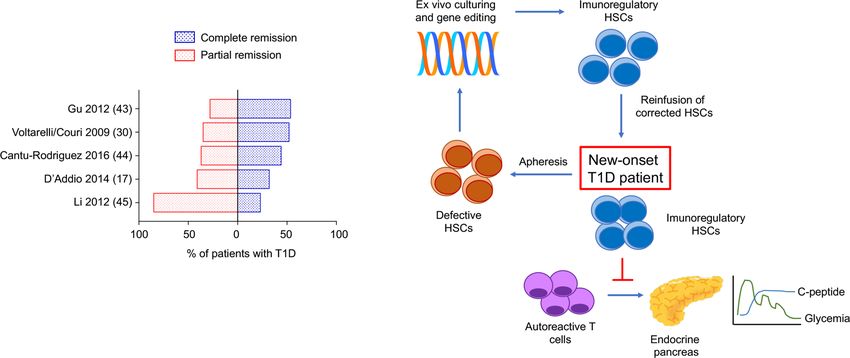
delivery in HSCs of NOD mice was able to prevent the onset of (Figure 1A and Table 1) (17, 31, 34, 35). Also, an increase in C-
T1D, mainly through the deletion of autoreactive T cells which peptide levels and C-peptide area under the curve (AUC)
did not engage in the MHC class II-mediated response (19, 20). measurement were detectable in AHSCT-treated T1D patients
While this approach was again limited by the need of immune as compared to baseline, and only minor adverse events were
ablation for the HSCs infusion, which is feasible in NOD mice registered in the mid-term (25, 36). A reduction of the T-helper-
but at high risk in humans, it paved the way for exploring genetic 1 and T-helper-17 subsets was also observed in the short-term
engineering of HSCs to better exploit their multiple properties in (37). Interestingly, a cost-effectiveness analysis conducted in
autoimmunity. Ex vivo genetic manipulation of NOD HSCs, to patients with T1D undergoing AHSCT as compared to patients
encode proinsulin and transgenically target MHC class II, with T1D remaining on insulin therapy demonstrated that
successfully prevented T1D onset (21, 22). Also, HSCs can be AHSCT provides some benefits over time depending on the
Frontiers in Immunology | www.frontiersin.org 2 July 2021 | Volume 12 | Article 694118Pastore et al. Hematopoietic Stem Cells in Autoimmune Diabetes
A B
FIGURE 1 | Complete/partial remission of type 1 diabetes obtained with AHSCT in the long-term. Proposed genetic engineered HSC-based approach to target type
1 diabetes. (A) Proportion of patients with T1D undergoing AHSCT who achieved complete remission (insulin independence) and partial remission (low dose
exogenous insulin requirement) at the latest timepoint analyzed within each clinical study registered in ClinicalTrials.gov available as publication. (B) Use of genetically
engineered HSCs to target T1D: proposed approach. T1D, type 1 diabetes; AHSCT, autologous hematopoietic stem cell transplantation.
TABLE 1 | Summary of main characteristics, clinical outcomes and results obtained in the clinical studies conducted in T1D and registered in ClinicalTrials.gov.
Clinical Study N of pts Follow-up Clinical outcomes Main results
Type of study
Autologous Hematopoietic Stem Cell Transplantation for Early 28 pts T1D 3 years EIR, HbA1c, C-peptide and Insulin independence: 53.6% Increased
Onset Type 1 Diabetes (NCT00807651) Monocentric anti-GAD level C-peptide level (30)
prospective
Safety and Efficacy Study of Autologous Stem Cell 23 pts T1D 5 years C-peptide level Morbidity/ Insulin independent: 52% Low EIR: 35%;
Transplantation for Early Onset Type I Diabetes Mellitus Monocentric mortality EIR changes HbA1c C-peptide AUC increase, HbA1cPastore et al. Hematopoietic Stem Cells in Autoimmune Diabetes
may need to be employed in association with AHSCT in patients disorders, particularly type 1 diabetes, are associated with
with a high level of autoimmune response. In summary, results of altered HSCs, which fail in exerting their immunomodulatory
the use of HSC-based approach, primarily the AHSCT, in properties. Strategies aimed at targeting this defect successfully
patients with T1D (Table 1), suggest two major observations: delayed diabetes onset in murine models. Feasibility and
(i) AHSCT treatment has to be limited to a subgroup of T1D effectiveness in of the ex vivo manipulation and genetic
patients and it requires high-level immunosuppression to engineering of HSCs are well-established in mouse models,
obtain long-term effect, and (ii) the immune profile of T1D while studies on safety for translational purposes are still
patients plays a central role in the achievement of long-term required. In view of this, the use of humanized mouse model
insulin-independence when using HSC-based strategies. may accelerate the translation from murine experiments to
Therefore, the infusion of a subset of HSCs, rather than the human studies. The outstanding results collected in the past
whole HSCs pool, such as in AHSCT, endowed with and ongoing clinical trials are encouraging in pursuing the
immunoregulatory properties may provide additional benefits research around the use of genetic engineered-HSCS in type 1
in terms of balancing autoimmunity and achieving the proper diabetes. Therefore, in our opinion, genetic modulation to reset
clinical and metabolic outcomes. HSCs physiological function, may find an interesting field of
application not only in type 1 diabetes (Figure 1B) but in other
autoimmune conditions too. Finally, in the era of the
CONCLUSIONS AND FUTURE development of biologic therapy to treat immune-mediated
DIRECTIONS diseases, we envision genetically engineered HSCs as a novel
“biologic” agent and a “natural immunosuppressant” to be
The use of HSCs has hold great promises in the treatment of
considered in the portfolio of alternative therapeutic options in
autoimmune diabetes, however, in the last decade. The results
type 1 diabetes and autoimmune diseases.
obtained in clinical trials with the use of AHSCT in T1D suggest
a potential novel approach to treat autoimmune diseases, despite
all the aforementioned limitations. The use of a selected subset of
HSCs endowed with immunoregulatory properties, without the
AUTHOR CONTRIBUTIONS
need of additional immunosuppressive agents remains IP and EA wrote the paper. AB, MB, AM, CL, VU, AS, and AA,
unexplored so far and deserves more investigation and testing collected clinical and preclinical data. GZ edited the paper. FD’A
from the scientific community. Patients with T1D who may and PF conceived the idea, wrote and edited the paper. All authors
benefit the most from this therapeutic approach need to be contributed to the article and approved the submitted version.
carefully identified, probably based on disease stages, degree of
cellular and humoral autoimmune response, presence or not of
diabetic ketoacidosis (17). The recent findings on the use FUNDING
of teplizumab in patients at risk for T1D (45) confirmed that
immune ablation aimed at preventing T1D onset is a hot topic. FD is supported by SID Lombardia Grant and by EFSD/JDRF/
HSCs, endowed with immunomodulatory properties, may offer a Lilly Programme on Type 1 Diabetes Research 2019. PF is
potent immunoregulatory effect without inducing T lymphocytes supported by the Italian Ministry of Health grant RF-2016-
depletion, which is commonly observed with teplizumab. Indeed, 02362512 and by the Linea-2 2019 funding from Università di
several studies demonstrated that in absence of “healthy” HSCs Milano. We thank the “Fondazione Romeo e Enrica Invernizzi”
central tolerance may be difficulty obtained. Autoimmune for extraordinary support.
6. van Laar JM, Farge D, Sont JK, Naraghi K, Marjanovic Z, Larghero J, et al.
REFERENCES Autologous Hematopoietic Stem Cell Transplantation vs Intravenous Pulse
1. Copelan EA. Hematopoietic Stem-Cell Transplantation. N Engl J Med (2006) Cyclophosphamide in Diffuse Cutaneous Systemic Sclerosis: A Randomized
354(17):1813–26. doi: 10.1056/NEJMra052638 Clinical Trial. JAMA (2014) 311(24):2490–8. doi: 10.1001/jama.2014.6368
2. Fiorina P, Voltarelli J, Zavazava N. Immunological Applications of Stem Cells in 7. Alexander T, Farge D, Badoglio M, Lindsay JO, Muraro PA, Snowden JA, et al.
Type 1 Diabetes. Endocr Rev (2011) 32(6):725–54. doi: 10.1210/er.2011-0008 Hematopoietic Stem Cell Therapy for Autoimmune Diseases - Clinical Experience
3. Alchi B, Jayne D, Labopin M, Demin A, Sergeevicheva V, Alexander T, et al. and Mechanisms. J Autoimmun (2018) 92:35–46. doi: 10.1016/j.jaut.2018.06.002
Autologous Haematopoietic Stem Cell Transplantation for Systemic Lupus 8. Lutter L, Spierings J, van Rhijn-Brouwer FCC, van Laar JM, van Wijk F.
Erythematosus: Data From the European Group for Blood and Marrow Resetting the T Cell Compartment in Autoimmune Diseases With
Transplantation Registry. Lupus (2013) 22:245–53. doi: 10.1177/0961203312470729 Autologous Hematopoietic Stem Cell Transplantation: An Update. Front
4. Atkins HL, Bowman M, Allan D, Anstee G, Arnold DL, Bar-Or A, et al. Immunol (2018) 9:767. doi: 10.3389/fimmu.2018.00767
Immunoablation and Autologous Haemopoietic Stem-Cell Transplantation 9. Ben Nasr M, Tezza S, D'Addio F, Mameli C, Usuelli V, Maestroni A, et al. PD-L1
for Aggressive Multiple Sclerosis: A Multicentre Single-Group Phase 2 Trial. Genetic Overexpression or Pharmacological Restoration in Hematopoietic Stem
Lancet (2016) 388(10044):576–85. doi: 10.1016/S0140-6736(16)30169-6 and Progenitor Cells Reverses Autoimmune Diabetes. Sci Transl Med (2017) 9
5. Lindsay JO, Allez M, Clark M, Labopin M, Ricart E, Rogler G, et al. Autologous (416). doi: 10.1126/scitranslmed.aam7543
Stem-Cell Transplantation in Treatment-Refractory Crohn’s Disease: An 10. de Oliveira GL, de Lima KW, Colombini AM, Pinheiro DG, Panepucci RA,
Analysis of Pooled Data From the ASTIC Trial. Lancet Gastroenterol Hepatol Palma PV, et al. Bone Marrow Mesenchymal Stromal Cells Isolated From
(2017) 2(6):399–406. doi: 10.1016/S2468-1253(17)30056-0 Multiple Sclerosis Patients Have Distinct Gene Expression Profile and
Frontiers in Immunology | www.frontiersin.org 4 July 2021 | Volume 12 | Article 694118Pastore et al. Hematopoietic Stem Cells in Autoimmune Diabetes
Decreased Suppressive Function Compared With Healthy Counterparts. Cell Functional Renewal and TCR Diversification of Regulatory T Cells. Blood
Transplant (2015) 24(2):151–65. doi: 10.3727/096368913X675142 (2016) 127(1):91–101. doi: 10.1182/blood-2015-06-649145
11. Fadini GP, Ciciliot S, Albiero M. Concise Review: Perspectives and Clinical 30. Gu W, Hu J, Wang W, Li L, Tang W, Sun S, et al. Diabetic Ketoacidosis at
Implications of Bone Marrow and Circulating Stem Cell Defects in Diabetes. Diagnosis Influences Complete Remission After Treatment With
Stem Cells (2017) 35(1):106–16. doi: 10.1002/stem.2445 Hematopoietic Stem Cell Transplantation in Adolescents With Type 1
12. Anderson MS, Bluestone JA. The NOD Mouse: A Model of Immune Diabetes. Diabetes Care (2012) 35(7):1413–9. doi: 10.2337/dc11-2161
Dysregulation. Annu Rev Immunol (2005) 23:447–85. doi: 10.1146/ 31. Couri CE, Oliveira MC, Stracieri AB, Moraes DA, Pieroni F, Barros GM, et al.
annurev.immunol.23.021704.115643 C-Peptide Levels and Insulin Independence Following Autologous
13. Delovitch TL, Singh B. The Nonobese Diabetic Mouse as a Model of Nonmyeloablative Hematopoietic Stem Cell Transplantation in Newly
Autoimmune Diabetes: Immune Dysregulation Gets the NOD. Immunity Diagnosed Type 1 Diabetes Mellitus. JAMA (2009) 301(15):1573–9. doi:
(1997) 7(6):727–38. doi: 10.1016/S1074-7613(00)80392-1 10.1001/jama.2009.470
14. Racine J, Wang M, Zhang C, Lin CL, Liu H, Todorov I, et al. Induction of 32. Cantu-Rodriguez OG, Lavalle-Gonzalez F, Herrera-Rojas MA, Jaime-Perez
Mixed Chimerism With MHC-Mismatched But Not Matched Bone Marrow JC, Hawing-Zarate JA, Gutierrez-Aguirre CH, et al. Long-Term Insulin
Transplants Results in Thymic Deletion of Host-Type Autoreactive T-Cells in Independence in Type 1 Diabetes Mellitus Using a Simplified Autologous
NOD Mice. Diabetes (2011) 60(2):555–64. doi: 10.2337/db10-0827 Stem Cell Transplant. J Clin Endocrinol Metab (2016) 101(5):2141–8. doi:
15. Zhang M, Racine JJ, Lin Q, Liu Y, Tang S, Qin Q, et al. MHC-Mismatched 10.1210/jc.2015-2776
Mixed Chimerism Restores Peripheral Tolerance of Noncross-Reactive 33. Li L, Shen S, Ouyang J, Hu Y, Hu L, Cui W, et al. Autologous Hematopoietic
Autoreactive T Cells in NOD Mice. Proc Natl Acad Sci USA (2018) 115(10): Stem Cell Transplantation Modulates Immunocompetent Cells and
E2329–37. doi: 10.1073/pnas.1720169115 Improves Beta-Cell Function in Chinese Patients With New Onset of
16. Atkinson MA, von Herrath M, Powers AC, Clare-Salzler M. Current Concepts Type 1 Diabetes. J Clin Endocrinol Metab (2012) 97(5):1729–36. doi:
on the Pathogenesis of Type 1 Diabetes–Considerations for Attempts to 10.1210/jc.2011-2188
Prevent and Reverse the Disease. Diabetes Care (2015) 38(6):979–88. doi: 34. Snarski E, Milczarczyk A, Torosian T, Paluszewska M, Urbanowska E, Krol M,
10.2337/dc15-0144 et al. Independence of Exogenous Insulin Following Immunoablation and
17. D’Addio F, Valderrama Vasquez A, Ben Nasr M, Franek E, Zhu D, Li L, et al. Stem Cell Reconstitution in Newly Diagnosed Diabetes Type I. Bone Marrow
Autologous Nonmyeloablative Hematopoietic Stem Cell Transplantation in Transplant (2011) 46(4):562–6. doi: 10.1038/bmt.2010.147
New-Onset Type 1 Diabetes: A Multicenter Analysis. Diabetes (2014) 35. Malmegrim KC, de Azevedo JT, Arruda LC, Abreu JR, Couri CE, de Oliveira
63:3041–6. doi: 10.2337/db14-0295 GL, et al. Immunological Balance Is Associated With Clinical Outcome After
18. Tian C, Bagley J, Cretin N, Seth N, Wucherpfennig KW, Iacomini J, et al. Autologous Hematopoietic Stem Cell Transplantation in Type 1 Diabetes.
Prevention of Type 1 Diabetes by Gene Therapy. J Clin Invest (2004) 114:969– Front Immunol (2017) 8:167. doi: 10.1007/s00592-015-0724-1
78. doi: 10.1172/JCI22103 36. Couri CE, de Oliveira MC, Simoes BP. Risks, Benefits, and Therapeutic
19. Bagley J, Tian C, Iacomini J. Prevention of Type 1 Diabetes in NOD Mice by Potential of Hematopoietic Stem Cell Transplantation for Autoimmune
Genetic Engineering of Hematopoietic Stem Cells. Methods Mol Biol (2008) Diabetes. Curr Diabetes Rep (2012) 12(5):604–11. doi: 10.1007/s11892-012-
433:277–85. doi: 10.1007/978-1-59745-237-3_17 0309-0
20. Tian C, Ansari MJ, Paez-Cortez J, Bagley J, Godwin J, Donnarumma M, et al. 37. Ye L, Li L, Wan B, Yang M, Hong J, Gu W, et al. Immune Response After
Induction of Robust Diabetes Resistance and Prevention of Recurrent Type 1 Autologous Hematopoietic Stem Cell Transplantation in Type 1 Diabetes
Diabetes Following Islet Transplantation by Gene Therapy. J Immunol (2007) Mellitus. Stem Cell Res Ther (2017) 8(1):90. doi: 10.1186/s13287-017-0542-1
179(10):6762–9. doi: 10.4049/jimmunol.179.10.6762 38. Snarski E, Szmurlo D, Halaburda K, Krol M, Urbanowska E, Milczarczyk A,
21. Chan J, Clements W, Field J, Nasa Z, Lock P, Yap F, et al. Transplantation of et al. An Economic Analysis of Autologous Hematopoietic Stem Cell
Bone Marrow Genetically Engineered to Express Proinsulin II Protects Transplantation (AHSCT) in the Treatment of New Onset Type 1 Diabetes.
Against Autoimmune Insulitis in NOD Mice. J Gene Med (2006) 8 Acta Diabetol (2015) 52(5):881–8. doi: 10.1007/s00592-015-0724-1
(11):1281–90. doi: 10.1002/jgm.968 39. Sun SY, Gao Y, Liu GJ, Li YK, Gao W, Ran XW, et al. Efficacy and Safety of
22. Steptoe RJ, Ritchie JM, Harrison LC. Transfer of Hematopoietic Stem Cells Stem Cell Therapy for T1DM: An Updated Systematic Review and Meta-
Encoding Autoantigen Prevents Autoimmune Diabetes. J Clin Invest (2003) Analysis. J Diabetes Res (2020) 2020:5740923. doi: 10.1155/2020/5740923
111(9):1357–63. doi: 10.1172/JCI15995 40. Gu B, Miao H, Zhang J, Hu J, Zhou W, Gu W, et al. Clinical Benefits of Autologous
23. Coleman MA, Steptoe RJ. Induction of Antigen-Specific Tolerance Through Haematopoietic Stem Cell Transplantation in Type 1 Diabetes Patients. Diabetes
Hematopoietic Stem Cell-Mediated Gene Therapy: The Future for Therapy of Metab (2018) 44(4):341–5. doi: 10.1016/j.diabet.2017.12.006
Autoimmune Disease? Autoimmun Rev (2012) 12(2):195–203. doi: 10.1016/ 41. Walicka M, Milczarczyk A, Snarski E, Jedynasty K, Halaburda K, Torosian T,
j.autrev.2011.08.012 et al. Lack of Persistent Remission Following Initial Recovery in Patients With
24. Leng Q, Nie Y, Zou Y, Chen J. Elevated CXCL12 Expression in the Bone Type 1 Diabetes Treated With Autologous Peripheral Blood Stem Cell
Marrow of NOD Mice Is Associated With Altered T Cell and Stem Cell Transplantation. Diabetes Res Clin Pract (2018) 143:357–63. doi: 10.1016/
Trafficking and Diabetes Development. BMC Immunol (2008) 9:51. doi: j.diabres.2018.07.020
10.1186/1471-2172-9-51 42. Snarski E, Milczarczyk A, Halaburda K, Torosian T, Paluszewska M,
25. Ben Nasr M, D'Addio F, Malvandi AM, Faravelli S, Castillo-Leon E, Usuelli V, Urbanowska E, et al. Immunoablation and Autologous Hematopoietic Stem
et al. Prostaglandin E2 Stimulates the Expansion of Regulatory Hematopoietic Cell Transplantation in the Treatment of New-Onset Type 1 Diabetes
Stem and Progenitor Cells in Type 1 Diabetes. Front Immunol (2018) 9:1387. Mellitus: Long-Term Observations. Bone Marrow Transplant (2016) 51
doi: 10.3389/fimmu.2018.01387 (3):398–402. doi: 10.1038/bmt.2015.294
26. Masiuk KE, Laborada J, Roncarolo MG, Hollis RP, Kohn DB. Lentiviral Gene 43. Couri CEB, Malmegrim KCR, Oliveira MC. New Horizons in the Treatment
Therapy in HSCs Restores Lineage-Specific Foxp3 Expression and Suppresses of Type 1 Diabetes: More Intense Immunosuppression and Beta Cell
Autoimmunity in a Mouse Model of IPEX Syndrome. Cell Stem Cell (2019) 24 Replacement. Front Immunol (2018) 9:1086. doi: 10.3389/fimmu.2018.01086
(2):309–17.e7. doi: 10.1016/j.stem.2018.12.003 44. van Megen KM, van ‘T Wout ET, Forman SJ, Roep BO. A Future for
27. Greiner DL, Brehm MA, Hosur V, Harlan DM, Powers AC, Shultz LD, et al. Autologous Hematopoietic Stem Cell Transplantation in Type 1 Diabetes.
Humanized Mice for the Study of Type 1 and Type 2 Diabetes. Ann N Y Acad Sci Front Immunol (2018) 9:690. doi: 10.3389/fimmu.2018.00690
(2011) 1245:55–8. doi: 10.1111/j.1749-6632.2011.06318.x 45. Herold KC, Bundy BN, Long SA, Bluestone JA, DiMeglio LA, Dufort MJ, et al.
28. Shultz LD, Brehm MA, Garcia-Martinez JV, Greiner DL. Humanized Mice for An Anti-CD3 Antibody, Teplizumab, in Relatives at Risk for Type 1 Diabetes.
Immune System Investigation: Progress, Promise and Challenges. Nat Rev N Engl J Med (2019) 381(7):603–13. doi: 10.1056/NEJMc1912500
Immunol (2012) 12(11):786–98. doi: 10.1038/nri3311
29. Delemarre EM, van den Broek T, Mijnheer G, Meerding J, Wehrens EJ, Olek Conflict of Interest: PF and MB hold a patent of modulated HSCs and founded
S, et al. Autologous Stem Cell Transplantation Aids Autoimmune Patients by Altheia Science.
Frontiers in Immunology | www.frontiersin.org 5 July 2021 | Volume 12 | Article 694118Pastore et al. Hematopoietic Stem Cells in Autoimmune Diabetes
The remaining authors declare that the research was conducted in the absence of distributed under the terms of the Creative Commons Attribution License
any commercial or financial relationships that could be construed as a potential (CC BY). The use, distribution or reproduction in other forums is permitted,
conflict of interest. provided the original author(s) and the copyright owner(s) are credited and that
the original publication in this journal is cited, in accordance with accepted
Copyright © 2021 Pastore, Assi, Ben Nasr, Bolla, Maestroni, Usuelli, Loretelli, Seelam, academic practice. No use, distribution or reproduction is permitted which does
Abdelsalam, Zuccotti, D’Addio and Fiorina. This is an open-access article not comply with these terms.
Frontiers in Immunology | www.frontiersin.org 6 July 2021 | Volume 12 | Article 694118You can also read


