Synthesis of the NarP response regulator of nitrate respiration in Escherichiacoliis regulated at multiple levels by Hfq and small RNAs
←
→
Page content transcription
If your browser does not render page correctly, please read the page content below
Published online 24 June 2022                                                        Nucleic Acids Research, 2022, Vol. 50, No. 12 6753–6768
                                                                                                           https://doi.org/10.1093/nar/gkac504

Synthesis of the NarP response regulator of nitrate
respiration in Escherichia coli is regulated at multiple
levels by Hfq and small RNAs
Anaı̈s Brosse 1 , Pierre Boudry1 , Anne Walburger                                          2
                                                                                               , Axel Magalon             2
                                                                                                                              and
Maude Guillier 1,*
1
 UMR8261, CNRS, Université de Paris Cité, Institut de Biologie Physico-Chimique, 75005 Paris, France and 2 Aix
Marseille Université, CNRS, Laboratoire de Chimie Bactérienne (UMR7283), IMM, IM2B, 13402 Marseille, France

                                                                                                                                                                  Downloaded from https://academic.oup.com/nar/article/50/12/6753/6617446 by guest on 23 August 2022
Received January 26, 2022; Revised May 25, 2022; Editorial Decision May 26, 2022; Accepted May 30, 2022

ABSTRACT                                                                            to regulate gene expression plays a key role in this
                                                                                    process. Examples of control have been reported at multiple
Two-component systems (TCS) and small RNAs                                          steps of gene expression. Transcription initiation is, for
(sRNA) are widespread regulators that participate                                   instance, commonly regulated by proteins that bind to the
in the response and the adaptation of bacteria                                      promoter regions of genes and can activate or repress their
to their environments. TCSs and sRNAs mostly                                        transcription (1). Regulators falling in this category are
act at the transcriptional and post-transcriptional                                 involved in the response to diverse input signals, often
levels, respectively, and can be found integrated                                   via a change in their activity in response to a cognate
in regulatory circuits, where TCSs control sRNAs                                    signal, by phosphorylation in the case of two-component
transcription and/or sRNAs post-transcriptionally                                   systems (TCS). TCSs are widely used in bacteria and
regulate TCSs synthesis. In response to nitrate and                                 consist of a sensor kinase that can auto-phosphorylate
nitrite, the paralogous NarQ-NarP and NarX-NarL                                     in response to specific stimuli and transfer the phosphate
                                                                                    group to a cognate response regulator (RR). In most cases,
TCSs regulate the expression of genes involved in
                                                                                    the phosphorylated form of the RR is the biologically
anaerobic respiration of these alternative electron                                 active form and regulates transcription by binding to
acceptors to oxygen. In addition to the previously                                  DNA.
reported repression of NarP synthesis by the SdsN137                                   While undoubtedly crucial for bacterial adaptation,
sRNA, we show here that RprA, another Hfq-                                          transcriptional regulation is not the only form of control.
dependent sRNA, also negatively controls narP.                                      Indeed, many bacterial genes can also be regulated at the
Interestingly, the repression of narP by RprA actually                              post-transcriptional level and, in these cases, translation is
relies on two independent mechanisms of control.                                    often the regulated step. Although translational control by
The first is via the direct pairing of the central                                  proteins was described many decades ago, the observation
region of RprA to the narP translation initiation                                   that a myriad of small RNAs (sRNAs), most of which
region and presumably occurs at the translation                                     acting as post-transcriptional regulators, exist in virtually
                                                                                    all bacteria has confirmed the importance of post-
initiation level. In contrast, the second requires
                                                                                    transcriptional control in bacterial adaptation. In the vast
only the very 5 end of the narP mRNA, which is                                     majority of cases, sRNAs act by pairing to target mRNAs
targeted, most likely indirectly, by the full-length or                             via imperfect base-pairing interactions and repress, or
the shorter, processed, form of RprA. In addition,                                  more rarely increase, their translation and/or stability
our results raise the possibility of a direct role of                               (2). Based on the examples studied so far, the most
Hfq in narP control, further illustrating the diversity                             common scenario is that sRNAs of this category pair
of post-transcriptional regulation mechanisms in the                                at or in the vicinity of the ribosome binding site of
synthesis of TCSs.                                                                  their target and repress translation initiation by directly
                                                                                    competing with binding of the 30S ribosomal subunit.
INTRODUCTION                                                                        Several other mechanisms have been described, however,
                                                                                    including translation activation or repression by sRNAs
Bacteria have the ability to sense, respond and adapt                               pairing outside of the translation initiation region (TIR),
to a wide diversity of environments and their capacity                              or the stabilization or destabilization of target mRNAs as
* To   whom correspondence should be addressed. Tel: +33 01 58 41 51 49; Fax: +33 01 58 41 50 25; Email: maude.guillier@ibpc.fr
Present address: Anaı̈s Brosse, Université Paris-Saclay, INRAE, AgroParisTech, Micalis Institute, 78350 Jouy-en-Josas, France.

C The Author(s) 2022. Published by Oxford University Press on behalf of Nucleic Acids Research.
This is an Open Access article distributed under the terms of the Creative Commons Attribution-NonCommercial License
(http://creativecommons.org/licenses/by-nc/4.0/), which permits non-commercial re-use, distribution, and reproduction in any medium, provided the original work
is properly cited. For commercial re-use, please contact journals.permissions@oup.com
6754 Nucleic Acids Research, 2022, Vol. 50, No. 12
a direct consequence of sRNAs binding (3,4). In enteric of potassium phosphate buffer (100 mM) adjusted to
bacteria such as Escherichia coli and Salmonella, for which pH 7.4, ammonium sulfate (15 mM), sodium chloride (9
many of the details of sRNAs action have been elucidated mM), magnesium sulfate (2 mM), sodium molybdate (5
so far, these imperfectly pairing sRNAs require an RNA M), Mohr’s salt (10 M), calcium chloride (100 M),
chaperone, Hfq or the more recently identified ProQ, for casaminoacids (0.5%) and thiamine (0.01%), supplemented
stability and duplex formation with their targets (5,6). with 140 mM of glycerol as sole carbon source. When
Consistent with this, Hfq is involved in the regulation needed, nitrate was added at a final concentration of 5
of a multitude of genes whose expression is under the mM. Anaerobic growth was performed in gas tight Hungate
control of sRNAs. Furthermore, Hfq has also been shown tubes under Argon atmosphere. When necessary, antibiotics
to be involved in the direct control of gene expression, were used at the following concentrations: 100 or 150
independently of sRNAs (7,8). g/ml ampicillin (Amp100 or Amp150 in figure legends),
Interestingly, transcriptional and post-transcriptional 10g/ml tetracycline, 25 or 50 g/ml kanamycin and
controls do not form completely independent regulatory 10g/ml chloramphenicol. 100 M of IPTG was also
Downloaded from https://academic.oup.com/nar/article/50/12/6753/6617446 by guest on 23 August 2022
networks in bacterial cells but rather result in mixed added when required to induce expression of sRNAs from
regulatory circuits relying on both proteins and pBRplac derivatives. Amplification of DNA fragments
sRNAs acting mostly at the transcriptional and post- was performed with either Phusion DNA polymerase or
transcriptional level, respectively (9,10). Transcription LongAmp DNA polymerase (NEB).
of sRNAs is most often controlled by transcriptional Except for cloning, strains are all derivatives of E. coli
regulators, while sRNAs in turn post-transcriptionally MG1655, modified by recombineering or P1 transduction
regulate the synthesis of transcriptional regulators. One when needed. Mutant rprA::tet (from strain NM667,
example is the stress response alternative sigma factor from N. Majdalani, unpublished; the tet resistance gene
RpoS, which directs transcription of SdsR and SdsN replaces rprA sequence from –10 to + 75 relative to
sRNAs in enterobacteria (11,12), while RpoS synthesis the TSS, hence the RprA terminator is still present)
is directly up-regulated by at least three sRNAs, namely and sdsN::kan (strain GS0762 (12)) were obtained from
DsrA, RprA and ArcZ (13–16). This control of, and by, S. Gottesman’s and G. Storz’s laboratories, respectively,
sRNAs is also true for regulators of TCSs, including OmpR while the ΔnarP::kan allele was taken from the Keio
and PhoP, two of the most studied RRs in enterobacteria, collection (strain JW2181, (30)). For the construction
as well as the LuxO RR involved in quorum-sensing in of strains carrying hfq point mutants, a Δhfq::cat-sacB
Vibrio species (17–23). purA::kan mutant (strain DJS2604, from D. Schu) was
NarP is another example of a RR whose synthesis is first transduced into the recipient strain, and the different
under sRNA control. Together with its paralog NarX- hfq alleles (from strains DJS2927 (wt), DJS2609 (Δhfq),
NarL, the NarQ-NarP TCS regulates the expression of KK2561 (R16A), KK2562 (Y25D) or KK2560 (Q8A),
genes involved in the anaerobic respiration on nitrate, from D. Schu carrying alleles from (31,32)) were then moved
the energetically most favourable electron acceptor in the into the resulting strain, allowing selection on glucose
absence of oxygen, and on nitrite, the reduction product of minimal medium; mutant alleles were then checked by
nitrate (24). The translation of narP mRNA is repressed in sequencing. The various fusions with the lacZ reporter
E. coli by SdsN137 , one isoform of a set of RpoS-dependent gene were made as follows: a PCR fragment encompassing
sRNAs (12). In addition to this control, we report here that the sequence to be placed upstream of lacZ, flanked by
expression of narP is also regulated by Hfq and the RprA homology regions, was recombined into the strain MG1508
sRNA, whose synthesis is primarily controlled by the Rcs (or MG2114 for construction of the PnapF -lacZ fusion),
phosphorelay, but also responds to the CpxAR TCS and carrying the genes for recombineering on a mini-lambda
the LrhA regulator of flagellar synthesis (15,25,26). RprA and where a Ptet -cat-sacB cassette has been introduced
regulates expression of multiple genes involved in diverse upstream of lacZ. Recombinant cells were selected on
stress responses, biofilm formation, formate metabolism, sucrose-containing medium, checked for chloramphenicol
conjugation as well as the gene encoding LrhA, one of sensitivity and the fusion was sequenced. For fusions whose
its transcriptional regulators (14,27–29). By adding narP transcription originates from PnarP or PnapF , an rrnBt2
to the list of RprA and Hfq targets, our results expand transcription terminator was introduced upstream, either
the connections between sRNAs and TCSs, two classes on the PCR fragment (PnarP ), or by recombineering into
of widespread bacterial regulators, and highlights the high MG2114 strain carrying an rrnBt2-cat-sacB-lacZ construct
level of integration of the diverse pathways that regulate (for PnapF promoter fusion). Fusions PnarP-207+50 -lacZ and
gene expression. In addition, they demonstrate a dual level Ptet+1+50narP -lacZ have a mutation in the second codon
of control by a single sRNA, acting both canonically at the of lacZ (ACC is changed to AAC) which prevents the
TIR of narP and, via a distinct sRNA site, and most likely formation of an inhibitory structure for translation.
indirectly, at the distant 5 end of the same mRNA. For the insertion of a 3x-Flag (sequence
DYKDHDGDYKDHDIDYKDDDDK) just upstream
MATERIALS AND METHODS of the narP stop codon, a PCR fragment carrying the
3x-Flag sequence preceded by a linker (protein sequence
Strains, plasmids and general microbiology techniques
GAGAGAGA) and followed by a kanamycin resistance
All strains and plasmids used in this study are listed in gene flanked by FRT sites was amplified from plasmid
Supplementary Table S1. Cells were grown at 37◦ C, either pSUB11 (33) with homology regions to the end of narP.
in LB medium or in a defined medium (MMGly) composed This fragment was then recombined into strain MG1433Nucleic Acids Research, 2022, Vol. 50, No. 12 6755
and checked by sequencing after selection and purification containing gels was performed as described previously in
on LB-Kan. A control adding only the linker sequence was (17). Briefly, cells were diluted 250-fold from an overnight
constructed as well. This narP-3xFlag -FRT-KanR-FRT culture into fresh medium, grown to mid-exponential
allele was then transduced into recipient strains as needed. phase and cooled down in ice. After centrifugation of 5
The plasmids used to overexpress the different Hfq- ml of culture, the pellet was resuspended in Bugbuster
dependent sRNAs are mostly from (Mandin & Gottesman, reagent (Novagen) at a concentration equivalent to 40
16), with the addition of pCsrB (from N. de Lay, OD600 /ml. 1/4 volume of 5× SDS loading buffer (250
unpublished), pMcaS, pMicL and pSdsN137 (from G. mM Tris–HCl pH 6.8, 8% SDS, 25% glycerol, 572 mM
Storz, (12,34,35)) and pCpxQ, pDapZ and pNarS (this -mercaptoethanol, 0.10% bromophenol blue) was then
study, based on (36–38); see Supplementary Figure S1 for added and supernatant was collected after centrifugation.
Northern-blot validation of their overexpression). Mutant 20 l of this clarified lysate were loaded on 12.5% precast
plasmid pSdsN137 -1 (12) was obtained from G. Storz and gels containing 50 M PhosTag (Wako), and proteins were
pRprAmut2 was constructed by amplification of the pRprA separated during a 7-h electrophoresis at 80V in migration
Downloaded from https://academic.oup.com/nar/article/50/12/6753/6617446 by guest on 23 August 2022
plasmid with mutagenic primers using the Pfu enzyme buffer (25 mM Tris, 192 mM glycine, and 0.1% SDS).
(Agilent), followed by DpnI digestion and transformation After migration, the gel was equilibrated twice in transfer
into the cloning strain NEB5-alpha F’Iq . Supplementary buffer (50 mM Tris, 40 mM glycine, 0.037% SDS and 20%
Table S2 summarizes the main oligonucleotides used in this ethanol) supplemented with 10 mM EDTA, and then rinsed
study to construct strains or plasmids. in transfer buffer without EDTA. Proteins were transferred
overnight onto an Hybond-C super membrane; a 1/1000
dilution of a monoclonal anti-Flag antibody conjugated
Measure of -galactosidase activity
to alkaline phosphatase (Sigma) was used for detection of
Cells were diluted at least 250-fold into fresh medium flagged proteins following manufacturer’s instructions and
from an overnight culture, grown to mid-exponential CDP-star reagent as a substrate for chemiluminescence.
phase and -galactosidase activity was measured following For standard western blots, bacterial cells were pelleted
Miller’s protocol (39). When indicated, polymyxin B and resuspended in SDS-loading buffer containing DTT
nonapeptide (PMBN, Sigma #P2076) was added to a final (Biolabs) and the equivalent of 0.15 OD600 was loaded
concentration of 20 g/ml when cells were diluted in fresh on precast TGX gels (Biorad), prior to transfer to
medium. Cells were lysed either with toluene (for aerobic nitrocellulose membrane as above.
extracts) or SDS-chloroform (anaerobic extracts). Results
presented here correspond to the average of at least two RESULTS
independent experiments and error bars correspond to the
Hfq controls the expression of several Escherichia coli
standard deviation. Statistical significance of the results
response regulators
was systematically assessed with a bilateral heteroscedastic
student t-test. As mentioned above, several examples of genes
encoding regulators of TCSs whose expression is post-
transcriptionally regulated by Hfq-dependent sRNAs
RNA extraction and northern-blot analysis
have been reported. TCSs are widespread in bacteria and
The RNAs were extracted with hot phenol as previously >30 RR genes exist in the model bacterium E. coli for
described (19) from the same cultures as those used for instance. This raises the possibility that other RRs could
-galactosidase assays. A constant amount of total RNA be subject to sRNA control. We have started to address
(between 3.5 and 14 g) was loaded on 8% urea acrylamide this question by using lacZ reporter fusions to follow the
gel in 1× TBE and transferred to a nitrocellulose production of 11 E. coli regulators of TCSs (listed in Table
membrane (GE Healthcare). For detection, we used specific 1). RRs such as OmpR, PhoP or NarP, whose control by
5’-end biotinylated probes (see Supplementary Table S2 sRNAs has been previously described, have been included
for sequence), hybridized to the membrane overnight in in this set. It is worth noting that, in agreement with their
Ultrahyb buffer (Ambion). After two washes in SSC control by sRNAs, their mRNAs were found deregulated
2×–SDS 0.1% and two washes in SSC 0.1×–SDS 0.1% in an hfq null strain and/or enriched following Hfq co-
at 42◦ C, the membrane was incubated in nucleic acid immunoprecipitation (32,40,41). Other RRs included in
detection blocking reagent (ThermoScientific), and then this study were BaeR, EvgA, KdpE, RstA, UvrY and
in the same solution in presence of a streptavidin-alkaline HprR, whose mRNAs were suggested to interact with
phosphatase conjugate (Life Technologies). Membrane Hfq and/or sRNAs in several high-throughput studies
was then washed three times in wash buffer (Na2 HPO4 ((32,40–43), Table 1 for details), but for which no control
29 mM, NaH2 PO4 8.5 mM, NaCl 34 mM and SDS 0.05%), by sRNAs has been confirmed so far. At last, we also
equilibrated in assay buffer (NaCl 0.1 M, Tris 0.1M pH 9.5) included two RRs for which no strong indication for sRNA
and chemiluminescence was detected using the CDP-star control has been reported to our knowledge: BasR and
substrate (Applied Biosystems). PhoB.
Translational fusions of lacZ to these 11 regulators were
constructed at the lacZ locus by recombineering (Figure
Phos-tag electrophoresis and Western-blot
1A). All fusions followed the same general organization.
The whole procedure for protein extraction, gel First, their transcription was systematically driven by a
electrophoresis and western-blot detection from Phos-tag constitutively expressed Ptet promoter to exclude regulation6756 Nucleic Acids Research, 2022, Vol. 50, No. 12
Table 1. TCS investigated in this study
Indication for sRNA regulationd
Number of genes Portion of the RR gene
whose expression is present on the fusion
Two-component system up/down in the TCS (relative to start
(kinase-regulator)a mutant (based on (73)) Deregulation in hfq Interaction with Hfq codon)e
BaeS-BaeRb (response to 14/8 ++ (40); + for 3 UTR (41) –30 + 720
membrane stress)
BasS-BasR (response to iron) 20/12 –18 + 666
EvgS-EvgA (antibiotic 2/3 Slight enrichment upon Hfq –125 + 612
resistance and acid stress) IP, and presence in chimeric
fragments with sRNAs
Downloaded from https://academic.oup.com/nar/article/50/12/6753/6617446 by guest on 23 August 2022
(42,43)
KdpD-KdpEb (potassium 10/10 ++ (40); ++ in proQ (43) –39 + 675
transport)
NarQ-NarPc (nitrate NarQ 20/25 NarP 3/9 +++ (40) +++ (32,40); + (41); presence –150 + 645
metabolism) in chimeric fragments with
sRNAs (90)
PhoR-PhoB (phosphate 1/8 –41 + 687
metabolism)
RstB-RstA (acid stress 12/22 Presence in chimeric –13 + 726
response) fragments with sRNAs (43)
BarA-UvrY (global BarA 2/24 UvrY 86/37 +++(40); Slight enrichment –44 + 654
metabolism) upon Hfq IP, and presence in
chimeric fragments with
sRNAs (43)
HprS-HprR (response to 6/7 ++ in only one out of two +1 + 669
oxidative stress) experiments (32)
EnvZ-OmpR (response to 71/54 + (32); presence in chimeric –35 + 30
osmotic stress and acid fragments with sRNAs in one
stress) out of two experiments (90)
PhoQ-PhoP (response to 4/27 ++(40,44) +++(32,40); + (41); Slight –36 + 30
magnesium) enrichment upon Hfq IP, and
presence in chimeric
fragments with sRNAs
(42,43,90)
a Unless otherwise indicated, TCSs are expressed from a bicistronic operon with the gene for the response regulator being the first cistron.
b In the BaeS-BaeR and KdpD-KdpE systems the kinase is the first gene in the operon
c The two genes of the NarQ-NarP TCS are encoded by different loci of the genome.
d Weak, moderate or strong indications for sRNA regulation in different studies are indicated by +, ++ or +++, respectively.
e Positions of the transcription start sites (TSS) were chosen
based on (46); even though baeR and kdpE are not the first gene of their operon, they were
introduced downstream of the Ptet promoter in the absence of the baeS or kdpD gene, respectively. Note that the start codon is GUG for kdpE and rstA,
and UUG for uvrY.
at the promoter level. Second, the sequence of each RR are Hfq-independent, or because the fusion is not a good
gene covering the 5 UTR and all of the coding region reporter in these cases.
with the exception of the stop codon was placed in frame Consistent with previous data (44), expression of the
upstream of lacZ starting at the 10th aminoacid (aa) phoP fusion was up-regulated almost 2-fold in the hfq
of -galactosidase; for ompR and phoP however, only mutant, even if it is unclear at this stage whether this
the 10 first aa of the coding sequence were included in is due to sRNA control or not. In contrast, expression
the fusions as this was previously shown to be sufficient of ompR, also subject to negative regulation by sRNAs,
to allow regulation by sRNAs (13,14). Expression of namely OmrA and OmrB (14), was down-regulated 1.5-fold
these different fusions was then measured in an hfq+ or in the absence of Hfq, possibly indicating the existence of
hfq– background, with the idea that a Hfq effect could sRNAs that can activate ompR expression. Expression of
indicate potential regulation by sRNAs (Figure 1B). Note baeR, basR, evgA, kdpE, rstA and uvrY fusions was not
however that genes whose expression is not affected by significantly changed, while that of phoB and hprR was
Hfq in this experiment could nonetheless be regulated by slightly repressed, by respectively 1.6- and 1.4-fold. The
sRNAs because, for instance, these sRNAs are expressed in strongest Hfq effect was observed on the narP fusion, since
different experimental conditions than those used here or its activity was increased by almost 3-fold in the hfq deletionNucleic Acids Research, 2022, Vol. 50, No. 12 6757
Downloaded from https://academic.oup.com/nar/article/50/12/6753/6617446 by guest on 23 August 2022
Figure 1. Hfq modulates the expression of several RR genes. (A) Scheme of the different translational fusions used to follow RR expression. All fusions
are expressed from a Ptet promoter; phoP and ompR coding regions present on the fusions are limited to the 10 first aminoacids, while the entire coding
regions of the RR genes, except the stop codon, are present in all other fusions. (B) The -galactosidase activities of each fusion were measured in an
hfq+ of hfq– background in exponential phase in LB medium. wt and hfq null strains used here were, respectively, AB1000 and AB1009 (baeR); AB1001
and AB1010 (basR); AB1002 and AB1011 (evgA); AB1003 and AB1012 (kdpE); AB1004 and AB1013 (narP); AB1005 and AB1014 (phoB); AB1006 and
AB1015 (rstA); AB1007 and AB1016 (uvrY); AB1008 and AB1017 (hprR); MG1511 and MG1515 (phoP) and AB1148 and AB1149 (ompR). Data shown
correspond to the average of three independent experiments, with error bars indicating the standard deviations. For each fusion, the numbers above the
bars give the activation-fold upon hfq deletion, i.e. the ratio of the activity in Δhfq and the activity in wt cells, when considered statistically significant using
a bilateral heteroscedastic Student’s t-test; ***: P-value < 5 × 10⁻⁴ , **: P-value < 0.005, *: P-value < 0.05.
strain. Interestingly, the expression of the narP RR gene was (46). Four sRNAs had an effect >2-fold: one positively
previously shown to be repressed at the post-transcriptional (ChiX) and three negatively (DicF, RprA and SdsN137 ).
level by SdsN137 , one isoform of a set of Hfq-dependent Based on previous studies, the effect of ChiX is most
sRNAs involved in nitrogen metabolism (12). However, probably due to a titration of Hfq (47,48). For the repressing
SdsN sRNAs accumulate mostly in stationary phase as sRNAs, the effect of SdsN137 was expected and is in full
their transcription is dependent on the RpoS sigma factor agreement with the above-mentioned results (12). DicF
and thus, the level of SdsN137 is not expected to be overproduction led to a strong growth defect consistent
at its maximum under the conditions used here. This with this sRNA inhibiting cell division (49,50), which may
makes it unlikely that the observed Hfq effect on narP perturb the measurement of cell density used in the Miller
is completely explained by the loss of regulation by assay of Figure 2A. Thus, this potentially interesting result
SdsN137 in the hfq mutant (see also below), and suggests needs to be confirmed by a different approach and the
that other Hfq-dependent sRNAs might regulate narP possible repression of narP by DicF was not investigated
expression. further in this study. The third repressing sRNA was
RprA, whose transcription is under strong control by
the Rcs phosphorelay (15), and for which several targets
narP expression is modulated by several sRNAs have been identified in enterobacteria such as E. coli or
To identify other putative sRNAs that might regulate narP, Salmonella. RprA is known to activate the synthesis of
we made use of a plasmid library allowing overexpression the alternative sigma factor S and of the RicI protein
of most Hfq-dependent sRNAs known to date. This that inhibits conjugation (14,28). Several negative targets
library was initially created by Mandin & Gottesman (16), of RprA have also been previously described: this sRNA
and was completed for the present study with plasmids represses expression of the csgD and ydaM (dgcM) genes
overexpressing McaS (34), MicL (35), SdsN137 (12), CpxQ involved in biofilm formation (27) and of hdeD, encoding
(36), DapZ (37) or NarS (38), as well as the non Hfq- an acid resistance protein (29). Interestingly, expression
binding CsrB (45) sRNAs. The activity of the Ptet -narP- of other genes was found to be modulated in response
lacZ fusion was thus measured in presence of all plasmids to RprA pulse-overexpression in Salmonella (28). This
of the library (Figure 2A). The narP fusion is the same includes narP, which was repressed, in agreement with the
as that used in Table 1; it carries a 150 nt-long 5 UTR results reported here in E. coli.
that corresponds to transcription initiating from the most Because RprA up-regulates RpoS synthesis, one might
distal transcription start site (TSS) based on transcriptomic hypothesize that the pRprA plasmid used in Figure 2A
data after enrichment of 5 -triphosphate containing RNAs could promote SdsN137 synthesis by increasing S levels,6758 Nucleic Acids Research, 2022, Vol. 50, No. 12
Downloaded from https://academic.oup.com/nar/article/50/12/6753/6617446 by guest on 23 August 2022
Figure 2. Hfq-dependent sRNAs modulate the expression of narP, most likely at the post-transcriptional level. (A) The -galactosidase activity of the Ptet -
narP-lacZ fusion (strain AB1004) was measured in LB-Amp150 -IPTG in the presence of plasmids overexpressing 33 E. coli sRNAs reported to date. The
activity of the fusion in presence of the vector control pBRplac (white bar) was arbitrarily set at 100% and corresponds to an average value of 889 Miller
units (with a standard deviation of 110). Data shown are the average of two independent experiments. When found statistically significant using a bilateral
heteroscedastic student t-test (***: P-value < 5 × 10⁻⁴ , **: P-value < 0.005, *: P-value < 0.05), the repression factors associated to the overproduced
sRNAs compared to the pBRplac vector control are indicated above the corresponding bars. Grey bars indicate the sRNAs whose overproduction leads
to a fold-change >2 in the activity of the Ptet -narP-lacZ fusion. (B) The -galactosidase activity of the same Ptet -narP-lacZ fusion in a ΔrprA ΔsdsN
background (strain AB1029) was measured in the presence of plasmids overproducing RprA or SdsN137 in LB-Amp100 -IPTG. Data shown are the average
of three independent experiments and statistical analysis is as in panel (A).
and thereby repress expression of the narP-lacZ fusion. The predicted RprA-narP mRNA interaction (Figure
However, the pRprA plasmid still regulated the narP fusion 3A) was experimentally tested by introducing mutations in
to a similar extent in a strain deleted for the chromosomal RprA and/or in the previously described narP-lacZ fusion.
copy of sdsN and rprA (3.2-fold versus 2.9-fold repression Four possible base-pairs adjacent or inherent to the Shine-
in the rprA+ sdsN+ background, Figure 2B), indicating that Dalgarno (SD) sequence were disrupted by mutating either
its effect is independent of SdsN. We next investigated RprA nts 45–48 of RprA from UGAG to ACUC (RprAmut2)
control of narP in more detail. or nts 137 to 140 of narP-lacZ from CUCA to GAGU
(narPmut2). RprAmut2 only very weakly repressed narP-
lacZ activity (1.3-fold), even though the sRNA accumulates
RprA directly targets the narP mRNA to a level similar to that of the wt (Figure 3B) and,
similarly, the mut2 change in narP-lacZ strongly reduced
Hfq-dependent sRNAs typically regulate gene expression control by RprA. Although the activity of the mutant fusion
by pairing to their targets, and we therefore looked for was strongly decreased, presumably because the mutation
possible interactions between RprA and the narP mRNA reduces the strength of the SD sequence, restoring the
using IntaRNA (51). The result is shown in Figure 3A: pairing by combining these compensatory changes partially
nucleotides (nts) 31–69 of RprA can potentially imperfectly restored control (2.7-fold repression), demonstrating that
base-pair to the TIR of narP messenger, from nts 116 to RprA sRNA directly pairs to narP mRNA in vivo.
154 relative to the narP TSS (i.e. nts –35 to +4 relative Since the validated interaction includes the SD sequence,
to narP start codon). Of note, affinity purification and RprA most likely inhibits narP translation initiation
sequencing of RNAs associated with a tagged version of by preventing 30S ribosomal subunit binding to this
RprA identified narP mRNA as a potential direct target, mRNA.
although not among the best candidates (29).Nucleic Acids Research, 2022, Vol. 50, No. 12 6759
A
B
Downloaded from https://academic.oup.com/nar/article/50/12/6753/6617446 by guest on 23 August 2022
Figure 3. RprA directly pairs to the translation initiation region of narP mRNA. (A) Predicted base-pairing interaction between RprA and narP mRNA.
The Shine-Dalgarno sequence and start codon of narP are indicated in red, and the compensatory mut2 changes in RprA or narP-lacZ fusion are shown
in blue. (B) The -galactosidase activity of the Ptet -narP-lacZ translational fusion, wt or carrying the mut2 change, was measured upon overproduction of
RprA, RprAmut2 or RprA processed (RprAproc) in LB-Amp150 -IPTG. Data shown are the average of three independent experiments. When statistically
significant with a bilateral heteroscedastic Student’s t-test (***P-value < 5 × 10⁻⁴ , **P-value < 0.005, *P-value < 0.05), the repression factors associated
with the overproduced sRNAs are indicated above the corresponding bars. Strains used in this experiment are AB1018 (wt fusion) and PB65 (mut2) and
are deleted for the chromosomal rprA copy. In parallel, RNA was extracted from the same cultures and Northern-blot analysis was performed to assess
the overproduction of RprA and its derivatives. SsrA was probed from the same membrane and used as a loading control.
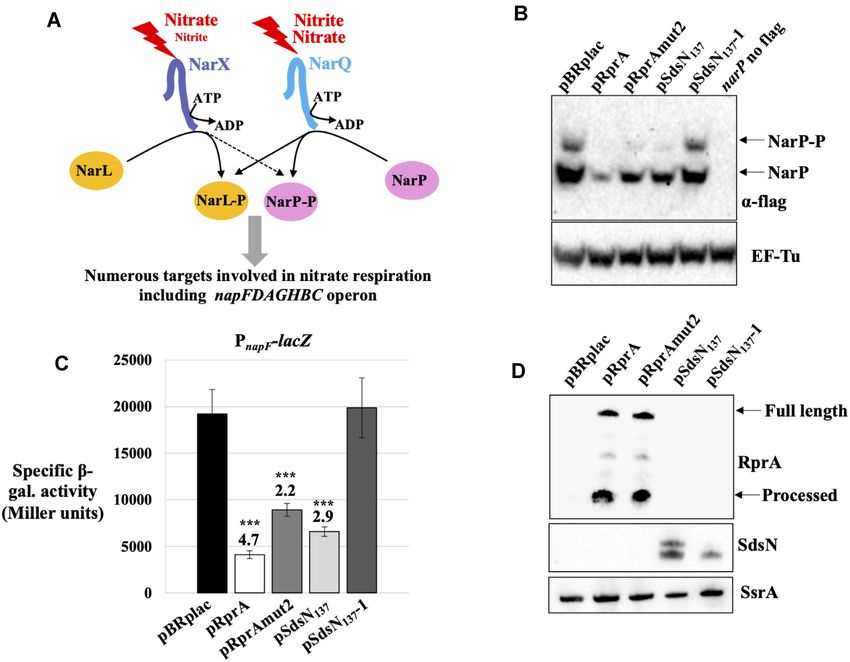
Overexpression of RprA or SdsN137 decreases NarP protein napF expression was thus followed by using a
levels transcriptional fusion between the napF promoter (from nts
–85 to +19 relative to the TSS from the proximal promoter)
In most cases, the active form of RRs is the phosphorylated
and lacZ sequence starting 17 nts before the translation
form. However, changing the total levels of a RR does
initiation codon. In a preliminary experiment, the activity
not necessarily lead to changes in the levels of its
of this fusion was measured in cells grown under anaerobic
phosphorylated form. For instance, for OmpR RR, it was
conditions at different nitrate concentrations and was
shown that modulating the synthesis of the protein, either
found to peak at around 5 mM nitrate (data not shown),
with an inducible heterogenous promoter or with sRNA
in agreement with its control by NarL and NarP. The
control, affected OmpR levels, without affecting that of
same minimal medium with glycerol as the sole carbon
phosphorylated OmpR (17,52). We thus wondered whether
source and supplemented with 5 mM nitrate (hereafter
controlling narP synthesis by RprA and SdsN137 sRNAs
MMGly+Ni) was thus used in the next experiments. As
would affect the levels of the phosphorylated form of the
expected, expression of the PnapF -lacZ fusion was strongly
NarP RR (NarP-P). For this purpose, a tagged version of
decreased in the narP deleted strain (Supplementary Figure
the NarP protein was constructed, where a 3xFlag sequence
S2A). Furthermore, expression was partially restored in
was added at its C-terminus after a short linker. This
presence of the NarP-3xFLAG protein, showing that this
construction replaces the narP chromosomal copy. The
tagged version of NarP retains biological activity, albeit at
biological activity of this tagged version of NarP was then
a reduced level compared to the wt protein (Supplementary
assessed by measuring its ability to activate transcription
Figure S2A).
from the napF promoter (Figure 4A).
The levels of NarP and NarP-P were then followed
The E. coli napFDAGHBC operon encodes the
by western-blot using antibodies directed against the
periplasmic nitrate reductase (and its accessory proteins)
FLAG sequence upon overexpression of RprA and SdsN137
required for nitrate respiration in the presence of low
sRNAs, either wt or variants that are defective in narP
concentration of this substrate (53). Expression of the napF
control. The western-blots were performed by separating
operon is induced by FNR and NarP-P, and repressed by
total proteins on a polyacrylamide gel containing Phos-
NarL, as binding of NarL-P, the phosphorylated form of
Tag to allow the separation of NarP-P from the non-
NarL to the napF promoter prevents binding of NarP-P.
phosphorylated form of NarP and directly assess the effect
Because NarP and NarL are preferentially phosphorylated
of the sRNAs on the two forms of the protein. As shown
under low and high nitrate concentration, respectively,
in Figure 4B, overexpression of wt RprA and SdsN137
napF expression is expected to be higher under low nitrate
significantly decreased the level of both forms of the NarP
conditions (54–56).6760 Nucleic Acids Research, 2022, Vol. 50, No. 12
Downloaded from https://academic.oup.com/nar/article/50/12/6753/6617446 by guest on 23 August 2022
Figure 4. RprA and SdsN137 decrease the levels of both the phosphorylated and the non-phosphorylated forms of NarP and indirectly affect transcription
of a NarP target. (A) Schematic of the regulatory network involving the two-component system NarQ-NarP. See text for details. (B) Levels of the
non-phosphorylated and phosphorylated forms of the NarP-3xFlag protein were followed by western-blot following protein separation on a Phos-Tag
containing polyacrylamide gel. Protein samples were taken from cells grown in MMGly+Ni, supplemented with Amp100 and IPTG, under anaerobic
condition. Strains used for this experiment are AB1082, transformed with the indicated plasmids, or AB1083, transformed with the vector control, to ensure
specificity of the Flag signal (see no Flag lane). EF-Tu levels were determined from the same membrane and used as a loading control. An independent repeat
of the same experiment is shown in Supplementary Figure S2C. (C) -galactosidase activity of the PnapF -lacZ transcriptional fusion (in strain AB1042)
was measured in the presence of plasmids overexpressing RprA and SdsN137 , wt or mutated in the pairing site with narP translation initiation region.
Cells were grown in MMGly+Ni, supplemented with Amp100 and IPTG, under anaerobic condition. Data shown are the average from three independent
experiments and, when statistically significant with a bilateral heteroscedastic Student’s t-test (***P-value < 5 × 10⁻⁴ , **P-value < 0.005, *P-value < 0.05),
repression factors compared to the vector control are indicated above the bars. (D) RNA samples were extracted from the same cultures than used in panel
(C) and the levels of RprA and SdsN sRNAs were analyzed by northern-blot, with detection of SsrA used as a loading control.
protein. Furthermore, this effect was abolished when we Downstream effects of RprA and SdsN137 on NarP targets
tested the SdsN137 -1 mutant for which pairing to narP
Previous work has shown that regulating the synthesis of
is eliminated (12), indicating that these changes are due
TCSs may have unexpected outcomes on the expression
to post-transcriptional control of narP by this sRNA.
of their targets (52). For instance, only one of the
Strikingly however, RprAmut2, i.e. the RprA variant
two sRNAs that repressed PhoP synthesis also repressed
that no longer controls expression of the Ptet -narP-lacZ
expression of PhoP-activated genes, while control of ompR
fusion (Figure 3B), was still very efficient at decreasing
by sRNAs affected only targets that were sensitive to
NarP and NarP-P levels (Figure 4B and Supplementary
the non-phosphorylated form of OmpR (17,18). It was
Figure S2, panels C and D). This surprising effect of
thus of interest to determine how RprA and SdsN137
RprAmut2 is further discussed below (see Figure 5).
control affected NarP-targets. For this purpose, we used the
Changes in total NarP protein levels were also assessed
previously described PnapF -lacZ transcriptional fusion and
in the same experiment by Western-Blot from a classical
measured its activity upon overproduction of wt or mutant
polyacrylamide gel where NarP and NarP-P are not
RprA and SdsN137 (Figure 4, panels C and D). Consistent
separated; the results are in complete agreement with the
with the observed reduction in NarP-P levels, RprA and
Phos-Tag data and confirm the reduction in NarP levels
SdsN137 decreased expression of the PnapF fusion by 4.7- and
in presence of pRprA, pRprAmut2, pSdsN137 , but not
2.9-fold, respectively. In contrast, SdsN137 -1 had no effect,
pSdsN137 -1 (Supplementary Figure S2B).
which was expected since this mutant no longer controls
Overall, narP repression by RprA or SdsN137 results in a
narP. The RprAmut2 variant still decreased expression of
clear decrease of both NarP and NarP-P levels.Nucleic Acids Research, 2022, Vol. 50, No. 12 6761
A
Downloaded from https://academic.oup.com/nar/article/50/12/6753/6617446 by guest on 23 August 2022
B C
Figure 5. A second control of narP by RprA relies on the 5 end of narP mRNA and the 3 end of RprA. (A) Schematic of the different RprA versions
and the three narP-lacZ fusions used in the next panels. The indicated RprA structure is based on (28); RprA processed is shown in red. The levels of the
different RprA variants were analyzed by northern-blot after RNA was extracted from AB1184 strain transformed by the indicated plasmids and grown in
LB-Amp100 -IPTG, using the same cultures than those used for the -galactosidase assays of the right panel of Figure 5C. The detection of the ArcZ sRNA
was used as a loading control. (B, C) The -galactosidase activity of the narP-lacZ fusions was measured upon overproduction of wt RprA or of several
RprA variants, in MMGly-Amp100 -IPTG medium (MMGly) or in LB-Amp100 -IPTG (LB). In panel B, cells were grown anaerobically in the presence of
nitrate. Strains used in this experiment were AB1092 (PnarP -narP-lacZ fusion), AB1159 (PnarP-207+50 -lacZ) and AB1184 (Ptet+1+50narP -lacZ). Data shown
are the average of two independent experiments (panel B) or three independent experiments (panel C). Repression fold by the different plasmids compared
to the vector control are given by the numbers above the bars after the statistical significance was assessed using a bilateral heteroscedastic student t-test
(***: P-value < 5 × 10⁻⁴ ).
the PnapF fusion by 2.2-fold, which is fully consistent with its with two observations made with the processed form of
intermediary effect on the NarP protein levels (Figure 4C). RprA (RprAproc), corresponding to the last 47 nts of
In other words, controlling NarP synthesis with RprA and the sRNA and co-existing in vivo with the full-length
SdsN137 sRNAs can impact NarP-targets, as shown here for primary transcript (57,28). First, even though RprAproc
napF. However, whether this is systematically true for other is mostly devoid of the region interacting with narP TIR
NarP targets remains to be determined. (Figure 5A), it still repressed expression of narP-lacZ
fusion (Figure 3B). Second, as full-length RprA, RprAproc
was found to repress narP in a transcriptomic study
A second, independent, regulation of narP by RprA
performed in Salmonella (28). These data are consistent
The previous results clearly established the direct pairing with RprA affecting narP not only via the canonical pairing
between RprA and the narP TIR (Figure 3). However, shown in Figure 3A, but also via another mechanism
mutating RprA in this pairing region (RprAmut2) strongly involving a different region of RprA that is present in
impaired control of a Ptet -narP-lacZ fusion (Figure RprAproc.
3B) but still allowed control of narP expression when To get further insight into this additional control, we used
looking at NarP protein levels and napF transcription several narP-lacZ fusions that differed in their promoter
(Figure 4B and C). This could be explained if the or in the transcribed region of narP that they carry
mut2 change does not completely prevent the RprA (Figure 5A); their control by RprA or RprAmut2 was
interaction with narP TIR under some conditions, but measured in anaerobic conditions in the presence of nitrate
we also considered the possibility that another regulation (MMGly+Ni-O2 , i.e. the same experimental conditions
of narP by RprA may explain the residual control by used in Figure 4) or in aerobic growth in LB or in MMGly.
RprAmut2. This hypothesis was furthermore in agreement In all tested media, RprAmut2 significantly repressed the6762 Nucleic Acids Research, 2022, Vol. 50, No. 12
expression of all tested fusions (Figure 5, panels B and B nonapeptide (PMBN), a known inducer of the Rcs
C). This repression was even similar to that obtained phosphorelay that efficiently promotes RprA synthesis (58).
with wt RprA for fusions that lack the RprA pairing site In control conditions, i.e. without PMBN, RprA is poorly
identified in Figure 3. Importantly, fusions carrying only expressed and its deletion has no significant effect on the
the first 50 nts of the transcribed region of narP are equally activity of the Ptet+1+50narP -lacZ fusion. When PMBN is
repressed by RprA, RprAmut2 and RprAproc, and this present, however, RprA accumulates and expression of the
is true whether their transcription is driven by the narP fusion is increased by 50% in ΔrprA cells when compared
promoter or the Ptet one. In other words, only the first 50 nts to the wt background (Figure 6, panels C and D). Thus,
of the narP 5 UTR are required for this second control by physiological levels of RprA are sufficient to observe a
RprA. modulation of narP expression.
It is not clear at this stage why this second regulation
did not allow a stronger control of the Ptet -narP-lacZ
The Hfq effect on narP-lacZ fusion may be only partially due
fusion by RprAmut2 or of the Ptet -narPmut2-lacZ fusion
to sRNA regulation
Downloaded from https://academic.oup.com/nar/article/50/12/6753/6617446 by guest on 23 August 2022
by wt RprA (Figure 3B). It is certainly possible that
the combination of the growth conditions used in this As described above, we initially focused on the regulation of
experiment (aerobic growth in rich medium) with the narP by sRNAs because narP expression was derepressed
fusion used (allowing transcription of an artificial narP- by about 3-fold in an hfq– background (Figure 1).
lacZ mRNA from a strong Ptet promoter) is unfavorable for Interestingly however, a similar increase in narP expression
observing this regulation. Nevertheless, the weak residual was observed in the hfq mutant in the absence of either
control of the wt fusion/mutant sRNA or mutant fusion/wt rprA or sdsN genes, or in the double mutant, clearly
sRNA combinations (Figure 3B) is most likely explained by showing that the Hfq effect is largely independent of these
this second mechanism of repression acting on the (+1+50) two sRNAs (Figure 7A). This suggests that other Hfq-
region of narP mRNA. dependent sRNAs, not represented in the library used
Together, these data clearly show that, in addition to the in Figure 2, could negatively regulate narP expression.
direct pairing of nts 30–70 of RprA to narP TIR, this sRNA Another possibility is that, in addition to being involved in
also represses narP via a second action involving only the RprA and SdsN action, Hfq could also directly modulate
first 50 nts of narP mRNA and the 47 last nts of the sRNA. narP expression, this time independently of sRNAs, as
shown for the mutS mRNA (7). To discriminate between
these two (non-exclusive) possibilities, we made use of point
Down-regulation of narP upon physiological induction of
mutants of Hfq that have been previously described.
rprA expression
Hfq forms a ring-shaped homohexamer that presents
To determine whether this effect of RprA or RprAproc on different surfaces involved in RNA binding: the
the narP (+1+50) region is specific, we measured expression proximal, distal, lateral faces and the C-terminal tail.
of the Ptet+1+50narP -lacZ fusion upon overproduction of In enterobacteria, several studies pointed to a major
other Hfq-dependent sRNAs. We included in this set role of the proximal face in binding and stabilizing most
SdsN137 , the other known repressor of narP, and sRNAs sRNAs through interaction with the polyU stretch of the
that had a more modest effect on the full-length narP- terminator, while the distal face displays a preference for
lacZ fusion, such as OmrA, MicA, Spot42 (Figure 2A). (AAN) triplets, found in mRNAs and some sRNAs. The
The NarS and SdsR sRNAs were tested as well based on lateral face also participates to the binding of sRNAs
the NarS involvement in nitrate/nitrite metabolism (38) or mRNAs via an arginine patch that can interact with
and the possible accumulation of SdsR mediated by the UA-rich RNA sequences (31,32,59–62). The expression of
RpoS increase when RprA is produced (11,15),respectively. the Ptet -narP-lacZ translational fusion was thus measured
Importantly, these other plasmids had only a very modest in point mutants affecting each of three surfaces: Q8A
or no effect on the Ptet+1+50narP -lacZ fusion (Figure 6A), (proximal face), Y25D (distal face) and R16A (lateral
showing that this effect is specific to RprA or RprAproc. face) (32). Q8A and R16A mutants had no effect on the
The physiological relevance of the control of narP by expression of the fusion, while the Y25D change caused
RprA was then investigated by comparing narP expression a 2.7-fold increase, i.e. similar to the effect of the hfq
in wt and ΔrprA strains. To this end, we first used the Ptet - null allele (Figure 7B). Furthermore, several AAN motifs
narP-lacZ fusion, but its expression was never significantly are present in the narP mRNA in the vicinity of the
affected by the deletion of rprA, even under conditions TIR and mutation of two of them to CCN abolished the
known to allow RprA accumulation (data not shown). A repression by Hfq (Supplementary Figure S3), supporting
likely hypothesis for this result is that RprA is not the binding of the distal face of Hfq to this site. Together,
only post-transcriptional regulator of this fusion, whose these data suggest that, as for mutS (7), narP expression
expression is also repressed by SdsN137 sRNA and the is not only subject to sRNA control, but could also be
Hfq protein, possibly independently of sRNAs (see below). directly controlled by Hfq. Since phoP expression was
These additional regulators could thus compensate and found to be up-regulated as well in the absence of Hfq,
further repress narP in the absence of RprA. In contrast, the independently of the two known Hfq-dependent sRNAs
expression of the Ptet+1+50narP -lacZ fusion is not controlled that repress phoP, i.e. MicA and GcvB (18), the same
by SdsN137 (Figure 6A) or by Hfq (Figure 6B), and set of mutants was tested with the Ptet -phoP-lacZ fusion.
we compared its expression in wt and ΔrprA cells. This In this case, the Q8A mimicked the effect of the Δhfq
experiment was carried out in the presence of polymyxin mutation, while R16A and Y25D had no effect (FigureNucleic Acids Research, 2022, Vol. 50, No. 12 6763
Downloaded from https://academic.oup.com/nar/article/50/12/6753/6617446 by guest on 23 August 2022
Figure 6. The endogenous copy of RprA specifically represses narP expression. (A) The -galactosidase activity of the Ptet+1+50narP -lacZ fusion was
measured upon overproduction of different Hfq-binding sRNAs. For the significant changes, the repression factors compared to the vector control are
given by the numbers above the bars. For panels A, B and C, the data shown correspond to the average of three independent experiments and statistical
significance was determined with a bilateral heteroscedastic Student’s t-test; *P-value < 0.05; **P-value < 0.005; ***P-value < 5 × 10⁻⁴ . (B) The activity
of the same Ptet+1+50narP -lacZ fusion was measured in LB in wt and hfq– strains. Strains are AB1184 (wt) and AB1194 (hfq– ). (C) The activity of the
same fusion was measured in wt or ΔrprA cells, grown in LB or LB supplemented with 20 g/ml polymyxin B nonapeptide (PMBN). Strains used in this
experiment are AB1184 (wt) and PB70 (ΔrprA). When significant, the fold-difference in the -galactosidase activity in rprA and wt cells is indicated. (D)
Northern-blot analysis of RprA using total RNA samples extracted from the same cultures than in (C). Detection of SsrA is used as a loading control. The
bands that are detected with the RprA probe in the rprA strain most likely correspond to RNA fragments carrying the RprA terminator, still present in
the ΔrprA::tet allele that was used (see Materials and Methods for details).
7C), consistent with the hypothesis that phoP expression ArcA. The NarX-NarL and NarQ-NarP TCSs are involved
is regulated by Hfq-dependent sRNAs that remain to be in the response to nitrate and nitrite. While the NarQ sensor
identified. phosphorylates both the NarP and NarL RR in response
to nitrate and nitrite, NarX preferentially phosphorylates
NarL in response to nitrate mostly (66,67). NarL and NarP
DISCUSSION regulons partially overlap and include genes for enzymes
A new connection between sRNAs and nitrate metabolism required for nitrate/nitrite respiration, among them the
nitrate reductases NarGHJI (membrane-bound) and
Enterobacteria such as E. coli and Salmonella are NapFDAGHBC (periplasmic), and the nitrite reductases
facultative anaerobes and often encounter low oxygen NirBDC and NrfABCDEFG. Other members of the NarP
conditions, e.g. in the gut of mammalian hosts. Their and the NarL regulons, e.g. the hcp-hcr operon, are involved
ability to respire on nitrate or nitrite, which are efficient in the response to nitrogen stress and NO detoxification
alternative electron acceptors to oxygen, is certainly an following nitrate respiration (68–71). The identification of
advantage under anaerobic conditions and this has been narP as one of the direct targets of RprA suggests that
linked to efficient colonization (63) and competitive growth it may be advantageous for the cell to limit NarP levels
in host (64,65). Several transcriptional regulators ensure under conditions where RprA is expressed, such as cell
control of gene expression in response to the availability of surface stress that would signal to the Rcs phosphorelay
different electron acceptors. In particular, FNR and ArcB- (72). In line with this, transcriptomic analyses of strains
ArcA both respond to anaerobiosis, with the oxidation lacking the RcsB regulator identified several genes related
status of quinones being involved in signaling to ArcB- to nitrogen metabolism, e.g. napAB, nirBDC, narK or6764 Nucleic Acids Research, 2022, Vol. 50, No. 12
A
Downloaded from https://academic.oup.com/nar/article/50/12/6753/6617446 by guest on 23 August 2022
B C
Figure 7. The Hfq effect on narP is largely independent of RprA and SdsN137 sRNAs. (A) The -galactosidase activity of the Ptet -narP-lacZ fusion was
measured in LB medium in hfq+ and hfq– background, in the presence and absence of the chromosomal copies of rprA and sdsN genes. Strains used here
were AB1004, AB1013, AB1018, AB1109, AB1028, AB1110, AB1029 and AB1111. The effect of an hfq deletion or of mutations in the lateral face (R16A),
proximal face (Q8A) or distal face (Y25D) of the Hfq protein was assessed on the activity of the same fusion (B) or that of the Ptet -phoP-lacZ translational
fusion (C). Strains used were AB1141, AB1142, AB1143, AB1144, AB1145, AB1151, AB1152, AB1153, AB1154 and AB1155, and were grown in LB.
Shown are the average of three independent experiments (panel A) or two independent experiments (panels B and C). Numbers above the bars give the
activation fold in the different hfq mutants compared to the hfq+ background when considered statistically significant with a bilateral heteroscedastic
Student’s t-test (*P-value < 0.05; **P-value < 0.005; ***P-value < 5 × 10⁻⁴ ).
narGH, as repressed by the Rcs system in several bacteria Interestingly, narL can also be targeted by sRNAs
(73,74). as its mRNA levels were shown to be decreased upon
Reducing NarP levels could facilitate the activation of overexpression of DicF, an sRNA that accumulates under
NarL by NarX or NarQ; this would be true for control by micro-aerobic conditions (76), and that was identified
either RprA or SdsN137 . Such a precise balance between here as a possible regulator of narP as well (Figure
NarP and NarL functions may be important for a proper 2A). Furthermore, NarL also promotes synthesis of the
response to different nitrate concentrations. For example, NarS sRNA, which is processed from the NarL-activated
NarX-NarL has been found to be more important for narK mRNA, encoding a nitrate/nitrite antiporter (38). In
intestine colonization than NarQ-NarP, possibly because turn, NarS represses the expression of the gene encoding
it corresponds to relatively high nitrate conditions where the nitrite transporter NirC. Although this NarS-control
the NarGHI reductase, whose expression is activated by does not affect the expression of the other genes of the
NarL, plays a key role (63). In this regard, it is interesting nirBDC-cysG operon, the synthesis of the NirB subunit
to note that SdsN137 levels vary in response to some of the NADH-dependent nitrite reductase is also subject
nitrogen sources (12). Even though RprA and SdsN137 to sRNA control, in this case by the RyhB sRNA (77).
production may not peak under the same conditions, The link between sRNAs and nitrogen metabolism is
the two sRNAs can be co-expressed, for example in further illustrated by the fact that SdsN137 represses the
stationary phase (12,57,75), which could contribute synthesis of the NfsA nitroreductase and the HmpA
to stronger reduction of narP expression under such nitric oxide dioxygenase (12). Additionally, several global
conditions. approaches looking at ProQ or Hfq targets, or at RNA–Nucleic Acids Research, 2022, Vol. 50, No. 12 6765
RNA interactions mediated by these chaperones, indicate (AAN) motifs in narP TIR (Supplementary Figure S3), is
that yet other genes related to nitrate/nitrite metabolism due to a defect in Hfq binding to narP mRNA, and that
are likely to be controlled by sRNAs in enterobacteria sRNAs are not involved. Nevertheless, these results already
(40,42,43). indicate that narP expression could vary in response to
Lastly, connections between sRNAs and nitrogen are signals that affect Hfq synthesis, stability and/or activity.
not restricted to enterobacteria and many other examples While a similar direct Hfq effect on phoP seems unlikely at
have been reported in extremely diverse bacteria as well this stage, these data also raise the question of whether other
(see 78 for a review). They include the sRNAs related to TCSs can be controlled by Hfq independently of sRNAs, as
denitrification in Pseudomonas aeruginosa or Paracoccus previously shown for mutS (7).
denitrificans (79,80), the RoxS/RsaE sRNA that responds In general, it will be important to determine how these
to nitric oxide in firmicutes (81) and the sRNAs involved post-transcriptional control mechanisms involving Hfq
in the control of carbon-nitrogen balance in cyanobacteria and/or sRNAs affect the various TCS signaling properties
(82). and, especially in the case of NarQ-NarP, the crosstalk with
Downloaded from https://academic.oup.com/nar/article/50/12/6753/6617446 by guest on 23 August 2022
other systems.
New connections between Hfq and two-component systems
This study adds RprA to the list of sRNAs that include
Two independent mechanisms participate in the control of
genes for TCSs in their regulons. Previous work has
narP by RprA
shown that altering the levels of transcriptional regulators
with sRNAs may not always lead to a change in their This study is also interesting from a mechanistic standpoint,
activity, especially in the case of TCS regulators that with the finding that an sRNA can repress a single target
must be activated by phosphorylation. In particular, via two mechanisms, involving different regions of both the
the EnvZ-OmpR TCS was found to be robust, i.e. the sRNA and the mRNA. The first, canonical, control relies
level of the phosphorylated form of OmpR is insensitive on the pairing of RprA to the narP TIR, which presumably
to large changes in total EnvZ or OmpR levels (52). blocks translation initiation. The second control only
Consistent with this, repressing ompR expression with requires the first 50 nts of narP mRNA, i.e. a region
OmrA and OmrB sRNAs decreased only the amount of that is distant from the TIR since narP 5 UTR is 150 nt-
the non-phosphorylated form of OmpR. This allows these long. These two pathways are most likely independent as
sRNAs to indirectly limit their own synthesis as their the 5 end region of narP mRNA is sufficient to observe
transcription responds to both the phosphorylated and regulation by RprA in the absence of the TIR (Figure 5)
the non-phosphorylated forms of OmpR (17). Although and, similarly, RprA efficiently represses expression of the
different, the outcomes of controlling PhoP synthesis with PBAD -narP-lacZ fusion used in (12) that carries a 78-nt 5
MicA or GcvB sRNA were also surprising: of these two UTR and is thus devoid of the 5 end of the narP 5 UTR
sRNAs that repressed phoP via competition with ribosome used here (our unpublished results).
binding, only MicA decreased the expression of positive The second control can be performed with similar
PhoP-targets (18). efficiencies by either the full-length or the processed form
In the case of narP, our results show that repression of RprA carrying only the last 47 nts of the sRNA.
by RprA or SdsN137 sRNAs decreased the level of both Because we could not predict a convincing base-pairing
the phosphorylated and the non-phosphorylated form of between the 5 end of narP messenger (narP(+1+50) region)
this RR and, consistently, repressed transcription from the and RprAproc, this second control is likely not due to a
NarP-dependent promoter PnapF . This sRNA effect on the direct sRNA-mRNA interaction. Instead, one can envision
phosphorylated form of the RR differs from what has that RprA, or RprAproc, would control the level or the
been observed for ompR and indicates that robustness is activity of a factor that would act on the narP(+1+50)
not true for all TCS. However, for most of the previously region. A first possibility is that this factor mediating
reported cases, genes for RRs whose expression is repressed the observed control of RprA on narP(+1+50) is another
by sRNAs are in an operon with their cognate sensor kinase sRNA. Such a scenario would be similar to other regulatory
genes, leading to the prediction that expression of the kinase circuits involving sponge RNAs (here, RprA) that can
would also be repressed by the sRNA. This is different for titrate and/or destabilize an sRNA and thereby prevent
narP since this is one of the few E. coli RR genes that is not its action (83,84). We have already tested a possible role
part of an operon. Because RprA does not appear to control of a few candidates sRNAs in the narP control by RprA.
narQ (our preliminary data), its control of narP should thus These candidates were sRNAs whose levels vary according
change the RR/sensor kinase ratio. It would be interesting to aerobic/anaerobic conditions (FnrS, ArcZ or NarS),
to determine whether this explains the observed difference sRNAs predicted to interact with RprA based on RIL-
in the levels of phosphorylated forms of NarP and OmpR seq data (sRNA from the ariR-ymgC intergenic region), or
in response to repression by sRNAs, which are decreased or sRNAs whose expression could be related to that of narP
unaffected, respectively (this study and (17)). (narP 3 UTR). However, our results so far do not support
Another conclusion of this study is that, in addition to the involvement of any of these sRNAs in this control (our
allowing sRNAs function, Hfq could also play a direct role unpublished data). Although possible factor(s) intervening
in controlling TCSs expression. More direct experiments in the effect of RprA on narP(+1+50) remain to be precisely
are required to definitively show that the effect of the Hfq identified, the dual-control mechanism analyzed here is
Y25D mutant on narP (Figure 7), or of the mutation of the most likely different from the reported examples of RprAYou can also read


