The latest IBM Z COBOL compiler: Enterprise COBOL V6.2! - Computer Measurement Group
←
→
Page content transcription
If your browser does not render page correctly, please read the page content below
The latest IBM Z COBOL compiler:
Enterprise COBOL V6.2!

             Tom Ross
             Captain COBOL
             SHARE Providence
             August 7,2017

                                   1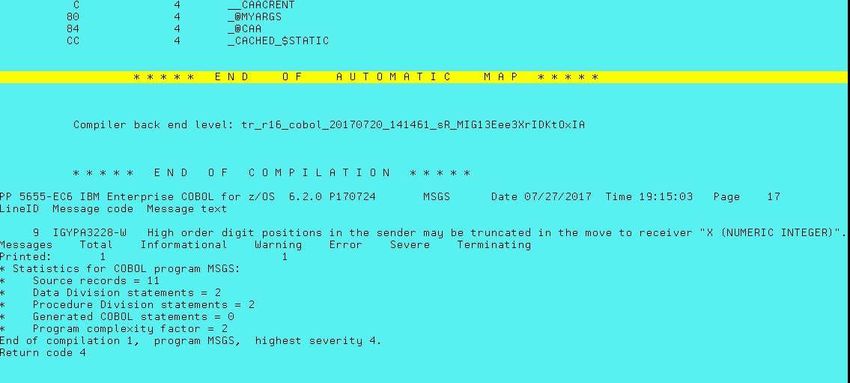
COBOL V6.2 ? YES!

• The 4th release of the new generation of IBM Z COBOL compilers
• Announced: July 17, 2017
   • The same day as IBM z14 hardware…coincidence?
• GA: September 8, 2017
   • Compiler support for the new IBM z14 hardware and IBM z/OS V2.3
   • Ability to exploit the new Vector Packed Decimal Facility of z14

• ‘OLD’ news:
   • COBOL V5 EOM Sept 11, 2017 (announced Dec 6, 2016)
   • EOS for COBOL V4 ‘might’ be earlier than 2020, still discussing

                                                                        2
COBOL V6.2 ? What else does it have?

• New and changed COBOL statements, such as the new JSON PARSE
  statement
• Support of COBOL 2002/2014 standards with the addition of the COBOL
  Conditional Compilation language feature
• New and changed COBOL options for increased flexibility
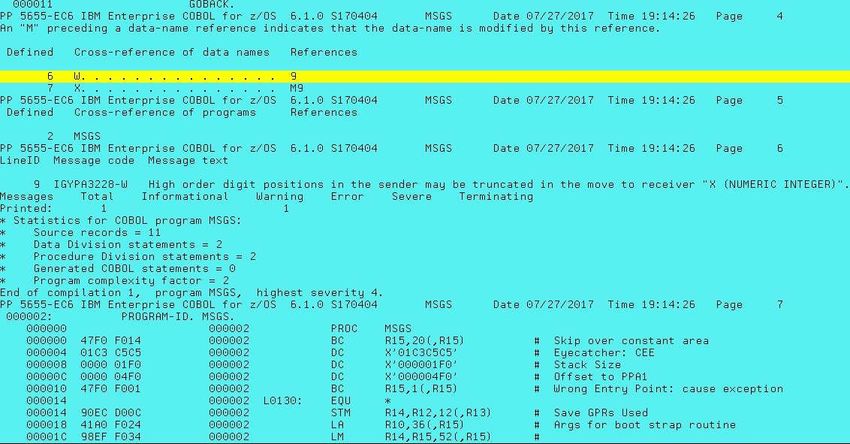
• Improved compiler listings with compiler messages at the end of the listing as in
  previous releases of the compiler
• Improved interfaces to optional products and tools such as IBM Debug for z
  Systems (formerly Debug Tool for z/OS) and IBM Application Discovery and
  Delivery Intelligence (formerly EzSource)
• Compile-time and runtime performance enhancements
• Improved usability of the compiler in the z/OS UNIX System Services
  environment
                                                                                      3
Vector Packed Decimal Facility of z14
• Enterprise COBOL V6.2 adds support for exploiting the new Vector Packed
Decimal Facility in z14 through the ARCH(12) compiler option.
• The Vector Packed Decimal Facility allows the dominant COBOL data types,
packed and zoned decimal, to be handled in wide 16-byte vector registers
instead of in memory.
• Decimal and floating-point computationally intensive COBOL programs, which are
optimized with Enterprise COBOL V6.2 and that target z14 ARCH(12), can deliver
CPU time reduction on the z14 server over the same applications built with COBOL
V6.1.
• No source changes are required to take advantage of this new facility; just recompile
with ARCH(12) to target z14.
4Changed ARCH compiler option
• ARCH(7) (still the default in 6.2)
• 2094-xxx models (IBM System z9 EC) 2096-xxx models (IBM System z9® BC)
• ARCH(8)
• 2097-xxx models (IBM System z10 EC) 2098-xxx models (IBM System z10 BC)
• ARCH(9)
• 2817-xxx models (IBM zEnterprise z196 EC) 2818-xxx models (IBM zEnterprise z114 BC)
• ARCH(10)
• 2827-xxx models (IBM zEnterprise EC12) 2828-xxx models (IBM zEnterprise BC12)
• ARCH(11)
• 2964-xxx models (IBM z13) 2965-xxx models (IBM z13s)
• ARCH(12)
• 3906-xxx models (IBM z14)
5Example 1 – Unsigned Packed Decimal Add – 4.85x Faster
Timing (100 million times in a loop)
01 WS-VAR-1 COMP-3 PIC s9(7) COBOL V4: 3.648 cpu seconds
01 WS-VAR-2 COMP-3 PIC s9(7). ARCH(11): 2.195 cpu seconds
01 WS-VAR-3 COMP-3 PIC s9(7). ARCH(12): 0.752 cpu seconds
. . .
ADD WS-VAR-1 TO WS-VAR-2 ARCH(12) is 4.85 times faster than COBOL V4
GIVING WS-VAR-3. ARCH(12) is 2.91 times faster than ARCH(11)
80% less CPU compared to V4!!!!
V4
ARCH(6|7|8|9|10)
• Use in memory instructions ARCH(11)
• Explicit sign setting • Convert to DFP ARCH(12)
• Conversion overhead • Use new ARCH(12) facility
MVC 168(4,R9),160(R9) • No conversions, no explicit sign setting
OI 171(,R9),X'0F' CDPT FP0,160(4,R9),0x9
MVC 352(4,R13),152(R9) CDPT FP1,152(4,R9),0x9 VLRL VRF16,160(,R9),0x3
OI 355(,R13),X'0F' ADTR FP0,FP0,FP1 VLRL VRF17,152(,R9),0x3
AP 168(4,R9),352(4,R13) LPDFR FP0,FP0 VAP VRF16,VRF16,VRF17,0x7,14
OI 171(,R9),X'0F' CPDT FP0,168(4,R9),0xb
6Example 2 – Large Decimal Divide – 135x Faster
01 WS-VAR-1 COMP-3 PIC s9(29)
01 WS-VAR-2 COMP-3 PIC s9(3).
Timing (100 million times in a loop)
01 WS-VAR-3 COMP-3 PIC s9(25)v9(6).
COBOL V4 or
. . .
COBOL V5/V6 w/ARCH(11): 2.319 cpu seconds
DIVIDE WS-VAR-1 BY WS-VAR-2
ARCH(12): 0.027 cpu seconds
GIVING WS-VAR-3.
ARCH(12) is 135 times faster than COBOL V4
Without ARCH(12)
• Call out to LE library routine (or COBOL V5/V6 with ARCH(11) or less)!
• Pre shifting operation 99% less CPU compared to pre-ARCH(12)!!!
• Piecewise divide, call overhead
ZAP 336(16,13),16(2,2)
With ARCH(12)
MVC 352(32,13),58(10)
MVC 366(15,13),0(2)
• Use new ARCH(12) facility
NI 380(13),X'F0' • Inline hardware accelerated shift+divide
MVN 383(1,13),14(2)
L 3,92(0,9 VLRL VRF24,_WSA[0x12c] 0(,R3),0xe
L 15,180(0,3) V(IGZCXDI ) VLRL VRF25,_WSA[0x12c] 16(,R3),0x1
LA 1,180(0,10 VSDP VRF24,VRF24,VRF25,0x6,0
BASR 14,15
7Example 3 – Large Decimal Multiply – 39x Faster
01 WS-VAR-1 COMP-3 PIC s9(14)v9(4).
01 WS-VAR-2 COMP-3 PIC s9(14)v9(4).
01 WS-VAR-3 COMP-3 PIC s9(14)v9(2).
Timing (100 million times in a loop)
MULTIPLY WS-VAR-1 BY WS-VAR-2
COBOL V4 or
GIVING WS-VAR-3. COBOL V5/V6 w/ARCH(11): 2.797 cpu seconds
ARCH(12): 0.072 cpu seconds
ARCH(12) is 39 times faster than COBOL V4
Without ARCH(12) (or COBOL V5/V6 with ARCH(11) or less)!
• Call out to LE library routine
• Piecewise multiply, call overhead
97.5% less CPU compared to pre-ARCH(12)!!!
• Post shifting operation
With ARCH(12)
L 3,92(0,9)
L 15,188(0,3) V(IGZCXMU ) • Use new ARCH(12) facility
LA 1,171(0,10) • Inline hardware accelerated multiply+shift
BASR 14,15
NI 388(13),X'0F' VLRL VRF16,152(,R9),0x9
MVN 396(1,13),399(13) VLRL VRF17,168(,R9),0x9
ZAP 32(9,2),388(9,13) VMSP VRF16,VRF16,VRF17,0x6,0
8Example 4 – Zoned Decimal Computation – 3.05x Faster
Timing (100 million times in a loop)
01 WS-VAR-1 PIC 9(8) value 1352435. COBOL V4: 1.469 cpu seconds
01 WS-VAR-2 PIC s9(8)v9(2). ARCH(11): 0.837 cpu seconds
01 WS-VAR-3 PIC s9(10)v9(2). ARCH(12): 0.482 cpu seconds
01 WS-VAR-4 PIC s9(8)v9(2).
. . .
COMPUTE WS-VAR-4 = (WS-VAR-1 / 365) * ARCH(12) is 3.05 times faster than COBOL V4
(WS-VAR-2 + 1) - WS-VAR-3. ARCH(12) is 1.74 times faster than ARCH(11)
67% less CPU compared to V4!!!!
V4 ARCH(10|11)
ARCH(6|7|8|9) • Convert to DFP
• Use in memory
instructions CDZT FP1,_WSA[0x12c] 0(8,R3),0x8 ARCH(12)
SLDT FP0,FP1,2
PACK 296(8,13),0(8,2)
• Use new ARCH(12) facility
...
VPKZ VRF24,_WSA[0x12c] 0(,R3),0x7
SRP 298(6,13),2(0),0 DDTR FP0,FP0,FP1
VSRP VRF24,VRF24,0xa,0x2,2
... FIDTR FP1,9,FP0
...
DP 296(8,13),40(2,10) LXDTR FP0:FP2,0,FP1
VLIP VRF25,0x365,0
ZAP 264(16,13),296(6,13) CDZT FP1,_WSA[0x12c] 8(10,R3),0x8
VDP VRF24,VRF24,VRF25,0xa,0
PACK 280(16,13),8(10,2) ...
...
... MXTR FP4:FP6,FP0:FP2,FP8:FP10
VMP VRF24,VRF24,VRF25,0x15,0
PACK 296(8,13),24(12,2) CXZT FP0:FP2,_WSA[0x12c] 24(12,R3),0x8
VPKZ VRF25,_WSA[0x12c] 24(,R3),0xb
SRP 296(8,13),2(0),0 SLXT FP8:FP10,FP0:FP2,2
VSRP VRF25,VRF25,0xe,0x2,0
SP 268(12,13),296(8,13) SXTR FP0:FP2,FP4:FP6,FP8:FP10
VSP VRF24,VRF24,VRF25,0x16,0
... ...
...
9New COBOL Language
• New Statement
• JSON PARSE … INTO
• New Compiler Directive (to control optimization inlining)
• >>INLINE
• >>NOINLINE
• New Compiler Directives (for conditional compilation)
• >>DEFINE
• >>EVALUATE
• >>IF
10JSON PARSE … INTO
• The JSON PARSE statement converts JSON text to COBOL data formats.
• Syntax:
>>-JSON PARSE--identifier-1--INTO--identifier-2----------------->
>--+------------------+----------------------------------------->
'-+------+--DETAIL-'
'-WITH-'
>--+---------------------------------------------------+-------->
| .---------------------------------. |
| V | |
'-NAME--+----+----identifier-3--+----+--literal-1-+-'
'-OF-' '-IS-'
>--+----------------------------+------------------------------->
| .--------------. |
| V | |
'-SUPPRESS----identifier-4-+-'
>--+-------------------------------------------+---------------->
'-+----+--EXCEPTION--imperative-statement-1-'
'-ON-'
>--+------------------------------------------------+----------->
'-NOT--+----+--EXCEPTION--imperative-statement-2-'
'-ON-'
>--+----------+------------------------------------------------><
'-END-JSON-'
11JSON PARSE
• JSON PARSE identifier-1 INTO identifier-2
[[WITH] DETAIL]
[NAME [OF] {identifier-3 [IS] literal-1}...]
[SUPPRESS {identifier-4}...]
[[ON] EXCEPTION imperative-statement-1 ]
[NOT [ON] EXCEPTION imperative-statement-2 ]
[END-JSON]
• Not so similar to XML PARSE
• No PROCESSING PROCEDURE
• Not event-driven
• INTO identifier 2 !!
12JSON PARSE
• Two kinds of condition might occur during execution of a
JSON PARSE statement and might result in the receiver
being partially modified:
• Nonexception conditions result in reason codes in special register
JSON-STATUS, but do not terminate execution of the statement.
• Exception conditions cause execution to be terminated with the
exception code set in special register JSON-CODE.
• Any nonexception conditions that were detected prior to the
exception condition are represented in the reason codes set in
special register JSON-STATUS.
13JSON PARSE
Examples of matched and mismatched data definitions and JSON text
• The following JSON text and data definitions are considered an exact match:
JSON PARSE input-json INTO G
{"g": {"H": {"A": "Eh?", "3_": 55, "c-C": "SeeThisLongString"}}}
01 G. 01 G.
02 h. Same as 02 h.
05 a pic x(10). 03 a pic x(10).
04 3_ pic 9. 03 3_ pic 9.
03 C-c pic x(10). 03 C-c pic x(10).
NOTE: Truncation and padding are normal, just like in MOVE
14JSON PARSE
• When WITH DETAIL is specified, fixed-point number or string truncation
from the previous example would be diagnosed with runtime messages
as follows:
IGZ0328I During execution of the JSON PARSE statement on line line-
number of program program-name, assignment of the value of the JSON
name/value pair at offset offset to data item 3_ resulted in loss of
significance ("SIZE ERROR").
IGZ0329I During execution of the JSON PARSE statement on line line-
number of program program-name, assignment of the value of the JSON
name/value pair at offset offset to data item C-C data-name resulted in a
loss of information.
15JSON PARSE
“Missing” names in JSON are tolerated, but matches require the level
(“qualification”) names to match. For example, the following data
definitions and JSON text are compatible, but data-items “3_” and
“etc” would not be modified by a JSON PARSE statement
(JSON-STATUS would be set to 1):
{"g": {"H": {"A": "Eh?", "c-C": "See", "etc:{"etc": "xxx"}}}
01 G.
02 h.
05 a pic x(10).
04 3_ pic 9.
03 C-c pic x(10).
02 etc.
03 etc pic x(10).
16JSON PARSE
Superfluous JSON name/value pairs are tolerated, but result in
setting special register JSON-STATUS to a condition code, and
possibly in one or more runtime messages, under control of the WITH DETAIL phrase.
For example, the following data definitions and JSON text are compatible, and would result in
completely populating group G, but JSON text "B": "Bee" would not be used, and the JSON
PARSE statement would terminate with a non-exception condition: JSON-STATUS = 2
{"G": {"h": {"a": "Eh?", "B": "Bee", "3_": 5, "C-c": "See"}}}
01 G.
02 h.
05 a pic x(10).
05 3_ pic 9.
05 C-c pic x(10).
Note: The program would not terminate, and all data items populated, so that the ‘flexible’
nature of parameter passing is supported
17JSON PARSE
• If superfluous JSON name/value pairs are found, and
WITH DETAIL was specified, then the program will get
the following runtime message (in addition to getting JSON-STATUS
set to 2:
IGZ0321I During execution of the JSON PARSE statement on line line-
number of program program-name, no data item matched JSON name
JSON-name at offset offset.
18JSON PARSE
The following data definitions and JSON text are fully compatible,
despite the name order mismatch.
{"g": {"H": {"3_": 5, "A": "Eh?", "c-C": "See"}}}
01 G.
05 h.
10 a pic x(10).
10 3_ pic 9.
10 C-c pic x(10).
19JSON PARSE
The following data definitions and JSON text are not a match,
because of the omitted name level (qualification by “H”), and would
result in an exception condition, JSON-CODE=106, with identifier-2 (“G”)
unchanged:
JSON PARSE input-json INTO G WITH DETAIL
{"g": {"A": "Eh?", "3_": 5, "c-C": "See"}}
01 G.
02 h.
05 a pic x(10).
04 3_ pic 9.
03 C-c pic x(10).
Use WITH DETAIL to get runtime messages with
explanation of what, if any, conditions occurred
20JSON PARSE
• If WITH DETAIL was specified, and the previous incompatible JSON
text and COBOL data definitions are used, then the program will get
the following message at run time, in addition to getting JSON-CODE
set to 106:
IGZ0341W During execution of the JSON PARSE statement on line
line-number of program program-name, no JSON name/value pair
matched any data item in the receiver. The receiver G was not
modified.
21JSON PARSE
The following data definitions and JSON text are not compatible,
because the JSON values are all incompatible with the corresponding
data items, and would result in an exception condition, with identifier-2
(“G”) unchanged:
{"g": {"H": {"A": 42, "3_": "x", "c-C": "123"}}}
01 G.
02 h.
05 a pic a(10).
04 3_ pic 9.
03 C-c pic 99.
22New and changed COBOL statements
• Support of COBOL 2002/2014 standards with the addition of the COBOL
Conditional Compilation language feature
• New compiler directives
• >>DEFINE
• >>EVALUATE, >>WHEN, >>END-EVALUATE
• >>IF, >>ELSE, >>END-IF
• New compiler option
• DEFINE
• Conditional compilation provides a way of including or omitting selected lines of
source code depending on the values of literals specified by the DEFINE
directive. In this way, you can create multiple variants of the same program
without the need to maintain separate source streams.
23Conditional Compilation
Set compiler option DEFINE(iscics=B’01’)
>>DEFINE iscics AS PARAMETER
>>IF iscics
EXEC CICS HANDLE ABEND
>>ELSE
CALL ‘CEEHDLR’ USING myhandler, etc
>>END-IF
24Conditional Compilation
Set compiler option DEFINE(subsys=‘IMS’)
>>DEFINE subsys AS PARAMETER
>>EVALUATE TRUE
>>WHEN subsys=‘BATCH’
CALL ‘DB2BATCH’
>>WHEN subsys=‘CICS’
CALL ‘DB2CICS’
>>WHEN subsys=‘IMS’
CALL ‘DB2IMS’
>>END-EVALUATE
25Conditional Compilation
Predefined compilation variables
Variables that are defined automatically by the compiler.
These compilation variables, listed below, can be referenced in conditional
compilation directives wherever a compilation variable is allowed.
Predefined compilation variable name Value
ARCH Numeric value representing the value of the ARCH compiler
option in effect.
CICS B’1’ if CICS compiler option is in effect, B’0’ otherwise.
COMPILER-VRM Numeric value representing the compiler version, release,
and mod level (e.g., 610 is COBOL V6.1.0)
DLL B’1’ if DLL compiler option is in effect; B'0' otherwise.
DYNAM B’1’ if DYNAM compiler option is in effect; B'0' otherwise.
OPTIMIZE Numeric value representing the value of the OPTIMIZE
compiler option.in effect
SQL B’1’ if SQL compiler option in effect, B'0' otherwise.
SQLIMS B’1’ if SQLIMS compiler option is effect, B'0' otherwise.
THREAD B’1’ if THREAD compiler option is effect, B'0' otherwise.
26Conditional Compilation
*> Use predefined compilation variables
*> These only reflect compiler options, could have more
*> more than one, like both SQL and CICS!
>>EVALUATE TRUE *> Check which coprocessor
>>WHEN SQL *> DB2
EXEC SQL blah blah END-SQL
>>WHEN CICS
EXEC CICS blah blah END-CICS
>>WHEN SQLIMS
EXEC SQLIMS blah blah END-SQLIMS
>>END-EVALUATE
27Examples of Conditional Compilation
Example 4: use OVERRIDE and OFF in the DEFINE directive
>>DEFINE VAR AS 12 *> Sort of like 77 VAR pic 99 value 12.
. . .
>>DEFINE VAR OFF *> VAR is now gone/undefined!
. . .
>>IF VAR IS DEFINED
compute x = x + 1 *> This code will not be included
>>ELSE
compute x = x - 1 *> This code will be included
>>END-IF
. . .
>>DEFINE VAR AS 16 *> VAR is back!
. . .
>>DEFINE VAR AS VAR - 2 OVERRIDE *> VAR is now 14
. . .
>>IF VAR IS EQUAL TO 16
compute x = x + 1 *> This code will NOT be included
>>ELSE
compute x = x - 1 *> This code will be included
>>END-IF
28New and changed COBOL options
• The IBM-supplied default for the AFP compiler option is changed from VOLATILE to
NOVOLATILE
• So that the compiler can generate more efficient code sequences for programs with floating
point operations.
• New DEFINE option allows you to define or set conditional compilation constants at compile time.
• New INITCHECK option tells the compiler to perform a static analysis of the program, and to emit
a warning message for data items that are used before they are initialized.
• Features to control inlining behaviors at OPTIMIZE(1) or OPTIMIZE(2):
• Sometimes inlining is not desired, like for error paragraphs that are rarely executed
• INLINE compiler option tells compiler to allow inlining of procedures if OPT decides it makes
sense, NOINLINE tells compiler to not allow it
• >>INLINE ON and >>INLINE OFF compiler directives to disable specific procedures within
the program from being inlined.
29New and changed COBOL options
• ‘New’ NUMCHECK option tells the compiler whether to generate extra code to validate data items
when they are used as sending data times. For zoned decimal (numeric USAGE DISPLAY) and
packed decimal (COMP-3) data items, the compiler generates implicit numeric class tests for
each sending field. For binary data items, the compiler generates SIZE ERROR checking to
determine whether the data item has more digits than its PICTURE clause allows.
• Note: The ZONECHECK option is deprecated but is tolerated for compatibility, and it is replaced by
NUMCHECK(ZON).
• ‘New’ PARMCHECK option tests for subprograms that write beyond the end of WORKING-
STORAGE.
• This option tells the compiler to generate an extra data item following the last item in WORKING-STORAGE
that is then used at run time to check whether a called subprogram corrupted data beyond
the end of WORKING-STORAGE.
• ‘New’ SSRANGE suboptions allow:
• MSG/ABD Choose a warning message or an ABEND for SSRANGE conditions
• ZLEN allows a reference modification of zero length to proceed without a message or abend
• These new options and suboptions were added to help with migration .
30New and changed COBOL options
• New combinations of suboptions are supported in
both the TEST and NOTEST compiler options, including:
• TEST(NODWARF)
• Can help 3rd-party vendor debugging experience without larger object programs
• TEST(SEPARATE)
• Helps customers who deploy copies of the same programs to many systems, they can share a
separate dataset with one copy of debugging information for all copies – less DASD usage
• DD SYSDEBUG is back!
• NOTEST(DWARF)
• For customers who want full optimization with some debugging information for Fault Analyzer
or CEEDUMP (IBM z/OS Debugger, formerly Debug Tool, cannot debug programs compiled
with NOTEST)
31New and improved TEST option
Use TEST to produce object code that enables debugging
with problem determination tools such as IBM z/OS Debugger and Fault Analyzer.
Syntax:
.-NOTEST-.
>>-+-TEST---+--+--------------------------------+-----><
| .-,------------------. |
| V | |
'-(------+----------------+-+--)-'
+-+-DWARF---+----+
| '-NODWARF-' |
+-+-EJPD---+-----+
| '-NOEJPD-' |
+-+-SEPARATE---+-+
| '-NOSEPARATE-' |
'-+-SOURCE---+---'
'-NOSOURCE-'
Default: NOTEST(NODWARF, NOSOURCE, NOSEPARATE)
Suboption defaults:
NODWARF, NOSOURCE, NOSEPARATE when NOTEST is specified with no suboptions
NOEJPD, DWARF, SOURCE, NOSEPARATE when TEST is specified with no suboptions 32New and improved TEST option - review
Abbreviations: None
Suboption abbreviation are:
NOSO | SO for SOURCE | NOSOURCE
NOSEP | SEP for SEPARATE | NOSEPARATE
DWARF | NODWARF
If TEST(DWARF) is in effect, complete DWARF diagnostic information is included in the object
program, or a separate debug file, when the SEPARATE suboption is in effect. This option enables
the best usability for application failure analysis tools, such as CEEDUMP and IBM®Fault Analyzer.
When NOTEST(DWARF) is in effect, the debugging information is a subset of the DWARF
information that is available with TEST. The DWARF diagnostic information that is produced when
NOTEST(DWARF) is in effect, cannot be used with IBM z/OS Debugger.
If NODWARF is in effect, DWARF diagnostic information is not included in the object program, or
written to a separate debug file.
Notes:
•SOURCE and SEPARATE are not allowed with NODWARF.
•If you specify the DWARF suboption of TEST or NOTEST, you must set the CODEPAGE option to the
CCSID that is used for the COBOL source program.
33New and improved TEST option - review
EJPD | NOEJPD
EJPD and NOEJPD control enablement of the IBM z/OS Debugger commands JUMPTO and
GOTO in production debugging sessions. EJPD and NOEJPD only take effect if you specify
the TEST option and a non-zero OPTIMIZE level (OPTIMIZE(1) or OPTIMIZE(2)).
If you specify TEST(EJPD) and a non-zero OPTIMIZE level:
The JUMPTO and GOTO commands are enabled.
The amount of program optimization is reduced. Optimization is done within statements,
but most optimizations do not cross statement boundaries.
If you specify TEST(NOEJPD) and a non-zero OPTMIZE level:
The JUMPTO and GOTO commands are not enabled, but you can use JUMPTO and
GOTO if you use the SET WARNING OFF IBM z/OS Debuger command. In this scenario,
JUMPTO and GOTO will have unpredictable results.
The normal amount of program optimization is done.
Note:
• EJPD is not allowed with NOTEST.
34New and improved TEST option - review
SOURCE | NOSOURCE
If you specify SOURCE, the DWARF debugging information generated by the compiler
includes the expanded source
Note: SOURCE is not allowed if NODWARF is specified.
If you specify NOSOURCE, the generated DWARF debugging information does not include the
expanded source. You will not be able to debug using the IBM z/OS Debugger with
TEST(NOSOURCE).
SEPARATE | NOSEPARATE
Specify SEPARATE to control program object size on disk while retaining debugging capability.
Generated DWARF debugging information is written to a separate SYSDEBUG file instead of
to the object program.
Note: SEPARATE is not allowed if NODWARF is specified.
Specify NOSEPARATE to include generated DWARF debugging information in the object
program.
(NOSEPARATE does not affect the size of the loaded program object)
35Improved compiler listings: usability!
• Improved compiler listings with compiler messages at the end of the listing as in
previous releases of the compiler
• Finally!
• Much improved integration between compiler Front End and Back End
36
36Improved compiler listings: usability!
Not really the end at all!
37
37Improved compiler listings: usability!
REALLY the end now!
38
38What else?
• Improved interfaces to other licensed programs and tools
• Addition of MD5 signature to program objects and debug data to
allow matching of debug data with executables even if a program is recompiled.
• Three new fields at the end of PPA4:
• Offset of the first user-defined data item in WORKING-STORAGE
• Total length of user-defined data items in WORKING-STORAGE
• Bit to indicate whether there are EXTERNAL data items
• Compile-time and runtime performance improvements
• General compile-time performance improvements
• With OPTIMIZE(1) and OPTIMIZE(2)
• Up to 20% improvement!
• General batch runtime performance improvements
• General online transaction runtime performance improvements
• Usability enhancements in the z/OS UNIX System Services environment
• We added help information for the cob2 compiler invocation command.
39Questions?
4041
You can also read


