Department of Statistics Malaysia - SESRIC
←
→
Page content transcription
If your browser does not render page correctly, please read the page content below
Department of Statistics Malaysia

                                    1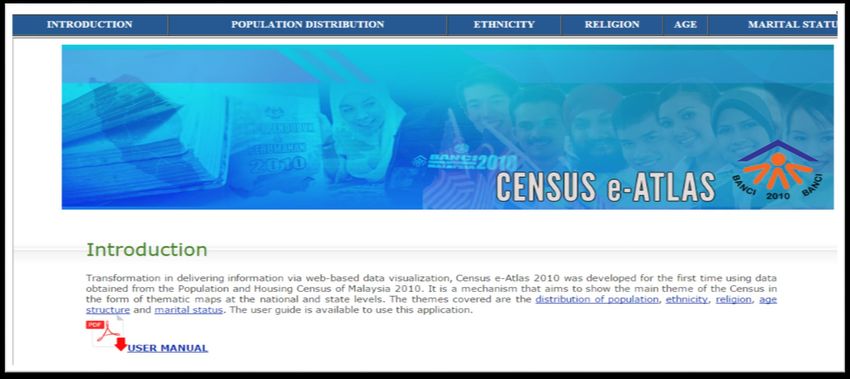
1   Introduction

2   Geographic Information Systems (GIS)

3   Geospatial activities for 2020

4   Modernisation

5   Way Forward

                                           2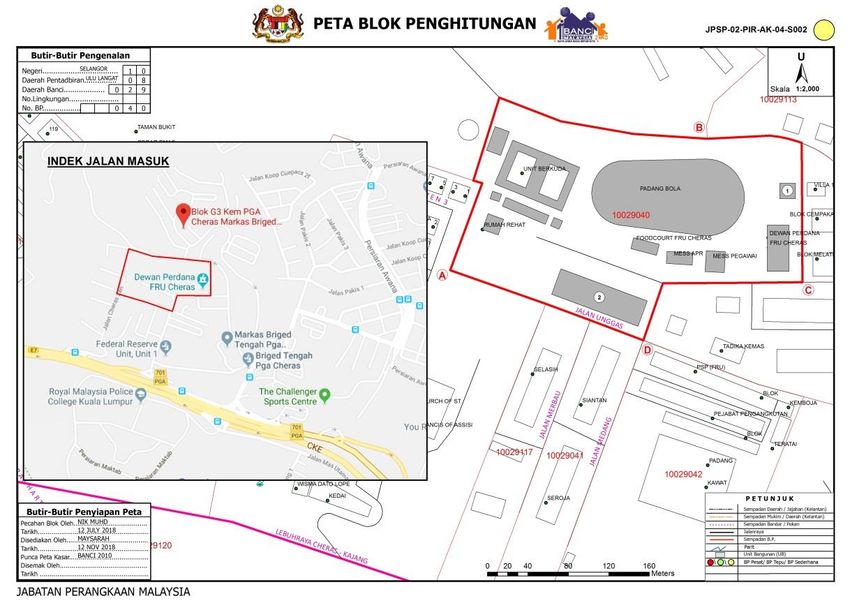
3
Malaysia          Census         2018
                                                                                                                   2010
                                                                                                 Population        28.33          32.36
                                                                                                 (Millions)
                                                                                                 Male              14.56          16.72
                                                                                                 Female            13.77          15.66

                                                                                                 Key Summary               2010
                                                                                                 Statistics,Malaysia
                                                                                                 Population                86
                                                                                                 Density(per sq.
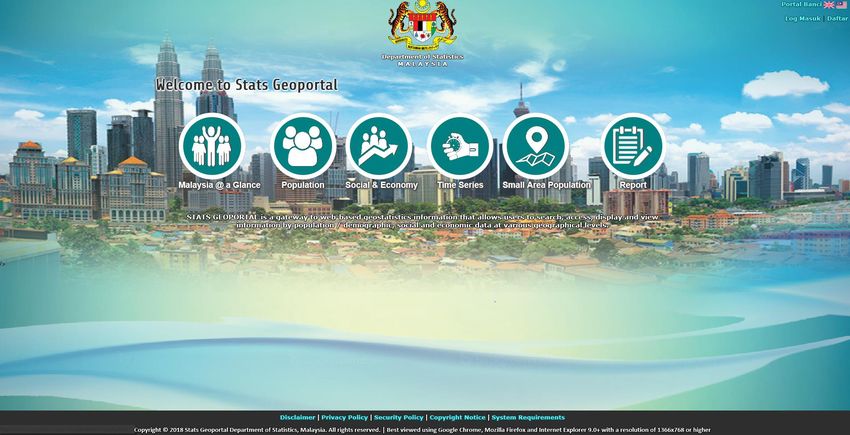
Location:                                                                                        km)
Located between 2 and 7 degrees north of the Equator, Peninsular
Malaysia is separated from the states of Sabah and Sarawak by the                                Average annual            2.0
South China Sea. To the north of Peninsular Malaysia is Thailand while                           population growth
its southern neighbour is Singapore. Sabah and Sarawak are bounded                               rate,2000-2010(%)
by Indonesia while Sarawak also shares a border with Brunei.                                     Urban                     71.0
https://www.statistics.gov.my/index.php?r=column/cone&menu_id=ZmVrN2FoYnBvZE05T1AzK0RLcEtiZz09
                                                                                                 population(%)

                                                                                                                                          4
5
Established in 1949 under the Statistics
Ordinance 1949

A premier government agency under the
Ministry of Economic Affairs entrusted with
the responsibility to collect, interpret and
disseminate latest and real time statistics in
the monitoring of national economic
performance and social development.

VISION
To Become A Leading Statistical
Organisation Internationally by 2020

MISSION
Producer of National Statistics of Integrity
and Reliability                                  14 States DOSM 28 Operational Centres

                                                                                         6
Statistics Act 1965                                                                                                          Census Act 1960
(Revised-1989)

                                  LAWS OF MALAYSIA                             LAWS OF MALAYSIA

                                                                                           REPRINT
                                        Act 415

                                 STATISTICS ACT1965                                         Act 16
                                       (REVISED-1989)
                                                                                 CENSUS ACT1960
                                                                         Incorporating all amendments up to 1 January 2006

                      Under the Statistics Act1965 (Revised –    Under Census Act 1960:
                      1989), the functions of DOSM [Section 2]
                                                                 The Yang di-Pertuan Agong may, by
                      are:
                                                                 notification in the Gazette, from time to
                                                                 time direct that a census to be taken
                      To collect and interpret statistics for
                                                                 throughout Malaysia of the Population,
                      the purpose of formulation or
                                                                 Agriculture, Trade, Labor, Industry,
                      implementation of government
                                                                 Commerce….
                      policies….

                                                                                                                                               7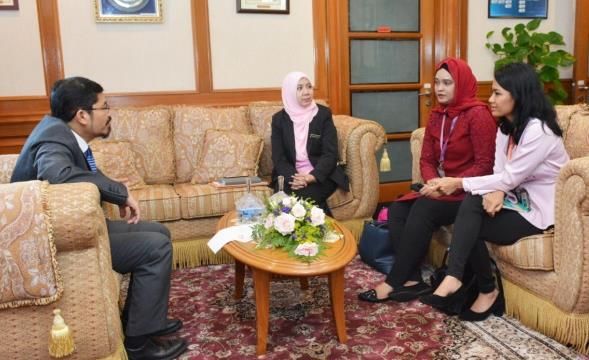
Stakeholders International Public
Users
Researcher
Universities
Embassy
Private Sectors
Ministry / Government Agencies
8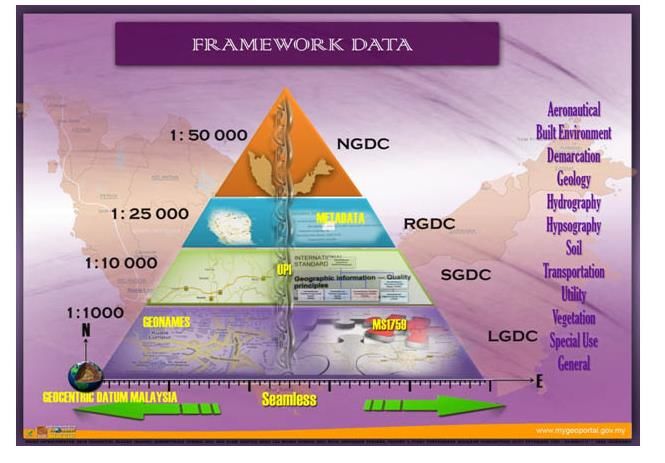
Salaries & Wages Survey Report Quarterly & Annual Gross Domestic Product
Current Population Estimates Consumer Price Index
Labour Force Survey Report Monthly External Trade Statistics
Household Income & Basic Amenities Index of Industrial Production, Malaysia
Survey Report Domestic Tourism Survey
Vital Statistics Balance of Payment
Statistics on Women Empowerment In Selected Domains, Malaysia
Labour Productivity
Social Accounting Matrix
Children Statistics, Malaysia
9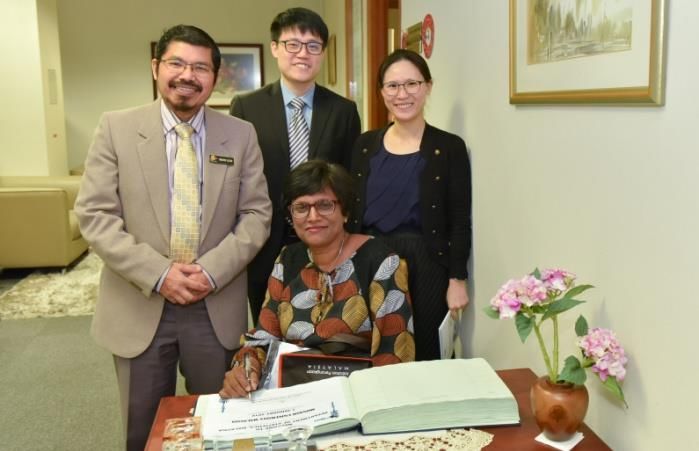
Courtesy Visit by Mr. James Lochhead, Consultant
                                    Courtesy visit by Monash University Malaysia
                                                                                   for Gender Mainstreaming Project
                                    Wednesday 03, January 2018
                                                                                   Wednesday, 10 January 2018
DOSM SAS Certified Data Scientist
Tuesday, 16 January 2018

 STATSBDA Development Review         Courtesy Visit by Vice Chancellor UNITEN
 Tuesday, 16 January 2018            Thursday 04, January 2018

                                                                                                                                      10
6th CENSUS 2020
The Population and Housing RESOLUTION
Census in Malaysia is conducted Resolution on 2020 World
every 10 years. Since the Population and Housing Census
establishment of Malaysia, 5 Programme adopted by the
census has been implemented. ECOSOC (10 June 2015) to
LEGAL BASIS ensure the member states to
conduct a census during 2015–
2024 period.
• Census Act 1960 (Revised
MAIN OBJECTIVE 1969).
To have a total coverage and to • Statistics Act 1965
accurately count and measure the (Revised 1989). MANUAL
numbers and key characteristics Principles and Recommendations
of the population, households and for Population and Housing
living quarters in Malaysia at a Censuses, Revision 3, UNSD
point in time (2015).
11• UN Principles and Recommendations for Population and Housing Censuses, , recommended the use
of Geospatial technologies for improving traditional methods of census mapping (adopted by
UNSC in 2007).
• Other recommendations derived from UN EGM on GIS and Census Mapping emphasized:
– the need for countries to consider the census geography programme as a continuous process
– the use of and application of geospatial technologies and information is beneficial at all stages of
population and housing census process (GI improves the efficiency in the preparatory,
enumeration, processing and dissemination phases of the census)
12To compile the total coverage and profile of the population, households
01 and living quarters in Malaysia with a wide range of demographic and
socio-economic characteristics to the smallest area
To provide input for planning, formulation and implementation of
02 government policies and development programmes as stated in the
Legislation
To provide a reliable basis for the estimation and projection of the
03 population and living quarters
To provide input for the development of new socio-economic key indicators
04
13LIVING QUARTERS POPULATION HOUSEHOLD
OCCUPANCY CONNECTIVITY AGE SEX ETHNICITY TYPE OF HOUSEHOLD
MIGRATION MARITAL STATUS RELIGION AGRICULTURE ACTIVITIES
UTILITIES LOCAL AREA
EDUCATION CITIZENSHIP ECONOMICS
TYPES OF LIVING QUARTERS OWNERSHIP STATUS
1415
1989-1991
         Preparatory Stage

         After 1991 Census
Create a census cartographic database

                                        16
Malaysian Centre for Geospatial Data Infrastructure (MaCGDI) is a centre established by the
government to manage and promote the development of geospatial data infrastructure for Malaysia
(MyGDI). MaCGDI is also responsible for coordinating access and delivery of the geospatial
information held by all government agencies.
The main role of MaCGDI is to continuously make available and accessible current and accurate
geospatial data that promotes a sustainable living environment, economic growth and social
progress for public.
Objectives:
• To provide mechanism/infrastructure in supporting the usage and sharing of current, accurate
and reliable geospatial information among agencies by employing the latest geospatial
technologies; and
• To avoid redundancy of duplicating effort in collecting, processing, maintaining, providing and
dissemination of required geospatial information.
http://macgdi.mygeoportal.gov.my/167.aspx
17MyGDI Governance
To manage the development and operation of MyGDI, a MyGDI National
Coordinating Committee (MNCC) was formed with the role of a central
policy and decision making body on matters pertaining to the
implementation, development and operations of MyGDI programmes and
MaCGDI as the coordinator
Framework Data refer to the coordinating data sharing within
government agencies by establish fundamental dataset of National
Geospatial Data Centre (NGDC) and State Geospatial Data
Centre (SGDC). The objective is to prevent duplication of effort in
data collection within government agencies.
18Administrative Areas Statistical Areas
19CENSUS MAPPING & DIGITAL MAPS
2000 - 2007 2007 - 2009
2011 - 2012
2010 2015
Dissemination
Development
2017 - 2020
Data Census
Geodatabase National
Statistical • Statistical Enterprise StatsDW
MyIPCS
boundaries boundaries wide
Integrating Statistical Location
• Vector data Smart Listing and
census with System intelligent
(topographic Smart Map
Statistical (NEWSS)
digital map) Integration BI
boundaries Integration Data
and GIS
and Map
Internal GIS .
Portal
20• Delineation and digitizing of Enumeration Block (EB) boundaries for 2020
Census by using base maps from OGA.
• Establish the centralised geodatabase and internal GIS Portal for updating
maps by State Office.
• Generating census data at small area statistics or specific area for the users.
• Producing thematic maps from various sources especially on Census and
other data.
21 About 70% of statistical digital map were used for the 2010 census.
All the map was produced using GIS software.
EB’s map -A3 sized maps up-dated based on base map from various
resources
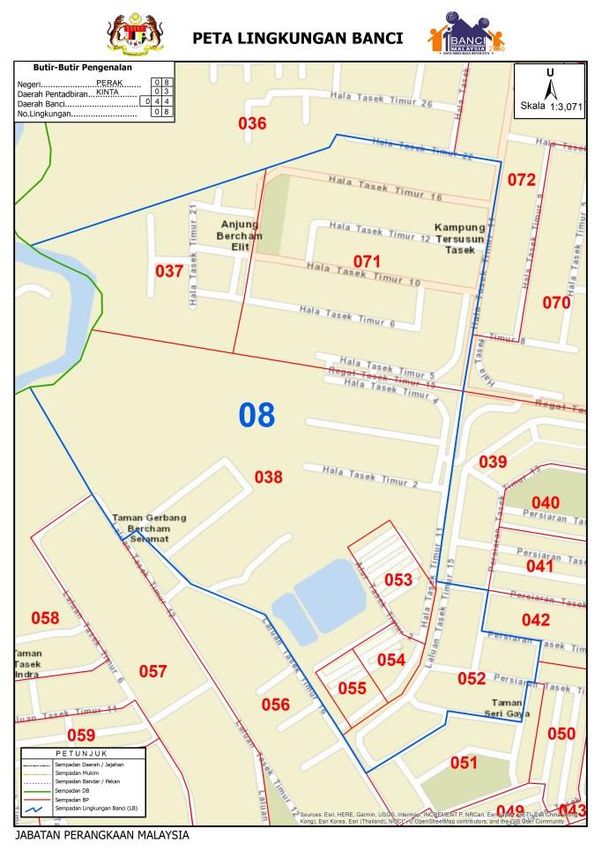
22 Census geopatial database at difference levels of geography. Small area statistics from
census data which is consist of demographic data, living quarters, household, and others.
23 GIS internal portal; developed under National Enterprise Wide Statistical System (NEWSS).
24 Census e-Atlas developed using ArcGis Online platform- Changed to Stats Geo Portal
It shows thematic maps of selected census data.
2526
27
Data visualisation at www.dosm.gov.my. Data visualisation tools allow anyone to organize
and present information intuitively.
28 Lack of expertise and technical capabilities to enhance the
use and development of GIS with the most updated
technology.
Need investment to purchase the most updated base
maps/software especially on raster data.
Integrating the variety of spatial data from OGA in order to
create updated statistical maps.
29 Extending the scope of census cartography to the national spatial
framework.
Providing the most efficient platform for data dissemination through
GIS Portal.
Merging of household and establishment frames into the GIS
environment.
Constructing the EB geo database by using technical advances, such as
Remote Sensing data, GPS.
Strengthening the collaboration with OGA/GLC for map integration,
standard and quality assurance.
30Sources :
http://ggim.un.org/meetings/2014-IGSI_Beijing/
International Workshop on Integrating Geospatial and Statistical Information, Beijing, China, 2014
3132
StatsBDA      StatsDW

       CAPI                           StatsDigital

CATI                                        GIS

 e-survey                             MyIPCS

                NEWSS    eStatistik

                                                     33
Modernisation of listing methods
Increased data security: (Reengineering Address
Security/Risk Canvassing/listing) :
MSAR, OSL
6 1
Census Portal as a Integrating administrative
one stop centre for the
dissemination of information
pre, current and post
5 2 data from OGA &
survey data :
MSAR & MSPR
census
4 3
Modernisation in field
work: Mobile apps, tablet Increase Self-Response rate :
e-Census, MOMB, DOPU
Malaysia Statistical Ubiquitous Learning (MySUL)
Malaysia Census Strategic Communications Plan
34CENSUS
MSAR ANALYTIC & INTERACTIVE
+ OPERATION DATA DATABASE
STATS BDA e-Census, CAPI, STATISTICS NATIONAL
Primary & MSPR MANAGEMENT
Secondary Online Self- CATI, PAPI, DOPU COMMUNICATION AGENDA
Listing GIS GIS INPUT
Data
Preparatory Enumeration Data Processing Dissemination Evaluation Principles and Recommendations for
Work & Databases Population and Housing Censuses, Rev. 3
1 2 3 4 5 6 8 Generic Statistical Business
7
Process Model (GSBPM)
Specify Design Build Collect Process Analyse Disseminate Evaluate
Needs
3536
37
2017-2019                                  2020                             2021-2022
      PRE-ENUMERATION                       ENUMERATION                        POST ENUMERATION
•   Create and update statistical map                                      •   Dissemination via Web based and
                                        •   Census tracking and progress
•   Address geocode                                                             spatial analysis
                                            monitoring during operation

                                                                                                                 38
Period
Period 2017-2019
Process
Process
Platform
Platform
Base map
Base map
39• Preliminary report
• Progress monitoring
• Census tracking
40• Preliminary report
• Progress monitoring
• Census tracking
4142
• Expand the integration of statistical and geospatial

• Strategic partnership with other agencies for the use of
  high resolution of spatial data

• Advanced the use of spatial analysis & tools for official
  statistics

• Extend the use of web based platform for dissemination
  of geo statistics

                                                              43
THANK YOU
44You can also read


