Visual Search at Pinterest
←
→
Page content transcription
If your browser does not render page correctly, please read the page content below
Visual Search at Pinterest
                                 1                       1                                1                 1               1                    1,2
            Yushi Jing , David Liu , Dmitry Kislyuk , Andrew Zhai , Jiajing Xu , Jeff Donahue ,
                                                           1

                                           1
                                                Sarah Tavel
                                                                          Visual Discovery, Pinterest
                                                                    2
                                                                        University of California, Berkeley
                           {jing, dliu, dkislyuk, andrew, jiajing, jdonahue, sarah}@pinterest.com

ABSTRACT
We demonstrate that, with the availability of distributed
computation platforms such as Amazon Web Services and
open-source tools, it is possible for a small engineering team
to build, launch and maintain a cost-effective, large-scale
visual search system. We also demonstrate, through a com-
prehensive set of live experiments at Pinterest, that content
recommendation powered by visual search improves user en-
gagement. By sharing our implementation details and learn-
ings from launching a commercial visual search engine from
scratch, we hope visual search becomes more widely incor-
porated into today’s commercial applications.

Categories and Subject Descriptors
H.3.3 [Information Systems Applications]: Search Pro-
cess; I.4.9 [Image Processing and Computer Vision]:
Application

General Terms                                                                                   Figure 1: Similar Looks: We apply object detec-
                                                                                                tion to localize products such as bags and shoes. In
information retrieval, computer vision, deep learning, dis-
                                                                                                this prototype, users click on automatically tagged
tributed systems
                                                                                                objects to view similar-looking products.
Keywords
visual search, visual shopping, open source                                                        We faced two main challenges in deploying a commercial
                                                                                                visual search system at Pinterest. First, as a startup we
1.      INTRODUCTION                                                                            needed to control the development cost in the form of both
                                                                                                human and computational resources. For example, feature
   Visual search, or content-based image retrieval [5], is an                                   computation can become expensive with a large and con-
active research area driven in part by the explosive growth of                                  tinuously growing image collection, and with engineers con-
online photos and the popularity of search engines. Google                                      stantly experimenting with new features to deploy, it was
Goggles, Google Similar Images and Amazon Flow are sev-                                         vital for our system to be both scalable and cost effective.
eral examples of commercial visual search systems. Although                                     Second, the success of a commercial application is measured
significant progress has been made in building Web-scale vi-                                    by the benefit it brings to the users (e.g. improved user
sual search systems, there are few publications describing                                      engagement) relative to the cost of development and main-
end-to-end architectures deployed on commercial applica-                                        tenance. As a result, our development progress needed to
tions. This is in part due to the complexity of real-world                                      be frequently validated through A/B experiments with live
visual search systems, and in part due to business consider-                                    user traffic.
ations to keep core search technology proprietary.                                                 In this paper, we describe our approach to deploy a com-
Permission to make digital or hard copies of all or part of this work for personal or
                                                                                                mercial visual search system with those two challenges in
classroom use is granted without fee provided that copies are not made or distributed
for profit or commercial advantage and that copies bear this notice and the full citation
                                                                                                mind. We make two main contributions.
on the first page. Copyrights for components of this work owned by others than the                 Our first contribution is to present our scalable and cost
author(s) must be honored. Abstracting with credit is permitted. To copy otherwise, or          effective visual search implementation using widely available
republish, to post on servers or to redistribute to lists, requires prior specific permission   tools, feasible for a small engineering team to implement.
and/or a fee. Request permissions from Permissions@acm.org.                                     Section 2.1 describes our simple and pragmatic approach to
KDD’15, August 10-13, 2015, Sydney, NSW, Australia.
                                                                                                speeding up and improving the accuracy of object detection
Copyright is held by the owner/author(s). Publication rights licensed to ACM.
ACM 978-1-4503-3664-2/15/08 ...$15.00.
                                                                                                and localization that exploits the rich metadata available
DOI: http://dx.doi.org/10.1145/2783258.2788621 .                                                at Pinterest. By decoupling the difficult (and computation-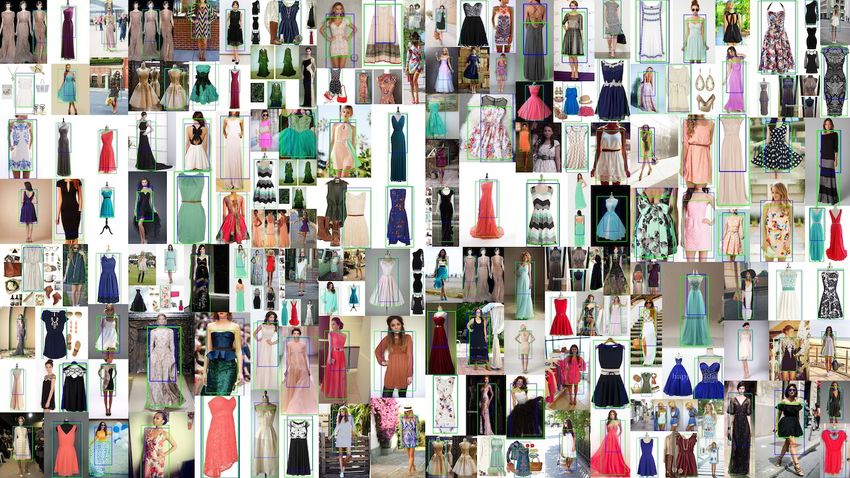
database images. To our knowledge, this is the first pub-
                                                                  lished work on object detection/localization in a commer-
                                                                  cially deployed visual search system.
                                                                     Our experiments demonstrate that 1) one can achieve very
                                                                  low false positive rate (less than 1%) with a decent detection
                                                                  rate by combining the object detection/localization meth-
                                                                  ods with metadata, 2) using feature representations from
                                                                  the VGG [22] [3] model significantly improves visual search
                                                                  accuracy on our Pinterest benchmark datasets, and 3) we
                                                                  observe significant gains in user engagement when visual
                                                                  search is used to power Related Pins and Similar Looks ap-
                                                                  plications.

                                                                  2.    VISUAL SEARCH ARCHITECTURE AT
                                                                        PINTEREST
                                                                     Pinterest is a visual bookmarking tool that helps users dis-
                                                                  cover and save creative ideas. Users pin images to boards,
                                                                  which are curated collections around particular themes or
                                                                  topics. This human-curated user-board-image graph con-
                                                                  tains rich information about the images and their semantic
                                                                  relationships. For example, when an image is pinned to a
                                                                  board, it implies a “curatorial link” between the new board
                                                                  and all other boards the image appears in. Metadata, such
                                                                  as image annotations, can then be propagated through these
                                                                  links to describe the image, the image board and the users.
                                                                     Since the image is the focus of each pin, visual features
                                                                  play a large role in finding interesting, inspiring and relevant
Figure 2: Related Pins is a product feature that                  content for users. In this section we describe the end-to-end
shows recommendations based on the Pinterest cu-                  implementation of a visual search system that indexes bil-
ration graph.                                                     lions of images on Pinterest. We address the challenges of
                                                                  developing a real-world visual search system that balances
                                                                  cost constraints with the need for fast prototyping. We de-
                                                                  scribe 1) the features that we extract from images, 2) our
ally expensive) task of multi-class object detection into cate-
                                                                  infrastructure for distributed and incremental feature ex-
gory classification followed by per-category object detection,
                                                                  traction, and 3) our real-time visual search service.
we only need to run (expensive) object detectors on images
with a high probability of containing the object. Section
2.2 presents our distributed pipeline to incrementally add or
                                                                  2.1    Image Representation and Features
update image features using Amazon Web Services, which               We extract a variety of features from images, including
avoids wasteful re-computation of unchanged image features.       local features and “deep features” extracted from the acti-
Section 2.3 presents our distributed indexing and search in-      vation of intermediate layers of deep convolutional neural
frastructure built on top of widely available tools.              networks (CNNs) [6]. We studied architectures based on
   Our second contribution is to share results of deploying       AlexNet [15] and VGG [22], extracting feature representa-
our visual search infrastructure in two product applications:     tions from fc6 and fc8 layers. These features are binarized
Related Pins (Section 3) and Similar Looks (Section 4). For       for representation efficiency and compared using Hamming
each application, we use application-specific data sets to        distance. We use the open-source Caffe [12] framework to
evaluate the effectiveness of each visual search component        perform training and inference of our CNNs on multi-GPU
(object detection, feature representations for similarity) in     machines.
isolation. After deploying the end-to-end system, we use             The system also extracts salient color signatures from im-
A/B tests to measure user engagement on live traffic.             ages. Salient colors are computed by first detecting salient
   Related Pins (Figure 2) is a feature that recommends Pins      regions [25, 4] of the images and then applying k-means clus-
based on the Pin the user is currently viewing. These rec-        tering to the Lab pixel values of the salient pixels. Cluster
ommendations are primarily generated from the “curation           centroids and weights are stored as the color signature of the
graph” of users, boards, and Pins. However, there is a long       image.
tail of less popular Pins without recommendations. Using
visual search, we generate recommendations for almost all         Two-step Object Detection and Localization
Pins on Pinterest. Our second application, Similar Looks          One feature that is particularly relevant to Pinterest is the
(Figure 1) is a discovery experience we tested specifically       presence of certain object classes, such as bags, shoes, watches,
for fashion Pins. It allows users to select a visual query        dresses, and sunglasses. We adopted a two-step detection
from regions of interest (e.g. a bag or a pair of shoes) and      approach that leverages the abundance of weak text labels
identifies visually similar Pins for users to explore or pur-     on Pinterest images. Since images are pinned many times
chase. Instead of using the whole image, visual similarity        onto many boards, aggregated pin descriptions and board
is computed between the localized objects in the query and        titles provide a great deal of information about the image.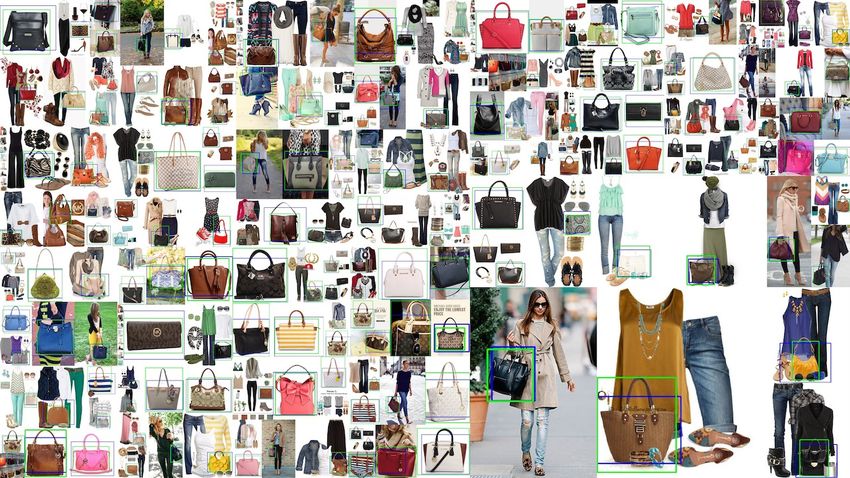
Figure 3: Instead of running all object detectors
on all images, we first predict the image categories
using textual metadata, and then apply object de-
tection modules specific to the predicted category.
                                                                    Figure 4: ROC curves for CUR prediction (left) and
                                                                    CTR prediction (right).
A text processing pipeline within Pinterest extracts relevant
annotations for images from the raw text, producing short
phrases associated with each image.                                 features learned from a much larger corpus than that of the
   We use these annotations to determine which object detec-        target task. We use Caffe to perform this transfer learning.
tors to run. In Figure 1, we first determined that the image           Figure 4 depicts receiver operating characteristic (ROC)
was likely to contain bags and shoes, and then we proceeded         curves for our CNN-based method, compared with a base-
to apply visual object detectors for those object classes. By       line based on a “traditional” computer vision pipeline: a
first performing category classification, we only need to run       SVM trained with binary labels on a pyramid histogram
the object detectors on images with a high prior likelihood         of words (PHOW), which performs well on object recogni-
of matching. This filtering step reduces computational cost         tion datasets such as Caltech-101. Our CNN-based approach
as well as false positives.                                         outperforms the PHOW-SVM baseline, and fine-tuning the
   Our initial approach for object detection was a heavily op-      CNN from end-to-end yields a significant performance boost
timized implementation of cascading deformable part-based           as well. A similar approach was also applied to the task of
models [8]. This detector outputs a bounding box for each           detecting pornographic images uploaded to Pinterest with
detected object, from which we extract visual descriptors for       good results 1 .
the object. Our recent efforts have focused on investigating
the feasibility and performance of deep learning based object       2.2   Incremental Fingerprinting Service
detectors [9, 10, 7].                                                 Most of our vision applications depend on having a com-
   Our experiment results in Section 4 show that our sys-           plete collection of image features, stored in a format amenable
tem achieved a very low false positive rate (less than 1%),         to bulk processing. Keeping this data up-to-date is challeng-
which was vital for our application. This two-step approach         ing; because our collection comprises over a billion unique
also enables us to incorporate other signals into the category      images, it is critical to update the feature set incrementally
classification. The use of both text and visual signals for ob-     and avoid unnecessary re-computation whenever possible.
ject detection and localization is widely used [2] [1] [13] for       We built a system called the Incremental Fingerprinting
Web image retrieval and categorization.                             Service, which computes image features for all Pinterest im-
                                                                    ages using a cluster of workers on Amazon EC2. It incre-
Click Prediction                                                    mentally updates the collection of features under two main
When users browse on Pinterest, they can interact with a            change scenarios: new images uploaded to Pinterest, and
pin by clicking to view it full screen (“close-up”) and subse-      feature evolution (features added/modified by engineers).
quently clicking through to the off-site source of the content        Our approach is to split the image collection into epochs
(a click-through). For each image, we predict close-up rate         grouped by upload date, and to maintain a separate feature
(CUR) and click-through rate (CTR) based on its visual fea-         store for each version of each feature type (global, local,
tures. We trained a CNN to learn a mapping from images              deep features). Features are stored in bulk on Amazon S3,
to the probability of a user bringing up the close-up view or       organized by feature type, version, and date. When the
clicking through to the content. Both CUR and CTR are               data is fully up-to-date, each feature store contains all the
helpful for applications like search ranking, recommendation        epochs. On each run, the system detects missing epochs for
systems and ads targeting since we often need to know which         each feature and enqueues jobs into a distributed queue to
images are more likely to get attention from users.                 populate those epochs.
   CNNs have recently become the dominant approach to                 This storage scheme enables incremental updates as fol-
many semantic prediction tasks involving visual inputs, in-         lows. Every day, a new epoch is added to our collection with
cluding classification [16, 15, 23, 3, 21, 14], detection [9, 10,   that day’s unique uploads, and we generate the missing fea-
7], and segmentation [18]. Training a full CNN to learn a           tures for that date. Since old images do not change, their
good representation can be time-consuming and requires a            features are not recomputed. If the algorithm or parameters
very large corpus of data. We apply transfer learning to            1
our model by retaining the low-level visual representations           By fine-tuning a network for three-class classification of
                                                                    ignore, softcore, and porn images, we are able to achieve a
from models trained for other computer vision tasks. The            validation accuracy of 83.2%. When formulated as a binary
top layers of the network are fine-tuned for our specific task.     classification between ignore and softcore/porn categories,
This saves substantial training time and leverages the visual       the classifier achieved a ROC AUC score of 93.6%.
for generating a feature are modified, or if a new feature is
added, a new feature store is started and all of the epochs
are computed for that feature. Unchanged features are not
affected.
We copy these features into various forms for more con-
venient access by other jobs: features are merged to form a
1. Find New Image fingerprint containing all available features of an image, and
Pinterest pin
Signatures database fingerprints are copied into sharded, sorted files for random
access by image signature (MD5 hash). These joined finger-
print files are regularly re-materialized, but the expensive
Signature Lists feature computation needs only be done once per image.
A flow chart of the incremental fingerprint update pro-
(initial epoch) sig/dt=2014-xx-xx/{000..999} cess is shown in Figure 5. It consists of five main jobs: job
(delta date epoch) sig/dt=2015-01-06/{000..004} (1) compiles a list of newly uploaded image signatures and
groups them by date into epochs. We randomly divide each
epoch into sorted shards of approximately 200,000 images
to limit the size of the final fingerprint files. Job (2) identi-
2. Enqueuer
fies missing epochs in each feature store and enqueues jobs
into PinLater (a distributed queue service similar to Ama-
work chunks zon SQS). The jobs subdivide the shards into “work chunks”,
tuned such that each chunk takes approximate 30 minutes to
3. Feature Computation Queue compute. Job (3) runs on an automatically-launched cluster
(20 - 600 compute nodes)
of EC2 instances, scaled depending on the size of the update.
Spot instances can be used; if an instance is terminated, its
work chunks recombined
job is rescheduled on another worker. The output of each
Individual Feature Files work chunk is saved onto S3, and eventually recombined into
color/dt=2014-xx-xx/{000..999}
feature files corresponding to the original shards.
(initial epoch)
deep/dt=2014-xx-xx/{000..999} Job (4) merges the individual feature shards into a unified
… fingerprint containing all of the available features for each
(delta date epoch) color/dt=2015-01-06/{000..004} image. Job (5) merges fingerprints from all epochs (along
deep/dt=2015-01-06/{000..004}
… with other metadata) into a sorted, sharded HFile format
allowing for random access (VisualJoins).
The initial computation of all available features on all im-
ages, takes a little over a day using a cluster of several hun-
4. Sorted Merge
for each epoch
dred 32-core machines, and produces roughly 5 TB of feature
data. The steady-state requirement to process new images
incrementally is only about 5 machines.
Fingerprint Files (all features)
2.3 Search Infrastructure
(initial epoch) merged/dt=2014-xx-xx/{000..999}
At Pinterest, there are several use cases for a distributed
(delta date epoch) merged/dt=2015-01-06/{000.004}
visual search system. One use case is to explore similar look-
ing products (Pinterest Similar Looks), and others include
near-duplicate detection and content recommendation. In
Other Visual Data Sources
5. VisualJoiner (visual annotations,
all these applications, visually similar results are computed
deduplicated signature, …) from distributed indices built on top of the VisualJoins gen-
erated in the previous section. Since each use case has a
different set of performance and cost requirements, our in-
VisualJoin frastructure is designed to be flexible and re-configurable. A
(Random Access Format)
flow chart of the search infrastructure is shown in Figure 6.
visualjoin/00000 As the first step we create distributed image indices from
…
visualjoin/01800
VisualJoins using Hadoop. Each machine contains indexes
(and features) associated with a randomly sharded subset of
the entire image collection. Two types of indexes are used:
the first is a disk-based (and partially memory cached) token
Figure 5: Examples of outputs generated by incre- index associating each vector-quantized feature (i.e. visual
mental fingerprint update pipeline. The initial run vocabulary token) with a posting list of image document IDs.
is shown as 2014-xx-xx which includes all the images This is analogous to a text-based image retrieval system, ex-
created before that run. cept text is replaced by visual tokens. The second index is
an in-memory store of visual features and metadata such as
image annotations and “topic vectors” computed from the
user-board-image graph. The first part is used for fast (but
imprecise) lookup, and the second part is used for more ac-
curate (but slower) ranking refinement.
VisualJoin

                                   FullM=VisualJoin/part-0000
                                   FullM=VisualJoin/part-0001
                                                ...

                                    Index Visual Features

     ( Shard by ImageSignature )

              Shard 1                       Shard 2                   Shard N

             Token Index                  Token Index                Token Index

            Features Tree                Features Tree              Features Tree
                                                                …

            Leaf Ranker 1                Leaf Ranker 2              Leaf Ranker N

                                             Merger

Figure 6: A flow chart of the distributed visual
search pipeline.                                                                    Figure 7: Before and after incorporating Visual Re-
                                                                                    lated Pins

   Each machine runs a leaf ranker, which computes the k
nearest neighbors from the indices using visual features, and                       rotation, translation, adding, deleting and altering minor
then re-ranks the top candidates using additional metadata.                         parts of the visual content. Since the resulting images look
In some cases, the leaf ranker skips the token index and                            visually identical to the query image, their recommenda-
directly retrieves the k nearest neighbor images from the                           tions are most likely relevant to the query image. In most
feature tree index using approximate KNN methods such                               cases, however, we found that there are either no near du-
as [19]. A root ranker hosted on another machine will re-                           plicates detected or the near duplicates do not have enough
trieve the top results from each of the leaf rankers, merge                         recommendations. Thus, we focused most of our attention
the results, and return them to the users. To handle new                            on retrieving visual search results generated from an index
fingerprints generated with our real-time feature extractor,                        based on CNN features.
we have an online version of the visual search pipeline where
a very similar process occurs. With the online version how-                         Static Evaluation of Search Relevance
ever, the given fingerprint is queried on pre-generated in-
dices.                                                                              Our initial Visual Related Pins experiment utilized features
                                                                                    from the original and fine-tuned versions of the AlexNet
                                                                                    model in its search infrastructure. However, recent successes
3.       APPLICATION 1: RELATED PINS                                                with deeper CNN architectures for classification led us to in-
   One of the first applications of Pinterest’s visual search                       vestigate the performance of feature sets from a variety of
pipeline was within a recommendations product called Re-                            CNN models.
lated Pins, which recommends other images a user may be                                To conduct evaluation for visual search, we used the im-
interested in when viewing a Pin. Traditionally, we have                            age annotations associated with the images as proxy for rel-
used a combination of user-curated image-to-board relation-                         evancy. This approach is commonly used for offline eval-
ships and content-based signals to generate these recommen-                         uation of visual search systems [20] in addition to human
dations. However, this system is unable to provide recom-                           evaluation. In this work, we used top text queries associ-
mendations for less popular Pins (which do not have many                            ated with each image as labels. We retrieved 3,000 images
connections) and newly created Pins (which may not have                             per query for 1,000 queries using Pinterest Search, which
been indexed yet). As a result, 6% of images at Pinterest                           yielded a dataset with about 1.6 million unique images. We
have very few or no recommendations. For these images, we                           labeled each image with the query that produced it. A vi-
used our visual search pipeline to generate Visual Related                          sual search result is assumed to be relevant to a query image
Pins in real time, as shown in Figure 7.                                            if the two images share a label.
   The first step of the Visual Related Pins product is to                             With this dataset, we computed precision@k for recom-
use the local token index built from all existing Pinterest                         mendations based on several features: the fc6 layer ac-
images to detect if we have near duplicates to the query im-                        tivations from the generic AlexNet model (pre-trained for
age. Specifically, given a query image, the system returns                          ILSVRC) [15], the fc6 activations of an AlexNet model fine-
a set of images that are variations of the same image but                           tuned to recognize over 3,000 Pinterest product categories,
altered through transformation such as resizing, cropping,                          the loss3/classifier activations of a generic GoogLeNet [23],
4.   APPLICATION 2: SIMILAR LOOKS
         Table 1: Relevance of visual search.
       Model              p@5 p@10 latency                             One of the most popular categories on Pinterest is women’s
       Generic AlexNet    0.051 0.040    193ms                      fashion. However, a large percentage of pins in this category
       Pinterest AlexNet  0.234 0.210    234ms                      do not direct users to a shopping experience, and therefore
       Generic GoogLeNet 0.223 0.202 1207ms                         are not actionable. There are two challenges towards making
       Generic VGG-16     0.302 0.269    642ms                      these Pins actionable: 1) Many pins feature editorial shots
                                                                    such as “street style” outfits, which often link to a website
                                                                    with little additional information on the items featured in
                                                                    the image; 2) Pin images often contain multiple objects (e.g.
                                                                    a woman walking down the street, with a leopard-print bag,
                                                                    black boots, sunglasses, torn jeans, etc.) A user looking at
                                                                    the Pin might be interested in learning more about the bag,
                                                                    while another user might want to buy the sunglasses.
                                                                       User research revealed this to be a common frustration,
                                                                    and our data indicated that users are much less likely to
                                                                    click through to the external Website on women’s fashion
                                                                    Pins, relative to other categories.
                                                                       To address this problem, we built a product called “Simi-
                                                                    lar Looks”, which localizes and classifies fashion objects (Fig-
                                                                    ure 9). We use object recognition to detect products such as
                                                                    bags, shoes, pants, and watches in Pin images. From these
Figure 8: Visual Related Pins increases total Re-                   objects, we extract visual and semantic features to generate
lated Pins repins on Pinterest by 2%.                               product recommendations (“Similar Looks”). A user would
                                                                    discover the recommendations via a red dot displayed on
                                                                    the object in the Pin (see Figure 1). Clicking on the red dot
and the fc6 activations of a generic VGG 16-layer model [3].        loads a feed of Pins featuring visually similar objects (e.g.
Table 1 shows p@5 and p@10 performance of these mod-                other visually similar blue dresses).
els, along with the average CPU-based latency of our vi-
sual search service, which includes feature extraction for the      Related Work
query image as well as retrieval. Using GPU-based infer-            Applying visual search to “soft goods” has been explored
ence dramatically reduces these latencies. We observed a            both within academia and industry. Like.com, Google Shop-
substantial gain in precision against our evaluation dataset        ping, and Zappos (owned by Amazon) are a few well-known
when using the FC6 features of the VGG 16-layer model,              applications of computer vision to fashion recommendations.
with an acceptable latency for our applications.                    Baidu and Alibaba also recently launched visual search sys-
                                                                    tems targeting similar problems. There is also a growing
Live Experiments                                                    amount of research on vision-based fashion recommenda-
We set up a system to detect new Pins with few recom-               tions [24, 17, 11]. Our approach demonstrates the feasibility
mendations, query our visual search system, and store their         of an object-based visual search system for tens of millions of
results in HBase to serve during Pin close-up.                      Pinterest users and exposes an interactive search experience
   For this application, we show visual search results when         around these detected objects.
a majority share a common category (category conformity             Static Evaluation of Object Localization
thresholding). We chose to trade off coverage for greater
precision in this manner to avoid using visual search when          The first step of evaluating our Similar Looks product was
we have relatively low confidence in its results.                   to investigate our object localization and detection capabil-
   We initially launched the experiment to 10% of eligible live     ities. We chose to focus on fashion objects because of the
traffic; users were eligible when they viewed a Pin close-up        aforementioned business need and because “soft goods” tend
that did not have enough recommendations. Eligible users            to have distinctive visual shapes (e.g. shorts, bags, glasses).
were triggered into either a treatment group (in which we              We collected our evaluation dataset by randomly sampling
replaced the Related Pins section with visual search results),      a set of images from Pinterest’s women’s fashion category,
or a control group (in which we did not alter the experience).      and manually labeling 2,399 fashion objects in 9 categories
We measured the change in total repin activity2 within the          (shoes, dress, glasses, bag, watch, pants, shorts, bikini, earn-
Related Pins section.                                               ings) on the images by drawing a rectangular crop over the
   By displaying visually similar pins for just the 6% of queries   objects. We observed that shoes, bags, dresses and pants
that would otherwise have empty recommendations, we ob-             were the four largest categories in our evaluation dataset.
served a 2% increase in total re-pin actions on Related Pins        Shown in Table 2 is the distribution of fashion objects as
(Figure 8). Furthermore, we performed another experiment            well as the detection accuracies from the text-based filter,
in which we reranked all recommendations using deep CNN             image-based detection, and the combined approach (where
feature similarity, achieving a 10% increase in re-pin and          text filters are applied prior to object detection).
click-through engagement.                                              As previously described, the text-based approach applies
                                                                    manually crafted rules, such as regular expressions, to the
2
 Repinning is the action of adding an existing Pinterest Pin        Pinterest metadata associated with images (which we treat
to a board. Repins are one of our standard top-line metrics         as weak labels). For example, an image annotated with
for measuring engagement.                                           “spring fashion, tote with flowers” will be classified as “bag,”
Figure 9: Once a user clicks on the red dot, the sys-               Figure 10: Engagement rates for Similar Looks ex-
tem shows products that have a similar appearance                   periment
to the query object.

                                                                    Live Experiments
Table 2:     Object detection/classification accuracy               Our system identified over 80 million “clickable” objects from
(%)                                                                 a subset of Pinterest images. A clickable red dot is placed
                    Text           Img            Both              upon the detected object. Once the user clicks on the dot,
 Objects     #      TP      FP     TP     FP      TP      FP        our visual search system retrieves a collection of Pins with
 shoe        873    79.8    6.0    41.8   3.1     34.4    1.0       other instances of the object class, ranked by visually sim-
 dress       383    75.5    6.2    58.8   12.3    47.0    2.0       ilarity to the query object. We launched the system to a
 glasses     238    75.2    18.8   63.0   0.4     50.0    0.2       small percentage of Pinterest live traffic and collected user
 bag         468    66.2    5.3    59.8   2.9     43.6    0.5       engagement metrics for one month. Specifically, we looked
 watch       36     55.6    6.0    66.7   0.5     41.7    0.0       at the clickthrough rate (CTR) of the dot, the CTR on our
 pants       253    75.9    2.0    60.9   2.2     48.2    0.1       visual search results, and we compared engagement on Sim-
 shorts      89     73.0    10.1   44.9   1.2     31.5    0.2       ilar Look results with the engagement on existing Related
 bikini      32     71.9    1.0    31.3   0.2     28.1    0.0       Pins recommendations.
 earrings    27     81.5    4.7    18.5   0.0     18.5    0.0          As shown in Figure 10, on average, 12% of users who
 Average            72.7    6.7    49.5   2.5     38.1    0.5       viewed a pin with a dot clicked on a dot in a given day.
                                                                    Those users went on to click an average of 0.55 Similar
                                                                    Looks results. Although this data was encouraging, when
                                                                    we compared engagement with all related content on the
and is considered as a positive sample if the image contains a      pin close-up (summing both engagement with Related Pins
“bag” object box label. For image-based evaluation, we com-         and Similar Look results for the treatment group, and just
pute the intersection between the predicted object bounding         Related Pins engagement for the control), Similar Looks ac-
box and the labeled object bounding box of the same type,           tually hurt overall engagement on the pin close-up by 4%.
and count an intersection over union ratio of 0.3 or greater        After the novelty effort wore off, we saw a gradual decrease
as a positive match.                                                in CTR on the red dots, which stabilized at around 10%.
   Table 2 demonstrates that neither text annotation filters           To test the relevance of our Similar Looks results indepen-
nor object localization alone were sufficient for our detection     dently of the newly introduced UI (the clickable object dots),
task due to their relatively high false positive rates at 6.7%      we ran an experiment in which we blended Similar Looks re-
and 2.5% respectively. Not surprisingly, combining two ap-          sults directly into the existing Related Pins. This gave us
proaches significantly decreased our false positive rate to less    a way to directly measure whether users found our visually
than 1%.                                                            similar recommendations more relevant than our existing
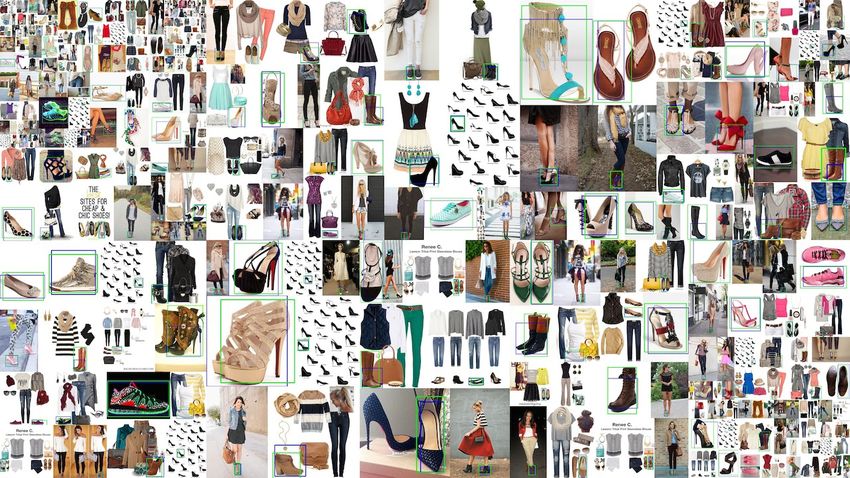
   Specifically, we saw that for classes like glasses, text anno-   non-visual recommendations. On pins where we detected an
tations were insufficient and image-based classification ex-        object, this experiment increased overall engagement (repins
celled (likely due to the distinctive shape of glasses). For        and close-ups) in Related Pins by 5%. Although we set an
other classes, such as dress, this situation was reversed (the      initial static blending ratio for this experiment (one visually
false positive rate for our dress detector was high, 12.3%, due     similar result for every three non-visual results), we later
to occlusion and high variance in style for that class, and         adjusted this ratio dynamically using user click data.
adding a text filter dramatically improved results). Aside
from reducing the number of images we needed to process
with our object classifiers, for several object classes (shoe,      5.   CONCLUSION AND FUTURE WORK
bag, pants), we observed that text filtering was crucial to           We demonstrate that, with the availability of distributed
achieve an acceptable false positive rate (under 1%).               computational platforms such as Amazon Web Services and
Figure 12: Samples of object detection and localization results for bags. [Green: ground truth, blue: detected
objects.]

                 Figure 13: Samples of object detection and localization results for shoes.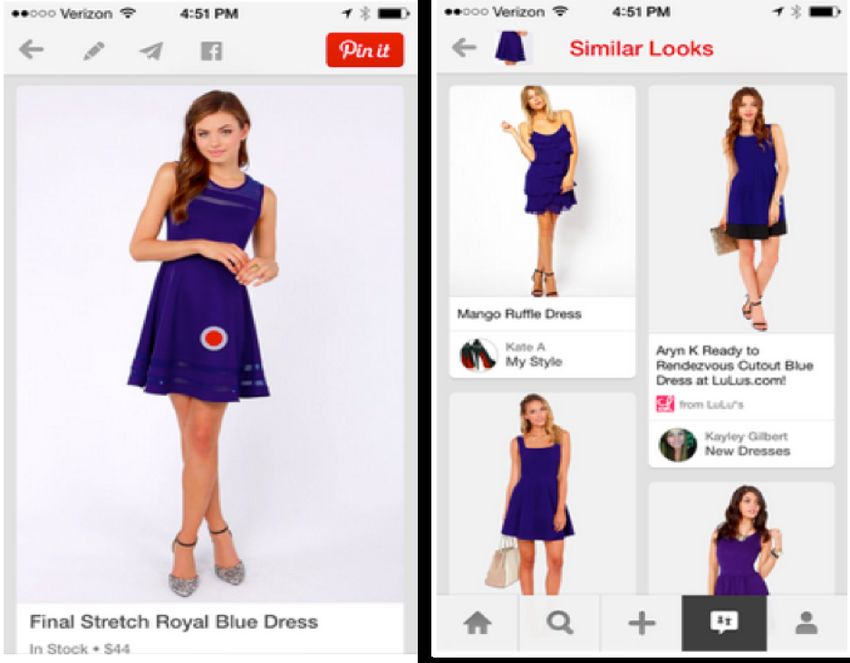
Figure 14: Samples of object detection and localization results for dresses

open-source tools, it is possible for a handful of engineers or          Transactions on Pattern Analysis and Machine
an academic lab to build a large-scale visual search system              Intelligence (T-PAMI), 2014.
using a combination of non-proprietary tools. This paper           [5]   R. Datta, D. Joshi, J. Li, and J. Wang. Image
presented our end-to-end visual search pipeline, including               retrieval: Ideas, influences, and trends of the new age.
incremental feature updating and two-step object detection               ACM Computing Survey, 40(2):5:1–5:60, May 2008.
and localization method that improves search accuracy and          [6]   J. Donahue, Y. Jia, O. Vinyals, J. Hoffman, N. Zhang,
reduces development and deployment costs. Our live prod-                 E. Tzeng, and T. Darrell. Decaf: A deep convolutional
uct experiments demonstrate that visual search features can              activation feature for generic visual recognition.
increase user engagement.                                                CoRR, abs/1310.1531, 2013.
   We plan to further improve our system in the following ar-      [7]   D. Erhan, C. Szegedy, A. Toshev, and D. Anguelov.
eas. First, we are interested in investigating the performance           Scalable object detection using deep neural networks.
and efficiency of CNN based object detection methods in the              In 2014 IEEE Conference on Computer Vision and
context of live visual search systems. Second, we are inter-             Pattern Recognition, CVPR 2014, Columbus, OH,
ested in leveraging Pinterest “curation graph” to enhance                USA, June 23-28, 2014, pages 2155–2162, 2014.
visual search relevance. Lastly, we want to experiment with        [8]   P. F. Felzenszwalb, R. B. Girshick, and D. A.
alternative interactive interfaces for visual search.                    McAllester. Cascade object detection with deformable
                                                                         part models. In The IEEE Conference on Computer
6.   REFERENCES                                                          Vision and Pattern Recognition (CVPR), pages
                                                                         2241–2248, 2010.
 [1] S. Bengio, J. Dean, D. Erhan, E. Ie, Q. V. Le,                [9]   R. Girshick, J. Donahue, T. Darrell, and J. Malik.
     A. Rabinovich, J. Shlens, and Y. Singer. Using web                  Rich feature hierarchies for accurate object detection
     co-occurrence statistics for improving image                        and semantic segmentation. arXiv preprint
     categorization. CoRR, abs/1312.5697, 2013.                          arXiv:1311.2524, 2013.
 [2] T. L. Berg, A. C. Berg, J. Edwards, M. Maire,                [10]   K. He, X. Zhang, S. Ren, and J. Sun. Spatial pyramid
     R. White, Y.-W. Teh, E. Learned-Miller, and D. A.                   pooling in deep convolutional networks for visual
     Forsyth. Names and faces in the news. In Proceedings                recognition. In Transactions on Pattern Analysis and
     of the Conference on Computer Vision and Pattern                    Machine Intelligence (T-PAMI), pages 346–361.
     Recognition (CVPR), pages 848–854, 2004.                            Springer, 2014.
 [3] K. Chatfield, K. Simonyan, A. Vedaldi, and                   [11]   V. Jagadeesh, R. Piramuthu, A. Bhardwaj, W. Di, and
     A. Zisserman. Return of the devil in the details:                   N. Sundaresan. Large scale visual recommendations
     Delving deep into convolutional nets. In British                    from street fashion images. In Proceedings of the
     Machine Vision Conference, 2014.                                    International Conference on Knowledge Discovery and
 [4] M. Cheng, N. Mitra, X. Huang, P. H. S. Torr, and                    Data Mining (SIGKDD), 14, pages 1925–1934, 2014.
     S. Hu. Global contrast based salient region detection.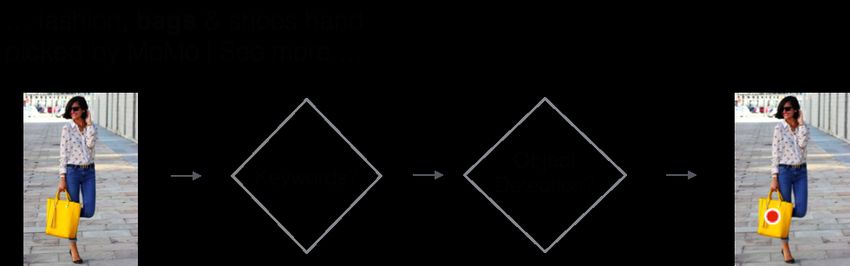
[12] Y. Jia, E. Shelhamer, J. Donahue, S. Karayev,
                                                            J. Long, R. Girshick, S. Guadarrama, and T. Darrell.
                                                            Caffe: Convolutional architecture for fast feature
                                                            embedding. arXiv preprint arXiv:1408.5093, 2014.
                                                       [13] Y. Jing and S. Baluja. Visualrank: Applying pagerank
                                                            to large-scale image search. IEEE Transactions on
                                                            Pattern Analysis and Machine Intelligence (T-PAMI),
                                                            30(11):1877–1890, 2008.
                                                       [14] A. Karpathy, G. Toderici, S. Shetty, T. Leung,
                                                            R. Sukthankar, and L. Fei-Fei. Large-scale video
                                                            classification with convolutional neural networks. In
                                                            2014 IEEE Conference on Computer Vision and
                                                            Pattern Recognition (CVPR), pages 1725–1732, 2014.
                                                       [15] A. Krizhevsky, S. Ilya, and G. E. Hinton. Imagenet
                                                            classification with deep convolutional neural networks.
                                                            In Advances in Neural Information Processing Systems
                                                            (NIPS), pages 1097–1105. 2012.
                                                       [16] Y. LeCun, B. Boser, J. S. Denker, D. Henderson,
                                                            R. E. Howard, W. Hubbard, and L. D. Jackel.
                                                            Backpropagation applied to handwritten zip code
                                                            recognition. Neural Comput., 1(4):541–551, Dec. 1989.
                                                       [17] S. Liu, Z. Song, M. Wang, C. Xu, H. Lu, and S. Yan.
                                                            Street-to-shop: Cross-scenario clothing retrieval via
                                                            parts alignment and auxiliary set. In Proceedings of
                                                            the IEEE Conference on Computer Vision and
                                                            Pattern Recognition (CVPR), 2012.
                                                       [18] J. Long, E. Shelhamer, and T. Darrell. Fully
                                                            convolutional networks for semantic segmentation.
                                                            arXiv preprint arXiv:1411.4038, 2014.
                                                       [19] M. Muja and D. G. Lowe. Fast matching of binary
                                                            features. In Proceedings of the Conference on
                                                            Computer and Robot Vision (CRV), 12, pages
                                                            404–410, Washington, DC, USA, 2012. IEEE
                                                            Computer Society.
                                                       [20] H. Müller, W. Müller, D. M. Squire,
                                                            S. Marchand-Maillet, and T. Pun. Performance
                                                            evaluation in content-based image retrieval: Overview
                                                            and proposals. Pattern Recognition Letter,
                                                            22(5):593–601, 2001.
                                                       [21] O. Russakovsky, J. Deng, H. Su, J. Krause,
                                                            S. Satheesh, S. Ma, Z. Huang, A. Karpathy,
                                                            A. Khosla, M. Bernstein, et al. ImageNet large scale
                                                            visual recognition challenge. arXiv preprint
                                                            arXiv:1409.0575, 2014.
                                                       [22] K. Simonyan and A. Zisserman. Very deep
                                                            convolutional networks for large-scale image
                                                            recognition. CoRR, abs/1409.1556, 2014.
                                                       [23] C. Szegedy, W. Liu, Y. Jia, P. Sermanet, S. Reed,
                                                            D. Anguelov, D. Erhan, V. Vanhoucke, and
                                                            A. Rabinovich. Going deeper with convolutions. arXiv
                                                            preprint arXiv:1409.4842, 2014.
                                                       [24] K. Yamaguchi, M. H. Kiapour, L. Ortiz, and T. Berg.
                                                            Retrieving similar styles to parse clothing.
                                                            Transactions on Pattern Analysis and Machine
                                                            Intelligence (T-PAMI), 2014.
                                                       [25] Q. Yan, L. Xu, J. Shi, and J. Jia. Hierarchical saliency
Figure 11: Examples of object search results for            detection. In Proceedings of the IEEE Computer
shoes. Boundaries of detected objects are automati-         Society Conference on Computer Vision and Pattern
cally highlighted. The top image is the query image.        Recognition (CVPR), 13, pages 1155–1162,
                                                            Washington, DC, USA, 2013.
You can also read


