White Paper on International Economy and Trade 2018 Outline - July 10, 2018 Trade Policy Bureau, Ministry of Economy, Trade and Industry
←
→
Page content transcription
If your browser does not render page correctly, please read the page content below
White Paper on International
 Economy and Trade 2018
         [Outline]

              July 10, 2018
          Trade Policy Bureau,
Ministry of Economy, Trade and Industry
Table of Contents
Part 1 Global economy
Chapter 1 Recent trends in the global economy and Japan’s external trade and
investment
Chapter 2 Economic trends and external economic policies in major
countries/regions
Part 2 Analysis: Significant shift in the global economy
Chapter 1 Expanding digital trade
Chapter 2 Rise of emerging and developing economies
Section 1 Changes in the roles of emerging and developing countries in the global economy
Section 2 Response to global excess production capacity
Chapter 3 Rapid change in the Chinese economy
Section 1 Macroeconomic trends
Section 2 Advance of new industries
Section 3 External trade and investment
Section 4 Business opportunities for Japanese companies
Part 3 Policies
Chapter 1 Development of free, fair and high-level trade rules
Section 1 Progress in mega-FTAs (TPP11, Japan-EU EPA, RCEP, etc.)
Section 2 Investment-related treaties
Section 3 Japan-U.S. economic relations
Section 4 WTO
Section 5 G7/G20 and OECD
Section 6 APEC
Chapter 2 Emerging country strategy (China, ASEAN/Asia-Pacific, India, Russia,
the Middle East, and Africa)
Chapter 3 Comprehensive trade policy
Section 1 Promotion of utilization of economic partnership agreements
Section 2 Consortium for New Export Nation
Section 3 Food exports 1Expanding digital trade Part 2 Chapter 1 Expanding digital trade
The scale of the global cross-border e-commerce (EC) market is expected to grow in
value from 236.0 billion dollars in 2014 to 994.0 billion dollars in 2020.
The number of cross-border EC users is expected to rise from around 300 million
people to more than 900 million people over the same period.
The domestic business-to-commerce (B2C) EC market is also expanding. In 2016,
China was already the global No. 1 in terms of both the scale of the internet retail sales
market (with a value of 939.4 billion dollars) and EC ratio (19%) .
Scale of the global cross-border EC market
(1 billion Others (100 million
North America people)
Western Europe 9.4 The scale of the global cross-border
1,200 Asia-Pacific 10
EC market, which was 236.0 billion
8.5
Number of cross-border EC users (right axis) 9
994 dollars in 2014, has continued
1,000 7.5 expanding since then and is
8
826 expected to reach 994.0 billion
7
800 Estimate 5.8 dollars in 2020.
6… 6
600 4.5 5 The number of cross-border EC
530
3.6 users, which was around 300
3.1 4
401 million people in 2014, is expected
400
308 3 to approximately triple to 900
236 million people in 2020.
2
200
1
0 0
2014 2015 2016 2017 2018 2019 2020
Remarks: Estimated figures
Source: Accenture and Alibaba Research (2015).
EC ratio, growth rate, and value of B2C EC market
by country (unit: 100 million dollars)
The scale of the global B2C EC
market in 2016 expanded 122% in
value from the previous year to
around 2.4 trillion dollars.
By region, China is the largest EC
market, accounting for around 40%
of the global market value.
The growth rate for China is higher
than the rate for the United States,
the second-largest market, so China
is expected to continue to lead the
global EC market.
Remarks: The size of the circle corresponds to the scale of the EC market. The figures above
China is also the global leader in
are for 2016. However, the market scale and the EC ratio in the Middle East/Africa region are terms of EC ratio (19%).
figures for 2014 and the annual average growth rate in the region is a figure for 2014-2025.
Source: Prepared on the basis of interviews with eMaketer and Transcosmos 2Part 2 Chapter 1 Expanding digital trade
Advance of IT platform providers
While companies in such sectors as energy, banking and telecommunications
dominated the top rankings of companies in terms of market capitalization 10
years ago, IT platform providers have advanced in the rankings. Six of the top
ten companies are now IT platform providers.
Global rankings of companies in terms of market capitalization
2008
In line with the expansion of digital trade,
Market
capitaliz global companies providing IT platforms
# Company name Country Sector ation (1 for EC and cloud computing services are
million
dollars) increasing their presence.
China National Petroleum
1 China Oil/gas 723,998
Corporation
2 Exxon Mobil Corporation U.S. Oil/gas 511,887 A decade ago, in 2008,
telecommunications companies, as well
General Electric Industrial
3 U.S. 374,637 as banks, and oil and gas companies, led
Company conglomerates
Wireless
the rankings, as businesses providing
Hong
4 China Mobile
Kong
communication 354,245 telecommunication infrastructure tended
service
Industrial and to be highly valued in terms of market
5 Commercial Bank of China Banking 339,004 capitalization against the backdrop of a
China Limited
6 Microsoft Corporation U.S. Software 333,054 marked rise in the diffusion rate of
7 Gazprom Russia Oil/gas 331,964 mobile phones. However, in recent years,
Netherla
8 Royal Dutch Shell plc
nds
Oil/gas 264,764 online services provided through
Wireless information and communication
9 AT&T Inc. U.S. communication 252,051
networks have risen in prominence.
service
China Petroleum and
10 China Oil/gas 249,659
Chemical Corporation
2018
In the global top 10 rankings in terms of
Market market capitalization as of January 2018,
capitalization Apple was No. 1, followed by other U.S.
# Company name Country Sector
(1 million
dollars)
and Chinese IT platform companies, such
Compute as Alphabet (Google), Amazon,
1 Apple Inc. U.S. r 825,593
hardware Facebook, Tencent, and Alibaba.
Online
2 Alphabet Inc. U.S. 731,933
services
Microsoft
3 U.S. Software 686,283
Corporation
Departm
4 Amazon.com, Inc. U.S. ent 671,084
stores
Online
5 Facebook, Inc. U.S. 512,471
services
Online
6 Tencent China 497,697
services
Berkshire Casualty
7 U.S. 491,154
Hathaway Inc. insurance
Alibaba Group Online
8 China 454,451
Holding Limited services
JPMorgan Chase &
9 U.S. Banking 387,707
Co.
Industrial and
10 Commercial Bank China Banking 354,750
of China Limited
Remarks: The above figures are as of February 12, 2008 and January 1, 2018
Source: Thomson Reuters 3Challenges for digital trade Part 2 Chapter 1 Expanding digital trade
Data protectionist moves are increasing, including data localization regulation,
requirement for the adoption of mandatory security standards, and requirement for
source code disclosure that impedes free cross-border data flow.
If new regulations related to data are introduced, the GDP of that country is expected
to be negatively impacted.
Other challenges include how to secure an environment of fair competition between
IT platform providers and existing industries and how to ensure the protection and
safety of consumers.
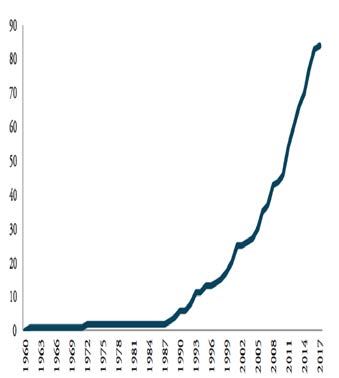
Changes in the number of Number of regulations related to
regulations related to cross-border cross-border data flow
data flow (1960 to 2017) (by region/country) (as of 2017) The promotion of the free flow of
information is developing a
Number of
regulations
Share favorable cycle that is creating new
Europe 37 42.5% technical innovations and business
Germany 5 5.7% models and is improving the quality
Russia 5 5.7% of people’s lives.
Asia-Pacific 33 37.9%
China 9 10.3% On the other hand, digital
Middle East/Africa 7 8.0% protectionist moves are also
North America 6 6.9%
emerging, including imposing
Canada 5 5.7%
restrictions on the free flow of
U.S. 1 1.1% cross-border data and the
Central and South installation locations of servers.
4 4.6%
America
Total 87 100.0% National regulations related to
Remarks: The number of regulations which were in cross-border data flow have
Remarks: The years represents the timings of force in 2017. The countries indicated above (except
entry-into-force and revision of regulations.
for the United States) had more than five regulations.
increased rapidly over the past 20
Based on a survey by ECIPE.
Source: ECIPE and Digital Trade Estimates Source: ECIPE and Digital Trade Estimates years.
Impact on GDP from introducing data usage regulations
(%)
0
-0.2
-0.4 If a country introduces cross-
-0.6 sectoral data localization regulation,
-0.8 -0.7 its GDP is estimated to suffer a
-1 -0.8 -0.8
negative impact ranging from minus
-1.2 -1.1 -1.1 -1.1 0.7% to minus 1.7% due to such
-1.4
factors as a domestic price increase
-1.6
and a productivity decline caused by
-1.8 -1.7
Brazil China EU28 India Indonesia ROK Viet Nam
an increase in the usage cost of data
Remarks: The above figures are estimates based on the assumption of the introduction of data usage processing services.
regulations, including data localization, in all sectors in each country.
Source: Prepared by METI from “The Cost of Data Localization: Friendly Fire on Economic
Recovery” (ECIPE).
4Part 2 Chapter 2 Rise of emerging and developing economies
Rise of emerging and developing economies
Since around 2000, emerging and developing economies, especially
China, have led global economic growth.
The share of emerging and developing economies in global GDP is
becoming around 40%.
Changes in the global GDP growth rate
(in terms of contribution by country/region)
(1990 -2017)
(%) Advanced countries 世界のGDP成長率の推移(国・地域別寄与度) China
Emerging and developing countries (excluding China) Real gowth rate of global GDP
6
Concerning the contribution to the
5
real growth rate of global GDP by
4 country/region, the contribution by
3 advanced countries has been
gradually declining since around
2
2000, while the contribution by
1
emerging and developing countries,
0 including China, has been
1981
1982
1983
1984
1985
1986
1987
1988
1989
1990
1991
1992
1993
1994
1995
1996
1997
1998
1999
2000
2001
2002
2003
2004
2005
2006
2007
2008
2009
2010
2011
2012
2013
2014
2015
2016
2017
-1
increasing.
-2
-3
Remarks: The contribution by country/region is an estimate based on each country/region’s share
in nominal GDP in the previous year.
Source: Prepared by METI based on the database of World Economic Outlook, April 2018 (IMF)
Changes in the share of emerging and developing countries
in nominal global GDP (Between 1980 and 2017)
(1 trillion dollars)
90 45%
China
80 Emerging and developing countries (excluding China) 40% Nominal global GDP has been
Advanced countries
70
World
35%
growing steadily despite temporary
Share of emerging and developing countries (including China) (right axis)
drops due to the Great Recession,
60 30% among other factors. The share of
50 25%
emerging and developing countries
in nominal global GDP has been
40 20%
increasing since the middle of the
30 15% 2000s and has recently surpassed
40%.
20 10%
10 5%
0 0%
Remarks: Nominal GDP is on a U.S. dollar basis.
Source: Prepared by METI based on the database of World Economic Outlook, April 2018 (IMF)
5Features of economic growth of emerging Part 2 Chapter 2 Rise of emerging and developing economies
and developing economies
In emerging and developing economies, fixed capital formation has accelerated since around
2003, and in 2016, it has reached 9.5 trillion dollars, almost the same value as in industrialized
economies. The average contribution to the real growth rate of GDP was 36% between 2003 and
2016.
In line with the growth in fixed capital formation, emerging and developing economies have
significantly increased the production capacity of the raw materials industry, providing a contrast
to the lack of growth in industrialized economies. Global production capacity for crude steel in
2017 was more than double the level in 2000.
Changes in the value of fixed capital formation (on a flow basis)
in developed and developing economies
Share of emerging and developing countries (including China)
12
Fixed capital formation (in terms of
1 trillion dollars
10
the value of domestic investments)
in emerging and developing
8 economies has been growing since
6
2000, and in 2016, it reached 9.5
trillion dollars, almost the same
4 value as the value in advanced
countries.
2
0
1980 1982 1984 1986 1988 1990 1992 1994 1996 1998 2000 2002 2004 2006 2008 2010 2012 2014 2016
Source: UN national accounts main aggregates data (December 2017)
Remarks: The classification of advanced, emerging and developing countries is based on the definition in the IMF WEO.
Breakdown of the contribution by emerging and developing
economies to the real growth rate of GDP by expenditure item
3.5%
Gross capital formation Final consumption expenditure Since 2003 in particular, the
Net export Nominal GDP
3.0% contribution by emerging and
2.5%
developing economies in terms of
fixed capital formation has been
2.0%
significant.
1.5%
1.0%
0.5%
0.0%
1980
1981
1982
1983
1984
1985
1986
1987
1988
1989
1991
1992
1993
1994
1995
1996
1997
1998
1999
2000
2001
2002
2003
2004
2005
2006
2007
2008
2009
2010
2011
2012
2013
2014
2015
2016
-0.5%
Remarks: Real GDP data in 1990 was excluded because statistical data concerning NIS countries were newly
-1.0%
added, a factor that overrepresents the growth rate.
Source: UN national accounts main aggregates data (December 2017)
While production capacity for crude
steel has stayed at around 600
Changes in global production capacity for crude steel
1 million tons
million tons in developed economies
2500
Advanced countries over the past 17 years, capacity in
Emerging and developing countries (excluding China) emerging and developing economies
China
2000 as a whole has continued to grow. In
2017, global production capacity
1500 increased to 2,300 million tons,
around 2.3 times as large as the
1000 capacity in 2000.
500 Among emerging and developing
economies, China has increased its
0 production capacity markedly.
2000 2001 2002 2003 2004 2005 2006 2007 2008 2009 2010
Remarks: The definition of advanced countries is based on the IMF’s definition.
Source: OECD Stat
2011 2012 2013 2014 2015 2016
6Chronology of the excess production capacity Part 2 Chapter 2 Rise of emerging and developing economies
in China’s steel industry
(i) Period of “imports surpassed exports”: Production capacity for crude steel
expanded through the use of loans from state-owned local banks, while the profit
margin increased
(ii) Period of “exports surpassed imports”: The expansion of production capacity
continued, but the profit margin declined. Subsidies started to increase.
(iii) After the reduction of production capacity for crude steel: The profit margin
showed signs of improving.
The development of the Chinese steel industry (2001-2016)
(i) Between 2001 and 2005, China
Long-term Subsidy Production capacity (ii) (iii) (%)
loan (1 billion (1 billion and net exports
(i) recorded steel import surpluses. As
dollars) dollars) (10 million tons)
5 2 20 The profit margin declined. 15 banks increased low-interest loans and
Production capacity expanded through
loans and the profit margin increased. steel companies expanded production
capacity, the return on assets (ROA)
10 rose from 7% in 2001 to 14% in 2004.
2.5 1 10
5 (ii) Since 2006, China has recorded
steel export surpluses, but loans and
0 0 0 0 production capacity expansion have
continued.
Long-term loans (change from the previous -5
From 2008 onward, the ROA for steel
year) companies stayed below 5%.
-2.5 -1 -10 Production capacity for crude steel (change
Around 20 to 70% of
from the previous year) companies recorded losses, Subsequently, the steel market slumped.
Governmental subsidies (fiscal year) and subsidies increased. -10
In 2012, around half of all listed steel
Net exports of crude steel from China Production capacity for
crude steel decreased. companies recorded operating losses,
-5 -2 Monetary tightening
-20 -15 and in 2015, around 70% did so. In both
2001 2002 2003 2004 2005 2006 2007 2008 2009 2010 2011 2012 2013 2014 2015 2016
years, governmental subsidies increased
Sources: Production capacity: National Bureau of Statistics of China and CEIC Database; net exports of crude steel: World steeply.
Steel Association; long-term loan and government subsidy: annual reports of 33 listed Chinese steel companies.
(iii) In February 2016, the central
government set the target for the
reduction of production equipment and
strictly managed the implementation of
the target. As a result, the target was
achieved in 2016 and 2017.
Targets for the reduction of crude steel production equipment in China and the results
In response to the G20 Leaders’
2016 2017 2018 Communique at the Hangzhou Summit
Long-term target
Target Result Target Target in 2016, the Global Forum on Steel
Reduction of 100 to 150 million Approx. 50 million Approx. 30 million Excess Capacity was established.
45 million tons 65 million tons Through the forum, information is
tons over five years from 2016 tons tons
exchanged with respect to production
Remarks: The target for 2017 was reportedly achieved. capacity for crude steel and
Source: The government work report issued at the National People’s Congress, etc. governmental support measures in
individual countries.
7Trends by corporate ownership type Part 2 Chapter 2 Rise of emerging and developing economies
Most loans from state-owned banks and support measures such as governmental subsidies are
provided to steel companies owned/controlled by local governments, whose operational
efficiency is relatively low.
Changes in the balance of long-term loans at Chinese steel companies
(1 billion dollars) (33 listed companies)
25
Grand total Support measures such as loans to
State-owned (owned/controlled by the central production equipment investment in
government)
20 State-owned (owned/controlled by local steel companies and government
governments)
Private companies subsidies, provided in response to
the sluggish business performance
15
since 2012, have been allocated
mainly to companies
10 owned/controlled by local
governments.
5
Most loans and governmental
subsidies have been allocated to
0 steel companies owned/controlled
2000 2001 2002 2003 2004 2005 2006 2007 2008 2009 2010 2011 2012 2013 2014 2015 2016 2017
Remarks: As of the end of 2016, there were 5 companies owned/controlled by the central government, 21 companies by local governments, according to
owned/controlled by local governments, and 7 private companies.
Source: Annual reports of 33 listed Chinese steel companies
a comparison of three groups—
companies owned/controlled by the
Changes in the value of subsidies received by Chinese steel companies central government, companies
(1 million dollars) (33 listed companies) owned/controlled by local
1,200
Grand total governments, and private companies.
1,000 State-owned (owned/controlled by the central
government)
State-owned (owned/controlled by local governments) However, the allocation of loans
800 Private companies
and subsidies has not necessarily
contributed to any improvement of
600 the companies’ profitability or value
added. In particular, despite the
400 intensive support they received,
management capability of
200 companies owned/controlled by
local governments has not improved,
0
2000 2001 2002 2003 2004 2005 2006 2007 2008 2009 2010 2011 2012 2013 2014 2015 2016 2017
with their ROA remaining lower
than other groups’ ROA.
Remarks: As of the end of 2016, there were 5 companies owned/controlled by the central government, 21 companies
owned/controlled by local governments, and 7 private companies.
The return on assets (ROA) for Chinese steel companies
(by corporate ownership type)
(%) Grand total
20
State-owned (owned/controlled by the central government)
State-owned (owned/controlled by local governments)
15 Private companies
10
5
0
2000 2001 2002 2003 2004 2005 2006 2007 2008 2009 2010 2011 2012 2013 2014 2015 2016 2017
-5
-10
Remarks 1: As of the end of 2016, there were 5 companies owned/controlled by the central government, 21 companies
owned/controlled by local governments, and 7 private companies.
Source: Annual reports of 33 listed Chinese steel companies. 8Part 2 Chapter 2 Rise of emerging and developing economies
Possibility of a new excess capacity
China’s integrated circuit (IC) industry has rapidly increased capital investment
through governmental support. This is similar to the situation in the period (i)
“imports surpassed exports” in the steel industry, but capital investment has not yet
led to a profitability improvement.
As a new support tool, industry development funds have emerged.
There is a risk that an excess production capacity problem may occur in the future.
In 2014, the Chinese government
Increase in the value of fixed assets, value of governmental subsidies,
formulated the National IC
and profit margin of IC-related companies Development Guidelines.
(1 million dollars) The value of investments by the National IC Industry Development Fund (fiscal year)
6,000 Value of governmental subsidies (fiscal year) 4 Based on the guidelines, a national
Value of fixed assets (change from the previous year)
Long-term loan (change from the previous year)
3.5
investment fund specialized in support
ROA (return on assets) (right axis)
5,000
(%) for the IC industry (National IC
3 Industry Investment Fund) was
4,000 established in the same year, and the
2.5
fund has invested around 4 billion
3,000 2 dollars annually in IC-related
companies.
2,000 1.5
1
As a result, in addition to governmental
1,000 subsidies and companies’ borrowings,
0.5 policy resources including investments
0 by investment funds have increased
0
rapidly since 2014. In line with the
-1,000 -0.5 increase, the value of fixed assets rose
2009 2010 2011 2012 2013 2014 2015 2016 2017 steeply between 2015 and 2017.
Remarks 1: The ROA is obtained by dividing the total value of operating profits of the 19 IC-related listed companies
in China by the total value of assets. The ROA in 2009 was -12.4%.
Source: Annual reports of the 19 IC-related listed companies in China. On the other hand, the return on assets
for companies continued to decline in
the same period.
This trend in the Chinese IC industry is
similar to the situation of the Chinese
Changes in the number of industry investment funds
and the total fund value steel industry in the period of net
(Number of funds)
1,800
(100 million yuan)
9,000
import, so there are concerns that an
excess production capacity problem
1,600 8,000 may occur in the IC industry as well in
Number of funds (cumulative total) (right axis)
Total fund value (100 million yuan)
the future.
1,400 7,000
In recent years, industry investment
1,200 6,000
funds such as the National IC Industry
1,000 5,000 Development Fund have played a
particularly significant role as policy
800 4,000 fund sources.
600 3,000
Since around 2014, the number and
400 2,000 value of those funds have increased
rapidly, and the funds’ presence as the
200 1,000 main policy fund source in China is
growing.
0 0
2013 2014 2015 2016 August 2017
Source: Database of Zero2IPO Group "Si Mu Tong"
9Comparison between Japan and China Part 2 Chapter 2 Rise of emerging and developing economies
in terms of governmental support
There is a large difference between the IC industry promotion measures in Japan and
China in terms of the scale of governmental support.
The Chinese government’s subsidies for those companies are equivalent in value to
around 2 to 4% of their sales. Meanwhile, the ROA shows a downward trend.
The Japanese government’s subsidies for those companies are equivalent in value to
less than 0.6% of their sales, at most. Meanwhile, the ROA shows an upward trend.
China
ROA (return on assets) Ratio of the value of governmental subsidies to sales
10
(%)
9
Notice concerning policy related to the Guidelines to Promote National IC
promotion of development of the IC Industry Development (State
The Chinese government’s subsidies for
8
industry (State Council; 2011) Council; 2014)) companies are equivalent in value to
→Enhancement of financial support, →Establishment of funds
7
including subsidies and loan interest →Enhancement of loans
around 2 to 4% of their sales.
6 discounts, etc. →Enhancement of financial support
,etc.
Meanwhile, the ROA is trending
5
downward.
4
3
2
1
0
2008 2009 2010 2011 2012 2013 2014 2015 2016 2017
Remarks 1: The ROA is the figure obtained by dividing the total value of operating
profits of the 19 IC-related listed companies in China by the total value of assets.
Remarks 2: The ROA was -4.3% in 2008 and -12.4% in 2009.
Source: Annual reports of the 19 IC-related listed companies in China.
(%) Japan
ROA (return on assets)
10 The ratio of miscellaneous revenue to sales
The value of governmental
9 The ratio of the value of governmental subsidies to sales of the Super LSI Technology Research
investments in the Super LSI
Association
8 Technology Research Association
7 was 29.0 billion yen.
6
The value of governmental subsidies
5 for companies before and after the
4 implementation period of the
Implementation period association’s project in Japan was
3 of the project under the equivalent to less than 0.6% of their
Super LSI Technology
2 Research Association sales at most.
1
Meanwhile, the ROA is trending
0
upward.
1971 1972 1973 1974 1975 1976 1977 1978 1979 1980 1981 1982 1983 1984
Remarks 1: Data was obtained from the five companies that participated in the Super LSI Technology Research
Association (excluding joint venture companies).
Remarks 2: The ROA is the figure obtained by dividing the total value of operating profits of the five companies
by the total value of assets.
Remarks 3: Regarding "miscellaneous revenue ("others")", figures in the non-operating revenue column of the
profit and loss statement were used.
Remarks 4: The ratio of the value of governmental subsidies to sales for the Super LSI Technology Research
Association is the figure obtained by dividing by four the total value of governmental subsidies in the four-year
project period, which was 29 billion yen, and then dividing the figure thus obtained by the total sales figure of
the five companies.
Source: Securities reports of the five companies that participated in the Super LSI Technology Research 10
Association (excluding joint venture companies)Change in the driver of China’s economic growth Part 2 Chapter 3 Rapid change in the Chinese economy
Section 1 Macroeconomic trends
In China, consumption has replaced gross capital formation as the largest
contributor to GDP growth. The economy is gradually shifting from the previous
investment-led growth to a consumption-led one.
By industry, the contribution by the information transmission, software and
information technology services industries, which are growth industries, grew
26% in 2017 compared with the previous year.
Changes in the contribution by GDP components
to China’s real GDP growth rate
If GDP is looked at from the
(%) Net exports turned to
20 viewpoint of demand, the share of
Net exports
negative growth, but capital
Lehman Shock formation made up for that. exports in GDP has declined since the
Gross capital (Sept. 2008)
15
formation
Final consumption
Great Recession and the share of
GDP Gross capital formation
gross capital formation has decreased
since the 4-trillion-yuan economic
10
package, while the share of final
consumption has been growing
5
moderately.
0 If these trends are examined based on
Consumption the breakdown of contributions to the
-5 real GDP growth rate, the
Net exports contribution by investment has
-10 declined since the Great Recession,
2000 2001 2002 2003 2004 2005 2006 2007 2008 2009 2010 2011 2012 2013 2014 2015 2016 2017 while consumption has become the
Remarks: Regarding the contribution by final consumption, a breakdown of the consumption into government and private consumption is not
published. main driver of growth. In that sense,
Source: The National Bureau of Statistics of China and CEIC database.
the economy is gradually shifting
from investment-led growth to
consumption-led growth.
Real GDP growth rate by industry in China (2017)
(%) A look at the real GDP growth rate by
30 industry in China in 2017 shows that
26.0%
25 the information transmission,
software and information technology
20 services industry recorded an
15
outstandingly high growth rate of
26.0%.
10
6.9%
5
0
communication…
Overall
manufacturing
telecommunications…
Accommodation and…
Construction
Finance
Wholesale and retail
Real estate
Others
Business services
Agriculture, forestry
Information and
Lodging and eateries
Transportation and
Industrial
and fisheries
trade
Source: The National Bureau of Statistics of China and CEIC database.
11Development of new industries in China Part 2 Chapter 3 Rapid change in the Chinese economy
Section 2 Advance of new industries
China was the global No. 1 in terms of EC transactions in 2016 with a total
transaction value of 23 trillion yuan (around 3.4 trillion dollars).
Internet services for consumers are wide-ranging, but the number of users
is rising at a particularly high pace with respect to travel reservations, meal
deliveries, car dispatching and financial services.
The scale of the sharing economy has also been growing rapidly, rising
47% in value in 2017 compared with the previous year to around 4.9
trillion yuan (around 0.73 trillion dollars).
Utilization of internet applications by sector in China
(as of the end of 2017)
(100 million people) (%)
8 80
7.2 With respect to video, music, shopping,
Concerning Internet applications, it is
7 and financial settlement, there are already The rate of increase is high with 70 estimated that there are more than 500
more than 500 million users. respect to travel reservations and
6 meal deliveries. 60 million users with respect to each of
5
The number of users Rate of increase 50
instant messaging, search engines,
(right axis) video, music, shopping, online
4 40
settlement.
3 30
2 20 The rate of increase in the number of
1 8.1 10 users is high with respect to travel
0 0 reservations, meal deliveries, car
dispatching, and financial services,
indicating a rapid market expansion.
Rate of increase
in the number of
internet users
Remarks: The rate of increase is on a year-on-year basis. With respect to bicycle sharing, the rate of increase is not available because this item
was not covered in the previous year’s survey.
Source: The 41st Statistical Report on Internet Development in China (January 2018) (China Internet Network Information Center )
The scale of the sharing economy (2017)
The sharing economy has emerged as
(Unit: 100 million yuan, %) a new type of economic activity
Scale of the market
conducted via the internet.
Value of
Value of Rate of funds
Share The scale of the market was around
transaction increase provided 4.9 trillion yuan in 2017, up 47%
Medical care 70 0.1 48.0 19 from the previous year.
Housing and lodging 145 0.3 70.6 37 By transaction value by sector, the
Knowledge and skills 1,382 2.8 126.6 266 transaction value of financial services,
Transportation 2,010 4.1 56.8 1,072 including online financial services,
amounts to around 2.8 trillion yuan,
Production capacity 4,120 8.4 25.0 34
accounting for more than half of the
Everyday life services 13,214 26.9 82.7 512 total.
Financial services 28,264 57.4 35.5 220
Total 49,205 100.0 47.2 2,160 The total value of funds provided for
new market entry and business
Source: "Report on Development of Sharing Economy 2018" (Sharing Economy
expansion in all sectors grew 25.7%
Research Center, State Information Center and Working Committee on Sharing
from the previous year to 216.0
Economy, Internet Society of China)
billion yuan.
12Rising entrepreneurial activity Part 2 Chapter 3 Rapid change in the Chinese economy
Section 2 Advance of new industries
The annual number of newly registered companies was 6.07 million in 2017
(19.25 million if self-employed businesses are included).
China became the second largest investing country in venture companies with a
total investment value of 2.2 trillion yen, next to the United States, where the
total investment value was 7.5 trillion yen.
Changes in the number of newly registered companies in China
(million companies)
7
Since around 2014, when “Mass
Tertiary industry
6 Entrepreneurship and Innovation,” an
Secondary industry Mass Entrepreneurship
5 and Innovation entrepreneurship support initiative
Primary industry
promoted by the Chinese government,
4
was announced, the number of new
3 business startups has increased
2 rapidly.
1
0
2012 2013 2014 2015 2016 2017
Source: The State Administration for Industry & Commerce of the People’s Republic of
China and the CEIC database.
Remarks: The total number of registered companies in China is 30.34 million, and the number is
around 98 million if self-employed businesses are included (2017).
Changes in the business startup and closure rates
(%) in Japan, the United States and China
30
As evidenced by the huge number of
Business startup rate in China Business closure rate in China newly registered companies, the
Business startup rate in U.S. Business closure rate in U.S.
25 business startup rate in China is much
Business startup rate in Japan Business closure rate in Japan
higher than the rates in the United
20 States and Japan.
15
10
5
0
2010 2011 2012 2013 2014 2015
Source: CEIC with respect to China; U.S.: Business Dynamics Statistics; Japan: Annual Report on
Employment Insurance .
In terms of the value of investments
The value of venture investments in major countries made by venture capital, China was
(billion yen) the second largest investing country
10,000
U.S. China Europe Japan
with a value of 2.2 trillion yen, next to
9,000 8,624 the United States, where the total
8,000 7,492 7,519 investment value was 7.5 trillion yen.
7,000
6,000
It can be said that the financing
4,820 4,876
environment in China is very
5,000
4,421 favorable for entrepreneurs.
3,868 4,043
4,000
3,392
3,164
2,881
3,000 2,560
2,121 2,153
2,000 1,703
1,346
1,000 585 755 657
389 472 303
155 228
0
2005 2006 2007 2008 2009 2010 2011 2012 2013 2014 2015 2016
Source: Venture White Paper 2017 (Venture Enterprise Center)
13Improvement of China’s innovation capability Part 2 Chapter 3 Rapid change in the Chinese economy
Section 2 Advance of new industries
The number of Chinese international patent publications has increased
over the past 18 years and has almost caught up with the United States
and Japan.
Regarding the 10 priority fields of “Made in China 2025”, China has
become a major global player in the field of IT-related technology.
On the other hand, China still lags behind the United States in the field
of biotechnology and medical products, and behind Japan in the field of
machinery.
International Patent Applications in Major Countries
(Number of applications)
70,000
U.S. China Japan
Germany South Korea France Since China acceded to the Patent
60,000 U.K. Switzerland Netherlands Cooperation Treaty (PCT) in 1994, the
56,518
Sweden
annual number of patent applications
50,000 48,869 have risen sharply. In 2000, China was
48,207 16th in terms of the number of
40,000 international patent applications, with
38,015 782 applications. China overtook the
Republic of Korea in 2010 and
30,000
Germany in 2013, and in 2017, it
18,943
overtook Japan to become the global
20,000
No. 2, after the United States.
12,581 15,753
10,000
9,569
0 782
2000 2001 2002 2003 2004 2005 2006 2007 2008 2009 2010 2011 2012 2013 2014 2015 2016 2017
Source: Prepared by METI based on WIPO Statistics Database
Looking at the number of international
(Number of publication)
3500 patent publications in the 10 priority
3000 Number of international patent publications (2000) fields of “Made in China 2025”, China
2500
2000
has not only caught up with major
China Japan U.S. global countries in the field of IT-
1500
1000 related technology in particular but is
500 also leading the world in some fields,
0
such as digital communications.
Audio-visual technolog y
Telecommunications
Electr ical machinery, appa ratus, ener gy
Chemical engineer ing
Organic fine chemistr y
IT methods for mana gement
Pha rmaceuticals
Semiconductor s
Analysis of biological mater ials
Mechanical element s
Food chemist ry
Materials, metallur gy
Medica l technology
Transport
Other special machines
Biotechnology
Bas ic communicat ion pr ocesses
Sur face technolog y, coating
Optics
Micro-structural and nano-t echnology
Meas urement
Macr omolecular chemist ry, polymers
Handling
Comput er t echnology
Contr ol
Digital communicat ion
Engines, pumps, turbines
Machine tools
Bas ic mat erials chemistry
8000
7000 Number of international patent publications (2017) China lags behind
6000 China has become a the United States. On the other hand, China lags behind
5000
major player. the United States in biotechnology and
4000
(i) Next-generation IT technology
China lags behind Japan.
(ii) Machine tools and robotics (iii) to (vi) and (viii) Aerospace and aeronautical (vii) Power (ix) New materials (x) Biopharmaceuticals and medical equipment medical technology and behind Japan in
3000 equipment, maritime equipment, rail transport equipment, equipment
2000
Number of international patent
automobiles, and agricultural equipment
the field of machinery-related
1000
0
publications (2017) technology, including robotics, in terms
Biotechnology
of the number of patent publications.
Digital communication
Basic communication processes
Semiconductors
Food chemistry
Pharmaceuticals
Analysis of biological materials
Measurement
Electrical machinery, apparatus, energy
Chemical engineering
Optics
Medical technology
IT methods for management
Mechanical elements
Organic fine chemistry
Other special machines
Materials, metallurgy
Transport
Computer technology
Macromolecular chemistry, polymers
Control
Engines, pumps, turbines
Audio-visual technology
Machine tools
Micro-structural and nano-technology
Telecommunications
Surface technology, coating
Handling
Basic materials chemistry
This indicates that China has focused
on particular fields in efforts to enhance
its technological capability.
China is attempting to strengthen its
competitiveness in fields where it is
(iii) to (vi) and (viii) lagging, designating them as priority
(ii) High-level NC Aerospace, maritime,
(i) Next-generation machine tools rail transport, automobiles, (x)Biopharmaceuticals
IT technology and robotics and agricultural (vii) Powe (ix) New materials And high-performance fields, and it is possible that the country
equipment equipment medical equipment
will make rapid advances in some of
Source: WIPO (2017) data
Remarks: The red square indicate the corresponding relationship with the priority fields of Made in those fields, as it did in the field of IT-
China 2025. In some cases, applicants choose the option of treating core technology as a “black box” related technology.
and refrain from filing a patent application concerning it. Therefore, it should be kept in mind that the
number of patent publications does not directly indicate the level of countries’ or companies’ 14
technological capability.Part 2 Chapter 3 Rapid change in the Chinese economy
Massive number of highly skilled Section 2 Advance of new industries
human resources
In China, the annual number of fresh university graduates who start a new
business has been around 200,000 in recent years.
Many Chinese students study in the United States, mainly in the STEM (science,
technology, engineering, and mathematics) fields. Partly because of the Chinese
government’s policy of encouraging students to return home after studying abroad,
such students have become a major source of the supply of human resources for
innovation and new business in China.
It is significant to recognize anew the advance of new industries, the improvement
of innovation capability, and the state of vigorous entrepreneurship activity in
China and to make further efforts to vitalize Japanese domestic industries.
The number of recent university graduates who
What is notable about China is not
(10 thousand graduates) started new businesses and the business startup rate
25 3.5% only the huge number of newly
The number of fresh university graduates 3.0%
who started a new business 2.9%
3.0%
registered companies but also the
The fresh university graduate business
20
startup rate (right axis) large number of new businesses
2.3% 2.5%
2.0%
started by recent university graduates.
15
1.6%
2.0% Of the more than 7 million students
1.5%
10 1.2%
22 23
1.5% who graduate from university
14
17
1.0%
annually, around 200,000 start a new
5
8
10 11 business.
0.5%
0 0.0%
2010 2011 2012 2013 2014 2015 2016
Source: Reference materials compiled by the State Administration for Industry & Commerce of the People’s
Republic of China and the website of Dream Incubator
The massive supply of human
resources in the science and
Number of students studying in the United States by nationality and major
engineering fields is considered to be
(Persons)
0 50,000 100,000 150,000 200,000 250,000 300,000 350,000 one reason for the large numbers of
2009/10 patent applications, research papers
China
and unicorn companies in China.
2015/16
2009/10 Nearly half of Chinese students
India
2015/16
studying in the United States major in
the STEM (science, technology,
Engineering
2009/10
Natural and life sciences STEM engineering and mathematics) fields.
Japan
Mathematics and CS STEM
2015/16
Medicine
Business administration
In 2009/2010, 45.6% of Chinese
Social sciences
Education
students in the United States majored
2009/10
Humanities
in the STEM fields, and the share was
ROK
English
Arts and applied arts
2015/16
Unspecified 42.7% in 2014/2015.
Others (including agriculture and communication)
Source: Institute of International Education (2017)
Numbers of Chinese student who left China to study abroad and Chinese
students who returned to China after studying abroad From 2000 onwards, the number of
(Number of students)
600,000 90%
Chinese students studying abroad
The number of students who left China to study abroad
The number of students who returned to China 80%
continued to rise, but until 2008, the
500,000 Return rate (right axis) return rate among such students was
70%
as low as less than 30%. However, the
400,000 60%
Chinese government announced a
50%
300,000
series of measures to encourage
40%
Chinese students studying abroad to
200,000 30% return to China in order to secure
20% highly skilled human resources, and
100,000
10% as a result, the return rate has risen
0 0%
rapidly since then. The return rate in
2000 2001 2002 2003 2004 2005 2006 2007 2008 2009 2010 2011 2012 2013 2014 2015 2016
Source: Meng (2018) “China’s Reform, Opening-Up and Policy for Foreign Study” (RIETI DP 18-J-016)
2013 was 85%. 15Part 2 Chapter 3 Rapid change in the Chinese economy
China’s expanding external trade Section 3 External trade and investment
Countries for which China is the largest import source country have rapidly
increased. In 2017, China was the largest import source country for around 30%
(57 countries) of all countries around the world.
China is also the largest export destination country for 16% (30 countries) of all
countries around the world, the second largest share after the United States.
Map of countries color-coded by the largest import source country
(2017)
In 2017, China was the largest import
source country for most countries
excluding Canada, Mexico, some
Central and South American countries,
and some European countries.
For Canada, Mexico and European
Other economies
Italy countries, the main industrialized
India
Germany country in their regions—the United
France
Russia States in the case of Canada and
China
U.S.
Mexico and Germany in the case of
U.K.
South Korea
European countries—are the largest
import source countries. However,
Source: Prepared by METI based on IMF DOTS
China is the largest import source
country for the United States and the
Map of countries color-coded by the largest export destination country second largest for Germany, after the
(2017)
Netherlands.
In 2017, China replaced Japan as the
largest export destination country for
ASEAN and Australia. In addition,
China replaced the United States as
Other economies the largest export destination country
U.S.
China for many countries in Africa and
Germany
Italy
South America.
India
France
Japan
Russia
U.K.
Canada
Source: Prepared by METI based on IMF DOTS South Korea
Source: Prepared by METI based on IMF DOTS
Share in China’s exports by company type
(%)
100
Foreign
companies Looking at the share in China’s
80 State-owned
companies
exports by corporate ownership type,
State-owned companies state-owned companies’ share
Foreign companies
60 declined, while foreign companies’
Private companies share continued to grow until the
40 middle of the 2000s. This is evidence
that foreign companies played a major
role in Chinese exports.
20
However, as private export companies
0 have been growing, their share has
recently surpassed foreign companies’
Remarks: Foreign companies include not only companies fully owned by foreign interests but also share.
joint ventures between local and foreign companies. 16
Source: The Chinese General Administration of Customs , CEI database, and Global Trade AtlasPart 2 Chapter 3 Rapid change in the Chinese economy
Change in China’s main export industries Section 3 External trade and investment
Electrical and optical equipment have replaced textiles as the main driver of
Chinese exports.
The growth in the shares of China’s electrical and optical equipment industries in
exports is higher on a value-added basis than on a customs-clearance basis. The
domestic value-added ratio in the industry's export is also growing, indicating
progress in a shift to local procurement of parts and to products with higher value
added
Share of value in China’s exports comparison with VA and CC by industry
100%
5.8% 6.4% 7.4% 7.8% 5.4%
10.9%
90% 4.4% 6.1% 8.0% 4.8% 6.1% Looking at a share of value in China’s
5.1%
80% exports by and optical equipment
26.6% 16.9%
70% 35.4%
have replaced textiles as the main
35.5% 29.7% 35.9%
8.1% driver of Chinese exports.
60% 6.1%
8.0% 9.5%
50% 11.3% 9.8% The growth in exports by China’s
10.7% 11.0%
11.8% 12.6%
40%
7.9% 9.8% 8.0%
8.4% electrical and optical equipment
30% 12.6%
industries is higher on a value-added
12.4% 12.9% 12.3%
20% 31.7% 28.7%
basis (VA) than on a customs-
16.5% 17.2%
clearance basis (CC).
10% 16.9% 16.7%
0%
2000 customs 2000 value added 2011 customs 2011 value added 2014 customs 2014 value added
clearance clearance clearance
Foods, beverages, and tobacco Textiles, leather, and footwear
Lumber, paper pulp, and printing Chemicals, and nonferrous metals
Metal products Machinery and equipment
Electrical machinery and optical equipment Transportation machinery
Other manufacturing industries
Remarks: Data from OECD TiVA was used with respect to value added in 2000 and 2011.
Value added in 2014 was estimated based on WIOD
Source: GTA, OECD TiVA, and WIOD
Changes in domestic value added ratio in the export by industry
On an industry-by-industry basis, the
China
share of the electrical and optical
2000 2011 2014
equipment industries in China was
Total for manufacturing industries
80
low at around 30% in 2000.
75
Transportation machinery 70 Foods and tobacco
65
This is presumably because those
60 industries were using a global value
55
50
chain in their manufacturing activity,
45 as shown by their imports of a large
Electrical machinery and optical 40
equipment
35
Textiles and footwear volume of semiconductors and liquid
30 crystal display panels from other
countries.
On the other hand, those industries’
General machinery Lumber and paper products
share of the value added increased
from the level in 2000 to around 50%
in 2011 and 2014, indicating progress
Base metals and metal products Chemicals and ceramics
in a shift to local procurement of parts
Remarks: The figures for 2014 are provisional. and to products with higher value
Source: OECD TiVA added.
17Trends in various countries with respect to Part 2 Chapter 3 Rapid change in the Chinese economy
Section 3 External trade and investment
trade with China
Between 1995 and 2016, China was the most frequent target of anti-dumping (AD) measures,
as AD measures were implemented against it in 866 cases. In recent years, the number of cases
in which AD measures were implemented has been trending upward. Emerging and developing
countries implemented anti-dumping measures against China in more cases than advanced
countries, such as the United States and European countries.
In addition to implementing AD measures against China, the United States considered and
implemented other measures with respect to trade with China based on Section 301 of the trade
act and other laws.
Europe has also implemented AD measures against China, and revised the AD regulation in
2017.
Number of cases in which AD measures were implemented by exporting
country (cumulative total between 1995 and 2016)
(Cases)
1000 Following the establishment of the
900 866
WTO, China was the most frequent
target of AD measures (866 cases)
800
between 1995 and 2016, followed far
700 behind by the Republic of Korea (239
600 cases), Taiwan (191 cases), the
500
United States (177 cases), and Japan
(146 cases) in that order.
400
300
239 In recent years, the number of cases
191
200 177
146 140
of implementation of AD measures
124 124 115
100
93 against China has increased across the
world: the number was 61 cases in
0
China Korea, Taipei, United Japan Thailand India Indonesia Russian Brazil 2015 and 44 cases in 2016, increasing
Republic of Chinese States Federation
steeply from 27 in 1995.
1 2 3 4 5 6 7 8 9 10
Source: Prepared by METI based on WTO
Source: Prepared by METI based on WTO
Number of cases of implementation of AD measures against China
(by region) (cumulative total between 1995 and 2016)
On a region-by-region basis, ,
13%
emerging countries implemented AD
measures against China in more cases
than advanced countries did. Among
advanced counties, the United States
10%
implemented AD measures against
China most frequently, followed by
the EU.
10%
67%
United States EU
Other Advanced Economies Emerging and Developing Economies
Source: Prepared by METI based on WTO
18Increasing China’s foreign direct Part 2 Chapter 3 Rapid change in the Chinese economy
Section 3 External trade and investment
investments
Since the beginning of the 2010s, Chinese companies have become active in
acquiring industrial and technology companies in advanced economies.
The United States has strengthened regulation on foreign direct investment. For
example, it has refused to approve acquisitions of U.S. companies by Chinese
ones in some cases.
As for EU, European Commission has proposed the establishment of a new
screening framework concerning foreign direct investments in the region. At the
national level as well, Germany and some other EU member countries are
moving to strengthen their regulation.
Changes in the number of Chinese companies’ cross-border M&As
(industrial and technology sectors) The number of cross-border M&As
by Chinese companies increased 14-
(Number of transactions) fold, from 44 transactions in 2000 to
160
Advanced countries 598 transactions in 2016. However, in
140 2017, the number declined to 463
Emerging and developing countries
120 Others transactions due to the Chinese
100 government’s restrictions on capital
outflow.
80
60 As a measure to enhance the
40 innovation capability of technologies
20
and industries that it wants to develop
as priorities, the Chinese government
0
2000 2001 2002 2003 2004 2005 2006 2007 2008 2009 2010 2011 2012 2013 2014 2015 2016 2017
is actively promoting M&As as a
Remarks 1: Acquired companies were classified by nationality into advanced countries, emerging and developing national policy.
countries, and others. The “advanced countries” are those in the IMF’s advanced country category excluding Hong
Kong and Macau. “Others” are Hong Kong, Macau, the British Virgin Islands, the Cayman Islands, and Bermuda.
Remarks 2: The industrial and high-tech sectors include software, semiconductors, electrical equipment, machinery, In the industrial and high-tech sectors,
and automobiles and auto parts.
Source: Prepared by METI based on Thomson One (as of March 2018)
Chinese company M&A is mainly
targeted at countries in advanced
economies, mainly the United States
and the EU, rather than those in
emerging and developing countries.
Cases of prohibition of investment based on
recommendations from CFIUS
Implementation
year
President Overview With respect to foreign direct
investments in the United States, there
2016 Barack Ordered the prohibition of the acquisition of
Obama Aixtron, a German semiconductor company owning
has been an increasing number of
assets in the United States, by Fujian Grand Chip cases in which a corporate acquisition
Investment Fund, a Chinese investment fund. The by a Chinese company is reviewed by
Congressional Research Service cited a reported the Committee on Foreign Investment
blocking of the transaction due to the possibility in the United States (CFIUS). In some
that Aixtron’s overall technical body of knowledge cases, the president has issued an
and experience could be applied to military use.
order prohibiting an acquisition.
2017 Donald Ordered the prohibition of the acquisition of Lattice
Trump Semiconductor, a U.S. semiconductor company, by In Japan, too, the Foreign Exchange
Canyon Bridge Fund, in which a company affiliated and Foreign Trade Act was revised in
with the Chinese government is investing. The
reason was that, as Lattice is handling military-use
2017 to strengthen the control of
devices used by the U.S. government, a transfer of foreign direct investment in Japan (the
intellectual property from the company could pose revised act was put into force on
a national security threat. January 1, 2017).
Source: Prepared based on materials published by the U.S. Government and JETRO 19Taking advantage of China’s high growth Part 2 Chapter 3 Rapid change in the Chinese economy
Section 4 Business opportunities for Japanese companies
The value of Japanese exports to China in 2017 was a record high 14.9 trillion
yen. Exports of foods, consumer goods and industrial machinery (semiconductor-
manufacturing equipment and machine tools) increased significantly.
The value of cross-border EC purchases by Chinese consumers from Japan
surpassed 1 trillion yen.
Major product items for which Japanese exports
to China recorded high growth (2017)
The value of Japanese exports to
[Consumer goods] China reached a record high of around
(Unit: million dollars, %)
Value of
Growth rate
14.9 trillion yen in 2017, making
exports
HS Items China the second-largest export
2017 2017 alone 2014-2017
destination country for Japan, after
Beauty care products, and preparations
3304
for cosmetics
723.3 98 328 the United States, for which the value
3305
Preparations for shampoos and other
128.4 94 367 of exports from Japan was around
haircare products
3401 Soaps 199.2 77 296
15.1 trillion yen. Exports to China
3005 Sanitary cotton, gauze, and bandages 45.4 57 160 account for around 20% of overall
9619 Baby diapers 1,220.8 26 121 Japanese exports.
[Industrial machinery] Among consumer goods, cosmetics,
(Unit: million dollars, %) medical products, products related to
Value of
Growth rate
HS Items
exports leisure, such as toys and travel-related
2017 2017 alone 2014-2017 goods, and baby goods recorded high
Civil engineering machinery export growth.
8429 214 63.4 71.0
(bulldozers)
Machine tools (for laser
8456
processing)
245 60.9 45.6 Among machinery, machine tools
8477
Rubber and plastics processing
903 48.4 52.4
recorded significant export growth,
machinery presumably reflecting investment for
Semiconductor-manufacturing
8486 6,552 43.5 118.1 labor-saving and rationalization
equipment
8457 Machine tools (machining centers) 1,359 39.0 2.4 purposes. In addition, reflecting an
Remarks: 1. Product items whose growth rate was high or whose value increase in the number of internet
was large in 2017 on an HS4 digit basis were selected.
2. Product item names were simplified for the sake of ease of u users, semiconductor demand is
3. Figures for 2014-2017 represent the total of the growth rates growing rapidly, resulting in a high
Source: Global Trade Atlas
value and high growth of exports of
semiconductor-manufacturing
Value of cross-border EC purchases by Chinese consumers equipment.
from Japanese companies
1,400 (Billion yen)
1,297.8
1,200
1,036.6
1,000
In recent years, cross-border e-
795.6
800 commerce (EC) sales from Japan to
606.4 China have expanded rapidly. In 2016,
600
the value of such sales surpassed the 1
390.2
400 trillion yen mark and reached 1,036.6
200
billion yen, and in 2017, the value is
estimated to have reached 1,297.8
0
2013 2014 2015 2016 2017
billion yen (an increase of 25.2%
Source: E-Commerce Market Survey (METI) from the previous year).
20You can also read


