Workplan 2018-2021 COST Action CA16235 - PEARL PV Performance and Reliability of Photovoltaic Systems: Evaluations of Large-Scale Monitoring Data
←
→
Page content transcription
If your browser does not render page correctly, please read the page content below
COST Action CA16235 - PEARL PV

Performance and Reliability of Photovoltaic Systems:
Evaluations of Large-Scale Monitoring Data

Workplan 2018-2021
Version 2: 18 November 2018

Authors:
Angèle Reinders, David Moser, Wilfried van Sark, Gernot
Oreski, Nicola Pearsall, Jonathan Leloux, Alessandra
Scognamiglio. Francesco Frontini
2 CA16235 PEARL PV Workplan 2018-2021
Table of Contents
0. Introduction to PEARL PV’s Workplan                                                  ..................................................................................... 5

1. Workplan of WG1: PV Monitoring                                            .............................................................................................. 13

2. Workplan of WG2: Reliability and Durability of PV                                                                    .................................................. 19

3. Workplan of WG3: PV Simulation                                            ..............................................................................................25

4. Workplan of WG4: PV in the Built Environment …………………………………………………31
5. Workplan of WG5: PV in grids                                       ......................................................................................................35

6. Schedule of Future Meetings and Results                                                        .........................................................................39

7. Publication Policy of COST Action PEARL PV                                                              ................................................................ 41

8. Participant Lists of COST Action PEARL PV ...................................................................... 43
    Acknowledgement ......................................................................................................................................55

                                                                                                  CA16235 PEARL PV Workplan 2018-2021                                             3
4 CA16235 PEARL PV Workplan 2018-2021
0. Introduction to Pearl PV’s Workplan
Chair: Angèle Reinders, University of Twente and TU/e, The
Netherlands

Vice Chair: David Moser, Eurac Research, Italy
This document presents COST Action PEARL PV’s workplan for the period of 2018 until the end
of the Action in 2021. It is the result of a collaborative effort of all PV experts that volunteer in
the PEARL PV network and will be fully implemented in the forthcoming years. This workplan
will also be available as a living document that will be periodically revised by the website of
PEARL PV at https://www.pearlpv-cost.eu/.

COST Action PEARL-PV aims are:
i) to improve the energy performance and reliability of photovoltaic (PV) solar energy systems
in Europe leading to lower costs of electricity produced by PV systems by a higher energy yield,
ii) a longer life time eventually beyond the guaranteed 20 years as specified by manufacturers,
and
iii) a reduction in the perceived risk in investments in PV projects.

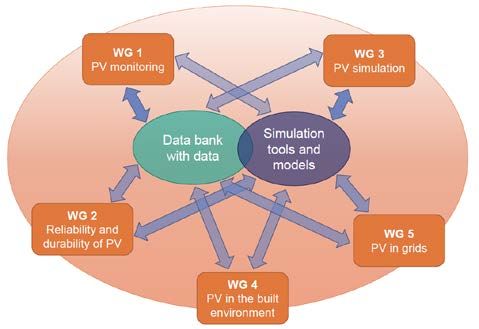
These objectives will be achieved by a solid collaboration between five Working Groups (WGs),
see Figure 1, which will be using a shared data bank and joint simulation tools to analyze big
data of the actual monitored long-term performance, defects and failures in PV systems
installed all over Europe. The 5 Working Groups are focused on (WG1) PV monitoring, (WG2)
Reliability and durability of PV, (WG3) PV simulation, (WG4) PV in the built environment and
(WG5) PV in grids.

  Figure 1: The 5 Working Groups of COST Action PEARL-PV in relation to a shared data bank and
                                       simulation tools.

By data analyses and simulations it will be possible to quantitatively determine the absolute
influences of components rated performance, key design of systems, installation, operation,
maintenance practice, geographic location and weather factors on the performance,
performance degradation over time and failure modes of installed PV systems.

                                                             CA16235 PEARL PV Workplan 2018-2021        5
In this document the workplans of the five Working Groups are presented in the context of
the wider Action. The background for workplan is the MoU of the Action which provides
information about the objectives, the research field of PV performance analyses and the
expected research program at the start of the Action in October 2017. However because of
interactions between researchers in combination with new insights resulting from ongoing
research in the field, these objectives and related research programs can change. Therefore
this Action’s workplan for the period of 2018 to 2021 has developed as a dynamic document
with the aim to review the Action’s progress on the basis of this document and where
necessary annually update it in relation to the internal progress made in this Action and the
external developments in the fields of PV performance, durability and reliability research.
To give the reader an insight in the wider scope and activities of this Action, Table 1 shows the
global planning of PEARL PV from 2018 to 2021 including all scheduled MC meetings, research
milestones regarding the set up and use of the envisioned data bank, and many networking
events such as Seminars, Workshops, Training Schools and Valorization Panel Meetings as well
as expected reporting for the COST Association, the Action’s participants and external parties.
After the workplans of the five Working Groups (WGs) have been presented in Chapter 1 to 5,
in Chapter 6 already scheduled meetings and events will be presented with a summary of the
core activities in this Action. Finally in Chapter 7 the publication policy of PEARL PV and in
Chapter 8 the participant lists (as known by Fall 2018) of this Action will be presented.
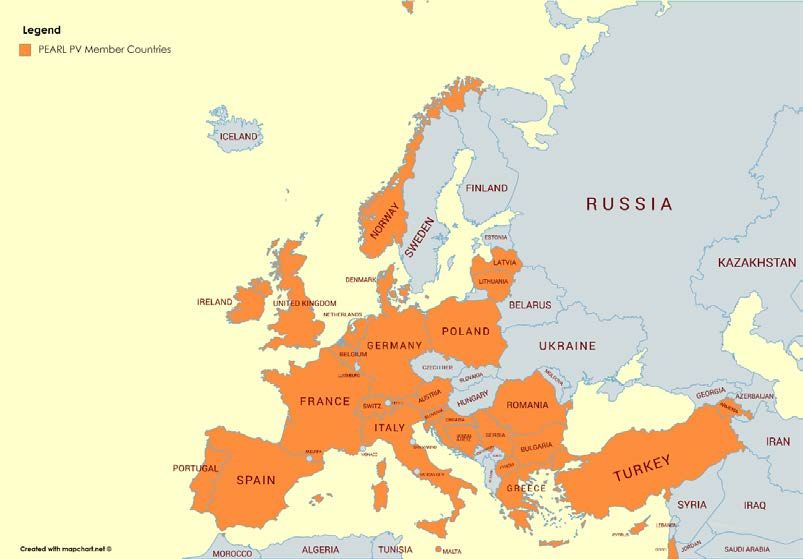
At present, 1st of October 2018, Cost Action PEARL PV consist of 31 member countries: that is to
say 29 European COST Member countries (including Israel), 1 International Partner Country
(IPC), namely the USA, and 1 Near Neightbour Country (NNC) which is Armenia. The map below,
Figure 2, shows all the with PEARL PV affiliated countries except the USA.
Figure 2: Countries involved in COST Action PEARL-PV by September 2018 in orange.
6 CA16235 PEARL PV Workplan 2018-2021Since its start at 5 October 2017, COST Action PEARL PV has acquired 165 members among which
50 MC members, 37 MC Substitutes and 77 regular members. Since it is required that in this
COST Action all members actively contribute to the execution of the workplan, new members
will be kindly invited to accept a role in this Action, ranging from being a member of a Working
Group to having a managerial role to being part of the Core Group. In Chapter 8 therefore all
roles will be shown with names of those involved by 1 October 2018.
CA16235 PEARL PV Workplan 2018-2021 7CA16235 PEARL PV Workplan 2018-2021 9
Table 1: Planning of COST Action PEARL PV for the period of 2018 until 2021

Year         2018                                                                2019
Month        M     A   M      J   J     A     S    O            N        D       J   F         M     A        M     J   J   A     S   O           N     D

Grant        GP1       GP2                                                                                    GP3
Periods

Reports &          N                               M12 - PR1    Work     N                           N                                M24 – PR2   N
Newsletter                                                      Plan
                                                                18-21

Meetings               CG               CG         Seminar               CG          MC3                      CG                      Seminar           CG

                                                   Training                          Work                                             Training
                                                   School                            shops                                            School

Data bank    Requirements         Realization data bank                          First data analyses / round robin      Second round analyses / round
                                                                                 test completed                         robin test

Working      Realization of       Combining all WGs work        Sharing of work plan and       Implementation of work plan                        Review
Groups       individual WGs       plans in a joint work plan    approval by MC3 meeting                                                           work
             work plans           for whole Action                                                                                                plan for
                                                                                                                                                  each WG

Training     Preparation      Advertising          Execution    Quality survey       Preparation                    Advertising       Execution   Survey
Schools
                                                   TS 1                                                                               TS 2

                                                          CA16235 PEARL PV Workplan 2018-2021            11
Year 2020 2021
Month J F M A M J J A S O N D J F M A M J J A S O
Grant GP3 GP4 GP5
Periods
Reports & N M36 – N N M48 - PR3
Newsletter PEARL
Newsletter
Book
Meetings MC4 CG Seminar CG MC5 CG Conference
Work Training Work Training
shops School shops School
Data bank Second round analyses / round Third round analyses / round robin test completed Fourth round analyses /
robin test completed round robin completed
Working Revise & Implementation of revised work plan Review Revise & Implementation of revised work plan
Groups approve work approve
MC4 plan for MC5
WGs
Training Preparation Advertising Execution Survey Preparation Advertising Execution
Schools
TS 3 TS 4
12 CA16235 PEARL PV Workplan 2018-20211. Workplan of WG1: PV Monitoring
WG1 Chair: Wilfried van Sark, Utrecht University, the Netherlands
WG1 Vice Chair: Christian Braun, Fraunhofer ISE
‘PV Monitoring’ is focused on the identification of relevant data to be collected to properly
assess PV performance of installed PV systems in the field and on rooftops. Activities cover both
defining guidelines for collection and analysis, as well as designing a data bank with appropriate
access options. A strong connection to all other Working Groups in the PEARL-PV project is
envisioned as data requirements will differ per Working Group.
The overall objective of WG1 is to investigate long-term PV performance. This will be achieved
by analyzing data of the actual monitored long-term performance, defects and failures in PV
systems installed all over Europe to quantitatively determine the absolute influences of
components rated performance, key design of systems including BIPV, residential, field-based
and floating systems, installation, operation, maintenance practice, geographic location and
weather factors on the performance, performance degradation over time and failure modes of
these PV systems.
In order to reach this overall objective, the following detailed objectives are defined as:
1. To develop generally accepted approaches and guidelines for the collection of data on
performance of PV modules and PV systems
2. To set-up a data bank for data collection and sharing
3. To develop generally accepted approaches and guidelines for the use and/or analysis of
data
4. To define a strategy for data bank access
CA16235 PEARL PV Workplan 2018-2021 13WG1 Description of Tasks
WG1 has four major tasks, as described below.
Task 1.1: Development of generally accepted approaches and guidelines for the collection of
data.
In this task a study of published approaches and existing guidelines on data collection will be
performed first, and will be discussed in a WG1 workshop. Existing IEC standards and IEA-
PVPS-Task13 reports will be used a basis, while a distinction will be made between need-to-
have and nice-to-have data taking into account that data availability can be flexible. Obviously,
power and energy data from systems are essential as well as irradiation data. The combined
outcomes will be used to design a questionnaire on data needs and requirements, that will be
used for consultation of all PEARL-PV participants in all working groups. The results of the
questionnaire will be then be discussed at a WG1 seminar, which will finally will form the basis
for the data structure of the data bank (T1.2).
This task will be completed by the end of Grant Period 2, while updates may be made if new
data is available. This task contributes to Objective 1.
Task leader: Anne Gerd Imenes, Norway
Subtasks:
T1.1.1: Preparation of data requirement questionnaire
T1.1.2: Distribution of questionnaire
T1.1.3: Analysis of questionnaire responses and summary of results
Task 1.2: Compilation of a data bank on a server.
Based on required data, statistical (meta)data and dynamical data, data types and time
resolutions, a system for data collection and sharing will be identified. Options using SQL and
non-SQL, HDFS, and others will be investigated. A decision will be made in Grant Period 2, after
consultation with PEARL-PV data experts during a WG1 seminar. A first version of the data
bank will be set-up, which will also prescribe the (standardized) formats for data. In order to
make the data structure future proof, a data bank will be selected that allows for inclusion of
different data and formats in the future.
Though originally it was assumed that the data bank would be fully available by the end of
2018, due to the complexity of implementation, it is more realistic to assume that this task will
be completed by the end of Grant Period 2, while updates may be made if new data is
available. This task contributes to Objective 2.
Task leader: Dijana Capeska Bogatinoska, fYR Macedonia
Subtasks:
T1.2.1: Investigation of data bank structure options
14 CA16235 PEARL PV Workplan 2018-2021T1.2.2: Selection of data bank structure
T1.2.3: First realization of data bank structure
T1.2.4: Assess necessity for updates of data bank structure
Task 1.3: Development of guidelines for use and analysis of data.
This task will target the development of generally accepted approaches and guidelines for the
use, analysis and/or interpretation of meteorological data and data about the performance of
PV modules and systems. This will use existing scientific documentation, guidelines and
standards, as well as meetings with PV monitoring experts. A link with Working Group 3 will
ensure harmonization of data and procedures regarding simulation algorithms and software.
Also, PEARL-PV data experts will co-develop scripts to access the data bank, if deemed
necessary. The guidelines will contain advantages and disadvantages, relevance, accuracy and
complexity of application as well as data requirements. Finally, using the guidelines on
collected data will provide information on the performance of PV systems.
This task contributes to Objective 3.
Task leader: Giorgio Belluardo, Italy
Subtasks:
T1.3.1: Collect state-of-the-art data use and analysis guidelines
T1.3.2: Discuss state-of-the-art guidelines among PV experts
T1.3.3: Compile updated guidelines
T1.3.4: Perform analyses on collected data
Task 1.4: Development of a strategy for data bank access
In this task an access strategy to data stored on a server will be developed in the form of a
data management plan, which will include non-disclosure agreements for participants that
supply data that may contain privacy sensitive information. The EU General Data Protection
Regulation will be guiding in this. Also, a policy for use of these data taking into consideration
costs, publishing and IP for COST Action participants and external parties will be developed.
This task contributes to Objective 4.
Task leader: Wilfried van Sark, the Netherlands
Subtasks:
T1.4.1: Draft a data management plan
T1.4.2: Prepare a Non-Disclosure Agreement
T1.4.3: Develop data bank access strategy and policy for use
CA16235 PEARL PV Workplan 2018-2021 15WG1 Deliverables Plan
Within the project specification, three main deliverables were identified for WG1 (D1 to D10
detailed below). This deliverables plan links the main deliverables to their respective Tasks and
identifies the path to those deliverables, according to the current workplan.
D1. Publications of findings originating from WG1 in high-impact scientific journals, conference
proceedings and via the COST Action’s website
D2. Reports of the WG 1 activities (month 12, 24, 36, 48), including the organization of one
workshop per year and one seminar per year on PV monitoring.
D3. A data bank to be realized on one of the MC members’ server.
D4. Publication of findings originating from WG3 in high impact journals, conference
proceedings and a book.
Pathway to D1: All tasks will contribute to the preparation of reports, specifically Task 1.1 and
Task 1.3. These will be assessed in terms of their suitability for the preparation of journal or
conference papers, with a specific target of the specialist journals and conferences relating to
the PV community. Since the first reports are due to be prepared in the third quarter of GP2, the
initial plan is to target abstract submission for the PV conferences taking place from April to
September 2019 (such as IEEE PVSC and EU PVSEC). WG1 will also contribute to papers
submitted in relation to the overall PEARL PV project, as appropriate. Specifically, subtask 1.3.4,
in which actual PV system data analysis will be performed based on the data collected will lead
to several publications in high-impact journal. It is expected that the work of WG3 will allow a
contribution of several specialist chapters to the projected book arising from the COST Action.
D2. Annual reports of the WG 1 activities (month 12, 24, 36, 48), including the organization
of one workshop per year and one seminar per year on PV monitoring.
Pathway to D9: Annual reports will be produced as required. The first annual report, in autumn
2018, will report on Tasks 1.1 and 1.2, both of which will be well advanced at that time, and on
Tasks 1.3 and 1.4 that just will have started. WG1 is organizing a seminar in October 2018 on
“Matching PV data and PV performance research questions” as part of Task 1.1. WG1 is also
contributing to the training workshop to be held in October 2018 on “Monitoring and simulation
of the performance and reliability of photovoltaics in the built environment”. WG1 will
contribute to other workshops, always focusing on PV system performance aspects.
D3. A data bank to be realized on one of the MC members’ server.
Pathway to D3: The activities of Tasks 1.1 will provide input to Task 1.2, which is about setting
up the data bank itself. It is planned that a first version of the data bank is available in December
2018, and data access (Task 1.4) is defined at that time as well. Collection of data as well as the
use and analysis of data (Task 1.3) will be evaluated which may lead to a change in data bank
structure. This means that the data bank structure will be made flexible.
16 CA16235 PEARL PV Workplan 2018-2021WG1 Timetable of Actions
Task Subtask 2017 2018 2019 2020 2021
10-12 1-4 5-8 9-12 1-4 5-8 9-12 1-4 5-8 9-12 1-4 5-10
1.1 1.1.1
1.1.2
1.1.3
1.2 1.2.1
1.2.2
1.2.3
1.2.4
1.3 1.3.1
1.3.2
1.3.3
1.3.4
1.4 1.4.1
1.4.2
1.4.3
Grant Period 1
Grant Period 2
Grant Period 3
Grant Period 4
Grant Period 5
Deliverables by the end of Grant Period 1 (30 April 2018):
• Workshop on data needs (Brussel, 22 January 2018)
• Questionnaire on data needs and PV monitoring guidelines defined and send out to all
PEARL-PV participants (completed 26.04.2018)
Deliverables by the end of Grant Period 2 (30 April 2019)
• Report “Results from questionnaire on data needs and PV monitoring guidelines”
(November 2018) (Task 1.1.1)
CA16235 PEARL PV Workplan 2018-2021 17• Report D1.1 First annual report of WG1 activities (November 2018)
• Seminar S1.1 Matching PV data and PV performance research questions (Nicosia,
Cyprus, 22 October 2018)
• Contribution to training school “Monitoring and Simulation of the Performance and
Reliability of PV in the Built Environment” (Nicosia, Cyprus, 23-26 October 2018)
• Contribution to joint conference paper for 35th EU PVSEC (September 2018)
• Realization of first data bank at MC member server (Task 1.2.1, 1.2.2, 1.2.3)
• Report on state-of-the-art in data use and analysis guidelines (Task 1.3.1), potentially
in the form of a paper
• Report on data access (Q2-2019)
Deliverables by the end of Grant Period 3 (30 April 2020)
• Contribution to training school “Evaluation of the performance degradation of PV-
systems – influence factors, failure modes and their detectability and affect on
economic viability” (Q3-2019)
• Realization of updated data bank at MC member server (Task 1.2.4)
• Contribution to (joint) conference paper for 36th EU PVSEC (September 2019)
• Report D1.2 Second annual report of WG1 activities (November 2019)
• Report on updated state-of-the-art in data use and analysis guidelines (Task 1.3.2,
1.3.3), potentially in the form of a paper
• First paper on analysis of data on PV system performance using data collected (Task
1.3.4)
Deliverables by the end of Grant Period 4 (30 April 2021)
• Realization of updated data bank at MC member server (Task 1.2.4)
• Scientific paper on overall performance of PV systems in Europe, focus on energy
yields (Q2-2020, Task 1.3.4)
• Contribution to (joint) conference paper for 37th EU PVSEC (September 2020)
• Report D1.3 Third annual report of WG1 activities (November 2020)
• Contribution to training school “Simulation tools and models for the forecast of system
efficiencies of PV plants – with focus on environmental and integration aspects (Q3-
2020)
Deliverables by the end of Grant Period 5 (31 October 2021)
• Contribution to (joint) conference paper for 38th EU PVSEC (September 2021)
• Scientific paper on detailed analysis of performance of PV systems in Europe,
identifying causes for malfunction (Q3-2021, Task 1.3.4)
• Contribution to (joint) conference paper for 38th EU PVSEC (September 2021)
• Contribution to training school “Potential of monitoring tools and advanced operation
and maintenance practice for security and predictability of PV performance (Q3-2021)
• Report D1.3 Fourth annual report of WG1 activities (31 October 2021)
18 CA16235 PEARL PV Workplan 2018-20212. Workplan of WG2: Reliability and
Durability of PV
WG2 Chair: Gernot Oreski, Polymer Competence Center Leoben
GmbH, Austria
WG2 Vice Chair: Hristina Spasevska, SS Cyril and Methodius University
Skopje, Macedonia
The main objectives of WG 2 are defined as follows:
1. Definition of reliability and durability metrics for PV modules, components and systems
2. Identification of relevant data to be collected to measure reliability and durability
3. Sharing knowledge via workshops, seminars and joint publications originating from WG2
with a wider community of PV experts solar electricity and other experts working for
insurers, investors and banks.
WG2 Description of Tasks
The work in WG2 is divided in two Tasks. The Deliverables and Task Leaders are summarized in
Table 2.
Task 2.1: Development of a common description of reliability and durability of PV modules and
PV systems by meetings and communications with PV researchers and other experts leading to
a shared document to be published on this COST Action’s website.
Task 2.2: Identification of required data and appropriate simulation models to be used in the
framework of understanding reliability and durability given the challenges of (i) the often long
elapsed duration before occurrence of both defects and degradation of PV modules in the field
(ii) the climate dependency of these effects and (iii) relationships between the manufactured
quality of PV module and observed reliability and durability in practice.
CA16235 PEARL PV Workplan 2018-2021 19Table 2: Overview on Tasks, Task leaders and deliverables for WG2
TASK 2.1: Development of a common description of reliability and durability of PV modules and PV
systems
LEADER: Gernot Oreski
Task 2.2: Identification of required data to be used in the framework of understanding reliability and
durability
LEADER: Ana Rosa Lagunas
DELIVERABLES AT THE END OF THE 1ST GRANT PERIOD (30.04.2018)
Work Plan (done)
Deliverables at month 12 (01.11.2018)
WG2 report #1
Deliverables at month 24 (01.11.2019)
WG2 report #2
Workshop #1: Reliability metrics for PV
Deliverables at month 36 (01.11.2020)
WG2 report #3
Workshop #2
Deliverable 5: White paper on definition of reliability and durability of different PV technologies
Deliverables at month 48 (01.11.2021)
WG2 report #4
Deliverable 7: Report on possible ways for modelling durability and reliability aspects of PV
20 CA16235 PEARL PV Workplan 2018-2021Task 2.1: Development of a common description of reliability and durability of PV
modules and PV systems
The main objective of Task 2.1 is the definition of reliability and durability metrics for PV
modules, components and systems. One the one hand properties describing reliability &
durability from different views of PV stakeholders (Consumers, investors, manufacturers,
researchers, utilities) are defined. One the other hand also different metrics for different PV
technologies (c-Si, thin film, organic….) are considered. Also metrics dependent on different
applications like PV for consumer products, utility-scale power production, mobility, building
integration etc. will be evaluated. Finally also discrepancies between high durability and easy
end-of-life management will be addressed.
The main outcome of Task 2.1 is Deliverable 5 mentioned in the MoU: White paper on definition
of reliability and durability of different PV technologies, which is planned to be published mid
2020. The tentative paper structure has been discussed with the work group members via email,
a conference call in July 2018, bilateral talks and a personal meeting at the PVSEC 2018 in
Brussels. The main contributing authors (as of October 2018) will be: Gernot Oreski (AUT);
Gabriele Eder (AUT); Alessandro Virtuani (CH); Eleonora Annigoni (CH); Caroline Tjengdrawira
(BE); Krzysztof Pielichowski (PL); Mihaela Girtan (F); Killian Lobato (PT); Shahzada Ahmad (E);
Samrana Kazim (E); Jeff Kettle (UK). The next steps will be the distribution of an online document
as well as to attract additional WG members to take over missing contributions. The tentative
paper structure is shown in Table 3.
CA16235 PEARL PV Workplan 2018-2021 21Table 1: Paper structure based on WG2 members feedback
1 Definition of reliability and end-of-life considering different views of PV stakeholders and
different technologies
Differentiation of the terms reliability and durability
Standard conditions for reliability – climate conditions
End-of-Life & Reliability: Consideration of different applications like PV for
consumer products, utility-scale power production, mobility, building integration
etc.
Discussion of PV Modules, PV systems and BOS components
Different approach of reliability for different technologies:
i. Silicon PV
ii. CIGS
iii. CDTE
iv. Organic PV and Dye Sensitized Cells
v. Perowskites
vi. Other
Discussion and disclosure of discrepancies between high durability and easy
end-of-life management
Aspects of Eco-Design and recyclability?
2 Reliability testing of PV modules
How to test reliability?
Possibilities of acceleration
Overview on comparison of lab results with field results
3 Modelling of PV module and PV system reliability and/or lifetime
Can reliability, lifetime or end-of-life be modelled from short term testing?
Known approaches for life time estimation and modelling
i. Modelling of material degradation effects (polymers, metal…)
ii. Modelling of failure modes IEA Task 13
iii. Modelling of PV systems
4 Outlook: Can available models for single effects or single materials be combined to a
comprehensive PV module lifetime assessment method?
Which approaches?
Which data is needed?
Proof of concept?
22 CA16235 PEARL PV Workplan 2018-2021Task 2.2: “Identification of required data to be used in the framework of
understanding reliability and durability”
The work plan of Task 2.2 had to be adapted in order to avoid overlaps and duplications with
parallel running activities. For example, simulation models for certain PV module degradation
modes are already summarized in IEA Task 13 report on “Assessment of PV module failures in
the field” (published 2017). Also, there are strong overlaps between original Task 2.2 description
and recent IEA PVPS Task 13 work program (2018-2021), which runs in parallel to Pearl PV.
Moreover, several proposals of WG2 members are already covered within Task 13, such as
description of reliability and failure modes of new module technologies and new system designs.
Therefore the new objectives for Task 2.2 are as follows.
Main objectives: Identification of relevant data to be collected to measure reliability and
durability. This includes the description of mass PV data analysis methods - output power over
time and multi-faceted analysis to gauge output decrease, the identification of issue causing
decrease in power output (e.g. shading, physical degradation…) and a correlation of failure
modes with climatic conditions
The planned output of Task 2.2 is Deliverable 7 (“An open source model for durability and
reliability aspects of PV modules”). However, the WG members are not sure if this deliverable
can be provided at the end of the COST action. Nevertheless, chapters 3 and 4 of the Task 2.1
Paper are dealing with this question and at least will provide a current state of the art as well
as an outlook on what has to be done in order to provide such a model.
WG2 Deliverables Plan
Within the project specification, three main deliverables were identified for WG2 (D5 to D7
detailed below). This deliverables plan links the main deliverables to their respective Tasks and
identifies the path to those deliverables, according to the current workplan.
D5. Publications of findings originating from WG2 in high-impact journals, conference
proceedings and a special issue of an international peer reviewed journal..
Pathway to D5: to be amended in the next version of the workplan
D6. Reports of the WG2 activities (month 12, 24, 36, 48), including the organisation of one
workshop per year on reliability and durability of PV modules, components and systems.
Pathway to D6: to be amended in the next version of the workplan
D7. An open source model for durability and reliability aspects of PV modules
Pathway to D7: to be amended in the next version of the workplan
CA16235 PEARL PV Workplan 2018-2021 2324 CA16235 PEARL PV Workplan 2018-2021
3. Workplan of WG3: PV Simulation
WG3 Chair: Nicola Pearsall, Northumbria University, UK

WG3 Vice Chair: João Serra, Universidade de Lisboa, Portugal

‘PV Simulation’ considers the use of modelling tools to simulate the performance of photovoltaic
devices and systems. This covers both the prediction and the assessment of performance and
complements the activities of the other Working Groups in the PEARL PV project, especially
those considering specific PV applications. The objectives of WG3 are:

    1.      Classification of PV simulation models by content ranging from (i) fundamental solar
            cell research, (ii) PV irradiance modelling including forecasting and cloud formation,
            (iii) PV systems (grid-connected, stand alone and hybrid), (iv) PV in the built
            environment and (v) PV grid interactions. Distinction will be determined between
            simulation models that can predict performance on short and long timescales as
            well as different approaches to prediction of the durability of PV modules and
            systems.
    2.      Identification of PV simulation tools and models by category.
    3.      Provision of access to information about PV solar electricity simulation models.
    4.      Comparison of various PV solar electricity simulation models.
    5.      Sharing knowledge originating from WG3 with a wider community of PV and other
            renewable energy experts by internet, workshops, seminars and joint publications
            about the topic of PV simulation.

                                                           CA16235 PEARL PV Workplan 2018-2021       25
WG3 Description of Tasks
WG3 has three major tasks, as described below.
Task 3.1: Development of a common description of PV simulation
The description of simulation will be expressed in terms of the categories outlined in Objective
1 and developed by meetings and consultation with PV researchers and other experts, both
within and outside the COST Action. This will lead to a shared document to be published on the
PEARL PV website, together with contributions to the journal, conference and workshop
publications from PEARL PV. The initial work involves the initial identification of software, the
categorization of that software and the specification of the information requirements for the
inventory (ST 3.1.1). This feeds into the development of the questionnaire in Task 3.2 (see
below), the results of which will feed back into ST 3.1.2 where the scope of the current modelling
will be determined. Finally, the recommendations arising from ST 3.1.3 will feed into the
definition and realization of the testing programme in Task 3.3 (see below).
The three subtasks will be completed by the end of Grant Period 2 and will then be repeated as
necessary to support the recurring testing programme in Task 3.3.
This task contributes mainly to Objectives 1, 2, 3 and 5.
Task Leader: Tihomir Betti, Croatia
Subtasks:
ST 3.1.1 Identification of the simulation categories and inventory requirements
ST 3.1.2 Determination of the scope of modelling currently undertaken
ST 3.1.3 Recommendations for testing of models and development of new models
Task 3.2: Identification of PV simulation tools and models
This task will identify the PV simulation tools and models that are currently used and/or available
to the PV community, together with information on scope and ease of use. This will be achieved
via consultation with the COST Action participants and other members of the community,
together with internet and publication searches. The first two subtasks relate to the
development and distribution of a questionnaire that investigates the current usage of software
by the COST Action participants and others, determines some of the reasons for that usage and
seeks to identify any gaps in provision. ST 3.2.3 summarizes the results of the questionnaire and
feeds into ST 3.1.2 and 3.1.3 of Task 3.1.
The initial distribution and analysis of the questionnaire will be completed by the middle of
Grant Period 2, with subsequent investigations (using the same or a modified questionnaire) will
be carried out as necessary through the COST Action.
This task contributes mainly to Objectives 2, 3 and 5.
Task Leader: Jesús Robledo Bueno, Germany
26 CA16235 PEARL PV Workplan 2018-2021Subtasks:
ST 3.2.1 Preparation of simulation questionnaire (including delivery method)
ST 3.2.2 Distribution of questionnaire
ST 3.2.3 Analysis of questionnaire responses and summary of inventory results
Task 3.3: Testing of simulation models
A selection of models, identified and classified in the first two tasks, will be tested in a round-
robin format by participants in the COST Action. The testing will investigate the suitability of the
models for meeting the requirements of the community, with specific interaction with the PEARL
PV Working Groups in relevant areas. Testing will be repeated at intervals during the COST
Action so as to account for developments in both the models and the simulation needs. ST 3.3.1
will use information from Tasks 3.1 and 3.2 to aid in the definition of which software should be
tested and the applications to be considered. The second and third subtask relate to the
organization of the testing, linking with one or more of the other Working Groups in the COST
Action, and the assessment of the results from the testing.
The choice of software to be tested, the system scenarios to be considered and the execution
of the tests will be carried out in consultation with the other Working Groups, depending on the
focus of the test. Relevant data from the database developed by WG1 will be used in the testing,
where possible. For each testing round, liaison members will be identified for all relevant
Working Groups to ensure close cooperation. The coordination of the testing will take account
of the expertise of members in the relevant Working Groups and the methodology will be
adapted to suit the topic (e.g. BIPV systems, durability of modules) and the chosen software.
The first round of testing is planned to be completed by the third quarter of Grant Period 3, with
two further rounds of testing in GP3/4 and GP 4/5.
This task contributes mainly to Objectives 3, 4 and 5.
Task Leader: Nicholas Riedel, Denmark
Subtasks:
ST 3.3.1 Definition of software to be tested, together with the test regimes
ST 3.3.2 Organisation and completion of the round robin testing programme
ST 3.3.3 Assessment of test results and recommendations for future tests
CA16235 PEARL PV Workplan 2018-2021 27WG3 Deliverables Plan
Within the project specification, three main deliverables were identified for WG3 (D8 to D10
detailed below). This deliverables plan links the main deliverables to their respective Tasks and
identifies the path to those deliverables, according to the current workplan.
D8. Publication of findings originating from WG3 in high impact journals, conference
proceedings and a book.
Pathway to D8: All three tasks will result in the preparation of reports, specifically as an output
of STs 3.1.2, 3.1.3, 3.2.3 and 3.3.3. These will be assessed in terms of their suitability for the
preparation of journal or conference papers, with a specific target of the specialist journals and
conferences relating to the PV community. Since the first reports are due to be prepared in the
third quarter of GP2, the initial plan is to target abstract submission for the PV conferences
taking place from April to September 2019. WG3 will also contribute to papers submitted in
relation to the overall PEARL PV project, as appropriate. It is expected that the work of WG3 will
allow a contribution of one or two specialist chapters to the projected book arising from the
COST Action.
D9. Annual reports of the WG3 activities, together with the organization of two workshops
and two seminars on PV simulation.
Pathway to D9: Annual reports will be produced as required. The first annual report, in autumn
2018, will report on Tasks 3.1 and 3.2, both of which will be well advanced at that time. WG3 is
also contributing to the training workshop to be held in October 2018, with a specific set of
sessions on the simulation of BIPV systems. It is planned that the third PEARL PV training
workshop, to be held in GP4, will focus on simulation and modelling, whilst WG3 also expects to
contribute to the fourth workshop in GP5. The detail of the seminar programme is still to be
determined.
D10. Open source software for the simulation of PV modules and systems.
Pathway to D10: The activities of Tasks 3.1 and 3.2 will identify the current open source software
available for PV modules and systems and provide advice on how to access this software. Task
3.3 is likely to include the testing of some open source software in the round robin programme.
WG3 will identify the current software and make recommendations for future development. If
appropriate, some software development may be instigated or projects identified for that
development.
28 CA16235 PEARL PV Workplan 2018-2021WG3 Timetable of Actions
Task Subtask 2017 2018 2019 2020 2021
10-12 1-4 5-8 9-12 1-4 5-8 9-12 1-4 5-8 9-12 1-4 5-10
3.1 3.1.1
3.1.2
3.1.3
Tasks 3.1 and 3.2
3.2 3.2.1 repeated as necessary
3.2.2
3.2.3
3.3 3.3.1
3.3.2
3.3.3
Grant Period 1
Grant Period 2
Grant Period 3
Grant Period 4
Grant Period 5
Deliverables by the end of Grant Period 1 (30 April 2018):
• Definition of the questionnaire - delayed to 23 May 2018 (completed)
• Distribution of the questionnaire – delayed to 01 June 2018 (completed)
Deliverables by the end of Grant Period 2 (30 April 2019)
• Report (ST 3.1.2) on the scope of the modelling tools at the current stage
• Report (ST 3.2.3) summarizing the questionnaire/inventory results
• Report (ST 3.1.3) on the recommendations for testing of models
• Definition of software to be tested (Round 1) (ST 3.3.1)
• Review/benchmark paper on PV simulation
• Workshop 1 with session on PV simulation of BIPV systems
• First annual report for WG3 (month 12)
Deliverables by the end of Grant Period 3 (30 April 2020)
• Report on the first round of simulation testing (Task 3.3.3)
• Definition of the software to be tested (Round 2) (Task 3.3.1)
CA16235 PEARL PV Workplan 2018-2021 29• Report on the organisation of the first seminar on PV simulation
• Paper on simulation testing results
• Second annual report for WG3 (month 24)
Deliverables by the end of Grant Period 4 (30 April 2020)
• Report on the organization of the training workshop on PV simulation
• Report on the second round of simulation testing (Task 3.3.3)
• Definition of the software to be tested (Round 3) (Task 3.3.1)
• Third annual report for WG3 (month 36)
Deliverables by the end of Grant Period 5 (31 October 2021)
• Report on the organization of the second seminar on PV simulation
• Report on the third round of simulation testing (Task 3.3.3)
• Paper on open source software availability and development needs
• Fourth annual report for WG3 (month 48)
30 CA16235 PEARL PV Workplan 2018-20214. Workplan of WG4: PV in the Built
Environment
WG4 Chair: Alessandra Scognamiglio, ENEA, Italy
WG4 Vice Chair: Francesco Frontini, SUPSI, Zwitserland
For many years PV has been used with the unique objective to produce renewable energy from
the sun thanks to the installation of modules on open area field and on large industrial or
commercial flat roofs. Since the drastically cost reduction of photovoltaic technologies and the
definition of net Zero Energy Buildings as target for new buildings by 2020, the idea to integrate
PV modules in Built environment (mainly as façade or roof element) become more feasible and
important for designers. This has been defined as Building Integrated Photovoltaic (BIPV)
meaning that PV modules will serve not only as renewable energy producers but also as element
of the building with further functions such as weather protection or shading device.
If integrated in the Built Environment PV modules have to withstand more complex and often
variables outdoor condition leading to more complex situation difficult to be predicted with SoA
simulation model and existing standards that are normally produce to represent “conventional”
condition. For these reasons the main goal of WG4 are:
1. Collect information about the applications of PV solar electricity in the built environment using
both information from other WGs and by communications with PV experts, architects, installers,
construction and building services engineers and city/urban planners.
2. Identify monitored data and the appropriate simulation models to be used in the framework
of PV in the built environment.
3. Sharing knowledge originating from WG4 with a wider community of PV experts and other
experts in the building sector by internet, workshops, seminars and joint publications.
CA16235 PEARL PV Workplan 2018-2021 31WG4 Description of Tasks
WG4 has two major tasks, as described below.
Task 4.1: Collection of information in the data server
The aim of this task is the collection of information in a data server of this Cost Action about PV
in the built environment. In particular it is foreseen to collect, thanks to the interviews of
different WG partners and other stakeholders all relevant and useful information from realized
projects (such as exemplary public founded research or Pilot and Demonstration projects),
scientific publications and information retrieved from internet.
Moreover since the objective is to enlarge the scope of the task and increase the echo of the
action PV experts related to cost partners, architects that already experienced PV installation in
their building project, installers, construction and building services engineers and city/urban
planners will be interviewed thanks to a specific survey that will be developed.
The data collected will be stored in a data server and available also for other WGs.
Task 4.2: Identification of required data and appropriate simulation models to be used in the
framework of PV systems in the built environment
The aim of the task that is fully complementary of task 3.1 is to identify useful relevant data from
real case studies to assess and simulate the performances and the behaviors of PV system in the
built environment (BIPV). This collection will be done thank to first the definition of BIPV and PV
in built environment archetypes ( thanks to the description of used and existing product and
system), afterward the physical, technological and architectural parameters related to
integration into building (e.g. shading, temperature, non-optimal cabling, …) will be described in
order to in the last stage to identify the specific and appropriate simulation models that better
fit to the planning needs and designer requirements.
Within this task the building and planning codes (such as international regulation and norms)
that apply and are required for BIPV will be also reviewed and presented in order to give a
general overview of the international (with focus on European region) situation.
There is a strong overlaps between Task 4.2 description and recent IEA PVPS Task 15 work
program that maybe extended after 2019.
Subtasks:
ST 4.2.1 Definition of BIPV and PV in built environment archetypes (product and system)
ST 4.2.2 Identification of issue and parameter related to integration into building (e.g.
shading, temperature, non-optimal cabling, …)
ST 4.2.3 Identification of specific and appropriate simulation models
ST 4.2.4 Identification of building and planning codes/regulation/norms that apply and
are required for BIPV.
32 CA16235 PEARL PV Workplan 2018-2021WG4 Deliverables Plan
Within the project specification, three main deliverables were identified for WG3 (D8 to D10
detailed below). This deliverables plan links the main deliverables to their respective Tasks and
identifies the path to those deliverables, according to the current workplan.
D11. Publications of findings originating from WG4 in high-impact journals, conference
proceedings and a special issue of an international peer reviewed journal.
Pathway to D11: All tow tasks will result in the preparation of reports, specifically as an output
of different subtasks activities as described before. These will be assessed in terms of their
suitability for the preparation of journal or conference papers, with a specific target of the
specialist journals and conferences relating to the BiPV community (photovoltaic expert and
construction domain). In particular for the firs years we have foreseen two publication regarding
the Trends in integration of photovoltaic facilities into the built environment and the
identification of international experiences on the use of photovoltaics in the built environment.
For the second half of the project a report and a scientific publication is foreseen on the actual
situation of PV in built environment in practice: photovoltaic products, building technologies
and morphologies. Worldwide overview.
D12. Reports of the WG 4 activities (month 12, 24, 36, 48), including the organization of two
workshops and two seminars about PV in the built environment.
Pathway to D12: Annual reports will be produced as required. The first annual report, end of
2018, will report on Tasks 4.1, both of which will be well advanced at that time. WG4 is also
contributing to the training workshop to be held in October 2018 in Cyprus, with a specific set
of sessions on the simulation of BIPV systems and state of the art of BIPV in Europe. The detail
of the following seminar programs is still to be determined.
D13. Open source data and software for PV in the built environment
Pathway to D13: Collection of information in the data server of this Action about PV in the built
environment, from realized projects, publications and information retrieved from internet,
together with PV experts, architects, installer, construction and building services engineers and
city/urban planners. Design of the data server still have to be completed.
CA16235 PEARL PV Workplan 2018-2021 33WG4 deliverables at the end of 1st GP
Under D11 the following publications were published:
Paper for Places and Technologies conference 2018 (published in the proceedings)
Title: Trends in integration of photovoltaic facilities into the built environment
Authors: Aleksandra Krstić-Furundžić, Alessandra Scognamiglio, Mirjana Devetaković,
Francesco Frontini, Budimir Sudimac
Paper for ESCC Energy Sustainablity and Climate Change 2018 (abstract in publishing process in
the conference proceedings)
Title: International experiences ongoing on the use of photovoltaics in the built environment.
Starting points for new research development
Authors: Alessandra Scognamiglio, Francesco Frontini (abstract to be published in the book of
proceedings).
Paper for EUPVSEC (presented as a visual presentation)
Title: The Use of Photovoltaic Technologies in the Built Environment: Open Issues and
Research Perspectives
Authors: A. Scognamiglio, F. Frontini, A. Krstić-Furundžić, M. Devetaković, B. Sudimac
34 CA16235 PEARL PV Workplan 2018-20215. Workplan of WG5: PV in grids
WG5 Chair: Jonathan Leloux, Polytechnic University of Madrid,
Spain
WG5 Vice Chair: Marios Theristis, University of Cyprus, Cyprus
The WG5 aims to contribute towards PV systems that are better integrated into the grid, that
perform better, and whose operation under real-world conditions is better understood. This WG
will use information from WG1, WG2 WG3 and WG4 on PV monitoring, reliability and durability
and PV simulation respectively and information from communications with PV experts, electrical
engineers, utilities, smart grid experts and meteorologists. These objectives will be achieved by
exploring different complementary pathways, such as the dentification of required data and
appropriate simulation models, to be used in the framework of PV in grids, and the development
of several data analysis and simulation tools, for PV integration into the grid, PV power
forecasting, power quality evaluation, and fault detection.
CA16235 PEARL PV Workplan 2018-2021 35WG5 Description of Tasks
WG5 has five major tasks, as described below.
Task 5.1: PV power forecasting and self-consumption
This task is concerned with the short-term and long-term accurate forecasting of solar PV power
generation and cloud formation to help utilities to better balance their distribution grids. There
is a need for accurate forecasting of solar power and cloud formation by utilities to be able to
balance distribution grids. Matching electricity demand with supply in (smart) energy homes is
a promising path for the future. Smart solar charging of electric vehicles and other storage
solutions will be contemplated, as well as self-consumption and domestic uses of PV such as
smart appliances. A tool will be developed to provide a short-term and also a long-term
forecasting of irradiance and PV power generation for utilities. It will also study the relationship
between PV power fluctuations, solar irradiation, local and energy consumption.
Peer-to-peer prosumer cooperation, e.g. using blockchain technology are increasingly appearing
as a viable option for the future development of PV generation. Therefore, a tool will be
developed to allow for these considerations, and it will contain a spatio-temporal forecasting
using data from distributed PV systems.
Task Leader: Carolina Senabre, Miguel Hernandez University of Elche, Spain
Task 5.2: PV power fluctuations for grid operators
An analysis of the interface between PV systems and low voltage distributed grids will be carried
out. The possibility for feeding distributed solar power into grids under variable irradiance
conditions will be explored. A tool will be developed to provide a short-term and also a long-
term forecasting of irradiance and PV power generation for utilities.
A tool will allow the assessment of the PV power mitigation potential from the geographic
dispersion of PV systems.
A tool will be developed for the assessment of PV power fluctuations at one PV system, as well
as for PV system fleets, including the study of the correlation between the fluctuations in PV
power between neighboring installations. This will be done through several complementary
approaches, including parametric and non-parametric models, peer to peer (P2P) approaches,
Artificial Neural Networks (ANNs), the use of geostatistics...
Task Leader: Emilio Gómez, University of Castilla-La-Mancha, Spain
36 CA16235 PEARL PV Workplan 2018-2021Task 5.3: PV power quality in the grid
The evaluation of the Power Quality indicators at the connection of PV systems to the grid is
going to become increasingly important along with the increasing PV penetration into the grid,
and a tool will therefore be developed to analyze these aspects.
Task Leader: Sonia Pinto, University of Lisboa, Portugal
Task 5.4: PV energy storage and management
Better energy management and storage control at the interface between PV systems and low
voltage distributed grids are needed and they will be investigated. There will be a link with the
smart solar charging of electric vehicles, and domestic uses of PV such as smart appliances. This
includes the study of the relationship between the PV production and the local consumption,
the possible use of batteries, the economic viability of alternative options...
Task Leader: Luis Fialho, University of Évora, Portugal
Task 5.5: PV performance and fault detection
Better procedures for cheap and effective Operation and Maintenance (O&M) of PV systems
will be searched for, including soiling and cleaning strategies.
A fault detection toolbox will be developed to improve the energy yield of grid-connected PV
systems and reduce their power instability. This will be done through several complementary
approaches, including parametric and non-parametric models, peer to peer (P2P) approaches,
Artificial Neural Networks (ANN), stochastic modelling...
Task Leader: Emilio Muñoz, University of Jaén, Spain
CA16235 PEARL PV Workplan 2018-2021 37WG5 Deliverables Plan
Within the project specification, three main deliverables were identified for WG5 (D14, D15 and
D16 detailed below).
D14. Publications of findings originating from WG5 in high-impact journals, conference
proceedings and a special issue of an international peer reviewed journal.
Pathway to D14: Several journal publications will be produced. Their exact nature will depend
on the advances that will be achieved in each one of the five tasks.
D15. Reports of the WG5 activities (month 12, 24, 36, 48), including the organization of two
workshops and two seminars about PV in grids.
Pathway to D15: Workshops and seminars will be held during the course of the project and they
will allow to present the main findings obtain as the results of the work done in WG5.
D16. Open source data and software for PV in grids.
Pathway to D16: Several tools will be developed in WG5, and part of their code will be made
open source, to be decided as a function of the interest of the parties and the soundness of the
use of open source for these tools.
38 CA16235 PEARL PV Workplan 2018-20216. Schedule of Future Meetings and Results
Event Dates Location - LO Targeted audience Comments
Seminar WG1 22 – 10 - 2018 Cyprus – Nicosia - WG 1 members and all Confirmed
University of other interested Action
Cyprus participants
Training 23 – 10 – 2018 Cyprus – Nicosia - Trainees: PhD Confirmed
School 1 * until University of students, colleagues
26 – 20 -2018 Cyprus from academia,
industry partners
MC3 meeting 25 – 02 - 2019 Portugal - Lisbon – MC members only Confirmed
University of Lisbon
Workshops 26 – 02 – 2019 Portugal - Lisbon – All participants of the Confirmed
until University of Lisbon Action
01 – 03 -2019
Seminar 14 – 10 - 2019 Malta – MCAST All participants of the Confirmed
Action
Training 15 – 10 – 2019 Malta - MCAST Trainees: PhD Confirmed
School 2 * until students, colleagues
18 – 10 - 2019 from academia,
industry partners
MC4 meeting February 2020 Netherlands – MC members only Dates not
Utrecht - UU confirmed
Workshops February 2020 Netherlands – All participants of the Dates not
Utrecht - UU Action confirmed
Seminar 15 – 10 - 2020 Romania – All participants of the Confirmed
University of Action
Brasov
Training 16 – 10 – 2020 Romania – Trainees: PhD Confirmed
School 3 * until University of students, colleagues
20 – 10 - 2020 Brasov from academia,
industry partners
MC5 meeting February 2021 TBDL MC members only Local organizer
to be selected
Dates not
confirmed
CA16235 PEARL PV Workplan 2018-2021 39Workshops February 2021 TBDL All participants of the Local organizer
Action to be selected
Dates not
confirmed
Conference October 2021 Netherlands – All participants of the Dates not
Enschede - UT Action confirmed
Training October 2021 Netherlands – Trainees: PhD Dates not
School 4 * Enschede - UT students, colleagues confirmed
from academia,
industry partners
Valorization 2019 TBDL External parties from VPMs will be
Panel industry, scheduled in
Meeting governmental bodies, coherence with
consumer major
organizations and conferences,
financial institutions therefore
location and
exact dates tbdl
Valorization 2020 TBDL Idem Idem
Panel
Meeting
Valorization 2021 TBDL Idem Idem
Panel
Meeting
*) Training School 1: Monitoring and Simulation of the Performance and Reliability of PV in the Built
Environment.
Training School 2: Evaluation of the performance degradation of PV-systems – influence factors,
failure modes and their detectability and effects on economic viability.
Training School 3: Simulation tools and models for the forecast of system efficiencies of PV plants –
with focus on environmental and integration aspects.
Training School 4: Potential of monitoring tools and advanced operation and maintenance practice
for security and predictability of PV performance.
40 CA16235 PEARL PV Workplan 2018-2021You can also read


