Conducted February 2021 - Ronald Reagan Library
←
→
Page content transcription
If your browser does not render page correctly, please read the page content below
Polling Conducted By                                                       Analysis in Collaboration With

                                     Conducted February 2021

  With all that has happened in the last year, it is understandable that Americans are experiencing a
  sense of pessimism. The latest Reagan National Defense Survey reflects a downturn in overall attitudes
  across nearly every category of question. One of the more alarming downward trends is declining trust
  and confidence in the military.

  Despite the current environment, Americans still believe in President Reagan’s vision of strong
  American leadership in the world, advancing the values of freedom and democracy abroad, and
  maintaining the peace through our strength.

  Unsurprisingly, the coronavirus topped the list
  of greatest problems facing the country (29%),
  with politics and partisanship ranking second
  (17%). Almost all Americans (and an equal
  percentage of Republicans and Democrats) are
  worried that political polarization will lead to
  violence. While it may not be surprising that
  88% of respondents expressed this concern
  given that the survey was conducted just one
  month after the January 6th attack on the U.S.
  Capitol, it is worth noting that 84% of
  respondents in our October 2019 survey
  reported concern about political division
  leading to violence.

  Americans are presently more worried about
  domestic threats than those from abroad. When
  asked whether the greatest threats to the United
  States come from within or from outside (Figure
  1), a majority of Americans (61%) report that                             Figure 1
  threats emanating from within are either equal
  to (25%) or greater than (36%) those emanating from abroad (35%). There is some partisan distinction
  on this, with 69% of Democrats viewing internal threats as greater than (40%) or equal to (29%) external
  threats (28%) and 55% of Republicans saying internal threats are greater than (33%) or equal to (22%)
  external threats (43%).

                                                     1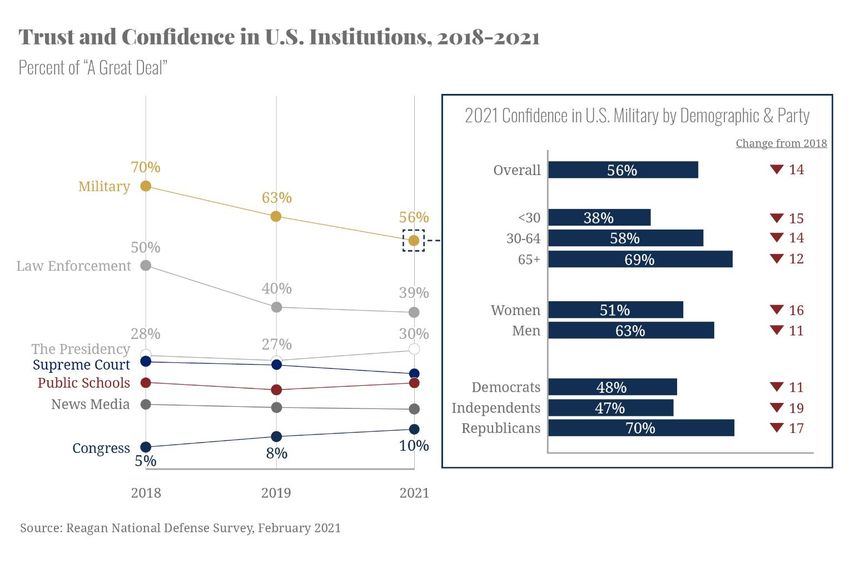
The number of Americans who say they have a great deal of trust and confidence in the military has
fallen by 14 percentage points (from 70% to 56%) since 2018 (Figure 2). The lowest ratings come from
those under 30 years of age (only 38% say they have a great deal of confidence), Black voters (44%),
Democrats (48%), and women (51%).

                                                Figure 2

This diminished confidence, one that mirrors declining support for law enforcement in the United
States, is not due to the events of 2020 alone. While the military has suffered a seven-point drop in
confidence since 2019, there was an equal seven-point decline between 2018 and 2019. In that time, the
military declined in trust across all major demographic subgroups (including age, gender, and party
affiliation) by double-digit percentage points. Over the same period of time, all other institutions
(including Congress, the presidency, the Supreme Court, the media, and public schools) experienced
generally stable levels of trust.

It is worth noting that while public support of the military has fallen, the military remains the most
trusted institution by a large margin. Additionally, large majorities of Americans do see a role for the
military in responding to a wide range of domestic scenarios, from responding to natural disasters to
helping control the pandemic. Smaller numbers believe it would be appropriate to use the military to
control violent protests, respond to domestic terrorism, or engage in the event of insurrection by U.S.
citizens.

Only slightly over one-half of Americans (57%) think that the United States has the best military in the
world and an even slimmer majority (53%) think it would win a war against a nuclear power. Between

                                                 2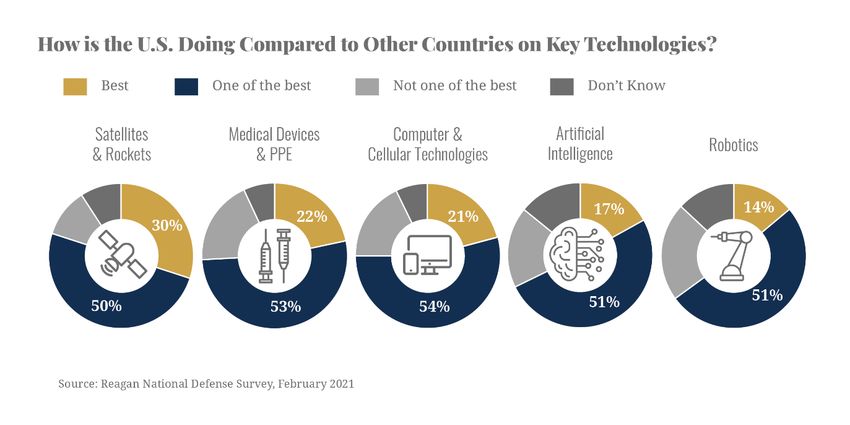
using the military or diplomacy in international affairs, 41% of Americans think the United States
strikes the right balance, but about a third (34%) think the military is used when diplomacy would be
better.

Overall, three-quarters (75%) of Americans are in favor of increasing defense spending, including
substantial majorities of both parties: 87% of Republicans (with only 10% opposed) and 67% of
Democrats (with 31% opposed). However, the military ranks behind health care and education as a
priority for increased funding.

The survey reflects mixed findings when it comes to civilian control of the military. Initially, only 18%
of respondents said the Secretary of Defense should be a civilian, whereas 73% thought it should be
someone who recently served in the military. After providing some background on the concept of civil-
military relations, a plurality (39%) said that the law preventing the Secretary of Defense from being a
recent member of the military is a good law, but 33% opposed it. About one-half of Americans
supported the congressional waivers for Secretaries Mattis and Austin, with a slight partisan difference
on support.

Declining confidence in the military has not shaken the belief in the importance of America’s role in
the world. Americans are not trending toward isolationism and do not want the United States to retreat
from global leadership. One-half (51%) of Americans think the United States should be more engaged
and take the lead regarding international events, consistent with the findings of our 2019 survey
(Figure 3). The number who say America should be less engaged and react to events instead fell by 6
percentage points to 27%.

                                                 Figure 3

Support for leadership and engagement is not only theoretical. When asked if the United States should
maintain military bases around the world or reduce its presence overseas, nearly two-thirds (63%) of
Americans support maintaining military bases to deter attacks and respond quickly if needed (Figure
3). There is strong bipartisanship on this issue, with over 60% of both Republicans and Democrats
supporting maintaining bases. Support for maintaining overseas bases, however, does drop from a
majority to a plurality among people under 30 years old (48%).

                                                  3
As for forward-deployed troops, 50% of Americans
think troop levels in Afghanistan should be increased
or kept the same, while 39% would prefer to decrease.
Republicans (47%) are more likely than Democrats
(33%) or Independents (36%) to support decreasing
troop levels. In Iraq, 60% of Americans think troop
levels should be increased or kept the same, with 29%
preferring troop levels be decreased. Democrats
(23%) are more likely than Republicans (15%) or
Independents (14%) to support increasing troop
levels.
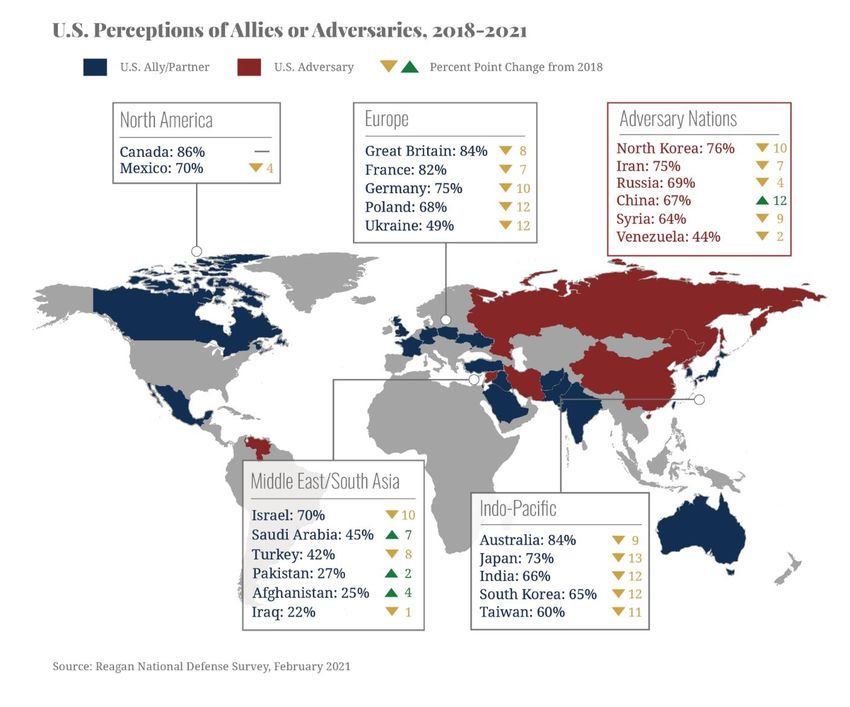
Americans continue to support alliances and allies
around the world, from the North Atlantic Treaty
Organization (NATO) to Indo-Pacific allies. Sixty
percent of Americans have a favorable view of NATO.
Figure 4 Countries like Australia, Japan, and South Korea are
widely viewed as allies. Americans do want allies to
do more in terms of burden-sharing, however, with a
majority (55%) saying NATO allies should do more and a plurality (48%) saying Indo-Pacific allies
should do more (Figure 4). In general, however, favorable perception of our allies has declined since
2018 (Figure 5).
Figure 5
4While Americans support the United States being engaged in the international community, opinion is
mixed as to whether the Iran nuclear deal or Paris Agreement on climate change are the best
approach—and there is extreme partisan polarization on both these topics.
Overall, a majority (54%) of Americans support the Paris Agreement on climate change, while 33% are
opposed. Opinion breaks down along party lines, however, with 80% of Democrats in support and 62%
of Republicans opposed. Slightly less than one-half of Americans (44%) support re-entering the Iran
nuclear deal, with 36% opposed. Similarly, there is a partisan divide on this issue, with 64% of
Democrats supporting and 61% of Republicans opposing the deal.
An increasing number of Americans
believe that China poses the greatest
threat to the United States. More
than one-third of Americans (37%)
say China is the country posing the
greatest threat to the United States
compared to 21% in 2018. Over the
same period, Russia has fallen from
30% to 16% of Americans who think
it is the greatest threat (Figure 6).
This trend has been driven by
Republicans and Independents, with
55% and 39% putting China at the top
of the list, respectively. For
Democrats, Russia still tops the list at
28%, while China ranks second with
20% (Figure 6). Among Republicans,
55% list China as the top threat,
followed by North Korea (12%), Iran
(10%), and then Russia (6%).
There has also been a significant
shift in public opinion on the
question of where the United States
should focus its military forces. More
Americans (28%) now say that the
United States should focus its forces
in Asia, with only 21% selecting the
Middle East. In both 2018 and 2019,
more respondents chose the Middle
East than Asia. Here too, there is
significant partisan divide, with Figure 6
Democrats choosing the Middle East
(22%) over Asia (19%). Republicans
chose Asia over the Middle East by a
margin of 37% to 23%.
5Over three-quarters (76%) of Americans are concerned about rising authoritarianism around the world
(Figure 7). And in general, Americans support efforts to promote freedom and democracy abroad. Fifty-
five percent support increasing government spending to this end.
With respect to China and Russia, Americans express alarming concern with regard to this set of issues.
Three-quarters (75%) of Americans have unfavorable views of both the Chinese political system and
the Chinese Communist Party. Human rights violations top the list of concerns among the American
people about China, at 85%. Nearly three-quarters (72%) want the United States to support the pro-
democracy movement in Hong Kong, even if it angers China. When it comes to Russia, three in four
Americans (77%) are concerned about the poisoning of opposition leaders and the suppression of
dissent (Figure 7).
Figure 7
Although Americans are greatly concerned about freedom, democracy, and human rights, they report
relatively low awareness of particular situations, like China’s actions against the Uyghur ethnic
minority group and democracy activists in Hong Kong. When provided with some information about
these attacks on freedom, there is a notable increase in concern.
6Americans do not think the United States is the best at developing the technologies critical to national
security, which is particularly alarming in the context of significant Chinese investment in these
technologies. Three in four (77%) Americans are concerned about China’s development of artificial
intelligence capabilities. Additionally, a majority (55%) believe the United States is too reliant on non-
allies for key national security materials.
With respect to how the United States is doing relative to other countries in developing key
technologies, small minorities of Americans think it is the “best in the world” at satellites and rockets
(30%); medical devices (22%); computers and cellular technologies (21%); artificial intelligence (17%);
and robotics (14%). While in general slightly over one-half of Americans say that the United States is
“one of the best” in these areas (Figure 8), in the context of great power competition, there is a
meaningful distinction between the being “the best” versus “one of the best” regarding these 21st-
century technologies.
Figure 8
Americans now principally see national security through a high-tech lens, and it is intuitive to them
that threats in the gray zone and technological competition are an increasingly important aspects of
contemporary great power competition. They are intensely worried about cyber-attacks on both
personal computers and accounts (88%) as well as on government computers and the grid (88%). In
fact, more Americans (27%) report cyber-attacks as their chief concern about Russia than any other
potential malign Russian activity, including interfering in elections (12%) or invading former Soviet
republics (6%). Overall, 82% of Americans are concerned to some extent about Russian cyber-attacks.
Relatedly, “technology theft” is high on the list of concerns about China, ranking second behind human
rights violations.
7President Reagan continues to be viewed favorably among Americans, with 71% overall favorability.
Notably, a majority of Americans of all political stripes view President Reagan favorably: 88% of
Republicans, 76% of Independents, and 55% of Democrats (Figure 9).
Forty years on from the year he was first inaugurated, President Reagan’s values and worldview have
been put to the test—and they have withstood the test of time. Amid coarsened domestic politics and
geopolitical upheaval, emerging threats and new technologies, extended conflicts and elusive
adversaries, the values of Reaganism endure.
The belief in “peace through strength” and the commitment to America as a beacon of freedom in the
world—a “shining city upon a hill”—are cemented in the national psyche, unshaken by the forces that
might weaken the American resolve.
Leaders who seek to take up the Reagan mantle and believe in a more hopeful, more peaceful future
will find substantial support among the American people.
Figure 9
8The Ronald Reagan Presidential Foundation & Institute (RRPFI) sponsored a national poll to assess the
priorities and opinions of Americans across a wide array of defense, military, and foreign policy issues
at the outset of a new administration. This February 2021 poll is RRPFI’s third such survey since 2018.
This survey was conducted from February 4-14, 2021 by the bi-partisan team of Beacon Research (D)
and Shaw & Company Research (R). It features a mixed-mode design, with 1,011 responses collected by
live telephone interviewers and another 1,516 responses gathered online. The telephone portion of the
survey is a probability sample, relying on a multi-stage cluster design. Forty percent of the calls were
completed via landline and 60 percent were completed via cell phone. On average, the interviews lasted
approximately 20 minutes. To ensure that results accurately reflect the demographics of the country,
they were weighted by age/gender, race/region, and education targets drawn from the U.S. Census
Bureau’s 2019 American Community Survey. The probability sample was then used to calibrate the
non-probability online sample (conducted over the same dates) by key demographic and attitudinal
variables. For the full sample of 2,527 respondents, the estimated margin of error is +/- 1.96 percentage
points. Many items are split-sampled, however, so that the relevant margin of error is +/- 2.77
percentage points. In addition, the margin of error for sub-groups is larger.
Govini is a Decision Science company whose mission is to advance U.S. competitiveness through
dynamic data and machine learning. Govini’s National Security Knowledge Graph and Decision Science
Platform are used at scale to facilitate implementation of the National Defense Strategy and ensure DoD
decision superiority in areas pertaining to Supply Chain Security, Resourcing & Reform, Defense
Industrial Base, and Technology & Innovation.
The Ronald Reagan Presidential Foundation and Institute is the nonprofit organization created by
President Reagan himself and specifically charged by him with continuing his legacy and sharing his
principles - individual liberty, economic opportunity, global democracy and national pride. The
Foundation is a non-partisan organization which sustains the Ronald Reagan Presidential Library and
Museum in Simi Valley, CA, the Reagan Center for Public Affairs, the Presidential Learning Center, The
Air Force One Pavilion and the award-winning Discovery Center, as well as the Reagan Institute, which
carries out the Foundation’s work in Washington, D.C. The Reagan Library houses over 55 million
pages of Gubernatorial, Presidential and personal papers and over 60,000 gifts and artifacts chronicling
the lives of Ronald and Nancy Reagan. It also serves as the final resting place of America’s 40th
President and his First Lady. www.reaganfoundation.org.
9You can also read


