Erasmus+ Programme Statistical factsheets on the achievements of the Erasmus Mundus Joint Master Degrees (2014-2020)
←
→
Page content transcription
If your browser does not render page correctly, please read the page content below

Erasmus+ Programme
     Statistical factsheets on the
achievements of the Erasmus Mundus
 Joint Master Degrees (2014-2020)

              European Education
              and Culture
              Executive Agency
More information on the European Union is available on the Internet (http://europa.eu).

Luxembourg : Publications Office of the European Union, 2021

PRINT     ISBN : 978-92-9484-621-1		doi:10.2797/557081		EC-03-21-188-EN-C
PDF       ISBN : 978-92-9484-622-8		 doi:10.2797/639462		 EC-03-21-188-EN-N

© Education, Audiovisual and Culture Executive Agency, 2021

The Commission’s reuse policy is implemented by Commission Decision 2011/833/EU of 12 December
2011 on the reuse of Commission documents (OJ L 330, 14.12.2011, p. 39 – https://eur-lex.europa.eu/eli/
dec/2011/833/oj).

Unless otherwise noted, the reuse of this document is authorised under the Creative Commons Attribution
4.0 International (CC BY 4.0) licence (https://creativecommons.org/licenses/by/4.0/). This means that reuse is
allowed, provided appropriate credit is given and any changes are indicated.

For any use or reproduction of elements that are not owned by the EU, permission may need to be sought
directly from the respective rightholders. The EU does not own the copyright in relation to any images which
do not carry the copyright indicator © European Union.

CREDITS
Cover image : © European Union, 2021 (CC BY-NC-ND 4.0) — image source: iStockphoto.com
Erasmus+ Programme
     Statistical factsheets on the
achievements of the Erasmus Mundus
 Joint Master Degrees (2014-2020)

    As part of the Erasmus+ programme (2014-2020), Erasmus Mundus supports the
    implementation of prestigious, integrated, international Master programmes, jointly
    delivered by international consortia of HEIs. It provides financial support to institutions
    and scholarships to the best candidates worldwide.
TABLE OF CONTENTS

Factsheet 1 : Participation of the Programme Countries Higher         3-6
Education Institutions (HEIs) : Institutional Excellence and
Inclusiveness

Factsheet 2 : Statistical Analysis of Scholarship Holder Mobility    7 - 11
flows - Partner Country Students to Programme Countries

Factsheet 3 : Statistical Analysis of Scholarship Holder Mobility   12 - 17
flows - Programme Country Students to Programme Countries

Factsheet 4 : Statistical Analysis of Scholarship Holder Mobility   18 - 20
flows to Partner Countries

Factsheet 5 : Statistical Analysis of the Main Project Features     21 - 29

Factsheet 6 : Overview of the participating Higher Education        30 - 45
Institutions

                                                                              2
Erasmus+ Programme
Erasmus Mundus Joint
Master Degrees 2014-2020
© European Union, 2021 (CC BY-NC-ND 4.0) — image source: iStockphoto.com
Factsheet 1
Participation of the Programme Countries Higher Education
Institutions (HEIs) : Institutional Excellence and Inclusiveness
This document is part of a series of fact sheets about the achievements of the 250 EMJMDs selected
under Erasmus+ 2014-2020 :
Factsheet 1 : Participation of the Programme Countries HEIs (excellence and inclusiveness)
Factsheet 2 : Partner Country scholarship holders mobility
Factsheet 3 : Programme Country scholarship holders mobility
Factsheet 4 : Scholarship holders’ mobility to Partner Countries
Factsheet 5 : Statistical analysis of the main project features
Factsheet 6 : Overview of the participating Higher Education Institutions
Since 2014, under the Erasmus+ programme, 369 HEIs from the Programme Countries have participated
as coordinator or as full partner in at least one Erasmus Mundus Joint Master Degree (EMJMD) (see
annex 1).
Taking as a reference both the 2020 Academic Ranking of World Universities (Shanghai Ranking) and
the 2020 Times Higher Education World University Ranking (THE), more than 50% of the 150 top-
ranked European universities are involved in EMJMDs. This confirms the dimension of excellence of
this programme. As an example, 60% of the top-10 European universities and approximately three
quarters of the 50 top-ranked European universities participate in at least one EMJMD project (see
table 1 and annex 2). Compared to a similar analysis carried out in 2018, the situation remains stable.
While the EMJMDs attract the European leading universities, the programme has also a scope of
inclusiveness since it attracts less renowned HEIs. More than 65% of the participating Programme
Country universities are ranked beyond the 500 top universities worldwide (see table 2). Erasmus
Mundus looks more inclusive than in 2018 when 57% of the universities were ranked beyond 500.
European Education
and Culture
Executive Agency 3The majority of the leading universities in Europe participate in the
Erasmus Mundus Joint Master Degrees.
Table 1 : Percentage of leading institutions participating in at least one EMJMD per ranking
category
Ranking
0-10 11-50 51-75 76-150 151-250 0-150 0-250
categories for
* ** *** **** ***** ******
Europe1
Shanghai Ranking
60%2 84% 76% 68% 54% 72% 64%
2020
(6/10) (32/38) (16/21) (48/72) (57/106) (101/141) (158/247)
THE Ranking 2020 60% 77% 62% 49% 55% 59% 57%
(6/10) (30/39) (16/26) (38/78) (57/104) (90/153) (147/257)
Source : EACEA
Because of ex-aequo cases, the cut-off points vary according to the rankings :
* Shanghai : 11-48 / THE 11-49 ** Shanghai : 49-69 / THE 50-75 *** Shanghai : 70-141 / THE 76-153
**** Shanghai : 142-247 / THE 154-257 ***** Shanghai : 0-141 / THE 0-153 ****** Shanghai : 0-247 /THE 0-257
1 Ranking order at European level (250 best Programme Country institutions according to international rankings)
2 60% of the 10 best universities in Europe were involved in EMJMD according to the Shanghai ranking
The Erasmus Mundus Joint Master Degrees target a large variety of
European HEIs.
Table 2 : Breakdown of the European HEIs participating in at least one EMJMD according to their
ranking at worldwide level
Ranking
0-100 101-200 201-300 301-500 Above 500 Total
categories3
Shanghai Ranking
6%4 8% 7% 12% 66% 100%
2020
23 30 27 46 243 369
THE Ranking 2020 5% 9% 6% 12% 67% 100%
20 35 22 45 247 369
Source : EACEA
3 Ranking order at worldwide level according to the two international rankings.
4 according to the Shanghai ranking, 6% of the European universities participating in Erasmus Mundus Joint Degrees are among the 100 first universities
worldwide
4ANNEX 1
Number of HEIs involved in EMJMDs 2014-2020, by Programme Country
0 10 20 30 40 50 60 70
Austria 10
Belgium 11
Bulgaria 2
Croatia 1
Cyprus 3
Czechia 6
Denmark 7
Estonia 3
Finland 9
France 62
Germany 44
Greece 10
Hungary 9
Iceland 0
Ireland 8
Italy 37
Latvia 1
Liechtenstein 0
Lithuania 2
Luxembourg 0
Malta 1
Netherlands 14
North Macedonia 0
Norway 6
Poland 16
Portugal 17
Romania 5
Serbia 1
Slovakia 3
Slovenia 2
Spain 35
Sweden 11
Turkey 6
UK 27
5ANNEX 2
50 Top-Ranked European HEIs
Rank SHANGHAI RANKING (2020) Country Rank THE RANKING (2020) Country
HEI HEI
1 University of Cambridge UK 1 University of Oxford UK
2 University of Oxford UK 2 University of Cambridge UK
3 Paris-Saclay University France 3 Imperial College London UK
4 University College London UK 4 London School of Economics UK
5 Imperial College London UK 5 University of Edinburgh UK
6 University of Copenhagen Denmark 6 LMU Munich Germany
7 PSL University France 7 King’s College London UK
7 The University of Manchester UK 8 Karolinska Institute Sweden
8 Sorbonne University France 9 Technical University of Munich Germany
9 The University of Edinburgh UK 10 Heidelberg University Germany
10 Karolinska Institute Sweden 11 KU Leuven Belgium
11 King's College London UK 12 University of Manchester UK
12 University of Munich Germany 13 Wageningen University & Research Netherlands
13 Utrecht University Netherlands 14 University of Amsterdam Netherlands
14 Technical University of Munich Germany 15 Delft University of Technology Netherlands
15 Heidelberg University Germany 15 Leiden University Netherlands
16 University of Oslo Norway 16 Erasmus University Rotterdam Netherlands
17 University of Bristol UK 17 University of Groningen Netherlands
18 University of Paris France 18 Utrecht University Netherlands
19 Ghent University Belgium 19 Charité - Universitätsmedizin Berlin Germany
20 Aarhus University Denmark 19 Sorbonne University France
20 Stockholm University Sweden 20 University of Tübingen Germany
20 University of Groningen Netherlands 21 École Polytechnique France
21 University of Helsinki Finland 22 University of Helsinki Finland
22 Uppsala University Sweden 23 Lund University Sweden
23 Erasmus University Rotterdam Netherlands 24 University of Glasgow UK
23 Leiden University Netherlands 25 RWTH Aachen University Germany
24 University of Bonn Germany 26 University of Copenhagen Denmark
25 KU Leuven Belgium 27 Uppsala University Sweden
26 Université Grenoble Alpes France 28 University of Bonn Germany
27 Aix Marseille University France 29 University of Birmingham UK
27 Goethe University Frankfurt Germany 30 Aarhus University Denmark
27 Norwegian University of Science and Norway 31 University of Sheffield UK
Technology - NTNU 32 University of Southampton UK
27 Radboud University Nijmegen Netherlands 33 Ghent University Belgium
27 Technical University of Denmark Denmark 34 University of Göttingen Germany
27 The University of Sheffield UK 35 Maastricht University Netherlands
27 Université libre de Bruxelles - ULB Belgium 36 Radboud University Nijmegen Netherlands
27 University of Amsterdam Netherlands 37 University of York UK
27 University of Birmingham UK 37 University of Paris France
27 University of Freiburg Germany 38 University of Oslo Norway
27 University of Goettingen Germany 39 Durham University UK
27 University of Gothenburg Sweden 40 University of Vienna Austria
27 University of Leeds UK 41 Vrije Universiteit Amsterdam Netherlands
27 University of Liverpool UK 42 Lancaster University UK
27 University of Nottingham UK 43 Ulm University Germany
27 University of Southampton UK 44 Pompeu Fabra University Spain
27 University of Strasbourg France 45 University of Exeter UK
27 University of Warwick UK 46 University of Sussex UK
27 Vrije Universiteit Amsterdam Netherlands
1 The ranking order at European level - 48 Programme Country institutions according to the Shanghai list, and the 49 Programme Country institutions
according to the THE list. In bold, the Programme Country HEIs that are involved in at least one EMJMD project.
6Erasmus+ Programme
Erasmus Mundus Joint
Master Degrees 2014-2020
© European Union, 2021 (CC BY-NC-ND 4.0) — image source: iStockphoto.com
Factsheet 2
Statistical Analysis of Scholarship Holder Mobility flows
Partner Country Students to Programme Countries
(extract August 2020)
This document is part of a series of fact sheets about the achievements of the 250 EMJMDs selected
under Erasmus+ 2014-2020 :
Factsheet 1 : Participation of the Programme Countries HEIs (excellence and inclusiveness)
Factsheet 2 : Partner Country scholarship holders mobility
Factsheet 3 : Programme Country scholarship holders mobility
Factsheet 4 : Scholarship holders’ mobility to Partner Countries
Factsheet 5 : Statistical analysis of the main project features
Factsheet 6 : Overview of the participating Higher Education Institutions
BACKGROUND
During the programming period 2014-2020, the European Commission selected 250 Erasmus Mundus
Joint Master Degrees (EMJMDs). Each project implements three or four student intakes and the
scholarship holders study in at least two different Programme Countries. This overview looks at two
types of statistics: the actual number of individual Partner Country students concerned (n=6,418),
and their mobility flows (i.e. the number of mobility periods carried out so far by these students)
(n=13,248).
Partner Country1 students represent more than 80% (n=6,418) of all the scholarship holders funded
so far (n=7,718), with the remaining 20% being composed of Programme Country students, who are
the subject of a separate analysis (Factsheet 3). Most of the EMJMD projects selected in the 2014-
2020 programming phase are still going to select students until 2024. Therefore, the figures below
include roughly 60% of the total expected number of Partner Country scholarship holders (12,900) to
be completed for the period 2014-2020.
1 P
rogramme Countries : for the reference period are considered all 27 EU Member States and Iceland, Liechtenstein, North Macedonia, Norway, Serbia (since 2019), Turkey,
United Kingdom. Partner Countries are all other countries in the world that are not Programme Countries.
European Education
and Culture
Executive Agency 7MAIN RESULTS
• The Partner Country scholarships holders are gender balanced, with a small majority of women
Some 53% of all students are female, 47% are male and the majority of them were born between 1992 and
1996.
• Overall, students study equally in the fields of humanities, life sciences and exact sciences
While one third of the students study social sciences and humanities and another third life sciences (including
environmental and geo sciences), slightly fewer than a third study exact sciences, including 23% in information
science & engineering, and 6% in chemistry (Figure 1). There is, however, some diversity among the regions.
For instance, while in West Asia, North America and European Partner Countries2 & Russia more than 40%
study Social Sciences & Humanities, the proportion is markedly lower in Other Asian countries3 (24%) and
Association of Southeast Asian Nations - ASEAN (25%) respectively.
Figure 1 : Study Areas of Partner Country students by region of origin
Social Sciences and Humanities (SOC) Life Sciences (LIF) Chemistry (CHE)
Economic Sciences (ECO) Information Science and Engineering (ENG)
Environmental and Geosciences (ENV) Mathematics (MAT) and Physics (PHY)
All regions 33% 3% 22% 9% 23% 3% 6%
West Asia 46% 5% 12% 7% 22% 2%5%
East Asia 33% 5% 22% 7% 20% 5% 9%
Association of Southeast Asian Nations (ASEAN) 25% 4% 29% 10% 20% 2% 9%
Other Asian Countries 24% 3% 24% 10% 31% 3% 5%
Oceania 37% 3% 26% 5% 22% 1% 6%
Africa 33% 4% 24% 11% 20% 2% 6%
North America 43% 7% 28% 10% 8% 2%
Latin America and Caribbean 36% 3% 23% 8% 23% 2% 4%
European Partner Countries and Russia 44% 4% 13% 8% 22% 4% 6%
• Ten countries worldwide represent almost half of all Partner Country scholarship holders
The EMJMD scholarship holders come from 127 Partner Countries across five continents. The most represented
region of origin is Latin America and the Caribbean (Figure 2), and the most popular individual nationalities
are Brazilian, Mexican, Indian and Pakistani (Figure 3). Both trends reflect the top-up budgets allocated to
geographical areas, the country priorities4 and the population of the countries concerned.
Figure 2 : Origin of the partner Country scholarship Figure 3 : Origin of the scholarship holders per Partner
holders per region (n=6,418) Country (n=6,418)
Oceania Brazil
1%
7% Mexico
Other Asian
Countries Latin America
6%
India
and 6%
22%
26% Caribbean
5% Pakistan
East Asia 4% Rest of
56% 4% Bangladesh
the world
8% 5% 4%
West Asia North America Colombia
3%
8% 3% United States
10% European Partner
16% 3% Russian Federation
Countries and Russia 3% Philippines
ASEAN
Ethiopia
Africa
2 A lbania, Belarus, Bosnia and Herzegovina, Kosovo* (this designation is without prejudice to positions on status, and is in line with UNSCR 1244 and the ICJ Opinion on the
Kosovo Declaration of Independence), Moldova, Montenegro, Switzerland, Ukraine.
3 Afghanistan, Bangladesh, Bhutan, India, Kazakhstan, Kyrgyzstan, Mongolia, Nepal, Pakistan, Sri Lanka, Tajikistan, Turkmenistan, Uzbekistan.
4 In particular low and middle-income countries and least developed countries. For reference, please see the Erasmus+ Programme Guide for the respective calls. 8• Four Programme Countries (France, Spain, United Kingdom and Germany) host almost half of all
mobility flows
France (17%) is by far the most visited country, followed by Spain (12%), United Kingdom (10%), Germany
(9%), Italy (8%), Belgium (7%) and Portugal (6%) (Figure 4). So far, Croatia, Cyprus, Iceland, Latvia,
Liechtenstein, Lithuania, Luxembourg and North Macedonia, did not yet host any student. Moreover, Higher
Education Institutions (HEIs) from Iceland, Liechtenstein, Luxembourg and North Macedonia are not involved
in any EMJMD as full partner to date.
Figure 4 : Number of hosted mobility flows per Programme Country (n=13,248)
2500
2192
2000
1561
1500 1305
1196
1030 987
1000 859
501
500 381 362 361 359
325 318 286
266 244 219
208
106 95
50 14 10 8 5
0
FR ES UK DE IT BE PT NL SE NO CZ AT PL HU DK EE FI EL IE MT SI TR RO SK BG RS
Highlyconcentrated
• Highly concentrated worldwide
worldwide mobility flows flows
mobility
TheThemost
most popular
popular mobility
mobilityflows come
flows come fromfrom
La n Latin
America & Caribbean
America and “Other
& Caribbean andAsian countries”
“Other Asianincountries”
in direc on totoFrance
direction Franceor orSpain, andand
Spain, fromfromAfricaAfrica
to France, or “Other
to France, Asian countries”
or “Other to UK. The
Asian countries” to top
UK. 7The top 7
Programme Countries hos ng students from the top 4 regions (see red square in Table
Programme Countries hosting students from the top 4 regions (see red square in Table 1) represent 1) represent 50% of 50%
all mobility flows. This result is perhaps due to linguis c or historical es with the Programme Countries.
of all mobility flows. This result is perhaps due to linguistic or historical ties with the Programme Countries. At
Atcountry
countrylevel, thethe
level, most
mostsignificant flowsflows
significant are (Table 2): 2) :
are (Table
- Brazil to France, Spain and Portugal
- Mexico to France and Spain
- India and Pakistan to France
Table 1 : Main mobility flows worldwide by home region to the host Programme Country (n=13,248)
Origin of scholarship holders
European
Latin
Other Partner
Host America North
Asian ASEAN Africa Countries West Asia East Asia Oceania Total
country and America
countries and
Caribbean
Russia
FR 568 450 210 399 117 164 154 112 18 2192
ES 481 302 133 230 115 123 109 52 16 1561
DE 304 251 122 181 68 108 80 72 10 1196
UK 295 339 114 178 87 121 120 37 14 1305
BE 274 188 117 161 53 83 57 46 8 987
PT 265 139 72 178 51 50 63 36 5 859
IT 247 182 86 189 66 115 92 39 14 1030
NL 118 101 45 67 41 50 45 23 11 501
SE 110 74 61 45 31 21 17 17 5 381
NO 82 65 35 75 21 27 30 22 5 362
HU 81 65 17 54 22 34 30 12 3 318
AT 72 71 30 45 33 49 28 27 4 359
Other 450 485 250 292 169 226 195 108 22 2197
Total 3347 2712 1292 2094 874 1171 1020 603 135 13248
9Other 450 485 250 292 169 226 195 108 22 2197
Total 3347 2712 1292 2094 874 1171 1020 603 135 13248
Table 2 : Mobility flows of the top 10 mobility countries (n=13,248)
Origin of scholarship holders
Host United
Brazil Mexico India Pakistan Bangladesh Colombia Russia Philippines China
country States
FR 159 138 136 79 107 83 72 64 62 69
ES 103 111 71 96 74 59 73 49 36 29
UK 86 69 63 66 78 65 38 44 38 24
DE 82 71 76 48 49 42 51 41 38 51
IT 76 45 53 50 39 35 36 40 20 23
BE 74 61 67 33 44 31 43 27 44 31
PT 102 48 35 40 34 30 38 22 24 25
NL 25 34 31 30 20 23 21 20 11 14
SE 24 25 21 23 14 21 22 10 16 12
NO 31 19 19 19 19 14 5 9 6 14
• Different profiles of hosting Programme Countries
While the number of students from Partner Countries obviously largely depends on the top-up budget available
for the regions concerned and the size of the population, the number of mobility flows hosted by the different
Programme Countries depends upon other parameters, and not only on the number of HEIs involved in the
projects.
Figure 5 : Instances of HEIs participation as full partners (2014-2020) per Programme Country (n=1,136)
180 179
154
160
140
120
107
100 96
80
66 66 65
60 50 49 48
40 29 26 25 24
22 20 19 18 18
20 9 7 7 7 4 4 2 2 2 1 1
0
FR ES IT DE PT UK BE NL SE PL FI NO AT HU CZ DK EL EE IE SI MT RO TR CY SK BG HR LT LV RS
Note : the same institutions appear several times in different projects and these instances are counted separately.
10Most HEIs participating in the programme come from France, followed by Spain, Italy, Germany and Portugal
(Figure 5). As previously mentioned, so far, HEIs from Iceland, Liechtenstein, Luxembourg and North Macedonia
are not yet involved as full partners in any EMJMD.
Figure 6 and Figure 6-zoom show the correlation between the mobility flows and the number of participating
HEIs per Programme Country. For example, Spain hosts 12% of the mobility flows whereas it represents 14% of
the HEIs involved (instances of participation).
In summary, three categories of Programme Countries can be identified:
1. H ighly attractive countries in relation to their institutional participation, such as Belgium and the United
Kingdom.
2. B alanced participation in the sense that the mobility flows reflect the institutional participation of the
Programme Countries: France, Netherlands, Portugal, Germany, etc.
3. U nderrepresented countries in relation to their institutional participation, such as Spain, Italy, Poland,
Sweden and Finland.
18%
Figure 6 : Correlation between hosting
16% student mobility and institutional participation in Programme
FR Countries
18%
14% FR
Number of student mobility flows
16%
12% ES
14%
Number of student mobility flows
10% UK
12% DE ES
8% IT
10% UK BE
PTDE
6%
8% IT
BE
4% PT NL
6%
CZ NO
AT SE
HU PL
2% EEDK FI
4% IEEL
NL
MT
SI
NO TR SE
0% CZ AT
RSSK
BG RO PL
2% DKHU
EE0%
IEEL FI 2% 4% 6% 8% 10% 12% 14% 16% 18%
MT
SI Institutional Participation of HEIs in EMJMDs
0% SKTR
BG
RS RO
0% 2% 4% 6% 8% 10% 12% 14% 16% 18%
Institutional Participation of HEIs in EMJMDs
Figure 6-zoom : Correlation between hosting student mobility and institutional participation in Programme
Countries
3,0%
3,0% 2,5%
EE
FI
Instances of Mobility
2,5% 2,0%
EL
IE
EE
FI
Instances of Mobility
2,0% 1,5%
EL
IE
1,5% 1,0% MT
SI
1,0% TR
0,5% MT
SI
RSBGSK RO
TR
0,5% 0,0%
RSBGSK RO
0,0% 0,5% 1,0% 1,5% 2,0% 2,5% 3,0%
0,0% Institutional Participation of HEIs in EMJMDs
0,0% 0,5% 1,0% 1,5% 2,0% 2,5% 3,0%
Institutional Participation of HEIs in EMJMDs
11Erasmus+ Programme
Erasmus Mundus Joint
Master Degrees 2014-2020
© European Union, 2021 (CC BY-NC-ND 4.0) — image source: iStockphoto.com
Factsheet 3
Statistical Analysis of Scholarship Holder Mobility flows
Programme Country Students to Programme Countries
(extract August 2020)
This document is part of a series of fact sheets about the achievements of the 250 EMJMDs selected
under Erasmus+ 2014-2020 :
Factsheet 1 : Participation of the Programme Countries HEIs (excellence and inclusiveness)
Factsheet 2 : Partner Country scholarship holders mobility
Factsheet 3 : Programme Country scholarship holders mobility
Factsheet 4 : Scholarship holders’ mobility to Partner Countries
Factsheet 5 : Statistical analysis of the main project features
Factsheet 6 : Overview of the participating Higher Education Institutions
BACKGROUND
During the programming period 2014-2020, the European Commission selected 250 Erasmus Mundus
Joint Master Degrees (EMJMDs). Each project implements three or four student intakes and the
scholarship holders study in at least two different Programme Countries1. This overview looks at two
types of statistics: the actual number of individual Programme Country scholarship holders concerned
(n=1,3002); and their study periods (i.e. the number of study periods carried out so far by these
scholarship holders) (n=3,346). Among these 3,346 study periods, 2,825 (84%) of them correspond to
a mobility flow to a Programme Country different from the country of residence.
Programme Country scholarship holders represent 18% (n=1,300) of all the scholarship holders
funded so far (n=7,718), with the remaining 82% being the Partner Country scholarship holders who
are the subject of a separate analysis (Factsheet 2). Most of the EMJMD projects selected in the 2014-
2020 programming phase are still going to select scholarship holders until 2024. The figures below
represent therefore roughly 50% of the total expected number of Partner Country scholarship holders
(2,473) to be completed for the period 2014-2020.
1 Programme
Countries : for the reference period are considered all 27 EU Member States and Iceland, Liechtenstein, North Macedonia, Norway, Serbia (since 2019),
Turkey, United Kingdom. Partner Countries are all other countries in the world that are not Programme Countries.
2 This number includes 191 Partner Country students resident in a Programme Country. The number of Programme Country nationals amounts to 1109.
European Education
and Culture
Executive Agency 12MAIN RESULTS
• The Pogramme Country scholarships holders are gender balanced, with a small majority of women
Some 55% of all scholarship holders are female, 45% are male and the majority of them were born between
1992 and 1997.
• Overall, most Programme Country scholarship holders study in the field of humanities
While 40% of the scholarship holders study Humanities (Social Sciences and Humanities, and Economic
Sciences) the rest is equally divided (30% each) between Life Sciences (Environmental and Geosciences, Life
Sciences) and Exact Sciences (Information Science and Engineering, Chemistry, Mathematics and Physics)
(Figure 1).
Figure 1 : Study areas of Programme Country scholarship holders
Mathematics Chemistry
(MAT) and (CHE)
Physics (PHY)
7% Social Sciences
4%
and Humanities
Information
(SOC)
Science and 36%
Engineering 19%
(ENG)
10%
Life Sciences 4%
(LIF) 20% Economic
Sciences (ECO)
Environmental and
Geosciences (ENV)
• Over half of all Programme Country scholarship holders originate from five Programme Countries
The EMJMD scholarship holders come from 31 Programme Countries out of 34. The most popular countries
of origin are Spain (16%), Germany (12%), Italy (10%), United Kingdom (7%) and France (7%) (Figure 2). No
scholarship holders came yet from Malta (which is, however, involved in five projects as full partner), Iceland
and Liechtenstein3.
Figure 2 : Origin of the Programme Country scholarship holders per nationality4
180 173
160
140 129
120 112
100
83 77
80
60 58 55
60
44 38
40 31 27 27
23 23 19 17 16
20 15 12
11 11 9 9 7 7
5 4 3 2 2
0
Cr onia
Fra om
Un rma in
d K It ny
ing aly
Tu nce
Gr key
Ne Po ece
er nd
Ro rtug s
m al
n a
No B rela ry
rth el nd
ced m
Se tia
Lit stonia
hu ia
La nia
Au tvia
lg a
Cz aria
Sw chia
Fin den
d
a
nm ia
Lu C ark
mb rus
No ourg
ay
Po land
Slo lan
Hu ani
Bu stri
Slovaki
Ge Spa
E rb
De en
I ga
Ma giu
rw
th la
oa
d
a
xe yp
r
e
e
e
v
ite
of
blic
pu
Re
3 These Programme Countries, together with Luxembourg and North Macedonia, are also not represented in any EMJMD project.
4 Programme Country students with a Partner Country nationality are not displayed in this figure. 13• Five Programme Countries (Spain, Germany, Italy, United Kingdom and France) host more than half
of all study periods
France (15%) is the most visited country, followed by Spain (12%), Italy (9%), Germany (8%), United Kingdom
(8%), Belgium (7%) and Portugal (6%) (Figure 3). Whereas they are at least involved in one EMJMD as full
partner, Croatian, Cypriot, Latvian, Lithuanian, Romanian and Slovak HEIs did not yet host any scholarship
holder. On the other hand, higher education institutions (HEIs) from Iceland, Liechtenstein, Luxembourg and
North Macedonia are not involved in any EMJMDs as full partner to date and therefore also did not host any
scholarship holder.
n the other hand, higher educa�on ins�tu�ons (HEIs) from Iceland, Liechtenstein,
Macedonia
Figureare not involved
3 : Number in any
of hosted EMJMDs
study periods as
perfull partnersCountry
Programme to date(n=3,346)*
and therefore
holarship holder. 500 486
395
e 3: Number of hosted
400 study periods per Programme Country (n=3,346)*
301
300 283 280
230
212
200
140 135
119
102 99 94
280 100 75 75 74 70
55 44
230 212 38
23 10
4 2
0
140 135
Sp e
ain
Un Ger aly
ing y
P ium
erl l
Au ds
Sw tria
Es en
Fin ia
Po d
Hu land
No ry
Cz ay
G hia
De land
Ma k
Slo lta
Tu ia
Se y
Bu bia
ria
Be om
Ire ce
119 102
th ga
ar
d K an
rke
nc
lan
n
n
a
an
rw
ed
ree
lga
99
t
to
ve
r
ec
d
Ne ortu
nm
94
ng
s
Fra
ite m
lg
I
75 75 74 70 55 44 38 23 10 4
2 of residence have the same
* These figures include nationals studying in their country of residence. Figures excluding nationals studying in their country
patterns.
Figure 4 shows the correlation between the percentage of scholarship holders per nationality and the share of
hosted study periods per country. For example, France hosts almost 15% of the study periods whereas less than
7% of all scholarship holders are French.
In summary, three categories of Programme Countries can be identified :
nationals studying in their country of residence. Figures excluding nationals studying in their countr y of
1. “ Net scholarship holders exporting” countries, such as Spain and Germany, who send more nationals than
patterns.
they host study periods.
orrela�on between distribution
2. Balanced the : United Kingdom and Netherlands.
olarship3. “holders per holdersFigure
Net scholarship 4: Correla�on
importing” countries,between percentage
such as France and Portugal, who host more study periods
than they
share of hosted study send nationals. of scholarship holders per na�onality and
r example, France hosts the share of hosted study periods per
dy periods whereas less 5 country holders per nationality and the share of hosted study
Figure 4 : Correlation between percentage of scholarship
periods per country
ip holders are French. 17%
15%
tegories of Programme FR
fied: 13%
Hosted Study Periods
countries, such as Spain ES
nals than they host study 11%
9% IT
om and Netherlands. UK DE
ng” countries, such as 7%
study periods than they PT
5%
NE
3%
3% 5% 7% 9% 11% 13% 15% 17%
dy periods are highly Student Nationality
e Programme Countries
e Countries hostabove
5 Only countries more
3% are displayed.
14
eriods (Table 1). The most popular mobility flows come from Spain, Germany, Italy• The location of study periods are highly concentrated within the Programme Countries
The top 10 Programme Countries host more than 75% of all study periods (Table 1). The most popular
mobility flows come from Spain, Germany, Italy and the United Kingdom in direction to France, Spain, Italy and
Germany. Patterns are very similar when excluding scholarship holders studying in their country of residence.
In that respect, for some countries, the number of nationals studying in their country of residence is among
the highest number of hosted study periods, as in the case of French students studying in French (Table 1). In
these cases, it is noteworthy that according to the programme rules, scholarship holders do not receive the
scholarship when they study in their home country.
Table 1: Loca�on of the study periods of scholarship holders origina�ng from the top 10 Programme
Table 1 : LocationCountries
of the(n=3,346)
study periods of scholarship holders originating from the top 10 Programme Countries
(n=3,346) Origin of scholarship holders
Host Total
ES DE IT UK FR RS PL EL NL PT Other
country
FR 90 44 46 32 66 34 28 14 11 16 105 486
ES 105 26 43 39 27 29 12 19 8 14 73 395
IT 46 31 68 8 33 24 12 11 11 11 46 301
DE 17 74 23 24 12 23 13 13 21 5 58 283
UK 37 30 26 45 11 21 14 19 3 10 64 280
BE 29 18 14 18 25 13 7 14 15 8 69 230
PT 35 22 35 10 12 15 6 9 5 23 40 212
NL 9 26 14 11 5 10 2 2 25 4 32 140
AT 5 20 12 11 6 2 11 4 13 4 47 135
SE 17 13 7 8 11 12 2 4 3 1 41 119
EE 1 9 4 20 3 18 3 3 4 4 33 102
FI 14 6 12 11 6 8 5 1 4 2 30 99
PL 14 13 7 2 11 7 15 1 3 2 19 94
HU 4 4 2 8 7 8 2 1 4 35 75
NO 14 13 8 7 4 7 2 1 3 16 75
CZ 5 15 4 8 5 3 1 2 3 3 25 74
EL 8 3 6 18 1 1 12 5 16 70
IE 2 7 3 6 4 3 1 3 1 3 22 55
DK 4 9 3 1 1 3 2 2 2 1 16 44
MT 4 2 4 10 2 3 3 7 1 2 38
SI 2 8 2 4 2 2 3 23
TR 3 2 1 4 10
RS 2 1 1 0 4
BG 1 1 2
Total 462 388 351 303 253 249 143 142 136 122 797 3346
Different profiles of hos�ng Programme Countries
• Different profiles of hosting
The number Programme
of par�cipa�ng Countries
scholarship holders from Programme Countries depends largely upon the size
of the popula�on and the number of HEIs
The number of participating scholarship holders from involved in the projects.
Programme An overview of the la�er
Countries is presented
depends in
largely upon the size
Figure 5.
of the population and the number of HEIs involved in the projects. An overview of the latter is presented in
Figure 5. Figure 5: Instances of HEIs par�cipa�on as full partners (2014-2020) per Programme
Country
Figure 5 : Instances of HEIs participation as full partners (2014-2020) per Programme Country (n=1,136)
200 176 155
150 108 95
100 67 66 66
51 49 47
180 179 50 30 27 25 24 22 20 18 18 18
8 7 7 7 4 4 2 2 2 1 1
0
154
United…
160
France
Austria
Serbia
Denmark
Greece
Spain
Italy
Netherlands
Germany
Finland
Hungary
Turkey
Belgium
Ireland
Romania
Sweden
Poland
Norway
Czech Republic
Portugal
Estonia
Slovenia
Malta
Cyprus
Bulgaria
Latvia
Slovakia
Lithuania
Croa�a
140
120 Note: the same institutions appear several times in different projects and these instances are counted
107separately.
100 96
4
80
66 66 65
60 50 49 48
40 29 26 25 24
22 20 19 18 18
20 9 7 7 7 4 4 2 2 2 1 1
0
FR ES IT DE PT UK BE NL SE PL FI NO AT HU CZ DK EL EE IE SI MT RO TR CY SK BG HR LT LV RS
Note : the same institutions appear several times in different projects and these instances are counted separately.
15EIs par�cipa�ng in the programme come from France, Spain, Germany and the United Kingdom. As
usly men�oned,
Most so far,participating
HEIs HEIs from Iceland, Liechtenstein,
in the programme Luxembourg and France,
come from North Macedonia are not
Spain, Italy and Germany. As previously mentioned,
olved as full partners in any EMJMD.
so far, HEIs from Iceland, Liechtenstein, Luxembourg and North Macedonia are not yet involved as full partners
in 18%
any EMJMD.
16% Most HEIs par�cipa�ng in the programme come from France, Spain, Germany and the United Kingdom. As
previously men�oned, so far, HEIs from Iceland, Liechtenstein, Luxembourg and North Macedonia are not
Figure
14%
6: Correlation between
yet involved hosted
as full partners study
in any periods andFRinstitutional participation in Programme
EMJMD. Countries
18%
12% ES
16%
Hosted Study Periods
10% FR
14%
IT
UK DE
8% 12% ES
Hosted Study Periods
BE
6% PT
10%
IT
NL UK DE
4% AT 8%
SE
EE FI PL BE
HU
CZNO 6% PT
2% RO EL
IE
MT DK
SI NL
AT
SKTR
RS
BG 4%
0% SE
0% 2% 4% 6% 8% 10% EE FI
12% PL14% 16% 18%
2% RO ELHU
CZNO
Institutional Participation of HEIs
IE in EMJMDs
MT DK
SI
RS TR
6 and Figure 6-zoom show the correla�on 0% BG
SK
8% 0% 10%2% 12%4% 6%
14% 16% 18%
en the hosted study periods and the number
Institutional Participation of HEIs in EMJMDs
�cipa�ng HEIs per Programme Country. For
e, Spain hosts some 12% of 6the
Figure and study
Figure 6-zoomhosted
show the correla�on
whereasFigure 6-zoom
it represents : Correlation
almost
between14%
theof
between
the
hosted
study periods and institutional participation in Programme Countries
study periods and the number
volved (instances of par�cipa�on).
of par�cipa�ng HEIs per5%Programme Country. For
example, Spain hosts some 12% of the study
mmary, three categoriesperiodsof Programme
whereas it represents
4% almost 14% of the
es can be iden�fied: HEIs involved (instances of par�cipa�on). 5%
Hosted Study Periods
1. Somewhat more a�rac�ve countries in
rela�on to In summary,
their three categories
ins�tu�onal 3% of Programme FI
4%
Countries can
par�cipa�on, such as United Kingdom, be iden�fied:
Hosted Study Periods
Austria and Belgium. 1. Somewhat more 2%
a�rac�ve countriesELin
RO 3%
rela�on to their ins�tu�onal FI
2. Balanced par�cipa�on in the sense that
par�cipa�on, such as United Kingdom,
the hosted study periods reflect the MT
Austria and Belgium.
1% 2% RO EL
ins�tu�onal par�cipa�on 2. of the
Balanced par�cipa�on in theSI sense that
Programme Countries: Germany,
the hosted study periods TR reflect the
MT
0% RSBG
SK 1%
Netherlands, Portugal, etc. ins�tu�onal par�cipa�on
0% 1% of the
2% 3% 4%SI 5%
3. Somewhat underrepresented countriesProgramme Countries: Germany, TR
Institutional Participation0%
of HEIsRSin EMJMDs
in rela�on to their ins�tu�onal Netherlands, Portugal, etc. BG
SK
0% 1% 2% 3% 4% 5%
par�cipa�on, such as France, Spain, underrepresented countries
3. Somewhat
Institutional Participation of HEIs in EMJMDs
Poland,Figure
etc. 6 and Figure in rela�on to their ins�tu�onal
6-zoom show the correlation between the hosted study periods and the number of
par�cipa�on, such as France, Spain,
participating HEIs per Poland,
Programme Country. For example, Spain hosts some
etc.between the percentage of scholarship holders per 12% of the study periods whereas it
7 and Figure 7-zoom show the correla�on
represents almost 14% of the HEIs involved (instances of participation).
ality and ins�tu�onal par�cipa�on in Programme Countries. For example, while France represents
Figure 7 and Figure 7-zoom show the correla�on between the percentage of scholarship holders per
In summary, three categories
na�onality of Programme
and ins�tu�onal par�cipa�on inCountries
Programme can be identified
Countries. : while France represents
For example,
1. Somewhat more attractive 5
countries in relation to their institutional participation, such as United
Kingdom, Austria and Belgium.
5
2. B alanced participation in the sense that the hosted study periods reflect the institutional participation
of the Programme Countries: Germany, Netherlands, Portugal, etc.
3. S omewhat underrepresented countries in relation to their institutional participation, such as France,
Spain, Poland, etc.
16Figure 7 and Figure 7-zoom show the correlation between the percentage of scholarship holders per nationality
and institutional participation in Programme Countries. For example, while France represents 16% of the HEIs
involved (instances of participation), French students only represent 7% of all Programme country scholarship
holders.
In summary, three categories of Programme Countries can be identified :
1. Countries with a high student representation in relation to their institutional participation like
Greece, Germany, Spain, Turkey and United Kingdom.
16% of2.theCHEIs involved with
ountries (instances of p
a balancepastudent
on), Frenchrepresentation
students only represent 7% of all Programme
in relation to their institutional participation: Italy,
country scholarship holders.
Poland, Netherlands, etc.
3. C
18% ountries with a low student representation in relation to their institutional participation like
France, Belgium, Sweden, Portugal, etc.
16%
ES (instances of p
16% of the HEIs involved pa on), French students only represent 7% of all Programme
country scholarship holders.
Figure
14% 7 : Correlation between percentage of scholarship holders per nationality and institutional participation
in Programme Countries 18%
12%
DE
Student Natonality
16%
10% IT ES
14%
8%
UK
12% FR
DE
6%
Student Natonality
TR EL 10% IT
PL
4% NL
PT 8%
RO UK
IE HU FR
2% MT BE
CR
RS EE
LI
LV 6%
BG CZATFI SE TR
SK
SL EL
0% CY SI DKNO
LU PL
0% 2% 4% 6% 8% 10%4% 12% 14% NL
16% PT
18%
RO
Institutional Participation of HEIs in EMJMDsMT
IE HU
BE
2% CR
RS
LI EE
LV
BG CZATFI SE
SK
SL
0% CY SI DKNO
LU
0% 2% 4% 6% 8% 10% 12% 14% 16% 18%
In summary, three categories of Programme Countries can be iden d:
1. Countries with a high student representa on in rel Institutional Participation of HEIs in EMJMDs
on to their in u onal p p on like
Greece,
Figure Germany,
7-zoom Spain, Turkey and
: Correlation United Kingdom.
between percentage of scholarship holders per nationality and institutional
2. Countries with
participation in aProgramme
balance student representa on in
Countries on to their in onal p pa on:
Italy, Poland, Netherlands, etc. In summary, three categories of Programme Countries can be iden d:
3. Countries with a low student 1. Countries 5% with a high student representa on in rel on to their in u onal p p on like
representa on in rela on to their Greece, Germany, Spain, Turkey and United Kingdom.
in onal p pa on like France, 2. Countries
4% with a balance student representa on in on to their in onal p pa on:
Belgium, Sweden, Portugal, etc. Italy, Poland, Netherlands, etc.
Student Natonality
3. Countries with a low student 5%
3%
representa on RO
in rela on to their
in onal p pa on IE
like HU
France, 4%
Belgium,
2% Sweden,MTPortugal, etc.
Student Natonality
CR
RS EE 3%
LI RO
1% LVBG AT IE HU
CZ SE
SK FI 2% MT
SL DK
CY
LU SI NO CR
0% RS EE
LI
0% 1% 2% 3% 4%
1% LVBG
5% AT
CZ SE
Institutional Participation of HEIs in EMJMDs SL SK FI
CY DK
LU SI NO
0%
0% 1% 2% 3% 4% 5%
Institutional Participation of HEIs in EMJMDs
17
6Erasmus+ Programme
Erasmus Mundus Joint
Master Degrees 2014-2020
© European Union, 2021 (CC BY-NC-ND 4.0) — image source: iStockphoto.com
Factsheet 4
Statistical Analysis of Scholarship Holder Mobility flows
to Partner Countries
(extract August 2020)
This document is part of a series of fact sheets about the achievements of the 250 EMJMDs selected
under Erasmus+ 2014-2020 :
Factsheet 1 : Participation of the Programme Countries HEIs (excellence and inclusiveness)
Factsheet 2 : Partner Country scholarship holders mobility
Factsheet 3 : Programme Country scholarship holders mobility
Factsheet 4 : Scholarship holders’ mobility to Partner Countries
Factsheet 5 : Statistical analysis of the main project features
Factsheet 6 : Overview of the participating Higher Education Institutions
BACKGROUND
During the programming period 2014-2020, the European Commission selected 250 Erasmus
Mundus Joint Master Degrees (EMJMDs). Each project implements three or four student intakes and
the scholarship holders study in at least two different Programme Countries1. It is also possible for
scholarship holders to spend a limited time of their study period in a Partner Country in order to study,
carry out research or take part in an internship. Partner Country scholarship holders can receive the
scholarship when being in a Partner Country for a maximum of 3 months. It is however possible to
exceed this maximum without scholarship payment.
Until now, out of a total of 7,718 students who benefitted from an Erasmus Mundus scholarship, 263
students have made use of the possibility to study in a Partner Country representing all together 455
mobility flows. This represents 3.4% of the total number of scholarship holders and less than 3% of
the total number of mobility flows organised so far under the EMJMDs.
Partner Country and Programme Country scholarship holders studying in a Programme country are the
subject of a separate analysis (respectively Factsheets 2 and 3).
1 P
rogramme Countries : for the reference period are considered all 27 EU Member States and Iceland, Liechtenstein, North Macedonia, Norway, Serbia (since 2019), Turkey,
United Kingdom. Partner Countries are all other countries in the world that are not Programme Countries.
European Education
and Culture
Executive Agency 18MAIN RESULTS
• Almost 80% of all scholarship holders who spent a mobility period in a Partner Country originate
from Partner Countries reflecting the composition of the overall population of the scholarship
holders
Indeed, overall, Partner Country students represent 82% of all the scholarship holders funded so far under
Erasmus Mundus (n=7,718).
Figure 1 : Nationality of Programme Country and Part- Figure 2 : Mobility flows according to their duration in
ner Country scholarship holders who went in mobility months (n=455)
to a Partner Country (n=263)
8-12
Brazil months 1-2
7% Mexico months
5% Spain
4% 10%
18%
Pakistan
4%
Others 4% Colombia
Countries 6-7 24%
60% 4% France
months
3%
Ukraine
3%
3% Germany 48%
3% India
Ecuador
3-5
months
• Almost one quarter of all these scholarship holders come from five countries worldwide
(Figure 1)
The EMJMD scholarship holders that go for a mobility period to a Partner Country come from 72 different
countries. Scholarship holders from Brazil (7%) and Mexico (5%) were the most represented out of the 263
students.
• The scholarships holders going to Partner Countries are gender balanced
Some 52% of all scholarship holders are female (48% male) which is in line with the patterns of the overall
scholarship holder population.
• Half of the mobility flows to Partner Countries lasted between 3 and 5 months (Figure 2)
Both Programme Country and Partner Country scholarship holders are eligible to study in a Partner Country
different from their home country. The Partner Country scholarship holders, however, can receive the
scholarship only for a maximum of 3 months when on mobility in a Partner Country. This explains why most
mobility durations were 3 months long.
Figure 3 : Destination of Programme Country and Partner Country scholarship holders in mobility to a Partner
country (n=455)
70 68
60
50 46
40
31
30
23 22 22 21 21
20 19 19 18
20 16 15 14
12 11 10 10
10 8
6 4
3 2 2 2 2 2 1 1 1 1 1 1
0
Ca ates
MaJapaa
ssi lays n
an Me ia
Au eratioo
str n
Tu alia
i L ia
Ho Egnka
r g
So ocoo
le's fric l
Re Is a
Sw pub rael
e f)
n d
Viegandal
t a
Th Nam
ug d
Ar Ind y
ge ia
Ch a
Ky o ile
Se gyzs ia
Co hell n
Indlom s
bia
Jo sia
(Un Ka Kedan
dR h a
ub n
of)
Mo Kon t
A i
ng yp
e
(Pe uth raz
ua
yc ta
ep sta
d c
Se rlan
Urailan
d
in
ite zak ny
itz lic o
Sr nis
r rg
U eg
Fe xi
na
ne
lic
nt
a
r
B
t
dS
e
o
G
ite
Un
op
Ru
nia
ina
19
nza
Ch
Ta• Most of the scholarship holders choose the USA when going to a Partner Country (Figure 3)
Some 15% of all mobility flows to Partner Countries were hosted by the USA. This country is followed by
Canada (10%) and Japan (7%).
• The thematic fields of studies of scholarship holders going on a mobility to Partner Countries are
identical to the thematic fields that scholarship holders study overall.
While one third of the students study social sciences and humanities and one third life sciences (including
environmental and geo sciences), slightly fewer than a third study the exact sciences, including 23% in
information science & engineering, and 6% in chemistry.
Figure 4 : Main activities in mobilities to Partner Countries (n=455)
Other
8%
Internship
Study
14%
35%
20%
Research +
Lab Work 23%
Thesis +
Dissertation
• Most of the scholarship holders go to a Partner Country for the purpose of research, internships
and thesis writing (Figure 4)
When compared to the scholarship holders population as a whole, it becomes clear that the scholarship
holders that go to Partner Countries mostly do so in order to carry out research and to do thesis work. These
types of mobilities represent almost half of all scholarship holders’ mobilities in Partner Countries, compared
to only 34% for the overall population of scholarship holders. Complementarily, in the overall population, 51%
of the scholarship holder mobility flows have been identified as “Study”, compared to 35% for the mobility
flows to Partner countries. The number of scholarship holders doing an internship when on mobility in a
Partner Country (14%) is twice as high as the share of the overall population of scholarship holders doing an
internship (7%).
This is also reflected in the fact that for the overall population of scholarship holders only 10% of all mobilities
take place at non-university institutions (e.g. enterprises, research institutes, NGOs, etc.) whereas for mobilities
to Partner Countries it reaches 23%.
20Erasmus+ Programme
Erasmus Mundus Joint
Master Degrees 2014-2020
© European Union, 2021 (CC BY-NC-ND 4.0) — image source: iStockphoto.com
Factsheet 5
Statistical Analysis of the Main Project Features
This document is part of a series of fact sheets about the achievements of the 250 EMJMDs selected
under Erasmus+ 2014-2020 :
Factsheet 1 : Participation of the Programme Countries HEIs (excellence and inclusiveness)
Factsheet 2 : Partner Country scholarship holders mobility
Factsheet 3 : Programme Country scholarship holders mobility
Factsheet 4 : Scholarship holders’ mobility to Partner Countries
Factsheet 5 : Statistical analysis of the main project features
Factsheet 6 : Overview of the participating Higher Education Institutions
BACKGROUND
Between 2014 and 2020, the European Commission selected 250 Erasmus Mundus Joint Master
Degrees (EMJMDs). Each EMJMD implements three or four student intakes, and the scholarship holders
study in at least two different Programme Countries. Partner Countries can be included in the EMJMD
as either full partners or associated partners. This overview analyses the main characteristics of the
selected EMJMDs.
The number of selected EMJMDs (Figure 1) has increased since the first call in 2014, reflecting the
budget made available to support the projects. The lowest number of selected EMJMDs was in 2016
(27 selected EMJMDs), and the highest in 2019 (51 selected EMJMDs).
Similarly, the average budget size of the selected EMJMDs and the average number of scholarships
awarded per EMJMD has risen since the first call (Figure 2). The lowest average grant awarded per
EMJMD was in 2015 (1.591.000 €), and the highest in 2020 (3.845.000 €). The budget awarded
reflects mainly the number of scholarships allocated to the EMJMD projects, but also the type of
scholarships requested by the institutions1.
1 The scholarship amount varies according to different parameters, such as the nationality and country of residence of the student and the distance traveled.
European Education
and Culture
Executive Agency 21Figure 1: Number of selected EMJMDs per call Figure 2: Average maximum grant amount and
Figure 1 : Number of selected EMJMDs per call for Figure 2number
average : Averageof maximum grantawarded
scholarships amount per
and
for proposals (n=250)
proposals (n=250) average number of scholarships awarded per EMJMD
EMJMD and year
and year
60 4.0 90
Number of scholarships
50 3.5 80
Million on Euros
40 3.0 70
30 2.5 60
20 2.0 50
10 1.5 40
0 1.0 30
2014 2015 2016 2017 2018 2019 2020 2014 2015 2016 2017 2018 2019 2020
Year
Average maximum grant awarded per project
Average number of scholarships awarded per project
As shown in Figure 3, the budget size of the EMJMDs varies to a large extent. Most EMJMDs (85%)
As shown
receivedin Figure 3, the budget
a maximum grant size of the EMJMDs
of 2.000.000 € orvaries
more.to Most
a largeofextent. Most EMJMDs
the EMJMDs (85%) received
who received less than
a maximum grant of 2.000.000 € or more. Most of the EMJMDs who received less than
2.000.000 € were selected during the two first calls, in a context where no budget was allocated 2.000.000 € were for
selected during
targeted the two
regions in first
2014 calls,
andinapplications
a context where
withnosmaller
budgetbudgets
was allocated
were for targeted
received in regions in 2014
2015. The number
andofapplica ons with smaller budgets were received in 2015. The number of awarded
awarded scholarships also varies among the EMJMDs (Figure 4). The lowest number of foreseen scholarships also
varies among thefor
scholarships EMJMDs (Figureis4).
an EMJMD 9, The
andlowest numbernumber
the highest of foreseen
is 94.scholarships
Most EMJMDs for an(88%)
EMJMD is 9,allocated
were and
thebetween
highest number
40 andis9494.scholarships
Most EMJMDs (88%) were allocated between 40 and 94 scholarships.
Figure 3:3 :Breakdown
Figure Breakdown ofofthe
theselected
selectedEMJMDs
EMJMDs FigureFigure 4: Breakdown
4 : Breakdown of the selected
of the selected EMJMDsEMJMDs
according
according to the maximum grant awardedEMJMD
according to the maximum grant awarded per per to theaccording
number of scholarships allocated per
to the number of scholarships EMJMD
(1000 Euros)
EMJMD (1000 Euros) allocated per EMJMD
0-999 1-19
20-39
5%5% 1000-1999 4%
4000-4999 80-99 4%
10% 10% 8% 8%
23%
23% 26%
26%
40-59
26% 26%
28%
2000-2999
28%
34%
36%
34%
3000-3999 36%
60-79
0-999 1000-1999 2000-2999 3000-3999 4000-4999 1-19 20-39 40-59 60-79 80-99
Main results
This factsheet analyses the main characteris cs of the selected EMJMD projects in rela on to their study
programmes, consor a arrangements, and openness to the world.
2
22MAIN RESULTS
This factsheet analyses the main characteristics of the selected EMJMD projects in relation to their study
programmes, consortia arrangements, and openness to the world.
FEATURES OF THE STUDY PROGRAMMES
• Almost all Master programmes are 120 ECTS programmes
An overwhelming majority (95%) of the EMJMDs offer Master programmes of 120 ECTS, corresponding to two
academic years. Only 3% of the EMJMDs offer 90 ECTS Master programmes, and 2% 60 ECTS programmes
(Figure 5).
Figure 5 : Breakdown of EMJMDs per number of ECTS
90 ECTS 60 ECTS
3% 2%
95%
120 ECTS
• An even distribution of thematic fields
The thematic fields of the EMJMDs are quite evenly distributed between the three main thematic fields: 34%
of the EMJMDs are within the fields of Humanities (Social Sciences and Humanities, Economic Sciences), 28%
within the Life Sciences (Environmental and Geosciences, Life Sciences) and 37% within the Exact Sciences
(Information Science and Engineering, Chemistry, Mathematics and Physics) (Figure 6). At a more detailed
level, almost a third (30%) of the selected EMJMDs belong to the Social Sciences and Humanities, whereas
Mathematics is a much less common study field (1%).
Figure 6 : Breakdown of the selected EMJMDs per thematic field (n=250)
Social Sciences and Humanities (SOC) 30%
Information Science and Engeneering (ENG) 25%
Environmental and Geosciences (ENV) 20%
Life Sciences (LIF) 9%
Chemistry (CHE) 7%
Physics (PHY) 4%
Economic Sciences (ECO) 4%
Mathematics (MAT) 1%
0 5 10 15 20 25 30
23• Half of the EMJMDs offer joint degrees or degrees with a joint component2
55% of the EMJMDs (type A + type B + type D) either offer joint degrees or degrees with a joint component
(Figure 7). A joint degree is awarded by all partners in 21% of the EMJMDs (type A). The joint degree is
awarded only by those institutions at which the students studied according to their specific study track in 11%
of the EMJMDs (type B). In 23% of the EMJMDs, some partners award a joint degree, whereas others still issue
a separate diploma (type D).
More information on the type of degree is available in the 2020 EACEA study ‘Implementing joint degrees in
the Erasmus mundus action of the Erasmus+ programme’.
Figure 7 : Type of degree awarded by the EMJMDs
TYPE A - JOINT DEGREE
TYPE D - COMBINATION
23% 21%
11% TYPE B - JOINT DEGREE
PER TRACK
44%
TYPE C - MULTIPLE DEGREE
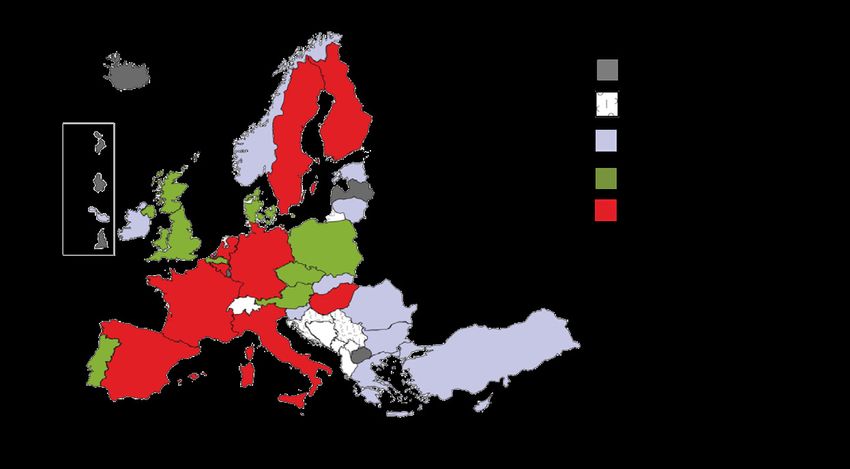
Whereas in average 33% of the EMJMDs award a Joint Degree, it should be noted that some countries/regions
are proportionally awarding more joint degrees than the others. In Figure 9, for each Programme Country, the
proportion of programmes offering a joint degree is compared with the average of 33%. Are highlighted in
green (higher proportion) and red (lower) those involved in more than 10 EMJMDs.
In the EMJMD programmes, the organisation of the mobility path is to a large extent left open to the choice
of the consortia, provided they respect the minimum mobility rules. The EMJMD study periods must take place
in at least two of the Programme Countries represented in the consortium, and students will have to acquire
the entirety of ECTS credits of the Master programme (60, 90 or 120). EMJMDs organise their mobility path
in different ways, varying from a predetermined “fixed” mobility track, in which all students move between the
same institutions at the same time, to a completely open study programme depending on the students’ needs
and the number of available places per institution. In almost two third of the EMJMDs (Figure 8), students can
choose their mobility track.
Figure 8 : Breakdown of the EMJMDs according to the type of mobility path
Students have to visit
all partners
36%
64%
Students visit only
some of the partners
2 Source : EACEA 2020 (based on a sample of EMJMD projects)
24Figure 9 : EMJMDs awarding a “joint degree” or “joint degree per track” per country
No participation in EMJMDs
Not covered by the survey
answers
Involved in less than 10
BE de EMJMDs
LU
More than 33% of projects
awarding a joint degree
MT Less than 33% of projects
awarding a joint degree
LI
• More than half of the selected consortia between 2014-2020 were new Master progammes
Out of the 250 EMJMDs that were selected between 2014 and 2020, 177 correspond to a unique partnership
according to the information indicated by EMJMD applicants at application stage. Some partnerships have
been funded two consecutive times under Erasmus+ 2014-2020 (e.g. under the 2014 and 2018 calls, or
under the 2016 and 2020 calls). Moreover, as the Erasmus Mundus programme has been running since 2004,
part of the selected EMJMDs obtained their first funding before the 2014-2020 funding period (Figure 10). In
total, 94 entirely new Master programmes were funded between 2014 and 2020.
Figure 10 : Breakdown of the selected Master programmes (2014-2020) according to the date of their first
partnership funding (n=177)
Partnership since
2004-2008
15%
Partnership since
53% 2014-2020
32%
Partnership since
2009-2013
25You can also read


