In situ zircon U-Pb, Lu-Hf, δ18O, and trace elements from intrusive units in northern Hogem batholith, Quesnel terrane, north-central British Columbia
←
→
Page content transcription
If your browser does not render page correctly, please read the page content below
In situ zircon U-Pb, Lu-Hf, δ18O, and trace elements from
             intrusive units in northern Hogem batholith,
         Quesnel terrane, north-central British Columbia

                                          G. Jones, L. Ootes,
                                             Y. Luo, R. Stern,
                                    A. Vezinet, D.G. Pearson

                                               GeoFile 2022-09
Ministry of Energy, Mines and Low Carbon Innovation
Mines, Competitiveness, and Authorizations Division
British Columbia Geological Survey

Recommendation citation: Jones, G., Ootes, L., Luo, Y., Stern, R., Vezinet, A., and Pearson, D.G., 2022. In situ
zircon U-Pb, Lu-Hf, δ18O, and trace elements from intrusive units in northern Hogem batholith, Quesnel terrane,
north-central British Columbia. British Columbia Ministry of Energy, Mines and Low Carbon Innovation,
British Columbia. Geological Survey GeoFile 2022-09, 19p.

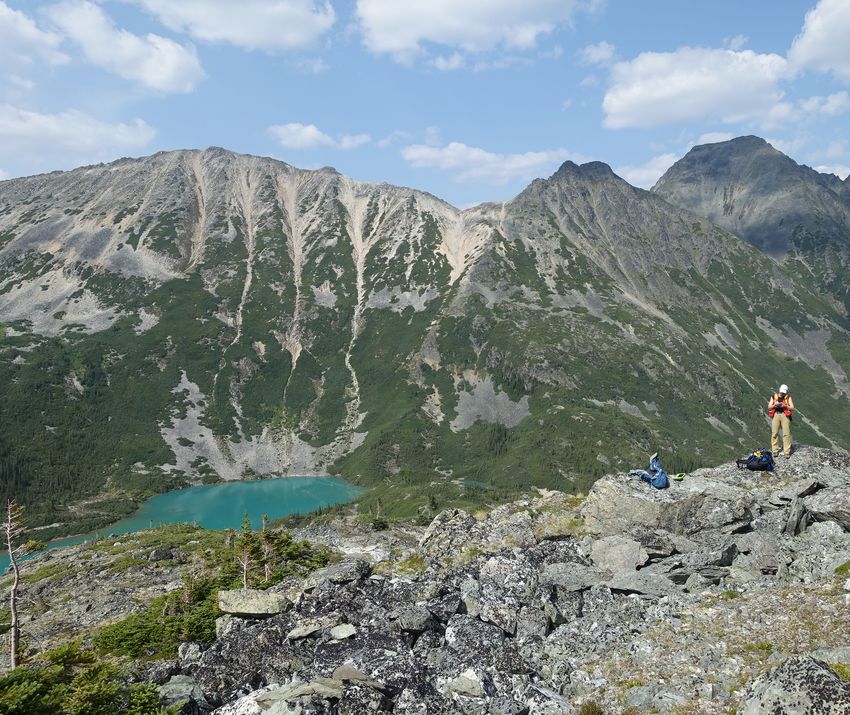
Front cover: On distant ridge, intrusive contact between the Osilinka suite granite (left, light toned) and Thane Creek suite
diorite (right, dark toned). Contact dips steeply and extends in a valley from the middle skyline to the small lake, lower left.
Hogem batholith, south-central British Columbia.

Back cover: Backscatter electron image of a subset of zircon separates from hornblendite sample 18lo22-1a, Thane Creek suite.

In situ zircon U-Pb, Lu-Hf, δ18O, and trace
elements from intrusive units in northern
Hogem batholith, Quesnel terrane, north-central
British Columbia

G. Jones
L. Ootes
Y. Luo
R. Stern
A. Vezinet
D.G. Pearson

                    Ministry of Energy, Mines and Low Carbon Innovation
                                      British Columbia Geological Survey
                                                     GeoFile 2022-09
In situ zircon U-Pb, Lu-Hf, δ18O,
and trace elements from intrusive
units in northern Hogem batholith,
Quesnel terrane, north-central British
Columbia
G. Jones1, L. Ootes2a, Y. Luo1, R. Stern1, A. Vezinet1, and D.G. Pearson1

1
  Department of Earth & Atmospheric Sciences, University of Alberta, Edmonton, AB, T6G 2E3
2
  British Columbia Geological Survey, Ministry of Energy, Mines and Low Carbon Innovation, Victoria, BC, V8W 9N3
a
 corresponding author: luke.ootes@gov.bc.ca

Recommendation citation: Jones, G., Ootes, L., Luo, Y., Stern, R., Vezinet, A., and Pearson, D.G., 2022. In situ zircon U-Pb, Lu-Hf, δ18O, and
trace elements from intrusive units in northern Hogem batholith, Quesnel terrane, north-central British Columbia. British Columbia Ministry
of Energy, Mines and Low Carbon Innovation, British Columbia. Geological Survey GeoFile 2022-09, 19 p.

Abstract
New and refined geochronology and geochemistry results complement bedrock mapping in northern Hogem batholith, Quesnel terrane. Data
and interpretations presented here include 13 new and refined U-Pb zircon crystallization ages and five new U-Pb titanite crystallization ages,
determined by LA-ICP-MS. These are supported by zircon oxygen-isotope data, determined by SIMS, and zircon Lu-Hf and trace elements. and
titanite and apatite Sm-Nd results, determined by LA-ICP-MS.

Keywords: Hogem batholith, Quesnel terrane, geochronology; isotope geochemistry, U-Pb zircon crystallization ages, trace elements; Lu-Hf,
Sm-Nd, oxygen isotopes, apatite, titanite, LA-ICP-MS, SIMS

1. Introduction                                                           3 contains new zircon oxygen isotope data determined from
  In 2018, the British Columbia Geological Survey initiated               SIMS. Appendix 4 contains new zircon U-Pb crystallization
a three-year mapping project in the Omineca Mountains of                  results and supporting data, determined from LA-ICP-MS.
north-central British Columbia to better understand the geology           Appendix 5 contains new zircon Lu-Hf data, determined from
and associated base- and precious-metal mineralization in the             LA-ICP-MS. Appendix 6 contains new zircon trace element
northern part of Hogem batholith and adjacent supracrustal                data, determined from LA-ICP-MS. Appendix 7 contains
rocks of the Quesnel, Stikine, and Cache Creek terranes (Ootes            combined zircon U-Pb crystallization age and Lu-Hf results
et al., 2019, 2020a,b,c). Herein we present analytical results            and supporting data, determined from laser ablation split
from samples collected during 2018 and 2019 mapping. These                stream (LASS)-ICP-MS. Appendix 8 contains new combined
results include U-Pb, Lu-Hf, and trace element analyses of                zircon Lu-Hf and trace elements (TE) results, determined from
zircon and supplementary U-Pb and Sm-Nd analyses of titanite              LASS-ICP-MS. Appendix 9 contains new combined apatite
and apatite data using laser ablation inductively coupled plasma          and titanite U-Pb age and Sm-Nd results and supporting data,
mass-spectrometry (LA-ICP-MS), and zircon oxygen-isotope                  determined from LASS-ICP-MS.
data using secondary ion mass spectrometry (SIMS). Most of
the U-Pb igneous zircon crystallization ages were previously              2. Geology
reported by Ootes et al. (2020c) and Jones et al. (2021); some               Hogem batholith is in the Quesnel terrane and comprises
are refined herein. This GeoFile serves as a data repository for          Triassic to Cretaceous intrusions that intruded volcanic and
an M.Sc. thesis study on zircon geochemistry of the Hogem                 sedimentary rocks of the Nicola Group (Triassic), which bound
batholith (Jones, 2022) and for forthcoming reports.                      the batholith to the north and east (Figs. 1, 2). To the west, the
  Nine appendices are included (BCGS_GF2022-09.zip).                      batholith and Nicola Group rocks are juxtaposed against Cache
Appendix 1 includes a table of bedrock units and their salient            Creek and Stikine terranes along the Pinchi-Ingenika dextral
features and a table of samples, locations, and analytical work           strike-slip fault system (Figs. 1, 2).
completed on each sample. Images of zircon grain mounts with                 Hogem batholith is subdivided into four petrologically distinct
beam-spot locations are included in Appendix 2. Appendix                  intrusive units. From oldest to youngest these are the Thane

British Columbia Geological Survey GeoFile 2022-09
                                                                      1
Jones, Ootes, Luo, Stern, Vezinet, and Pearson

                                    140°W                                             120°W
                                                                       Outboard                   Intermontane

                                                                                                                              70°N
                                    ka
                                                                       OC Olympic                 SH Shuksan

                                   on
                            Alas
                               Yuk
                                                                       YA Yakutat                 BR Bridge River
                     AG                                                CG Chugach                 CC Cache Creek
                                                                       PR Pacific Rim              CD Cadwallader
                                                        NAc
                                                                       CR Crescent                SJ San Juan
                                                                       W Alaska                   CK Chilliwack
                     AAns

                                                  NWT
                                                                       AG Angayucham              HA Harisson
                                         NA
                                 NAp
                                                                       Insular                    MT Methow
                                            b
                                                                       CPC Coast plutonic
                                                                            complex               OK Okanagan
                                                                       KS Kluane, Windy           ST Stikinia
             NAb                                                       PE Peninsular              QN Quesnellia
                                                             NAp       WR Wrangellia              YT Yukon-Tanana
                                                                       AX Alexander               SM Slide Mountain
                                                                       Arctic                     Ancestral North
              WR          YT                                           AAns Arctic Alaska         America
                                                 NAb
                                       QN                                   (North Slope)         CA Cassiar
                                                                       AAh Arctic Alaska           NAcLaurentia
                                                 SM                         (Hammond)
                                                                                                  NAb
                                                                                                      (offshelf)
                     AX
                          KS

                                    ST           YT                    RB Ruby                    NAp Laurentia
                                            YT                                                        (shelf)
                 YA                                                                               NAc
                                                                                                      Laurentia
                                                   CA                                                 (craton/cover)

                                                                                                                              60°N
                                          CC          SM        British Colu
                                                                             mbia

                            CG                                         NAp
                                                      Study
                                                                                        Alberta

                                   AX
                                                      Area

                                                        ST         QN

                                   WR            YT
                                                                               SM
                                                                                  CA
                                                                          CC
                                                           CP                                           NAp
                 ( megathrust                                 C
                      transform                                                  QN
                      ridge                                                            NAb
                                                                                                                              50°N

                                                                                                   SM
                      strike-slip                                        CD
                 (    thrust                               WR
                                                                                                  OK
             0             200           400                                                            Canada
                            km                             CR                                             USA

          Fig. 1. Location of Hogem batholith study area with respect to Cordilleran terranes of British Columbia. Modified
          after Colpron and Nelson (2020).

British Columbia Geological Survey GeoFile 2022-09
                                                                   2
Jones, Ootes, Luo, Stern, Vezinet, and Pearson
19GJ12-1 18lo12-7
19GJ12-2
18lo11-1
19GJ12-4
19GJ12-3
18lo17-1 19GJ13-1
19GJ13-2
18lo20-4
19GJ16-2
18lo22-1a 19GJ13-3
18lo22-1d
18lo25-2a 19GJ13-4 19GJ13-5a
Fig. 2. Geology of northern Hogem batholith with sample locations. After Ootes et al. (2020a,b).
British Columbia Geological Survey GeoFile 2022-09
3Jones, Ootes, Luo, Stern, Vezinet, and Pearson
Creek, Duckling Creek, Osilinka, and Mesilinka suites (Fig. 18
O/16O compositions were measured on 488 spots on 397
2; Woodsworth, 1976; Schiarizza and Tan, 2005a, b; Devine zircon grains using a Cameca IMS 1280 multicollector ion
et al., 2014; Ootes et al., 2019, 2020a-c). Unit descriptions are microprobe. A 133Cs+ beam was operated using an impact
found in Ootes et al. (2019) and supporting geochemical and energy of 20 keV and beam current of approximately 2.0 nA.
geochronological data are in Ootes et al. (2020c) and Jones et Before data acquisition, the 10 µm diameter was rastered (20 x
al. (2021). 20 µm) for 30 seconds, across an area of 5 x 5 µm. The normal
incidence electron gun was used for charge compensation.
3. Methods Negative secondary ions were extracted through 10 kV into
3.1. Sample preparation the secondary (transfer) column. Transfer conditions included
Alteration and lichen-free samples were prepared in the field a 122 µm entrance slit, a 5 x 5 mm pre-ESA (field) aperture,
as chips then bagged and sealed. Samples with the prefix 18lo and 100x (MA80) sample magnification at the field aperture,
were prepared at the University of British Columbia using transmitting all regions of the sputtered area. No energy
standard mineral separation procedures. At the University filtering was employed. The mass/charge separated oxygen
of Alberta, 1 to 2 kg samples were disaggregated using the ions were detected simultaneously in Faraday cups L’2 (16O-)
electronic pulse disaggregation (EPD) system in the Selective and H’2 (18O-) as mass resolutions (m/Δm at 10%) of 1950 and
Fragmentation (SELFRAG) laboratory in the Canadian Centre 2250, respectively. Secondary ion count rates for 16O- and 18O-
for Isotopic Microanalysis (CCIM). Mineral separates were were approximately 2x10⁹ and 4x10⁶ counts per second using
dried in a 20°C oven, then sieved to pass a 355 µm mesh. The 1010 Ω and 1011 Ω amplifier circuits, respectively. Faraday cupJones, Ootes, Luo, Stern, Vezinet, and Pearson
was ablated using settings of 35 to 50 s of ablation, 50 s of values may indicate altered zircon domains, or growth zones
background and washout, 6 Hz repetition rate, 120 mJ laser with mineral inclusions, which may affect the interpreted age
energy, 11%T attenuator value, and ca. 1.8 J/cm2 fluence, of the sample. After data filtering, individual zircon 206Pb/238U
measured at the ablation site (Table 1). Masses 202, 204, 206, ages were used to calculate a weighted mean 206Pb/238U age for
207, 208, 232, and 238 were measured. Uranium-235 was each sample. Zircon 207Pb/235U and 206Pb/238U ratios were used
calculated from 238U results and the 238U/235U isotopic ratio to determine concordia ages. Weighted means and concordia
(Jaffey et al., 1971). Data were processed and reduced offline plots were created using IsoplotR online (Vermeesch, 2018).
using the Iolite version 3 software package (Paton et al., 2010; All reported isotope ratios and age uncertainties are given as
Paton et al., 2011), using the data reduction scheme (DRS) 2σ standard error, or 95.4% confidence level, propagated by
‘X_U_Pb_Geochron’. The decay constants of 235U (9.485 x 10- quadratic addition.
10
year-1), 238U (1.55125 x 10⁻¹⁰ year-1) and the 238U/235U isotopic
ratio (137.88) used in age calculations are from Jaffey et al. 3.4. Zircon Lu-Hf isotopes analyses by LA-ICP-MS and
(1971). LASS-ICP-MS
Uranium-lead isotopes of standard zircon reference material Lutetium-hafnium isotopes in zircon were analyzed by
were determined throughout three analytical sessions. Three multi-collector (MC) LA- ICP-MS at the Arctic Resources
zircon reference materials were analyzed after every six Laboratory, the University of Alberta. The same zircon grains
analyses of unknowns. The natural zircons 91500 (1062.4±0.8 used for oxygen and U-Pb isotope analyses were used for Lu-
Ma; Wiedenbeck et al., 1995, 2004) or Plešovice (337.13±0.37 Hf isotope analysis, and the same analytical spots or magmatic
Ma; Sláma et al., 2008) were used for the primary calibration zones were sampled. The same laser ablation system used for
reference material to monitor analytical reproducibility, U-Pb U-Pb isotope analyses was used for Hf isotope analysis and
fractionation, and instrument drift during each analytical run. coupled with a Thermo Fisher Scientific Neptune Plus MC-
The Plešovice, 94-35 (55.5±1.5 Ma; Klepeis et al., 1998), and SF-ICP-MS using multiple Faraday detectors with 1011 Ω
Mud Tank (731.0±0.2 Ma; Gain et al., 2019) zircons were used amplifiers operating in static collection mode. Masses 172,
as secondary validation reference materials to monitor the 173, 175, 176, 177, 178, 179, 180, and 181 were measured. A
accuracy of the primary correction. 33 µm diameter laser spot size was ablated using settings of 60
A subset of zircons was analyzed using the laser ablation split s of ablation, 60 s of background and washout, 8 Hz repetition
stream (LASS)-ICP-MS method (Appendix 7), in which U-Pb rate, 120 mJ laser energy, 44%T attenuator value, and ca. 6.5 J/
isotopes were analyzed concomitantly with Lu-Hf on a portion cm2 (Table 3).
of the same zircon material using separate mass spectrometers. Data were processed and reduced offline using the Iolite
The LASS method used the same ICP-MS and laser set-ups to version 3 software package (Paton et al., 2010; Paton et al.,
collect U-Pb as the previously mentioned single-stream ICP- 2011 and the data reduction scheme (DRS) “Hf_Alberta”.
MS method (Table 2). Due to the interferences of 176Yb and 176Lu on 176Hf, a two-step
correction was necessary to determine accurate Hf isotopic
3.3.1. Filtering ratios. The Yb-mass bias factor (βYb) was determined using
No common Pb correction was applied to the data. The the peak-stripping method, by measuring the ratio of two
206
Pb/204Pb ratio in the unknown zircons ranged from 200 to interference-free isotopes of Yb, 172Yb/173Yb (Woodhead et al.,
1800000. The presence of significant common Pb in individual 2004; Fisher et al., 2011), and calculated using the exponential
zircon analyses was indicated by calculating f206Pbc, in which mass fractionation law described in Russell et al. (1978). The
the 206Pb/204Pb ratio was calculated using the method of Stacey measured 176Yb/173Yb was iteratively calibrated to optimize
and Kramers (1975) and divided by the measured 206Pb/204Pb the Yb-interference correction, monitored by zircon reference
ratio for each analysis (e.g., Vezinet et al., 2018). Measured materials with variable Yb contents (91500, MUN1, MUN3).
204
Pb was corrected for 204Hg interference by subtracting the The Lu interference correction was calculated in the same
counts per second (cps) of 202Hg multiplied by the natural ratio manner as the Yb interference, assuming that Lu behaves
of 204Hg to 202Hg (6.87/29.86; Rosman and Taylor, 1998) from similarly to Yb, using the 176Lu/175Lu ratio (e.g., Vezinet et al.,
the cps of 204Pb. Zircon with f206Pbc results >1% (Eqn. 2) were 2018).
not included in age calculations. The corrected 176Hf/177Hf results of unknowns were
converted to ɛHf(t), which is the 176Hf/177Hf ratio of at the
f206Pbc % = [(206Pb/204Pb)Stacey & Kramers, 1975 / (206Pb/204Pb)measured] *100 (Eqn. 2)
time of crystallization (t) relative to the 176Hf/177Hf ratio of the
Zircon grains with >5% discordance, determined using the chondritic uniform reservoir (CHUR; Eqn. 3).
individual zircon 206Pb/238U and 207Pb/235U ages, were rejected
from intrusive age weighted means. In addition to U-Pb data (176Hf/177HfSAMPLE(t))
ɛHf(t)= � (176
Hf/177HfCHUR(t))
-1� ×10000 (Eqn. 3)
filters, the internal structures of zircon were examined using
in which
CL and BSE images. Xenocrystic or antecrystic cores were 176
Hf/177Hf(t)= 176Hf/177Hf(measured) – 176Lu/177Hf x e[(λ176Lu x t) - 1], 176Hf/177HfCHUR(measured)=0.282785±1,
identified by the degree of roundness and crosscutting growth 176
Lu/177HfCHUR=0.0336±1 (Bouvier et al., 2008), and λ176Lu=1.867x10⁻¹¹ (Söderlund et al., 2004)
zones, and these grains were not used toward calculating sample
ages. Zircon grains with suspect age results (significantly The time of crystallization used in the ɛHf(t) for individual
younger or older than the main population) that passed the zircon analyses was either the single zircon 206Pb/238U age,
initial data filters were further filtered by removing grains with or the interpreted crystallization age of the sample if a single
trace element concentrations of Ca >300 ppm, Fe >300 ppm, zircon age was unavailable. Uncertainties of ɛHf(t) values were
Ti >20 ppm, and La >1 ppm. Concentrations greater than these propagated using the calculations of Ickert (2013).
British Columbia Geological Survey GeoFile 2022-09
5Jones, Ootes, Luo, Stern, Vezinet, and Pearson
Table 1. Single stream laser ablation-inductively coupled plasma-mass spectrometry (LA-ICP-MS) parameters for zircon U-Pb analyses.
Laboratory and sample preparation
Laboratory name Arctic Resource Lab, University of Alberta (Canada)
Sample type/mineral Zircon grains (magmatic)
Sample preparation Conventional mineral separation, polished 1inch resin mount
CL & BSE (Zeiss EVO MA15)
Imaging
15kv, 3-5 nA
Laser ablation system
Make, Model & type RESOlution ArF excimer
Ablation cell Laurin Technic S-155
Laser wavelength 193 nm
Pulse width 4-20 ns
Fluence ca. 1.8 J.cm-2 (120 mJ, 11% transmission)
Repetition rate 6 Hz
Ablation/Washout duration 35-50 secs / 50 secs
Ablation rate 0.11-0.15 µm.pulse-1
Spot diameter 33, 40, or 23 μm
Sampling mode / pattern Static spot ablation
100% He in the cell, Ar and N2 make-up gas combined using a Y-piece 50% along
Carrier gas
the sample transport line to the torch.
A mixture of 1.6-1.8 L/min Ar and 12-14ml/min N2, which entered tangentially
Cell carrier gas flow from the top of the S-155 ablation cell funnel and ~800 ml/min He entering from
the side of the cell
ICP-MS instruments
U–Th–Pb measurements
Make, Model & type Thermo Fisher Scientific, Element XR, SC-SF-ICP-MS
Sample introduction Ablation aerosol introduced through Tygon tubing
RF power 1360W
202, 208, 232 in triple mode.
206 and 238 in analogue mode.
Detection system
204 and 207 in counting mode
235 is calculated using canonical value. No Faraday cup used.
Masses measured 202, 204, 206, 207, 208, 232, 238
Integration time per peak/
30 ms on 202, 204, 208 and 232; 60 ms on 206, 207 and 238
dwell times
Total integration time 300 ms for each output datapoint
IC Dead time 20 ns
Data processing
Gas blank 30 second on-peak zero subtracted both for U-Pb and Lu-Hf measurements
91500 or Plešovice used as primary reference material (U-Pb), Plešovice, 94-35,
Calibration strategy
Mud Tank used as secondaries/validation materials.
Plešovice (Sláma et al., 2008)
91500 (Wiedenbeck et al., 1995; Wiedenbeck et al., 2004; Blichert-Toft, 2008)
Reference Material info
Mud Tank (Gain et al., 2019)
94-35 (Klepeis et al., 1998)
Iolite software package (Paton et al., 2010; Paton et al., 2011; Fisher et al., 2017)
Data processing package used /
using the following DRS: “X_U_Pb Geochron” for U–Th–Pb isotope analyses.
Correction for LIEF
LIEF correction assumes matrix match between reference material and samples.
Standard-sample bracketing with 207Pb/206Pb and 206Pb/238U normalized to primary
Mass discrimination
reference material.
Common-Pb correction, composition
No common-Pb correction applied to the data
and uncertainty
Ages are quoted at a coverage factor of 2, absolute. Propagation is by quadratic
Uncertainty level & propagation addition. Reproducibility and age uncertainty of reference material and common-
Pb composition uncertainty are propagated where appropriate.
British Columbia Geological Survey GeoFile 2022-09
6Jones, Ootes, Luo, Stern, Vezinet, and Pearson
Table 2. Split stream laser ablation-inductively coupled plasma-mass spectrometry (LASS-ICP-MS) parameters for zircon U-Pb and Lu-Hf
analyses.
Laboratory and sample preparation
Laboratory name Arctic Resource Lab, University of Alberta (Canada)
Sample type/mineral Zircon grains (magmatic)
Sample preparation Conventional mineral separation, polished 1inch resin mount
CL & BSE (Zeiss EVO MA15)
Imaging
15kv, 3-5 nA
Laser ablation system
Make, Model & type RESOlution ArF excimer
Ablation cell Laurin Technic S-155
Laser wavelength 193 nm
Pulse width 4-20 ns
Fluence ca. 6 J.cm-2 (120 mJ, 44% transmission)
Repetition rate 8 Hz
Ablation/Washout duration 45 secs / 45 secs
Ablation rate 0.125µm.pulse-1 with the ca. 6.5 J.cm-2 setting
Spot diameter 44 μm
Sampling mode / pattern Static spot ablation
100% He in the cell, Ar and N2 make-up gas combined using a Y-piece 50%
Carrier gas
along the sample transport line to the torch.
A mixture of 1.6-1.8 L/min Ar and 12-14ml/min N2, which entered tangentially
Cell carrier gas flow from the top of the S-155 ablation cell funnel and ~800 ml/min He entering from
the side of the cell
ICP-MS instruments
U–Th–Pb measurements
Make, Model & type Thermo Fisher Scientific, Element XR, SC-SF-ICP-MS
Sample introduction Ablation aerosol introduced through Tygon tubing
RF power 1360W
202, 208, 232 in triple mode.
206 and 238 in analogue mode.
Detection system
204 and 207 in counting mode
235 is calculated using canonical value. No Faraday cup used.
Masses measured 202, 204, 206, 207, 208, 232, 238
Integration time per peak/
30 ms on 202, 204, 208 and 232; 60 ms on 206, 207 and 238
dwell times
Total integration time 300 ms for each output datapoint
IC Dead time 20 ns
Lu–Yb–Hf measurements
Make, Model & type Thermo Fisher Scientific, Neptune Plus, MC-SF-ICP-MS
Ablation aerosol introduced tygon tubing.
Sample introduction
Ni-Jet Sample cone and X-Skimmer cone.
RF power 1250W
Detection system Static Faraday (attached to 1011 Ω amplifier) measurement
Masses measured 172, 173, 175, 176, 177, 178, 179, 180, 181
Total integration time per output
1.049 secs
datapoint
L4 L3 L2 L1 Axial H1 H2 H3 H4
Cup configuration
172 173 175 176 177 178 179 180 181
Data processing
Gas blank 30 second on-peak zero subtracted both for U-Pb and Lu-Hf measurements
91500 used as primary reference material (U-Pb), Plešovice, GJ-1, MUN1 &
Calibration strategy
MUN-3 used as secondaries/validation materials.
GJ-1 (Jackson et al., 2004; Morel et al., 2008)
Plešovice (Sláma et al., 2008)
Reference Material info
MUN-1 and MUN-3 (Fisher et al., 2011)
91500 (Wiedenbeck et al., 1995; Wiedenbeck et al., 2004; Blichert-Toft, 2008)
Data processing package used / Iolite software package (Paton et al., 2010; Paton et al., 2011; Fisher et al., 2017)
Correction for LIEF using the following DRS: “U_Pb Geochron 4” for U–Th–Pb isotope analyses’;
British Columbia Geological Survey GeoFile 2022-09
7Jones, Ootes, Luo, Stern, Vezinet, and Pearson
Table 2, continued.
“Hf_Alberta” for Lu-Hf isotope analyses. LIEF correction assumes matrix match
between reference material and samples.
Standard-sample bracketing with 207Pb/206Pb and 206Pb/238U normalized to
Mass discrimination
primary reference material.
Common-Pb correction,
No common-Pb correction applied to the data
composition and uncertainty
Calculated using 173Yb/172Yb invariant ratio and the exponential law of Russell
Yb mass bias coefficient (βYb)
et al. (1978).
Calculated with 176Yb/173Yb ratio, the Yb-mass bias coefficient (βYb) and the
Yb interference
exponential law of Russell et al. (1978). Daily adjusted.
Calculated with 176Lu/175Lu ratio, the Yb-mass bias coefficient (βYb) and the
Lu interference
exponential law of Russell et al. (1978). Daily adjusted.
Ages are quoted at a coverage factor of 2, absolute. Propagation is by quadratic
Uncertainty level & propagation addition. Reproducibility and age uncertainty of reference material and common-
Pb composition uncertainty are propagated where appropriate.
Hafnium isotopes of standard zircon reference material Trace element reference materials were analyzed between
were determined throughout three analytical sessions. Four every 8-10 unknowns. Glass standard reference material (SRM)
zircon reference materials were analyzed after every seven NIST 612 was used as the primary calibration standard. NIST
to twelve unknown analyses. The natural zircon Plešovice SRM 614 and zircon 91500 were used as secondary verification
(176Hf/177Hf=0.282482±13; Sláma et al., 2008) was used standards to monitor accuracy, instrumental drift, and matrix
as the primary calibration reference material to monitor effects. The stoichiometric 29Si content in zircon (15.32 wt.%)
analytical reproducibility, Hf fractionation, and instrument was used as an internal standard. Limits of detection (LOD=
drift during each analytical run. The natural zircon 91500 3.29σ blank; Currie, 1968) were calculated in Iolite using the
(176Hf/177Hf=0.282308±6; Wiedenbeck et al., 1995; Blichert- calculation of Pettke et al. (2012), based on Poisson statistics.
Toft, 2008) and synthetic zircons MUN1 and MUN3 For data to be quantitative they must exceed the limit of
(176Hf/177Hf=0.282135±7; Fisher et al., 2011) were used quantification (LOQ= 10σ blank; Currie, 1968), which was
as secondary reference materials to verify the accuracy of calculated and reported for each analysis.
the calibration. The weighted mean 176Hf/177Hf results for A subset of zircons was analyzed using the laser ablation split
the primary and secondary zircon reference materials were stream (LASS)-ICP-MS method (Appendix 8), in which trace
compared to the accepted values. elements and Lu-Hf isotopes were analyzed concomitantly
A subset of zircons was analyzed using the laser ablation on a portion of the same zircon material using separate mass
split stream (LASS)-ICP-MS method (Appendices 7 and 8), spectrometers. The LASS method used the same ICP-MS and
in which Lu-Hf and U-Pb or trace elements were analyzed laser setups to collect trace elements as the single-stream ICP-
concomitantly on a portion of the same zircon material using MS method (Table 4).
separate mass spectrometers (Tables 2 and 4). The LASS
method used the same ICP-MS and laser set-ups to collect U-Pb 3.6. Apatite and titanite Sm-Nd and U-Pb isotope analyses
as the previously mentioned single-stream ICP-MS method. by LASS-ICP-MS
Samarium-neodymium and U-Pb isotopes in apatite and
3.5. Zircon trace element analyses by LA-ICP-MS and titanite were simultaneously measured using the laser ablation
LASS-ICP-MS split-stream (LASS)-ICP-MS method (e.g., Fisher et al., 2014).
Trace elements in zircon were analyzed by LA-SC-SF-ICP- Concurrent Sm-Nd and U-Pb measurements were obtained
MS with the same laser ablation and ICP-MS configuration at the University of Alberta Arctic Resources Laboratory,
used for U-Pb isotope analyses. The same zircon grains used using the same laser and ICP-MS configurations described
for oxygen, U-Pb, and Hf isotope analyses were used for trace in the U-Pb and Lu-Hf single stream LA-ICP-MS methods.
element analysis, and the same analytical spots or growth zones The U-Pb isotope measurements were acquired on a Thermo
were sampled. A portion of the samples were analyzed for Hf Fisher Element II XR SC-SF-ICP-MS. The Sm-Nd isotope
isotopes before trace element analysis, while the other portion measurements were obtained simultaneously, on a portion of
was analyzed for trace elements first. Concentrations for the same material as analyzed for U-Pb, on a Thermo Fisher
twenty-nine elements were acquired: 31P, 43Ca, 45Sc, 49Ti, 55Mn, Scientific Neptune Plus MC-SF-ICP-MS using multiple
57
Fe, 89Y, 93Nb, 137Ba, 139La, 140Ce, 141Pr, 146Nd, 147Sm, 153Eu, Faraday detectors with 1011 Ω amplifiers operating in static
157
Gd, 159Tb, 163Dy, 165Ho, 166Er, 169Tm, 172Yb, 175Lu, 177Hf, 181Ta, collection mode. Masses 143, 144, 145, 148, and 150 were
232
Th, 204Pb, 208Pb, and 238U. Samples were ablated for 40 or 50s, measured. The apatite and titanite samples were ablated using a
using a 33µm or 50 µm laser beam diameter, 60s of background RESOlution 193 nm ArF excimer laser using a 90 µm diameter
and washout, 10 Hz repetition rate, 120mJ laser energy, 26%T spot size, 45s of ablation time, 60s of background and washout,
attenuator value, and fluence of ca. 3.5 J/cm2 (Table 5). 8 Hz repetition rate, and ca. 5-6 J/cm2 fluence (Table 6).
Data were processed and reduced offline using the Iolite Data were processed and reduced offline using the Iolite
version 4.3.7 software package (Paton et al., 2010; Paton et al., version 3 software package (Paton et al., 2010; Paton et al., 2011)
2011) and the DRS “Trace Elements” (Longerich et al., 1996). in multiple DRS mode, using the DRS “SmNd_Downhole”
British Columbia Geological Survey GeoFile 2022-09
8Jones, Ootes, Luo, Stern, Vezinet, and Pearson
Table 3. Single stream laser ablation-inductively coupled plasma-mass spectrometry (LA-ICP-MS) parameters for zircon Lu-Hf analyses.
Laser ablation system
Make, Model & type RESOlution ArF excimer
Ablation cell Laurin Technic S-155
Laser wavelength 193 nm
Pulse width 20 ns
Fluence ca. 6 J.cm-2 (120 mJ, 44% transmission)
Repetition rate 8 Hz
Ablation/Washout duration 60 secs / 60 secs
Ablation rate 0.07µm.pulse-1
Spot diameter 33 µm
Sampling mode / pattern Static spot ablation
A mixture of ~0.85 L/min Ar and 6- 7 ml/min N2, which entered tangentially from the
Carrier gas and gas flow top of the S-155 ablation cell funnel and ~400 ml/min He entering from the side of the
cell.
Lu–Yb–Hf measurements
Make, Model & type Thermo Fisher Scientific, Neptune Plus, MC-SF-ICP-MS
Ablation aerosol introduced tygon tubing.
Sample introduction
Ni-Jet Sample cone and X-Skimmer cone.
RF power 1250W
Detection system Static Faraday (attached to 1011 Ω amplifier) measurement
Masses measured 172, 173, 175, 176, 177, 178, 179, 180, 181
Total integration time per output
1.049 secs
datapoint
L4 L3 L2 L1 Axial H1 H2 H3 H4
Cup configuration
172 173 175 176 177 178 179 180 181
Data processing
Gas blank 60 second on-peak zero subtracted for Lu-Hf measurements
Plešovice (Sláma et al., 2008)
Reference Material info 91500 ( Blichert-Toft, 2008)
MUN-1 and MUN-3 (Fisher et al., 2011)
Iolite software package (Paton et al., 2010; Paton et al., 2011; Fisher et al., 2017) using
Data processing package used
the following DRS: ““Hf_Alberta”
Calculated using 173Yb/172Yb invariant ratio and the exponential law of Russell et al.
Yb mass bias coefficient (βYb)
(1978).
Calculated with 176Yb/173Yb ratio, the Yb-mass bias coefficient (βYb) and the exponential
Yb interference
law of Russell et al. (1978). Daily adjusted.
Calculated with 176Lu/175Lu ratio, the Yb-mass bias coefficient (βYb) and the exponential
Lu interference
law of Russell et al. (1978). Daily adjusted.
and “X_U_Pb_Geochron”. The Nd mass bias corrections chondritic uniform reservoir (CHUR; Eqn. 4).
were calibrated using the Bear Lake titanite (1047.1±0.4 Ma;
143
Nd/144Nd=0.512310±5; TH-tnt-1 of Fisher et al., 2020 and (143Nd/144NdSAMPLE(t))
ɛNd(t)= � (143
Nd/144NdCHUR(t))
-1� ×10000 (Eqn. 4)
BLR-1 of Aleinikoff et al., 2007) and Bancroft apatite (1021±3
in which
Ma; 143Nd/144Nd=0.512048±6; TH-ap-1 of Fisher et al., 2020)
as primary reference materials. Verification of the Nd mass bias Nd/144Nd(t)= 143Nd/144Nd(measured) – 147Sm/144Nd x e[(λ147Sm x t) - 1], 143Nd/144NdCHUR(measured)=0.51263±11,
143
correction was determined using the MKED titanite (1519.5±3.0 Sm/144NdCHUR=0.1960±4 (Bouvier et al., 2008), and λ147Sm=6.54x10⁻¹² (Lugmair and Marti, 1979)
147
Ma; 143Nd/144Nd=0.511630±3; Spandler et al., 2016) and MAD
apatite (475.4±1.8 Ma; 143Nd/144Nd=0.511304±13; Fisher et al., The interpreted titanite U-Pb discordia age was used for time
2020). The U-Pb mass bias corrections were calibrated using of crystallization in the ɛNd(t) calculation for individual titanite
the MKED titanite and Bancroft apatite and verified using analyses. Because apatite U-Pb analyses did not yield any ages,
the Bear Lake titanite and MAD apatite. The LASS-ICP-MS the interpreted zircon 206Pb/238U ages from the same samples
143
Nd/144Nd and U-Pb ages were compared to the reported were used to calculate ɛNd(t) of the apatite grains. Uncertainties
values for each reference material. on ɛNd(t) values were propagated using the calculations of
The 143Nd/144Nd results of unknown titanite and apatite grains Ickert (2013).
were converted to ɛNd(t), which is the 143Nd/144Nd ratio of at the Additionally, titanite and apatite ɛNd(t) results were converted
time of crystallization (t) relative to the 143Nd/144Nd ratio of the to ɛHf(t) using the calculation of Vervoort et al. (2011), which
British Columbia Geological Survey GeoFile 2022-09
9Jones, Ootes, Luo, Stern, Vezinet, and Pearson
Table 4. Split stream laser ablation-inductively coupled plasma-mass spectrometry (LASS-ICP-MS) parameters for zircon Lu-Hf and trace
elements analyses.
Laboratory and sample preparation
Laboratory name Arctic Resource Lab, University of Alberta (Canada)
Sample type/mineral Zircon grains (magmatic)
Sample preparation Conventional mineral separation, polished 1inch resin mount
CL & BSE (Zeiss EVO MA15)
Imaging
15kv, 3-5 nA
Laser ablation system
Make, Model & type RESOlution ArF excimer
Ablation cell Laurin Technic S-155
Laser wavelength 193 nm
Pulse width 4-20 ns
Fluence ca. 6 J.cm-2 (120 mJ, 44% transmission)
Repetition rate 8 Hz
Ablation/Washout duration 60 secs / 60 secs
Ablation rate ~0.075 µm.pulse-1
Spot diameter 33 or 40 μm
Sampling mode / pattern Static spot ablation
100% He in the cell, Ar and N2 make-up gas combined using a Y-piece 50%
Carrier gas
along the sample transport line to the torch.
A mixture of 1.6-1.8 L/min Ar and 12-14ml/min N2, which entered tangentially
Cell carrier gas flow from the top of the S-155 ablation cell funnel and ~800 ml/min He entering from
the side of the cell
ICP-MS instruments
Lu–Yb–Hf measurements
Make, Model & type Thermo Fisher Scientific, Neptune Plus, MC-SF-ICP-MS
Ablation aerosol introduced tygon tubing.
Sample introduction
Ni-Jet Sample cone and X-Skimmer cone.
RF power 1250W
Detection system Static Faraday (attached to 1011 Ω amplifier) measurement
Masses measured 172, 173, 175, 176, 177, 178, 179, 180, 181
Total integration time per output
1.049 secs
datapoint
L4 L3 L2 L1 Axial H1 H2 H3 H4
Cup configuration
172 173 175 176 177 178 179 180 181
Trace elements measurements
Make, Model & type Thermo Fisher Scientific, Element XR, SC-SF-ICP-MS
Sample introduction Ablation aerosol introduced through Tygon tubing
RF power 1360W
31P, 43Ca, 45Sc, 49Ti, 55Mn, 57Fe, 89Y, 93Nb, 137Ba, 139La, 140Ce, 141Pr, 146Nd, 147Sm,
Elements measured 153Eu, 157Gd, 159Tb, 163Dy, 165Ho, 166Er, 169Tm, 172Yb, 175Lu, 177Hf, 181Ta, 232Th,
204
Pb, 208Pb, and 238U
Data processing
Plešovice used as primary reference material (Lu-Hf), 91500, MUN1 & MUN-3
used as secondaries/validation materials.
Calibration strategy NIST SRM 612 used as primary reference material (trace elements), NIST SRM
614 and zircon 91500 used as secondaries/validation materials. Stoichiometric
29Si content in zircon (15.32 wt.%) used as an internal standard.
Plešovice (Sláma et al., 2008)
MUN-1 and MUN-3 (Fisher et al., 2011)
NIST SRM 612 (Jochum et al., 2011)
Reference Material info
NIST SRM 614 (Jochum et al., 2011)
Zircon 91500 (Wiedenbeck et al., 2004)
91500 (Wiedenbeck et al., 1995; Wiedenbeck et al., 2004; Blichert-Toft, 2008)
Iolite software package (Paton et al., 2010; Paton et al., 2011; Fisher et al., 2017)
Data processing package used / using the following DRS: “Hf_Alberta” for Lu-Hf isotope analyses; “X_Trace
Correction for LIEF Elements_IS” for trace elements analysis. LIEF correction assumes matrix match
between reference material and samples.
Calculated using 173Yb/172Yb invariant ratio and the exponential law of Russell
Yb mass bias coefficient (βYb)
et al. (1978).
British Columbia Geological Survey GeoFile 2022-09
10Jones, Ootes, Luo, Stern, Vezinet, and Pearson
Table 4 contined.
Calculated with 176Yb/173Yb ratio, the Yb-mass bias coefficient (βYb) and the
Yb interference
exponential law of Russell et al. (1978). Daily adjusted.
Calculated with 176Lu/175Lu ratio, the Yb-mass bias coefficient (βYb) and the
Lu interference
exponential law of Russell et al. (1978). Daily adjusted.
Uncertainties are quoted at a coverage factor of 2, absolute. Propagation is by
Uncertainty level & propagation quadratic addition. Limits of detection were determined using calculations
(Pettke et al., 2012) in Iolite (Paton et al., 2010; Paton et al., 2011).
uses the linearity of the mantle Hf-Nd isotope array (Eqn. 5). The sample was analyzed by single stream LA-ICP-MS.
After analysis and data filtering, the resulting weighted mean
ɛHf(t) = [1.55 x ɛNd(t)] + 1.21 (Eqn. 5)
206
Pb/238U age is 191.4±0.7 Ma (n=33/42; MSWD=0.87;
pof=0.68). A zircon CA-TIMS U-Pb age of 197.6±0.1 Ma for
4. Results sample 18lo22-1a was previously determined (Ootes et al.,
4.1. SIMS zircon oxygen-isotope results 2020b). The discrepancy between the LA-ICP-MS weighted
Igneous zircon δ18OVSMOW results are in Appendix 3. The mean 206Pb/238U date (191.4±0.7 Ma) and the reported CA-
δ O results of Hogem batholith zircons are compared to the
18
TIMS 206Pb/238U date (197.6±0.1 Ma) may be due to differences
approximate δ18O range of zircons sourced from the mantle in the calibration techniques between the LA-ICP-MS and CA-
(δ18O=+5.3±0.6‰; Valley et al., 1998). Zircons with δ18O values TIMS methods. Although both the LA-ICP-MS and CA-TIMS
higher than the mantle range indicate possible interaction with U-Pb dates of the hornblendite are considered valid, the CA-
the low-temperature hydrosphere (i.e., crust that interacted TIMS date (197.6±0.1 Ma) is interpreted to be more accurate
with the hydrosphere, was buried, and then later melted) and the best estimate of the crystallization age.
whereas sub-mantle δ18O values suggest high-temperature
hydrothermal zircon sources (Valley et al., 2005). Thane Creek 4.2.2. Thane Creek Quartz diorite: 18lo22-1d (revision of
zircon δ18O compositions range from +4.95 to +8.52‰, with result in Ootes et al. (2020b,c)
most (n=170/177) between +5.00 and +6.50‰. Duckling Quartz diorite sample 18lo22-1d of the Thane Creek suite is
Creek zircon δ18O compositions range from +5.48 to +6.72‰ from 18.6 km south-southeast of Mount Ferris, approximately
with most (n=77/84) between +6.00 and +6.72‰. Osilinka 100 m east of hornblendite sample 18lo22-1a (Fig. 2). It is a
zircon δ18O compositions range from +4.11 to +13.45‰, but “salt and pepper”, medium-grained equigranular quartz diorite.
predominantly (n=41/63) from +5.00 to +6.00‰. Because The rock is deformed and contains a moderate foliation defined
most Osilinka suite zircons are interpreted as inherited, these by plagioclase, biotite, and amphibole. The sample is mostly
δ18O values represent the oxygen-isotope composition(s) of the clay-altered plagioclase (65%), biotite (12%), and amphibole
primary magma source(s). Mesilinka zircon δ18O compositions (6%). Minor clay-altered alkali feldspar (7%) and quartz (1-
range from +4.68 to +12.22‰. There are two main distributions 2%) are present and interstitial to plagioclase. Accessory
of zircon δ18O, with values from +5.00 to 6.00‰ (n=69/164) anhedral to subhedral, fine-grained epidote, apatite, magnetite,
and from +7.00 to 8.00‰ (n=72/164). and zircon spatially occur with biotite. Trace fine-grained
chalcopyrite is disseminated through the sample.
4.2. LA-ICP-MS and LASS-ICP-MS zircon U-Pb results The sample was analyzed by single stream LA-ICP-MS.
Zircon LA- and LASS-ICP-MS U-Pb isotope data are After analysis and data filtering, the resulting weighted
reported in Appendices 4 and 7. These results include new ages mean 206Pb/238U age is 199.0±0.5 Ma (n=26/46; MSWD=1.2;
and refined interpretations of previously reported ages (Ootes pof=0.24) and is interpreted as the crystallization age for
et al., 2020c). sample 18lo22-1d.
A zircon CA-TIMS age of 196.61±0.19 Ma was previously
4.2.1. Thane Creek hornblendite: 18lo22-1a (previously determined for sample 18lo22-1d (Ootes et al., 2020b). The
reported in Ootes et al. (2020c) CA-TIMS age was interpreted using the youngest zircon
Hornblendite sample 18lo22-1a of the Thane Creek suite is result out of five grains, which range in 206Pb/238U age from
from 18.6 km south-southeast of Mount Ferris (Fig. 2). It is a 196.61±0.19 to 202.28±0.64 Ma (Ootes et al., 2020b).
coarse-grained to pegmatitic plagioclase-bearing hornblendite. Although the CA-TIMS U-Pb age results are more precise than
Pegmatitic white amphibole-plagioclase segregations (7%) LA-ICP-MS U-Pb age results for individual zircon grains, the
are interstitial to predominantly green amphibole (72%). range of LA-ICP-MS ages agree with the range of CA-TIMS
Amphibole is commonly overgrown by brown or green U-Pb results for sample 18lo22-1d. The reported CA-TIMS age
biotite, with biotite making up 10% of the sample. The sample may not represent the main stage of zircon crystallization in
contains 5% magnetite that is interstitial to amphibole and is this sample, because the youngest zircon may have crystallized
concentrated with accessory titanite (1%) and apatite (trace). later than the bulk of the population. The LA-ICP-MS age takes
Coarse, subhedral accessory epidote (2%) occurs in pegmatitic a greater range of dates into account and is more representative
plagioclase segregations. Euhedral, ~100 to 200 µm long zircon of the age range of the zircon population in this sample than the
(trace) grains occur within patches of intercumulus feldspar interpreted CA-TIMS age. We consider the LA-ICP-MS age
and epidote. Trace fine-grained chalcopyrite is disseminated (199.0±0.5 Ma) the best estimate of the crystallization age for
through the sample. quartz diorite sample 18lo22-1d.
British Columbia Geological Survey GeoFile 2022-09
11Jones, Ootes, Luo, Stern, Vezinet, and Pearson
Table 5. Single stream laser ablation-inductively coupled plasma-mass spectrometry (LA-ICP-MS) parameters for zircon trace elements
analyses.
Laboratory and sample preparation
Laboratory name Arctic Resource Lab, University of Alberta (Canada)
Sample type/mineral Zircon grains (magmatic)
Sample preparation Conventional mineral separation, polished 1 inch resin mount
CL & BSE (Zeiss EVO MA15)
Imaging
15kv, 3-5 nA
Laser ablation system
Make, Model & type RESOlution ArF excimer
Ablation cell Laurin Technic S-155
Laser wavelength 193 nm
Pulse width 4-20 ns
Fluence 3.5 J.cm-2 (120 mJ, 26% transmission)
Repetition rate 10 Hz
Ablation/Washout duration 60 secs / 60 secs
Ablation rate 0.06 or 0.08 µm.pulse-1
Spot diameter 33 or 50 μm
Sampling mode / pattern Static spot ablation
A mixture of ~0.85 L/min Ar and 1ml/min N2, which entered tangentially from the
Carrier gas top of the S-155 ablation cell funnel and ~350 ml/min He entering from the side of
the cell.
ICP-MS instruments
Trace elements measurements
Make, Model & type Thermo Fisher Scientific, Element XR, SC-SF-ICP-MS
Sample introduction Ablation aerosol introduced through Tygon tubing
RF power 1360W
Total gas is made of ~1.6 l.min-1 of Ar, 0.8-0.9 l.min-1 of He and 12-14 ml.min-1 of
Make-up gas flow (l/min) N2.
This total gas is divided between both ICP-MS at a ~ 50-50 rate.
31P, 43Ca, 45Sc, 49Ti, 55Mn, 57Fe, 89Y, 93Nb, 137Ba, 139La, 140Ce, 141Pr, 146Nd, 147Sm,
Elements measured 153Eu, 157Gd, 159Tb, 163Dy, 165Ho, 166Er, 169Tm, 172Yb, 175Lu, 177Hf, 181Ta, 232Th,
204Pb, 208Pb, and 238U
Data Processing
NIST SRM 612 used as primary reference material, NIST SRM 614 and zircon
Calibration strategy 91500 used as secondaries/validation materials. Stoichiometric 29Si content in
zircon (15.32 wt.%) used as an internal standard.
NIST SRM 612 (Jochum et al., 2011)
Reference Material info NIST SRM 614 (Jochum et al., 2011)
Zircon 91500 (Wiedenbeck et al., 2004)
Iolite software package (Paton et al., 2010; Paton et al., 2011) using the following
Data processing package used
DRS: “Trace Elements” (Longerich et al., 1996).
Concentrations are quoted at a coverage factor of 2, absolute. Limits of detection
Uncertainty level & limits of
were determined using calculations (Pettke et al., 2012) in Iolite (Paton et al., 2010;
detection
Paton et al., 2011).
4.2.3. Thane Creek quartz diorite: 19GJ12-4 (revision of occur with altered feldspar. Anhedral to euhedral, fine-grained
result in Ootes et al. (2020c) magnetite (1%) are disseminated throughout the sample and as
Quartz diorite sample 19GJ12-4 of the Thane Creek suite an alteration product within amphibole. Zircon (trace) occurs
is from 17.9 km east-northeast of Notch Peak (Fig. 2). It is a as euhedral, ~50 to 100 µm long inclusions in amphibole and
white and black, medium-grained, equigranular quartz diorite, clinopyroxene. Trace, disseminated, fine-grained chalcopyrite
and is composed of mostly plagioclase (62%), with about 25% occurs as inclusions in magnetite.
equal parts green amphiboles with corroded clinopyroxene The sample was analyzed by single stream LA-ICP-MS.
cores, and brown (metamorphic?) and green biotite. The After analysis and data filtering, the resulting weighted
sample contains minor quartz (6%) and alkali feldspar (7%), mean 206Pb/238U age is 206.8±0.9 Ma (n=12/13; MSWD=1.7;
with accessory magnetite, apatite, titanite, zircon, and epidote. pof=0.06). This crystallization age was further refined from,
Titanite occurs as rims on magnetite grains. Euhedral, fine- but within uncertainty of, a previously reported age of sample
grained apatite (trace) are included in feldspar, magnetite, 19GJ12-4 (206.6±0.9 Ma) by Ootes et al. (2020c) and Jones et
and amphibole. Epidote occurs as fine-grained patches that al. (2021).
British Columbia Geological Survey GeoFile 2022-09
12Jones, Ootes, Luo, Stern, Vezinet, and Pearson
Table 6. Split stream laser ablation-inductively coupled plasma-mass spectrometry (LASS-ICP-MS) parameters for titanite and apatite U-Pb
and Sm-Nd analyses.
Laboratory and sample preparation
Laboratory name Arctic Resource Lab, University of Alberta (Canada)
Sample type/mineral Apatite and titanite grains (magmatic)
Sample preparation Conventional mineral separation, polished 1 inch resin mount
CL & BSE (Zeiss EVO LS15)
Imaging
25kv
Laser ablation system
Make, Model & type RESOlution ArF excimer
Ablation cell Laurin Technic S-155
Laser wavelength 193 nm
Pulse width 20 ns
Fluence ca. 5-6 J.cm-2 (120 mJ, 44% transmission)
Repetition rate 8 Hz
Ablation/Washout duration 60 secs / 60 secs
Ablation rate 0.19µm.pulse-1
Spot diameter 90 µm
Sampling mode / pattern Static spot ablation
A mixture of ~0.85 L/min Ar and 6- 7 ml/min N2, which entered tangentially from the
Carrier gas and gas flow top of the S-155 ablation cell funnel and ~400 ml/min He entering from the side of the
cell.
LA-ICP-MS
U–Th–Pb measurements
Make, Model & type Thermo Fisher Scientific, Element XR, SC-SF-ICP-MS
Sample introduction Ablation aerosol introduced through Tygon tubing
RF power 1360W
202, 208, 232 in triple mode.
206 and 238 in analogue mode.
Detection system
204 and 207 in counting mode
235 is calculated using canonical value. No Faraday cup used.
Masses measured 202, 204, 206, 207, 208, 232, 238
Integration time per peak/
30 ms on 202, 204, 208 and 232; 60 ms on 206, 207 and 238
dwell times
Total integration time 300 ms for each output datapoint
IC Dead time 20 ns
Sm-Nd measurements
Make, Model & type Thermo Fisher Scientific, Neptune Plus, MC-SF-ICP-MS
Ablation aerosol introduced tygon tubing.
Sample introduction
Ni-Jet Sample cone and X-Skimmer cone.
RF power 1250W
Detection system Static Faraday (attached to 1011 Ω amplifier) measurement
Masses measured 143, 144, 145, 148, 150
L2 L1 Axial H1 H2
Cup configuration
143 144 145 148 150
Data Processing
Gas blank 30 second on-peak zero subtracted both for U-Pb and Sm-Nd measurements
Bear Lake titanite and Bancroft apatite used as primary reference material (Sm-Nd),
MKED titanite and MAD apatite used as secondaries/validation materials. MKED
Calibration strategy
titanite and MAD apatite used as primary reference material (U-Pb), Bear Lake titanite
and Bancroft apatite used as secondaries/validation materials.
Bear Lake titanite (Aleinikoff et al., 2007)
Bancroft apatite (Fisher et al., 2020)
Reference Material info
MKED titanite (Spandler et al., 2016)
MAD apatite (Fisher et al., 2020)
Iolite software package (Paton et al., 2010; Paton et al., 2011; Fisher et al., 2017) using
Data processing package used / the following DRS: “X_U_Pb Geochron” for U–Th–Pb isotope analyses and
Correction for LIEF “SmNd_Downhole” for Sm-Nd analyses. LIEF correction assumes matrix match
between reference material and samples.
Ages are quoted at a coverage factor of 2, absolute. Propagation is by quadratic
Uncertainty level & propagation
addition.
British Columbia Geological Survey GeoFile 2022-09
13Jones, Ootes, Luo, Stern, Vezinet, and Pearson 4.2.4. Thane Creek quartz monzodiorite: 19GJ13-3 and magnetite combine to make up ~5% of the sample, while (revision of result in Ootes et al. (2020c) fine-grained apatite, titanite, epidote, and zircon are trace Quartz monzodiorite sample 19GJ13-3 of the Thane Creek (
Jones, Ootes, Luo, Stern, Vezinet, and Pearson

date of 187.7±3.8 Ma. This zircon grain is also interpreted as       and as inclusions in biotite.
inherited, due to the presence of younger (ca. 160 Ma) zircons          The sample was analyzed by single stream LA-ICP-MS.
in Osilinka granite 18lo17-1 and porphyry sheet 18lo20-4.            After data filtering, the resulting weighted mean 206Pb/238U date
Additionally, field relationships indicate the Osilinka granite      is 134.1 ± 0.5 Ma (n=18/23; MSWD=1.5; pof=0.09), which we
cross-cuts Duckling Creek syenites (ca. 179 to 174 Ma), thus         interpret records the time of crystallization.
the Osilinka granite must be younger than at least ca. 174 Ma.
                                                                     4.2.13. Mesilinka equigranular granite: 19GJ16-2 (new age)
4.2.10. Mesilinka equigranular granite: 18lo11-1 (revision              Equigranular granite sample 19GJ16-2 of the Mesilinka
of result in Ootes et al. (2020c)                                    suite is from 11.8 km southeast of Mount Ferris (Fig. 2). The
   Equigranular granite sample 18lo11-1 of the Mesilinka suite       rock is a pinkish-white and black, fine to medium-grained,
is from 1.5 km northeast of Horn Peak (Fig. 2). The rock is an       equigranular granite. The sample is composed of slightly
equigranular, fine to medium-grained granite with a foliation        altered, anhedral K-feldspar (~40%), with subhedral, variably
defined by biotite. The sample is mostly strained fine-grained       myrmekitic plagioclase (~32%), and anhedral, strained quartz
quartz (40%), anhedral medium-grained alkali feldspar (30%),         (~22%). Minor anhedral, fine-grained brown biotite (2%)
and clay-altered plagioclase (25%). Accessory minerals               occurs interstitially to the main minerals and is variably
include zircon, fine-grained muscovite, biotite, and magnetite.      altered to chlorite (1%). Apatite, epidote, magnetite, titanite,
Magnetite may be rimmed by titanite.                                 allanite, muscovite, zircon, chalcopyrite, and bornite are
   The sample was analyzed by split stream LA-ICP-MS. After          accessory. Apatite (1%) occurs as very fine-grained, euhedral
data filtering, an excessive scatter constant of 2.23 was applied    inclusions within biotite. Subhedral, very fine magnetite (1%),
to the standard error of single data points to lower the MSWD        fine anhedral epidote (trace), and fine anhedral titanite (trace)
of the weighted mean 206Pb/238U date. The resulting weighted         grains are spatially associated with biotite. Rare, euhedral, fine-
mean 206Pb/238U age is 127.7±0.8 Ma (n=34/48; MSWD=1.5;              grained zoned allanite (trace) are rimmed by epidote. Euhedral,
pof=0.02). This crystallization age was further refined from,        ~50 to 60 µm long zircon (trace) grains are inclusions in biotite,
but within uncertainty of, a previously reported age of sample       quartz, and feldspar. Chalcopyrite and bornite are rare, very
18lo11-1 (127.9±0.8 Ma) by Ootes et al. (2020c) and Jones et         fine-grained inclusions in magnetite.
al. (2021).                                                             The sample was analyzed by single stream LA-ICP-MS.
                                                                     After data filtering, an excessive scatter constant of 2.58 was
4.2.11. Mesilinka K-feldspar porphyritic granite: 18lo12-7           applied to the standard error of single data points to lower the
(revision of result in Ootes et al. (2020c)                          MSWD of the weighted mean 206Pb/238U date. The resulting
   K-feldspar porphyritic granite sample 18lo12-7 of the             weighted mean 206Pb/238U age is 127.1±1.6 Ma (n=13/33;
Mesilinka suite is from 2.1 km northeast of Horn Peak (Fig. 2).      MSWD=1.4; pof=0.18) and is interpreted as the crystallization
The rock is a medium-grained K-feldspar porphyritic granite          age for sample 19GJ16-2.
with a foliation defined by biotite. Clay-altered alkali feldspar
phenocrysts up to 5 cm (38%), strained anhedral quartz (28%),        4.3. LASS-ICP-MS titanite U-Pb results
and myrmekitic plagioclase (22%) comprise most of the sample.           Supporting data for titanite LASS-ICP-MS U-Pb results are
Biotite (10%) is 1 to 2 mm wide and interstitial to feldspar and     in Appendix 9. Titanite LA-ICP-MS U-Pb results are plotted
quartz. Accessory minerals include zircon, magnetite, apatite,       on Tera-Wasserburg diagrams using uncorrected 238U/206Pb and
epidote, and allanite with epidote rims.                             207
                                                                        Pb/206Pb ratios. Titanite crystallization ages were calculated
   The sample was analyzed by split stream LA-ICP-MS. After          using a regression approach, in which an isochron fit through
data filtering, an excessive scatter constant of 2.18 was applied    the data defines a mixing line between the common Pb
to the standard error of single data points to lower the MSWD        composition (upper intercept) and the radiogenic U-Pb cooling
of the weighted mean 206Pb/238U date. The resulting weighted         age (lower intercept) of the titanite population for each sample.
mean 206Pb/238U age is 135.4±0.9 Ma (n=20/33; MSWD=1.4;              Individual data points that did not overlap with the regression
pof=0.11). This crystallization age was further refined from,        line were excluded to reduce scatter, indicated by MSWD and
but within uncertainty of, a previously reported age of sample       p(χ2) values closer to one.
18lo12-7 (134.8±1.2 Ma) by Ootes et al. (2020c) and Jones et
al. (2021).                                                          4.3.1. Thane Creek quartz monzodiorite: 19GJ13-3 (new
                                                                     age)
4.2.12. Mesilinka tonalite: 19GJ12-1 (previously reported              A description of the Thane Creek Quartz monzodiorite
in Ootes et al. (2020c)                                              sample 19GJ13-3 is in section 4.2.4. Titanite grains from the
   Tonalite sample 19GJ12-1 of the Mesilinka suite is from           sample have a U-Pb intercept age of 197.5±3.7 Ma. Five titanite
2.4 km northwest of Horn Peak (Fig. 2). The rock is a grey,          results were excluded from the regression to reduce scatter,
medium-grained, equigranular biotite-rich tonalite with a            yielding an MSWD of 2.4 (n=9/14). This titanite U-Pb intercept
foliation defined by biotite. Equigranular granite dikes cut the     age overlaps with the interpreted zircon LA-ICP-MS U-Pb
tonalite in outcrop ~50 m away. The sample is composed of            crystallization age of the same sample (194.0±1.1 Ma; section
slightly clay-altered, subhedral plagioclase (~50%), with lesser     4.2.4). The titanite U-Pb intercept age is interpreted as the
anhedral, strained quartz (~30%) and brown and green biotite         magmatic crystallization age of titanite, which occurred before
(~15%). Subhedral amphibole (2%) and magnetite (trace) are           and during zircon crystallization. Petrographic identification
spatially associated with biotite. Trace fine-grained anhedral       of zircon inclusions within titanite grains in sample 19GJ13-3
epidote and titanite, and euhedral apatite and zircon occur with     supports this interpretation.

British Columbia Geological Survey GeoFile 2022-09
                                                                    15
Jones, Ootes, Luo, Stern, Vezinet, and Pearson
4.3.2. Duckling Creek syenite: 19GJ13-2 (new age) myrmekitic quartz (~33%), and euhedral, bimodal (very
Syenite sample 19GJ13-2 of the Duckling Creek suite is from fine- and fine-grained) biotite (~16%). Minor subhedral,
18.2 km southeast of Notch Peak (Fig. 2). It is a pink-white fine-grained amphibole (2%) occurs with biotite and epidote.
and greenish-black, coarse-grained, K-feldspar phenocrystic Apatite, epidote, magnetite, and titanite are accessory. Apatite
syenite. The rock comprises predominantly >2cm long alkali (trace) occurs as very fine-grained, euhedral inclusions within
feldspar phenocrysts (~85%). Muscovite (10%), epidote feldspar, quartz, and biotite. Fine, anhedral epidote (1%) grains
(2%), magnetite (1%), biotite (1%), and quartz (trace) occur are spatially associated with biotite and may have rare allanite
as fine-grained intergrown patches interstitial to K-feldspar cores. Trace, fine-grained subhedral magnetite (trace) and
phenocrysts. Subhedral fine-grained titanite (trace) occurs anhedral titanite occur with biotite.
with magnetite. Rare, disseminated, fine-grained chalcopyrite Titanite grains from Mesilinka tonalite sample 19GJ12-2
grains are spatially associated with biotite inclusions within have a U-Pb intercept age of 145.8±4.6 Ma. Two titanite data
K-feldspar. points were excluded from the regression to reduce scatter,
Titanite grains from Duckling Creek syenite sample 19GJ13- yielding an MSWD of 1.5 and probability of fit of 0.17 (n=7/9).
2 have a U-Pb intercept age of 177.4±7.0 Ma. One titanite result This titanite U-Pb intercept age is interpreted as the magmatic
was excluded from the regression to reduce scatter, yielding crystallization age of titanite. Sample 19GJ12-2 failed to yield
an MSWD of 1.9 and p(χ2) of 0.09 (n=7/8). This titanite U-Pb zircons, thus the titanite age is the best current estimate for
intercept age may be interpreted as the magmatic crystallization crystallization of this unit.
age of titanite, due to the overlap with interpreted U-Pb zircon
crystallization ages of two other Duckling Creek syenite samples 4.3.5. Mesilinka tonalite: 19GJ12-1
(179.0±1.0 Ma and 174.7±0.7 Ma; section 4.2.5 and 4.2.6). It The description for Mesilinka tonalite sample 19GJ12-1
is unclear if titanite grains in sample 19GJ13-2 are magmatic is in section 4.2.12. Titanite grains from Mesilinka tonalite
because subhedral titanite grains are spatially associated with sample 19GJ12-1 have a U-Pb intercept age of 122.0±2.8 Ma.
biotite inclusions in feldspar, and form intercumulus patches Five titanite data points were excluded from the regression
with magmatic biotite, magnetite, and secondary muscovite to reduce scatter, yielding an MSWD of 2.8 (n=7/12), which
and epidote between K-feldspar phenocrysts. indicates scatter in the data. Titanite grains in sample 19GJ12-1
are spatially associated with biotite, epidote, and apatite, and
4.3.3. Duckling Creek syenite: 19GJ13-4 (new age) define a weak foliation. Because the titanite U-Pb intercept age
Duckling Creek suite syenite sample 19GJ13-4 is from is younger than the interpreted zircon crystallization age of
28.9 km southeast of Notch Peak (Fig. 2). It is a pink and sample 19GJ12-1 (134.1±0.5 Ma; section 4.2.12), we interpret
greenish-black, medium-grained, foliated syenite. The sample that this titanite U-Pb intercept age records crystallization
consists of ~80% anhedral, clay-altered alkali feldspar with during cooling of the Mesilinka suite. However, the scatter in
lesser anhedral clinopyroxene (~8%) and amphibole (~5%). the data (MSWD >2) and exclusion of multiple results makes
Biotite (2%) occurs as fine grains along clinopyroxene grain this interpretation tentative.
boundaries, has magnetite inclusions within cleavage, and
is spatially associated with chlorite (2%). Magnetite (1%), 4.4. LA- and LASS-ICP-MS zircon Lu-Hf isotope results
muscovite (1%), apatite (1%), epidote (trace), and titanite Zircon LA- and LASS-ICP-MS Lu-Hf isotope results are in
(trace) are accessory minerals. Subhedral magnetite is generally Appendices 5, 7, and 8. Overall, Hogem batholith zircons
very fine grained and disseminated throughout the sample and record relatively juvenile, suprachondritic (ɛHf(t) >0) Lu-Hf
concentrated with other mafic minerals. Muscovite is very fine isotope compositions. Zircons from the oldest Thane Creek
grained and occurs with epidote, biotite, and chlorite. Fine- intrusive suite have the most juvenile (mantle-like) ɛHf(t)
grained euhedral apatite and anhedral titanite are spatially values, ranging from +8.2±1.6 to +12.1±1.5. Duckling Creek
associated and occur interstitially to K-feldspar. intrusive suite zircon grains record ɛHf(t) values of +7.8±1.9 to
Titanite grains from Duckling Creek syenite sample 19GJ13- +10.6±1.4. Zircon grains from Osilinka suite have the widest
4 have a U-Pb intercept age of 174.4±2.2 Ma. One titanite range in ɛHf(t) values, from -10.2±1.0 to +10.2±1.5. However,
result was excluded from the regression to reduce scatter, the less radiogenic (i.e., more evolved) ɛHf(t) values (+4), ranging
agreement with the interpreted zircon U-Pb crystallization from +4.8±1.0 to +12.5±1.8.
age of Duckling Creek syenite sample 19GJ13-5a (174.7±0.7
Ma; section 4.2.6). Titanite grains in sample 19GJ13-4 appear 4.5. LA- and LASS-ICP-MS zircon trace element results
magmatic in thin section, because they form subhedral to Zircon LA- and LASS-ICP-MS trace element results are
euhedral, wedge-shaped crystals spatially associated with in Appendices 6 and 8. Zircons from Hogem batholith have
amphibole, biotite, and apatite. typical chondrite-normalized rare earth element trends, with
enriched heavy rare earth elements (REEs) relative to light
4.3.4. Mesilinka tonalite: 19GJ12-2 (new age) REEs, positive Ce-anomalies, and negative Eu-anomalies.
Tonalite sample 19GJ12-2 of the Mesilinka suite is from 2.5 Duckling Creek syenite sample 18lo25-2a is an exception, as
km northeast of Horn Peak (Fig. 2). It is a grey, fine-grained, zircons from this sample have positive Ce-anomalies but lack
equigranular biotite-rich tonalite. The sample is composed Eu-anomalies (Appendix 6).
of slightly clay-altered, subhedral plagioclase (~48%), with
British Columbia Geological Survey GeoFile 2022-09
16You can also read


