Investigation of the microstructure evolution in TP347HFG austenitic steel at 700 C and its characterization method
←
→
Page content transcription
If your browser does not render page correctly, please read the page content below
High Temperature Materials and Processes 2021; 40: 12–22
Research Article
Yuetao Zhang, Tingbi Yuan, Yawei Shao#, and Xiao Wang*
Investigation of the microstructure evolution in
TP347HFG austenitic steel at 700°C and its
characterization method
https://doi.org/10.1515/htmp-2021-0013 that the nonlinear ultrasonic technique can be utilized to
received November 17, 2020; accepted January 19, 2021 characterize the microstructure evolution in TP347HFG.
Abstract: This article reports the microstructure evolution Keywords: TP347HFG, twin structure, precipitates, non-
in TP347HFG austenitic steel during the aging process. linear ultrasonic technique
The experiments were carried out at 700°C with different
aging time from 500 to 3,650 h. The metallographic results
show that the coherent twin and incoherent twin are
existed in the original TP347HFG grains, while they gra- 1 Introduction
dually vanished with the increase of the aging time. After
aging for 500 h, a lot of fine, dispersed particles precipi- In the electric utility industry, there is a growing demand
tated from the matrix, but they disappeared after aging for for reduction of energy consumption and CO2 gas emis-
1,500 h. When the aging time extend to 3,650 h, the pre- sion in power stations. To enhance the heat efficiency,
cipitates appeared apparently coarse in TP347HFG steel, most of the countries are developing the large capacity
which include the M23C6 and σ phase; besides, the micro- ultra-supercritical (USC) units. By increasing the steam
hardness of TP347HFG also changes during the aging, temperature up to 600°C, the economic efficiency of gen-
which was closely related to the effect of dispersion erating units can be increased significantly. In the mean-
strengthening and solution strengthening. The results of time, materials that possess the higher heat resistance are
the nonlinear ultrasonic measurement reveal that the β′ required to meet the demands of such severe service con-
of TP347HFG steel was also changed with the aging time. ditions [1–3].
It first increased at 0–500 h, then reduced later, and 9% Cr ferritic heat-resistant steels, such as the T/P91
increased finally at 1,500–3,650 h. The variation of β′ in (9Cr–1Mo–V–Nb) steel and T/P92 (9Cr–0.5Mo–1.8W–V–Nb)
TP347HFG was influenced by a combined effect of the twin steel, have been recognized as the ideal materials for USC
microstructure and the precipitate phase, which indicate components because they possess high creep resistance,
good ductility, and corrosion resistance. However, when
the service temperature was more than 620°C, it has been
# Present address: Corrosion and Protection Laboratory, Materials reported that there was limited resistance of 9% Cr steels to
Science and Chemical Engineering College, Harbin Engineering steam oxidation and gas-side corrosion. However, the aus-
University, 145 Nantong Street, Harbin, 150001, People’s Republic tenitic heat-resistant steels often possess a higher Cr content
of China. (>18%) [4–6]; therefore, they have a stronger oxidation
resistance, which could be employed at the high-tempera-
ture section of the pipeline system.
* Corresponding author: Xiao Wang, School of Mechanical
New type of austenitic heat-resistant steel TP347HFG
Engineering, Nantong University, Nantong, 226019, China,
e-mail: wxm1273@sina.com (18Cr–12Ni–Nb), developed on the basis of TP347H
Yuetao Zhang: Materials Science and Chemical Engineering College, (18Cr–10Ni), is being promoted as the superheaters and
Harbin Engineering University, Harbin, 150001, China; Guodian reheaters due to its good combination of the elevated
Boiler and Pressure Vessel Inspection Co., Ltd., Beijing, 102209, creep strength, oxidation resistance, and hot corrosion
China
resistance. Compared with TP347H, the addition of strong
Tingbi Yuan: Guodian Boiler and Pressure Vessel Inspection Co.,
Ltd., Beijing, 102209, China
carbide-/nitride-forming elements (i.e., niobium (Nb)) in
Yawei Shao: Materials Science and Chemical Engineering College, TP347HFG effectively increases the creep rupture strength
Harbin Engineering University, Harbin, 150001, China because the dispersive distributed fine NbCrN and Nb-rich
Open Access. © 2021 Yuetao Zhang et al., published by De Gruyter. This work is licensed under the Creative Commons Attribution 4.0
International License.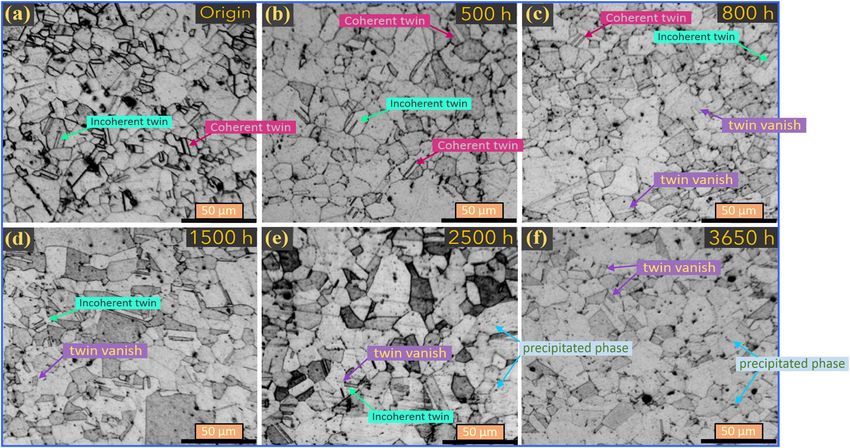
Microstructure evolution in TP347HFG steel and its characterization 13
carbonitrides in the matrix can play a role in precipitation synthesizers (see Figure 1(b)). These function modules
strengthening [7,8]. can realize the filtration of transmitted signals. Besides,
Currently, studies related to the microstructure evo- this system contains a gated amplifier and a pair of inte-
lution and mechanical property change mainly focused grators to process the information from the super-hetero-
on TP347H. However, with respect to the evolution of dyne phase-sensitive receiver. A pair of transducers (SIUI,
precipitates in TP347HFG at high temperature, there is D = 6 mm) are used in this study (see Figure 1(c)): 5 MHz
still lack of research in this area. Considering austenitic (transmitter) and 10 MHz (receiver). To improve the accu-
steel with high content of Cr, the carbides usually coar- racy of measurement, a fixed device with a pressure sensor
sened at grain boundaries, which is unfavorable for was laid out. Thus, the pressure of the transducer on the
mechanical properties; therefore, more research should specimen can be constant (9.8 N) during the measurement.
be devoted to this area. This study investigated the evo-
lution of precipitates and the change of micro-hardness
of the TP347HFG. It was found that during aging, both
precipitation area fraction and the micro-hardness pre- 2.2 Microstructure observation of the
sented a nonmonotonic variation trend. Besides, a sensi- TP347HFG specimens
tive nondestructive testing (NDT) method, i.e., nonlinear
ultrasonic technique, was utilized to explore the charac- After nonlinear ultrasonic experiments, the microstruc-
terization of microstructural degradation of this material. ture of each specimen was observed. The TP347HFG spe-
The results showed that the nonlinear parameter β′ cimen were grinded, polished, and then etched using
is sensitive to the microstructure change of TP347HFG. FeCl3–HCl solution for observation under optical micro-
It is hoped that the research could provide valuable scope (OM; Olympus PMG3) and scanning electron micro-
insights into the industrial applications of TP347HFG scope (SEM; HitachiS-3400N). The composition analysis
steel. of the precipitated phase was performed by using the
energy-dispersive spectrometer (EDS; X-MaxN 20) to obtain
the contents of the element. Besides, TEM samples were
prepared through the extraction replica technique, the sta-
2 Experiments tistics of the area fraction of precipitates was performed on
the TEM images, and the selected area electron diffraction
2.1 Aging experiments and nonlinear (SAED) pattern was utilized to analyze the characteristic of
precipitates in TP347HFG. The transmission electron micro-
ultrasonic measurements
scope used in this study is JEM-2100HT (LaB6 electron-tube
heater) with 200 kV accelerating voltage.
The chemical composition of TP347HFG is presented in
Table 1. The aging samples were cut from the TP347HFG
pipe and machined into the dimension of 40 mm of
length, 12 mm of width, and 10 mm of thickness. The 3 Results and discussion
aging experiments were performed on the resistance fur-
nace (SX2-5-12, Yinhe, china). The aging temperature was
700°C, and the holding time was 500, 800, 1,500, 2,500, 3.1 Microscopic structures observation
and 3,650 h. under optical microscope
After aging experiments, a Ritec-SNAP 5000 ultra-
sonic system was used to investigate the nonlinear ultra- Figure 2 shows the OM images of the original and aged
sonic response in TP347HFG specimens (see Figure 1(a)). TP347HFG specimens. The matrix of TP347HFG was com-
This system was composed of a 50 Ω termination, a 6 dB posed of the equiaxed austenite grains with the average
attenuator, two FDK-X diplexers, and three direct digital size of nearly 22 μm, but the size of grains is heterogeneous,
Table 1: The chemical composition of TP347HFG steel (wt%)
Element C Cr Si Ni Mn P S Nb N Fe
TP347HFG 0.09 18.57 0.47 11.80 1.56 0.022 0.004 0.61 0.04 Bal.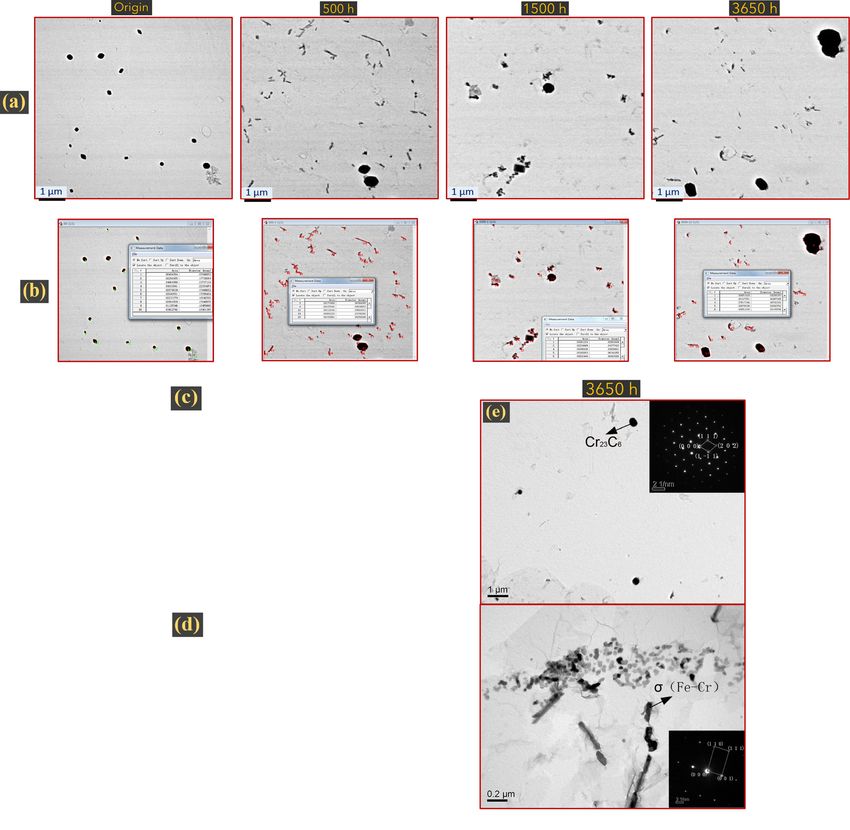
14 Yuetao Zhang et al. Figure 1: Diagram of nonlinear ultrasonic measurements of TP347HFG steels. with the large grain size of about 38 μm and the small one aging for 3,650 h, no apparent grain coarsening can be of about 12 μm. Meanwhile, twin structures can be clearly found in the TP347HFG microstructure since the average observed in the grains of the original TP347HFG spe- gain size remains at 18–24 μm, which indicates that the cimen, and it can also be subdivided into the coherent austenite grain structures are relatively stable during the twin and incoherent twin. These twins formed at the thermal aging at 700°C. However, the coherent twin were annealing heat treatment (i.e., solution treatment) [9], almost breaking down, which have no longer traversed the which depends on the slip of stacking fault for nucleating grains, and only a small portion of incoherent twin residue and extending; After aging for 500 h, the grain size has not in the grain. Vanishing of the twin structures could be changed much, and the coherent twin and incoherent twin mainly owed to the migration and degradation of stack- are still existed in the TP347HFG microstructure. Neverthe- ing fault during the aging process [9]. Besides, a certain less, when the aging time exceeded 800 h, the intragranular amount of second-phase particles is distributed inside twins gradually disappeared and the twin boundaries began the grains of TP347HFG (see Figure 2(e) and (f)); how- to turn unclear, which is shown in Figure 2(b)–(e). After ever, due to the limitation of the resolution, it is difficult Figure 2: The microstructure observations of TP347HFG steels during the thermal aging: (a) origin, (b) 500 h, (c) 800 h, (d) 1,500 h, (e) 2,500 h, and (f) 3,650 h.
Microstructure evolution in TP347HFG steel and its characterization 15
to investigate the characteristic of precipitates and its volume to surface area ratio), so that a lower energy state
evolution behaviors through the optical microscope can be achieved. During aging, the overall process of
observation. the evolution behaviors of precipitates in TP347HFG is
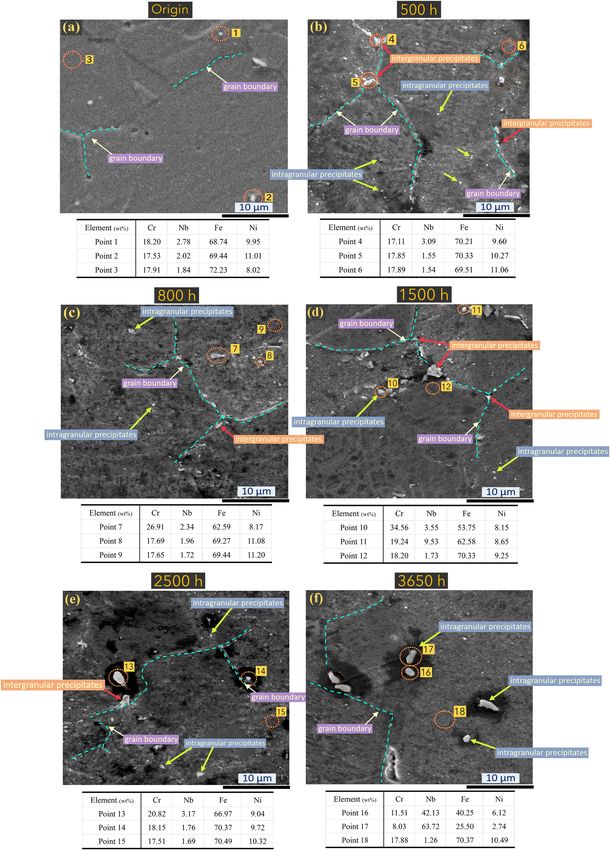
clearly shown in Figure 3. Besides, after aging for 800 and
1,500 h, the precipitates such as M23C6 and σ phases have
occurred (see EDS of Point 7 and Point 10), it should be
3.2 Microscopic structures observation note that the σ phase is a kind of intermetallic compound,
under scanning electron microscope which was composed of the similar element fraction of
Fe and Cr. In addition, after aging for 3,650 h, the coar-
To figure out the evolution behaviors of precipitates in sening of the Nb(C,N) carbides can be clearly observed,
TP347HFG during the aging, the SEM observations and and the content of Nb element was obviously increased
EDS analysis were performed. The SEM image of the ori- in those precipitates (see Figure 3(f)).
ginal TP347HFG is shown in Figure 3(a). Before aging, it To investigate the evolution of precipitates in TP347HFG
can be observed that there were relatively few precipitates in a quantitative manner, the statistics of the area fraction
existed in the grains or grain boundaries of the TP347HFG of precipitates was performed on the TEM images (see
microstructure. However, after aging for 500 h, there were Figure 4(a)). This process was carried out by using the image
many tiny primary particles precipitating from the matrix, analysis software (IPP-6.0, see Figure 4(b)). More than five
which is clearly shown in Figure 3(b). Those particles can different viewing fields were randomly chosen in each aging
be divided into the intragranular precipitates and inter- specimen. The area fraction of precipitates was equivalent to
granular precipitates. The intragranular precipitates are the total area of precipitates divided by the area of the field
distributed dispersedly in the TP347HFG matrix, and their of view [10,13], and the error bar was also given.
size is relatively small. On the contrary, the intergranular Figure 4(c) shows the variation of area fraction
precipitates possess a considerable larger dimension, and of precipitates in TP347HFG steel during the aging. It
they prone to aggregate at the junctions of grain boundary can be observed that the area fraction of precipitates
or triple grain boundary. The previous study [10] showed increased at the first 500 h and then decreased within
that the grain boundary junction was a kind of plane the range of 800–1,500 h. After 1,500 h, the area fraction
defect with large lattice distortion energy. Therefore, the of precipitates increased continuously. Here, the change
carbon atoms were easier to diffuse at this place so as to rule of precipitates was consistent with the earlier SEM
fulfill a combination reaction with other elements. In addi- observation. It is not difficult to understand that the
tion, EDS results showed that some intergranular precipi- increase in the area fraction of precipitates for the first
tates contain higher content of Nb (point 4), so that they time (0–500 h) was due to the precipitation of many tiny
could be the carbide particle of Nb(C,N). primary particles in the TP347HFG matrix. Then, Ostwald
After aging for 800 h, the fine, dispersed intragra- Ripening occurred, and many small precipitates faded
nular precipitates can still be observed in the TP347HFG away, so that the area fraction of precipitates presented
matrix, but they were no longer there when aging time a descend trend (800–1,500 h). Later, the precipitates
increased to 1,500 h. Instead, the precipitated particles appeared apparently coarse (2,500–3,000 h), which con-
appear apparently coarse, and the size of both intragra- tributes to the increase of area fraction.
nular precipitates and intergranular precipitates increased In the meantime, the micro-hardness of TP347HFG
significantly. This phenomenon is the classical Ostwald steel during the aging displayed a trend of earlier increase,
Ripening [11], which is a spontaneous process of energy later decrease, and then level off (see Figure 4(d)). The
transition. Generally, the small particles are kinetically increase of the micro-hardness of TP347HFG at the early
favored, while large precipitates are thermodynamically aging stage (0–800 h) can be owed to the dispersion
favored. Initially, many small particles precipitated in strengthening of the precipitated particles. These tiny pri-
the TP347HFG matrix (see Figure 3(b) and (c)) as the small mary particles existed in the grains and grain boundaries,
precipitates could nucleate more easily. However, those which can play a role in obstructing the glide and climb
tiny particles have a larger surface area to volume ratio, of the dislocation, thus resulted in the increase of the
which are energetically less stable. Consequently, many micro-hardness of TP347HFG. However, as time went on,
small precipitates gradually disappear except for a few alloying elements such as the Cr and Nb inevitably pre-
that grow larger, at the expense of the small precipitates cipitated from the TP347HFG matrix. Thus, the effect of
[12] (see Figure 3(d) and (e)). Eventually, some tiny par- solution strengthening has diminished, which causes
ticles transformed into the large ones (i.e., with the greater the decrease of the micro-hardness of TP347HFG.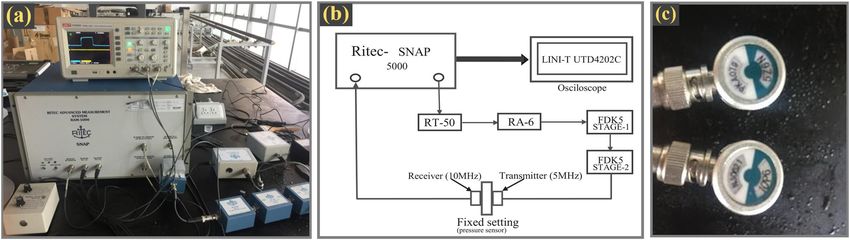
16 Yuetao Zhang et al. Figure 3: The SEM observations and EDS analysis of TP347HFG steel during the thermal aging: (a) origin, (b) 500 h, (c) 800 h, (d) 1,500 h, (e) 2,500 h, and (f) 3,650 h.
Microstructure evolution in TP347HFG steel and its characterization 17
3.0
Area fraction of precipitated phase (%)
2.5
2.0
1.5
1.0
0.5
0.0
0 800 1600 2400 3200 4000
Aging time (h)
280
240
Vickers hardness (HV0.10)
200
160
120
80
40
0
0 800 1600 2400 3200 4000
Aging time (h)
Figure 4: The statistics of area fraction of the precipitates and the hardness measurement of TP347HFG: (a) TEM images, (b) statistics
process and the use of image analysis software, (c) the variation of area fraction of precipitates, (d) the hardness change in TP347HFG
during the aging, and (e) the analysis of precipitates by using the SAED pattern.
Besides, the selected area electron diffraction (SAED) was unfavorable for the microstructural property of
pattern was utilized to analyze the characteristic of pre- TP347HFG steel.
cipitates in TP347HFG. Digital micrograph software was
used here to calibrate the diffraction pattern. The SAED
results further confirmed that, after aging for 3,650 h, 3.3 Nonlinear ultrasonic measurements
there were M23C6 phase and σ phase precipitated in
the TP347HFG matrix. Nevertheless, the σ phase pre- Since the characteristics of ultrasonic signal can reflect
sented a striped shape, and this could induce the stress the inherent property of metallic materials as the ultra-
concentration at the σ phase/matrix interface, which sonic wave travels through, the characterization of the18 Yuetao Zhang et al.
materials degradation based on the ultrasonic method 3.3.1 The principle of the ultrasonic nonlinearity
has been used widely during these years [14–17]. Never-
theless, it is worth noting that most of the conventional The main difference between the conventional ultrasonic
ultrasonic methods such as wave velocity method techniques and the nonlinear ultrasonic technique was
or attenuation method are only available for detect- that the latter could reflect the frequency change of the
ing those defects with larger dimensions (Φ > 1 mm, i.e., input signal, while the former could not. Thus, the degra-
gross defect), but regarding the degradation of microstruc- dation of material can be determined by monitoring how
ture in materials that happened in premature stages (e.g., much amplitude of the higher harmonic wave generated
precipitates coarsening or dislocation structure change), in the transmitted wave [10].
the effectiveness of conventional ultrasonic methods have Generally, the nonlinear wave equation could be
been confirmed to be quite low [18]. expressed as follows:
The nonlinear ultrasonic technique is an emerging
∂ 2u ∂ 2u ∂u
alternative approach, which has been recognized as a ρ = E 2 1 + 2β , (1)
∂t 2 ∂X ∂X
powerful method to characterize the microstructural
feature of materials. For instance, Hikata et al. [19] where u is the displacement vector, t is the time, ρ is the
investigated the nonlinear effect in an aluminum single medium mass density, β is the second-order nonlinear
crystal, and they found that the dislocation movement elastic coefficient (i.e., nonlinear parameter), and X is
under the action of stress will contribute to the variation the wave propagation distance.
of the nonlinear parameter; Valluri et al. [20] studied the Consider there is a plane wave A1 cos(kX1 − wt), A1 is the
nonlinear response in a 99.98% pure copper, and they fundamental wave amplitude, k is the wave number, and w
pointed out that the appearance of micro-void during is the angular frequency, and then, the approximate solution
the creep process could also lead to the increase of the of displacement can be obtained after two iterations:
nonlinear parameter. Xiang et al. [21] investigated the 1
nonlinear effect in a ferritic Cr–Ni alloy steel, and they u1 = − βk 2A12 X1 + A1 cos(kX1 − wt )
8
revealed that the precipitation of the second phases 1 (2)
during the process of thermal degradation will result + βk 2A12 X1 cos [2(kX1 − wt )] + ⋯
8
in the change of ultrasonic nonlinearity. In conclusion, = A0 + A1 cos(kX1 − wt ) + A2 cos [2(kX1 − wt )] + ⋯.
all these studies indicated that the nonlinear ultrasonic
technique is sensitive enough to probe the microstruc- From this solution, the amplitude of the second har-
tural change in metals, which can be unitized to char- monic (i.e. A2) can be obtained as follows:
acterize the degradation of material that occurred in 1 2 2
A2 = A1 k X1 β. (3)
early stages. 8
4.0
3.5 4
3.0
3
Amplitude (V)
Amplitude (V)
2.5
2.0
2
1.5
1.0 1
0.5
0.0 0
2 4 6 8 10 12 2 4 6 8 10 12
Frequency (MHz) Frequency (MHz)
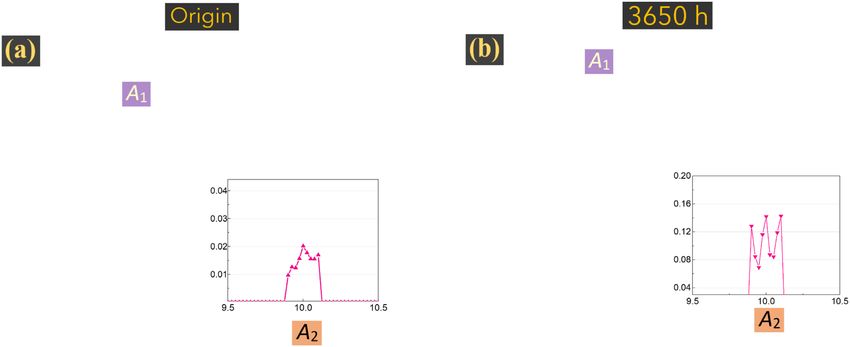
Figure 5: The curve of the frequency spectrum of the TP347HFG steel: (a) origin specimen and (b) aging for 3,650 h.Microstructure evolution in TP347HFG steel and its characterization 19
Therefore, the nonlinear parameter β can be written 0.014
as follows: 0.012
Nonlinear parameter β ' (1/V)
8A 0.010
β = 2 2 2. (4)
k X1 A1 0.008
Because the X1 and k are constant during the mea- 0.006
surement, to simplify the calculation, it can also use β′ to 0.004
replace β: 0.002
β′ = A2 / A12 . (5) 0.000
-0.002
0 800 1600 2400 3200 4000
Aging time (h)
3.3.2 Results of nonlinear ultrasonic measurement
Figure 6: The change of the nonlinear parameter β′ in TP347HFG
during the aging experiment.
Figure 5 shows the curves of the frequency spectrum of
the TP347HFG steel before and after the aging experi-
ments. It can be recognized that the frequency spectrum of micro-void and the change of dislocation density or
comprises both 5 and 10 MHz output frequency signals, structure were also essential for the generation of non-
which correspond to the fundamental wave (A1) and linear effect. In this study, the variation of the nonlinear
second harmonic wave (A2), respectively. Figure 5 shown parameter in TP347HFG may influence by a combined
that the second harmonic amplitude (A2) of TP347HFG effect of the change of the twin microstructure and the
increased significantly after aging for 3,650 h (here, it precipitates.
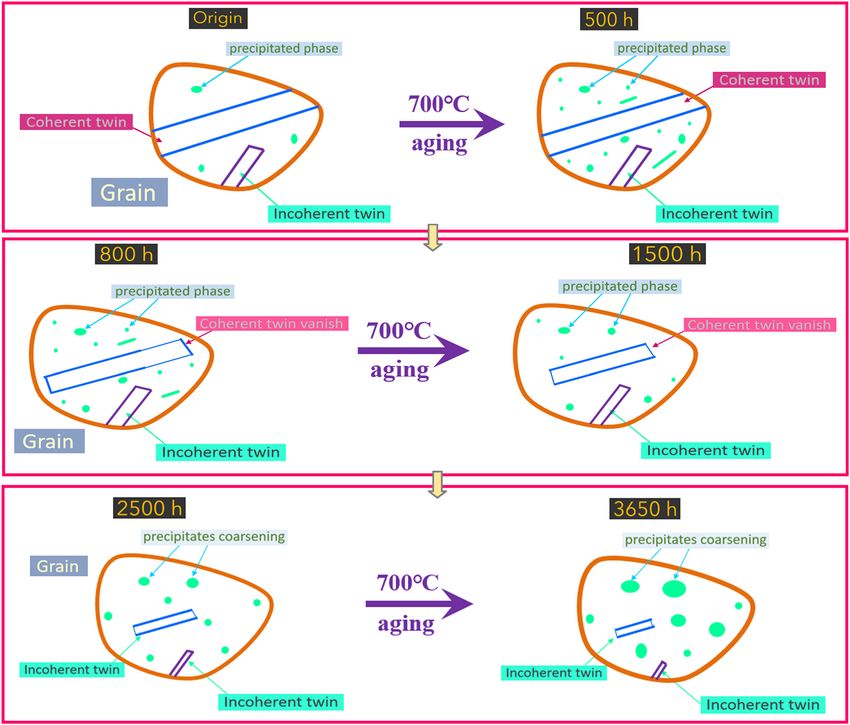
should be noted that the fundamental wave amplitude As shown in Figure 7, in the first 500 h, the twin
(A1) also increased after the aging experiments). structure has not changed too much since coherent
In general, the numerical value of the second har- twin and incoherent twin were still there. However, a
monic (A2) can be extracted to assess the degradation lot of tiny particles precipitating from the matrix could
of materials. However, a tooth-like nonlinear waveform give rise to the nonlinear effect in TP347HFG. Marino et
(around the frequency of 10 MHz) was generated during al. [22] studied the evolution of precipitates in a 9% Cr
the Fourier transform, which could lead to the data oscil- ferritic steel, and they revealed that the nonlinear
lation of the amplitude of second harmonic. To assess the parameter was sensitive to the change of the density
degradation degree and calculate the nonlinear para- of precipitates. As the dimension of the precipitated
meter of TP347HFG steel more reliably, the signal proces- particles is far less than the wavelength of the ultra-
sing was carried out on the second harmonic value, the sonic wave, the phenomenon of sound scattering can
average of the amplitude of the frequency component happen, which could alter the initial propagation path
from 9.9 to 10.1 MHz (i.e. nine points) was taken, and of the ultrasonic wave. Thus, the multiplication of pre-
this value could represent the overall level of the second cipitates in TP347HFG steel could result in the distor-
harmonic in each TP347HFG specimen. tion of the wave propagation, which gives rise to the
Figure 6 shows the variation of nonlinear parameter nonlinear effect in the aged 500 h specimen.
β′ of the TP347HFG steel before and after the aging When aging time increased to 800 h, compared with
experiments, the nonlinear parameter was calculated the former, there was less change in the density of the
from equation (5), and the error bar showed the maxi- precipitates (see Figure 4(c)), while a part of twins (both
mum and minimum value of each specimen. Figure 6 coherent twin and incoherent twin) has begun to degrade.
shows that the nonlinear parameter did not exhibit a Previous studies [17,19] verified that the content of dis-
monotonic increase or decrease in TP347HFG during the location in metals could also be a significant factor for
aging. However, it increases first (0–500 h), declines later the ultrasonic nonlinearity. Meanwhile, the twin boundary
(500–800 h, 800–1,500 h), and then increases at the final can be viewed as the dislocation wall, which was com-
(1,500–3,650 h). This result is somewhat like the change posed of a set of partial dislocations. Therefore, the degra-
rule of the area fraction of precipitates (see Figure 4(c)); dation of the twin structure could lead to the decline
however, previous studies [17–19] revealed that the non- of the nonlinear effect in metals, and this might be the
linear effect in metals can be affected by multiple factors; appropriate interpretation for the decrease of nonlinear
apart from the coarsening of precipitates, the appearance parameter from the range of 500 to 800 h. Besides, the20 Yuetao Zhang et al.
Figure 7: Illustration of microstructure variation of the TP347HFG steel during the aging experiment.
nonlinear parameter decreased further when aging time dislocation segments and give rise to a significant change
increased to 1,500 h. This can be attributed to the com- in the nonlinear effect. In addition, precipitates can also
bined effects of the twin degradation (see Figure 2(d)) be viewed as the body defect. When an ultrasonic wave
and the decreased of content of precipitates (i.e. the was propagating through the material, the change of the
decrease of area fraction of precipitates, see Figure 4(c)). propagating direction of ultrasonic wave would happen
After aging for 1,500 h, the nonlinear parameter β′ on the precipitates/matrix interface, which could cause
did not drop any more, but increases continuously with the effect of the reflection or refraction of the ultrasonic
the increase of the aging time (1,500–3,650 h). At this wave. Apparently, the probability of the distortion of
stage, the coarsening of precipitates (e.g., M23C6 phase ultrasonic wave will increase with the increase in the
and σ) may play a more important role in the change of size of precipitates, which lead to the increase in the
the ultrasonic nonlinearity than the twin degradation. nonlinear parameter. Based on the aforementioned
Cantrell and Yost [23] revealed that the growth of preci- results, it can be recognized that the nonlinear ultra-
pitates embedded in a surrounding matrix will cause a sonic response is sensitive to the microstructure change of
local stress field and thus would trigger the motion of TP347HFG steel during aging.Microstructure evolution in TP347HFG steel and its characterization 21
4 Conclusions Author contributions: Yuetao Zhang: acquisition of data,
methodology, software, and supervision; Tingbi Yuan: vali-
In this study, the evolution of precipitates in TP347HFG dation and formal analysis; Yawei Shao: funding acquisi-
steel during aging at 700°C was investigated. Meanwhile, tion and project administration; and Xiao Wang: writing.
the nonlinear ultrasonic technique was utilized for char-
acterizing the microstructure change of the TP347HFG Conflict of interest: No conflict of interest exits in the sub-
steel. The main conclusions can be summarized as mission of this manuscript, and manuscript is approved by
follows: all authors for publication.
(1) Coherent twin and incoherent twin are existed in
grains of the original TP347HFG specimen. After Data availability statement: The raw/processed data of
aging for 800 h, the intragranular twins gradually these findings can be shared by contacting the corre-
disappeared. When the aging time increased to sponding author.
3,650 h, the coherent twin structures were almost
break down, which no longer traversed the grains,
and there was only a small portion of incoherent
References
twin residue in the grain.
(2) Many fine, dispersed precipitates can be observed [1] Erten, D.T., T. T. Nguyen, T. M. Jeong, and K. B. Yoon. Creep
after aging for 500 h, but they disappeared when deformation and rupture behaviour of service exposed P91
aging time increased to 1,500 h. With the extend of weld and base steel measured by miniature tensile creep
testing. Materials at High Temperatures, Vol. 34, No. 5–6,
aging time, the precipitate particles appeared appar-
2017, pp. 425–433.
ently coarse, which is a phenomenon of the classical
[2] Rojas, D., J. Garcia, O. Prat, G. Sauthoff, and A. R. Kaysser-
Ostwald Ripening. Pyzalla. 9% Cr heat resistant steels: Alloy design, micro-
(3) The micro-hardness of TP347HFG was also changing structure evolution and creep response at 650°C. Materials
during the aging experiment. The increase of the Science and Engineering: A, Vol. 528, No. 15, 2011,
micro-hardness of TP347HFG steel at the early stage pp. 5164–5176.
[3] Mitra, A., J. N. Mohapatra, J. Swaminathan, M. Ghosh, A. K.
(0–800 h) was due to the dispersion strengthening.
Panda, and R. N. Ghosh. Magnetic evaluation of creep in
With the increase of aging time, the effect of the solu- modified 9Cr-1Mo steel. Scripta Materialia, Vol. 57, No. 9,
tion strengthening diminished and the micro-hard- 2007, pp. 813–816.
ness of TP347HFG have declined. [4] Mills, W. J. Fracture toughness of type 304 and 316 stainless
(4) The nonlinear parameter of TP347HFG steel increases steels and their welds. Metallurgical Reviews, Vol. 42, No. 2,
1997, pp. 45–82.
first (0–500 h), declines later (500–1,500 h), and then
[5] Kamaya, M. Measurement of local plastic strain distribution of
increases finally (1,500–3,650 h) during the aging
stainless steel by electron backscatter diffraction. Materials
process. The variation of the nonlinear parameter Characterization, Vol. 60, No. 2, 2009, pp. 125–132.
in TP347HFG was influenced by a combined effect [6] Niffenegger, M. and H. J. Leber. Sensitivity of the magnetiza-
of the change of the twin microstructure and the tion curves of different austenitic stainless tube and pipe
precipitates. steels to mechanical fatigue. Journal of Nuclear Materials,
Vol. 377, No. 2, 2008, pp. 325–330.
[7] Dudziak, T., M. Łukaszewicz, N. Simms, and J. R. Nicholls.
In conclusion, these results manifest that the non- Steam oxidation of TP347HFG, super 304H and HR3C-analysis
linear ultrasonic technique is sensitive enough to probe of significance of steam flowrate and specimen surface finish.
the microstructure evolution in metal, which can be uti- Corrosion Engineering Science and Technology, Vol. 50, No. 4,
lized for the characterization of microstructural feature of 2015, pp. 272–282.
[8] Scendo, M., M. Chat, and B. Antoszewski. Oxidation behaviour
TP347HFG steel.
of laser welding of TP347HFG and VM12-SHC stainless steels.
International Journal of Electrochemical Science, Vol. 10, No. 8,
Acknowledgements: The authors would like to express 2015, pp. 6359–6377.
the financial support of the National Key Research and [9] Gleiter, H. The formation of annealing twins. Acta Metallurgica,
Development Plan, the Ministry of Science and Technology, Vol. 17, No. 12, 1969, pp. 1421–1428.
China under contract no. 2016YFB0300604. [10] Wang, X., X. Wang, B. Luo, X. Hu, and T. Yuan. Creep degra-
dation assessment in 9% Cr heat-resistant steel welded joints
using ultrasonic methods. Results in Physics, Vol. 12, 2018,
Funding: This study was funded by the National Key pp. 307–320.
Research and Development Plan, the Ministry of Science [11] Baldan, A. Review progress in Ostwald ripening theories and
and Technology, China under contract no. 2016YFB0300604. their applications to the γ′-precipitates in nickel-base22 Yuetao Zhang et al.
superalloys part II nickel-base superalloys. Journal of nonlinear lamb waves. Construction and Building Materials,
Materials Science, Vol. 37, No. 12, 2002, pp. 2379–2405. Vol. 234, 2020, p. 117384.
[12] Ng, J. D., B. Lorber, J. Witz, A. Théobald-Dietrich, D. Kern, and [18] Willems, H. and G. Dobmann. Early detection of creep damage
R. Giegé. The crystallization of biological macromolecules by ultrasonic and electromagnetic techniques. Nuclear
from precipitates: evidence for Ostwald ripening. Journal of Engineering and Design, Vol. 128, No. 1, 1991, pp. 139–149.
Crystal Growth, Vol. 168, No. 1–4, 1996, pp. 50–62. [19] Hikata, A., B. B. Chick, and C. Elbaum. Dislocation contribution
[13] Wang, X., X. Wang, X. Niu, D. Xiao, and X. Hu. Application of to the second harmonic generation of ultrasonic waves.
nonlinear ultrasonic technique to characterize the creep Journal of Applied Physics, Vol. 36, No. 1, 1965, pp. 229–236.
damage in ASME T92 steel welded joints. NDT & E [20] Valluri, J. S., K. Balasubramaniam, and R. V. Prakash. Creep
International, Vol. 98, 2018, pp. 8–16. damage characterization using non-linear ultrasonic
[14] Breazeale, M. A. and D. O. Thompson. Finite-amplitude ultra- techniques. Acta Materialia, Vol. 58, No. 6, 2010,
sonic waves in aluminum. Applied Physics Letters, Vol. 3, pp. 2079–2090.
No. 5, 1963, pp. 77–78. [21] Xiang, Y. X., M. X. Deng, F. Z. Xuan, and C. J. Liu. Experimental
[15] Müller, M. F., J. Y. Kim, J. Qu, and L. J. Jacobs. Characteristics of study of thermal degradation in ferritic Cr–Ni alloy steel plates
second harmonic generation of Lamb waves in nonlinear using nonlinear Lamb waves. NDT & E International, Vol. 44,
elastic plates. The Journal of the Acoustical Society of America, 2011, pp. 768–774.
Vol. 127, No. 4, 2010, pp. 2141–2152. [22] Marino, D., J. Y. Kim, A. Ruiz, Y. S. Joo, J. Qu, and L. J. Jacobs.
[16] Baby, S., B. N. Kowmudi, and C. M. Omprakash. Creep Using nonlinear ultrasound to track microstructural changes
damage assessment in titanium alloy using a nonlinear due to thermal aging in modified 9% Cr ferritic martensitic
ultrasonic technique. Scripta Materialia, Vol. 59, No. 8, steel. NDT & E International, Vol. 79, 2016, pp. 46–52.
2008, pp. 818–821. [23] Cantrell, J. H. and W. T. Yost. Effect of precipitate coherency
[17] Wang, X., Y. X. Xiang, W. J. Zhu, T. T. Ding, and H. Y. Li. Damage strains on acoustic harmonic generation. Journal of Applied
assessment in Q690 high strength structural steel using Physics, Vol. 81, No. 7, 1997, pp. 2957–2962.You can also read


