Project Factsheet Understanding Europe's Fashion Data Universe - Deliverable number: D7.1 - FashionBrain
←
→
Page content transcription
If your browser does not render page correctly, please read the page content below
Horizon 2020

Understanding Europe’s Fashion Data Universe

       Project Factsheet

       Deliverable number: D7.1

                    Version 3.0

      Funded by the European Union’s Horizon 2020 research and
      innovation programme under Grant Agreement No. 732328
Project Acronym:        FashionBrain
 Project Full Title:     Understanding Europe’s Fashion Data Universe
 Call:                   H2020-ICT-2016-1
 Topic:                  ICT-14-2016-2017, Big Data PPP: Cross-sectorial and
                         cross-lingual data integration and experimentation
 Project URL:            https://fashionbrain-project.eu
 Deliverable type               Report (R)
 Dissemination level            Public (PU)
 Contractual Delivery Date      31 January 2017
 Resubmission Delivery Date     27 February 2019
 Number of pages                8, the last one being no. 3
 Authors                         Jennifer Dick - USFD
 Peer review                     Alan Akbik - Zalando

Change Log

 Version       Date            Status            Partner              Remarks
   0.1      01/02/2017        Full Draft          Zalando
   1.0      06/02/2017          Final             Zalando        Rejected 15/03/2018
   2.0      20/04/2018    Resubmitted Final    USFD, Zalando     Rejected 15/10/2018
   3.0      27/02/2019    Resubmitted Final    USFD, Zalando

Deliverable Description

A brief project Factsheet suitable for Web publishing will be published within
one month from the start of the project. The Factsheet will outline the project’s
rationale and objectives, specify its technical baseline and intended target groups
and application domains, and detail intermediate and final outputs. The Factsheet
can be used by the Commission for its own dissemination and awareness activities
throughout the project lifecycle, and may be published on European Commission
(EC) and EC sponsored Websites. The Factsheet has to be maintained and updated
until the end of the project; this will be documented in the regular reporting.

                                                                                  ii
Abstract
The FashionBrain project aims at combining data from different sources to support
different fashion industry players by predicting upcoming fashion trends from social
media as well as by providing personalized recommendations and advanced fashion
item search to customers.
The Factsheet will be a continually evolving document and will feature prominently
on the project’s website. It will outline the project’s rationale and objectives, specify
its technical baseline, intended target groups and application domains, as well as
detailing and linking to intermediate and final outputs.
iiiTable of Contents
List of Acronyms and Abbreviations v
FashionBrain Factsheet 1
ivList of Acronyms and Abbreviations
EC European Commission
FBT FashionBrain Taxonomy
NLP Natural Language Processing
OEM Original Equipment Manufacturer
RNNs Recurrent Neural Networks
SEO Search Engine Optimisation
vFashionBrain Factsheet
The FashionBrain factsheet, as prominently featured (and available for download) on
the project website (https://fashionbrain-project.eu/wp-content/uploads/
2019/02/D7.1-Factsheet-v3_Feb19.pdf), is attached below.
D7.1 – Project Factsheet 1FashionBrain Factsheet
Factsheet
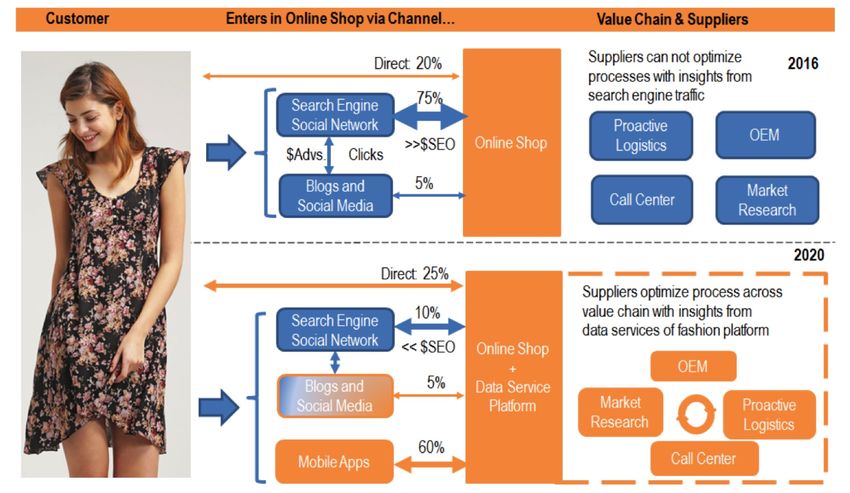
Data Challenges in the Fashion Industry: Understanding Europe’s Fashion Date Universe:
A core business in the fashion industry is understanding and The FashionBrain project aims at combining data from
predicting customer needs and trends. However, retailers different sources to support different fashion industry
often do not own enough data (as collected by search players by predicting upcoming fashion trends from social
engines and social media networks) to predict customers’ media as well as providing personalized recommendations
next trends; data is not integrated in a way that can create and advanced fashion item search to customers.
valuable insights (due to storage and formatting issues); and
The main objective of the FashionBrain project is to
fashion bloggers directly influence customer choices leading
consolidate and extend existing European technologies in
to limited understanding of bottom-up changes in fashion.
the area of database management, data mining, machine
In order to reinforce Europe’s position in the fashion learning, image processing, information retrieval and
industry, it has to reduce its dependency on search engines. crowdsourcing to strengthen the position of European
Instead, effectively extracting and analysing information fashion retailers among their world-wide competitors. We
from unstructured content like twitter, blogs and multi- intend to:
media sources such as Instagram (including posts by
Shift traffic away from Web search engines to
individual fashion bloggers), will enable businesses to
retailer’s mobile applications and domains.
directly mine fashion trends, seasonalities, and unusual
Create a novel shopping experience by making
events. Efficiency and gains in the logistics of suppliers,
images searchable.
shipping, and handling are minor compared the benefits
Detect influencers to predict fashion trends.
obtained (including financial) from better understanding
Share insights within Cross Industry Partner Network
customers’ personalities and habits.
to create a Data Integration infrastructure .
Current
Challenge
2020
Vision
D7.1 – Project Factsheet 2FashionBrain Factsheet
Target Beneficiaries: A library of trained deep-learning models for enriching
images with meta-data and a demo of the automatic image
The FashionBrain project targets the two main actors of the
recognition technology has been published. A demo of the
fashion industry: European retailers and customers. We
FashionBrain Taxonomy (FBT) to support cross-domain data
propose to gather and combine the sheer amount of data
integration across multiple sources of data has also been
generated by (emanating from) different fashion industry
created.
multisectorial players.
Detect Influencers and Predict Next Trends
The gathered data will be curated, analysed and used as
input for machine learning algorithms. The outcome of the Software for Probabilistic Recurrent Neural Networks
project will benefit retailers by reducing the financial efforts (RNNs) for sequential data with missing values and a tool
for Search Engine Optimisation (SEO) paid to the Web (RecovDB) for the recovery of missing values implemented
search engine. It will benefit both the retailer and customer in-database were developed. A method (TimeSVDvc) for the
by providing novel services to customers in order to prediction of user preferences in fashion data has also been
improve their shopping experience thereby boosting their made publicly available. A dataset of influencers and
brand/company loyalty. For example, a customer will be bloggers and a demo of fashion images from fashion blogs
able to receive personalized recommendations and perform and Instagram profiles that are automatically extracted and
advanced fashion items search by things like image and classified has also been produced.
complex textual description. Retailers will also be able to Share Insights with Cross Industry Partner Network
compose a marketing story about a product that fits the
The project has networked with multiple industry partners
customer’s taste, instead of merely showing an item and its
(e.g., ASOS.com, Qualifiction.com, Beezdata.de,
price.
projectstarling.com, schwarzkopf) and attended many
These improvements along with better exploitation of the industrial workshops and conferences (e.g., European Big
European fashion industry’s distinctive characteristics such Data Value Forum 2017, FashionTech, AI Expo Europe 2018,
as multiple languages, fashion and cultural differences, will Brussels TechSummit 2018, Shoptalk 2018, SAP Conference
reinforce its position within the global market. on Machine Learning), with opportunities to exchange
Project Achievements towards Objectives: knowledge and insights with players in the fashion industry
and with B2B Zalando partners.
Novel Shopping Experience: Make Images Searchable
Additional Information:
A multimodal corpus of fashion images was released which
will help to progress various text-image tasks. A first The FashionBrain project has
version of the FashionBrain text-to-product image search received funding from the European
system has been developed together with the release of a Union’s Horizon 2020 research and
public demo along with a state-of-the-art general NLP innovation programme under grant
framework called FLAIR. Several articles have also been agreement No 732328.
published on the handling of multilingual fashion data The project involves several partners from across Europe,
which will contribute to further development of advanced including the University of Sheffield, Beuth University of
search capabilities. Applied Sciences, Universite de Fribourg, Zalando SE,
Shift Traffic away from Web Search Engines to Retailer’s Fashwell AG and MonetDB Solutions B.V.
Mobile Apps Further information about the project team, deliverables
A set of guidelines and solutions, called ModOp, to improve and achievements can be found on the project website at:
the quality of crowdsourcing interfaces has been produced. https://fashionbrain-project.eu/
D7.1 – Project Factsheet 3You can also read


