QiBullet, a Bullet-based simulator for the Pepper and NAO robots
←
→
Page content transcription
If your browser does not render page correctly, please read the page content below
qiBullet, a Bullet-based simulator for the Pepper
                                                                                and NAO robots
                                                                                         Maxime Busy1 and Maxime Caniot2

                                           Abstract— The Pepper and NAO robots are widely used for
                                        in-store advertizing and education, but also as robotic platforms
                                        for research purposes. Their presence in the academic field is
                                        expressed through various publications, multiple collaborative
                                        projects, and by being the standard platforms of two different
                                        RoboCup leagues. Developing, gathering data and training
arXiv:1909.00779v3 [cs.RO] 7 Feb 2020

                                        humanoid robots can be tedious: iteratively repeating specific
                                        tasks can present risks for the robots, and some environments
                                        can be difficult to setup. Software tools allowing to simulate
                                        complex environments and the dynamics of robots can thus
                                        alleviate that problem, allowing to perform the aforementioned                           (a)                            (b)
                                        processes on virtual models. One current drawback of the
                                        Pepper and NAO platforms is the lack of a physically accurate
                                        simulation tool, allowing to test scenarios involving repetitive
                                        movements and contacts with the environment on a virtual
                                        robot. In this paper, we introduce the qiBullet simulation tool,
                                        using the Bullet physics engine to provide such a solution for
                                        the Pepper and NAO robots.

                                                              I. INTRODUCTION
                                           The use of the Pepper and NAO robots as research plat-
                                        forms is widely spread across various academic fields. More-
                                        over, each of these robot is a standard platform in a league of                            (c)                           (d)
                                        the Robocup[1] competition (the Robocup@Home [2] league                    Fig. 1: (a) Pepper and NAO robots in the botlab environ-
                                        for Pepper, and the Robocup soccer [3] for NAO). Addition-                 ment [6]. (b) Pepper robot in the Montreal arena of the
                                        ally, the Pepper and NAO robot are respectively standard                   Robocup@Home. (c) NAO robot in a soccer environment.
                                        platforms in the World Robot Summit [4] competition and                    (d) Pepper robot in a grasping environment.
                                        in the NAO Challenge [5]. In the recent years, tremendous
                                        progresses have been achieved in the robotics field through
                                        machine learning approaches, and in particular data-driven                    In this paper, we introduce qiBullet, an open-source sim-
                                        approaches such as Deep Learning and Reinforcement Learn-                  ulation tool based on the Bullet physics engine [13] and the
                                        ing. Such approaches often compel the developer to gather                  PyBullet module [14], designed to answer the aforemen-
                                        data by iteratively repeating specific tasks with a robot.                 tioned problems. This simulator aims to provide a cross-
                                        Gathering this data in a simulation able to handle complex                 platform and transparent mean to embed a virtual Pepper
                                        environments and the dynamics of the simulated robot would                 or NAO robot in different evironments (Figure 1), via a
                                        alleviate the data gathering task, and prevent the real robotic            Python-based API mimicking NAOqi [15] or a ROS interface
                                        platform from being damaged. Such a simulation would also                  emulating the naoqi driver1 ROS [16] package. In order to
                                        allow to identify potential problems in a scenario including               describe our work, we first specify the strong ties between
                                        Pepper or NAO before deploying it into the real world.                     qiBullet and the Bullet physics engine. We then describe the
                                           Presently, Pepper and NAO models are available in sim-                  simulator itself, its interfaces, the components of a virtual
                                        ulation tools such as Gazebo [7], V-REP [8], Webots [9],                   robot model and its control and sensing capabilities, along
                                        or Choregraphe [10]. These implementations either lack the                 with scenarios showcasing the tool. Lastly, we discuss the
                                        ability to accurately handle the physics of the model or to                exploitation and availability of the simulator.
                                        simulate complex environments. More recently, a Morse-
                                        based [11] simulation for the Pepper robot [12] has been                                       II. PHYSICS ENGINE
                                        announced, but focuses on human-robot interactions and not                    We based our approach on a comparison of physics-based
                                        on reliable physics.                                                       simulation libraries proposed by Erez et al. [17], discussing
                                          1 Maxime Busy is with the Innovation Department of SoftBank Robotics     the differences between the Bullet, Havok [18], MuJoCo[19],
                                        Europe, France. maxime.busy@softbankrobotics.com                           ODE[20] and Physx[21] physics engine.
                                          2 Maxime Caniot is with the Innovation Department of SoftBank Robotics
                                        Europe, France. maxime.caniot@softbankrobotics.com                          1 http://wiki.ros.org/naoqi_driver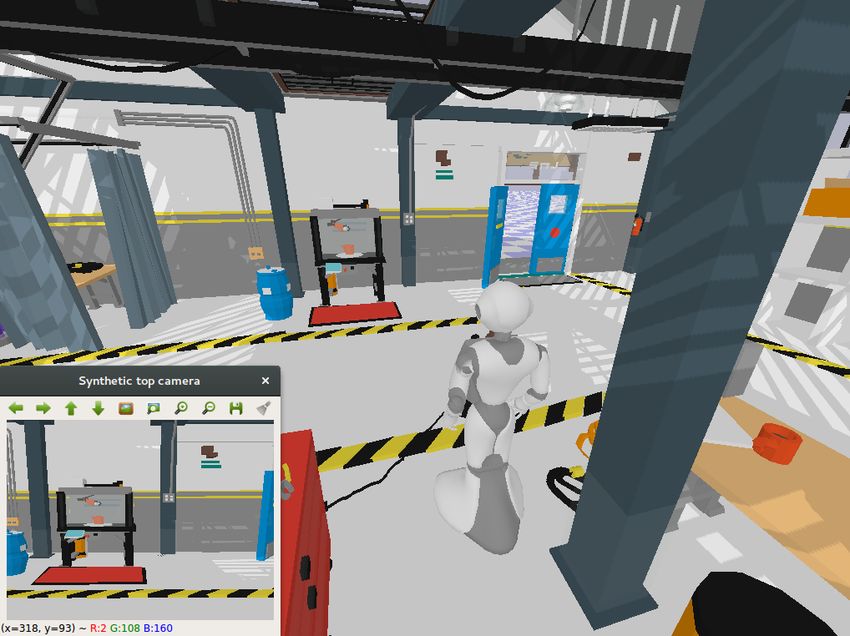
To build our simulator, we chose the Bullet physics engine       robot model through the ROS framework. As described in
and the additional PyBullet module. The physics engine              Figure 2, the wrapper retrieves the sensory data of the model
is integrated with many of the popular robotics software            to publish it into the framework, and retrieves commands
platforms, such as V-REP and Gazebo, and presents the               from the framework to apply them onto the model.
advantage of being open-source. This engine can addition-              In order to facilitate the use of the simulator for machine
ally be extended with PyBullet, an open-source Python               learning tasks, the API can also be used to instantiate, reset,
module providing robotics and machine learning capabili-            and stop several independent simulated instances, running
ties [22] [23] [24] [25] [26].                                      in parallel. It can also be used to spawn or remove virtual
   The qiBullet simulation has been designed to inherit the         robots from an instance, and to control the position of the
cross-platform properties of the PyBullet Python module and         light source of the simulation.
Bullet physics engine: the simulation tool can be run on
Linux, Windows and MacOS.
                                                                    C. Control and Sensing
                     III. SIMULATOR
                                                                      This subsection illustrates the control and sensing
   In this section, we will detail how a virtual robot is defined
                                                                    capabilities of the Pepper and NAO virtual robots in the
in the qiBullet simulator.
                                                                    qiBullet simulator.
A. Robot model
   We use a Unified Robot Description Format (URDF) [27]              The joints of the models can be controlled independently
file to describe the model of a virtual robot. The different        or as groups to reach a specified articular position with a
links of the model, their masses, inertia matrices and the          specified speed. Several postures can be applied onto the
joints connecting them are extracted from this file by the          models, similar to the postures defined within the NAOqi
engine. Mesh files are associated to each link, allowing the        API. Additionally, the base of the Pepper virtual robot can
engine to render the visual aspect of the robot model and to        be controlled in position or in velocity.
perform collision checking.
B. Interface
  Two different ways of interacting with the robot virtual
model are proposed in the simulation: The Python-based
qiBullet API or the ROS Framework.

  The Python-based qiBullet API, built on top of the Py-
bullet API, allows the user to interact with the simulated
robot and more generally with the simulated environment.
To ease the integration into existing projects and ensure code
consistency, the qiBullet API mimics a part of the NAOqi
API, rendering the interaction with a virtual and a real robot
as transparent as possible.                                         Fig. 3: Synthetic RGB image retrieval from the top camera of
                                                                    a virtual Pepper, in a simulated environment. The obtained
                                                                    RGB image is displayed in the bottom left corner, using
                                                                    OpenCV.

                                                                       Each Pepper and NAO virtual model embeds two RGB
                                                                    cameras (Figure 3). The Pepper virtual model additionally
                                                                    embeds a depth camera. Similarly to the NAOqi API, the
                                                                    resolution of the retrieved synthetic images can be selected
                                                                    by the user. The parameters of the simulated cameras are
                                                                    tuned to match the ones of the real model, although it is
                                                                    important to point out that a real depth image from Pepper
Fig. 2: Interfacing of a Pepper virtual model with the ROS          will be more noisy than a synthetic one. The Pepper virtual
framework. The wrapper specifies the description of the             model also possesses laser sensors attached to its base,
robot, publishes the sensory data of the model and subscribes       mimicking the lasers of the real robot. Finally, the position
to control topics.                                                  of each model in the world frame can be directly retrieved
                                                                    from the qiBullet API, providing odometry information. In
  The qiBullet simulator also provides a ”ROS wrapper”              our simulation, the odometry drift is not simulated. The API
built on top of the API, emulating the naoqi driver ROS             can also provide collision data for a link or a group of links
package and allowing the user to interact with the virtual          of the desired virtual model.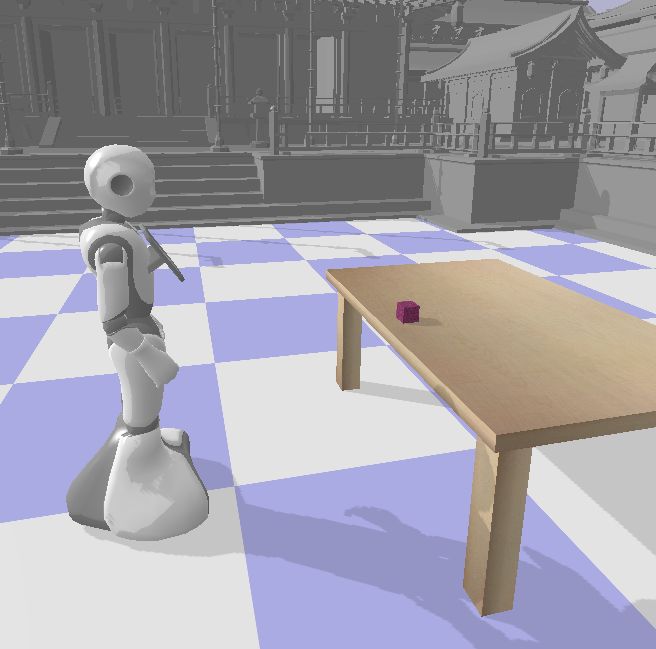
D. Scenarios
  In this subsection, we present three different scenarios
showcasing the qiBullet simulator.

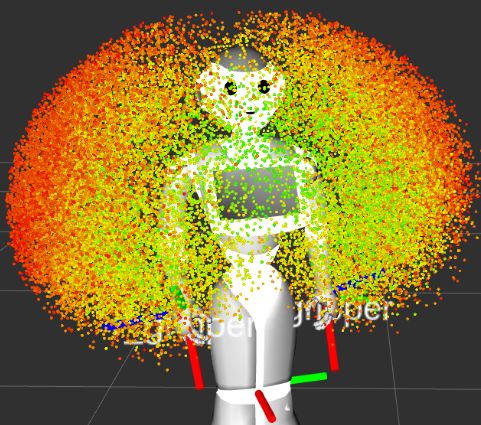
     a) Workspace computation: We aim to sample the right
and left arm workspaces of the Pepper robot, and to evaluate
the manipulability [28] of each sampled configuration. The
kinematic chains start at the Tibia link and respectively
end at the right and left gripper links. To do so, we                             (a)                                    (b)
instantiate 10 simulation instances. In each simulation and
                                                                  Fig. 5: (a) and (b) Virtual NAO robot being controlled by a
for each iteration, an articular position is randomly defined
                                                                  walking algorithm.
and applied onto the joints of a chain. If the chain is self
colliding with the model, the position is deemed incorrect,
and another position is computed. If the end effector does
not self collide, the reached position and the corresponding         The use of the qiBullet simulator can be extended beyond
manipulability are added to the workspace. When all of the        these scenarios, for instance to generate/extend datasets with
instances have reached 4000 successful iterations for each        synthetic data [29], to train Reinforcment Learning algo-
arm, the results are combined and normalized with respect         rithms or to perform localization and navigation tasks.
to the maximum manipulability value obtained to generate
                                                                                        IV. EXPLOITATION
a workspace containing 40000 elements for each kinematic
chain (see Figure 4(a)).                                             In order to foster the use of the qiBullet simulator, its
                                                                  code is made open-source and is available on Github2 . The
                                                                  qiBullet repository contains the files defining the Pepper
                                                                  and NAO robot models, the Python-based qiBullet API,
                                                                  examples illustrating how to use the simulator, an auto-
                                                                  matically generated documentation, and unit tests. The unit
                                                                  tests are automatically launched by a continuous integration
                                                                  tool3 when the simulation is updated, in order to ensure
                                                                  the stability of the library. Moreover, the qiBullet4 Python
                                                                  package has been created and is updated after each new
                                                                  release of the simulator: this particular packaging allows a
                                                                  simple installation of our simulator and of its dependencies.

                                                                                          V. CONCLUSION
                 (a)                             (b)
                                                                     In this paper we introduce qiBullet, a simulator based on
Fig. 4: (a) RViz display of the right and left arm workspaces     PyBullet and the Bullet physics engine, aiming to virtually
of the Pepper robot, with kinematic chains starting from the      emulate SoftBank Robotics’ robots in a physically accurate
Tibia link, and respectively ending at the right and left grip-   fashion. The simulator can sustain multiple instances running
per links. The color of each point represents the associated      in parallel, provides a Python API to interact with the sensors
normalized manipulability value: green corresponds to the         and actuators of the simulated models, and can be interfaced
maximum manipulability value, while red corresponds to the        with the ROS framework. In an effort to open the simulator
minimum. (b) Grasping scenario with a virtual Pepper robot:       to the community, its code has been made public and is
the pink cube in the right hand of Pepper is the object to be     hosted on Github. The work on the qiBullet simulator is
grasped.                                                          still ongoing, we envision introducing additional features and
                                                                  enhancing the existing robot models.
     b) Grasping task: We define a grasping scenario,
where Pepper is placed in front of a table on which an                                        R EFERENCES
object to be grasped is positioned. The physical properties        [1] Hiroaki Kitano, Minoru Asada, Yasuo Kuniyoshi, Itsuki Noda, and
of the Bullet physics engine allow to virtually test out such          Eiichi Osawa. Robocup: The robot world cup initiative. 1995.
a scenario with the Pepper virtual model (see Figure 4(b)).        [2] Thomas Wisspeintner, Tijn Van Der Zant, Luca Iocchi, and Stefan
                                                                       Schiffer. Robocup@ home: Scientific competition and benchmarking
                                                                       for domestic service robots. Interaction Studies, 10(3):392–426, 2009.
     c) Walking task: We define a walking scenario, where
                                                                    2 https://github.com/softbankrobotics-research/
NAO is placed standing still in a flat world. The simulator
                                                                  qibullet
can be used to test the balance of the robot while being            3 https://travis-ci.org/softbankrobotics-research/
controlled with different walking algorithms (see Figure 5).      qibullet
                                                                    4 https://pypi.org/project/qibullet/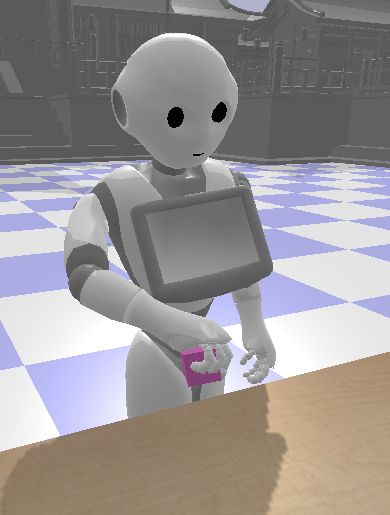
[3] Eric Chown and Michail G. Lagoudakis. The standard platform league.     [27] Willow Garage. Universal robot description format (urdf). Http://Www.
     In RoboCup 2014: Robot World Cup XVIII [papers from the 18th                 ros. org/urdf/, 2009, 2009.
     Annual RoboCup International Symposium, João Pessoa, Brazil, July      [28] Tsuneo Yoshikawa. Manipulability of robotic mechanisms. The
     15, pages 636–648, 2014.                                                     international journal of Robotics Research, 4(2):3–9, 1985.
 [4] World Robot Summit.                   [Online], Available: https:       [29] Alban Laflaquière and Verena V Hafner. Self-supervised body image
     //worldrobotsummit.org/en/.                                                  acquisition using a deep neural network for sensorimotor prediction.
 [5] NAO Challenge.               [Online], Available: https://www.               arXiv preprint arXiv:1906.00825, 2019.
     naochallenge.it/.
 [6] Alan Zimmerman. Botlab environment. [Online], Available: https:
     //poly.google.com/view/2hWxc7Hk9CJ.
 [7] Nathan Koenig and Andrew Howard. Design and use paradigms for
     gazebo, an open-source multi-robot simulator. In 2004 IEEE/RSJ Inter-
     national Conference on Intelligent Robots and Systems (IROS)(IEEE
     Cat. No. 04CH37566), volume 3, pages 2149–2154. IEEE, 2004.
 [8] Eric Rohmer, Surya PN Singh, and Marc Freese. V-rep: A versatile and
     scalable robot simulation framework. In 2013 IEEE/RSJ International
     Conference on Intelligent Robots and Systems, pages 1321–1326.
     IEEE, 2013.
 [9] Olivier Michel. Cyberbotics ltd. webots: professional mobile robot
     simulation. International Journal of Advanced Robotic Systems,
     1(1):5, 2004.
[10] Emmanuel Pot, Jérôme Monceaux, Rodolphe Gelin, and Bruno
     Maisonnier. Choregraphe: a graphical tool for humanoid robot pro-
     gramming. In RO-MAN 2009-The 18th IEEE International Symposium
     on Robot and Human Interactive Communication, pages 46–51. IEEE,
     2009.
[11] Gilberto Echeverria, Nicolas Lassabe, Arnaud Degroote, and Séverin
     Lemaignan. Modular open robots simulation engine: Morse. In 2011
     IEEE International Conference on Robotics and Automation, pages
     46–51. Citeseer, 2011.
[12] Florian Lier and Sven Wachsmuth. Towards an open simulation envi-
     ronment for the pepper robot. In Companion of the 2018 ACM/IEEE
     International Conference on Human-Robot Interaction, pages 175–
     176. ACM, 2018.
[13] Erwin Coumans. Bullet physics engine. Open Source Software:
     http://bulletphysics.org, 1(3), 2010.
[14] Erwin Coumans and Yunfei Bai. Pybullet, a python module for
     physics simulation for games, robotics and machine learning. http:
     //pybullet.org, 2016–2019.
[15] Aldebaran Robotics. Naoqi framework. [Online], Available: http:
     //doc.aldebaran.com/2-5/index_dev_guide.html.
[16] Morgan Quigley, Ken Conley, Brian Gerkey, Josh Faust, Tully Foote,
     Jeremy Leibs, Rob Wheeler, and Andrew Y Ng. Ros: an open-source
     robot operating system. In ICRA workshop on open source software,
     volume 3, page 5. Kobe, Japan, 2009.
[17] Tom Erez, Yuval Tassa, and Emanuel Todorov. Simulation tools
     for model-based robotics: Comparison of bullet, havok, mujoco, ode
     and physx. In 2015 IEEE international conference on robotics and
     automation (ICRA), pages 4397–4404. IEEE, 2015.
[18] Havok physics engine. [Online], Available: www.havok.com.
[19] Emanuel Todorov, Tom Erez, and Yuval Tassa. Mujoco: A physics
     engine for model-based control. In 2012 IEEE/RSJ International
     Conference on Intelligent Robots and Systems, pages 5026–5033.
     IEEE, 2012. [Online], Available: www.mujoco.org.
[20] Open Dynamics Engine. [Online], Available: http://ode.org.
[21] PhysX physics engine. [Online], Available: www.geforce.com/
     hardware/technology/physx.
[22] Jie Tan, Tingnan Zhang, Erwin Coumans, Atil Iscen, Yunfei Bai,
     Danijar Hafner, Steven Bohez, and Vincent Vanhoucke. Sim-to-
     real: Learning agile locomotion for quadruped robots. arXiv preprint
     arXiv:1804.10332, 2018.
[23] Michel Breyer, Fadri Furrer, Tonci Novkovic, Roland Siegwart, and
     Juan Nieto. Comparing task simplifications to learn closed-loop
     object picking using deep reinforcement learning. IEEE Robotics and
     Automation Letters, 4(2):1549–1556, 2019.
[24] Krzysztof Choromanski, Aldo Pacchiano, Jack Parker-Holder, Jasmine
     Hsu, Atil Iscen, Deepali Jain, and Vikas Sindhwani. When random
     search is not enough: Sample-efficient and noise-robust blackbox
     optimization of rl policies. arXiv preprint arXiv:1903.02993, 2019.
[25] Eloı̈se Dalin, Pierre Desreumaux, and Jean-Baptiste Mouret. Learning
     and adapting quadruped gaits with the” intelligent trial & error”
     algorithm. 2019.
[26] Andy Zeng, Shuran Song, Johnny Lee, Alberto Rodriguez, and
     Thomas Funkhouser. Tossingbot: Learning to throw arbitrary objects
     with residual physics. arXiv preprint arXiv:1903.11239, 2019.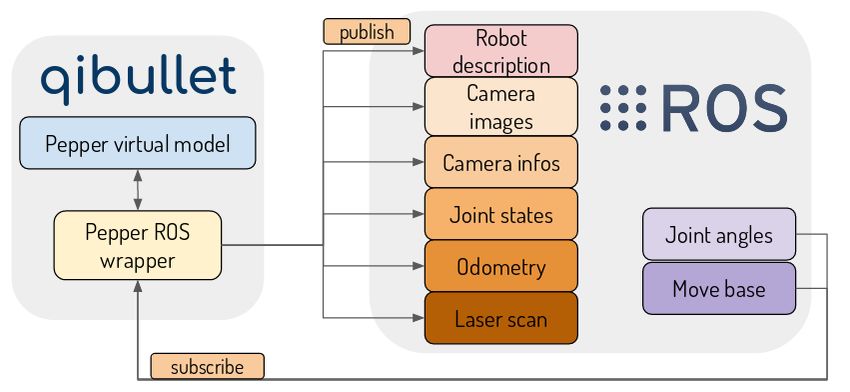
You can also read


