REGIONAL PLAN TO END HOMELESSNESS - MARICOPA REGIONAL CONTINUUM OF CARE 2018 - City of Chandler
←
→
Page content transcription
If your browser does not render page correctly, please read the page content below
REGIONAL PLAN TO
END HOMELESSNESS
   MARICOPA REGIONAL
   CONTINUUM OF CARE
         2018
Continuum of Care Board Co-Chairs
                      Kevin Hartke, Vice-Mayor, City of Chandler
                      Amy Schwabenlender, Executive Director, Human Services Campus

Plan adopted by the Maricopa Regional Continuum of Care Board August 27, 2018.

                                                      Page 1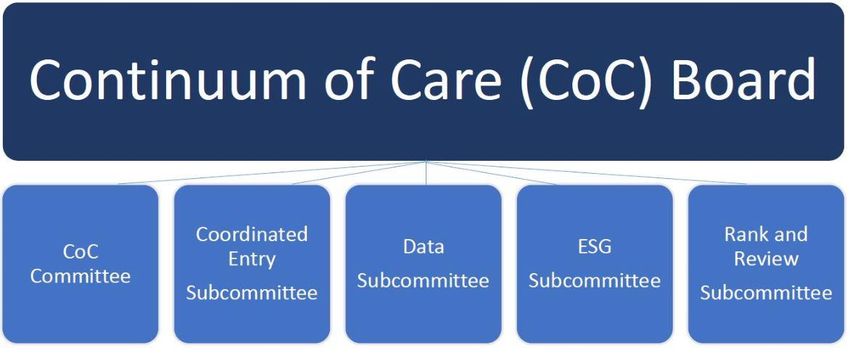
Table of Contents
Executive Summary                             3

Maricopa Regional Continuum of Care           4

Summary of Homelessness in Maricopa County   6

Local Initiatives                             9

Plan Overview                                10

       Singles Homelessness                  11

                Chronic Homelessness         15

                Veteran Homelessness         19

       Family Homelessness                   23

       Youth Homelessness                    26

       System for Ending All Homelessness    30

Coordinated Entry Visioning Sessions         34

Special Thank You                            39

Appendix                                     41

                              Page 2
Executive Summary
The Maricopa Regional Continuum of Care (CoC) following Plan to End Homelessness is our roadmap
represents the Phoenix metropolitan area. The CoC towards a day when the community has ample
is committed to collaboration and coordination on a resources and a seamless homeless services delivery
regional basis because we know that homelessness system for every individual and family experiencing
does not stop at any one city’s borders. Working homelessness.
together towards common goals, we will care for our
neighbors and ensure that the county’s residents To continue on the path towards ending
have access to safe, affordable, and stable housing. homelessness in the region, our priorities are:
The previous plan developed by the CoC was Targeting homeless services through a robust
successful by focusing on three key goals: and easily accessible coordinated entry
system;
Raising awareness and support for Delivering homeless services that decrease
coordinated responses to end homelessness; barriers to housing and determine eligibility
Leveraging funding, services, and housing by based on vulnerability and service needs;
creating new innovative partnerships and Strengthening partnerships to create
strengthening collaborative relationships; additional housing and freeing housing
and dollars by leveraging housing resources with
Increasing permanent supportive housing Medicaid-billable services; and
units and rapid re-housing units for Showing improved system performance
individuals and families experiencing year-to-year, to track progress towards
homelessness. overall goal of ensuring that homelessness in
the region is rare, brief and non-recurring.
While we are proud of our accomplishments thus
far, we know that there is still significant work to be
done. We are committed to forging a path for the This new plan reaffirms and builds upon the
most vulnerable among us and know the real risks goals made in the previous plan by working to
faced by our friends living on the streets. We mourn expand housing resources to meet the needs of
those lost to us in the harsh desert climate of our area those experiencing homelessness in our
and are mindful that one-third of all heat-related community. The goal is to create a long-term
deaths in the region are people experiencing sustainable system that ensures that
homelessness. For our community, ending homelessness in our community is brief, rare,
homelessness is truly a life or death proposition. The and non-recurring.
Page 3
Maricopa Regional Continuum of Care
              Who is involved in the regional effort to end homelessness?
At the center of this effort to end homelessness in      To connect those living on the street with health
the region is the Maricopa Regional Continuum of         and housing services, providers such as police, fire,
Care, coordinated by the Maricopa Association of         and other first responders partner with street
Governments (MAG).                                       outreach. The criminal justice system also works
                                                         hand-in-hand with behavioral health and homeless
We are fortunate to have the best and the brightest      service providers through implementation of
in our community committed to                                        innovative programs for the justice-
ending homelessness. Through                                           involved population experiencing
MAG’s stakeholder community,                                           homelessness.
including the region’s mayors, city
council members, the County Board                                       In addition to the healthcare and
of Supervisors, and other elected                                       justice systems, state child welfare
officials, the issue of ending                                          representatives connect youth
homelessness in our region has been                                     aging out of the foster care system
highly prioritized. Funding partners                                    with resources and oversee the
meet regularly to align resources in                                    needs of children and youth in the
order to meet regional needs, both                                      homeless services system. School
with private and public housing                                         liaisons work with school-aged
resources.                                                              children to ensure that education is
                                                                        not interrupted by episodes of
In addition, major healthcare                                           homelessness.
providers have led efforts to address medically
vulnerable persons. The area’s Regional Behavioral       The Continuum of Care stands at the center of
Health Authority commits to and leads community          regional efforts and is led by a diverse and expert
behavioral health initiatives.                           governing board, assisted by five key groups, and
                                                         is reflective of the systems described above.

                                                Page 4
What is the Maricopa Regional Continuum of Care?

The governing board and the five primary groups are             The Coordinated Entry Subcommittee serves to
represented by stakeholders in the community that               problem-solve issues facing the coordinated entry system
include: formerly homeless individuals, single providers,       and provides policy recommendations to the Continuum
family providers, youth providers, veterans and veteran         of Care Board on principles and guidelines for the system.
advocates, outreach teams, domestic violence advocates,
the criminal justice system, the healthcare system, the         The Data Subcommittee provides a forum to review
behavioral health system, the child welfare system, elected     data, provide input and make recommendations to the
officials, the police department, the fire department,          Continuum of Care Board on policies related to the
Emergency Solutions Grant recipients, Public Housing            Homeless Management Information System data
Authorities, and private funders. The roles of the primary      collection and use. Using data to inform decisions and
CoC stakeholders are described below.                           planning, the Data Subcommittee contributes expertise to
                                                                effectively use community data. It is important to the CoC
The CoC Board is the policy-setting and decision-               Board that there is consistency about data collection, the
making body for the Maricopa Regional Continuum of              definition of data categories and that data transparency
Care. The Board develops, annually updates, and follows         exists throughout the CoC. The Data Subcommittee
the governance charter in consultation with CoC (MAG)           consists of providers, funders, the singles and families
staff and the Homeless Management Information System            coordinated entry leads, and the HMIS lead.
lead (CIR). The Board works to strengthen the homeless
services system by providing guidance and support to            The ESG Subcommittee consults with the CoC Board
nonprofit homeless services providers and taking                to foster collaboration and coordination of ESG and
appropriate action on the performance of those providers.       CoC-funded services and performance outcomes.

The five key groups recommend policies to the CoC               The Rank and Review Subcommittee ensures the
Board in the following ways:                                    objective review of performance metrics, and seeks to
                                                                maximize HUD CoC funding through rating and
The CoC Committee is a collaborative of cross-sector            reviewing projects recommended for funding. They also
stakeholders providing housing and services to people           analyze the CoC’s portfolio of interventions to restructure
experiencing homelessness in Maricopa County. The               resources in order to meet regional homeless needs, and
purpose of the Committee is to provide input and                provide those recommendations to the Board.
recommendations to the Continuum of Care Board and
MAG staff, and support communication across groups.

                                                       Page 5
Summary of Homelessness in Maricopa County
                        Why is it Important to End Homelessness?

The health of our communities may be measured                    According to the U.S. Census Bureau, between
by the economic well-being of its residents. The                 July 1, 2016 and July 1, 2017, Maricopa County
cost of homelessness includes costs incurred by                  gained more than 73,000 people, an increase of
law enforcement, the healthcare system, city                     more than 200 people per day. The burgeoning
services like zoning and code enforcement, and the               population brings challenges associated with
toll it takes on neighborhoods and businesses                    absorbing the highest number of new residents in
where people experiencing homelessness may                       the country. Challenges include rising housing
congregate in parks and on the streets. Some                     costs and a tight private rental market run by
communities bear a disproportionate burden, such                 landlords reluctant to rent to vulnerable
as when services or encampments are centralized.                 populations who tend to “fall through the cracks”.
The greatest concentration of people experiencing
homelessness is in the City of Phoenix. However,                 The annual Point-in-Time (PIT) Count is a one-
trends show the unsheltered population increasing                night snapshot of homelessness in the region, and
in all communities in Maricopa County.                           can be supplemented with other data sources to
Moreover, increases in the County’s general                      provide a better understanding of what is going on
population has had an impact on housing                          in the community. The 2018 PIT Count showed
availability and costs that exacerbates the issue.               an overall increase from previous years’ counts.
                          Point-in-Time Count Total Persons, 2014-2018
                                                                                           6,298
                        5,918
                                       5,631             5,702            5,605

                                                                                           3680

                                                         4056             3546
                        4865           4342

                                                                                           2618
                                                                          2059
                                                         1646
                        1053           1289

                        2014           2015              2016             2017             2018

                                  Unsheltered Total Persons      Sheltered Total Persons

                                                   Page 6
The number of unsheltered individuals and
families has continued to rise each year, with a
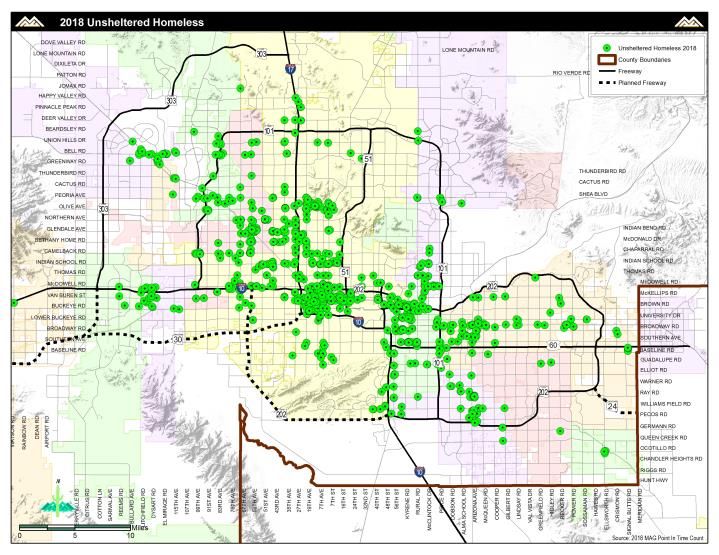
149% increase since 2014. A map of the 2018 PIT
Unsheltered Count depicts the scatter of
unsheltered homelessness. As expected, the largest
density is in the city of Phoenix, with significant
scatter in all directions compared to previous years.
Efforts must continue to target the increasing
unsheltered population across the region.
Through focused work on Veteran homelessness,
the community now has resources to end
homelessness for Veteran families within 30 days,
achieving functional zero. To build upon these
successes with the veteran population, the is a deficit of 116,080 units for households at or
community has added resources to pave the way below extremely low income (ELI) thresholds.
toward similar success for other target For every 100 households at or below ELI
populations. The community actively participates thresholds, there are 21 affordable and available
in the Built for Zero initiative, a national effort to units. For households at or below 50% of the area
end veteran and chronic homelessness by using median income (AMI), there is a deficit of 119,237
quality data to measure outcomes. units. There are only 48 affordable and available
units per 100 households at or below 50% of AMI,
However, there is still a long way to go to provide according to the National Low Income Housing
enough affordable units in Maricopa County; there Coalition’s March 2017 report.
Housing Inventory Chart, 2017-2018
Singles Families
6000
5350
5000 529
4480
516
Number of Households
4000
3000
4821
2000 3964 1516 1646
261 294 1072
1000 699 583 635
372 401 444
1255 1352 228 230 218
471 700 198 259
353 417 203 185
0
2017 2018 2017 2018 2017 2018 2017 2018 2017 2018
Permanent Supportive Emergency Shelter Transitional Housing Rapid Re-Housing Other Permanent
Housing (ES) (TH) (RRH) Housing
(PSH) (OPH)
Intervention by Year
Page 7What is the Impact of the Maricopa Regional Continuum of Care?
Awarded $25.89 million from the U.S. Department of Housing and Urban Development’s FY 2017
Continuum of Care Program Competition to fund 41 local homelessness programs.
Provided long-term housing and services. Significantly, 93% of formerly homeless residents in
permanent housing programs (not including RRH) exited to permanent housing destinations or
retained their housing in FY2017 (SPM Metric 7b.2).
Provided regional services to ensure that veteran families experiencing homelessness are immediately
connected with housing and related services.
Implemented a monitoring protocol to assess how closely nonprofit providers adhere to HUD
compliance, including low-barrier or Housing First model and Coordinated Entry participation, so
that the most vulnerable individuals and families have immediate access to housing.
Achieved success in diversion strategies. In 2017, coordinated entry successfully diverted 1,213
families from entering the homeless services system, with no return for service. For individuals,
coordinated entry diverted 439 individuals from the homeless services system (Family Housing Hub
and Singles Coordinated Entry 2017 Reports).
Page 8Local Initiatives
Maricopa County StandDown
Annually, the StandDown event for veterans experiencing or at risk of homelessness takes place in the
Phoenix metropolitan area, providing services such as: direct connection to housing and services, legal
services, driver’s licenses, Social Security, and Veterans benefits, amongst others.
Built for Zero
The Maricopa Regional Continuum of Care participates in Built for Zero, a national initiative to end
veteran and chronic homelessness. The Ending Veteran Homelessness Workgroup and Ending Chronic
Homelessness Workgroup meet bi-weekly to review data and strategize system improvements. The CoC
submits monthly HMIS data to Community Solutions for the Built for Zero Performance Management
Tracker dashboard, which captures monthly inflow, outflow, and active numbers for the chronic and
veteran subpopulations.
CoC Youth Workgroup and Youth Action Board
The Maricopa Regional CoC has two groups focused on addressing youth homelessness. The CoC Youth
Workgroup meets monthly, bringing together youth providers as well as other community stakeholders to
collaborate on improving services for youth experiencing homelessness. The Youth Action Board also
meets monthly and is made up of youth with lived experience who provide youth voice, input, and
direction for the CoC’s work to end youth homelessness in the Maricopa County region.
Outreach Collaborative
Outreach is an important component of the homeless services system. Outreach workers are often the first
point of contact for someone experiencing homelessness and play an important role in client engagement.
The Outreach Collaborative is made up of outreach workers and law enforcement officers who directly
interact with people experiencing homelessness. This group meets monthly to provide updates on outreach
initiatives and discuss how to improve coordination of care.
Page 9Plan Overview
Ultimate Goal
The Maricopa Regional Continuum of Care will create a system for providing services to individuals and
families experiencing homelessness that ensures that homelessness is rare, brief and non-recurring.
Throughout the Plan, various data are referenced from the Homeless Management Information System
(HMIS), the Point-in-Time Homeless Street Count, etc. It is important to note that the CoC strives to
achieve consistency with data collection as well as the definition of data categories, and that data
transparency exists.
Long-Term Goals
Integrate resources and achieve widespread coordination of services across the region.
Increase number of units available.
System Performance Measures (FY 2017)
Rare Brief Non-recurring
Annual count of sheltered 14,101 Average length of 97 days Returns to 25%
homeless persons in persons time homeless in homelessness in 2 years
HMIS Emergency Shelter,
Successful exits from 36%
Safe Haven, and
Street Outreach to
Transitional Housing
Permanent Housing
Number of persons who 9,746 Percentage of adult 36% Successful exits and 93%
became homeless for the persons system stayers retention of Permanent
first time increasing total Housing
income
Page 10Goal: End Singles Homelessness
Includes Chronic, Veterans, and unaccompanied youth.
Current Data
On the night of the 2018 PIT Count, in the region there were
4504
2018 Housing Inventory Chart and PIT Count, Singles
6000
5000 4821
4504
Number of Persons
4000
1932
Sheltered
3000
2000
1352 2572
Unsheltered
1000
700
417
185
0
PSH ES TH RRH OPH PIT
HIC
(Beds)
Page 11Milestones
One Year: Longer Term:
Strengthen services for singles experiencing Identify and secure funding stream(s) to support
homelessness. increasing the number of units needed to achieve
functional zero.
Enhance data partnerships to inform plan to end
homelessness for singles, including data needed Create a system that integrates jails, hospitals and
to determine the need for a progressive other systems of care into the coordinated entry
engagement policy. system using data-based solutions.
Address the need for sufficient access points to
ensure full geographic coverage of coordinated
entry.
Page 12Action Items
Short-Term
Priority Short-Term Strategy Lead Completion Date
Goal
1 Strengthen services for singles experiencing homelessness. CE Lead, 2019
o Formally define and communicate “diversion” strategies and establish baseline outcome data. Singles
Use diversion training from a national expert to inform community provider practices and Providers, CoC
policies. Committee
Review diversion plans and tools used by other communities.
Formalize diversion across the community.
o Explore technology solutions for making system more transparent and integrate with HMIS.
Explore a secure website for by-name list access.
Increase use of “mobile-enhanced” HMIS for outreach efforts.
o Strengthen process by which singles are connected with benefits or workforce connections to increase
income to achieve sustainability.
Ensure providers are using the referral tab in HMIS
Figure out a way to compare data across St. Joe the Worker, Goodwill Industries, AWEE, DES,
Maricopa County and Phoenix Workforce Connections
Explore opportunity for a SOAR dedicated program in the community.
o Improve integration of existing community resources into singles system i.e. CAP offices, navigation,
and housing resources.
2 Enhance data partnerships to inform plan to end homelessness for singles, including data needed to determine HMIS Lead, CE 2019
the need for a progressive engagement policy. Lead, Data
o Set threshold goals for the system to include exits to Permanent Housing, length of stay, and returns Subcommittee
to homelessness.
o Collect and evaluate data on a regional and sub-regional basis. Focus on where individuals are engaged
with the system, how many are assessed, and how many are housed.
o Use data to align funding needs and existing resources to end homelessness.
o Formally define and communicate “diversion” strategies and establish baseline outcome data.
o Document what all providers do for diversion (i.e., St. Vincent de Paul travel aid assistance).
3 Address the need for sufficient access points to ensure full geographic coverage of coordinated entry. CE Lead, CE 2019
Subcommittee
Page 13Long-Term
Priority Long-Term Strategy Lead
1 Identify and secure funding stream(s) to support increasing the number of units needed to achieve functional CoC Board
zero.
o Seek new partnerships to bring governmental and non-governmental resources to support units for
housing individuals experiencing chronic homelessness.
2 Create a system that integrates jails, hospitals and other systems of care into the coordinated entry system using Coordinated
data-based solutions. Entry
o Fully integrate other systems of care into coordinated entry and determine a process by which individuals Providers and
may access coordinated entry through a wide-range of access points. CE
o Explore enhanced data shares across these systems, specifically medical providers, to inform solutions Subcommittee
and improve coordination of care.
3 Increase community awareness of mission and leverage community partners for support. For example, employing All
marketing strategies though the Coalition.
Strengthen landlord relations and solicit future landlord participation in programs through tax incentives or other
models.
Require landlord retention training for scattered site programs to maintain existing landlord relationships.
Page 14Goal: End Chronic Homelessness
Current Data
On the night of the 2018 PIT Count, in the region there were
974
Current
Actively Homeless
1200
1,011 1,000 1,005 995
1000 944 964
916 926 922
Number of Chronic
800
600
400
200
0
Sep-17 Oct-17 Nov-17 Dec-17 Jan-18 Feb-18 Mar-18 Apr-18 May-18
Monthly data reported to Community Solutions from HMIS.
Page 15Milestones
One Year: Longer Term:
Evaluate data and trends to come up with ideas Identify and secure funding stream(s) to support
for interventions that would adjust the numbers increasing the number of units needed to achieve
(inflow/outflow). Test data-informed change
functional zero.
ideas to target interventions towards impact.
Connect chronic homeless in jails, frequent users
Enhance outreach, navigation, and housing
resources by onboarding to Coordinated Entry. of hospitals and other systems of care into the
coordinated entry system.
Develop, through a gaps analysis, the number of
units required to reach functional zero.
Community Solutions’ data dashboard definition of “Housing Placements” includes both Housing Placements and Positive Exits to Housing.
Page 16Action Items
Short-Term
Priority Short-Term Strategy Lead Completion Date
Goal
1 Evaluate data and trends to come up with ideas for interventions that would adjust the numbers Ending Chronic 2019
(inflow/outflow). Test data-informed change ideas to target interventions towards impact. Homelessness
o Establish a mechanism within HMIS to identify people aging into chronicity or at-risk of chronic status. Workgroup,
Explore the other part of the chronic definition for people who qualify through multiple HMIS
instances of homelessness, and people who are aging into chronicity but do not have a
disability
o Identify and quantify how many housing unit openings we have available each month.
o Community-wide diversion training to potentially reduce inflow.
2 Increase onboarding of providers and existing housing resources to Coordinated Entry. Ending Chronic 2019
o Identify existing housing resources that currently are not connected to coordinated entry and onboard Homelessness
to Coordinated Entry to expand our housing pool. Workgroup,
o Enhance outreach and navigation’s commitment to working off the by-name list. Coordinated
o Onboard additional navigation resources and integrate CAP resources into Coordinated Entry. Entry
3 Develop, through a gaps analysis, a value for the number of units required to reach functional zero. Focus Strategies, 2019
o Develop a course of action through data-driven processes to reach functional zero specifically for the Ending
subpopulation of chronically homeless veterans. Chronic/Veteran
Homelessness
Workgroups
Long-Term
Priority Long-Term Strategy Lead
1 Identify and secure funding stream(s) to support increasing the number of units needed to achieve functional CoC Board
zero.
o Seek new partnerships to bring governmental and non-governmental resources to support units for
housing individuals and families experiencing chronic homelessness.
2 Connect chronic homeless in jails, frequent users of hospitals and other systems of care into the coordinated Coordinated
entry system using data-based solutions. Entry
o Identify chronic homeless in jails, frequent users of hospitals and other systems of care. Providers and
o Fully integrate other systems of care into coordinated entry and determine a process by which individuals CE
and families may access coordinated entry through a wide-range of access points. Subcommittee
Page 17Successes
Priority Long-Term Strategy Lead Completed Goal
1 Set the policies and procedures for the ten benchmarks on the Community Solutions scorecard for a quality by- Ending 2018
name list. Chronic
o Established a policy from the by-name list that specifies the number of days of inactivity (within 30 days) Homelessness
at which a person’s status will be changed to ‘inactive.’ Workgroup,
o Regional coverage and coordination of outreach through the Outreach Collaborative, with pilot projects Outreach
Collaborative
to connect high priority individuals with outreach if they recently exited from shelter.
2 Determined the inflow, outflow, and active numbers of chronic homelessness to calculate the need for units Ending 2018
dedicated to chronic homeless persons. This data is submitted to Community Solutions from HMIS on a Chronic
monthly basis. Homelessness
Workgroup,
HMIS
Page 18Goal: End Veteran Homelessness
Current Data
On the night of the 2018 PIT Count, in the region there were
413
Actively Homeless
600
481 489 476 489
Number of Veterans
500 460 465
456
441
408
400
300
200
100
0
Sep-17 Oct-17 Nov-17 Dec-17 Jan-18 Feb-18 Mar-18 Apr-18 May-18
Monthly data reported to Community Solutions from HMIS.
Page 19Milestones
One Year: Longer Term:
Effectively manage significant changes to the Reach functional zero for veterans
Grant Per Diem program to appropriately target experiencing homelessness using HUD
interventions to the veteran population. prioritization strategies that populate the by-
Reduce the number of chronic veterans on the name list.
community by-name and the number of all Engage other systems of care, including
veterans experiencing homelessness by testing medical and behavioral health systems, using
“change ideas” geared towards reducing HMIS.
bottlenecks in the homeless services system. Address employment needs of veterans
experiencing homelessness by partnering with
employment and training resources.
Community Solutions’ data dashboard definition of “Housing Placements” includes both Housing Placements and Positive Exits to Housing.
Page 20Action Items
Short-Term
Priority Short-Term Strategy Lead Completion
Date Goal
1 Effectively manage significant changes to the Grant Per Diem program to appropriately target interventions to the veteran Ending 2019
population. Veteran
o Continue to work to integrate the changes to the GPD program to target interventions to the veteran population. Homelessness
o Work to ensure the GPD referral process makes most effective use of the resource. Workgroup
(with VA)
2 Test “change ideas” to remove bottlenecks in the homeless services system to reduce the number of veterans experiencing EVHW (with 2019
chronic homelessness and all veterans experiencing homelessness in the region. VA)
3 Work to increase prevention and diversion efforts to reduce the inflow of veterans to the homeless services system. EVHW (with 2019
o Increase diversion efforts, particularly for veterans planning to relocate to the region by education on housing costs and VA and CE
service availability in the region. Stress “come with a plan” to those veterans looking to relocate to the Phoenix area. Leads)
o Participate in the SSVF Rapid Resolution Pilot Project to identify and test best practices for resolving homelessness
before individuals and families access the homeless services system.
Long-Term
Priority Long-Term Strategy Lead
1 Reach functional zero for veterans experiencing homelessness using HUD prioritization strategies that EVHW (with VA)
populate the by-name list.
o Prioritize veterans experiencing chronic homelessness so that every veteran experiencing chronic
homelessness is housed within 90 days.
o Develop additional resources to ensure adequate housing options for all veterans experiencing
homelessness.
2 Engage other systems of care, including medical and behavioral health systems, using HMIS. Ending Veteran
o Develop policies and procedures to link the data and information from other systems of care to Homelessness
the information inputted into HMIS systems. Workgroup (with VA)
3 Address employment needs of veterans experiencing homelessness by partnering with employment and Ending Veteran
training resources. Homelessness
Workgroup (with VA)
Page 21Successes
Priority Lead Completed
Goal
1 Effectively managed significant changes to the Grant Per Diem program to appropriately target interventions to the veteran Ending 2018
population. Veteran
o Involve GPD providers in the Ending Veteran Homelessness Workgroup to ensure continuous feedback on status of Homelessness
GPD changes. Workgroup
o Ensure integration of GPD units with coordinated entry system including VI-SPDAT assessment for every veteran in (with VA)
a GPD bed.
2 Accelerated housing placements to reduce veterans on the list identified as experiencing chronic homelessness by increasing EVHW (with 2018
positive housing placements from 23 per month to 33 per month. VA)
3 Maintained a sustainable quality by-name list. EVHW (with 2018
o Work with the VA to enter veteran data into the Homeless Management Information System for coordinated entry VA, HMIS
which will include eligibility status and housing placements. Leads and CE
Create policies to identify, assess, and house all veterans experiencing homelessness within 90 days. Leads)
Achieved 100% data quality with “balanced” data increasing confidence in the community By-Name List.
Page 22Goal: End Family Homelessness
Current Data
On the night of the 2018 PIT Count, in the region there were
519
2018 Housing Inventory Chart and PIT Count, Families
600
529 519
14
500
400 372
Number of Families
294
300
259
505
218
200
100
0
PSH ES TH RRH OPH PIT
HIC Sheltered
(Units) Unsheltered
Page 23Milestones
One Year: Longer Term:
Prioritize and intensify diversion services for Align resources with acuity assessment scores and
families experiencing homelessness. need determined by gaps analysis, emphasizing the
Enhance data partnerships to inform plan to need for more non-restrictive PSH designated for
end homelessness for families and to families.
determine the need for additional housing Connect with sustainable community supports to
resources. . transition successful exits to Permanent Housing,
Map community resources to transition including faith-based and behavioral health
resources.
successful exits to permanent housing.
Develop strategies to strengthen infrastructure and
partnerships to prevent recidivism.
Develop, assess and determine effective move on
strategies for families in PSH, where appropriate,
when stability is achieved.
Address the need for sufficient access points to
ensure full geographic coverage of coordinated
entry
720 entered Shelter
545 entered RRH
72 entered TH
32 entered GPD
43 entered PSH
Page 24Action Items
Short-Term
Priority Short-Term Strategy Lead Completion
Date Goal
1 Prioritize and intensify diversion services for families experiencing homelessness. CE Lead, Family Providers, 2018
o Formally define and communicate “diversion” strategies and establish baseline outcome data. CoC Committee
o Implement community training (including all front line staff) on diversion to encourage families to
use their existing resources to resolve their homelessness.
Ensure equal treatment for those receiving diversion resources.
Develop ongoing learning collaborative.
o Evaluate the outcomes of Coordinated Entry and diversion techniques.
o Connect families with benefits or workforce connections to increase income to achieve sustainability.
o Expand geographic coverage of Coordinated Entry system and a 24/7 phone system for families.
2 Enhance data partnerships to inform plan to end homelessness for families and to determine the need HMIS Lead, CE Lead, Data 2018
for additional housing resources. Subcommittee
o Explore technology solutions for making system more transparent and integrate with HMIS.
o Set threshold goals for the system to include exits to Permanent Housing, length of stay, and
returns to homelessness.
o Develop data to inform funding needs and existing resources to end family homelessness,
including history of foster care or homelessness as a child.
Long-Term
Priority Long-Term Strategy Lead
1 Align resources with acuity assessment scores and need determined by gaps analysis, emphasizing the HMIS Lead, CE Lead, Data
need for more non-restrictive PSH designated for families. Subcommittee, CE
o Use current Standards of Excellence to assist with informing the development of best practices. Subcommittee
2 Connect with sustainable community supports to transition successful exits to Permanent Housing, Family providers, CoC
including faith-based and behavioral health resources. Committee
o Map community supports and resources.
o Implement long-term, extensive services for Rapid Re-housing to prevent recidivism.
3 Address the need for sufficient access points to ensure full geographic coverage of coordinated entry. Family providers, CoC
Committee
4 Implement community information strategy so that clients and public understand there is limited capacity, for Family providers, CoC
example through a flyer that details a process map. Committee
Page 25Goal: End Youth Homelessness
Current Data
On the night of the 2018 PIT Count, in the region there were
415
2018 Housing Inventory Chart and PIT Count, Unaccompanied Youth
450
415
400
350
300
274
Sheltered
250
200
150
119
100
142
50 Unsheltered
34
0
Permanent Housing PIT
ES and TH (PSH, RRH, OPH)
HIC
(Youth-Dedicated Beds)
Page 26Milestones
One Year: Longer Term:
Identify and define unique needs of youth, and Maximize use of the existing resources to
improve service delivery to youth populations. improve service delivery to youth and implement
Develop a dashboard for tracking youth new practices based on gaps identified through
experiencing homelessness. HMIS data and innovative strategies informed by
Identify an appropriate coordinated entry the short-term action items.
integration strategy for youth. Identify and secure new funding sources for
youth housing.
Explore the use of the TAY VI-SPDAT for youth
assessment. Expand Youth Workgroup to region-wide
stakeholders and connect regional work with
Convene a Youth Action Board monthly to guide
national efforts to end youth homelessness
the direction of youth work.
Review the work from the systems-wide analysis
project and build upon identified opportunities
for youth.
Explore dedicated diversion funds for youth.
Page 27Action Items
Short-Term
Priority Short-Term Strategy Lead Completion
Date Goal
1 Identify and define unique needs of youth, and improve service delivery to youth populations. Youth Workgroup, Youth Action 2019
o Continue to improve access and engagement strategies for identifying and connecting youth to Board, HMIS, MAG
services/resources through Outreach and Coordinated Entry.
o Identify youth hotspots using outreach and provider data.
o Increase scope of youth providers using HMIS.
o Identify trends and needs based on HMIS and PIT data.
o Encourage innovative strategies for addressing the needs of youth experiencing homelessness.
2 Develop a dashboard for tracking youth experiencing homelessness. Youth Workgroup, HMIS 2019
o Identify required data elements to input into HMIS.
o Incorporate non-HMIS data as needed.
3 Identify an appropriate coordinated entry integration strategy for youth. Youth Workgroup, CE Leads, CE 2019
o Identify how youth are impacted by the coordinated entry prioritization strategy. Subcommittee
o Incorporate youth-specific assessments at access points.
o Develop protocols for warm hand-off to youth services.
4 • Explore the use of the TAY VI-SPDAT for youth assessment. Youth Workgroup, CE 2019
Subcommittee
5 • Convene a Youth Action Board monthly to guide the direction of youth work. Youth Workgroup, Youth Action 2019
Board
6 • Review the work from the systems-wide analysis project and build upon identified opportunities for Youth Workgroup, Focus 2019
youth. Strategies, HMIS, MAG
7 • Explore dedicated diversion funds for youth. Youth Workgroup, Other 2019
Funders, CoC Board
Page 28Long-Term
Priority Long-Term Strategy Lead
1 Maximize use of the existing resources to improve service delivery to youth and implement new CoC Committee, Youth
practices based on gaps identified through HMIS data and innovative strategies informed by the short- Workgroup
term action items.
o Develop connection with schools, juvenile justice, and foster care and identify ways to share
data and coordinate services.
o Connect with sustainable community supports to transition successful exits to Permanent
Housing and ensure that the data is documented on HMIS.
2 Identify and secure new funding sources for youth housing. CoC Board
3 Expand Youth Workgroup to region-wide stakeholders. CoC Board, Collaborative
o Engage new partners in geographic areas where youth congregate. Applicant, Youth Workgroup
Connect regional youth homelessness work with national efforts to end youth homelessness.
o Align with federal benchmarks and criteria.
o Explore opportunities to send youth to national conferences.
Successes
Priority Success Lead Completed
Goal
1 The Maricopa Regional Continuum of Care submitted an application for HUD’s FY 2017 Youth Youth Workgroup, YHDP April 2018
Homelessness Demonstration Program (YHDP) competition. Planning Team, Youth Action
Board, MAG, HMIS
Page 29Goal: Strengthen the System for
Ending All Homelessness
Data indicate that there are not yet enough resources to end homelessness in Maricopa County. For example, units
for singles are not prevalent enough to address the issue of homelessness among this population of 4,504 singles
identified in the 2018 Point-in-Time Count in Maricopa County. Specifically, the chronic population – which heavily
consists of singles – has increased substantially from 2016 to 2018. In addition, families and youth also face
homelessness without sufficient resources and the overall unsheltered count has been rising since 2014.
Before reaching conclusions on actions to take regarding homelessness in Maricopa County, it is important to first
acknowledge that the data from the Homeless Services system represent only a portion of homelessness in the county.
There are many other county systems that encounter homeless individuals and families who actually do not make
contact with the Homeless Services system, and are never included in the Homeless Management Information System.
Some examples of these other county systems include:
The criminal justice and jail system;
The healthcare system (AHCCCS, hospitals, etc.);
The behavioral health system;
Fire and police.
As such, the goal must not simply to be to reduce the numbers of
homeless individuals and families outlined throughout this plan to
end homelessness, but also should be to integrate the other systems
that frequently interact with homelessness. This represents a very
pressing data need: a comparison of hospital, healthcare, and criminal
justice coding compared to HMIS records to determine how many
homeless individuals and families are not reaching the system. Only
after achieving this goal will Maricopa County have a more accurate
and representative idea on the true needs of the system, and be able
to work to help those in our society who are most vulnerable.
Partnerships with ESG recipients and other funding sources are key to our efforts to end homelessness.
Partnership includes aligning outcomes, serving on application review panels, and coordinating the adoption of
funding priorities by the CoC Board.
Page 30Milestones
One Year: Longer Term:
Leverage CoC resources by seeking new Develop and implement a strategy for right-sizing
partnerships with funders, affordable housing interventions.
developers, landlords, faith community, Integrate other systems of care into the
healthcare providers, and other partners. coordinated entry system.
Continue to build a fully functional coordinated Create additional permanent housing in the
entry system. region.
Partner with the funding community to ensure Identify prevention funds.
common outcomes and consistent program
delivery.
Conduct a systems analysis to identify strengths
and areas of improvements and make
recommendations for right-sizing interventions.
System Performance Measures
Category System Performance FY 2016 FY 2017 Change from
Measures FY 2016 to FY 2017
Number of Homeless 15,271 persons 14,101 persons -7.7% (change in persons)
Persons (in HMIS)
Rare
Number of Persons who 10,099 persons 9,746 persons -3.6% (change in persons)
Become Homeless for the
First Time
Length of Time Homeless 101 days 97 days -4.0% (change in days)
(Average days in ES/SH/TH)
Brief
Employment and Income 22% 36% +14.0% (change in percent),
Growth (Percentage of Adult (531 persons) (778 persons) +46.5% (change in persons)
System Stayers Increasing
Total Income)
Returns to Homelessness 24% 25% +1.0% (change in percent),
(Percentage in 2 years)
Non-Recurring
(1,258 persons) (1,420 persons) +12.9% (change in persons)
Successful Exits from 25% 36% +11.0% (change in percent),
Street Outreach (373 persons) (495 persons) +32.7% (change in persons)
Successful Exits and 95% 93% -2.0% (change in percent),
Retention from Permanent (5635 persons) (5945 persons) +5.5% (change in persons)
Housing
Page 31Action Items
Short-Term
Priority Short-Term Strategy Lead Completion
Date Goal
1 Create Affordable Housing All 2019
o Create additional permanent housing in the region.
o Remove barriers to affordable housing.
2 Coordinate CE services regionally and continue to build a fully functional Coordinated Entry system. CoC Board, CE Leads, CE 2019
o Refine coordinated entry prioritization strategy to serve those most vulnerable. Subcommittee
o Ensure coordination between coordinated entry leads.
o Guard against silos within the coordinated entry system.
o Review assessment tools and protocols to incorporate information that comprehensively
determines need.
o Use HMIS to measure outcomes of Coordinated Entry and diversion.
o Develop and implement a monitoring and evaluation process: establish benchmarks, set specific
outcomes with associated timelines
o Consider an RFP process to administer Coordinated Entry.
3 Right-size interventions and find common language to achieve goals. All 2019
o Develop and implement a strategy for right-sizing interventions.
o Maximize the use of all current resources and invest where there is the greatest demand.
o Align resources determined by system analysis.
4 Leverage CoC resources by seeking new partnerships and find common language to achieve goals. CoC Board, CoC Committee, 2019
o Develop partnerships with funders, affordable housing developers, landlords, faith community, Collaborative Applicant
healthcare providers, and others
o Provide opportunities for new partners to engage in CoC meetings, CoC membership, and
education and training events.
o Review current matrix of participants; solicit lead within sectors where representation is lacking
within the CoC; this includes PHA and housing developers.
o Develop formal PHA housing workgroup.
o Focus on having robust, cross-sector representation at the table.
Page 32Short-Term Work Completed
Priority Short-Term Strategy Lead Completed
Goal
1 Conduct a systems analysis to identify strengths and areas of improvements and make recommendations CoC Board, CE Leads, CE 2018
for right-sizing interventions. Subcommittee
o Develop timelines for securing contractor and completing system analysis.
o Facilitate RFP process to secure a consultant to conduct system analysis.
2 Partner with the funding community to ensure common outcomes and consistent program delivery. ESG Subcommittee, 2018
o Serve on ESG funding process to collaborate on common goals. Collaborative Applicant
Long-Term
Priority Long-Term Strategy Lead
1 Integrate other systems of care into the coordinated entry system. Coordinated Entry
o Seek partnerships and engage with jails and corrections, mental health, hospitals, and other Subcommittee, CE Lead,
systems that serve those experiencing homelessness. Collaborative Applicant
2 Identify prevention funds and coordinate with DES, CAP offices and other sources to secure and CoC Board, ESG
prioritize prevention funds for all populations. Subcommittee
3 Ensure supportive services continue after program exit (up to six months) to ensure long-term housing All
success.
Page 33Coordinated Entry Visioning Sessions
The Maricopa Regional Continuum of Care’s Coordinated Entry Subcommittee hosted stakeholders for a
workshop to explore ideas about how the current coordinated entry system can be enhanced and identify
opportunities for new approaches including investment, partnerships, and collaboration to address
homelessness in Maricopa County.
Meeting Details
Date Held: April 24, 2018
Place: Maricopa Association of Governments, 302 N 1st Avenue, Saguaro Room
Time of Meeting:
10:00 a.m. to 12:00 p.m., Singles Coordinated Entry System
1:00 p.m. to 3:00 p.m., the Family Coordinated Entry System
Attendees: 51 individuals including representatives of cities, the County, homeless services providers, CoC
Board members, Coordinated Entry leads and access points, funders, and CoC staff.
Purpose:
1. Conduct a high-level review of the coordinated entry system (CES) organized by the Maricopa Regional
Continuum of Care
2. Facilitate dialogue among leaders to discuss opportunities and strategies to improve the CES
3. Inform the next steps for the work of the Coordinated Entry Subcommittee to update the CES to be more
effective and efficient to reduce homelessness across Maricopa County
Summary:
The meeting began with a presentation of the purpose and function of the CES. In small group discussions,
stakeholders worked to identify strengths of the CES and opportunities to improve. Reconvening with the larger
group, attendees debriefed on work completed in the smaller groups.
Small group discussions were convened first around outreach, engagement, and access by households
experiencing homelessness. During the second round of small group discussions, groups focused on
prioritizing, matching, and assisting households experiencing homelessness.
Page 34Community Feedback - Singles Session
Topic 1: Outreach, Engagement and Access by Households Experiencing Homelessness
Strongest Aspects of Singles CES:
Case conferencing Special needs
Diversion Shared resources
By-Name List Housing match
Multiple navigation providers Data & technical capacity
Prioritization Other
Small group exercise #1: Think of people you have known or worked with who have been homeless. How
could CES better meet their needs for quick resolution of their housing crisis? How could CES be more
effective and efficient?
Access:
Telephonic access to real people
Access to transportation through resources at MAG
Regional approach/share data—people want to stay in their communities where they are already
connected
More intentional collaboration with law enforcement
Increase of outreach advocates to assist those experiencing homelessness in multiple sectors and
underserved communities such as child welfare, criminal justice, mental health, and West Valley
Assessment:
Immediate assessment at first contact 24/7
Marketing:
Increased awareness of CE process through education/training (clarity on roles and expectations of CE
and entry points)
Data:
Through data integration, connect varied systems to achieve:
1) No wrong door access; 2) better prioritization; and 3) more efficient referrals
Engagement:
Keep individuals from By-Name List engaged to ensure he/she can be located when their housing
opportunity presents itself
Interim resource connection (between assessment and housing match) to stay connected to system and
HMIS
Continued engagement from outreach to referral with improved communication with community and
increased effort/capacity
More programs with low-barrier options for shelter
Page 35Diversion:
Leverage public/private partnerships for funding toward diversion and prevention
Build a common diversion program
Prioritization:
Prioritize with impact on multiple systems, in mind (i.e., jail, geography, and depth of need-mental
health status)
Triaging-physical wait times need improvement appropriate triage, including 24/7 hotline, marketing to
the entire community, and using a tool other than the VI-SPDAT
Topic 2: Prioritization, Matching and Assisting Households Experiencing Homelessness
Strongest Aspects of Singles CES:
Data Outreach
Person-centered Collaboration
Access Knowledge and communication
Staff openness Other
Small group exercise #2: think of people you have known or worked with who have been homeless. How
could the CES better meet their needs for quick resolution of their housing crisis? How could the CES be
more effective and efficient?
Prioritization:
Identifying organizations where the strength matches the needed activity (e.g., using the strength of CRN
to manage data for prioritization/match)
Evaluate current prioritization outcomes; prioritization informed by data and best practices
Data warehousing/integration to identify high cost utilizers to increase access to varied funding dollars
Data integration to improve prioritization and improve communication and messaging
Prioritizing prevention for youth at risk of homelessness
Exploration of additional tools to better gauge vulnerability for prioritization
More balanced approach to prioritization than just chronic/high acuity to avoid creating more future
chronic homeless
Find the pains of the cities (hot spots) and use our CE to be a solution, in turn add their housing stock
Inter-agency case conferencing for all on BNL for all interventions
Matching:
On-boarding non CoC housing resources
Work off the BNL and not who is document-ready
Access:
Population specific entry points (DV, veterans, SMI)
Access to coordinate entry (e.g., West Valley)
Education for social service agencies and faith-based services in the community in regard to CE access
points and how they work
Page 36Assisting:
Secure emergency shelter for persons prioritized for housing such that they are more easily engaged by
navigators (i.e., effective bridge housing)
Diversion:
Recognize CAP programs as a proactive opportunity for diversion
A clear and commonly adopted operational definition of diversion leading to a community of providers
who are consistently and effectively implementing the best diversion strategies
Establishing a definition of those that fall in between “divertible” and “housing”—resources for those
people
Other:
Need better system measures to tell us how the system is function as a whole—are we using our full
capacity of resources—more than just diversion, but includes diversion
Create a client portal in HMIS (mobile app or web-based) after they already are in the system that allows
the client to update contact info, contact providers, and provide feedback
Sales pitch for CE
Community Feedback - Families Session
Topic 1: Outreach, Engagement and Access by Households Experiencing Homelessness
Strongest Aspects of Families CES:
Single entry Quality staff
Diversion Mobile outreach
Triage & assessment Other
Small group exercise #1: Think of people you have known or worked with who have been homeless. How
could CES better meet their needs for quick resolution of their housing crisis? How could CES be more
effective and efficient?
Access:
Hot-line that covers county 24/7 to increase access
More accessibility and flexibility with access point times and locations/and assisting with barriers with
transportation
Engagement:
Increased role of shelters serve as navigators plus additional navigators for street homeless
Assisting:
Need for low-barrier shelter options/more flexible eligibility criteria
Page 37Topic 2: Prioritization, Matching and Assisting Households Experiencing Homelessness
Strongest Aspects of Families CES:
Diversion Resource-matching Simple/standardized
Small group exercise #2: think of people you have known or worked with who have been homeless. How
could the CES better meet their needs for quick resolution of their housing crisis? How could the CES be
more effective and efficient?
Access:
24/7 regional access w/kiosks and mobile hot-spots
On-board more agencies with CE to be access points
Improve access hours and assessment process to ensure it meets the unique needs of each family we are
serving
Adding 24/7 access with multiple entry points (East & West) with additional staff beyond FHH (include
youth and use universal triage tools)
Schools could become entry points
Expand locations, hours of operations, capacity & staffing to have immediate access valley-wide
Partner with schools for access sites as a resource
“Move data not people”—no wrong door, multiple entry points, with multiple providers doing diversion
and assessment, look at number of hours/day & number of days/week that access is available
Diversion:
Diversion training available for all community providers so that we can offer that service to all clients
Diversion funds
Closer partnership w/Child Welfare System (reducing inflow at the source)
Assessment:
Ensuring appropriate intervention through accurate scoring and verification of self-reported information
(collaboration between CE and providers)
Prioritization:
Transparency in prioritization list
Create case conferencing for families
Street outreach prioritized for any open shelter beds—day by day
Assisting:
Expanding housing opportunities w/landlord incentives and education
Other:
Better system data so we know if we are fully using our housing capacity/two measures: bed utilization
rate 95% or above system-wide; length of time from initial assessment to move-in 60 days or less
Communication/advertisement and engaging all communities/education to understanding the system
& effectiveness
Page 38Special Thank You
Broad community input was integral to this 2018 Plan to End Homelessness and the workings of the Continuum of
Care. We would like to thank those who have volunteered to serve on groups central to the operations of the
Continuum of Care.
Continuum of Care Board
Allie Bones, Arizona Coalition to End Sexual and Domestic Violence Bruce Liggett, Maricopa County Human Services Dept.
Diana Yazzie Devine, Native American Connections, Inc. Darlene Newsom, UMOM
Sergeant Rob Ferraro, City of Tempe Police Dawn Noggle, Maricopa County Correctional Health Services
Moises ‘Moe’ Gallegos, AZ Head Start Association Amy Schwabenlender, Human Services Campus, Board Co-
Tad Gary, Mercy Care Chair
Scott Hall, Maricopa County Human Services Dept. Tamara Wright, Dept. of Veterans Affairs
Kevin Hartke, Vice-Mayor City of Chandler, Board Co-Chair
Continuum of Care Committee
Elizabeth Da Costa, Community Bridges Sara Sims, Phoenix Elementary School District
Kathy Di Nolfi, A New Leaf Barbara Sloan, The Salvation Army
Alfred Edwards, Arizona Department of Economic Security Stephanie Small, City of Glendale
Blythe Fitzharris, Mercy Care Stefanie Smith, Native American Connections
Shane Groen, Arizona Housing Coalition Charles Sullivan, Arizona Behavioral Health Corporation
Sheila Harris, Human Services Campus Jacki Taylor, Save the Family, Committee Chair
Michelle Jameson, U.S. VETS – Phoenix Keith Thompson, Phoenix Shanti Group
Laura Magruder, Maggie’s Place Kim Van Nimwegen, City of Tempe
Linda Mushkatel, Lodestar Day Resource Center John Wall, Arizona Housing Inc.
Ty Rosensteel, Crisis Response Network Brandi Whisler, Circle the City, Committee Vice Chair
Chela Schuster, UMOM Andrea Williams, Southwest Behavioral & Health Services
Coordinated Entry Subcommittee
Rachel Barber, CASS Chela Schuster, UMOM (non-voting)
Joshua Crites, AHCCCS Amy Schwabenlender, Human Services Campus
Elizabeth Da Costa, Community Bridges Nicky Stevens, Save the Family
Dana Martinez, A New Leaf Andy Wambach, Human Services Campus (non-voting)
Mary Page, Maricopa County Correctional Health Services Tamara Wright, Dept. of Veterans Affairs
TJ Reed, Crisis Response Network
Data Subcommittee
Jennifer Dangremond, Native American Connections, Inc. Ty Rosensteel, Crisis Response Network (non-voting)
Sarah Esperanza, CASS Laura Skotnicki, Save the Family
Jeremy Huntoon, Community Bridges, Inc. Raslyn Sleet, City of Glendale
Margaret Kilman, Corporation for Supportive Housing Charles Sullivan, Arizona Behavioral Health Corporation
Monique Lopez, UMOM Andy Wambach, Human Services Campus
Jennifer Page, Mercy Care
Page 39You can also read


