SASREF: Global Rigid Body Modelling - EMBL Hamburg
←
→
Page content transcription
If your browser does not render page correctly, please read the page content below
SASREF: Global Rigid Body Modelling
                • Starts from arbitrary initial positions and
                orientations of the subunits
                • Employs simulated annealing to search
                interconnected arrangement of the subunits
                without clashes
                • Random movement/rotation at one SA step
                • Fitting the SAXS/SANS data by minimizing
                the target function
                •
                        E (X) = Σχ2[Iexp(s), I(X,s)] + ΣαiPi(X)
                •
                • Penalty terms describe additional restraints

Petoukhov, M. V., and Svergun, D. I. (2006). Eur Biophys J., 35, 567-576
Interconnectivity and steric clashes
           (natural restraints)

• Subunit arrangements with steric
  clashes and disconnected
  models are penalized.
• Overlap: Ca-Ca distance < 4 A.
Interconnectivity and steric clashes
(natural restraints)
• To ensure the interconnectivity of the entire
complex each subunit should have a contact
with at least one other subunit.
• The contact distance between Cα atoms
of distinct subunits: 4-7 A.Contacts restraints • From binding affinity studies or from mutagenesis data the information on contacting subunits and even individual residues can be available. • Such information is accounted for by specifying the ranges of residues or nucleotides which can be involved in interactions between the partners. • Spring force potentials are added as penalties
Possible constraints
Symmetry
        Groups Pn / Pn2 (n=1..6), P23, P432 and icosahedral
        symmetry can be taken into account.
        - fewer spatial parameters to describe the model
        - selection rules for the partial amplitudes:
                  m equal to 0 or multiples of n,
                  for Pn2, terms of order l0 with odd l and all imaginary parts vanish

                    Fixation of subset                  A

                                                        B
  Some subunits can be fixed at the
  initial positions and orientations to
  keep their mutual arrangement                             C   D
                                                                        E
EMBO Practical Course on Solution Scattering from Biological Macromolecules
Test examples
• Symmetric tetramer of pyruvate oxidase
• Dimeric & trimeric functional units of
hemocyanin (Patrice)
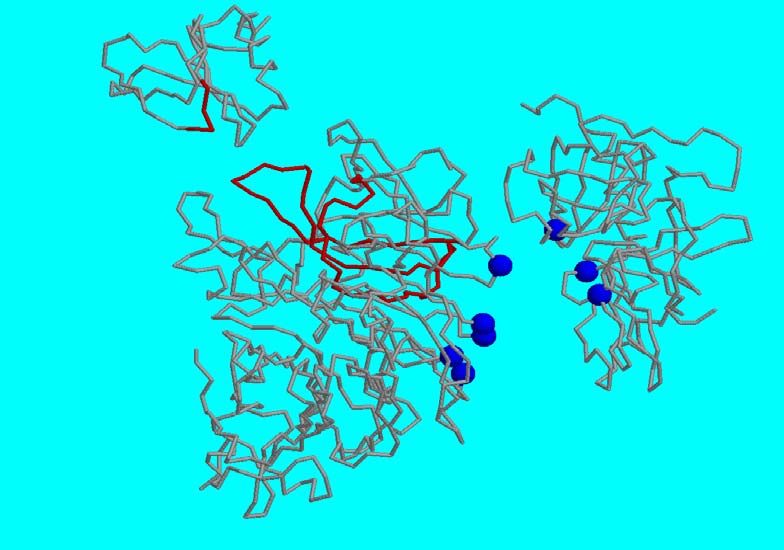
• TK Met ectodomain - multidomain protein
with no extended linkersModelling of multidomain proteins MRGSHHHHHH GSGVPSRVIH IRKLPIDVTE GEVISLGLPF GKVTNLLMLK GKNQAFIEMN TEEAANTMVN YYTSVTPVLR GQPIYIQFSN HKELKTDSSP NQARAQAALQ AVNSVQSGNL ALAASAAAVD AGMAMAGQSP VLRIIVENLF YPVTLDVLHQ IFSKFGTVLK IITFTKNNQF QALLQYADPV SAQHAKLSLD GQNIYNACCT LRIDFSKLTS LNVKYNNDKS RDYTRPDLPS GDSQPSLDQT MAAAFGLSVP NVHGALAPLA IPSAAAAAAA AGRIAIPGLA GAGNSVLLVS NLNPERVTPQ SLFILFGVYG DVQRVKILFN KKENALVQMA DGNQAQLAMS HLNGHKLHGK PIRITLSKHQ NVQLPREGQE DQGLTKDYGN SPLHRFKKPG
Modelling of multidomain proteins

           • A combined approach is
             proposed to built the models
             of multidomain proteins with
             large and flexible interdomain
             linkers
           • The latter are represented as
             DR      chains     which    are
             attached to the appropriate
             terminals in rigid domains.
           • A single modification of a
             model is a rotation about one
             or two randomly selected
             DR(s).
Modelling of multidomain proteins
Building native-like folds of linkers
                                                          Dihedral angles, degrees

                                                   150

                      Absence of                   100

                      steric clashes                50

                                                     0

          i+K                                       -50

                                                   -100

      r                                            -150

                                                             20     40    60    80   100   120   140   160

                                                                                     Bond angles, degrees

  i                                                  Bond angles &
Neighbors                                         dihedrals distribution
distribution
 along the
 sequence

           Loop compactness
           may also be required
                                  Rg id = 33 nl
Simultaneous fitting of multiple data sets from
deletion mutants
lg I, relative
11
10
9
8
0.5 1.0 1.5 2.0
s, nm-1EMBO Practical Course on Solution Scattering from Biological Macromolecules
PTB protein
MRGSHHHHHH GSGVPSRVIH IRKLPIDVTE GEVISLGLPF D
GKVTNLLMLK
GKNQAFIEMN TEEAANTMVN YYTSVTPVLR GQPIYIQFSN HKELKTDSSP
NQARAQAALQ AVNSVQSGNL ALAASAAAVD AGMAMAGQSP VLRIIVENLF
YPVTLDVLHQ IFSKFGTVLK IITFTKNNQF QALLQYADPV C
SAQHAKLSLD
GQNIYNACCT LRIDFSKLTS LNVKYNNDKS RDYTRPDLPS GDSQPSLDQT
MAAAFGLSVP NVHGALAPLA IPSAAAAAAA AGRIAIPGLA GAGNSVLLVS
NLNPERVTPQ SLFILFGVYG DVQRVKILFN KKENALVQMA DGNQAQLAMS
HLNGHKLHGK PIRITLSKHQ NVQLPREGQE DQGLTKDYGN B
SPLHRFKKPG
SKNFQNIFPP SATLHLSNIP PSVSEEDLKV LFSSNGGVVK GFKFFQKDRK
MALIQMGSVE EAVQALIDLH NHDLGENHHL RVSFSKSTI
ACORAL: new in ATSAS 2.4
Sasref vs Bunch
Merging Sasref and Bunch

      CORAL = COmplexes with RAndom Loops
RanLog library
Simplified input (config file)
NTER 20
A1.pdb
LINK 25
A2.pdb
CTER 10
NTER 45
B1.pdb
C1.pdb
Example
• GST-DHFR fusion protein (Kate)
You can also read


