ECook Zambia Kick Off Meeting Minutes - Modern Energy ...
←
→
Page content transcription
If your browser does not render page correctly, please read the page content below
eCook Zambia Kick Off Meeting
                          Minutes
Radisson Blu Hotel, Lusaka, Zambia - Thursday 21st September, 2017

Main authors: F. Mwila, J. Leary, N. Serenje, F. Yamba, S. Batchelor
          Associate authors: M. Leach, E. Brown, N. Scott

                     Innovate Project 132724
                           Implemented by:

                              Funded by: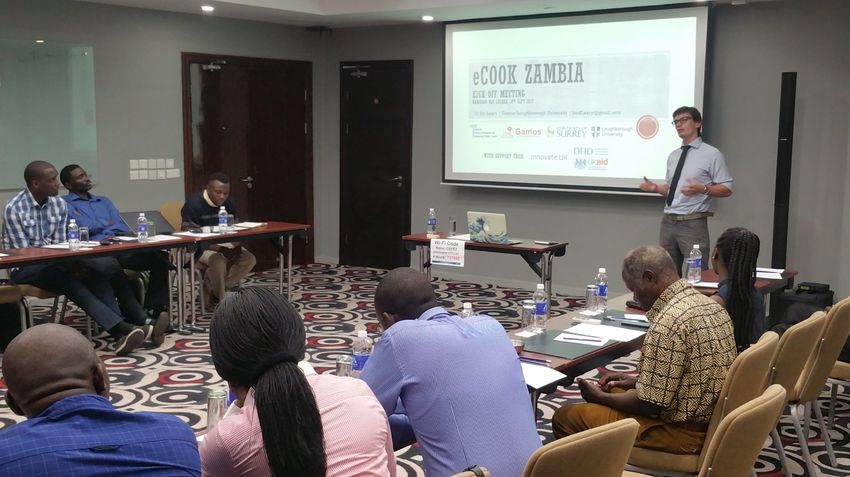
Acknowledgement
We are extremely grateful to the staff of CEEEZ, both those named as authors and the supporting staff,
who helped make this event such a success. We also thank all of the attendees of the stakeholder
workshop itself, who took the time to share their ideas and experiences to help us determine the role
that the generic eCook concept could play in the development of Zambia. Finally, we thank the donors,
UK AID via Innovate UK for partial funding and the directors and shareholders of Gamos who matched
the funding for the benefit and public good of Zambia.

Rights, permissions & disclaimer

                    This work is available under the Creative Commons Attribution 4.0 International
license (CC BY 4.0) https://creativecommons.org/licenses/by/4.0/. Under the Creative Commons
Attribution license, you are free to: Share — copy and redistribute the material in any medium or
format; Adapt — remix, transform, and build upon the material; for any purpose, even commercially.

Attribution: please cite this work as “Mwila F., Leary, J., Serenje, N., Yamba, F., Batchelor S., Leach M.,
Brown, E., Scott, N. 2019. “eCook Zambia Kick Off Meeting Minutes” CEEEZ, Loughborough University,
University of Surrey & Gamos Ltd. supported by Innovate UK, UK Aid & Gamos Ltd. Available from:
https://elstove.com/innovate-reports/”

This data and material have been funded by UK AID from the UK government; however, the views
expressed do not necessarily reflect the UK government’s official policies.

                                            Research@gamos.org | PV-ecook.org
                   This research is funded by DfID/UK Aid and Gamos through the Innovate UK Energy Catalyst.

2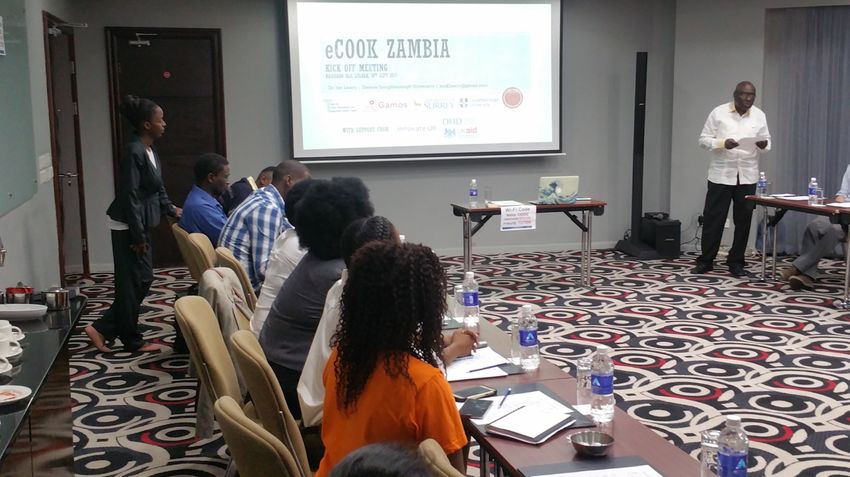
Executive Summary
The eCook Zambia Kick-off Workshop brought together key stakeholders from the solar lighting, clean
cookstoves and utility sectors to discuss the proposition of battery-supported cooking. The Centre for
Energy, Environment and Engineering Zambia (CEEEZ) in partnership with a UK research consortium
(Gamos Ltd., University of Surrey and Loughborough University), are collaborating on an initial
exploratory study to investigate the opportunity for this potentially transformative technology, which is
designed to extend access to electricity access and clean cooking facilities to poorer households (PV-
eCook.org).

Prof. Yamba opened the event, highlighting the fact that whilst the rapid spread of solar PV across Africa
has already transformed millions of lives, it has yet to have an impact on the main energy need of poor
households: cooking. However, in the context of falling global PV prices, recent advancements in battery
technology and rising charcoal/fuelwood prices in severely deforested regions, the door is opening for a
potentially transformative alternative - solar electric cooking (PV-eCook). eCook also has a role to play in
enhancing mini-, micro- and nano- grids, as well as unreliable national grid infrastructure as smart
household level energy storage offers grid operators a new demand side management mechanism and
households the ability to ride through blackouts.

Dr. Jon Leary of Gamos Ltd. and Loughborough University noted that their recently completed global
market assessment highlights Zambia’s enormous potential for eCook. Load shedding, relatively cheap
grid electricity and an established electric cooking market create an attractive market for Grid-eCook,
whilst the vast off-grid population and an emerging SHS industry offer huge potential for PV-eCook.

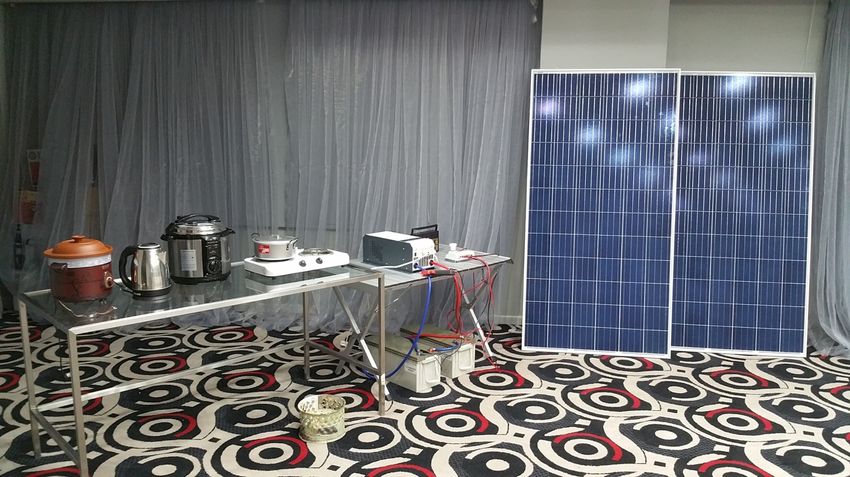
A prototype eCook device was demonstrated by cooking popcorn on an electric hotplate and beans on
an electric pressure cooker. The prototype is capable of charging from both solar PV and ZESCO’s grid
and was built using off-the-shelf components already available in Zambia. The system is sized for a small
family doing most of their cooking on a mixture of efficient appliances and the electric hotplate.

                                            Research@gamos.org | PV-ecook.org
                   This research is funded by DfID/UK Aid and Gamos through the Innovate UK Energy Catalyst.

3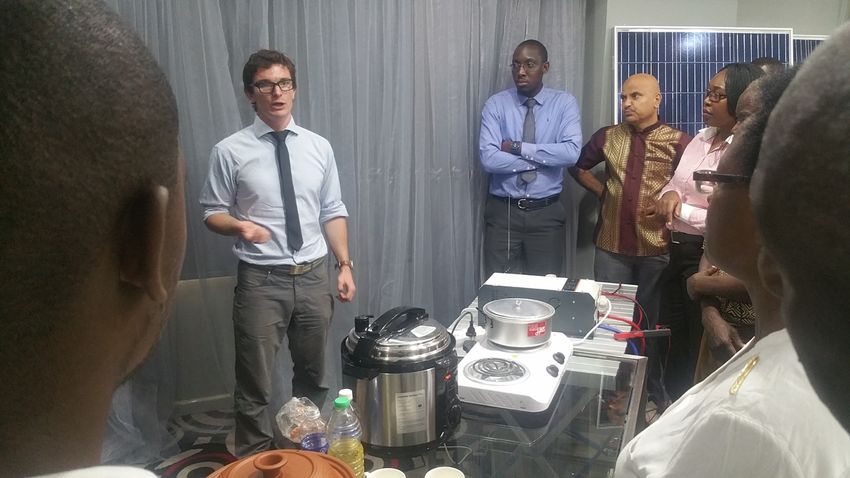
Small group discussions revealed the key opportunities and challenges that eCook is likely to face in
Zambia. Lack of awareness and the high upfront cost were identified as two of the key barriers, whist
deforestation and load shedding were two of the main drivers. Micro-financing, pay-as-you-go business
models and targeted training and awareness raising were seen as key enablers. The Department of
Energy, ZESCO (Zambia Energy Services Company), REA (Rural Electrification Authority), ERB (Energy
Regulation Board), the private sector, NGOs, traditional leaders and academia were identified as the key
actors in this transition. Peri-urban households were identified as the key target market segment, with
pay-as-you-go, Village Banking and cooperatives seen as the best marketing strategies to reach them.

                                           Research@gamos.org | PV-ecook.org
                  This research is funded by DfID/UK Aid and Gamos through the Innovate UK Energy Catalyst.

4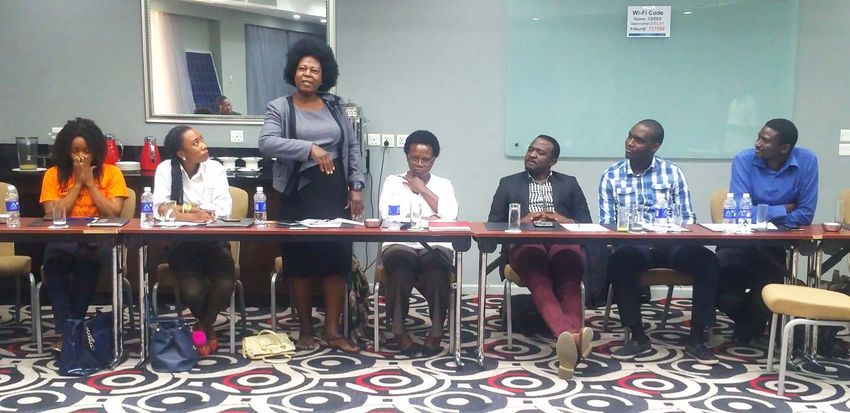
Table of Contents
ACKNOWLEDGEMENT .......................................................................................................................................... 2

RIGHTS, PERMISSIONS & DISCLAIMER .................................................................................................................. 2

EXECUTIVE SUMMARY ......................................................................................................................................... 3

1      INTRODUCTION ........................................................................................................................................... 6

    1.1        BACKGROUND.................................................................................................................................................. 6
       1.1.1       Context of the potential landscape change by eCook ............................................................................. 6
       1.1.2       Introducing ‘eCook’ ................................................................................................................................. 7
       1.1.3       eCook in Zambia ...................................................................................................................................... 8

2      OPENING REMARKS FOR THE ECOOK PROGRAMME IN ZAMBIA ................................................................... 9

3      PRESENTATION: WHAT IS ECOOK AND WHY ARE WE FOCUSING ON ZAMBIA? ........................................... 11

    3.1        QUESTION AND ANSWER SEGMENT .................................................................................................................... 12

4      DEMONSTRATION OF ECOOK PROTOTYPE ................................................................................................. 14

5      BREAK-OUT GROUP DISCUSSIONS .............................................................................................................. 15

    5.1        GROUP 1 ...................................................................................................................................................... 16
    5.2        GROUP 2 ...................................................................................................................................................... 17
    5.3        GROUP 3 ...................................................................................................................................................... 18
    5.4        GROUP 4 ...................................................................................................................................................... 19

6      CLOSING REMARKS .................................................................................................................................... 21

7      REFERENCES............................................................................................................................................... 22

8      APPENDIX .................................................................................................................................................. 23

    8.1        APPENDIX A: PROBLEM STATEMENT AND BACKGROUND TO INNOVATE ECOOK PROJECT................................................ 23
       8.1.1       Beyond business as usual ...................................................................................................................... 23
       8.1.2       Building on previous research ............................................................................................................... 25
       8.1.3       Summary of related projects ................................................................................................................. 28
    8.2        APPENDIX B - ECOOK ZAMBIA KICK-OFF MEETING AGENDA.................................................................................... 29
    8.3        APPENDIX C - ECOOK PRESENTATION BY DR. JON LEARY ......................................................................................... 30
    8.4        APPENDIX D - ATTENDEES ................................................................................................................................ 35
       8.4.1       Invited Guests Not in Attendance.......................................................................................................... 36

                                                              Research@gamos.org | PV-ecook.org
                              This research is funded by DfID/UK Aid and Gamos through the Innovate UK Energy Catalyst.

5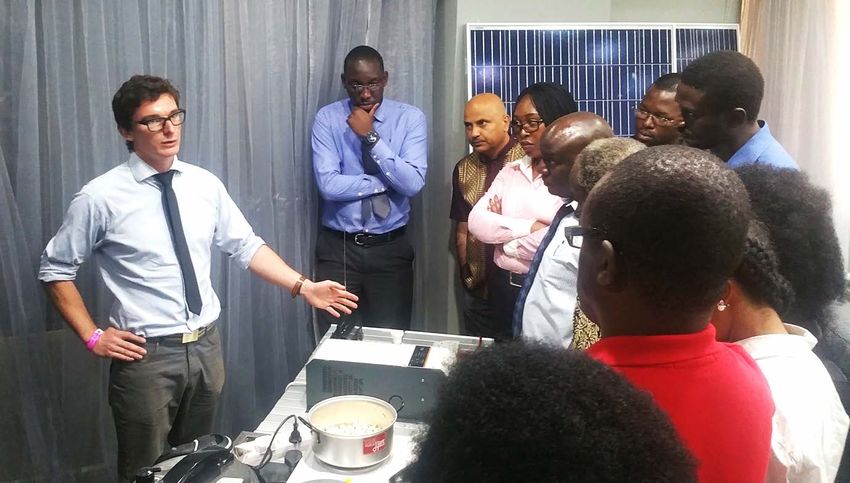
1 Introduction
This report presents one part of the detailed in country research carried out to explore the market for
eCook in Zambia. In particular, this in country work aims to gain much greater insight into culturally
distinct cooking practices and explore how compatible they are with battery-supported electric cooking.
The report is rich with detail and is intended to provide decision makers, practitioners and researchers
with new knowledge and evidence.

This report presents the key learning points from the first stakeholder meeting to inform the future
development of eCook within Zambia. It is one component of a broader study designed to assess the
opportunities and challenges that lay ahead for eCook in high impact potential markets, such as Zambia,
funded through Innovate UK’s Energy Catalyst Round 4 by DfID UK Aid and Gamos Ltd.
(https://elstove.com/innovate-reports/).

The overall aims of the Innovate project, plus the series of interrelated projects that precede and follow
on from it are summarised in in Appendix A: Problem statement and background to Innovate eCook
project.

1.1 Background
1.1.1      Context of the potential landscape change by eCook

The use of biomass and solid fuels for cooking is the everyday experience of nearly 3 billion people. This
pervasive use of solid fuels and traditional cookstoves results in high levels of household air pollution
with serious health impacts; extensive daily drudgery required to collect fuels, light and tend fires; and
environmental degradation. Where households seek to use ‘clean’ fuels, they are often hindered by lack
of access to affordable and reliable electricity and/or LPG. The enduring problem of biomass cooking is
discussed further in Appendix A: Problem statement and background to Innovate eCook project, which
not only describes the scale of the problem, but also how changes in renewable energy technology and
energy storage open up new possibilities for addressing it.

                                             Research@gamos.org | PV-ecook.org
                    This research is funded by DfID/UK Aid and Gamos through the Innovate UK Energy Catalyst.

6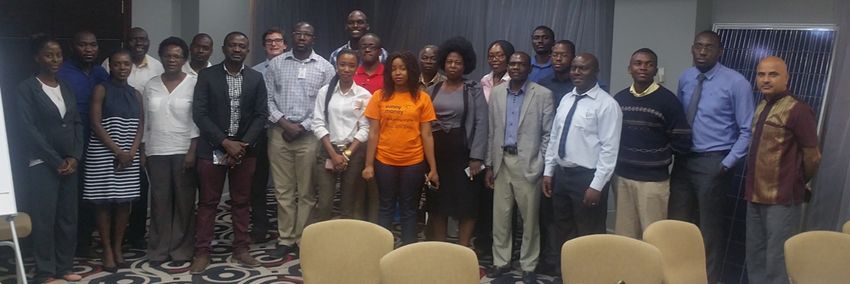
1.1.2    Introducing ‘eCook’

eCook is a potentially transformative battery-supported electric cooking concept designed to offer
access to clean cooking and electricity to poorer households (HHs) currently cooking on charcoal or
other polluting fuels (Batchelor 2013; Batchelor 2015a; Batchelor 2015b). Enabling affordable electric
cooking sourced from renewable energy technologies, could also provide households with sustainable,
reliable, modern energy for a variety of other purposes.

A series of initial feasibility studies were funded by DfID UK AID under the PEAKS mechanism (available
from https://elstove.com/dfid-uk-aid-reports/). Slade (2015) investigated the technical viability of the
proposition, highlighting the need for further work defining the performance of various battery
chemistries under high discharge and elevated temperature. Leach & Oduro (2015) constructed an
economic model, breaking down PV-eCook into its component parts and tracking key price trends,
concluding that by 2020, monthly repayments on PV-eCook were likely to be comparable with the cost
of cooking on charcoal. Brown & Sumanik-Leary's (2015), review of behavioural change challenges
highlighted two distinct opportunities, which open up very different markets for eCook:

    •    PV-eCook uses a PV array, charge controller and battery in a comparable configuration to the
         popular Solar Home System (SHS) and is best matched with rural, off-grid contexts.
    •    Grid-eCook uses a mains-fed AC charger and battery to create distributed HH storage for
         unreliable or unbalanced grids and is expected to best meet the needs of people living in urban
         slums or peri-urban areas at the fringes of the grid (or on a mini-grid) where blackouts are
         common.

                                                               +                      = eCook

              +                       +                        +                     = PV-eCook

             +                        +                        +                      = Grid-eCook
Figure 1: Pictorial definitions of ‘eCook’ terminology used in this report.

                                               Research@gamos.org | PV-ecook.org
                      This research is funded by DfID/UK Aid and Gamos through the Innovate UK Energy Catalyst.

7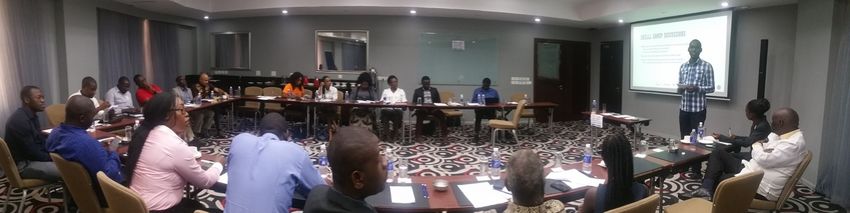
1.1.3   eCook in Zambia

Given the technical and socio-economic feasibility of the systems in the near future, Gamos,
Loughborough University and the University of Surrey have sought to identify where to focus initial
marketing for eCook. Each country has unique market dynamics that must be understood in order to
determine which market segments to target are and how best to reach them. Leary et al. (2018) carried
out a global market assessment, which revealed Zambia as the third most viable context for PV-eCook,
as 10% of the population already cook on electricity and recent load shedding caused a significant
number of these users to revert back to charcoal, rapidly accelerating deforestation.

The accompanying reports from the other activities carried out in Zambia can be found at:
https://elstove.com/innovate-reports/.

                                           Research@gamos.org | PV-ecook.org
                  This research is funded by DfID/UK Aid and Gamos through the Innovate UK Energy Catalyst.

8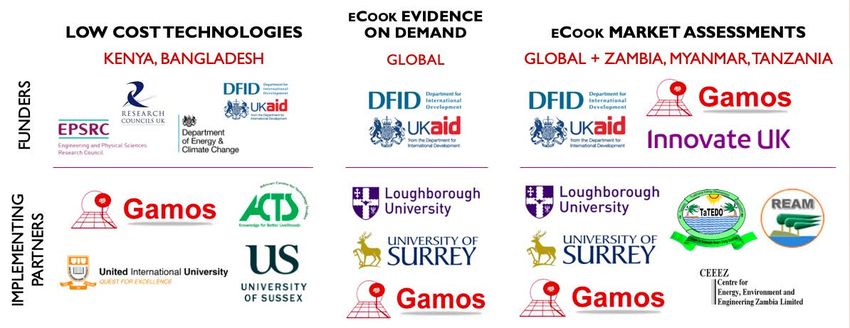
2 Opening Remarks for the eCook Programme in Zambia
Prof F.D Yamba welcomed all the persons present at the meeting. In his opening remarks, he stated that
the purpose of the workshop as:

    •   To explain what eCook is
    •   What is its potential role in Zambia?
    •   To build partnerships to support the transition in Zambia.
He further informed the audience that Centre for Energy, Environment and Engineering Zambia (CEEEZ)
in partnership with a UK research consortium (Gamos Ltd., University of Surrey and Loughborough
University) supported by Innovate UK and DFID.

Together, they are investigating a potentially transformative battery electric cooker combination
(eCook), which is designed to extend access to electricity access and clean cooking facilities to poorer
households. He also stated that the proposition of Solar Electric Cooking (SEC or PV-eCook) is that by
2020 the cost of using solar photovoltaic panels to charge a battery, and then using the battery for
cooking as and when required, will be comparable to the monthly cost of cooking with charcoal and
other polluting fuels in many developing regions. This proposition sits at the intersect of two major
global challenges; the use of biomass for cooking which is harmful to the household and to the

                                           Research@gamos.org | PV-ecook.org
                  This research is funded by DfID/UK Aid and Gamos through the Innovate UK Energy Catalyst.

9
environment, and the challenge to extend modern energy access to all peoples (Sustainable
Development Goal 7 - SDG7).
Finally, he outlined the 2 month exploratory programme of work which will has the following objectives:
i. Review of national policy areas relevant to the eCook proposition.
ii. Understanding national markets, to include the state of the electricity supply industry (grid and
off-grid), including solar PV, and state of cooking markets e.g. supply chains, service networks,
skills availability (and deficits), manufacturing facilities.
iii. Understanding cooking practices by collating any existing data on cooking practices e.g. foods
cooked, fuels used, fuel stacking strategies, specific energy consumptions, appliances used,
factors influencing choice of fuels (and foods).
iv. Dissemination of the eCook concept and supporting information by engaging key stakeholder
networks.
He also thanked the participants for taking time to attend the kick-off meeting. Please see Appendix D -
Attendees for a list of participants.
Research@gamos.org | PV-ecook.org
This research is funded by DfID/UK Aid and Gamos through the Innovate UK Energy Catalyst.
103 PRESENTATION: What is eCook and why are we focusing on
Zambia?
Please refer to presentation in Appendix C - eCook presentation by Dr. Jon Leary.
Gamos and Loughborough University researcher, Dr. Jon Leary stated that:
i. cooking on batteries is possible;
ii. that soon “battery supported electricity” will be cost comparable with charcoal, offering access
to both clean cooking and reliable electricity; and
iii. that we are looking to build long-term partnerships to make this transition happen.
Dr. Leary introduced eCook as an opportunity for households in both off-grid and weak grid regions. He
shared with the participants a synopsis of the global market assessment, focusing on the opportunity for
eCook in Zambia. The analysis showed that 59% of Zambians (10 million) live in rural areas, 96% of
whom are off-grid (World Bank 2017). The market for pico-solar products and SHS is expanding rapidly,
with 15,000 sales in second half of 2016 (GOGLA et al. 2016) and Zambia has favourable environmental
conditions (WorldClim 2017) with good solar resources and a warm climate, meaning that space heating
with stoves likely to be minimal and battery lifetime/performance is not likely to suffer from extreme
temps.
Research@gamos.org | PV-ecook.org
This research is funded by DfID/UK Aid and Gamos through the Innovate UK Energy Catalyst.
11Dr. Leary went on to mention the aims of the Zambia case study:
i. To evaluate the compatibility of eCook with the Zambian context.
ii. To assess the potential market and market segments should be target that eCook should target
iii. To explore which marketing strategies that are likely to be most effective
iv. To engage with key stakeholders and build partnerships to facilitate the roll out of eCook across
Zambia.
He further elaborated on the programme of work, which will include:
i. Stakeholder engagement to build long-term partnerships to facilitate the transition to eCook,
including 2 stakeholder workshops:
a. this Kick off Meeting; and
b. a subsequent Design Challenge.
ii. Cooking diaries with 20 households recording what/how they cook and how much energy it uses
over 6 weeks.
iii. 4 focus groups with different groups of potential end users to find out how they currently cook
and how they aspire to cook.
iv. Choice modelling surveys with 200 individuals to determine which characteristics they value
most in a future eCook stove.
3.1 Question and answer segment
QUESTIONS FROM DoE
• Technology: Normally when solar units are been installed, clients are advised not to use heating
elements because of charging and discharging of battery. Is an eCook system the same or
Research@gamos.org | PV-ecook.org
This research is funded by DfID/UK Aid and Gamos through the Innovate UK Energy Catalyst.
12different from the known PV systems, or is the cooker involved very efficient or a type that does
not draw a lot of energy and is therefore fit for the known PV system?
• Cost: The current alternatives available- charcoal and LPG.
o LPG is costly and there is a negative perception about safety to use. If someone used the
money they usually spent on charcoal for a month on LPG, it would not last through the
month.
o In order to buy LPG, one has to go to a filling station. Charcoal is easily accessible
everywhere. With these two options, people are more likely to choose charcoal.
o In terms of cost, how do you compare eCook to charcoal and electricity?
• RESPONSE:
o The main difference between what is been proposed and the standard solar system is
the battery chemistry. eCook is proposing use of Lithium ion batteries instead of the
conventional Lead acid battery. Lithium ion has much more favourable performance
characteristics compared to Lead acid. Lead acid if discharged below 50%, it will reduce
its life span, whilst Lithium ion can comfortably go down to just 20%. Lead acid is
unlikely to last more than 1,000 cycles, whilst Lithium ion can reach 3,000. Rapid
discharge also damages lead acid batteries and reduces the amount of energy they
deliver. Lithium ion is much more hardwearing, so they are not affected as much by
heavy loads like cooking.
o In terms of cost, storing the energy in a lithium ion battery is estimated to add 0.25
USD/kWh. As ZESCO’s current rates are approximately 0.09 USD/kWh, this would
increase the price to 0.34 USD/kWh. Our modelling has shown that with a pay-as-you-go
business model, monthly repayments can be comparable to current expenditures on
charcoal. However, we came here to Zambia to investigate the relative costs with
detailed on the ground research, so we will be able to answer this question much more
comprehensively when we have completed this initial scoping study.
QUESTION FROM VITALITE
• What is the durability for eCook system? And how suitable is the system in terms of climate
conditions?
• RESPONSE:
o From our preliminary desk-based research, it seems that Zambia has favourable
conditions. It does not get too cold or too hot. Dust maybe. But we could have a
prototype that is battery and hot plate on top, in a box that protects the system from
dust.
o Lifetime of Lithium ion battery is around 6 years or 3,000 cycles, but we are also looking
at more experimental battery chemistries like sodium ion, which promises 10,000
cycles. Lifetime of the other components is the same as for an ordinary PV system, i.e.
solar panel is 20 years, 10 years for inverter, etc.
Research@gamos.org | PV-ecook.org
This research is funded by DfID/UK Aid and Gamos through the Innovate UK Energy Catalyst.
13QUESTION FROM MUHANYA SOLAR
• How will deployment of eCook be done, as stand- alone or feed in to existing works?
• RESPONSE:
o We plan to work with as many of the organisations represented here today as possible
to build upon your existing product range to offer a solar electric cooking solution to
your existing customers within the next 5-10 years.
4 Demonstration of eCook prototype
Dr. Jon Leary demonstrated a prototype eCook device capable of charging from both solar PV and
ZESCO’s grid. The prototype had 600W PV, 5.5kWh battery storage (2*230Ah 12V batteries), a 24V
1.5kW inverter/charger and a 30A 24V solar charge controller. All components had been sourced within
Lusaka. Four electrical cooking appliances were demonstrated – a 1,500W kettle, a 250W slow cooker, a
1,000W electric pressure cooker and a double 1kW hotplate. The system is sized for a small family doing
most of their cooking on a mixture of efficient appliances and the electric hotplate.
The demonstration involved cooking popcorn on the hotplate and boiling beans on the electric pressure
cooker. The hotplate is the most commonly used across Zambia today, but also the least energy
efficient. Some households also own a kettle, but few have an electric pressure cooker or a slow cooker.
Research@gamos.org | PV-ecook.org
This research is funded by DfID/UK Aid and Gamos through the Innovate UK Energy Catalyst.
14The kettle saves energy by heating water very quickly to avoid heat losses. The slow cooker is very
compatible with solar, as it uses a small amount of power throughout the day to slowly cook dishes like
meat stew, producing a very tender and flavoursome result. The electric pressure cooker can cook long
boiling dishes like offals and beans in approximately half the time and with a fraction of the energy, so is
particularly well suited to battery-supported cooking.
5 Break-out group discussions
Four sub-groups were formed to allow participants to discuss questions that would inform the eCook
programme of work:
• What are the key barriers and drivers for eCook in Zambia?
• Who are the key actors and what are their roles?
• What market segments should we target in Zambia?
• Which marketing strategies are likely to be most effective?
Professor Yamba chaired the plenary discussion, where participants fed back to the group on the
opportunities and challenges awaiting eCook in Zambia.
Research@gamos.org | PV-ecook.org
This research is funded by DfID/UK Aid and Gamos through the Innovate UK Energy Catalyst.
155.1 Group 1
Key barriers Solutions
• Government policies not attending to • Ban traditional cook stoves which will
ecook encourage manufactures and users to
• Availability of traditional stoves- widely stick to other improved alternative
available stoves
• Ecook system complicated for a layman • Already assembled unit and few basics
• Initial price is very high written on the unit
• Awareness on the technology • Government to set up a loan scheme of
• Lack of skilled and trained personnel paying slow for the ecook
e.g. for installation and maintenance of • Create partnerships between GRZ and
e cook producers to educate users on the
products
• Skills training
Key Actors Key market segment
• Government • Peri urban
• Media
• Academia
• NGO’s
• Banks
• Manufactures
• Corporate World
• Utilities – Zesco
Research@gamos.org | PV-ecook.org
This research is funded by DfID/UK Aid and Gamos through the Innovate UK Energy Catalyst.
165.2 Group 2
Key Barriers Solutions
• Cost of technology – for both • Introduction of cost-effective
production and deployment technologies, like eCook, that are
• Inadequate awareness on RE solutions, energy efficient
specifically eCook • Micro financing
Key Drivers • Government subsidies on RE
technology
• Environmental: • Dedicated investment for financing RE
o High rate of deforestation technologies
o Climate change • Favourable tax incentives on RE
• Reliability and affordability of grid technology
electricity • Increase awareness and capacity
o High electricity tariffs building, especially community
o Load shedding and power mobilization
outages
• Health
o Houses catching fire
o Breathing smoke
Key Actors Market Segment to target in Zambia
• Government (for policy direction)- DoE • Off grid areas
• ERB • Micro financing institutions. The idea is
• ZABS to come up with friendly financing
• Zesco mechanisms such as saving
• Private Sector (inclusive green growth) groups/cooperatives.
• CEEEZ Strategies to reach market segment
• REA
• Financial Institutions • Pay as you go,
• Product-loan service such as group
loans (chilimba) where money is put up
in a group to buy product for one
person, and again more is put up to buy
for the next until all members have the
product.
Research@gamos.org | PV-ecook.org
This research is funded by DfID/UK Aid and Gamos through the Innovate UK Energy Catalyst.
175.3 Group 3
Key Barriers Solutions
• Social: • Awareness creation
o Acceptance o Need for resources to reach
o Lack of awareness and create awareness
• Economical/financial: • Micro financing with flexible re-
o Cost of purchasing system payments
o Cost of electricity
Key Drivers
• Load shedding
• High cost of electricity
• High rate of deforestation
• Increased load shedding
Research@gamos.org | PV-ecook.org
This research is funded by DfID/UK Aid and Gamos through the Innovate UK Energy Catalyst.
18Key Actors Key Market Segment
• Community members • Peri- urban
• Utilities – Zesco
Marketing Strategies
• Regulator – ERB
• Private sector • Pay as you go
• Village bank idea
• Cooperatives
5.4 Group 4
Key Barriers Solutions
• Technological: • Micro financing to all target group to
o None because technology is access the technology
known • Widening the target group- inclusive
• Financial: objective to include middle- and low-
o High cost of the system for income groups. Targeting people in
target group (off-grid in rural rural areas alone may not work because
areas) of high cost of system.
o Lack of financing mechanisms- • Widen objectives for eCook: to include
i.e. loans energy efficiency as well as poverty
• Social reduction
o Cultural, e.g. changing the • Capacity building - training more than
mindset of people that have one person to maintain the system in a
been using charcoal/firewood given location, such that the migration
to using batteries for cooking of one trained person does not affect
o Lack of information on the maintenance in cases of breakdowns.
availability of new/improved • Pay as you go or pay to own
technologies.
o People’s perception- they
would rather have something
cooked on charcoal or firewood
because it ‘tastes better’.
o Scattered settlements make it
difficult to deploy technology.
Locations far off make outreach
costly.
Research@gamos.org | PV-ecook.org
This research is funded by DfID/UK Aid and Gamos through the Innovate UK Energy Catalyst.
19Drivers
• High deforestation
• High cost of charcoal
• High cost of electricity
• Increased load shedding
• Decreasing cost of P.V systems
• Solar electric cooking is a
clean and convenient source of energy
Key Actors
• Department of Energy
• Zesco
• REA
• ERB
• Private sector
• NGO and Civil Societies
• Traditional leaders
Research@gamos.org | PV-ecook.org
This research is funded by DfID/UK Aid and Gamos through the Innovate UK Energy Catalyst.
206 Closing remarks
Prof. Yamba closed the event by inviting the participants to collaborate with the research team over the
next 2 months during this initial exploratory study and to work together to see eCook transform the way
we cook across Zambia over the next 5-10 years.
The findings from this stakeholder workshop will be combined with those from the other activities that
have been carried under the eCook Zambia Market Assessment. Together they will build a more
complete picture of the opportunities and challenges that await this emerging concept. Further outputs
will be available from https://elstove.com/innovate-reports/.
Research@gamos.org | PV-ecook.org
This research is funded by DfID/UK Aid and Gamos through the Innovate UK Energy Catalyst.
217 References
Batchelor, S., 2015a. Africa Cooking with Electricity (ACE), Reading. Gamos Working Paper (Draft as at
August 2015). Available at:
https://www.researchgate.net/publication/298722923_Africa_cooking_with_electricity_ACE.
Batchelor, S., 2013. Is it time for Solar electric cooking for Africa?, Gamos Concept Note, May 2013,
Reading, UK. Available at: http://www.gamos.org/images/documents/Is.
Batchelor, S., 2015b. Solar Electric Cooking in Africa in 2020: A synthesis of the possibilities, Evidence on
Demand (prepared at the request of the UK Department for International Development). Available
at: https://www.gov.uk/dfid-research-outputs/solar-electric-cooking-in-africa-in-2020-a-synthesis-
of-the-possibilities.
Brown, E. & Sumanik-Leary, J., 2015. A review of the behavioural change challenges facing a proposed
solar and battery electric cooking concept, Evidence on Demand (prepared at the request of the UK
Department for International Development). Available at: https://www.gov.uk/dfid-research-
outputs/a-review-of-the-behavioural-change-challenges-facing-a-proposed-solar-and-battery-
electric-cooking-concept.
ESMAP & GACC, 2015. State of the clean and improved cooking sector in Africa, Washington DC, USA.
IEG World Bank Group, 2015. World Bank Group Support to Electricity Access, FY2000-2014 - An
Independent Evaluation, Available at:
https://openknowledge.worldbank.org/bitstream/handle/10986/22953/96812revd.pdf?sequence
=9&isAllowed=y.
Leach, M. & Oduro, R., 2015. Preliminary design and analysis of a proposed solar and battery electric
cooking concept : costs and pricing, Evidence on Demand (prepared at the request of the UK
Department for International Development). Available at: https://www.gov.uk/dfid-research-
outputs/preliminary-design-and-analysis-of-a-proposed-solar-and-battery-electric-cooking-
concept-costs-and-pricing.
Leary, J. et al., 2018. eCook Global Market Assessment Where will the transition take place first ?,
Implemented by Gamos, Loughborough University, University of Surrey. Funded by DfID, Innovate
UK, Gamos. Available at:
https://www.researchgate.net/publication/326489706_eCook_Global_Market_Assessment_Wher
e_will_the_transition_take_place_first.
Slade, R., 2015. Key Assumptions and Concepts on Potential for Solar Electric Cooking: Batteries capable
of operating suitably in ‘harsh’’ conditions in the developing world,’ Prepared at the request of the
UK Department for International Development. Available at: https://www.gov.uk/dfid-research-
outputs/key-assumptions-and-concepts-on-potential-for-solar-electric-cooking-batteries-capable-
of-operating-suitably-in-harsh-conditions-in-the-developing-world.
World Bank, 2014. Clean and improved cooking in sub-Saharan Africa: A landscape report, Washington,
D.C. Available at: http://documents.worldbank.org/curated/en/879201468188354386/pdf/98667-
WP-P146621-PUBLIC-Box393179B.pdf.
Research@gamos.org | PV-ecook.org
This research is funded by DfID/UK Aid and Gamos through the Innovate UK Energy Catalyst.
228 Appendix
8.1 Appendix A: Problem statement and background to Innovate eCook
project
8.1.1 Beyond business as usual
The use of biomass and solid fuels for cooking is the everyday experience of nearly 3 Billion people. This
pervasive use of solid fuels––including wood, coal, straw, and dung––and traditional cookstoves results
in high levels of household air pollution, extensive daily drudgery required to collect fuels, and serious
health impacts. It is well known that open fires and primitive stoves are inefficient ways of converting
energy into heat for cooking. The average amount of biomass cooking fuel used by a typical family can
be as high as two tons per year. Indoor biomass cooking smoke also is associated with a number of
diseases, including acute respiratory illnesses, cataracts, heart disease and even cancer. Women and
children in particular are exposed to indoor cooking smoke in the form of small particulates up to 20
times higher than the maximum recommended levels of the World Health Organization. It is estimated
that smoke from cooking fuels accounts for nearly 4 million premature deaths annually worldwide –
more than the deaths from malaria and tuberculosis combined.
While there has been considerable investment in improving the use of energy for cooking, the emphasis
so far has been on improving the energy conversion efficiency of biomass. Indeed in a recent overview
of the state of the art in Improved Cookstoves (ICS), ESMAP & GACC (2015), World Bank (2014), note
that the use of biomass for cooking is likely to continue to dominate through to 2030.
“Consider, for a moment, the simple act of cooking. Imagine if we could change the way nearly five hundred
million families cook their food each day. It could slow climate change, drive gender equality, and reduce
poverty. The health benefits would be enormous.” ESMAP & GACC (2015)
The main report goes on to say that “The “business-as-usual” scenario for the sector is encouraging but
will fall far short of potential.” (ibid,) It notes that without major new interventions, over 180 million
households globally will gain access to, at least, minimally improved1 cooking solutions by the end of the
1
A minimally improved stove does not significantly change the health impacts of kitchen emissions. “For biomass cooking,
pending further evidence from the field, significant health benefits are possible only with the highest quality fan gasifier stoves;
more moderate health impacts may be realized with natural draft gasifiers and vented intermediate ICS” (ibid)
Research@gamos.org | PV-ecook.org
This research is funded by DfID/UK Aid and Gamos through the Innovate UK Energy Catalyst.
23decade. However, they state that this business-as-usual scenario will still leave over one- half (57%) of
the developing world’s population without access to clean cooking in 2020, and 38% without even
minimally improved cooking solutions. The report also states that ‘cleaner’ stoves are barely affecting
the health issues, and that only those with forced gasification make a significant improvement to health.
Against this backdrop, there is a need for a different approach aimed at accelerating the uptake of truly
‘clean’ cooking.
Even though improved cooking solutions are expected to reach an increasing proportion of the poor, the
absolute numbers of people without access to even ‘cleaner’ energy, let alone ‘clean’ energy, will
increase due to population growth. The new Sustainable Development Goal 7 calls for the world to
“ensure access to affordable, reliable, sustainable and modern energy for all”. Modern energy
(electricity or LPG) would indeed be ‘clean’ energy for cooking, with virtually no kitchen emissions (other
than those from the pot). However, in the past, modern energy has tended to mean access to electricity
(mainly light) and cooking was often left off the agenda for sustainable energy for all.
Even in relation to electricity access, key papers emphasise the need for a step change in investment
finance, a change from ‘business as usual’. IEG World Bank Group (2015) note that 22 countries in the
Africa Region have less than 25 percent access, and of those, 7 have less than 10 percent access. Their
tone is pessimistic in line with much of the recent literature on access to modern energy, albeit in
contrast to the stated SDG7. They discuss how population growth is likely to outstrip new supplies and
they argue that “unless there is a big break from recent trends the population without electricity access
in Sub-Saharan Africa is projected to increase by 58 percent, from 591 million in 2010 to 935 million in
2030.” They lament that about 40% of Sub-Saharan Africa’s population is under 14 years old and
conclude that if the current level of investment in access continues, yet another generation of children
will be denied the benefits of modern service delivery facilitated by the provision of electricity (IEG
World Bank Group 2015).
“Achieving universal access within 15 years for the low-access countries (those with under 50 percent
coverage) requires a quantum leap from their present pace of 1.6 million connections per year to 14.6 million
per year until 2030.” (ibid)
Once again, the language is a call for a something other than business as usual. The World Bank
conceives of this as a step change in investment. It estimates that the investment needed to really
address global electricity access targets would be about $37 billion per year, including erasing
generation deficits and additional electrical infrastructure to meet demand from economic growth. “By
Research@gamos.org | PV-ecook.org
This research is funded by DfID/UK Aid and Gamos through the Innovate UK Energy Catalyst.
24comparison, in recent years, low-access countries received an average of $3.6 billion per year for their
electricity sectors from public and private sources” (ibid). The document calls for the Bank Group‘s
energy practice to adopt a new and transformative strategy to help country clients orchestrate a
national, sustained, sector-level engagement for universal access.
In the following paragraphs, we explore how increasing access to electricity could include the use of
solar electric cooking systems, meeting the needs of both supplying electricity and clean cooking to a
number of households in developing countries with sufficient income.
8.1.2 Building on previous research
Gamos first noted the trends in PV and battery prices in May 2013. We asked ourselves the question, is
it now cost effective to cook with solar photovoltaics? The answer in 2013 was ‘no’, but the trends
suggested that by 2020 the answer would be yes. We published a concept note and started to present
the idea to industry and government. Considerable interest was shown but uncertainty about the cost
model held back significant support. Gamos has since used its own funds to undertake many of the
activities, as well as IP protection (a defensive patent application has been made for the battery/cooker
combination) with the intention is to make all learning and technology developed in this project open
access, and awareness raising amongst the electrification and clean cooking communities (e.g. creation
of the infographic shown in Figure 2 to communicate the concept quickly to busy research and policy
actors).
Gamos has made a number of strategic alliances, in particular with the University of Surrey (the Centre
for Environmental Strategy) and Loughborough University Department of Geography and seat of the
Low Carbon Energy for Development Network). In October 2015, DFID commissioned these actors to
explore assumptions surrounding solar electric cooking2 (Batchelor 2015b; Brown & Sumanik-Leary
2015; Leach & Oduro 2015; Slade 2015). The commission arose from discussions between consortium
members, DFID, and a number of other entities with an interest in technological options for cleaner
cooking e.g. Shell Foundation and the Global Alliance for Clean Cookstoves.
Drawing on evidence from the literature, the papers show that the concept is technically feasible and
could increase household access to a clean and reliable modern source of energy. Using a bespoke
economic model, the Leach and Oduro paper also confirm that by 2020 a solar based cooking system
2
The project has been commissioned through the PEAKS framework agreement held by DAI Europe Ltd.
Research@gamos.org | PV-ecook.org
This research is funded by DfID/UK Aid and Gamos through the Innovate UK Energy Catalyst.
25could be comparable in terms of monthly repayments to the most common alternative fuels, charcoal
and LPG. Drawing on published and grey literatures, many variables were considered (e.g. cooking
energy needs, technology performance, component costs). There is uncertainty in many of the
parameter values, including in the assumptions about future cost reductions for PV and batteries, but
the cost ranges for the solar system and for the alternatives overlap considerably. The model includes
both a conservative 5% discount rate representing government and donor involvement, and a 25%
discount rate representing a private sector led initiative with a viable return. In both cases, the solar
system shows cost effectiveness in 2020.
Figure 2 Infographic summarising the concept in order to lobby research and policy actors.
Research@gamos.org | PV-ecook.org
This research is funded by DfID/UK Aid and Gamos through the Innovate UK Energy Catalyst.
26The Brown and Sumanik-Leary paper in the series examines the lessons learned from four transitions –
the uptake of electric cooking in South Africa, the roll out of Improved Cookstoves (ICS), the use of LPG
and the uptake of Solar Home Systems (SHS). They present many behavioural concerns, none of which
preclude the proposition as such, but all of which suggest that any action to create a scaled use of solar
electric cooking would need in depth market analysis; products that are modular and paired with locally
appropriate appliances; the creation of new, or upgrading of existing, service networks; consumer
awareness raising; and room for participatory development of the products and associated equipment.
A synthesis paper summarising the above concludes by emphasising that the proposition is not a single
product – it is a new genre of action and is potentially transformative. Whether solar energy is utilised
within household systems or as part of a mini, micro or nano grid, linking descending solar PV and
battery costs with the role of cooking in African households (and the Global South more broadly) creates
a significant potential contribution to SDG7. Cooking is a major expenditure of 500 million households. It
is a major consumer of time and health. Where households pay for their fuelwood and charcoal
(approximately 300 Million) this is a significant cash expense. Solar electric cooking holds the potential
to turn this (fuelwood and charcoal) cash into investment in modern energy. This “consumer
expenditure” is of an order of magnitude more than current investment in modern energy in Africa and
to harness it might fulfil the calls for a step change in investment in electrical infrastructure.
Research@gamos.org | PV-ecook.org
This research is funded by DfID/UK Aid and Gamos through the Innovate UK Energy Catalyst.
278.1.3 Summary of related projects
A series of inter-related projects have led to and will follow on from the research presented in this
report:
• Gamos Ltd.’s early conceptual work on eCook (Batchelor 2013).
o The key CONCEPT NOTE can be found here.
o An early infographic and a 2018 infographic can be found here.
• Initial technical, economic and behavioural feasibility studies on eCook commissioned by DfID
(UK Aid) through the CEIL-PEAKS Evidence on Demand service and implemented by Gamos Ltd.,
Loughborough University and University of Surrey.
o The key FINAL REPORTS can be found here.
• Conceptual development, stakeholder engagement & prototyping in Kenya & Bangladesh during
the “Low cost energy-efficient products for the bottom of the pyramid” project from the USES
programme funded by DfID (UK Aid), EPSRC & DECC (now part of BEIS) & implemented by
University of Sussex, Gamos Ltd., ACTS (Kenya), ITT & UIU (Bangladesh).
o The key PRELIMINARY RESULTS (Q1 2019) can be found here.
• A series of global & local market assessments in Myanmar, Zambia and Tanzania under the
“eCook - a transformational household solar battery-electric cooker for poverty alleviation”
project funded by DfID (UK Aid) & Gamos Ltd. through Innovate UK’s Energy Catalyst Round 4,
implemented by Loughborough University, University of Surrey, Gamos Ltd., REAM (Myanmar),
CEEEZ (Zambia) & TaTEDO (Tanzania).
o The key PRELIMINARY RESULTS (Q1 2019) can be found here.
• At time of publication (Q1 2019), a new DfID (UK Aid) funded research programme ‘Modern
Energy Cooking Services’ (MECS) lead by Prof. Ed Brown at Loughborough University is just
beginning and will take forward these ideas & collaborations.
This data and material have been funded by UK AID from the UK government; however, the views
expressed do not necessarily reflect the UK government’s official policies.
Research@gamos.org | PV-ecook.org
This research is funded by DfID/UK Aid and Gamos through the Innovate UK Energy Catalyst.
288.2 Appendix B - eCook Zambia Kick-off Meeting Agenda
Time Session Speaker
8.30 Registration
9.00 Opening Prof. F. Yamba
(CEEEZ)
9.10 What is eCook and why are we focussing on Zambia? Dr. J. Leary (Gamos,
Loughborough
• Introduction to eCook
University)
• Global market assessment
• eCook Zambia preliminary market analysis
• Objectives for Zambia case study
• Programme of work in Zambia
9.40 Feedback session
Is our eCook Zambia preliminary market data valid?
Will the proposed programme of work achieve the objectives?
10.00 Tea break
10.15 Demonstration of eCook prototype Dr. J. Leary (Gamos,
Loughborough
University)
11.00 Small group discussions
• What are the key barriers & drivers for eCook in Zambia?
• Who are the key actors and what are their roles?
12:00 Plenary session
• Summary of group discussions and key learning points
• Closing remarks
13:00 Lunch
Research@gamos.org | PV-ecook.org
This research is funded by DfID/UK Aid and Gamos through the Innovate UK Energy Catalyst.
298/10/18
8.3 Appendix C - eCook presentation by Dr. Jon Leary
§ Cooking on batteries is possible
§ Soon “battery supported electricity” will be cost
comparable with charcoal
§ Clean cooking
Dr Jon Leary | Gamos/Loughborough University | JonKLeary@gmail.com
§ Access to reliable electricity
§ Build long-term partnerships to make this transition
happen
PV-eCook.org
PV-eCook.org
CEEEZ
Centre for
Energy, Environment and
Engineering Zambia Limited
§What is eCook?
§Why are we in Zambia?
§What are we planning to do in Zambia?
§Feedback
PV-eCook.org
CEEEZ
Centre for
Energy, Environment and
Engineering Zambia Limited
Batchelor (2013, 2015a)
• Batchelor (2013, 2015a):
Solar Home System (SHS)
sized for cooking
• Lighting, TV, radio &
other low power
appliances as a bonus
• Simple electric hotplate
• Minimal behaviour
4 change from charcoal
• Moving toward DC
PV-eCook.org PV-eCook.org
CEEEZ
Centre for
Energy, Environment and
Engineering Zambia Limited
1
Research@gamos.org | PV-ecook.org
This research is funded by DfID/UK Aid and Gamos through the Innovate UK Energy Catalyst.
308/10/18
LEDs vs. incandescent = 1/10 Insulation vs. standard pot = 1/2
+ induction, pressure, lids, kettles
PV-eCook.org PV-eCook.org
CEEEZ CEEEZ
Centre for Centre for
Energy, Environment and Energy, Environment and
Engineering Zambia Limited Engineering Zambia Limited
2015: charcoal & LPG was cheaper for almost everyone
140
Cost of cooking, $/month 120
§ Sustainable Development Goal (SDG) 7:
100
80 • Leach & Oduro (2015)
ENSURE ACCESS TO AFFORDABLE, RELIABLE, SUSTAINABLE AND 60
modelled monthly costs
MODERN ENERGY FOR ALL of cooking
40 • Comparable ‘energy in the
§ Batchelor (2015b) Opportunity to create a gateway product 20 •
pot’
Costs levelised & inclusive
for SDG7 by redirecting an existing expenditure to offer 0
of financing
both clean cooking and access electricity PV-eCook, PV-eCook, Charcoal
utility private
LPG PV-eCook, PV-eCook, Charcoal
utility private
LPG • Are monthly/weekly/daily
(DR=5%) sector (DR=5%) sector
repayments on a battery
(DR=20%) (DR=20%) electric cooker likely to be
comparable to current
expenditures on HH cooking
Small HHs cooking low Large HHs cooking high fuels by 2020?
energy foods energy foods
PV-eCook.org PV-eCook.org
CEEEZ
Centre for
Energy, Environment and
Engineering Zambia Limited
2020: PV-eCook becomes cost competitive for a
significant number of people
140
120
Cost of cooking, $/month
100
+ + +
80 • Leach & Oduro (2015)
60
modelled monthly costs
of cooking
• Comparable ‘energy in the
= PV-eCook
40
pot’
20 • Costs levelised & inclusive
of financing
0
+ + +
PV-eCook, PV-eCook, Charcoal LPG PV-eCook, PV-eCook, Charcoal LPG • Are monthly/weekly/daily
Grid-eCook =
utility private utility private
(DR=5%) sector (DR=5%) sector
repayments on a battery
(DR=20%) (DR=20%) electric cooker likely to be
comparable to current
expenditures on HH cooking
Small HHs cooking low Large HHs cooking high fuels by 2020?
energy foods energy foods
PV-eCook.org PV-eCook.org
CEEEZ
Centre for
Energy, Environment and
Engineering Zambia Limited
1
Research@gamos.org | PV-ecook.org
This research is funded by DfID/UK Aid and Gamos through the Innovate UK Energy Catalyst.
318/10/18
§ Grid operator perspective
§ Load balancing • Solar lighting successful as
§ Demand side management substituted for existing
expenditure
§ User perspective
• kerosene, candles and batteries
§ Able to cook & use low power
appliances during a blackout • Solar TVs & refrigeration also low
energy consumers
§ Fluid transition from off-grid
Enhance quality of life, but no
to unreliable grid •
existing expenditure
§ Incorporation of existing • Productive applications generate
expenditure to justify the new revenue, but usually much
costs of grid extension those higher energy
currently ‘under the grid’
• Cooking often has a monthly
§ HH storage is finding its place expenditure that could be re-
in developed economies purposed to pay for modern
energy infrastructure
• better returns for investors
PV-eCook.org PV-eCook.org
CEEEZ
Centre for
Energy, Environment and
Engineering Zambia Limited
Refine data
Techno-
economic
People most likely modelling &
to transition design
Global market Participatory
assessment design
3x local market Social marketing Design for market
assessment
Launch locally
Places most likely appropriate
to transition eCook product
PV-eCook.org
CEEEZ
Centre for
Energy, Environment and
Engineering Zambia Limited
PV-eCook market viability scores for Sub-
Saharan Africa
• East and Southern • Zambia ranks third in
Africa offer the the world
greatest opportunity • Zambia scores highly
• Zambia is one of the for every factor
biggest and easiest to
PV-eCook reach markets
Viability
scores
PV-eCook.org PV-eCook.org
1
Research@gamos.org | PV-ecook.org
This research is funded by DfID/UK Aid and Gamos through the Innovate UK Energy Catalyst.
328/10/18
Leach & Oduro’s (2015) 2020 $/kWh
modelling
§ 59% of Zambians (10 million) live in rural areas, 96% of whom are off-grid (World
Bank 2017) At a charcoal price of
§ Market for pico-solar products and SHS is expanding rapidly 0.38USD/kg:
§ 15,000 sales in second half of 2016 (GOGLA et al. 2016) • Zambia is within the
§ Favourable environmental conditions (WorldClim 2017) overlapping region of
§ Monthly avg. solar irradiation: 4.4-5.8kWh/m2/day L&O’s (2015) 2020
§ Monthly avg. temps.: 17-25°C modelling
§ Space heating with stoves likely to be minimal • PV-eCook will become
§ Battery lifetime/performance not likely to suffer from extreme temps. • BLACK = cheaper to cook with PV-eCook in 2020 under all of • BLACK = cost effective to switch if eCook falls to below cost effective in
L&O's (2015) scenarios. 0.3USD/kWh
• DARK GREY = cheaper to cook with PV-eCook in 2020 some • DARK GREY = cost effective to switch if eCook falls to Zambia when SHS or
of L&O's (2015) scenarios. 0.2USD/kWh
• LIGHT GREY = not yet cheaper to cook with PV-eCook in • GREY = cost effective to switch if eCook falls to 0.1USD/kWh mini-grids hit
2020 under any of L&O's (2015) scenarios. • LIGHT GREY = eCook must fall below 0.1USD/kWh before it is
• WHITE = no data available. cost effective to switch 0.2USD/kWh
• WHITE = no data available
PV-eCook.org PV-eCook.org
CEEEZ
Centre for
Energy, Environment and
Engineering Zambia Limited
Zambian grid electricity • Focus shifts to Asia,
is amongst the cheapest Latin America and
in the world Southern Africa
At a charcoal price of • Zambia scores highly
0.38USD/kg:
• Grid-eCook is cost Grid-eCook
effective against Viability
charcoal, no matter
scores
how efficient an ICS
may be
PV-eCook.org PV-eCook.org
100% § 37% of Zambians (6 million) cook primarily on charcoal
electricity § 4th highest % in the world (WHO 2017) • Nshima
90% • Heating water main
§ Kerosene & LPG use minimal energy input
80%
• Main challenge: stirring
70% charcoal § 5 million Zambians are grid connected (World Bank 2017) • Insulating pots
challenging
60% § 2 million Zambians already cook with grid electricity as their
primary fuel (WHO 2017) • FAOSTAT (2017) food
50% balance sheets
§ 3 million grid-connected Zambians primarily cook with • Predominantly vegetable-
40%
other fuels based diet
30% • 0.65kWh/person/day
firewood
§ 3 million Zambians live in urban slums and rural grid- • Boiling of maize,
20% cassava & sweet
connected regions potatoes major energy
10% requirement
0%
§ Load shedding dramatically increased charcoal use
Zambia (WHO 2017) (Dlamini et al. 2016)
PV-eCook.org PV-eCook.org
CEEEZ
Centre for
Energy, Environment and
Engineering Zambia Limited
1
Research@gamos.org | PV-ecook.org
This research is funded by DfID/UK Aid and Gamos through the Innovate UK Energy Catalyst.
33You can also read


