FOOD LOSS AND WASTE Building on Existing Federal Efforts Could Help to Achieve National Reduction Goal - Report to Congressional Requesters ...
←
→
Page content transcription
If your browser does not render page correctly, please read the page content below
United States Government Accountability Office
             Report to Congressional Requesters

             FOOD LOSS AND
June 2019

             WASTE

             Building on Existing
             Federal Efforts Could
             Help to Achieve
             National Reduction
             Goal

GAO-19-391
June 2019

                                            FOOD LOSS AND WASTE
                                            Building on Existing Federal Efforts Could Help to
                                            Achieve National Reduction Goal
Highlights of GAO-19-391, a report to
congressional requesters

Why GAO Did This Study                      What GAO Found
The Natural Resources Defense               GAO identified three key areas in which challenges exist to reducing food loss
Council reported that in the United         and waste (FLW) in the United States: (1) limited data and information about
States up to 40 percent of the food         FLW; (2) a lack of awareness and education about FLW; and (3) limited
supply goes uneaten. FLW has                infrastructure and capacity. For example, the causes of FLW vary across the
significant economic, environmental,        stages of the food supply chain (see figure), but the share of total FLW due to
and social effects on various               each of these causes is currently unknown, according to a U.S. Department of
stakeholders, including businesses and      Agriculture (USDA) report. GAO identified these challenges through interviews
consumers. In 2015, EPA and USDA            with selected stakeholders.
announced a national goal to reduce
FLW in the United States by half by
2030. In 2018, FDA joined EPA and           Food Supply-Chain Stages and Examples of Causes of Food Loss and Waste
USDA in these efforts.
GAO was asked to examine efforts by
federal agencies to reduce FLW. This
report (1) describes nonfederal
stakeholder views on key challenges to
reducing FLW in the United States, (2)
describes actions EPA and USDA
have taken to address key challenges
to reducing FLW in the United States,
and (3) examines federal planning
efforts toward achieving the national
FLW reduction goal. GAO reviewed            The Environmental Protection Agency (EPA) and USDA have taken initial
federal reports on FLW; analyzed
                                            actions to address key challenges to reducing FLW in the United States since
agency documents; interviewed
                                            announcing a national FLW reduction goal in 2015. These actions include
officials from EPA, FDA, USDA, and
states and representatives of               conducting a study to identify gaps in information about farm-level FLW and
nonfederal stakeholders, such as            building public awareness about ways to reduce FLW.
academic institutions, industry,            EPA, USDA, and the U.S. Department of Health and Human Services’ Food and
international organizations, nonprofit      Drug Administration (FDA) have taken some actions to plan and organize their
organizations, and a tribal                 efforts toward achieving the national FLW reduction goal. For example, EPA
organization, based on their                developed an internal plan that established action areas, goals, and activities for
demonstrated expertise on FLW; and
                                            reducing FLW, and USDA designated an individual to guide USDA’s FLW efforts.
attended conferences on FLW.
                                            In October 2018, EPA, USDA, and FDA signed an interagency agreement
What GAO Recommends                         committing them to developing a strategic plan to improve their collaboration and
                                            coordination in reducing FLW. In April 2019, the agencies announced an
GAO is making three                         interagency strategic plan with prioritized action areas to reduce FLW, but this
recommendations in this report. GAO         strategic plan does not address how it will incorporate key practices for
is recommending that EPA, FDA, and          interagency collaboration that GAO identified, including (1) agreeing on roles and
USDA incorporate leading
                                            responsibilities; (2) developing mechanisms to monitor, evaluate, and report on
collaboration practices as they
                                            results; (3) clearly defining short- and long-term outcomes; (4) identifying how
implement their interagency strategic
plan to reduce FLW.
                                            leadership commitment will be sustained; and (5) ensuring that the relevant
                                            stakeholders have been included in the collaborative effort. By incorporating
                                            such practices as they implement their interagency strategic plan, EPA, USDA,
                                            and FDA would have better assurance that they were effectively collaborating
View GAO-19-391. For more information,      toward achieving the national FLW reduction goal.
contact Steve Morris at (202) 512-3841 or
morriss@gao.gov.

                                                                                     United States Government Accountability Office
Contents

Letter                                                                                   1
               Background                                                                7
               Nonfederal Stakeholders Cited Various Challenges to Reducing
                 Food Loss and Waste in the United States                               13
               EPA and USDA Have Taken Initial Actions to Address Key
                 Challenge Areas to Reducing Food Loss and Waste                        17
               EPA, USDA, and FDA Have Done Some Initial Planning toward
                 Achieving the National FLW Reduction Goal                              29
               Conclusions                                                              34
               Recommendations for Executive Action                                     34
               Agency Comments                                                          35

Appendix I     Comments from the U.S. Environmental
               Protection Agency                                                        37

Appendix II    Comments from the U.S. Department
               of Agriculture                                                           39

Appendix III   Comments from the U.S. Department
               of Health and Human Services                                             40

Appendix IV    GAO Contact and Staff Acknowledgments                                    42

Figures
               Figure 1: Food Supply-Chain Stages and Examples of Causes of
                        Food Loss and Waste                                             11
               Figure 2: Environmental Protection Agency’s Food Recovery
                        Hierarchy                                                       12
               Figure 3: EPA Total Municipal Solid Waste Landfilled by Material,
                        2015                                                            18
               Figure 4: U.S. Department of Agriculture “Let’s Talk Trash”
                        Infographic                                                     23

               Page i                                        GAO-19-391 Food Loss and Waste
Abbreviations

CEQ               Council on Environmental Quality
EPA               Environmental Protection Agency
ERS               Economic Research Service
FAO               Food and Agriculture Organization
FDA               Food and Drug Administration
FLW               food loss and waste
OMB               Office of Management and Budget
ReFED             Rethink Food Waste Through Economics and Data
USDA              U.S. Department of Agriculture

This is a work of the U.S. government and is not subject to copyright protection in the
United States. The published product may be reproduced and distributed in its entirety
without further permission from GAO. However, because this work may contain
copyrighted images or other material, permission from the copyright holder may be
necessary if you wish to reproduce this material separately.

Page ii                                                  GAO-19-391 Food Loss and Waste
Letter

441 G St. N.W.
Washington, DC 20548

                       June 21, 2019

                       The Honorable Rosa DeLauro
                       Chairwoman
                       Subcommittee on Labor, Health and
                        Human Services, Education, and
                        Related Agencies
                       Committee on Appropriations
                       House of Representatives

                       The Honorable Chellie Pingree
                       House of Representatives

                       In 2017, the Natural Resources Defense Council reported 1 that, in the
                       United States, up to 40 percent of the food supply goes uneaten. 2 In
                       addition, in 2016, Rethink Food Waste Through Economics and Data
                       (ReFED) reported that more than $218 billion—1.3 percent of the U.S.
                       gross domestic product—is spent each year on growing, processing,
                       transporting, and disposing of food that is not eaten. 3 For the purposes of
                       this report, we refer to food loss and waste (FLW) as any food originally
                       meant for human consumption that leaves the human food supply chain,
                       even if it is directed to other uses, such as animal feed or bioenergy. 4
                       FLW may occur across the entire food supply chain and has significant
                       economic, environmental, or social effects on various stakeholders,

                       1
                         Natural Resources Defense Council, Wasted: How America is Losing Up to 40 Percent of
                       Its Food from Farm to Fork to Landfill (August 2017). The Natural Resources Defense
                       Council is an international nonprofit environmental organization that works to protect
                       natural resources, public health, and the environment.
                       2
                        K. D. Hall et al., “The Progressive Increase of Food Waste in America and Its
                       Environmental Impact,” PLoS ONE, vol. 4, no. 11 (2009): p. e7940.
                       3
                        Rethink Food Waste Through Economics and Data, A Roadmap to Reduce U.S. Food
                       Waste by 20 Percent (2016). According to this report, each year 52.4 million tons of food
                       is sent to landfills and an additional 10.1 million tons remain unharvested at farms, totaling
                       62.5 million tons of annual food waste. This total represents an average of over 171,000
                       tons of food waste generated each day. ReFED is a nonprofit organization that focuses on
                       accelerating solutions for food loss and waste (FLW) in the United States, including
                       prevention, as a strategy for creating economic value, resource conservation, creating
                       jobs, alleviating hunger, and reducing greenhouse gas emissions.
                       4
                        For the purposes of this report, we refer to the food supply chain as having four stages:
                       (farm) production; processing; retail and food services; and consumer, as shown in fig. 1
                       below.

                       Page 1                                                     GAO-19-391 Food Loss and Waste
including businesses and consumers. For example, in 2014, the U.S.
Department of Agriculture (USDA) reported that FLW costs consumers
$371 per person each year. 5

According to a 2017 study, the environmental effects of FLW include
biodiversity loss and the use of resources, such as cropland, fertilizers,
and water, to grow food that is never eaten. 6 In addition, in 2018 the
Environmental Protection Agency (EPA) reported that, based on 2015
data, food constituted 22 percent of all waste in landfills. 7 Due to the lack
of oxygen, as food decays in landfills it produces methane, a greenhouse
gas that contributes to climate change. 8 Furthermore, according to a 2018
USDA report, 40 million Americans lived in households that were food
insecure at some point during the previous year. 9 Recovering edible food
is an opportunity to help feed people. For example, in 2016, ReFED
estimated that by increasing food recovery through food donations, food

5
 U.S. Department of Agriculture, Economic Research Service, The Estimated Amount,
Value, and Calories of Postharvest Food Losses at the Retail and Consumer Levels in the
United States, Economic Information Bulletin Number 121 (Washington, D.C.: February
2014).
6
 Commission for Environmental Cooperation, Characterization and Management of Food
Loss and Waste in North America (Montreal, Canada: 2017).
7
 Environmental Protection Agency, Advancing Sustainable Materials Management: 2015
Fact Sheet; Assessing Trends in Material Generation, Recycling, Composting,
Combustion with Energy Recovery and Landfilling in the United States (July 2018).
8
 U.S. Environmental Protection Agency, Basic Information about Landfill Gas, accessed
December 4, 2018, https://www.epa.gov/lmop/basic-information-about-landfill-gas. When
food is first deposited in a landfill, it undergoes an aerobic (with oxygen) decomposition
stage when little methane is generated. Then, typically within less than 1 year, anaerobic
(without oxygen) conditions are established and methane-producing bacteria begin to
decompose the waste and generate methane. Methane is a greenhouse gas 28 to 36
times more effective than carbon dioxide at trapping heat in the atmosphere over a 100-
year period.
9
 U.S. Department of Agriculture, Economic Research Service, Household Food Security in
the United States in 2017, Economic Research Report No. 256 (Washington, D.C.:
September 2018). Food-insecure households (those with low and very low food security)
had difficulty at some time during the year providing enough food for all their members
due to a lack of resources.

Page 2                                                   GAO-19-391 Food Loss and Waste
businesses could feasibly provide an additional 1.8 billion meals over the
next decade. 10

FLW has been an issue of concern for decades. For example, we
reviewed USDA’s FLW reduction efforts in 1977. 11 In September 2015,
EPA, which oversees municipal solid-waste management, and USDA,
which has overarching objectives related to reducing food insecurity and
improving food safety, among other things, announced a national goal to
reduce FLW in the United States by 50 percent by 2030, 12 which aligns
with Target 12.3 of the United Nations Sustainable Development Goals. 13
EPA and USDA each has its own definition and baseline estimate of FLW
that it intends to use to measure progress in reaching the 50 percent FLW
reduction goal based on their agency missions. 14 In October 2018, EPA,
USDA, and the Food and Drug Administration (FDA), which has food
10
  ReFED, A Roadmap to Reduce U.S. Food Waste by 20 Percent. According to this
report, food recovery networks in the United States, including food banks, soup kitchens,
shelters, and other agencies, already receive and distribute nearly 1.7 million tons of
rescued food each year. However, based on ReFED’s analysis, over three times this
amount—up to 5.8 million additional tons—could be feasibly recovered from food
businesses. ReFED reports that approximately 20 percent of this additional recovery
potential, or 1.1 million tons (1.8 billion meals), can be cost-effectively recovered over the
next decade.
11
   GAO, Food Waste: An Opportunity to Improve Resource Use, CED-77-118 (Sept. 16,
1977). This review focused primarily on the agency’s National School Lunch Program and
other food assistance programs, and we made a number of recommendations to USDA,
including that USDA undertake a comprehensive study of both the magnitude and causes
of FLW. USDA agreed with our recommendations at that time. However, in February
2019, USDA officials told us that they were unsure what action, if any, was taken in
response to the report.
12
 U.S. Department of Agriculture, Office of Communications, USDA and EPA Join with
Private Sector, Charitable Organizations to Set Nation’s First Food Waste Reduction
Goals, Press Release No. 0257.15 (Washington, D.C.: Sept. 16, 2015).
13
   United Nations Sustainable Development Goal 12.3 states: “By 2030, halve per capita
global food waste at the retail and consumer levels and reduce food losses along
production and supply chains, including post-harvest losses.” This goal was one part of a
set of 17 Sustainable Development Goals that the United Nations General Assembly
adopted in September 2015 as part of the 2030 Agenda for Sustainable Development.
14
  Using available 2010 data, EPA selected a baseline at 218.9 pounds of food waste per
person sent for disposal per year. EPA’s 2030 FLW reduction goal aims to reduce FLW
going to landfills and combusted with energy recovery by 50 percent to 109.4 pounds per
person per year. In contrast, USDA’s Economic Research Service estimated that the
amount of FLW at the retail and consumer levels in 2010 was 31 percent of the food
supply, equaling 133 billion pounds and almost $162 billion. To reach the national goal to
reduce FLW by 50 percent, the United States would need to reduce FLW by
approximately 67 billion pounds at the retail and consumer levels.

Page 3                                                     GAO-19-391 Food Loss and Waste
safety responsibilities, among other things, signed a formal agreement
aimed at increasing collaboration and coordination on FLW reduction
efforts among these agencies. 15 Furthermore, in the Agriculture
Improvement Act of 2018, also known as the 2018 Farm Bill, Congress
tasked the Secretary of Agriculture with taking a number of actions to
address FLW, including conducting studies, and working with local
governments, among other things. Nonfederal stakeholders, such as
states and municipalities, tribes, international and nonprofit organizations,
the food industry, and academic institutions, are also involved with efforts
to study and reduce FLW. For example, the Massachusetts Department
of Environmental Protection supports residential FLW reduction efforts
through grants to cities and towns to promote residential composting, and
it implemented a regulation in 2014 that bans commercial entities from
disposing of or incinerating food waste at solid waste disposal facilities. In
addition, academic institutions, such as Harvard Law School’s Food Law
and Policy Clinic, have studied FLW issues and worked with stakeholders
to identify potential solutions, including working with various states to
develop legal fact sheets to help businesses and nonprofit organizations
understand the legal liability issues related to food donations.

You asked us to examine the actions federal agencies are taking to
address FLW. This report (1) describes nonfederal stakeholder views on
key challenges to reducing FLW in the United States, (2) describes
actions EPA and USDA have taken to address key challenges to reducing
FLW in the United States, and (3) examines federal planning efforts
toward achieving the national FLW reduction goal.

To address all our objectives, we reviewed documentation related to FLW
by selected federal agencies, including the Centers for Disease Control
and Prevention, Congressional Research Service, EPA, FDA, and USDA.
We interviewed agency officials from the Centers for Disease Control and
Prevention, Congressional Research Service, Council on Environmental
Quality (CEQ), EPA, FDA, Office of Management and Budget (OMB), and
USDA.

15
  U.S. Environmental Protection Agency, U.S. Department of Agriculture, and U.S. Food
and Drug Administration, Formal Agreement among the United States Environmental
Protection Agency and the United States Food and Drug Administration and the United
States Department of Agriculture Relative to Cooperation and Coordination on Food Loss
and Waste (Washington, D.C.: Oct. 18, 2018). The formal agreement is available at
https://www.usda.gov/sites/default/files/documents/usda-fda-epa-formal-agreement.pdf.

Page 4                                                GAO-19-391 Food Loss and Waste
To describe nonfederal stakeholder views on challenges to reducing
FLW, we reviewed documentation provided by selected nonfederal
stakeholders, such as academic institutions, food industry entities,
international organizations, municipalities, nonprofit organizations, states,
and a tribal organization and interviewed the stakeholders about their
views on such challenges and ways in which federal agencies could
potentially address these challenges. For example, we interviewed
representatives of the United Nations Food and Agriculture Organization
(FAO) about the challenges it faces in developing a methodology for
measuring FLW at the national and food supply-chain stage levels. 16

We identified representatives of these nonfederal stakeholders through
interviews with agency officials and through a snowball approach, in
which we reviewed stakeholder documents to identify other key
stakeholders and asked stakeholders to recommend other key
stakeholders for possible inclusion in this review. We selected a
nongeneralizable sample of 26 nonfederal stakeholders based on
whether the stakeholders had demonstrated expertise on FLW by
conducting research or drafting reports about FLW issues at one or more
of the food supply-chain stages or by participating in FLW reduction
activities. Nonfederal stakeholders that met these selection criteria but
were not selected were excluded only due to time and resource
limitations. We conducted a thematic analysis of our interviews to identify
common patterns of challenges. Specifically, we reviewed nonfederal
stakeholder responses to our interview questions and grouped them into
categories of challenges that EPA, FDA, and USDA may be able to
address. Because this is a nongeneralizable sample, the views of these
nonfederal stakeholders do not represent the views of all stakeholders
who study FLW or who have made efforts to reduce FLW, but they
provide illustrative examples of challenges to reducing FLW and ways in
which federal agencies could address these challenges.

We also conducted site visits to businesses and institutions in
Massachusetts that are taking steps to reduce FLW. These site visits
were selected and organized by the Center for EcoTechnology, a
nonfederal stakeholder that we had previously interviewed, to provide

16
   FAO is a specialized agency of the United Nations that leads international efforts to
defeat hunger. FAO and the United Nations Environmental Program share responsibility
for developing indicators in support of the United Nations Sustainable Development Goal
Target 12.3 on FLW. FAO is the custodian of a subindicator of food loss and the United
Nations Environmental Program is the custodian of a subindicator of food waste.

Page 5                                                  GAO-19-391 Food Loss and Waste
illustrative examples of ongoing FLW reduction efforts at the different
stages of the food supply chain. 17 For example, we visited a farm in
Massachusetts that had collaborated with an energy company to develop
an anaerobic digestion facility to process FLW from local farms and other
sources. 18 In addition, we toured a grocery store, hospital, university, and
restaurant that are each taking steps to reduce FLW through efforts such
as more efficient ordering, food donations to charitable organizations, and
composting.

We also attended various conferences and workshops dealing with
FLW.19 During these events, we used convenience sampling (i.e.,
interviewing attendees that were available for discussions) to capture a
broad range of perspectives across actors and sectors of the food supply
chain. These discussions were included for contextual sophistication, but
not for evidentiary purposes.

To examine actions EPA and USDA have taken to address the
challenges with reducing FLW in the United States, we reviewed EPA and
USDA reports, such as EPA’s Advancing Sustainable Materials
Management Fact Sheet reports 20 and a 2014 USDA report on food loss
estimates. 21 We also reviewed relevant legislative documents, such as
the Committee on Appropriations House Report 115-232 accompanying
H.R. 3268, which directs USDA’s Economic Research Service to conduct

17
   The Center for EcoTechnology is a nonprofit organization engaged in FLW reduction at
the national, state, and local levels.
18
  Anaerobic digestion is a recycling technology in which organic waste (such as food or
yard waste) decomposes in a closed vessel without oxygen, generating both biogas and
material that can be composted and returned to the soil. Biogas is combusted to generate
electricity and heat; it can also be processed into renewable natural gas and
transportation fuels.
19
 2018 New York State Organics Summit (Mar. 27–28, 2018); 2018 U.S. Food Waste
Summit (June 26–27, 2018); 2018 Midwest Food Recovery Summit (Sept. 11–13, 2018);
Environmental Law Institute’s “American Waste: Paradigm Shifting Toward a Circular
Economy” (Oct. 4, 2018); and National Academies of Sciences, Engineering, and
Medicine’s Science and Technology for Sustainability Program, “Reducing Food Loss and
Waste: A Workshop on Impacts” (Oct. 17, 2018).
20
   Each year, EPA produces a report called Advancing Sustainable Materials Management:
Fact Sheet, formerly called Municipal Solid Waste in the United States: Facts and Figures.
It includes information on municipal solid-waste generation, recycling, combustion with
energy recovery, and landfilling.
21
 USDA, The Estimated Amount, Value, and Calories of Postharvest Food Losses at the
Retail and Consumer Levels in the United States.

Page 6                                                  GAO-19-391 Food Loss and Waste
a study that describes the quantity and types of produce wasted on farms,
                              barriers to recovering that produce, and new market opportunities to
                              increase recovery and farmers’ income. We also reviewed USDA’s
                              Strategic Plan and other documentation on USDA’s programs, studies,
                              and activities.

                              To assess federal efforts to plan toward achieving the national FLW
                              reduction goal, we reviewed and analyzed relevant laws and EPA, USDA,
                              and FDA policies, guidance, program information, and planning
                              documentation related to FLW. We also interviewed the selected
                              nonfederal stakeholders to determine the extent to which they have
                              collaborated with EPA, USDA, and FDA on FLW issues. We focused on
                              EPA, USDA, and FDA because these agencies made a commitment to
                              coordinate federal efforts to achieve the national FLW reduction goal. In
                              addition, we compared EPA, USDA, and FDA’s collaborative efforts for
                              planning to achieve the national FLW reduction goal to practices for
                              enhancing interagency collaboration that we identified in prior work. 22

                              We conducted this performance audit from December 2017 to June 2019
                              in accordance with generally accepted government auditing standards.
                              Those standards require that we plan and perform the audit to obtain
                              sufficient, appropriate evidence to provide a reasonable basis for our
                              findings and conclusions based on our audit objectives. We believe that
                              the evidence obtained provides a reasonable basis for our findings and
                              conclusions based on our audit objectives.

Background
Federal Roles and             In 2015, the President signed Executive Order 13693, “Planning for
Responsibilities Related to   Federal Sustainability in the Next Decade.” This executive order called for
                              federal agencies to, among other things, advance waste prevention and
FLW Vary
                              pollution prevention in federal facilities, operations, and vehicles by
                              diverting at least 50 percent of nonhazardous solid waste, including food

                              22
                                GAO, Results-Oriented Government: Practices That Can Help Enhance and Sustain
                              Collaboration among Federal Agencies, GAO-06-15 (Washington, D.C.: Oct. 21, 2005);
                              Managing For Results: Key Considerations for Implementing Interagency Collaborative
                              Mechanisms, GAO-12-1022 (Washington, D.C.: Sept. 27, 2012); Managing for Results:
                              Implementation Approaches Used to Enhance Collaboration in Interagency Groups,
                              GAO-14-220 (Washington, D.C.: Feb. 14, 2014).

                              Page 7                                               GAO-19-391 Food Loss and Waste
and compostable material, but not construction and demolition debris, in their internal operations annually, and pursue opportunities for net-zero waste or additional diversion opportunities. In May 2018, Executive Order 13693 was revoked and replaced by Executive Order 13834, “Efficient Federal Operations,” which directed federal agencies to implement waste prevention and recycling measures but no longer included the specific direction to divert at least 50 percent of nonhazardous solid waste, including food and compostable material, annually or to pursue opportunities for net-zero waste or additional diversion opportunities. CEQ and OMB are responsible for implementing and tracking progress for these executive orders. Among its duties, EPA oversees municipal solid-waste management. For example, EPA regulates the management of household, industrial, and manufacturing solid and hazardous wastes under the Resource Conservation and Recovery Act. The objectives of the act include protecting the United States from the hazards of waste disposal, to conserve energy and natural resources by recycling and recovery, and to minimize the generation of hazardous waste. However, the management of nonhazardous solid waste, such as food waste, is left primarily to the states and local governments. Under the act, EPA established solid- waste management guidelines for municipalities that encouraged recycling, including composting food and yard waste. EPA’s Sustainable Materials Management Program, including the Sustainable Management of Food strategic priority area, seeks to reduce the environmental impact of materials through their entire life cycle. Furthermore, available landfill space is decreasing in various parts of the United States; EPA’s FLW activities may help extend the life of those existing landfills and provide opportunities for energy generation. According to USDA officials, USDA has developed a broad range of programs and policies to reduce FLW as a means to support its overarching objectives related to reducing food insecurity, improving food safety, 23 increasing market efficiencies, and enhancing farmer income and rural development. USDA also conducts education and outreach through its network of state and local offices, the Cooperative Extension Service, state Departments of Agriculture, land-grant university partners, and nongovernmental, nonprofit, community, and faith-based 23 USDA is responsible for ensuring that the meat, poultry, and processed eggs supply is wholesome, safe, and properly labeled. Page 8 GAO-19-391 Food Loss and Waste
organizations. 24 Additionally, the 2018 Farm Bill requires the Secretary of
Agriculture to take a number of actions to address FLW: (1) create a FLW
Reduction Liaison to coordinate federal, state, local, and
nongovernmental programs, and other efforts, to measure and reduce the
incidence of FLW; (2) conduct a study on food waste in consultation with
the FLW Reduction Liaison and report data collected on food waste and
efforts to reduce and prevent such waste; (3) issue guidance outlining the
best practices to minimize food waste for donated commodities; (4) enter
into cooperative agreements with local or municipal governments to
develop and test strategies for planning and implementing municipal
compost plans and food waste reduction plans; (5) establish a milk
donation program to encourage the donation of milk products produced
and processed in the United States, assist individuals in low-income
groups, and reduce food waste; and (6) establish a Local Agriculture
Market Program to, among other things, promote new business
opportunities and marketing strategies to reduce on-farm food waste.

Finally, FDA, which is responsible for, among other things, overseeing the
safety of about 80 percent of the nation’s food supply, has a limited
mission related to FLW.25 FDA was not involved with establishing the
national FLW reduction goal in 2015 but, according to agency officials,
has become more engaged in consumer education and outreach to the
food industry, hunger relief and food rescue organizations, state and local
governments, academia, and other stakeholders on issues related to
FLW. By signing the 2018 formal agreement on collaboration and
coordination with EPA and USDA, FDA has committed to taking further
actions to reduce FLW.

24
 GAO, Climate Change: USDA’s Ongoing Efforts Can Be Enhanced with Better Metrics
and More Relevant Information for Farmers, GAO-14-755 (Washington, D.C.: Sept. 16,
2014). Established by the Smith-Lever Act of 1914, the cooperative extension system is a
nationwide system used to disseminate information and research developed at land-grant
universities.
25
   FDA is responsible for protecting and promoting public health by (1) ensuring the safety
of food and animal feed, cosmetics, and radiation emitting products; (2) ensuring the
safety, effectiveness, and security of human and animal drugs, biological products, and
medical devices; and (3) regulating tobacco products. Regarding food safety and nutrition
specifically, the mission of the agency’s Office of Foods and Veterinary Medicine Program
is to promote human health by preventing foodborne illness and fostering good nutrition.
Among other things, FDA has the authority under the Federal Food, Drug, and Cosmetic
Act to seek an order to remove any food from the market if the food is unsafe. The agency
can also pursue enforcement action against those marketing such a food.

Page 9                                                   GAO-19-391 Food Loss and Waste
Varying Definitions Inform   Definitions of FLW vary among the various organizations, including
Methodologies for            federal agencies, working in this area, which inform different
                             methodologies for measuring and reporting FLW. For example, consistent
Measuring Food Loss and
                             with its focus on advancing the sustainable use of materials, including
Waste                        food, throughout their life cycle to minimize waste and environmental
                             impacts, EPA uses the term “wasted food” instead of “food waste” for
                             food that is not used for its intended purpose because it conveys that a
                             resource with value is being wasted, whereas “food waste” implies that
                             the food no longer has value and needs to be managed as waste. 26 EPA
                             states that “wasted food” is managed in a variety of ways, including
                             through donations to food banks, conversion to animal feed, composting,
                             anaerobic digestion, or sending it to landfills. In contrast, USDA’s
                             Economic Research Service (ERS) defines food loss as edible food that
                             is available for human consumption but that is not eaten. 27 According to
                             ERS, food losses may occur for any number of reasons, including
                             cooking loss and natural shrinkage; loss from mold, pests, or inadequate
                             climate control; and plate waste, which refers to edible food that is served
                             but discarded. In addition, ERS defines food waste as a component of
                             food loss that refers to food discarded by retailers and consumers due to
                             quality concerns, such as blemished food. ERS takes this approach in
                             support of its effort to estimate the nation’s available food supplies, which
                             it adjusts to account for nonedible parts of foods and losses throughout
                             the food supply chain.

                             USDA has noted that definitions of FLW vary worldwide. For example,
                             FAO differentiates food loss from food waste based on the stage of the
                             food supply chain in which the amount of edible food decreased. FAO
                             refers to food loss as the decrease in edible food that occurs throughout
                             the production and processing stages of the food supply chain, whereas
                             food waste occurs at retail and consumer stages of the food supply chain.

                             These varying definitions have led to different methodologies for
                             measuring and reporting FLW. For example, EPA estimates the amount
                             of food from residences, commercial establishments (such as grocery
                             stores), and institutional establishments (such as schools) that is

                             26
                               Environmental Protection Agency, Sustainable Management of Food Basics, accessed
                             February 15, 2019,
                             https://www.epa.gov/sustainable-management-food/sustainable-management-food-basics
                             #what.
                             27
                              USDA, The Estimated Amount, Value, and Calories of Postharvest Food Losses at the
                             Retail and Consumer Levels in the United States.

                             Page 10                                             GAO-19-391 Food Loss and Waste
disposed of through landfills or converted to energy, while ERS estimates
the amount, value, and calories of postharvest food losses at the retail
and consumer stages of the food supply chain. In addition, ERS and FAO
FLW estimates do not include inedible parts, whereas, with its focus on
materials management, EPA’s estimates do.
Food Loss and Waste FLW can occur across the entire food supply chain, occur at more than
Occurs throughout the one stage (e.g., spoilage), or be unique to a specific stage, as seen in
figure 1 below. However, the share of total FLW due to each of these
Food Supply Chain, and causes is currently unknown, according to a USDA report. 28
Options to Reduce It Vary
Figure 1: Food Supply-Chain Stages and Examples of Causes of Food Loss and Waste
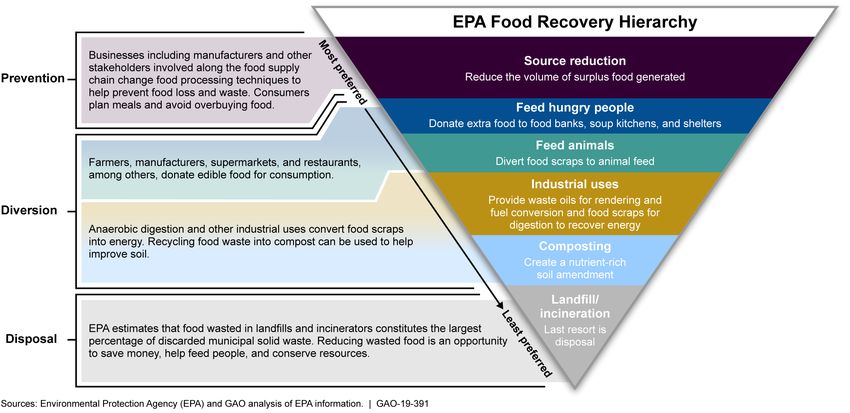
EPA’s Food Recovery Hierarchy, shown in figure 2 below, focuses on
different options for reducing FLW. According to EPA, the top levels of the
hierarchy are the best ways to reduce FLW because they create the most
benefits for the environment, society, and the economy. Source reduction
is the preferred option for reducing FLW because it provides the greatest
benefits in terms of environmental sustainability. This is because growing
food requires resources, such as land, water, fertilizer, and pesticides. In
28
USDA, The Estimated Amount, Value, and Calories of Postharvest Food Losses at the
Retail and Consumer Levels in the United States.
Page 11 GAO-19-391 Food Loss and Wastecontrast, food that is sent to landfills generates greenhouse gases, such
as methane. 29
Figure 2: Environmental Protection Agency’s Food Recovery Hierarchy
• Prevention refers to reducing the amount of surplus food generated at
any stage of the food supply chain. For example, businesses, such as
restaurants, may prevent FLW through better planning and food
preparation techniques.
• Diversion includes recovering food by donating edible food to feed
hungry people or sending food scraps to feed animals. Diversion also
includes recycling food scraps for industrial uses, such as waste-to-
energy generation or anaerobic digestion, or for composting.
29
According to a senior USDA official, hierarchies that prioritize source reduction and
feeding people over industrial uses or composting incorporate efficiency as well as food-
security objectives. They reflect the observation that it is generally inefficient to use food
produced to feed people as animal feed or as inputs to industrial uses or composting since
the same or fewer resources could have been used to produce nutritionally balanced
animal feed, feedstocks for industrial use, and high-value soil amendments (i.e., materials
that are applied to land primarily to enhance soil characteristics rather than as plant food).
Page 12 GAO-19-391 Food Loss and Waste• Disposal refers to food that is sent to landfills, incinerators, or washed
into sewers.
According to USDA, some FLW is inevitable and, therefore, entirely
eliminating FLW is unrealistic. 30 For example, USDA ERS reports that
there is a practical limit to how much FLW in the United States could be
reduced, given different factors, such as food safety concerns, the
perishability of foods, storage and temperature considerations, and risk
management for production and marketing uncertainties, and resource
constraints to recover uneaten food for another use, among others.
According to USDA officials, to be successful, FLW reduction strategies
should consider the economic incentives and disincentives faced by
stakeholders across the food supply chain.
Nonfederal stakeholders we interviewed cited various challenges that
Nonfederal exist to reducing FLW in the United States. Through our analysis of those
Stakeholders Cited interviews, we identified three key areas: (1) limited data and information
about the amounts and causes of FLW; (2) a lack of awareness and
Various Challenges to education about FLW; and (3) limited infrastructure and capacity, which
Reducing Food Loss can hamper efforts to reduce FLW. In some instances, the nonfederal
stakeholders also provided their views for ways federal agencies could
and Waste in the potentially address the identified challenge areas.
United States
Nonfederal Stakeholders Through interviews with nonfederal stakeholders, we identified limited
Said Data and Information data and information about the amounts and causes of FLW as a
challenge to reducing FLW in the United States. For example, several
about Amounts and
stakeholders told us that data gaps associated with the different food
Causes of FLW Are supply-chain stages make it challenging to estimate FLW. For example:
Limited
• An international organization published a study in 2011 that included
estimates of FLW by different regions and different stages of the food
supply chain. The organization reported in its study that there were
major data gaps in the knowledge of global FLW, such as the causes
of FLW. Representatives of this organization told us that a challenge
to measuring and estimating FLW is the lack of data on the various
stages of the food supply chain. They are proposing a new
30
USDA, The Estimated Amount, Value, and Calories of Postharvest Food Losses at the
Retail and Consumer Levels in the United States.
Page 13 GAO-19-391 Food Loss and Wastemethodology intended to help countries measure FLW along the
supply chain in a cost-effective manner and monitor progress in
reducing FLW.
• Researchers from two academic institutions told us there are
challenges to estimating farm-production food losses. For example,
researchers from one of these academic institutions told us that farm-
production losses fluctuate from year to year based on changes in
markets and growing conditions, such as weather, which can make
estimating FLW more challenging. In addition, these researchers told
us more information is needed about how different economic factors,
such as the existence of secondary (alternative) markets to sell
excess food, 31 or changes in farming costs such as increases in labor
costs, may influence FLW.
• One nonprofit organization reported that data at the farm-production
stage of the food supply chain are limited, including data on what
happens to some food at that stage. For example, there are limited
data about whether produce that goes unsold is tilled back into the
farmland, composted, or sent to a landfill. This nonprofit organization
reported the limitations of its estimate of FLW across the food supply
chain in the United States. 32 For example, the nonprofit organization
documented in its FLW estimate methodology that its farm-production
FLW data analysis focused on estimating imperfect-produce rates, but
noted that FLW may occur at this stage for a variety of reasons,
including inclement weather, pests, or overproduction. It also
documented that future research efforts could assess actual produce
imperfection and loss rates for each produce type using geographical
differences to improve estimate accuracy.
• Representatives from another nonprofit organization that has
published an estimate of FLW told us there are data gaps about FLW
along the food supply chain. For example, this nonprofit organization
reported in 2017 that improved research is needed regarding farm-
production data and FLW estimates of the consumer stage of the food
supply stage. 33 In addition, this nonprofit organization reported that
one challenge is the absence of standardized measurement
31
An example of a secondary market is CropMobster, a community exchange that
addresses FLW and food surpluses with online tools.
32
ReFED, A Roadmap to Reduce U.S. Food Waste by 20 Percent.
33
Natural Resources Defense Council, Wasted: How America is Losing Up to 40 Percent
of Its Food from Farm to Fork to Landfill.
Page 14 GAO-19-391 Food Loss and Wastemethodologies and common metrics to help entities representing all
food supply-chain stages accurately estimate FLW, develop strategies
to reduce FLW, and measure progress. In this report, they noted that
federal agencies’ efforts to develop a mechanism to aggregate and
disseminate FLW information as it is gathered by businesses and
institutions, among others, would be beneficial to all stakeholders.
• Representatives of a third nonprofit organization stated that FLW
measurement methodologies need to be tailored to the particular
stages of the food supply chain and that the strategies to reduce FLW
need to respond to the conditions associated with specific foods.
Nonfederal Stakeholders Nonfederal stakeholders identified a lack of education and awareness
Identified a Lack of about FLW as a challenge to reducing FLW. For example, an official from
one state told us that there is a lack of awareness among various
Education and Awareness
organizations about the benefits of preventing FLW. Specifically:
about FLW
• One state official told us that there is a lack of awareness among food
producers, businesses, and consumers about the benefits of
preventing FLW. According to this official, to address this challenge
the state developed a strategic action plan that prioritizes focusing
upstream in the food supply chain to prevent FLW, as opposed to the
more traditional focus on increasing FLW diversion, such as through
composting. This official also told us that implementing organic waste
(e.g., food waste or other plant and animal materials) bans, which
prohibit specified waste generators from sending food waste to
landfills, as several states are doing to reduce FLW, tends to promote
FLW reduction activities further down on EPA’s Food Recovery
Hierarchy. As a result, organic waste bans may contribute relatively
little to reducing FLW or maximizing the benefits of such reductions.
This official emphasized that additional steps are needed to increase
awareness about the benefits of prioritizing prevention through shifts
in supply chains, purchasing, and consumption patterns to reduce
FLW.
• Officials from two states told us there is a lack of resources to support
efforts to educate consumers about FLW. For example, one state
official told us that the state agency has insufficient staff resources to
do effective outreach regarding FLW, and current staff members do
not yet have the expertise to fully educate and assist consumers and
businesses about all options available to reduce FLW. Another state
official told us that the state would like to do a state-wide social
marketing campaign to disseminate education and information about
Page 15 GAO-19-391 Food Loss and WasteFLW to household consumers, but the state lacks sufficient resources
to launch such an effort.
• Representatives of a nonprofit food donation organization identified a
lack of education and awareness about date labeling as one of the
challenges to reducing FLW.34 For example, the representatives told
us that consumer confusion about date labels may be an impediment
to reducing FLW among consumers. 35 However, in these
representatives’ view, reducing date labeling confusion is unlikely to
lead to additional food donations. In addition, an academic institution
representative, in collaboration with other authors, reported that a
driver of household FLW is consumer confusion over date labels and
conducted a survey to gain information about consumer perceptions
of date labels. They concluded from their research that increasing
consumer education on the meaning of date labels can help to reduce
FLW.
• A representative of a nonprofit food donation organization told us that
education and awareness about liability protections and compliance
are lacking for various potential food donors and may hinder some
food producers from donating food and, by extension, reducing FLW.
Nonfederal Stakeholders Through interviews with nonfederal stakeholders, we identified that limited
Said Limited Infrastructure infrastructure and capacity is a challenge that can hamper efforts to
reduce FLW. For example:
and Capacity Can Hamper
Efforts to Reduce FLW • Representatives of a nonprofit food donation organization that
receives food donations cited a lack of sufficient capacity and
logistical support to collect and distribute available food. For example,
representatives told us that food pantries may not have a sufficient
volunteer workforce or enough food storage capacity to be able to
distribute all donated food to needy people.
• Food industry representatives told us that businesses have
infrastructure limitations, such as a lack of transportation options to
deliver excess food to food pantries or composting facilities. For
example, representatives told us that if such facilities were available,
food scraps, such as produce peels, could be used as animal feed or
34
Food manufacturers use date labeling such as “sell by” or “use by” to communicate the
estimated time for which the food product will be of best quality.
35
GAO expects to issue a report on date labeling in 2019 (GAO-19-407) that will focus on
this issue.
Page 16 GAO-19-391 Food Loss and Wastecomposted. However, if the infrastructure to utilize these options is not
available, the companies generating the FLW may opt to send it to
landfills instead.
• An official from one state told us that the state does not have access
to the infrastructure and capacity needed to separate contaminants in
order to be able to divert FLW for other uses, such as animal feed,
composting, or anaerobic digestion. For example, this state official
told us that the state does not have access to the necessary
equipment to separate plastic and other packaging materials from
food waste in order to be able to process FLW through anaerobic
digesters. Officials of another state provided a study stating that
removing packaging from food waste can be an obstacle to successful
FLW diversion and that separation of food waste for composting or
other diversion can be costly. In addition, a representative of one
international organization told us that federal agencies could facilitate
a collaborative approach with industry stakeholders to develop
voluntary industry standards on food packaging materials and food
portion sizes to help reduce FLW in the United States. 36
• Officials from another state told us that a lack of food recycling
infrastructure limits their ability to enforce the state’s organic waste
ban and reduce FLW. A state official told us that the state has one
anaerobic digester facility to process food waste, but additional
recycling infrastructure would be needed statewide to enable food
waste generators, such as hospitals or schools, to recycle their food
waste instead of sending it to landfills.
Since announcing the national FLW reduction goal in 2015, EPA and
EPA and USDA Have USDA have taken initial actions to address challenges in the three key
Taken Initial Actions areas that nonfederal stakeholders identified to reduce FLW. For
example, EPA and USDA have taken actions to provide improved data
to Address Key and information about FLW in the United States; educate and increase
Challenge Areas to awareness of FLW along the food supply chain; and expand the
infrastructure and capacity to support efforts to reduce FLW.
Reducing Food Loss
and Waste
36
The Waste Reduction and Action Programme, an international nonprofit organization
that works with the United Kingdom government and the private sector to reduce FLW,
developed the “Courtauld Commitment,” a voluntary agreement for the grocery sector, to
improve resource efficiency and prevent food and packaging waste in the home and food
supply chain.
Page 17 GAO-19-391 Food Loss and WasteEPA and USDA Have EPA and USDA have provided some data and information about FLW in
Provided Some Data and the United States. Specifically:
Information on Food Loss • In a 2018 report, EPA published trends of food waste materials
and Waste in the United generation, among other materials, and provided updated information
States about municipal solid waste being generated, recycled or composted,
landfilled, and combusted with energy recovery using 2015 data from
residential, commercial, and institutional sources. 37 According to EPA,
food waste represents the largest percentage of landfilled material in
municipal solid waste, as seen in figure 3 below. 38 EPA relies on
gathering these data on food waste generation and management from
studies conducted by other organizations, such as state and local
governments and food waste generators.
Figure 3: EPA Total Municipal Solid Waste Landfilled by Material, 2015
a
Other waste includes miscellaneous inorganic waste and other product materials, such as
electrolytes in batteries.
• EPA measures certain FLW diversion activities (i.e., divert food to a
destination other than landfill or incineration). For example, in
37
EPA has collected and reported data on the generation and disposition of municipal solid
waste in the United States for more than 30 years.
38
U.S. Environmental Protection Agency, Advancing Sustainable Materials Management:
2015 Tables and Figures (Washington, D.C.: July 2018).
Page 18 GAO-19-391 Food Loss and WasteSeptember 2018 EPA completed an effort to quantify the number and
capacity of anaerobic digestion facilities in the United States. 39 EPA
also aggregates and publishes data submitted by EPA’s Food
Recovery Challenge program participants on recycling fats, oils, and
grease, which may otherwise be disposed of through wastewater. For
example, participating restaurants may submit data on the amount of
fats from their fryer grease containers that they send for recycling
through rendering, conversion to biofuels, or to an anaerobic digester.
In addition, EPA develops estimates of food waste composting based
on a review of state environmental agency websites, as well as
published reports.
• EPA updates its FLW estimates annually. EPA officials stated that
these annual estimates are the most comprehensive annual estimates
of generated and managed FLW and that EPA plans to use these
estimates to track progress. However, EPA officials acknowledged
certain limitations in using these estimates to track annual progress
against the 2030 goal. For example, EPA officials stated that data
challenges include limited studies available for some sectors and the
lack of geographic coverage, among others. EPA is taking steps to
improve its FLW estimates. For example, officials stated that in 2017
EPA embarked on an effort to improve its food measurement
methodology to reflect all potential FLW generating sectors for which
there are data, and to characterize how food is being managed
beyond composting and landfill.
USDA has also provided some data and information about FLW at
various stages of the food supply chain in the United States since 2015.
Specifically:
• ERS is working on initiatives to refine and improve its data system in
order to support its ongoing efforts to estimate FLW at the retail and
consumer stages of the food supply chain. For example, USDA
officials told us they are developing a proposal for an external expert
panel to analyze food loss estimates at the consumer stage of the
food supply chain and make recommendations for data updates. In
addition, USDA officials told us that work is under way to update the
retail-level loss estimates of selected foods.
39
U.S. Environmental Protection Agency, Anaerobic Digestion Facilities Processing Food
Waste in the United States in 2015 Survey Results, EPA/903/S-18/001 (Washington, D.C.:
September 2018).
Page 19 GAO-19-391 Food Loss and Waste• In addition, in December 2017, ERS initiated work on a study to
identify gaps in information about farm-level FLW. 40 According to ERS
officials, as part of the study, ERS will describe the existing data-
collection challenges and address the economic factors that influence
farmers’ decisions as they relate to FLW at the farm level. For
example, one factor could involve a farmer deciding to plow excess
produce into the fields instead of harvesting or processing the crop if
the potential additional labor or operations costs exceed the potential
revenue. One senior ERS official told us that ERS expects to issue
the study by the end of calendar year 2019. Additionally, ERS officials
told us that USDA could use the final study to inform USDA’s policy
approaches to reducing FLW. For example, the report may inform
USDA’s efforts to assist farmers in implementing best practices in
reducing FLW and expanding market opportunities for imperfect fruits
and vegetables or excess harvest.
• USDA’s National Institute for Food and Agriculture has provided grant
funding to projects related to FLW. For example, the institute awarded
a grant in 2018 to an academic institution to study the effect of
secondary markets as alternative channels for usable food. 41
• To advance the research mission of the agency, among other
reasons, USDA has a memorandum of understanding with the
Foundation for Food and Agriculture Research, an organization that
Congress authorized as part of the 2014 Farm Bill. The Foundation for
Food and Agriculture Research conducts research in six defined
challenge areas, including one area that focuses research on
inefficiencies in the food system, such as FLW.
40
According to USDA officials, this study is in response to House Report 115-232, which
directed ERS to conduct a study about on-farm food losses. H.R. Rep. No. 115-232, at 15
(2017).
41
Timothy J. Richards and Stephen F. Hamilton, “Food Waste in the Sharing Economy,”
Food Policy, vol. 75 (2018). This study funded by the institute described a secondary
market as an alternative channel for a food producer to distribute usable food (e.g.,
imperfect produce) to consumers in lieu of discarding the food.
Page 20 GAO-19-391 Food Loss and WasteEPA and USDA Have EPA and USDA have taken some actions to educate and build
Taken Some Actions to awareness about FLW in the United States since announcing the national
FLW reduction goal in 2015. For example, EPA published its Sustainable
Educate and Build
Materials Management Program Strategic Plan, Fiscal Years 2017-2022
Awareness about Food in October 2015. 42 One of the plan’s three strategic priority areas is
Loss and Waste Sustainable Food Management, which includes an action area of
promoting opportunities to reduce wasted food and the food’s associated
effects over the entire food supply-chain life cycle with a preference for
using approaches that are higher on the agency’s Food Recovery
Hierarchy. EPA’s strategic plan describes delivering tools and education;
working with states and local communities to help provide regional or
sector-based support; and sharing best practices on wasted-food
reduction efforts. In addition to the planned actions identified in the
Sustainable Food Management area, EPA has also provided the following
FLW education and awareness tools, among others:
• Food: Too Good to Waste. This community-based social marketing
campaign, implementation guide, and toolkit aim to reduce wasteful
household food management practices and keep FLW out of landfills.
The toolkit is designed for community organizations, local
governments, households, and others interested in reducing wasteful
household food management practices. The implementation guide is
designed to teach local governments and community organizations
how to implement a Food Too Good to Waste campaign in their
community using the toolkit. In a 2016 report, EPA listed 17
communities in various states, including Rhode Island and Vermont,
that had implemented Food Too Good to Waste campaigns and, as
part of this implementation, could use outreach and engagement tools
adaptable to the needs of their communities based on their available
resources. The campaigns focused on helping households make
small shifts in how they shop, prepare, and store food to prevent it
from being wasted.
• Waste Reduction Model. According to the agency’s website, EPA
created this tool to help solid-waste planners and organizations track
greenhouse gas emissions reductions from several different waste-
management practices, including source reduction, recycling,
anaerobic digestion, combustion, composting, and landfilling. For
example, a food service establishment can use the tool to create an
42
U.S. Environmental Protection Agency, U.S. EPA Sustainable Materials Management
Program Strategic Plan, Fiscal Years 2017-2022 (Washington, D.C.: October 2015).
Page 21 GAO-19-391 Food Loss and WasteYou can also read


