Leveraging Digital Twin Technology in Model-Based Systems Engineering - MDPI
←
→
Page content transcription
If your browser does not render page correctly, please read the page content below
systems
Article
Leveraging Digital Twin Technology in Model-Based
Systems Engineering
Azad M. Madni 1, *, Carla C. Madni 1             and Scott D. Lucero 2
 1   Intelligent Systems Technology, Inc., Los Angeles, CA 90066, USA; cmadni@intelsystech.com
 2   Research and Engineering, Office of the USD, Washington, DC 20301–3030, USA; don.s.lucero.civ@mail.mil
 *   Correspondence: azad.madni@usc.edu; Tel.: +1-310-709-1680

 Received: 6 November 2018; Accepted: 22 January 2019; Published: 30 January 2019

 Abstract: Digital twin, a concept introduced in 2002, is becoming increasingly relevant to systems
 engineering and, more specifically, to model-based system engineering (MBSE). A digital twin, like
 a virtual prototype, is a dynamic digital representation of a physical system. However, unlike a
 virtual prototype, a digital twin is a virtual instance of a physical system (twin) that is continually
 updated with the latter’s performance, maintenance, and health status data throughout the physical
 system’s life cycle. This paper presents an overall vision and rationale for incorporating digital twin
 technology into MBSE. The paper discusses the benefits of integrating digital twins with system
 simulation and Internet of Things (IoT) in support of MBSE and provides specific examples of the use
 and benefits of digital twin technology in different industries. It concludes with a recommendation to
 make digital twin technology an integral part of MBSE methodology and experimentation testbeds.

 Keywords: model-based systems engineering; digital twin; digital thread; Internet of Things;
 simulation; virtual prototype; Model Based Systems Engineering (MBSE) experimentation testbed

1. Introduction
      The concept of digital twin was first introduced in 2002 by Michael Grieves at the University
of Michigan [1]. Since then the concept has evolved with the advent of the Internet of Things (IoT).
A digital twin is a dynamic virtual model of a system, process or service. Thus, a product, factory
or a business service can have digital twins [2,3]. The vision of a digital twin calls for incorporating
business, contextual and sensor data from physical systems (or processes) into the virtual system
model of the digital twin to facilitate analysis, circumvent problems, and develop informed technology
roadmaps. By integrating the virtual and physical worlds, the digital twin enables real-time monitoring
of systems and processes and timely analysis of data to head off problems before they arise, schedule
preventive maintenance to reduce/prevent downtimes, uncover new business opportunities, and plan
for future upgrades and new developments. While virtual models tend to be generic representations
of a system, part, or a family of parts, the digital twin represents an instance (i.e., a particular system or
process). Digital twin technology has the potential to reduce the cost of system verification and testing
while providing early insights into system behavior. Today, digital twin technology is an integral part
of the Department of Defense’s (DoD’s) Digital Engineering initiative that seeks to connect systems
and operations in a world of increasingly interconnected and smart physical devices [4–6].
      With the advent of the Internet of Things (IoT), digital twin technology has become cost-effective
to implement and is gaining increasing acceptance in the Industrial Internet of Things (IIoT)
community [7], which tends to focus on large, complex, capital-intensive equipment. At the same time,
the aerospace and defense industry, which continues to invest in Industry 4.0, has started to invest in
digital twin technology. According to Gartner, by 2021 nearly half the major industrial companies will

Systems 2019, 7, 7; doi:10.3390/systems7010007                                 www.mdpi.com/journal/systems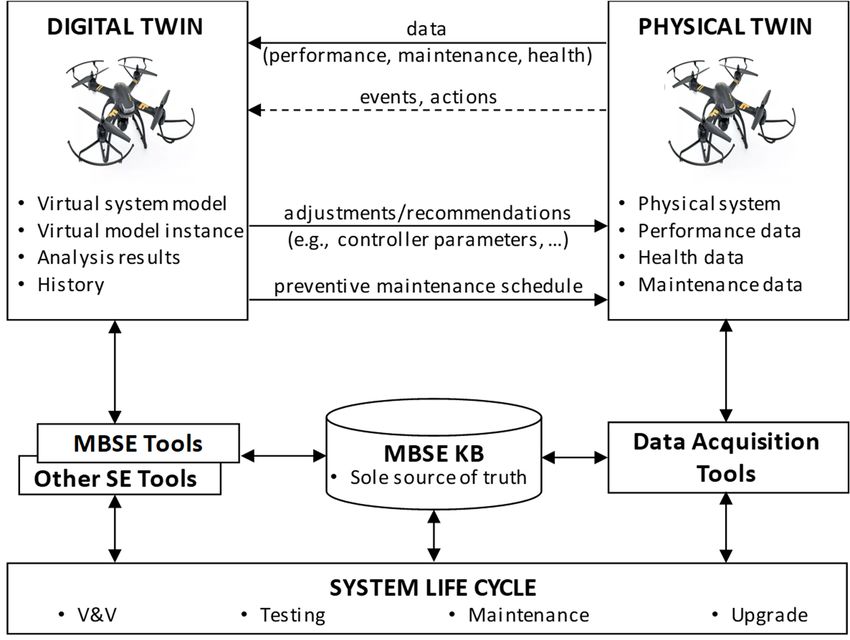
Systems 2019, 6, x 2 of 13
community [7], which tends to focus on large, complex, capital-intensive equipment. At the same
Systemsthe
time, 2019, 7, 7
aerospace and defense industry, which continues to invest in Industry 4.0, has started 2 of to
13
invest in digital twin technology. According to Gartner, by 2021 nearly half the major industrial
companies
be leveraging will be twin
digital leveraging digital
technology twin technology
to facilitate to facilitate
the assessment of systemthe assessment
performance andoftechnical
system
performance and technical risks, while achieving approximately
risks, while achieving approximately 10% improvement in system effectiveness [8]. 10% improvement in system
effectiveness
A digital[8]. twin, by definition, requires a physical twin for data acquisition and context-driven
A digitalThe
interaction. twin, by definition,
virtual requires
system model inathe
physical
digitaltwin
twinforcan
data acquisition
change and context-driven
in real-time as the state
interaction. The virtual system model in the digital twin can change
of the physical system changes (during operation). Today, a digital twin consists in real-time as the
ofstate of the
connected
physical
products,system
typically changes (during
utilizing operation).
the IoT, Today,
and a digital a digital
thread. Thetwin consists
digital threadofprovides
connected products,
connectivity
typically utilizing the IoT, and a digital thread. The digital thread provides connectivity
throughout the system’s lifecycle and collects data from the physical twin to update the models in the throughout
the system’s
digital twin. lifecycle
Figure 1 and collects
presents the data from
digital theconcept
twin physical twin the
within to update
contextthe models in thesystems
of model-based digital
twin. Figure(MBSE).
engineering 1 presents the digital twin concept within the context of model-based systems
engineering (MBSE).
Figure 1. Digital twin concept within MBSE (Model Based Systems Engineering) Framework.
Figure 1. Digital twin concept within MBSE (Model Based Systems Engineering) Framework.
As shown in this figure, the digital twin links the virtual and physical environments. The physical
As shown
environment in thisthe
includes figure, the system,
physical digital twin
onboardlinksandtheexternal
virtualsensors,
and physical environments.
communication The
interfaces,
physical environment includes the physical system, onboard and external sensors,
and possibly other vehicles operating in an open environment with access to GPS data. Both operational communication
interfaces, and possibly
and maintenance other vehicles
data associated with the operating
physicalinsystem
an open areenvironment
supplied to the with access
virtual to GPS data.
environment to
Both operational and maintenance data associated with the physical system
update the virtual model in the digital twin. Thus, the digital twin becomes a precise and up-to-date are supplied to the
virtual environment
representation to update
of a physical the virtual
system model
that also in thethe
reflects digital twin. Thus,
operational the digital
context twin becomes
of the physical twin.
aImportantly,
precise and the
up-to-date representation
relationship of a physical
with the physical twin system that also
can continue reflects
even after the
the operational context
sale of the physical
of the thereby
twin, physicalmaking
twin. Importantly,
it possible tothe relationship
track with theand
the performance physical twin canhistory
maintenance continue of even
each after the
physical
sale
twin of thetime,
over physical
detecttwin, thereby
and report making itbehavior,
anomalous possibleand to track the performance
recommend/ and maintenance
schedule maintenance.
history
NASA and USAF (United States Air Force) researchers describe a digital twinand
of each physical twin over time, detect and report anomalous behavior, as anrecommend/
integrated
schedule maintenance.
multi-physics, multiscale, probabilistic simulation of an as-built vehicle or system that uses the best
NASA
available and USAF
physical (United
models, States
sensor Air Force)
updates, fleet researchers
history, etc.,describe
to mirrora digital
the lifetwin
of itsascorresponding
an integrated
multi-physics, multiscale, probabilistic simulation of an as-built vehicle
flying twin [9]. The digital twin is ultra-realistic and may consider one or more important or system that uses the best
and
available physical models, sensor updates, fleet history, etc., to mirror the life
interdependent vehicle systems such as airframe, propulsion and energy storage, life support, avionics of its corresponding
flying twin [9].
and thermal The digital
protection. Thetwin is ultra-realistic
extreme requirements andof may consider
the digital twinone or more the
necessitate important and
integration
interdependent vehicle systems such as airframe, propulsion and energy
of design of materials and innovative material processing approaches. Manufacturing anomalies storage, life support,
avionics
that may and thermal
affect protection.
the vehicl, are alsoThe extremeconsidered,
“explicitly requirements of the and
evaluated digital twin necessitate
monitored.” the
In addition
integration of design of materials and innovative material processing approaches.
to the high-fidelity physical models of the as-built structure, the digital twin integrates sensor data Manufacturing
anomalies that mayon-board
from the vehicle’s affect theintegrated
vehicl, arevehicle
also “explicitly considered, (IVHM)
health management evaluatedsystem,
and monitored.”
maintenance In
addition
history andto the high-fidelity
all available physical
historical andmodels of obtained
fleet data the as-built structure,
through the digital
techniques such twin
as data integrates
mining
sensor data from the vehicle’s on-board integrated vehicle health management
and text mining [9]. By combining data from these different sources of information, the digital (IVHM) system,
twin
can continually forecast vehicle health status, the remaining useful vehicle life, and the probability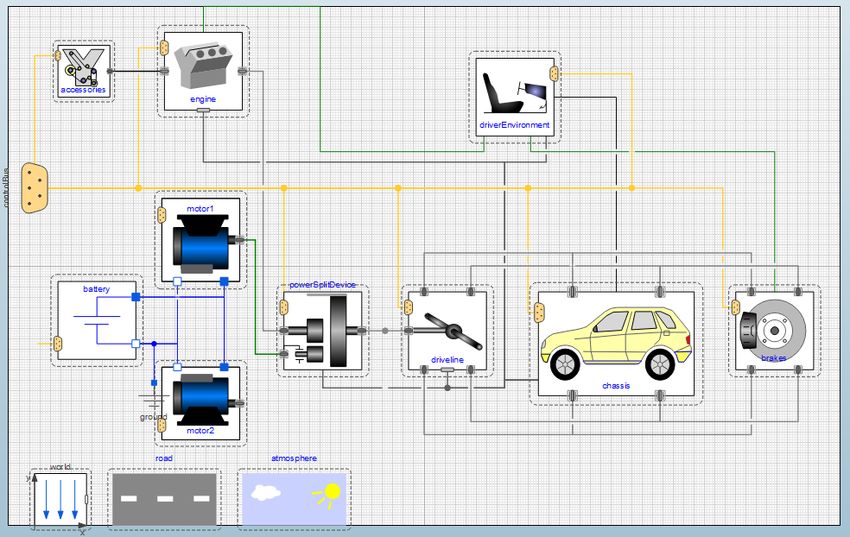
Systems 2019, 7, 7                                                                                     3 of 13

of mission success. The digital twin can also be used to predict system response to safety critical
events and uncover new issues before they become acute by comparing predicted and actual responses.
Finally, the systems on board the digital twin are capable of mitigating damage or degradation by
activating self-healing mechanisms, or by recommending changes in mission profile to decrease loads,
thereby increasing both the life span and the probability of mission success [9].
      The context of operation of the digital twin involves an instrumented testbed in which
model-based systems engineering (MBSE) tools (e.g., system modeling and verification tools) and
operational scenario simulations (e.g., discrete event simulations, agent-based simulations) are used
to explore the behavior of virtual prototypes in a what-if simulation mode under the control of the
experimenter. Insights from the operational environment are used to modify the system models used
in the virtual prototype. Data supplied by the physical system is used by the virtual prototype to
instantiate a digital twin. Subsequently, the digital twin is updated on an ongoing basis, so it faithfully
mirrors the characteristics and history of the physical twin. Importantly, systems that collect and
supply data from the operational environment contribute to insights needed for business intelligence
(BI). For example, the DoD is presently altering its systems to comprehensively record all electronics
warfare (EW) signals (data) from operational missions to analyze and better understand the operational
environment and provide focused updates to our systems.
      The MBSE tool suite in Figure 1 includes system modeling methods (e.g., SysML models,
Design Structure Matrix, process dependency structure matrix, probabilistic models such as
Partially-Observable Markov Decision Process (POMDP), discrete event simulation [10,11], agent-based
simulation, model-based storytelling [12,13], an MBSE knowledge base (that constitutes the
authoritative sources of truth), and systems engineering life cycle process models. The virtual
system model can range from lightweight models to full-up models. The lightweight models reflect
simplified structure (e.g., simplified geometry) and simplified physics (e.g., reduced order models)
to reduce computational load especially in upfront engineering activities. These lightweight models
allow simulations of complex systems and system-of-systems (SoS) with fidelity in the appropriate
dimensions to answer questions with minimal computation costs. These models can be shared
within the organization and with the supplier network thereby increasing their understanding of the
system being engineered. The digital twin concept also subsumes automated and manual processes
in manufacturing environments. From the physical twin, performance, maintenance, and health
data can be collected and supplied to the digital twin. This data includes operational environment
characteristics, engine and battery status, and other such factors. The digital twin and the physical
twin can both be supported by a shared MBSE repository, which also supports SE and data collection
tools. The MBSE models constitute the authoritative sources of truth. This configuration also ensures
bidirectional communication between the digital twin and the physical twin.
      A digital twin is different from the traditional Computer Aided Design/Computer Aided
Engineering (CAD/CAE) model in the following important ways:

(a)   It is a specific instance that reflects the structure, performance, health status, and mission-specific
      characteristics such as miles flown, malfunctions experienced, and maintenance and repair history
      of the physical twin;
(b)   It helps determine when to schedule preventive maintenance based on knowledge of the system’s
      maintenance history and observed system behavior;
(c)   It helps in understanding how the physical twin is performing in the real world, and how it can be
      expected to perform with timely maintenance in the future;
(d)   It allows developers to observe system performance to understand, for example, how modifications
      are performing, and to get a better understanding of the operational environment;
(e)   It promotes traceability between life cycle phases through connectivity provided by the
      digital thread;
Systems 2019, 7, 7 4 of 13
(f) It facilitates refinement of assumptions with predictive analytics-data collected from the physical
system and incorporated in the digital twin can be analyzed along with other information sources
to make predictions about future system performance;
(g) It enables maintainers to troubleshoot malfunctioning remote equipment and perform
remote maintenance;
(h) It combines data from the IoT with data from the physical system to, for example, optimize service
and manufacturing processes and identify needed design improvements (e.g., improved logistics
support, improved mission performance);
(i) It reflects the age of the physical system by incorporating operational and maintenance data from the
physical system into its models and simulations.
This paper is organized as follows. Section 2 presents the digital twin rationale and potential
uses. Section 3 presents the levels of sophistication (maturity) of a digital twin. Section 4 presents the
relationship between the digital twin and MBSE, in terms of the relationship of the digital twin with
simulation, machine learning, Internet of Things (IoT), and cost. Section 5 offers concluding comments
on the future prospects of digital twins in advancing MBSE.
2. Digital Twin Rationale and Potential Uses
A digital twin is first created when the physical system can start providing data to the virtual
system model to create a model instance that reflects the structural, performance, maintenance,
and operational health characteristics of the physical system [11,12]. The physical system can be said
to be ”fit for purpose” if the digital twin’s behavior is analyzed and can be appropriately adjusted
for a variety of contingency situations. For example, computer simulations of the braking system
of a car can be run to understand how the vehicle (model) would perform in different real-world
scenarios. This approach is faster and cheaper than building multiple physical vehicles to test. However,
computer simulations tend to be confined to current events and operational environments. In other
words, they do not have the ability to predict vehicle responses to future/envisioned scenarios. Also,
braking systems are software-intensive systems, not merely a combination of mechanical and electronic
subsystems. This is where digital twin and IoT can play important roles. A digital twin uses data
collected from connected sensors onboard the physical vehicle to enable virtual testing. Furthermore,
with IoT-provided data (e.g., temperature, humidity), it becomes possible to reflect system performance
and health status in the digital twin and use that information to make predictions about the physical
twin. Equipped with such data and knowledge, the digital twin can “tell” the story (i.e., events,
experiences, history) of its physical twin over the physical twin’s life cycle.
Being a virtual representation, a digital twin is easier to manipulate and study in a controlled testbed
environment than its physical counterpart in the operational environment. This flexibility enables
cost-effective exploration of system behaviors and sensitivities to various types of system malfunctions
and external disruptions. Second, data produced by the digital twin under various what-if conditions
can be used to: improve future system designs; optimize maintenance cycles; surface ideas for new
system applications; validate preliminary design decisions; and predict system response to different
types of disruptions in the field. Specifically, the digital twin can be used to:
• Validate system model with real world data Operational environment data and the interactions of the
system with that environment can be incorporated into the digital twin to validate its models and
to make assessments and predictions.
• Provide decision support and alerts to users After incorporating operational, maintenance, and health
data, the digital twin can be employed in a what-if analysis mode to produce tailored decision
support information and alerts to operators/users of the physical system.
• Predict changes in physical system over time Simulation-based analysis of operational,
maintenance, and health data from the physical twin can facilitate optimization of operations
(including satisfying requirements and identifying root causes), enhance contingency planningSystems 2019, 7, 7 5 of 13
and predicting system performance. The digital twin can also be embedded in the control loop to
predict changes in the physical system and adjust/modify physical system parameters to deal
with contingencies.
• Discover new application opportunities and revenue streams With a digital twin, different versions
of systems can be evaluated to determine which features provide the “biggest bang for the
buck.” Machine learning and other data science technologies can facilitate timely analysis of
significant volumes of data generated, thereby providing insights into potential new uses and
revenue streams.
Thus far, the initial series of digital twin initiatives have focused on complex, high-cost systems.
However, today with advances in cost models for sensors, communication networks, analytics and
simulation, it is possible to develop a digital twin for almost any system.
3. Digital Twin Levels of Sophistication (or Maturity)
Today any digital version of a system, component, or asset is called a digital twin. With this larger
interpretation, there are several questions that arise including:
• Does a physical system have to exist before a digital twin is created?
• Does the physical system with onboard sensors and processor need to report performance, health,
and maintenance data to the virtual system model before the latter can be called a digital twin?
• Does the definition of a digital twin have to change because any physical asset today can be made
smart with the advent of the Industrial Internet of Things (IIoT)?
These questions and many more need to be answered about the digital twin and its various uses.
To this end, we define four levels of a virtual representation. Each level has a specific purpose and
scope and helps with decision making and answering questions throughout the system’s lifecycle.
Table 1 presents these different levels along with the characteristics that define each level.
Table 1. Digital twin levels.
Data Machine
Acquisition Learning Machine Learning
Level Model Sophistication Physical Twin
from Physical (Operator (System/Environment)
Twin Preferences)
virtual system model with
1
emphasis on
Pre-Digital does not exist Not applicable No No
technology/technical-risk
Twin
mitigation
performance,
2 virtual system model of health status,
exists No No
Digital Twin the physical twin maintenance;
batch updates
performance,
3 virtual system model of health status,
Adaptive the physical twin with exists maintenance; Yes No
Digital Twin adaptive UI real-time
updates
performance,
health status,
virtual system model of
4 maintenance,
the physical twin with
Intelligent exists environment; Yes Yes
adaptive UI and
Digital Twin both
reinforcement learning
batch/real-time
updates
3.1. Pre-Digital Twin
Level 1 is the traditional virtual prototype created during upfront engineering. It supports
decision-making at the concept design and preliminary design. The virtual prototype is a virtualSystems 2019, 6, x 6 of 13
3.1. Pre-Digital Twin
Systems 2019, 7, 7 6 of 13
Level 1 is the traditional virtual prototype created during upfront engineering. It supports
decision-making at the concept design and preliminary design. The virtual prototype is a virtual
generic executable
generic executable system
system model
model of the envisioned
of the envisioned system
system that
that is
is typically
typically created
created before
before the the physical
physical
prototype
prototype is built. Its primary purpose is to mitigate technical risks and uncover issues in upfront
is built. Its primary purpose is to mitigate technical risks and uncover issues in upfront
engineering. We
engineering. We call
call this
this virtual
virtual prototype-Pre-Digital
prototype-Pre-Digital Twin. Twin. Like
Like most
most model-driven
model-driven approaches,
approaches,
virtual
virtual prototyping involves aa model
prototyping involves model ofof the
the system
system early
early in
in the
the design
design process. However, a
process. However, a virtual
virtual
prototype is not usually used to derive the final system. This is because
prototype is not usually used to derive the final system. This is because a virtual prototype cana virtual prototype can be
be aa
“throwaway”
“throwaway” prototype
prototype or or aa “reusable”
“reusable” prototype.
prototype. The The latter
latter can
can bebe used
used to to derive
derive thethe final
final system.
system.
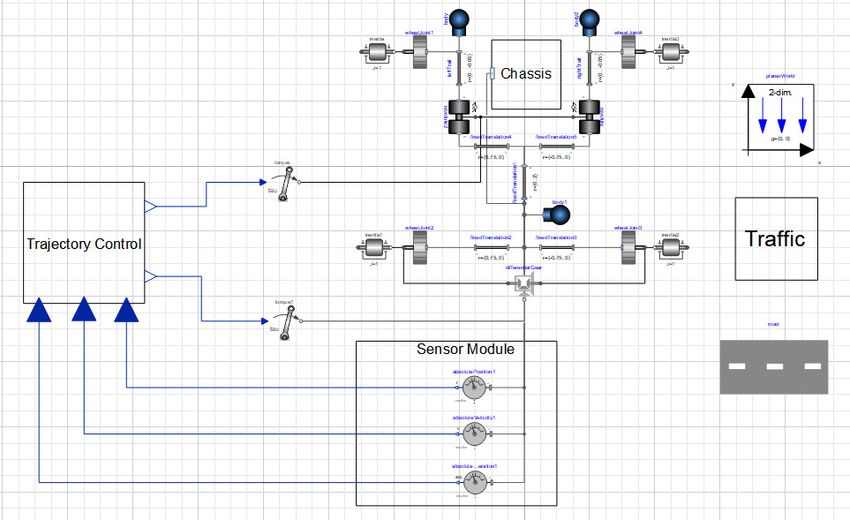
A virtual prototype is mostly used to validate certain key decisions about
A virtual prototype is mostly used to validate certain key decisions about the system and mitigate the system and mitigate
specific technical
specific technical risks
risks early
early in
in the
the design process. Figure
design process. Figure 22 presents
presents an an example
example of of aa Level
Level 1 1 virtual
virtual
representation of a car using the Planar Mechanics library provided by Modelica.
representation of a car using the Planar Mechanics library provided by Modelica. This model consists This model consists
of ideal
of idealwheels
wheelswithwithdrydryfriction contact
friction patch
contact rolling
patch on a on
rolling surface. It employs
a surface. a simple
It employs (i.e., low(i.e.,
a simple fidelity)
low
model ofmodel
fidelity) differential gear to distribute
of differential torque equally
gear to distribute torque to the wheels,
equally and reflects
to the wheels, and properties such as
reflects properties
inertia,
such as mass, fixed
inertia, mass,translation and torque
fixed translation and to torque
realize to
a basic structure
realize a basic of vehicle with
structure mass with
of vehicle properties.
mass
A PlanarWorld component is used to define gravity and global coordinates
properties. A PlanarWorld component is used to define gravity and global coordinates system. system. The sensors
The
measuremeasure
sensors absoluteabsolute
position,position,
velocity velocity
and acceleration. The trajectory
and acceleration. control module
The trajectory providesprovides
control module torques
values
torquesto the steering
values and differential
to the steering gear mechanism.
and differential gear mechanism.Such Such
low fidelity models
low fidelity can can
models be used, for
be used,
example,
for example,in testing,
in testing,planning,
planning, andanddecision-making
decision-makingalgorithms
algorithmsrelated
relatedto, to,for
for example,
example, trajectory
trajectory
control in autonomous vehicles performing
control in autonomous vehicles performing lane changes. lane changes.
Figure
Figure 2.
2. Virtual
Virtual Vehicle
Vehicle Model Built with Planar Mechanics Open Source Library.
Library.
3.2. Digital
3.2. Digital Twin
Twin
Level 22is is
Level a digital twintwin
a digital in which the virtual
in which the system
virtual model
system is capable
model of is incorporating performance,
capable of incorporating
health and maintenance data from the physical twin. The virtual representation,
performance, health and maintenance data from the physical twin. The virtual representation, an an instantiation of
the generic system
instantiation of the model,
generic receives batch updates
system model, receivesfrom
batchthe physical
updates system
from that it uses
the physical to support
system that it
high-level decision making in conceptual design, technology specification,
uses to support high-level decision making in conceptual design, technology specification, preliminary design and
development. Data collection from the physical sensors and computational elements
preliminary design and development. Data collection from the physical sensors and computational in the physical
twin includes
elements bothphysical
in the health status
twindata (e.g., battery
includes level), mission
both health performance
status data data (e.g.,
(e.g., battery flightmission
level), hours).
The data is reported back to the digital twin which updates its model including the
performance data (e.g., flight hours). The data is reported back to the digital twin which updates its maintenance
schedule
model for the physical
including system. Since
the maintenance interaction
schedule with
for the the physical
physical system
system. Sinceis bidirectional,
interaction with therethe
is
ample opportunity
physical for the physical
system is bidirectional, twin
there to use opportunity
is ample knowledge acquired from one
for the physical or more
twin to usedigital twins
knowledge
to improve its performance during real time operation. The digital twin at this level is used toSystems 2019, 6, x 7 of 13
Systems 2019, 7, 7 7 of 13
acquired from one or more digital twins to improve its performance during real time operation. The
digital twin at this level is used to explore the behavior of the physical twin under various what-if
explore theBeing
scenarios. behavior of the physical
an executable twin
digital under various itwhat-if
representation, is easyscenarios. Being an
to manipulate executable
when digital
exploring the
representation, it is easy to manipulate when exploring the behavior of the
behavior of the system in the controlled simulation environment of the testbed. Any deficiencies system in the controlled
simulation
discovered environment
are used to modifyof thethetestbed. Anytwin
physical deficiencies
with the discovered are used
changes reflected to modify
in the the physical
digital twin. Figure
twin
3 presents an example of a Level 2 system model of a passenger car. This model is built with2 Vehicle
with the changes reflected in the digital twin. Figure 3 presents an example of a Level system
model of Library
Interface a passengerof thecar. This model
Modelica is built
tool. The model with
has Vehicle Interface
a passenger Library
car with power of split
the Modelica tool.
hybrid power
The
train.model
The has a passenger
chassis model has car with
singlepower
degree split
of hybrid
freedom power
withtrain. The chassis
mass-and model has single
speed-dependent drag
degree of freedom with mass-and speed-dependent drag properties. The
properties. The braking subsystem which uses brake pedal position resulting from driver action braking subsystem whichto
uses brake
calculate pedal
brake position
torque. Thisresulting from
affects the driver action
driveline. to calculate
The driveline model brake torque.
consists Thiswheels
of four affectswith
the
driveline.
front wheelThe driveline
drive and idealmodel consistsThe
differential. of four wheels
power split with
device front wheel
consists of drive and idealgear
ideal epicyclic differential.
without
The
losses. An ideal battery with constant voltage source powers DC motor model with inductor,constant
power split device consists of ideal epicyclic gear without losses. An ideal battery with resistor
voltage source powers DC motor model with inductor, resistor and emf component
and emf component connected to shaft hub. The engine model with flywheel consist of drive-by-wire connected to shaft
hub.
accelerator, where the accelerator inputs are converted to output torque. Models of inputs
The engine model with flywheel consist of drive-by-wire accelerator, where the accelerator Road,
are converted and
environment to output torque. Models
WorldFrame softwareof Road, environment
(MathWorks, andMA,
Natick, WorldFrame
USA) are software
used to(MathWorks,
define the
Natick, MA, USA)
inertial frame, are air
gravity, used to define the
temperature, inertial
wind frame,
velocity, gasgravity,
constant airfor
temperature, wind velocity,
air, and air pressure. gas
The data
constant for air, and air pressure. The
used in this model is from the physical twin. data used in this model is from the physical twin.
Figure 3. Digital
Digital twin
twin model
model built
built with vehicle interfaces open source library.
library.
3.3. Adaptive Digital
3.3. Adaptive Digital Twin
Twin
Level
Level 3
3 is
is the
the Adaptive
Adaptive Digital
Digital Twin.
Twin. It
It offers
offers an
an adaptive
adaptive user
user interface
interface (in
(in the
the spirit
spirit of
of aa smart
smart
product
product model)
model) to to the
the physical
physical and
and digital
digital twins. The adaptive
twins. The adaptive user
user interface
interface isis sensitive
sensitive toto the
the
preferences and priorities of the user/operator. A key capability at this level is the ability to
preferences and priorities of the user/operator. A key capability at this level is the ability to learn thelearn the
preferences
preferences and
and priorities
priorities in
in of
of human
human operators
operators inin different
different contexts
contexts [14].
[14]. These
These characteristics
characteristics are
are
captured
captured using
usinga neural
a neuralnetwork-based
network-basedsupervised machine
supervised learninglearning
machine algorithm. The models
algorithm. Theemployed
models
within thiswithin
employed digitalthis
twin are continually
digital updated based
twin are continually updatedon the data
based onbeing “pulled”
the data from the from
being “pulled” physical
the
twin in real-time. It can also accept information in batches after system use. This digital
physical twin in real-time. It can also accept information in batches after system use. This digital twin twin can
support real-time
can support planning
real-time and and
planning decision-making
decision-makingduring operations,
during maintenance,
operations, maintenance,and support.
and support.
3.4. Intelligent Digital Twin
3.4. Intelligent Digital Twin
Level 4 is the Intelligent Digital Twin. It has all the capabilities of a Level 3 digital twin
Level 4 is the Intelligent Digital Twin. It has all the capabilities of a Level 3 digital twin (including
(including supervised machine learning). In addition, it has unsupervised machine learning capability
supervised machine learning). In addition, it has unsupervised machine learning capability to discernSystems 2019, 7, 7 8 of 13
to discern objects and patterns encountered in the operational environment, and reinforcement learning
of system and environment states in uncertain, partially observable environment. This digital twin
at this level has a high degree of autonomy. At this level, the digital twin can analyze more granular
performance, maintenance, and health data from the real-world counterpart.
4. Digital Twin Technology and MBSE
Digital twins can be integrated through the digital thread to MBSE tool suites, and potentially
become a core element of model-based systems engineering (MBSE). In fact, MBSE can serve as the
starting point for the digital thread [15–17]. Using data gathered from IoT, system simulations can be
run to explore failure modes, leading to progressive design improvements over time. For example,
a manufacturer can link a digital twin to its service history, manufacturing process, design history,
real-time IoT data, configuration-specific simulation models, and expected failure modes using MBSE
tools such as Design Failure Mode and Effects Analysis (DFMEA). The ability to compare simulation
outputs with actual results can provide valuable insights about the physical twin. Using an appropriate
MBSE tool, engineers can generate event-driven or agent-based simulations to explore the behavior and
interactions of the digital twin, respectively. The digital twin can incorporate 3D data and simulations,
along with their characterizations using methods such as response surface models. To gauge customer
experience and the impact of innovation on that experience, the digital twin can be employed to
simulate a plant, product or service at the right level of abstraction. For example, the DoD has a policy
of barcoding line replaceable units for analysis in logistics support. The benefits of this policy would
apply to digital twins.
4.1. Digital Twin and Simulation
Engineers can potentially use simulations linked to the digital twin to predict how the physical
twin can be expected to perform in the real-world [18,19]. Contrast this with having to rely on the
ideal and perceived worst-case conditions typically employed in the design process. Actual system
performance data can be compared to data from the digital twin, prompting adjustment decisions that
can contribute to successful mission outcomes [20]. Also, by incorporating data from the physical twin
into the digital twin, engineers can improve system models, and subsequently use the results of the
analysis with the digital twin to improve the operation of the physical system in the real-world.
The value added by a digital twin to its physical twin stems from its ability to optimize both
physical twin operation and maintenance schedule. Simulating digital twin behavior enables the
determination and adjustment of real-world system behavior. Specifically, insights gained through
simulation can guide changes needed in system design and manufacturing with the digital thread
providing the necessary connectivity across the system life cycle.
The fidelity of the simulation will typically vary with the purpose of the simulation and the
stage in the system life cycle [18,19]. A potential benefit would be to rehearse missions in specific
operational conditions (terrain, weather, etc.) using the capabilities of the digital twin. For example,
in the system design phase, a relatively slow, non-real-time simulation may suffice so long as it enables
exploration and investigation of multiple different use cases under real world conditions. With access
to IoT data, actual operational conditions can be simulated (with high confidence) to yield insights
into expected outcomes.
An important use of simulation is in the assessment of the expected operational life of the system
(i.e., low long the system can be expected to be operational). In this regard, a digital twin can keep track
of its mortality based on the wear and tear experienced by the physical twin. By employing simulation,
the digital twin can estimate the remaining working life of the physical twin and proactively schedule
maintenance. In other words, predictive maintenance can be used to estimate how long the physical
system can be expected to operate normally and use that knowledge to proactively schedule and
perform system shut down rather than wait for the breakdown of the physical twin which can be both
expensive and potentially catastrophic.Systems 2019, 7, 7 9 of 13
4.2. Digital Twin and Machine Learning
For simple applications, digital twin technology offers value without having to employ machine
learning. Simple applications are characterized by a limited number of variables and an easily
discoverable linear relationship between inputs and outputs. However, most real-world systems
that contend with multiple data streams stand to benefit from machine learning and analytics to
make sense of the data. Machine learning, in this context, implies any algorithm that is applied
to a data stream to uncover/discover patterns that can be subsequently exploited in a variety of
ways. For example, machine learning can automate complex analytical tasks. It can evaluate data in
real-time, adjust behavior with minimal need for supervision, and increase the likelihood of desired
outcomes. Machine learning can also contribute to producing actionable insights that can lead to
cost savings. Smart buildings are an excellent example of applications that stand to benefit from
machine learning capabilities in the digital twin [21,22]. Machine learning uses within a digital twin
include: supervised learning (e.g., using neural network) of operator/user preferences and priorities
in a simulation -based, controlled experimentation testbed [14]; unsupervised learning of objects and
patterns using, for example, clustering techniques in virtual and real-world environments [23,24];
and reinforcement learning of system and environment states in uncertain, partially observable
operational environments [25,26].
4.3. Digital Twin and Internet of Things (IoT)
Linking digital twins to the IoT brings the data needed to understand how the physical twin
(e.g., manufacturing assembly line, autonomous vehicles network) behaves and performs in the
operational environment [27–29]. Furthermore, the combination of IoT and digital twins can enhance
preventive maintenance and analytics/AI (artificial intelligence)-based optimization of the physical
system and operational processes. Acting as a bridge between the physical and virtual worlds,
the IoT can deliver performance, maintenance and health data from the physical twin to the digital
twin. Combining insights from the real-world data with predictive modeling can enhance the ability
to make informed decisions that can potentially lead to the creation of effective systems, optimized
production operations, and new business models. Multi-source/multi-sensor information (e.g., outside
temperature, moisture content, production status of current batch) can be delivered to the digital
twin along with information from traditional sensors (e.g., SCADA) to facilitate predictive modeling.
Furthermore, the IoT enables much needed flexibility when it comes to system mobility, location and
monetization options. Such flexibility contributes to the creation of business options such as selling a
capability (i.e., product as a service) versus selling the product itself. For example, Caterpillar sells the
capability to move dirt (i.e., a service) versus selling the equipment (i.e., product).
Importantly, the combination of digital twin and IoT allows an organization to gain insights
into how a system/product is being used by customers. Such insights can enable customers to
optimize maintenance schedule and resource utilization, proactively predict potential product failures,
and avoid/reduce system downtimes. Ultimately, the digital twin is a key enabler for improving
system maintenance over time based on system operation and maintenance history. The benefits
of the IoT can be further amplified through the integration of the IoT with multiple digital twins,
each monitored from a central location that oversees maintenance schedules and cycles. In this latter
case, data ownership becomes somewhat complicated especially when equipment is rented.
While access to execution data can contribute to improving manufacturing operations, the reality
is that most manufacturers tend to have limited equipment data for optimization. In contrast, suppliers
typically have a multitude of interconnected equipment and devices supplying data that can be
exploited. Importantly, vendors indicate that customers would be willing to share data with suppliers.
If this is the case, then timely optimization is achievable. Perhaps the greatest potential benefits of
the IoT is in the service area. For example, service that is continually informed about the operational
state and health status of the system can be effective in ensuring cost savings and high availability.Systems 2019, 7, 7 10 of 13
In a similar vein, predictive analytics can be employed, for example, to pre-fetch and rapidly deliver a
required part to a maintenance crew.
4.4. Digital Twin and Cost
Cost is always an important consideration when deciding to integrate digital twins into MBSE and
systems engineering processes [30]. Clearly defined scope and purpose are prerequisites to estimating
the cost for implementing digital twins. While a digital twin requires a greater upfront investment,
the inclusion of digital twin(s) can be expected to provide significant return on investment down the
line in the systems life cycle. Based on the sophistication level, time and effort required for generating
a virtual system representation, costs can vary. However, in today’s world, most organizations are
pursuing the creation of virtual system models anyway because of their value in reducing verification
and test durations and costs. The digital twin is a logical next step in this progression. The cost of the
digital twin is a function of the number of components in the system, the interfaces and dependencies
among the components, the complexity of the algorithms employed to implement specific functions,
and the knowledge and know-how required to build the digital twin. Importantly, architecting the
digital twin for reuse can further reduce costs.
5. Future Prospects
In the future, digital twin technology can be expected to become a central capability in MBSE
because it can enable MBSE to span the full system life cycle while at the same time helping MBSE
to penetrate new markets such as manufacturing, construction and real estate. Specifically, digital
twins can be exploited in upfront engineering (e.g., system conceptualization and model verification),
testing (e.g., model-based system validation), system maintenance (e.g., condition-based maintenance),
and smart manufacturing. On the flip side, MBSE can contribute a variety of system modeling
constructs and modeling languages that digital twins can exploit in virtual system representation.
In the near-term, digital twin technology can be expected to be integrated into manufacturing and
maintenance activities to enhance predictive maintenance and design [31,32]. At the same time, digital
twin technology will continue to gain ground in the construction, building and real estate industries
because of real-time access to system data which is essential for functions such as adaptive energy
management. The latter is key to applications such as efficient energy management.
Maintenance will be a major contribution area for digital twins. For example, digital
twins will help organizations transition from schedule-based to condition-based maintenance,
thereby substantially reducing system maintenance costs while also enhancing system availability. In a
similar vein, digital twins can be exploited in aircraft engine maintenance. Currently, aircraft engines
are routinely taken apart and rebuilt based on the number of hours flown, regardless of whether
most of those hours are simply cruising at altitude or performing high-G maneuvers. Digital twin
technology can help us better understand maintenance needs and schedule maintenance accordingly.
For example, the Nunn–McCurdy breach on the C-130 AMP, which was primarily due to “tail-number
diversity” would be better understood with digital twins.
The building and real estate industries are currently poised to exploit digital twins in the different
construction phases, from design to construction management to operation and ultimately demolition.
The need for digital twins in the building construction and real estate industries originates from the
need for increasingly sophisticated dashboard software for users to view everything they need to
know about their projects and properties in a convenient form and format. However, as the real estate
universe continues to digitize, and building and property data becomes increasingly more complex and
abundant, there has been an exponential growth in the number of tools, data formats and data services.
As a result, generating actionable information from diverse data supplied by different tools is becoming
increasingly difficult. Despite this recognition, the software dashboards in current use continue to
rely on traditional bar graphs and pie charts to visualize system state and status information, largely
ignoring the tools and data services building owners rely on today. A next-generation dashboard tiedSystems 2019, 7, 7 11 of 13
to one or more digital twins can dramatically improve timely decision-making and plan execution
on the construction projects and property maintenance. In addition, digital twins will continue to
earn ROI from multiple projects and properties over their life cycle. In the initial stages, architects,
planners and property managers will be able to realize gains in the planning and design stages. In the
later stages, they will derive benefits from the digital twin-provided ability to streamline energy and
maintenance functions.
For architects, engineers and planners, digital twin technology can become a source of sustainable
competitive advantage by linking projects and properties to real-time data with user-customizable
smart dashboards. Zoning, permitting, traffic and air quality data can be linked to the digital
twin, and accounted for in making siting and structural component placement decisions. For
example, pedestrian traffic information can be used to determine where to place an entrance to
a building. Similarly, property managers interested in reducing energy consumption will be able
to exploit the digital twin to rapidly determine energy use and usage profile of each tenant and
use that information to optimize and dynamically adjust energy usage in the building. Real-time
sensor data from throughout the building such as those connected to HVAC and lighting can make
this possible [21,22]. Timely maintenance can also be expected to contribute to tenant satisfaction,
while faster time-to-market will contribute to increase in sales.
For businesses and manufacturers, digital twin technology can provide a window into system
performance [27–29,33–35]. For example, a digital twin can potentially help identify equipment faults
and troubleshoot equipment remotely thereby alleviating a key customer concern. In addition to
improving virtual system models, a digital twin can potentially improve physical system operations
and sustainment. A digital twin can also help with product differentiation, product quality and
add-on services. Knowing how customers are using the product post-purchase, can provide useful
insights including identifying and eliminating unwanted product functionality and features, as well as
unwanted components thereby saving both time and money. A digital twin can enable visualization
of remote physical systems (e.g., a system engineer in Washington D.C. can use the digital twin
to troubleshoot a landing gear problem of an airplane parked at a gate of Los Angeles airport).
Multimodality sensors (e.g., sight, sound, vibration, altitude) can serve to deliver data from physical
systems to digital twins anywhere in the world. These flexible capabilities can potentially lead to clear
understanding of the state of remote systems through multi-perspective visualization [12,13].
The digital twin story is just beginning to be written with leadership provided by the U.S.
Department of Defense (through its Digital Engineering initiative), the IIoT community and Industry
4.0. Digital twin technology is key to acquiring early insights into system performance and technical
risks [36]. The digital thread can facilitate upstream and downstream transfer of knowledge from
one program to another. Within the MBSE rubric, digital twins can become the single authoritative
sources of truth about the system over its life cycle. By exploiting simulation-based modeling and
data analytics, the digital twin can help quantify margins and uncertainties in cost and performance.
The combination of digital connectivity provided by the digital thread and the trusted data and
knowledge supplied by the digital twin can accelerate the transformation of systems engineering
processes employed in MBSE [18,19].
Despite the promise of digital twin technology for MBSE, there are a few concerns that need
to be resolved before wide-scale adoption of digital twin technology can be achieved. For example,
being a relatively new concept, digital twin raises concerns about privacy and ownership. To many
the extensive sharing of data with suppliers and potential customers is disconcerting. There are also
concerns about intellectual property (IP) and legal considerations. For example, will operators want to
report operational data to the manufacturer? And who owns the data provided by the digital twin?
Ultimately, who reaps the benefit? And, does the operator want to share manufacturing execution
data with the device manufacturer? Does the operator want to share such data with competing device
manufacturers? If the operator decides not to share such data with everyone, then who owns that data?Systems 2019, 7, 7 12 of 13
The digital engineering community is working diligently on answering these questions any more.
In the meantime, digital twin technology is continuing to make impressive inroads in several industries
including aerospace and defense, manufacturing, building construction and real estate.
Author Contributions: A.M.M. conceived the different levels of the digital twin; C.C.M. provided the commercial
perspective including the construction and real estate perspective; S.D.L. contributed the DOD perspective; A.M.M.
wrote the paper with C.C.M. serving as editor and reviewer.
Funding: This research received no external funding.
Acknowledgments: Shatad Purohit rendered the exemplar visualization screens using an off-the-shelf tool.
Research is performed by ISTI in collaboration with Scott Lucero.
Conflicts of Interest: The authors declare no conflict of interest.
References
1. Grieves, M. Digital Twin: Manufacturing Excellence through Virtual Factory Replication; A White Paper;
Michael Grieves, LLC: Melbourne, FL, USA, 2014.
2. Matthews, S. Designing Better Machines: The Evolution of the Digital Twin Explained; Keynote Delivered at
Hannover Messe: Hanover, Germany, 2018.
3. Marr, B. What is Digital Twin Technology—And Why is It so Important? Forbes, 6 March 2017.
4. Madni, A.M. Transdisciplinary Systems Engineering: Exploiting Convergence in a Hyper-Connected World;
Foreword by Norm Augustine; Springer: Berlin, Germany, 2017.
5. West, T.D.; Pyster, A. Untangling the Digital Thread: The Challenge and Promise of Model-Based Engineering
in Defense Acquisition. Insight 2015, 18, 45–55. [CrossRef]
6. Kraft, E.M. HPCMP CREATE-AV and the Air Force Digital Thread. In Proceedings of the 53rd AIAA
Aerospace Sciences Meeting, Kissimmee, FL, USA, 5–9 January 2015.
7. O’Connor, C. IBM IoT Platform. Available online: https://www.ibm.com/blogs/internet-of-things/leader-
iot-platforms/ (accessed on 28 January 2019).
8. Pettey, C. Prepare for the Impact of Digital Twins; Gartner: Stamford, CT, USA, 2017.
9. Glaessgen, E.H.; Stargel, D.S. The Digital Twin Paradigm for Future NASA and U.S. Air Force Vehicles.
In Proceedings of the AIAA 53rd Structures, Structural Dynamics, and Materials Conference: Digital Twin
Special Session, Honolulu, HI, USA, 23–26 April 2012.
10. Zeigler, B.; Muzy, A.; Kofman, E. Theory of Modeling and Simulation: Discrete Event and Iterative System
Computational Foundations, 3rd ed.; Academic Press: New York, NY, USA, 2018.
11. Madni, A.M. Expanding Stakeholder Participation in Upfront System Engineering Through Storytelling in
Virtual Worlds. Syst. Eng. 2015, 18, 16–27. [CrossRef]
12. Madni, A.M.; Spraragen, M.; Madni, C.C. Exploring and Assessing Complex System Behavior through
Model-Driven Storytelling. In Proceedings of the IEEE Systems, Man and Cybernetics International
Conference, Invited Special Session “Frontiers of Model Based Systems Engineering”, San Diego, CA, USA,
5–8 October 2014.
13. Madni, A.M.; Nance, M.; Richey, M.; Hubbard, W.; Hanneman, L. Toward an Experiential Design Language:
Augmenting Model-Based Systems Engineering with Technical Storytelling in Virtual Worlds. In Proceedings
of the 2014 CSER, Redondo Beach, CA, USA, 21–22 March 2014.
14. Madni, A.M.; Samet, M.G.; Freedy, A. A Trainable On-Line Model of the Human Operator in Information
Acquisition Tasks. IEEE Trans. Syst. Man Cybern. 1982, 12, 504–511.
15. Schluse, M.; Atorf, L.; Rossmann, J. Experimentable Digital Twins for Model-Based Systems Engineering and
Simulation-Based Development. In Proceedings of the 2017 Annual IEEE International Systems Conference
(SysCon), Montreal, QC, Canada, 24–27 April 2017.
16. Schluse, M.; Priggemeyer, M.; Atorf, L.; Rossmann, J. Experimentable Digital Twins—Streamlining
Simulation-Based Systems Engineering for Industry 4.0. IEEE Trans. Ind. Inform. 2018, 14, 1722–1731.
[CrossRef]
17. Schluse, M.; Rossman, J. From simulation to experimentable digital twins: Simulation-based development
and operation of complex technical systems. In Proceedings of the 2016 IEEE International Symposium on
Systems Engineering (ISSE), Edinburgh, UK, 3–5 October 2016.Systems 2019, 7, 7 13 of 13
18. Madni, A.M.; Sievers, M. Model Based Systems Engineering: Motivation, Current Status, and Research
Opportunities. Syst. Eng. 2018, 21, 172–190. [CrossRef]
19. Madni, A.M.; Sievers, M. Model-Based Systems Engineering: Motivation, Current Status, and Needed
Advances. In Proceedings of the Conference on Systems Engineering Research, Redondo Beach, CA, USA,
23–25 March 2017.
20. Dahmen, U.; Rossmann, J. Simulation-based Verification with Experimentable Digital Twins in Virtual
testbeds. In Tagunsband des 3. Kongresses Montage Hand habung Industrierboter; Sxhuppstuhl, T., Tracht, K.,
Franke, J., Eds.; Springer: Berlin/Heidelberg, Germany, 2018.
21. Cityzenith. What are Digital Twins? What the Building and Real Estate Industries Need to Know. Cityzenith,
9 October 2018.
22. Scholten, A. Smart Buildings and Their Digital Twins. Realcomm20 Advis. Newslett. 2017, 17.
Available online: https://www.realcomm.com/advisory/827/2/smart-buildings-and-their-digital-twins
(accessed on 28 January 2019).
23. Madni, A.M.; Sievers, M.; Erwin, D.; Madni, A.; Ordoukhanian, E.; Pouya, P. Formal Modeling of Complex
Resilient Networked Systems. In Proceedings of the AIAA Science and Technology Forum, San Diego,
CA, USA, 7–11 January 2019.
24. Madni, A.M.; Sievers, M.; Ordoukhanian, E.; Pouya, P.; Madni, A. Extending Formal Modeling for
Resilient Systems. In Proceedings of the 2018 INCOSE International Symposium, Washington, DC, USA,
7–12 July 2018.
25. Madni, A.M. Next Generation Adaptive Cyber-Physical Systems. In Proceedings of the 21st Annual Systems
Engineering Conference, Tampa, FL, USA, 22–24 October 2018.
26. Madni, A.M.; Madni, C.C.; Sievers, M. Adaptive Cyber-Physical-Human Systems. In Proceedings of the
2018 INCOSE International Symposium, Washington, DC, USA, 7–12 July 2018.
27. Uhlemann, T.H.-J.; Lehmann, C.; Steinhilper, R. The Digital Twin: Realizing the Cyber-Physical Production
System for Industry 4.0. Procedia CIRP 2017, 61, 335–340. [CrossRef]
28. Kritzinger, W.; Karner, M.; Traar, G.; Henjis, J.; Sihn, W. Digital Twin in Manufacturing: A categorical
literature review and classification. IFAC-PapersOnLine 2018, 51, 1016–1022. [CrossRef]
29. Haag, S.; Anderl, R. Digital Twin: Proof of Concept. Manuf. Lett. 2018, 15, 64–66. [CrossRef]
30. West, T.D.; Blackburn, M. Is Digital Thread/Digital Twin Affordable? A Systemic Assessment of the Cost of
DoD’s Latest Manhattan Project. Procedia Comput. Sci. 2017, 114, 47–56. [CrossRef]
31. Madni, A.M.; Sievers, M. System of Systems Integration: Key Considerations and Challenges. Syst. Eng.
2014, 17, 330–347. [CrossRef]
32. Madni, A.M.; Sievers, M. Systems Integration: Key Perspectives, Experiences, and Challenges. Syst. Eng.
2014, 17, 37–51. [CrossRef]
33. Negri, E.; Fumagalli, L.; Macchi, M. A Review of the Roles of Digital Twin in CPS-based Production Systems.
Procedia Manuf. 2017, 11, 939–948. [CrossRef]
34. Uhlemann, T.H.-J.; Lehmann, C.; Freiberger, S.; Steinhilper, R. The Digital Twin: Demonstrating the Potential
of Real-Time Data Acquisition in Production Systems. Procedia Manuf. 2017, 9, 113–120. [CrossRef]
35. Soderberg, R.; Warmefjord, K.; Carlson, J.S.; Lindkvist, L. Toward a Digital Twin for real-time geometry
assurance in individualized production. CIRP Ann. 2017, 66, 137–140. [CrossRef]
36. Kraft, E. Challenges and Innovations in Digital Systems Engineering. In Proceedings of the NDIA 20th
Annual Systems Engineering Conference, Springfield, VA, USA, 25 October 2017.
© 2019 by the authors. Licensee MDPI, Basel, Switzerland. This article is an open access
article distributed under the terms and conditions of the Creative Commons Attribution
(CC BY) license (http://creativecommons.org/licenses/by/4.0/).You can also read


