Predicting Event-Based Sediment and Heavy Metal Loads in Untreated Urban Runoff from Impermeable Surfaces
←
→
Page content transcription
If your browser does not render page correctly, please read the page content below
water
Article
Predicting Event-Based Sediment and Heavy Metal
Loads in Untreated Urban Runoff from
Impermeable Surfaces
Frances J. Charters * , Thomas A. Cochrane         and Aisling D. O’Sullivan
 Department of Civil and Natural Resources Engineering, University of Canterbury, Private Bag 4800,
 Christchurch 8140, New Zealand; tom.cochrane@canterbury.ac.nz (T.A.C.);
 aisling.osullivan@canterbury.ac.nz (A.D.O.)
 * Correspondence: frances.charters@canterbury.ac.nz

 Received: 19 February 2020; Accepted: 24 March 2020; Published: 29 March 2020

 Abstract: Understanding the amount of pollutants contributed by impermeable urban surfaces
 during rain events is necessary for developing effective stormwater management. A process-based
 pollutant load model, named Modelled Estimates of Discharges for Urban Stormwater Assessments
 (MEDUSA), was further developed (MEDUSA2.0; Christchurch, New Zealand) to include simulations
 of dissolved metal loadings and improve total suspended solids (TSS) loading estimations. The model
 uses antecedent dry days, rainfall pH, average event intensity and duration to predict sediment
 and heavy metal loads generated by individual surfaces. The MEDUSA2.0 improvements provided
 a moderate to strong degree of fit to observed sediment, copper, and zinc loads for each modelled
 road and roof surface type. The individual surface-scale modelling performed by MEDUSA2.0 allows
 for identification of specific source areas of high pollution for targeted surface management within
 urban catchments.

 Keywords: MEDUSA2.0; stormwater quality; total suspended solids; particulate and dissolved
 metals; rainfall characteristics

1. Introduction
      The accumulation, or build-up, of pollutants on an impermeable surface during dry periods
is the result of interactions between several processes, including atmospheric deposition, wind
erosion, surface material breakdown due to weathering, and direct deposition of particles from
vehicle wear [1–3]. During rain events, kinetic energy in the raindrops enables the entrainment and
transportation of pollutants from the impermeable surfaces. Simultaneously, additional pollutants
may enter the runoff from wet deposition, where the raindrops scavenge particles from the air as
they fall [4], or via dissolution of the surface material due to acidity of the rainfall [5,6]. Rainfall
characteristics, such as rainfall pH, rainfall intensity (average event intensity (INTavg) and peak
intensity (INTpeak)), duration (Dur), depth, and the length of the dry period between rain events
(antecedent dry days: ADD), therefore influence the amount of pollutants that build up and are washed
off urban surfaces. Several studies have found correlations between pollutant build-up and wash-off
and rainfall characteristics for both total suspended solids (TSS) and heavy metals (Table 1), and these
relationships vary with both pollutant and surface type.

Water 2020, 12, 969; doi:10.3390/w12040969                                       www.mdpi.com/journal/water
Water 2020, 12, 969                                                                                                         2 of 19

      Table 1. Reported relationships between pollutants in untreated runoff and rainfall characteristics
      (chronological order).

           Runoff Type         Year of Study                     TSS                         Total Copper and Zinc
             Highway              1998 [7]              INTavg, runoff volume
                                                                                            Cu only: INTavg (power
           Roof (copper)          2001 [8]
                                                                                                 relationship)
                                                 Dur, INTavg, days since last event >25
           Urban runoff           2002 [9]
                                                                 mm
           Urban runoff           2003 [10]                Rainfall intensity
                                                         Significant: INTpeak;
            Roof, road            2005 [11]      Not significant: ADD, INTavg, Depth,
                                                 Runoff volume, Max runoff discharge
             Highway              2006 [12]                Depth, INTpeak
                                                         Significant: INTavg;
             Highway              2007 [13]       Not significant: ADD, Depth, Dur,
                                                           Runoff volume
             Carpark              2009 [14]                      ADD                                  ADD
                                                  Most significant: Depth, INTpeak,
        Carpark, roof, road       2010 [15]        Less so: Dur, antecedent storm
                                                            rainfall depth
           Urban street           2011 [16]             INTavg, INTpeak, Dur
           Atmospheric                                Dry deposition: ADD; Bulk
                                  2013 [17]
            deposition                                    deposition: Depth
           Roof (copper,                                                                   pH (Cu: power relationship;
                                  2014 [6]
           galvanized)                                                                       Zn: linear relationship)
           Atmospheric
                                  2015 [18]                 INTpeak, Dur                              Depth
            deposition
                                                                                                      ADD
           Urban runoff           2017 [19]                  ADD, Depth                     Zn only - Not significant:
                                                                                                     Depth
           Urban runoff           2019 [20]        Significant: ADD, Depth, INTavg
                                                                                           Significant: Depth, INTpeak,
           Urban runoff           2019 [21]                                               ADD (all negative correlations)
                                                                                               Not significant: Dur
             Carpark              2019 [22]                  Depth, ADD                            Depth, ADD
      Note: TSS, total suspended solids; ADD, antecedent dry days; Dur, duration; INTavg, average intensity; INTpeak,
      peak intensity.

     Many stormwater quality models describe pollutant build-up and wash-off processes using rainfall
characteristics to predict the resultant pollutant contribution from impermeable surfaces [23–25]. Model
simulation structures can vary both spatially and temporally. Some models simulate individual surfaces,
whereas other models are structured to simulate spatially distributed surfaces in a catchment or provide
lumped representations of catchments. In terms of temporal scale, models can predict pollutant loads
or concentrations either as continuously simulated values, on a single rain event basis or as an annual
load [26,27]. Continuous models simulate pollutant load over a long time period, and account for the
continuous build-up and wash-off of pollutants across each time step using the principles of mass
balance [26,28]. An event model simulates results for an individual storm event. Annual load models
use unit area pollutant load factors (based on published literature) to estimate the annual load for
each pollutant.
     Although some available models are sophisticated and many are comprehensive in their scope,
their complexity and need for detailed input data (e.g., catchment hydraulics), or their aggregation of
surfaces to a subcatchment level, pose a restriction to their use. A balance is needed between accuracy
and reliability of the model outputs against the time and cost of obtaining the required input data.
     This gap has led to the development of a process-based model framework, the Modelled
Estimates of Discharges for Urban Stormwater Assessments (MEDUSA) model (first introduced in
Water 2020, 12, 969 3 of 19
Fraga et al. (2016) [29]). However, the original model form did not include predictions of dissolved
metals. Heavy metal partitioning in dissolved and particulate form is not only an important indicator
of the potential environmental effects of the stormwater runoff, but it also directs the type of treatment
that would be effective at reducing the heavy metal load. Furthermore, new field data enabled better
representation of TSS and rainfall characteristics relationships to be incorporated into MEDUAS2.0
for improved TSS predictions. MEDUSA2.0 now predicts the TSS, total copper (TCu), dissolved
copper (DCu), total zinc (TZn), and dissolved zinc (DZn) loads contributed by individual surfaces for
individual rain events, using rainfall parameters as the independent variables. Different equations
are used for each pollutant, with TSS load most related to antecedent dry days (ADD), rainfall
intensity and duration; TCu and TZn loads most closely related to rainfall pH, ADD, average intensity,
and duration; and DCu and DZn related back to the total metals loads. The equation coefficients are
also specific to each surface type, thereby enabling dynamic relationships between various rainfall
parameters and different impervious surfaces to be quantified in terms of pollutant generation in runoff.
The MEDUSA2.0 framework assumes that the rate at which the material is washed from a surface is
proportional to the amount of material built up on the surface at the start of a rain event and that the
rate can be described by an exponential equation [7,24,30].
The objective of this paper was to present the MEDUSA2.0 physical process-based (i.e., build-up
and wash-off processes) model. Firstly, the need for improvements from the previous version of
MEDUSA is informed through review of literature and a new dataset of untreated runoff quality from
various impermeable urban surfaces. The improvements are recorded in terms of model framework
and equations. Model calibration and validation is also presented using the extensive field data.
The paper also provides a catchment-wide application of MEDUSA2.0, and reports on the usability,
benefits, and future needs of the model.
2. MEDUSA2.0 Model Framework
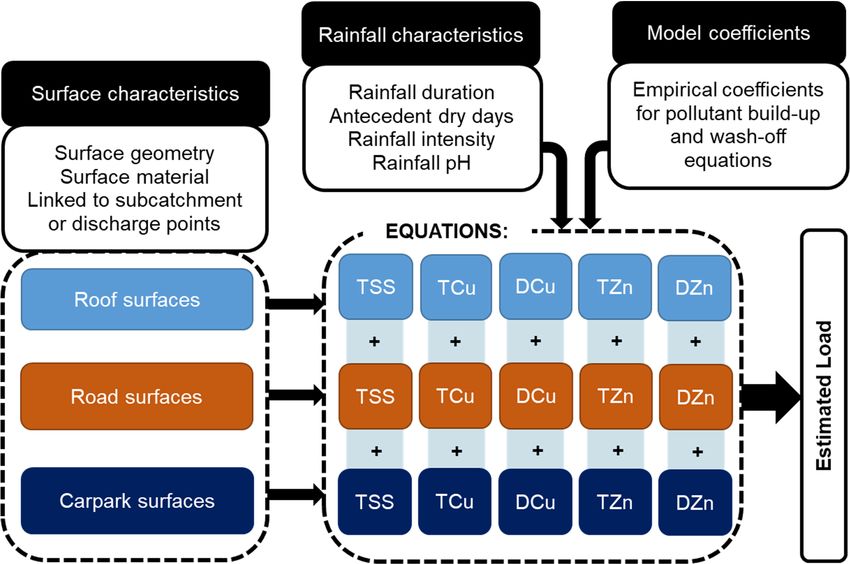
MEDUSA2.0 is an event-based pollutant load process model. It predicts the amount of TSS, TCu,
DCu, TZn, and DZn contributed by an individual impermeable surface during a rain event, on the
basis of the surface area, material type, and the surface’s relationship to specific rainfall characteristics,
namely, rainfall pH, average intensity, duration, and length of antecedent dry period (updated from
Fraga et al. (2016) [29]) (Figure 1 and Table 2). These particular pollutants were prioritized for
modelling as previous receiving environment monitoring had identified these pollutants as elevated
and of concern [31,32].Water 2020, 12, 969 4 of 19
Water 2020, 12, x FOR PEER REVIEW 4 of 19
Figure 1. MEDUSA2.0
MEDUSA2.0 model
model framework.
framework. TSS,
TSS, total
total suspended
suspended solids;
solids; TCu,
TCu, total
total copper;
copper; DCu,
DCu,
dissolved copper; TZn, total zinc; DZn, dissolved zinc.
Table 2.
Table Rainfall characteristics
2. Rainfall characteristics used
used in
in the
the urban
urban runoff
runoff pollutant
pollutant load
load modelling.
modelling.
Rainfall Characteristic
Rainfall Significance in Pollutant Generation Processes
Significance in Pollutant Generation Processes
Characteristic Rainfall is naturally acidic due to raindrops’ scavenging of carbon
Rainfall pH dioxide to form carbonic
Rainfall is naturally acid to
acidic due as they fall. Thescavenging
raindrops’ low pH can of
dissolve
metallic components of a surface [33,34].
Rainfall pH carbon dioxide to form carbonic acid as they fall. The low pH
canAverage event
dissolve intensity
metallic was characterized
components for each
of a surface sampled event.
[33,34].
Rainfall intensity (mm/h) The intensity is an indication of the kinetic energy present that allows
Average event intensity
the entrainment was characterized
and transport of particles infor each
runoff sampled
from a surface [24].
Rainfall intensity event. The intensity is an indication of the kinetic energy present
Pollutants accumulate on impermeable surfaces due to atmospheric
(mm/h) that allows the entrainment
deposition, andfrom
direct deposition transport ofand
vehicles, particles in runoff
weathering of surface,
Length of antecedent dry
from a surface [24].
during the dry periods between rain events. Studies have shown a log
period (days)
or arctan relationship
Pollutants accumulate where pollutant build-up
on impermeable rates due
surfaces are most
to rapid at
the start of the antecedent dry period then slower over time [6].
atmospheric deposition, direct deposition from vehicles, and
Length of Pollutantofwash-off
weathering surface,continues
during thethroughout
dry periodsa rainbetween
event, however,
rain the
antecedent dry rate of wash-off is generally expected to reduce (exponentially) over
Event duration (h) events. Studies have shown a log or arctan relationship where
period (days) the course of a rain event due to the decreasing amount of available
pollutant build-up ratesremaining
material are most rapid
on the at the start
surface [23]. of the
antecedent dry period then slower over time [6].
Greater rainfall depths, and therefore larger rainfall volumes, will
Depth of event (mm) Pollutant wash-off continues throughout a rain event, however,
generate larger total amounts of pollutants [35].
the rate of wash-off is generally expected to reduce
Event duration
(exponentially) over the course of a rain event due to the
MEDUSA2.0 (h) predicts the TSS event load from each contributing road and roof surface (TSSRoad
decreasing amount of available material remaining on the
and TSSRoof ) using a relationship defined in Egodawatta et al. (2009) [1]:
surface [23].
Depth of event TSS Greater rainfall depths,a2 and therefore larger rainfall volumes,
a3 INT×DUR
Road, Roof = A(a1 ADD )(Cf ) 1 − e , (1)
(mm) will generate larger total amounts of pollutants [35].
where A is the surface
MEDUSA2.0 area,
predicts the ADD
TSS is the length
event of antecedent
load from dry period
each contributing road(days), INTsurface
and roof is the average
(TSSRoad
rainfall intensity of the event (mm/h), DUR is the event duration (h),
and TSSRoof) using a relationship defined in Egodawatta et al. (2009) [1]: C f is the capacity factor (simplified
to 0.75 for roofs, 0.25 for roads), and a1 to a3 are empirically-derived coefficient values. The capacity
×
TSS , = A(a ADD )(C )(1 − e ), (1)
where A is the surface area, ADD is the length of antecedent dry period (days), INT is the average
rainfall intensity of the event (mm/h), DUR is the event duration (h), Cf is the capacity factorWater 2020, 12, 969 5 of 19
factor is a measure of a specific rainfall intensity’s ability to mobilize sediment available on the
impermeable surface (1).
Total metal loads from roof surfaces (TCuRoof and TZnRoof ; µg) are predicted using the following
relationship:
TCuRoof , TZnRoof = X0 A k1 1 − ek.INT.DUR for DUR ≤ Z , (2)
TCuRoof , TZnRoof = X0 A k1 1 − ek.INT.Z + Xest A(INT)(DUR − Z) for DUR > Z , (3)
where X0 is the initial copper or zinc concentration (µg/L); Xest is the second stage copper or zinc
concentration (µg/L) that the runoff drops to over a transition period, Z (hours), as observed from the
intra-event concentration sampling; A is surface area (m2 ); k is the wash off coefficient (i.e., based on
the rate of decay to second stage concentrations from initial concentrations); INT is average rainfall
intensity (mm/h); and DUR is event duration (h). X0 and Xest can be described by the following
relationships to rainfall characteristics (where X0 = Cu0 and Xest = Cuest for copper, and X0 = Zn0 and
Xest = Znest for zinc):
Cu0 = b1 PHb2 b3 ADDb4 b5 INTb6 , (4)
Cuest = b7 PHb8 , (5)
Zn0 = (c1 PH + c2 )(c3 ADDc4 )(c5 INTc6 ) , (6)
Znest = c7 PH + c8 , (7)
where PH is rainfall pH, ADD is antecedent dry period (days), INT is average rainfall intensity (mm/h),
and b1 to b8 and c1 to c8 are empirically-derived coefficient values. Note that the relationship of copper
to pH is a power relationship, whereas zinc has a linear relationship with pH that is based on empirical
observations (14).
Total metal loads for road and carpark surfaces were found to strongly correlate to the TSS load in
the calibration data and therefore the model predicts total metal loads for all road and carpark surfaces
as a proportion of the TSS load, as follows:
TCuRoad, Carpark = d1 × TSSRoad, Carpark , (8)
TZnRoad, Carpark = e1 × TSSRoad, Carpark , (9)
where d1 and e1 are dimensionless proportionality coefficients derived from experimental data.
As the heavy metal build-up and wash-off processes remain the same for each surface type across
multiple rain events, the model assumes that the ratio of dissolved to particulate metals is relatively
constant for any given surface type (as evidenced by untreated runoff quality data; see Appendix A).
Accordingly, dissolved metal loads for all roof, road, and carpark surfaces (DCuSurface and DZnSurface )
are calculated as a proportion of the total metal load in the model, as follows:
DCuSurface = f1 × TCuSurface , (10)
DZnSurface = g1 × TZnSurface , (11)
where f1 and g1 are dimensionless proportionality coefficients derived from experimental data.
3. Model Calibration and Validation
3.1. Sample Collection and Analysis for Calibration Data
Runoff quality data was collected from the Okeover catchment in western Christchurch, New
Zealand, to calibrate the MEDUSA2.0 model coefficients for the local (low-intensity) rainfall conditions.
Untreated runoff samples were collected from four different urban surfaces within the Okeover
catchment: a concrete tile roof (a common residential roofing material), a copper roof (used primarilyWater 2020, 12, 969 6 of 19
as an architectural material), a galvanized roof (a common industrial, commercial, and residential
roofing material), and a coarse asphalt road (most common road surface in the city). Further details of
the sampled surfaces’ characteristics are found in Charters et al. (2015) [36].
Time-series samples were collected throughout 25 rain events (see Table A1 in Appendix B) using
a combination of grab sampling and automatic sampling (ISCO 6712C Compact Portable Automatic
Sampler). Samples were analysed for TSS (as per American Public Health Association (APHA) method
2540 D (APHA, 2005)), and TCu, DCu, TZn, and DZn concentrations (as per APHA method 3125 B), as
previous receiving environment monitoring had identified these particular pollutants as elevated and
of concern [31,32].
3.2. Sample Collection and Analysis for Validation Data
First flush (FF; defined as the first 1 L of runoff for this study) and second stage (SS; taken at
least 1 h after FF capture) samples from the Heathcote catchment, adjacent to the Okeover catchment,
were used for validating the models. The validation dataset included a painted galvanized roof and
collector road that were sampled over nine rain events (see Table A2 in Appendix B). Thermo Scientific
Nalgene Storm Water Sampler bottles (1 L high density polyethylene (HDPE)) were used to collect the
FF samples. For the collector road site, they were deployed by suspending the bottle from the sump
grate in the corner of the sump where the initial runoff would flow in. For the galvanized roof site,
the bottle was fitted within a Thermo Scientific Nalgene Storm Water Mounting Kit and fixed under
the downpipe. Grab sampling (1 L HDPE) was used for all SS samples. Samples were analysed for
TSS, TCu, DCu, TZn, and DZn, as per the Okeover samples.
3.3. Sampled Event Rainfall Data
For each sampled event, rainfall was collected and its pH measured during sample collection.
For the Okeover calibration data, rainfall data were sourced from Campbell weather station data
at the University of Canterbury within the Okeover catchment. For the Heathcote validation data,
rainfall data were sourced from the National Institute of Water and Atmosphere’s (NIWA) Kyle St
Weather Station, within 2.5 km of the sampling sites. Rainfall data were compared between the
University of Canterbury station and the NIWA station for the same rain events, as they are 2.2 km
apart, and little difference was found in recorded amount and time of rain start and end, confirming
the appropriateness of using the NIWA station data for the Heathcote sites. The 5 min interval data
were aggregated into average event intensity (mm/hr), antecedent dry period (days), event duration
(hours), and total event depth (mm) for each sampled event (Table 2 and Appendix B). Rainfall within
6 h of the previous rain was considered as being part of the same event.
3.4. Total Event Loads from Observed Concentrations
Event pollutant loads (g/m2 /event or mg/m2 /event) for each surface were calculated on a per area
basis using the measured pollutant concentrations for each sample and rainfall depth accumulated
over the time interval between samples. These event loads derived from observed concentration data
(hereafter, observed loads) were used to both calibrate the model to achieve as close as fit as possible
to these event loads and for validation. Optimal calibration was achieved by adjusting the model
coefficient values (i.e., a1 to a3 in Equation (1), b1 to b8 in Equations (4) and (5), c1 to c8 in Equations (6)
and (7), d1 and e1 in Equations (8) and (9), and f1 and g1 in Equations (10) and (11)) to obtain the best
predictive accuracy and goodness of fit.
3.5. Assessing Model Fit to Case Study Observed Data
The Nash–Sutcliffe model efficiency (NSE) and percent bias (PBIAS) statistics were used to assess
the predictive power of the model and its goodness of fit to observed data for calibration and validation.
The NSE was developed for assessing hydrological models [37], but has also been employed forWater 2020, 12, 969 7 of 19
modelling sediment and nutrient loadings [38]. It describes the predictive accuracy of the model in
comparison to the observed data. The NSE is defined as:
j
PJ j 2
xo − xm
j=1
NSE = 1 − 2 , (12)
PJ j
x
j=1 o
− x 0
j j
where xo is the mean of the observed pollutant loads, xm is the modelled load, and xo is the observed
load for rain event j. An NSE value of 1 indicates a perfect fit between the modelled and observed loads,
a value of 0 < NSE < 1 indicates the model is a better predictor than the observed mean, and NSE = 0
indicates the model is only as accurate as the observed mean, whereas NSE < 0 indicates the observed
mean is a better predictor than the model. Modelled and observed loads were log-transformed before
the NSE was applied to reduce the influence of any peak events as they increase the sensitivity of NSE
to systematic over- or under-prediction [39].
The percent bias (PBIAS) is a measure of the average tendency of the model-predicted values to
be greater or smaller than their observed values [40]. It has been commonly used for hydrological
models and is recognized for its ability to clearly identify poor model performance [40]. The PBIAS is
defined as: P !
( xm − xo )
PBIAS = 100 × P , (13)
xo
where xm is the modelled load and xo is the modelled load and is the observed load. A value of 0
indicates a perfect fit; the smaller the PBIAS value, the better the performance of the model.
4. Case Study Application: Okeover Catchment Description
The Okeover Catchment is a mixed residential/institutional catchment in western Christchurch,
New Zealand. A GIS map of the 61 ha catchment (of which 40% is impermeable) was developed
that delineated all individual roof, road, and carpark surfaces contributing runoff to the stormwater
network and ultimately to the Okeover Stream via multiple discharge points (Figure 2). Each surface
was classified on the basis of material type and assigned appropriate model properties (Figure 3 and
Appendix C). Hardstand areas such as driveways on private residential property were not included in
the modelling as their pollutant loads to the net stormwater runoff were considered to be negligible.
Roofs are the largest surface type in the catchment (58% of impermeable surfaces), with 51% of
roofs galvanized and 25% of roofs concrete tile (Figure 3). MEDUSA2.0 was run for each of the
delineated surfaces.Water 2020, 12, x FOR PEER REVIEW 8 of 19
Water 2020, 12, x FOR PEER REVIEW 8 of 19
Water 2020, 12, 969 8 of 19
Concrete roof
^_
Galvanized roof
Okeo
Asphalt
_
^
road roof
Concrete
^_ _
v er S
tream ^ Copper roof
Asphalt road
_
^ _
^
Galvanized roof
Okeo
v er S
tream ^_ Copper roof
^_
Legend
¯
^_
Legend
Sampling Sites Okeover Stream
Catchment Outline Roofs
¯
^_ Sampling Sites
Discharge Points Okeover Stream
Roads 0 125 250 500
Metres
Catchment Outline Roofs
Carparks
Discharge Points Roads 0 125 250 500
Metres
Carparksand stormwater sampling sites in the Okeover Catchment,
Figure 2. Map of impermeable surfaces
Christchurch, New Zealand.
Figure 2. Map of impermeable surfaces and stormwater sampling sites in the Okeover Catchment,
Figure 2. Map of impermeable surfaces and stormwater sampling sites in the Okeover Catchment,
Christchurch, New Zealand.
Christchurch, New Zealand.
9.8, 40%
10.2, 42%
9.8, 40%
10.2, 42%
Galvanized roof
Concrete roof
Galvanized roof
Copper roof
Concrete roof
Asphalt road and carpark
Copper roof
Asphalt road and carpark
0.1, 1%
4.2, 17%
Figure 3. Relative impermeable area (ha) and percentage of surface type.
0.1, 1% Figure 3. Relative impermeable area (ha) and percentage of surface type.
4.2, 17%
5. Results
Figure 3. Relative impermeable area (ha) and percentage of surface type.
5.1. Optimized Model Fits
The MEDUSA2.0 model produced moderate to strong goodness of fit NSE values for all pollutants,
for all four surfaces (Table 3). Of the four sampled surfaces, the optimized MEDUSA2.0 model was
most effective at predicting road runoff pollutant loads (NSEs of 0.66–0.74). The highest copper loads
(per area) were from the copper roof, and the model was moderately effective at predicting TCu and
DCu from a copper roof (NSEs of 0.46 and 0.69, respectively). The highest zinc loads (per area) were
from the galvanized roof, and MEDUSA2.0 was also effective at predicting TZn and DZn from this
roof type (NSEs of 0.66 and 0.68, respectively). PBIAS results (see Appendix D) were all < ±10 for theWater 2020, 12, 969 9 of 19
MEDUSA2.0 model, with exceptions of the galvanized roof TCu and DCu models and the copper roof
DZn model. The resultant model loads are shown against the observed loads in Figures 4–6.
Table 3. Nash–Sutcliffe model efficiencies (NSEs) of MEDUSA2.0 predicted loads against observed
loads for the Okeover surfaces (calibration) and Heathcote surfaces (validation).
Parameter Surface Okeover Surfaces Heathcote Surfaces
Concrete roof 0.50
TSS Copper roof 0.49
Galvanized roof 0.43 0.63
Asphalt road 0.74 0.75
Concrete roof 0.55
TCu Copper roof 0.46
Galvanized roof 0.58 0.18
Asphalt road 0.66 0.71
Concrete roof 0.47
DCu Copper roof 0.69
Galvanized roof 0.59 −0.72
Asphalt road 0.68 0.69
Concrete roof 0.63
TZn Copper roof 0.68
Galvanized roof 0.66 0.56
Asphalt road 0.73 0.72
Concrete roof 0.69
DZn Copper roof 0.68
Galvanized roof 0.68 0.71
Asphalt road 0.69 0.80
Water Note: TSS,
2020, 12, total PEER
x FOR suspended solids; TCu, total copper; DCu, dissolved copper; TZn, total zinc; DZn, dissolved zinc.
REVIEW 10 of 19
100000
Concrete roof
10000 Copper roof
Galvanized roof
MEDUSA Predicted TSS loads
1000 Asphalt road
100
(mg/m2)
10
1
0.1
0.01 1 100 10000
Observed TSS loads (mg/m2)
Figure 4.
Figure Predicted total
4. Predicted total suspended
suspended solids
solids (TSS)
(TSS) loads
loads against
against observed
observed loads
loads for
for Okeover
Okeover surfaces.
surfaces.
10000000 Concrete roof 10000000 Concrete roof
1000000 Copper roof 1000000 Copper roof
Galvanized roof Galvanized roof
100000 100000
Asphalt road Asphalt road
oads
oads
10000 100001
MEDUSA Pr
(
0.1
0.01 1 100 10000
Observed TSS loads (mg/m2)
Water 2020, 12, 969 10 of 19
Figure 4. Predicted total suspended solids (TSS) loads against observed loads for Okeover surfaces.
10000000 Concrete roof 10000000 Concrete roof
1000000 Copper roof 1000000 Copper roof
Galvanized roof Galvanized roof
100000 100000
Asphalt road Asphalt road
MEDUSA Predicted DCu loads
MEDUSA Predicted TCu loads
10000 10000
1000 1000
100 100
(ug/m2)
(ug/m2)
10 10
1 1
0 0
0 1 100 10000 1000000 0 1 100 10000 1000000
Observed TCu loads (ug/m2) Observed DCu loads (ug/m2)
(a) (b)
Figure
Figure 5. Predicted
5. Predicted loadsagainst
loads against observed
observedloads forfor
loads (a) total copper
(a) total and (b)
copper dissolved
and copper, for
(b) dissolved copper, for
Okeover surfaces.
Okeover surfaces.
Water 2020, 12, x FOR PEER REVIEW 11 of 19
1000000 Concrete roof 1000000 Concrete roof
Copper roof Copper roof
100000 100000
Galvanized roof Galvanized roof
MEDUSA Predicted DZn loads
MEDUSA Predicted TZn loads
10000 Asphalt road 10000 Asphalt road
1000 1000
100 100
(ug/m2)
(ug/m2)
10 10
1 1
0 0
0 1 100 10000 2 1000000 0 1 100 10000 1000000
Observed TZn loads (ug/m ) Observed DZn loads (ug/m2)
(a) (b)
Figure Figure 6. Predicted loads against observed loads for (a) total zinc and (b) dissolved zinc, for Okeover
6. Predicted loads against observed loads for (a) total zinc and (b) dissolved zinc, for
surfaces.
Okeover surfaces.
5.2. Example Application of MEDUSA2.0 to A Case Study Catchment: Okeover Catchment, Christchurch,
MEDUSA2.0
New Zealand produced moderate to strong NSEs when applied to untreated runoff data from the
same surface types in the adjacent Heathcote catchment used for validation (Table 3), with the sole
Once the model was calibrated and its goodness of fit assessed, the calibrated MEDUSA2.0
exception being total and dissolved copper prediction for the galvanised roof. It should be noted that
model was applied to the local Okeover catchment, where the untreated runoff samples used for
the copper
modelconcentrations on the
calibration had been sampled
collected. The galvanized roofs
model was run for awere found
full year to events
of rain be low, as the
from theyear
sole source
was atmospheric deposition.
2012 (see Appendix E for summarized event details), as researchers at the University of Canterbury
had measured rainfall pH for several rain events in 2012. Therefore, a complete set of characterized
5.2. Example
rainfallApplication of MEDUSA2.0
events was available, to A assumptions
with minimal Case Study required
Catchment: Okeover
for rainfall pH.Catchment, Christchurch,
Although there will
New Zealand
be variation from year to year, 2012 also had relatively typical annual rainfall for Christchurch
(Christchurch Botanic Gardens weather station recorded 631 mm annual rainfall for 2012 [41]);
Once the modelmean
Christchurch’s was calibrated andisits
annual rainfall goodness
647 mm [42] ofandfititassessed,
provides antheindication
calibrated of MEDUSA2.0
the expected model
was applied toofthe
variation local
rain Okeover
events across a catchment,
year. Averagewhere the untreated
event loads were derived runoff samples
from the averageused
of all for
88 model
calibration had been
rain events collected. The model was run for a full year of rain events from the year 2012
of 2012.
The modelling
(see Appendix predicted substantial
E for summarized annual as
event details), pollutant loads (Table
researchers at the4),University
with roads and carparks
of Canterbury had
contributing most of the predicted 4.9 t/year of TSS, but roofs contributing most
measured rainfall pH for several rain events in 2012. Therefore, a complete set of characterized of the predicted 54
kg/year of zinc. There was also significant load variation (multiple orders of magnitude) for each
rainfall events was available, with minimal assumptions required for rainfall pH. Although there
pollutant across the 88 modelled events (Figure 7).
will be variation from year to year, 2012 also had relatively typical annual rainfall for Christchurch
(Christchurch Botanic Table Gardens weather
4. Predicted station
total annual recorded
pollutant loads in631 mmcatchment.
Okeover annual rainfall for 2012 [41]);
Christchurch’s mean annual rainfall is 647 mm [42] and it provides
Surface Type TSS (kg/year) TCu (kg/year) TZn (kg/year) an indication of the expected
Roofs 439 1.2 45.3
Roads 2770 1.2 5.4
Carparks 1704 0.8 3.3
Total 4914 3.2 54.1Water 2020, 12, 969 11 of 19
variation of rain events across a year. Average event loads were derived from the average of all 88 rain
events of 2012.
The modelling predicted substantial annual pollutant loads (Table 4), with roads and carparks
contributing most of the predicted 4.9 t/year of TSS, but roofs contributing most of the predicted
54 kg/year of zinc. There was also significant load variation (multiple orders of magnitude) for each
pollutant across the 88 modelled events (Figure 7).
Table 4. Predicted total annual pollutant loads in Okeover catchment.
Surface Type TSS (kg/year) TCu (kg/year) TZn (kg/year)
Roofs 439 1.2 45.3
Roads 2770 1.2 5.4
Carparks 1704 0.8 3.3
Total 4914 3.2 54.1
Water 2020, 12, x FOR PEER REVIEW 12 of 19
1000 1000 10000
1000
100 100
TSS Event Loads (kg)
100
TCu Event Loads (g)
TZn Event Loads (g)
10 10
10
1 1
1
0 0 0
(a) (b) (c)
FigureFigure 7. Event load variation across the 88 modelled events of 2012, by surface type, for (a) TSS, (b)
7. Event load variation across the 88 modelled events of 2012, by surface type, for (a) TSS,
total copper, and (c) total zinc.
(b) total copper, and (c) total zinc.
6. Discussion
6. Discussion
6.1. MEDUSA2.0 Model Performance
6.1. MEDUSA2.0 Model Performance
MEDUSA2.0’s predictive performance was good for all the modelled pollutants with NSE of
MEDUSA2.0’s predictive
≥0.43 for TSS, ≥0.46 for TCu,performance was MEDUSA2.0
and ≥0.63 for TZn. good for alloffers
the modelled pollutants
a process model that canwith
be NSE of
≥0.43 calibrated
for TSS, ≥0.46 for TCu,
to a particular and ≥0.63
catchment usingfor TZn.
local MEDUSA2.0
runoff quality data, offers a process
for estimating model
pollutant that can be
loads
fromto
calibrated individual impermeable
a particular catchment surfaces
usingduring each rain
local runoff event. data,
quality WhereforMEDUSA2.0
estimatingwas able to be
pollutant loads from
applied to surfaces outside the Okeover catchment (i.e., with the Heathcote catchment data), the
individual impermeable surfaces during each rain event. Where MEDUSA2.0 was able to be applied to
model produced moderate to strong NSEs with the sole exception of copper loads from the painted
surfaces outside the Okeover catchment (i.e., with the Heathcote catchment data), the model produced
galvanised roof. However, as the only source of copper on such a roof is from atmospheric deposition
moderate
and istoofstrong NSEs with
low magnitude, it isthe
notsole exception
surprising that anofeffective
coppermodelloadsfitfrom thebepainted
cannot galvanised
readily found. A roof.
However, as the only source of copper on such a roof is from atmospheric deposition
mean value could instead be derived from local runoff data and applied instead of directly modelling and is of low
the copper load on such a low-copper surface using rainfall characteristics.
magnitude, it is not surprising that an effective model fit cannot be readily found. A mean value could
instead be derived from local runoff data and applied instead of directly modelling the copper load on
6.2. Influence of Rainfall Characteristics on Pollutant Loads
such a low-copper surface using rainfall characteristics.
In the MEDUSA2.0 model, ADD is used to predict TSS loads, regardless of surface type, which
is based on observations of dry weather pollutant build-up on surfaces [1,43]. The MEDUSA2.0 model
also assumes rainfall pH is a significant variable relating to both initial and second stage copper
concentrations, and the initial concentrations are also dependent on ADD and average intensity. For
the TCu model, the copper roof was substantially more influenced by rainfall pH than the other two
roof surfaces and, to a lesser extent, by average rainfall intensity (see Appendix D for coefficient
values). For the TZn model, the galvanized roof was more influenced by rainfall pH (particularly
during second stage conditions) than the other two roof surfaces. It was also more influenced by ADD
and, to a lesser extent, average rainfall intensity. This could be expected, as the natural (slight) acidity
of rainfall is a key driver of the copper and zinc generation (via dissolution) on the copper andWater 2020, 12, 969 12 of 19
6.2. Influence of Rainfall Characteristics on Pollutant Loads
In the MEDUSA2.0 model, ADD is used to predict TSS loads, regardless of surface type, which is
based on observations of dry weather pollutant build-up on surfaces [1,43]. The MEDUSA2.0 model
also assumes rainfall pH is a significant variable relating to both initial and second stage copper
concentrations, and the initial concentrations are also dependent on ADD and average intensity. For the
TCu model, the copper roof was substantially more influenced by rainfall pH than the other two roof
surfaces and, to a lesser extent, by average rainfall intensity (see Appendix D for coefficient values). For
the TZn model, the galvanized roof was more influenced by rainfall pH (particularly during second
stage conditions) than the other two roof surfaces. It was also more influenced by ADD and, to a lesser
extent, average rainfall intensity. This could be expected, as the natural (slight) acidity of rainfall is
a key driver of the copper and zinc generation (via dissolution) on the copper and galvanized roofs,
respectively. Likewise, the influence of ADD could be expected as the dry weather period allows
build-up of pollutants from atmospheric deposition, but also, importantly, contributes to weathering
and degradation of the metallic surfaces with a corresponding increased leaching rate.
Gnecco et al. [11] did not find any correlation between runoff pollutant amounts such as event
mean concentration (EMC) and ADD, and attributed this to the low-to-medium rainfall intensity and
low total rainfall volume of their sampled events, where the amount of pollutant wash-off was too
low to show differences in dry weather TSS build-up between each event. This study’s rainfall is
similarly of low intensity. A study within the same Okeover catchment of atmospherically deposited
TSS, copper, and zinc did show that pollutant build-up was significantly influenced by ADD; however,
pollutant wash-off processes had a stronger influence than build-up processes on the overall pollutant
loads generated from atmospheric deposition [18].
6.3. Individual Model Limitations
Currently, MEDUSA2.0 has a restricted number of pollutant–rainfall parameter relationships,
which may inadvertently present inaccurate model coefficient values. For example, the calibrated TSS
coefficient values for MEDUSA2.0 suggests that the copper roof was substantially more influenced by
ADD than the concrete and galvanised roofs (i.e., higher ADD coefficient values; see Appendix D).
However, because MEDUSA2.0’s framework is restricted to relating TSS loads to ADD only, it is likely
that the high TSS loads from copper roofs are not due directly to ADD (patination is largely driven by
water, carbon dioxide, and time), but simply a means by which the model can reproduce high TSS
loads. Furthermore, the NSE values of the calibrated MEDUSA2.0 model were lower for TSS than
for metal predictions, suggesting that factors beyond rainfall characteristics are important drivers
of pollutant build-up and wash-off. As always, there is a balance sought in the model framework
between achieving a reasonable fit without over-parameterization of the model or creating an overly
complex running process. Further research is needed to characterize a wider variety of surface types
(such as commercial and industrial carparks and roads of different traffic characteristics) to better
represent them in the model and incorporate surface factors such as aspect and slope as appropriate.
MEDUSA2.0’s use of generalized build-up and wash-off equations allows the model to be applied to
catchments outside of Christchurch’s low intensity rainfall climate, and further studies are presently
underway to assess the ease and effectiveness of recalibrating MEDUSA2.0 to other catchments as well
as serving as further model validation.
MEDUSA2.0 predicts pollutant loads as they are generated at each surface, and therefore does not
account for pollutant changes as runoff is conveyed through the stormwater network or discharged
into the receiving waterway. Additionally, the presence of sumps (and other (pre)treatment systems),
for example, may induce settling of coarse sediment and associated metals, which are removed from
the stormwater runoff.
Within its current scope, MEDUSA2.0 allows stormwater managers to identify individual or
aggregated impermeable surfaces that can be targeted for optimized stormwater management. However,
further research is needed to incorporate multiple stormwater management options and pollutantWater 2020, 12, 969 13 of 19
transformation processes into the MEDUSA2.0 model framework so that different management
strategies can be computed within the modelled scenarios.
6.4. Data Limitations
As the available dataset for MEDUSA2.0 model calibration was limited, the entire Okeover dataset
was used for calibration instead of truncating the dataset for calibration and having a small validation
dataset (following similar approaches by hydrologic modellers, for example Shrestha et al. (2016) [44]).
Limited validation data were then provided from untreated runoff sampling in an adjacent catchment
for two of the same surface types sampled and modelled in the Okeover catchment. These showed
good model performance for the key pollutants of concern from those particular surface types. Further
validation data should now be collected from the same surface types as the model has been calibrated
for in different geographical locations to expand the conditions under which the model performance
is validated. The significant load variation observed in the modelled results for the Okeover case
study application indicate that validation data would be particularly valuable for events with rainfall
characteristics that produce high event loads (e.g., long duration rain events).
The sampling dataset (that was used to calibrate the model and apply it to the Okeover catchment)
was restricted to the four most common impermeable surface types within the catchment. Therefore,
assumptions were made by assigning model coefficient values to all the other surface types present in
the catchment (Appendix C). Further untreated runoff water quality data are needed from different
surface types, particularly carparks, unpainted galvanised roofs, and new painted Zincalume roofs
(e.g., Colorsteel) to enable the calibration of model coefficients for a wider range of surface types.
6.5. Implications of Model Predictions on Management Approaches
The variation in MEDUSA2.0 pollutant loading from individual surfaces confirms that it is
necessary to apply pollutant load models at an individual surface scale rather than a catchment or
land use scale, as surface type is a key driver of pollutant generation. The variations for each pollutant
type, for the same surface, also reinforce the need to use specific relationships for each pollutant and
rain event, rather than assuming metal loads are proportional to sediment loads as is done with many
current models. Metals in dissolved form were a major contributor to metal loads, and therefore it
is important that any pollutant model framework does incorporate dissolved metals predictions, as
understanding the proportion of metals in dissolved form influences the treatment system selection
and source reduction decisions for most effective pollution management. The predicted load variation
across multiple rain events must be considered when selecting and designing pollutant treatment
systems to ensure effective sizing and maintenance planning.
7. Conclusions
The improvements made to develop MEDUSA2.0 have resulted in a model that performs well
in predicting TSS, total and dissolved copper, and total and dissolved zinc loads generated from
individual impermeable urban surfaces, with common rainfall parameters being used as the predictor
variables. Moderate to strong NSE goodness of fit values were achieved in most instances.
Quantifying the amount of pollutants contributed by each surface during rain events is necessary
for the development and implementation of effective and efficient stormwater management options.
Furthermore, adopting a modelling approach to predict pollutant loads derived from different
impermeable surfaces offers a more cost-effective and reliable tool for understanding pollutant
“hotspots” than can be achieved through water quality sampling alone.
Author Contributions: Conceptualization, F.J.C., T.A.C. and A.D.O.; methodology, F.J.C., T.A.C. and A.D.O.;
validation, F.J.C.; formal analysis, F.J.C.; investigation, F.J.C.; resources, T.A.C. and A.D.O.; data curation, F.J.C.;
writing—original draft preparation, F.J.C.; writing—review and editing, F.J.C., T.A.C. and A.D.O.; visualization,
F.J.C.; supervision, T.A.C. and A.D.O; project administration, F.J.C., T.A.C. and A.D.O.; funding acquisition, F.J.C.,
T.A.C. and A.D.O. All authors have read and agreed to the published version of the manuscript.Water 2020, 12, 969 14 of 19
Funding: This research received funding from Christchurch City Council, and Frances Charters received
scholarship funding while she undertook research on MEDUSA2.0 development and application from the
Waterways Centre for Freshwater Management and University of Canterbury’s Department of Civil and Natural
Resources Engineering and Scholarships Office.
Acknowledgments: We would like to thank Peter McGuigan from the University of Canterbury for his technical
support in the field and in the lab.
Conflicts of Interest: Christchurch City Council approved the Heathcote sampling sites on the basis of the
researchers’ recommendations. The authors declare no other conflict of interest.
Appendix A
Total and Dissolved Metal Relationships from Untreated Runoff Sampling Data
Comparison of observed dissolved loads against total loads for copper and zinc show a strong
linear relationship, particularly for the surfaces with the highest loads (Figure A1). This provides
a sound basis for the MEDUSA2.0 framework to use a proportional relationship in calculating dissolved
metalsWater
from total
2020, 12, xmetal loads.
FOR PEER REVIEW 15 of 19
10000000 10000000
Concrete roof
1000000 Copper roof 1000000
Galvanized roof
100000 100000
Asphalt road
DCu loads (ug/m2)
10000 10000
DZn loads (ug/m2)
1000 1000
100 100
10 10
1 1
0 0
0 1 100 10000 1000000 0 1 100 10000 1000000
TCu loads (ug/m2) TZn loads (ug/m2)
(a) (b)
A1. Relationship
FigureFigure between
A1. Relationship observed
between observeddissolved
dissolved loads andobserved
loads and observed total
total loads
loads forcopper
for (a) (a) copper and
(b) zinc.
and (b) zinc.
Appendix B B
Appendix
Summary of Sampled
Summary Rainfall
of Sampled Event
Rainfall EventCharacteristics
Characteristics
Table
Table A1.B1. Okeoversampled
Okeover sampled event
eventcharacteristics,
characteristics,usedused
for calibration.
for calibration.
Rainfall Average Event Antecedent Dry Event Total Rainfall
Event Date Average Event Antecedent Total
pH Rainfall
Intensity Event
Event Date pH (mm/h)
IntensityDays (days)
Dry Days Duration (h) Depth (mm)
Rainfall
Duration (h)
8 December (mm/h) (days) Depth (mm)
1 5.90 2.82 10.8 3.6 10.1
1 2013
8 December 2013 5.90 2.82 10.8 3.6 10.1
17 December
2 2 17 December 2014 7.86 7.86 1.27 1.27 4.1 4.1 3.4 3.4 4.4
4.4
2014
3 20 January 2014 7.78 0.68 13.5 14.3 9.7
20 January
3 4 26 January2014
7.78 5.78
0.68 0.46
13.5 3.1
14.36.4 9.7
2.9
2014
5 26
5 February 2014 6.46 0.80 9.3 0.3 0.2
4 5.78 0.46 3.1 6.4 2.9
6 January2014
12 February 2014 6.35 3.41 3.6 4.0 13.6
5 February
5 7 14 February 2014 6.46 6.33 0.80 0.20 9.3 1.1 0.3 5.1 0.2
1.0
2014
8 4 March 2014
12 February 6.35 4.61 0.6 31.3 144.2
6 6.35 3.41 3.6 4.0 13.6
9 201416 March 2014 6.38 3.00 10.5 16.3 41.2
10 14 February
25 March 2014 5.58 0.20 6.1 0.1 0.2
7 6.33 0.20 1.1 5.1 1.0
2014
8 4 March 2014 6.35 4.61 0.6 31.3 144.2
9 16 March 2014 6.38 3.00 10.5 16.3 41.2
10 25 March 2014 5.58 0.20 6.1 0.1 0.2
11 25 March 2014 5.58 3.20 0.2 2.9 9.2
12 5 April 2014 5.98 1.47 10.7 3.6 2.2
13 5 May 2014 6.01 1.60 5.6 0.3 0.4
14 26 May 2014 5.86 2.40 0.6 4.9 5.2
15 6 June 2014 6.26 0.30 0.3 1.3 0.4Water 2020, 12, 969 15 of 19
Table A1. Cont.
Average Event Antecedent Total
Event
Event Date Rainfall pH Intensity Dry Days Rainfall
Duration (h)
(mm/h) (days) Depth (mm)
11 25 March 2014 5.58 3.20 0.2 2.9 9.2
12 5 April 2014 5.98 1.47 10.7 3.6 2.2
13 5 May 2014 6.01 1.60 5.6 0.3 0.4
14 26 May 2014 5.86 2.40 0.6 4.9 5.2
15 6 June 2014 6.26 0.30 0.3 1.3 0.4
16 9 June 2014 5.82 1.37 0.2 31.4 43.0
17 16 June 2014 5.46 2.40 3.9 0.3 0.8
18 25 June 2014 5.81 1.48 7.3 1.1 1.6
19 3 October 2014 5.74 2.03 5.4 1.1 2.2
20 18 October 2014 5.10 0.56 5.4 3.6 2.0
21 22 November 2014 5.67 0.53 2.8 2.4 1.3
22 10 December 2014 5.93 0.80 0.2 1.3 1.0
23 9 February 2015 6.31 0.90 3.6 0.7 0.6
24 6 March 2015 6.05 1.41 3.2 4.3 6.0
Table A2. Heathcote sampled event characteristics, used for validation.
Average Event Antecedent Total
Event
Event Date Rainfall pH Intensity Dry Days Rainfall
Duration (h)
(mm/h) (days) Depth (mm)
1 8 July 2016 6.29 0.81 9.66 4.0 3.2
2 3 August 2016 6.60 0.16 3.23 8.8 1.4
3 4 August 2016 6.02 0.43 0.71 6.8 2.9
4 13 August 2016 6.64 0.49 4.24 18.0 8.8
5 26 August 2016 6.79 1.76 1.29 8.0 14.0
6 7 September 2016 6.53 0.79 1.45 24.8 19.5
7 14 October 2016 6.74 0.47 2.01 5.8 2.7
8 20 October 2016 6.17 1.70 5.60 22.3 37.8
9 11 November 2016 –1 0.40 2.22 17.5 7.0
1 Rainfall pH not recorded for Event 9.
Appendix C
Notes:
Calibration data were available for four different surface types: a concrete tile roof (Cr), a copper
roof (Cu), a galvanized roof (Gv), and an asphalt road (Rd). Validation data were available for Gv
and Rd.
Table A3. Category allocation for Okeover surface types on the basis of calibrated model coefficients
(see Appendix D).
Surface Type Modelled Category
Galvanised roofs (all age and conditions)
Zincalume and Colorsteel roofs (all age and conditions) Gv
Decramastic tile roofs (all age and conditions)
Copper roofs (all age and conditions) Cu
Concrete roofs
Cr
Butynol, glass, fiberglass roofs, and other non-metallic roof materials
Roads (all traffic intensities and surface materials)
Rd
Carparks (all usage types and condition)Water 2020, 12, 969 16 of 19
Appendix D
Notes:
For Tables A4–A8: Cr = concrete tile roof; Cu = copper roof; Gv = galvanized roof; Rd =
asphalt road.
See Equations (1) to (11) for coefficient relationships to model variables.
Table A4. Optimized MEDUSA2.0 model coefficient values and goodness of fit statistics for TZn.
TZn Coefficients (Equations (6), (7), and (9)) NSE PBIAS
Surface
b1 b2 b3 b4 b5 b6 b7 b8 Z c1
Cr 50 2600 0.1 0.01 1 −3.1 −0.007 0.056 0.75 0.632 −1.71
Cu −0.1 2 0.1 0.01 0.8 −1.3 −0.007 0.056 0.75 0.679 −7.02
Gv 910 4 0.2 0.09 1.5 −2 −0.23 1.990 0.75 0.657 3.97
Rd 1.96 0.731 1.14
Table A5. Optimized MEDUSA2.0 model coefficient values and goodness of fit statistics for DZn.
DZn Coefficient
Surface (Equation (11)) NSE PBIAS
d1
Cr 0.67 0.69 −5.2
Cu 0.72 0.68 −10.6
Gv 0.43 0.68 1
Rd 0.43 0.69 −3.26
Table A6. Optimized MEDUSA2.0 model coefficient values and goodness of fit statistics for TCu.
TCu Coefficients (Equations (4), (5), and (8)) NSE PBIAS
Surface
b1 b2 b3 b4 b5 b6 b7 b8 Z c1
Cr 2 −2.8 0.5 0.217 3.57 −0.09 7 −3.73 0.75 0.55 1.67
Cu 100 −2.8 1.372 0.217 3.57 −1 275 −3.3 0.75 0.68 −5.09
Gv 2 −2.8 0.5 0.217 3.57 −0.09 7 −3.73 0.75 0.58 11.47
Rd 0.441 0.69 −0.05
Table A7. Optimized MEDUSA2.0 model coefficient values and goodness of fit statistics for DCu.
DCu Coefficient
Surface (Equation (10)) NSE PBIAS
d1
Cr 0.46 0.47 9.4
Cu 0.77 0.69 −5.8
Gv 0.28 0.59 37
Rd 0.28 0.68 4.9Water 2020, 12, 969 17 of 19
Table A8. Optimized MEDUSA2.0 model coefficient values and goodness of fit statistics for TSS.
TSS Coefficients (Equation (1))
Surface NSE PBIAS
a1 a2 a3
Cr 0.6 0.25 9.33 × 10⁻³ 0.503 0.2
Cu 2.5 0.95 9.33 × 10⁻³ 0.487 −3.2
Gv 0.6 0.5 9.33 × 10⁻³ 0.430 −4.5
Rd 2.9 0.16 8.0 × 10⁻⁴ 0.736 0.1
Appendix E
Table A9. Summarized rainfall event characteristics for the year 2012.
Rainfall Parameter Median Value (Range)
Number of rain events 88
Rainfall pH 6.01 (5.19–7.15)
Average intensity (mm/h) 0.53 (0.12–4.00)
Antecedent dry days (days) 3.0 (0.2–19.0)
Event duration (hours) 5.0 (1.0–41.0)
References
1. Egodawatta, P.; Thomas, E.; Goonetilleke, A. Understanding the physical processes of pollutant build-up
and wash-off on roof surfaces. Sci. Total. Environ. 2009, 407, 1834–1841. [CrossRef] [PubMed]
2. Wicke, D.; Cochrane, T.; O’Sullivan, A. Build-up dynamics of heavy metals deposited on impermeable urban
surfaces. J. Environ. Manag. 2012, 113, 347–354. [CrossRef] [PubMed]
3. Zanders, J. Road sediment: Characterization and implications for the performance of vegetated strips for
treating road run-off. Sci. Total. Environ. 2005, 339, 41–47. [CrossRef] [PubMed]
4. Sabin, L.D.; Lim, J.H.; Stolzenbach, K.D.; Schiff, K.C. Contribution of trace metals from atmospheric deposition
to stormwater runoff in a small impervious urban catchment. Water Res. 2005, 39, 3929–3937. [CrossRef]
[PubMed]
5. Quek, U. Trace metals in roof runoff. Water, Air, Soil Pollut. 1993, 68, 373–389. [CrossRef]
6. Wicke, D.; Cochrane, T.; O’Sullivan, A.D.; Cave, S.; Derksen, M. Effect of age and rainfall pH on contaminant
yields from metal roofs. Water Sci. Technol. 2014, 69, 2166–2173. [CrossRef]
7. Barrett, M.; Irish, L.B., Jr.; Malina, J.F., Jr.; Charbeneau, R.J. Characterization of Highway Runoff in Austin,
Texas, Area. J. Environ. Eng. 1998, 124, 131–137. [CrossRef]
8. He, W.; Wallinder, I.O.; Leygraf, C. A laboratory study of copper and zinc runoff during first flush and
steady-state conditions. Corros. Sci. 2001, 43, 127–146. [CrossRef]
9. Brezonik, P.L.; Stadelmann, T.H. Analysis and predictive models of stormwater runoff volumes, loads, and
pollutant concentrations from watersheds in the Twin Cities metropolitan area, Minnesota, USA. Water Res.
2002, 36, 1743–1757. [CrossRef]
10. Vaze, J.; Chiew, F.H.S. Study of pollutant washoff from small impervious experimental plots. Water Resour.
Res. 2003, 39. [CrossRef]
11. Gnecco, I.; Berretta, C.; Lanza, L.G.; La Barbera, P. Storm water pollution in the urban environment of Genoa,
Italy. Atmos. Res. 2005, 77, 60–73. [CrossRef]
12. Crabtree, B.; Moy, F.; Whitehead, M.; Roe, A. Monitoring pollutants in highway runoff. Water Environ. J.
2006, 20, 287–294. [CrossRef]
13. Desta, M.B.; Bruen, M.; Higgins, N.; Johnston, P. Highway runoff quality in Ireland. J. Environ. Monit. 2007,
9, 366. [CrossRef] [PubMed]
14. Wicke, D.; Cochrane, T.; O’Sullivan, A.; Hutchinson, J.; Funnell, E. Developing a Rainfall Contaminant
Relationship Model for Christchurch Urban Catchments. In Proceedings of the Water New Zealand’s 6th
South Pacific Stormwater Conference, Auckland, New Zealand, April 2009.Water 2020, 12, 969 18 of 19
15. Brodie, I.; Dunn, P.K. Commonality of rainfall variables influencing suspended solids concentrations in
storm runoff from three different urban impervious surfaces. J. Hydrol. 2010, 387, 202–211. [CrossRef]
16. Brodie, I.; Egodawatta, P. Relationships between rainfall intensity, duration and suspended particle washoff
from an urban road surface. Hydrol. Res. 2011, 42, 239–249. [CrossRef]
17. Gunawardena, J.; Egodawatta, P.; Ayoko, G.A.; Goonetilleke, A. Atmospheric deposition as a source of heavy
metals in urban stormwater. Atmos. Environ. 2013, 68, 235–242. [CrossRef]
18. Murphy, L.U.; Cochrane, T.; O’Sullivan, A. Build-up and wash-off dynamics of atmospherically derived Cu,
Pb, Zn and TSS in stormwater runoff as a function of meteorological characteristics. Sci. Total. Environ. 2015,
508, 206–213. [CrossRef]
19. Cheema, P.P.S.; Reddy, A.S.; Kaur, S. Characterization and prediction of stormwater runoff quality in
sub-tropical rural catchments. Water Resour. 2017, 44, 331–341. [CrossRef]
20. Salim, I.; Paule-Mercado, M.C.; Sajjad, R.U.; Memon, S.A.; Lee, B.-Y.; Sukhbaatar, C. Trend analysis of rainfall
characteristics and its impact on stormwater runoff quality from urban and agricultural catchment. Membr.
Water Treat. 2019, 10, 45–55.
21. Bak,
˛ Ł.; Szelag,
˛ B.; Górski, J.; Górska, K. The Impact of Catchment Characteristics and Weather Conditions
on Heavy Metal Concentrations in Stormwater—Data Mining Approach. Appl. Sci. 2019, 9, 2210. [CrossRef]
22. Poudyal, D.S. Characterizing Stormwater Pollutant Yields from Urban Carparks in a Low-Intensity Rainfall Climate;
University of Canterbury: Christchurch, New Zealand, 2019.
23. Charbeneau, R.J.; Barrett, M.E. Evaluation of methods for estimating stormwater pollutant loads. Water
Environ. Res. 1998, 70, 1295–1302. [CrossRef]
24. Egodawatta, P.; Thomas, E.; Goonetilleke, A. Mathematical interpretation of pollutant wash-off from urban
road surfaces using simulated rainfall. Water Res. 2007, 41, 3025–3031. [CrossRef] [PubMed]
25. Deletic, A.; Maksimovic, C.E.; Ivetic, M. Modelling of storm wash-off of suspended solids from impervious
surfaces. J. Hydraul. Res. 1997, 35, 99–118. [CrossRef]
26. Zoppou, C. Review of urban storm water models. Environ. Model. Softw. 2001, 16, 195–231. [CrossRef]
27. Auckland Regional Council. Development of the Contaminant Load Model; Auckland Regional Council:
Auckland, New Zealand, 2010.
28. James, W.; Boregowda, S. Continuous Mass-Balance of Pollutant Build-Up Processes; Springer Science and
Business Media: Berlin, Germany, 1986; pp. 243–271.
29. Fraga, I.; Charters, F.; O’Sullivan, A.; Cochrane, T. A novel modelling framework to prioritize estimation of
non-point source pollution parameters for quantifying pollutant origin and discharge in urban catchments. J.
Environ. Manag. 2016, 167, 75–84. [CrossRef]
30. Sartor, J.D.; Boyd, G.B.; Agardy, F.J. Water pollution aspects of street surface contaminants. J. Water Pollut.
Control. Fed. 1974, 46.
31. Margetts, B. Wet Weather Monitoring Report for the Period May 2013–April 2014; Christchurch City Council:
Christchurch, New Zealand, 2014.
32. Margetts, B.; Marshall, W. Wet Weather Monitoring Report for the Period 14–April 2015; Christchurch City
Council: Christchurch, New Zealand, 2015.
33. Clark, S.E.; Steele, K.A.; Spicher, J.; Siu, C.Y.; Lalor, M.M.; Pitt, R.E.; Kirby, J.T. Roofing Materials’ Contributions
to Storm-Water Runoff Pollution. J. Irrig. Drain. Eng. 2008, 134, 638–645. [CrossRef]
34. Förstner, U.; Wittmann, G.T. Metal Pollution in the Aquatic Environment; Springer Science & Business Media:
Berlin, Germany, 2012.
35. Chui, P. Characteristics of Stormwater Quality from Two Urban Watersheds in Singapore. Environ. Monit.
Assess. 1997, 44, 173–181. [CrossRef]
36. Charters, F.; Cochrane, T.; O’Sullivan, A.D. Particle size distribution variance in untreated urban runoff and
its implication on treatment selection. Water Res. 2015, 85, 337–345. [CrossRef]
37. Nash, J.E.; Sutcliffe, J.V. River Flow forecasting through conceptual models-Part I: A discussion of principles.
J. Hydrol. 1970, 10, 282–290. [CrossRef]
38. Moriasi, D.N.; Arnold, J.G.; Van Liew, M.W.; Bingner, R.L.; Harmel, R.D.; Veith, T.L. Model Evaluation
Guidelines for Systematic Quantification of Accuracy in Watershed Simulations. Trans. ASABE 2007, 50,
885–900. [CrossRef]
39. Krause, P.; Boyle, D.P.; Bäse, F. Comparison of different efficiency criteria for hydrological model assessment.
Adv. Geosci. 2005, 5, 89–97. [CrossRef]You can also read


