Residential Property Behavior Forecasting in the Metropolitan City of Milan: Socio-Economic Characteristics as Drivers of Residential Market Value ...
←
→
Page content transcription
If your browser does not render page correctly, please read the page content below
sustainability

Article
Residential Property Behavior Forecasting in the Metropolitan
City of Milan: Socio-Economic Characteristics as Drivers of
Residential Market Value Trends
Marzia Morena * , Genny Cia                    , Liala Baiardi       and Juan Sebastián Rodríguez Rojas

                                          Department of Architecture, Built Environment and Construction Engineering, Politecnico di Milano,
                                          Via Bonardi 9, 20133 Milan, Italy; genny.cia@polimi.it (G.C.); liala.baiardi@polimi.it (L.B.);
                                          juansebastian.rodriguez@mail.polimi.it (J.S.R.R.)
                                          * Correspondence: marzia.morena@polimi.it; Tel.: +39-02-2399-5189

                                          Abstract: The phenomenon of urbanization of cities has been the subject of numerous studies
                                          and evaluation protocols proposing to analyze the degree of economic and social sustainability of
                                          development projects. Through careful research and synthesis of the theoretical framework regarding
                                          residential properties’ performance measurement and forecasting, this paper goes deeper into the
                                          proposition of property development as an asset class that represents the biggest share of the Italian
                                          property market and yet is avoided by the big portfolios. The analysis model was applied to the city
                                          of Milan and its Metropolitan Area. The method is based on the development of correlation indices
                                to evaluate different behaviors, through time and a Geographic Information System (GIS) based on

                                          the Hedonic Price Method (HPM). Results from a hedonic model estimated for several recent years
Citation: Morena, M.; Cia, G.;            suggest that, depending on the particular view, the relation between the rent/price performance
Baiardi, L.; Rodríguez Rojas, J.S.
                                          and the different external and intrinsic variables can represent a useful parameter for evaluating the
Residential Property Behavior
                                          feasibility of different real estate investments.
Forecasting in the Metropolitan City
of Milan: Socio-Economic
                                          Keywords: real estate market; residential property; hedonic price method (HPM); urban sustainabil-
Characteristics as Drivers of
                                          ity; urban transformation
Residential Market Value Trends.
Sustainability 2021, 13, 3612.
https://doi.org/10.3390/su13073612

Academic Editors: Jorge Chica-Olmo        1. Introduction
and Ángeles Sánchez                            The nature of the property market causes the construction of predictions to be de-
                                          pendent on many factors that are often ignored or undervalued, as well as on the already
Received: 1 February 2021                 existing factors that determine less perceptible changes. According to various international
Accepted: 17 March 2021                   research works carried out at an urban level, the true nature of the change in real estate
Published: 24 March 2021                  values lies in trends that may be due to the simple perception of the population [1,2], a
                                          complex urban process [3,4], or, on occasion, situations where the price system may not
Publisher’s Note: MDPI stays neutral      immediately reflect the changes suffered by the area in recent times [5,6].
with regard to jurisdictional claims in
                                               The possibility that residential Real Estate might not be efficiently upraised was
published maps and institutional affil-
                                          given a strong foundation by Case and Shiller (1989) [7]. The authors state that there is a
iations.
                                          correlation and predictability in the average cost of housing prices but establishes the idea
                                          of a possible correlation between future prices with immediate rents as a natural behavior
                                          of residential real estate. When considering residential properties, predictability states and
                                          reinforces the idea of a sequential correlation [8].
Copyright: © 2021 by the authors.              The susceptibility of house prices, and the model with which such prices are calculated,
Licensee MDPI, Basel, Switzerland.        are presented by Poterba (1984) [9] stating that a perfectly informed model of house prices
This article is an open access article
                                          may have positive shocks followed by declining prices and vice versa; this is related to the
distributed under the terms and
                                          lags in the supply of new assets. Even if these scenarios are known and incorporated into
conditions of the Creative Commons
                                          the model, the nature of the market creates a serial correlation and then, even if these lags
Attribution (CC BY) license (https://
                                          are well known and fully incorporated into expectations, “they still create serial correlation
creativecommons.org/licenses/by/
                                          and (somewhat) predictable house price movements in reaction to shocks” [10].
4.0/).

Sustainability 2021, 13, 3612. https://doi.org/10.3390/su13073612                                     https://www.mdpi.com/journal/sustainability
Sustainability 2021, 13, 3612                                                                                               2 of 25

                                      Poterba [9] presents an asset market model for residential real estate and he estimates
                                how changes and inflation rates affect the equilibrium of prices. Then, making a model for
                                deducting changes in Real Estate, he includes the effectiveness of the market, like Campbell
                                (1999) [11]; if markets are efficient, value/income proportions ought to be decidedly
                                connected with resulting profit (and value) growth.
                                      Over the past 10 years, extensive research has attempted to evaluate the dynamics
                                involved in metropolitan cities by comparing them. Most of these studies have defined
                                synthetic indicators to measure urban smartness [12] as well as its dimensions and produc-
                                tivity. Kitchin et al. (2015) and Vanolo, (2015) [13,14] have found that although indicators
                                are an effective means of describing complex phenomena and supporting decision-making
                                processes to define adequate urban strategies and actions, sometimes they do not allow
                                measurable elements such as social, demographic, and cultural differences between cities.
                                      The behavior of the real estate market and, in particular, the residential sector, in a large
                                city varies from that of small, medium-sized, and large cities; it is necessary to consider
                                the main differences due to the size of the sector and the dynamics of a metropolitan
                                city. Moreover, it is necessary to add that housing markets are not homogenous across
                                metropolises. Aggregating data at the national level may disguise the true volatility at
                                a local level that homeowners face and care about [15]. In the same way, the areas of a
                                metropolitan city may not reflect the general behavior of the neighborhood or even the
                                sector.
                                      It is precisely this context that the Research Project of Relevant National Interest (PRIN)
                                “Metropolitan cities: territorial economic strategies, financial constraints and circular
                                regeneration” includes their research results (the Projects of Relevant National Interest
                                (PRIN) Are Research Projects Funded by the Italian Ministry of Education, University and
                                Research (MIUR) with the Aim of Strengthening the National Scientific Bases, Also in
                                View of a More Effective Participation in European Initiatives Relating to the Framework
                                Programs).
                                      This research project involved four different research units (UdR): Architecture, Built
                                Environment and Construction Engineering Department of Politecnico di Milano, Iuav
                                University of Venice, University of Bari Aldo Moro and the University of Naples Federico
                                II. The three-year research project aims to investigate the evolution over time of the rela-
                                tionships between the central city and the metropolitan suburbs through census data of the
                                functions and activities hosted. It also intends to deepen the trend of public investments,
                                taxation relating to the metropolitan city, and finally the analysis of the profile of land and
                                real estate income from the center to the periphery of the metropolitan cities.
                                      One of the aims of the research is to demonstrate the trends in ten Italian metropolitan
                                cities and, for Politecnico di Milano research unit, the in-depth study and analysis of the
                                trend of real estate values in the Metropolitan City of Milan.
                                      The analysis of land and real estate trends started in one of the first phases of PRIN
                                Project (Baiardi et al. 2019) [16], within which the variations in price and rental value were
                                analyzed, as well as the capitalization rate.
                                      The research continued with an in-depth analysis of the trends in real estate values
                                in the residential sector and of the factors that can influence them. It is precisely on this
                                theme that this paper focuses.
                                      The research therefore provided the preparation and processing of data through the
                                creation of special indices used to monitor and map residential real estate performance
                                given by data pertinent to the Real Estate Market, making use of data provided by the
                                Agenzia delle Entrate (Agenzia delle Entrate—Revenue Agency—is the Italian Revenue
                                Agency, a non-economic public body that operates to ensure the highest level of tax
                                compliance. It is mainly responsible for collecting tax revenues, providing services and
                                assistance to taxpayers and carrying out assessment and inspections aimed at countering
                                tax evasion. It also provides cadastral and geocartography services, manages all the
                                payment to public administration, handles the e-invoice for all the public authorities and
                                the Health Insurance Card); as well as the identification of socioeconomic factors related
Sustainability 2021, 13, 3612                                                                                              3 of 25

                                to these trends. Using real observations of housing transactions in the residential market,
                                from 2006 to 2017, the analysis conducted aims to identify the possible future scenarios
                                of the residential property market of the metropolitan city of Milan in specific areas of
                                interest.

                                2. Methodology
                                      The paper aims to identify, through an analysis of price variations, external and
                                intrinsic characteristics, the possible future scenarios of the residential real estate market
                                of the metropolitan city of Milan in specific areas of interest, building-specific tools for
                                decision-making, and analysis of risk.
                                      The construction of a model to analyze trends and investment opportunities in the real
                                estate market of the metropolitan city of Milan involves several steps: The analysis of the
                                previous conditions that have led to the current market situation through the evaluation
                                of the series of existing data (Residential transactions occurred between 2006 and 2017),
                                the assumption of certain parameters and general conditions as well as the analysis of
                                the dynamics existing between the city and its metropolitan area; thus determining the
                                areas of greatest potential to carry out a specific analysis of the expected future changes in
                                these areas, determined by the city’s urban plans as well as by investment trends, private
                                projects, and changes in the inhabitants perception of each zone.
                                      Understanding the dynamics of public and private investment in the city was initially
                                evident through the analysis of real estate growth or reduction trends [17] and performance
                                of different factors external and intrinsic to the market, and then proposing an investment
                                scenario [18].
                                      In order to achieve this aim, the research involves the adoption of Hedonic Pricing
                                Method (HPM) proposed by Rosen [19] in the city of Milan in order to quantify the impact
                                that the features (structural, neighborhood, and accessibility characteristics) of a residential
                                property have on its real market price. For this purpose, a set of 352 transactions occurred
                                in the third quarter of 2019 within the urban limits of the metropolitan city of Milan have
                                been used. GIS (Geographic Information System) has been used to analyze the location
                                properties on the map and to measure distances between each property and the variables
                                described in Section 6. Subsequently, the model will be used for evaluating the impact on
                                prices and rents (the model will be run with both) that selected private and public urban
                                projects will have in the behavior of the city. In this scenario, once the initial model is built,
                                the current situation will be modified with a second scenario and prices and rents will be
                                recalculated according with the results of the first model, and these results will be used in
                                the investment scenarios.
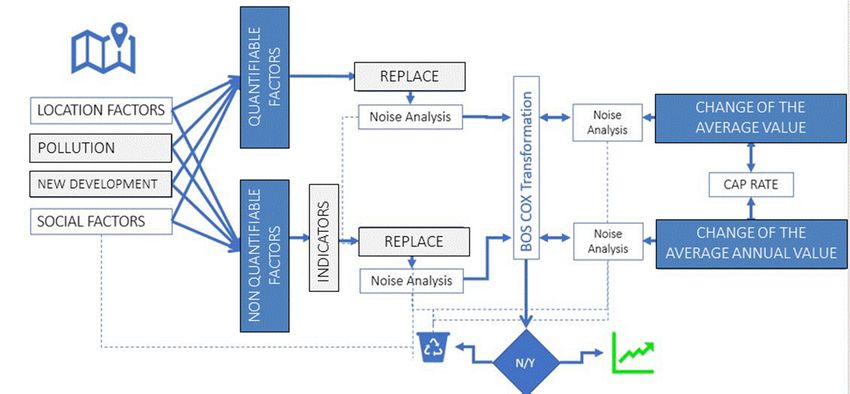
                                      Through a statistical regression in cases where a total or partial mapping of the
                                information is possible, a model was constructed (Figure 1).
                                      In addition to the hedonic model, an important starting point for the completion of
                                the analysis was to analyze not only prices but also rent, thanks to the document presented
                                by Lee, Seslen, and Wheaton [20], where a direct relationship between rent and prices is
                                established throughout subsequent prices.
                                      In the proposition of this analysis, the main idea is that prices and rents are the correct
                                comparison for a test of autocorrelation. The rent is considered as a linear combination of
                                its various attributes (hedonic equation). Subsequent price appreciations will be considered
                                in a specific area, in a panel of at least 5 years.
                                      The first endeavor to use value/rent proportions for testing housing market efficiency
                                was developed by Meese and Wallace [21]. These authors examine the ratio of average
                                between house prices and average rents and find some positive correlation to subsequent
                                price appreciations.
Sustainability 2021, 13, 3612 4 of 25
Sustainability 2021, 13, x FOR PEER REVIEW 4 of 26
Figure
Figure 1.
1. Model
Model algorithm.
algorithm.
In addition
A study to the hedonic
by Campbell model,
et al. [11] an important
attempts an exhaustivestartingtimepoint for the completion
examination of value/rent of
the analysis
rates was to analyze
and presumes that therenotisonly
solid prices
proofbut of aalso rent, thanks
time-relation into the document
metropolitan presented
cities. At the
by Lee,
point Seslen,
when rentsandareWheaton
high, they [20],
willwhere a direct
in general fall,relationship
with most ofbetween rent and
the alteration beingprices
made is
established throughout
by prices instead subsequent prices.
of rents.
In
If the
rentsproposition
change over of this
time,analysis, the mainofidea
the volatility is that
prices prices
should beandlessrents
thanare theof
that correct
rents
comparison for a test the
since they represent of autocorrelation.
discounted value Theofrent is considered
expected future as a linear
rents. Rentscombination
play a more of
its various role
important attributes
when (hedonic
adjustingequation). Subsequent
actual conditions price
efficient appreciations
price rent ratios will
are thebe consid-
highest
ered
wheninoscillations
a specific area,haveindriven
a panel of attoleast
rents 5 years. bottom, and lowest when rents are
a (temporary)
at a (temporary)
The first endeavorpeak. to According
use value/rentto Abel, Andrew for
proportions andtesting
Blanchard,
housing Olivier
market [22] “Hence
efficiency
regardless
was developedof whether
by Meese the and
rentsWallace
in question[21]. are
These smoothly
authorstrending
examineup theorratio
down, or oscil-
of average
lating in house
between some manner,
prices and efficient
average price/rent
rents andratiosfind are
some positively
positive correlated
correlationwith near-term
to subsequent
subsequent rental
price appreciations. movements. When prices are the present value of rents the correlation
will extend
A study to prices as well”. et al. [11] attempts an exhaustive time examination of
by Campbell
According
value/rent rates toandLee, Seslen, and
presumes thatWheaton [20] aproof
there is solid unit’s ofpredicted price using
a time-relation its current
in metropolitan
characteristics
cities. At the point in awhen
hedonic
rentsmodel
are high, hasthey
a rent
willas ininput.
generalHence,
fall, withthemost
residuals from this
of the alteration
hedonic equation should reflect
being made by prices instead of rents. the omitted determinants of rent and the expected future
growth.
If rents change over time, the volatility of prices should be less than that of rents sincea
This way of modelling will test if housing Hedonic equation residuals have
significant
they represent positive correlationvalue
the discounted with of subsequent
expected futureprice growth.
rents. Rents play a more important
The simulations are raised specifically
role when adjusting actual conditions efficient price for the areas
rentofratios
interest
areandthe are applied
highest when to the
os-
models built
cillations havetodriven
identify possible
rents changes in real
to a (temporary) estateand
bottom, or rental
lowestvalues. For such
when rents are at scenarios
a (tem-
a risk study
porary) peak.was developed,
According considering
to Abel, Andrew theandaccuracy
Blanchard,of theOlivier
models and
[22] characteristics
“Hence regardless of
the area, the feasibility of investments analyzed depending
of whether the rents in question are smoothly trending up or down, or oscillating in someon capital expenditures, and
the profiles
manner, of possible
efficient investment
price/rent ratios funds or individual
are positively investors.
correlated with near-term subsequent
The model permits us to:
rental movements. When prices are the present value of rents the correlation will extend
• prices
to Identify and interpret the general trends of the residential property market and identify
as well”.
Accordingthat
the areas are most
to Lee, Seslen, interesting
and Wheaton for an in-depth
[20] a unit’sanalysis
predicted of price
trends through
using a self-
its current
constructed forecasting model.
characteristics in a hedonic model has a rent as input. Hence, the residuals from this he-
•
donic Identify
equation and quantify
should the impact
reflect the omittedof thedeterminants
different socio-economic
of rent and and the spatial
expected variables
future
growth.on theThisprice
waytreated in the areas
of modelling will of interest,
test if housingunderHedonic
the critical issues and
equation constraints.
residuals have a
• By simulating
significant positive future scenarios
correlation with in the real estate
subsequent priceforecasting
growth. model, pose the different
The simulations are raised specifically for the areaspresent,
future situations that the residential market could of interestas and
wellareas develop
applied to a risk
the
analysis within the different areas of interest.
models built to identify possible changes in real estate or rental values. For such scenarios
a• riskIdentify
study was in which areasconsidering
developed, price/rent ratios are positively
the accuracy correlated
of the models and with subsequent
characteristics of
rent (and hence price) growth, raising future investment
the area, the feasibility of investments analyzed depending on capital expenditures, and scenarios.
the profiles of possible investment funds or individual investors.
Sustainability 2021, 13, 3612                                                                                            5 of 25

                                •    Identify the different possible responses that the residential property market may
                                     suffer in the future due to general changes in the city, its socio-economic conditions,
                                     and moreover under the effect of public and private projects, in order to build a series
                                     of investment scenarios.
                                     Through the use of GIS tools and regression models it was possible to identify areas
                                of interest and general trends, in addition to identifying the main challenges for the
                                elaboration of a more detailed study that would allow future analysis.
                                     The paper is partitioned into following sections:
                                •   Real estate forecasting will analyze different methods for predicting prices and trends,
                                    defining its limitations and advantages depending on the availability of data. More-
                                    over, a method for deducting general behaviors from price/earnings ratios and its
                                    positive correlation with subsequent earnings (and price) growth will be introduced.
                                •   Data gathering and description summarize the sources and treatments that were given
                                    to data, the entities in charge of providing real estate official information, and the
                                    sources of different crucial variables that were considered in the model.
                                •   Econometric modeling of the residential properties in the metropolitan city of Milan is
                                    a statistical assessment of the real estate profile in the Metropolitan City of Milan, only
                                    focused on the micro areas that were already identified in the PRIN “Metropolitan
                                    cities: territorial economic strategies, financial constraints and circular regeneration”
                                    project, analyzing also the current situation of residential properties in Italy and Milan.
                                    This section defines the parameters used in the creation of a model able to be modified
                                    with further assumptions for future investment scenarios that will be postulated.
                                •   Analysis and interpretation of the results in order to evaluate future scenarios and
                                    investment opportunities in residential properties in the metropolitan City of Milan.
                                    This last section completes the paper with investment scenarios using the analysis
                                    framework for the real estate profile. The different scenarios consider public invest-
                                    ment in new infrastructure, the impact of new urban developments in the city, and
                                    also the effect of private projects that strongly affect the current state of specific areas
                                    in the city raising different opportunities for investing in specific areas. This effect as
                                    is seen might already be happening since the effect price/rent ratio reflects a faster re-
                                    sponse of the market than just analyzing the timeline of acquisition prices. This section
                                    provides evidence of investment properties with indications about the advantages
                                    and risks of the transactions.

                                3. The Metropolitan City of Milan (MCM) as a Privileged Study Context
                                      The importance of geographically defining the study to be performed is based in the
                                light of overall regional economic conditions. In this sense, the analysis should “provide
                                background on the location of the site within the metropolitan area, for example, the
                                distance to downtown, to the airport, and to other regional draws” [23].
                                      In order to analyze the Metropolitan City residential market, it is important to under-
                                stand the scale of the analysis and the specificity of the information available [24] as well
                                as the scale of the objectives of this research.
                                      The Metropolitan City of Milan (MCM) was established on 8 April 2014 lying inside the
                                Province of Milan as a result of the entry into force of Law 56/2014 (art. 12) [25]. According
                                to its metropolitan city charter [26], the MCM aims to express the best of the culture of
                                government and the administrative experience of the municipalities of its territory, each
                                carrying stories and traditions in an integrated and polycentric framework that respects
                                their identity and enhances their participation. The MCM wants to make administrative
                                simplification its working method. The role of the new body and our common political
                                and civil commitment are defined around these challenges.
                                      The fundamental functions of the MCM are established by Section 85 of the Law n.
                                56 of 7 April 2014 [25], in force since 8 April 2014, and by Regional Law 92/2015 [27],
                                amended into Law 32/2015, published in the Regional Official Bulletin on 16 October
                                2015. In particular, Law no. 56 of 2014 [25] (in articles 85 and 86) underlines that among
Sustainability 2021, 13, 3612 6 of 25
the fundamental actions exercised by metropolitan cities, there are: Provincial territorial
planning for coordination, as well as protection and enhancement of the environment, for
the aspects of competence (letter a) of art. 85); and the care of the strategic development
of the territory and management of services in associated form based on the specific
characteristics of the territory itself (letter a) of art. 86).
The former Metropolitan City of Milan (MCM) is made up of 134 Municipalities,
covering an area of 6827 square kilometers and has 3,196,825 inhabitants, almost a third of
the regional population. There are 1,337,155 inhabitants in the municipality of Milan (over
40 percent of the former provincial population) and the territory is classified as entirely
flat; with 1500 kmq of surface, the MCM is the second urban area in Italy [28].
The MCM is divided into different homogeneous areas with similar socioeconomical
characteristics and equivalent to areas with similar rent and sell value characteristics [26].
Given that the behavior of the residential sector in a large city varies in a different way
from that of a small, medium-sized, and large cities, it is necessary to consider the main
differences due to the size of the sector and the dynamics of a metropolitan city. Besides,
housing markets are not homogenous across metropolises [29].
It is critical to have a full model when considering costs and value changes across
jurisdictional submarkets in a metropolitan area that is subdivided in homogeneous areas
like Milan. A standard model of metropolitan housing submarkets accepts that a pre-
determined number of households look for a market over a set number of areas. Every
area has a fixed amount of supply. Family units get utility from the market, an amenity
associated with being located in a determined area, in other words, each homogeneous
area has special characteristics that make it attractive to house buyers [30].
The flexibility of the metropolitan market is an important issue to be considered, since
offer and demand may vary asymmetrically. Moreover, for a product as diverse as real
estate, in metropolitan cities a considerable reduction in population and the relative low
elasticities of supply and demand might be expected. “It is common in metropolitan areas
that asymmetric price reactions growth in population numbers has no significant effect on price”,
whereas declining population significantly lowered prices, hence “rental and the property
sectors are characterized by low price elasticity of demand, indicating that significant real estate
price decreases can result” [31].
The dynamics in metropolitan urban communities in western cities as Milan are
not the same as in developing nations, since critical beneficial outcomes are shown for
disposable income and construction costs, and the reaction to the creation of supply is
asymmetrical, meaning that population growth and the resulting increases in demand
have no significant effect on price. However, a declining population leads to significantly
reduced prices [25].
Several factors influence the attractiveness of one real estate asset compared to others
in the same metropolitan market. Some analysts start with an overview of the demographic
indicators of the metropolitan area or add indicators that describe the conditions of the
local market, thus facilitating the comparison and the regional or metropolitan contrast
with the conditions of a specific submarket, or the area of interest for a project. “At a
minimum, demographic and economic data should go back as far as the preceding decennial census.
However, once the most recent census is more than a few years in the past, the analyst will need
to provide more current estimates and projections”. This is the main reason why this analysis
also considers transactions made after the main database available (OMI transactions until
2017) needs to be updated to the latest available [23].
A metropolitan diagram must incorporate data on the construction sector. For hous-
ing, real estate studies, building permits, and construction volumes have to be tracked,
ideally with isolated arrangements for single-family and multifamily projects. The eco-
nomic conditions of each neighborhood may not accurately reflect national patterns: Not
every metropolitan homogeneous zone profits by a national financial blast. Accordingly,
Real estate market studies give more importance to regional and metropolitan economic
indicators than to nationwide statistics [23].Sustainability 2021, 13, 3612 7 of 25
4. Data Gathering and Description
Even if residentially focused, the Italian market has no records for specific subsectors
or neighborhoods of a city delivered by institutional bodies. Analyzing who produces Real
Estate Information in Italy, governmental entities in charge of compiling the information,
trade associations, and consulting companies are the most interesting data providers.
The main problem being the low level of connection among all these bodies, there is no
systematic trade of information. Among the official entities, there is the Osservatorio del
Mercato Immobiliare (OMI) an institution that is reliant on the Agenzia delle Entrate.
The OMI is responsible for collecting and processing technical and economic informa-
tion relating to property values, the rental market and annuity rates, and the publication
of studies and calculations for the statistical enhancement of the Agenzia delle Entrate’s
archives [32].
In the OMI’s dataset structure, in order to homogenize the data, the metropolitan
city of Milan (and the city of Milan) has been divided into different areas (OMI zones),
which are defined as a continuous portion of the municipal territory that reflects a homoge-
neous sector of the local property market, in which there is uniformity of appreciation for
economic and socio-environmental conditions [33].
The area is defined as a homogeneous segment of the local real estate market, in which
there is uniformity of appreciation for economic and socio-environmental conditions. It is
formed on the basis of the deviation, between the minimum value and the maximum value,
not exceeding 50%, found for the prevailing typology, within the residential destination.
After the 2014 update, the municipality of Milan was divided into 41 reference real
estate areas, the so-called “OMI Zones”, 14 less than in 2006 (The territorial areas of the
OMI areas are subject to a ten-year review process, in order to verify their consistency with
the urban development of the territory and with the rules for the formation of municipal
zoning. The updating of the articulation of the municipal territory by homogeneous areas
must be justified exclusively in structural changes of the territory and / or in a changed
reality of the local market, found through appropriate and detailed territorial analysis,
following the criteria and operating methods set out in the Manual.The updating of the
municipal zoning is released every semester with the validation of the cartographic archives
according to the following terms and can take place in the following ways: Partial update;
10-year update.The updating of the perimeters of the OMI areas must also be ensured in
the event of changes in the cadastral map and / or in the presence of errors. In such cases,
the following procedures are applied: Realignment; grinding) (Figure 2).
In 2014, a general review was carried out of the territorial areas (OMI areas) within
which the prices of the properties are defined. This operation, which ended in the second
half of 2014, was necessary to incorporate the changes in the urban and economic fabric.
On that occasion, improvements were made in terms of a uniform methodological
approach, internal controls, and fine-tuning in the boundary delimitations, starting from
the second half of 2014.
For this reason, the comparison between the quotations for the second half of 2014
and those of the previous semesters for individual areas is not always possible, where the
perimeters of the territorial areas of reference have changed substantially.
The change of the homogeneous divisions is evident in the figure below. Given the
considerable change in the area and their shape and coverage, the average prices from
2006 to 2013 will not be considered for the analysis in this dissertation. A study of the
consequences of the change of OMI areas was already presented in the context of Research
Project of Relevant National Interest—PRIN “Metropolitan cities: territorial economic strategies,
financial constraints and circular regeneration” [34].Sustainability2021,
Sustainability 13,x3612
2021,13, FOR PEER REVIEW 88ofof26
25
.
Figure 2. Difference between Osservatorio del Mercato Immobiliare (OMI) areas in 2006 and 2014.
Figure 2. Difference between Osservatorio del Mercato Immobiliare (OMI) areas in 2006 and 2014.
The real estate value in the municipality of Milan is given by the type, age, and
In 2014, acharacteristics
architectural general review thatwas carried out
distinguish theofsingle
the territorial
area of the areas (OMI areas)
municipality within
of Milan.
whichInthe prices
order to of the properties
build the econometric are defined.
model,This operation,
it was important which ended
to find theinrelationship
the second
half of 2014,
between thewas necessary
variation to incorporatefactors
of socio-economic the changes
with thein the urban
change in and
the realeconomic fabric.in
estate value
On that occasion,
the residential category improvements were made inCity
of the entire Metropolitan terms of a uniform
of Milan with anmethodological
analysis period
approach,
of 11 years, internal
from 2006controls, andevaluating
to 2017, fine-tuningthe in the boundary
importance ofdelimitations, starting from
the various socio-economic
the second half of 2014.
characteristics as drivers of the change in the real estate value.
For
Thisthis reason,
analysis the comparison
attempted between
to evaluate the quotations
the change from yearfor the second
to year half of 2014
in the average sales
and
valuethose of the previous
of residential semesters
real estate forwhich
units, individual
is why areas is not alwaystransaction
a standardized possible, where the
database,
perimeters
provided by of the
the Agenzia
territorialdelle areas of reference
Entrate, is used.have changed substantially.
As presented
The change of in the the paper “Real estate
homogeneous market
divisions values and
is evident land
in the revenue
figure analysis
below. Giveninthe
the
Metropolitanchange
considerable city of inMilan”the area[16],and
the their
division
shape of the
andmetropolitan
coverage, the city into homogeneous
average prices from
zones
2006 toshows
2013 will a high
notheterogeneity
be consideredoffor characteristics
the analysis between the 2006–2013
in this dissertation. classification
A study of the
and that of 2014–2017.
consequences of the change Thisofphenomenon
OMI areas was is present for all groups.
already presented in theThe analysis
context must be
of Research
concentrated
Project of Relevant only on the variation
National in the periods
Interest—PRIN before and
“Metropolitan afterterritorial
cities: the update, and the
economic data
strate-
for the
gies, yearsconstraints
financial 2018 and and the circular
first halfregeneration”
of 2019 will[34]. also be taken into consideration by the
revenue agency
The real forvalue
estate greater inaccuracy. In this sense,
the municipality of Milanthe new analysis
is given by the and model
type, age,wasandbuilt
ar-
only with the most recent data, and no data before 2014 were
chitectural characteristics that distinguish the single area of the municipality of Milan. considered.
InAsorder
for the analysis
to build the on the influence
econometric model, of itsome
was geographical,
important to find physical, and socio-
the relationship
economic factors, the state of conservation of the building
between the variation of socio-economic factors with the change in the real estate value is undoubtedly the factor with
in
the most significant impact, followed by the quality of the neighborhood,
the residential category of the entire Metropolitan City of Milan with an analysis period and the distance
ofto11
theyears,
center is confirmed
from 2006 to 2017, as anevaluating
importantthe exchange
importancerate factor
of the for listing;
various the proximity
socio-economic
to the city’s large parks and the metro have
characteristics as drivers of the change in the real estate value. an important positive effect on prices. The
changeThis analysis attempted to evaluate the change from year to year in the averageare
in status of the neighborhood, along with green areas and accessibility, the
sales
geographical factors identified that could mean a change
value of residential real estate units, which is why a standardized transaction database, in prices, given that the other
spatial characteristics
provided by the Agenzia aredelle
fixed.Entrate,
Other exchange
is used. factors must be seen individually for each
district (e.g., large real estate developments,
As presented in the paper “Real estate market market values
dynamics). and land revenue analysis in
However, following this analysis, the limitations
the Metropolitan city of Milan” [16], the division of the metropolitan given by the citylackintoof punctual
homogene- ref-
erence for transactions were evident. Although the database of the Real Estate Market
ous zones shows a high heterogeneity of characteristics between the 2006–2013 classifica-
tion and that of 2014–2017. This phenomenon is present for all groups. The analysis mustSustainability 2021, 13, 3612 9 of 25
Observatory aims to provide guidelines for all operators in the sector, it is necessary to
study geolocated data in a point to better study the phenomenon.
Within the project, the division of the city into neighborhoods was considered, given
that the databases and sources of qualitative data are based on this division to report
results.
The municipality of Milan is divided into 88 districts, not directly connected to the
delimitation of homogeneous areas except in some cases (e.g., Tre Torri). For this reason, it
was necessary to take into consideration the division into city districts; the same methodol-
ogy used to compare the OMI areas before and after the update was therefore applied to
the districts (Figure 3):
Figure 3. Discretization of real estate values of Zona OMI 2017 in the 88 districts of Milan.
Although there are a wide range of techniques for managing the way towards building
a real estate model, the following methodology was implemented, as performed in the
Hedonic study by Vries et.al. (2009) [35]:
1. Economic Real Estate theory.
2. Data gathering.
3. Formulation of the econometric model.
4. Modeling prove and noise data elimination.
5. Representativeness evaluation.
6. Reformulate model/Interpret model
7. Use model for investment proposals.
5. Econometric Modeling of the Residential Properties in the Metropolitan City of Milan
For confronting statistical deficiencies recently experienced and connected with
transaction-based indices, two methods have been developed: The Hedonic Price Method-
ology and the repeat-sales regression methodology [36]. The hedonic pricing method
depends on the principle that a property is a complex with plenty of sections which, re-
gardless of whether or not they can be traded independently, have their very own valuable
elements. Computing the value of all attributes for every trade, everything being equal—
both physical (size of the land, size of the building, development period, number of rooms,
construction quality, and so on) and localization (area, quality of the area, accessibility,
1
noise, and so forth)—it is conceivable to generate an index by researching the value for a
given property and by regression to gauge each characteristic [37].Sustainability 2021, 13, 3612 10 of 25
Fundamentally, the process depends on the representation of the market through
econometric models. The reliant variable is the cost of the property or the relative price of
utilization at various occasions of time. The simplest model is to consider the state of the
buildings, their location, and so on.
We can compose y = f(X) + ε, indicating with y the value per sqm of the real estate
units, with X the vector of the specific attributes observed and with ε the stochastic errors
of the model with the theory that they are regularly distributed with consistent variance,
ε~N (0, σ2).
The calculated parameters, achieved as inherent costs ascribed by the market to
individual characteristics, can be applied to a lot of standard attributes to acquire a value
that gives a gauge of the cost that would have been seen without fluctuation in the features
of the properties. The valuation of a specific housing unit can be acquired by applying the
intrinsic costs to the attributes of the residence.
The utilization of this methodology allows one to develop indices of steady quality
dependent on transaction costs, with, however, the utilization of a regression model that
permits the attributes and consequently the heterogeneity of real estate to be considered.
From an econometric perspective, the building quality is studied and thus the value variety
of a property whose qualities would be consistent after some time is featured.
There are two fundamental techniques for the construction of a real estate index
dependent on the hedonic method:
(a) Regression model will be determined for every period;
(b) Single regression model utilized for all periods concerned.
The principal strategy includes performing a hedonic regression for every period by
following the development by time of the estimation of a common property (or a portfolio
of properties) and evaluating the value in every period, utilizing the coefficients of hedonic
regressions.
The principle limitation of the hedonic technique is connected to the complexity of the
econometric models that must be applied to guarantee the nature of an index. What is more,
specific consideration ought to be paid to the utilization of these techniques: Specifically, it
ought to be guaranteed that all the most significant factors have been incorporated into the
model, yet additionally the model’s illustrative factors are not very interrelated and that
the estimations of the diverse variables are estimated precisely. The subsequent restriction
concerns the quantity of the databases necessary for the advancement of such indices:
The market inclusion ought to be as significant as would be prudent. It is subsequently
important to persuade the holders of this data (specifically public accountants, mortgage
banks and real estate experts) that it is helpful to make it accessible so as to know value
increases on the residential markets.
The general objective of the model built by this dissertation is to interpret residential
real estate prices as a variable dependent of several characteristics, the theoretical model
follows the alignments of a Hedonic Price Model (HPM) and several variables will be
defined, indexes for residential real estate performance will be used, as well as a new
indicator for reflecting the independent variables. The information will be collected from
official institutions and other sources that gather other types of information. The estimation
indexes were built in a such a way that they could reflect the current situation of every
location in the most suitable way. The statistical evaluation of the model considers the
assumptions made in it and describes data properly, that will be then interpreted and
analyzed.
The model required for the most significant part of the analysis includes various
distinctive general arrangements of tasks:
(a) An assortment of record organizations and information sources.
(b) Normalizing data and avoiding inclusion of non-significant information in the model.
(c) Transformation applying scientific and factual tasks to gatherings of datasets to infer
new datasets (e.g., amassing a huge table by bunch factors).Sustainability 2021, 13, 3612 11 of 25
(d) Modeling and calculation. Associating the information to the model, AI calculations,
and other computational tools as GIS, used several times in this dissertation.
(e) Presentation. Making intuitive graphical representations of the results.
This project performs an HPM in the city of Milan in order to quantify the impact that
the features (structural, neighborhood, and accessibility characteristics) of a residential
property have on its real market price. For this purpose, a set of transactions within the
urban limits of the metropolitan city of Milan has been used. GIS has been used to analyze
the location properties on the map and to measure distances and areas of the neighborhood
characteristics of the transactions. Subsequently, the model will be used for evaluating
the impact on prices and rents (the model will be run with rents and costs) that selected
private and public urban projects will have in the behavior of the city. In this scene, once
the initial model is built, the current situation will be modified with a second scenario and
prices and rents will be recalculated according with the results of the first model. These
results will be used in the investment scenarios.
Through a Box Cox statistical regression in cases where a total or partial mapping of
the information is possible, a model was constructed.
In addition to the hedonic model, rent has also been analyzed, referring to what
is presented by Lee et al. (2015), where a direct relationship between rent and prices is
established throughout subsequent prices. The main idea of authors is that prices and rents
are the correct comparison for a test of autocorrelation. The rent is considered as a linear
combination of its various attributes (hedonic equation). Subsequent price appreciations
will be considered in a specific area, in a panel of at least five years.
The first endeavor to utilize value/rent proportions for the testing of housing market
efficiency was developed by Meese and Wallace (1995) [21]. These authors examine the ratio
of average between house prices and average rents and do find some positive correlation
to subsequent price appreciations.
If rents change over time, the volatility of prices should be less than the one of rents
since they represent the discounted value of expected future rents. Rents play a more
important role when adjusting actual conditions, efficient price rent ratios are the highest
when oscillations have driven rents to a (temporary) bottom, and lowest when rents are
at a (temporary) peak. “Hence regardless of whether the rents in question are smoothly
trending up or down, or oscillating in some manner, efficient price/rent ratios are positively
correlated with near-term subsequent rental movements. When prices are the present value
of rents the correlation will extend to prices as well” [38].
According to Lee et. al. (2015) [20] a unit’s predicted price using its current character-
istics in a hedonic model has rent as input. Hence, the residuals from this hedonic equation
should reflect the omitted determinants of rent and the expected future growth. This way
of modelling will test if housing Hedonic equation residuals have a significant positive
correlation with subsequent price growth.
The methodology worked with three categories of independent variables: Structural
characteristics of the house, neighborhood environmental characteristics, and accessibility
characteristics, following the categorization of Fanhua et.al. [39,40].
The data collection process consisted of private housing transactions in the city of
Milan, occurred in the third quarter of 2019, taking into account the price per square meter
of the properties, their condition, the internal characteristics of the property, and its location,
together with the capitalization values obtained from the OMI analysis, in addition to the
average yearly increase of a stable area x (Table 1).
For the calculation of an initial cash flow, the following parameters must be considered:
• Taxes correspondent for a secondary house: 10.156% of the gross annual rent.
• An average of the market for administration fee of about 0.8% of the gross annual rent.
• Indexation at 100% of ISTAT values, taken from the Focus economics magazine
• Sale cost 3% of the final price.Sustainability 2021, 13, 3612 12 of 25
Table 1. Definition of the average yearly (example).
Indexation
Year Year Year Year Year Year Year Year Year Year Year
Period
1 2 3 4 5 6 7 8 9 10 11
Value 0.78% 1.02% 1.23% 1.41% 1.58% 2.00% 2.00% 2.00% 2.00% 2.00% 2.00%
A Geographical Information System (GIS) has been used to analyze the location
properties on the map [41] and to measure distances and areas of the neighborhood
characteristics of the transactions.
Several variables were introduced into the model: Demographic, economic, spatial,
structural (intended as intrinsic to the property), considerations of taxation, and other
variables [37].
The demographic variables are defined based on data provided by ISTAT (2017) [28]
(Table 2). They are represented in the following table where the correlation of these
indicators has been defined and studied for each neighborhood. For changing quotations
from neighborhood to areas and vice versa, GIS software was used.
Table 2. Demographical variables considered (Source: ISTAT, 2017).
ID Scope DEN Indicator Definition
Ratio between the population resident in
1 Territorial D Housing density-Ab/Km2
the area and the relative area in Km2
Ratio between the number of commuter
flows entering the area (net of commuters
2 Mobility Ic Centrality index residing and working in the area) and the
number of commuter flows leaving the area
(net of the same amount).
Percentage ratio between the resident
3 Demographic Iv Age index population aged 65 and over and the
population in the class 0–14
Ratio between the foreign population and
4 Demographic Is Incidence of foreign residents
the resident population per thousand
Percentage ratio between the population in
Index of non-completion of the the age group 15–52 who did not graduate
5 Education Insm
first-cycle secondary school from the lower secondary school and the
total population of the same age group
Percentage ratio between jobseekers and the
6 Economic Td Unemployment rate
labor force
Percentage ratio of the resident population
Incidence of young people in the 15–29 age group in non-professional
7 Social vulnerability Neet outside the labor market and condition other than a student and the
training resident population in the same age
group-enlarged NEETs
Percentage ratio of the number of families
Incidence of families with
8 Social vulnerability Fde with children whose reference person
potential economic risk
has until
Two variables defining the economic situation of the householder and the area were
introduced into the mode: Average income and the commercial vocation of the area.
Average income of the residents: The model first analyzes the relationship between
price and rents with the average income of residents. After the analysis of income and
rent, even the change in income declared IRPEF does not seem to have a general direct
correlation for all the municipalities of the Metropolitan City of Milan with the change in
the residential real estate value; it can be seen how the territorial generalization cannot beSustainability 2021, 13, 3612 13 of 25
applied in this context. As can be seen in the graph (Figure 4) where every municipality
integrating the Metropolitan City of Milan was represented as a point considering its14IRPEF
Sustainability 2021, 13, x FOR PEER REVIEW of 26
and its average housing price, there is no direct relation between the IRPEF and the average
price of residences.
2400
34
111
2200 104
78 4
113 17
Average price(2016) [€/m2]
2000 39
41 49 80 6
91
46 87 19
102 71
6444 70
1800 37 106 97
83 55
21
38 279 52 31 88
128
16 45 85
1600 7 53 603089
112 11554 62
63 184 92 65 130 124
107 61
90 1108 94
76 59
116 3134 29
95 132
75 50 36125
2 691016826
5743
126
20 25 121114 109
96 67
1400 8666
119123
131 5 1511 118
117
14133
93 32 514035
77
74 13 7233108 105 42 12
28
12256
82 18 814798 2358 99 24
22 100
129 127 120
1200 103 79
1000
16,000 18,000 20,000 22,000 24,000 26,000 28,000 30,000 32,000 34,000
IRPEF (2016) [€/dich.]
Figure 4. IRPEF (Imposta sul Reddito delle Persone Fisiche) vs. OMI average price, municipalities of the Metropolitan city.
Figure 4. IRPEF (Imposta sul Reddito delle Persone Fisiche) vs. OMI average price, municipalities of the Metropolitan city.
Commercial aim: This variable represents the importance that is given to areas that
are Commercial aim: This
active for shopping, variable
stores, represents
restaurants, theand
etc., importance
is measuredthat by
is given to areasofthat
the presence the
are active for
“Districts shopping, stores,
of Commerce”, restaurants,
as defined etc., and of
in the geoportal is measured
the city of by the presence of the
Milan.
“Districts of Commerce”,
As regards the spatial as variables,
defined inthe theresearch
geoportal of the city
adopted of Milan.
the same variables adopted by
As regards
the IMO. the spatial
Therefore: variables,
condition; distancethetoresearch adopted
the center; averagetheyear
sameofvariables adopted
construction; by
average
number
the of floors; presence
IMO. Therefore: condition; of commercial
distance to the services;
center;presence
average of green
year spaces; presence
of construction; aver-of
public
age numbertransportation; parkingofavailability;
of floors; presence commercialroad connections;
services; presence commercial
of green spaces;vocation; and
presence
offinally,
publicquality of the area.
transportation; parking availability; road connections; commercial vocation; and
finally,Therefore,
quality ofitthe is important
area. to understand in which magnitude each of these charac-
teristics affect the price of the area:
Therefore, it is important to understand Hence the single magnitude
in which transaction,eachthe ofcharacteristics that
these character-
istics affect the price of the area: Hence the single transaction, the characteristics that referof
refer to the intrinsic state of each individual property (prevailing state, average year
toconstruction,
the intrinsicaverage
state of area,
each and averageproperty
individual number (prevailing
of floors) are already
state, averageconsidered
year of in the
con-
“condition”
struction, of thearea,
average building. The other
and average characteristics
number depend
of floors) are on considered
already the spatial arrangement
in the “con-
of eachoftransaction,
dition” the building. to identify
The other which factors are more
characteristics depend important a qualitative
on the spatial analysisofis
arrangement
proposed for the city of Milan.
each transaction, to identify which factors are more important a qualitative analysis is
proposedThisfor
analysis
the city is of
conducted
Milan. with the aim of identifying the factors that, in addition to
the special characteristics
This analysis is conducted of each withdistrict (new
the aim of developments
identifying theand real that,
factors estateinprojects),
additioncan
to
influence the price change in some way.
the special characteristics of each district (new developments and real estate projects), can
According
influence the price to change
Istat (2017)
in somethe quotations
way. of neighborhoods, zones, and municipalities
are closely
According correlated
to Istatwith(2017)their
the distance
quotations from the city center. zones, and municipalities
of neighborhoods,
Presence of public services is measured
are closely correlated with their distance from the city center. through the presence of public healthcare
infrastructures, schools, and universities,
Presence of public services is measured through the as reported in thepresence
geoportal of of the municipality
public healthcare
of Milan.
infrastructures, schools, and universities, as reported in the geoportal of the municipality
Presence of public green space is measured through different indicators: Parks Prox-
of Milan.
imity Index: Influence of each green area classified as Urban Park (ParkP) over the distance
Presence of public green space is measured through different indicators: Parks Prox-
to each transaction.
imity Index: Influence of each green area classified as Urban Park (ParkP) over the dis-
Urban vegetation proximity index (GrVegP): Influence of the areas classified as urban
tance to each transaction.
vegetation (ISTAT4) over the distance of each transaction.
Urban vegetation proximity index (GrVegP): Influence of the areas classified as ur-
ban vegetation (ISTAT4) over the distance of each transaction.
Special Green areas proximity index (SGrAP): Influence of the areas classified as
school gardens, vegetable gardens, cemeteries, and public gardens (ISTAT 5) on the dis-
tance of each transaction.Sustainability 2021, 13, 3612 14 of 25
Special Green areas proximity index (SGrAP): Influence of the areas classified as school
gardens, vegetable gardens, cemeteries, and public gardens (ISTAT 5) on the distance of
each transaction.
Urban Green area index: Influence of the areas classified as equipped green areas and
historic green areas (ISTAT 1,3) on the distance of each transaction.
Regarding the level of transport services, this is measured as Metro Proximity Index
(Metro PI): Indicator of the proximity of metro stations.
Status of the area: Weights from 1 to 6 (the highest, plus status) classify the different
areas of Milan, based on their status considerations, in function of urban land use.
Iconic Places Proximity Index (IconPI): Proximity to iconic attractions for tourists in
the city, with a weight of 5 to 1 based on the number of their annual visitors.
Regarding the intrinsic property variables or structural characteristics, as said before,
one limitation of the model is the fact that several characteristics of each house are in every
OMI area are reduced to one single state where buildings were given a number for their
corresponding condition (state); 4 for new, 3 for Perfect (renovated), 2 for Good, 1 for Bad
(to be renovated).
The data administered by the Agenzia delle Entrate is measured according to their
‘status’: Poor, normal, and excellent. The listing is then associated with this status. This is
an important factor, since it defines the only characteristic that refers to the condition of the
apartment. As can be seen in the two maps below, quotations change drastically due to
this factor.
Finally, regarding other variables research considered: Contaminated areas Index
(ContAI): Influence of each site with soil and/or groundwater contamination (caused
by accidental events, spills, and illegal activity. Potentially Contaminated Areas Index
(PContAI): Influence of each potentially contaminated site (defined as a site where one
or more concentration values of the polluting substances detected in the environmental
matrices are higher than the concentration threshold values of contamination) over the
distance to each transaction.
Furthermore, Air Quality Indexes: According to the 2018 air quality measuring sta-
tions, a density map was built through GIS, assigning a value of pollution for different
contaminant agents: C6 H6 (Benzene, a monocyclic aromatic hydrocarbon), CO_8H (Carbon
monoxide (CO), indicates the average concentration over 8 h), NO2 (Nitrogen dioxide),
PM10 (Powders with diameter less than 10 µm). Values were measured in g/m3 .
6. Model’s Goodness of Fit: Results Analysis
All the collected information from official sources and from the definition of the
variables mentioned was modelled through a hedonic model. The sample for the dependent
variable, namely the price per square meter of a residential property in Milan, consisted
of 352 residential transactions that occurred in the city during the third quarter of 2019 as
shown in Figure 5, all properties distributed across the city to give the highest possible
coverage, and discretizing all the information into a GIS supported platform.
The discretization of the intrinsic characteristics of each property consisted in the
definition of a scale to describe the state of conservation of the property: The house
State (State), from 1 to 5, 1 being a decadent state and 5 as an optimal state, the spatial
distribution of the property was evidenced through the number of Rooms (Rooms), the
year of construction of the building was discretized as Old coefficient (OldCo), the lower
the value the older the building, the Distance to the city Center (DistCBD), Distance to a
Metro Station (MetroPi), and finally the socio-economic characteristics of the neighborhood
were described through the variable Status of neighborhood (NeighSt).You can also read


