Smarter Grid in the 5G Era: A Framework Integrating Power Internet of Things With a Cyber Physical System
←
→
Page content transcription
If your browser does not render page correctly, please read the page content below
ORIGINAL RESEARCH
                                                                                                                                         published: 24 June 2021
                                                                                                                                 doi: 10.3389/frcmn.2021.689590

                                            Smarter Grid in the 5G Era: A
                                            Framework Integrating Power Internet
                                            of Things With a Cyber Physical
                                            System
                                            Yuanjie Liu 1, Xiongping Yang 2, Wenkun Wen 3 and Minghua Xia 1*
                                            1
                                              School of Electronics and Information Technology, Sun Yat-sen University, Guangzhou, China, 2Strategy and Planning
                                            Department, China Southern Power Grid Co., Ltd., Guangzhou, China, 3Guangzhou Techphant Co., Ltd., Guangzhou, China

                                            As the energy infrastructure of smart cities, smart grid upgrades traditional power grid
                                            systems with state-of-the-art information and communication technologies. In particular,
                                            as the full deployment of the Internet of Things in the power grid (a.k.a. power Internet of
                                            Things or PIoT), the newly introduced information flow together with inherent energy flow
                                            makes it more efficient for power generation, transmission, distribution, and consumption.
                                            To further exploit the precious energy and the latest 5G technologies, this article boosts to
                                            add a value flow in the smart grid, mainly including the value created by innovative services
                                            and market mechanisms and the value added by the information flow. Specifically, by
                                            integrating PIoT with cyber-physical systems, this article sketches a conceptual framework
                          Edited by:        of the cyber-physical power system (CPPS). The CPPS carries out holistic perception and
    Uche Kennedy Chude-Okonkwo,
   University of Johannesburg, South
                                            ubiquitous connection of distributed energy sources and electrical facilities and builds up a
                               Africa       smarter power grid with global information interaction, intelligent decision-making, and
                        Reviewed by:        real-time agile control. Finally, for illustration purposes, we conduct a case study regarding
                   Muhtahir Oloyede,        an intelligent home management system.
            University of Ilorin, Nigeria
                 *Correspondence:           Keywords: 5G, smart grid, power IoT, cyber-physical power system, energy flow, information flow, value flow
                        Minghua Xia
          xiamingh@mail.sysu.edu.cn
                                            1 INTRODUCTION
                   Specialty section:
        This article was submitted to       By integrating state-of-the-art information and communication technologies (ICTs) with legacy
           IoT and Sensor Networks,         urban infrastructure facilities, it is envisaged that future cities will evolve into huge cyber-physical
               a section of the journal     systems and finally a digital-physical twinning world. To this end, a smart grid is of the first and
    Frontiers in Communications and         foremost importance. For instance, in the Texas power crisis that occurred in February 2021, the
                             Networks       United States, a massive electricity generation failure in the state of Texas resulted in shortages of
            Received: 01 April 2021         water, food, and heat, yielding more than 4.5 million homes and businesses being left without
            Accepted: 31 May 2021           electricity in severe winter storms (Campbell, 2021).
           Published: 24 June 2021
                                                According to the definition made by the American Electric Power Research Institute in 2011, a
                             Citation:      smart grid is an electricity network enabling a two-way flow of electricity and information (EPRI,
Liu Y, Yang X, Wen W and Xia M (2021)       2011). Unlike traditional electric power grids with only a one-way electricity flow, the smart grid
         Smarter Grid in the 5G Era: A
                                            allows a two-way electricity flow between power grids and electricity customers. More importantly,
Framework Integrating Power Internet
               of Things With a Cyber
                                            integrating ICTs into power grids yields a novel two-way information flow and enables grids to have
                      Physical System.      self-healing capabilities and electricity customers to become active participants.
        Front. Comms. Net 2:689590.             Figure 1 shows the conceptual model of smart grid, proposed by the National Institute of
     doi: 10.3389/frcmn.2021.689590         Standards and Technology (NIST, 2014). It consists of seven domains and energy/information flows

Frontiers in Communications and Networks | www.frontiersin.org                   1                                         June 2021 | Volume 2 | Article 689590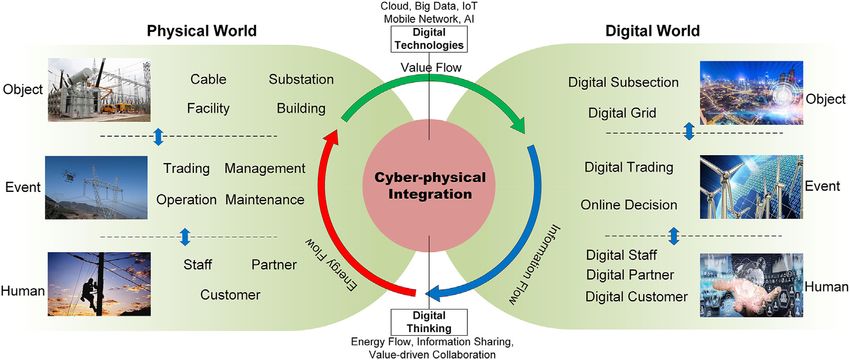
Liu et al.                                                                                                                 Smarter Grid in the 5G Era

                                                                            interconnects physical facilities and makes traditional power
                                                                            grids to evolve into smart grids, the cyber-physical system
                                                                            (CPS) can improve the intelligence level of a smart grid, by
                                                                            interacting between physical facilities and the cyber world and
                                                                            controlling the physical process with the help of processed data
                                                                            and information (Gavriluta et al., 2020). In other words, PIoT
                                                                            implements the interconnection of the wide-area devices and
                                                                            performs data collection, storage, and aggregation, while the CPS
                                                                            performs data mining and information retrieval and makes
                                                                            effective, reliable, accurate, and real-time control of the
                                                                            physical process in the smart grid. From the perspective of the
                                                                            CPS, PIoT is a network infrastructure that provides the mapping
                                                                            from physical into cyber worlds.
                                                                                To further explore the potential of PIoT, this article conducts a
                                                                            comprehensive overview of PIoT regarding architecture, enabling
                                                                            technologies, security, and privacy issues. Then, integrating PIoT
                                                                            with the CPS yields a cyber-physical power system (CPPS),
                                                                            making the current smart grid turn smarter. In particular, in
  FIGURE 1 | Conceptual model of a smart grid.
                                                                            addition to the energy flow and information flow, a new value
                                                                            flow is created, and the operation of the next-generation smarter
                                                                            grid is value driven. In brief, the CPPS carries out holistic
among them. The four lower domains correspond to the physical               perception and ubiquitous connection of distributed energy
facilities in traditional power grids, and they represent the power         resources and electrical facilities to build up a smarter power
generation, transmission, distribution, and customers. Among                grid with global information interaction, intelligent decision-
them, there exists a legacy energy flow, as denoted by the solid red         making, and real-time agile control.
lines. The three upper domains are mainly related to information                The remainder of this article is organized as follows. Section 2
communication infrastructure and electricity services, including            describes the PIoT architecture, enabling technologies, security, and
power markets, operations, and service providers. The                       privacy issues. Section 3 sketches a cyber-physical power system for a
information flow denoted by dashed blue lines among all                      future smarter grid, including a conceptual framework and the
seven domains allows their interaction, equipping the power                 corresponding cloud-pipe-edge-end architecture. Section 4
grid with intelligence.                                                     performs a case study of a home energy management system.
    Integrating energy flow and information flow enables                      Finally, Section 5 concludes the article.
additional functionality of the smart grid. On the one hand,
the power grid is the carrier of electricity. Complete physical
facilities and grid architecture ensure energy flow and provide              2 POWER INTERNET OF THINGS
powerful and reliable electricity transmission and supply to meet
optimal dispatch of electricity in a wide area. On the other hand,          For the intelligent development of power grid, in addition to
the information network is the soul of the smart grid.                      building a sound power physical infrastructure, it is also
Characterized by informatization, automation, and interaction,              necessary to realize the digitalization, informatization,
the smart grid improves the quality of the power supply and                 automation, and interaction of a power grid.
provides diversified services for customers securely and                         As shown in Figure 2, PIoT is composed of the perception
efficiently. Unlike a traditional power grid, in a smart grid, the           layer, network layer, platform layer, and application layer, which,
information network plays a more important role. Relying on                 respectively, focuses on data collection, transmission,
advanced ICTs, the smart grid has a highly reliable and flexible             management, and value creation. At the perception layer, all
communication infrastructure, to realize real-time information              things are interconnected, and the state of a power grid is fully
interaction, and to provide more reliable asset supervision, load           visualized; at the network layer, backbone network, distribution
management, peer-to-peer electricity trading, and other                     network, and terminal access network ensure the ubiquitous and
innovative electricity services.                                            all-time communication ability; at the platform layer, digital
    As a typical application of 5G technology to machine-type               management makes power grid knowable and controllable;
communications, in recent years, the Internet of Things (IoT) was           and at the application layer, power grid provides all kinds of
widely integrated into power grids, yielding the so-called power            services to create greater opportunities for all walks of life. Cyber
Internet of Things (PIoT) (Wang and Wang, 2018). In principle,              security and privacy is an important issue throughout all layers in
the IoT provides interconnection for anyone and anything, which             data-based PIoT. For reaching IoT’s full potential in smart grid,
is no longer limited to devices or objects, but also applications and       we should fully consider the characteristics of the layers, and
human behaviors, among others (Shafique et al., 2020). In a PIoT,            select appropriate facilities, devices, and communication
various electrical premises and power facilities interconnect to            technologies for various applications. We discuss the different
provide efficient and secure electricity services. After PIoT                layers and cyber security and privacy issue in the following.

Frontiers in Communications and Networks | www.frontiersin.org          2                                       June 2021 | Volume 2 | Article 689590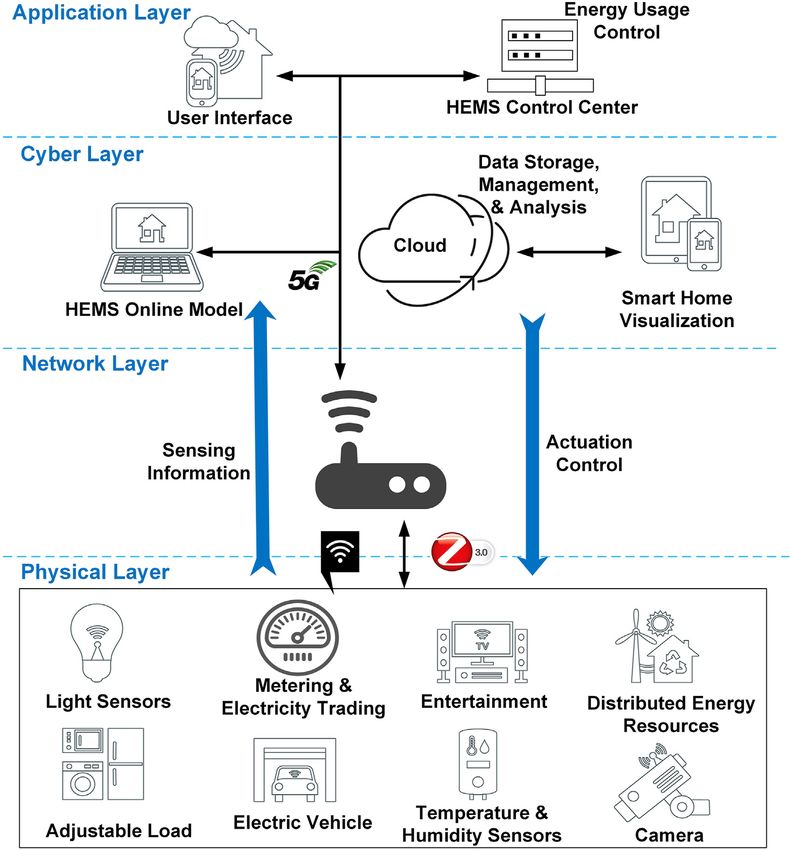
Liu et al.                                                                                                                 Smarter Grid in the 5G Era

  FIGURE 2 | Architecture of power IoT.

2.1 Perception Layer: Sensing and                                             consists of three key components: smart meters, two-way
Measurement                                                                   communication links, and a data center for data aggregation,
The sensing and measurement facilities and devices in the smart grid          analysis, and processing. Smart meters collect the electric power
include intelligent metering equipment, phasor measurement units              data and transmit them to a data management system. After data
(PMUs), various sensors, etc. They compose the perception layer and           analysis, the system makes decisions, such as billing, load
play a critical role in data collection. Sensing and measurement              forecasting, load management, and demand response. When
devices are deployed in the whole area of the power grid to realize the       customers deploy the distributed energy system, AMI allows
digitalization and visualization through the ubiquitous information           customers to sell the excess electricity to the grid through the
network. Through smart meters, PMUs, and various sensing devices,             market. Hence, AMI can improve the quality of power supply and
the physical grid is intensively perceived in time and space and can be       the service level by building a two-way interactive relationship of
easily mapped into a digital logical grid.                                    energy flow and information flow between public utilities and
                                                                              households.
                                                                                 With the increasing deployment of AMI, the amount of
2.1.1 Smart Meter–Based Advanced Metering                                     electric power data increases sharply such that the centralized
Infrastructure                                                                architecture for AMI will not be sustainable. By contrast, the
A smart meter is a kind of equipment that fundamentally changes               distributed architecture with an advanced computing technology
the operation of power grid and promotes the intellectualization              such as edge and fog computing will provide more powerful
of a power grid. Smart meters enable two-way information flow                  performance (Olivares-Rojas et al., 2020). In the 5G and IoT era,
and energy flow between the customer and supplier. In addition                 the advanced distributed architecture, the ICT, and the security
to performing the function of metering, smart meters can act as               mechanism are the key to the intelligent functionality of AMI.
intelligent sensing devices and actuator in distribution network,
participating in the distribution and management of energy                    2.1.2 PMU-Based Wide-Area Measurement System
(Alahakoon and Yu, 2016).                                                     PMUs play a more important role in wide-area measurement
   Advanced metering infrastructure (AMI) based on smart                      systems and state estimation in transmission network. PMUs
meters is the core infrastructure of the smart grid. AMI                      support synchronous data collection and calculation. They

Frontiers in Communications and Networks | www.frontiersin.org            3                                     June 2021 | Volume 2 | Article 689590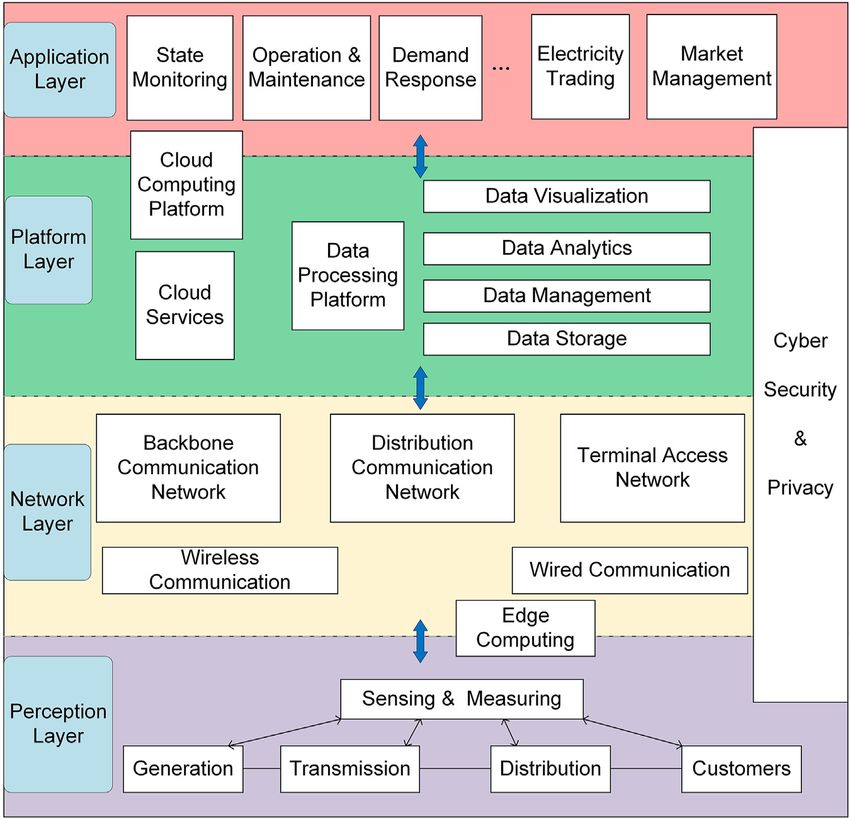
Liu et al.                                                                                                                      Smarter Grid in the 5G Era

connect with multiple substations and upload data in real time,                 universal standards and protocols to enable seamless
which are used for dynamic monitoring and management, system                    communication among various devices. The network layer of
prediction, and protection of smart grid.                                       PIoT has a ubiquitous communication capability around the clock
    A wide-area measurement system has four key components:                     and realizes the holographic perception of the power grid. To choose
PMUs, phasor data concentrator (PDC), applications, and                         the most suitable communication technology and infrastructure for
information network among PMUs and PDC. A PMU obtains                           the smart grid, four key factors to be considered in practice consist of
synchronous measurement and transmits data to the PDC                           deployment duration, operation and management costs,
through the information network. The decision-making and                        communication performance, and environmental factors. In the
control center make the corresponding predictive correction and                 following, the pros and cons of six typical communication
protection measures based on these data and send the feedback signal            technologies widely applied to the smart grid are sketched,
for self-control. Compared to situational awareness of supervisory              including four wireless technologies and two wired technologies.
control and data acquisition (SCADA), the advanced PMU has a
higher update frequency that can adapt to the highly dynamic                    2.2.1 ZigBee
operations of the smart grid (Gore and Valsan, 2018). Using                     ZigBee is a low-power wireless communication technology based
PMUs for distributed state estimation benefits lower cost of data                on the physical layer and medium access control layer of the IEEE
communication, sufficient redundancy and stability, and higher                   802.15.4 standard developed by the ZigBee Alliance (LAN/MAN
accuracy and efficiency. However, a distributed PMU network is                   Standards Committee, 2003). ZigBee is devoted for wireless
vulnerable to hackers. And malicious manipulation of PMU data                   devices that require a low data rate and ultralow power
causes damage to power transmission and distribution, regardless of             consumption. It is mainly applied in the fields of industrial
potential voltage instability or out of phase. Therefore, it is necessary       control, home automation, building automation, energy
to fully consider the information security of the PMU and evaluate              management, personal health care, and consumer electronics.
the impact of distributed state estimation on a power grid (Cosovic                The mesh topology of the ZigBee network is capable of self-
et al., 2017).                                                                  healing and route repair. These features provide scalability,
                                                                                stability, and tolerance to node and link failures. These
2.1.3 Wireless Sensor Network                                                   powerful network characteristics, as well as high anti-
Considering the diversification and the explosive growth of                      interference performance, have promoted the application of
electric power data and high demand for real-time interaction,                  ZigBee in distribution network measurement, monitoring, and
the low scalability, low flexibility, and relatively high deployment             home energy management. For instance, integrating ZigBee-
cost of wired networks restrict the development of the smart grid,              based smart devices with machine learning benefits intelligent
which promotes the application of wireless sensor networks.                     home control with high robustness, stability, and efficiency for
Sensor nodes in wireless sensor networks are responsible for                    home’s energy control and management (Zhang et al., 2019).
measurement, data processing, storage, and communication. And
they transmit information to sink nodes in a multi-hop way. Sink                2.2.2 WLAN
nodes have powerful computing and communication capabilities,                   Wireless local area network (WLAN) can provide high data rate
and they connect to the management center. The management                       communication with low latency, and perform point-to-point
center makes decisions according to the acquired information of                 and point-to-multipoint communication within a limited
sensor networks. Wireless sensor networks are capable of self-                  coverage area such as home area network (HAN). In WLAN,
organization, self-healing, adaptivity, and multi-hopping. They                 Wi-Fi, a wireless network protocol based on the IEEE 802.11
enhance the reliability of the power grid information network by                standards, is widely used for local area networking of devices and
allowing better monitoring of the system components, implement                  Internet access.
coordinated protection, and avoid and reduce the power grid fault                  WLAN is greatly affected by interference, such as the
(Chhaya et al., 2017).                                                          electromagnetic interference of high-voltage electrical
    The wireless sensor network plays a critical role in many fields             equipment and the interference of other wireless signals.
of the smart grid, such as wireless automatic meter reading,                    Moreover, WLAN is vulnerable because the transmission
remote system monitoring, and equipment fault diagnosis.                        channel is open such that anyone within the range of a
However, wireless sensor networks are inherently limited to                     network with a wireless network interface controller can
battery life, processing capability, and cache capacity.                        attempt to access it. However, with the advantages of easy
Therefore, it is imperative to ensure the performance of sensor                 deployment, flexible topology, and high scalability, WLAN can
nodes and extend the network life span under strictly resource-                 form a dynamic self-organizing and self-healing network. In
constrained conditions (Ogbodo et al., 2017).                                   practice, WLAN is suitable for applications with a high data
                                                                                rate and low-interference environment requirements, such as
                                                                                smart meters communication (Hlaing et al., 2017) and
2.2 Network Layer: Communication                                                substation communication (Zheng et al., 2018).
Technologies in a Smart Grid
To facilitate the interconnection and intercommunication of grid                2.2.3 Cellular Communication
components, one must adopt an open and plug-and-play                            Cellular communication has a long history of development, and
communication network architecture. It is also necessary to use                 almost everywhere, ubiquitous cellular communication systems

Frontiers in Communications and Networks | www.frontiersin.org              4                                        June 2021 | Volume 2 | Article 689590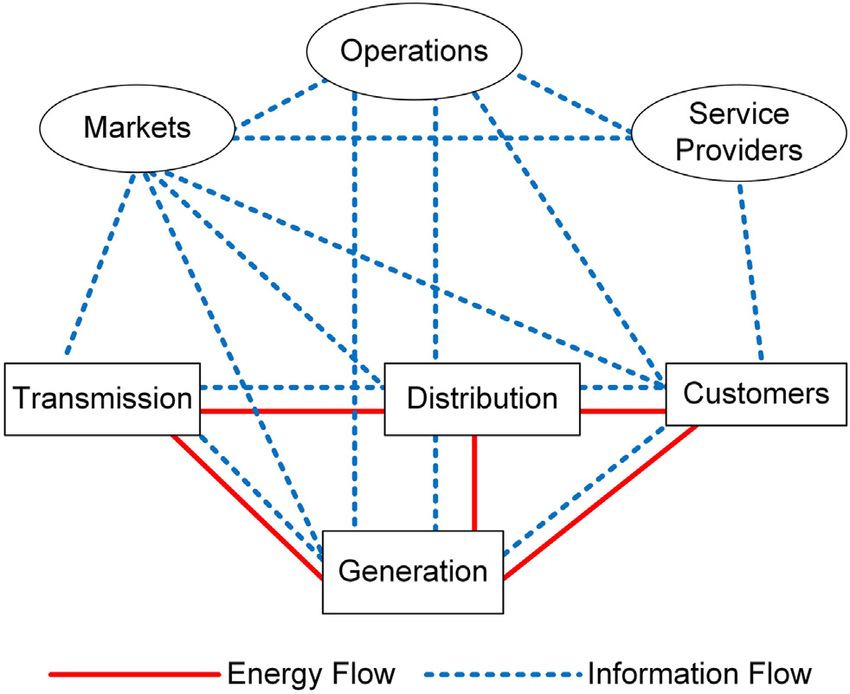
Liu et al.                                                                                                             Smarter Grid in the 5G Era

and infrastructure already exist. With the characteristics of           low security such that it is not suitable for high-quality data
broadband, such as high data rate and wide-area coverage,               transmission services. In practice, PLC is usually integrated with
cellular communication helps reduce investment in dedicated             other communication technology, for example, wireless
communication infrastructure, allows rapid deployment of                communication systems, for smart grid applications (d. M. B.
applications, and provides low maintenance costs and high               A. Dib et al., 2018).
performance.
    In the smart grid, cellular technologies suit wide-area             2.2.6 Fiber-Optic Communication
intelligent applications such as automatic demand response              Fiber-optic communication refers to a communication method
and remote monitoring and control of distributed energy                 that uses optical fiber to transmit information, which performs
resources. However, cellular technologies need to be tailored           great in high data rate, very low interference, reliability, security,
and/or strengthened because cellular technologies such as LTE           and broadband. In the smart grid, it is mainly used in the
were designed originally for mobile communication. Therefore, it        backbone network between the wide area network (WAN) and
is necessary to fully consider the spectrum usage, data flow             the neighborhood area network (NAN), connecting the control
characteristics, security, energy efficiency, reliability, and           center, substations, and public utilities, bringing extremely low
congestion mechanism of cellular technologies. For instance,            latency, high data rate, and coverage of hundreds of kilometers,
narrow-band        IoT   is   promising   for    machine-type           and being free from electromagnetic interference.
communications with a low power and data rate in a smart                    As fiber-optic communication suffers from poor scalability
grid (Li et al., 2018).                                                 and high cost of deployment and maintenance, integrating fiber-
                                                                        optic communication with other technologies like wireless
2.2.4 WiMAX                                                             communications provides heterogeneous solutions for
WiMAX, a microwave access technology with global                        communications with strict latency and reliability
interoperability, is a communication technology developed by            requirements. For instance, with the integration of fiber-optic
the IEEE 802.16 wireless broadband standard. It supports long-          communication into a wireless sensor network, the collected
distance and broadband wireless communications, especially in           information is transmitted to a data center through optical
rural and suburban areas. WiMAX is devoted to point-to-                 fibers to process front-end data in real time. Advanced optical
multipoint communications in fixed or mobile applications,               fiber sensor network helps realize the real-time monitoring and
allowing thousands of simultaneous users in wide-area coverage.         control of the power system and improve the stability of the
    On the account of wide-area coverage, high data rate, low           power system (Akerele et al., 2019).
latency, and high scalability, WiMAX is suitable for smart grid             To sum up, Table 1 compares the performance of
applications such as wireless automatic meter reading and real-         communication technologies described above. It is not hard to
time pricing. In particular, WiMAX mesh networks can use                see that cellular communication, especially 5G technology,
multiple channels and rapidly identify outages and restore,             outperforms the others in terms of data rate, coverage, latency,
thereby improving reliability and efficiency of smart grid               and deployment cost.
operation (Eissa, 2018). However, WiMAX deployment costs
and equipment are expensive, and the radio frequency that               2.3 Platform Layer
can be easily interfered by obstacles is very high. Therefore, it       The platform layer of PIoT refers to a digital power grid platform
is imperative to select suitable geographic locations for WiMAX         that integrates physical grid architecture and information
towers to meet higher quality of service (QoS) requirements             network infrastructure. The digital platform employs big data
(Tavasoli et al., 2016).                                                and artificial intelligence (AI) technologies to gather, store,
                                                                        manage, and analyze data. And it realizes the holographic
2.2.5 Power Line Communication                                          perception and intelligent decision-making of the power grid.
Power line communication (PLC) refers to a communication                As shown in Figure 2, the components and functionalities of the
technology that exploits power lines to transmit data and media         digital grid platform include both cloud computing platform for
signals. PLC is divided into narrowband PLC and broadband               cloud services and data processing platform for data storage,
PLC. The former works between 3 and 5 kHz frequency band                management, analysis, and visualization, as each detailed below.
with a low data rate, which is suitable for sensor measurement             Data at the platform layer come from various sources at the
applications in the power grid. The latter works in 2–250 MHz           lower perception layer, including power grid state data, operation
with a data rate up to hundreds of Mbps, which is more inclined         data, and external environmental data. The cloud computing
to media entertainment and Internet applications.                       platform provides electricity services and applications via a
   PLC is widely used in the monitoring, control, and automation        remote cloud computing server rather than an on-site server.
of medium-voltage power grids and substations, mainly involving         Cloud services do not only benefit from decoupling applications
fault location, isolation, and recovery. PLC can exploit the            and physical servers but also reduce costs on building
existing distribution line as the transmission line and easily          infrastructure and maintaining local servers. Moreover, it
penetrate into every family, providing plug-and-play                    provides scalable computing resources for data processing as
communication at a very low cost. However, the PLC                      per service and application requirements (Talaat et al., 2020).
communication system is vulnerable to high noise, poor                     The data storage module typically includes distributed file
communication channel condition, interference sensitivity, and          systems, distributed databases, relational database management

Frontiers in Communications and Networks | www.frontiersin.org      5                                       June 2021 | Volume 2 | Article 689590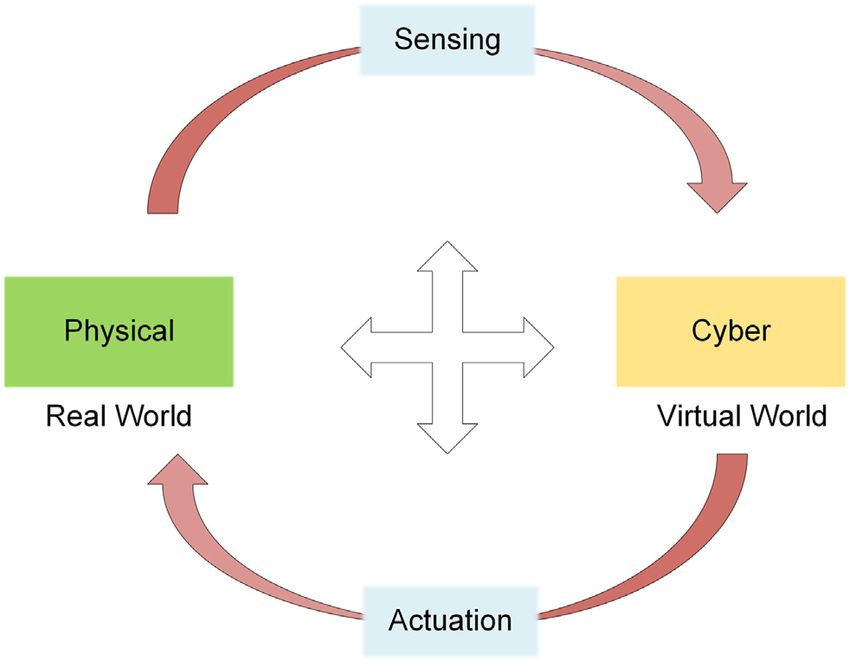
Liu et al.                                                                                                                               Smarter Grid in the 5G Era

TABLE 1 | Comparison of typical communication technologies for a smart grid.

Technology                   Standards                Data ratea              Distance covered            Latency            Cost                    Scope

ZigBee                      IEEE   802.15.4           Low                           100 m                   50 ms           Low               HAN
                            IEEE   802.11ax           Very high                      70 m                    3 ms           Medium            HAN and NAN
                            IEEE   802.11ac           High                           70 m                   10 ms           Low               HAN and NAN
WLAN
                            IEEE   802.11n            Medium                         50 m                   15 ms           Low               HAN
                            IEEE   802.11g            Medium                         50 m                   15 ms           Low               HAN
                            2G                        Low                                                  300 ms           Low               HAN and NAN
                            3G                        High                                                 100 ms           Low               HAN, NAN, and WAN
Cellular                                                                            35 km
                            4G                        High                                                  10 ms           Low               HAN, NAN, and WAN
                            5G                        Very high                                             100 km                 3 μs/km          High              NAN and WAN
a
    Data rate: low (1 Gbps).

systems, and distributed message queues, providing high-                                   2.4 Application Layer
performance life-cycle data storage and access. The                                        The application layer is the highest in PIoT architecture from the
appropriate storage strategy is usually chosen according to                                perspective of client’s end. Ready-to-use data from the platform
data types and characteristics to ensure adequate storage                                  layer create value only if they result in problem-solving solutions
capacity. The connections between different storage systems                                and achieve different application goals. The application layer
are crucial to data fusion, yielding an optimal amount of data                             needs to precisely match data with various affairs, closely link the
and valuable information from them (Ding et al., 2019).                                    data with the specific content of various transactions, and realizes
    The data management module supports various                                            the combination of data and smart grid applications. With
functionalities of model management, data asset operation and                              graphic user interfaces, smart grid applications such as state
maintenance, and metadata management. Data management                                      monitoring and demand response are implemented through
refers to the effective use of hardware and software resources                             PIoT, allowing the smart grid to benefit from IoT and
to systematically gather, manage, and extract useful information                           manipulate the physical power grid.
from big data of the smart grid to build up a unified public data                               Many smart grid applications exist in this layer, with each
model. The unified framework for data management is                                         having very different requirements. For example, the demand
fundamental to data consistency, interoperability, granularity,                            response application needs to respond to load changes timely and
and reusability (Gharaibeh et al., 2017).                                                  reliably, while the state monitoring application needs to collect
    The data analytics module refers to the process of a large                             small packet data from massive devices. Indeed, each smart grid
number of diverse data, which can discover potentially useful data                         application is the collaboration of all layers. Taking reading
characteristics and relationships. It uses distributed computing                           meters, for example, one obtains the customers’ power
and grid simulation technology to realize the whole process of                             consumption and load information, acting as sensors at the
power grid simulation, electrical calculation, spatial analysis,                           perception layer of PIoT. Then, the electric power data are
topology analysis, etc. Moreover, data are deeply analyzed                                 sent through the network layer to the data center at the
using approaches, like deep learning and reinforcement                                     platform layer for data analysis. Then some corresponding
learning, to enhance intelligent applications, grid operations,                            strategies such as automatic billing and pricing are made at
and customer insight (Syed et al., 2021).                                                  the application layer. In the 5G era, the smart grid can
    The data visualization module uses graphics and image                                  support more and more new application scenarios with ICTs.
processing and computer vision to implement visual                                         Equipped with AI and machine learning technologies, the
interpretation of data (Sanchez-Hidalgo and Cano, 2018). The                               application layer can efficiently handle the stochastic factors
visualization module effectively integrates the large-scale                                influencing the smart grid. For instance, the smart grid can
computing capabilities and human cognitive abilities to realize                            provide a customized power plan through learning from
power grid simulation and panoramic visualization. It provides                             customer behaviors such as daily electricity load profiles
historical data query and inversion, self-served application                               inferred from smart metering data (Wang et al., 2019).
intelligence, and multi-terminal mobile decision support, and                              Meanwhile, a novel event classification can help smart grid
supports the construction of digital power grid visualization                              operators to detect and classify local events that have a
applications.                                                                              considerable impact on safety and operation. The work
    After comprehensive data processing, the platform layer can                            (Haddad et al., 2018) used artificial neural networks to
fully explore the value and benefit in the data; ensure the safe,                           distinguish different classes of events to maintain the quality
secured, and stable operation of the grid; provide value-added                             and reliability of the smart grid with various impairments. In
services; and create new value for various power businesses at the                         sum, the application layer is the value realization layer of the
application layer.                                                                         combination of energy flow and information flow through PIoT.

Frontiers in Communications and Networks | www.frontiersin.org                         6                                      June 2021 | Volume 2 | Article 689590
Liu et al. Smarter Grid in the 5G Era
2.5 Security and Privacy communication overhead, the work by Mahmood et al. (2016)
The value created by various applications depends heavily on the proposed a lightweight message authentication scheme for the
secure and reliable information flow. However, the large-scale smart grid. Furthermore, Kumar et al. (2019 proposed a mutual
and heterogeneous deployment of smart grid information authentication scheme, which requires less computational cost as
networks has introduced many network access points. The it builds upon the elliptic curve cryptography, symmetric
destruction of any one of the links may directly affect the encryption, hash function, and message authentication code.
power generation and distribution of the entire power grid
and cause huge economic losses to customers and utilities. For 2 Access Control
example, an attacker can extract important information such as Access control is a data protection mechanism that uses
keys from the memory of a smart meter and insert malicious code predefined strategies to limit authorized users to access
into the device to attack other parts of the power grid. In addition, constrained data resources. The commonly used access control
information networks contain the private electricity consumption method in telecommunication networks is role-based access
information of many customers, which discloses personal control (RBAC), which defines different roles according to
electricity consumption habits and privacy. distinct tasks or functions and then allocates resources and
The reliability of the smart grid depends not only on the stable operating permissions for these roles (Saxena et al., 2016).
operation of energy grid components and facilities but also on the Electric power data are multidimensional and multilevel. And
reliable communication of various intelligent terminal and an efficient aggregation of data and fine-grained data access
measuring devices. Therefore, it is imperative to improve the control are the concerns of security and privacy issues in the
reliability and effectiveness of communications while using more smart grid. The work by Lang et al.( 2018) proposed a mechanism
secured mechanisms and algorithms to resist and even avoid that tightly aggregates multidimensional data and supports
network attacks and/or data theft. privacy protection and fine-grained access control, called
MTA-PA. In the MTA-PA, the authors used homomorphic
2.5.1 Security encryption technology to aggregate multidimensional data into
Attacks on the power grid can usually be divided into three types ciphertext and key-policy attribute-based encryption (KP-ABE)
(Saghezchi et al., 2017): 1) attacks on the data collection system, to achieve fine-grained dimension-level access control. Moreover,
making the control center obtain false information and perform as data in the smart grid were stored in a distributed way due to
wrong operations; 2) attacks on the operation of the power the cloud-edge computing infrastructure, it is necessary to
market, disrupting pricing in the electricity market and develop an efficient access control scheme for edge computing
making profits from it; and 3) attacks on the smart metering infrastructure (Chaudhry et al., 2020).
and demand-side response, destroying the balance of supply and
demand by changing the load status. While the security issues of 3 Intrusion Detection
the PIoT are similar to those of the Internet, they still have An intrusion detection system (IDS) ensures data security by
particularities (Demir and Suri, 2017): 1) The edge node identifying attacks and triggering appropriate countermeasures.
equipment have the same high-security requirements as the There are three major schemes for intrusion detection technology
control center; 2) grid data need to be transmitted in time and in the network: signature-based, anomaly-based, and
accurately, which is totally different from the best-effort delivery specification-based schemes.
on the Internet; and 3) the computing and communication Distributed smart grid network structure leads to the
capabilities of the grid nodes may be insufficient. Therefore, distributed intrusion detection system. The work by Zhang
PIoT adopts lightweight and active data security mechanisms et al. (2011) proposed a hierarchical IDS solution in the power
such as identity authentication and access control, intrusion grid. This solution deploys intelligent analysis modules at each
detection, and other security mechanisms. network layer, using support vector machines and artificial
immune systems to detect and classify malicious data or
1 Authentication possible network attacks. The work by Patel et al. (2017)
Authentication is applied to verify device identity and data showed that traditional intrusion detection systems based on
validity. Each trusted user has a unique identity and obtains signature and anomaly techniques are insufficient to protect the
data after being authenticated by both parties during the smart grid due to the ever-rapidly-evolving masquerades and
communication process. There are three main methods of cyber criminality. Hence, they proposed a collaborative IDS to
identity authentication: shared key, public key infrastructure provide excellent protection with a fully distributed management
(PKI), and biological characteristics. Among them, the PKI is structure. With the development of machine learning and
the basic security tool in most telecommunication networks and advanced information processing technologies, IDS will
distributed systems. And it is also the first line of defense to integrate more statistics and machine learning–based
ensure the security of the power grid. algorithms to enhance their efficiency in identifying the data
Although the PKI is the most popular key management that have different underlying distributions (Ahmed et al., 2019).
solution in telecommunication networks, the application of the
PKI to the smart grid still faces several challenges, such as 2.5.2 Privacy
scalability, delay, and fault tolerance (Ancillotti et al., 2013). In the smart grid, smart meters and other measuring instruments
As the PKI requires a high computational cost and frequently collect detailed energy and state information.
Frontiers in Communications and Networks | www.frontiersin.org 7 June 2021 | Volume 2 | Article 689590Liu et al. Smarter Grid in the 5G Era
In practice, privacy protection and information accessibility
need to be balanced. The more information customers are willing
to disclose, the more intelligent decisions the management system
can make to improve the service level. However, easy access to
information means more privacy leakage, thus obtaining a
compromise between accessibility and privacy protection and
determines the level of privacy protection to deal with different
grid services.
3 CYBER-PHYSICAL POWER SYSTEM
Figure 3 illustrates a basic CPS framework. On the one hand, the
physical system (i.e., the real world) perceives the environment
and component states, collects and processes data, and sends
them to the cyber system through the network. On the other
hand, the cyber system (i.e., the virtual world) analyzes the data
according to the system model and operating mechanism and
FIGURE 3 | CPS framework.
sends instructions to the execution devices of the physical system
to actuate physical entities.
The CPS embeds the sensing, communication, computing,
Although data accuracy is essential to power distribution, and control abilities into the physical devices to realize the
demand-side management, load control, and other services, distributed sensing, reliable data transmission, and
these data may expose customer privacy such as personal comprehensive information processing of the external
energy use mode and power consumption. environment and resources and implements the real-time
To guarantee electricity services and applications while control of physical entities through the feedback loop. It is a
protecting customer privacy, lots of privacy preserving critical premise to reach the intelligent industrial production
approaches have been proposed, which can be classified into automation and make the industrial system evolve toward
two categories: cryptography-based and non–cryptography- Industry 4.0 (Tao et al., 2019).
based privacy preserving schemes (Liao et al., 2019). In the traditional power grid, the physical system and the
The cryptography-based privacy preserving approaches in the information system are relatively separated. Thus, it is hard to
smart grid are divided into two main categories: anonymization achieve refined and automated coordination of grid components.
and data aggregation. An effective cryptography privacy As many electrical devices, data collection devices, and
preserving is to use an anonymous scheme such that the data computing devices interconnect through PIoT, the power grid
are not easy to connect with the relevant customers. For example, has already had the main characteristics of the CPS to a certain
each smart meter can be equipped with a key through a trusted extent. With the construction of grid automation systems, large-
third party to correspond to customer data (Ambrosin et al., capacity transmission networks, ubiquitous sensor networks, and
2016). Data aggregation is an important method for data deep integration with the PIoT and power grid, the smart grid
management while preserving customer privacy, because it is continues to evolve into a system with wide-area coordination
hard to extract the electricity consumption information of a and autonomous behavior, thus yielding the CPPS.
specific customer from aggregated data. Meanwhile, the By integrating physical and cyber worlds, the CPPS enables the
aggregated data can be used for electricity applications such as bidirectional real-time mapping and interaction between the
dynamic pricing-based billing and demand response physical and virtual digital systems. In other words, it is now
management (Gope and Sikdar, 2018). allowed to reconstruct the objects, events, and human behaviors
A feasible non-cryptography solution is to divide electric of the physical world in the digital world and, finally, to apply
power data into two parts: the low-frequency data and the simulation models to optimize the physical performance in real
high-frequency data. In this approach, the storage units are worlds.
used to flatten high-frequency and fine-grained usage curve, In the evolution of the smart grid, the gradual integration of
and hide detailed energy usage information, which only shows the physical infrastructure and information system makes the
a low-frequency shape for billing (Sun et al., 2018). Another smart grid smarter and smarter, with the following features:
popular non-cryptographic approach is physically unclonable
function (PUF)-based approach. PUF devices have a unique • Heterogeneity and extreme complexity: The smart grid itself
physical feature, which is not only non-reproducible by the is a large-scale heterogeneous complex system. The
cryptographic primitives but also too hard or impossible to be components in the power grid have different protocols
cloned physically (Kaveh and Mosavi, 2020). This unique and standards, and the smart grid uses different
property makes PUF useful in the key generation, technologies for the operation in various scenarios,
authentication and customer privacy protection. yielding a heterogeneous and extremely complex system.
Frontiers in Communications and Networks | www.frontiersin.org 8 June 2021 | Volume 2 | Article 689590Liu et al. Smarter Grid in the 5G Era
FIGURE 4 | Conceptual framework of the CPPS.
• Adaption and automation: The smart grid enables local represent the physical, information, and value dimensions in
control and global optimization through dynamic the CPPS, respectively.
connections and interactions between physical and cyber
systems. Thus, it can automatically and adaptively adjust 1 Physical Dimension
grid parameters online through fault detection, state It mainly involves the energy flow and the physical facilities as the
estimation, and control system. carrier of energy flow. The smart grid aims to realize the
• Real-time control: The stability of grid voltage, power, and generation, transmission, distribution, storage, and
frequency requires real-time feedback loops of sensing, consumption of electric energy efficiently, and integrate large-
transmission, and control. The long latency of scale distributed energy sources to build a power system with a
information processing and asynchrony may lead to two-way flow of electric energy.
instability of the grid state and even destroy the power
system. 2 Information Dimension
• Deep integration of physical and digital worlds: Distributed It takes data generated by an information network as a virtual
intelligent component integrates with the central entity, focusing on data collection, transmission, analysis, and
monitoring and control system to enable the cyber world processing. Information flow controls energy flow, conducting
to interact with the physical process so that the power grid the planning and operation of the smart grid. Moreover, the
has the ability of sensing, computing, communicating, and information flow establishes a connection between energy flow
controlling. and value flow, achieving the optimal value flow through the CPS
• High safety and security: A secure and reliable operation of control center.
the smart grid is necessary to ensure people’s productivity
and living. Power supply interruption will seriously threaten 3 Value Dimension
production and personal safety. Therefore, the integration It mainly takes the profit and social benefit of energy flow and
of cyber and physical systems can improve the reliability of electrical applications as value entities, focusing on the value
the power system as the fundamental premise. creation of smart grids. Driven by ICTs, the power industry
creates innovations in business models and market mechanisms,
to realize customer-centric value creation, data-centric value
3.1 Conceptual Framework of the CPPS extraction, and technology-driven services innovations.
Figure 4 illustrates the conceptual framework of the CPPS. The
objects, events, and human behaviors in the physical world are 3.2 The Layered Architecture of the CPPS
mapped into the digital world through the information network Based on the aforementioned framework of the CPPS, we are now
using state-of-the-art ICTs, to provide a digital image for the in the position to show the layered architecture for integrating
complex processes of power generation, operation, management, smart grid with PIoT, and to analyze how the physical and cyber
and control. In the digital world, digital thinking is used to systems interact in the future smarter grid from the perspective of
implement power system modeling, simulation, testing, and the CPS. In the context of the CPS, this subsection analyzes the
monitoring, to make efficient production scheduling and key components, domains, and their interactions, to provide a
planning of smart grid. The core of the CPPS lies in the deeper understanding on the integration of the smart grid, ICT,
energy flow, information flow, and value flow and they IoT, and CPS.
Frontiers in Communications and Networks | www.frontiersin.org 9 June 2021 | Volume 2 | Article 689590Liu et al. Smarter Grid in the 5G Era
FIGURE 5 | Layered architecture and enabling technologies of the CPPS.
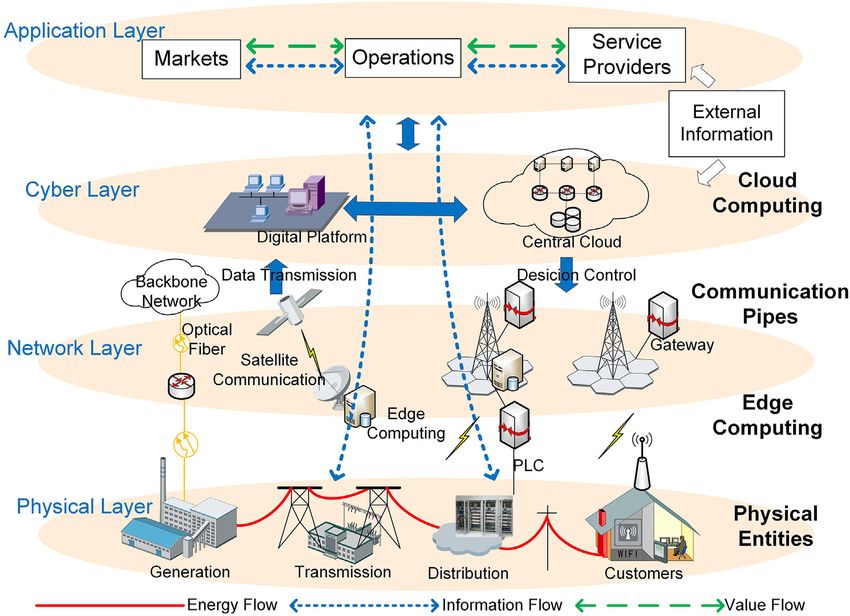
As shown in Figure 5, the CPPS architecture includes four • Application layer (i.e., application, management, and control
layers: the physical layer, network layer, cyber layer, and layer) includes service providers, markets, and operations
application layer. The interaction of the four layers relies on between them, which is the highest level decision-maker.
the information flow across them. More specifically, the main The decision-makers consider all issues from the
functions of each layer are as follows: perspectives of economy, society, and environment, taking
market regulation, pricing, and incentive measures into
• Physical layer (i.e., facilities layer) is the fundamental layer account to conduct the power generation and consumption
of the architecture, including various physical facilities and in the physical world. A dominant feature of this layer is that the
executors in the grid. It is deployed in a distributed manner, optimal operations are performed based on the two-way
and the decision-making instructions are executed in this information, and value flows between the markets and
layer to achieve the required system functionality. Also, the service providers.
enery flows in a two-way fashion within this layer among
the power generation, transmission, distribution, and To put the CPPS into practice, there are four enabling ICTs;
customers. they are cloud computing, communication pipes, edge
• Network layer (i.e., communication network layer) is the computing, and physical entities, with each detailed below.
key of the architecture, which makes a bridge between the
lower physical layer and the upper cyber layer. It describes 1 Cloud Computing
the overall functions of the information network, namely, The CPPS needs to analyze, process, and make decisions on big
how the electrical facilities make the interaction between data, which poses new challenges to the computing and
heterogeneous components and execute the control information processing capabilities. Cloud computing can
instructions of the upper layer. meet the business requirements of massive data for
• Cyber layer (i.e., decision-making layer) is the core of the networking, storage, and computing, and provide rich
architecture, which consists of a cloud computing–based application services. With the support of virtualization
central processing mechanism and distributed computing technology, cloud computing can integrate the hardware and
intelligence to optimize both computing and control software resources distributed in different geographical locations
strategies. This decision-making layer acts as the to form a virtual platform with strong storage and computing
executive brain of the whole system and provides the capabilities. As cyber hardware is maintained at the cloud side,
human–computer interface with the upper layer to the electric power users only need to pay on demand and thus can
coordinate all the lower layers by designing and sending largely reduce the local investment and operation costs on the
appropriate commands. hardware and software.
Frontiers in Communications and Networks | www.frontiersin.org 10 June 2021 | Volume 2 | Article 689590Liu et al. Smarter Grid in the 5G Era
Cloud-based information infrastructure for smart grid has the cyber world. To some extent, MEC has certain computing and
several merits, such as scalable resource provision and access storage capacity at the local, avoiding the long-distance
convenience (Luo et al., 2016). Cloud computing can dynamically transmission of data. As computing capacities extend to the
provide services to users on demand according to the different edge of the network, cooperative edge-cloud solutions help
electricity application requirements in a distributed computing improve distributed intelligence and decision-making ability of
mode. Cloud can be accessed anytime and anywhere through the the CPPS (Liu et al., 2019).
Internet; at the same time, many cyberattack-defending
mechanisms for the specific power applications can be 4 Physical Entities
implemented to ensure security and fault tolerance (Guan Physical entities refer to various electrical and electronic
et al., 2017). equipment involved in the power grid. As the basic units of
the power system, they are distributed throughout the power grid
2 Communication Pipes and perform distributed sensing and acting tasks. Through sensor
Communication pipes refer to the data transmission channels technology, chip technology, and IoT, physical entities create a
between the physical layer and cyber layer, connecting user comprehensive network to enable the CPS and various
terminals, edge devices, and cloud computing resources, which stakeholders to interact closely. Physical entities can be
represent the ubiquitous information network in the smart grid. connected to monitors or computers through the network, and
In the CPPS, as various electricity services have different provide a graphical interface for human–computer interaction.
communication, computing, and cache requirements, Through the device and network, customers have a deeper
deploying dedicated physical facilities for different types of understanding on the electricity application and services,
applications is cost-intensive and may degrade interconnection providing electrical staff with easier equipment control.
and interoperability of the grid. Instead, communication pipes AI makes it possible for physical entities to learn from
should integrate multiple communication methods to provide experience and environment, adjust to new inputs, and
common communication services for different application perform human-like tasks. As further development of
scenarios. distributed computing, physical entities may have certain
5G network slicing provides distinct virtual networks and computing capabilities and can apply for simple programs.
differentiated QoS guarantees under a shared physical Device-to-device (D2D) communication allows adjacent
infrastructure, which is a promising solution for the CPPS to entities to establish direct communication links between them
efficiently handle different electricity services. Through the without a third-party base station, to share their connection, or
architecture based on virtualization and software-defined directly communicate and exchange information. Therefore, the
network, 5G network slicing realizes an end-to-end, combination of D2D and AI provides communication and
multiservice ecosystem, in which users share the underlying computing ability among local entities, which have potential to
physical infrastructure resources and use a virtualization perform task completely at the device side without any servers.
method to efficiently meet requirements of various Decentralized federated learning techniques are promising
applications. However, the main difficulty in network slicing solutions for these server-less applications (Savazzi et al., 2020).
lies in how to efficiently use the physical network and
computing infrastructure, and provide a reliable and secure
connection and computation to the CPS (Liu et al., 2020). 4 CASE STUDY: AN INTELLIGENT HOME
Machine learning is the potential to automate and optimize ENERGY MANAGEMENT SYSTEM
network slicing efficiently in a heterogeneous and dynamic
environment (Sun et al., 2019). In a traditional home energy management system (HEMS), the
efficiency of energy management and planning is very low due to
3 Edge Computing inadequate energy consumption information collection and
Edge computing is to deploy distributed intelligent agents at the analysis, leading to high energy cost. By integrating PIoT and
edge of the network, which provides network, computing, the CPPS, HEMS is equipped with much more powerful situation
storage, and application services near data sources. While awareness ability and automatic control ability, turning to
cloud computing provides the computing resources needed by intelligent HEMS. Through advanced network infrastructure
the smart grid, the remote central cloud is far away from data and machine learning–based big data analysis and control
source, resulting in long-time latency. Using MEC to offload tasks strategies, intelligent HEMS can improve the efficiency and
to the local edge, many electricity applications and services will provide innovative home energy management services, such as
benefit from localized communication and data processing, thus fine-grained consumption data collection, management for
dramatically decreasing service response latency, reducing the electric vehicles, precise load control, and customized energy
communication overhead and traffic load on the central network, management. Moreover, intelligent HEMS promotes
and improving context awareness (Cosovic et al., 2017). It helps comprehensive visibility, flexibility, and control of home assets
for peak-load shifting and balances the load with the demand in and energy, and finally increases convenience and happiness of
real time, to carry out the optimal electric power distribution. resident.
MEC doubles the hardware resources and software Figure 6 illustrates the architecture of integrating PIoT with
applications at the end side, bridging the physical world and the CPPS in an intelligent HEMS, which from the bottom-up
Frontiers in Communications and Networks | www.frontiersin.org 11 June 2021 | Volume 2 | Article 689590Liu et al. Smarter Grid in the 5G Era FIGURE 6 | Architecture of an intelligent home energy management system. includes the physical layer, network layer, cyber layer, and the environment and energy data to the upper cyber layer using application layer. The physical layer comprises all kinds of long-distance 5G communication technologies, where cloud household electrical appliances, various sensors (e.g., computing provides data storage, management, and analysis. It is temperature sensors, humidity sensors, and light sensors), data noted that the hybrid communication network can provide seamless collection devices (e.g., smart meters and cameras), and electric two-way data transmission, to provide mutual real-time interaction actuators (e.g., light controllers and voltage/current controllers). between physical measurement systems and digital control systems. Distributed energy resources, storage units, and electric vehicles Each intelligent HEMS allows to update local AI models for efficient enable the two-way energy flow between household consumers energy management and to customize local energy management and power grid, which requires robust two-way information flow plans, making adaption to distinct living habits of different families. for interaction. The PIoT in the home area network provides Furthermore, the data can reuse anytime and anywhere to build up interconnection for things, objects, and electricity applications, home energy management visualization. The application layer collecting household environment data, energy consumption comprises user interfaces and a control center to provide various data, and user behavior data. advanced energy management applications and services. The data generated in the physical layer are transmitted to the On the other hand, the layered architecture integrating PIoT network layer using Wi-Fi, ZigBee, and other short-distance with the CPPS implements intelligent home energy management communication technologies. Then, the network layer forwards through four steps. At first, the environment and energy data are Frontiers in Communications and Networks | www.frontiersin.org 12 June 2021 | Volume 2 | Article 689590
You can also read


