Multiple ASpects TrajEctoRy management and analysis - MASTER
←
→
Page content transcription
If your browser does not render page correctly, please read the page content below
Issue 1 | September 2018

                          Multiple ASpects TrajEctoRy
                          management and analysis

                                                                                Inside this issue
                                                                                  3
                                                                                       Editorial
                                                                                  4    The MASTER project
                                                                                  7    Holistic trajectories, privacy, and
                                                                                       the strategic concealment/disclo-
                                                                                       sure of information

This project has received funding from the European Union’s Horizon 2020 research and innovation programme under the Marie Sklodowska-Curie
grant No 777695 Duration: March 1 2018 | February 28 2022                                       © 2018 MASTER www.master-project-h2020.eu
3

Editorial
Welcome to the first issue of the MASTER newsletter. The objective of this newsletter is to keep the consortium updated with the
main activities that are going on during the project, summarizing the main interesting results in terms of secondments, training,
scientific results, vision and dissemination activities. We also want to communicate our main outcomes to a wider audience, find
more opportunities for collaborations and exchange of ideas with interested readers outside the consortium.

Our newsletter will be published every 6 months. Each issue will be available for download from the MASTER web site at
http://www.master-project-h2020.eu

In this first issue we introduce the project, the consortium and report about our kick off event held the last March 2018.
We are very happy and proud that our Independent Ethical Advisor Prof. Bettina Berendt accepted our invitation to prepare a
very stimulating article expressing her vision about the need of ethical consideration in data science for holistic trajectories. Prof.
Berendt shares her thoughts on two case studies: the well known New York taxi dataset and the controversial topic of the analysis
of ships traces for the detection of search and rescue operations in the Mediterranean Sea, linked to the migration phenomena.
Her vision will be our starting point for reflecting on the ethical issues that our research is posing.

The next issue will be published at the end of February 2019: we will report results from our secondments, selecting highlights on
the major research results and the plan for activities like the first MASTER Workshop and the planned Summer School.

Stay tuned and happy reading!

                                                                                                   Chiara Renso, Project Coordinator
4
          MASTER NEWSLETTER - www.master-project-h2020.eu

    The MASTER project
    MASTER is a Horizon 2020 project under the programme Marie Sklodowska-Curie Actions - Re-
    search and Innovation Staff Exchange (RISE) for boosting the carrier perspectives of researchers
    through staff exchange
    Chiara Renso, Project Coordinator, HPC Lab, ISTI-CNR, Italy

    In our everyday life we interact with a      senting the multiple aspects of move-            We investigate methods for managing
    number of diverse, real-life applications    ment data.                                       and building semantically rich trajecto-
    that produce massive amounts of spa-                                                          ries from heterogeneous and multidi-
    tio-temporal data representing trajec-       In the MASTER (Multiple Aspects Trajec-          mensional data.
    tories of moving objects. For example,       tory Management and Analysis) project            How can we infer interesting knowl-
    we can considering mobile phone calls,       we call them holistic trajectories, mean-        edge from large amounts of holistic tra-
    GPS enabled tracking applications, (geo-     ing trajectories characterized by the fact       jectories?
    tagged) social media but also land, sea,     that space, time and semantics are all           We study data analysis methods capa-
    and air surveillance systems with smart      different aspects that are intimately cor-       ble of taking into account the different

                           APPLICATIONS

                                 Tourism                   Sea monitoring                       Transportation

                           METHODS

                           Definition, construction
                          and management of holis-                                 Analysis of holistic tra-
                               tic trajiectories                                          jectories

                           Big Data               Privacy                        Big Data                 Privacy

                                                 The concept of the MASTER research programme

    sensors and public transportation like       related and should be considered as a            aspects of holistic trajectories. We focus
    buses and metro. In all these areas, po-     whole. Current state-of-the-art methods          specifically on: similarity analysis, clus-
    sitioning data is produced, collected,       do not provide methods “ready for use”           tering, graph analysis, prediction and
    stored and analysed together with ad-        for these multiple aspects trajectories.         recommendation.
    ditional contextual data. These trajecto-                                                     Which applications benefit from the
    ry data is therefore evolving from pure      THE MASTER PROJECT IN 5                          analysis of holistic trajectories?
    sequences of timestamps and position         QUESTIONS:                                       We assess the impact of the holistic tra-
    coordinates to more comprehensive and        How can we create and manage holistic            jectories analysis methods in the tour-
    semantically significant objects repre-      trajectories?                                    ism, sea monitoring and public transpor-
5

The MASTER project

  tation domains.                             plementary domains: tourism, sea mon-         one is European non academic and four
  Is the privacy preserved?                   itoring and public transportation. On the     are international academic.
  The project develops methods based on       other hand, the methods that are being        The European academic partners are:
  privacy-by-design.                          developed can stimulate new require-
  How can we deal with the Big Data           ments in the application domains. Big         National Research Council of Italy (CNR)
  characteristics?                            Data principles have to be considered         participates with the ISTI institute (Isti-
  The storage and analysis methods will       as part of the methods. Privacy is a per-     tuto di Scienze e Tecnologie dell’Infor-
  pose emphasis on efficiency and large       vasive ethical aspect when dealing with       mazione) located in Pisa in Italy and it
  scale data management.                      positioning data, therefore, in MASTER,       is the coordinator of the project. The
                                              we have specific tasks for privacy pre-       main expertize of CNR researchers are

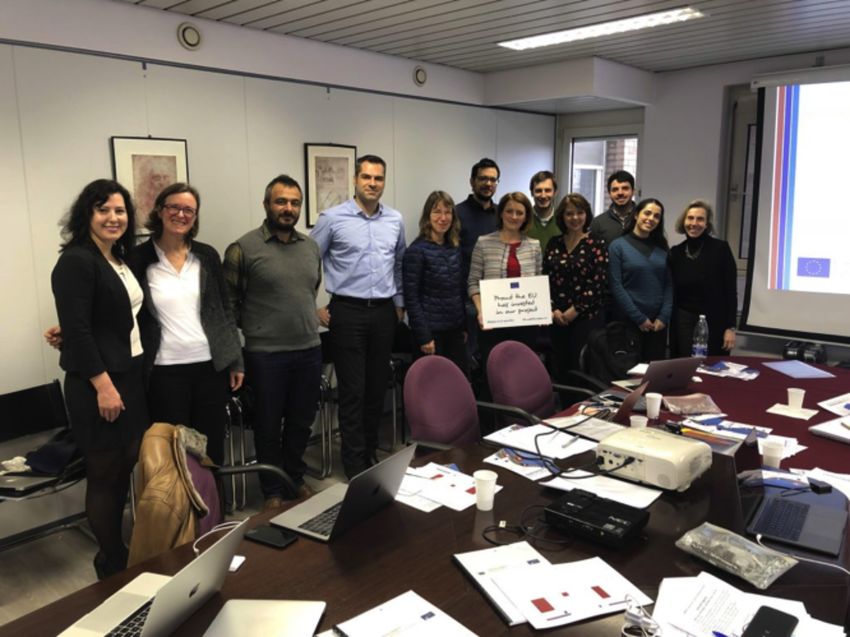
                                                   The consortium at the kick-off meeting

  MASTER                                      serving methods for holistic trajectories.    in mobility data and semantics, machine
  MASTER is a H2020 Marie Sklodows-           Furthermore, the consortium is support-       learning, data mining for spatio-tempo-
  ka-Curie Actions RISE (Research and         ed by an Independent Ethical Advisor          ral data. The principal investigator and
  Innovation Staff Exchange) project. The     (Prof. Bettina Berendt) and an Ethical        coordinator of the project is Dr. Chi-
  overarching objective of MASTER is to       Committee (Dr.ssa Rosaria de Luca, Prof.      ara Renso. Members of the research
  form an international and inter-sectoral    Tommaso Piazza, Prof. Celia Zolynski).        group are Raffaele Perego, Cristina Io-
  network of partners working on a joint      A precious first contribution from Prof.      ana Muntean, Beatrice Rapisarda, Ida
  research programme to answer the            Berendt giving her ethical view on two        Mele, Vinicius Monteiro de Lira, Andrea
  above research challenges. The concept      typical cases of privacy in trajectory data   Michienzi.
  of MASTER is depicted in the figure. We     is reported later in the newsletter.
  see that the research objective of the                                                    University of Ca’ Foscari Venice (UNIVE)
  project is to develop methods to build,     THE CONSORTIUM                                is located in Venice in Italy. The main ex-
  manage and analyse holistic trajectories.   MASTER consortium is formed by ten            pertise is in Trajectory Data warehous-
  These methods are driven by application     synergic and complementary partners:          ing, efficient and scalable methods for
  scenarios from three different and com-     five partners are European academic,          storage, mining and quantitative mod-
6
          MASTER NEWSLETTER - www.master-project-h2020.eu
                                                                                                                              The MASTER project

    elling of agents’ behaviours. Principal        is the Thira Municipality (Thira) in the       ed in the city of Halifax in the Nova Sco-
    Investigator is Dr. Alessandra Raffaeta’       Santorini island in Greece. Thira is repre-    tia province in the eastern Canada. DAL
    and members of the research group in-          sented in MASTER by Christallia Papao-         expertize is in machine learning, trajec-
    clude Marta Simeoni, Elisabetta Russo,         ikonomou who is supporting seconded            tory classification, privacy, big data. Prin-
    Salvatore Orlando, Claudio Lucchese, Fa-       researchers to better understand the           cipal investigator is Prof. Stan Matwin.
    bio Pranovi, Andrea Marin and Claudio          tourism issues of the island, the data         Members of the group include Amilcar
    Silvestri.                                     that can be collected and the kinds of         Soares Junior and Mohammad Etemad.
                                                   analysis that can be done on such data.
    University of Pireaus Research Center                                                         KICK-OFF MEETING
    (UPRC) is located in Piraeus in Greece.        The international partners are:                The Kick off meeting has been a great
    Main expertize is in spatio-temporal da-                                                      opportunity to meet “live” the European
    tabases and analysis methods, privacy,         The Federal University of Santa Catari-        Academic partners, our Project Officer
    big data analysis for movement data.           na (UFSC) is located in Florianopolis in       Simona Losmanova from REA and the In-
    Principal investigator is Prof. Nikos Pele-    the state of Santa Catarina in the south       dependent Ethical Advisor Prof. Bettina
    kis. The research group includes Prof.         of Brazil. UFSC experize is on semantic        Berendt from University of Leuven.
    Yannis Theodoridis.                            trajectory modelling and similarity mea-       The meeting was held in Brussels thanks
                                                   sures. Principal investigator is Prof. Vania   to the kind hospitality of the CNR Brus-
    University of Versailles Saint Quentin         Bogorny. Members of the group are Prof.        sels office at Rue du Trone, 98 on March
    (UVSQ) is located in the west of Paris,        Ronaldo Melo, Prof. Luis Otavio Alvares        22, 2018. A total of 13 people partici-
    and its science campus in Versailles city.     and student Lucas May Petry.                   pated in the meeting from CNR, UNIVE,
    UVSQ main expertize is trajectory data                                                        UPRC, UVSQ and HUA. Partner Organiza-
    modeling, indexing, mining, as well as         The Federal University of Ceara’ (UFC) is      tions from Brazil (UFC, UFSC, PUC) and
    privacy, with a focus on trajectories fol-     located in Fortaleza in the state of Ceara’    Canada (DAL) could participate via re-
    lowing a predefined network. UVSQ also         in the north of Brazil. UFC expertize is       mote connection.
    investigates time dependent graphs ei-         on mobility patterns and prediction,           We had productive discussions and two
    ther by aggregation of trajectories or as      trajectory reconstruction and graph            interactive Question Answering sessions
    their underlying context. Principal inves-     modelling. Principal investigator is Prof.     with the Project Officer and the Inde-
    tigator is Prof. Karine Zeitouni. The re-      Jose Fernandes de Macedo. Members of           pendent Ethical Advisor.
    search group includes Prof. Yehia Taher,       the group include Francesco Lettich, Igo       Indeed, particularly useful has been the
    and Prof. Iulian Sandu Popa, Alexandros        Brilhante and the students Livia Almada,       clarifications of Simona to our questions
    Kontarinis and Jingwei Zuo.                    Ticiana Linhares.                              on how to implement secondments and
                                                                                                  the Prof. Berendt’s vision about ethical
    Harokopio University (HUA) is located          The Pontifical Catholic University of Rio      issues that might arise when dealing
    in Athens in Greece. The main expertize        de Janiero (PUC) is located in the city of     with mobility data.
    is in sea monitoring analysis from ves-        Rio de Janeiro in Brazil. PUC expertize
    sels data, machine learning and big data       is in semantic web, social media analysis
    analysis. Principal investigator is Prof.      and in transportation applications. Prin-
    Konstantinos Tserpes. Members of the           cipal investigator is Prof. Marco Antonio
    group include Iraklis Varlamis.                Casanova.
    The European non academic partner              The Dalhousie University (DAL) is locat-

                                                  www.master-project-h2020.eu

                                                  Facebook: Master Project H2020

                                                  Twitter: Master Project H2020
7

Holistic trajectories,
privacy, and the strategic concealment/
disclosure of information
A reflection on ethical questions in the mapping of taxi rides and Mediterranean migrant rescue
operations, and the implications of these questions for data-science modelling
Bettina Berendt, Independent Ethics Advisor of MASTER, Department of Computer Science, KU Leuven, Belgium

As the Independent Ethics Advisor (IEA)     ethical considerations, it presents more     analysis methods for holistic trajectories
of MASTER, I am tasked with “provid[ing]    questions than results – the open-end-       that are compliant to the privacy-by-de-
support to the consortium in reflecting     edness of this text is therefore a feature   sign principle.”
on the broader ethical considerations re-   and an invitation for carrying the discus-
lated to holistic trajectories”. The Grant  sion further.                                Anonymization and other methods for
Agreement (from which this task is tak-                                                  privacy-aware data sharing are certain-
en) further describes that this role com-   Specifically, I will share some obser-       ly key for the goal of privacy by design,
plements that of the Ethics Committee,      vations on data science for improving        and MASTER will certainly contribute to
whose task is to “guarantee the good        humanitarian rescue operations in the        the emerging field of data privacy for
governance of data and the research in-     Mediterranean, a timely topic area with      rich spatiotemporal data. Linked to this
tegrity and academic ethics” as well as     lots of spatiotemporal data and even         and equally undisputed is the necessity
to ensure “compliance with ethical and      more options for creating, analysing and     to observe data protection law and be
legal framework in case additional da-      predicting holistic trajectories.            one of the first projects to demonstrate
tasets will become available during the                                                  how to effectively do data science under
lifetime of the project”. To fill the chal- BACKGROUND: HOLISTIC TRA-                    the European Union’s General Data Pro-
lenging role of IEA, I have worked out,     JECTORIES, PRIVACY, DATA SCI-                tection Regulation (GDPR), which came
together with the consortium, several       ENCE, AND THE MASTER AP-                     into effect two months after the start of
concrete steps, in particular documen-      PROACH                                       MASTER. (MASTER faces the additional
tation and interaction provisions, which    Many holistic trajectories involve data      interesting challenge that some of the
are described in an internal Deliverable.   and inferences on human mobility, and        consortium members operate under
Our plan is to describe experiences in      human mobility is well-known as a field      other jurisdictions, but this is not the
and insights from this process in publi-    that raises many legal and ethical issues.   topic of the present text.)
cations, with the aim of sharing lessons    The MASTER Grant Agreement summa-
learned with future projects. Before the    rizes the challenges and the approach       But are data privacy and GDPR compli-
(necessarily ex post) publication(s), this  of the project: “The location of a mobile   ance all there is to an ethically reflected
line of activities is likely to be                                                              approach to holistic trajectory
of interest primarily to project                                                                analysis? What other questions
members themselves.                 MASTER will certainly contribute                 to the surface when one considers dif-
                                  emerging field of data privacy for             rich spatio- ferent use cases?
So what could be contributions temporal data
of the IEA during the project that                                                               I will investigate two examples of
are interesting to a wider public                                                                vehicle trajectory data. The first
and therefore fit a newsletter? I believe   user represents very sensitive informa-      is the New York taxi rides dataset. The
this should be reports from inspiring dis-  tion and it has been shown … that the        reception of this dataset represents a
cussions in and around MASTER’s topics      simple obfuscation of the location data      standard example of today’s discussions
that illustrate selected ethical questions  or the user identifier do not grant priva-   in data science around privacy-sensitive
around data science and the activities of   cy: an attacker could correlate the coarse   mobility datasets, and it was, at least
data scientists, and that highlight why     location provided with background            for me, the initial “blueprint” for iden-
and how the task of reflecting on broad-    knowledge to try to identify the location    tifying key questions to be asked of a
er ethical considerations differs from      with higher precision. … [With] contex-      research project dealing with vehicle
those around data governance, research      tually enriched trajectories, the privacy    trajectory data. The second is an anal-
integrity, academic ethics, and compli-     problem may become even more chal-           ysis of AIS ship location data to study
ance. The present text is the first in this lenging. … [W]e plan to cope with this       rescue operations at sea, and a brief
planned series. As often happens with       challenge by studying management and         description of the wider data ecosystem
8
          MASTER NEWSLETTER - www.master-project-h2020.eu
                                                                       Holistic trajectories, privacy, and the strategic concealment/disclosure of information

    related to migrant movements in the            the sense that at least some, and likely            ate a type of holistic trajectories, manu-
    Mediterranean. This example illustrates        many, taxi drivers and taxi customers are           ally label them as representing (or not) a
    that even “privacy” takes on a different       easily identifiable, the dataset contains           rescue operation, and use clustering and
    meaning in this context, that legal and        personal data. Taxi customers (and con-             machine learning with a view to classi-
    technological questions relevant in the        ceivably also taxi drivers) had not been            fication and prediction (The enriching
    first example do not appear applicable,        asked to give their consent to these data           data in this case include broadcast warn-
    and that instead the example points to         being published online for unspecified              ing data produced by WWNWS, a global
    many further questions that researchers        purposes, nor are other grounds for                 service managed by the UN Maritime
    should ask. While migrant phenomena            such processing (Article 6 GDPR) pres-              Organization IMO, and the tweets issued
    and sea rescue operations are no doubt         ent. This is textbook privacy violation             by NGO vessels).
    a particularly politically charged environ-    by data (more accurately in the EU con-
    ment, I believe that many of these ques-       text: a violation of data protection law),          Other researchers, including from the
    tions are relevant for other contexts of       and therefore, data protection / ethics             MASTER project, have investigated how
    applied research too.                          boards in EU universities strongly dis-             to model and detect such trajectories.
                                                   courage the use of this dataset for any             Based on AIS data, complex events, in-
    CASE STUDY 1: NEW YORK CITY                    kind of data mining. (This is anecdotal             cluding but not limited to SAR (search
    TAX RIDES DATASET                              evidence, gathered not at the universi-             and rescue) missions, and involving one
    In 2014, the City of New York released,        ties of the MASTER partners.)                       or several vessels, can be modelled and
    in response to a Freedom of Information                                                            detected efficiently and in real time us-
    request, data about all 173 million taxi       This perception of a dataset assumes                ing combinations of exploratory, ma-
    rides in New York in 2013, with the taxi       that the population of data subjects con-           chine learning, and logics-based (event
    identifiers pseudonymised, and exact           sists of informed individuals, who exer-            calculus) techniques (Patroumpas et al.,
    spatiotemporal data about start- and           cise their autonomy among other things              2017; Varlamis, Tserpes, & Sardianos,
    endpoints, as well as fares, given. This       by travelling in vehicle passages they pay          2018).
    dataset provided a rich real-life dataset      for, and who have a reasonable expecta-
    for a wide range of data mining studies,       tion of privacy in doing so that requires           Hoffmann et al. mention several limita-
    such as “optimization of the revenue           that the data about their movements re-             tions of their method, mainly with re-
    of NYC Taxi Service using Markov Deci-         main confidential. The main question for            gard to data quality, including the fact
    sion Processes” (Li, Bhulai, & van Essen,      the responsible data scientist appears to           that as circumstances change, so do the
    2017). At the same time, the publication       follow from the observation that the re-            data and patterns (thus, the analysis of
    of the dataset was soon criticized on          moval of taxi identifiers “would adverse-           timely data is crucial).
    privacy grounds. For example, the taxi         ly impact certain types of analysis on the
    pseudonyms could easily be re-identi-          data” (Douriez et al., 2016, p. 148) and            Under the heading of “privacy”, they
    fied to their actual medallion numbers         the need to find different analysis types.          raise several points. The first is a refer-
    (Pandurangan, 2014). It was also ar-                                                               ence to concerns over port security as a
    gued that the data allowed inferences          CASE STUDY 2: AIS DATA FOR                          consequence of AIS data being publicly
    towards sensitive attributes of the taxi       DESCRIBING MIGRANT RESCUE                           available. The second is the possibility
    drivers, such as the patterns of breaks        OPERATIONS                                          that rescue organisations may not want
    during the day indicating that someone         The second case study is based on a                 the full details of their operations to be
    is a devout Muslim (uluman, 2015). Fi-         paper published in a report by the IOM              publicly known, because they are facing
    nally, with some background knowledge,         (Hoffmann et al., 2017), the UN Interna-            opposition and threats (a European far-
    inferences can be made towards the             tional Organization for Migration, and              right group threatening to attack rescue
    identity of taxi customers, and based on       illustrated in an interactive and multi-            vessels is mentioned). Both concerns
    that, details about their whereabouts          media online presentation (see: http://             are not privacy concerns in the sense of
    learned (Atockar, 2014). The futility even     rescuesignatures.unglobalpulse.net/                 European law (in particular because the
    of better pseudonymisation/anonymi-            mediterranean/). As in case study 1, the            agent requesting the confidentiality is
    sation approaches was demonstrated             base data are in principle publicly acces-          not a natural person). As a third reason,
    by Douriez et al. (2016). Medallion and        sible. They are data from the Automatic             the authors mention that “adversarial
    driver license IDs were removed from           Information System (AIS), a maritime                users could take advantage of the data
    NYC’s taxi datasets released in subse-         communications system through which                 to track the location of individual refu-
    quent years.                                   vessels regularly broadcast information,            gees [identified by record linkage with
    (https://data.cityofnewyork.us/                including their identifier, vessel type, lat-       data such as photos or statements, or
    browse?q=taxi)                                 itude and longitude, speed, course and              other background knowledge], attack
                                                   destination. The information is used by             rescue boats or guide piracy operations”
    The taxi rides represent a typical case of     maritime authorities and ships to lo-               (p. 40). Presumably, the attacks and pi-
    personal data in the sense of the GDPR.        cate nearby vessels and avoid collisions.           racy operations are security/safety con-
    Personal data are “any information relat-      Based on these spatiotemporal data and              cerns of the rescue vessels, and these
    ing to an identified or identifiable natu-     enriched with textual and pictorial data            concerns could arise from the public
    ral person (‘data subject’)” (Article 4). In   from other sources, the authors gener-              availability of the data as well as from
9
Holistic trajectories, privacy, and the strategic concealment/disclosure of information
possible predictors learned from them, Berendt, 2010). because traditional approaches to (for
i.e. the data scientists’ work. example) anonymisation are focussed
A second question related to privacy is on the protection of individuals from
It also appears, from the sentence, that related to the referent of the data. Tech- threats against persons as individuals. It
the possible tracking of individuals is con- nically a ships’ trajectory could be con- is an open research question what could
sidered a security/safety risk (because it sidered personal data in the same sense constitute effective measures of group
could lead to attacks) rather than a typ- as a taxi’s trajectory. (This concerns protection.
ical privacy risk (by which an individual the ships provided by the traffickers as
migrant would want to keep their iden- well as rescuing ships once they have Data privacy, viewed technically, does not
tity or properties hidden). It is difficult been boarded by migrants.) However, need to make a clear distinction between
to say what role such expectations of, the chances appear slim that individu- protecting information and control over
or wishes for, privacy in our usual sense, als would be identified like in the ded- it related to individuals (a concept root-
play in this extreme situation. Also, icated attacks in the taxi example, and ed in human rights) and protecting in-
it has been formation and
observed in- control over
creasingly it related to
over the past other entities
years that (such as or-
rather than ganisations,
trying to hide the NGOs in
their voyage, the current
“migrants example and
from Libya fa- in the argu-
cilitated their ment made
traceability by Hoffmann
by national et al., a con-
authorities cept rooted in
and monitor- IT security). In
ing systems, data privacy, a
a nt i c i p at i n g different and
in space and independent
time border dimension
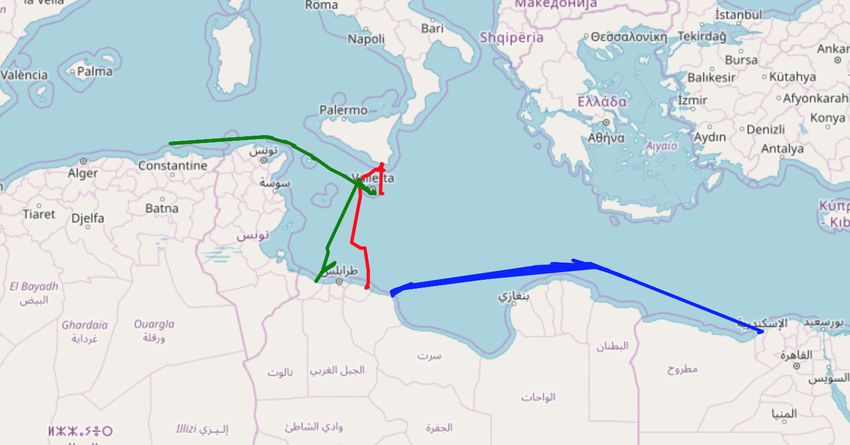
patrols by The Alexander Maersk trajectory rescuing refugees in the Mediterranean Sea becomes rel-
sending an evant when
SOS as soon as they entered the inter- it is unclear whether they would even one asks “whose privacy” should be
national waters” (Tazzioli, 2016, p. 576). be identifiable. In this sense, then, AIS- protected. A useful distinction is that
In other words, along their journey, mi- based trajectories of rescuing ships may between data owner, data respondent
grants deal strategically with visibility not count as personal data. In fact, as (the data subject, although not always in
and invisibility, with information disclo- has been argued in this context (Tazzioli, its legal sense of an individual person),
sure and hiding/confidentiality. This is 2016) as well as in connection with other and data user; and this distinction has
quite probably a very rational strategy applications of big data analyses to hu- implications for the choice of data-priva-
given the fact that a successful and invis- manitarian causes (Taylor, 2017), there cy protection methods (Domingo-Ferrer,
ible journey to Europe is by now nearly is a temptation to focus on migrants as a 2007). In the present example, one as-
impossible for many reasons, including group defined only by one feature (here: signment of these roles that follows the
that traffickers severely overload and to be in need of rescue). argument about risks above could be:
under-equip their vessels, and that due the NGO as the data owner, the migrant
to the high-resolution sensors employed The fact that big data constitute new (or migrant group) as the data respond-
in the European Border Surveillance Sys- risks in the profiling of groups has been ent, and various (potential) data users:
tem EUROSUR (Deibler, 2015), even very lamented often in connection with data the public, politicians, pirates, ...
small vessels are likely to be spotted and protection laws such as the GDPR (which
monitored. Strategic information disclo- focus on the protection of individuals’ Moving beyond privacy and data priva-
sure (in addition to strategic information rights and freedoms); in the humanitar- cy, many other questions, technical as
hiding) by individuals can also be ob- ian realm, it creates additional and dif- well as ethical, arise about information
served in many other contexts that are ferent challenges (Taylor, van der Sloot, disclosure and hiding. The study and
less dramatic than the life-or-death situ- & Floridi, 2017). visualisation of “rescue patterns” can
ations faced by migrants on the Mediter- have different objectives. Hoffmann et
ranean, and it has been pointed out that For the data scientist, this means that al. mention operational objectives (e.g.,
strategic information disclosures too can also the response to these risks and supporting coordination of rescue oper-
be privacy-related behaviour (Gürses & threats may need to be very different, ations), analytic objectives (e.g., deter-10
MASTER NEWSLETTER - www.master-project-h2020.eu
Holistic trajectories, privacy, and the strategic concealment/disclosure of information
mining conditions under which rescues In the following paragraphs, I will illus- (Ziniti, 2018). Can these aspects be mod-
are most effective), and reporting ob- trate three examples of these consider- elled as part of multi-aspect trajectories,
jectives. The latter are described as fol- ations. and how could this be done if the datum
lows: “supplement the large amount of itself is still being contested?
qualitative, descriptive coverage already First, sometimes trajectory data illus-
produced by NGOs and the news me- trate very directly the influences of
In sum, an ethical consideration of the
dia”, “help external observers … obtain context and the uncertainty and the modelling and reporting of vehicle data
a high-level picture of what is happening “unknowns” of vessel operators. As an
and patterns, even if restricted to what
in the region over time. An overview of example, consider the recent case of a
data are to be included and how, what
these patterns is critical for coordina- commercial cargo ship that took on 113
information is to be kept confidential or
tion and advocacy purposes; it enables people saved by an NGO rescue ship and
disclosed, can reach far beyond the tra-
stakeholders to see the true magnitude then spent four days in a political stand-
ditional questions discussed under data
of rescue operations, and to quantify off on a zig-zag trajectory between ports
protection and data privacy. It requires
costs, shortcomings and future needs.” before being allowed to dock in Sicily (Al
a critical examination of the sociopolit-
(Hoffmann et al., 2017, p. 30) ical background of the mobil-
Although data can help citizens demand accounta- ity that these vehicles afford,
Concentrating on the report- support, or impede, and of
ing objective, it can be argued bility, ultimately, the inferences that can be drawn the goals of the data-science
that rescue patterns constitute from the data are only as valuable as the actions project undertaken. And al-
a counter-mapping practice: in they induce. though “data can help citizens
the EUROSUR monitoring sys- demand accountability”, “ul-
tem, selected migratory events timately, the inferences that
are produced from the sensed data and Jazeera, 2018; Borghese et al., 2018) (I can be drawn from the data are only
mapped in time and space (Tazzioli, thank Konstantinos Tserpes for mention- as valuable as the actions they induce.
2016). The website watchthemed.net, ing this example and making available … this problem will not be solved with
initiated and run by a network of NGOs, the visualization of the trajectory). Can data alone” (Hoffmann et al., 2017, p.
activists and researchers, maps events and should holistic trajectories measure 42). This added complexity may be what
to monitor deaths and violations of mi- and visualize the enormous costs caused makes data science projects “for social
grants’ rights. In the SAR-centric appli- by such decisions, as well as the incen- good” so fascinating and worthwhile. I
cations described here, rescue events tives and influences this may have on look forward to feedback on this essay
are produced and mapped. EUROSUR is further behaviour by vessel operators? and to future work in the area!
run by Frontex, and its data and analyt- Second, many of the existing, but not
ics are not available to NGOs and other accessible data have strong effects on
external partners, whereas the rescue the rescue events modelled. For exam-
patterns are mined from data available ple, the Libyan coastguard now has indi- REFERENCES
publicly (AIS data) or to partners of the rect access to EUROSUR data (Monroy, Al Jazeera News (2018). Danish car-
go ship carrying refugees allowed to dock
research (the broadcast warnings), and 2018); thus, their rescue actions, includ- in Italy. 26 June 2018. https://www.alja-
enriched with further aspects from pub- ing those in cooperation or competition ze e ra . co m /n e w s / 2 0 1 8 / 0 6 /d a n i s h - c a r-
lic data (such as tweets). with European actors, may be planned go-ship-carrying-refugees-allowed-dock-ita-
based on data that are not modelled in ly-180626081632471.html
Mapping practices generate a narrative the rescue patterns system, and which Atockar (2014). Riding with the Stars: Passen-
around their real-world phenomenon. therefore can co-determine the “coordi- ger Privacy in the NYC Taxicab Dataset. https://
The current data models and visualiza- nation” and “effectiveness” of a rescue. research.neustar.biz/2014/09/15/riding-with-
tions of rescue patterns, maybe for tech- Can and should these data (or at least the-stars-passenger-privacy-in-the-nyc-taxi-
cab-dataset/
nical reasons (because the EUROSUR the fact of their existence and possible
data are not available), maybe to avoid influence) be modelled? Borghese, L., Vandoorne, S., & Vonberg, J.
visual clutter, display these patterns in (2018). Migrant rescue ship Lifeline to dock
an otherwise “empty” space. Is it possi- Third, further questions concern which in Malta after being stranded for five days in
the Mediterranean. CNN News, 26 June 2018.
ble, and is it advisable, to at least repre- aspects are important to judge the legal https://edition.cnn.com/2018/06/26/europe/
sent that far more data exist (even if one and ethical dimensions of a rescue op- migrant-ships-maersk-lifeline-intl/index.html
does not have access to them)? In other eration (cf. Medina, 2018, resp. Cancel-
words, should the “known unknown” lato, 2018): in a recent case in which a Cancellato, F. (2018). Poche palle, i migranti
della Asso 28 li abbiamo respinti noi: e la Lib-
data be modelled and represented too, commercial towboat under Italian flag ia è solo la foglia di fico della nostra ipocrisia.
and if so, how? These data are impor- rescued migrants and then handed them Linkiesta, 1 August 2018.
tant for technical reasons as much as for over to the Libyan coastguard, a key le- h t t p s : // w w w . l i n k i e s t a . i t / i t / a r t i -
narrative reasons – how can and should gal question revolves not around the cle/2018/08/01/poche-palle-i-migranti-del-
la-asso-28-li-abbiamo-respinti-noi-e-la-li-
these two motivations be addressed, spatiotemporal data of the rescue oper- bi/39019/
and how can the choices made be made ation, but on whether it was instructed
in a transparent and accountable way? by the Italian or the Libyan authorities Deibler, D. (2015). EUROSUR – A Sci-fi Border
Zone Patrolled by Drones? In J. Camenisch, S.11
Holistic trajectories, privacy, and the strategic concealment/disclosure of information
Fischer-Hübner, & M. Hansen (Eds.), Privacy ume_3_part_1.pdf oping World. In L. Taylor, B. van der Sloot, &
and Identity Management for the Future In- L. Floridi (Eds.), Group Privacy: the Challenges
ternet in the Age of Globalisation (pp. 87-109). Li, J.P.K., Bhulai, S., & van Essen, T. (2017). of New Data Technologies. Berlin etc.: Spring-
Berlin etc.: Springer. Retrieved from https://hal. Optimization of the revenue of the New York er. Available at SSRN: https://ssrn.com/ab-
inria.fr/hal-01431600/document City Taxi Service using Markov Decision Pro- stract=2848825
cesses. In Proc. of DATA ANALYTICS 2017:
Domingo-Ferrer, J. (2007). A three-dimension- The Sixth International Conference on Data Taylor, L., van der Sloot, B., & Floridi, L.
al conceptual framework for database privacy. Analytics. Retrieved from https://www.think- (Eds.) (2017). Group Privacy: the Challeng-
In Proc. SDM 2007 (pp. 193–202). Berlin etc.: mind.org/download.php?articleid=data_analyt- es of New Data Technologies. Berlin etc.:
Springer, LNCS 4721. Retrieved from https:// ics_2017_4_10_68005 Springer. https://www.springer.com/de/
crises-deim.urv.cat/webCrises/publications/ book/9783319466064
lncs/lncs4721.pdf Medina, J. (2018). U.N. says migrants’ return to
Libya by Italian boat could be illegal. Reuters, Tazzioli, M. (2016).Eurosur, humanitarian
Douriez, M., Doraiswamy, H., Freire, J., & Silva, 31 July 2018. https://www.reuters.com/arti- visibility, and (nearly) real-time mapping in
C.T. (2016). Anonymizing NYC Taxi Data: Does cle/us-europe-migrants-libya/migrants-return- the Mediterranean. Acme, 15 (3), 561-579.
It Matter? In Proc. 2016 IEEE International to-libya-by-italian-boat-could-breach-interna- https://acme-journal.org/index.php/acme/ar-
Conference on Data Science and Advanced An- tional-law-u-n-idUSKBN1KL1K4 ticle/view/1223/1201
alytics (DSAA), Montreal, QC, 2016 (pp. 140-
148). Retrieved from https://vgc.poly.edu/~ju- Monroy, M. (2018). Durch die Hintertür: uluman (2015). Identifying Muslim cabbies
liana/pub/taxi-privacy.pdf Anschluss Libyens an europäische Überwa- from trip data and prayer times. https://
chungssysteme. CILIP Blog, 19 January 2018. www.reddit.com/r/dataisbeautiful/com-
Gürses, S.F. & Berendt, B. (2010). The Social h t t p s : // w w w . c i l i p . d e / 2 0 1 8 / 0 1 / 1 9 / ments/2t201h/identifying_muslim_cabbies_
Web and Privacy. In E. Ferrari & F. Bonchi durch-die-hintertuer-anschluss-libyens-an-eu- from_trip_data_and/
(Eds.), Privacy-Aware Knowledge Discovery: ropaeische-ueberwachungssysteme/
Novel Applications and New Techniques. Boca Varlamis, I., Tserpes, K., & Sardianos, C. (2018).
Raton, FL: Chapman & Hall/CRC Press, Data Pandurangan, V. (2014). On Taxis and Rainbows “Detecting Search and Rescue Missions from
Mining and Knowledge Discovery Series. Re- Lessons from NYC’s improperly anonymized AIS Data,” 2018 IEEE 34th International
trieved from taxi logs. https://tech.vijayp.ca/of-taxis-and- Conference on Data Engineering Workshops
https://www.esat.kuleuven.be/cosic/publica- rainbows-f6bc289679a1 (ICDEW), Paris, 2018 (pp. 60-65). http://iee-
tions/article-1304.pdf explore.ieee.org/stamp/stamp.jsp?tp=&ar-
Patroumpas, K., Alevizos, E., Artikis, A., Vodas, number=8402020&isnumber=8402003
Hoffmann, K., Boy, J., Leon-Dufour, J., Breen, M., Pelekis, N., & Theodoridis, Y. (2017). Online
D. Earney, C. & Luengo-Oroz, M. (2017). Using event recognition from moving vessel trajecto- Ziniti, A. (2018). Migranti, inchiesta sul com-
big data to study rescue patterns in the Med- ries. GeoInformatica, 21(2), 389-427. https:// portamento del rimorchiatore italiano Asso
iterranean. In: Fatal Journeys. Volume 3, Part link.springer.com/article/10.1007/s10707- 28. La Repubblica, 8 August 2018. http://
1: Improving Data on Missing Migrants (pp. 016-0266-x www.repubblica.it/cronaca/2018/08/08/
24-46). Geneva, Switzerland: International Or- news/migranti_presentato_un_esposto_sul_
ganization for Migration. https://publications. comportamento_del_rimorchiatore_italiano_
Taylor, L. (2017). Safety in Numbers? Group
iom.int/system/files/pdf/fatal_journeys_vol- asso_28-203654671/
Privacy and Big Data Analytics in the Devel-This project has received funding from the European Union’s Horizon 2020 research and
innovation programme under the Marie Sklodowska-Curie grant No 777695
Duration: March 1 2018 | February 28 2022
Editorial Secretariat
master-info@isti.cnr.it
Editorial Board
Chiara Renso
Beatrice Rapisarda
Cristina Muntean
Layout and Design
Beatrice Rapisarda
Copyright notice
All authors, as identified in each article, retain copyright of their work.
The authors are responsible for the technical and scientific contents of their work.
Privacy statement
The personal data (names, email addresses…) and the other information entered in MASTER Newsletter will be treated according with
the provision set out in Legislative Degree 196/2003 (known as Privacy Code) and subsequently integration and amendment.
Coordinator of the project: Chiara Renso | chiara.renso@isti.cnr.it
MASTER Newsletter is not for sale but it is distributed for purposes of study and research and published online at
http://www.master-project-h2020.eu
Consiglio Nazionale
delle Ricerche
ip
unic ality
M
of
T h iraYou can also read


