Summer Rules 2021 - Lake Minnetonka Conservation District
←
→
Page content transcription
If your browser does not render page correctly, please read the page content below
Lake Minnetonka
Summer Rules

                                                                                            SM
2021

       Share the Lake Safely and Responsibly So
             Everyone Can Enjoy the Lake

Lake Minnetonka Conservation District • 5341 Maywood Road, Suite 200 • Mound, MN 55364 • lmcd.org
Lake Minnetonka Summer Rules 2020

  Table of Contents
  Lake Minnetonka & the Conservation District (LMCD) .  .  .  .  .  .  .  .  .  .  .  .  .  .  .  .  .  .  .  .  .  .  .  .  .  .  .  .  .  .  .  . 1

  Quiet Water Areas, Slow Areas, Public Accesses, Toilets. .  .  .  .  .  .  .  .  .  .  .  .  .  .  .  .  .  .  .  .  .  .  .  .  .  .  .  .  . 2-3

  Health & Safety.............................................................................................................................................4

  Top Ten Summer Violations.....................................................................................................................5

  Unique Regulations, Wastewater Discharge......................................................................................6

  Towing & Nonmotorized Watercraft Safety........................................................................................7

  Watercraft Operator Age & Personal Watercraft Operations .  .  .  .  .  .  .  .  .  .  .  .  .  .  .  .  .  .  .  .  .  .  .  . 8-10

  General Safety Items .  .  .  .  .  .  .  .  .  .  .  .  .  .  .  .  .  .  .  .  .  .  .  .  .  .  .  .  .  .  .  .  .  .  .  .  .  .  .  .  .  .  .  .  .  .  .  .  .  .  .  .  .  .  .  .  .  .  .  .  .  .  . 11

  Navigation & Rules of the Road .  .  .  .  .  .  .  .  .  .  .  .  .  .  .  .  .  .  .  .  .  .  .  .  .  .  .  .  .  .  .  .  .  .  .  .  .  .  .  .  .  .  .  .  .  .  .  .  .  . 12-13

  Other Safety, Courtesy, & Nuisances. .  .  .  .  .  .  .  .  .  .  .  .  .  .  .  .  .  .  .  .  .  .  .  .  .  .  .  .  .  .  .  .  .  .  .  .  .  .  .  .  .  .  .  .  . 14-15

  Help Stop Aquatic Hitchhikers.  .  .  .  .  .  .  .  .  .  .  .  .  .  .  .  .  .  .  .  .  .  .  .  .  .  .  .  .  .  .  .  .  .  .  .  .  .  .  .  .  .  .  .  .  .  .  .  .  .  . 16-17

  Resources, Links, & Emergency Contacts .  .  .  .  .  .  .  .  .  .  .  .  .  .  .  .  .  .  .  .  .  .  .  .  .  .  .  .  .  .  .  .  .  .  .  . Back Cover

 This brochure contains a summary of rules of conduct for Lake Minnetonka. Since Lake Minnetonka is
 one of the busiest lakes, certain regulations are in place to help protect the Lake and all those who use it.
 More information about applicable laws can be found by contacting the State of Minnesota Department
 of Natural Resources (MN DNR), Hennepin County Sheriff’s Office Water Patrol, and the Lake Minnetonka
 Conservation District (LMCD) and its member cities. Thank you to all the agencies and volunteers that help
 make the lake fun and safe. Thank you for doing your part in these protection efforts. Have a safe and
 enjoyable summer!

                         Lake Minnetonka Conservation District (LMCD)
        Main Office 952-745-0789 Fax 952-745-9085 lmcd.org email: lmcd@lmcd.org
                      5341 Maywood Road, Suite 200 • Mound, MN 55364

Lake Minnetonka Summer Rules 2020
Lake Minnetonka Conservation District

                                              New Lake Resources Online
             SM
                                                Find lake maps, lake amenities (gas,
                                               bathrooms, etc.), beaches, safety tips,
                                                   events, and more at lmcd.org
OUR MISSION
For more than 50 years, the Lake
Minnetonka Conservation District
(LMCD) has been managing the use
of Lake Minnetonka in its mission
to preserve and enhance the “Lake
Minnetonka experience.”
                                              Variety of photos for purchase at lmcd.org
The (LMCD) brings together 14
different cities, two counties, and
many state and local agencies to
protect, preserve and enhance                DID YOU KNOW?
Lake Minnetonka’s environment,               Lake Minnetonka is known for its:
economy and vitality. We are
one, uniform, coordinating body                •   125 miles of shoreline
that cares for and regulates one               •   14,043 acres of surface area—the
of Minnesota’s most important                      Ninth largest lake in Minnesota
resources in a way that is consistent
across all jurisdictions, representing         •   42 bays/named bodies of water
all stakeholders. Lake Minnetonka              •   Deepest bay of 113 feet (Crystal Bay)
is a unique asset requiring unique             •   30-foot mean water depth
governance.
                                               •   39 percent of the lake has a water
Some services such as emergency                    depth of less than 15 feet
response, solar lights, boater                 •   Vibrant community, including 14 cities
safety education, vegetation
management, and more are supported                 surrounding the Lake
by the generous contributions of lake          •   Sacred indigenous areas, featured
enthusiasts through the LMCD SAVE                  in Dakota legends
the LAKE Fund. Lake Minnetonka
is a highly valued year-round asset            •   Dakota name of “Minn-ni-tanka,”
with vibrant aesthetic, recreational,              meaning “Big Water”
commercial and natural qualities.              •   Located within the Minnehaha Creek
The LMCD works to ensure these
qualities and values will be protected             Watershed
and preserved not just today, but for          •   Abundance of nature, including
generations to come.                               regional parks, islands and trails
                                               •Numerous sightings of “Lou,” a
                                                legendary sturgeon in-excess of
                                             		 10 feet in length (per local folklore)
      Visit lmcd.org and join us on
                                               •   First known “Electric-lit” inland
     Facebook and Twitter for Lake
                                                   steamboat in the US (1881)
  Minnetonka information and updates.

                                         1                                             lmcd.org
North Arm/Hendrickson Access
                                                           (Henn Cty)
                                                                                                       Maxwell (MN DNR)
                                                                                                                                                                         SM

                                                                                                                      ORONO
                                                                                                                                                         WAYZATA

                                                               MOUND                                                                                                Wayzata
                                                  Cooks                                                                                                             (City)
                                     Halsted      (City)                          SPRING PARK

Lake Minnetonka Summer Rules 2021
                                     (City)                                           Spring Park      MINNETONKA
                                                                                         (Henn Cty)       BEACH                            WOODLAND

                                                                                                                                                          Grays

2
                                                                                                                                                  (City/MN DNR)

                                                                 •
                                                                                                                                             DEEPHAVEN
                                    MINNETRISTA                                                        TONKA
                                                                  Phelps                                BAY
                                     Lake Minnetonka              (City)                                                        Carsons
                                     Regional Park                                                                                (City)
                                     (Three Rivers                                                              GREENWOOD                            MINNETONKA
                                     Park District)                               SHOREWOOD

                                                       VICTORIA                                        EXCELSIOR
                                     KEY
                                                                                                                          QUIET WATER / SLOW AREAS
                                            Public Access/Boat Launch                                                     Proceed at minimum wake along shorelines and
                                                                                                                          in all areas as indicated on map
                                            Public toilet facilities indicated on map.
                                                                                                                                   Slow Areas (150 ft from shore, docks, etc.)
                                            See lmcd.org for business facilities and additional lake
                                                                                                                                                                                 Quiet Water, Slow Areas, Public Accesses, Toilets

                                            amenities.                                                                           Quiet Waters
Speed Limits & Quiet Water Locations

MAXIMUM WATERCRAFT SPEED LIMITS
                                                                         AT ALL TIMES
                                                                          Speed Limit
                                                                            5 mph
                                                                            Within
                                                                  • 150 feet of the shore;
                                                                    dock structure–except
                                                                    where a person is being
                                                                    towed; of an authorized
         DAYTIME                         NIGHTTIME                  bathing area, swimmer,
        Speed Limit                      Speed Limit                scuba diver’s flag,
         40 mph                           20 mph                    anchored craft or structure
                                                                  • 300 feet for PWCs

LAKE MINNETONKA QUIET WATER AREA LOCATIONS
ENTIRE BAYS
   Carsons Bay            Grays Bay                                 KEY DEFINITIONS
   Emerald Lake           From 4 p.m. Fridays through
                          11:59 p.m. Sundays and all       Quiet Water Areas
   Libbs Lake
                                                           Established areas where
   St. Louis Bay          day on holidays
                                                           motor-operated watercraft (including
   		                                                      waterborne aircraft) cannot be
PARTIAL BAYS                                               operated in excess of 5 mph or at a
   Black Lake–north side                                   speed that results in more than a
   Coffee Cove–east of a line from Fagerness Point to      minimum wake.” Designated QWAs
		 Park Lane                                               are delineated by waterway markers.
   Excelsior Bay–south end
                                                           Watercraft
   Harrisons Bay–north of Seton channel area               Any vessel, boat, sailboat, canoe, raft,
   Lower Lake North-north side of Big Island/Cruiser’s     barge, paddleboard, sailboard, or
       Cove                                                any similar device used or usable for
   Maxwell Bay–south shore from Noerenberg                 carrying and transporting persons on
		 Bridge to Boy Scout Bridge and Noerenberg Inlet         the Lake.
   St. Albans Bay–southwest corner
                                                           Minimum Wake
   Wayzata Bay–southeast corner near Hwy 101
                                                           The wave moving out from a
		Causeway                                                 watercraft and trailing in a widening
CHANNEL AREAS                                              ‘V’ of insufficient size to affect other
   All channels between bays                               watercraft or be detrimental to the
                                                           shoreline.
   Channels between Black/Emerald/Seton Lakes
   Echo and Lafayette Bays–west end of Big                 Daytime
		 lsland by West Point                                    One-half hour before sunrise to one-
   Lower Lake North–west side, northwest of                half hour after sunset—except when
		 Huntington Point and Arcola Bridge                      weather or other conditions do not
   Lower Lake North and Lafayette Bay–south                provide sufficient light to see people
		 of Huntington Point                                     or watercraft at a distance of
                                                           500 feet.
   Wayzata Bay–south side, north of Cedar Point
		 east of Huntington Point

                                              3                                          lmcd.org
HEALTH & SAFETY AT THE LAKE
             SM

OWN YOUR WAKE-- FOR EVERYONE’S SAKE
Wakes present dangers to lake users and can damage
property. Therefore, it is especially important that boaters be
aware of their wakes and how it impacts the shorelines, other
people, and the lake.

Under Minnesota law, the damage your wake causes is treated the same as damage caused
by an actual collision. You may also be held personally liable for injuries or damage due to
your wake.

Be aware of your environment and what’s going on around you to prevent injuries or
damage to the lake – this applies to everyone on and around the water.

Observe minimum wake zones. Further, if your wake is hitting the shoreline, other
watercraft, or docks, move farther away or reduce your wake.

Please respect the lake and rights of others so everyone can enjoy their time on the
water – keep the noise down, be courteous to other boaters, and show consideration to all
recreationists on and around the water. Be extra aware of your wakes when operating near
shore or when water levels are higher than usual. More information about reducing safety
hazards and environmental damage is available at lmcd.org or mndnr.gov.

STAYING HEALTHY ON THE LAKE
MDH, Hennepin County, and the CDC offer some tips that everyone can take to minimize
the risk of illness while enjoying the water and to keep the lake healthy for everyone. More
information is available at health.state.mn.us.

Minimize the risk of illness                        Help keep the lake healthy for everyone
 • Don’t swallow the water                           • Stay out of the water if you have diarrhea
 • Shower after swimming                             • Shower before swimming
 • Avoid swimming after a rain event                 • Don’t go to the bathroom in the water
 • Avoid swimming near discharge pipes               • Take frequent bathroom breaks
 • Avoid swimming if you see a blue-green            • Change diapers frequently and away from
   algal bloom                                         the water
 • Wash your hands before eating                     • Dispose of trash, animal waste, raw meat
                                                       juices, and boat waste properly

                                      Please follow applicable State/Governor’s Executive Orders
                                       regarding COVID-19 and any social distancing guidance.

  Lake Minnetonka Summer Rules 2021             4
TOP TEN SUMMER VIOLATIONS
The following are the most common boating violations observed by HCSO Water Patrol. Be mindful
of the rules and use common sense so everyone can have a safe and enjoyable time on the lake.

1         LIFE JACKETS
          One coast guard approved life jacket must be readily available for each person on board
          the watercraft. Watercraft measuring 16 or longer must also have a throwable flotation
          device. Children below the age of 10 must wear a life jacket while on a watercraft that
          is underway.

2         BOATING UNDER THE INFLUENCE
          Boating while under the influence of alcohol, or any other controlled or illegal
          substance.

3         FIRE EXTINGUISHERS
          Boats with enclosed fuel tanks must have ventilation and fire extinguishers.

4
          REGISTRATION
          All motorized watercraft and unmotorized watercraft over 10 feet in length must be
          registered by the Department of Natural Resources.

5
          RIDING ON GUNWALES OR DECKING
          It is illegal to ride or sit on, or operate a motorboat while someone is riding or sitting
          on the gunwale, bow, transom, decking over the bow, side or stern while underway
          (unless it is equipped with an adequate railing).

6         OPERATING PERSONAL WATERCRAFT AFTER HOURS
          Personal watercraft may only be operated from 9:30 a.m. until one hour before sunset,
          and no longer than 30 consecutive minutes in a single area.

7
          QUIET WATERS/Minimum Wake Zones
          Motor-operated watercraft (including waterborne aircraft) cannot be operated in
          excess of 5 mph or at a speed that results in more than a minimum wake in designated
          quiet water areas. See the summer rules brochure for a map of locations.

8         TOWING OBSERVER
          In addition to the watercraft operator, an observer (not a rear-facing mirror) is required
          to continuously observe the person(s) being towed. The observer must be at least 12
          years old and able to communicate with the driver.

9         NAVIGATIONAL LIGHTS
          Proper navigational lights, including a red light to port, a green light to starboard, and
          a white light to stern, must be displayed when boating after sunset and before sunrise.

10        SPEED LIMITS
          The daytime speed limit is 40 mph; the nighttime speed limit is 20 mph; the speed limit
          for Quiet Water Areas or within 150 of shoreline, docks, and swimmers is 5 mph.

                                                5                                       lmcd.org
Unique Regulations & Safety

             SM                                 UNIQUE LAKE REGULATIONS
BIG ISLAND PUBLIC SAFETY LANES
  Public Safety Lanes are installed at the north end of Big Island to provide better access
  by the Hennepin County Sheriff’s Office for emergency purposes. Buoys delineate these
  lanes and extend 600 feet from shore (visual reference when high water declaration in
  effect). Watercraft may not be anchored in these lanes, but may use for traveling.
BOW FISHING
  Bowfishing is prohibited one half hour after sunset to sunrise, and from
  November 15th through May 1st. Bow fishing is also prohibited in designated areas
  and during specific dates and times. View the LMCD code for details.
SPECIAL “HIGH-WATER” DECLARATION
  The LMCD may declare “High Water” when lake water levels reach 930.00 feet NGVD for
  a certain number of days or reach 930.25 feet. When “High Water” is declared, minimum
  wake restrictions are implemented for user safety and shoreline protection. During
  “High Water,” watercraft must maintain minimum wake within 600 ft from shore for
  some bays and entirely for other bays, or otherwise directed. The Ordinary High Water
  level is 929.4 ft. Visit minnehahacreek.org or @graysbaydam for the latest water
  levels. Updates will be provided at lmcd.org.

           NEW WASTEWATER DISCHARGE REQUIREMENTS

MARINE TOILETS & WASTEWATER DISCHARGE
To prevent illnesses from the accidental or intentional discharge of
sewage into the lake from watercraft, any watercraft operating on
Lake Minnetonka must meet the following requirements:
• Macerater/grinder pumps must be removed, and,
• Discharge valves (“Y-valves”) must be locked.
If the watercraft has been re-piped to satisfy regulations on other waters, you may be in
compliance.

Monitoring & Reporting
All boaters on Lake Minnetonka must comply with the ordinance. Lake service providers
who launch watercraft or provide pumping services are required to report to the LMCD any
situations where marine toilets do not comply with regulations and may not launch any
watercraft in violation.
Penalty for Violating Ordinance
Any person launching a watercraft equipped with a marine toilet that is not following the
ordinance is subject to a petty misdemeanor. Due to COVID-19, make corrections if it can be
completed safely with social distancing. Enforcement of all watercraft will begin 2021.

  The LMCD Code and links to applicable state laws can be found on the LMCD website.

  Lake Minnetonka Summer Rules 2021                      6
Towing & Nonmotorized Watercraft Safety

TOWING (SKIING, WAKEBOARDING, WAKESURFING...)
NUMBER TOWED                                           DISTANCE
 No more than three persons may be                       Towing may not occur within 150 ft of
 towed at one time.                                      a swim area, skin or scuba
                                                         diver’s flag, swimmer, watercraft, or
OBSERVER
                                                         dock or pier (except dock/pier where
 In addition to the watercraft operator,
                                                         operating from).
 an observer (not a rear-facing mirror) is
 required to continuously observe the                  EMPTY TOW
 person(s) being towed. The observer                    An unoccupied tow line may not be
 must be at least 12 years old and able                 dragged behind a watercraft for an
 to communicate with driver.                            unreasonable length of time.
HOURS                                                  TOWING IN CHANNELS
 Towing is prohibited from one-half                      No person shall tow or be towed
 hour after sunset until sunrise.                        into or through any marked channel
                                                         connecting two bodies of water. It is
LIFE JACKETS                                             unsafe.
  A person being towed must wear a life
  vest, belt, or other buoyant device. If
  the buoyant device is not U.S. Coast
  Guard-approved, a U.S. Coast Guard-
  approved life jacket must also be on                           SHARE THE LAKE
  board and readily available to the                      Wake in the Middle of the Bay
  person being towed.
                                                              Avoid Repetitive Passes
LENGTH OF TOW
  Maximum length of 85 ft (except with                         Keep the Sound Down
  written permission of the Sheriff ).

SAFETY TIPS FOR NONMOTORIZED WATERCRAFT
Whether operating in low light conditions or areas with
powerboats, operators of nonmotorized watercraft should
be extra cautious and take precautions to make themselves BE               Light and Flag
VISIBLE to other lake users to prevent accidents.                           Combination
                                                                          Improve Visibility
If you are kayaking, canoeing, or paddleboarding, some ways to
become more visible include:
•     Wear vibrant clothing
•     Fly a flag
•     Install a light
•     Pay attention to lake conditions such as wakes, boat traffic,
      and weather
Powerboaters and larger boat operators should be aware of
their surroundings and take measures to LOOK FOR smaller boats
and nonmotorized watercraft on the lake. Avoid injuring other
lake users by being courteous, reducing wakes, and increasing
distance.

                                                7 15                                     lmcd.org
                                                                                          lmcd.org
Youth-Specific Regulations

          SM
                               YOUTH REGULATIONS
In addition to the minimum age requirements for Minnesota youth operators), State
regulations for Operator’s Permits are followed and vigorously enforced on Lake Min-
netonka. What’s more, lake-wide curfew regulations also apply.

Youth operators-- know the rules and keep your boating experience fun and safe!

    CURFEW
      Youth under the age of 15 may not be on a watercraft between the hours
      of 10 p.m. and 6 a.m.—unless accompanied by a parent or guardian. Those
      between the ages of 15 and 17 must be supervised by a parent or guardian
      while on watercraft between the hours of 12 a.m. (midnight) and 6 a.m.

    OPERATOR’S PERMIT
       See Minnesota Age Restrictions section
       for information about required Watercraft
       Operator’s Permits. Permits may be
       obtained by successfully completing
       an approved boating safety course—
       including the boater safety education
       course offered through the LMCD or one
       offered on-line by MN DNR.

 OPERATOR’S PERMIT & BOATING SAFETY COURSES

    LMCD BOATER SAFETY EDUCATION PROGRAM
     Funded through its Save the Lake Fund, the LMCD partners with the Hennepin
     County Sheriff’s Office Water Patrol and Mound Fire Department to offer the
     Boater Safety Education Program. Adults and youth (ages 12 to 17) work
     directly with presenters to obtain their MN DNR Watercraft Operator’s Permit
     in a single full-day session. Parents and guardians are encouraged to attend
     to enhance the training. Due to the COVID-19 situation, classes may be
     temporarily suspended. However, additional educational materials are being
     created for the website. Visit lmcd.org or call LMCD Office at 952-745-0789.

    BOAT MINNESOTA: MN DNR’S ON-LINE BOATING SAFETY COURSE
     The Minnesota Department of Natural Resources offers an on-line Minnesota
     Watercraft Operator’s Permit program for youth ages 12 to 17. Adults
     who want to learn more about boating safety or to enhance their current
     knowledge can also take the course. Some insurance companies offer
     premium discounts for such certification; check with your insurance company
     for participation and possible discounts. For more information visit the MN
     DNR site at mndnr.gov/boatingcourse.

Lake Minnetonka Summer Rules 2021                  8
Youth-Specific Regulation & PWCs
STATE OF MINNESOTA AGE REGULATIONS
WATERCRAFT AGE MINIMUMS
Operators less than 12 years of age: 25 hp or less—no restrictions; more than 25
hp to 75hp must have someone at least 21 years of age on board and within reach of
the controls; over 75 hp, cannot operate watercraft even with an adult on board
Operators 12 to 17 years of age: 25 hp or less—no restrictions; over 25 hp, must
have either a valid Watercraft Operator’s Permit or someone at least 21 years of age
on board and within reach of the controls
PERSONAL WATERCRAFT (PWC)-SPECIFIC AGE MINIMUMS
Operators less than 13 years of age: Cannot operate (even with an adult on board)
Operators 13 years of age: Must have someone at least 21 years of age on board or
have a valid Watercraft Operator’s Permit and be in visual supervision by someone at
least 21 years of age
Operators 14 to 17 years of age: Must have a valid Watercraft Operator’s Permit or
someone on board who is 21 years of age
PERSONAL WATERCRAFT (PWC)
OPERATION & REGULATIONS
A personal watercraft (PWC) is a watercraft less than
14 feet in length that uses a motor powering a water
jet pump as its primary source of power, and is
designed to be operated by a person sitting, standing
or kneeling on, rather than the conventional manner
of sitting or standing inside the watercraft. This includes jet skis.
The regulations for motorboats apply, in addition to specific PWC requirements.
AUTOMATIC CUTOFF DEVICES
If the machine is equipped by the manufacture with a lanyard-type engine cutoff
switch, it must be attached to the person, life jacket or clothing of the operator
when underway.
ON LAKE MINNETONKA:
Lanyard-type or wireless engine cutoff switch may not be altered, disabled or
removed.
CARELESS OPERATION
A PWC may not be operated in a manner that unreasonably or unnecessarily
endangers life, limb, or property (including weaving through congested boat
traffic).
ON LAKE MINNETONKA:
Includes swerving at the last moment to avoid a collision if you weren’t paying
attention.
9 lmcd.orgPWCs & Rentals PWC CONT... HOURS OF OPERATION 9:30 am to one hour before sunset. LIFE JACKETS Anyone operating or riding on a PWC must wear a U.S. Coast Guard-approved wearable life jacket that is compatible with that activity. Check the label. TOWING Operator must have an additional observer on board. ON LAKE MINNETONKA: The observer must be 12 years or older. See Towing section for more towing information. SPEED PWC operators must travel at slow, no-wake speed (5 mph or less) within 150 ft of non-motorized boats, shore (unless launching or landing skiers directly to or from open water), docks, swim rafts, swimmers, or any moored or anchored boat. ON LAKE MINNETONKA: Speed limit also applies to proximity to persons fishing, docks, or other water structures. Further, speed limit of 5 mph or no more than minimum wake between 150 ft and 300 ft of shoreline, unless PWC is being driven perpendicular to the shoreline, and to or from the nearest point of water 300 ft from the shoreline, or parallel to the shoreline from one location to another in non-repetitive manner. WAKE JUMPING PWC operators may not jump wakes within 150 ft of another watercraft or PWC. PROLONGED OPERATION ON LAKE MINNETONKA: PWC may not be operated more than 30 consecutive minutes in a single area (defined as a small area where noise emanating from the PWC may be a nuisance or cause substantial annoyance to one or more shoreline properties). RENTAL REQUIREMENTS Businesses required to: 1) Distribute summary of laws free of charge (including instructions to laws and safety factors), 2) Provide required safety equipment, and 3) Ensure those less than 18 years of age show their Watercraft Operator’s Permit. ON LAKE MINNETONKA: A PWC may not be rented to anyone less than 16 years of age. Further, a Watercraft Operator’s Permit is required for all persons under 18 years of age. The LMCD Code and links to applicable state laws can be found on the LMCD website. Lake Minnetonka Summer Rules 2020 10
General Safety Regulations

CARBON MONOXIDE ALARMS SAVE LIVES
Sophia’s Law, named for a seven-year-old who died from carbon
monoxide (CO) poisoning while boating on Lake Minnetonka,
requires functioning marine-grade CO alarms on certain
motorboats. Minnesota is the first state in the nation to require
CO alarms in motorboats to prevent tragic accidents. To learn
more about CO alarms, stickers, and when they are required,
visit the MN DNR website:
dnr.state.mn.us/safety/boatwater.

BEWARE OF ESD
ELECTRIC SHOCK DROWNING

ESD results from paralysis caused by electrical currents in the water—by electricity leaking
into the water from faulty wiring of boats, docks, and lifts. ESD kills both humans and
animals. There are many ways to prevent ESD. The most important way to stay safe is to
never enter water around boats and docks using electrical power. For more information,
visit electricshockdrowning.org or links on the LMCD website. Also, learn about new
electrical code requirements (NFPA 70) for marinas, commercial and noncommercial
docking facilities, and residential docks.

                                                       FIRE PREVENTION & SAFETY
Safe Refueling
Before fueling make sure all passengers have exited the boat and all doors, ports, and
hatches are closed to prevent fumes from accumulating. Do not operate any electrical
switches, chargers, or other electrical items while refueling or before the fumes dissipate.
When you are done fueling, wipe up spilled fuel and be sure to operate the boat’s blowers
for several minutes to diffuse any lingering fumes. Learn more at https://lmcd.org/lake-
safety.

Regular Inspection & Maintenance
Many boat fires begin from electrical malfunctions. Regular inspection of engines for
damage and timely replacement of critical parts
could prevent a considerable amount of boat
fires. Check newly purchased boats thoroughly.

If Your Boat Catches Fire
If the size of the fire is beyond what a single
portable extinguisher can put out, evacuate
and call for professional firefighters. Your life is
infinitely more valuable than your boat.

                                                 11                               lmcd.org
Identifying Inland Waterway Markers/Buoys
SM
KNOW YOUR MARKERS/BUOYS BEFORE YOU SET SAIL!
Comprehensive boating safety information, regulations and tips—including details on all
inland waterway markers—can be found on the Minnesota Department of Natural Resources’
website at mndnr.gov/boatingsafety. Inland markers are used to: help boaters safely
navigate channels; direct traffic; control speeds; protect resources; and identify dangerous
waterways/areas.
Minnesota Waterway
Minnesota Inland WaterwayMarkers
Markers
Channel lies between Do not pass Mid-Channel
green and red markers between buoy pass close
and shore on either side
M
I
L
F
O
I
L
Diver below Mooring Milfoil Area
stay 150´ away Buoy Boats Keep Out
Controlled Danger Boats Keep Out Information
Area
Graphic source: mndnr.gov
Life jackets save lives! Wear it!
mndnr.gov/boatingsafety
2/14
Lake Minnetonka Summer Rules 2020 12Waterway Navigation: “Rules of the Road”
RULES
RULESOF
RULES OFTHE
OF THEROAD
THE ROADFOR
ROAD FORLAKE
FOR LAKEMINNETONKA
LAKE MINNETONKA
MINNETONKA
RULES OF THE ROAD FOR LAKE MINNETONKA
1 2
1.WHEN
1.WHEN
WHEN OVERTAKING
OVERTAKING-- --When
OVERTAKING- Whenovertak-
When overtaking
overtak- 2.2.APPROACHING-
APPROACHING
APPROACHING -- --When
When approaching
Whenapproaching
approaching
1.1. WHEN
WHEN OVERTAKING
OVERTAKING When
When overtak-
overtak- 2.2.APPROACHING
APPROACHING When
When approaching
approaching
ing
inganother
another vessel
vessel, passpass
passwhen
when safe.safe. head-on
head-onor
ornearly
nearlyso,
so,pass
passto
tothe
theright.
ing
ing another
another
another vessel
vessel pass
vessel pass when
when
when safe.
safe.
safe. head-on
head-on
head-onor
or
ornearly
nearly
nearly so,
so,
so, pass
pass
pass to
to
to the
the
the right.
right.
right.
Overtaking.
When When
watercraft
Overtaking. When are watercraft
running the
watercraft are running
aresamerunningin in When
Whenwatercraft
watercraftare areapproaching
approachingeach eachother
other
Overtaking.
Overtaking. When
When watercraft
watercraft are
are running
running inin When
When watercraft
watercraft are
are approaching
approaching each
each other
other
the
thesame
samedirection,
direction, the craft that
direction, thethe iscraft
craftwhich
astern mustisisis
which isastern
astern head
headon, on,or ornearly
nearlyso, so,each
eachshallshallturn
turnto tothe
the
the
the same
same direction,
direction, the
the craft
craft which
which astern
astern head
head on,
on, oror nearly
nearly so,
so, each
each shall
shall turn
turn totothe
the
shall
shallpass
pass passonly
only onlywhen
when there
when there isissufficient
is sufficient
there distance
distance
sufficient distance right
rightaaaasufficient
When sufficientdistance
watercraft sosothat
are approaching
distance thatthey will
willsafe-
each
they safe-
shall
shallpass
pass only
only when
when there
there isissufficient
sufficient distance
distance right
right sufficient
sufficient distance
distance sosothat
that they
they will
will safe-
safe-
between
between
between the
the
the craft
craft
craft sosoit
so it it
can
can can dodo so
do soso safely
safely and
and
safely and lyother
pass.
lypass. When
head-on,
pass.WhenWhenthe the
or course
nearly
thecourse of
so,
courseofof an
each
ofan approaching
must
anapproaching turn
approaching
between
between the craft
thespeed so
craft that it can
so ititscan do so
do or safely
safelyand
so wake and lyly pass. When the course an approaching
only
only
only
only
at
at
atatsuch
such
such
such speed
speed
speed that
that
that itsits
its
wash
wash
wash
wash or
or wake
or wake
wake
will
will
will
will to
craft the
craft
craft right
isisso
isisso farato
sofar
far tosufficient
tothe
theright
the distance
right
right
asasnot
asasnot toso
notto tobethat
beconsid-
be consid-
consid-
onlyendanger
not at such speedthe that being
craft its wash or wake
passed or will craft
they willso far
safely to the
pass. right
When not
the to
coursebe consid-
of an
not
notendanger
not
not endangerthe
endanger
endanger thecraft
the
the craft
craft
craft
being being
being
being
passed
passed
passed
passed
or ororits
its
or its
its
its
ered
ered
ered
ered
as
asas meeting
meeting
meeting
as meeting
head
head
head
head
on,
on,
on,
on,
each
each
each
each
shall
shall
shall
shall
maintain
maintain
maintain
maintain
occupants.
occupants.
occupants.No No person
Noperson
personoperating operating a watercraft
operatingaaawatercraft
watercraft itsapproaching
course
its course and
and craft
pass
pass is so
clear.
clear.far to the right as not
occupants.
occupants. No
No person
person operating
operating watercraft
watercraft its course
its be
course and pass clear.
and passasclear.
may
shallabruptly
shall abruptlychange
abruptly change
changeits itscourse
its coursewithout
course withoutfirst
without first
first to considered meeting head-on, each
shall
shall abruptly
abruptly change
change its course
course without
without first
determining
determining
determiningthat
determining that
thatitititit
that can
itcan
canbe
can be
be done
besafely
safely safely
safelydone
done andfirst
donewithout
without
without
must maintain its course and pass clear.
InInnearly
nearlyhead-on
InInnearly head-onmeeting
head-on meetingsituation,
meeting situation,both
situation, bothves-
both ves-
ves-
determining
without
risk that
risk of with
collision. can be safely done without nearly head-on meeting situation, both ves-
riskof
risk ofcollision
ofof collision
collision withanother
with anotherwatercraft.
another watercraft.
watercraft.
sels
selsmust
sels mustgive
must giveway
give wayto
way tostarboard,
to starboard,neither
starboard, neitherhas
neither has
has
risk collision with another watercraft. theIn a
sels nearly
must head-on
give way meeting
to situation,
starboard, both
neither has
theright-of-way.
the right-of-way.
right-of-way.
vessels
the must give way to starboard; neither
right-of-way.
Although
Although
Althoughthe
the smaller
thesmaller
craft
smallercraft
has
crafthas
moved
hasmoved
movedup
up
upintointo
Although
into
Although the
thesmaller
the overtaken craft
vessel’s
smaller crafthas moved
“danger
has up
zone”,
moved up into
the
into has the right-of-way.
the
theovertaken
overtakenvessel’s
vessel’s“danger
“dangerzone”,
zone”,the
therela-
rela-
the
the overtaken
relative overtaken vessel’s
right-of-way
vessel’s“danger
has not
“danger zone”,
changed.
zone”, the
She
the rela-
is
rela-
tive right-of-way
tiveburdened
right-of-way has
has not
notchanged
changed and she
sheisisis
andshe is
tive
still
tive right-of-way
right-of-wayandhas
has not
must not changed
make any
changed and
necessary
and she
still burdened
still burdened and
and must
must make
make any
anynecessary
necessary
still
course burdened
still burdened and
and/orspeed
speedmust make
changes
and changes
must make any
topass necessary
passsafely.
any safely.
necessary
course and/or
courseand/or
and/orspeed
speedchanges to
changestoto topass
passsafely.
safely.
course
course and/or speed changes pass safely.
3 CROSSING-
3.3.
CROSSING
3.3.CROSSING
vessel
the
the
the
on your
CROSSING
vessel
vessel
vessel
When crossing,
CROSSING-- --When
on
on
on
Whencrossing,
When
right.
When
your
your
your
yield to to
crossing,yield
crossing,
crossing,
right.
right.
right.
the vessel on your right.
yield
the
yield toto
yield to
44.4.SAILBOATS-
SAILBOATS
4.4.when
SAILBOATS
SAILBOATS
when
when
when
they
they
they
they
are
are
are
Yield to
SAILBOATS-- --Yield
Yield
to sailboats,
tosailboats
Yield toto
areYield
overtaking.
overtaking. sailboats
overtaking.
overtaking.
when they are overtaking.
except
sailboatsexcept
sailboats except
except
except
When watercraft are crossing courses, or
Whenwatercraft
watercraft are crossing courses, or Sailboats
Sailboatsunder
undersail
sailalone
aloneshall
shallhave
haveright-of-
right-of-
When
When
When watercraft
watercraft areare crossing
crossing
are crossing courses,
paths, orat right
courses, oror Sailboats
Sailboatsunder
under sail
sailalone
alone shall
shallhave
have right-of-
right-of-
approaching
approachingeach
approaching each
other
eachother
other
obliquely
otherobliquely
obliquelyor
obliquely
ororat
oror atright
atat right Sailboats
way
way
way
over
over
over
allunder
other
all
all sail
other
other alone
watercraft
watercraft
watercraft have the
underway
underway
underway right-
except
except
except
approaching
approaching
angles, so as each
each
to other
involve obliquely
risk of collision, right
the way over
of-way
when all all
over
overtakingother watercraft
other
such underway
watercraft
other except
underway,
watercraft.
angles,
angles,
right sosoasat
angles
angles, so asto
as toinvolve
the
to involve
risk of on
involve riskofof
risk ofcollision,
collision,
risk collision,
the craft
collision, the
the
the when
when overtaking
overtaking
when overtaking such
such other
other
such other watercraft.
watercraft.
watercraft.
craft
craftwhich
which has
hasthe
the other
other onits own
its right
ownyield shall
righttheshall except when overtaking other watercraft.
that
crafthas
craft
yield
the
which
which
the
other
has
has theon
the
right-of-way.
its right
other
other onon itsmust
itsown
own right
right shall
shall InInany
yieldthe
theright-of-way.
right-of-way.
yield right-of-way. anyencounter
InInany encounterbetween
encounter betweenaaaasailing
between sailingvessel
vesseland
and
yield the right-of-way. aAny any encounter
sailboat
power-driven under between
power
vessel, the ofsailing
sailing
aformer
motor
former
vessel
vesseland
(with
has and
has the
or
aaa power-driven
power-driven
power-driven vessel,
vessel,
vessel, the
the
the former
former has
has the
the
the
InIn anan encounter between without sails) is considered a power-driven
In
InInananencounter
an encounter
encounter
encounter between twothe
between
between
between the
the
the
two
vessels
two
two
vessels
twowhere
vessels
vessels
vessels
right-of-way
right-of-way
right-of-way
vessel
right-of-way
unless
unless
unless
and must unless
she
she
she
obey
should
should
should
shethe samebe
should
bebeovertaking
overtaking
overtaking
rules
be as other
overtaking
where
onewhere one
has thehas
one the
theright-of-way
right-of-way
has over
over the
right-of-way the
theother,
other,
over other, thetheother.
other.
where
where one
one has
hasthe
the right-of-way
right-of-way over
over the
theother,
other, the
theother.
power-driven
other. watercraft.
both
both have
bothhave responsibilities,
haveresponsibilities. not
responsibilities,Not only
notonly must
onlymust the
mustthe the
both
both have
have responsibilities,
responsibilities,not
notonly
only must
must the
the
burdened
burdenedvessels
burdened vesselsgive
vessels giveway;
give way;the
way, theprivileged
the privilegedves-
privileged ves-
burdened
burdened vessels
vesselsgive
giveway;
way; the
the privileged
privileged ves-
ves-
sel
vesselhas
selhas the
has
hasthe duty
the
theduty of
dutymaintaining
dutyofof of her
maintaining
ofmaintaining
maintainingher course
its and
course
hercourse
courseandand
sel
sel has the duty maintaining her course and
speed.
and speed.
speed.
speed.
speed.
13 10
Page
Page||||10
lmcd.org
Page
Page 10
10Other Safety, Courtesy, & Nuisances
COMMON STATE & LAKE MINNETONKA REGULATIONS
SM
SAFETY
LIFE JACKETS
Readily accessible and wearable approved life jacket for each person must be
on board a boat, paddleboard, and other watercraft. Some inflatable life jackets
(automatic or manual) are not considered valid PFDs unless being worn. All children
under the age of 10 years are required to wear life jackets while watercraft are
underway. One Type IV throwable is required on boats 16 ft or longer (except
canoes, kayaks, and paddleboards) and must be immediately available. All PWC
operators and passengers must wear life jackets.
RIDING ON GUNWALES OR DECKING
It is illegal to ride or sit on, or operate a motorboat while someone is riding or sitting
on the gunwale, bow, transom, decking over the bow, side or stern while underway
(unless it is equipped with an adequate railing).
SAFETY EQUIPMENT
Fire extinguishers, horns, marine-grade carbon monoxide detectors (for specified
watercraft), and lighting must be in compliance with State law.
UNDER THE INFLUENCE
“Little Alan’s Law” went into effect Aug. 1, 2018. Drivers convicted of DWI will face
additional consequences such as criminal penalties, civil litigation, and other liabilities
regardless of the type of vehicle they were driving at the time. Boating while under
the influence of alcohol, or any other controlled or illegal substance, is illegal. The
Minnesota alcohol concentration level for impaired operation is 0.08. Designate a
captain for safety. Underage drinking is also strictly enforced. Watercraft owners or
operators may be held liable for violations.
WASH AND WAKE
It is a violation to operate a watercraft in a manner that its wash and wake will
endanger, harass, or unnecessarily interfere with any person or property.
CHANNELS & NAVIGATION
No person may interfere or block
navigation of watercraft, moor, or
otherwise create safety hazards in
channels or public passageways.
Swimming, jumping from bridges, or
overtaking boats in channels is also
prohibited.
Lake Minnetonka Summer Rules 2021 14Other Safety, Courtesy, & Nuisances
COMMON REGULATIONS CONTINUED...
NUISANCES & SAFETY PLEASE BE
SHARE THE LAKE SAFELY & RESPONSIBLY SO EVERYONE COURTEOUS
CAN ENJOY THE LAKE
!
Many residents
live on Lake
PUBLIC NUISANCES Minnetonka. W
hen you
No person may commit or engage in any activity that recreate on or
around the
constitutes a public nuisance—including excess noise, Lake, you are ha
ving fun near
inappropriate behavior, indecent exposure, etc. someone’s back
yard!
LITTERING
Littering on Lake Minnetonka is illegal. Carry out what
you carry in. Please be kind and remove any litter you
notice. Help prevent hazards to people and animals.
PLAN AHEAD FOR SANITATION
If bathroom facilities are not available on the
watercraft, find a location with public facilities.
Find a list of Lake Minnetonka amenities at lmcd.org.
EQUIPMENT NOISE
All watercraft motors must have a muffler, underwater exhaust, or other device that
suppresses the sound of the motor to levels
consistent with State law.
NOISE & QUIET HOURS
Please keep the sound down, whether from music, yelling, or other actions. It may
also protect your hearing. Sound travels easily across the lake. Noise must not
unreasonably disturb the peace, quiet or comfort of anyone nearby. Between 10 p.m.
and 7 a.m. sound from any device plainly audible at a distance of 150 feet is a violation
of LMCD Code.
RESTRICTED ACCESS TO DOCKS & SHORELAND
Lake Minnetonka has several public accesses, commercial marinas, and transient
docks for use by the general public. However, some multiple dock facilities are
intended for the exclusive use of their tenants. Further, other docks and shoreland are
private property with restricted access. Please respect nonpublic docks and do not
trespass.
LIGHTING
All watercraft must display the proper navigation lights when underway or in use
between sunset and sunrise.
WAKES
Visit Own Your Wake to learn about wake safety and the importance of watching your
wake regardless the type of watercraft, e.g. large cruisers, wake boats, etc. Learn wake
surfing tips from experts by visiting links on lmcd.org
The LMCD Code and links to applicable state laws can be found on the LMCD website.
15 lmcd.orgStop Aquatic Hitchhikers!
SM
STOP AQUATIC HITCHHIKERS! IT’S THE LAW.
Lake Minnetonka currently has identified five Aquatic Invasive Species (AIS) in its waters—the
zebra mussel, Eurasian watermilfoil, curly-leaf pondweed, flowering rush and purple loosestrife.
Help keep other AIS out of Lake Minnetonka by taking the following steps.
CLEAN
Clean visible aquatic plants, zebra mussels and/or other prohibited invasive species off all water-
craft, trailers, and water-related equipment before leaving a water access or shoreland property.
It is illegal to transport aquatic plants, zebra mussels or other prohibited species—dead or
alive.
SPRAY
Use a high-pressure washer to spray down your watercraft and equipment.
RINSE
Rinse with very hot water whenever possible—using water at 120º F for at least two
minutes (or 140º F for at least 10 seconds) kills zebra mussels and some other AIS.
DRAIN
Drain water-related equipment (boat, trailer, ballast tanks, portable bait containers, motor)
and drain bilge, livewell and baitwell by removing drain plugs before leaving a water access or
shoreline property. Keep drain plugs out and water-draining devices open while transport-
ing watercraft. It is illegal to transport a watercraft or water-related equipment without draining
water.
DRY
Allow your watercraft or equipment to dry for at least five days whenever possible.
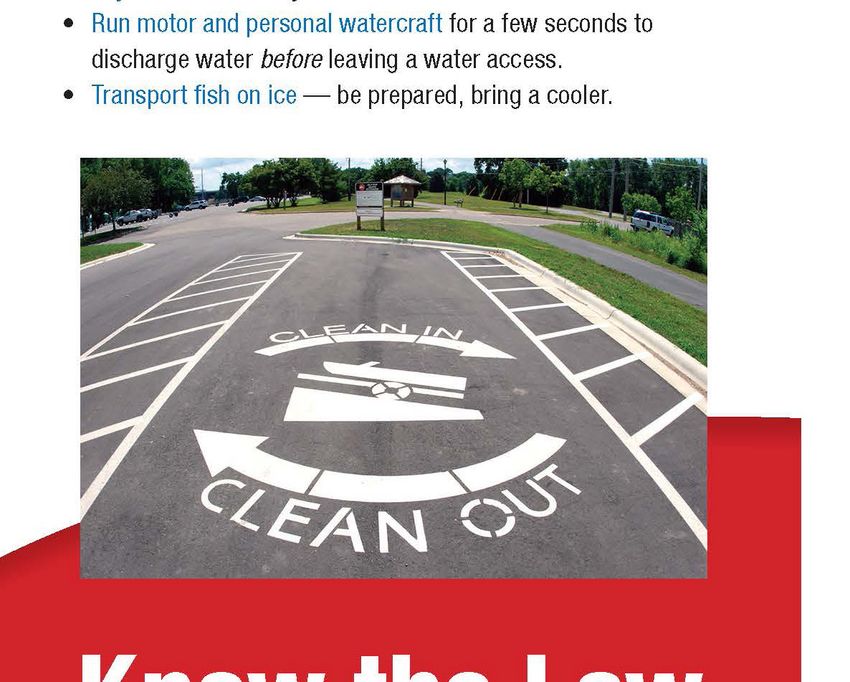
RUN THE MOTOR
Discharge all water by running your motor (or personal watercraft) for a few seconds
before leaving a water access.
DISPOSE
Be prepared! Transport your catch in a cooler. Dispose of unwanted bait—including minnows,
leeches, worms, and fish parts in the trash. If you want to keep live bait, drain bait containers
and refill with bottled or purified tap water. It is illegal to release bait into the water or re-
lease worms onto the ground.
Curly-leaf pondweed, Zebra mussel, Dreissena polymorpha Eurasian Watermilfoil,
Potamogeton crispus Myriophyllum spicatuml
Lake Minnetonka Summer Rules 2021 16Stop Aquatic Hitchhikers!
YOU CAN DO EVEN MORE TO PREVENT THE SPREAD OF AIS
BE AN AIS SLEUTH
Since Lake Minnetonka is a regional and
national recreation destination, the risk
of exposure to a variety of AIS threats is
Be on the lookout for Starry stonewort, spiny high. AIS damage the ecology of the lake,
waterflea and other aquatic invasive species enjoyment of recreation, economics of the
threats. Visit lmcd.org or StopSpiny.org for area, and is a significant financial burden to
more information. manage.
Learn about AIS management on Lake
Minnetonka and report any suspicious
aquatic vegetation or animals at lmcd.org
or call 952-745-0789.
AIS Detector Opportunities
If you would like to connect your love of
lakes with meaningful ways to protect
them, consider AIS Detectors training
sponsored by the University of Minnesota
Minnesota Aquataic Invasive Species
Research Center (MAISRC) . For more
information, visit maisrc.umn.edu/ais-
detectors or contact the LMCD.
KNOW THE LAW!
YOU MAY NOT...
• Transport watercraft without removing the drain plug
• Arrive at a lake access with a drain plug in place
• Transport aquatic plants, or prohibited invasive species. Learn more at mndnr.gov
• Launch a watercraft with prohibited species attached
• Transport water from Minnesota lakes or rivers; or release bait into water.
There are many regulated species—such as spiny
waterfleas, faucet snails, ruffe round goby, rusty crayfish,
and mystery snails—that cannot be released into
another body of water.
What’s more, docks, structures, and boatlifts must
be dried for 21 days before placing in another
body of water. Violating these regulations may
result in fines up to $1,000.
17
17 lmcd.org
lmcd.orgLAKE MINNETONKA SUMMER RULES RESOURCES & LINKS
Lake Minnetonka Conservation District (LMCD)
5341 Maywood Road, Suite 200
SM
Mound, MN 55364
Office: 952-745-0789
Email: lmcd@lmcd.org Website: lmcd.org
Connect with us at: /LakeMinnetonkaConservationDistrict
@LakeMtkaCD
• Licensing and surface regulations
• Docks, structures, and watercraft storage
• Public navigation harvesting program
• Boater safety course
• Solar lights program
• Some services funded by SAVE the LAKE Fund contributions
Hennepin County Sheriff’s Office (HCSO)
Water Patrol Unit
4141 Shoreline Drive
Spring Park, MN 55384
EMERGENCY or Officer Assistance: Call 911
Non-Emergency 24/7: 763-525-6216 Office: 612-596-9880
Website: HennepinSheriff.org/water-patrol
• Patrol and enforcement of State and LMCD laws on Lake
Minnetonka
• Emergency and rescue operations
• Special events
Minnesota Department of Natural Resources (MNDNR)
Conservation Officers
500 Lafayette Road
St. Paul, MN 55155
DNR Information Center: 651-296-6157 or
888-MINNDNR (646-6367)
Officer Locator: mndnr.gov/officerpatrolareas
Website: mndnr.gov
• Boating and fishing regulations and enforcement
• AIS prevention and management
Form 04192021 WPYou can also read


