The CAN Bus in the Maritime Environment - Technical Overview and Cybersecurity Vulnerabilities - Title of paper
←
→
Page content transcription
If your browser does not render page correctly, please read the page content below
the International Journal                                Volume 15
                                              on Marine Navigation                                      Number 3
http://www.transnav.eu                        and Safety of Sea Transportation                   September 2021

                                                                                       DOI: 10.12716/1001.15.03.05

The CAN Bus in the Maritime Environment – Technical
Overview and Cybersecurity Vulnerabilities
Gary C. Kessler
Fathom5, Ormond Beach, Florida, USA

ABSTRACT: The Controller Area Network (CAN) bus standard was developed in the 1980s and is in
widespread use in automobile, vehicular, aviation, and other networks. The CAN bus was introduced in the
maritime environment with the adoption of the National Marine Electronics Association (NMEA) 2000 standard
in the late-1990s. Many papers have been written about the CAN bus protocols and security vulnerabilities but
there is sparse literature about use of the CAN bus in the maritime environment. Part I of this paper is a
technical overview, describing CAN bus standards and operation, with particular attention to its use with the
NMEA 2000 maritime communications standard. Part II of this paper describes security vulnerabilities in terms
of loss of confidentiality, integrity, or availability of information (such as eavesdropping, denial-of-service, and
spoofing), and mitigations specific to the maritime environment.

1 INTRODUCTION                                             2 CAN BUS TECHNICAL DESCRIPTION

The Controller Area Network (CAN) bus was                  In this part of the paper, Section 1 provides an
developed in the early 1980s and has been in wide use      overview of the CAN bus, including its history,
for intra-vehicular communication since its initial        origins, and generic use in the maritime industry.
introduction 30 years ago, primarily for automobiles       Section 2 describes the CAN bus standards, operation,
and other land vehicles. The CAN bus has been used         and frame format, followed in Section 3 by a high-
in maritime communication standards for the last 20        level overview of maritime communications
years, yet there are few papers describing the             employing the CAN bus. Section 4 provides a detailed
maritime applications of the CAN bus or the                description of the coding of a CAN bus transmission.
cybersecurity vulnerabilities of the CAN bus in the
maritime environment. Part I of this paper is a
technical tutorial describing the CAN bus and how it       2.1 CAN bus overview
is employed in maritime communications. Part II is
less technical, and discusses CAN bus cybersecurity        The CAN bus standard is a message-based
vulnerabilities and mitigations specific to maritime       communications protocol developed in the early-
applications. The paper ends with a summary and            1980s for automobile device communication. Unlike
some conclusions.                                          the point-to-point and multidrop serial protocols of
                                                           the day, the CAN bus is a broadcast bus where any
                                                           device can transmit when it is ready and does not
                                                           have to wait to be polled by some master station; the

                                                                                                                531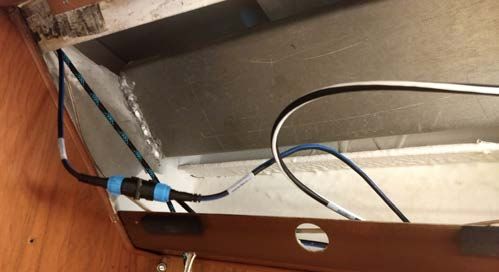
CAN bus standard refers to this as a multimaster           employed in environments as varied as audio/video
protocol because all devices are, essentially, peers. In   systems and smart building controls to telescopes and
terms of the Open Systems Interconnection (OSI)            elevators/escalators [3].
reference model, the CAN bus standard provides
physical and data link layer (layer 1 and 2) services.
Any suitable higher layer protocol can be designed or      2.2 CAN bus standards and operation
adapted to run over the CAN bus [7, 10–12].
                                                           This section will describe the CAN bus standards,
    The CAN bus was originally developed by Robert         protocol layers, and operation in order to establish a
Bosch Gmbh just as microprocessors were being              basis for the discussion of security vulnerabilities.
introduced into the design of automobiles. Adopted
by the Society of Automotive Engineers (SAE) in 1986
as the Automotive Serial Controller Area Network,          2.2.1 Standards
the 1992 Mercedes-Benz W140 was the first
production vehicle to employ CAN bus. It is now               The SAE J1939 family of standards describes both
nearly universally used in automobiles for                 the physical and data link layers of the CAN bus, as
interconnecting the vehicle's computer controllers         well as higher layer protocols for use in a variety of
with the transmission, airbags, anti-lock braking          automotive applications [28]. The generic global CAN
system, power steering, engine control, traction           bus specification is contained in four standards from
management, navigation system, and entertainment           the International Organization for Standardization
devices [7, 10, 12].                                       (ISO):
                                                           − ISO 11519-1 describes a low-speed (125 kbps) serial
   Use of the CAN bus has grown considerably over             interface [18].
the last three decades. Within the transportation          − ISO 11898-1 describes the data link layer frame
sector alone, CAN bus communications are used in [3,          format and physical layer signaling [15].
10]:                                                       − ISO 11898-2 describes the high-speed (1 Mbps or 5
− Buses, tractor trailers, and agricultural vehicles to       Mbps) interface [16].
   interconnect specialized systems and devices.           − ISO 11898-3 describes a low-speed, fault-tolerant
− Aircraft to interconnect flight state sensors and           interface [17].
   analyzers, navigation systems, aircraft engine
   control systems, flight surfaces, fuel systems, and        The CAN bus multimaster architecture supports a
   more.                                                   multihost, broadcast environment where any node can
− Railroad equipment such as streetcars, trams,            transmit whenever it has data to send, although rules
   subways (undergrounds), light rail, and long-           must be in place to ensure that end devices do not
   distance trains.                                        transmit over one another. Higher-layer protocols
− Maritime vessels to interconnect such equipment          define the messages that are exchanged via the CAN
   as the wind speed/wind direction/air temperature        bus.
   sensors, Automatic Identification System (AIS),
   Global Navigation Satellite System (GNSS),              2.2.2 Physical Layer
   gyroscope, compass, navigation display, a large
   variety of ship status sensors, voyage data recorder       The CAN bus physical layer is a two-wire bus
   (VDR), and ship state dashboard display (Figure         (Figure 2). Each node attaches to both wires, called
   1).                                                     CAN high (CANH) and CAN low (CANL). By default,
                                                           the bus signals are driven to a dominant state (0) with
                                                           CANH > CANL; a signal is passively pulled by
                                                           resistors to a recessive state (1) with CANH ≤ CANL.
                                                           Thus, if more than one node transmits at the same
                                                           time, the effect is a logical AND (i.e., if any node
                                                           transmits a 0, then 0 will be the resultant signal on the
                                                           line; only if all transmitting nodes send a 1 will the
                                                           resultant signal be a 1). In order to maintain clock
                                                           synchronization, the CAN bus employs a bit-stuffing
                                                           mechanism where five consecutive bits of the same
                                                           value are followed by a single bit of the opposite
                                                           value [6, 7, 11, 12].
                                                               The CAN bus has a relatively simple physical
                                                           design (Figure 3). The main backbone comprises a
                                                           series of point-to-point, twisted-pair cables with a
Figure 1. CAN bus interconnection of (clockwise, from      CAN bus connector at each end. The entire CAN bus
upper left) the weather station, AIS and GNSS receivers,   is terminated at each end with a terminating resistor.
gyroscope, compass, navigation display, myriad sensors,    Devices are attached to the backbone by placing a T-
VDR, and ship state dashboard display.                     connector on the bus; the backbone, then, is really a
                                                           sequence of cables that string together the T-
   Cars represent the very earliest of what we now         connectors. The T-connector also attaches to a two-
refer to as industrial control systems (ICS), where        wire pigtail that connects to the CAN bus interface on
computers, sensors, and actuators are interconnected       compatible devices.
to manage and operate industrial and other
mechanical systems. ICS are used on land as well as in
the air and on the water. The CAN bus is currently

532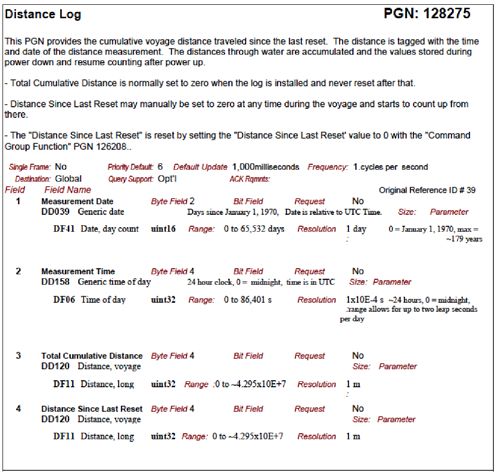
resend its message. Finally, an overload frame is sent
                                                            by a device that is in an overloaded or busy state, and
                                                            is used to inject a delay between transmissions.

                                                            Figure 4. CAN 2.0A frame with 11-bit identification field
                                                            (top) and CAN 2.0B frame with 29-bit identification field
                                                            (bottom).       (Source:    https://cdn.sparkfun.com/assets
                                                            /learn_tutorials/5/4/1/CAN_PacketStructureFrames_1.png)

Figure 2. CAN bus nodes connected to the two-wire bus.
                                                               Figure 4 shows the CAN 2.0 frame format for both
Note that the bus is terminated with a resister. (Source:   basic and extended frames. The fields are:
https://cdn10.bigcommerce.com/s-7f2gq5h/product_images      − Start-of-Frame (SOF) bit (0)
/uploaded_images/can-bus-network-with-transceiver.jpg)      − Base Identifier (11 bits in length)
                                                            − Substitute Remote Request (SRR) bit (1) [CAN 2.0B
                                                               only]
                                                            − Identifier Extension (IDE) bit (0 in CAN2.0A, 1 in
                                                               CAN2.0B))
                                                            − Extended Identifier (18 bits in length) [CAN 2.0B
                                                               only]
                                                            − Remote Transmission Request (RTR) bit (0 = Data,
                                                               1 = Remote Request)
                                                            − Reserved (RES) bits (0)
                                                            − Data Length Code (4 bits in length, value 0-8)
                                                            − Data (0-8 bytes in length)
                                                            − Cyclic Redundancy Check (CRC) field (16 bits in
                                                               length)
                                                               − CRC-15 value (15 bits in length)
                                                               − CRC Delimiter bit (1)
                                                            − Acknowledgement (ACK) field (2 bits in length)
                                                               − ACK Slot bit (transmitter sends 1, any receiver
Figure 3. CAN bus architecture.
                                                                   can send 0)
                                                               − ACK Delimiter bit (1)
   The CAN bus standard supports speeds up to 1
                                                            − End-of-Frame (EOF) field (1111111)
million bits per second (Mbps) or distances up to
                                                            − Inter-Frame Space (IFS; at least seven 1s)
3,300 feet (1,000 meters). As shown in Table 1, the
maximum speed decreases as the end-to-end distance              The CAN bus frame structure is not terribly
– and end-to-end signal delay – increases [7, 11, 12].      efficient in terms of data transfer; an extended frame
                                                            with eight bytes of data is at least 135 bits in length,
Table 1. Cable length and maximum speed trade-off.
_______________________________________________             which means that, at most, 47% of the transmission is
Cable Length        Max. Speed
_______________________________________________             data. For the original designers of automotive
1,000 m (3,300 ft)  50 kbps                                 networks, this was not a high price to pay in a
500 m (1,660 ft)    125 kbps                                geographically small network with only a few dozen
200 m (650 ft)      250 kbps                                devices, but it does not necessarily scale well to
100 m (330 ft)      500 kbps                                physically larger networks with more devices.
40 m (130 ft)       1 Mbps
_______________________________________________

2.2.3 CAN Bus Frame Types                                   2.2.4 Arbitration

   The bits on the CAN bus are organized into a                The CAN specification employs a broadcast bus so
protocol data unit called a frame. There are two frame      that all devices hear all transmissions. There is no bus
formats; CAN 2.0A, called the base frame format, uses       controller nor is there a primary device to which all
an 11-bit Identifier field while CAN2.0B, called the        others must communicate; it is essentially a peer-to-
extended frame format, uses a 29-bit device identifier,     peer network. When more than one station is ready to
split between an 11-bit Identifier field and an 18-bit      transmit, they resolve the conflict through a process
Identifier Extension field [7, 11].                         known as arbitration [7, 11]. This process is somewhat
                                                            similar to the Carrier Sense, Multiple Access with
    There are four primary types of frames used by the      Collision Detection (CSMA/CD) scheme used in IEEE
CAN bus standard. The most common frame type is a           802.3/Ethernet networks.
data frame which contains up to 8 bytes of data
transmitted by a device. A remote frame is used by              When a CAN device is ready to transmit, it listens
one device to request data from another; it contains no     to the bus to see if the bus is already in use. If another
data. An error frame is transmitted by any device           device is transmitting, the station waits until the line
detecting any sort of error in a transmission; this         becomes idle, represented by a sequence of more than
frame causes all other devices to send an error frame       seven consecutive 1 bits (the Inter-Frame space),
after which the original transmitter will automatically     before it starts transmitting. If more than one device

                                                                                                                   533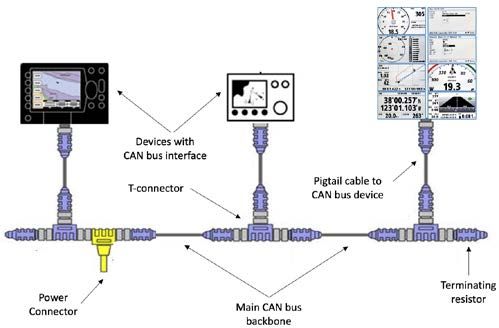
becomes ready while another station is transmitting,           2.3.1 Maritime Communication Standards
all will start to transmit at the same time after seeing
                                                                  Just as there are many networks onboard a ship,
the line go idle.
                                                               there are many communication protocols and
    A device continues to monitor the bus while it             standards. National Marine Electronics Association
transmits. As described in Section 3.2 above, if more          (NMEA) standards are the primary specifications
than one station transmits at one time, the resultant bit      employed on boats and ships of all sizes to
signal on the line is the equivalent of a logical AND of       interconnect instrumentation, from a Global
the two inputs. As soon as a station "sees" a bit that is      Positioning System (GPS) receiver, navigation display,
different from one that it sent, it will stop                  and engine monitor to the Electronic Chart Display
transmitting.                                                  and Information System (ECDIS), myriad sensors, and
                                                               a variety of controllers (Figure 6).
   Consider this simple example of CAN bus
arbitration. Suppose there two devices that are ready
to transmit, where Device 1 has the 11-bit address
0x5C3 (binary 10111000011) and Device 2 has the
address 0x598 (binary 10110011000). Per the
description of the CAN bus frame, both stations start
by transmitting a Start-of-Frame bit, or a 0, so both
will "see" a 0 on the line.

                                                               Figure 6. Maritime instrumentation and the NMEA 2000 bus
                                                               on a boat. (Source: https://upload.wikimedia.org/wikipedia
                                                               /commons/b/bf/NMEA2000_Modified_motor_yacht.jpg)

                                                                  There are three dominant NMEA standards for
Figure 5. CAN bus arbitration. Devices 1 and 2 start to        instrumentation communication within a vessel:
transmit at the same time; Device 2, with the lower address,   − Introduced in 1983, NMEA 0183 operates on
"wins" the arbitration.                                           Electronic Industries Alliance (EIA)-232/422 serial
                                                                  lines at 4,800 or 38,400 bits per second (bps). This
    Next, each station starts to send their 11-bit                standard     is    the   basis    of   International
identifier (Figure 5). The first four bits of both                Electrotechnical Commission (IEC) standard
addresses are "1011" so each station sees, in turn, the           61162-1, and is employed in International
same bit on the line as the one that they are sending.            Telecommunication Union, Radiocommunication
When they transmit the fifth bit (Bit 7), Device 1 sends          Sector (ITU-R) Recommendation M.1371-5 for
a 1 and Device 2 sends a 0; the resultant value on the            over-the-air transmissions at a rate of 9,600 bps.
line is a 0. At that point, Device 1 stops transmitting           Version V4.11 of NMEA 0183 was released in 2018
but Device 2, seeing the same value as it transmitted,            [22].
continues. This same arbitration process works                 − NMEA 2000 was released in 2001 and introduced a
regardless of how many stations might wish to transit             streamlined message format and PGN message set
at once. The station with the lowest address will                 to support a large variety of maritime devices. This
always win the arbitration and, in fact, is never aware           standard operates at speeds up to 250 kbps over
that a collision occurred.                                        the CAN bus. NMEA 2000 was adopted as IEC
                                                                  61162-3; Edition 3.101 was released in 2016 [23].
                                                               − OneNet is the newest member of the NMEA family
2.2.5 Higher-Layer Protocols                                      of standards. Released in 2020, OneNet employs a
                                                                  superset of the NMEA 2000 message set. OneNet
   The CAN bus standard defines a physical layer
                                                                  devices exchange data using Internet Protocol
and frame format for the exchange of data. The actual
                                                                  version 6 (IPv6) packets running over an Ethernet
format of the data is specified in application- and
                                                                  local area network at speeds up to 10 Gbps and
device-specific higher-layer protocols. The format for
                                                                  employs IP Security (IPsec) for secure inter-device
higher-layer messages are described in parameter
                                                                  communication [24].
group number (PGN) specifications. A PGN defines
the function of a message, the format of the CAN bus               Since NMEA 2000 is the only one of these
Arbitration field, and the format of the contents in the       standards to operate over the CAN bus, the remainder
Data field.                                                    of this discussion will focus on the interrelationship of
                                                               these two standards.

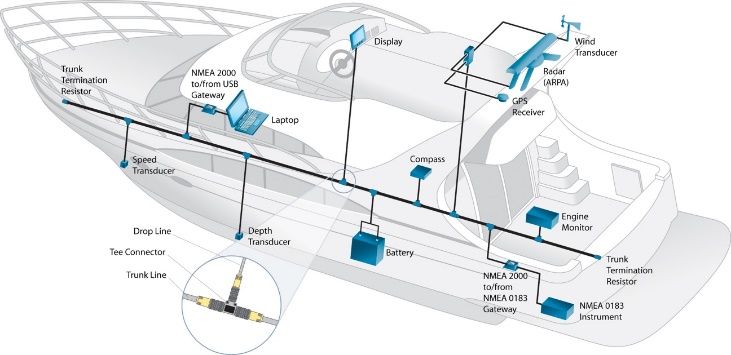
2.3 Maritime communications over the can bus                   2.3.2 NMEA 2000
This section will briefly describe the primary maritime           As mentioned above, the NMEA 2000 (aka N2K)
communication standard that employs the CAN bus.               standard is designed for communication between
                                                               marine electronics on a vessel and employs the CAN
                                                               bus as the physical layer; this protocol is not used for
                                                               over-the-air transmissions [2]. Prior maritime
                                                               communication standards used point-to-point links

534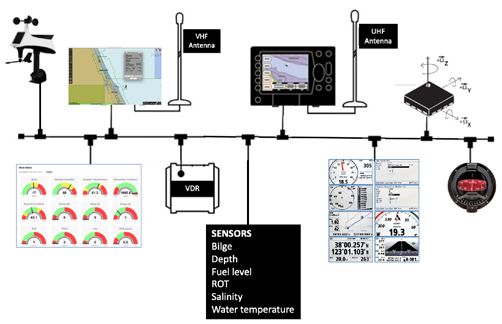
between each device and a central controller, whereas        addressed/global indicator. If this bit is a 0, the PGN is
the CAN bus employs a single communications bus              addressed and, if set to 1, the PGN is global. CAN bus
with which to interconnect multiple devices. Use of          arbitration, then, favors addressed messages over
the CAN bus yields a much simpler wiring scheme              global messages (the overwhelming majority of PGNs
that requires less overall cable, resulting in a             are global). The setting of this bit affects the encoding
noticeable reduction in the cost of the wiring,              of the next 16 bits, which contain the low-order 16 bits
installation, and maintenance, as well as a lower total      of the PGN identifier.
weight of the system [6, 10, 12].                            − In the case of an Addressed PGN, the next 16 bits
                                                                 are the sum of the PGN identifier and the 8-bit
    N2K messages are denoted by their name and PGN
                                                                 address of the intended destination device. As an
[6, 10, 23]. Each PGN definition describes details
                                                                 example, the ISO Address Claim message has a
about the message, including (Figure 7):
                                                                 PGN identifier of 060928 (0xEE00). If this message
− The binary format of the data
                                                                 was being sent to a device with address 165 (0xA5),
− Message priority (0-7)
                                                                 these 16 bits would be encoded as 0xEEA5.
− Whether the message fits in a single frame (i.e., it
                                                             − In the case of a Global PGN, the next 16 bits are
   contains eight or fewer bytes of data) or requires
                                                                 merely the remainder of the PGN identifier. As a
   multiple frames
                                                                 broadcast message, the destination address is
− Whether the message is addressed to a specified
                                                                 implied to be 255 (0xFF).
   destination or is a broadcast (global) message [All
   transmissions are physically broadcast on the CAN            The final eight bits of the Arbitration field contain
   bus. An addressed PGN is ignored by all devices           the address of the transmitting device (0-254, 0x00-
   other than the one matching the destination               0xFE). Given the CAN bus arbitration scheme, a lower
   address in the CAN bus transmission; global PGNs          priority message will always be sent before a higher
   are received by all devices on the bus.]                  priority message if multiple devices are ready to
                                                             transmit at one time. If the priority of multiple
                                                             transmissions is the same, lower PGNs take
                                                             precedence over higher numbered PGNs; Addressed
                                                             PGNs, then, will be sent before Global PGNs. In the
                                                             case of multiple Addressed PGNs of the same value, a
                                                             lower destination address wins arbitration over a
                                                             higher destination address. Finally, if the priority and
                                                             PGN are the same, the lowest source address wins
                                                             arbitration.
                                                                 The next field of importance to NMEA 2000 is the
                                                             Data Length field, which can take on a value between
                                                             zero and eight, indicating the length of the Data field,
                                                             which can be from zero to eight bytes. A PGN
                                                             containing eight or fewer bytes will be transported in
                                                             a single CAN bus frame; larger PGNs – referred to as
                                                             multi-frame PGNs – are fragmented and transported
                                                             in multiple CAN bus frames. There are two strategies
                                                             in NMEA 2000 for managing a multi-frame PGN.
                                                             − The fast-packet method supports PGNs with up to
                                                                 223 bytes of data. In this case, the PGN is assigned
                                                                 a serial number (0-7) and can be fragmented into
                                                                 up to 32 CAN bus frames, each of which is
Figure 7. A sample NMEA 2000 PGN. [2]                            assigned a sequence number (0-31). The
                                                                 combination of the serial number and sequence
                                                                 number allows for PGN reassembly.
                                                             − The multi-packet method supports PGNs with up
                                                                 to 1,785 bytes of data. This method uses Request to
                                                                 Send (RTS) and Clear to Send (CTS) messages
                                                                 exchanged between the sender and receiver to
                                                                 control when the individual CAN bus frames can
                                                                 be sent.

Figure 8. NMEA 2000 format of 29-bit Arbitration Fields in
CAN Bus Extended Frame, showing encoding for an              2.4 Sample CAN bus frame and PGN encoding
addressed (upper) and global (lower) PGN.
                                                             The complete encoding and transmission of an NMEA
    NMEA 2000 specifies use of the CAN bus                   2000 PGN in a CAN bus frame is shown below, with
Extended Frame format, employing a 29-bit                    the intent to remove some of the mystery. This
arbitration field (Figure 8). The first three bits are the   example will show the encoding of a Position, Rapid
message priority field. Bit 4 is reserved and always set     Update message, with a PGN identifier value of
to zero [2].                                                 129025 (0x1F801). This is a global message with a
                                                             priority of 2; in this example, the sending device has
   The next bit is the leading bit of the 17-bit PGN         the address 150 (0x96) [2].
identifier. This first bit is, functionally, an

                                                                                                                   535
Figure 8 shows the format of the 29-bit Arbitration 3 CYBERSECURITY VULNERABILITIES AND
field. For this example, the field contains the MITIGATIONS
following values:
− Priority = 0x2 (010) Part I of this paper provided the technical details
− Reserved = 0 about the CAN bus and NMEA 2000 standards
− High-order PGN identifier bit = 1 (global) necessary for an appreciation of the cybersecurity
− Low-order 16-bits of PGN identifier = 0xF8-01 vulnerabilities that are described in this part of the
(11111000 00000001) paper. Part II is decidedly less technical than Part I.
− Source address = 0x96 (10010110)
PGN 129025 has two data fields, namely Latitude
and Longitude, each of which is four bytes in length. 3.1 CAN bus cybersecurity issues
In this example, we will use the coordinates of the
There have been many papers written about CAN bus
U.S. Coast Guard Research and Development Center
security issues. Although these papers typically
in New London, Connecticut:
address vehicular and agricultural applications, CAN
− Latitude = 41°20'44.1"N (encoded 0xA0-D5-A4-18)
bus cybersecurity vulnerabilities in ICS and aviation
− Longitude = 072°05'45.7"W (encoded 0x00-05-07-
networks and avionics have also been reported [8, 9].
D5)
It is not surprising that papers discussing the
Figure 4 shows the entire CAN bus Extended maritime environment are hard to find; although the
Frame format. In this example, the frame would be CAN bus protocol has been in place since the late-
encoded as follows: 1980s, it has only been in use in maritime since 2000.
− SOF: 0 Most of the CAN bus cybersecurity papers have been
− Base ID (first 11 bits of the Arbitration field): published in the last 15 years, which is when
01001111110 cybersecurity discussions started to become more
− SRR: 1 mainstream and hacking conferences demonstrated
− IDE: 1 attacks on vehicular networks.
− Extended ID (last 18 bits of the Arbitration field):
This section will explore what kind of
000000000110010110
vulnerabilities are present that threaten the security of
− RTR: 1
information on CAN bus network. Information
− Reserved bits: 00
security is often discussed in terms of the CIA Triad, ,
− Data Length: 0x08 (00001000)
where CIA stands for confidentiality, integrity, and
− Data: 0xA0-D5-A4-18-00-05-07-D5 (10100000
availability. This section addresses CAN bus
11010101 10100100 00011000 00000000 00000101
vulnerabilities in terms of these characteristics of
00000111 11010101)
information. Note that some of the scenarios
− CRC-15 value: 101001010110010
described below are impossible with a properly
− CRC Delimiter bit: 1
functioning CAN bus or NMEA 2000-certified device,
− ACK Slot bit: 1
but might be quite possible if a rogue device was built
− ACK Delimiter bit: 1
specifically to violate the CAN or N2K standards.
− EOF: 1111111
− IFS: 1111111....
Given this data, the transmitted bit stream would 3.1.1 Confidentiality
appear as follows; stuffed bits, to maintain clock Confidentiality refers to the secrecy or privacy of
synchronization between the SOF bit and the end of information between a sender and receiver. Neither
the CRC field, are shown in bold: the CAN bus nor NMEA 2000 standards address
00100111110101100000100001100101101000001010001 confidentiality. Both the CAN bus and the NMEA
01000001110101011010010000011 2000 standard provide a mechanism to send a
10000010000010000010101000001111110010101101001 message addressed to specific receiver; a sender
0101100101111111111 needing product information from another network
node, for example, optimizes network bandwidth by
The receiving device would interpret this bit sending an addressed message because it does not
stream as shown in Figure 9. need a response from all of the devices. Similarly, a
command and control message telling a particular
actuator or valve to engage should only be sent to the
necessary target device.
CAN, however, is a broadcast bus and, therefore
every device can hear every transmission [5, 12, 21].
While a properly configured CAN device will not
"listen" to an addressed message if it is not the
Figure 9. Interpretation of CAN bus frame using the
Actisense EBL Reader [1].
intended receiver, a CAN device could be designed to
operate in promiscuous mode and listen to every
transmission.
Similarly, the majority of NMEA 2000 PGNs are
global messages that employ the broadcast address, so
that N2K device sees every global message. Although
an NMEA 2000-certified device will not listen to
536addressed PGN not intended for this device, a rogue there is no mechanism to ensure bit integrity of the
promiscuous N2K node could read all PGNs. entire PGN message. One of the NMEA 2000 multi-
frame mechanisms is the fast-packet method, which
The use of cryptography could be employed to allows a PGN of up to 223 bytes sent in up to 32 CAN
ensure confidential communication between two bus frames; each multi-frame block has a serial
network nodes [19]. Neither the CAN bus nor NMEA number (0-7) and each frame within the block has a
2000 PGNs have a provision for encryption [2, 4]. sequence number (0-31). Suppose there is a fault on
At the physical level, it is possible to add a rogue the bus that causes some frames to be lost without the
device to the CAN bus [4, 5, 21]. A CAN bus on a car, sender knowing. If the sender continues sending
truck, or passenger coach might have dozens of multi-frame PGNs, it increments the multi-frame
devices on a network that is 10-100 ft (3-30 m) in serial number. After eight multi-frames, the serial
length and difficult to surreptitiously access. A ship number wraps back around to match the serial
might have several hundred devices on a network that number of the block where the fault occurred. It is
is more than 1,000 ft (305 m) in length. In any case, it possible for a frame from the new block to have a
is straight-forward to covertly add a device to a CAN sequence number that matches a missing frame from
bus; all you need is a short length of backbone pigtail the old block, which will then be used by the receiver
cable, a T-connector to attach to the rogue device, and to reassemble the first PGN. This reassembly error
an obscure access panel on the ship (Figure 10). scenario is rare under normal circumstances, but such
an error could be forced by a rogue node.
A rogue N2K device can also send bogus
messages, an attack known as frame injection. As an
example, a device on the network could send fake
NMEA 2000 messages masquerading as the GPS
receiver, compass, or depth gauge, causing false
information to be fed to the navigation console. There
is no CAN bus or NMEA 2000 mechanism to verify
that transmitted data is correct or that the sender is
the device that it purports to be [4, 5, 21, 25].
NMEA 2000 and CAN bus standards provide no
timestamp in the message body, thus providing no
Figure 10. Easy physical access to the CAN Bus on a vessel timing integrity. This opens the network to a replay
can make it simple to add a rogue device. attack, where a legitimate message is stored and
retransmitted at a later time by a rogue device. As an
The ability to physically insert a rogue node on the example, during an extreme low tide in a narrow
CAN bus and the lack of confidentiality in the channel, an attacker could replay depth gauge
transmissions provides many ways in which a information from an earlier extreme high tide,
malicious actor can access and, possibly, exfiltrate possible causing a ship to run aground [4].
information from a vessel's network. An inserted The CAN bus protocol also provides no
node, for example, can monitor all or a select subset of authentication mechanism, thus providing no way to
transmissions on the communications bus; this node ensure the integrity of the sender's address. CAN bus
can buffer the information for later retrieval by a Bad nodes derive their device identifier from their serial
Actor or transmit the information to another system number, hardware switch settings, or other
on or off the vessel in real-time. assignment mechanism, but there is actually nothing
that would prevent a device from using an address
already in use on the bus. Similarly, a rogue N2K
3.1.2 Integrity
device could use the same source address as another
In the vernacular of information security, integrity device, and spoof the authentic device and its
refers to the correctness of the message; including information [20, 21, 25].
whether the received message is the same one that
Another attack on message integrity could occur if
was transmitted by the sender, the information is
a rogue device on a CAN bus network uses the same
correct, and the purported sender is actually the one
address as another node, in which case it would be
who sent the message.
impossible for receivers to distinguish between the
Bit integrity is provided on the CAN bus by use of different transmitters. Indeed, this scenario would
a CRC calculation; if the receiver calculates a different allow multiple physical devices to attempt to transmit
checksum value than the one contained in the CRC different data at the same time.
field of the message, then this indicates that a bit error
has occurred during transmission. A rogue device can
send spurious bits on the line, forcing such 3.1.3 Availability
transmission errors, causing the receiver to ignore a The availability of information refers to the ability
transmission. A sufficient number of such bit errors of (authorized) users to access data or the network
could cause other devices to believe that the communications channel whenever they need to.
communication bus is unreliable [4, 5, 21]. There are several attacks on availability possible via
The CRC provides bit integrity in the CAN bus the CAN bus.
only on a per-frame basis. An NMEA 2000 multi- One of the biggest compromises to availability is a
frame PGN is sent in multiple CAN bus frames, but denial-of-service (DoS) or resource exhaustion attack.
537These attacks makes a device or the entire network function. NMEA 2000 limits the CAN bus to cable
inaccessible by using up all of the available device segments of no more than 200 m (650 ft) in length due
memory or network bandwidth by bogus requests for to employing a 250 kbps transmission speed. CAN
service. Consider the example above where a rogue bus network designers can add security to the system
device purposely uses the same address as another by separating passenger/crew, entertainment,
node on the CAN bus and continues to transmit when engineering, navigation, and other functional
the valid device transmits. The arbitration process is communications onto different network segments.
designed to be resolved during the transmission of the While this design adds cost to implementation and
Arbitration field; transmitting after losing arbitration maintenance, it limits access to critical systems by
is a direct violation of the CAN bus protocol. A potential Bad Actors [5, 14, 25, 29].
receiver detecting a line state different from its
While the use of cryptography would provide
transmission while sending its Data field will
privacy, confidentiality, and authentication for the
interpret the event as a transmission error; this will
CAN bus, the protocol issues in the maritime
eventually cause the device to enter a BUS OFF state
environment make the introduction of encryption
and remove itself from the network. A BUS OFF state
methods unlikely. Several methods have been
is resolved by rebooting the device, the device’s CAN
proposed for adding encryption to the CAN bus, but
bus controller, or, in extreme cases, the entire CAN
all have focused on relatively small, low-traffic
bus network [5, 8, 25, 27].
automotive networks that would employ modified,
Another way to force devices to enter a BUS OFF specialized CAN bus nodes. Encryption is also a drain
state is if one or more are operating at different on the limited computational and storage resources of
transmission rates. NMEA 2000 requires devices to the typical CAN bus node [5, 19, 25, 31]. Shipboard
operate at 250 kbps. If a rogue device was placed on networks are not geographically small and evolving
the network persistently operating at a different maritime equipment is actually producing an
speed, some or all of the other transmitting devices increasing amount of information and network traffic.
would eventually enter a BUS OFF state [27]. The protocol overhead added by encryption
exacerbates the limitations of the CAN bus protocol
The CAN bus arbitration process favors devices that only allows eight bytes of data per transmission;
with lower addresses. By assuming a low address, a sending larger messages would necessitate adding
rogue device could launch a different form of DoS traffic to an already burdened network. In the
attack by continually transmitting and blocking out maritime environment, it would be possible to
other devices [5, 21]. encrypt NMEA 2000 PGNs where the use of
Another form of DoS attack is for a rogue node to cryptography would be transparent to the CAN bus
send spurious error or overload frames, or otherwise protocol, although such methods have not yet been
signal nonexistent error conditions. This can result in designed. Theoretically, such mechanisms could be
unnecessary network or device resets, causing a added to the N2K standard by defining PGNs for key
sequence of network outages [5, 25]. A malicious node exchange; use of secret key cryptography would not
can also send false RTS messages and overflow the increase the size of the PGNs although it would add
receiver's input buffer or send bogus CTS messages to to the processing burden of the node [19].
hold a connection open and usurp the entire network An intrusion detection system (IDS) is commonly
bandwidth [5]. employed on a network to detect, and respond to,
cyberattacks. A host-based IDS is generally software
3.1.4 Additional Observations that resides on a network node, and analyzes the
traffic in and out of the node to detect anomalous
If there are applicable lessons from the Stuxnet behavior; a network-based IDS is a physical device on
virus – designed to attack centrifuges in Iranian the network that monitors network traffic to detect
nuclear research facilities and discovered in 2010 – aberrant behavior. A host-based IDS would not be
they are that software can be used to attack hardware feasible in today's maritime environment as it would
and malware can be hidden in a working system for require changes to the devices themselves and add a
years before being activated [30]. It is not too far- computational burden. A network-based IDS,
fetched to realize a Trojan Horse scenario where a however, could easily be attached to a CAN bus
CAN bus controller manufacturer builds malware into without any impact on the network. A number of IDS
a working system. Such a system would work methods for the CAN bus have been proposed, all for
precisely as designed until its malware was activated, automotive networks. The research has shown myriad
which could then launch any one of the attack advantages and disadvantages, taking into account
schemes mentioned above [4, 21]. the complexity of the algorithms, types of attacks
detected, rate of false positives/negatives, and cost [5,
25]. Designing an IDS for maritime CAN bus
3.2 CAN bus security protections and migrations environments seems to be one area that might bear
fruit. Such an IDS would utilize a host-based, passive
A number of mechanisms have been proposed to monitor that can detect anomalous activity on the
mitigate or reduce CAN bus security vulnerabilities. network without adding any traffic to the bus.
While most focus on automotive and vehicular Furthermore, it would require no change to the CAN
applications, this section will review several that bus protocol.
might apply to the maritime environment.
Fenster, Lee, and Whitfield [13] proposed a
The easiest mitigation strategy is network machine-learning approach to detecting rogue devices
segmentation, where a network is subdivided into on a CAN bus. Their method identified a subset of
multiple subnetworks, usually based upon their
538PGNs for a specific application environment. They introduction-to-the-sae-j1939-protocol/, last accessed
took advantage of the fact that NMEA 2000 is a 2021/03/01.
proprietary standard, meaning that an attacker will 7. Corrigan, S.: Introduction to the Controller Area
not have complete information when attacking an Network (CAN). Texas Instruments Application Report,
SLOA 101,
NMEA 2000 network and, therefore, can be detected. https://www.rpi.edu/dept/ecse/mps/sloa101.pdf, last
This is not a CAN bus-specific solution, but it suggests accessed 2021/03/01.
an interesting approach to defending the maritime 8. CSS Electronics: ICS Alert (ICS-ALERT-17-209-01): CAN
network environment. Bus Standard Vulnerability. U.S. Department of
Homeland Security, https://us-
cert.cisa.gov/ics/alerts/ICS-ALERT-17-209-01, last
accessed 2021/03/01.
4 SUMMARY AND CONCLUSIONS 9. CSS Electronics: ICS Alert (ICS-ALERT-19-211-01): CAN
Bus Network Implementations in Avionics. U.S.
Department of Homeland Security, https://us-
The CAN bus was developed in the 1980s for the cert.cisa.gov/ics/alerts/ics-alert-19-211-01, last accessed
automotive environment. Developed for a trusted 2021/03/01.
network during a time when networks could be 10. CSS Electronics: J1939 Explained - A Simple Intro,
trusted, it has no particular security mechanisms or https://www.csselectronics.com/screen/page /simple-
defenses. Indeed, use of the CAN bus shows little sign intro-j1939-explained/language/en, last accessed
of diminishing 40-plus years later, yet the security 2021/03/01.
landscape is very different today than it once was; 11. Di Natale, M.: Understanding and Using the Controller
consider that the hacker community has been Area Network. Radical Eye Software,
demonstrating successful attacks on automotive CAN https://inst.eecs.berkeley.edu/~ee249/fa08/Lectures/hand
out_canbus2.pdf, last accessed 2021/03/01.
bus networks for more than a decade and CAN bus 12. Farsi, M., Ratcliff, K., Barbosa, M.: An overview of
attack suites employing open-source code and Controller Area Network. Computing & Control
inexpensive hardware are now readily available [26]. Engineering Journal. 10, 3, 113-120(7) (1999).
We can no longer afford to build networks that are 13. Fenster, C., Lee, G., Whitfield, W.: Machine Learning in
resilient to naturally-occurring errors but not to active Support of Anomalous Device Detection. U.S. Coast
attack. Guard Academy, Electrical Engineering Section (2019).
14. Furuno: Furuno CAN Bus Network Design Guide,
In today's environment of nearly constant https://www.furunousa.com/-
cyberwarfare, cyberattacks are planned and scheduled /media/sites/furuno/document_library/technical_info/int
to occur at the convenience of the attacker. Any of the erfacing_and_installation/interfacing_and_installation/f
exploits described here might be exacerbated by the uruno_can_bus_network_design.pdf, last accessed
fact that a ship at sea has access to a limited pool of 2021/03/01.
personnel and other resources. While a large vessel 15. International Organization for Standardization: Road
might have someone trained to administer shipboard vehicles — Controller area network (CAN) — Part 1:
Data link layer and physical signalling. ISO 118981-1.
information technology (IT) systems and deal with (2015).
some malfunctions, most are unlikely to have an 16. International Organization for Standardization: Road
information security officer trained to recognize and vehicles — Controller area network (CAN) — Part 2:
respond to a cyberattack. Furthermore, regardless of High-speed medium access unit. ISO 11898-2. (2016).
the qualifications of the ship's officers and crew, being 17. International Organization for Standardization: Road
at sea limits the options for fixing a problem; vehicles — Controller area network (CAN) — Part 3:
sometimes the only solution is to power essential Low-speed, fault-tolerant, medium-dependent interface.
devices down. ISO 11898-3. (2006).
18. International Organization for Standardization: Road
vehicles — Low-speed serial data communication —
Part 1: General and definitions. ISO 11519-1. (1994).
19. Kessler, G.C.: An Overview of Cryptography,
REFERENCES https://www.garykessler.net/library /crypto.html, last
accessed 2021/03/01.
1. Actisense: EBL Reader Software, 20. Lin, C., Sangiovanni-Vincentelli, A.: Cyber-Security for
https://www.actisense.com/acti_software/ebl-reader, last the Controller Area Network (CAN) Communication
accessed 2021/03/01. Protocol. In: 2012 International Conference on Cyber
2. Anderson, L.C., Luft, L.A.: NMEA 2000® Applied. Security. pp. 1–7 (2012).
Presentation at RTCM Meeting, St. Petersburg, FL, May https://doi.org/10.1109/CyberSecurity.2012.7.
2002, 21. Matsumoto, T., Hata, M., Tanabe, M., Yoshioka, K.,
https://www.nmea.org/Assets/final_rtcm_2002_white_p Oishi, K.: A Method of Preventing Unauthorized Data
aper.pdf, last accessed 2021/03/01. Transmission in Controller Area Network. In: 2012 IEEE
3. Applications of Controller Area Network (CAN) Bus: 75th Vehicular Technology Conference (VTC Spring).
Polytechnic Hub, pp. 1–5 (2012).
https://www.polytechnichub.com/applications- https://doi.org/10.1109/VETECS.2012.6240294.
controller-area-network-can-bus/, last accessed 22. National Marine Electronics Association (NMEA):
2021/03/01. NMEA 0183 Interface Standard,
4. Bozdal, M., Randa, M., Samie, M., Jennions, I.: https://www.nmea.org/content/STANDARDS/NMEA_0
Hardware Trojan Enabled Denial of Service Attack on 183_Standard, last accessed 2021/03/01.
CAN Bus. Procedia Manufacturing. 16, 47–52 (2018). 23. National Marine Electronics Association (NMEA):
https://doi.org/10.1016/j.promfg.2018.10.158. NMEA 2000® Interface Standard,
5. Bozdal, M., Samie, M., Aslam, S., Jennions, I.: Evaluation https://www.nmea.org/content/STANDARDS/NMEA_2
of CAN Bus Security Challenges. Sensors. 20, 8, (2020). 000, last accessed 2021/03/01.
https://doi.org/10.3390/s20082364. 24. National Marine Electronics Association (NMEA):
6. Copperhill Technologies: A Brief Introduction to the OneNet Standard for IP Networking of Marine
SAE J1939 Protocol, https://copperhilltech.com/a-brief-
539Electronic Devices, 29. U.S. Coast Guard: Cyber Incident Exposes Potential
https://www.nmea.org/content/STANDARDS/OneNet, Vulnerabilities Onboard Commercial Vessels. Marine
last accessed 2021/03/01. Safety Alert 06-19,
25. Palanca, A., Evenchick, E., Maggi, F., Zanero, S.: A https://www.dco.uscg.mil/Portals/9/DCO%20Documents
Stealth, Selective, Link-Layer Denial-of-Service Attack /5p/CG-5PC/INV/Alerts/0619.pdf, last accessed
Against Automotive Networks. In: Polychronakis, M. 2021/03/01.
and Meier, M. (eds.) Detection of Intrusions and 30. Zetter, K.: How digital detectives deciphered Stuxnet,
Malware, and Vulnerability Assessment. pp. 185–206 the most menacing malware in history,
Springer International Publishing, Cham (2017). https://arstechnica.com/tech-policy/news/2011/07/how-
26. Payne, B.: Car Hacking: Accessing and Exploiting the digital-detectives-deciphered-stuxnet-the-most-
CAN Bus Protocol. Journal of Cybersecurity Education, menacing-malware-in-history.ars, last accessed
Research and Practice. 2019, 1, (2019). 2021/03/01.
27. Pfeiffer, O., Keydel, C.: Challenges of CANopen Node 31. Zimmermann, T., Bauer, J., Aschenbruck, N.:
ID assignment, avoiding duplicates. Presented at the 1st CryptoCAN – Ensuring Confidentiality in Controller
International Mobile Machine Control (MMC) Area Networks for Agriculture. In: Reinhardt, D.,
Conference (2013). Langweg, H., Witt, B.C., and Fischer, M. (eds.)
28. SAE International: SAE J1939 Standards Collection on SICHERHEIT 2020. pp. 79–90 Gesellschaft für
the Web: Content, https://www.sae.org Informatik e.V., Bonn (2020).
/standardsdev/groundvehicle/j1939a.htm, last accessed https://doi.org/10.18420/sicherheit2020_06.
2021/03/01.
540You can also read


