2021 Outlook for Cell-Based Therapies in Oncology: CAR-T Expansion and Beyond - White Paper
←
→
Page content transcription
If your browser does not render page correctly, please read the page content below
2021 Outlook for Cell-Based
Therapies in Oncology:
CAR-T Expansion and Beyond
Authored by Jeron Eaves and Pankaj Oza

White Paper

                                         Blue Matter, Copyright © 2021
White Paper

2021 Outlook for Cell-Based Therapies in
Oncology: CAR-T Expansion and Beyond
One year ago when we published an in-depth review of the cell-based immunotherapy landscape,
no one could have predicted the global COVID-19 pandemic and its associated disruptions. But
researchers, drug developers, regulatory agencies, clinicians, and patients all worked hard to ensure
that the cell therapy field continued to advance and deliver promising new treatments in oncology.
Notably, many of the pre-2020 top-of-mind key questions about both commercial success and
scientific potential have now been answered - some of them in surprising ways.

Here, we will:
• Briefly align on the core design       •   BCMA CAR-Ts: which (class                • Other Cell Therapies: (When) will
  elements and open questions                of) therapy will take the prize in         NK Cells and new DC Vaccines
  surrounding cell-based therapies in        multiple myeloma?                          succeed in clinic?
  oncology:                              •   What’s Next for CAR-T Cell             • Review major research, regulatory,
  • Overview: What has changed for           Therapies: Other targets,                and commercial progress during
    cell therapies in 2020?                  technology advances, solid               2020 that has addressed or begun
  • CD19 CAR-Ts: Competition heats           tumors?                                  to address these key questions
    up between the autologous            •   Non-CAR-T Cell Therapy (TCR-T,         • Outline the key milestones for 2021-
    players - can allogeneic and next-       TILs, etc) - will we see approval(s)     22 that will further address these
    gen designs displace?                    in 2021-22?                              questions

  2                                                                                       Blue Matter, Copyright © 2021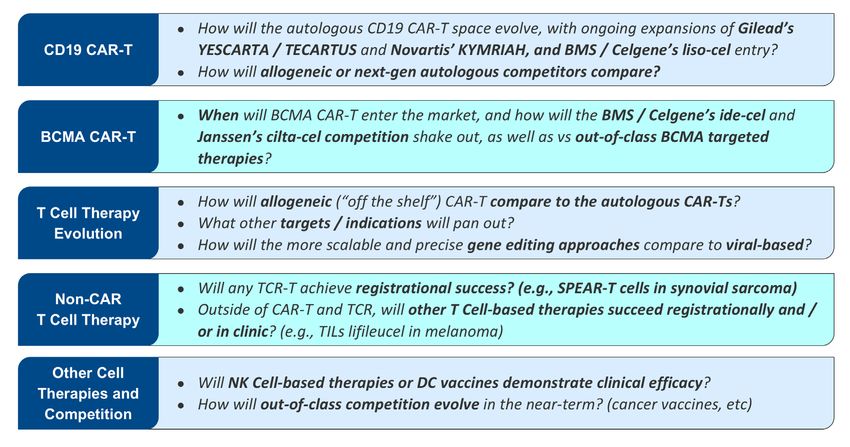
White Paper

   2021 Outlook for Cell-Based Therapies in Oncology: CAR-T Expansion and Beyond

Overview: What has changed for cell therapies in 2020?

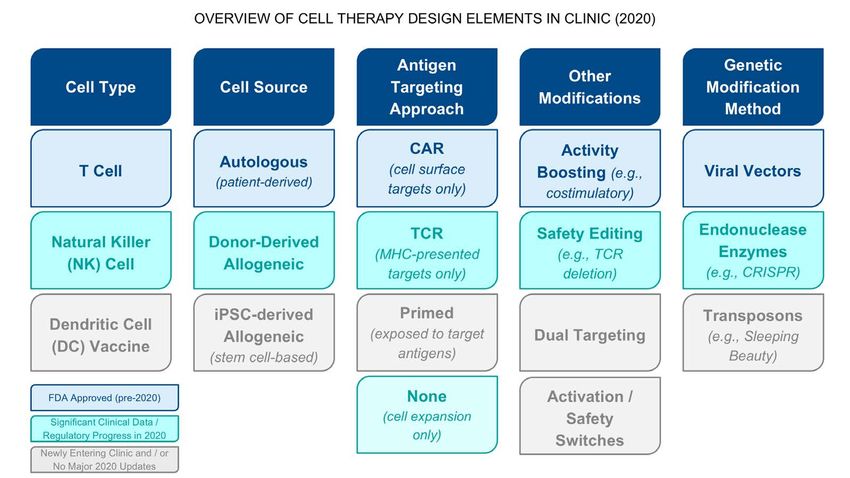
  Cell therapy design requires               please see our previous report here.      impacts of COVID-19 on individual
selection(s) from each column of               In addition to various clinical and     cancer patients and health care
the elements below, chosen to                regulatory developments regarding         providers, the pandemic also impacted
complement and supplement each               these design decisions and attributes     several anticipated 2020 milestones
other’s attributes. In addition, cell        (discussed further below), 2020 also      across the cell therapy landscape.
therapy development programs must            brought a major external disruption       Most notably, the FDA cited COVID-19
also define the target (where relevant)      to cell therapy development and           as a reason for manufacturing
and indication(s) for clinical trials. For   commercialization, namely, the            inspection delays that made liso-cel
a deeper dive on these elements and          COVID-19 pandemic and its associated      miss its end of year approval target,
associated design considerations,            crises. In addition to the incalculable   therefore losing out on a major

   3                                                                                         Blue Matter, Copyright © 2021
White Paper
2021 Outlook for Cell-Based Therapies in Oncology: CAR-T Expansion and Beyond
milestone payout. In addition, various well-understood safety / tolerability the established autologous CAR-T
clinical trials experienced pauses and profile, there is always room for design are at the forefront lately,
delays in enrollment, which will no improvement in the overall product particularly the question of autologous
doubt impact data release timelines in profile. This includes efficacy, vs allogeneic cell source. Autologous
the future. safety, and—crucially for these CAR-T manufacturing is inherently
At the beginning of 2021, the complex therapies—speed and time-consuming and expensive, as
cell therapy market is dominated ease of manufacturing and delivery it requires T cells to be successfully
by Novartis’ KYMRIAH and Gilead’s to the patient. Separately, there is obtained from each individual patient,
YESCARTA and TECARTUS which enormous opportunity if cell therapies then purified, modified, expanded, and
share many design commonalities. can succeed in other targets and infused back into the patient.
They have the same CD19 target and indications. This extends beyond Allogeneic CAR-T manufacturing,
despite different order of approvals BCMA in multiple myeloma (where on the other hand, begins with source
they now have overlapping indications we expect one or more CAR-Ts to be cells from a donor or iPSC (induced-
in leukemia/lymphoma, and they approved in 2021), perhaps to include pluripotent stem cell)-generated
are all autologous, costimulatory- solid tumors too, where the TCR-Ts pool, and can therefore skip ahead
boosted CAR-T cells generated using and TILs could be approved within to the modification step. While faster
viral vectors. While we can now rest 2021-2022. and cheaper to produce, it has been
assured that these particular design Several of these design decisions unclear whether these cells would
elements have proven efficacy and a or possible improvements from be as efficacious as patient-derived
KEY 2020-2021 MILESTONES & IMPLICATIONS EOY 2020 Status 2021 Milestones
BMS / Celgene’s liso-cel FDA approval decision (DLBCL) - Safety / tolerability profile DELAYED
(Filed in Feb, but FDA awaiting FDA decision
appears superior; could disrupt YESCARTA and KYMRIAH in DLBCL delayed)
Gilead / Kite’s TECARTUS (KTE-X19) FDA and EMA approval decision (MCL) - First DONE Ph2 data / planned filing
(FDA: Sept,
approval in MCL specifically; pivotal trials in ALL where it could compete with KYMRIAH in Adult-ALL
EU: Dec)
iNHL/FL approvals: Gilead’s YESCARTA FDA approval (indolent NHL); KYMRIAH Ph2 data / YESCARTA awaiting FDA
CD19 ON TRACK decision (KYMRIAH
CAR-T filing planned for 1H21 - competition in FL (Filed: Sept)
planned filing 1H21)
DLBCL earlier lines: YESCARTA Ph3 data / filing in 2L DLBCL; KYMRIAH Ph3 data / filing in ON TRACK YESCARTA (2021)
1L DLBCL - what will be eventual standard of care when to use CAR-T? (Data: Dec) KYMRIAH (2H21)
Allogeneic CD19 CAR-T Ph1 data: Precision Biosciences’ PBCAR0191 (NHL, B-ALL),
Allogene / Cellectis / Servier’s ALLO-501(A) (NHL), CRISPR’s CTX110 (B Cell Malignancies) - ON TRACK mature datasets expected
(initial Ph1 data: Q3)
Will enable comparisons to autologous
BMS / Celgene’s ide-cel updated FDA approval decision (MM) - could be first non-CD-19 DELAYED awaiting FDA decision
(filed in Jul; initially
CAR-T approval; would hint at success of other earlier stage BCMA CAR-T after re-filing
rejected, re-filed Sept)
Janssen’s cilta-cel (JNJ-4528) FDA approval decision (MM) - Would compete with ide-cel ON TRACK awaiting FDA decision
BCMA (Filed: Dec)
CAR-T Allogeneic BCMA CAR-T Ph1 data: Allogene / Cellectis’ ALLO-715 initial Ph1 data and ON TRACK mature datasets
Celyad’s CYAD0202 initial Ph1 data - first allogeneic data to compare to autologous (initial data: Dec)
BCMA competition: GSK’s ADC Blenrep (belantamab mafodotin) FDA approval DONE market competition once
(Approved: Aug) CAR-T launch
Other targets Ph1 data: Celyad’s NKG2D portfolio, Precigen’s MUC16 and CD33, Bellicum’s ON TRACK mature datasets
PSCA and HER2, Cellectis’ UCART platform (CS1/SLAM7, CD22, CD123) (initial data)
CAR-T Non-viral-transduced Ph1 data: CRISPR (CRISPR, Fate), ARCUS (Precision Biosciences), ON TRACK mature datasets
“Next Gen” Sleeping Beauty (Precigen, Ziopharm) (initial data)
Switches and other Mods Ph1 trial starts / data: Bellicum’s “Dual Switch GoCAR-T” and ON TRACK initial data
Precigen’s “Ultra-CAR-T” (trial starts: Q3)
Pivotal data / filings / approvals: Adaptimmune’s MAGE A4 SPEAR T-Cell in Synovial ON TRACK data / planned filing
Sarcoma; GSK / Adaptimmune’s NY-ESO-1 SPEAR T-Cell in Synovial Sarcoma (Ph1 data reported) (2022)
TCR-T
Other TCR platforms: TCR2’s TrUC (Mesothelin and CD19), Amgen / Immatic’s ACTengine, ON TRACK mature datasets
Ziopharm’s multi-target, personalized TCR (initial data reported)
Other T Cell First filing / approval: Iovance’s TILs lifileucel (LN-145) filing and FDA decision DELAYED
(FDA delayed planned planned filing
Therapies (melanoma) - positive pivotal data released May 2020 Q4 filing)
NK Cell data: Unmodified NK Cells (Fate’s NK100, FT500), CD16-Boosted NK Cells (Fate’s ON TRACK
NK Cell initial data +/- mature
FT516, FT538 and NantKwest’s haNK), CAR-NK cells (Fate’s FT596, Takeda’s TAK-007, (trial starts and prelim
datasets
Therapies data)
NantKwest’s CD-19.t-haNK and PD-L1.t-haNK)
4 Blue Matter, Copyright © 2021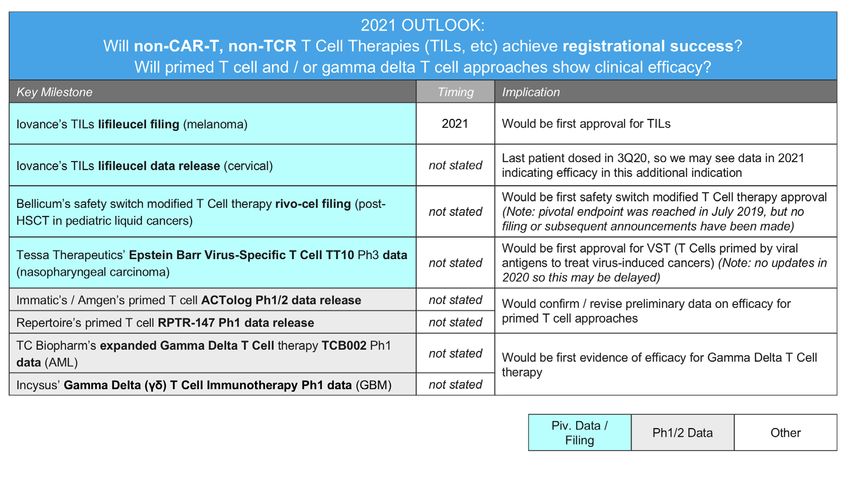
White Paper

   2021 Outlook for Cell-Based Therapies in Oncology: CAR-T Expansion and Beyond

ones. There are also concerns about       would prove functional. They offer both    in melanoma and one or more TCR-T
donor vs host immune reactions,           greater scalability as well as more        therapies in synovial sarcoma, which
e.g., Graft vs Host Disease (GvHD).       precise insertions than the traditional    on the face of it are quite different
Below, we will review emerging data       viral transduction approaches. While       indications (common vs rare, many
that suggests possibly comparable         these approaches are relatively new,       treatments vs few, immunologically
efficacy as well as an encouraging        we do have several in clinic now           “hot” vs “cold”). It remains to be
lack of GvHD. Based on these data,        with early data reported in 2020.          seen what common themes, if any,
it seems quite possible that the          Early evidence suggests that the           connect solid tumor indications where
allogeneic platforms will succeed as      non-viral genetic modifications are        cell therapies achieve both regulatory
both safe (i.e., no GvHD or any worse     comparable to the viral-based ones.        and commercial success.
AE than the autologous ones) as           While it is unlikely they would offer        Overall, despite the impact of
well as effective enough to achieve       any efficacy benefit, their use would      COVID-19 on clinical trials and
registrational success. The open          make manufacturing more precise            R&D, in 2020 we saw numerous
question is whether they will match       and scalable, so if these early findings   developments and hints of future
the efficacy of the autologous; if they   pan out we would expect rapid uptake       promise that address these and
are somewhat less effective but much      across manufacturers.                      other key questions about the future
quicker and cheaper, consumers will          One overarching and still open          of cell therapies, as well as some
have to make trade-off decisions.         question, which involves all forms         unexpected regulatory setbacks.
   Another big question is whether the    of cell therapy, is whether any cell          We anticipate 2021 will be an
enzymatic (non-viral) gene modification   therapy will truly succeed in solid        even richer source of new data and
methods such as endonucleases             tumors. Based on current data and          decisions that will further characterize
like CRISPR or transposon-mediated        announced timelines, we could see          the ultimate potential of cell therapies,
approaches like Sleeping Beauty           near-term approval of TILs (lifileucil)    namely:

   5                                                                                        Blue Matter, Copyright © 2021
White Paper

   2021 Outlook for Cell-Based Therapies in Oncology: CAR-T Expansion and Beyond

CD19 CAR-Ts: Competition heats up between the autologous
players - can allogeneic and next-gen designs displace?

  In the almost three and a half                     granted a priority review for BMS /                             an unfortunate development for
years since the first CAR-T (Novartis’               Celgene’s autologous CD19 CAR-T                                 stockholders as the liso-cel approval
KYMRIAH) was approved, only two                      liso-cel, setting the expectation that                          by the end of 2020 was one of three
other CAR-T therapies have been FDA                  it too would join them in DLBCL                                 milestones required for a payout.
approved (Gilead’s YESCARTA just two                 this year. However, in May the FDA                              Meanwhile, both KYMRIAH and
months later, and their TECARTUS                     announced it was delaying its decision                          YESCARTA are pushing towards new
in 2020). Notably, all three of these                until November 2020, citing COVID-                              labels in NHL. They both announced
products are autologous CD19 CAR-T                   19-related delays in manufacturing                              positive data in FL (iNHL) at ASH, and
with a focus in NHL and B-ALL.                       inspections. Further delays have                                YESCARTA also announced positive
  At the beginning of 2020, the FDA                  pushed the decision into 2021,                                  data in newly-diagnosed DLBCL.

                                                2020 YEAR-IN-REVIEW: AUTOLOGOUS CD19 CAR-T
               Product Name (Manufacturer)   Description                             Current Status & 2020 Updates
               KYMRIAH                                                               • Approved in 2L+ DLBCL, 1L+ B-ALL; numerous ongoing trials
                                             autologous, viral-transduced
               (Novartis)                                                            • ASH data: Ph2 in FL (ORR=83%, CR=65%)
                                                                                     • Approved in 2L+ NHL; numerous ongoing trials
               YESCARTA
                                             autologous, viral-transduced            • ASH data: Ph2 in indolent NHL (ORR=92%, CR=76%); Ph2 in
               (Gilead)
                                                                                       newly-diagnosed DLBCL (ORR=85%, CR=74%)
               TECARTUS                      autologous, viral-transduced, same as   • Approved in 2L+ MCL; Ph2 in ALL ongoing
               (Gilead)                      YESCARTA w/add’l expansion step         • FDA approved (July); positive CHMP decision (Oct)
                                                                                     • Filed for FDA approval in 2l+ DLBCL; numerous ongoing trials
               liso-cel
                                             autologous, viral-transduced            • FDA delayed decision date (was originally expected in 2020),
               (BMS / Celgene)
                                                                                       due to COVID-19-related manufacturing inspection delays
               Nex-T CD19
                                             autologous, optimized manufacturing     • Ph1 in r/r NHL
               (BMS / Celgene)

   At the time of this writing, direct               things will heat up in 2021 if BMS’                             compete in indolent NHL / FL as well.
competition between marketed                         liso-cel does receive FDA approval in                           YESCARTA has received a priority FDA
autologous CD19 CAR-T is restricted                  2L+ DLBCL where it would compete                                review for r/r FL and KYMRIAH has
to 2L+ DLBCL, where both YESCARTA                    with both KYMRIAH and YESCARTA.                                 announced a 1H21 Ph2 readout and
and KYMRIAH are approved. All                        Meanwhile, the KYMRIAH vs                                       possible filing in the same indication.
other approved indications are non-                  YESCARTA competition will move into                             In the meantime, Gilead’s TECARTUS
overlapping (YESCARTA also has a                     earlier lines of therapy. YESCARTA                              (same product as YESCARTA but with
broader NHL label, KYMRIAH has a                     will have a Ph3 readout and possible                            an additional manufacturing step)
B-ALL label, and TECARTUS has an                     filing for 2L DLBCL as well as a Ph2                            is aiming for a 2021 filing in adult-
MCL label).                                          readout for 1L DLBCL. KYMRIAH                                   ALL where it would compete with
   To-date, Gilead’s YESCARTA enjoys                 will have a Ph3 readout and possible                            KYMRIAH.
a lead in earned revenue, however,                   filing for 1L DLBCL. In 2021 they will

   6                                                                                                                          Blue Matter, Copyright © 2021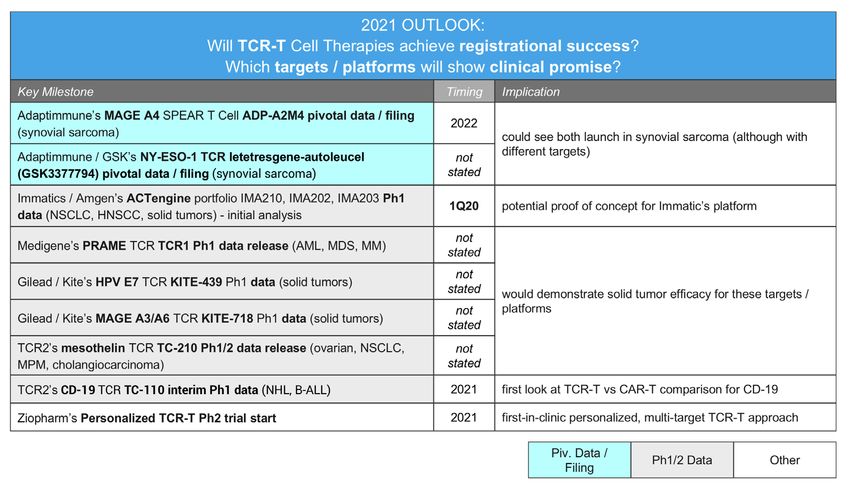
White Paper

   2021 Outlook for Cell-Based Therapies in Oncology: CAR-T Expansion and Beyond

   All four of these products are        more feasible and scalable. In 2020      advancements into clinic as well as
autologous (donor-derived) and           we saw preliminary data that starts to   early but positive readouts for several
modified using viral vectors. One        address both of these key questions      allogeneic CD19 CAR-T, three of which
open question has been whether           affirmatively, which has far-reaching    are also using enzymatic (non-viral)
allogeneic products and non-viral gene   implications beyond just the CD19        gene editing technologies:
modifications methods would prove        CAR-T competitive space.
safe, efficacious, and importantly,        Specifically, in 2020 we saw

   7                                                                                    Blue Matter, Copyright © 2021
White Paper

   2021 Outlook for Cell-Based Therapies in Oncology: CAR-T Expansion and Beyond

                                                        2020 YEAR-IN-REVIEW: ALLOGENEIC CD19 CAR-T
                 Product Name (Manufacturer)        Description                                   Current Status & 2020 Updates
                 ALLO-501 / UCART19                                                               • Ph1 in NHL
                                                    allogeneic, viral-transduced, safety edited
                 (Allogene / Cellectis / Servier)                                                 • ASCO data (n=19, ORR=63%, CR=37%)

                 ALLO-501A                          allogeneic, viral-transduced, rituximab       • Ph1/2 in NHL
                 (Allogene / Cellectis / Servier)   recognition domain deleted                    • Ph1/2 trial initiated (June)
                                                                                                  • Ph1 in B Cell malignancies
                 CTX110                             allogeneic, enzymatic-modified (CRISPR),
                                                                                                  • Data: best dose (n=4, CR=50%); overall (n=11, CR=36%),
                 (CRISPR Therapeutics)              safety, persistence edited
                                                                                                    highest dose patient died of neurotoxicity
                                                                                                  • Ph1 in NHL/B-ALL
                 PBCAR0191                          allogeneic, enzymatic-modified (ARCUS),
                                                                                                  • ASH data (NHL n=16, ORR=69%, CR=55%; B-ALL n=11,
                 (Precision Biosciences)            safety edited
                                                                                                    ORR=36%, CR=36%)
                 FT819                              allogeneic (iSPC-derived), enzymatic-
                                                                                                  • IND (July) for NHL/B-ALL
                 (Fate Therapeutics)                modified (CRISPR), safety edited

  For context, the registrational trials                   syndrome (ICANS), which is a known                                  Fate Therapeutic’s FT819 performs, as
for KYMRIAH and YESCARTA had                               AE with other CAR-T cell therapies,                                 it is the first iPSC-derived therapy to
ORR=50%/CR=32% and ORR=72%/                                there has been no sign of Graft vs                                  enter the clinic. Induced-pluripotent
CR=50%, respectively, with much                            Host Disease (GvHD) due to the donor                                stem cells (iPSC) serve as “master
higher n-values. Taken together,                           T cells.                                                            cell lines” which can be maintained
these initial results for the allogeneic/                    While none of these manufacturers                                 over time to offer a standardized,
enzymatic gene modified CAR-T,                             have announced dates for future                                     scalable foundation for cell therapy
while not clearly superior, are certainly                  data releases, we expect to see                                     manufacturing. If successful, this
promising given their other product                        additional interim, and possibly final,                             approach could streamline and
attributes. And very importantly,                          Ph1 readouts in 2021, as well as                                    standardize the current patient / donor-
while there was a patient death from                       updates on filing timelines based on                                derived manufacturing approaches on
CRISPR’s CTX110 due to immune                              these complete datasets. It will be                                 the market and in the clinic.
effector cell-associated neurotoxicity                     particularly informative to see how

BCMA CAR-Ts: which (class of) therapy will take the prize in
multiple myeloma?

  In 2020 the first BCMA targeted                          However, the FDA unexpectedly                                       delay has already cost them the
therapy in multiple myeloma was                            refused the filing, citing a need for                               payout). In the meantime, competition
approved, GSK’s BCMA-ADC Blenrep                           additional manufacturing information.                               continues to heat up in the BCMA
(belantamab mafodotin-blmf). BMS/                          BMS refiled in July and received                                    space - not just within CAR-T including
Celgene’s BCMA CAR-T ide-cel                               a March 2021 PDUFA date, which                                      the very impressive data from J&J’s
was supposed to be hot on their                            would have been just in time for their                              cilta-cel, but also the bispecific T cell
heels, filing for FDA approval in May.                     milestone payout (however, liso-cel’s                               engagers (TCE).

   8                                                                                                                                  Blue Matter, Copyright © 2021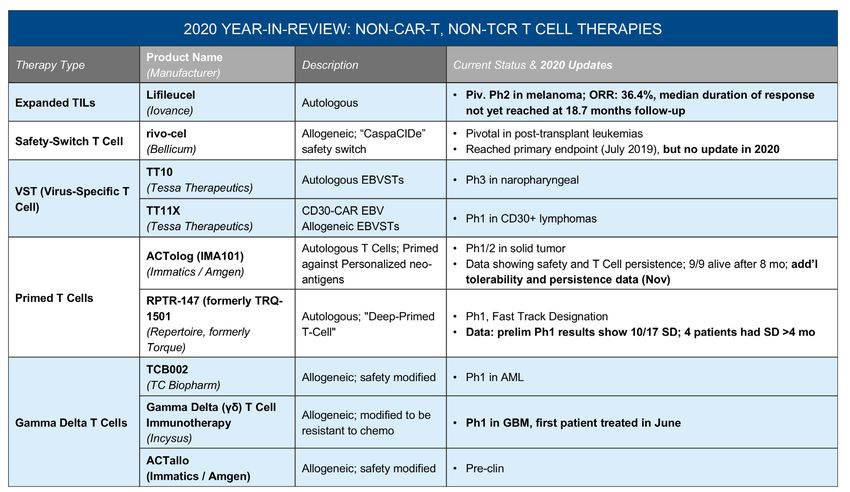
White Paper

   2021 Outlook for Cell-Based Therapies in Oncology: CAR-T Expansion and Beyond

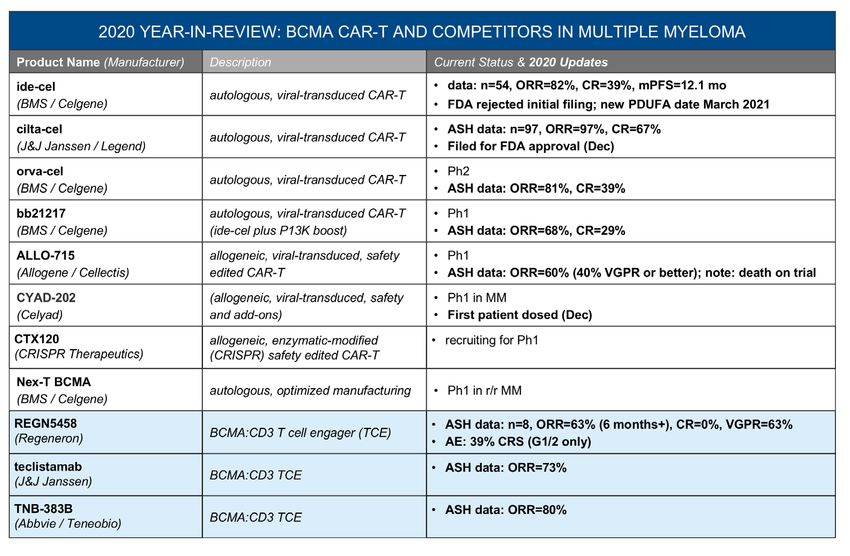
  In December 2020, there were             data showing ORR=31%, 73% with             Orva-cel is one to watch with an
numerous data releases at ASH              DOR >6 months, n=97, so the CAR-T          impressive 81% ORR and 39% CR.
which informed several outstanding         and TCE both look quite competitive        Regarding allogeneic contenders, only
questions:                                 in terms of efficacy. Although some        Allogene / Cellectis’ ALLO-715 has
• Which autologous CAR-T will take         datasets are still early or small, there   announced data, with a more modest
   the market lead (once they are          seems to be a general consensus            ORR of 60%.
   approved)? Cilta-cel may launch         that the autologous CAR-T have the           BCMA CAR-T are not only
   not far behind ide-cel, with a very     efficacy edge overall. In particular,      competing with each other and the
   impressive ORR and CR                   J&J / Legend’s “dark horse”                approved Blenrep, however. We
• Can allogeneic compete? Unclear          contender cilta-cel impressed with a       saw several promising datasets
   - the only allogeneic data we have      nearly 100% response rate and 67%          from the TCEs as well, with ORR
   to-date is ALLO-715’s relatively        CR. They filed for FDA approval in         up to 80%. That said, these data
   modest 60% ORR                          December, so in 2021 we may see            are more preliminary with CR either
• Will bispecific / T cell engagers        ide-cel and cilta-cel go head-to-head      not announced, or in the case of
   (TCE) offer a competitive efficacy      in the market. While cilta-cel seems       Regeneron’s REGN5458, none
   / safety profile? Possibly, but while   to have superior efficacy, it also has     achieved (63% VGPR but no CR).
   the ORR is competitive, we have         greater neurotoxicity, so ide-cel may        In 2021 the major BCMA news will
   not seen CR yet, and TCE do have        be able to carve out a niche based on      be the regulatory decisions for ide-cel
   their own serious AEs                   tolerability. The BCMA CAR-T space         and cilta-cel, but we also anticipate
                                           also has emerging data for “next gen”      maturing datasets in allogeneic CAR-T
  For context, GSK’s BCMA-ADC              autologous BCMA CAR-T, namely              and TCE that will clarify how the
Blenrep was FDA approved based on          BMS / Celgene’s orva-cel and bb21217.      overall BCMA market will play out.

   9                                                                                        Blue Matter, Copyright © 2021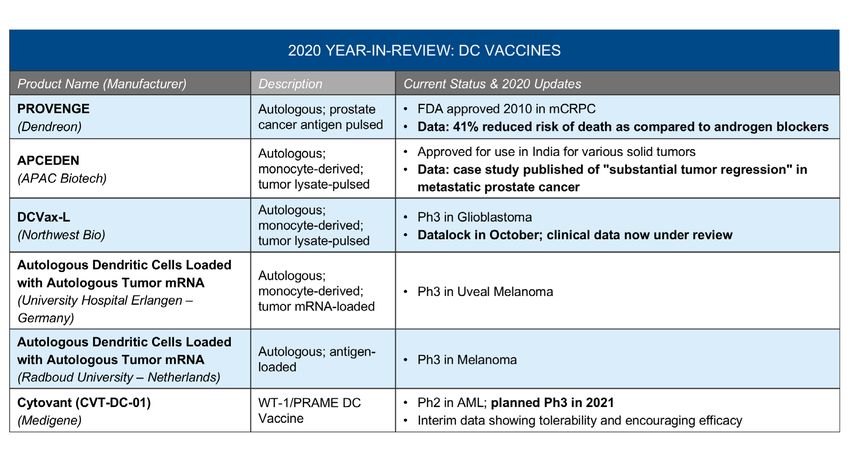
White Paper

   2021 Outlook for Cell-Based Therapies in Oncology: CAR-T Expansion and Beyond

What’s Next for CAR-T Cell Therapies: other targets, technology
advances, solid tumors?

  In recent years we have seen many                     questions about longer-term evolution                           • What other targets will succeed in
significant advances in the CD19 and                    of T cell therapies, namely:                                      liquid tumors? Will any succeed
BCMA CAR-T spaces, but we also                          • How will allogeneic product                                     in solid? See: PRG-3006, CYAD-02,
expect additional targets, indications,                    attributes compare to                                          and Cellectis platform for liquid; all
and designs to reach registrational                        autologous? See: Celyad, Cellectis,                            others in solid
milestones in 2021-22.                                     Precision Biosciences platform                               • Will safety / activation switches
  For these earlier stage products,                     • How will non-viral-transduced                                   or other modifications boost
based on their current status, in 2021                     products compare to viral-                                     outcomes? See: BPX-603 and
we expect preliminary / Ph1 data                           transduced? See: Precigen,                                     Precigen platform
releases that will inform several key                      Precision Biosciences platform

                                            2020 YEAR-IN-REVIEW: CAR-T CELL THERAPY EVOLUTION
         Product Name (Manufacturer)   Target / Description                        Current Status & 2020 Updates

         BPX-601                       PSCA CAR-T                                  • Ph1/2 in PSCA-expressing Pancreatic, Gastric, Prostate
         (Bellicum)                    (autologous, activation switch “GoCAR-T”)   • Trial on hold after patient death

                                       HER2 CAR-T
         BPX-603                                                                   • Ph1 in HER2-expressing solid tumors
                                       (autologous, dual safety / activation
         (Bellicum)                                                                • IND (June); First patient enrolled (Dec)
                                       switches “Dual Switch GoCAR-T”)
                                       MUC16 CAR-T
         PRGN-3005                                                                 • Ph1 in Ov, Fallopian, Peritoneal
                                       (UltraCAR-T: autologous, Sleeping
         (Precigen)                                                                • First patient dosed (Nov)
                                       Beauty, efficacy + safety switch)
                                       CD33 CAR-T
         PRGN-3006                                                                 • Ph1 in AML
                                       (UltraCAR-T: autologous, Sleeping
         (Precigen)                                                                • First patient dosed (Nov)
                                       Beauty, efficacy + safety switch)
                                                                                   • Ph1 in solid tumors (Colorectal), liquid tumors (AML/MDS)
         CYAD-01                       NKG2D CAR-T
                                                                                   • Prelim results show disease control in mCRC
         (Celyad)                      (autologous)
                                                                                   • Discontinued due to “clinical futility”

         CYAD-02                       NKG2D CAR-T                                 • Ph1 in AML/MDS                    (Chart Continues          on next page)
         (Celyad)                      (autologous, “next gen” design)             • First patient dosed (Jan); 1 patient achieved CR

         CYAD-101                      NKG2D CAR-T                                 • Ph1 in mCRC
         (Celyad)                      (allogeneic)                                • combo study with Keytruda initiated (Sept)
   10                                                                                                                             Blue Matter, Copyright © 2021
         UCARTCS1A                     CS1/SLAMF7 CAR-T                            • Ph1 in MM
HER2 CAR-T
BPX-603 • Ph1 in HER2-expressing solid tumors
(autologous, dual safety / activation
(Bellicum)
switches “Dual Switch GoCAR-T”)
• IND (June); First patient enrolled (Dec) White Paper
MUC16 CAR-T
PRGN-3005 • Ph1 in Ov, Fallopian, Peritoneal
(UltraCAR-T: autologous, Sleeping
2021(Precigen)
Outlook for Cell-Based Therapies in Oncology: CAR-T Expansion and Beyond
• First patient dosed (Nov)
Beauty, efficacy + safety switch)
CD33 CAR-T
PRGN-3006 • Ph1 in AML
(UltraCAR-T: autologous, Sleeping
(Precigen) • First patient dosed (Nov)
Beauty, efficacy + safety switch)
• Ph1 in solid tumors (Colorectal), liquid tumors (AML/MDS)
CYAD-01 NKG2D CAR-T
(Continued from previous page) • Prelim results show disease control in mCRC
(Celyad) (autologous)
• Discontinued due to “clinical futility”
CYAD-02 NKG2D CAR-T • Ph1 in AML/MDS
(Celyad) (autologous, “next gen” design) • First patient dosed (Jan); 1 patient achieved CR
CYAD-101 NKG2D CAR-T • Ph1 in mCRC
(Celyad) (allogeneic) • combo study with Keytruda initiated (Sept)
UCARTCS1A CS1/SLAMF7 CAR-T • Ph1 in MM
(Cellectis) (allogeneic, safety edited) • FDA hold after patient death (July); trial resumed (Nov)
UCART22 CD22 CAR-T • Ph1 in B-ALL
(Cellectis) (allogeneic, safety edited) • ASH data: n=5, 2 CR, no DLT
UCART123 CD123 CAR-T • Ph1 in AML
(Cellectis) (allogeneic, safety edited) • Was on FDA hold after trial fatality, resumed dosing (Jan)
PBCAR20A CD20 CAR-T • Ph1 in NHL, CLL, SLL
(Precision Biosciences) (allogeneic, safety edited) • First patient dosed (Apr)
Non-CAR-T Cell Therapy (TCR-T, TILs, etc) - will we
see approval(s) in 2021-22?
It has been a major question TCR-T T cell therapies, which includes ORR=44% with a DCR of 94%. These
whether and when any of the purified and reinfused tumor-infiltrating are promising data for this difficult
non-CAR-T cell therapies would T cells (TILs) as well as safety-edited to treat cancer, and Adaptimmune
successfully file and launch. Here or otherwise boosted T cells that has announced they will be filing
we consider two major categories of do not have their T cell receptors with an estimated commercial launch
non-CAR-T: the first is TCR-T, where modified. Both of these categories are in 2022. GSK is likely on a similar
the endogenous T cell receptor (TCR) designed to work in solid tumors as timeline, although they have not
is swapped out for an engineered well as liquid, although efficacy has made a specific announcement. No
TCR that will detect a tumor-specific been challenging to achieve. other TCR-T is in pivotal trial nor has
antigen. The key distinction is that In 2020 there were relatively few announced timelines for filing or
CAR-T can only detect tumor-specific data updates for TCR-T, with the key launch, however we expect in 2021
antigens that are naturally expressed exception of two TCR-T approaching that additional Ph1 datasets will read
on the cell surface, whereas TCR-T registrational milestones, both in out and clarify which targets and
can detect a tumor-specific antigen synovial sarcoma. These were platforms are most efficacious. As
that is expressed anywhere within GSK / Adaptimmune’s letetresgene- in CAR-T, we expect to see data on
the cell, as long as it is appropriately autoleucel, which targets NY-ESO-1 a variety of genetic modifications
processed by the MHC cellular and delivered an ORR=20-50%, and and methods to deliver them (viral
machinery. The second category of Adaptimmune’s ADP-A2M4, which vs non-viral), as well as various pre-
non-CAR-T is the non-CAR-T, non- targets MAGE A4 and delivered an conditioning and boosting protocols.
11 Blue Matter, Copyright © 2021White Paper 2021 Outlook for Cell-Based Therapies in Oncology: CAR-T Expansion and Beyond 12 Blue Matter, Copyright © 2021
White Paper

   2021 Outlook for Cell-Based Therapies in Oncology: CAR-T Expansion and Beyond

  In 2020 we also saw some notable          data for primed T cell approaches          delta T cells are a subset of T cells
data and registrational progress for        (Immatics / Amgen’s ACTolog and            that do not require MHC presentation.
non-TCR, non-CAR T cell therapies,          Repertoire’s TRQ-1501), where T cells      So, they could theoretically overcome
in particular TILs. Iovance announced       are extracted from the patient and         this known form of tumor resistance
positive pivotal trial data for their TIL   then primed against cancer neo-            without triggering Graft vs Host
therapy lifileucil (LN-145) in heavily-     antigens before being re-infused.          Disease, which has been a concern
pretreated metastatic melanoma              There is some preliminary evidence of      with other allogeneic approaches.
(n=65, DCR=80%, ORR=36%). They              disease control as well as persistence     Therefore, they have good potential
plan to file in 2021 and could therefore    of these T cells over time. And finally,   as a safe and efficacious T cell-based
be the first non-CAR T cell therapy to      in 2020 we saw additional gamma            approach.
market. Also in 2020, we saw initial        delta T cells enter the clinic. Gamma

    In 2021, we expect to see major         tumors and / or Tessa Therapeutic’s        Amgen’s ACTolog and Repertoire’s
registrational and clinical updates.        TT10 in nasopharyngeal carcinoma.          RPTR-147) as well as allogeneic
Namely, we could see Iovance’s              Additionally, we may see additional        gamma delta T cells (TC Biopharm’s
lifileucel filing in melanoma, and          Ph1 data that clarifies the potential of   TCB002 and Incysus’ in GBM).
perhaps filings (or at least updates) for   other T cells approaches like primed
Bellicum’s rivo-cel in pediatric liquid     endogenous T cells (Immatic’s /

   13                                                                                        Blue Matter, Copyright © 2021
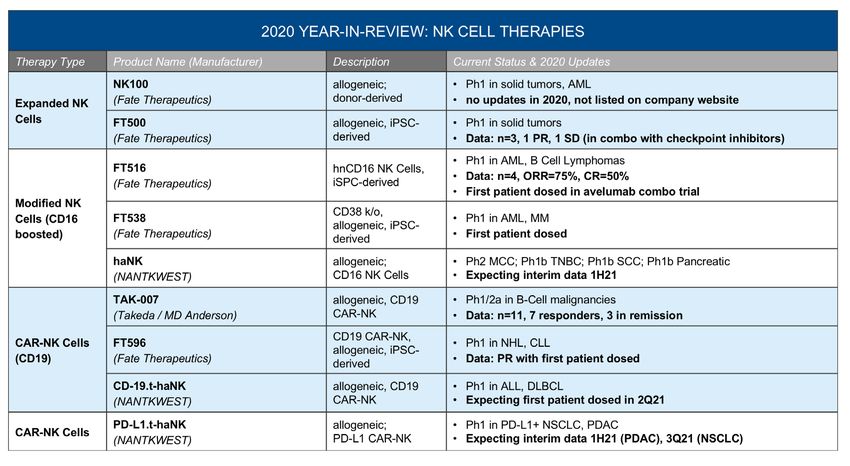
White Paper 2021 Outlook for Cell-Based Therapies in Oncology: CAR-T Expansion and Beyond Other Cell Therapies: (When) will NK Cells and new DC Vaccines succeed in clinic? NK cells, which are the cytotoxic with further progress into the clinic For DC vaccines, in 2020 there were effector cells of the innate immune which should deliver clarifying data in no major updates on clinical-stage system (as opposed to the adaptive 2021-22. programs. However, Dendreon’s immune system, which is where In 2021, we expect to see further PROVENGE delivered a new dataset T cells operate), have long been data which characterizes the efficacy showing a survival benefit over considered as a promising foundation and safety of the different NK cell standard of care androgen blockers, for cell therapy because they can iterations, including CAR-NK for CD19 and APCEDEN (not approved in the potentially recognize tumor-specific that can give us a sense of how these US) published a case study showing antigens with less risk of immune therapies will compare to CAR-T. a regression. In 2021, we will keep “overreaction”. Similar to T cells, DC “vaccines” are a cell therapy an eye out for Northwest Bio’s Ph3 there are unmodified, boosted / based on Dendritic Cells, which data release for their DCVax-L in activated, and CAR-NK iterations process tumor-specific antigens and glioblastoma, which had reported under development. In 2020 we saw activate the adaptive immune system promising earlier data on efficacy. some very preliminary data, along (T cells) to recognize and attack them. 14 Blue Matter, Copyright © 2021
White Paper

Cell-Based Therapies: 2019 Year in Review and Upcoming Milestones

15                                                          Blue Matter, Copyright © 2021
White Paper

   2021 Outlook for Cell-Based Therapies in Oncology: CAR-T Expansion and Beyond

Summary and Conclusions: Looking Ahead to a Competitive 2021

   In addition to the specific regulatory   to offer the first new treatment            In conclusion, while we did see
milestones and data releases                advances in a long time, for example     delays and set-backs in 2020 from
discussed above, in 2021 we will            in synovial sarcoma where two            COVID-19, namely clinical trial delays
also start to see cell-based therapies      different TCR-T are reaching pivotal     and manufacturing issues (which in
position themselves within various          stage, and in glioblastoma where a       turn led to regulatory delays), overall
competitive markets. While CD19             DC vaccine is now undergoing data        the field has made much progress.
CAR-T competition will largely be           analysis for a completed Ph3. For both   It has set the stage for an eventful
in-class (between established and           cancers, the current standard of care    2021-22 where we expect to see
entering CD19 CAR-T), the BCMA              is surgery plus chemoradiation (with     multiple approvals in new targets
competitive space will be active, not       poor outcomes), so there is huge         with the BCMA CAR-T(s) and possibly
just with out-of-class BCMA therapies       unmet need which cell therapies can      non-CAR-T therapies as well. In
like BCMA-ADC and BCMA:CD3                  hopefully address.                       addition, we expect to see data from
TCEs, but in the context of numerous           In terms of longer-term out-of-       the numerous Ph1 trials which are
other multiple myeloma therapies            class competition beyond the T           continuing to enroll, which will answer
like the CD38 antibodies and other          Cell Engagers as discussed above,        questions not just about targets and
immunomodulating agents. Similarly,         the success of the mRNA vaccine          indications, but about the attributes of
for TILs and TCR-Ts trying to break         approaches in COVID hints at possible    allogeneic cell sources, NK cell-based
through in melanoma, they must not          success in cancer as well (where         therapies, and various modifications
only demonstrate sufficient efficacy        they are being actively developed).      and modification methods (e.g.,
/ safety for regulatory approval, they      However, the early data is mixed at      CRISPR-based). And finally, taken
must also carve out a niche amongst         best, with Moderna’s mRNA cancer         together these data releases and
numerous established treatments, some       vaccine mRNA-4157 delivering a ORR       regulatory advancements will further
of which are already quite effective.       of 50% (n=10) in HNSCC, and Roche        clarify the ultimate potential for cell
   Conversely, there are indications        / BioNTech’s RO7198457 delivering a      therapies within the oncology market,
where cell therapies have the potential     very low ORR of 8% in their Ph1 trial.   including out-of-class competition.

   16                                                                                      Blue Matter, Copyright © 2021
White Paper

    New Ideas. Better Results.
    Blue Matter is a consulting firm serving the life sciences industry.
    We strive to bring a new approach to consulting with original ideas
    that deliver a meaningful impact.

    This paper authored by Jeron Eaves and Pankaj Oza.

San Francisco                    London                            Berlin
sf@bluematterconsulting.com      london@bluematterconsulting.com   berlin@bluematterconsulting.com
400 Oyster Point Blvd.           6th Floor                         Potsdamer Platz -
Suite 309                        75 Farringdon Road                Kemperplatz 1
South San Francisco, CA 94080    London EC1M 3JY                   Berlin Mitte, 10785
650-754-6817                     UK                                Germany

New York                         Zurich
ny@bluematterconsulting.com      zurich@bluematterconsulting.com
575 Lexington Avenue             Walchestrasse 9
Suite 24A                        8006 Zurich
New York, NY 10022               Switzerland                       www.bluematterconsulting.com

   17                                                                     Blue Matter, Copyright © 2021
You can also read


