A Primer on the Proliferation of Offensive Cyber Capabilities
←
→
Page content transcription
If your browser does not render page correctly, please read the page content below
#ACcyber

    ISSUE BRIEF                          A Primer on the
                                         Proliferation of
                                         Offensive Cyber
                                         Capabilities
                                             MARCH 2021              WINNONA DESOMBRE, MICHELE
                                                                     CAMPOBASSO, LUCA ALLODI,
                                                                     JAMES SHIRES, JD WORK, ROBERT
                                                                     MORGUS, PATRICK HOWELL O’NEILL,
                                                                     AND TREY HERR
THE SCOWCROFT CENTER FOR
STRATEGY AND SECURITY works
to develop sustainable, nonpartisan
strategies to address the most
important security challenges facing
                                         EXECUTIVE SUMMARY

                                         O
the United States and the world.
The Center honors General Brent                  ffensive cyber capabilities run the gamut from sophisticated, long-term
Scowcroft’s legacy of service and                disruptions of physical infrastructure to malware used to target human rights
embodies his ethos of nonpartisan                journalists. As these capabilities continue to proliferate with increasing
commitment to the cause of security,
                                         complexity and to new types of actors, the imperative to slow and counter their
support for US leadership in
cooperation with allies and partners,    spread only strengthens. But to confront this growing menace, practitioners and
and dedication to the mentorship of      policy makers must understand the processes and incentives behind it. The
the next generation of leaders.          issue of cyber capability proliferation has often been presented as attempted
THE CYBER STATECRAFT INITIATIVE          export controls on intrusion software, creating a singular emphasis on malware
works at the nexus of geopolitics and    components. This primer reframes the narrative of cyber capability proliferation
cybersecurity to craft strategies to     to be more in line with the life cycle of cyber operations as a whole, presenting
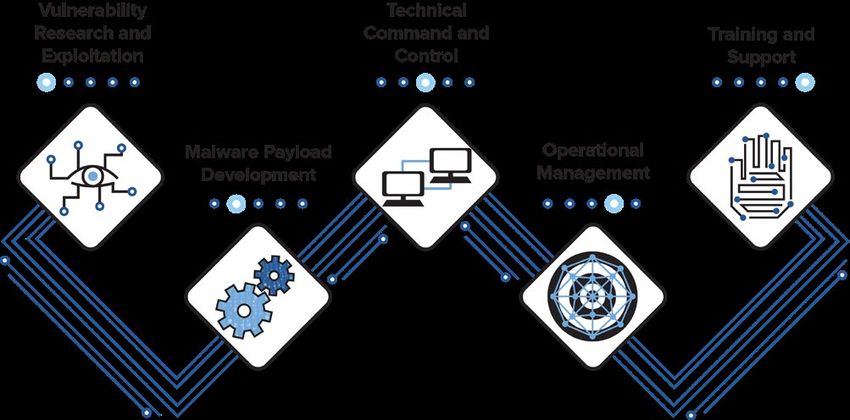
help shape the conduct of statecraft     five pillars of offensive cyber capability: vulnerability research and exploit
and to better inform and secure users
                                         development, malware payload generation, technical command and control,
of technology. This work extends
through the competition of state and     operational management, and training and support. The primer describes how
non-state actors, the security of the    governments, criminal groups, industry, and Access-as-a-Service (AaaS) providers
internet and computing systems, the      work within either self-regulated or semi-regulated markets to proliferate offensive
safety of operational technology and     cyber capabilities and suggests that the five pillars give policy makers a more
physical systems, and the communities
                                         granular framework within which to craft technically feasible counterproliferation
of cyberspace. The Initiative convenes
a diverse network of passionate and      policies without harming valuable elements of the cybersecurity industry. These
knowledgeable contributors, bridging     recommended policies are developed in more detail, alongside three case studies
the gap among technical, policy, and     of AaaS firms, in our companion report, Countering Cyber Proliferation: Zeroing in
user communities                         on Access as a Service.
#ACcyber A PRIMER ON THE PROLIFERATION OF OFFENSIVE CYBER CAPABILITIES
INTRODUCTION cyber capabilities, the difficulties in the attribution process
T
of attacks caused by an invisible militia, and the lack of
he proliferation of offensive cyber capabilities (OCC) mature counterproliferation regimes bring the problem to a
has often been compared with nuclear proliferation and geopolitical scale.
stockpiling. Nuclear and cyber are two very different
threats, especially in their regulatory maturities, but in both Creating a counterproliferation regime in cyberspace has
of them a multitude of bilateral and multilateral treaties have confounded policy makers for over a decade. As the number
been created and then sidestepped, acceded to, expanded, of state-sponsored cyber actors continues to rise alongside
and abandoned like steps in a dance. Regulatory and policy the severity of cyber attacks, the issue has become even
aspects in the OCC domain are particularly difficult due to more pressing.
the elusive nature of cyber capabilities, and the difficulty
of measuring them, especially in the absence of a clear The renewed vigor with which the European Union (EU) has
framework that defines and maps them to the broader picture seized upon this topic and the arrival of new occupants in
of international equilibria. Offensive cyber capabilities the locus of political authority in the United States present
are not currently cataclysmic, but are instead quietly and an opportunity to provide the debate with a more complete
persistently pernicious. The barrier to entry in this domain context and to more precisely frame the interests of the
is much more of a gradual rise than a steep cliff, and this players involved. This effort sits within the body of work that
slope is expected to only flatten increasingly over time.1 As frames the construction, sale, and use of OCC as a question
states and non-state actors gain access to more and better of proliferation.3 Policy efforts should seek to reduce the utility
offensive cyber capabilities, and the in-domain incentives to of these capabilities and influence the incentives of the parties
use them,2 the instability of cyberspace grows. Furthermore, involved in the process of proliferation, rather than seeking
kinetic effects resulting from the employment of offensive vainly to block proliferation entirely.4
1 Adam Segal, “The Code Not Taken: China, the United States, and the Future of Cyber Espionage,” Bulletin of the Atomic Scientists 69, no. 5 (November 27,
2015), https://www.tandfonline.com/doi/abs/10.1177/0096340213501344.
2 Michael P. Fischerkeller and Richard J. Harknett, “Cyber Persistence, Intelligence Contests, and Strategic Competition,” In Policy Roundtable: Cyber Conflict
as an Intelligence Contest, eds. Robert Chesney and Max Smeets, (Texas National Security Review, September 17, 2020), https://tnsr.org/roundtable/policy-
roundtable-cyber-conflict-as-an-intelligence-contest/.
3 Trey Herr, “Malware Counter-Proliferation and the Wassenaar Arrangement,” Proceedings of the 8th International Conference on Cyber Conflict, 2016, https://
dx.doi.org/10.2139/ssrn.2711070.
4 Trey Herr, “Countering the Proliferation of Malware: Targeting the Vulnerability Lifecycle,” The Cyber Security Project, Harvard Kennedy School, Belfer Center
for Science and International Affairs, June 2017, https://digital.hbs.edu/wp-content/uploads/2017/09/CounteringProliferationofMalware.pdf; Robert Morgus, Max
Smeets, and Trey Herr, “Countering the Proliferation of Offensive Cyber Techniques,” GCSC Briefings from the Research Advisory Group, 2017, http://maxsmeets.
com/wp-content/uploads/2018/09/GCSC-Briefings-from-the-Research-Advisory-Group_New-Delhi-2017-161-187.pdf, 161-187.
2 ATLANTIC COUNCIL#ACcyber A PRIMER ON THE PROLIFERATION OF OFFENSIVE CYBER CAPABILITIES
OFFENSIVE CYBER CAPABILITIES: the specific hardware in Iran’s Natanz nuclear site, but the
SEEING THE WHOLE CHAIN malware itself also used five 0day-exploits,9 was regularly
T
updated by malware developers, and likely required
he failure of OCC counterproliferation stems from a poor heavy collaboration between Israeli and US intelligence
understanding of how cyber capabilities are created counterparts to deploy. The malware delivery mechanism,
and spread. The majority of contemporary policy efforts, testing processes, and deployment of the Stuxnet malware
including the Wassenaar Arrangement, are meager transplants through Operation Olympic Games were the culmination
of Cold War–era nonproliferation strategies into cyberspace. of multiple offensive cyber capabilities much broader than
These efforts, while part of an existing toolkit to counter just command and control. To accurately frame OCC, it is
proliferation efforts, frame OCC as tools and work to block their therefore crucial to be able to distinguish and separate
sale through export control rules; there are myriad critiques of different offensive capabilities—to understand OCC as a
this approach.5 The Wassenaar Arrangement accounted for chain of commodities, skills, and activities, moving away from
some of this, controlling not the malware itself (which it has a singular emphasis on malware components and toward the
dubbed “intrusion software”) but software that was designed life cycle of a cyber operation.
for command-and-control finalities.
In this document, we introduce five pillars of offensive cyber
However, offensive cyber capabilities consist of more capability as a means to characterize the technical and
than just malware and its command and control. Stuxnet operational foundations of OCC. The five pillars are vulnerability
was malware attributed to Israel and the United States,6 a research and exploit development, malware payload
worm that did not rely on command-and-control networks.7 development, technical command and control, operational
The malware was designed to target specialized hardware management, and training and support. Table 1 provides an
(SCADA systems) adopted to control machinery and overview of these pillars.
industrial processes, including centrifuges for obtaining
nuclear material, and to destroy them by causing controlled The next sections develop a more detailed picture of the
malfunctions, ultimately slowing down the Iranian nuclear markets in which these transactions take place and describe
program.8 Not only was the malware incredibly tailored to the five pillars of this chain of OCC.
5 Gozde Berkil, “Cybersecurity and Export Controls,” The Fletcher School, Center for Law and International Governance, December 10, 2018, https://sites.tufts.
edu/cilg/2018/12/10/cybersecurity-and-export-controls/; Dorothy Denning, “Reflections on Cyberweapons Controls,” Computer Security Journal 16, no. 4 (2000):
43-53, https://faculty.nps.edu/dedennin/publications/Reflections_on_Cyberweapons_Controls.pdf; “Export Controls,” Electronic Frontier Foundation, accessed
January 19, 2021, https://www.eff.org/issues/export-controls; Sergey Bratus, DJ Capelis, Michael Locasto, and Anna Shubina, “Why Wassenaar Arrangement’s
Definitions of Intrusion Software and Controlled Items Put Security Research and Defense at Risk—and How to Fix It,” Dartmouth College, October 9, 2014,
https://www.cs.dartmouth.edu/~sergey/wassenaar/wassenaar-public-comment.pdf; Sergey Bratus, “The Wassenaar Arrangement’s Intent Fallacy,” Bureau
of Industry and Security, US Department of Commerce, December 8, 2015, https://tac.bis.doc.gov/index.php/documents/pdfs/320-wa-intent-fallacy-bratus-
comments/file; Thomas Dullien, Vincenzo Iozzo, and Mara Tam, “Surveillance, Software, Security, and Export Controls: Reflections and Recommendations for
the Wassenaar Arrangement Licensing and Enforcement Officers Meeting,” Bureau of Industry and Security, US Department of Commerce, February 10, 2015,
https://tac.bis.doc.gov/index.php/documents/pdfs/299-surveillance-software-security-and-export-controls-mara-tam/file; Mailyn Fidler, “Proposed U.S. Export
Controls: Implications for Zero-Day Vulnerabilities and Exploits,” Lawfare, June 10, 2015, https://www.lawfareblog.com/proposed-us-export-controls-implications-
zero-day-vulnerabilities-and-exploits.
6 David Kushner, “The Real Story of Stuxnet: How Kaspersky Lab Tracked Down the Malware that Stymied Iran’s Nuclear-Fuel Enrichment Program, IEEE
Spectrum, February 26, 2013, https://spectrum.ieee.org/telecom/security/the-real-story-of-stuxnet; Nate Anderson, “Confirmed: US and Israel Created Stuxnet,
Lost Control of It,”
https://arstechnica.com/tech-policy/2012/06/confirmed-us-israel-created-stuxnet-lost-control-of-it/; “What Is Stuxnet?” McAfee, accessed January 28, 2021,
https://www.mcafee.com/enterprise/it-it/security-awareness/ransomware/what-is-stuxnet.html.
7 Kushner, “The Real Story of Stuxnet.”
8 Ralph Langner, “To Kill a Centrifuge: A Technical Analysis of What Stuxnet’s Creators Tried to Achieve,” The Langner Group, November 2013, https://www.
langner.com/wp-content/uploads/2017/03/to-kill-a-centrifuge.pdf.
9 A zero day (or 0day) is a vulnerability that is currently unknown to the software vendor and the organization whose system the vulnerability affects, and for
which a patch does not exist.
3 ATLANTIC COUNCIL#ACcyber A PRIMER
TABLE ON THE
1. THE FIVEPROLIFERATION OF OFFENSIVE
PILLARS OF OFFENSIVE CYBER
CYBER CAPABILITIES
CAPABILITY PROLIFERATION
Government Criminal industry
Definition examples examples examples AaaS examples
VULNERABILITY Discovered Chinese intelligence Exploit kits sold on Bug bounty NSO Group’s use of a
RESEARCH vulnerabilities, or community vulnerability underground forums programs, WhatsApp 0day
AND EXPLOIT disclosure programs research and vulnerability
DEVELOPMENT that facilitate the exploitation, specifically disclosures,
proliferation of within the MSS and its Zerodium
discovered vulnerabilities associated CNNVD
and written exploits
MALWARE Any malware or tool Custom malware Commercial malware Red-team tools NSO Group’s
PAYLOAD written or used by developed by state market developed and sold Pegasus spyware
DEVELOPMENT attackers to conduct teams that is reverse through commercial
offensive cyber engineered and offerings and
operations, or any published by malware companies; posting
forum that encourages analysts malware for research
or conducts exchange on GitHub
of malware
TECHNICAL Technologies aimed at IPs and domains Bulletproof hosting Test servers built Infrastructure used
COMMAND AND supporting offensive attributed to state and other pre-bullet to send phishing by Appin Security for
CONTROL cyber operations, operations by threat command-and- tests against one’s Operation Hangover
e.g., bulletproof intelligence reports control infrastructure own companies,
hosting, domain name infrastructure used
registration, server side for penetration
command-and-control testing services
software, VPN services,
or delivery accounts
involved with the initial
creation of an offensive
cyber operation
OPERATIONAL Operations Chain of command Criminal outsourcing, Delegation of duties Good Harbor
MANAGEMENT management, within and organization ransomware affiliate within a red-team Consulting’s
strategic organization of government programs exercise; escalation organizational
of resources and intelligence agencies policies during an management of
teams, initial targeting incident UAE DREAD cyber
decisions, and other capabilities
functions that are
required to effectively
manage an organization
that conducts cyber
operations
TRAINING AND Training or education NSA’s National Fraud tutorials, Kali Linux tutorials DarkMatter training
SUPPORT provided on the Cryptologic School phishing kits, on YouTube, provided to UAE
offensive cyber or other government- customer support cyber security cyber operators
operation process, sponsored cyber provided within certifications,
expanding the number training program forums conference trainings
of trained professionals and talks
and creating
connections between
them that facilitate the
growth of OCC
Note: Abbreviations: MSS: China’s Ministry of State Security; CNNVD: China’s National Vulnerability Database; AaaS: Access-as-a-Service; VPN: virtual private
network; IP: Internet Protocol; OCC: offensive cyber capabilities; UAE: United Arab Emirates; DREAD: the UAE’s Development Research Exploitation and Analysis
Department; NSA: US National Security Agency.
4 ATLANTIC COUNCIL#ACcyber A PRIMER ON THE PROLIFERATION OF OFFENSIVE CYBER CAPABILITIES
SEMI- AND SELF-REGULATED MARKETS FOR country of origin and nature of attack, can consist of individuals
OCC PROLIFERATION spanning multiple categories (e.g., government and contracting
P
businesses, government and criminal, business and criminal).
roviders and developers of OCC can be roughly separated
into self-regulated and semi-regulated spaces. Both spaces In the self-regulated criminal space, heterogeneous
provide access to technology such as malware, supporting underground markets proliferate, ranging from free markets
infrastructures, and vulnerabilities, but differ in their maturities, that can be easily and freely accessed by any (wannabe)
capacities to innovate, and quality of offerings. Self-regulated attackers, pull-in markets that enable some mechanisms of
spaces operate autonomously, typically through underground access regulation via invite from trusted members of the
internet markets that govern transactions and rules to enforce market, to segregated marketplaces frequented by highly
contracts. Among the most well-known, 0day.today operates in skilled cybercriminals.11,12 This progression reflects not only
the clearweb and is branded as a marketplace specialized in more controlled environments, but also access to more
vulnerability exploits and 0days (albeit of dubious quality), while mature and innovative attack capabilities (e.g., in the form
exploit.in and dark0de operate(d) in the underground as well- of new vulnerabilities, malware, or command-and-control
regulated forums offering their members a trusted environment infrastructure).13
to facilitate trade of different products. By contrast, operators
in semi-regulated spaces typically act in the open, under the Similarly, operators in the semi-regulated space also vary in
jurisdiction of the state where they operate; among them, the terms of offensive capabilities: from governmental agencies
notorious Israeli firm NSO Group states on its website that it with ample and mature cyber capabilities, able to develop their
provides “authorized governments with technology that helps own attacks and capable of autonomously conducting offensive
them combat terror and crime.”10 Both spaces contain actors cyber operations at all levels, to private companies offering
of varying capabilities, communities, and resources to develop legitimate versions of cyber tools with the same capabilities as
and conduct their own operations. For example, 0day.today those that may be misused by criminals. Among these, AaaS
provides a loosely regulated environment with little assurance organizations also operate in the semi-regulated space, but are
that the exploits therein are effective and undetectable; by different from all other forms of proliferation in that they offer
contrast, more strongly (self-) regulated markets like exploit.in, fully fledged offensive services commercially accessible only
operating in the mainly Russian underground space, provide by accredited actors (e.g., governmental agencies with plentiful
stronger regulation mechanisms aimed at pushing upward the resources but little or insufficient internal know-how). These
average quality of traded products. Services also vary widely actors offer and develop advanced offensive capabilities to
in offered capabilities. These range from supplying individual governments due to the prices or funding they are able to
components to independently developing and conducting receive for providing such services, and their frequent ability
whole offensive cyber operations. The accompanying report, to simultaneously conduct research and development, train
Countering Cyber Proliferation, provides a breakdown over personnel, and scale businesses.
three case studies of AaaS players of varying capabilities
across the proposed five pillars. AaaS groups are known to provide support to governments that
need established capabilities, but are incapable of producing
Actors present within self- and semi-regulated spaces can them organically. NSO Group is one of the most prominent
further be divided into government, criminal, and private such vendors, providing services to operations in forty-five
actors enabling Access-as-a-Service (AaaS)—i.e., hack-for- countries.14 The main differences in terms of capabilities that
hire actors effectively selling computer network intrusion distinguish governments from private actors emerge from the
services to clients. A single cyber operation, depending on the presence of a business model for the latter, which ultimately
10 “Home,” NSO Group, accessed January 28, 2021, https://www.nsogroup.com/; This claim is largely disputed due to the use of their products to conduct attacks
against human rights activists and journalists in various countries: Bill Marczak, John Scott-Railton, Sarah McKune, Bahr Abdul Razzak, and Ron Deibert, “Hide
and Seek: Tracking NSO Group’s Pegasus Spyware to Operations in 45 Countries,” The Citizen Lab, September 18, 2018, https://citizenlab.ca/2018/09/hide-and-
seek-tracking-nso-groups-pegasus-spyware-to-operations-in-45-countries/.
11 Brian Krebs, “Why Were the Russians So Set against This Hacker Being Extradited?” Krebs on Security, November 18, 2019, https://krebsonsecurity.com/2019/11/
why-were-the-russians-so-set-against-this-hacker-being-extradited/.
12 Luca Allodi, M. Corradin, and F. Massacci, “Then and Now: On the Maturity of the Cybercrime Markets, the Lesson that Black-Hat Marketeers Learned,” IEEE
Transactions on Emerging Topics in Computing, 2016.
13 Ibid.
14 Marczak et al., “Hide and Seek.”
5 ATLANTIC COUNCIL#ACcyber A PRIMER ON THE PROLIFERATION OF OFFENSIVE CYBER CAPABILITIES
need to remain profitable to operate—a constraint not operations observed “in the wild.” The differences between
necessarily as strong for nation states that have developed criminal, government, industry, and AaaS organizations
advanced cyber capabilities. While governments may develop that proliferate these capabilities are explained in the next
OCC for strategic reasons, AaaS private groups must achieve section. Table 2 provides a bird’s eye view of the landscape
economic sustainability to continue operations. Nonetheless, across these presented dimensions. Overall, there is a
Access-as-a-Service firms offer government-level capabilities clear progression in offensive capabilities as one moves
at private sector speeds. from the underground markets to private and governmental
players; on the other hand, some similarities emerge. In the
The chain of offensive cyber capabilities encompasses following pages we provide an in-depth view of the specific
five pillars of activity as laid out below. These pillars are capabilities developed across the defined pillars by actors
rooted in existing literature and models on cyber operations in the self-regulated and semi-regulated spaces from which
and capabilities, as well as in public reporting on cyber this overview is derived.
TABLE 2: AVAILABILITY OF TECHNOLOGY FOR EACH PHASE ACROSS MARKETPLACE
Self-regulated space (Black markets) Semi-regulated space
Free Pull-in Segregated Private - AaaS^^ Government (*)
Vulnerability
Research – ○ ◐ ● ●
and
–
Exploit
Development ◐ ● ● ●
Malware Payload
Development ○ ◐ ◐ ● ●
–
Technical
Command and ○ ◐ ◐ ●
Control
Operational
Management – ◐ ◐ ● ●
Training and
Support ○ ◐ ◐ ● ●
Notes: Cells indicate the capabilities for a specific pillar for a given actor.
Blank cells with a dash – indicate no capabilities for that specific dimension;
○ indicates the actors have only basic capabilities on that dimension, e.g., obtained by operating automated frameworks;
◐ indicates actors can repurpose and modify existing technologies in that dimension, e.g., to obfuscate known malware/exploit code;
● indicates actors can generate novel methods or efforts in that dimension, e.g., 0day exploits.
(*) Assessment for governments with mature cyber capabilities. ^^AaaS stands for Access-as-a-Service.
6 ATLANTIC COUNCIL#ACcyber A PRIMER ON THE PROLIFERATION OF OFFENSIVE CYBER CAPABILITIES
THE FIVE PILLARS OF OFFENSIVE CYBER CAPABILITY PROLIFERATION
PILLAR ONE: the system’s security policy, usually by catalyzing unexpected
Vulnerability Research and Exploit Development behavior.15 The specific code used to trigger the unexpected
behavior by using the vulnerability is called an exploit.16 An
Attackers find vulnerabilities and write exploits exploit is written for a specific vulnerability and the type of
to gain a foothold in or access to a target system the vulnerability targets.
program or device, usually within the
context of a multistage operation. Exploiting a vulnerability provides attackers with access to
This pillar includes research to find a target system before installing a malware payload that
the vulnerabilities themselves, as well creates the intended final effect. This access becomes
as disclosure programs and research especially effective when so-called zero day vulnerabilities
organizations that facilitate the proliferation are involved. A zero day (or 0day) is a vulnerability that
of discovered vulnerabilities and written exploits. is currently unknown to the software vendor and the
organization whose system the vulnerability affects, and
A vulnerability is a flaw in a system’s design, implementation, or for which a patch does not exist. Because of this, a well-
operation and management that could be exploited to violate engineered exploit for that vulnerability will have no defense
15 “Internet Security Glossary, Version 2,” IETF Trust, 2007, https://tools.ietf.org/html/rfc4949.
16 “Vulnerability,” F-Secure, accessed January 19, 2021, https://www.f-secure.com/v-descs/articles/vulnerability.shtml.
7 ATLANTIC COUNCIL#ACcyber A PRIMER ON THE PROLIFERATION OF OFFENSIVE CYBER CAPABILITIES
until a fix is developed.17 A number of campaigns attributed to Vulnerability disclosure can be similarly affected by
nation states employ zero days:18 Cyber operations alleged government organizations conducting offensive cyber
to originate from North Korea,19 China,20 Iran,21 the United operations to prevent patching of targeted systems. China’s
Arab Emirates (UAE),22 South Korea,23 the United States,24 National Vulnerability Database (CNNVD) is run by CNITSEC.
and multiple other countries25 used zero days to increase By comparing publication dates of vulnerabilities within the
their access to a target network, download additional CNNVD and its US counterpart, the National Vulnerability
malware, or install backdoors onto victim computers. Database (NVD), researchers found that CNNVD beat NVD to
publication for 43 percent of all vulnerabilities, except where
Because zero days can provide unmatched access when vulnerabilities were used by Chinese APTs29 (after that report
conducting offensive cyber operations, vulnerability research was released, the CNNVD retroactively altered the publication
or bug bounty programs are sometimes linked to government date of the vulnerabilities in question).30 Vulnerability research
organizations to funnel vulnerabilities into state-backed cyber also has legitimate uses for defense within both governments
operations. The US Vulnerabilities Equities Process determines and private companies: By finding vulnerabilities in one’s own
whether zero day vulnerabilities are disclosed to the public or system prior to exploitation, an organization can update its
withheld for cyber operations on a case-by-case basis.26 As software, protecting users. Corporate and government-wide
another example, CNITSEC, an office within China’s Ministry of bug bounty programs are designed for exactly this purpose,
State Security, has operated a Source Code Review Lab out effectively “crowdsourcing” security testing.31
of Beijing since 2003.27 China’s Ministry of State Security has
repeatedly been associated with Chinese-backed advanced States and large criminal groups will also use exploits even
persistent threats, or APTs, which have conducted cyber after their vulnerabilities have been patched (known as N-days).
operations against US targets.28 While generally less effective, these exploits make up a bulk of
17 A. Ozment, “The Likelihood of Vulnerability Rediscovery and the Social Utility of Vulnerability Hunting,” WEIS, June 2005.
18 Maddie Stone, “Reversing the Root: Identifying the Exploited Vulnerability in 0-Days Used in-the-Wild,” Black Hat USA, August 5, 2020, https://www.blackhat.
com/us-20/briefings/schedule/index.html#reversing-the-root-identifying-the-exploited-vulnerability-in--days-used-in-the-wild-20308.
19 “North Korean Hackers Allegedly Exploit Adobe Flash Player Vulnerability (CVE-2018-4878) against South Korean Targets,” Trend Micro, February 2, 2018,
https://www.trendmicro.com/vinfo/us/security/news/vulnerabilities-and-exploits/north-korean-hackers-allegedly-exploit-adobe-flash-player-vulnerability-cve-
2018-4878-against-south-korean-targets.
20 Catalin Cimpanu, “Two Trend Micro Zero-Days Exploited in the Wild by Hackers,” ZDNet, March 17, 2020, https://www.zdnet.com/article/two-trend-micro-zero-
days-exploited-in-the-wild-by-hackers/.
21 Ionut Arghire, “Iranian Hackers Exploit Recent Office 0-Day in Attacks: Report,” Security Week, May 1, 2017, https://www.securityweek.com/iranian-hackers-
exploit-recent-office-0-day-attacks-report.
22 Kathleen Metrick, Parnian Najafi, and Jared Semrau, “Zero-Day Exploitation Increasingly Demonstrates Access to Money, Rather than Skill — Intelligence for
Vulnerability Management, Part One,” FireEye, April 6, 2020, https://www.fireeye.com/blog/threat-research/2020/04/zero-day-exploitation-demonstrates-access-
to-money-not-skill.html.
23 Eduard Kovacs, “South Korea–Linked Hackers Targeted Chinese Government via VPN Zero-Day,” Security Week, April 6, 2020, https://www.securityweek.com/
south-korea-linked-hackers-targeted-chinese-government-vpn-zero-day.
24 Nicole Perloth and Scott Shane, “In Balitmore and Beyond, a Stolen N.S.A. Tool Wreaks Havoc,” New York Times, May 25, 2019, https://www.nytimes.
com/2019/05/25/us/nsa-hacking-tool-baltimore.html.
25 Metrick et al., “Zero-Day Exploitation Increasingly Demonstrates Access to Money.”
26 White House, “Vulnerabilities Equities Policy and Process for the United States Government,” US Government, November 15, 2017, https://www.whitehouse.gov/
sites/whitehouse.gov/files/images/External%20-%20Unclassified%20VEP%20Charter%20FINAL.PDF.
27 “China Information Technology Security Certification Center Source Code Review Lab Opened,” Microsoft News, September 26, 2003, https://news.microsoft.
com/2003/09/26/china-information-technology-security-certification-center-source-code-review-lab-opened/.
28 “Two Chinese Hackers Associated with the Ministry of State Security Charged with Global Computer Intrusion Campaigns Targeting Intellectual Property and
Confidential Business Information,” US Department of Justice, Office of Public Affairs, December 20, 2018, https://www.justice.gov/opa/pr/two-chinese-hackers-
associated-ministry-state-security-charged-global-computer-intrusion.
29 Priscilla Moriuchi and Bill Ladd, “China’s Ministry of State Security Likely Influences National Network Vulnerability Publications,” Recorded Future, November 16,
2017, https://www.recordedfuture.com/chinese-mss-vulnerability-influence/.
30 Priscilla Moriuchi and Bill Ladd, “China Altered Public Vulnerability Data to Conceal MSS Influence,” Recorded Future, March 9, 2018, https://www.recordedfuture.
com/chinese-vulnerability-data-altered/.
31 Dale Gardner, “Emerging Technology Analysis: Bug Bounties and Crowdsourced Security Testing,” Gartner Research, June 4, 2018, https://www.gartner.com/en/
documents/3877467.
8 ATLANTIC COUNCIL#ACcyber A PRIMER ON THE PROLIFERATION OF OFFENSIVE CYBER CAPABILITIES
all exploits used in the wild.32 Exploits for N-day vulnerabilities free-access underground markets are almost nonexistent. 36
are often embedded in exploit kits and tools sold or rented in These markets are largely populated from scammers
the underground markets, ranging from a few hundred to a targeting wannabe criminals, resulting in an untrustworthy
few thousand dollars, depending on exploit reliability and the field for trade.37 Vulnerability research remains relatively
adopted exploit portfolio.33 AaaS and private groups are known basic in these markets, and appears to rely mainly on
to perform to at least some extent autonomous vulnerability preexistent technologies or automated frameworks (e.g.,
research and exploit development, as well as to acquire zero to find low-hanging-fruit vulnerabilities).38 Pull-in markets
days and related exploits from other private actors in the semi- are generally unable to supply new vulnerabilities and
regulated market. This can be seen through private sector exploits, which are reserved for the more elite spaces of
zero day vendors like Zerodium,34 as well as the Israeli NSO segregated forums and marketplaces where appropriate
Group: Both organizations likely house their own vulnerability trust mechanisms enabling their trade are in place.39 In
research teams while also purchasing outside exploits. The this respect segregated markets, built on reliable trust
market may also play the role of a catalyst to favor the transfer mechanisms and user verification, can provide both
of these capabilities across actors: Vulnerability researchers room for discussions between members, cooperation
selling vulnerabilities and exploits to AaaS groups may later be and research, and the trade of highly effective products
hired and integrated in the AaaS group itself. Similarly, internal and services resulting also from private groups.40 These
capabilities may “spin-off” externally to a new or existent markets may trade zero day vulnerabilities weaponized in
vulnerability research company. Similar dynamics have been ready-to-deploy exploits. By contrast, pull-in markets have
observed, for example, for NSO Group.35 proved able to supply new malware payload generation
techniques and to make progress in the management of
Novel and effective offensive capabilities offered from more complex command-and-control architectures.41
32 Jay Jacobs, Sasha Romanosky, Idris Adjerid, and Wade Baker, “Improving Vulnerability Remediation through Better Exploit Prediction,” WEIS, 2009, https://
weis2019.econinfosec.org/wp-content/uploads/sites/6/2019/05/WEIS_2019_paper_53.pdf.
33 Boris Larin, “Magnitude Exploit Kit – Evolution,” Kapersky SecureList, June 24, 2020, https://securelist.com/magnitude-exploit-kit-evolution/97436/.
34 “Program Overview,” Zerodium, accessed January 19, 2021, https://zerodium.com/program.html.
35 Patrick Howell O’Neill, “Inside NSO, Israel’s Billion-Dollar Spyware Giant,” MIT Technology Review, August 19, 2020, https://www.technologyreview.
com/2020/08/19/1006458/nso-spyware-controversy-pegasus-human-rights/.
36 Ibid.
37 Cormac Herley and Dinei Florencio, “Nobody Sells Gold for the Price of Silver: Dishonesty, Uncertainty and the Underground Economy,” Microsoft Research,
June 2009, https://www.microsoft.com/en-us/research/publication/nobody-sells-gold-for-the-price-of-silver-dishonesty-uncertainty-and-the-underground-
economy/.
38 Luca Allodi, “Economic Factors of Vulnerability Trade and Exploitation,” In Proceedings of the 2017 ACM SIGSAC Conference on Computer and Communications
Security (2017): 1483-1499.
39 Allodi et al., “Then and Now”; Krebs, “Why Were the Russians So Set against This Hacker Being Extradited?”
40 F. Wehinger, “The Dark Net: Self-Regulation Dynamics of Illegal Online Markets for Identities and Related Services,” IEEE, 2011.
41 M. Campobasso and L. Allodi, “Impersonation-as-a-Service: Characterizing the Emerging Criminal Infrastructure for User Impersonation at Scale,” CCS ‘20:
Proceedings of the 2020 ACM SIGSAC Conference on Computer and Communications Security, 2020; Allodi, “Economic Factors of Vulnerability Trade and
Exploitation.”
9 ATLANTIC COUNCIL#ACcyber A PRIMER ON THE PROLIFERATION OF OFFENSIVE CYBER CAPABILITIES
PILLAR TWO: Malware payloads become more tailored and effective for
Malware Payload Development more exclusive marketplaces, especially for the most exclusive
of clients: government organizations. Government agencies
The most common part of a malware-oriented incapable of developing their own OCC recur to AaaS groups
campaign is the malware itself. This pillar to obtain high-quality malware to conduct their offensive
includes any malware or malware tools campaigns; this malware can rely on 0days and sophisticated
written or used by attackers to conduct stealth mechanisms to conduct offensive cyber operations.
offensive cyber operations, or any forum The cybersecurity industry has a long-held belief in the
that encourages or conducts exchanges Digital Quartermaster theory with regard to Chinese APTs:
of malware. that malware similarity among multiple Chinese threat groups
suggests that there exists an organization within the Chinese
Malware generally comprises the bulk of OCC proliferation government writing and disseminating malware to multiple
debates. Malware can be openly shared as offensive security operational units.46 In addition, Vault7 and other information
and intrusion tools,42 developed and sold as stalkerware,43 or shared via Wikileaks alleged that the United States’ National
even licensed as commercial spyware to large organizations. Security Agency47 and Central Intelligence Agency48 each
Free intrusion tools can be found on code-sharing sites and have their own centralized OCC development groups. Most
are regularly developed within the cybersecurity community, recently, the US Treasury Department sanctioned a Russian
although many target older systems, or exploit weaknesses state research center (TsNIIKhM) for writing malware linked to
that result from common developer or user errors. Russian cyber operations in the Middle East.49
Malware can also be found within underground marketplaces. If state-backed malware in a government is not constructed in-
Within these, malware varies widely in its ultimate desired house, contractors may also fill that void. Contractors and other
effect, how effectively it evades detection, and how it encrypts Access-as-a-Service firms that provide malware development
its outgoing and incoming communications. This is largely services allow governments to purchase capabilities they
correlated to the quality—or maturity—of the underground may not be able to build in-house themselves. For example,
market itself.44 In self-regulated spaces, rules on reselling in November 2016, researchers asserted that Boyusec, the
software or selling unreliable software can be strictly company behind Chinese espionage group APT3, and Huawei,
enforced for more mature markets, and a rules violation often a company currently embroiled in commercial espionage
results in permanent expulsion from the community. In these allegations, were jointly producing a backdoor in Chinese-
marketplaces, it is relatively common to see malware advertised made telecom equipment for Chinese intelligence.50 Similarly,
for “exclusive” trade to a limited number of buyers, usually at a AaaS groups such as the NSO Group develop in-house
higher price tag than other non-exclusive malware.45 malware that is then provided as an additional capability to
42 “Security Tools,” GitHub, accessed January 19, 2021, https://github.com/topics/security-tools?q=red+team&unscoped_q=red+team.
43 Damien Wilde, “Google Removes Seven Major Stalkerware Apps from the Play Store,” 9 to 5 Google, July 18, 2019, https://9to5google.com/2019/07/18/
stalkerware-apps-play-store/.
44 “Multiple vs. Exclusive Sales on the Dark Web: What’s in a Sale?” Digital Shadows, June 29, 2020, https://www.digitalshadows.com/blog-and-research/multiple-
vs-exclusive-sales-on-the-dark-web/.
45 Of course, whether these contracts are eventually breached by the seller is very hard to measure. Forum moderation and escrowing can play an important role
here, where forum administrators become “guarantors” for both the single transaction and the longer-term contract enforcement.
46 “Supply Chain Analysis: From Quartermaster to SunshopFireEye,” Security Reimagined, 2014, https://www.fireeye.com/content/dam/fireeye-www/global/en/
current-threats/pdfs/rpt-malware-supply-chain.pdf.
47 Lorenzo Franceschi-Bicchierai, “Who Are the NSA’s Elite Hackers?” Vice, August 23, 2016, https://www.vice.com/en_us/article/bmvyxw/nsa-hacking-unit-tao-
cyberwar.
48 Sean Gallagher, “Helpful(?) Coding Tips from the CIA’s School of Hacks,” ARS Technica, March 8, 2017, https://arstechnica.com/information-technology/2017/03/
malware-101-the-cias-dos-and-donts-for-tool-developers/.
49 “Treasury Sanctions Russian Government Research Institution Connected to the Triton Malware,” US Department of the Treasury, October 23, 2020, https://
home.treasury.gov/news/press-releases/sm1162.
50 Catalin Cimpanu, “Chinese Government Contractor Identified as Cyber-Espionage Group APT3,” Bleeping Computer, May 18, 2017, https://www.
bleepingcomputer.com/news/security/chinese-government-contractor-identified-as-cyber-espionage-group-apt3/; Bill Gertz, “Pentagon Links Chinese Cyber
Security Firm to Beijing Spy Service,” Washington Free Beacon, November 29, 2016, https://freebeacon.com/national-security/pentagon-links-chinese-cyber-
security-firm-beijing-spy-service/.
10 ATLANTIC COUNCIL#ACcyber A PRIMER ON THE PROLIFERATION OF OFFENSIVE CYBER CAPABILITIES
inquiring governments; NSO’s Pegasus malware is known for the characteristics of cyber intrusions.52 OCC infrastructure
its modularity and relative sophistication, adopting multistage can consist of command-and-control servers, domain names
infection stages to maintain (and increase chances of) of phishing pages, resources to launch phishing attacks
persistence on the system. This is generally achieved by (e.g., leaked email addresses for phishing emails), or abused
adopting multiple exploits and so-called droppers, which are technologies (ranging from software within a company’s supply
responsible for maintaining persistence on the system and may chain to mass-mail providers).
be used to customize malware functionalities after installation,
for example, by installing or updating malware modules. Other In many state-sponsored cases, infrastructure for offensive cyber
techniques rely on the employment of stealthy malware, such operations often compromises or otherwise abuses legitimate
as rootkits, to maintain persistence on the infected system; internet technologies, largely to cover indicators of malicious
for example, part of the offering from Hacking Team was activity. In 2015, Chinese threat actor group Deep Panda used
VectorEDK, a Unified Extensible Firmware Interface (UEFI) VPN services to conduct cyber espionage campaigns.53 Many
malware ensuring that, even if the second-stage malware is of the VPN endpoints used in the campaign were also found
detected and removed, the underlying UEFI infection remains to be compromised machines belonging to non-Chinese
and can be used to reinstall the wiped malware at the attacker’s companies, further obscuring the source of network traffic.54
will.51 Similar multistage techniques are used by hackers State-sponsored cyber operations have also compromised
operating in the underground markets, for example, to provide legitimate websites to serve malware.55 From a command-and-
pay-per-install (PPI) services. control perspective, nation states56 and cybercriminals57 alike
have developed malware that uses legitimate cloud services
PILLAR THREE: like Google Drive to communicate with or download additional
Technical Command and Control malware onto victim machines.
This pillar includes the provision of technologies Particularly in self-regulated markets, setting up and running
aimed at supporting the operative aspects command-and-control infrastructure for malware campaigns
of OCC, such as bulletproof hosting, is at constant risk of law enforcement takedowns. To prevent
domain name registration, server side unwanted interruptions to their illegal enterprises, criminal
command-and-control software, virtual communities will often purchase “bulletproof” hosting services,
private network (VPN) services, or which provide infrastructure resistant to intervention from
delivery accounts involved with the initial regulators or law enforcement.58 These services can be created
creation of an offensive cyber operation. by criminals themselves,59 or individuals residing in countries
with fewer restrictions. Providers of these bulletproof hosting
An offensive cyber operation usually consists of more than just services are abundant on criminal forums. In providing such
malware payloads and exploits. Malicious software needs to services, underground markets play an important role in the
be delivered and, in most cases, communicated with. The initial supply of related infrastructural services. Some of the services
delivery, command and control, and final exfiltration all depend are built off of infrastructure yielded from previous offensive
on reliable infrastructure set up by the attacker. This is well operations (e.g., botnets obtained from phishing campaigns).
known as the “infrastructure” segment of the Diamond Model AaaS and private actors are known to deploy their infrastructure
of Intrusion Analysis, a popular model to analyze and track globally to enable activities in different countries, particularly to
51 Andy Greenberg, “A China Linked Group Repurposed Hacking Team’s Stealthy Software,” Wired, October 5, 2020, https://www.wired.com/story/hacking-team-
uefi-tool-spyware/.
52 Sergio Caltagirone, Andy Pendergast, and Chris Betz, “The Diamond Model of Intrusion Analysis,” Semantic Scholar, 2013, https://pdfs.semanticscholar.org/
dca1/9253781fbc429d85ec09e8f0f7f2ddbe7fdf.pdf?_ga=2.66524334.1838484345.1597299841-2110084014.1597299841.
53 “Chinese VPN Service as Attack Platform?” Krebs on Security, August 4, 2015, https://krebsonsecurity.com/tag/terracotta-vpn/.
54 Peter Beardmore, “An Update on Terracotta VPN,” RSA, April 1, 2016, https://www.rsa.com/en-us/blog/2016-04/an-update-on-terracotta-vpn.
55 Matthieu Faou, “OceanLotus: New Watering Hole Attack in Southeast Asia,” We Live Security, November 20, 2018, https://www.welivesecurity.com/2018/11/20/
oceanlotus-new-watering-hole-attack-southeast-asia/.
56 Tara Seals, “RogueRobin Malware Uses Google Drive as C2 Channel,” Threatpost, January 23, 2019, https://threatpost.com/roguerobin-google-drive-c2/141079/.
57 “The Tetrade: Brazilian Banking Malware Goes Global,” Kapersky SecureList, July 14, 2020, https://securelist.com/the-tetrade-brazilian-banking-malware/97779/.
58 “What Is Bulletproof Hosting?” Norton, 2020, https://us.norton.com/internetsecurity-emerging-threats-what-is-bulletproof-hosting.html.
59 “German Cops Raid ‘Cyberbunker 2.0,’ Arrest 7 in Child Porn, Dark Web Market Sting,” Krebs on Security, September 28, 2019, https://krebsonsecurity.
com/2019/09/german-cops-raid-cyberbunker-2-0-arrest-7-in-child-porn-dark-web-market-sting/.
11 ATLANTIC COUNCIL#ACcyber A PRIMER ON THE PROLIFERATION OF OFFENSIVE CYBER CAPABILITIES
maintain the command-and-control activities associated with PILLAR FOUR:
the service those actors provide; in at least one previous case, Operational Management
that of DarkMatter (a UAE actor employing US mercenaries
in so-called Project Raven),60 an AaaS group attempted to A more human-centric aspect of operations,
become a trusted Certification Authority—a position that would this pillar includes operations management,
have allowed the group to sign as trusted command-and- strategic organization of resources
control servers, potentially allowing them to distribute software and teams, initial targeting decisions,
as part of their offensive operations. and other functions that are required
to effectively manage an organization
Either way, it is highly likely that nation states, criminals, or any conducting cyber operations.
other entities that set up technical infrastructure for offensive
cyber operations do so in bulk. In self-regulated markets, Malware, exploits, and associated infrastructure do not
fake social media or email account creation61 for spam, false proliferate themselves. Forming strategic direction,
reviewing, and other related fraudulent activities are a booming establishing organizational processes, building relationships,
business, as are the associated captcha-breaking services and developing contingency plans all require people and all
and dedicated hardware products associated with creating need to be developed, executed, and iterated for any offensive
the accounts.62 For organizations that do their setup in-house, cyber operation organization’s overall success.
many individuals that set up infrastructure for operations often
follow a pattern when doing so. For example, the Chinese actors Creating processes and directing individuals to carry out
behind the US Office of Personnel Management hack used specific portions of an operation is common even in small
Marvel superhero themes63 when setting up their domains. cyber criminal firms. The unsealed US Department of Justice
60 Joel Schectman and Christopher Bing, “Inside the UAE’s Secret Hacking Team of American Mercenaries,” Reuters, January 30, 2019, https://www.reuters.com/
investigates/special-report/usa-spying-raven/.
61 “Fake Account Creation: It’s Fraud by Any Other Name,” Cequence, July 2019, https://www.cequence.ai/blog/fake-account-creation-its-fraud-by-any-other-
name/.
62 Ting Fang Yen, “How to Register Millions of Fake Accounts with Ease,” Datavisor, September 29, 2015, https://www.datavisor.com/blog/how-to-register-millions-
of-fake-accounts-with-ease/.
63 “OPM Breach Analysis,” ThreatConnect, June 5, 2015, https://threatconnect.com/blog/opm-breach-analysis/.
12 ATLANTIC COUNCIL#ACcyber A PRIMER ON THE PROLIFERATION OF OFFENSIVE CYBER CAPABILITIES
indictment of Andrey Turchin,64 a member of cybercriminal work of the US Defense Advanced Research Projects Agency
group FXMSP,65 revealed that the group followed a repeatable to automate many manual processes within vulnerability
process: using phishing emails or brute-forcing credentials to discovery and patching through its Cyber Grand Challenge
get into corporate networks, deploying malware to establish program.68 While more of a defensive example than one strictly
persistence within the networks themselves, and then related to OCC, the Cyber Grand Challenge is a form of research
monetizing the access based on level of access and victim and development that could influence future processes within
entity on multiple criminal forums. To monetize the access, OCC in the US government.
Turchin allegedly hired fellow cybercriminal Antony Moricone
(or “BigPetya”)66 as his sales manager for this process. Such departments can also be assisted by an outside
organization. For example, the UAE’s cyber surveillance
Other criminal operations are supported by (and scaled organization Development Research Exploitation and
through) well-devised criminal business models. In 2020, Mr. Analysis Department (DREAD) was initially created in
Moricone’s job had since been automated through the creation 2008, assisted by an outside organization. Former US
of Impersonation-as-a-Service (IMPaaS) infrastructure,67 counterterrorism coordinator Richard Clarke recommended
another example of criminal innovation in response to the that the UAE create a cyber surveillance agency, then
problem of how to monetize stolen information with less helped create and mature the organization through his own
manual effort. The IMPaaS model creates a whole supply company, Good Harbor Consulting, until 2010.69 Good Harbor
chain of products originating from systematic malware did this by creating the overall structure of the organization,
infection, pushing user information (e.g., credentials, system and hiring US subcontractors well versed in offensive
fingerprints, web cookies) to the systems of paying customers cyber operations to develop the project’s necessary covert
selecting their products in an e-commerce-like market when computer networks, and necessary training for potential
malware collects updated information. Emirati staff.70
Creating a high-functioning state-sponsored department for Cyber capabilities can be further supplemented with third-party
OCC requires far more organizational knowledge than that of vendors. The UAE moved to expand DREAD capabilities with
a small cybercrime group. Departments that house offensive the help of other contractors like US firm Cyberpoint, whose
cyber capabilities must know how to collect intelligence famous Project Raven effectively introduced UAE operatives
on targets, tailor operations for those targets, and execute to espionage techniques they later used on both domestic
operations with success. The knowledge and processes dissidents and US citizens.71 The American contingent of
inherent to these departments can be homegrown through Project Raven, made up primarily of former US intelligence
years of in-house research and development but turning officers, identified vulnerabilities in targets, developed or
manual processes into a collective, automated effort requires acquired malware for the targets, and assisted the Emiratis in
skill, nonlinear input of time, and no small effort. Witness the conducting operations.72
64 Indictment, United States v. Andrey Turchin, 2:18-cr-00303-RAJ (United States District Court for the Western District of Washington at Seattle, December 12,
2018), https://www.justice.gov/usao-wdwa/press-release/file/1292541/download.
65 Charlie Osborne, “Fxmsp Hacker Indicted by Feds for Selling Backdoor Access to Hundreds of Companies,” ZDNet, July 8, 2020, https://www.zdnet.com/article/
fxmsp-hacker-indicted-by-feds-for-selling-network-access-impacting-hundreds-of-companies/.
66 Tara Seals, “Notorious Hacker ‘Fxmsp’ Outed after Widespread Access-Dealing,” Threatpost, July 8, 2020, https://threatpost.com/notorious-hacker-fxmsp-
outed/157275/.
67 Michele Campobasso and Luca Allodi, “Impersonation-as-a-Service: Characterizing the Emerging Criminal Infrastructure for User Impersonation at Scale,”
In Proceedings of the 2020 ACM SIGSAC Conference on Computer and Communications Security (September 9, 2020): 1665-1680, https://arxiv.org/
abs/2009.04344.
68 Dustin Fraze, “Cyber Grand Challenge,” Defense Advance Research Projects Agency, US Government, https://www.darpa.mil/program/cyber-grand-challenge.
69 Joel Schectman and Christopher Bing, “Special Report: White House Veterans Helped Gulf Monarchy Build Secret Surveillance Unit,” Reuters, December
10, 2019, https://www.reuters.com/article/us-usa-raven-whitehouse-specialreport/special-report-white-house-veterans-helped-gulf-monarchy-build-secret-
surveillance-unit-idUSKBN1YE1OB.
70 Ibid.
71 Schectman and Bing, “Inside the UAE’s Secret Hacking Team of American Mercenaries.”
72 Ibid.
13 ATLANTIC COUNCIL#ACcyber A PRIMER ON THE PROLIFERATION OF OFFENSIVE CYBER CAPABILITIES
PILLAR FIVE: prerequisites to apply.75 Many security conferences, ranging
Training and Support from the widely attended BlackHat conferences76 to more
tailored offensive security conferences like INFILTRATE,77 also
Offensive cyber operations programs require provide training sessions that develop the offensive security
trained professionals for the programs to be community (although members of US and other intelligence
successful. This pillar encompasses any agencies also likely attend the same conferences).
training program or education provided
by one set of individuals to another Training also exists for offensive cyber operations (albeit in
about the offensive cyber operation less open venues). Underground criminal forums contain
process, expanding the number explicit fraud tutorials78 showing how to turn dumps of
of trained professionals and creating stolen credit card numbers into Bitcoin, and provide setup
connections between them that facilitate the guides for commodity malware sold on those forums.79
growth of OCC. These tutorials and malware instructions are, in essence,
“replication guides” to set up or re-create malware
Organizations cannot spontaneously generate skilled teams configurations. Some tutorials are provided together with
for offensive cyber operations. Operators, vulnerability “kits” (e.g., phishing kits) that any attacker can deploy and
researchers, and malware authors must be provided with the readily use against their targets. This is also common in the
proper training to do their jobs, while new employees must private sector: The organization that created Cobalt Strike,
be oriented, trained, and overseen. a popular penetration testing tool also used frequently in
APT attacks, 80 hosts free video tutorials 81 on how to use
As with other pillars, offensive training programs can be the tool.
offered for defensive reasons. Training on open source
security tools like Nmap and Metasploit and other tools within Organizations offering offensive cyber operations training
Kali Linux are widely available on YouTube, advertised as in the semi-regulated space will go out of their way to
“ethical hacking” courses.73 Certifications like the Offensive travel to foreign jurisdictions, providing their services
Security Certified Professional, alongside its associated to government officials and organizations in exclusive
training and workbooks, are conducted by companies like workshops. Governments have a myriad of sources to pull
Offsec Services LTD.74 Some of these certifications are not from when deciding to train their employees in offensive
only desired experience for top-tier penetration testing, cyber operations tactics and techniques. In-house solutions
auditing, and consulting job applications, but can also be developed by governments, such as the National Security
73 freeCodeCamp.org, Linux for Ethical Hackers (Kali Linux Tutorial), YouTube, July 5, 2019, audiovisual recording, 1:27, https://www.youtube.com/results?search_
query=kali+linux+tutorial.
74 “Penetration Testing with Kali Linux (PEN-200),” Offensive Security, accessed January 19, 2021, https://www.offensive-security.com/pwk-oscp/.
75 “Penetration Testing with Kali Linux (PEN-200),” Start a Cyber Career, accessed January 19, 2021, https://startacybercareer.com/oscp-worth-it-cost-comparision-
benefits/#benefit.
76 “Training Schedule,” Black Hat USA, 2020, https://www.blackhat.com/us-20/training/schedule/listing.html.
77 “Training,” INFILTRATE, accessed January 19, 2021, https://www.infiltratecon.com/conference/training.html.
78 Winnona Desombre and Dan Byrnes, “Thieves and Geeks: Russian and Chinese Hacking Communities,” Recorded Future, October 10, 2018, https://www.
recordedfuture.com/russian-chinese-hacking-communities/.
79 INSIKT Group, “Bestsellers in the Underground Economy: Measuring Malware Popularity by Forum,” Recorded Future, July 24, 2019, https://www.recordedfuture.
com/measuring-malware-popularity/.
80 “Multi-stage APT Attack Drops Cobalt Strike Using Malleable C2 Feature,” Malwarebytes Labs, June 17, 2020, https://blog.malwarebytes.com/threat-
analysis/2020/06/multi-stage-apt-attack-drops-cobalt-strike-using-malleable-c2-feature/.
81 “Training,” Cobalt Strike, accessed January 19, 2021, https://www.cobaltstrike.com/training.
14 ATLANTIC COUNCILYou can also read


