AFG2021 Arbitrary Function Generator Service Manual - xx
←
→
Page content transcription
If your browser does not render page correctly, please read the page content below
xx

      AFG2021
      Arbitrary Function Generator
ZZZ

      Service Manual

      *P077058600*
      077-0586-00
xx    AFG2021
      Arbitrary Function Generator
ZZZ

      Service Manual

      www.tektronix.com
      077-0586-00
Copyright © Tektronix. All rights reserved. Licensed software products are owned by Tektronix or its subsidiaries
or suppliers, and are protected by national copyright laws and international treaty provisions.
Tektronix products are covered by U.S. and foreign patents, issued and pending. Information in this publication
supersedes that in all previously published material. Specifications and price change privileges reserved.
TEKTRONIX and TEK are registered trademarks of Tektronix, Inc.
Additional trademark statements can be added here.

Contacting Tektronix
Tektronix, Inc.
14150 SW Karl Braun Drive
P.O. Box 500
Beaverton, OR 97077
USA

For product information, sales, service, and technical support:
   In North America, call 1-800-833-9200.
   Worldwide, visit www.tektronix.com to find contacts in your area.
Warranty
Tektronix warrants that the product will be free from defects in materials and workmanship for a period of three (3)
years from the date of original purchase from an authorized Tektronix distributor. If the product proves defective
during this warranty period, Tektronix, at its option, either will repair the defective product without charge for
parts and labor, or will provide a replacement in exchange for the defective product. Batteries are excluded from
this warranty. Parts, modules and replacement products used by Tektronix for warranty work may be new or
reconditioned to like new performance. All replaced parts, modules and products become the property of Tektronix.
In order to obtain service under this warranty, Customer must notify Tektronix of the defect before the expiration
of the warranty period and make suitable arrangements for the performance of service. Customer shall be
responsible for packaging and shipping the defective product to the service center designated by Tektronix,
shipping charges prepaid, and with a copy of customer proof of purchase. Tektronix shall pay for the return of the
product to Customer if the shipment is to a location within the country in which the Tektronix service center is
located. Customer shall be responsible for paying all shipping charges, duties, taxes, and any other charges for
products returned to any other locations.
This warranty shall not apply to any defect, failure or damage caused by improper use or improper or inadequate
maintenance and care. Tektronix shall not be obligated to furnish service under this warranty a) to repair damage
resulting from attempts by personnel other than Tektronix representatives to install, repair or service the product;
b) to repair damage resulting from improper use or connection to incompatible equipment; c) to repair any damage
or malfunction caused by the use of non-Tektronix supplies; or d) to service a product that has been modified or
integrated with other products when the effect of such modification or integration increases the time or difficulty
of servicing the product.
THIS WARRANTY IS GIVEN BY TEKTRONIX WITH RESPECT TO THE PRODUCT IN LIEU OF ANY
OTHER WARRANTIES, EXPRESS OR IMPLIED. TEKTRONIX AND ITS VENDORS DISCLAIM ANY
IMPLIED WARRANTIES OF MERCHANTABILITY OR FITNESS FOR A PARTICULAR PURPOSE.
TEKTRONIX' RESPONSIBILITY TO REPAIR OR REPLACE DEFECTIVE PRODUCTS IS THE SOLE
AND EXCLUSIVE REMEDY PROVIDED TO THE CUSTOMER FOR BREACH OF THIS WARRANTY.
TEKTRONIX AND ITS VENDORS WILL NOT BE LIABLE FOR ANY INDIRECT, SPECIAL, INCIDENTAL,
OR CONSEQUENTIAL DAMAGES IRRESPECTIVE OF WHETHER TEKTRONIX OR THE VENDOR HAS
ADVANCE NOTICE OF THE POSSIBILITY OF SUCH DAMAGES.
[W16 – 15AUG04]
Table of Contents
      General safety summary ...........................................................................................         v
      Service safety summary............................................................................................         1
      Preface ...............................................................................................................    3
          Manual contents................................................................................................        3
          Manual conventions ...........................................................................................         3
          Finding other information.....................................................................................         4
      Introduction .........................................................................................................     5
          Strategy for servicing..........................................................................................       5
          Tektronix service offerings ...................................................................................        6
          Performance verification procedures ........................................................................           6
      Operating basics ....................................................................................................      7
          General features................................................................................................       7
          Installation ......................................................................................................    8
          Power the instrument on and off .............................................................................          9
          Perform instrument self test and self calibration ..........................................................          10
          Protect your instrument from misuse .......................................................................           11
          Floating ground ...............................................................................................       13
          Protect your DUT .............................................................................................        14
          Front panel overview .........................................................................................        15
          Parts of the screen interface .................................................................................       16
          Rear panel .....................................................................................................      17
      Theory of operation ...............................................................................................       19
          Overview ......................................................................................................       19
          Main board ....................................................................................................       20
          Front Panel board .............................................................................................       21
          Power Supply module ........................................................................................          21
          BNC Insulator boards ........................................................................................         21
      Adjustment procedures............................................................................................         23
          Purpose of adjustments.......................................................................................         23
          Equipment required...........................................................................................         24
          Performance conditions ......................................................................................         25
          Enable the Service mode .....................................................................................         25
          Save/Recall menu.............................................................................................         25
          Clear CAL Data menu........................................................................................           25
          Reference clock ...............................................................................................       26
          Flatness adjustment ...........................................................................................       27
          Resetting the serial number ..................................................................................        30
          Resetting the MAC address..................................................................................           30

AFG2021 Service Manual                                                                                                           i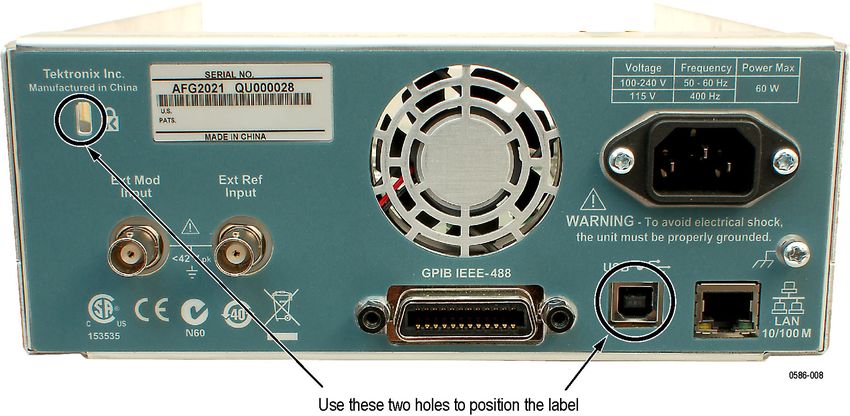
Table of Contents

       Maintenance........................................................................................................    31
          Service preparation ...........................................................................................     31
          Preventing ESD ...............................................................................................      31
          Preventive maintenance ......................................................................................       32
          Inspection and cleaning ......................................................................................      33
       Removal and installation procedures ............................................................................       37
          After repair adjustments......................................................................................      38
          Before disassembly ...........................................................................................      38
          Equipment required for disassembly .......................................................................          38
          Handle removal/installation .................................................................................       39
          Case removal/installation ....................................................................................      40
          Front panel knob removal/installation ......................................................................        41
          Front panel cover removal/installation .....................................................................        42
          LCD display and Front Panel board removal/installation ................................................             44
          Front BNC Insulator board removal/installation ..........................................................           47
          Front chassis and main chassis separation .................................................................         48
          Power Supply module removal/installation................................................................            51
          Fan removal/installation .....................................................................................      53
          AC line filter removal/installation ..........................................................................      56
          Main board removal/installation ............................................................................        57
       Troubleshooting....................................................................................................    61
          Troubleshooting tools and equipment ......................................................................          61
          Troubleshooting tree..........................................................................................      61
          Diagnostics ....................................................................................................    63
       Diagrams ...........................................................................................................   67
       Replaceable parts ..................................................................................................   69
          Parts ordering information ...................................................................................      69
          Using the replaceable parts list ..............................................................................     70

ii                                                                                                AFG2021 Service Manual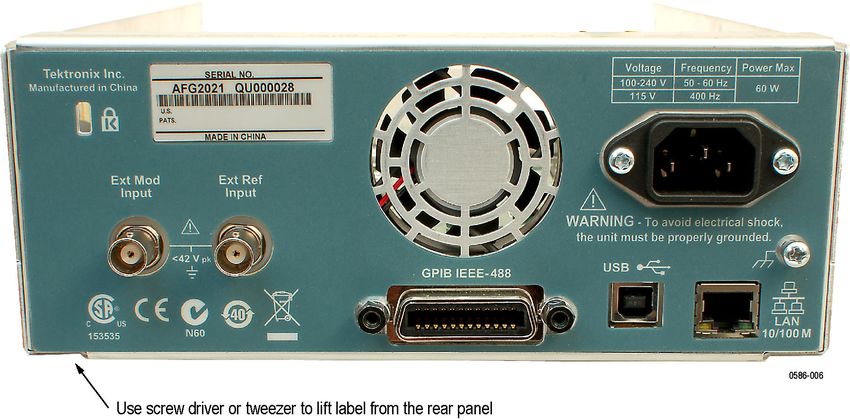
List of Figures
      Figure 1: Instrument dimensions .................................................................................    8
      Figure 2: Fuse and fuse adapter..................................................................................   12
      Figure 3: AFG2021 block diagram ..............................................................................      19
      Figure 4: Frequency/Period tests ................................................................................   26
      Figure 5: Flatness adjustment connections .....................................................................     27
      Figure 6: Positioning the handle for removal ..................................................................     39
      Figure 7: Location of the case retaining screws................................................................     40
      Figure 8: Removing the rear case................................................................................    41
      Figure 9: Location of the knob retaining clip ..................................................................    41
      Figure 10: Location of the front panel cover retaining screws ...............................................       42
      Figure 11: Removing the front panel cover and rubber keypad ..............................................          43
      Figure 12: Disconnecting the front-panel ribbon cable from the Main board ..............................            44
      Figure 13: Removing the Front Panel board ...................................................................       45
      Figure 14: Disconnecting the LCD display cable..............................................................        46
      Figure 15: Disconnecting the ribbon cable from the Main board ............................................          48
      Figure 16: Location of the front chassis retaining screws ....................................................      49
      Figure 17: Correct position of the EMI clip for the USB port................................................        50
      Figure 18: Correct orientation of BNC insulator...............................................................      50
      Figure 19: Correct orientation of power button ................................................................     50
      Figure 20: Location of the Power Supply module cables and retaining screws ............................             51
      Figure 21: Positioning the power supply shield on the stand-off posts......................................         52
      Figure 22: Location of the fan cable ............................................................................   53
      Figure 23: Location to start removing the rear panel label ...................................................      54
      Figure 24: Peeling off the rear panel label......................................................................   54
      Figure 25: Aligning the rear panel label (Option GL shown) ................................................         55
      Figure 26: AC line filter cable connections.....................................................................    56
      Figure 27: Location of Main board retaining screws and stand-offs.........................................          58
      Figure 28: Installing the rear BNC washers, nuts, and insulators ............................................       59
      Figure 29: Troubleshooting tree .................................................................................   62
      Figure 30: Interconnections for the AFG2021 .................................................................       67
      Figure 31: Front panel assembly exploded diagram ...........................................................        72
      Figure 32: Chassis assembly exploded diagram ...............................................................        75

AFG2021 Service Manual                                                                                                    iii
Table of Contents

List of Tables
       Table 1:   Test equipment ..........................................................................................    24
       Table 2:   External inspection check list..........................................................................     33
       Table 3:   Internal inspection check list...........................................................................    35
       Table 4:   Troubleshooting equipment ............................................................................       61
       Table 5:   Error codes...............................................................................................   65
       Table 6:   Parts list column descriptions..........................................................................     70
       Table 7:   Front panel assembly replaceable parts (See Figure 31.) ...........................................          71
       Table 8:   Chassis assembly replaceable parts (See Figure 32.)................................................          73

iv                                                                                                 AFG2021 Service Manual
General safety summary
General safety summary
Review the following safety precautions to avoid injury and prevent damage to
this product or any products connected to it.
To avoid potential hazards, use this product only as specified.
Only qualified personnel should perform service procedures.
To avoid fire or personal Use proper power cord. Use only the power cord specified for this product and
injury certified for the country of use.
Ground the product. This product is grounded through the grounding conductor
of the power cord. To avoid electric shock, the grounding conductor must be
connected to earth ground. Before making connections to the input or output
terminals of the product, ensure that the product is properly grounded.
Observe all terminal ratings. To avoid fire or shock hazard, observe all ratings
and markings on the product. Consult the product manual for further ratings
information before making connections to the product.
Do not apply a potential to any terminal, including the common terminal, that
exceeds the maximum rating of that terminal.
Power disconnect. The power cord disconnects the product from the power source.
Do not block the power cord; it must remain accessible to the user at all times.
Do not operate without covers. Do not operate this product with covers or panels
removed.
Do not operate with suspected failures. If you suspect that there is damage to this
product, have it inspected by qualified service personnel.
Avoid exposed circuitry. Do not touch exposed connections and components when
power is present.
Do not operate in wet/damp conditions.
Do not operate in an explosive atmosphere.
Keep product surfaces clean and dry.
Provide proper ventilation. Refer to the manual's installation instructions for details
on installing the product so it has proper ventilation.
AFG2021 Service Manual vGeneral safety summary
Terms in this manual These terms may appear in this manual:
WARNING. Warning statements identify conditions or practices that could result
in injury or loss of life.
CAUTION. Caution statements identify conditions or practices that could result in
damage to this product or other property.
Symbols and terms on the These terms may appear on the product:
product DANGER indicates an injury hazard immediately accessible as you read
the marking.
WARNING indicates an injury hazard not immediately accessible as you
read the marking.
CAUTION indicates a hazard to property including the product.
The following symbol(s) may appear on the product:
vi AFG2021 Service ManualService safety summary
Only qualified personnel should perform service procedures. Read this Service
Safety Summary and the General Safety Summary before performing any service
procedures.
Do not service alone.. Do not perform internal service or adjustments of this
product unless another person capable of rendering first aid and resuscitation is
present.
Disconnect power. To avoid electric shock, disconnect the mains power by means
of the power cord or, if provided, the power switch.
Use care when servicing with power on. Dangerous voltages or currents may exist
in this product. Disconnect power, remove battery (if applicable), and disconnect
test leads before removing protective panels, soldering, or replacing components.
To avoid electric shock, do not touch exposed connections.
AFG2021 Service Manual 1Service safety summary 2 AFG2021 Service Manual
Preface
                          This manual provides instructions to calibrate, troubleshoot, and repair the
                          AFG2021 Arbitrary Function Generator to the module level.

Manual contents
                          The manual consists of the following sections:
                              Operating Information includes general information and operating
                              instructions.
                              Theory of Operation contains circuit descriptions that support service to the
                              module level.
                              Adjustment Procedures contains information that you need to manually adjust
                              the Arbitrary Function generator so that it meets specifications.
                              Maintenance contains information and procedures for performing preventive
                              and corrective maintenance of the Arbitrary Function generator . These
                              instructions include cleaning, module removal and installation, and fault
                              isolation to the module.
                              Diagrams contains interconnection diagrams.
                              Replaceable Parts List includes a table of all replaceable modules, their
                              descriptions, and their Tektronix part numbers.

Manual conventions
                          This manual uses certain conventions that you should become familiar with.
                          Some sections of the manual contain procedures for you to perform. To keep those
                          instructions clear and consistent, this manual uses the following conventions:
                              Front-panel controls and menu names appear in the same case (initial capitals,
                              all uppercase, and so on) in the manual as is used on the arbitrary function
                              generator front-panel and menus. Front-panel labels are all upper case letters
                              (for example, MENU, SELECT, PULSE GEN, and so on).
                              Instruction steps are numbered unless there is only one step.

                Modules   Throughout this manual, any replaceable component, assembly, or part of the
                          arbitrary function generator is referred to generically as a module. In general, a
                          module is an assembly (like a circuit board), rather than a component (like a
                          resistor or an integrated circuit). Sometimes a single component is a module; for
                          example, the chassis of the arbitrary function generator is a module.

AFG2021 Service Manual                                                                                         3
Preface
Safety Symbols and terms related to safety appear in the Safety Summary near the
beginning of this manual.
Finding other information
See the following list for other documents supporting the arbitrary function
generator. All documents except the Online Help and the Declassification and
Security Instructions are located on the AFG2021 Documentation CD-ROM that
shipped with your instrument. Product documents can also be found on the
Tektronix Web site (www.tektronix.com/downloads).
Document name Description
AFG2021 Quick Start User Manual A quick reference to major features of the
instrument and how they operate. It also
provides several tutorials to familiarize you
with basic instrument features.
AFG2021 Specifications and Performance A source for complete instrument
Verification Technical Reference specifications and a procedure for verifying
the performance of the instrument.
AFG2021 Programmer Manual An encyclopedia of topics that describe the
arbitrary function generator interface and
features, and gives background information
on how to use them. It provides Menu
Structures, User Interface, and Programming
Information.
AFG2021 Online Help An online help system, integrated with the
User Interface application that ships with this
product. The online help is preinstalled in
the instrument.
AFG2021 Declassification and Security A source for instructions on how to declassify
Instructions the instrument.
4 AFG2021 Service ManualIntroduction
This manual contains information that is needed to properly service the AFG2021
Arbitrary Function Generator as well as general information that is critical to
safe and effective servicing.
To prevent personal injury or damage to the arbitrary function generator, consider
the following before attempting service:
The procedures in this manual should be performed only by a qualified service
person.
Read the General safety summary and the Service safety summary.(See
page v.)
Read the operating requirements for the instrument. (See page 8, Installation.)
When using this manual for servicing, be sure to follow all of the warnings,
cautions, and notes.
Strategy for servicing
This manual contains the information needed for periodic maintenance of the
arbitrary function generator. Further, it contains information for corrective
maintenance down to the module level:
To isolate a failure to a module, use the troubleshooting procedures found
in the Maintenance section.
To remove and replace any failed module, follow the instructions in the
Removal and Installation Procedures subsection.
After isolating a faulty module, replace it with a fully-tested module obtained
from the factory. The Replaceable Parts List section contains part number
and ordering information for all replaceable modules.
AFG2021 Service Manual 5Introduction
Tektronix service offerings
Tektronix provides service to cover repair under warranty as well as other services
that may provide a cost-effective answer to your service needs.
Tektronix service technicians are well trained to service the arbitrary function
generator. They have access to the latest information on improvements to the
AFG2021 generator as well as new options.
Warranty repair service Tektronix warrants this product for three years from date of purchase. The
warranty appears at the front of this manual. Tektronix technicians provide
warranty service at most Tektronix service locations.
Self service Tektronix supports repair to the replaceable part and module level.
For more information Contact your local Tektronix service center or sales engineer for more information
on any repair or adjustment service.
Performance verification procedures
The performance check is provided in the AFG2021 Specifications and
Performance Verification Technical Reference manual should be performed every
12 months. In addition, a performance check is recommended after module
replacement.
If the AFG2021 does not meet the performance criteria, repair is necessary.
6 AFG2021 Service ManualOperating basics
This section provides installation and operating information that is necessary for
service.
General features
The AFG2021 Arbitrary/Function Generator offers the functionality of three
generators in one:
20 MHz Function Generator
10 MHz Pulse Generator
14 bits Arbitrary Waveform Generator
The following table describes some of the general features of your instrument.
Feature Description
Channel 1
Sine 20 MHz
Pulse 10 MHz
Memory 128K 14bit
Sampling Rate 250 MS/s
Amplitude 10 Vp-p
Display Color TFT LCD
Interface USB
GPIB (AFG2021with option GL only)
LAN (AFG2021with option GL only)
Synchronous operation Available
Ground isolation Available
Context-sensitive Help system Instrument help available in multiple languages
ArbExpress® Software Waveform creation and editing tool software
AFG2021 Service Manual 7Operating basics
Installation
Use the following information to safely install your instrument.
Operating requirements The following information and figure describe temperature, clearance, and power
supply operating requirements of the instrument.
Figure 1: Instrument dimensions
Environmental Clearance. When placing the instrument on a cart or bench, observing the
requirements following clearance requirements:
Sides: 50 mm (2 in)
Rear: 50 mm (2 in)
Temperature. Before operating the instrument, ensure the ambient temperature is
between 0 °C to +50 °C (+32 °F to +122 °F).
CAUTION. To ensure proper cooling, keep both sides of the instrument clear of
obstructions.
Power supply Source voltage and frequency. 100 V to 240 V, 50 Hz to 60 Hz or 115 V, 400 Hz.
requirements
Power Consumption. 60 W
WARNING. To reduce the risk of fire and shock, ensure that the mains supply
voltage fluctuations do not exceed 10% of the operating voltage range:
8 AFG2021 Service ManualOperating basics
Power the instrument on and off
The following procedures show you how to apply power to the instrument and
turn it on and off.
CAUTION. This product will not function with the rear feet in the down position.
Ensure they are raised before instrument setup.
Power on To turn apply power to the instrument and turn it on, do the following:
1. Insert the AC power
cord into the power
receptacle on the
rear panel and the
other end into a
properly grounded
power outlet.
2. Push the front-panel
power button to power
on the instrument.
NOTE. Wait until the
front panel display shows
that the instrument has
passed all power-on self
tests before using the
instrument.
Power off To turn the instrument off, do the following:
1. Push the front-panel
power button to power
off the instrument.
AFG2021 Service Manual 9Operating basics
Perform instrument self test and self calibration
The instrument performs a limited set of hardware tests at power-on. You can
also perform the following manual diagnostics and/or self calibration using the
Utility menu:
NOTE. Disconnect all the cables from the instrument before performing a self
test or a self calibration.
Diagnostics (Self test): Perform the self test to verify that your instrument
is operating correctly.
Calibration (Self calibration): The self calibration mainly checks DC accuracy
using the internal calibration routines. Perform at least once a year to maintain
DC accuracy. It is recommended that the self calibration should be performed
along with a periodic check.
NOTE. If you need to verify that the instrument meets the warranted specifications,
do the complete set of performance verification procedures provided in the
Specifications and Performance Verification manual.
CAUTION. Do not power off the instrument while executing self calibration. If the
power is turned off during self calibration, data stored in the internal memory
may be lost.
10 AFG2021 Service ManualOperating basics
1. Push the front-panel
Utility button.
2. Push the -more- bezel
button.
3. Push the
Diagnostics/Calibration
bezel button.
4. Do one of the following:
NOTE. Before executing
self calibration, ensure that
the ambient temperature is
between +20 °C and +30 °C
(+68 °F to +86 °F), and allow
a 20 minute warm-up period.
Execute Diagnostics:
Push this bezel button to
execute the instrument
diagnostics.
Execute Calibrations:
Push this bezel button to
execute self calibration.
5. If the diagnostics or
calibration completes
without any errors, the
message “PASSED” is
displayed.
Protect your instrument from misuse
Check input and output When connecting a cable, be sure to distinguish the input connector from the
connectors output connectors to avoid making the wrong connection.
NOTE. The instrument input and output connectors are floating inputs/outputs.
(See page 13, Floating ground.)
AFG2021 Service Manual 11Operating basics
1. Locate the Channel
Output and the Trigger
Output connectors on the
front panel.
2. Locate the Trigger Input
on the front panel.
3. Locate the Ext Mod Input
and the Ext Ref Input
connectors on the rear
panel.
WARNING. To avoid personal injury due to electric shock, do not apply voltages
in excess of 42 Vpk to any BNC connector ground or to the chassis ground.
CAUTION. Do not short output pins or apply external voltages to Output
connectors. The instrument may be damaged.
CAUTION. Do not apply excessive inputs over +5 V to Trigger Input connector.
The instrument may be damaged.
Use fuse adapter The instrument will be damaged if a large DC or AC voltage is applied to the
output or input connectors. To protect the output circuits, a fuse adapter is
provided as an optional accessory. When the instrument is used by students or
other inexperienced users, always attach the fuse adapter to the output connectors
to avoid damage. (See the AFG2021 User Manual for information about optional
accessories.)
Figure 2: Fuse and fuse adapter
1. Fuse adapter
2. Fuse
12 AFG2021 Service ManualOperating basics
Floating ground
Since the common input and output channels of the arbitrary/function generator
are electrically isolated from the chassis ground (the instrument chassis and
ground line of the AC connector), you can make a floating connection between
the instrument and other equipment.
All the BNC connectors are connected to the common ground, and the remote
interface connector is connected to the chassis ground.
CAUTION. The maximum rated voltage between the chassis ground and common
ground is 42 Vp-p (DC + peak AC). When the potential voltage between the
chassis ground and common ground goes over 42 Vp-p, the internal protective
circuit will be activated to protect the circuits. However, higher voltage may cause
the internal circuits in the instrument to be damaged.
When a potential voltage exists between the chassis ground and common ground,
a short circuit from output to ground causes the instrument internal fuse to open
and the output is stopped. If the fuse opens, you need to contact your local
Tektronix Service Support.
When a potential voltage exists between the common ground and chassis ground,
short-circuiting between them may lead to excessive current flow and the internal
or external circuits may be damaged.
WARNING. To prevent electrical shock, use this product so that the sum of the
floating voltage and the output voltage of the instrument does not exceed 42 Vpk.
Do not touch the center of the BNC while the equipment is in use.
AFG2021 Service Manual 13Operating basics
Protect your DUT
Use care when you connect the instrument Channel Output to your DUT (device
under test). To avoid damage to your DUT, the following preventive measures are
provided. Follow these steps to set the limit values for high level and low level.
1. Push the Output Menu
bezel button.
2. Push the Limit bezel
button.
3. Push the High Limit bezel
button.
4. Notice that in this
example, High Limit
is set to 5.000 V, and Low
Limit is set to -5.000 V.
5. Use the numeric keys or
the general purpose knob
to set the High Limit to
50 mV and the Low Limit
to -50 mV.
6. Push the front-panel
Sine button to display
the waveform parameter.
Confirm that High and
Low voltage levels were
changed.
NOTE. You cannot enter any
values greater than 50 mV for
High level.
NOTE. When you set limit values using the Output Menu, a level indicator is
displayed at the left end of the graph area.
14 AFG2021 Service ManualOperating basics
Front panel overview
The front panel is divided into easy-to-use functional areas. This section provides
you with a quick overview of the front panel controls and the screen interface.
Item Description
1 Bezel buttons
2 Return to previous menu
3 Run mode buttons
4 Help, Utility, and Save/Recall buttons
5 Numeric keypad, cancel action, delete/backspace, and Enter buttons
6 General purpose knob
7 Arrow buttons allow you to select a specific number on the display screen when
you are changing amplitude, phase, frequency, or other such values
8 Channel On/Off and Manual Trigger buttons
9 Trigger input connector
10 Trigger output connector
11 Channel output connector
12 USB connector
13 Function buttons
14 Power button
Lock or unlock the front If you need to lock the front panel controls, use the following remote command:
panel controls SYSTem:KLOCk[:STATe]
To unlock the front panel without using a remote command, push the front-panel
Cancel button twice.
AFG2021 Service Manual 15Operating basics
Parts of the screen interface
Item Description
1 Bezel menu: When you push a front panel button, the instrument displays
the corresponding menu on the right side of the screen. The menu shows the
options that are available when you push the unlabeled bezel buttons directly
to the right of the screen. (Some documentation may also refer to the bezel
buttons as option buttons, side-menu buttons, or soft keys.)
2 Graph / waveform display area: This part of the main display area shows
the signal as a graph or waveform.
3 Level meter: The top portion of the indicator shows the high limit value; the
bottom portion of the indicator shows the low limit value; and the indicator itself
shows the currently selected level.
4 Parameter display area: This part of the main display area shows active
parameters.
5 Message display area: A message that monitors hardware status such as
clock or trigger is displayed in this area.
6 Output status: If the output is set to disable, Output Off message is displayed
in this area. When you push the front panel channel output button to enable the
output, the message will disappear.
16 AFG2021 Service ManualOperating basics
Rear panel
The following illustration shows the rear panel connectors for the instrument.
Item Description
1 Power input: This is where you attached an appropriate power cord to supply
power to the instrument.
2 Chassis ground screw: This screw is used to ground the instrument. Use a
unified coarse screw (#6-32, 6.35 mm length or less).
3 LAN port: This port can be used to connect the instrument to a network.
Connect a 10BASE-T or 100BASE-T cable here.
NOTE. This port is only available for the AFG2021 with option GL.
4 USB (type B) connector: This can be used to connect a USB type B controller.
5 GPIB: This is port can be used to control the instrument through GPIB
commands.
NOTE. This port is only available for the AFG2021 with option GL.
6 EXT REF INPUT connector: This is a BNC connector for the external reference
input.
7 EXT MODULATION INPUT connector: This is a BNC connector for the external
modulation input. It can be used to input a modulated signals.
8 Security slot: This slot allows you to use a standard laptop computer security
cable to secure your instrument to your location.
9 Fan (ventilation) vent: This is the ventilation opening for the fan.
AFG2021 Service Manual 17Operating basics 18 AFG2021 Service Manual
Theory of operation
                              This section describes the electrical operation of the AFG2021 instrument to the
                              module level. It describes the basic operation of each functional circuit block
                              shown in the block diagram. (See Figure 3 on page 19.)

Overview
                              AFG2021 instrument provides a basic model with a USB interface and an option
                              GL model which adds GPIB and LAN interfaces.

Figure 3: AFG2021 block diagram

AFG2021 Service Manual                                                                                       19
Theory of operation
Main board
CPU section CPU circuit. The CPU Circuit contains an MPU, Flash RAM, and DRAM to
control the instrument. The liquid crystal controller and the USB circuit are
included in the MPU.
Local regulators. This regulator stabilizes and supplies +3.3 V and +5.0 V for
the logic circuit.
Remote interface. This section contains a GPIB and LAN driver circuit.
Fan controller. This circuit controls the speed of the fan.
Primary circuit. Contains the power switch and the filter circuit.
Signal I/O circuit. The Reference Clock Input/Output and the Modulation Input
signals are transmitted to the Generator section through this section.
Generator section Isolator. Transmit the serial control signal from the CPU section to the following
circuits with electrical insulation.
Clock circuit. Generates a 1 GHz high-speed clock necessary for the signal
generation from a 10 MHz reference clock by PLL. This circuit has a function of
selecting the reference signal source as well.
GoC ASIC. GoC (Generator on Chip) ASIC is a CMOS waveform synthesis IC
which includes 2 GS/s DA, Direct Digital Synthesis, waveform SRAM 128 K,
x8 MUX, Modulation, Burst and Sweep. So GoC manages most of the generator
section.
Trigger circuit. Receives an External Trigger input signal, executes the level
conversion, then supplies the level converted trigger signal to the GoC ASIC.
Pre-Amplifier circuit. Converts the differential output signal of the GoC to single
ended output, then supplies the single ended output to the Output Amplifier
through the Attenuator.
Output amplifier. The output of the pre-amplifier is amplified and output. LPF is
used when a sine wave is output.
Trig Out circuit. Sync Out signal from GoC ASIC is level converted to Trigger
Out.
ADC. Modulation by an external source is performed by digitally sampling the
external input from the Ext Modulation Input connector.
20 AFG2021 Service ManualTheory of operation
Local regulator. Supplies the necessary +1.8 V, +3.3 V, +15 V, and -15 V power.
On/Off relay. On/Off of the output signal.
Calibration circuit. DC Calibration of the output signal is done by a 16 bit AD
Converter.
Fan A 50 mm by 50 mm size, DC 12 V type fan. It is driven by fan controller in
the CPU section.
Front Panel board
Front panel The Front Panel controls a rubber button matrix, LED, a buzzer, and a rotary
module encoder.
LCD display The display is a 3.5 inch QVGA (320 x 240) color TFT LCD.
module
Power Supply module
The power supply module provides +4.3 V, ±15 V, and +5 V to the circuit. This
power supply module accepts the input voltage within the range of 250 VAC
from 90 VAC.
BNC Insulator boards
Front BNC This board insulates the I/O signals on the front panel BNC connectors from the
Insulator board chassis.
Rear BNC This board insulates the I/O signals on the rear panel BNC connectors from the
Insulator board chassis.
AFG2021 Service Manual 21Theory of operation 22 AFG2021 Service Manual
Adjustment procedures
                             This section describes the procedures necessary to manually adjust the AFG2021
                             Arbitrary Function Generator. Perform each adjustment when you exchange a
                             circuit board.

Purpose of adjustments
                             This procedure returns the arbitrary function generator to compliance with its
                             Warranted Characteristics as listed in the Specification section. It can also be used
                             to optimize the performance of the arbitrary function generator.

      Adjustment interval    Generally, these adjustments should be performed every 12 months.

  After repair adjustments   After the removal and replacement of a module due to electrical failure, perform
                             the following two adjustments as described in this section:
                                 Reference clock
                                 Flatness

AFG2021 Service Manual                                                                                         23
Adjustment procedures
Equipment required
The following table lists the equipment that is required to complete the adjustment
procedures.
Table 1: Test equipment
Recommended
Description Minimum requirements equipment Purpose
1. Power meter 100 kHz to 250 MHz R&S NRVS Measures voltage. Used in
1 μW to 100 mW (-30 dBm to multiple procedures.
+20 dBm)
Accuracy: 0.02 dB
Resolution: 0.01 dB
2. Power head 100 kHz to 250 MHz R&S NRV-Z5 Measures voltage. Used in
1 μW to 100 mW (-30 dBm to multiple procedures.
+20 dBm)
3. Frequency counter 50 kHz to 5 GHz, Tektronix FCA3100 or Checks clock frequency.
Accuracy: 0.01ppm equivalent
Phase measurement
4. BNC coaxial cable 50 Ω , male to male BNC Tektronix part number Signal interconnection
(2 required) connector, 91 cm 012-0482-00
5. BNC terminator 50 Ω , ±1Ω , 2 W, DC to 1 GHz, Tektronix part number Signal termination
BNC 011-0049-02
6. Adapter dual-banana Plug BNC (female) to dual banana Tektronix part number Signal interconnection to a
103-0090-00 DMM
24 AFG2021 Service ManualAdjustment procedures
Performance conditions
The adjustments in this section are an extensive, valid confirmation of
performance and functionality when the following requirements are met:
The cabinet covers must be on the instrument.
The instrument must have been calibrated/adjusted at an ambient temperature
between +20 °C and +30 °C.
The instrument must have had a warm-up period of at least 20 minutes.
Enable the Service mode
You must enable the service mode to perform the adjustment procedure. Do the
following steps to enter the service mode:
1. Push the power button to power on the arbitrary function generator.
2. After the beep, push the front-panel Recall button, and then push the
front-panel 7 numeric button.
3. Keep pushing these buttons until the power-on screen is displayed.
4. Release the buttons when the top screen is displayed.
5. Check whether the service mode is available by pushing the Utility > -more-
> -more- buttons. The Service Menu selection is displayed in the third page
of the Utility menu.
Save/Recall menu
You can adjust the Reference Clock and Flatness parameters on the Manual
Calibration that is described in this section. Each of changed parameters is stored
in non-volatile memory of the arbitrary function generator after you push the Save
menu in the first page of Manual Calibration. Previous adjustment parameters will
be recalled after a power cycle unless you push the Save/Recall menu button.
Clear CAL Data menu
The Clear CAL Data menu in the second page of Manual Calibration clears all
the current adjustment parameters and sets them to 0. However, unless you
push the Save/Recall menu button, the previous adjustment parameters will be
recalled after a power cycle.
AFG2021 Service Manual 25Adjustment procedures
Reference clock
This procedure adjusts the frequency accuracy of the arbitrary function generator.
Only one frequency point of the output channel is adjusted.
1. Connect the arbitrary function generator to the frequency counter as shown in
the following figure.
Figure 4: Frequency/Period tests
2. Push the following buttons to recall the arbitrary function generator default
setup:
Save/Recall > Setup > Recall > Default.
3. Set up the arbitrary function generator as follows:
a. Push the Sine button on the front panel
b. Push the Frequency/Period/Phase Menu bezel button.
c. Push the Frequency bezel button (it will turn dark when activated) and
use the numeric keypad or general purpose knob to set the frequency to
1.000000 MHz.
d. Push the button on the front panel to return to the top menu.
e. Push the Amplitude/Level Menu bezel button.
f. Push the Amplitude bezel button (it will turn dark when activated) and
use the numeric keypad or general purpose knob to set the amplitude
to 1.000 Vp-p.
g. Check that the Channel On/Off front panel button LED is lit. If it is
not lit, then the channel output is off. Push the Channel On/Off button
to turn it on.
4. Check that reading of the Frequency Counter is between 0.999999 MHz and
1.000001 MHz.
5. Push the Pulse button on the front panel.
26 AFG2021 Service ManualAdjustment procedures
6. Adjust the Ref Clock value with the front panel rotary knob on the generator
so that the frequency counter reading is between 0.999999 MHz and
1.000001 MHz.
7. Push the Save/Recall button on the front panel.
8. Push the Save bezel button to save the adjusted value.
Flatness adjustment
To obtain the flatness of sine waveform relative to the 100 kHz sine waveform,
compensate the output level of the sine waveform at 5 MHz interval with the
power meter.
1. Connect the arbitrary function generator to the power meter with a power
head as shown in the following figure.
Figure 5: Flatness adjustment connections
2. Set up the arbitrary function generator as follows:
a. Push the Sine button on the front panel.
b. Push the Frequency/Period/Phase Menu bezel button.
c. Push the Frequency bezel button (it will turn dark when activated) and
use the numeric keypad or general purpose knob to set the frequency to
100.0000 kHz.
d. Push the button on the front panel to return to the top menu.
e. Push the Amplitude/Level Menu bezel button.
f. Push the -more- bezel button.
g. Push the Units bezel button and then push the dBm bezel button to change
the voltage units to dBm.
h. Push the -more- bezel button.
AFG2021 Service Manual 27Adjustment procedures
i. Push the Amplitude bezel button (it will turn dark when activated) and
use the numeric keypad or general purpose knob to set the amplitude to
+4.0 dBm.
j. Check that the Channel On/Off front panel button LED is lit.
If it is not lit, then the channel output is off. Push the Channel On/Off
button to turn it on.
3. Set the frequency of the power meter to 100 kHz, and compensate the power
meter so that the reading value at 100 kHz may become 0 dB with the
frequency dependent offset function. Then set up the power meter to the
relative measurement mode.
4. Change the frequency of the power meter setting to 5 MHz so that it is the
same as the arbitrary function generator frequency.
5. The power meter shows the value difference from the reference value, which is
± 0.30. Set this value to the Flatness field of the arbitrary function generator.
28 AFG2021 Service ManualAdjustment procedures
6. Repeat steps 4 through 5 until the setting of the arbitrary function generator
is 20 MHz.
The output signal frequency of the arbitrary function generator increases in
5 MHz steps every time you increase the frequency. Set the frequency of the
power meter to the same frequency of the arbitrary function generator in step 4.
AFG2021 Service Manual 29Adjustment procedures
Resetting the serial number
When you replace the A72 CPU board, you must set the serial number. Perform
the following procedure to set the serial number:
1. Enable the Service mode. (See page 25, Enable the Service mode.)
2. Push the Utility > -more- > -more- buttons.
3. Push the Service Menu > Factory Initialize > Serial Number buttons.
4. Enter the serial number using the numeric keys and Function buttons.
NOTE. Use the Function buttons to enter alphabetical characters. The Sine to
More... button corresponds to A through F.
5. Push the OK button.
Resetting the MAC address
The MAC Address is set at the factory and usually does not need to be reset.
When a new MAC address setup is required, perform the following procedure:
1. Enable the Service mode. (See page 25, Enable the Service mode.)
2. Push the Utility > -more- > -more- buttons.
3. Push the Service Menu > Factory Initialize > MAC Address buttons.
4. Enter the MAC address using the numeric keys and Function buttons.
NOTE. Use the Function buttons to enter alphabetical characters. The Sine to
More... button corresponds to A through F. Use the +/- key to enter hyphens.
5. Push the OK button.
30 AFG2021 Service ManualMaintenance
This section contains the information needed to do periodic and corrective
maintenance on the arbitrary function generator. The following subsections are
included:
Preparation – Tells you how to get ready to do arbitrary function generator
maintenance.
Preventing ESD – Provides general information on preventing damage to
internal modules when doing maintenance.
Inspection and Cleaning – Information and procedures for inspecting the
arbitrary function generator and cleaning its external and internal modules.
Removal and Installation Procedures – Procedures for the removal of
defective modules and replacement of new or repaired modules.
Troubleshooting – Information for isolating failed modules. Included are
instructions for operating the internal diagnostic routines of the arbitrary
function generator and troubleshooting trees.
Service preparation
Only qualified persons should perform service procedures. Before performing any
service procedures, read the General Safety Summary and Service Safety Summary
sections of this manual and the preventing ESD information below.
Refer to the Operating Information section and your arbitrary function generator
user manual for information about using the arbitrary function generator.
Preventing ESD
When performing any service that requires internal access to the arbitrary function
generator, adhere to the precautions on page 6-2. These precautions will help
you avoid damaging internal modules and their components due to electrostatic
discharge (ESD).
CAUTION. Static discharge can damage any semiconductor component in this
arbitrary function generator.
Minimize handling of static-sensitive modules.
Transport and store static-sensitive modules in their static protected containers
or on a metal rail. Label any package that contains static-sensitive modules.
AFG2021 Service Manual 31Maintenance
Discharge the static voltage from your body by wearing a grounded antistatic
wrist strap while handling these modules. Service static-sensitive modules
only at a static-free work station.
Do not allow anything capable of generating or holding a static charge on the
work station surface.
Handle circuit boards by the edges when possible.
Do not slide the modules over any surface.
Avoid handling modules in areas that have a floor or work-surface covering
that is capable of generating a static charge.
Preventive maintenance
Preventive maintenance consists of visually inspecting and cleaning the arbitrary
function generator, and using general care when operating it. Perform preventive
maintenance more often if you operate the arbitrary function generator in a severe
environment. A good time to perform preventive maintenance is just before
adjustment of the arbitrary function generator.
General care For optimum performance, follow these recommendations:
Protect the arbitrary function generator from adverse weather conditions. The
arbitrary function generator is not waterproof.
Do not store or leave the arbitrary function generator whether the liquid
crystal display (LCD) will be exposed to direct sunlight or high humidity for
long periods of time.
The front and rear cases help keep dust out of the arbitrary function generator
and must be in place during normal operation.
To avoid damage to the arbitrary function generator, do not expose them
to any sprays, liquids, or solvents.
32 AFG2021 Service ManualMaintenance
Inspection and cleaning
This section describes how to inspect for dirt and damage, and how to clean
the exterior and interior of the arbitrary function generator. Inspection and
cleaning are done as preventive maintenance. Preventive maintenance, when
done regularly, may prevent malfunctions and enhance reliability. (See page 32,
Preventive maintenance.)
The collection of dirt on internal components can cause them to overheat and fail.
Dirt also provides an electrical conduction path that could cause an arbitrary
function generator failure, especially under high-humidity conditions. Inspect the
arbitrary function generator as often as operating conditions require.
CAUTION. Avoid the use of chemical cleaning agents which might damage the
plastics used in this AFG2021 Arbitrary Function Generator. Use only deionized
water when cleaning the front panel buttons. Use an ethyl alcohol solution as a
cleaner and rinse with deionized water.
Exterior inspection Inspect the outside of the arbitrary function generator for damage, wear, and
missing parts, using the following check list as a guide. An arbitrary function
generator that appears to have been dropped or otherwise abused should be
checked thoroughly to verify correct operation and performance. Immediately
repair defects that could cause personal injury or cause further damage to the
arbitrary function generator.
Table 2: External inspection check list
Item Inspect for Repair action
Cabinet, front panel, Cracks, scratches, Repair or replace the defective
and cover deformations, damaged module.
hardware or gaskets.
Front-panel knobs Missing, damaged, or loose Repair or replace missing or
knobs. defective knobs.
Connectors Broken shells, cracked Repair or replace the defective
insulation, and deformed modules. Clear or wash out dirt.
contacts. Dirt in connectors.
Carrying handle, bail, Correct operation. Repair or replace the defective
cabinet feet module.
AFG2021 Service Manual 33Maintenance
Exterior cleaning Perform the following steps to clean the exterior of the arbitrary function
generator:
1. Remove loose dust on the outside of the arbitrary function generator with a
lint-free cloth. Use care to avoid scratching the clear glass display shield.
2. Remove remaining dirt with a lint free cloth dampened in a general purpose
detergent-and-water solution. Do not use abrasive cleaners.
CAUTION. To prevent getting moisture inside the arbitrary function generator
during external cleaning, use only enough liquid to dampen the cloth or applicator.
To avoid damage to the surface of the arbitrary function generator, do not use any
abrasive or chemical cleaning agents.
Flat panel display cleaning The display is a soft plastic display and must be treated with care during cleaning.
CAUTION. Imported cleaning agents or methods can damage the flat panel
display.
Avoid using abrasive cleaners or commercial cleaners to clean the display surface.
Avoid scrubbing the display with excessive force.
Avoid spraying liquids on the display surface.
1. Clean the flat panel display surface by gently rubbing the display with a
clean-room wipe (such as Wypall Medium Duty Wipes, #05701, available
from Kimberly-Clark Corporation).
2. If the display is very dirty, moisten the wipe with distilled water or a 75%
isopropyl alcohol solution and gently rub the display surface. Avoid using
excess force or you may damage the plastic display surface.
CAUTION. To prevent getting moisture inside the arbitrary function generator
during external cleaning, use only enough liquid to dampen the cloth or applicator.
34 AFG2021 Service ManualYou can also read


