BAHÇELİEVLER Carrefour - Turkey's First Refrigeration System with CO2 Case Study for United Nations Environment Programme
←
→
Page content transcription
If your browser does not render page correctly, please read the page content below
                                                                 1

BAHÇELİEVLER Carrefour

Turkey’s First Refrigeration System with CO2

Case Study for United Nations Environment Programme
Jump Start Project
July 2010

                                                      market research
                                                                                                        2

Abstract

The increasing focus on reducing the environmental impact arising from its food
retail activities has led Carrefour to commission the construction of the first
subcritical CO2 refrigeration system in Turkey. This case study outlines the
motivation to build the country’s first cascade system using a natural refrigerant in
the Bahçelievler Store in Istanbul in August 2009.

The use of the CO2 cascade refrigeration system has led to substantial direct
emissions savings from the refrigerant use as compared to HCFC-based systems and
HFC-only units, as well as significant energy reductions and resulting financial
savings of up to 40%. Installation and maintenance were carried out at similar costs
than an HFC-only system. In its 10 months of operation the system has performed
with high reliability and safety. It hence qualifies as a technically feasible, safe, and
energy-efficient replacement option to HCFC-based commercial refrigeration in
developed and developing countries, also and especially in warm climates.

Background

Policy

Montreal Protocol: Turkey signed the Montreal Protocol and the Vienna Convention in 1991, and
ratified the London and Copenhagen Amendments in 1995. It operates under Article 5 of the Montreal
Protocol and is thus legally required to phase out Ozone Depleting Substances (ODS) by 2010. The
country adopted an accelerated phase out of some ODS listed in Annex A and B of the Protocol. Turkey
was the first Article 5 country to promulgate a National Ozone Policy and associated regulations to
phase out the import and production of ODS-using products. In 1997, Turkey received an award from
the Montreal Protocol as one of the 9 most successful Article 5 countries in implementing the treaty.

Kyoto Protocol: Turkey signed up to the Kyoto Protocol only in February 2009. Turkey was not a
Party to the convention adopted in 1992 when the Kyoto Protocol was negotiated, and it is not
currently included in the agreement's Annex-B, which includes 39 countries that are obliged to reduce
their greenhouse emissions to 1990 levels between 2008 and 2012. Among all Annex I countries,
Turkey has the highest rate of increase in emissions since 1990 (82 percent) and is the 24th largest
carbon emitting country in the world1.

      1
       UN Statistics Division, Millenium Goal Indicators, last updated 14 July 2009:
      http://mdgs.un.org/unsd/mdg/SeriesDetail.aspx?srid=749&crid

                                                                                            market research
3
The Bahçelievler Store
Location, Working Hours & Sales Area
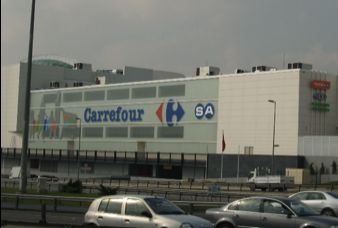
The supermarket is located in Adnan Kahveci Bulvarı E-5
Yolu Yanı Bahçelievler İstanbul no:227. It was opened to
the public in August 2009.
Daily working hours are from 10:00 am to 10:00 pm.
The Bahçelievler store has a total sales area of 7,778 m2, and a net constructed area of 12,001 m2. One
third of the total area is dedicated to refrigeration and cooling equipment.
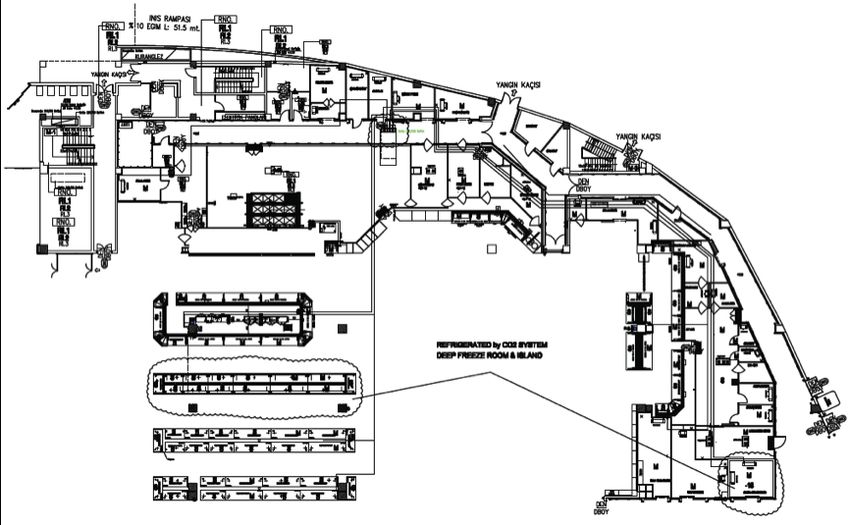
Store Layout & Location of CO2 Low-Temperature and Island System
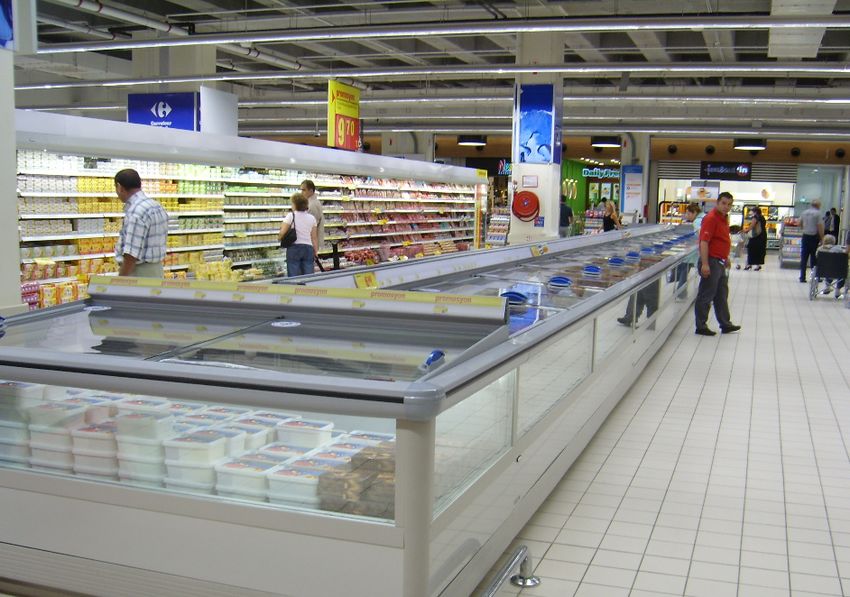
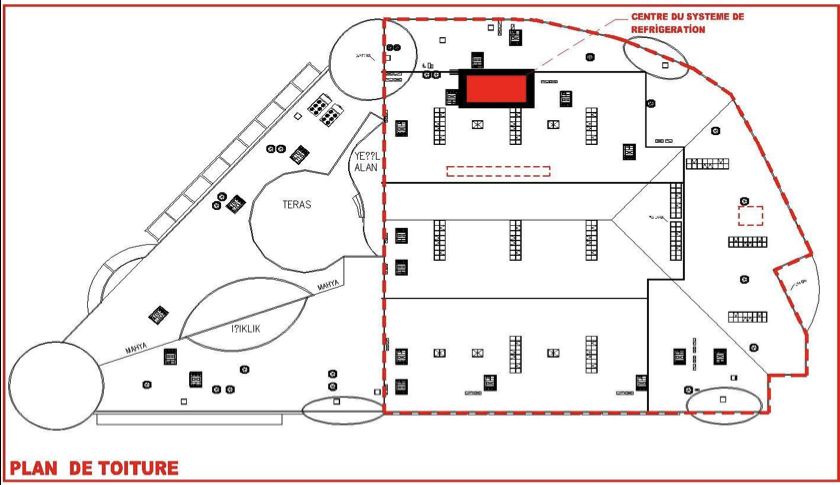
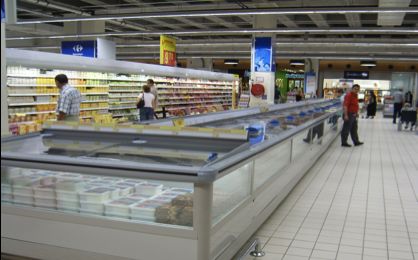
The Bahçelievler Carrefour supermarket uses CO2 as a refrigerant in its deep freeze zone (), and in one
island refrigeration system ().
market research
                                                                                                                4

      The plan of the roof shows the location of the centre of the refrigeration system. Also indicated are
      the two locations of the deep-freeze zone and the island system within the store (red dotted lines).

The CO2 Cascade Refrigeration System

System Type

The system selected by Carrefour is a CO2-R404a Cascade System. It supplies the medium
temperature (MT) refrigeration units and the CO2 condenser with R404a, and the low temperature (LT)
units with CO2 (R744). The CO2 rack was designed by the Italian manufacturer enEX, while the
installation and commissioning was carried out by Turkish market leader Cözüm Soğutma in June 2009.
37 employees were involved in the installation of Turkey’s first CO2 cascade system.

                                                                                                     market research
                                                                                                                              5

The installation features a high temperature
(HT) rack and a cascade system bringing
together the medium temperature (MT) and
low temperature (LT) units (see table). As
the cascade solution is so dynamic, it was
decided to further stabilise the installation
using a capacity controlled compressor for the MT units and an inverter-driven compressor for the LT.2

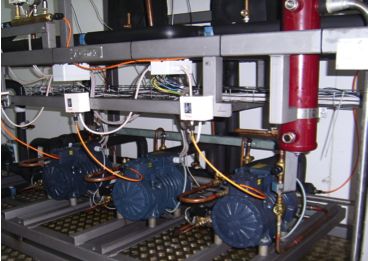
     The CO2 compressor pack comprising 3 SCC 380B                               The refrigeration system commissioned
     models designed by Dorin.                                                   and installed by Cözüm.

The system is equipped with a management and electronic monitoring system that allows for the
control of floating evaporation temperature of CO2 by taking into account the outside temperature
conditions. This further increases efficiency and hence leads to a reduction in energy expenditure.

System Layout

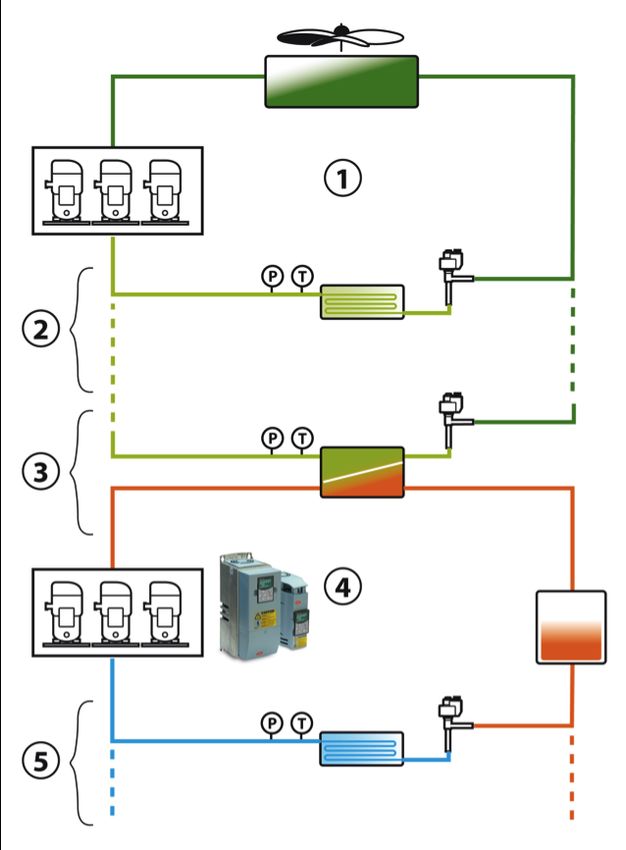
    Above / Right: System Scheme CO2-R404 cascade system

    Right:         1 - R404a rack; 2 - MT units;
                   3 - LT condenser/condensers;
                   4 - CO2 rack; 5 - LT units

      2
             CAREL Industries S.r.l., “CARREFOUR and CAREL develop the first CO2 installation in Turkey”, February 2010

                                                                                                                   market research
                                                                                                        6

Operating Conditions

CO2 System                                          R404a System

Evaporation                : - 35                   Evaporation                   : - 10
Condensation               :-5                      Condensation                  : + 50
Compressor Type            : Dorin SCC 380B x 3     Compressor Type               : Copeland D6DJ 4000 x 5
Refrigeration Capacity     : 40,62 kW/h             Refrigeration Capacity        : 306,5 kW/h
Cooled Products            : Deep freeze products   Cooled Products               : Meat and dairy products
Energy Consumption         : 28,2 kW/h              Energy Consumption            : 155 kW/h

Prepared Area with R404a:

Evaporation                :0
Condensation               : + 50
Compressor Type            : Copeland ZB 45 x 4
Refrigeration Capacity     : 50,4 kW/h
Cooled Products            : Prepared area
Energy Consumption         : 21,2 kW/h

Involved Partners

CO2 Rack Manufacturer                               System Commissioning & Installation
enEX S.r.l.                                         Cözüm Soğutma
via Camalò 22                                       Atatürk Bulvarı No: 45,
31050 Ponzano Veneto (TV), Italy                    41400 Gebze/Kocaeli, Turkey
http://www.enex-ref.com/                            http://www.cozumsogutma.com/

System Management & Controls                        CO2 Compressors
CAREL Turkey                                        Officine Mario Dorin S.p.A.
CFM Sogutma ve Otomasyon San. Tic. LTD              via Aretina 388
1201 Sok.No:13/Z 21 Izmir, Turkey                   50061 Compiobbi (FI), Italy
http://www.cfmsogutma.com/                          http://www.dorin.com

                                                                                            market research
                                                                                                                              7

The Analysis

Motivation for the Switch to a non-HCFC System - Overview

Technology: From a technical point of view, the cascade system is one of the most consolidated
solutions in the commercial refrigeration market. Carbon dioxide has established itself as a preferred
cooling carrier fluid for the LT units in commercial refrigeration. CO2 is one of the leading candidates to
replace current synthetic refrigerants - both HCFCs and HFCs -, given its excellent heat exchange
properties, its compatibility with the most commonly used materials and oils in the installations. System
manufacturers and component suppliers have gained large experience with the design of cascade
systems, and offer standardised solutions that do not pose any technical challenge during installation,
maintenance, and end-of-life treatment.

      Carrefour confirms that the retailer has done an inventory of the state of its refrigeration
      equipment and their leakage rates in 2008 and 2009. As a result, the company decided for
      climate-friendly refrigeration systems to cover newly built installations or installations that are
      obsolete and need to be replaced. While compliance with the new HCFC requirements is a
      priority for the retailer, this diagnosis has led Carrefour to explore new climate-friendly
      refrigeration options in order to also address the second biggest source of greenhouse gas
      emissions in its stores, due to chemical refrigerant leakages.3

Market: Figures differ, but it is estimated that CO2 cascade systems are employed in the range of
several thousand units in the European Union alone. Highest penetration rates for CO2-only (transcritical
operation) and CO2 cascade systems (subcritical operation) can be found in Denmark (100% market
penetration), Scandinavia, and Switzerland. High adoption rates in developed countries provide a
unique opportunity for developing countries to benefit from the design, installation, and maintenance
expertise already gained, at lower costs than in early days of CO2 technology. CO2 as a refrigerant is
available worldwide, posing no restrictions for its sourcing worldwide, as opposed to synthetic fluids.

      Carrefour states that the market penetration of CO2 commercial refrigeration could be further
      accelerated if qualified contractors were more widely available to cater for the needs of the
      booming CO2 refrigeration market. This is relevant for countries outside the European market
      and more particularly in Asia and Latin America.4

      3
       Carrefour group Sustainability Report 2008: http://www.carrefour.com/cdc/responsible-commerce/sustainibility-report/
      4
       Interview Jean-Francois Brunet, Director of Assets Carrefour group, with R744.com, 12 February 2010:
      http://www.r744.com/articles/2010-02-12-10-carrefour-stores-in-europe-run-with-r744-more-to-come.php

                                                                                                              market research
                                                                                                          8

Environment: The use of the natural refrigerant reduces the presence of HCFCs/HFCs in the entire
installation, making the system more environmentally sustainable. CO2 occurs naturally, has no Ozone
Depletion Potential, and a Global Warming Potential of 1 (reference case). In cascade refrigeration
systems it leads to significant energy savings in all climates, including in warm ambient temperatures.

      Carrefour states that greenhouse gas emissions control, following a phase-out of ODS, is taking
      priority in the construction of food retail stores worldwide. This is especially critical for the
      European Union accession of Turkey, where the recent entry into force of the HCFC phase-out
      has led food retailers to make crucial decisions for sustainable refrigeration.5 In total, Carrefour
      has up to 700 stores to retrofit by 2015 worldwide that amount to 500 tones of R-22.

Costs: Due to the standardisation of systems and components for cascade solutions, the cost for
design, commissioning, installation, and maintenance has decreased already significantly, amounting to
around €40,000. A serial production of cascade systems in more world regions, a wider availability of
trained personnel, and increasing raw material costs for chemical refrigerant supplies (HFCs) will
furthermore reduce upfront costs for CO2 cascade systems. A slightly higher initial investment – as
compared to HFC-only systems – is offset by energy savings throughout the system’s life cycle.

      Carrefour decided to invest on CO2 cascade refrigeration systems for freezing foodstuffs as the
      prices of these systems have become more affordable and thus make sense from an investment
      point of view. The food retailer also confirms that CO2 refrigeration could help the retailer
      minimise its direct greenhouse gas emissions while using an energy efficient refrigerant that
      would keep energy bills unchanged.
      To date, ten retail stores across Europe have already been retrofitted to CO2 refrigeration in
      France, Belgium, Italy, and Turkey.6

Safety: Although commercially viable natural refrigerants systems have been reliably working in a high
number of applications around the world (ammonia in industrial refrigeration; hydrocarbons in
domestic refrigerators; carbon dioxide in hot water heat pumps), different safety standards and other
use restrictions impede their wide-spread and consistent use. Both ammonia and hydrocarbons have
been successfully used in supermarket refrigeration systems.

      Carrefour confirms that it has opted for a CO2-R404a cascade system due to non-harmonised
      safety regulations and industry standards on the use of other environmentally friendly natural
      refrigerants, including ammonia and hydrocarbons.7

      5
        REGULATION (EC) No 1005/2009 OF THE EUROPEAN PARLIAMENT AND OF THE COUNCIL of 16 September 2009 on
      substances that deplete the ozone layer OJ L 286/1 of 31.10.2009
      6
        Interview Jean-Francois Brunet, Director of Assets Carrefour group, with R744.com, 12 February 2010

                                                                                              market research
                                                                                                                  9

Impact of Switch to Alternative - Environment

Carrefour lists several ongoing restrictions on the use of HFCs in other countries and world regions as a
major incentive to adopt non-HFC solutions as a direct leapfrog from HCFC as widely as possible.
Besides the Kyoto Protocol, the following initiatives were highlighted to have a high impact on the
company’s strategy regarding its refrigerant use:

  -   F-Gas Regulation: The European Union is putting use restrictions on high-global warming
      fluorinated gases (F-gases) in stationary refrigeration, air-conditioning and heat pump
      equipment. The Regulation addresses the containment, use, recovery, and destruction of F-gases,
      their labelling and reporting, the placing on the market restrictions, and the training and
      certification of servicing personnel and operators involved in handling F-gases equipment.8

  -   MAC Directive: The European Union Directive bans R134a as a high-global warming
      refrigerant from mobile air conditioning systems in passenger cars. Only refrigerants with a GWP
      of below 150 will be allowed in new model types as from 1 January 2011, with a complete
      phase-out of high GWP refrigerants by 2017. As R134a is also one of the most widely used
      refrigerant alternatives for R22 in commercial refrigeration, this scheduled phase-out is likely to
      be extended to cover also stationary refrigeration systems in Europe.9

  -   National Regulations: Denmark today has a close to 100% market penetration rate of HFC-
      free refrigeration systems. This is the result of high taxation on the use of HFC refrigerants
      introduced in 2003 (linked to their GWP value), coupled with a 10 kg limit of HFCs per
      refrigeration system as from 2007 on. This combined approach has led to a mass market for CO2
      transcritical and CO2 cascade systems, and has created the necessary expertise to export HFC-free
      technology to countries outside Denmark.
      The Danish HFC tax scheme has been adopted by Sweden and Norway. The UK is currently
      considering restrictions on the use of HFCs in supermarket refrigeration, and is likely to introduce
      an HFC tax in the coming years. A similar move is to be expected in other countries where
      natural refrigerants (CO2, ammonia, hydrocarbons) are becoming increasingly popular.

As a conclusion, Carrefour Turkey confirms that “HFC is not a sustainable technology solution in the
long term”, and that it will be used “only if there are no other technically feasible, secure, low-cost and

      7
        Communication CarrefourSA Carrefour Sabancı Ticaret Merkezi A.Ş., 16 April 2010
      8
        REGULATION (EC) No 842/2006 OF THE EUROPEAN PARLIAMENT AND OF THE COUNCIL of 17 May 2006 on certain
      fluorinated greenhouse gases, OJ L 161/1 of 14.06.2006
      9
        DIRECTIVE 2006/40/EC OF THE EUROPEAN PARLIAMENT AND OF THE COUNCIL of 17 May 2006 relating to emissions
      from air-conditioning systems in motor vehicles and amending Council
      Directive 70/156/EEC, OJ L 161/12 of 14.06.2006

                                                                                                   market research
                                                                                                                               10

environmentally friendly alternatives” to HCFCs. The Turkish subsidiary of the Carrefour group supports
the “technical developments with natural fluids and hydrocarbons”, and hence the direct leapfrog from
HCFCs to natural refrigerants, such as CO2, actively.10

Following Carrefour’s statement about the restricted use of HFCs in new installations, it should be
assumed that cascade solutions using only natural refrigerants – namely CO2 and ammonia (R717), or
CO2 and hydrocarbons – are also already available and successfully installed. These are technically
feasible, and a more environmentally friendly solution than cascade systems using HFCs. However, they
might face restrictions due to differing safety standards in some countries, a lack of well-trained
installation and maintenance staff, and slightly higher initial investment costs. This can be assumed to
be the reason why the Bahçelievler cascade system is equipped with R404a on the MT side. Carrefour
Turkey has opted for CO2 as the refrigerant is naturally occurring, non-toxic, and non-flammable.

However, the Carrefour group confirms that in installations with a continued use of fluorinated gases -
namely HFCs - it plans to reduce leakages as much as possible and that a stricter containment policy will
be pursued aiming at minimising global warming leakages as much as possible.11

Impact of Switch to Alternative – Energy Use

The distribution of energy consumption in Carrefour markets of different sizes clearly shows that
refrigeration is taking the largest share in used energy in stores up to a floor size of 2500 m2.12 The
majority of Carrefour stores falls under the category of stores not exceeding 1,200 m2. In its 2008
Sustainability Report, Carrefour has pledged to reduce energy consumption by 20% per m2 of sales
area by 2020, as compared to the baseline year 2004.13 To achieve this target, a substantial reduction in
the use of electricity to run the refrigeration units is needed.

    Distribution of Energy
    Consumption in
    Carrefour markets -
    By size of supermarket

       10
              Communication CarrefourSA Carrefour Sabancı Ticaret Merkezi A.Ş., 16 April 2010
       11
              Interview Jean-Francois Brunet, Director of Assets Carrefour group, with R744.com, 12 February 2010
       12
              Communication CarrefourSA Carrefour Sabancı Ticaret Merkezi A.Ş., 16 April 2010
       13
              Carrefour group Sustainability Report 2008

                                                                                                                    market research
                                                                                                                                  11

Carrefour Turkey confirms that the Bahçelievler cascade system is “definitely more efficient than HFCs
for deep freeze use in Turkey”. As compared to the EDİPİPLİK 212 MINUS store using an R404a-only
system, the CO2 cascade system is 40% more energy-efficient. This results in savings of 115.7 kW per
day, and 41,659.2 kW per year. Translated into financial savings this amounts to daily savings of 19.70
Turkish Lira (~9.90 EUR / 13.25 USD) and to an annual savings of 7,082.10 TL (~3,545 EUR / 4,761
USD) 14

    Energy Comparison CO2 cascade                                   Energy and Price Comparison CO2 cascade system
    system with conventional R404-only system                       with R404a-only system

As confirmed by results of latest simulation programmes comparing the energy efficiency of CO2
systems with units based on conventional refrigerants, CO2 cascade system will be more energy-
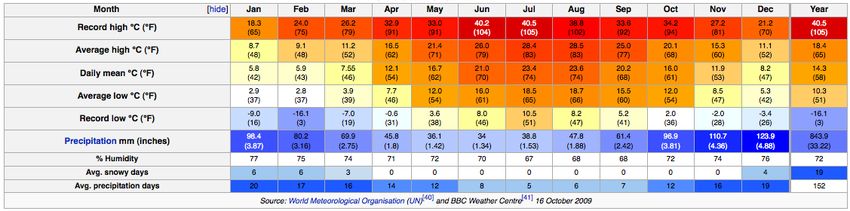
efficient than a CO2-only transcritical option in higher ambient temperatures.15 The below chart
provides an overview of average annual temperatures in Istanbul.16

     Average annual temperatures in Istanbul, Turkey. During summer time, average ambient temperatures
     can reach close to 30°C.

      14
         Communication CarrefourSA Carrefour Sabancı Ticaret Merkezi A.Ş., 16 April 2010
      15
         Pack Calculation II is a simulation tool developed for calculating the energy use of refrigeration systems with CO2 as the
      refrigerant. It offers comparison of different refrigeration systems based on the refrigeration cycle and compressor used
      as well as their geographical location. The tool can be downloaded free of charge from:
      http://www.ipu.dk/English/IPU-Manufacturing/Refrigeration-and-energy-technology/Downloads/PackCalculation.aspx
      16
         World Meteorological Organisation, accessed 20 April 2010; http://www.worldweather.org/014/c00047.htm

                                                                                                                   market research
                                                                                                                    12

Impact of Switch to Alternative - Technology

The installation process for the CO2 refrigeration rack has been found to be similar to the one for HFC
system. The system uses copper pipes where higher pressure levels must be resisted than in the R404a
system. As CO2 is a more efficient refrigerant than R404a, the pipe diameter needed is smaller than for
R404a systems.

       Above: Comparison of Compressor Displacement

       Right: Comparison of Refrigerants – Pipe Cross
       Section Area Wet Return / Liquid Lines (-250 kW –
       40 / -15°C)

Due to the relative small vapour volume of the CO2 system and its large volumetric refrigeration
capacity, the CO2 system is relatively sensitive to capacity fluctuations. It is therefore important to
design the liquid separator with sufficient volume to compensate for the small vapour volume in the
pipes. Adequate capacity control is important.17

The CO2 compressor used in the cascade solution compares to an R404a compressor for DX systems as
follows, where an equivalent capacity for the CO2 model comes at significantly reduced weight and
motor size:

       CO2 Compressor Design                                 Comparison of CO2 Compressor for Cascade System with
                                                             comparable model for R404a DX system

        17
               Communication CarrefourSA Carrefour Sabancı Ticaret Merkezi A.Ş., 16 April 2010

                                                                                                        market research
                                                                                                        13

Impact of Switch to Alternative – Safety & Reliability

The commissioning and installation was performed without any major issues as constructors and
installers were experienced with taking appropriate precautions for handling a high-pressure system.

According to CETINEL A.S., the distributor of the CO2 compressors in Turkey, HFC systems are still
considered to be the most common and well-known alternative to HCFC systems. This leads to a lack of
technicians experienced with the installation of CO2 refrigeration systems in Turkey. However, CETINEL
confirms that manufacturers are gaining expertise in Turkey, suggesting a more wide-spread use of this
technology in markets outside the European Union – right now the strongest market for CO2 systems.18

Regarding reliability and user experience, Carrefour confirmed that the CO2-R404a cascade system in
the Bahçelievler store has been working for nearly 10 months with high reliability.19

Impact of Switch to Alternative - Costs

The installation process for the CO2 refrigeration rack has been found to be similar to the one for the
HFC system at comparable costs, even for this first installation in Turkey. As a result, Carrefour
estimates that with increasing supply and demand in Turkey and other countries, system installation
and the system itself will be more cost-competitive still.

According to CO2 compressor manufacturer Dorin the compressor model used in the cascade system
costs about 6 times less than its R404a equivalent.20

Operation costs were significantly reduced due to an increased efficiency of compressors and heat
transfer processes. In addition, the low cost of CO2 as a refrigerant and the reduced material use due to
smaller diameters has lowered overall costs.

Maintenance costs will be comparable to an HFC system. Until now, and in the space of 10 months, the
system has not needed any maintenance work.

       18
          Communication with Vahe Dagdevirenel, CETINEL, 20 April 2010
       19
          Communication CarrefourSA Carrefour Sabancı Ticaret Merkezi A.Ş., 16 April 2010
       20
          Communication with Giacomo Pisano, Officine Mario Dorin S.p.A., 20 April 2010

                                                                                             market research
                                                                                                   14

Conclusion & Outlook

The installed CO2 system has delivered in environmental, safety and economic terms.
During a visit to the site on 27 April, Carrefour Turkey and representatives of most
involved     partners       confirmed    their    positive    experience   with    the     design,
commissioning, installation and operation of Turkey’s first CO2 commercial
refrigeration system. Carrefour expressed its wish to eliminate all F-gases still
contained in the cascade solution to move towards a natural refrigerants-only
solution in the future. Major reasons cited are direct leakages of R404a that would
still put a significant burden on the environment, as well as economic considerations
where the continuous market price increase for chemical refrigerants would render
their use increasingly less attractive.

As a concrete result, Carrefour is now enquiring on the possibility to implement a
CO2 direct expansion (DX) system. Any information on the components used and
servicing needed are actively sought and welcomed.

CONTACT

Ms Nina Burhenne               Ms Christianna Papazahariou            Mr Marc Chasserot
nina_burhenne@hotmail.com      christianna.papazahariou@shecco.com    marc.chasserot@shecco.com
+32 473 468 194                +32 484 138 069                        +32 465 972 006

                                                                                        market research
                                                                                                                15

ANNEX I - Best-Practice Example: Tesco Ramsey Store

The use of carbon dioxide in retail refrigeration is not new. Over the past 10 years its use has increased
exponentially across Northern Europe. More and more UK retailers are now also committed to the use
of only natural refrigerants – CO2, hydrocarbons, ammonia – in retail.

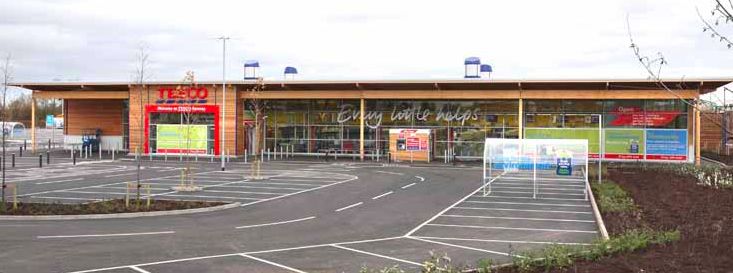
Designed as the world’s first zero-carbon store, the Tesco Store at Ramsey, UK, is completely HFC-free.
The supermarket uses CO2 and hydrocarbons throughout its fridges, freezers, heating, ventilation and
air conditioning systems in the store and petrol kiosk. The CO2 system is the result of two years of
intensive work by Tesco and Star Refrigeration, seeking to develop a standard CO2 transcritical plant
that could be easily rolled out throughout a large number of stores.

Motivation for Switch to an HFC-free Alternative

Tesco defined the following key criteria for any new refrigeration system used:

    •          Eliminates the use of high global warming HFC refrigerant
    •          As efficient as “state of the art” HFC equipment or better
    •          A single refrigerant can be used for both chill (HT) and freezer (LT) cooling requirements,
               simplifying plant design, training requirements and aftercare.
    •          A standard design that can be repeated across the estate and is easy to replace within the
               existing estate as a retrofit
    •          Easy to install, maintain and service
    •          Legally and regulatory compliant
    •          Designed for a 15+ year operating life
    •          Supportive in reducing Tesco’s existing store refrigeration carbon footprint by 70%

The study concluded that transcritical CO2 provides the optimum solution to meet these criteria.

                                                                                                     market research
                                                                                                            16

System layout

A cascade solution was selected, for it provides the best balance of energy efficiency, availability and
flexibility. Each LT package cascades against two or three HT packages so that if one HT package is out
of operation, the full LT cooling capacity will remain available. The LT plant consists of three
compressors, a common oil separator, a high-pressure receiver, a liquid subcooling/suction line
superheater and three CO2 to CO2 condensers. The HT plant consists of three compressors, a common
oil separator, a gas cooler with EC fans, a high-pressure regulator, an intermediate separation vessel
and a low-pressure receiver. The change over between transcritical and subcritical operating modes of
the HT system is managed by a modular control system.

Impact of Switch to Alternative – Technology & Safety

Some observed benefits as regards technology, safety and ease of use:

    •          Servicing: This can be carried out without decanting any refrigerant, as the receiver is large
               enough to contain the total refrigerant charge of the system

    •          Compressor protection: The receiver is positioned in such a way that it prevents any liquid
               getting back to the compressors, hence fully protecting it against expansion valve failure –
               unlike a typical R404a system.

    •          Design pressure: The system will run on reduced charge in the event of exceeding design
               pressure but will still operate to provide partial cooling.

    •          Automatic power re-establishment: After power comes back on, the system operation
               restarts without manual intervention, hence saving time and expenditures.

Impact of Switch to Alternative - Costs

The capital benefit in developing a standard range of CO2 packages is already apparent. Benchmarking
work with a ‘green store’ CO2 project completed in 2008 on a like for like package basis indicates a cost
saving of 22% with using the standard solution. Analysis of the operating data, particularly with the
improved HT suction pressure against design, indicate an improvement in efficiency against R404A,
giving a better life cycle cost of ownership with CO2. Analysis indicate that standardization of the
system will save 22% on the rollout costs versus bespoke solutions of the same capacity. Moreover, the
system achieves cost savings of up to 10% compared to an R404A system, as the overfeed design
reduces superheat in the cases.

                                                                                                 market research
                                                                                                            17

Conclusion & Outlook

The UK retailer plans to install 20-30 systems new CO2 transcritical systems in the period 2010/2011,
and 150 by 2012.

The presented case demonstrates that the development of one standard transcritical CO2 system for
future roll-out across a retailer’s entire estate is possible. It hence represents a best-practice example to
follow, as the solution developed can be manufactured by suitable suppliers and used by other retailers.
The plant design has eliminated HFC refrigerants without detriment to energy efficiency.

Most importantly, the contribution of
CO2 refrigeration         in   a   zero-carbon
concept for food retail stores sets a
landmark        for   a    more     integrative
thinking regarding the use of renewable
and          locally-sourced       construction
materials, effective waste management,
rainwater collection, natural and LED
lighting, CHP, and the use of low-
energy devices (see graphic).

                                                                                                market research
                                                                                                               18

ANNEX II -
Manufacturers of CO2 Commercial Refrigeration Systems

The following list provides an overview of manufacturers (and installers) of CO2 refrigeration systems for
commercial applications. It cannot be comprehensive as new players are entering the market constantly,
but provides a first indication of the global presence of refrigeration system suppliers with expertise on
R744 installations.

     Company                       Products                   Country                 Website

                                                             Denmark         http://www.advansor.dk/
 Advansor A/S            transcritical CO2 booster systems
                         for commercial refrigeration;
                         integrated CO2 refrigeration
                         units for smaller supermarkets;
                         CO2 modular concept for
                         commercial refrigeration

                         manufacturing and installation      Switzerland     http://www.alpiq-
 Alpiq InTec West                                                            energyservices.ch/en/about-
                         of CO2 transcritical systems
 AG                                                                          alpiq/our-business/energy-
                                                                             services-companies/alpiq-intec-
                                                                             west.jsp

                                                             Spain           http://www.area.es/index.html
 AREA Cooling            CO2 transcritical and cascade
 Solutions               systems

                                                             France,         http://www.aximaref.com/ ;
 Axima                   design to implementation and                        http://www.aximaref.be/HTML/E
                                                             Belgium,
 Refrigeration           maintenance of CO2 retail           Luxembourg      N/index.htm

 (GDF SUEZ)              refrigeration

                                                                             http://www.birton.dk/
 Birton A/S              CO2 cascade systems                 Denmark

                                                                             http://www.bitzer.com.au/eng/I
 Bitzer Australia        CO2 subcritical systems             Australia       ntro

                                                                             http://www.carrier-
 Carrier                 CO2 refrigerated and freezer        Germany         refrigeration.com/?L=3
 Commercial              display cases as well as
 Refrigeration           refrigeration systems for
                         industry and commercial uses

                         transcritical CO2 refrigeration     United          http://www.cartersynergy.com/
 Carter Synergy
                         systems                             Kingdom

                                                                                                 market research
                                                                                                         19

   Company                   Products                     Country                Website

                   design/installation of CO2 direct    South Africa   http://www.crservices.co.za/def
Commercial                                                             ault.htm
                   expansion medium temperature
Refrigeration      systems
Services (Pty)
Ltd

                                                        Germany        http://www.dka-dresden.de/
Dresdner           Installation of R744 refrigeration
Kühlanlagenbau     systems

                                                        Australia      http://www.eco2technologies.c
eCO2               adaptation several designs of                       om.au/
Technologies Pty   CO2 transcritical and cascade
Ltd                systems to suit Australian /
                   South African conditions

                   design company specialised in        Italy          http://www.enex-ref.com/
enEX
                   CO2 technology including for
                   commercial refrigeration

                                                        Italy          http://epta-italia.com/
EPTA               CO2 cascade systems

                                                        The            http://www.frijado.nl/
Fri-Jado B.V       CO2 system
                                                        Netherlands

                                                        Switzerland    http://www.frigoconsulting.ch/
Frigo-Consulting   engineering of transcritical and
AG                 subcritical CO2 commercial
                   refrigeration systems

                   CO2 rack manufacturing and           Australia      http://www.frigrite.com.au/
Frigrite
                   installation to showcase
                   manufacturing and installation

                                                        Sweden         http://www.greenandcool.com/
Green & Cool       chiller and freezer units for CO2                   en/index.html
                   transcritical and cascade
                   refrigeration systems

                                                        Canada         http://www.groupecsc.com/
Groupe CSC         CO2 refrigeration system for
                   commercial applications
                   featuring heat recovery
                   technology

                                                        Austria        http://www.hauser.com/
Hauser GmbH        CO2 system

                                                        US             http://www.hillphoenix.com/
Hill Phoenix       CO2 secondary and cascade
                   systems

                   system manufacturer that             Sweden         http://www.jacab.se/produkter/
JAC AB                                                                 produkter.phtml
                   focuses mainly on industrial
                   applications; has also reported

                                                                                            market research
                                                                                                           20

   Company                      Products                    Country              Website
                    to have had one of its systems
                    installed in a Swedish
                    supermarket

                    pump stations for use with CO2        Denmark       http://www.johnsoncontrols.co
Johnson                                                                 m/publish/us/en.html
                    as a secondary volatile
Controls            refrigerant in supermarkets and
                    a wide range of other
                    applications

                    compressor pack systems based         Denmark       http://www.knudsenkoling.dk/
Knudsen Køling
                    on CO2 technology; transcritical
                    CO2 booster systems

                    CO2 transcritical and cascade         Global        http://koxka.ingersollrand.com/E
Koxka (Ingersoll                                                        nglish/Pages/default.aspx
                    systems
Rand)

                    CO2 cascade systems                   US            http://www.kysorwarren.com/
Kysor Warren

                    CO2 cascade systems                   Canada
Les Systèmes
LMP

                    subcritical systems for big           New Zealand   http://www.mcalpinehussmann.
McAlpine                                                                co.nz/
                    supermarkets
Hussmann
(Ingersoll Rand),

Norild AS           CO2 racks                             Norway        http://www.norild.no/

                    Refrigeration engineering             Norway        http://www.norskkulde.com/?p
Norsk Kulde AS                                                          age=25
                    services / Installation of CO2
                    systems

                    Design and installation of            United        http://www.oaksmere.com/
Oaksmere
                    subcritical pumped CO2 systems        Kingdom

                    CO2 cascade systems                   Brazil
Plotter & Racks

                    CO2 subritical refrigeration pack     United        http://www.prplant.co.uk/
PONTARDAWE
                                                          Kingdom

                    complete solutions with its           Hungary       http://www.qplan.hu/index_en.
QPLAN                                                                   php
                    design- production- installation-
Refrigeration       and maintenance groups for all
                    refrigeration jobs including CO2
                    transcritical and subcritical
                    systems

                    direct expansion type                 Japan         http://sanyo.com/
SANYO Electric
                    refrigeration systems for use in
Co., Ltd.           supermarket freezer showcases

                    subcritical packs, cascade            Italy         http://www.scmfrigo.com/defau
SCM Frigo                                                               lt.asp?lingua=eng&
                    systems, transcritical chillers and
                    booster systems

                                                                                            market research
                                                                                                         21

      Company                 Products                 Country                  Website

                    transcritical CO2 refrigeration   United           http://www.space-
 Space                                                                 engineering.co.uk/
                    plant for retail applications     Kingdom
 Engineering
 Services

                    subcritical CO2 supermarket       United           http://www.star-ref.co.uk/star/
 Star
                    packs                             Kingdom
 Refrigeration

                    refrigeration contractor          Sweden           www.tesab.se
 Tesab
                    installing CO2 refrigeration
                    systems

                    installation of CO2 systems       Norway           http://www.trondheimkulde.no/
 Trondheim
 Kulde

                    installation of CO2 systems       United           http://www.wrref.com/
 WR
                                                      Kingdom
 Refrigeration
 Ltd

ANNEX III - Glossary of Terms

GWP            -   Global Warming Potential
HCFC           -   Hydrochlorofluorocarbon
HFC            -   Hydrofluorocarbon
DX             -   Direct Expansion
HT             -   High Temperature Application
LT             -   Low Temperature Application
MT             -   Medium Temperature Application
ODP            -   Ozone Depletion Potential
ODS            -   Ozone-Depleting Substance
R22            -   Chlorodifluoromethane (HCFC)
R404a          -   Near-azeotropic blend of R143a, R125, R134a (HFC)
R744           -   Industry Nomenclature for CO2 as a refrigerant

                                                                                            market research
You can also read


