Accuracy Investigation of the Pose Determination of a VR System - MDPI
←
→
Page content transcription
If your browser does not render page correctly, please read the page content below
sensors
Article
Accuracy Investigation of the Pose Determination of a
VR System
Peter Bauer *, Werner Lienhart                   and Samuel Jost

                                           Institute of Engineering Geodesy and Measurement Systems, Graz University of Technology, 8010 Graz, Austria;
                                           werner.lienhart@tugraz.at (W.L.); samuel.jost@tugraz.at (S.J.)
                                           * Correspondence: peter.bauer@tugraz.at

                                           Abstract: The usage of VR gear in mixed reality applications demands a high position and orientation
                                           accuracy of all devices to achieve a satisfying user experience. This paper investigates the system
                                           behaviour of the VR system HTC Vive Pro at a testing facility that is designed for the calibration of
                                           highly accurate positioning instruments like geodetic total stations, tilt sensors, geodetic gyroscopes
                                           or industrial laser scanners. Although the experiments show a high reproducibility of the position
                                           readings within a few millimetres, the VR system has systematic effects with magnitudes of several
                                           centimetres. A tilt of about 0.4◦ of the reference plane with respect to the horizontal plane was
                                           detected. Moreover, our results demonstrate that the tracking algorithm faces problems when several
                                           lighthouses are used.

                                           Keywords: virtual reality; accuracy; HTC Vive Pro; laboratory investigations

                                 1. Introduction

                                                 Virtual Reality (VR) has become a state-of-the-art tool for visualisation, gaming and
Citation: Bauer, P.; Lienhart, W.; Jost,   education in virtual environments [1]. The integration of external objects into a VR applica-
S. Accuracy Investigation of the Pose      tion is a common way to realise a more realistic user experience. The usage of a car interior
Determination of a VR System.
                                           in a driving simulation or the inclusion of a table’s surface as a game board are widely used
Sensors 2021, 21, 1622. https://
                                           examples. Whenever real objects interact with the simulation, the accuracy of the position
doi.org/10.3390/s21051622
                                           and the orientation (pose) of the VR system’s components in the real-world environment
                                           are crucial.
Academic Editor: Nikolaos Doulamis
                                                 For the pose estimation of VR systems, different tracking approaches are used. These
                                           tracking approaches differ from their possible use cases, because some are designed for a
Received: 19 January 2021
Accepted: 20 February 2021
                                           quick and user-friendly setup and some are designed for a stable and accurate simulation.
Published: 25 February 2021
                                           However, in both cases manufacturers of VR systems usually do not provide information
                                           about the achievable pose accuracy of their devices. This also applies to the HTC Vive
Publisher’s Note: MDPI stays neutral
                                           system where the majority of the accessible information originates from user reports in web
with regard to jurisdictional claims in
                                           forums and video channels, e.g., YouTube. Due to the concept of the tracking approach
published maps and institutional affil-    and the user feedback, a high accuracy in the pose estimation is assumed for this HTC Vive
iations.                                   system. Therefore, it is commonly used in various technical applications, for instance, for
                                           motion tracking in a robot control system [2]. A first developer inspection of the lighthouse
                                           system was carried out by Kreylos in 2016 [3]. His investigations focused on the update
                                           rate and drifts of the HTC Vive system and covered small scale accuracy investigation. In
Copyright: © 2021 by the authors.
                                           the report, the position measurements of the HTC Vive have been compared with a 36 inch
Licensee MDPI, Basel, Switzerland.
                                           ruler. Niehorster [4] has published the first scientific inspection of the lighthouse system
This article is an open access article
                                           of the first generation in 2017. The reference grid was set up with a spirit level and the
distributed under the terms and            WorldViz PPT-X device as reference system. A tilted horizontal reference plane has been
conditions of the Creative Commons         detected and horizontal deviations of a few centimetres were reported. However, a detailed
Attribution (CC BY) license (https://      investigation of the behaviour of the deviation vectors was missing and the experiments
creativecommons.org/licenses/by/           have not been repeated with different lighthouse constellations. Moreover, a PhD thesis in
4.0/).                                     2018 has obtained comparable results with deviations of more than one centimetre with

Sensors 2021, 21, 1622. https://doi.org/10.3390/s21051622                                                    https://www.mdpi.com/journal/sensors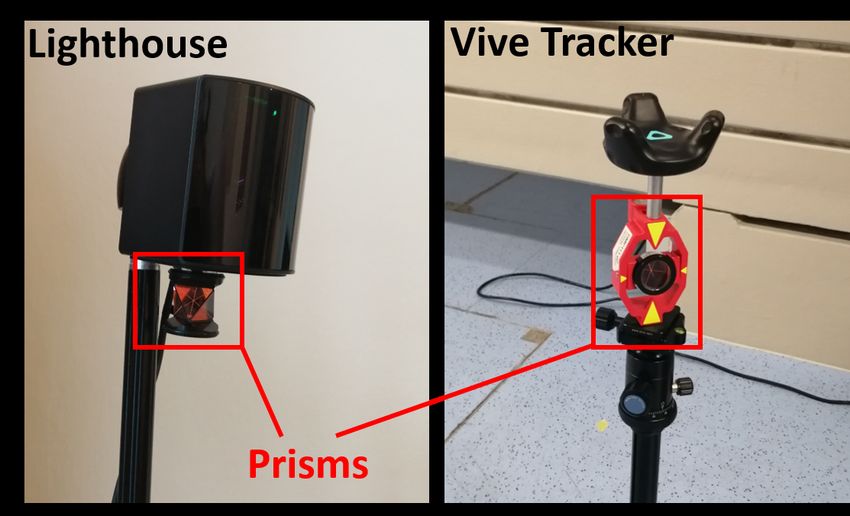
Sensors 2021, 21, 1622                                                                                                  2 of 17

                         regard to a research grade motion capture device [5]. In the same year, NASA [6] presented
                         an improved tracking algorithm for the first generation of the HTC Vive system using the
                         raw data of the VR system. However, end users usually do not have access to this raw data
                         and thus all investigations shown in this article use positions and orientations which are
                         provided by Valve’s SteamVR software.
                              Since 2018, the second generation of the lighthouse system has been available, which
                         originally supported only the HTC Vive Pro system. In the following year, Valve released
                         its own VR System called the Valve Index. Both state-of-the-art systems use the same
                         lighthouse infrastructure and the same SteamVR software for position and orientation
                         estimation and distribution to third-party software [7]. The working principle of the second
                         generation differs significantly from the working principle of the first generation which
                         was officially presented by Alan Yates in 2016 [8]. Information on the working principle
                         and accuracy of the lighthouses 2.0 originate mainly from unofficial online sources such as
                         CNLohr [9] or Bezmalinovic [10].
                              In 2019, a team of researchers around van der Veen investigated the position accuracy
                         of the HTC Vive Tracker in a dynamic 3D setup [11]. In their test setup, the tracker was
                         placed on a movable robot arm. The investigations with the lighthouses of the second
                         generation have shown in this case higher deviations than Niehorster [4] has published
                         for his static investigations of the first generation. A final conclusion cannot be drawn as
                         different hardware and test setups were used.
                              The concept of the lighthouse system is comparable to the iGPS system of Metris
                         which is used in industrial metrology [12]. A capability study performed by the National
                         Physical Laboratory has proven an accuracy of 0.1 mm position error for the iGPS system
                         in a 10 m × 10 m test setup [13]. Therefore, it seems still promising that the HTC Vive
                         Pro system is capable of a high accuracy with different restrictions even though it is low
                         cost sensor.
                              This paper is intended to provide detailed information for the lighthouse system of
                         the second generation and to determine the achievable position accuracy under controlled
                         laboratory conditions.
                              A summary of acronyms and notations is listed in Table 1.

                         Table 1. List with acronyms and notations.

                                     Acronyms or Notations                                 Meaning
                                               pose                              3D position and orientation
                                            significant                     based on a statistical test with p = 0.95
                                        noise or precision                        standard deviation (1 σ)
                                               HMD                                 Head Mounted Display
                                                VR                                      Virtual Reality
                                             QQ-Plot                               Quantile Quantile Plot
                                                IR                                         Infrared
                                               HTC                            High Tech Computer Corporation
                                           400 Gon (g)                                 360 Degrees (◦ )

                         2. System Components of the Htc Vive Pro
                               The HTC Vive Pro system (HTC Cooperation, Xindian, Taiwan) is a 3D indoor posi-
                         tioning system with a designated working range up to 7 m and, based on the available
                         literature, errors of more than one centimetre can be assumed for the position tracking. The
                         VR System HTC Vive Pro is sold with a Head-Mounted Display (HMD), two controllers
                         and two base stations (Figure 1c). These base stations (Lighthouses 2.0, HTC Cooperation,
                         Xindian, Taiwan) are part of the outside-in tracking procedure (Figure 1b). The lighthouses
                         of the HTC Vive emit IR signals which are detected by IR diodes on each device. Valve
                         has published that it is necessary that at least five diodes have to be observed by the
                         lighthouse to estimate the position and the orientation of a device [14]. Other indoor
                         positioning systems following an outside-in tracking procedure are for instance Bluetooth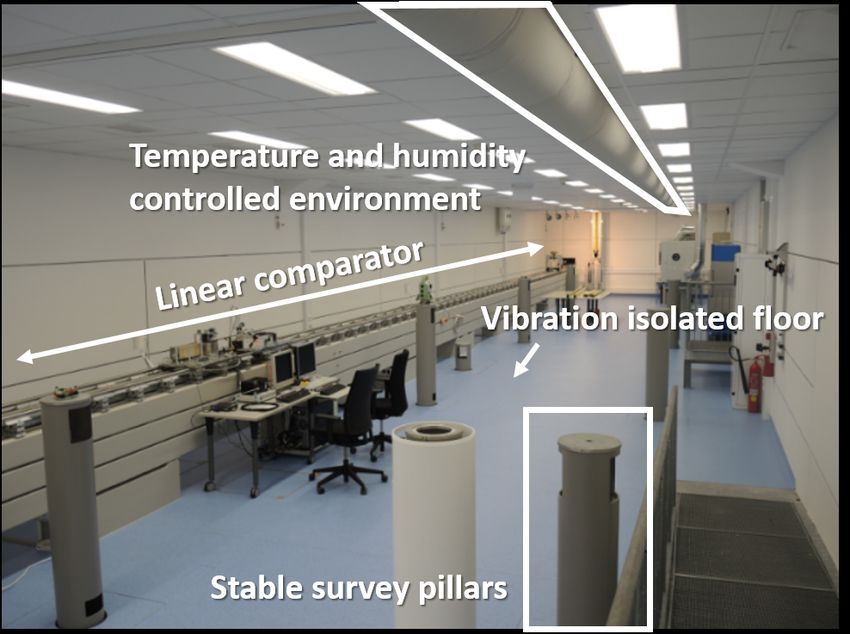
Sensors 2021, 21, 1622                                                                                            3 of 17

                         fingerprinting [15], High sensitivity GNSS [16], the iGPS system from Metris [12], or the
                         CLIPS system of ETH Zurich [17].

                         Figure 1. Different tracking procedures (a,b) and system components (c).

                               In contrast to the outside-in tracking is the inside-out tracking procedure (Figure 1a),
                         where the positioning system is independent from external reference signals as used in the
                         HTC Vive Cosmos [18] or the Microsoft HoloLens [19].
                               The HTC Vive Pro HMD has a configuration of 31 IR diodes and the controllers of
                         24 IR diodes. Using the known configuration of the diodes, the time when a diode is hit by
                         the signal and the time differences between the hits of the diodes, SteamVR can calculate
                         all 6 degrees of freedom for each device. The lighthouse system can be operated with up
                         to four lighthouses at the same time [7]. The Vive Tracker (HTC Cooperation, Xindian,
                         Taiwan) from 2018 is an additional device to include external objects into a VR application.
                         The Tracker has a known origin which is defined by the camera screw thread on the ground
                         plane. With its 22 IR diodes, the Tracker uses the same positioning system as the HMD
                         and the controllers. The camera screw thread enables the tracker to be mounted on an
                         arbitrary object and to easily track that object’s position and orientation within the VR
                         application [20].

                         3. Testing Environment
                              A representative investigation of the system behaviour requires a test setup, which
                         is capable of sustaining a three dimensional reference with constant superior accuracy
                         for the whole working range. Regarding developer studies like Kreylos [3], the accuracy
                         investigations have been carried out on a very small scale and were aimed to detect the
                         minimal position resolution of the HMD. The results published by Niehorster [4] have
                         been the basis for all upcoming research, although he has used only a 2D reference grid
                         and it is questionable if the visual reference system provided an adequate accuracy level.
                              In the publication by van der Veen [11], the lighthouse system has been used in a
                         typical setup with two lighthouses in a dynamic test setup. Due to the high influence of the
                         dynamic tracking algorithm of SteamVR in this test setup, these results are representative
                         for a dynamic use case but may underestimate the reachable accuracy level of the Vive
                         Tracker itself.
                              All of the investigations presented in this article have been carried out under controlled
                         environmental and lighting conditions in the measurement laboratory of the Institute of
                         Engineering Geodesy and Measurement Systems (IGMS) of Graz University of Technology
                         (TUG). To minimize the effects of the dynamic tracking procedure of SteamVR a static
                         test setup has been chosen for the investigations. The experiments have been carried
                         out in setups with one and two lighthouses in different constellations to reveal possible
                         systematic effects.
                              The laboratory is fully air-conditioned (temperature 20 ± 0.5 ◦ C) and has a vibration-
                         isolated floor. Furthermore, it is equipped with stable surveying pillars for setting up
                         total stations and creating a 3D reference system with sub-millimetre accuracy (Figure 2)
                         throughout the whole working range of the lighthouse system. With this reference frame the
                         position of objects can be determined with sub-millimetre accuracy as used in Section 6.1.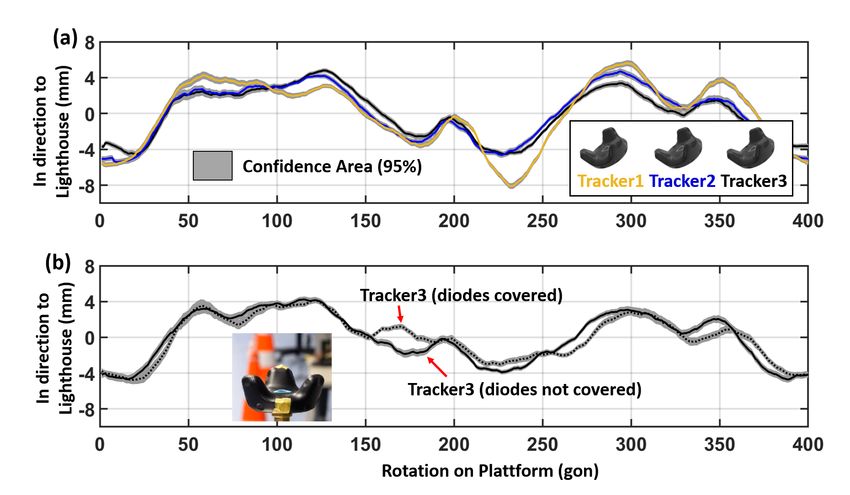
Sensors 2021, 21, 1622                                                                                            4 of 17

                         In addition, the pillars can be used as a stable platform for rotation tests as performed in
                         Section 6.4.

                         Figure 2. IGMS measurement laboratory.

                              One of the main test infrastructure is a 25 m long linear rail system. This horizontal
                         comparator is levelled with a height accuracy of better than 2 mm along its entire length and
                         has an automatically movable carriage on it (test setup in Section 6.3). The position of the
                         carriage along the rail can be determined by an interferometer with micrometre resolution.
                              This test facility is normally used for the calibration of opto electronical distance
                         metres and for accuracy investigations of terrestrial laser scanners [21] and fibre optical
                         sensors [22].

                         4. Statistical Analysis
                               The acquired data sets have been investigated on the basis of their systematic and
                         stochastic behaviour. At each experiment an adequate amount of measurements has
                         been recorded to describe the precision (or noise) and to perform a statistical test with
                         the corresponding distribution (theoretical variance = Gaussian distribution, empirical
                         variance = Student t distribution). The precision (noise) is described with the standard
                         deviation of coordinate differences in the corresponding axis.
                               For statistical tests with a complex functional relationship the laws of variance propa-
                         gation have been applied. All statements in the paper that have been made on the basis of
                         a statistical test are marked with the term “significant”. All results in the paper have been
                         tested for statistical significance on a confidence level of 95% (p = 0.95) which is commonly
                         used in engineering geodesy [23].
                               The pose data of HTC Vive Pro devices has been recorded via the SteamVR Plugin
                         2.0 (Valve Cooperation, Bellevue, WA, USA) in a custom Unity application. All mathemat-
                         ical computations have been executed within the Matlab environment (version R2015b,
                         Mathworks, Natick, MA, USA).

                         5. Precision of the VR System
                              The precision of a 3D positioning system can be described by the reproducibility of
                         3D positions at different time epochs. Reproducibility is a relative parameter and is not
                         affected by systematic effects. Therefore, precision describes the noise level that is inherent
                         in every observation.

                         5.1. Precision of the HTC Vive Pro Devices
                             To investigate the precision of the HTC Vive Pro devices, 500 static 3D positions
                         have been recorded with every device at three different locations. In this setup, only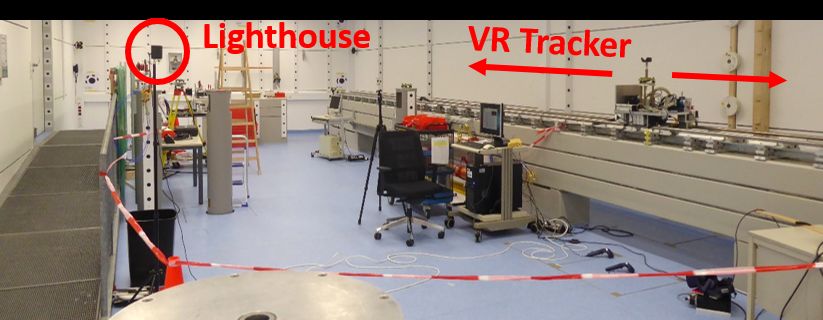
Sensors 2021, 21, 1622                                                                                                   5 of 17

                         one lighthouse has been used to avoid any kind of compensation by redundancy in the
                         position tracking. The resulting horizontal positions are plotted in Figure 3 and show an
                         elliptic-shaped noise pattern for all devices.

                         Figure 3. Noise pattern of all devices at three different positions with one lighthouse. Distance to
                         lighthouse: 1.8 m. Individual position results (coloured dots), 95% confidence ellipses (black).

                              This pattern is orientated towards the active lighthouse. This indicates that the noise
                         in the positions is higher in the direction towards the lighthouse than orthogonal to it.
                              Therefore, the distribution of the noise pattern was further investigated in these
                         two distinctive directions. As an example, the histograms of position 2 are displayed
                         in Figure 4. The histograms are scaled according to the density functions and show a
                         stochastic behaviour without any systematic effects.

                         Figure 4. Histograms of the horizontal deviations (a) orthogonal (b) in direction to the lighthouse at
                         position 2 seen in Figure 3. Standard deviation (σ) values are in the unit mm. Distance to lighthouse
                         1.8 m.

                              The numerical values, which are displayed in Table 2, show that the magnitudes of
                         the noise patterns correlate to the amount of IR diodes on the devices. Therefore, the VR
                         Tracker has a higher noise compared to the controllers and the HMD in this setup.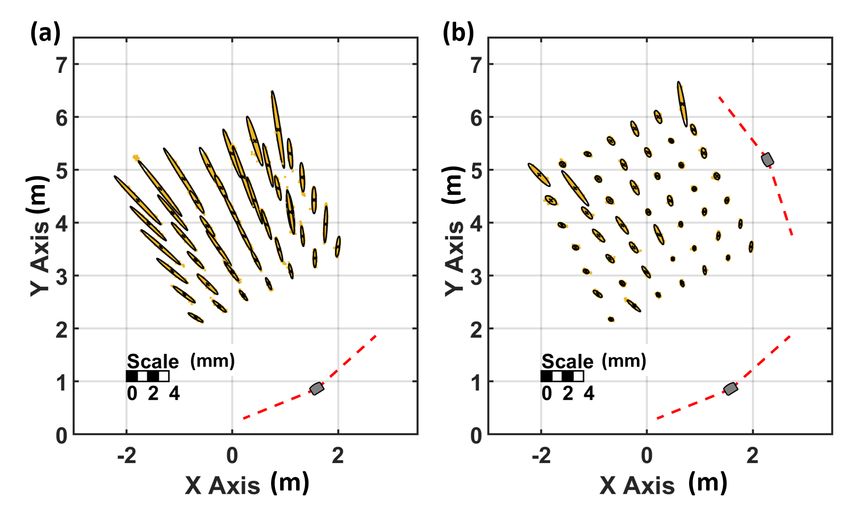
Sensors 2021, 21, 1622                                                                                                 6 of 17

                         Table 2. Numerical values for the noise distribution of different devices.

                                                                                σ Orthogonal to         σ in Direction to
                               Device Typ            Amount of Diodes
                                                                                  Lighthouse               Lighthouse
                                  HMD                         31                    0.1 mm                  0.3 mm
                                Controller                    24                    0.2 mm                  0.4 mm
                                 Tracker                      22                    0.3 mm                  0.5 mm

                         5.2. Detailed Precision Investigation of the VR Tracker
                              Due to the similar behaviour of all devices and the importance of the Vive Tracker
                         for mixed reality applications, it is the Vive Tracker that is examined in more detail. Valve
                         recommends the use of at least two lighthouses in a regular setup [24]. This should improve
                         the visibility of IR diodes and should lead to an improvement in the position tracking.
                              To investigate the impact on the Tracker’s precision, 500 static measurements have
                         been carried out in a setup with one lighthouse and in a setup with two lighthouses.
                         To ensure good spatial distribution, a grid has been measured with 0.5 m spacing. The
                         distribution of the grid points and the lighthouse configuration can be seen in Figure 5. In
                         Figure 5a, the noise pattern is orientated in the direction of the single lighthouse and it can
                         be seen that the magnitude increases with the distance to the lighthouse. Figure 6a shows a
                         detailed inspection of the noise pattern when a single lighthouse is used.

                         Figure 5. Noise pattern of the Tracker with one (a) and two lighthouses (b).

                         Figure 6. Distance dependency of the noise patterns of the tracker positions (a) with one lighthouse
                         and (b) with two lighthouses.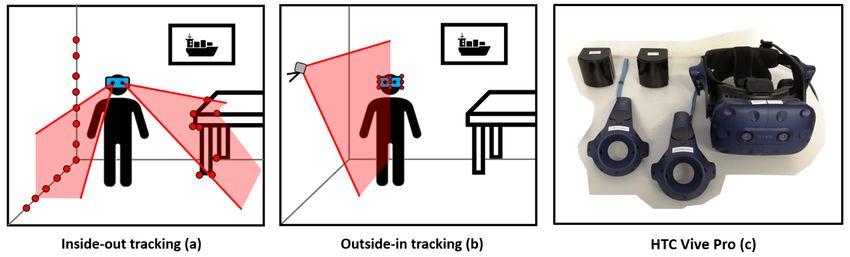
Sensors 2021, 21, 1622                                                                                                7 of 17

                               The corresponding numerical values are displayed in Table 3. The linear regression
                         of the deviation in direction to the lighthouse shows a significant slope of 0.32 mm per
                         metre (precision of the slope 0.04 mm/m) with the use of a single lighthouse. The further
                         the Tracker is away from the single lighthouse, the higher the noise in the direction to
                         the lighthouse.

                         Table 3. Numerical values of precision investigation with regard to the lighthouse and significance
                         (Sig.) at a confidence level of 95%.

                                               Orthogonal to Lighthouse                  in Direction to Lighthouse
                          Lighthouses      Slope        σ Slope         Sig.         Slope        σ Slope         Sig.
                               1         0.012 mm      0.002 mm         Yes        0.318 mm      0.039 mm          Yes
                               2         0.002 mm      0.002 mm         No         0.019 mm      0.011 mm          No

                              In Figure 5b, the use of two lighthouses reduces the measurement noise in direction
                         to the lighthouse significantly. The majority of the grid points show an nearly isotropic
                         noise distribution. In comparison to Figure 6a, no significant distance dependence of the
                         noise (see Table 3, second row) can be observed in Figure 6b. Although two identical
                         lighthouses have been used, some of the ellipses in Figure 5b are still headed towards
                         a specific lighthouse. This behaviour indicates that the algorithm of SteamVR chooses
                         one of the used lighthouses to be a “master” lighthouse with higher influence on the
                         position estimation.

                         6. Accuracy of the VR System
                              The absolute deviation of a measurement from a true value is called accuracy. The
                         investigation of this parameter requires external information as the true value is unknown
                         in most cases. A reference value is often used, which is determined by a sensor which has
                         a measurement accuracy of a higher order.

                         6.1. Orientation of the Reference Plane
                              A major issue that was revealed by Niehorster [4] for the lighthouse system of the first
                         generation was a tilt in the horizontal reference plane that appeared to be very unstable.
                              To investigate this effect for the Lighthouse system 2.0 the experiment of Section 5.2
                         has been repeated with external information by a calibrated geodetic total station (Leica
                         Viva TS15, Leica Geosystems AG, Heerbrugg, Switzerland) which provided ground truth.
                              As it can be seen in Figure 7, the used lighthouses and the Vive Tracker have been
                         equipped with surveying prisms. The 3D positions of these prisms have been tracked
                         with millimetre accuracy by the total station throughout the whole experiment. The 3D
                         coordinates are measured in a local coordinate system. Due to the internal compensator
                         of the total station, the horizontal plane of this local coordinate system is levelled with
                         an accuracy of 0.500 (0.00014◦ ) [25]. For comparison, the Vive Tracker measurements
                         have been transformed with a 2D Helmert transformation onto the corresponding total
                         station measurements.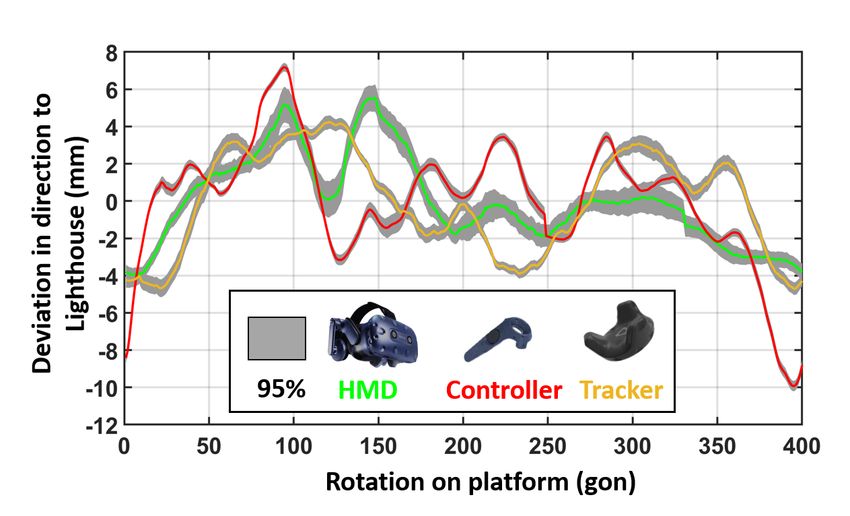
Sensors 2021, 21, 1622                                                                                                8 of 17

                         Figure 7. Mounted surveying prisms on the lighthouse and tracker.

                              The height deviations in Figure 8 show a systematic behaviour and prove a tilted
                         reference plane also for the lighthouse system of the second generation. A best fitting
                         reference plane in Figure 8a has a centreline that is orientated towards the single lighthouse
                         and has a calculated inclination of 0.416◦ (precision 0.005◦ ). Resetting the VR system
                         with a new room setup did not improve the vertical tilt of the plane (tilt of first room
                         setup: 0.416◦ , tilt of second room setup: 0.423◦ ). When the HMD faces tracking issues and
                         regains tracking, the whole lighthouse system is recalculated, also in this case no significant
                         improvement of the tilt has been observed (new tilt: 0.405◦ ).

                         Figure 8. Height deviations to total station measurements with (a) one and (b) two lighthouses.

                               A significant effect on the reference plane can be observed in a setup with two light-
                         houses. Figure 8b shows that both lighthouses contribute to the reference plane, therefore
                         the rotation axis of the plane is aligned between the two lighthouses and a tilt of this plane
                         of 0.788◦ (precision 0.005◦ ) was derived. When the HMD faces tracking issues in this setup,
                         the “master” lighthouse can change due to internal quality parameters. If this happens, the
                         alignment of the reference plane changes with regard to the new “master” lighthouse.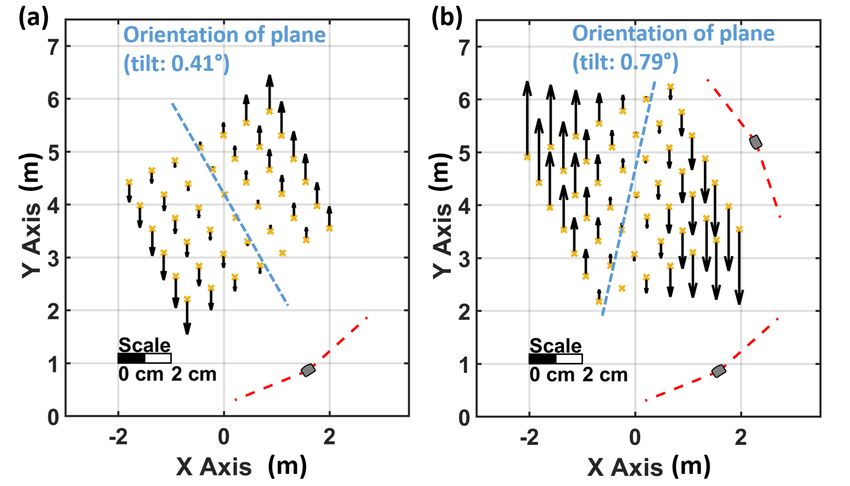
Sensors 2021, 21, 1622                                                                                          9 of 17

                         6.2. Lighthouse Behaviour and 2D Accuracy
                               As displayed in Figure 7, a surveying prism has also been mounted underneath each
                         lighthouse to investigate the behaviour of the lighthouse coordinates as well. Due to the
                         known orientation of the lighthouses and the offset between the centre point and the camera
                         screw thread (can be obtained from the model that is provided by the SteamVR plugin
                         in the game engine Unity), the coordinates of the prism centre can be calculated in the
                         local lighthouse coordinate system. These local prism coordinates have been transformed
                         via the same 2D Helmert transformation, which has been obtained from the Vive Tracker
                         positions and the total station measurements. With this procedure the relative accuracy of
                         all the Tracker measurements and the relative accuracy between the Tracker measurements
                         and the corresponding lighthouse positions can be investigated.
                               Figure 9 provides the horizontal deviations of the Vive Tracker measurements for
                         the same setup, which can be seen in Figures 5b and 8b. Figure 9b shows the results
                         for the same setup after the HMD faced bad tracking issues and the lighthouse system
                         was recalculated. The bad tracking issues have been caused intentionally by obstructing
                         the lines of sight between the HMD and the lighthouses. A detailed inspection of the
                         corresponding noise pattern proved that the “master” lighthouse had changed.

                         Figure 9. Horizontal deviations to total station measurements (a) before and (b) after bad
                         tracking issues.

                               The deviations that are displayed in Figures 9a and 10b are between 1 and 12 mm.
                         The calculated position for the “master” lighthouse has a total deviation of 10 mm to
                         the total station measurements. The second lighthouse has a position error of 100 mm
                         relative to the Vive Tracker measurements. After a recalculation of the lighthouse system
                         in Figure 9b, the priority of the lighthouses has changed. The new “master” lighthouse
                         matches the reference coordinates within 2 mm. The former “master” lighthouse has now
                         a position error of 55 mm, which is an overall improvement compared to the configuration
                         in Figure 9a. The Vive Tracker measurements have now a mean difference of 3.5 mm to
                         the total station measurements in this setup, the corresponding QQ-Plot is displayed in
                         Figure 10c. On the basis of these results it can be said that the coordinates of the “master”
                         lighthouse fit best to the Vive Tracker measurements and the other lighthouses are prone to
                         vast position errors.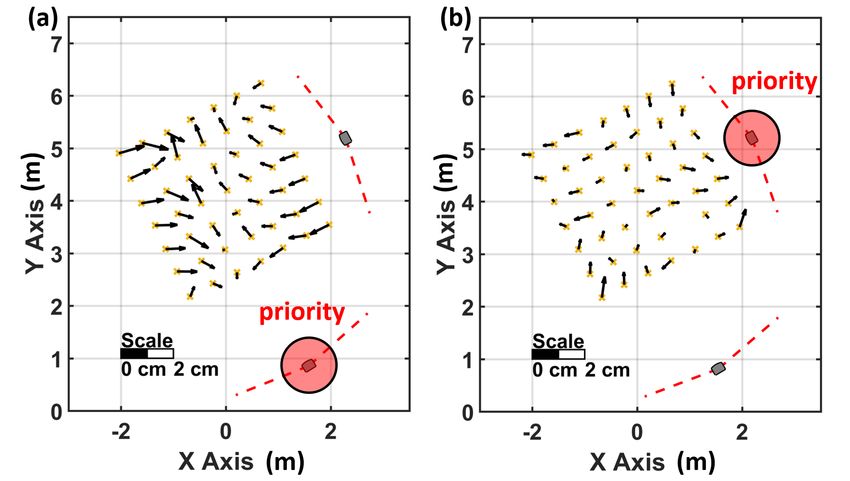
Sensors 2021, 21, 1622                                                                                                           10 of 17

      Figure 10. QQ-Plot with horizontal (a) with a single lighthouse, (b) with two lighthouses, and (c) with two lighthouses after
      bad tracking issues.

                                       Experiments with the same setup and the use of a single lighthouse (Figure 10a)
                                  have proven that the use of two lighthouses (Figure 10c) can lead to a significant accuracy
                                  improvement. The mean difference of 5.4 mm in a setup with a single lighthouse can be
                                  reduced to a mean difference of 3.5 mm with the use of two lighthouses. However in the
                                  setup with two lighthouses, before the recalculation (seen in Figure 10b), a comparable
                                  result has been achieved to the use of a single lighthouse.
                                       The observed lighthouse behaviour indicates that the system is designed to adapt
                                  on the fly. The central element of the SteamVR algorithm is the HMD which defines the
                                  “master” lighthouse and calculates the position for all the other visible lighthouses. Due to
                                  internal quality parameters the HMD can choose the best available lighthouse to be the
                                  new “master” lighthouse and defines its coordinates as stable. The coordinates of all visible
                                  lighthouses are then altered on the basis of the new “master” lighthouse. The experiment
                                  in Figure 9 has shown that this estimation of the lighthouse coordinates can have tensions
                                  of several centimetres, which affects the position estimation of all other devices, excluding
                                  the HMD.

                                  6.3. Deviations from a Reference Path
                                       For the investigation of the performance of the Vive Tracker for the whole working
                                  range of a lighthouse the device has been mounted on the horizontal comparator of the
                                  measurement laboratory. To achieve a representative result by avoiding a changing “master”
                                  lighthouse, only a single lighthouse has been used in this setup (Figure 11).

                                  Figure 11. Setup on the horizontal comparator with one lighthouse.

                                        The VR Tracker has been moved along the rail in 25 cm steps. At each stop, 500
                                  static measurements have been recorded. The mean values of these measurements can
                                  be compared to the interferometer measurements. In this setup, several tests have been
                                  carried out with varying distances between lighthouse and VR tracker. These tests have
                                  confirmed that the working range of the lighthouses lasts up to 7 m.
                                        The deviations between the VR Tracker and the true positions on the comparator are
                                  displayed in Figure 12 and can reach up to 40 mm. The deviations are headed towards
Sensors 2021, 21, 1622 11 of 17
the lighthouse like the noise pattern. All experiments on the comparator have been
repeated twice and the deviations have been reproducible within 3 mm. Regarding the
systematic effect of the deviations, which can be seen in Figure 12, it has to be noted that
the orientation of the tracker with respect to the lighthouse changes as the tracker moves
along the horizontal comparator. It was assumed that this effect occurs due to the change
of the visibility of the IR diodes on the VR Tracker during the experiment (Figure 13).
Figure 12. Horizontal deviations between the VR Tracker and the laser interferometer of the comparator.
Figure 13. Visibility of different IR diodes as the tracker moves along the horizontal comparator.
6.4. Rotation Dependency in a Setup with a Single Lighthouse
To investigate the contribution of different IR diodes to the position estimation, all
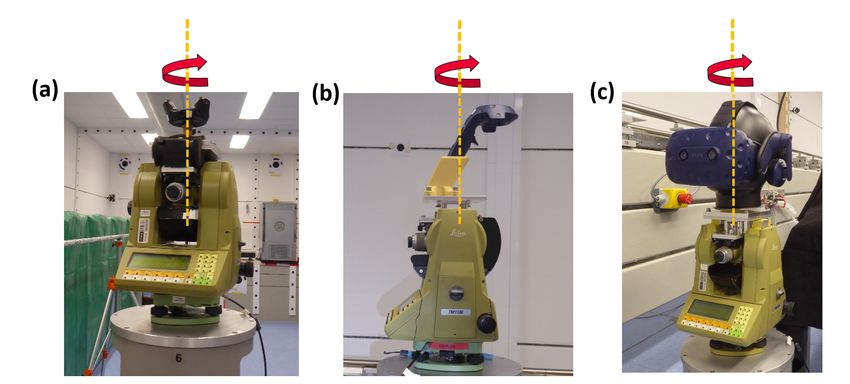
VR devices have been mounted onto a rotation device. The rotation device was a Leica
TM1100 total station (Leica Geosystems AG, Heerbrugg, Switzerland) [26], which rotated
automatically 360◦ with a 1◦ step-width. At each step, 500 positions and orientations have
been recorded. For each rotation step the mean value of the position and the corresponding
standard deviations have been computed. As seen in Figure 14, the controller and the
HMD have been mounted eccentrically; this has been corrected numerically by circle fits in
the data analysis.Sensors 2021, 21, 1622 12 of 17
Figure 14. Setup on the TM1100 rotation platform: (a) for the tracker, (b) for the controllers and (c) for the HMD.
The elliptic-shaped noise pattern of the 500 measurements can be observed at each
1◦ rotation step. Moreover, during the rotation the mean position of tracker (calculated
out of the 500 measurements at each step) faces a significant movement. Figure 15a shows
the results for the rotation for a VR Tracker in a setup with one lighthouse which was 2 m
away. The deviations of the mean positions are orientated in direction to the lighthouse
which correlates with the noise pattern and the deviation shown in Figure 3. Each rotation
has been carried out three times and the results are reproducible within a few millimetres
(see Figure 15b,c).
Figure 15. Horizontal position variation a VR Tracker with a single lighthouse: (a) horizontal plot, (b) in direction to the lighthouse
and (c) in orthogonal direction. (400 g = 360◦ )
Several rotation tests in different setups (variation in tilt and height of the lighthouse
and distance to the Tracker) have shown that a systematic pattern is inherent in all mea-
surements. The behaviour of the systematic pattern and the magnitude changes in different
setups due to the visible IR diodes on the Tracker. To see if other VR Trackers are affected
by these systematic deviations as well, three different VR Trackers have been rotated in
exactly the same setup in 2 m distance. The results can be seen in Figure 16.Sensors 2021, 21, 1622 13 of 17
Figure 16. Deviation of the mean positions during the rotation test (a) with three different VR Trackers and (b) with covered
IR diodes. Distance to lighthouse: 2 m.
Plotted are the mean deviations of the 500 individual measurements at each orienta-
tion and as a grey band the 95% confidence area. The overall systematic with the same
magnitude appears in all datasets (see Figure 16a), although each VR Tracker shows locally
significant differences. Comparing the three Trackers it can be seen that Tracker2 and
Tracker3 fit better to each other than Tracker1. This may indicate a different quality in
the IR diodes of the VR Trackers. To simulate a malfunction of IR diodes the experiment
has been repeated with covered diodes on the VR Tracker3. This has led to similar local
deviations from the overall systematic displayed in Figure 16b.
To investigate this effect on other Vive devices, rotation tests with the HMD and a
controller have been carried out as well. In Figure 17, the rotation results for different VR
devices are shown in a comparable measurement configuration. It can be seen that all
devices face a systematic rotation behaviour of several millimetres up to one centimetre.
Due to the arrangements of the IR diodes on the devices these systematic patterns differ
significantly from each other.
Figure 17. Horizontal position variation in direction to the lighthouse for different VR devices.
Distance to lighthouse: 2 m.Sensors 2021, 21, 1622 14 of 17
6.5. Rotation Dependency in a Setup with Two Lighthouses
The rotation test with the VR Tracker has been repeated in a setup with two light-
houses. Figure 18 shows a detailed inspection of the noise pattern at each rotation step. In
Figure 18a, a higher standard deviation in direction to the lighthouse can be seen. Due to
the use of two lighthouses in Figure 18b the noise in direction to the “master” lighthouse
has been reduced and a nearly isotropic noise pattern of the 500 measurements can be
observed at each rotation step.
Figure 18. Investigation of the noise pattern at each rotation step in a setup (a) with one lighthouse and (b) with two lighthouses.
However, the mean positions at each rotation step show the same systematic deviation
in Figure 19, as it can be seen in Figure 15 in a setup with only one lighthouse. The rotation
systematic is clearly orientated towards in direction to the “master” lighthouse in the
setup with two lighthouses. This means that the use of two lighthouses affects the noise
distribution, but has no affect on the absolute deviations due to the rotation of the devices.
Figure 19. Results of the rotation test for a VR Tracker with two lighthouses (a) horizontal plot, (b) in direction to the
lighthouse and (c) in orthogonal direction.
7. Discussion
The system investigations on the VR system HTC Vive Pro have shown that the
Lighthouse system 2.0 is capable of reaching a position accuracy of a few millimetres with
the Vive Tracker device. This is a factor of 10 worse than the reported accuracy of the
iGPS system.Sensors 2021, 21, 1622 15 of 17
However, a big issue is that the position estimation by SteamVR is a black box. The
designed workflow aims for a quick setup, needs no information from outside the system
and has a big focus on continuity, which is needed for the well-being of the user [27].
Regarding the experiments carried out in the measurement laboratory, it can be
said that the position estimation of the used lighthouses can have discrepancies of a few
centimetres and the whole system is dependent on the current lighthouse with the highest
priority. When moving from one lighthouse to another lighthouse, the system can decide
to re-adjust all visible lighthouses. On the one hand, this behaviour makes the system hard
to control in mixed reality applications, and, on the other hand, this can lead to problems
when using multiple lighthouses in a row to extend the working range. Valve’s SteamVR
Software supports the use of up to 16 lighthouses in a single setup. Therefore, the working
range of the lighthouse system can be expanded throughout several rooms. Moving with
the HMD from one room to another room will force the lighthouse system to recalculate
the lighthouse priorities and will affect the overall accuracy. Investigations of the system’s
behaviour with an increased number of lighthouses will be part of future research activities.
A strategy for improving the accuracy of the VR system would be the use the light-
house system in a fixed setup with known positions of the lighthouses. This would decrease
the active role of the HMD in the position estimation and the system would have enormous
potential in various industrial applications. However, this would mean a major alteration
in the SteamVR tracking approach.
Another approach for improving the accuracy of the VR system could be the use of
several Vive Trackers on known positions in the room. The Vive Tracker has shown a high
relative accuracy in the surrounding area, and it is affected by all systematic changes of the
lighthouse system. Equipping areas which have a high need for spatial accuracy with at
least three Vive Trackers, observing their behaviour and applying the changes to the used
models in VR applications could sustain a high relative accuracy, which might be sufficient
for most mixed reality applications.
Investigations by the University of British Columbia showed that the accuracy of an-
other state of the art VR system, the Oculus Touch, is similar under optimal conditions [28].
An accuracy of a few millimetres was reported; however, the orientation of the controller
has been constant throughout the whole experiment and the measurement system, which
was used as reference, was only capable of 1D movements.
8. Conclusions
The behaviour of the position of the Vive HTC Pro system showed a high reproducibil-
ity of a few millimetres in all experiments. The major impacts on the overall accuracy have
been systematic effects like a tilted reference plane, a poor calibration of the VR devices and
a changing hierarchy in the lighthouse system. These effects can lead to position errors of
more than one centimetre. Regarding the rotation systematics of the VR devices, they have
shown a high dependency on the setup and the visibility of the IR diodes by the lighthouse.
However, the tests have proven that these systematics show a high reproducibility in a
fixed setup. Therefore, calibration functions can be derived and when using the VR Tracker
in a fixed setup (e.g., mounted on a driving wheel) it should be possible to numerically
correct these rotation systematics.
Furthermore, it has been proven, that also the second generation of the HTC Pro
system does not provide a horizontal reference plane. In our experiments, an inclination of
about 0.4◦ with a single lighthouse and 0.8◦ with two lighthouses have been observed.
Author Contributions: Investigation, S.J.; writing—original draft, P.B.; writing—concept of exper-
iments & review & editing, W.L. All authors have read and agreed to the published version of
the manuscript.
Funding: This research was partly funded by Magna Steyr Fahrzeugtechnik AG and Co KG, Austria
within a collaborative project. Open Access Funding by the Graz University of Technology.
Institutional Review Board Statement: Not applicable.Sensors 2021, 21, 1622 16 of 17
Informed Consent Statement: Not applicable.
Data Availability Statement: Not applicable.
Acknowledgments: We would like to thank Robert Hofstadler from the Institute of Automotive
Engineering of Graz University of Technology as well as Markus Salchner and Severin Stadler of
Magna Steyr Fahrzeugtechnik AG and Co KG for the valuable discussions and the good collaboration.
Conflicts of Interest: The authors declare no conflict of interest.
References
1. Levin, E.; Shults, R.; Habibi, R.; An, Z.; William, R.W. Geospatial Virtual Reality for Cyberlearning in the Field of Topographic
Surveying: Moving Towards a Cost-Eective Mobile Solution. ISPRS Int. J. Geo-Inf. 2020, 9, 433. [CrossRef]
2. Tuli, T.B.; Manns, M. Real-Time Motion Tracking for Humans and Robots in a Collaborative Assembly Task delay in virtual
environments. Proceedings 2020, 42, 48. [CrossRef]
3. Kreylos, O. Lighthouse Tracking Examined. 2016. Available online: http://doc-ok.org/?p=1478 (accessed on 9 February 2020).
4. Niehorster, D.; Li, L.; Lappe, M. The Accuracy and Precision of Position and Orientation Tracking in the HTC Vive Virtual Reality
System for Scientific Research. i-Perception 2017, 8. [CrossRef] [PubMed]
5. Luckett, E. A Quantitative Evaluation of the HTC Vive for Virtual Reality Research. Ph.D. Thesis, The University of Mississippi,
Oxford, MI, USA, 2018.
6. Borges, M.; Symington, A.; Coltin, B.; Smith, T.; Ventura, R. HTC Vive: Analysis and Accuracy Improvement. In Proceedings of
the IEEE International Conference on Intelligent Robots, Madrid, Spain, 1–5 October 2018.
7. Valve, Technical Data. 2020. Available online: www.valvesoftware.com/de/index/base-stations (accessed on 31 March 2020).
8. Yates, A. Impossible Tasks of Making Valve’s VR Work. 2016. Available online: https://www.youtube.com/watch?v=75
ZytcYANTA&t=489s (accessed on 23 September 2019).
9. CNLohr, Tearing down a Vive Lighthouse 2.0. 2018. Available online: https://www.youtube.com/watch?v=JP5maGaumYo
(accessed on 24 September 2019).
10. Bezmalinovic, T. SteamVR: Erste Entwickler Erhalten neue Trackingboxen. 2018. Available online: https://mixed.de/steamvr-
erste-entwickler-erhalten-neue-trackingboxen/ (accessed on 2 February 2020).
11. Van der Veen, S.; Bordeleau, M.; Pidcoe, P.; Christopher, F.; Thomas, J. Agreement Analysis between Vive and Vicon Systems to
Monitor Lumbar Postural Changes. Sensors 2019, 19, 3632. [CrossRef] [PubMed]
12. Metris, iGPS: Data Sheet v1.3. 2007. Available online: http://www.nucleon.com.br/upload/26.pdf (accessed on 3 December 2012).
13. Hughes, B.; Forbes, A.; Sun, W.; Maropoulos, P.; Muelaner, J.; Jamshidi, J.; Wang, Z. NPL Report ENG 23—iGPS Capability Study,
National Physical Laboratory. 2010. Available online: https://www.researchgate.net/publication/273319506_iGPS_capability_
study (accessed on 9 February 2021).
14. Müller, R.A. Lighthouses Explained by VALVE. 2015. Available online: http://vrjump.de/lighthouse-erklaert (accessed on 23
September 2019).
15. Faragher, R.; Harle, R. Location Fingerprinting with Bluetooth Low Energy Beacons. IEEE J. Sel. Areas Commun. 2015, 33,
2418–2428. [CrossRef]
16. Niedermeier, H.; Eissfeller, B.; Winkel, J.; Pany, T.; Riedl, B.; Woerz, T.; Schweikert, R.; Lagrasta, S.; Lopez-Risueno, G.; Jiminez-
Banos, D. DINGPOS: High sensitivity GNSS platform for deep indoor scenarios. In Proceedings of the 2010 International
Conference on Indoor Positioning and Indoor Navigation (IPIN), Zurich, Switzerland, 15–17 September 2010.
17. Tilch, S.; Mautz, R. Development of a new laser-based, optical indoor positioning system. In Proceedings of the ISPRS Commission
V Mid-Term Symposium “Close Range Image Measurement Techniques”, Newcastle upon Tyne, UK, 21–24 June 2010; Volume 38,
pp. 575–580.
18. HTC, Homepage—Product Overview. Available online: https://www.vive.com/de/product/vive-cosmos/overview/ (accessed
on 15 February 2021).
19. Microsoft, Enthusiast-Guide: Tracking-System. 2020. Available online: https://docs.microsoft.com/en-us/windows/mixed-
reality/enthusiast-guide/tracking-system (accessed on 15 February 2021).
20. HTC, HTC Vive Tracker Developer Guidelines Ver. 1.3. Available online: https://dl.vive.com/Tracker/Guideline/HTC_Vive_
Tracker_Developer_Guidelines_v1.3.pdf (accessed on 23 September 2019).
21. Zámečníková, M.; Wieser, A.; Woschitz, H.; Ressl, C. Influence of surface reflectivity on re-flectorless electronic distance
measurement and ter-restrial laser scanning. J. Appl. Geod. 2014, 8, 311–325.
22. Klug, F.; Woschitz, H. Test and calibration of 20 FBG based strain transducers. In Proceedings of the 7th International Conference
on Structural Health Monitoring of Intelligent Infrastructure (SHMII), Torino, Italy, 1–3 July 2016.
23. Möser, M.; Hoffmeister, H.; Müller, G.; Staiger, R.; Schlemmer, H.; Wanninger, L. Handbuch Ingenieurgeodäsie—Grundlagen;
Wichmann Verlag: Berlin, Germany, 2012; pp. 40–55.
24. HTC, How to Plan Your Play Area. Available online: https://www.vive.com/de/support/vive-pro-hmd/category_howto/
planning-your-play-area.html (accessed on 13 July 2020).Sensors 2021, 21, 1622 17 of 17
25. Leica Geosystems AG, TS15—Datasheet, Heerbrugg, Switzerland, 2010; 781666de—01.14. Available online: https://w3.leica-
geosystems.com/downloads123/zz/tps/Viva%20TS15/brochures-datasheet/Leica%20Viva%20TS15%20Datasheet_de.pdf
(accessed on 25 February 2021).
26. Lackner, S.; Lienhart, W. Impact of Prism Type and Prism Orientation on the Accuracy of Automated Total Station Measurements. In
Proceedings of the Joint International Symposium on Deformation Monitoring (JISDM), Wien, Austria, 30 March–1 April 2016; p. 8.
27. Allison, R.S.; Harris, L.R.; Jenkin, M.; Jasiobedzka, U.; Zacher, J.E. Tolerance of temporal delay in virtual environments. In
Proceedings of the IEEE Virtual Reality Conference, Yokohama, Japan, 13–17 March 2001; pp. 247–254.
28. Shum, L.; Valdés, B.; Loos, M. Determining the Accuracy of Oculus Touch Controllers for Motor Rehabilitation Applications
Using Quantifiable Upper Limb Kinematics: Validation Study. J. Med. Internet Res. 2019, 4, e12291. [CrossRef]You can also read


