Healthcare's Epic Problem - The Audacity of Liberating Patient Data Market Corner Commentary February 3, 2020 By David W. Johnson - 4sight Health
←
→
Page content transcription
If your browser does not render page correctly, please read the page content below

Healthcare’s Epic Problem
        The Audacity of
    Liberating Patient Data

                   Market Corner Commentary
                   February 3, 2020
                   By David W. Johnson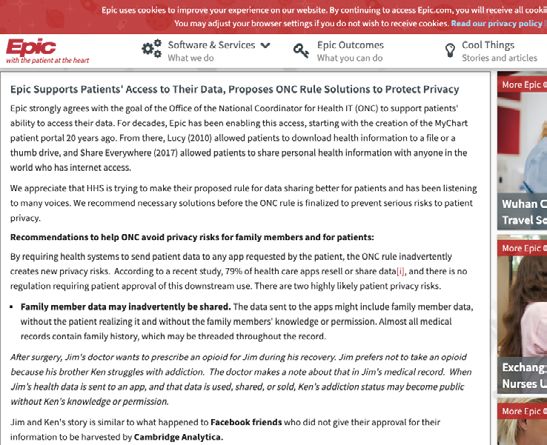
The gloves are off and the big guns are out. Epic Systems             organization of source patient data is proprietary information may
Corporation, the nation’s largest EHR vendor, is applying every       be the single largest impediment to liberating patient data.
fiber of its corporate being to dilute the government’s well-
crafted data interoperability rules before they become final. Most    For those who would like more information on the details of the
believe HHS will issue the new rules this month, February 2020.       proposed interoperability rules and data blocking, along with a
                                                                      description of current industry practices that limit the exchange
Under the banner of patient safety, Epic’s normally taciturn CEO      of patient data, please read my March 26, 2019, commentary
Judy Faulkner has stepped out of the shadows to persuade              “Interoperability Battle Lines: Data Freedom Fighters vs.
health systems to join her cause.1 She contacted leading health       Entrenched Data Blockers.” Today’s commentary will explore
system CEOs in January 2020 to request that they co-sign a            how a monied interest (Epic) combats progressive, pro-market
letter to HHS Secretary Azar requesting a delay in finalizing the     regulatory reforms.
proposed rules. Faulkner employed strident language in making
her case,                                                             My latest book, The Customer Revolution in Healthcare:
                                                                      Delivering Kinder, Smarter, Affordable Care for All, identifies a
  We are concerned that health care costs will rise, that care        massive Healthcare Industrial Complex as the root cause of the
  will suffer, and that patients and their family members will        U.S.’s high-cost, fragmented delivery system. This “System”
  lose control of their confidential health information.              enriches itself at the expense of the American people. Its
                                                                      incumbents operate business models that increase costs without
With $3 billion in revenues, 10,000 employees, over 160 hospital      improving health outcomes or overall societal health.
clients and an operating system that touches 40 percent of the
American population, Epic wields enormous influence over              There are hundreds, if not thousands, of micro-economies in
the market, patients and public opinion. Like many corporate          healthcare where healthcare companies exert monopoly pricing
behemoths, Epic also has the hubris to conflate its interests with    power. Epic is an example of a monopolistic company within the
patient interests.                                                    $30-plus billion2 EHR micro-economy. The System’s key players
                                                                      rely upon lax and beneficial regulation to optimize their market
Ironically, it is the current fragmented system of patient data       positions and profitability. In opposing the new interoperability
collection, curation and application that delivers suboptimal care    rules, Epic is first and foremost pursuing its own financial
outcomes, frustrates both practitioners and patients, complicates     interests.
standardization and limits innovation. Epic’s insistence that its

EPIC’S AUDACITY
The Oxford dictionary has the following two very different definitions for
the noun “audacity.”

  1.     A willingness to take bold risks.
         “her audacity came in handy during our most recent
         emergency”

  2.     Rude or disrespectful behavior; impudence.
         “she had the audacity to pick up the receiver and ask me
         to hang up”

After earning a graduate degree in computer science from the University
of Wisconsin in the 1970s, Judy Faulkner exhibited the first type of
audacity. She and a dozen fellow programmers pooled their money to
launch Epic in Faulkner’s basement.3 This is the bold, risk-taking type of
audacity people admire and applaud.

Faulkner and her colleagues had the audacious belief that they
could create a digital longitudinal medical record that could track
patients’ medical activity across inpatient, ambulatory and insurance
environments. And they did, using a 30-year old programming language
called M (formerly MUMPS). Epic software still runs on M today.

                                                                                                                                           2
Building on programming initiated at Massachusetts General              Increasingly Epic expects health systems to align their data
Hospital (where MUMPS originated) and with a $40 billion assist         semantics to Epic, not the reverse. Atul Gawande noted this
from the federal government4 (since 2010) to fund the creation of       in his insightful New Yorker article, “Why Doctors Hate Their
electronic health records, Epic has emerged as the clear market         Computers.”
leader. The company administers over 50% of the nation’s patient
records.5 It is the EHR that most major health systems employ.          While receiving Epic training at Partners, Gawande realized that
                                                                        standardizing data entry across hospitals, physician offices and
Today, more often than not, Epic exhibits the second form of            health systems complicates data entry. What used to take two
audacity. It pursues its corporate interests with limited regard for    keystrokes now takes seven. Checking boxes in pre-populated
others. This is the brazen, shameless type of audacity we, the          dropdown lists is a repetitive, time-consuming, mind-numbing
people of America, deride and fear.                                     exercise in frustration that impedes patient care. Gawande
                                                                        concludes the following after using Epic’s EHR for three years,
Epic restricts innovative companies from accessing source patient
data to build vital apps that could improve care outcomes and             But three years later I’ve come to feel that a system that
delivery efficiency. Epic crushes today’s young Judy Faulkners            promised to increase my mastery over my work has,
and their upstart health companies before they emerge from their          instead, increased my work’s mastery over me.
own basements.
                                                                        Gawande is hardly alone among physicians in castigating EHRs.
Epic forces companies that participate in its App Orchard to share      A recent study found 70% of physicians suffer stress related to
aspects of their intellectual property while preserving Epic’s rights   health IT usage.6 Epic and other EHR vendors have become
to develop similar technologies. Although Epic says publicly it         a form of Star Trek’s Borg, a collective organism that acquires
does not own the patient data that resides in its systems, the          knowledge and technology from external sources and then
practical impact of its contractual restrictions and practices in the   forcibly assimilates their clients into its drone army.
marketplace is that Epic maintains de facto control over health
systems’ ability to share patient data with other vendors.              The emergence of EHRs has increased burnout among frontline
                                                                        caregivers.7 They can’t keep up. Epic is the architect and
Despite this autocratic control, the industry has not received          administrator of their daily trauma. Epic apparently believes it
commensurate gains in efficiency. Still running on M, Epic’s data       is the answer to healthcare’s fragmentation. Audacity, thy name
platform is cumbersome. It requires enormous effort to clean            is Epic.
and normalize data for system application. It is time-consuming
and expensive for health system clients to make even routine
template changes.

                                                                                                                                           3
SCORCHED
EARTH TACTICS
In February 2019, HHS’ Office of the National
Coordinator of Health IT and CMS issued its
proposed new rules for data interoperability,
restrictions against data blocking and patient access
to their health records.

The rules took two years to draft. They implement a
clear statutory mandate under the 21st Century Cures
Act, which received broad bipartisan support and
was signed into law in December of 2016. The rules
are comprehensive and thoughtful. If implemented
as initially drafted, these new data usage rules will
stimulate game-changing innovations that will save
lives, minimize errors, reduce caregiver stress, lower
costs and enhance consumer experience.

Epic has opposed the proposed rules from the
moment of their release by ONC and CMS. It is
particularly ironic that Epic is leading the charge
against the new data-sharing rules when it owes so much of its               singing Epic’s praises and warning that the proposed new
corporate success to the federal government’s investment in EHR              rules would damage both Epic and the Wisconsin economy.
technologies.                                                                In a world where up is down and black is white, Thompson
                                                                             claims the new rules would force Epic to share its hard-earned
Epic is the ringleader for the Electronic Health Records                     intellectual property with competitors.
Association that requested and received a 30-day extension
to the comment period. In responding to the proposed                         The new rules will require Epic and other EHR vendors to share
rules, the EHRA questioned whether the proposed two-year                     source patient data; however, the rules will not require vendors
implementation period will be sufficient. EHRA also warned                   to share their intellectual property. Consequently, these rules
of unintended negative consequences associated with rule                     will stimulate innovation and improve patient outcomes.
implementation.
                                                                           • Fearmongering: Epic is devoting its entire homepage (as
Despite a vigorous lobbying effort, HHS has remained committed               of Jan. 30) to suggest “solutions” to improve the proposed
to issuing the new rules in close to their original form. It is for this     data-sharing rules. Its homepage includes a hypothetical
reason that Epic has increased its lobbying pressure. In addition            “Jim and Ken” case study where an unregulated app publicly
to Faulkner’s letter to health system CEOs, Epic has undertaken              reveals Ken’s opioid usage through Jim’s medical record. Epic
the following initiatives to distort, delay and/or derail these new          compares this to the Cambridge Analytica-Facebook scandal.
data rules.
                                                                             A second hypothetical case study illustrates how an
• Heavy-Handed Lobbying: Epic has rolled out a major publicity               unregulated wellness app receives the totality of Liz’s lab
  campaign in Metro Washington, DC to influence lawmakers.                   results when Liz thought she approved just the release of her
  The company is working hand-in-hand with other heavyweight                 cholesterol levels. In both cases, Epic positions its actions as
  advocates, including the American Medical Association, to                  stepping up to protect the vulnerable public.
  make the case that the proposed rules will harm patients.8
                                                                             We have always, and will always, support patients’ right
                                                                             to use their data as they see fit. However, it is the role of
  Epic has enlisted former Wisconsin governor and HHS
                                                                             government to ensure that patients have the information
  Secretary Tommy Thompson to its cause. Thompson was
                                                                             they need to make those decisions knowledgeably, like they
  current HHS Secretary Azar’s boss during the George W. Bush
                                                                             have for nutrition and food or labels in the clothes they
  administration and oversaw initial efforts to institute EHRs into
                                                                             buy. Patients must be fully informed about how apps will
  American healthcare.
                                                                             use their data, and apps and other companies must be held
                                                                             accountable to honor the promises they made to patients.
  Thompson penned an op ed in the Wisconsin State Journal

                                                                                                                                                4
Ironically, Epic’s reluctance to embrace cloud-based technologies       In a keynote address at the ONC’s annual meeting11 on Jan. 27,
and analytics limits its HIPAA compliance capabilities as well as its   Azar declared that “scare tactics” would not prevent HHS from
ability to employ artificial intelligence to drive better outcomes.     implementing necessary reforms. Azar might have had Epic in
                                                                        mind when he made the following observation,12
• Threats: In a recent interview with Politico, Faulkner suggested
  that Epic would sue the federal government if her company               Health records today are stored in a segmented,
  finds the final rules objectionable.9 Jeff Smith of the American        balkanized system. Unfortunately, some are defending
  Medical Informatics Association observed in an interview that           the balkanized, outdated status quo and fighting our
  he’d “never heard of organizations threatening to sue ONC               proposals fiercely. But defending the current system is a
  before.”10                                                              pretty unpopular place to be.

LIBERATED DATA SAVES LIVES
The moment of truth has arrived. Despite intense pressure,              Once implemented, the new rules will improve health outcomes
HHS appears prepared to move forward with its constructive              and service delivery while protecting patients’ privacy. As that
rules to improve data interoperability, prevent inappropriate           occurs, let’s hope that Epic has a Plan B to revolutionize its EHR
data blocking and grant better patient access to their health           platform and reduce the burden its products currently impose on
data. More power to them.                                               consumers and clinicians. Technology should make life easier and
                                                                        better. That’s the American way.
 Like all data, health data wants to be free, free-flowing and
protected. It wants to move to the places where it can have the
most positive impact. Pro-market regulations like the data-
sharing rules proposed by HHS level the competitive playing
field, stimulate innovation and create value. They will make
healthcare better.

SOURCES
1.       https://www.cnbc.com/2020/01/22/epic-ceo-sends-letter-urging-hospitals-to-oppose-hhs-data-sharing-rule.html

2.       https://www.fiercehealthcare.com/tech/global-ehr-market-hits-31-billion-but-faces-usability-interoperability-challenges

3.       http://www.fundinguniverse.com/company-histories/epic-systems-corporation-history/

4.       https://www.fiercehealthcare.com/tech/global-ehr-market-hits-31-billion-but-faces-usability-interoperability-challenges

5.       https://madison.com/news/local/govt-and-politics/epic-systems-draws-on-literature-greats-for-its-next-expansion/
         article_4d1cf67c-2abf-5cfd-8ce1-2da60ed84194.html

6.       https://ehrintelligence.com/news/study-shows-physician-burnout-directly-related-to-ehrs

7.       https://ehrintelligence.com/news/study-shows-physician-burnout-directly-related-to-ehrs

8.       https://finance.yahoo.com/news/health-care-data-sharing-rules-160214326.html

9.       https://www.politico.com/newsletters/morning-ehealth/2020/01/24/epic-ramps-up-campaign-against-hhs-interop-
         rules-784623

10.      https://finance.yahoo.com/news/health-care-data-sharing-rules-160214326.html

11.      https://www.healthit.gov/news/events/2020-onc-annual-meeting

12.      https://www.modernhealthcare.com/information-technology/azar-scare-tactics-wont-stall-interoperability-rules?utm_
         source=modern-healthcare-hits&utm_medium=email&utm_campaign=20200127&utm_content=article1-headline

                                                                                                                                             5
David Johnson is the CEO of 4sight Health, a thought leadership and advisory company working at the intersection
of strategy, economics, innovation and capital formation. Dave wakes up every morning trying to fix America’s broken
healthcare system. Prior to founding 4sight Health in 2014, Dave had a long and successful career in healthcare
investment banking. He is a graduate of Colgate University and earned a Masters in Public Policy from Harvard
Kennedy School. Employing his knowledge and experience in health policy, economics, statistics, behavioral finance,
disruptive innovation, organizational change and complexity theory, Dave writes and speaks on pro-market healthcare
reform. His first book Market vs. Medicine: America’s Epic Fight for Better, Affordable Healthcare, and his second
book, The Customer Revolution in Healthcare: Delivering Kinder, Smarter, Affordable Care for All (McGraw-Hill
2019), are available for purchase on www.4sighthealth.com.
Join The Customer Revolution in Healthcare
Read about today’s revolutionary forces and leaders in David
Johnson’s latest book, The Customer Revolution in Healthcare,
available for purchase on RevolutionaryHC.com
6You can also read


