Higher-Order Musical Temporal Structure in Bird Song - Frontiers
←
→
Page content transcription
If your browser does not render page correctly, please read the page content below
ORIGINAL RESEARCH
                                                                                                                                               published: 25 March 2021
                                                                                                                                        doi: 10.3389/fpsyg.2021.629456

                                                Higher-Order Musical Temporal
                                                Structure in Bird Song
                                                Hans T. Bilger 1,2*, Emily Vertosick 3 , Andrew Vickers 3 , Konrad Kaczmarek 4 and
                                                Richard O. Prum 1
                                                1
                                                  Department of Ecology and Evolutionary Biology, and Peabody Museum of Natural History, Yale University, New Haven, CT,
                                                United States, 2 Department of Integrative Biology, University of Texas, Austin, TX, United States, 3 Department of
                                                Epidemiology and Biostatistics, Memorial Sloan Kettering Cancer Center, New York, NY, United States, 4 Department of
                                                Music, Yale University, New Haven, CT, United States

                                                Bird songs often display musical acoustic features such as tonal pitch selection,
                                                rhythmicity, and melodic contouring. We investigated higher-order musical temporal
                                                structure in bird song using an experimental method called “music scrambling” with
                                                human subjects. Recorded songs from a phylogenetically diverse group of 20 avian
                                                taxa were split into constituent elements (“notes” or “syllables”) and recombined in
                                                original and random order. Human subjects were asked to evaluate which version
                                                sounded more “musical” on a per-species basis. Species identity and stimulus treatment
                                                were concealed from subjects, and stimulus presentation order was randomized within
                                                and between taxa. Two recordings of human music were included as a control for
                                                attentiveness. Participants varied in their assessments of individual species musicality,
                                                but overall they were significantly more likely to rate bird songs with original temporal
                          Edited by:            sequence as more musical than those with randomized temporal sequence. We discuss
                Julia Hyland Bruno,
                                                alternative hypotheses for the origins of avian musicality, including honest signaling,
   Columbia University, United States
                                                perceptual bias, and arbitrary aesthetic coevolution.
                        Reviewed by:
                       Dave Gammon,             Keywords: bio-musicology, musicality, linguistics, bird song, sexual selection, honest signaling, perceptual bias,
         Elon University, United States         aesthetic evolution
                    Erich David Jarvis,
        Duke University, United States

                 *Correspondence:               INTRODUCTION
                        Hans T. Bilger
               hansbilger@utexas.edu            Many bird songs show striking behavioral, neural, genetic, and developmental parallels with human
                                                language (Doupe and Kuhl, 1999; Bolhuis et al., 2010; Bolhuis, 2013; Lipkind et al., 2013; Jarvis,
                   Specialty section:           2019; Hyland Bruno et al., 2020). Like language, bird song can be combinatorial and hierarchical:
         This article was submitted to          Elements, or notes, combine to form syllables; syllables are combined into phrases; phrases are
            Comparative Psychology,             combined to form songs; and multiple songs comprise an individual song repertoire (ten Cate and
               a section of the journal
                                                Okanoya, 2012; Bowling and Fitch, 2015). But the linguistic analogy breaks down above this basic
               Frontiers in Psychology
                                                scheme. Since bird songs seem to lack symbolic meaning beyond basic functional reference, they
       Received: 14 November 2020               cannot have words, semantics, or syntax in the strict linguistic sense (Marler et al., 1992; Berwick
        Accepted: 25 February 2021
                                                et al., 2011; Bowling and Fitch, 2015). To make empirical sense of the structure and content of bird
         Published: 25 March 2021
                                                song, we need different conceptual tools.
                             Citation:
                                                    Music can be defined as “human sound communication outside the scope of spoken language”
     Bilger HT, Vertosick E, Vickers A,
   Kaczmarek K and Prum RO (2021)
                                                (Nettl, 2005:25). Although music varies greatly across cultures in its acoustic features, behavioral
      Higher-Order Musical Temporal             context, and conceptual framing, it also appears to have remarkable statistically “universal” qualities
               Structure in Bird Song.          (Stumpf, 1911; Voss and Clarke, 1975; Nettl, 2005; Savage et al., 2015; Mehr et al., 2019). Analyzing
          Front. Psychol. 12:629456.            a diverse global ethnographic sample, Mehr et al. (2019) found that human vocal songs: (1) showed
    doi: 10.3389/fpsyg.2021.629456              more variation within than between societies, (2) were reliably associated with behavioral contexts

Frontiers in Psychology | www.frontiersin.org                                         1                                         March 2021 | Volume 12 | Article 629456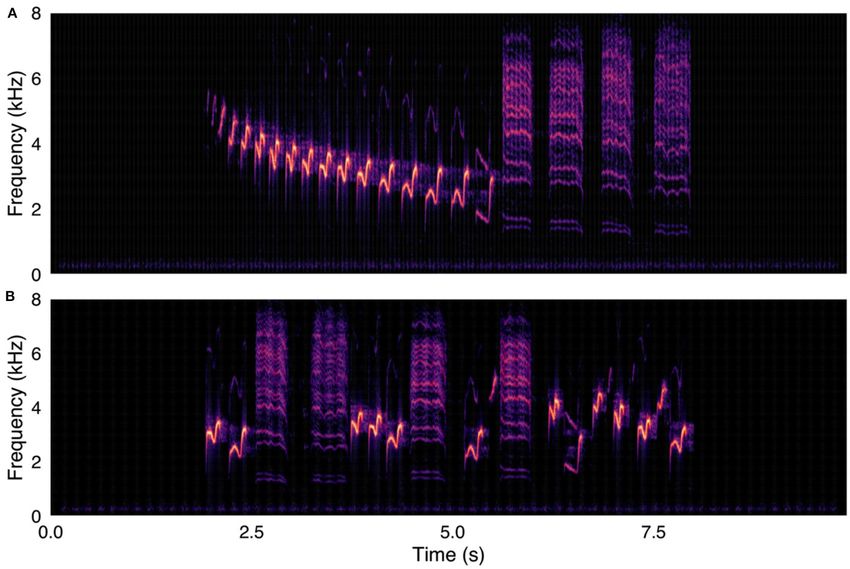
Bilger et al.                                                                                                                    Bird Song Musicality

like love, dance, infant care, religious activity, play, and healing,       phase and Wiener entropy plots to trace the rhythmic and
(3) nearly always displayed tonality, and (4) showed power-                 tonal trajectories of Thrush Nightingale songs, uncovering
law distributions of melodic and rhythmic ratios, where a few               “escalations” and “modifications” of rhythm and frequency
frequently used ratios dominate, followed by a “heavy tail”                 formally similar to some human music. Studying the same
of rarer ones (Adamic, 2011). Bird song has described in                    species, Roeske et al. (2018) used “multi-fractal analysis” to
musical terms for centuries—in Historia Animalium (Stap, 2005),             uncover musical variations in the timing, duration, and intensity
Aristotle described a nightingale giving “lessons in singing to             of notes across different levels of temporal hierarchy. Along
a young bird”—but until recently, most scientific literature on             similar lines, Janney et al. (2016) found that Pied Butcherbirds
music and bird song was biologically superficial and overly reliant         (Cracticus nigrogularis) with more “phrase types” in their
on Eurocentric conceptions of musical structure (Rothenberg                 repertoires tended to repeat common motifs shared across phrase
et al., 2014). Convergences between bird song and music were                types more often than those with repertoires composed of
treated as objects of idle charm, and comparative studies often             fewer phrase types. This implied a repertoire size-dependent
simply examined times when famous Western composers got                     optimization of “balance between repetition and novelty” in long
inspired by birds (e.g., Keister and Baptista, 2005).                       song bouts (Janney et al., 2016).
   However, Darwin (1871), Craig (1943), Armstrong (1963),                      Musical structure at these higher levels may exist in bird song,
Hartshorne (1973) and Rothenberg et al. (2014) and others have              but the fact cannot be assumed a priori. Musicality is a percept—
given serious consideration to the idea that musical aesthetics             not a physically definable property of a sound—and humans are
can provide intellectual insights into avian evolution. Hartshorne          the only species from which we can collect direct reports on
(1958, 1973) considered bird song an “evolutionary anticipation             subjective aesthetic evaluations. So, the best way to test for the
of human music,” and used a six-dimensional rating system                   presence of musicality in bird song is to use humans as musical
to quantify the “singing skill” of thousands of avian species               feature detectors. As one of the classic ethnomusicology texts
according to the parameters: Loudness or carrying power, Scope              states, “All humans can identify music—though not necessarily
(variety and complexity), Continuity (shortness of pauses in a              understand it—when they hear it” (Nettl, 2005:25).
standard performance), Tone quality (shown by narrow bands                      Here, we used human subjects to evaluate whether there is
in a spectrogram), Organization or Order (Gestalt closure,                  higher-order, musical temporal structure in complex bird songs.
musical coherence), and Imitative ability. Though Hartshorne’s              By temporal musical structure, we mean time-based variation in
analyses were statistically rudimentary, his explicit goal was to           acoustic content that elicits a positive hedonic response in the
relate “song-development” to biologically relevant factors such             listener. To test for the existence of musical structure, we used
as behavioral context, plumage coloration, diet, and habitat                the method “music scrambling” from the field of experimental
(Hartshorne, 1973).                                                         music cognition (Levitin and Menon, 2003, 2005; Abrams et al.,
   Recently, several more investigations of bird song musicality            2011), which involves reordering segments of recorded sound so
have been conducted with new empirical rigor (Fitch, 2015).                 that its temporal structure can be disturbed without significantly
Doolittle et al. (2014) and Araya-Salas (2012) compared the                 altering its global length or total spectral content. Functional
frequency ratios used in Hermit Thrush (Catharus guttatus) and              MRI studies have shown differential responses to normal and
Nightingale Wren (Microcerculus philomela) song to common                   scrambled music in music-sensitive populations of neurons in
harmonic intervals used in Western tonal music, demonstrating               humans (e.g., Norman-Haignere et al., 2015).
convergence in the first case and its absence in the second.                    To our knowledge, this is the first general test of the existence
Using human subjects, Doolittle and Brumm (2012) found that                 of high-order musical temporal structure across a range of
synthesized versions of Musician Wren (Cyphorhinus arada)                   avian taxa.
songs that preserved the original intervallic relationships between
notes evaluated as more “musical” than songs with slightly
deformed tonal relationships. Patel et al. (2009; see also Keehn            MATERIALS AND METHODS
et al., 2019) reported behavioral evidence of musical beat
perception and synchronization in a Sulfur-crested Cockatoo                 Sampling Method
(Cacatua galerita eleonora), the first description of such behavior         We are not investigating whether all bird songs have high-order
in a non-human animal. In another rhythmicity study, Roeske                 musical temporal structure, but whether any bird songs do. Thus,
et al. (2020) showed that Thrush Nightingale (Luscinia luscinia)            we used a specifically biased sample of highly complex bird songs
rhythms, similar to many human ones, are categorical and                    exhibiting a variety of what we perceived to be musical features.
centered around small ratios. Earp and Maney (2012) found                   We did not include in our sample any songs that obviously lack
when female White-throated Sparrows (Zonotrichia albicollis)                complex temporal structure among syllables, such as songs that
in a reproductive state listened to song from male conspecifics,            include a series of identical notes uttered at a continuous pace
immediate early gene activity increased in every region of the              (e.g., Chipping Sparrow, Spizella passerina). Rather, we selected
mesolimbic reward pathway that shows differential response to               songs characterized by complex acoustic structure composed of
music in its putative human homolog.                                        discrete and variable notes or syllables. We also selected bird
   Many musical signals also exhibit temporal structure at                  songs with notes and syllables that were temporally discrete
more complex levels of organization. Rothenberg et al. (2014)               rather than graded and continuous in order to facilitate temporal
quantified aspects of “higher order” musicality by using                    scrambling without creating obvious acoustic artifacts.

Frontiers in Psychology | www.frontiersin.org                           2                                     March 2021 | Volume 12 | Article 629456
Bilger et al.                                                                                                                                         Bird Song Musicality

   Our sample included single songs or single song bouts                                        longer than 1 s. Some recordings from species with comparatively
from 20 bird species from 13 different families (Table 1).                                      short or fast-paced songs included multiple songs; in these cases,
Nineteen samples were songs of male oscine songbirds                                            notes/syllables were randomized within individual songs and the
(Passeri, Passeriformes), and one was a mechanically produced                                   periods of silence between songs were preserved. 2 s of relative
winnowing tail sound from a displaying male Wilson’s Snipe                                      silence from the original source recording was added before
(Gallinago delicata; Scolopacidae, Charadriiformes). Recordings                                 the beginning and after the ending of each song in order to
were collected from various archival sources (see Table 1).                                     normalize the presentation of stimuli. Envelopes of ∼0.2 s were
                                                                                                applied to each note/syllable file to reduce boundary artifacts
Stimulus Preparation                                                                            upon recombination. Audition’s spectral editing tool was used to
High-quality digital audio files of bird songs with minimal                                     decrease background noise, normalize the recordings and remove
background noise were edited using the program Audition CC                                      unwanted sonic artifacts (other bird vocalizations, environmental
(Adobe Audition CC, Adobe Systems, San Diego, CA, USA).                                         noise, etc.). The Noise Reduction tool was used to decrease
First, each note or syllable was split into a separate audio file.                              the general background noise, and prominent artifacts were
Each file began at the exact onset of the sound and ended just                                  manually removed from the spectrogram.
before the onset of the next note or syllable (i.e., gaps between                                   After each bird song was edited into its component
syllables were grouped with the previous syllable). Terminal                                    notes/syllables, the edited audio files were recombined into
syllables were cut off after the end of visually detectable sound                               two versions: one in original temporal order, and another with
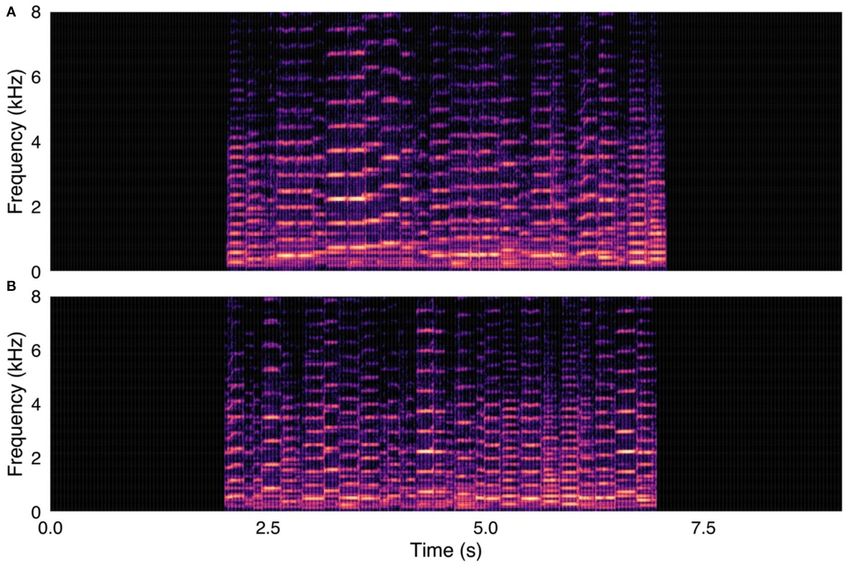
in the spectrogram. Editing was done visually following ten                                     random temporal order (Figures 1, 2). The new recordings
Cate and Okanoya (2012). Thus, edited audio files varied in                                     were then reviewed once more and converted to mp3
length with the length of the note or syllable from ∼6 ms to                                    files for uploading onto the online survey platform. All
                                                                                                stimulus audio files have been uploaded to Mendeley Data
                                                                                                (doi: 10.17632/pkrvf77by8.2). Spectrograms of all stimuli are
                                                                                                available in the Supplementary Material.
TABLE 1 | Experimental stimulus identities and sources.

Family               Common name                    Species                     Source
                                                                                                Survey Design and Implementation
Scolopacidae         Wilson’s Snipe                 Gallinago delicata          C               A psychophysical survey for human subjects was created using
Atrichornidae        Noisy Scrubbird                Atrichornis clamosus        I               the online platform Qualtrics. In the survey, subjects were given
Acanthizidae         Scrubtit                       Acanthornis magna           J               the following prompt and instructions:
                     Striated Fieldwren             Calamanthus fuliginosis J
Artamidae            Gray Butcherbird               Cracticus torquatus         E                  “Music is often characterized by tunefulness, harmony, temporal
Pachycephalidae      Gray Shrikethrush              Colluricincla harmonica E                      patterning, and thematic development. In each question, you
Regulidae            Common Firecrest               Regulus ignicapilla         D                  will hear a series of two audio recordings. Please indicate which
Cettidiae            Japanese Bush Warbler          Horornis diphone            F
                                                                                                   sounds more musical with regard to the qualities listed above.”
Muscicapidae         Madagascar Magpie-Robin Copsychus                          H
                                             albospecularis                                     The prompt was designed to suggest to the subjects a broad
Mimidae              Brown Thrasher                 Toxostoma rufum             B               range of criteria that might influence the evaluation of musicality
Troglodytidae        Canyon Wren                    Catherpes mexicanus         C               without specifying temporal pattern exclusively. The subjects
                     Winter Wren                    Troglodytes hiemalis        C               were then presented with original sequence and temporally
Fringillidae         Citril Finch                   Carduelis citrinella        D               randomized recordings from the 20 bird species under review.
                     Common Chaffinch               Fringilla coelebs           D               Two recordings of human music (excerpts of solo fiddle and
Passerellidae        Red Fox Sparrow                Passerella iliaca           B               banjo performances) were manipulated in a similar manner
                     White-crowned Sparrow          Zonotrichia leucophrys      B               and presented along with the bird song recordings as a control
                     Field Sparrow                  Spizella pusilla            B               for subject attentiveness or perverse responses. The order of
                     Vesper Sparrow                 Pooecetes gramineus         G               species/human music presentation was randomized, as was the
                     Bachman’s Sparrow              Peucaea aestivalis          A               order of natural vs. manipulated stimuli within species. Subjects
Cardinalidae         Lazuli Bunting                 Passerina amoena            G               were required to start the playback of each recording themselves,
Attentiveness        Fiddle                         Homo sapiens                K               and a timer was implemented so that it would not be possible to
Control                                                                                         advance to the next sample until the subject had had time to listen
                     Banjo                          Homo sapiens                L               to the entire recording.
Recording sources: A, Stokes Field Guide to Bird Songs: Eastern Region; B, Donald
                                                                                                    All subjects provided personal demographic information
Kroodsma, The Singing Life of Birds; C, Cornell Lab of Ornithology, The Diversity of            including: gender; whether they were hearing impaired; whether
Animal Sounds; D, Andreas Schulze and Karl-Heinz Dingler, Die Vogelstimmen Europas,             they had experience identifying wild birds by song; whether
Nordafrikas, und Vorderasiens; E, David Stewart, Australian Bird Calls: Subtropical East;       they had ever owned pet birds; and how much prior musical
F, Hideo Ueda, Wild Bird Songs of Japan; G, Stokes Field Guide to Bird Songs: Western
Region; H, British Library Sound Archive, Bird Sounds of Madagascar; I, XC40687, Mark
                                                                                                experience they had. All subjects were 18 years or older.
Harper, xeno-canto.org; J, David Stewart, Australian Bird Calls: Tasmania; K, “Rolling          Following Doolittle and Brumm (2012), the musical experience
Waves,” Pitnacree, unreleased recording; L, “Josie-O” on Earth Tones, by Adam Hurt.             categories available to participants were:

Frontiers in Psychology | www.frontiersin.org                                               3                                      March 2021 | Volume 12 | Article 629456
Bilger et al. Bird Song Musicality
FIGURE 1 | (A, upper panel) Canyon wren (Catherpes mexicanus) recording used in survey, with song elements in original temporal order. (B, lower panel) Same
Canyon wren recording, with song elements in randomized temporal order. Spectrograms were created with were created using a 1024-point FFT and a Hamming
window with 87.5% overlap.
a.) “little or no experience studying music, singing, or playing or banjo music as more musical than the original temporal
an instrument,” sequence recordings. We concluded that they were inattentive
b.) “amateur/some experience studying music, singing, or or malicious, and they were eliminated from any further
playing an instrument,” and consideration (Fleischer et al., 2015). Given the frequency of
c.) “professional/extensive experience studying music, singing, inattentive responses to our two control questions, we could
or playing an instrument.” expect there may be as many as 23 additional inattentive subjects
making random choices included in our analysis. One additional
Summaries of subject demographic and personal experience data
observation was excluded because it was a duplicate survey from
are presented in Table 2.
the same coordinates (latitude and longitude); we kept the first
Subjects were recruited using Amazon’s crowdsourcing
survey taken from that respondent and excluded the second.
marketplace Mechanical Turk, and paid a small fee for their
The processed survey response dataset used in the statistical
participation. We only accepted subjects who had had at least
analysis can be found at the Mendeley Data link provided in Data
90% of their previous MTurk tasks approved, and IP address
Availability Statement.
and geolocation information were used to ensure that duplicate
We first assessed whether there was a difference in musicality
surveys were not counted. On the MTurk website, the activity was
ratings between the 20 species studied. Each participant evaluated
entitled “Sound Musicality Survey.” No information provided to
all 20 species, leading to correlation between responses for
the participants mentioned that the sounds were bird songs. The
different species assessed by the same participant. To account
survey took an average of 19 min and 56 s to complete.
for the correlation in musicality evaluations between different
species assessed by the same participant, we analyzed the
Statistical Analysis responses from the remaining 92 subjects using a multilevel
We recruited a sample of 126 human subjects. There were 33 mixed-effects logistic regression model with the endpoint of
subjects who identified either the temporally randomized fiddle correct assignment of original order vs. the endpoint of
Frontiers in Psychology | www.frontiersin.org 4 March 2021 | Volume 12 | Article 629456Bilger et al. Bird Song Musicality
FIGURE 2 | (A, upper panel) Control stimulus from survey. Human fiddle music recording, with notes in original temporal order. (B, lower panel) Same fiddle music
recording, with notes in randomized temporal order. Spectrograms were created with were created using a 1024-point FFT and a Hamming window with 87.5%
overlap.
temporally randomized bird song. Species was included as a fixed TABLE 2 | Characteristics of survey subjects, N = 92.
effect in the model, participant as a random effect, with musical
Male gender 51 (55%)
experience and bird ownership as covariates. To assess whether
Survey taker is hearing impaired 1 (1.1%)
original order bird songs were more likely to be assessed as more
Experience with studying music, singing, playing an instrument
musical by participants overall, we performed a meta-analysis
Little/no experience 42 (46%)
using the proportion of participants choosing original order bird
Amateur/some experience 46 (50%)
song across all species. All analyses were conducted using Stata
Professional/extensive experience 4 (4.3%)
15 (Stata Corp., College Station, TX).
Survey taker has experience with wild bird song 10 (11%)
Survey taker is a bird owner 27 (29%)
RESULTS
The random effect on our logistic regression model was highly
significant (p < 0.0001), suggesting that subjects varied in their and Wilson’s Snipe) had average musicality evaluation responses
musicality ratings of original order vs. temporally randomized that were less musical than the null expectation, but none of
songs of this sample of avian species. We also found a highly these were statistically distinguishable from the null. Combining
significant difference in musicality ratings across all bird species the results from each species meta-analytically, bird songs with
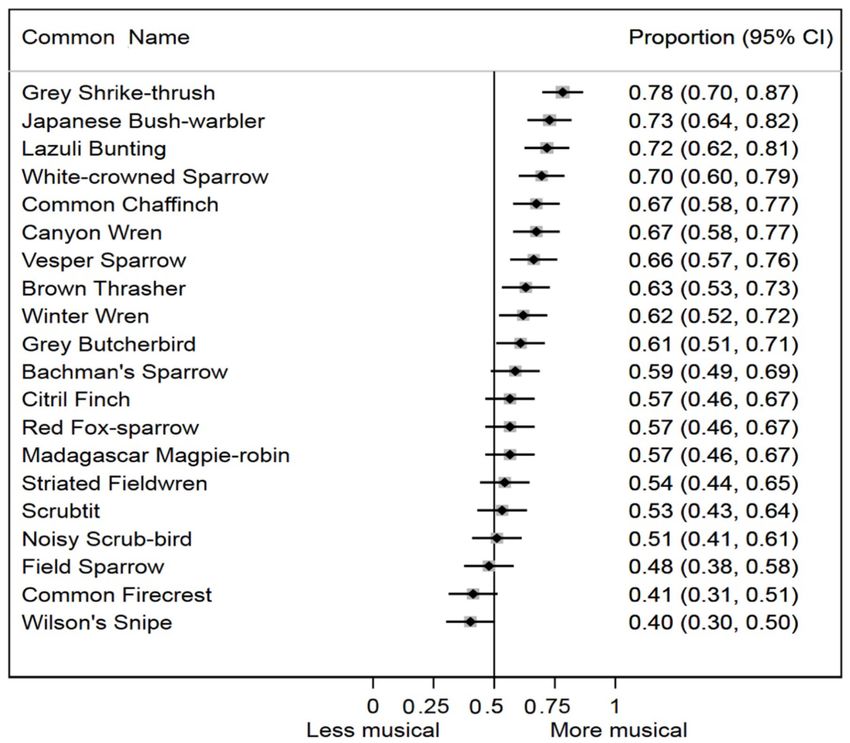
studied (p < 0.0001). For 10 of 20 species in the study, the original temporal sequence were significantly more likely to be
95% confidence intervals for the average musicality responses evaluated as more musical by human subjects than bird songs
both excluded, and were more musical than, the null expectation with randomized temporal sequence (p < 0.0001).
(Figure 3). For seven of 20 species, the average musicality Musicality ratings were not affected by either musical
responses were more musical than, but did not exclude, the null. experience of the subjects (some experience vs. no experience
Only three of 20 species (Field Sparrow, Common Firecrest, odds ratio 0.93; 95% C.I. 0.69, 1.26; extensive experience vs. no
Frontiers in Psychology | www.frontiersin.org 5 March 2021 | Volume 12 | Article 629456Bilger et al. Bird Song Musicality
FIGURE 3 | Proportion of human subjects who rated the original order song of each species as more musical, with 95% confidence intervals ordered from high to low.
experience odds ratio 0.68; 95% C.I. 0.33, 1.40; p = 0.6) or by humans can confirm the broad existence of musical structure
history of pet bird ownership (odds ratio 1.36; 95% C.I. 0.98, 1.88; per se. So, we have used human subjects to evaluate the relative
p = 0.064). musicality of the specific, original sequence of notes/syllables
found in natural songs compared to a randomized sequence
of the same notes/syllables. We found strong support for the
DISCUSSION hypothesis that the temporal sequence of notes/syllables is
musically non-random in some bird songs.
We hypothesized that some acoustically complex bird songs have Western classical compositions are often characterized as
higher order, musical temporal structure. In other words, we having temporal development, such as introduction, variations
hypothesize that syllable sequence is not temporally arbitrary for on a theme, and creation/resolution of expectations (e.g., Huron,
some birds, but has specifically evolved because of its aesthetic, 2006; Morgan et al., 2019). Human psychological research
musical impact upon the receiver. Given that the critical agents demonstrates that perception of musicality is strongly associated
in this evolutionary process are birds themselves, it is reasonable with the presence of natural temporal structure (e.g., Norman-
to ask why our question was not addressed via behavioral tests Haignere et al., 2015). This finding supports our conclusion that
on avian subjects. However, our question was whether bird song human subjects can perceive aesthetic temporal structure in some
evinces high-order musical temporal structure at all. This is bird songs.
a subjective question that cannot be answered via behavioral Bird songs are so much shorter in duration than most human
observation. It requires “introspective access” (sensu Bowling musical performances, they may be better compared to musical
and Fitch, 2015) to aesthetic evaluations, which means that only motives (Hartshorne, 1973). Motives are shorter musical themes
Frontiers in Psychology | www.frontiersin.org 6 March 2021 | Volume 12 | Article 629456Bilger et al. Bird Song Musicality
or “ideas” that are characterized by a series of notes of particular a productive study object for vocal evolution research since it is
pitches and rhythmic sequence (Zbikowski, 1999). Motives also hierarchically organized, common to language and music, and
have aesthetic structure—i.e., their musical effect would be independent from semantic meaning (Mol et al., 2017).
transformed or disrupted if the sequence of pitches or the amount The fact that both birds and humans exhibit temporal
of time between discrete sonic events were scrambled. pattern-dependent categorical perception and prosody salience
Some examples of musical temporal structure in bird song is likely due to convergent evolution. But avian possession of
appear obvious to many listeners. Pied Butcherbirds sing in these important perceptual building blocks of human musicality
antiphonal choruses whose interlocking parts resemble the suggests that aesthetic perception of sound is likely not restricted
“hocketed” lines of medieval motets and freely improvised jazz to humans.
(Taylor, 2010). Male Club-winged Manakins (Machaeropterus
deliciosus) stridulate their secondary wing feathers during Origins of Avian Musicality
courtship to create sustained, string instrument-like tones Why should temporal musicality evolve in bird song? Unlike
(Bostwick and Prum, 2005). Among the species used in our alarm calls, for example, bird song functions in sexual signaling,
sample, the songs of male Japanese Bush Warbler (Horornis and is hypothesized to evolve primarily under sexual selection.
diphone) are famous for their musicality (Hartshorne, 1973). We will consider three hypotheses concerning avian acoustic
They are characterized by an initial penetrating pure tone signal evolution: honest signaling theory, sensory/cognitive bias,
or series of tones that increase in volume, and an abrupt and arbitrary aesthetic coevolution.
cascade of diverse and rapidly modulated pure tones on different Honest signaling theory suggests that reliable information
frequencies. This temporal sequence of events has a clear about signaler quality or condition is insured by the production
analog in the “introduction, variation, and resolution” phrase and survival costs of the signal (Gil and Gahr, 2002). In honest
structure found across many human musical traditions. Perhaps signaling, the adaptive advantage of the song is an extrinsic
unsurprisingly, human subjects rated the natural song of Japanese property that is correlated with, but not part of, the sexual signal
Bush Warbler more musical at a higher frequency than nearly such as good genes that will enhance the survival of offspring,
every other species in our sample. material resources necessary for reproduction, minimizing search
When we scramble music, bird song, or speech, what exactly is costs, or protection from sexually transmitted diseases or other
disrupted for the receiver? In human speech, temporal patterning infections. In bird song, the potential for encoding information
affects categorical perception. In certain cases, identical sounds about mate quality in song has been hypothesized to be related
are classified as different phonemes depending on their location to motor constraints, such as the trade-off between trill rate
in the speech stream (Bloch, 1941; Lachlan and Nowicki, and frequency bandwidth in songbird song elements (e.g.,
2015). Auditory perception in some songbirds exhibits a similar Podos, 1997; Ballentine et al., 2004). However, in general,
dependency. Lachlan and Nowicki (2015) studied three related musical structures do not appear to be strongly shaped by such
note types in Swamp Sparrow (Melospiza georgiana) song, which constraints. Human vocal songs tend to be “dominated by small
they named “short,” “intermediate,” and “long.” The types are melodic intervals and simple rhythmic ratios” (Mehr et al., 2019).
easy to separate via acoustic clustering methods, but the study A small melodic ratio implies a narrow frequency bandwidth
population of Swamp Sparrows perceived only two categories in between adjacent notes. If human songs were optimized for
playback experiments: short and long. In further experiments, “performance,” we would expect them to compensate for these
the authors determined that “intermediate” notes tended to be small ratios by favoring fast trills by design, at least by the
classified as “short” if they fell at the beginning of a syllable and trill rate/bandwidth interpretation of vocal performance. This is
“long” if they fell at the end. Roeske et al.’s (2020) discovery plainly untrue, as human song incorporates a variety of speeds
of small ratio, categorical rhythms in Thrush Nightingale songs and rhythms. Since human song appears to strongly deviate from
suggests a similar perceptual grounding—scrambling note order vocal motor limits, it is “low performance” by design. Therefore,
redistributes the onset-to-onset interval times in a given song, the presence of musical structure in bird song is not predicted
possibly shifting them toward ratios less typical (and therefore by the most prominent avian acoustic application of honest
possibly less preferred) for the species. signaling theory.
Above the level of segment sequence in speech is “prosody,” A second hypothesis is that sensory/cognitive biases emerge
or variation in the frequency, timing, and intensity of elements in the context of mate choice which arise from independent
over the course of a spoken phrase (Mol et al., 2017). Analogous adaptations or basic design constraints of the sensory and
variation in musical phrasing is sometimes called “musical cognitive systems (Ryan and Cummings, 2013; Renoult and
prosody” and can be critical in establishing and manipulating Mendelson, 2019). A classic, acoustic example comes from the
musical expectation in listeners (Huron, 2006; Palmer and túngara frog (Physalaemus pustulosus), where the dominant
Hutchins, 2006; Heffner and Slevc, 2015). Certain songbirds frequencies of male advertisement call components match the
appear sensitive to prosodic cues in human speech as well. In previously-evolved tuning of the female inner ear organs (Ryan,
a set of behavioral experiments, Spierings and ten Cate (2014) 1985; Ryan and Rand, 1990; Ryan et al., 2019). Other biases
found that Zebra Finches (Taeniopygia guttata) responded more may be more cognitively rooted, such as the preferences for
to prosodic cues in manipulated human speech recordings than more complex songs and/or larger repertoires in many oscines,
syntactic structure—and they responded even more strongly to possibly due to an adaptive avoidance of neurological habituation
prosody than human subjects did. Prosodic structure could be (e.g., Catchpole, 1986; Eda-Fujiwara et al., 2006; Ryan and
Frontiers in Psychology | www.frontiersin.org 7 March 2021 | Volume 12 | Article 629456Bilger et al. Bird Song Musicality Cummings, 2013). Importantly, though, evolution of traits due the building and fulfillment of expectation. In this way, we to sensory/cognitive biases alone will not lead to coevolution of can conceptualize the evolution of temporal musicality in bird traits/preferences. This is because such biases, by definition, are song as the result of an interaction between arbitrary sexual the result of natural selection on unrelated traits. selection and broad cognitive biases for aesthetically attractive Alternatively, temporal musical structure in bird song could temporal structure in acoustic sexual signals. Multiple lineages evolve because it is more aesthetically attractive to learners of oscine birds have independently evolved songs with higher- and receivers than other possible sonic sequences. Aesthetic order musical temporal structure as they reached a certain coevolution involves sensory perception, cognitive evaluation, threshold of acoustic complexity and strength of selection and choice based on genetically or culturally transmitted (Devoogd et al., 1993). Future work on aesthetic evolution in variation (Prum, 2012, 2017). More specifically, musical temporal bird song should work to characterize the nature of acoustic structure in bird songs could evolve as an arbitrary sexually aesthetic biases by comparing multiple evolutionary origins of selected trait (Fisher, 1958; Lande, 1981; Kirkpatrick, 1982; Prum, complex, higher-order temporal structure to close relatives that 2010, 2012, 2017; Bailey and Moore, 2012)— i.e., there is no lack such complexity. causal correlation between temporal musicality in bird song and Our explicitly aesthetic hypothesis for the evolution of bird signaler quality or condition. Such songs are neither honest nor song’s musicality continues the tradition of Darwin (1871), dishonest because they are unrelated to any extrinsic quality who characterized male oscine song as “having the power to information that can be lied about. Rather, they are merely charm the female.” A century later, Hartshorne (1973) proposed available for aesthetic evaluation by receivers, and subject to the “monotony threshold hypothesis,” which proposes that subsequent sexual or social selection. However, the sharing of vocal repertoire diversity evolves to prevent habituation—i.e., components of musicality by some complex bird songs and boredom—in the receiver. The monotony threshold suggests human music implies that these avian acoustic signals are an inverse relationship between “continuity” and “variety” in extremely non-random in another way—their aesthetic impact bird song. Hartshorne posited that birds with more elaborate upon the receiver (Rothenberg et al., 2014; Roeske et al., 2020). repertoires tend to sing more continuously than birds with To distinguish between arbitrary aesthetic coevolution (Bailey simpler, more repetitive vocalizations. Vocal learning plays a role and Moore, 2012; Prum, 2012, 2017) and perceptual bias here as well: species that learn their songs tend to have larger (Ryan and Cummings, 2013; Renoult and Mendelson, 2019), repertoires than those who do not (Marler, 2000). we need evidence of coevolution of preferences and traits. Evidence suggesting such a dynamic is abundant for oscine birds. Classic studies of male neural/cognitive templates, or learning Variation in Musical Temporal Structure biases, demonstrate that heritable, biologically evolving neural Among Species preferences can coevolve with the vocal structure of male song Empirical data already document that there are significant (e.g., Nottebohm, 1968, 1970; Marler and Waser, 1977; Marler variations among species in bird song’s musical acoustic and Sherman, 1983; Lachlan and Feldman, 2003). On the other structure. Some species appear to explore harmonic content, extreme, Derryberry (2007) conducted a playback experiment whereas others explore rhythmic variation (e.g., Doolittle et al., on the White-crowned Sparrows (Zonotrichia leucophrys)—a 2014; Rothenberg et al., 2014; Roeske et al., 2020). Although species with a song that was ranked as having with among our study was not designed to investigate differential musical the most musical temporal structure in our sample (Figure 3). temporal structure among species, our data do yield some In a population in the Sierra Nevada, California, Derryberry useful comparative observations. The four species with the played song recordings to wild female and male sparrows of highest perceived musical temporal structure in our study were contemporaneous male songs, and male songs recorded 24 years Japanese Bush Warbler (Horornis diphone), Gray Shrikethrush earlier at the same locality. She found that the older songs elicited (Colluricincla harmonica), Lazuli Bunting (Passerina amoena), nearly half the social response—either male territorial challenges, and White-crowned Sparrow (Zonotrichia leucophrys). The songs or curious female interest—as the contemporaneous songs did. In of the latter three were complex along Hartshorne’s (1973) other words, cultural evolution in male White-crowned Sparrow dimensions of “singing skill,” described above for the Japanese song was associated with corresponding cultural coevolution in Bush Warbler—they employed a variety of pure tone and the social salience and attractiveness of those social signals. These broadband frequency elements, used a high degree of rhythmic data cannot be explained by a sensory bias alone. variation, and had, to our ears, a sense of musical “development” However, the ability of both humans (in our experiments) and “resolution” over the course of an individual song. and birds (avian evaluators in wild populations of these The temporal complexity of these “highly musical” songs species) to perceive and prefer musical temporal structures stood in noticeable contrast to the temporal structure of the songs in bird songs does imply the independent evolution of some of the three “least musical” species in our study—Field Sparrow broad cognitive preference for temporal aesthetic structure (Spizella pusilla), Common Firecrest (Regulus ignicapilla), and has evolved convergently in multiple different lineages of Wilson’s Snipe (Gallinago delicata). All three species have songs organisms, minimally including oscine birds and humans. This with a clear sense of rhythmic acceleration (or accelerando aesthetic concept could be defined as a kind of broad, non- in Western musical terms), but they had much less spectral adaptive, aesthetic cognitive bias—specifically a bias toward diversity. They were selected for the sample because they might being aesthetically engaged by the attraction of attention, and manifest some minimal criteria for musical temporal structure. Frontiers in Psychology | www.frontiersin.org 8 March 2021 | Volume 12 | Article 629456
Bilger et al.                                                                                                                                           Bird Song Musicality

The Field Sparrow song begins with a rhythmic diminution, but                               at the sight of an eyespot on a Peacock’s tail feather because
its terminal trill simply repeats the same downward-sweeping                                he found it uselessly beautiful (Burkhardt et al., 1995). If the
note. A similar musical simplicity characterized the song of                                tail had not appeared beautiful to him, there would have been
the Common Firecrest, which consists of a single repeated                                   no need to seek a novel evolutionary mechanism to explain
rhythm accelerating toward the end, with a rise in pitch as                                 its visual aesthetics. Musical beauty is no different. Although
its only harmonic development. Wilson’s Snipe received the                                  there are clearly limits to the observational potential of human
lowest marks for musicality of any species, though this may                                 evaluators, using humans to establish the existence of high-order
be due to a unique interaction between the idiosyncrasies of                                musical temporal structure in bird song is within these bounds,
its winnowing tail feather song and the nature of our acoustic                              and effective.
manipulation. The song employs a steadily accelerating pulse of
notes and features a bell curve-like pitch and loudness contour.                            DATA AVAILABILITY STATEMENT
When the notes were temporally randomized, however, this
smooth progression of pitches and volumes was transformed                                   All stimuli audio files and processed survey results are available
into something that sounded far more syncopated (almost                                     for download at Mendeley Data (doi: 10.17632/pkrvf77by8.2).
funky) to us, and apparently more musical to many human
observers. In this case, it seems possible that our random                                  ETHICS STATEMENT
manipulation created interesting musical temporal structure
instead of breaking it down. Of course, the failure of these songs                          The studies involving human participants were reviewed by the
to be ranked as highly musical in our scrambling experiment                                 Yale University Human Subjects Committee, and were granted
does not mean that they are not actually examples of musical                                an exemption from permit and informed consent requirements.
temporal structure. An alternative experiment could compare
these natural songs to edited recordings of the same notes                                  AUTHOR CONTRIBUTIONS
in the same temporal sequence but at a single, consistent
tempo. A negative control (i.e., two alternative random orders                              RP and HB conceived of the study and wrote the manuscript.
of the same non-musical notes) could also be useful for                                     HB created the stimuli, designed the psychophysical survey, and
future studies.                                                                             collected the data. EV and AV carried out the statistical analyses.
    These examples also do not imply that bird song always                                  KK designed and wrote Bird Call, the Max MSP patch used to
sounds more musical as it gets more complex. The song                                       recombine bird song notes/syllables. All authors contributed to
of the Winter Wren (Troglodytes troglodytes) is an intricate                                the article and approved the submitted version.
stream of varied sounds and rhythms, but it received middling
musicality scores in our study. The vagaries of individual                                  FUNDING
aesthetic preference and differences in acoustic perception
between humans and birds (such as the fact that birds can                                   This study was supported by the W. R. Coe Fund, Yale University
discern changes in the temporal structure of harmonic sounds                                and the Franke Program in Science and the Humanities,
at a much finer timescale than humans) make it impossible to                                Yale University.
render objective comparative judgements about avian musicality
across species based on acoustic features alone (Hartshorne,                                ACKNOWLEDGMENTS
1973; Lohr et al., 2006). The likely presence of systemic biases
in the musical preferences of our study subjects—who were by                                J. Clarke and M. Ryan provided useful discussion of the
definition tech-savvy computer owners—underscores this point.                               manuscript. The comments of T. Freeberg, S. Handel, and
In future studies, introducing a control featuring human vocal                              two anonymous reviewers improved an earlier version of
recordings (which are maximally analogous to bird song in                                   the manuscript.
terms of biomechanical production) could further validate the
experimental method.                                                                        SUPPLEMENTARY MATERIAL
    We think that human evaluations of bird musicality are
scientifically informative. Indeed, if it were not for the aesthetic                        The Supplementary Material for this article can be found
evaluation by humans of other species’ display traits, the field                            online at: https://www.frontiersin.org/articles/10.3389/fpsyg.
of sexual selection would not exist at all. Darwin became “sick”                            2021.629456/full#supplementary-material

REFERENCES                                                                                  Adamic, L. (2011). Unzipping Zipf ’s law. Nature 474, 164–165.
                                                                                               doi: 10.1038/474164a
Abrams, D. A., Bhatara, A., Ryali, S., Balaban, E., Levitin, D. J., and Menon, V.           Araya-Salas, M. (2012). Is birdsong music? Evaluating harmonic intervals in songs
  (2011). Decoding temporal structure in music and speech relies on shared                     of a Neotropical songbird. An. Beh. 84, 309–313. doi: 10.1016/j.anbehav.2012.
  brain resources but elicits different fine-scale spatial patterns. Cereb. Cort. 21,          04.038
  1507–1518. doi: 10.1093/cercor/bhq198                                                     Armstrong, E. A. (1963). A Study of Bird Song. London: Oxford University Press.

Frontiers in Psychology | www.frontiersin.org                                           9                                           March 2021 | Volume 12 | Article 629456
Bilger et al. Bird Song Musicality
Bailey, N. W., and Moore, A. J. (2012). Runaway sexual selection without Heffner, C. C., and Slevc, L. R. (2015). Prosodic structure as a parallel to musical
genetic correlations: social environments and flexible mate choice structure. Front. Psy. 6:1962. doi: 10.3389/fpsyg.2015.01962
initiate and enhance the Fisher process. Evolution 66, 2674–2684. Huron, D. B. (2006). Sweet Anticipation: Music and the Psychology of Expectation.
doi: 10.1111/j.1558-5646.2012.01647.x Cambridge, MA: MIT Press. doi: 10.7551/mitpress/6575.001.0001
Ballentine, B., Hyman, J., and Nowicki, S. (2004). Vocal performance influences Hyland Bruno, J., Jarvis, E. D., Liberman, M., and Tchernichovski, O. (2020).
female response to male bird song: an experimental test. Behav. Ecol. 15, Birdsong learning and culture: analogies with human spoken language. Ann.
163–168. doi: 10.1093/beheco/arg090 Rev. Ling. 7, 449–472. doi: 10.1146/annurev-linguistics-090420-121034
Berwick, R. C., Okanoya, K., Beckers, G. J., and Bolhuis, J. J. (2011). Janney, E., Taylor, H., Scharff, C., Rothenberg, D., Parra, L. C., and Tchernichovski,
Songs to syntax: the linguistics of birdsong. Tr. Cog. Sci. 15, 113–121. O. (2016). Temporal regularity increases with repertoire complexity in
doi: 10.1016/j.tics.2011.01.002 the Australian pied butcherbird’s song. Roy. Soc. Op. Sci. 3:160357.
Bloch, B. (1941). Phonemic overlapping. Amer. Sp. 16, 278–284. doi: 10.1098/rsos.160357
doi: 10.2307/486567 Jarvis, E. D. (2019). Evolution of vocal learning and spoken language. Science 366,
Bolhuis, J. J. (2013). Birdsong, Speech, and Language: Exploring 50–54. doi: 10.1126/science.aax0287
the Evolution of Mind and Brain. Cambridge, MA: MIT Press. Keehn, R. J. J., Iversen, J. R., Schulz, I., and Patel, A. D. (2019). Spontaneity
doi: 10.7551/mitpress/9322.001.0001 and diversity of movement to music are not uniquely human. Curr. Biol. 29,
Bolhuis, J. J., Okanoya, K., and Scharff, C. (2010). Twitter evolution: converging R621–R622. doi: 10.1016/j.cub.2019.05.035
mechanisms in birdsong and human speech. Nat. Rev. Neur. 11, 747–759. Keister, R. A., and Baptista, L. F. (2005). Why birdsong is sometimes like music.
doi: 10.1038/nrn2931 Pers. Bio. Med. 48, 426–443. doi: 10.1353/pbm.2005.0066
Bostwick, K. S., and Prum, R. O. (2005). Courting bird sings with stridulating wing Kirkpatrick, M. (1982). Sexual selection and the evolution of female
feathers. Science 309, 736–736. doi: 10.1126/science.1111701 choice. Evolution 36, 1–12. doi: 10.1111/j.1558-5646.1982.tb05003.x
Bowling, D. L., and Fitch, W. T. (2015). Do animal communication systems have Lachlan, R. F., and Feldman, M. W. (2003). Evolution of cultural communication
phonemes? Tr. Cog. Sci. 19, 555–557. doi: 10.1016/j.tics.2015.08.011 systems: the coevolution of cultural signals and genes encoding learning
Burkhardt, F., Porter, D., Browne, J., and Richmond, M. (1995). The preferences. J. Evol. Biol. 16, 1084–1095. doi: 10.1046/j.1420-9101.2003.00624.x
Correspondence of Charles Darwin, Vol. 8, 1860. Cambridge: Cambridge Lachlan, R. F., and Nowicki, S. (2015). Context-dependent categorical
University Press. perception in a songbird. Proc. Natl. Acad. Sci. U. S. A. 112, 1892–1897.
Catchpole, C. K. (1986). Song repertoires and reproductive success in the great doi: 10.1073/pnas.1410844112
reed warbler Acrocephalus arundinaceus. Behav. Ecol. Soc. 19, 439–445. Lande, R. (1981). Models of speciation by sexual selection on polygenic traits. Proc.
doi: 10.1007/BF00300547 Natl. Acad. Sci. U. S. A. 78, 3721–3725. doi: 10.1073/pnas.78.6.3721
Craig, W. (1943). The Song of the Wood Pewee (Myiochanes virens Linnaeus): A Levitin, D. J., and Menon, V. (2003). Musical structure is processed in “language”
Study of Bird Music. Albany: New York State Museum Bulletin No. 334. areas of the brain: a possible role for Brodmann Area 47 in temporal coherence.
Darwin, C. (1871). The Descent of Man and Selection in Relation to Sex. London: NeuroImage 20, 2142–2152. doi: 10.1016/j.neuroimage.2003.08.016
Murray. doi: 10.5962/bhl.title.2092 Levitin, D. J., and Menon, V. (2005). The neural locus of temporal structure and
Derryberry, E. P. (2007). Evolution of bird song affects signal efficacy: an expectancies in music: evidence from functional neuroimaging at 3 Tesla. Mus.
experimental test using historical and current signals. Evolution 61, 1938–1945. Perc. 22, 563–575. doi: 10.1525/mp.2005.22.3.563
doi: 10.1111/j.1558-5646.2007.00154.x Lipkind, D., Marcus, G. F., Bemis, D. K., Sasahara, K., Jacoby, N., Takahasi, M.,
Devoogd, T. J., Krebs, J. R., Healy, S. D., and Purvis, A. (1993). Relations between et al. (2013). Stepwise acquisition of vocal combinatorial capacity in songbirds
song repertoire size and the volume of brain nuclei related to song: comparative and human infants. Nature 498, 104–108. doi: 10.1038/nature12173
evolutionary analyses amongst oscine birds. Proc. Roy. Soc. Lon. Bio. Sci. 254, Lohr, B., Dooling, R. J., and Bartone, S. (2006). The discrimination of temporal
75–82. doi: 10.1098/rspb.1993.0129 fine structure in call-like harmonic sounds by birds. J. Comp. Psy. 120:239.
Doolittle, E., and Brumm, H. (2012). O Canto do Uirapuru: consonant intervals doi: 10.1037/0735-7036.120.3.239
and patterns in the song of the musician wren. Jour. Int. Mus. Stud. 6, 55–85. Marler, P. (2000). “Origins of music and speech: insights from animals,” in The
doi: 10.4407/jims.2013.10.003 Origins of Music, eds N. L. Wallin, B. Merker, and S. Brown (Cambridge, MA:
Doolittle, E. L., Gingras, B., Endres, D. M., and Fitch, W. T. (2014). Overtone- MIT Press), 31–48.
based pitch selection in hermit thrush song: unexpected convergence with scale Marler, P., Evans, C. S., and Hauser, M. D. (1992). “Animal signals: motivational,
construction in human music. Proc. Natl. Acad. Sci. U. S. A. 111, 16616–16621. referential, or both?,” in Nonverbal Vocal Communication: Comparative and
doi: 10.1073/pnas.1406023111 Developmental Approaches, eds H. Papoušek, U. Jürgens, and M. Papoušek
Doupe, A. J., and Kuhl, P. K. (1999). Birdsong and human speech: (Cambridge: Cambridge University Press), 66–86.
common themes and mechanisms. Ann. Rev. Neu. 22, 567–631. Marler, P., and Sherman, V. (1983). Song structure without auditory feedback:
doi: 10.1146/annurev.neuro.22.1.567 emendations of the auditory template hypothesis. J. Neu. 3, 517–531.
Earp, S. E., and Maney, D. L. (2012). Birdsong: is it music to their ears?. Front. Evol. doi: 10.1523/JNEUROSCI.03-03-00517.1983
Neur. 4:14. doi: 10.3389/fnevo.2012.00014 Marler, P., and Waser, M. S. (1977). Role of auditory feedback in
Eda-Fujiwara, H., Satoh, R., and Miyamoto, T. (2006). Song preferences by females: canary song development. J. Comp. Phys. Psy. 91, 8–16. doi: 10.1037/
male song complexity and gene expression in the female brain. Orn. Sci. 5, h0077303
23–29. doi: 10.2326/osj.5.23 Mehr, S. A., Singh, M., Knox, D., Ketter, D. M., Pickens-Jones, D., Atwood,
Fisher, R. A. (1958). The Genetical Theory of Natural Selection. 2nd Edn. New York, S., et al. (2019). Universality and diversity in human song. Science 366:6468.
NY: Dover. doi: 10.1126/science.aax0868
Fitch, W. T. (2015). Four principles of bio-musicology. Phil. Trans. Roy. Soc. Lond. Mol, C., Chen, A., Kager, R. W., and ter Haar, S. M. (2017). Prosody
B: Bio. Sci. 370:20140091. doi: 10.1098/rstb.2014.0091 in birdsong: a review and perspective. Neu. Bio. Rev. 81, 167–180.
Fleischer, A., Mead, A. D., and Huang, J. (2015). Inattentive responding in doi: 10.1016/j.neubiorev.2017.02.016
MTurk and other online samples. Ind. Org. Psyc. 8:196. doi: 10.1017/iop. Morgan, E., Fogel, A., Nair, A., and Patel, A. D. (2019). Statistical learning and
2015.25 Gestalt-like principles predict melodic expectations. Cognition 189, 23–34.
Gil, D., and Gahr, M. (2002). The honesty of bird song: multiple constraints for doi: 10.1016/j.cognition.2018.12.015
multiple traits. Tr. Ecol. Evol. 17, 133–141. doi: 10.1016/S0169-5347(02)02410-2 Nettl, B. (2005). The Study of Ethnomusicology: Thirty-One Issues and Concepts.
Hartshorne, C. (1958). The relation of bird song to music. Ibi 100, 421–445. Champaign: University of Illinois Press.
doi: 10.1111/j.1474-919X.1958.tb00406.x Norman-Haignere, S., Kanwisher, N. G., and McDermott, J. H. (2015). Distinct
Hartshorne, C. (1973). Born to Sing: An Interpretation and World Survey of Bird cortical pathways for music and speech revealed by hypothesis-free voxel
Song. Bloomington: Indiana University Press. decomposition. Neuron 88, 1281–1296. doi: 10.1016/j.neuron.2015.11.035
Frontiers in Psychology | www.frontiersin.org 10 March 2021 | Volume 12 | Article 629456Bilger et al. Bird Song Musicality Nottebohm, F. (1968). Auditory experience and song development in the chaffinch mate preferences despite individual variation. Am. Nat. 194, 125–134. Fringilla coelebs. Ibi 110, 549–568. doi: 10.1111/j.1474-919X.1968.tb00063.x doi: 10.1086/704103 Nottebohm, F. (1970). Ontogeny of bird song. Science 167, 950–956. Ryan, M. J., and Cummings, M. E. (2013). Perceptual biases and mate choice. Ann. doi: 10.1126/science.167.3920.950 Rev. Ecol. Evol. Sys. 44, 437–459. doi: 10.1146/annurev-ecolsys-110512-135901 Palmer, C., and Hutchins, S. (2006). What is musical prosody?. Psy. Lea. Mot. 46, Ryan, M. J., and Rand, A. S. (1990). The sensory basis of sexual selection 245–278. doi: 10.1016/S0079-7421(06)46007-2 for complex calls in the túngara frog, Physalaemus pustulosus Patel, A. D., Iversen, J. R., Bregman, M. R., and Schulz, I. (2009). Experimental (sexual selection for sensory exploitation). Evolution 44, 305–314. evidence for synchronization to a musical beat in a nonhuman animal. Curr. doi: 10.1111/j.1558-5646.1990.tb05200.x Biol. 19, 827–830. doi: 10.1016/j.cub.2009.03.038 Savage, P. E., Brown, S., Sakai, E., and Currie, T. E. (2015). Statistical universals Podos, J. (1997). A performance constraint on the evolution of trilled vocalizations reveal the structures and functions of human music. Proc. Natl. Acad. Sci. U. S. in a songbird family (Passeriformes: Emberizidae). Evolution 51, 537–551. A. 112, 8987–8992. doi: 10.1073/pnas.1414495112 doi: 10.1111/j.1558-5646.1997.tb02441.x Spierings, M. J., and ten Cate, C. (2014). Zebra finches are sensitive to prosodic Prum, R. O. (2010). The Lande–Kirkpatrick mechanism is the null features of human speech. Phil. Trans. Roy. Soc. B. Bio. Sci. 281:20140480. model of evolution by intersexual selection: implications for meaning, doi: 10.1098/rspb.2014.0480 honesty, and design in intersexual signals. Evolution 64, 3085–3100. Stap, D. (2005). Birdsong. New York, NY: Scribner. doi: 10.1111/j.1558-5646.2010.01054.x Stumpf, C. (1911). The Origins of Music. (Trans. Trippett D). Oxford: Oxford Prum, R. O. (2012). Aesthetic evolution by mate choice: Darwin’s really University Press. dangerous idea. Phil. Trans. Roy. Soc. B. Bio. Sci. 367, 2253–2265. Taylor, H. (2010). Blowin’in birdland: improvisation and the Australian pied doi: 10.1098/rstb.2011.0285 butcherbird. Leo. Mus. J. 20, 79–83. doi: 10.1162/LMJ_a_00016 Prum, R. O. (2017). The Evolution of Beauty: How Darwin’s Forgotten Theory of ten Cate, C., and Okanoya, K. (2012). Revisiting the syntactic abilities of non- Mate Choice Shapes the Animal World—and Us. New York, NY: Doubleday. human animals: natural vocalizations and artificial grammar learning. Phil. Renoult, J. P., and Mendelson, T. C. (2019). Processing bias: extending Trans. Roy. Soc. B. Bio. Sci. 367, 1984–1994. doi: 10.1098/rstb.2012.0055 sensory drive to include efficacy and efficiency in information Voss, R. F., and Clarke, J. (1975). “1/f noise” in music and speech. Nature 258, processing. Phil. Trans. Roy. Soc. B. Bio. Sci. 286:20190165. doi: 10.1098/rspb. 317–318. doi: 10.1038/258317a0 2019.0165 Zbikowski, L. M. (1999). Musical coherence, motive, and categorization. Mus. Perc. Roeske, T. C., Kelty-Stephen, D., and Wallot, S. (2018). Multifractal analysis 17, 5–42. doi: 10.2307/40285810 reveals music-like dynamic structure in songbird rhythms. Sci. Rep. 8, 1–15. doi: 10.1038/s41598-018-22933-2 Conflict of Interest: The authors declare that the research was conducted in the Roeske, T. C., Tchernichovski, O., Poeppel, D., and Jacoby, N. (2020). Categorical absence of any commercial or financial relationships that could be construed as a rhythms are shared between songbirds and humans. Curr. Biol. 30, 3544–3555. potential conflict of interest. doi: 10.1016/j.cub.2020.06.072 Rothenberg, D., Roeske, T. C., Voss, H. U., Naguib, M., and Tchernichovski, Copyright © 2021 Bilger, Vertosick, Vickers, Kaczmarek and Prum. This is an open- O. (2014). Investigation of musicality in birdsong. Hear. Res. 308, 71–83. access article distributed under the terms of the Creative Commons Attribution doi: 10.1016/j.heares.2013.08.016 License (CC BY). The use, distribution or reproduction in other forums is permitted, Ryan, M. J. (1985). The Túngara Frog: A Study in Sexual Selection and provided the original author(s) and the copyright owner(s) are credited and that the Communication. Chicago and London: University of Chicago Press. original publication in this journal is cited, in accordance with accepted academic Ryan, M. J., Akre, K. L., Baugh, A. T., Bernal, X. E., Lea, A. M., Leslie, practice. No use, distribution or reproduction is permitted which does not comply C., et al. (2019). Nineteen years of consistently positive and strong female with these terms. Frontiers in Psychology | www.frontiersin.org 11 March 2021 | Volume 12 | Article 629456
You can also read


