Kent Academic Repository - Full text document (pdf) Citation for published version - University of Kent
←
→
Page content transcription
If your browser does not render page correctly, please read the page content below
Kent Academic Repository
Full text document (pdf)
Citation for published version
Seaman, Dave J.I and Bernard, Henry and Ancrenaz, Marc and Coomes, David and Swinfield,
Thomas and Milodowski, David T. and Humle, Tatyana and Struebig, Matthew J. (2019) Densities
of Bornean orangutans ( Pongo pygmaeus morio ) in heavily degraded forest and oil palm plantations
in Sabah, Borneo. American Journal of Primatology . ISSN 0275-2565.

DOI
https://doi.org/10.1002/ajp.23030

Link to record in KAR
https://kar.kent.ac.uk/76003/

Document Version
Publisher pdf

   Copyright & reuse
   Content in the Kent Academic Repository is made available for research purposes. Unless otherwise stated all
   content is protected by copyright and in the absence of an open licence (eg Creative Commons), permissions
   for further reuse of content should be sought from the publisher, author or other copyright holder.

   Versions of research
   The version in the Kent Academic Repository may differ from the final published version.
   Users are advised to check http://kar.kent.ac.uk for the status of the paper. Users should always cite the
   published version of record.

   Enquiries
   For any further enquiries regarding the licence status of this document, please contact:
   researchsupport@kent.ac.uk
   If you believe this document infringes copyright then please contact the KAR admin team with the take-down
   information provided at http://kar.kent.ac.uk/contact.html
Received: 13 December 2018     |    Revised: 17 June 2019   |   Accepted: 25 June 2019

DOI: 10.1002/ajp.23030

RESEARCH ARTICLE

Densities of Bornean orang‐utans (Pongo pygmaeus morio)
in heavily degraded forest and oil palm plantations
in Sabah, Borneo

Dave J.I. Seaman1                      |   Henry Bernard2                |   Marc Ancrenaz3,4             |   David Coomes5                   |
Thomas Swinfield5,6                        |   David T. Milodowski7                      |   Tatyana Humle1                |
Matthew J. Struebig1

1
  Durrell Institute of Con servation and
Ecology (DICE), School of Anthropology and          Abstract
Conservation, University of Kent, Canterbury,       The conversion of forest to agriculture continues to contribute to the loss and
UK
2                                                   fragmentation of remaining orang‐utan habitat. There are still few published estimates
 Institute for Tropical Biology and
Conservation, Universiti Malaysia Sabah, Kota       of orang‐utan densities in these heavily modified agricultural areas to inform range‐
Kinabalu, Sabah, Malaysia
                                                    wide population assessments and conservation strategies. In addition, little is known
3
 HUTAN‐Kinabatangan Orangutan
Conservation Programme, Sandakan, Sabah,            about what landscape features promote orang‐utan habitat use. Using indirect nest
Malaysia                                            count methods, we implemented surveys and estimated population densities of the
4
 Borneo Futures, Bandar Seri Begawan,
                                                    Northeast Bornean orang‐utan (Pongo pygmaeus morio) across the continuous logged
Brunei Darussalam
5
  Department of Plant Sciences, Forest Ecology
                                                    forest and forest remnants in a recently salvage‐logged area and oil palm plantations in
and Conservation Group, University of               Sabah, Malaysian Borneo. We then assessed the influence of landscape features and
Cambridge, Cambridge, UK
6
                                                    forest structural metrics obtained from LiDAR data on estimates of orang‐utan density.
 Centre for Conservation Science, Royal
Society for the Protection of Birds, David          Recent salvage logging appeared to have a little short‐term effect on orang‐utan
Attenborough Building, Cambridge, UK                density (2.35 ind/km2), which remained similar to recovering logged forest nearby
7
 School of GeoSciences, University of
                                                    (2.32 ind/km2). Orang‐utans were also present in remnant forest patches in oil palm
Edinburgh, Edinburgh, UK
                                                    plantations, but at significantly lower numbers (0.82 ind/km2) than nearby logged forest
Correspondence
                                                    and salvage‐logged areas. Densities were strongly influenced by variation in canopy
Dave J. I. Seaman, Durrell Institute of
Conservation and Ecology, School of                 height but were not associated with other potential covariates. Our findings suggest
Anthropology and Conservation, Marlowe
                                                    that orang‐utans currently exist, at least in the short‐term, within human‐modified
Building, University of Kent, Canterbury, Kent
CT2 7NR.                                            landscapes, providing that remnant forest patches remain. We urge greater recognition
Email: djis4@kent.ac.uk
                                                    of the role that these degraded habitats can have in supporting orang‐utan populations,
Funding information                                 and that future range‐wide analyses and conservation strategies better incorporate
Primate Society of Great Britain, Grant/Award
                                                    data from human‐modified landscapes.
Number: Conservation Grant; Natural
Environment Research Council, Grant/Award
Number: NE/K016407/1                                KEYWORDS
                                                    habitat disturbance, human‐modified tropical landscape, LIDAR, oil palm, orang‐utan, Pongo
                                                    pygmaeus morio

---------------------------------------------------------------------------------------------------------------------------
This is an open access article under the terms of the Creative Commons Attribution License, which permits use, distribution and reproduction in any medium,
provided the original work is properly cited.
© 2019 The Authors. American Journal of Primatology Published by Wiley Periodicals, Inc.

Am J Primatol. 2019;81:e23030.                                                                                  wileyonlinelibrary.com/journal/ajp   |   1 of 12
https://doi.org/10.1002/ajp.23030
2 of 12   |                                                                                                                               SEAMAN    ET AL.

1 | INTRODUCTION                                                                   On Borneo, an estimated 78% of the island’s orang‐utan (pongo
                                                                               pygmaeus) population is outside of protected areas (Wich et al.,
Agriculture is a leading cause of deforestation globally and, with             2012). Therefore, the inclusion of human‐modified landscapes within
increasing demands for food and commodities, this trend is likely to           orang‐utan conservation strategies will be vital to ensure the species’
continue (Sandker, Finegold, D’annunzio, & Lindquist, 2017). Inevi-            long‐term persistence (Ancrenaz et al., 2015). Recent efforts have
tably, deforestation leads to losses of biodiversity and ecosystem             yielded valuable information on distributions (Husson et al., 2009;
services (Chapin Iii et al., 2000), and nowhere are these losses felt          Voigt et al., 2018; Wich et al., 2012), population trends (Santika et al.,
more than in high biodiversity tropical regions (Pimm & Raven, 2000).          2017), responses to future human and climate‐driven land cover
Southeast Asia has experienced some of the highest deforestation               changes (Struebig et al., 2015; Wich et al., 2016), as well as the
rates in the world (Hansen et al., 2013). Deforestation has been               effects of habitat disturbance (Ancrenaz, et al., 2015, 2010; Spehar &
particularly severe in Borneo, Sumatra and Peninsular Malaysia,                Rayadin, 2017). However, there is still a paucity of data on orang‐
which, between 2000 and 2010 lost roughly 11% of their lowland                 utan density, demographic response, and dispersal within anthro-
forests and 20% of peatswamp forest (Miettinen, Shi, & Liew, 2011).            pogenic landscapes, which is vital to inform effective conservation
Forests in the region have been cleared for commercial plantations,            initiatives.
such as rubber, timber, and fast‐growing trees for the pulp and paper              Here we employ orang‐utan nest surveys to determine orang‐
industry, but clearance for oil palm (Elaeis guineensis) has been              utan population densities in the continuous logged forest and forest
particularly extensive over the last 20 years (Gaveau et al., 2016).           remnants in a recently salvage‐logged area and oil palm plantations in
Mitigating the negative effects of further forest conversion presents          Sabah. We explore the role of forest structural data and landscape
a huge challenge for conservationists, balancing the needs of                  features in predicting orang‐utan density.
developing nations whilst protecting biodiversity and the valuable
ecosystem services they provide.
                                                                               2 | METHODS
    Orang‐utans (Pongo spp.) are the only non‐human great ape found
outside Africa. Although heralded as conservation icons (Meijaard,
                                                                               2.1 | Study site
Wich, Ancrenaz, & Marshall, 2012) and under strict legal protection
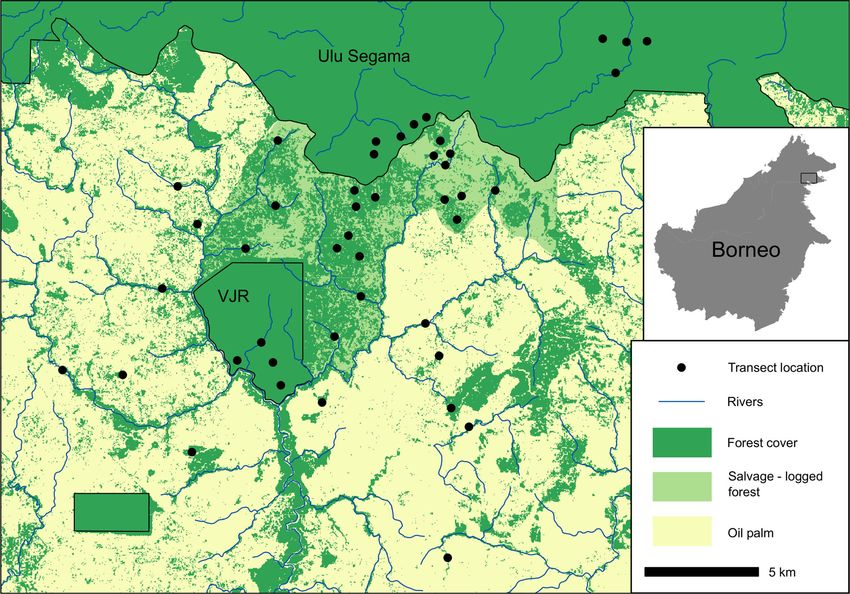
across all range states, all three species of orang‐utans are Critically       Our study was conducted in and around the Stability of Altered
Endangered on the IUCN Red List of Threatened Species (IUCN,                   Forest Ecosystems project (SAFE: https://www.safeproject.net),
2017). Habitat loss, fragmentation, and hunting continue to be                 including the Kalabakan and Ulu Segama forest reserves and
leading contributors of population decline (Meijaard et al., 2011;             surrounding oil palm estates in the Malaysian state of Sabah,
Voigt et al., 2018; Wich et al., 2016), and could have particularly            Borneo. The total study area comprises 13,000 ha, of which
catastrophic consequences in combination with range contractions               7,200 ha is within the SAFE experimental area, which is being
expected under climate change (Struebig et al., 2015). Currently, the          converted to oil palm plantation (Ewers et al., 2011; Struebig
highest densities of orang‐utans are in forests lower than 500 m               et al., 2013). Most of the forest has experienced several rounds of
above sea level (ASL; Voigt et al., 2018). However, these low‐lying            logging since 1978, yet still supports substantial primate
areas are often the most suitable for agriculture, leading to high             biodiversity (Bernard et al., 2016). The SAFE area was later
levels of deforestation and forest degradation within the orang‐utan           salvage‐logged (removal of all remaining commercially valuable
range (Santika et al., 2017). Further forest conversion is expected,           trees) between 2013 and 2016, with some areas retained as
and estimates of future orang‐utan habitat loss range from                     forest fragments for scientific research (Figure 1). To the north, a
23,000 km2 to as much as 57,000 km2 by the 2050s (9–20%                        block of continuous twice‐logged forest in Ulu Segama connects
reduction; Struebig et al., 2015).                                             to >1 million ha of forest habitat, including pristine conservation
    Orang‐utan dietary and behavioral ecology makes these species              areas, such as Danum Valley and Maliau Basin. Ulu Segama
highly adapted to tropical forests (Marshall et al., 2009). Orang‐utans        contains one of the largest unfragmented populations of orang‐
prefer moving through areas of uniform canopy height, avoid forest gaps        utans in Malaysia (2,300 individuals), which is thought to have
(Felton, Engström, Felton, & Knott, 2003), and face energetic costs            remained relatively stable since initial surveys in 2002 (Ancrenaz
associated with their arboreal habits (Davies, Ancrenaz, Oram, & Asner,        et al., 2010). The wider landscape also contains a substantial
2017). Although orang‐utans will readily move on the ground through            block of old growth forest, the Brantian‐Tatulit Virgin Jungle
areas of oil palm, most observations in oil palm (nests or signs of feeding)   Reserve (VJR), which covers 2,200 ha, although logging encroach-
are within 50 m of forest areas (Ancrenaz et al., 2015). The forest canopy     ment has caused considerable degradation across much of the
buffers against extreme temperature changes and solar radiation                reserve (Deere et al., 2018). The remainder of the site comprises
(Hardwick et al., 2015) and likely provide important refuge, resources,        oil palm estates, which were 8–12 years old at the time of this
and nesting opportunities for orang‐utans in heavily modified landscapes.      study. These estates contain remnant forest patches, many of
Therefore, three‐dimensional structural features of the canopy are likely      which are within riparian reserves between 15 and 500 m wide
to be important determinants of orang‐utan presence.                           (Mitchell et al., 2018).
SEAMAN ET AL. | 3 of 12
FIGURE 1 Placement of transects across the study landscape in Sabah, Borneo
2.2 | Transect design 2.3 | Orang‐utan nest surveys
To investigate the effects of habitat modification on orang‐utan Orang‐utans build nests daily to rest during the day and to sleep in
abundance, we placed transects and surveyed orang‐utan nests overnight (van Casteren et al., 2012). These nests are complex and have
within three distinct habitat types representative of the wider characteristics that make them easily distinguishable from those made by
landscape, as well as other parts of the oil palm producing regions of sympatric species, such as sun bear (Helarctos malayanus), giant squirrel
Borneo and Sumatra. These included: (Ratufa affinis), or raptors (van Casteren et al., 2012). Typically, a minimum
of 60–80 nest observations is required to reliably estimate great ape
• 13 transects in the logged forest of Ulu Segama Forest Reserve
densities using distance‐based methods (Kühl, Maisels, Ancrenaz &
and Brantian‐Tantulit VJR;
Williamson, 2008).
• 19 transects in newly isolated remnant forest patches and riparian
We conducted nest surveys between April and August 2017, using
reserves within the salvage‐logged SAFE experimental area;
the standing crop methods described by Spehar et al. (2010). Transects
• 12 transects in forest remnants (hillside fragments and riparian
were surveyed once by walking at a steady pace, stopping at regular
reserves) within oil palm estates.
intervals to scan every direction for nests. Upon nest encounter, we
measured the perpendicular distance from directly under the nest to the
Transect length ranged between 0.6 km and 2 km, with an average of
transect line, using a tape measure. We assigned a decay category to each
1.6 km across the three habitats. We ensured > 3 km of transect within
nest, ranging from A to E: where A = new nest, solid structure and leaves
each habitat, as this is the minimum length needed to produce density
still green, B = leaves have started to dry out and discolor, C = nest
estimates in areas of low orang‐utan density (Singleton, 2000). To ensure
structure still intact, leaves starting to disappear, D = most leaves gone,
spatial independence in sampling, transects were placed randomly at
nest structure starting to disintegrate, and E = all leaves gone, structure
least 500 m apart, or were implemented on pre‐existing routes
visible but heavily degraded (Spehar et al., 2010).
established independently as part of the SAFE project experimental
design. Transects in riparian remnants followed the river course to ensure
2.4 | Parameters in the orang‐utan density model
the survey remained within the forest area and avoided oversampling the
oil palm matrix. In total, 44 transects were surveyed once, with a Conversions of nest density to orang‐utan density requires three
combined survey effort of 51.3 km. parameters: Proportion of nest builders within the population (p),4 of 12 | SEAMAN ET AL.
nest production rate (r), and the nest decay rate (t). Because no We obtained nest density using the formula:
measures were available for the site, we incorporated parameters
Dnest = N/(L⁎2w )
from the published literature. We employed a conservative estimate
of the proportion of nest producers (p) at .85 and used a nest
Where N is the number of nests observed along each transect, L is
production rate (r) value of 1.00, reported from a long‐term study in
the length of each transect and w is the effective strip width,
the Lower Kinabatangan in Sabah (Ancrenaz, Calaque, & Lackman‐
calculated using Distance software 7.1 (Thomas et al., 2010).
Ancrenaz, 2004). As nest decay rate (t) shows the highest variation
Examination of histograms of the data suggested density estimates
across sites, we calculated orang‐utan density using a rigorously
were slightly spiked at zero, therefore, the data were aggregated into
estimated t value of 259 days, reported from Gunung Palung
distance classes at 4 m intervals. Similarly, to avoid biases from
(Johnson, Knott, Pamungkas, Pasaribu, & Marshall, 2005). We chose
outliers, we truncated data at 40 m. Six distance models were fitted
t from Gunung Palung as this is from a similar forest type and
to the data‐uniform key with either cosine or simple polynomial
calculated from a large number of nests over an extended period.
adjustments, half‐normal key with either cosine or hermite
However, because changes in environmental conditions, altitude, and
polynomial adjustments and hazard‐rate key with cosine and simple
rainfall have been reported to influence decay rate (Mathewson,
polynomial adjustments. We then assessed model fit using the
Spehar, Meijaard, Sasmirul, & Marshall, 2008), comparing estimates
Chi‐Square goodness of fit test (X2), and obtained estimates of
from across a disturbance gradient using the same decay rate may
w from the best performing model, using Akaike Information
not always be suitable. As we used parameters obtained from other
Criterion (AIC) values. As we observed sufficient numbers of nests
sites, our results are best interpreted as relative measures of density
within each habitat type, we fitted detection functions to pooled data
between habitat types.
from each habitat type separately.
We then converted nest densities to orang‐utan density using
2.5 | Sensitivity analysis the formula:
To test the robustness of our density estimates to uncertainties Dorang = Dnest /(p⁎r ⁎t )
surrounding the three demographic and nest visibility parameters
used in the orang‐utan density model, we performed a sensitivity Where p is the proportion of nest builders within the population, r is
analysis. We reproduced density estimates using high, medium (our nest production rate and t is nest decay rate. To assess possible
original estimate), and low values, for each of the three input associations between orang‐utan density and environmental corre-
parameters t, r, and p. Parameter combinations resulted in 27 lates, we calculated orang‐utan densities individually for each
possible iterations, allowing us to examine variation in estimates via transect or fragment and produced estimates of error around the
histograms. We produced three subsets of estimates, whereby one mean density of each habitat type.
parameter was fixed at the medium value and the other two varied
across all possible combinations of high, medium, and low values,
2.7 | Predictors of orang‐utan density
allowing for the effect of each individual parameter on the density
estimate to be examined. For t, we used the highest (602: Bruford To identify potential predictors of orang‐utan density in the heavily
et al., 2010) and lowest values reported for Borneo (202: Ancrenaz modified landscape, we obtained vegetation structural metrics from
et al., 2004), compared with the medium value (259: Johnson et al., airborne LiDAR data, collected by NERC’s Airborne Research Facility
2005). For r, we already incorporated the lowest value available in between September and October 2014 (Jucker et al., 2018). A detailed
the literature of 1.00, therefore, we used the highest available value description of the data collection and processing is available in Jucker
(1.16: Johnson et al., 2005) and subtracted the difference between et al. (2018). Briefly, ground points from the georeferenced point cloud
the high and medium values from the medium value, given a low r were classified into ground and non‐ground returns, with a digital
value of 0.84, which would be indicative of high levels of nest reuse. elevation model (DEM) produced from the ground data. A normalized
Similarly, for p, we already utilized a conservative value of 0.85 and, canopy height model CHM was produced by subtracting the DEM from
therefore, we used a high value of 0.88 (van Schaik, Wich, Utami, & the non‐ground returns. The CHM was then used to generate two
Odom, 2005), resulting in a low value of 0.82. derived raster products describing the three‐dimensional vegetation
structure: (a) a 50 cm resolution pit‐free top of canopy height raster; and
(b) a 20 m resolution stack of plant area index (PAI in m2 m−2; strictly
2.6 | Calculating nest density
plant area density) rasters, measuring the one‐sided area of leaves and
We calculated nest encounter rate by dividing the number of nests woody tissues per unit surface area, through 1 m deep vertical canopy
recorded along each transect by the total survey effort. As there was profile slices. Total PAI was calculated as the sum of the vertical slices
no significant difference in the distribution of perpendicular and PAI diversity was calculated using the Shannon index across all of the
distances across the three habitat types (X2 = 1.080, df = 2, vertical slices (see Table 1).
P = .583), we were able to compare nest encounter rates between In addition to the LiDAR‐based information, we investigated
habitat types. landscape‐level features as possible predictors of orang‐utanSEAMAN ET AL. | 5 of 12
T A B L E 1 Predictor variables for linear models. LiDAR‐based metrics were averaged within a 40 m buffer of each transect
Predictor variables Description
Local‐level (from LiDAR)
Canopy height Mean height of canopy within the buffer.
Canopy height variation Standard deviation of canopy height. A measure of heterogeneity in the canopy.
No. layers Number of contiguous layers within the vertical forest column.
Shannon index Index of diversity in the distribution of material within the vertical column.
Landscape‐level
Habitat type The habitat type in which the transect was embedded.
Forest cover Percentage forest cover within a 150 ha buffer around each transect
Distance Distance to the nearest continuous logged forest, measured from the midpoint of each transect to the closest border
with either Ulu Segama Forest Reserve or the VJR.
densities, because these measures influence densities elsewhere in were examined for collinearity using the Pearson product‐
Borneo. Spehar and Rayadin (2017) found orang‐utan abundance to moment correlation coefficient (r) and generalized variance
increase with proximity to natural forest. Therefore, we also included inflation factors (GVIF), with variables considered highly colli-
the distance from the nearest large forest area (Ulu Segama or the near if r ≥ 0.7 or GVIF ≥ 5 (Zuur, Ieno, & Elphick, 2010). We
VJR) and the percentage of forest cover within a 150 ha buffer observed a high degree of collinearity among variables and as a
(typical home range of a female orang‐utan in a heavily disturbed result, we coded models to exclude highly collinear variables
forest; Ancrenaz Unpublished Data) around each transect, as possible from appearing in the same model.
predictors. We derived these covariates using layers produced by We ranked models based on corrected AIC scores. Across all
Hansen et al. (2013) to reflect forest cover at the time of our surveys models, parameter estimates were averaged and parameters
(See Table 1). For pairwise comparison of predictor variables among weighed on the basis of the proportion of models in which each
habitat types see supporting information (Figure S1). was included (Grueber et al., 2011). We inspected residual
diagnostics to determine the influences of curvature and hetero-
scedasticity, considered indicative of poor model fit. Model validation
2.8 | Statistical analysis
identified a single outlier with high leverage (Cook’s Distance > 1).
Both nest encounter rate and orangutan density estimates were Because subsequent removal and reanalysis found no significant
normally distributed (Shapiro‐Wilk test, W = 0.958, P = .304 and effect on the parameter estimates, we present findings for models
W = 0.969, P = .553, respectively) and had homogeneous variance including the outlying data point. All analysis was performed using R
between habitat types (Bartlett’s test K = 2.434, df = 2, P = .296 version 3.4.2 statistical software (R Core Team, 2017). The data will
and K = 1.832, df = 2, P = .400, respectively). We, therefore, be available from the NERC Environmental Information Data Center
employed a One‐Way ANOVA to assess differences in nest following an embargo period (accessible from 18th March 2021,
encounter rate and orang‐utan density between habitat types. To https://doi.org/10.5281/zenodo.3237506)
assess relationships between nest encounter rate and orang‐utan
density, relative to several landscape and forest structural
predictor variables, we used multiple linear regression models
2.9 | Ethical statement
(LM). We applied LMs with a Gaussian error structure and
identity link function to the data. LMs were specified with an The study was approved by the University of Kent’s Animal Welfare
effects parameterisation, designating logged forest as the fixed Ethics Review Board and fully complied the American Society of
intercept and reference habitat class from which to assess Primatologists Principles for the Ethical Treatment of Non‐Human
deviations in the response variable. Using methods delineated Primates. Field research was authorized by Sabah Biodiversity
by Grueber, Nakagawa, Laws, and Jamieson (2011), we fitted a Council under access license No. JKM/MBS.1000–2/2 JLD.4(104).
global model to the data that included all predictor variables.
Using the R package arm (Gelman & Su, 2018), we standardized
variables to have a mean of 0 and a standard deviation of 0.5, to
enable the direct comparison of the effect size of parameter 3 | RESULTS
estimates derived from model averages. The dredge function was
then applied to the global model using the MuMIn package We observed 678 nests along the 44 transects. After transects
(Barton, 2009), which produces a set of all possible model outside the LiDAR extent were excluded and the data were
outcomes, including an intercept‐only model. Predictor variables truncated, 594 nests on 35 transects remained for analyses.6 of 12 | SEAMAN ET AL.
T A B L E 2 Summary of nest‐count survey data
No. of Transect length Effective strip Nest encounter rate Orangutan density
Habitat Type Site ID nests (km) widtha (m) (nests/km) (Ind/km2)
Continuous logged forest
LF1 31 1.8 15.5 17.2 2.5
LF2 23 2 15.5 11.5 1.7
LF3 25 2 15.5 12.5 1.8
LFR 15 1 15.5 15.0 2.2
LFE1 17 2 15.5 8.5 1.3
LFE2 24 1.5 15.5 15.7 2.3
LFE3 24 1.2 15.5 20.0 2.9
LFE4 17 1 15.5 17.0 2.5
LFER 25 1.6 15.5 15.6 2.3
VJR_R 25 1.6 15.5 15.6 2.3
VJR_1 37 1.2 15.5 30.8 4.5
VJR_2 10 1 15.5 10.0 1.5
Salvage‐logged forest
RR0 30 1.6 14.3 19.1 3.0
RR5 26 1.5 14.3 17.3 2.8
RR15 28 1.6 14.3 17.5 2.8
RR30 29 1.7 14.3 17.1 2.7
RR60 11 1.5 14.3 7.3 1.2
RR120 21 1.6 14.3 13.1 2.1
Block_B 28 1.9 14.3 14.6 2.3
Block_C 29 2.1 14.3 13.8 2.2
Block_D 24 2.4 14.3 9.5 1.5
Block_E 43 2.3 14.3 19.1 3.0
Forest remnants in oil palm plantations
OP02 13 1.6 14.7 8.1 1.3
OP03 9 1.3 14.7 7.0 1.1
OP07 1 1.8 14.7 0.6 0.1
OP12 6 1.8 14.7 3.4 0.5
OP14 16 1.8 14.7 8.9 1.4
OP16 7 1.8 14.7 4.0 0.6
a
Effective strip width was calculated in Distance 1.7 software (Thomas et al., 2010).
3.1 | Orang‐utan density 3.2 | Landscape determinants of orang‐utan
density
Over the whole landscape, we encountered an average of 13.31
nests/km, and generated an estimate of 2.01 orang‐utans per km2 Our information‐theoretic statistical approach yielded 48 possible
(Table 2). However, both nest encounter rate and resulting density models (Tables S1,S2) from which we produced full model‐averaged
estimates varied considerably across the landscape (nest encounter estimates penalized for parameter redundancy. For habitat type,
rate, 0.56‐30.83 nests/km; density, 0.09‐4.52 ind/km2), with overall these models confirmed that nest encounter rate and orang‐utan
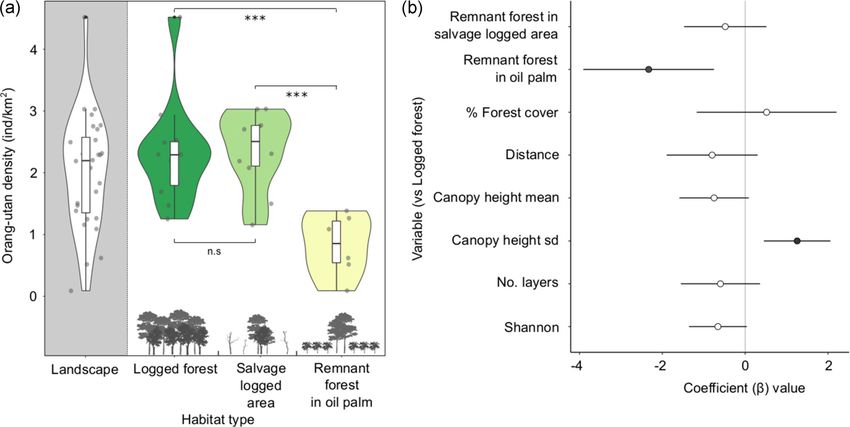
significant differences among habitats (ANOVA: nests, F 2, 12 = 15.49, densities were lower in remnant forest patches in oil palm
P = < .001; density F 2, 24 = 15.37, P = < .001). Density estimates (Coefficient β = −16.44, 95%CI = −26.48, − 6.39 and β = −2.33, 95%
were similar between logged forest and forest remnants in the CI = −3.91, −0.75, respectively, Figure 2). Variation in canopy height
salvage‐logged area (mean 2.32 and 2.35, respectively; Tukey post was also positively associated with nest encounters and densities
hoc test, P = .601), but were significantly lower in the forest remnants (β = 7.76, 95%CI = 2.62, 12.90 and β = 1.25, 95%CI = 0.45, 2.06,
in the oil palm (mean 0.82, P = < .001; Figure 2). respectively). The 95% confidence intervals of all other variablesSEAMAN ET AL. | 7 of 12
F I G U R E 2 (a) Violin plots of orang‐utan density (individuals/km2), for the overall landscape and between habitat types. A significant
difference of p< 0.001 between habitat types is denoted by *** and no significance by n.s. Data points are jittered for visualization. (b)
Coefficient plot (β) from an averaged model of orang‐utan population density, showing 95% confidence intervals
crossed zero, indicating that they had little effect on orang‐utan habitat to neighboring logged forest (Ulu Segama 2.17 ind/km 2
abundance. and the VJR 2.76 ind/km2 ). This result is contrary to previous
research that found densities across the orang‐utan range to be
higher in areas surrounding recently logged forest (Husson et al.,
3.3 | Sensitivity analysis 2009), perhaps because insufficient time had passed to capture
the demographic response. At our study site, forest structural
There was a large range of possible density values, with several
metrics revealed that remnant forest patches in the salvage‐
estimates substantially higher than our original estimate
logged area are structurally more similar to remnant forest in oil
(Figure 3). For the logged forest, when t was fixed, density
palm, than to areas of logged forest. Although being structurally
estimates ranged from 1.03 to 5.65. However, this range
similar, the SAFE experimental area has been disturbed relatively
increased to between 0.51 and 6.09 when r was fixed and t and
recently 2–5 years before the study) compared to the remnant
p were varied. We observed the largest variation in density
forest patches in the oil palm estates 8‐12 years). Orang‐utans
estimates when p was fixed and both t and r varied, with
have the longest interbirth period of any mammal (ca. 9 years)
estimates increasing to between 0.46 and 6.91. We observed a
and an extended period of adolescence before first birth (Knott,
similar pattern across all habitat types (Table S3).
Emery Thompson, & Wich, 2009). This long life history may result
in a large time lag before demographic responses to disturbance
are truly observed, meaning that there may have been insuffi-
4 | D IS C U S S IO N cient time for the full effects of the disturbance on orang‐utan
populations to manifest in the SAFE experimental area.
We produced orang‐utan density estimates across a mosaic The salvage‐logged area at SAFE is due to be converted to oil
landscape in Malaysian Borneo and found orang‐utans were palm. On the basis of the density of nests, the area still appears to
present in all forest habitats, although on average orang‐utan support a relatively large number of orang‐utans. During the
density was ≥65% lower in remnant forest patches in oil palm. conversion process, any remaining vegetation will be felled and
The average density across our landscape of 2.01 ind/km 2, is cleared before terracing and the planting of oil palm commences,
within the range of estimates produced by Ancrenaz et al. (2010) forcing most wildlife, including orang‐utans, to move to the
within the same area from aerial surveys (2.1‐0.7 ind/km 2 ). neighboring forest areas or become isolated in remnant forest
Recent salvage logging (2–5 years previous to this study) patches. In our study area, the nearby Ulu Segama and the VJR
appeared to have little effect on orang‐utan density within already support high densities of orang‐utans, and immigration of
2
remnant forest patches (2.35 ind/km ), which was similar in this orang‐utans from surrounding areas would increase competition8 of 12 | SEAMAN ET AL.
(a-i) Fixed t (b-i) Fixed r (c-i) Fixed p
30
25
40
25
20
Logged forest
Frequency
20
30
15
15
20
10
10
10
5
5
0
0
0
0 2 4 6 8 0 2 4 6 8 0 2 4 6 8
Orang-utan density (ind/km2) Orang-utan density (ind/km ) 2
Orang-utan density (ind/km2)
20
(a-ii) Fixed t (b-ii) Fixed r (c-ii) Fixed p
Salvage-logged forest
20
15
15
15
Frequency
10
10
10
5
5
5
0
0
0
0 2 4 6 8 0 2 4 6 8 0 2 4 6 8
Orang-utan density (ind/km2) Orang-utan density (ind/km2) Orang-utan density (ind/km2)
20
(a-iii) Fixed t (b-iii) Fixed r (c-iii) Fixed p
10
10
Remnant forest
15
8
8
Frequency
6
6
10
4
4
5
2
2
0
0
0
0 2 4 6 8 0 2 4 6 8 0 2 4 6 8
2 2 2
Orang-utan density (ind/km ) Orang-utan density (ind/km ) Orang-utan density (ind/km )
F I G U R E 3 Sensitivity analyses to demonstrate the effect of changing fixed parameters (nest decay rate t, nest production rate r and
proportion of nest builders p), on orang‐utan density estimates. The density reported in the main text is labeled by a dashed line in each plot.
Plots a, d, and g show results where t is fixed, b, e, and h where r is fixed and c, f, and i where p is fixed, across all three habitat types. For t we
used the vales: high 602 (Bruford et al., 2010), medium 259 (Johnson et al., 2005), and low 202 (Ancrenaz et al., 2004). For r: high 1.16 (Johnson
et al., 2005), medium 1 (Ancrenaz et al., 2004), and low r value of 0.84. For p: high .88 (Van Schail at el., 2005), medium .85 (Ancrenaz et al.,
2004), and low value of .82
for resources. In addition, the VJR will be fragmented when the Both indices of orang‐utan abundance in remnant forest
oil palm is planted. Unless a wildlife corridor is maintained to link patches within oil palm estates were lower than those in the
the VJR to Ulu Segama, orang‐utans in this forest will be isolated logged forest and remnant forest in the salvage‐logged area. As
and overcrowded unless they are able to disperse across several expected, conversion to oil palm has a negative effect on local
kilometers of oil palm plantation. A recent integrative trend orang‐utan populations. Despite these negative effects, we
analysis found orang‐utan survivorship was lowest in areas of encountered nests on all transects within remnant forest patches
fragmented forest or near to areas of recent forest conversion to and riparian reserves in oil palm estates. We also directly
agriculture (Santika et al., 2017). With increasing areas of orang‐ observed three adult females with dependent young within
utan habitat likely to be converted to oil palm, practical matters several riparian reserves, suggesting reproductive orang‐utans
need to be considered to ensure resident animals can disperse use these areas. Additionally, as nests were observed at large
successfully. distances (≥6 km) from the nearest large forest area, it is likely atSEAMAN ET AL. | 9 of 12 least some of these individuals are resident within the estates. orang‐utan nesting behavior within remnant forest patches in oil Equally, because densities were similar in salvage‐logged and palm. logged forest, it is doubtful that orang‐utans within oil palm Previous research on orang‐utan behavioral ecology in modified estates are those displaced during the salvage logging process. landscapes suggests young subordinate males are dispersing from The above observations suggest that the oil palm plantation still optimal habitat from where they have been displaced by dominant hosts an orang‐utan population, albeit at a lower density than in flanged males (Ancrenaz et al., 2015). However, the three orang‐ the logged forest. utans we observed directly during our surveys of remnant forest in The linear models revealed certain nuances in the data that oil palm were all adult females with dependent offspring. Spehar and may be important in explaining orang‐utan persistence within oil Rayadin (2017) also recorded adult females with dependent offspring palm estates. Although we expected distance from logged forests in timber plantations in East Kalimantan. Orang‐utans exhibit female to have a negative effect on orang‐utan presence, we found no philopatry and are less likely to disperse over large distances than evidence in our survey that distance from this forest affects males (van Noordwijk et al., 2012). Female range fidelity may, orang‐utan density. Davies at el. (2017) found the number of therefore, explain the number of females we encountered. Equally, contiguous layers in the canopy did not determine orang‐utan this may indicate female orang‐utans are becoming effectively movement through disturbed forests in the Kinabatangan region. stranded in heavily degraded landscapes. In any case, our results Similarly, we found little evidence that vertical layering had an suggest remnant forest patches in modified landscapes are likely to effect on orang‐utan densities across our study landscape. hold a significant number of reproductive females, which are However, contrary to Davies at el. (2017), we found that large important to the population and largely overlooked within conserva- variation in canopy height was positively associated with orang‐ tion strategies. Further research is needed to fully understand how utan density. Across our study site, the most heavily degraded these areas affect reproduction and survival rates and the role they areas tended to be dominated by pioneer species, such as play in connecting meta‐populations. Macaranga spp (Struebig et al., 2013), giving the canopy a highly Integrating modified landscapes into orang‐utan conservation strate- uniform structure. Orang‐utans also appear averse to nesting gies poses a significant challenge. Leaving 1,000 ha of land unconverted within Macaranga spp., and therefore these areas may be can entail annual losses to oil palm producers of over US$0.5 million ecologically unsuitable to support orang‐utans (Ancrenaz et al., (Nantha & Tisdell, 2009). Despite these potential losses, the oil palm 2004). Variation in canopy height is strongly associated with industry is increasingly moving towards business models based on successional status (Deere et al. (2018) Unpublished Data) and corporate environmental and social responsibility (Morgans et al., 2018). thus indicates greater environmental heterogeneity and breadth As a result, certification schemes, such as the RSPO, have considerable of resources. Further research is needed to quantify resource potential to help conserve orang‐utans within oil palm estates (Nantha & availability in remnant forest patches under various levels of Tisdell, 2009). Across Indonesia, RSPO certification has reduced degradation and gain an improved understanding of the long‐ deforestation by 33% on land managed by certified companies (Carlson term carrying capacity of agricultural landscapes. However, at et al., 2018). Currently, however, there may be greater numbers of orang‐ least in our study site, it appears orang‐utans have been able to utans within non‐RSPO certified estates than in certified estates persist in oil palm estates for several years. (Morgans et al., 2018). Therefore, increasing the uptake of RSPO Our sensitivity analysis revealed two important points. First, certification among oil palm producers will likely reduce deforestation across all possible iterations of parameter values, the upper limits of further and aid orang‐utan conservation. our density estimates for remnant forest sites in oil palm were lower If orang‐utan populations are maintained in human‐modified than half the upper limits for the logged forest, and density estimates landscapes, individuals face additional risks which conservationists were on average close to a third that of logged forest. These results and policymakers should consider. An increase in orang‐utan provide strong evidence that, despite using parameters acquired proximity to humans is likely to result in a greater risk of zoonotic from other sites in our density calculations, oil palm estates support disease transmission (Russon, 2009). Persecution of orang‐utans is
10 of 12   |                                                                                                                                     SEAMAN    ET AL.

Borneo is subject to more severe droughts and resource fluctuation             Ancrenaz, M., Oram, F., Ambu, L., Lackman, I., Ahmad, E., Elahan, H., …
as a result of the El Nino Southern Oscillation (Taylor, 2006).                    Meijaard, E. (2015). Of pongo, palms and perceptions: A multi-
                                                                                   disciplinary assessment of Bornean orang‐utans pongo pygmaeus in an
                                                                                   oil palm context. Oryx, 49, 465–472. https://doi.org/10.1017/
                                                                                   S0030605313001270
5 | CONC LU SION                                                               Barton, K. (2009). MuMIn: Multi‐model inference. R Package Version 1. 0. 0,
                                                                                   https://doi.org/10.4236/ojs.2015.54031.         http://R‐Forge.R‐Project.Org/
                                                                                   Projects/Mumin/
Despite pledges by the Indonesian and Malaysian government to
                                                                               Bernard, H., Bili, R., Matsuda, I., Hanya, G., Wearn, O. R., Wong, A., & Ahmad, A.
stabilize orang‐utan populations, they have continued to decline                   H. (2016). Species richness and distribution of primates in disturbed and
by 25% over the past 10 years (Santika et al., 2017). Our results                  converted forest landscapes in northern Borneo. Tropical Conservation
show forest conversion to oil palm negatively affects orang‐utan                   Science, 9. https://doi.org/10.1177/1940082916680104
                                                                               Bruford, M. W., Ancrenaz, M., Chikhi, L., Lackman‐Ancrenaz, I., Andau, M.,
populations, leading to reduced densities. Nevertheless, we found
                                                                                   Ambu, L., & Goossens, B. (2010). Projecting genetic diversity and
orang‐utans still persist in remnant forest patches within oil palm                population viability for the fragmented orang‐utan population in the
estates. The presence of orang‐utans within oil palm estates                       Kinabatangan floodplain, Sabah, Malaysia. Endangered Species Re-
demonstrates that these great apes may have greater ecological                     search, 12, 249–261. https://doi.org/10.3354/esr00295
resilience to disturbance than previously assumed. Although                    Burnham, K. P., & Anderson, D. R. (2004). Multimodel inference: Under-
                                                                                   standing AIC and BIC in model selection. Sociological Methods & Research,
forest patches alone cannot maintain viable populations, if
                                                                                   33, 261–304. https://doi.org/10.1177/0049124104268644
managed appropriately, they may act as important corridors or                  Carlson, K. M., Heilmayr, R., Gibbs, H. K., Noojipady, P., Burns, D. N.,
stepping‐stones, connecting isolated populations, and facilitate                   Morton, D. C., … Kremen, C. (2018). Effect of oil palm sustainability
migration in response to climate change. As orang‐utan habitats                    certification on deforestation and fire in Indonesia. Proceedings of the
                                                                                   National Academy of Sciences of the United States of America, 115,
are the most suitable areas for oil palm production in Borneo and
                                                                                   121–126. https://doi.org/10.1073/pnas.1704728114
Sumatra, these modified landscapes should be taken more                        Cattau, M. E., Husson, S., & Cheyne, S. M. (2015). Population status of the
seriously in orang‐utan conservation and monitoring efforts.                       Bornean orang‐utan pongo pygmaeus in a vanishing forest in Indonesia:
                                                                                   The former Mega Rice Project. Oryx, 49, 473–480. https://doi.org/10.
                                                                                   1017/S003060531300104X
A C K N O W L E D GM E N T S                                                   Chapin Iii, F. S., Zavaleta, E. S., Eviner, V. T., Naylor, R. L., Vitousek, P. M.,
                                                                                   Reynolds, H. L., … Hobbie, S. E. (2000). Consequences of changing
This research was funded by the UK Natural Environment Research                    biodiversity. Nature, 405, 234–242. https://doi.org/10.1038/35012241
Council via the Human‐Modified Tropical Forests research program (NE/          Davies, A. B., Ancrenaz, M., Oram, F., & Asner, G. P. (2017). Canopy
                                                                                   structure drives orangutan habitat selection in disturbed Bornean
K016407/1; http://lombok.nerc‐hmtf.info/), as well as the Primate Society
                                                                                   forests. Proceedings of the National Academy of Sciences, 114, 8307‐
of Great Britain. We would like to thank the Sabah Biodiversity Council,           8312. https://doi.org/10.1073/pnas.1706780114
Sabah Forest Department, Benta Wawasan, and Sabah Softwoods for                Deere, N. J., Guillera‐Arroita, G., Baking, E. L., Bernard, H., Pfeifer, M.,
permitting access. We are grateful to Arnold James, Mohd. Shah Nizam               Reynolds, G., … Struebig, M. J. (2018). High carbon stock forests
                                                                                   provide co‐benefits for tropical biodiversity. Journal of Applied Ecology,
Mustamin, Ampat Siliwong, Sabidee, and Mohd. Rizan for their assistance
                                                                                   55, 997–1008. https://doi.org/10.1111/1365‐2664.13023
in the field. We would also like to thank field staff at HUTAN for their       Ewers, R. M., Didham, R. K., Fahrig, L., Ferraz, G., Hector, A., Holt, R. D., …
training in survey methods and Nicolas J. Deere for statistical advice.            Turner, E. C. (2011). A large‐scale forest fragmentation experiment:
                                                                                   The stability of altered forest ecosystems project. Philosophical
OR CID                                                                             Transactions of the Royal Society of London.Series B, Biological Sciences,
                                                                                   366, 3292–3302. https://doi.org/10.1098/rstb.2011.0049
Dave J.I. Seaman      http://orcid.org/0000-0002-6616-7001                     Felton, A. M., Engström, L. M., Felton, A., & Knott, C. D. (2003). Orangutan
David Coomes       http://orcid.org/0000-0002-8261-2582                            population density, forest structure and fruit availability in hand‐
                                                                                   logged and unlogged peat swamp forests in West Kalimantan,
Thomas Swinfield      http://orcid.org/0000-0001-9354-5090
                                                                                   Indonesia. Biological Conservation, 114, 91–101. https://doi.org/10.
David T. Milodowski      http://orcid.org/0000-0002-8419-8506                      1016/S0006‐3207(03)00013‐2
Tatyana Humle       http://orcid.org/0000-0002-1919-631X                       Gaveau, D. L., Sheil, D., Salim, M. A., Arjasakusuma, S., Ancrenaz, M., Pacheco,
Matthew J. Struebig      http://orcid.org/0000-0003-2058-8502                      P., & Meijaard, E. (2016). Rapid conversions and avoided deforestation:
                                                                                   Examining four decades of industrial plantation expansion in Borneo.
                                                                                   Scientific Reports, 6, 6. https://doi.org/10.1038/srep32017
REFERENC ES                                                                    Gelman, A., & Su, Y. (2018). Arm: Data analysis using regression and
                                                                                   multilevel/hierarchical models. R package version 1.10‐1. URL. https://
Ancrenaz, M., Ambu, L., Sunjoto, I., Ahmad, E., Manokaran, K., Meijaard, E.,       CRAN.R‐project.org/package=arm
   & Lackman, I. (2010). Recent surveys in the forests of Ulu Segama           Grueber, C., Nakagawa, S., Laws, R., & Jamieson, I. (2011). Multimodel
   Malua, Sabah, Malaysia, show that orang‐utans (P. p. morio) can be              inference in ecology and evolution: Challenges and solutions. Journal
   maintained in slightly logged forests PLoS One, 5, e11510. https://doi.         of Evolutionary Biology, 24, 699–711. https://doi.org/10.1111/j.1420‐
   org/10.1371/journal.pone.0011510                                                9101.2010.02210.x
Ancrenaz, M., Calaque, R., & Lackman‐Ancrenaz, I. (2004). Orangutan            Hansen, M. C., Potapov, P. V., Moore, R., Hancher, M., Turubanova, S.,
   nesting behavior in disturbed forest of Sabah, Malaysia: Implications           Tyukavina, A., … Loveland, T. (2013). High‐resolution global maps of
   for nest census. International Journal of Primatology, 25, 983–1000.            21st‐century forest cover change. Science, 342, 850–853. https://doi.
   https://doi.org/10.1023/B:IJOP.0000043347.84757.9a                              org/10.1126/science.1244693
SEAMAN ET AL. | 11 of 12
Hardwick, S. R., Toumi, R., Pfeifer, M., Turner, E. C., Nilus, R., & Ewers, R. and Conservation, 18, 487–502. https://doi.org/10.1007/s10531‐008‐
M. (2015). The relationship between leaf area index and microclimate 9512‐3
in tropical forest and oil palm plantation: Forest disturbance drives Pimm, S. L., & Raven, P. (2000). Biodiversity: Extinction by numbers.
changes in microclimate. Agricultural and Forest Meteorology, 201, Nature, 403, 843–845. https://doi.org/10.1038/35002708
187–195. https://doi.org/10.1016/j.agrformet.2014.11.010 Rayadin, Y., & Spehar, S. N. (2015). Body mass of wild Bornean orangutans
Husson, S. J., Wich, S. A., Marshall, A. J., Dennis, R. D., Ancrenaz, M., living in human‐dominated landscapes: Implications for understanding
Brassey, R., … Simorangkir, T. (2009). Orangutan distribution, density, their ecology and conservation. American Journal of Physical Anthro-
abundance and impacts of disturbance. Orangutans: Geographic pology, 157, 339–346. https://doi.org/10.1002/ajpa.22709
Variation in Behavioral Ecology and Conservation, 77–96. https://doi. Russon, A. E. (2009). Orangutan rehabilitation and reintroduction. Orangutans:
org/10.1093/acprof:oso/9780199213276.001.0001 Geographic Variation in Behavioral Ecology and Conservation, 327–350.
IUCN. (2017). The International union for conservation of nature (IUCN) https://doi.org/10.1093/acprof:oso/9780199213276.001.0001
red list of threatened species version 2017‐3. URL http://Www. Sandker, M., Finegold, Y., D’annunzio, R., & Lindquist, E. (2017). Global
iucnredlist.org. (accessed 23 october 2017). deforestation patterns: Comparing recent and past forest loss
Johnson, A. E., Knott, C. D., Pamungkas, B., Pasaribu, M., & Marshall, A. J. processes through a spatially explicit analysis. international Forestry
(2005). A survey of the orangutan (pongo pygmaeus wurmbii) Review, 19, 350–368. https://doi.org/10.1505/146554817821865081
population in and around Gunung Palung National Park, West Santika, T., Ancrenaz, M., Wilson, K. A., Spehar, S., Abram, N., Banes, G. L., …
Kalimantan, Indonesia based on nest counts Biological Conservation, Delgado, R. A. (2017). First integrative trend analysis for a great ape
121, 495–507. https://doi.org/10.1016/j.biocon.2004.06.002 species in Borneo. Scientific Reports, 7. https://doi.org/10.1038/s41598‐
Jucker, T., Asner, G. P., Dalponte, M., Brodrick, P. G., Philipson, C. D., 017‐04435‐9
Vaughn, N. R., … Deere, N. J. (2018). Estimating aboveground carbon Singleton, I. (2000). Ranging behaviour and seasonal movements of
density and its uncertainty in Borneo’s structurally complex tropical Sumatran orang‐utans pongo pygmaeus abelii in swamp forests. Dodo,
forests using airborne laser scanning. Biogeosciences, 15, 3811–3830. 36, 88–88. ISSN 0265‐5640.
https://doi.org/10.5194/bg‐15‐3811‐2018 Spehar, S. N., & Rayadin, Y. (2017). Habitat use of Bornean orangutans
Knott, C. D., Emery Thompson, M., & Wich, S. A. (2009). The ecology of (pongo pygmaeus morio) in an industrial forestry plantation in east
female reproduction in wild orangutans, Orangutans: geographic Kalimantan, Indonesia. International Journal of Primatology, 38,
variation in behavioral ecology and conservation (pp. 171–188). New 358–384. https://doi.org/10.1007/s10764‐017‐9959‐8
York: Oxford University Press. https://doi.org/10.1093/acprof:oso/ Spehar, S. N., Mathewson, P. D., Wich, S. A., Marshall, A. J., Kühl, H., &
9780199213276.003.0011 Meijaard, E. (2010). Estimating orangutan densities using the standing
Kühl, H., Maisels, F., Ancrenaz, M., & Williamson, E. A. (2008). Best practice crop and marked nest count methods: Lessons learned for conserva-
guidelines for surveys and monitoring of Great Ape populations. Gland: tion. Biotropica, 42, 748–757. https://doi.org/10.1111/j.1744‐7429.
IUCN SSC Primate Specialist Group. URL. http://www.primate‐sg.org/ 2010.00651.x
best_practice_surveys Struebig, M. J., Fischer, M., Gaveau, D. L., Meijaard, E., Wich, S. A., Gonner,
Marshall, A. J., & Meijaard, E. (2009). Orang‐utan nest surveys: The devil is C., … Kramer‐Schadt, S. (2015). Anticipated climate and land‐cover
in the details. Oryx, 43, 416–418. https://doi.org/10.1017/ changes reveal refuge areas for Borneo’s orang‐utans. Global Change
S0030605309001513 Biology, 21, 2891–2904. https://doi.org/10.1111/gcb.12814
Marshall, A. J., Lacy, R., Ancrenaz, M., Byers, O., Husson, S. J., Leighton, M., Struebig, M. J., Turner, A., Giles, E., Lasmana, F., Tollington, S., Bernard, H.,
… Stephens, S. (2009). Orangutan population biology, life history, and & Bell, D. (2013). Quantifying the biodiversity value of repeatedly
conservation. Orangutans: Geographic Variation in Behavioral Ecology logged rainforests: Gradient and comparative approaches from
and Conservation, 311–326. https://doi.org/10.1093/acprof:oso/ Borneo. Advances in Ecological Research, 48, 183–224. https://doi.
9780199213276.001.0001 org/10.1016/B978‐0‐12‐417199‐2.00003‐3
Mathewson, P., Spehar, S., Meijaard, E., Sasmirul, A., & Marshall, A. J. Taylor, A. B. (2006). Feeding behavior, diet, and the functional
(2008). Evaluating orangutan census techniques using nest decay consequences of jaw form in orangutans, with implications for the
rates: Implications for population estimates. Ecological Applications, 18, evolution of Pongo. Journal of Human Evolution, 50, 377–393. https://
208–221. https://doi.org/10.1890/07‐0385.1 doi.org/10.1016/j.jhevol.2005.10.006
Meijaard, E., Buchori, D., Hadiprakarsa, Y., Utami‐Atmoko, S. S., Nurcahyo, Thomas, L., Buckland, S. T., Rexstad, E. A., Laake, J. L., Strindberg, S.,
A., Tjiu, A., … Abadi, F. (2011). Quantifying killing of orangutans and Hedley, S. L., … Burnham, K. P. (2010). Distance software: Design and
human‐orangutan conflict in Kalimantan, Indonesia. PLoS One, 6, analysis of distance sampling surveys for estimating population size.
e27491. https://doi.org/10.1371/journal.pone.0027491 Journal of Applied Ecology, 47, 5–14. https://doi.org/10.1111/j.1365‐
Meijaard, E., Wich, S., Ancrenaz, M., & Marshall, A. J. (2012). Not by 2664.2009.01737.x
science alone: Why orangutan conservationists must think outside the van Casteren, A., Sellers, W. I., Thorpe, S. K., Coward, S., Crompton, R. H.,
box. Annals of the New York Academy of Sciences, 1249, 29–44. https:// Myatt, J. P., & Ennos, A. R. (2012). Nest‐building orangutans
doi.org/10.1111/j.1749‐6632.2011.06288.x demonstrate engineering know‐how to produce safe, comfortable
Miettinen, J., Shi, C., & Liew, S. C. (2011). Deforestation rates in insular beds. Proceedings of the National Academy of Sciences, 109, 6873‐6877.
Southeast Asia between 2000 and 2010. Global Change Biology, 17, https://doi.org/10.1073/pnas.1200902109
2261–2270. https://doi.org/10.1111/j.1365‐2486.2011.02398.x van Noordwijk, M. A., Arora, N., Willems, E. P., Dunkel, L. P., Amda, R. N.,
Mitchell, S. L., Edwards, D. P., Bernard, H., Coomes, D., Jucker, T., Davies, Mardianah, N., … van Schaik, C. P. (2012). Female philopatry and its
Z. G., & Struebig, M. J. (2018). Riparian reserves help protect forest social benefits among Bornean orangutans. Behavioral Ecology and
bird communities in oil palm dominated landscapes. Journal of Applied Sociobiology, 66, 823–834. https://doi.org/10.1007/s00265‐012‐
Ecology, 55, 2744–2755. https://doi.org/10.1111/1365‐2664.13233 1330‐7
Morgans, C. L., Meijaard, E., Santika, T., Law, E., Budiharta, S., Ancrenaz, M., & van Schaik, C. P., Wich, S. A., Utami, S. S., & Odom, K. (2005). A simple
Wilson, K. A. (2018). Evaluating the effectiveness of palm oil certification alternative to line transects of nests for estimating orangutan
in delivering multiple sustainability objectives. Environmental Research densities. Primates, 46, 249–254. https://doi.org/10.1007/s10329‐
Letters, 13. https://doi.org/10.1088/1748‐9326/aac6f4 005‐0134‐z
Nantha, H. S., & Tisdell, C. (2009). The orangutan–oil palm conflict: Voigt, M., Wich, S. A., Ancrenaz, M., Meijaard, E., Abram, N., Banes, G. L., …
Economic constraints and opportunities for conservation. Biodiversity Erman, A. (2018). Global demand for natural resources eliminated12 of 12 | SEAMAN ET AL.
more than 100,000 Bornean orangutans. Current Biology, 28, SUPPO RTING IN F ORMATION
761–769. https://doi.org/10.1016/j.cub.2018.01.053
Wich, S. A., Gaveau, D., Abram, N., Ancrenaz, M., Baccini, A., Brend, S., … Additional supporting information may be found online in the
Fredriksson, G. M. (2012). Understanding the impacts of land‐use Supporting Information section.
policies on a threatened species: Is there a future for the Bornean
orang‐utan? PLoS One, 7, e49142. https://doi.org/10.1371/journal.
pone.0049142
Wich, S. A., Singleton, I., Nowak, M. G., Atmoko, S. S. U., Nisam, G., Arif, S. How to cite this article: Seaman DJI, Bernard H, Ancrenaz M,
M., … Usher, G. (2016). Land‐cover changes predict steep declines for et al. Densities of Bornean orang‐utans (Pongo pygmaeus
the Sumatran orangutan (Pongo abelii) Science Advances, 2, e1500789. morio) in heavily degraded forest and oil palm plantations in
https://doi.org/10.1126/sciadv.1500789
Sabah, Borneo. Am J Primatol. 2019;81:e23030.
Zuur, A. F., Ieno, E. N., & Elphick, C. S. (2010). A protocol for data exploration
to avoid common statistical problems. Methods in Ecology and Evolution, 1, https://doi.org/10.1002/ajp.23030
3–14. https://doi.org/10.1111/j.2041‐210X.2009.00001.xYou can also read


