Meteorites as a scientific heritage Os meteoritos como património científico
←
→
Page content transcription
If your browser does not render page correctly, please read the page content below
A RT
                                                                                                            A RT ÍC ICL
                                                                                                                    U L OE/ /AART
                                                                                                                                RTIGO
                                                                                                                                   IGO/ A RT ICL E

Meteorites as a scientific heritage                                                                           ANNARITA FRANZA 1
                                                                                                              GIOVANNI PRATESI *
                                                                                                                              2

Os meteoritos como património científico                                                                      1. Department of Earth Sciences,
                                                                                                              University of Firenze,
                                                                                                              Firenze, Italy
                                                                                                              2. INAF-IAPS, Istituto di
                                                                                                              Astrofisica e Planetologia
                                                                                                              Spaziali, Roma, Italy
                                                                                                              * giovanni.pratesi@unifi.it

                                          Abstract
This paper investigates the importance of meteorites as a scientific heritage. While the                      KEYWORDS
significance of meteorites as natural heritage is relatively easy to establish, the implication               Natural heritage
of their meaning as scientific heritage may be more difficult to define. With this aim in                     Scientific heritage
mind, in this paper, we present the catalogue standards for meteorite specimens, preserved                    Cultural heritage
either in natural history museums or in private collections, proposed by the Italian Istituto                 Meteorites
Centrale per il Catalogo e la Documentazione – ICCD (Central Institute for Catalogue and                      Preservation policies
Documentation). This work outlines the structure of the catalogue card that describes                         Catalogue
the meteorite specimen along with other information related to the sample (e.g., archival
documentation on collectors and traders, museum catalogues and inventories, general
bibliography). This paper concludes discussing the cataloguing, according to ICCD
standards, of two Renazzo meteorite specimens, which fell in the eponymous Italian village
in 1824 and are now preserved at the Natural History Museum of the University of Firenze.

                                              Resumo
O presente artigo investiga a importância dos meteoritos como património científico.                          PALAVRAS-CHAVE
Enquanto a relevância dos meteoritos como património natural é relativamente fácil de                         Património natural
estabelecer, a implicação do seu significado como património científico poderá ser mais difícil               Património científico
de definir. Com esse objectivo em mente, no presente artigo apresentam-se as normas de                        Património cultural
catálogo para espécimes de meteoritos preservados, quer em museus de história natural, quer                   Meteoritos
em coleções privadas, propostos pelo Istituto Centrale per il Catalogo e la Documentazione –                  Políticas de preservação
ICCD (Instituto Central para o Catálogo e Documentação). A estrutura do cartão de catálogo                    Catálogo
que descreve o espécime de meteorito, juntamente com outras informações relacionadas com
a amostra (e.g. documentação de arquivo sobre colectores e comerciantes, catálogos de museus
e inventários, bibliografia geral), é aqui delineada. Conclui-se com a discussão da catalogação
de acordo com os padrões do ICCD, de dois espécimes de meteorito Renazzo, que caíram
na aldeia italiana homónima em 1824 e que estão agora preservados no Museu de História
Natural da Universidade de Florença.

CONSERVAR PATRIMÓNIO 36 (2021) 106-121 · https://doi.org/10.14568/cp2020018 · ISSN 2182-9942                                              106
ARP · Associação Profissional de Conservadores-Restauradores de Portugal · https://conservarpatrimonio.pt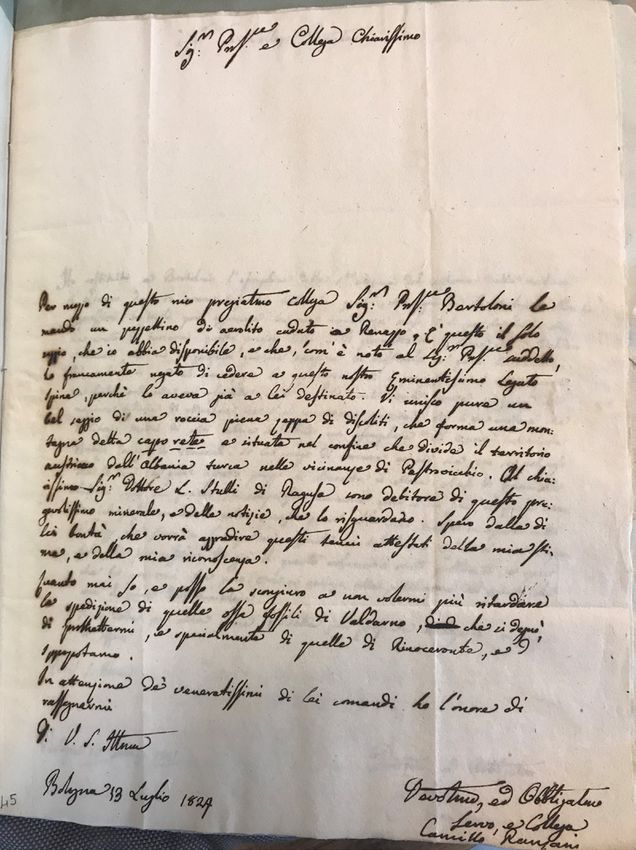
A. Franza, G. Pratesi

                       Introduction                                 have become an important source of extraterrestrial
                                                                    material for research purposes [14]. Hartmann’s and Golia’s
More than 50 tons of extraterrestrial material hit the              [19] studies emphasize how meteorites have a social and
Earth every year [1]. Meteorites are natural objects that           cultural history, being surrounded by a significant corpus
have survived passage through the atmosphere and have               of myths, legends and folklore. In this regard, there have
reached the ground. An important difference exists                  been numerous studies to investigate recorded accounts of
between meteorite falls and meteorite finds: the former             meteoritic events in the oral traditions of Native Americans
are meteorites collected after their fall was witnessed by          and Indigenous Australians [21]. For instance, the following
observers or camera networks designed for monitoring                studies were conducted using first-hand ethnographic
fireballs; the latter are meteorites that were recovered by         records, literature, and field trip data to locate possible new
people but whose fall was not seen [3]. Each meteorite found        impact structures or meteorites in Australia [23]. A number
is given a name by the Nomenclature Committee of the                of authors have also recognized the use of meteorites in
Meteoritical Society, usually that of the closest geographical      ancient human artefacts [27]. In short, as rightly remarked
landmark where it fell or was recovered. All known                  by Dorfman [33], the literature pertaining to meteorites in
meteorites recognized by the Meteoritical Society are then          history strongly suggests that meteorites hold many levels
included in the Meteoritical Bulletin Database (https://            of intangible heritage [34]. On this subject, a recent study
www.lpi.usra.edu/meteor/metbull.php) a digital repository           by Wilson [35] concluded that the way in which planetary
for basic information such as meteorite classification, place       science is represented in natural history museums
and year of discovery, whether it was observed to fall and          contributes to demonstrating the role of natural heritage as
references to catalogues (i.e., Catalogue of Meteorites from        a means of moral and social witnessing. The author argued
the Natural History Museum in London, MetBase, Antarctic            that in temporary or permanent exhibitions focusing on the
Meteorite Newsletter) in which the meteorite is described.          formation of galaxies, stars and planets (e.g., the temporary
   Meteorites have been falling from the sky for aeons and          exhibition ‘The Evolving Universe’ in The Arthur Ross Hall
have been investigated by scientists from a number of various       of Meteorites at the American Natural History Museum
disciplines. In 1858, Karl Ludwig Reichenbach (1788-1869)           in New York, and the permanent exhibition ‘Kosmos &
defined meteorites as cosmological, astronomical, physical,         Sonnensystem’ in the Museum für Naturkunde in Berlin),
geological, chemical, mineralogical, and meteorological             visitors observe, through the display of meteorites, not only
objects, highlighting the fact that they can be studied from        the cosmic processes that have shaped the Solar System,
different perspectives [4]. Even the term ‘meteor’ did not          but also how humans have interacted with this aspect of
have the meaning it has got at the present. In his Lexicon          the environment thanks to the recovery and the analysis
Technicum, John Harris (1666-1719) described meteors as             of meteorite fragments. Wilson [35] further points out that
“various impressions made upon the Elements, exhibiting             meteorite exhibitions demonstrated “how humanity is not
them in different forms (…) for the most part, they appear up       the measure but a component in a wider system that is
in the Air, and they are either Fiery, Airy, or Watery” [5]. This   dependent upon the relationships that are built within it”.
description stemmed directly from Aristotle’s Meteorologica            As stated before, meteorite collections are the subjects
(about 340 B.C.). The meteorological tradition, as stated by        of studies looking into the evolution of both the universe
Jankovic (2006), remained entrenched in the Aristotelian            and our planets [36]. Within these research projects, the
view until the early nineteenth century when naturalists such       analysis of historical documents, museum catalogues and
as Ernst Chladni (1756-1827), Edward Howard (1774-1816) and         inventories can lead both scientists and historians to the
Jean-Baptiste Biot (1774-1862) established the extraterrestrial     potential discovery of meteorite specimens previously
origin of meteorites [6]. It is beyond the scope of this article    unknown [41]. Meteorite collections in natural history
to attempt a comprehensive reconstruction of the history of         museums are therefore representative of scientific as well
the meteoritics [9], nonetheless, even before scholars were         as historical and cultural meanings that add extra value
convinced of the reality of meteorite falls from the outer          to a specimen. The issue that then naturally arises is how
space, meteorites were preserved in naturalistic museums            best to define museum meteorite collections in the heritage
and private collections throughout the world. In this regard,       context. Revisiting the questions posed by De Chadervian
Burke [10] noted that the development of mineralogical              [44], we can ask why meteorite collections in natural history
collecting in the eighteenth century aided the recovery             museums are an issue we are invited to think about? Has the
of meteorite specimens to the point that, after the mid-            way in which meteorite specimens are valued and collected
nineteenth century, meteorites collection became a symbol           changed? Is the access to the samples an issue? Are science
of a nation’s scientific prestige and political power [11]. Burke   historians, museum curators and planetary scientists
[10] further pointed out how, between the late nineteenth and       raising the issue?
early twentieth century, the major European and American               These questions are especially true for the meteorites
meteorite collections were established and opened to the            that have been recovered in Italy over the centuries. Due
public. From then on, the specimens in these collections            to physiographic factors, Italian meteorites are extremely

CONSERVAR PATRIMÓNIO 36 (2021)                                                                                                 107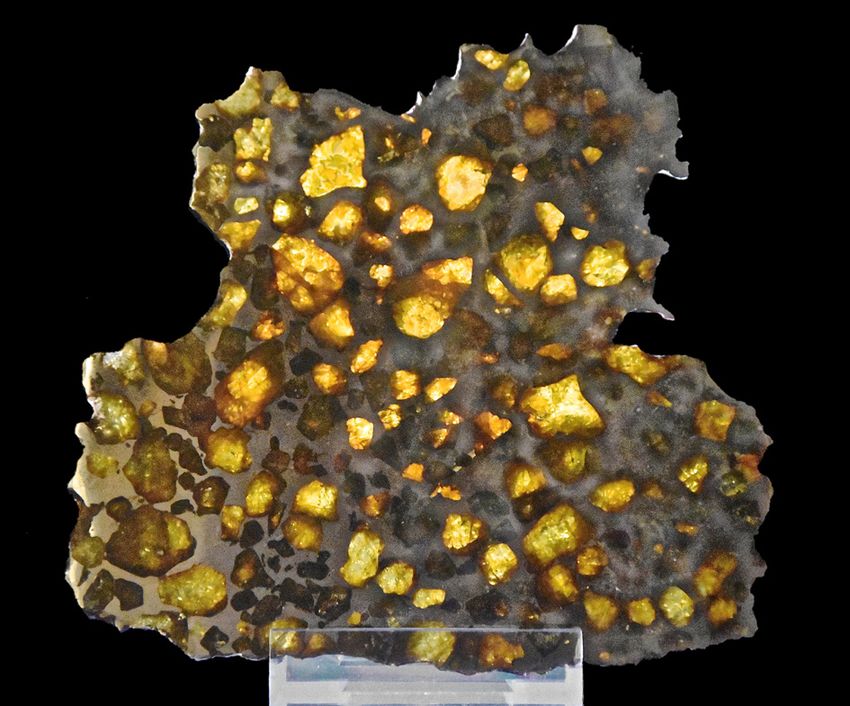
Meteorites as a Scientific Heritage

rare and to date only 42 meteorites – both falls and finds –                museum curators and visitors) within a complex network of
have been officially approved by the Meteoritical Society. In               agency. As Godsden et al. [65] and Bennett [66] have noticed,
spite of their small number and their belonging to a rather                 this agency does not end with the specimen acquisition, but
common typology (among these, 25 are ordinary chondrites)                   it continues in the procedures of display as well as in the
the study of Italian meteorites has long been the subject of                social and cultural practices or researching and learning
intense historiographic and theoretical debates [45] such as                which arise from the study of the single meteorite sample
the lively controversy that arose after the shower of stones                [67] (Figure 1).
that fell on Siena on 17 June 1794 [52]. Furthermore, Italian                  The management of the catalogue cards through the
meteorites, such as those of other Western countries, are                   SIGECweb digital database then shows how meteorite
particularly sought out in the collector market due to their                collections have not only a documentary value, but they
rarity. This can sometimes lead to false ‘discoveries’ designed             represent a scientific heritage, the study of which helps to
to meet this market demand, e.g. the compelling case of the                 increase and improve our understanding of the cosmos,
Castenaso meteorite in 2003 [54]. Some authors have also                    through the sharing of data otherwise unknown to the
suggested that increased commerce in meteorites raises                      scientific community [68].
legal and ethical questions for museum curators, considering
that international law about meteorite acquisition is non-
uniform [55]. Natural history museums preserve the majority                                The standardized cataloguing
of the Italian meteorites known, as well as archival sources                                 of meteorite collections
regarding the history of their discovery. These collections
are repositories of specimens, documents and artefacts                      Much has been said about the concept of heritage in museum
that allow reconstructing the processes by which they were                  studies [69]. Quoting the expression proposed by Boundia
assembled, beginning from the late seventeenth century, as                  and Soubiran [71], the “heritage fever” – and thus the notion
the result of diverse cultural practices that involved different            of heritage – has been the subject of countless studies since
persons, places and things [57].                                            the 1980s. De Chadarevian [44] underlined how the term
   Starting from the methodological approach presented by                   ‘heritage’ usually indicates “something preserved from the
Alberti [63], this work revisits the metaphor of “unpacking                 past” – from artefacts to buildings, from cities to landscapes
museum collections”, proposed by Byrne et al. [64], in the light            – but also living cultures and intangible heritage (i.e.,
of the establishment of cataloguing standards for meteorite                 gestures, feasts, ceremonials) according to the definition
specimens. The creation of a standardized cataloguing card,                 proposed by the UNESCO [72]. Policies for safeguarding and
elaborated by the Italian Central Institute for Catalogue                   management both material and intangible heritage have
and Documentation (Istituto Centrale per il Catalogo e la                   been developed by the International Council of Museums
Documentazione − ICCD) together with museologists and                       (ICOM), which established a new international committee
academics, describes meteorite collections as a scientific                  dedicated to the cultural heritage of museum universities
heritage, problematising the specimens as both naturalistic                 (UMAC) in 2002 [73]. In 2005, the Committee of Ministers
and cultural objects through the compendium of data about                   of the Council of Europe adopted the Convention on the
their minerochemical classification, the roles they had over                Value of Cultural Heritage for Society (also known as the
the times and in contemporary planetary science, the social
relations they formed and the interactions they continue to
have with varied persons and groups (i.e., collectors, scholars,

Figure 1. Ordinary chondrite meteorite with fusion crust (weight 2236 g).   Figure 2. Acfer 371 oriented meteorite showing well visible regmaglypts
Museum of Planetary Sciences − Prato, Italy, Inv. No. 1413/1.               (weight 9608 g). Museum of Planetary Sciences − Prato, Italy, Inv. No. 2282/1.

CONSERVAR PATRIMÓNIO 36 (2021)                                                                                                                       108
A. Franza, G. Pratesi

Faro Convention), which emphasizes the concept of heritage             Botanica − BNB), paleontological specimens (Beni Naturalistici,
and its relationships to communities and society [75].                 Paleontologia − BNP), zoological specimens (Beni Naturalistici,
    Lourenço and Wilson [77] advocate the view that, while            Zoologia − BNZ), mineralogical specimens (Beni Naturalistici,
natural or industrial heritage are concepts of immediate               Mineralogia − BNM), petrological specimens (Beni Naturalistici,
understanding, the notion of scientific heritage is “diverse,          Petrologia − BNPE), planetological specimens (Beni
complex, multi-layered, and more difficult to define.”                 Naturalistici, Planetologia − BNPL). The last type of catalogue
The authors then underline how the concept of scientific               card has been defined for the study of meteorite samples.
heritage lies “at the intersection of two distinct and complex             Tucci [85] noted that all the catalogue cards, generally
worlds – the world of science and the world of (cultural)              speaking, contain: (a) both descriptive and more detailed
heritage.” In this context, the term ‘heritage’ refers not             data, which highlights the cultural value of the catalogued
only to buildings and landscapes of historical value (e.g.,            specimen; (b) geographical information (i.e., the place
astronomical observatories and botanical gardens) but also             of recovery, the place where the specimen is actually
– and among many others – to anatomical preparations,                  preserved and/or previous institutions where it was stored);
scientific instruments, herbaria, fossils, archives and                (c) information about other data possibly related to the
documents, ethical issues in conducting research and                   specimens (i.e., archival documents, museum catalogues
teaching practices, meteorite specimens. This material is              and inventories); (d) administrative data such as economic
often dispersed in scientific museums or institutions and              evaluations. The structure of the data is then organized in
university collections [78].                                           a series of sections, which are dedicated to a specific topic
    Scientific heritage, due to the variety of the material            (e.g., identification of the specimen, location, scientific and
and immaterial media that it encompasses, raises broad-                historical background, technical data, archival or general
spectrum issues related to its preservation, conservation              documentation). Each catalogue card presents a set of
and dissemination. The problems related to the preservation            guidelines for the standardized filling of the sections (i.e.,
of meteorite collections concern, for instance, the transfer           which sections must be completed, which can be repeated for
of the specimens into research and teaching laboratories               additional information, which need the use of a predefined
making the samples more exposed to the risk of damage                  vocabulary) as well as for management of the catalogue
or loss. This is especially true when samples are involved             card on the digital database (SIGECweb). About filling
in inter-institutional loans under international research              some sections according to a predefined terminology, the
agreements. In this section, we, therefore, discuss how the            ICCD guidelines provide for the use of an ‘open’ vocabulary
standardized cataloguing of meteorites preserved in natural            or a ‘closed’ vocabulary. Open vocabularies consist of
history museums – whether historical or newly acquired                 lists of terms that can be increased during the editing of
specimens – can prove to be a useful tool to safeguard their           a catalogue card, with the insertion of new headwords by
roles and identities as well as to promote their scientific            the cataloguer. The proposals for updating the vocabularies
heritage preservation and use (Figure 2). The case study               are subsequently submitted to a scientific verification
research has been conducted on the legislation and                     committee and, in case of acceptance, they are officially
regulations promoted in Italy regarding the standardized               published on the ICCD website. Closed vocabularies consist
cataloguing of the planetological heritage (beni planetologici).       of a series of predefined terms that cannot be updated
    The decree 22 January 2004, n. 42 (Codice per i Beni Culturali     by the cataloguer. Open and closed vocabularies may be
e del Paesaggio, Code for Cultural Heritage and Landscape)             formed by a list of terms, definitions, references to primary
acknowledged as cultural heritage all the collections preserved        sources or general bibliography, thesauri. The cataloguing
in public museums and institutions in Italy regardless the             activity can be conducted at a (1) inventory level (i.e. the
typology of the objects that are part of it (art. 10, part 2, letter   level of minimum information required for the correct
a). In Attachment A (n. 13), the Code directly mentions as             preservation of the specimen as well as for the planning of
cultural heritage “collections and/or specimens belonging              conservation and valorisation activities); (2) pre-catalogue
to zoological, botanical, mineralogical and anatomical                 level that provides additional information deduced from
collections”. In 2007, the Ministry of Cultural Heritage and           the direct observation of the specimen; (3) catalogue level,
Activities (Ministero per i Beni e le Culturali e per il Turismo −     which corresponds to a more in-depth study of the specimen
MiBACT) in collaboration with the Conference of the Rectors            (e.g., bibliographical and archival research). It is noteworthy
of the Italian Universities (Conferenza dei Rettori delle Università   to mention that the cataloguing system here described
Italiane − CRUI), ENEA (Agenzia nazionale per le nuove tecnologie,     can be arranged from (1) to (3) depending on the type of
l'energia e lo sviluppo economico sostenibile), ICCD, the National     sample to be catalogued. However, the main objective of
Association of Scientific Museums (Associazione Nazionale              any cataloguing level remains the precise identification of
Musei ScientificiANMS) scholars and museum practitioners,              the specimen and its historical, cultural and geographical
established a standardized procedure to catalogue objects              background, in order to emphasize the network of relations
identified as natural heritage. The ICCD realised six different        between the natural heritage and the territory [86].
catalogue cards for: botanical specimens (Beni Naturalistici,

CONSERVAR PATRIMÓNIO 36 (2021)                                                                                                    109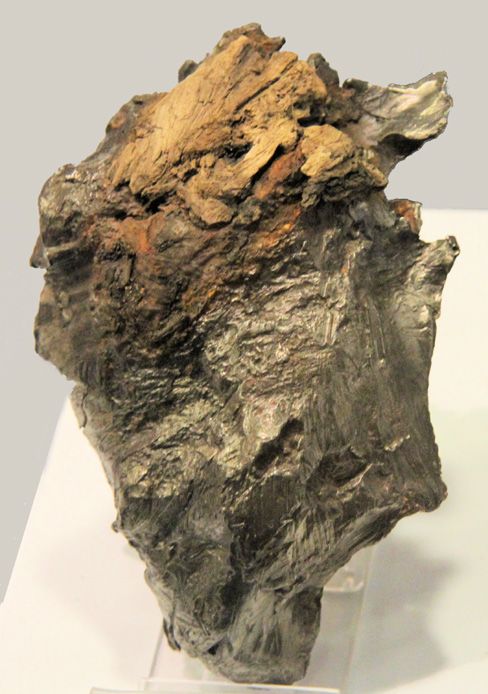
Meteorites as a Scientific Heritage

              How to catalogue a meteorite?                                     Therefore, it is also very important to reanalyse the historical
               The cataloguing card BN-PL                                       meteorites in order to confirm their extra-terrestrial origin
                                                                                and to revise their classification. This is the reason why the
The catalogue card BN-PL consists of more than 400 sec-                         catalogue card must provide accurate information about the
tions. It is therefore not possible to describe all the indivi-                 meteorite analytical data.
dual sections, so this study discusses the most significant                        The MSS section then contains information if the
paragraphs of the card for the correct preservation, conser-                    specimen was a fall or a find. This is an important distinction
vation and valorisation of a meteorite specimen [90].                           because finds are more prone to contamination with the
   After having established which institution is carrying                       terrestrial environment, depending on the time they spent
out the cataloguing activities, the Object Section (OS)                         on the ground [3, 92]. Most of the meteorites actually
contains the essential information for the identification                       preserved in Italian natural history museums are falls.
of the catalogued specimen. The name of the collection to                       Nonetheless, in the last two decades, diverse institutions
which the specimen belongs must then be indicated in                            have increased their meteorite collections with finds
full. The Meteorite Systematics Section (MSS) provides for                      recovered in hot and cold deserts [60, 93]. It is important
information about the classification of the specimen based                      to note that the date of the meteorite fall could not be the
on its mineralogical and petrographic characteristics as well                   same as of the meteorite recovery. For instance, fragments
as on its whole-rock chemical and O-isotopic compositions [3]                   of the Sikhote-Alin meteorite (Figure 4), which fell on the
(Figure 3). As Weisberg et al. [92] rightly pointed out meteorite               eponymous Russian mountains on 12 February 1947, are
classification is the basic framework from which planetary                      still being found today. The MSS then contains information
scientists and cosmochemists work and communicate. The                          about where the holotype is preserved and who holds the
process of classification evolves with both the collection of                   biggest meteorite specimen (i.e., naturalistic museum or
new data and the discovery of unknown meteorite types.                          private collector). Within this section, the cataloguer can

Figure 3. Slice of Imilac pallasite with olivine crystals embedded in metal (weight 199 g). Museum of Planetary Sciences – Prato, Italy, Inv. No. 1394/1.

CONSERVAR PATRIMÓNIO 36 (2021)                                                                                                                              110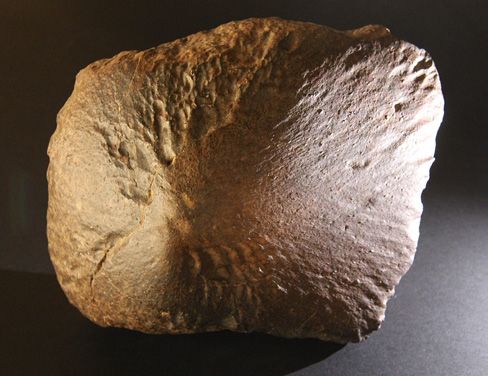
A. Franza, G. Pratesi

                                                                            evaluation of the meteorite fragment along with information
                                                                            about the collector and the collection in which the specimen
                                                                            is included. The economic evaluation of the single meteorite
                                                                            sample is a very important data that the cataloguing process
                                                                            returns to the community and stakeholders. In recent
                                                                            years there has been a growing interest in the processes for
                                                                            determining the economic value of naturalistic collections.
                                                                            This is an indicator useful for establishing the costs of
                                                                            protection, conservation, valorisation and insurance cover
                                                                            against theft, fire, and damage to be used even in the case
                                                                            of loans for temporary exhibitions or study purposes [91, 94].
                                                                            As pointed out by Burke [10], museum curators complained
                                                                            from the 1840s about the prices of meteorites in what
                                                                            seemed to be a chaotic market. An element that seemed to
                                                                            influence this chaotic market was, as Burke [10] further
                                                                            asserted, the total weight of the recovered specimen. In this
                                                                            regard, Buchner [102] made the first attempt to standardize
                                                                            meteorite pricing, listing 263 specimens held in various
                                                                            private and public collections and their total weight. A few
                                                                            decades later, Wülfing [103] brought Buchner’s survey up
                                                                            to date, considering eight factors as determining meteorite
                                                                            exchange values: (1) the amount of preserved material, (2)
                                                                            the total weight of the petrographic group in which the
                                                                            meteorite was classified, (3) the number of owners, (4) the
                                                                            addition of a new fall or find to a group of limited weight, (5)
                                                                            the cost of acquisition, (6) the state of preservation, (7) the
                                                                            historical interest, and (8) whether the meteorite was a fall
Figure 4. Sikhote Alin meteorite (weight 290 g). On the upper side of the   or a find. The factors 1-3 were then used in a mathematical
specimen, it can be noted a fragment of wood that remained attached on
the hot meteorite surface following the impact with a tree. Museum of       formula to determine the correct exchange value of a
Planetary Sciences – Prato, Italy, Inv. No. 2241/1.                         meteorite specimen.
                                                                                All the criteria listed in Wülfing’s essay are still valid
also enter data about the presence of meteorite fragments,                  today and considered within the BN-PL catalogue card.
thin sections and powder available for loan as well as general              Furthermore, as rightly pointed out by Moggi Cecchi et al.
bibliography and any information taken from museum                          [104] the classification of newfound meteorites according
catalogues, inventories or original exhibition labels.                      to their mineralogical and petrographic characteristics
   The subsequent section is dedicated to Meteorite                         (Figure 5), carried out by natural history museums on
Collection Data (MCD). In these paragraphs shall be                         behalf of third parties, is a useful instrument in terms
included data about the year and the place where the
meteorite specimen was found and any information
concerning the scientific expedition that led to its discovery.
As stated before, meteorites are given names based on the
location in which they were recovered. Fragments from
cold or hot desert areas are given names and numbers. For
instance, Istifane 005 is a meteorite find that was collected
in the Moroccan ridge of Istifane in 2017, and it is now
preserved at the Florentine Natural History Museum. The
cataloguer can specify all this information in MCD as well
as other data about the mineralogical and petrographic
characteristics of the collected meteorite. A specific sub-
section is then devoted to the description (about 2000
characters) of the paper labels attributed to the specimen
during the meteorite-hunting expedition.
   After providing detailed information on the scientific
institution or the natural history museum preserving the                    Figure 5. Slice of Nantan iron meteorite showing Widmanstätten figures
specimen, the BN-PL catalogue card provides an economic                     (weight 3100 g). Museum of Planetary Sciences − Prato, Italy, Inv. No. 1364/2.

CONSERVAR PATRIMÓNIO 36 (2021)                                                                                                                        111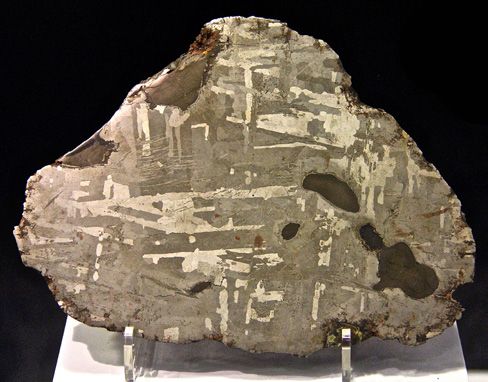
Meteorites as a Scientific Heritage

of both economic enhancement of naturalistic heritage                         village of Renazzo, in the current province of Ferrara (Italy).
and improvement of museum’s image in the scientific                           Three fragments of the meteorite were found, one of which
community. The next paragraph of the BN-PL catalogue card                     was 5 kg, for a total mass of 10 kg. Two weeks later, Camillo
reports the coordinates X, Y where the meteorite fragment                     Ranzani (1775-1841), the director of the Natural History
was recovered. These parameters are very important because                    Museum of Bologna from 1803 to 1841 [107], went to Renazzo
failure to report precise locality information makes it difficult             to recover as many samples as possible. In 1827, he sent one
for scientists to pair up recent finds with previous ones [105].              of these specimens to the French chemist André Laugier
The last paragraphs describe technical and analytical data                    (1770-1832) for analysis. The mineralogical and petrographic
relative to the meteorite specimens including size, colour,                   description of the fragments was then provided by Pierre
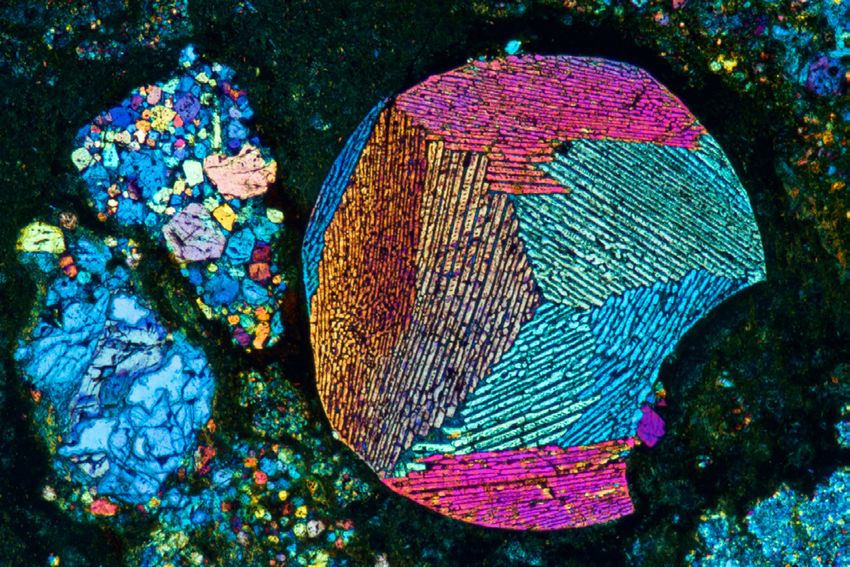
shape, surface, interior features (Figure 6), weight, and                     Louise Antoine Cordier (1777-1861), who was a naturalist and
magnetic properties. Information about meteorite care,                        a founder of the French Geological Society [108]. Cordier
preservation, previous restoration works, and laboratory                      noted that the sample was not similar to other known meteo-
analysis is also given within these sections.                                 rites, except for the black and glassy crust which partly cove-
   The BN-PL catalogue card ends with bibliographical                         red its surface. On this basis, he classified the specimen as
data on essays and scientific articles about the specimen as                  a meteorite vitreuse (vitreous meteorite) [109]. Contemporary
well as references to archival material. In this section, the                 petrological, geochemical and oxygen isotopic studies have
cataloguer can also upload a high-resolution image relative                   identified the Renazzo meteorite as the holotype of the CR
to the sample along with the photo credits.                                   (Renazzo-type) carbonaceous chondrite group because of a
                                                                              set of properties that distinguishes it from other chondrite
                                                                              groups [110]. For this reason, the meteorite Renazzo is still
   The Renazzo meteorite (1824): cataloguing a                                today one of the most studied meteorites by the scientific
   meteorite specimen through the BN-PL card                                  community as well as one of the most sought-after on the
                                                                              collectors' market.
According to the chronicle written by Francesco Lenzi (dates                     The Natural History Museum of the University of Firenze
uncertain) and now preserved at the Historical Archive                        preserves two specimens of the Renazzo meteorite that
of Cento [106], on 15 January 1824, a stone fell on the small                 have been catalogued through the BN-PL card. The first is a

Figure 6. Cross polarized nicols image of a chondrite meteorite. It is to be noted the barred olivine chondrule on the right-middle of the image. Museum
of Planetary Sciences – Prato, Italy. Photo credit Prof. Bernardo Cesare (University of Padova).

CONSERVAR PATRIMÓNIO 36 (2021)                                                                                                                      112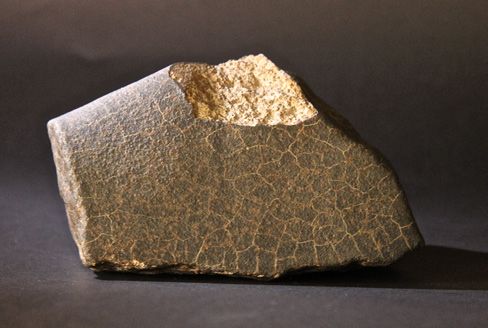
A. Franza, G. Pratesi

Table 1. Extract of the BN-PL catalogue card for the Renazzo meteorite specimen (ICCD Cat. No. 01142167) preserved at the Natural History Museum
(Collection of Mineralogy and Lithology) of the University of Firenze.
 ICCD catalogue number       01142167
 Name                        Renazzo
 Genre                       Chondrite
 Class                       Carbonaceous Chondrite
 Group                       CR
 Fall/Find                   Fall
 Date                        1824
 Definition                  Renazzo Carbonaceous Chondrite
 Locality                    Renazzo, Province of Ferrara, Italy
 Type of localization        Recovery location − historical data
 Valuation                   2.500 €
 Weight                      70 g
 State of conservation       Good
 Laboratory analysis         Minerochemical analysis
 Date of analysis            1998
 Type of acquisition         Donation
 Name of the donor           Camillo Ranzani
 Date of the donation        1824
 Sources and documents       Archivio Storico, Collezione di Mineralogia e Litologia, Appendice di Aumenti al Catalogo della Mineralogia del 1824, n. 00525.
                             Archivio Storico, Collezione di Mineralogia e Litologia, Catalogo della Mineralogia e Orittologia 1843-1845, n. 7148.
                             Archivio Storico, Collezione di Mineralogia e Litologia, Catalogo della Collezione di Meteoriti, 1947, n. 13770.
                             Archivio Storico, Museo Galileo, ARMU Affari 038, Carteggio della Direzione, gennaio-dicembre 1824, c. 37.

specimen of 70 g acquired by the Museum in 1824 (Figure 7,                        As stated by Alberti [63], collectors, curators, and
Table 1).                                                                      scientists encountered museum objects in very different
   Table 1 illustrates data regarding the cataloguing of the                   ways. For instance, things collected in the field, as meteorite
Renazzo meteorite specimen using the BN-PL catalogue                           specimens, can be connected to institutions and scientific
standard. The information shows the date of the fall, where                    practices, providing insights into the role of museums in
the meteorite was recovered, and its minerochemical                            scientific and civic culture. Of this, the HA-GM preserves
classification. Furthermore, the table indicates the state                     the Archivio del Reale Museo di Fisica e Storia Naturale di
of conservation of the specimen, its economic valuation,                       Firenze (Archive of the Royal Museum of Physics and
and how it was acquired by the Florentine Natural                              Natural History of Florence), a fund of more than 5700
History Museum. In this regard, it is interesting to note                      documents covering a period of almost a century (1780-
the information that stands out from the Sources and                           1872), and representing one of the most important sources
Documents (SD) field. This field is repeatable within                          to reconstruct the history of the Florentine Natural History
the BN-PL card and contains all the references relative to                     Museum and its relationships with the main European
the catalogued specimen. In this case, the SD reports the
historical documentation about the Renazzo meteorite
preserved both at the Historical Archive of the Natural
History Museum (HA-NHM) of the University of Firenze
and at the Historical Archive of the Galileo Museum (HA-
GM). The archival documents kept in HA-NHM reconstructs
the trajectories of the Renazzo meteorite specimen within
the Natural History Museum through catalogues and
museum inventories. Thanks to the study of this material,
it is possible to trace the “career” of the specimen from
its acquisition in 1824 to 1947, and to analyse the different
scientific contexts and the changes of value incurred by
these shifts [111]. In this regard, the specimen was described
in the Catalogue of the Mineralogical Collection (1843-1845) as
a “meteoritic iron fallen on 15 January 1824 [112]”. It will be
necessary to wait until 1947, when the meteorite collection
                                                                               Figure 7. The largest sample (70 g) of the Renazzo meteorite preserved at
was first inventoried, to see the sample described as a                        the Natural History Museum of the University of Firenze, Collection of
meteorite whose economic value was 130 lire [113].                             Mineralogy and Lithology, ICCD Cat. No. 1142167.

CONSERVAR PATRIMÓNIO 36 (2021)                                                                                                                            113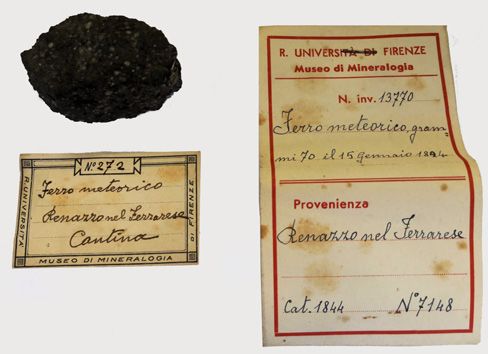
Meteorites as a Scientific Heritage

scientific institutions. Within these funds, we can trace                   confirming the importance of the House of the Habsburg in
a letter from the Grand Duke of Tuscany Leopold II (1797-                   the mineralogical collecting in the nineteenth century [116].
1870) to Girolamo Bardi (1777-1829), Director of Natural                        The Natural History Museum of the University of Firenze
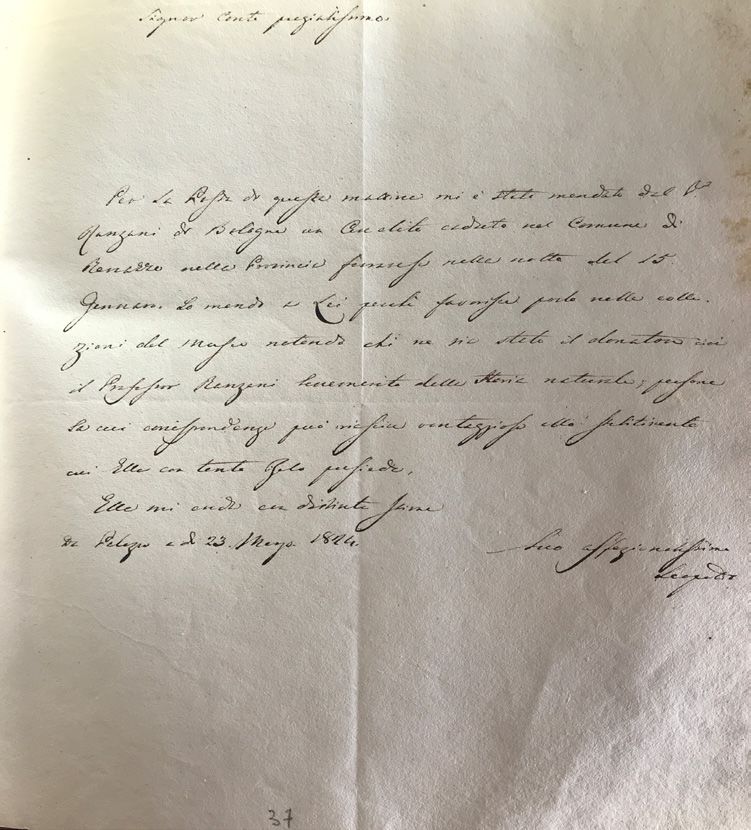
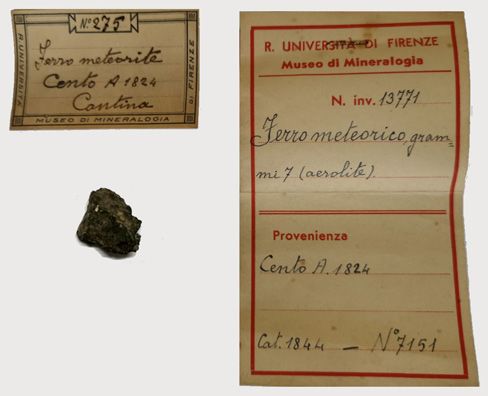
History Museum of Firenze from 1806 to 1829 [114]. On 23                    preserved a second fragment of the Renazzo meteorite,
March 1824, Leopold II sent to Bardi an “aerolite that fell                 i.e. a small specimen of about 7 g that was acquired by the
in the village of Renazzo on the night of 15 January”, which                Museum in 1840 (Table 2, Figure 9).
he had received from Camillo Ranzani. The Grand Duke                            As noted earlier, the museum catalogues provide
stated that the meteorite was sent to Bardi as Director of                  information for the second Renazzo meteorite fragment
the Natural History Museum of Firenze so that he could                      since its acquisition by the Natural History Museum in 1840
display it in the mineralogical collections, specifying the                 onwards. The Catalogue of the Mineralogical Collection (1843-
name of the donor on the specimen label [114] (Figure 8).                   1845) described the specimen as an “aerolite, year 1824”,
   This important document (Figure 8), which represents the                 while the inventory of the meteorite collection (1947) gave the
deed of donation of the Renazzo meteorite to the Museum,                    sample a 10 lire value [120]. Even if the museum catalogues
was found thanks to the cataloguing of the specimen                         do not provide further data about the sample except for
through the BN-PL card. It reveals not only the scientific                  the year of acquisition, this information is crucial to trace
importance attributed to the meteorite Renazzo since its                    the object's career through archival sources kept in other
discovery, but also the primary role played by the meteorite                Florentine research institutions.
exchange within naturalistic collections [10]. Furthermore,                     In this regard, the National Library of Firenze preserved
it is interesting to note how Ranzani did not send the                      the Targioni-Tozzetti Fonds’, which includes more than
meteorite specimen directly to Bardi, but to Leopold II, thus               2500 documents belonging to the Targioni Tozzetti family,

Figure 8. Letter of donation to the Florentine Imperial and Royal Museum of Physics and Natural History, by the Grand Duke Leopold II, of an aerolite
fallen in the village of Renazzo and sent to him by Camillo Ranzani, 23 March 1824. Historical Archive, Galileo Museum, Firenze.

CONSERVAR PATRIMÓNIO 36 (2021)                                                                                                                   114
A. Franza, G. Pratesi

and therefore of great interest for the history of physics
and natural sciences between the eighteenth and the
nineteenth centuries [123]. In this fonds is also preserved the
correspondence of Ottaviano Targioni Tozzetti (1755-1826),
a naturalist and an expert in mineralogy, who maintained
scientific relationships with the Natural History Museum
of Firenze. The analysis of Ottaviano Targioni Tozzetti’s
scientific correspondence showed how his studies on
meteorites were well known to the scientific community of
the time, to the point that he had a close exchange of letters
with Ambrogio Soldani (1733-1808) about the mineralogical
analyses carried out on the Siena meteorite (1794) [52, 126].
On 13 July 1824, Ottaviano Targioni Tozzetti received from
Camillo Ranzani “a very small fragment of the aerolite
that fell on Renazzo” in exchange for “fossil bones from
Valdarno, in particular hippopotamus and rhinoceros’
                                                                               Figure 9. The smallest sample (7 g) of the Renazzo meteorite specimen.
bones” [129] (Figure 10). On 18 December 1824, Ranzani                         Natural History Museum of the University of Firenze, ICCD Cat. No.
wrote a second letter to Targioni Tozzetti to thank him for                    1142168.
the historical notes he sent about the “aerolites fallen on
Italy” that Ranzani will use as a preface to his “book on the
aerolites that fell on the Cento area this year.” Ranzani was,                 acquired by the Natural History Museum of Firenze for a price
therefore, preparing to write an essay on the meteorite of                     of 12.000 lire [131]. This mineralogical collection was initiated
Renazzo (Cento is the largest city near the place of fall). The                by the naturalist Pier Antonio Micheli (1679-1737), acquired by
book was never published, as Ranzani had predicted in his                      his pupil Giovanni Targioni Tozzetti (1712-1783) that enriched
letter to Targioni “but when will I be able to write this book?                it and accompanied it with a catalogue in 12 volumes, and at
God only knows” [130].                                                         last inherited from Targioni's son, Ottaviano, who added his
   No further information about the Renazzo meteorite                          own collection of minerals [133]. A first survey of the samples
fragment sent by Ranzani to Targioni was available before                      was made by the chemist Andrea Cozzi (dates uncertain) at
the specimen was catalogued thanks to the BN-PL card. As                       the end of February 1839. Afterwards, the Court Secretariat of
already been said, this meteoritic sample was recorded for the                 the Grand Duchy of Tuscany approved the project presented
first time in the museum inventory in 1840. One year before,                   by the geologist Filippo Nesti (1780-1849) for the arrangement
although the negotiations had begun in 1836, the mineralog-                    of the Targioni Tozzetti mineralogical collection [134]. From
ical collection belonging to the Targioni Tozzetti family was                  this standpoint, the second Renazzo meteorite specimen

Table 2. Extract of the BN-PL catalogue card for the second Renazzo meteorite specimen (ICCD Cat. No. 01142168) preserved at the Natural History
Museum (Collection of Mineralogy and Lithology) of the University of Firenze.

 ICCD catalogue number      01142168
 Name                       Renazzo
 Genre                      Chondrite
 Class                      Carbonaceous Chondrite
 Group                      CR
 Fall/Find                  Fall
 Date                       1824
 Definition                 Renazzo Carbonaceous Chondrite
 Locality                   Renazzo, Province of Ferrara, Italy
 Type of localization       Recovery location − historical data
 Valuation                  2.000 €
 Weight                     7g
 State of conservation      Good
 Laboratory analysis        Minerochemical analysis
 Date of analysis           1998
 Type of acquisition        Unknown
 Date of the acquisition    1840
 Sources and documents      Archivio Storico, Collezione di Mineralogia e Litologia, Appendice di Aumenti al Catalogo della Mineralogia del 1820-1844, n.
                            02378.
                            Archivio Storico, Collezione di Mineralogia e Litologia, Catalogo della Mineralogia e Orittologia 1843-1845, n. 7151.
                            Archivio Storico, Collezione di Mineralogia e Litologia, Catalogo della Collezione di Meteoriti, 1947, n. 13771.

CONSERVAR PATRIMÓNIO 36 (2021)                                                                                                                              115
Meteorites as a Scientific Heritage Figure 10. Letter sent to Ottaviano Targioni Tozzetti by Camillo Ranzani, which deals with the small fragment of the Renazzo meteorite, 13 July 1824. National Library of Firenze. preserved at the Natural History Museum of Firenze can be Conclusions considered as the small fragment that was sent by Camillo Ranzani to Ottaviano Targioni Tozzetti in 1824. It is impor- Since the early 1800s, naturalists began to collect meteo- tant to highlight the fact that this result would not have been rites systematically. As might be expected, Chladni was achieved without the cataloguing of the sample with the among the first to join this activity (he possessed about 33 BN-PL card, which identified the year of the specimen’s acqui- specimens in 1820), along with Martin Klaproth (1743-1817), sition and therefore linked the archival material about the Johann Blumenbach (1752-1840) and Johann Kaspar Lavater Renazzo meteorite stored in other Florentine research insti- (1741-1801) (10, 135). The first catalogue that collected all the tutions, with the fragment preserved at the Natural History meteorite specimens belonging to a museum was published Museum of Firenze. in 1847 by the Natural History Museum of London. Since CONSERVAR PATRIMÓNIO 36 (2021) 116
A. Franza, G. Pratesi

then the catalogue has been kept up to date and its last and                      Association 86 (1976) 133-139.
fifth edition was issued in 2001 [136].                                       7. Marvin, U.B., ‘Ernst Florens Friedrich Chladni (1756-
   Despite the fact that there is still no international                          1827) and the origins of modern meteorite research’,
standardized regulation for the cataloguing of meteorites,                        Meteoritics and Planetary Science 31 (1996) 15-71, https://doi.
the BN-PL catalogue card proposed by the ICCD proves                              org/10.1111/j.1945-5100.1996.tb02031.x.
to be an efficient and scientifically valid instrument for                    8. Gounelle, M., ‘The meteorite fall at L’Aigle and the Biot report:
the cataloguing of meteorite collections preserved in                             exploring the cradle of meteoritics’, in The History of Meteoritics
                                                                                  and Key Meteorite Collections: Fireballs, Falls and Finds, ed. by
Italian naturalistic museums and could represent a useful
                                                                                  McCall G.J.H, Bowden A.J., Howarth R.J., The Geological
guideline for an international standard. The use of the BN-PL
                                                                                  Society, London (2006) 73-89.
catalogue standard within the meteorite collection of the
                                                                              9. Westrum, R., ‘Science and social intelligence about anomalies:
Natural History Museum of Firenze has allowed not only the                        the case of meteorites’, Social Studies of Science 8 (1978) 461-493,
cataloguing of the Renazzo meteorite specimens, but also to                       https://doi.org/10.1177/030631277800800403.
trace correctly their historical and scientific background.                   10. Burke, J.G., Cosmic Debris. Meteorites in history, University of
   In conclusion, cataloguing is an essential part of managing                    California Press, Berkeley (1986).
a natural history museum on which are based important                         11. Wilson, W.E. ‘The history of mineral collecting, 1530-1799:
museum activities such as research, conservation, risk                            with notes on twelve hundred early mineral collectors’,
management, exhibition development and publications. The                          Mineralogical Record 25(6) (1994) 1-243.
standardized cataloguing of meteorite collection discussed                    12. Lucas, A.M.; Lucas, P.J.; Darragh, T.A.; Maroske S., ‘Colonial
in this paper proves how meteorite specimens are part of                          Pride and Metropolitan Expectations: The British Museum
a scientific heritage, which is important to preserve at the                      and Melbourne's Meteorites’, The British Journal for the
highest possible level of care and stewardship.                                   History of Science 27(1) (1994) 65-87, https://doi.org/10.1017/
                                                                                  S0007087400031678.
                                                                              13. Nair, S.P., ‘Science and the politics of colonial collecting:
                                                                                  the case of Indian meteorites’, British Journal for the History
Acknowledgements
The authors would like to thank the ICCD as well as all the colleagues            of Science 39(1) (2006) 97-119, https://doi.org/10.1017/
that have worked on the creation of a cataloguing standard for meteorite          S0007087405007624.
specimens preserved in natural history museums. The authors sincerely         14. Brandstätter, F., ‘History of the meteorite collection of
acknowledge the support of all the staff of both the Museum of Planetary          the Natural History Museum of Vienna’, in The History of
Science of Prato and of the Natural History Museum of Firenze (Collection         Meteoritics and Key Meteorite Collections: Fireballs, Falls and
of Mineralogy and Lithology). We are also grateful to Alessandra Lenzi,           Finds, ed. by McCall G.J.H, Bowden A.J., Howarth R.J., The
archivist and librarian at the Galileo Museum in Firenze. Finally, we thank       Geological Society, London (2006) 123-133.
the Fondazione Cassa di Risparmio di Firenze for providing the financial
                                                                              15. Clarke, R.S.; Plotkin, H.; McCoy T., ‘Meteorites and the
support to successfully complete this article through the fund MECSO
                                                                                  Smithsonian Institution’, in The History of Meteoritics and Key
“Meteoroid Characterization through Spectroscopic Observation”. The
                                                                                  Meteorite Collections: Fireballs, Falls and Finds, ed. by McCall
authors then thank all the staff of the Manuscript Room at the National
Library in Firenze for their help during their research.                          G.J.H, Bowden A.J., Howarth R.J., The Geological Society,
                                                                                  London (2006) 237-265.
                                                                              16. Grashake, A., ‘History of the meteorite collection at the
                                                                                  Museum für Naturkunde, Berlin’, in The History of Meteoritics
REFERENCES
                                                                                  and Key Meteorite Collections: Fireballs, Falls and Finds, ed. by
1. Halliday, I. T.; Blackwell, A.; Griffin, A., ‘The flux of meteorites
                                                                                  McCall G.J.H, Bowden A.J., Howarth R.J., The Geological
   on the Earth's surface’, Meteoritics and Planetary Science
                                                                                  Society, London (2006) 135-171.
   24(3) (1989) 173-178, https://doi.org/10.1111/j.1945-5100.1989.
                                                                              17. Komorowski, C.L.V.C., ‘The meteorite collection of the
   tb00959.x.
                                                                                  National Museum of Natural History in Parsi, France’, in The
2. Zolensky, M.; Bland, P.; Brown, P.; Halliday, ‘Flux of
                                                                                  History of Meteoritics and Key Meteorite Collections: Fireballs, Falls
   Extraterrestrial Materials’, in Meteorites and the Early Solar
                                                                                  and Finds, ed. by McCall G.J.H, Bowden A.J., Howarth R.J., The
   System II, ed. S. Lauretta Dante, H.Y. McSween, University of
                                                                                  Geological Society, London (2006) 163-204.
   Arizona Press, Tucson (2006) 869-888.
                                                                              18. Russell, S.; Grady, M., ‘A history of the meteorite collection
3. Grady, M.; Pratesi, G.; Moggi Cecchi, V., Atlas of Meteorites,
                                                                                  at the Natural History Museum, London’, in The History of
   Cambridge University Press, Cambridge (2014).
                                                                                  Meteoritics and Key Meteorite Collections: Fireballs, Falls and
4. Reichenbach, K. L., ‘Über die Anzhal der Meteoriten und
                                                                                  Finds, ed. by McCall G.J.H, Bowden A.J., Howarth R.J., The
   Betrachtungen über ihire Rolle im Westgebäde’, Annalen der
                                                                                  Geological Society, London (2006), 153-162.
   Physik 105 (1858) 551-563.
                                                                              19. Hartmann, W.K., ‘Chelyabinsk, Zond IV, and a possible
5. Harris, J., Lexicon Technicum: or an Universal English dictionary
                                                                                  first-century fireball of historical importance’, Meteoritics
   of Arts and Sciences: explaining not only the terms of Art, but the
                                                                                  and Planetary Science 50 (2015) 1-14, https://doi.org/10.1111/
   Arts themselves, printed for J. Walthoe, Mess. Knapton, D.
                                                                                  maps.12428.
   Midwinter, London (1736).
                                                                              20. Golia, M., Meteorites: Nature and Culture, Reaktion Books,
6. Sears, W.D., ‘Edward Charles Howard and an early
                                                                                  London (2015).
   contribution to meteoritics’, Journal of the British Astronomical

CONSERVAR PATRIMÓNIO 36 (2021)                                                                                                                      117
Meteorites as a Scientific Heritage
21. McCoy, T.J.; Marquardt, A.E.; Wasson, J.T.; Ash, R.D.; Vicenzi, 36. Elmann, A.J.; Keli, K., ‘Classification of four ordinary
E.P., ‘The Anoka, Minnesota iron meteorite as parent to chondrites from the Monnig Meteorite Collection’, Meteoritics
Hopewell meteoritic metal beads from Havana, Illinois’, and Planetary Science 27(4) (1992) 470-472, https://doi.
Journal of Archeological Science 81 (2017) 13-22, https://doi. org/10.1111/j.1945-5100.1992.tb00232.x.
org/10.1016/j.jas.2017.03.003. 37. Gattacceca, J.; Bourot-Denise, M.; Brandstaetter, F.; Folco, L.;
22. Gill, J.; Mardon A., ‘Meteorites in the Culture and Beliefs Rochette, P., ‘The Asco meteorite (1805): New petrographic
of Aboriginal Peoples in North America’, in 49th Lunar and description, chemical data, and classification’, Meteoritics
Planetary Science Conference, 19-23 March 2018, The Woodlands, and Planetary Science 42(8) (2007) A173-A176, https://doi.
Texas LPI (2018) Contribution No. 2083, id.1118. org/10.1111/j.1945-5100.2007.tb00602.x.
23. Bevan, A.; Bindon, P., ‘Australian Aborigines and Meteorites’, 38. Moggi Cecchi, V., ‘The application of the Raman spectroscopy
Records of the Wester Australian Museum 18 (1996) 93-101. to the study of meteorites and minerals belonging to the
24. Hamacher, D.W.; Norris, R.P., ‘Australian Aboriginal collections of the Museo di Scienze Planetarie della Provincia
geomythology: eyewitness accounts of cosmic impacts?’, di Prato’, Museologia Scientifica 11 (2014) 157-160.
Archeoastronomy 22 (2009) 60-93. 39. Wasson, J.T., ‘Campo del Cielo: a Campo by any other name’,
25. Hamacher, D.W., ‘Meteoritics and cosmology among the Meteoritics and Planetary Science 54(2) (2018) 280-289, https://
Aboriginal cultures of Central Australia’, Journal of Cosmology
doi.org/10.1111/maps.13205.
13 (2011) 3743-3753.
40. Llorca, J.; Campeny, M.; Ibáñez, N.; Allepuz, D.; Camarasa,
26. Hamacher, D.W., Goldsmith J., ‘Aboriginal oral traditions of
J.M.; Aurell-Garrido J., ‘The meteorite of Barcelona (1704):
Australian impacts craters’, Journal of Astronomical History and
History, discovery and classification’, Meteoritics and Planetary
Heritage 16(3) (2013) 295-311.
Science [Online Version of Record before inclusion in an issue]
27. McCoy, T.J.; Marquardt, A.E.; Vicenzi E.P.; Ash R.D.; Wasson
(2020), https://doi.org/10.1111/maps.13455.
J.T., ‘Meteoritic Metal Beads from the Havana, Illinois,
41. Moggi Cecchi, V.; Carpino, S.; Pratesi, G.; Caporali, S.; Manetti,
Hopewell Mounds: A Source in Minnesota and Implications
F., ‘Tale of a rediscovered meteorite: the case of the meteorite
for Trade and Manufacture’, 39th Lunar and Planetary Science
Slaghek’s Iron’, Museologia Scientifica 14 (2015) 166-168.
Conference, 10-14 March 2008, League City, Texas (2008) LPI
42. Moggi Cecchi, V.; Rossi, M.; Ghiara, M.R.; Pratesi G.; Franza
Contribution No. 1391., Id.1984.
A, ‘An unrevealed treasure: a new Italian meteorite from the
28. Johnson, D.; Tyldesley J.; Lowe T.; Withers P.H.; Grady M.,
Royal Mineralogical Museum of Naples’, Geology Today 35(6)
‘Analysis of a prehistoric Egyptian iron bead with implications
(2019) 212-216, https://doi.org/10.1111/gto.12293.
for the use and perception of meteorite iron in ancient Egypt’,
43. Pratesi, G.; Caporali, S.; Greenwoord, R.C.; Moggi Cecchi,
Meteoritics and Planetary Science 48 (2013) 997-1006, https://doi.
V.; Franchi, I.A., ‘A detailed mineralogica, petrographic, and
org/10.1111/maps.12120.
geochemical study of the highly reduced chondrite, Acfer 370’,
29. Rehren, T.; Belgya, T.; Jambon, A.; Káli, G.; Kasztovszky, Z.;
Meteoritics & Planetary Science 54 (2019) 2996-3017, https://doi.
Kis, Z.; Kovács, I.; Maróti, B.; Martinón-Torres, M.; Miniaci,
org/10.1111/maps.13409.
G.; Pigott, V.C.; Radivojevic, M.; Rosta, L.; Szentmiklósi, L.;
44. De Chadarevian, S., ‘Things and the archives of recent
Szökefalvi-Nagy, Z., ‘5000 years old Egyption iron beads made
sciences’, Studies in History and Philosophy of Science 44 (2013)
from hammered meteoritic iron’, Journal of Archeological Science
634-638, https://doi.org/10.1016/j.shpsa.2013.07.005.
40 (2013) 4785-4792, https://doi.org/10.1016/j.jas.2013.06.002.
45. Veggiani, A., Sulla caduta di una meteorite nel 1496 a Valdinoce nel
30. Comelli, D.; D’Orazio, M.; Folco, L.; El-Halwagy, M.; Frizzi, T.;
territorio cesenate, Lega, Faenza (1964).
Alberti, R.; Capogrosso, V.; Einaggar, A.; Hassan, H.; Nevin,
46. Tinazzi, M., ‘A meteorite fallen in ‘600 near Vago (Verona)’,
A.; Porcelli, F.; Rashed, M.G.; Valentini, G., ‘The meteoritic
Memorie della Società astronomica italiana 55(2) (1994) 547-566.
origin of Tutankhamun’s iron dagger’, Meteoritics and
47. Barbieri, F.; Zuccoli, M., ‘Note d’archivio: il vescovo Fogliani
Planetary Science 51(7) (2016) 1301-1309, https://doi.org/10.1111/
e la meteorite di Albareto’, Atti della Società dei naturalisti e dei
maps.12664.
matematici di Modena 128 (1997) 173-179.
31. Jambon, J., ‘Bronze Age Iron: Meteoritic or not? A Chemical
48. Guidone, N. La meteorite Fermo. Grafiche Bonassi, Fermo
Strategy’, Journal of Archeological Science 88 (2017) 47-53, https:// (1997).
doi.org/10.1016/j.jas.2017.09.008. 49. Cevolani, G., Fermo, la meteorite: l’ultima pietra celeste del secondo
32. Chen, K.; Wang, Y.; Liu, Y.; Mei, J.; Jiang, T., ‘Meteoritic origin millennio, Zefiro, Fermo (2005).
and manufacturing process of iron blades in two Bronze Age 50. Marvin, U.B.; Cosmo, L., ‘Domenico Troili (1766): “The true
bimetallic objects from China’, Journal of Cultural Heritage 30 cause of the fall of a stone in Albereto is a subterranean
(2018) 45-50, https://doi.org/10.1016/j.culher.2017.10.004. explosion that hurled the stone skyward"’, Meteoritics
33. Dorfman, E. (ed.), Intangible Natural Heritage: New Perspectives and Planetary Science 37(12) (2010) 1857-1864, https://doi.
on Natural Objects, Routledge, New York (2012). org/10.1111/j.1945-5100.2002.tb01169.x.
34. Ahmed, Y., ‘The scope and definitions of heritage: 51. Olson, R.J.M.; Pasachoff, J.M., ‘Comets, meteors, and eclipses:
from tangible to intangible’, International Journal Art and science in early Renaissance Italy’, Meteoritics
of Heritage Studies 12(3) (2006) 292-300, https://doi. and Planetary Science 37(11) (2010) 1563-1578, https://doi.
org/10.1080/13527250600604639. org/10.1111/j.1945-5100.2002.tb00811.x.
35. Wilson, R.J, Natural History. Heritage, Place and Politics, 52. Levi Donati, G., ‘La meteorite di Siena: una pagina importante
Routledge, New York (2018). nella storia della scienza’, Atti dell’Accademia delle Scienze di
CONSERVAR PATRIMÓNIO 36 (2021) 118A. Franza, G. Pratesi
Siena detta de’ Fisiocritici 15 (1994) 19-25. Cambridge University Press, Cambridge (1998).
53. Marvin, U.B., ‘The shower of stones at Siena, 1794: history’s 71. Boundia, S.; Soubiran, S., ‘Scientists and their cultural
most consequential meteorite fall’, in INHIGEO. Volcanoes and heritage: Knowledge, politics and ambivalent relationships’,
History, ed. by N. Morello N., Brigati, Genova (1998) 303-321. Studies in History and Philosophy of Science 44 (2013) 643-651,
54. Folco, L.; D’Orazio, M.; Perchiazzi, N., ‘Authenticating the https://doi.org/10.1016/j.shpsa.2013.07.002.
recovery location of meteorites: The case of Castenaso’, 72. Alivizatou, M., Intangible heritage and the museum: new
Meteoritics and Planetary Science 42(3) (2007)321-330, https:// perspectives on cultural preservation, Left Coast Press, Walnut
doi.org/10.1111/j.1945-5100.2007.tb00236.x. Creek (2012).
55. Schmitt, D.G., ‘The law of ownership and control of 73. Talas, S.; Lourenço M.C., Arranging and rearranging: planning
meteorites’, Meteoritics and Planetary Science 37 (2002) B5-B11, university heritage for the future, Padova University Press,
https://doi.org/10.1111/j.1945-5100.2002.tb00897.x. Padova (2012).
56. Gounelle, M.; Gounelle, M., ‘Meteorites: International law and 74. Mouliou, M.; Soubiran, S.; Talas, S.; Wittje, R. (eds.), Turning
regulations’, Meteoritics and Planetary Science 54(12) (2019) 2887- inside out European University Heritage: Collections, Audiences,
2901, https://doi.org/10.1111/maps.13396. Stakeholders, National and Kapodistrian University of Athens
57. Levi Donati, G., ‘The meteorite collection of Giorgio Abetti Press, Athens (2018).
Astronomical Observatory and Museum, San Giovanni 75. Fairclough, G.; Dragićević-Šešić, M.; Rogač-Mijatović, L.;
in Persiceto, Bologna, Italy: An update of the catalog’, Auclair, E.; Soini, K., ‘The Faro Convention, a new paradigm
Meteoritics and Planetary Science 31 (1996) A181-A186, https://doi. for socially − and culturally − sustainable heritage action?’,
Kymypa/Culture 8 (2015) 9-19.
org/10.1111/j.1945-5100.1996.tb02102.x.
76. Schofield, J., ‘Forget about ‘Heritage’: Place, Ethics and the
58. Cipriani, C.; Corazza, M., ‘Le meteoriti del Museo di
Faro Convention’, in The Ethics of Cultural Heritage, ed. by T.
Mineralogia di Firenze: nota I’, Museologia Scientifica 14 (1998)
Ireland, J. Schoofield, Springer, New York (2015), 197-209,
229-246.
59. Cipriani, C.; Corazza, M.; Olmi, F.; Pratesi, G., ‘Le meteoriti https://doi.org/10.1007/978-1-4939-1649-8_12.
del Museo di Mineralogia di Firenze: nota II, le condriti 77. Lourenço, M.C., Wilson, L., ‘Scientific heritage: Reflections
ordinarie’, Museologia Scientifica 15 (1999) 183-194. on its nature and new approaches to preservation, study and
60. Folco, L.; Rastrelli, N., ‘The meteorite collection of the access’, Studies in History and Philosophy of Science 44 (2013) 744-
Museo Nazionale dell’Antartide in Siena’, Meteoritics 753, https://doi.org/10.1016/j.shpsa.2013.07.011.
and Planetary Science 35 (2000) A189-A198, https://doi. 78. Ferrari, G, Proceedings of the workshop: Historical seismic instru-
ments and documents: a heritage of great scientific and cultural
org/10.1111/j.1945-5100.2000.tb01795.x.
value, May 16th to 18th, 1994, Walferdange (Grand-Duchy of Luxem-
61. Folco, L.; Pieri, F.; Pezzotta, F., ‘The meteorite collection of
bourg) organized by the European seismological commission (ESC),
the Civico Planetario and the Museo Civico di Storia Naturale
WG History of seismometry and the European centre for geodyna-
in Milan, Italy’, Meteoritics and Planetary Science 37 (2002)
mics and seismology (EUR-OPA Major Hazards), Centre européen
B95-B103, https://doi.org/10.1111/j.1945-5100.2002.tb00908.x.
de géodynamique et de séismologie, Luxembourg (1997).
62. Pratesi, G., ‘Per aspera ad astra: la collezione di meteoriti’, in Il
79. Amparo, S., ‘Strumentaria learned institutions: sources for
Museo di Storia Naturale dell’Università degli Studi di Firenze, ed.
unknown scientific instruments’, Nuncius 14 (1999) 491-504,
by Pratesi G., Firenze University Press, Firenze (2012) 127-141.
https://doi.org/10.1163/182539199X00058.
63. Alberti, S., ‘Objects and the Museum’, Isis 96 (2005) 559-571,
80. Fara, P., ‘Isaac Newton lived here: sites of memory and
http://doi.org/10.1086/498593.
scientific heritage’, British Journal for the History of Science 33
64. Byrne, S.; Clarke, A.; Harrison, R.; Torrence, R., ‘Networks,
(2000) 407-426, https://doi.org/10.1017/S0007087400004192.
agents and objects: frameworks for unpacking museum
81. Beretta, M., ‘Reconstructing science: contributions to
collections’, in Unpacking the Collection: Networks of Material
enhancement of European scientific heritage’, Nuncius 16
and Social Agency in the Museum, ed. by Byrne S., Harrison R.,
Torrence R., Springer, New York, (2011) 3-26. (2000) 799-816, https://doi.org/10.1163/182539101X00721.
65. Godsden, C., Larson, F.; Petch, A., Knowing things: Exploring 82. Jardine, N., ‘Reflections on the preservation of recent
the Collections at the Pitt Rivers Museum 1884-1945, Oxford scientific heritage in dispersed university collections’, Studies
University Press, Oxford (2007). in History and Philosophy of Science 44 (2013) 735-743, https://doi.
66. Bennett, T., ‘Making and Mobilising Worlds: Assembling and org/10.1016/j.shpsa.2013.07.009.
Governing the Other’, in Material Powers: Cultural Studies, 83. Epifania, P.; Sungging Mumpuni, E., ‘Bosscha observatory:
History and the Material Turn, ed. by Bennett T. and Joyce P., challenges as a scientific heritage of astronomy in Indonesia’,
Routledge, London (2010) 188-208. in The role of astronomy in society and culture, ed. by D. Valls-
67. Macdonald, S. (ed.), The politics of display: museums, science, Gabaud and A. Boksenberg, Cambridge University Press,
culture, Routledge, London/New York (2010). Cambridge (2011) 235-240.
68. Calosso, B.; Di Lorenzo, A.; Lattanzi, M., ‘SIGEC: General 84. Ludwig, D.; Weber, C., ‘A rediscovery of scientific collections
Information System for the Cataloguing of the National as material heritage? The case of university collections in
Cultural Heritage’, Museologia Scientifica 2 (2008) 21-24. Germany’, Studies in History and Philosophy of Science 44 (2013)
69. Hunter, M., Preserving the past: The rise of heritage in modern 652-659, https://doi.org/10.1016/j.shpsa.2013.07.012.
Britain, Alan Sutton, Stroud (1996). 85. Tucci, R., Le voci, le opere e le cose. La catalogazione dei beni
70. Lowenthal, D., The heritage crusade and spoils of history, culturali demoetnoantropologici, ICCD, Roma (2018).
CONSERVAR PATRIMÓNIO 36 (2021) 119You can also read


