New pathways for ICF advanced at NRL - Washington DC 6-7 December 2016 Fusion Power Associates Meeting
←
→
Page content transcription
If your browser does not render page correctly, please read the page content below
New pathways for ICF advanced at NRL
                          Fusion Power Associates Meeting

                                Washington DC
                             6-7 December 2016

Stephen Obenschain
Laser Plasma Branch                             Work supported by DOE–NNSA
Plasma Physics Division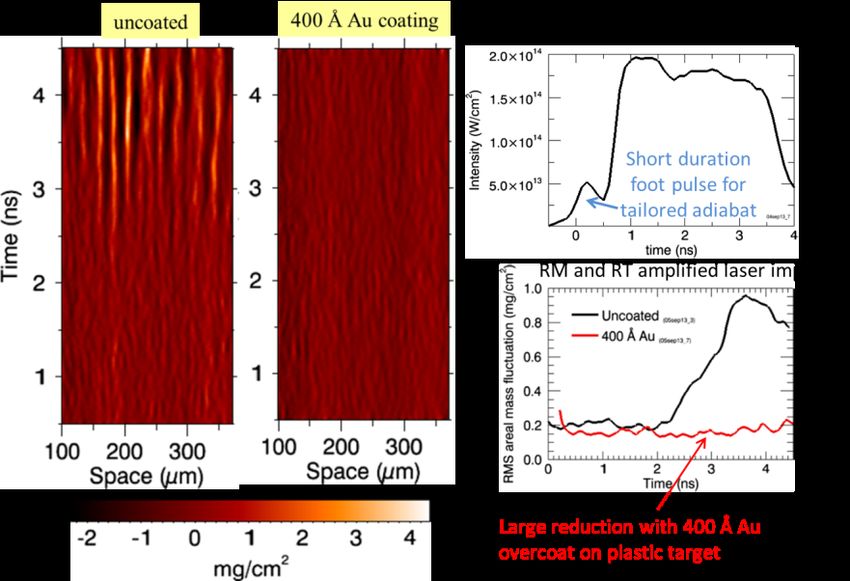
Common challenges to Direct and Indirect Laser Drive

                    Seeds for growth of high mode asymmetry
                                                      Target nonuniformity
  Target nonuniformity
                                                      Early time laser imprint

                                Low mode drive asymmetry

 LPI with high gas fills (SRS)
 CBET at LIH                                 Cross beam energy transfer (CBET)
 Hohlraum wall expansion with low gas fill   Beam control and target quality
 Beam control and target quality

LPI can be main large loss mechanism & can cause unacceptable preheat of the target
                                                                                 2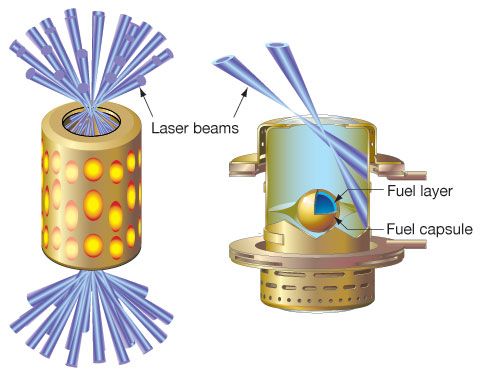
Three focus areas of NRL ICF research

• Hybrid x-ray/direct drive approach using high-Z layers to
  mitigate laser imprinting.
• S&T to utilize laser bandwidth to mitigate LPI/CBET
• S&T of deeper-UV broader-native-bandwidth KrF and ArF
  excimer lasers as drivers next generation ICF facilities.

                                                              3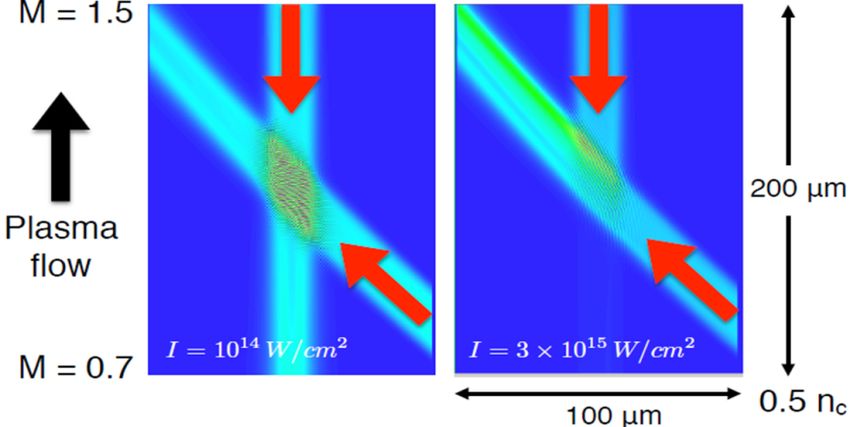
Mitigation of early time laser imprint is desired for direct
   drive implosions even with ISI/SDD smoothed beams

  Imprint seeds hydro instability

   Hybrid x-ray direct-drive approach utilizing a pre-expanded thin high-Z overcoat
                                                       Later time direct drive when laser
                                                       penetrates the high-Z plasma.

                                                          Efficiency of direct drive retained!
Spatial separation between laser absorption in the
high-Z (Au or Pd) plasma and the x-ray driven pellet
smooths imprint from laser nonuniformities.
                                                                                                 4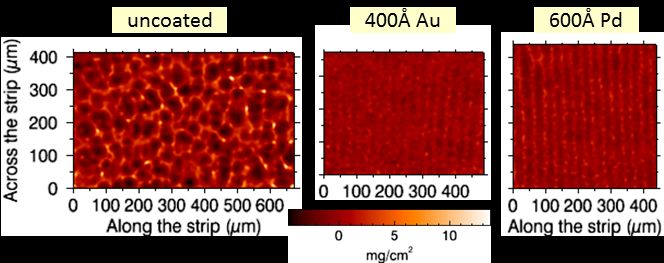
Hybrid approach using high-z layers developed on Nike has
   been applied to Omega EP, with similar large reduction in
   laser imprint

             Nike experiment                                        Omega EP experiment
                                                            • Large imprint reduction with high-Z
                                                              layer pre-expanded by a low energy x-
                                                              ray prepulse.
                                                            • Phase plates but no SSD smoothing

Max Karasik, J. L. Weaver, Y. Aglitskiy, J. Oh, and S. P.
Obenschain Phys. Rev. Lett. 114, 085001 – Published 26
February 2015                                                   with pre-imposed ripple (λ = 30μm, 1μm p-to-v)

           Plans underway to apply hybrid approach to Omega 60 implosions

                                                                                                                 5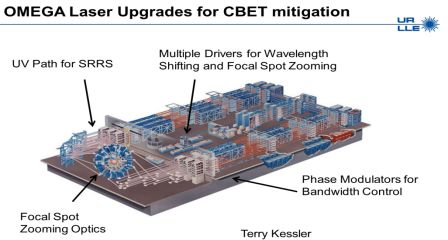
Mitigation of Laser Plasma Instabilities (LPI) and Cross
Beam Energy Transfer (CBET) is also very desirable.

                                    ! Shorter laser wavelength increases
                                      the instability thresholds
                                    ! Broad laser bandwidth can disrupt
                                      the coherent wave-wave interactions
                                      that produce LPI and CBET

12/9/17              Code 6700 – Presentation Template                 6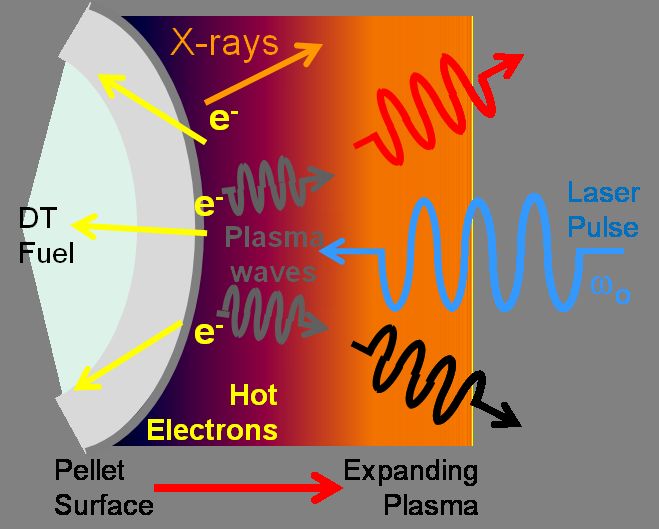
NRL simulations using LLE’s LPSE-CBET code indicate
>2 THz laser bandwidths can suppress CBET

                                     Jason Bates, IFSA 2017
12/9/17                                                       7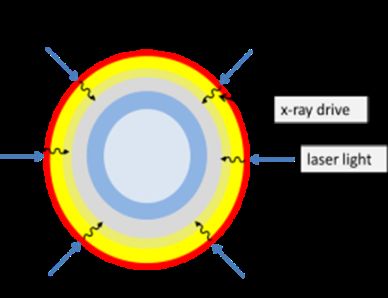
Generation of laser bandwidth utilizing Stimulated
      Rotational Raman Scattering (SRRS)
         Seeded SRRS can provide large bandwidths          THz
THz      with existing ICF lasers while maintaining the    15       Multi-THz*
15       beam quaintly on target                                    high power beam

      Narrowband               Multi-meter gas cell with
      high Power Beam               nitrogen or air

      ~
SRRS experiments on Nike are used to test code predictions
Temporal Power Spectrum at Z = 102 m
EOUT = 17.3 J
= 0.183 GW/cm2 35 XDL
*Z = 1.95 TW/cm beam divergence
Output spectrum
Simulated
(tc ~ 0.26 ps)
output
Input laser
(tc ~ 0.534 ps)
Spectral and far-field broadening due to stimulated rotational Raman scattering
SRRS is self seeded by tail of the driven by the Nike krypton fluoride laser, J. Weaver, R. Lehmberg, et al.
Applied Optics 2017
Nike beam’s spectral distribution https://www.osapublishing.org/ao/abstract.cfm?uri=ao-56-31-8618
Experiment with a frequency multiplied Nd:glass laser will begin in 2018 @ NRL
9Path forward for bandwidth effort • Complete basic S&T for SRRS induced bandwidth 2018-2019 • Define bandwidth needed to suppress LPI/CBET via simulations • Install SRRS on a single high energy (~500 J) Nd:glass laser beam(s) to test bandwidth effects on LPI/CBET (351 nm on Omega and 527 nm on Nike) • Apply to Omega 60 for direct drive and consider application to NIF indirect drive. 12/9/17 Code 6700 – Presentation Template 10
KrF and ArF Excimer lasers would be very attractive
    laser fusion drivers for a next generation ICF facility

• Deeper UV – 248 nm for KrF and 193 nm for ArF allows higher    Higher Pab allows lower
  ablative drive pressure (Pab)                                  aspect ratio pellets
• Easy to zoom the focal diameter
• Broader native bandwidth ( ~3 THz for KrF) (~ 5 THz for ArF)
• Gas laser media is easier to cool allowing higher shot rates

 NRL 6.1 funded effort will advance the basic physics of E-beam pumped ArF laser
 using the Electra facility

                                       Modify NRL Orestes
                                       kinetic code for ArF
                                       and test against
                                       experiment.

    12/9/17                                                                         11
Perspectives on Pathways and Progress We need to advance fundamentally new approaches to laser ICF that reduce the technological and physics challenges! 12/9/17 Code 6700 – Presentation Template 12
You can also read


