POTASH OUTLOOK AND FUNDAMENTALS 101 - 17 JUNE 2021 DR HUW MCKAY CHIEF ECONOMIST DR PAUL BURNSIDE MANAGER POTASH ANALYSIS - BHP
←
→
Page content transcription
If your browser does not render page correctly, please read the page content below
Potash outlook and fundamentals 101

Dr Huw McKay Chief Economist
Dr Paul Burnside Manager Potash Analysis

17 June 2021
Disclaimer
Forward-looking statements
This presentation contains forward-looking statements, including statements regarding: trends in commodity prices and currency exchange rates; demand for commodities; production forecasts; plans, strategies and objectives of management; assumed long-term scenarios; potential
global responses to climate change; the potential effect of possible future events on the value of the BHP portfolio; closure or divestment of certain assets, operations or facilities (including associated costs); anticipated production or construction commencement dates; capital costs and
scheduling; operating costs and shortages of materials and skilled employees; anticipated productive lives of projects, mines and facilities; provisions and contingent liabilities; and tax and regulatory developments.
Forward-looking statements may be identified by the use of terminology, including, but not limited to, ‘intend’, ‘aim’, ‘project’, ‘anticipate’, ‘estimate’, ‘plan’, ‘believe’, ‘expect’, ‘may’, ‘should’, ‘will’, ‘would’, ‘continue’, ‘annualised’ or similar words. These statements discuss future
expectations concerning the results of assets or financial conditions, or provide other forward-looking information.
These forward-looking statements are based on the information available as at the date of this presentation and/or the date of the Group’s planning processes or scenario analysis processes. There are inherent limitations with scenario analysis and it is difficult to predict which, if any, of
the scenarios might eventuate. Scenarios do not constitute definitive outcomes for us. Scenario analysis relies on assumptions that may or may not be, or prove to be, correct and may or may not eventuate, and scenarios may be impacted by additional factors to the assumptions
disclosed. Additionally, forward-looking statements are not guarantees or predictions of future performance, and involve known and unknown risks, uncertainties and other factors, many of which are beyond our control, and which may cause actual results to differ materially from those
expressed in the statements contained in this presentation. BHP cautions against reliance on any forward-looking statements or guidance, particularly in light of the current economic climate and the significant volatility, uncertainty and disruption arising in connection with COVID-19.
For example, our future revenues from our assets, projects or mines described in this presentation will be based, in part, upon the market price of the minerals, metals or petroleum produced, which may vary significantly from current levels. These variations, if materially adverse, may
affect the timing or the feasibility of the development of a particular project, the expansion of certain facilities or mines, or the continuation of existing assets.
Other factors that may affect the actual construction or production commencement dates, costs or production output and anticipated lives of assets, mines or facilities include our ability to profitably produce and transport the minerals, petroleum and/or metals extracted to applicable
markets; the impact of foreign currency exchange rates on the market prices of the minerals, petroleum or metals we produce; activities of government authorities in the countries where we sell our products and in the countries where we are exploring or developing projects, facilities or
mines, including increases in taxes; changes in environmental and other regulations; the duration and severity of the COVID-19 pandemic and its impact on our business; political uncertainty; labour unrest; and other factors identified in the risk factors discussed in BHP’s filings with the
U.S. Securities and Exchange Commission (the ‘SEC’) (including in Annual Reports on Form 20-F) which are available on the SEC’s website at www.sec.gov.
Except as required by applicable regulations or by law, BHP does not undertake to publicly update or review any forward-looking statements, whether as a result of new information or future events. Past performance cannot be relied on as a guide to future performance.

BHP Climate Change Report 2020
This presentation should be read in conjunction with the BHP Climate Change Report 2020 available at bhp.com. Some of the information in this presentation provides a concise overview of certain aspects of that Report and may omit information, analysis and assumptions and,
accordingly, BHP cautions readers from relying on that information in this presentation in isolation.

Presentation of data
Numbers presented may not add up precisely to the totals provided due to rounding.

No offer of securities
Nothing in this presentation should be construed as either an offer or a solicitation of an offer to buy or sell BHP securities in any jurisdiction, or be treated or relied upon as a recommendation or advice by BHP.

Reliance on third party information
The views expressed in this presentation contain information that has been derived from publicly available sources that have not been independently verified. No representation or warranty is made as to the accuracy, completeness or reliability of the information. This presentation
should not be relied upon as a recommendation or forecast by BHP.

BHP and its subsidiaries
In this presentation, the terms ‘BHP’, the ‘Company’, the ‘Group’, ‘our business’, ‘organization’, ‘Group’, ‘we’, ‘us’ and ‘our’ refer to BHP Group Limited, BHP Group Plc and, except where the context otherwise requires, their respective subsidiaries set out in note 13 ‘Related undertaking
of the Group’ in section 5.2 of BHP’s Annual Report and Form 20-F. Those terms do not include non-operated assets. This presentation includes references to BHP’s assets (including those under exploration, projects in development or execution phases, sites and closed operations)
that have been wholly owned and/or operated by BHP and that have been owned as a joint venture operated by BHP (referred to as ‘operated assets’ or ‘operations’) during the period from 1 July 2020 to 31 December 2020. Our functions are also included.
BHP also holds interests in assets that are owned as a joint venture but not operated by BHP (referred to in this presentation as ‘non-operated joint ventures’ or ‘non-operated assets’). Our non-operated assets include Antamina, Cerrejón, Samarco, Atlantis, Mad Dog, Bass Strait and
North West Shelf. Notwithstanding that this presentation may include production, financial and other information from non-operated assets, non-operated assets are not included in the Group and, as a result, statements regarding our operations, assets and values apply only to our
operated assets unless otherwise stated. References in this presentation to a ‘joint venture’ are used for convenience to collectively describe assets that are not wholly owned by BHP. Such references are not intended to characterise the legal relationship between the owners of the
asset.

Potash outlook briefing
17 June 2021                                                                                                                                      2
Potash: a future facing commodity with
attractive long term fundamentals
Potash fundamentals: key messages
A future facing commodity with attractive long term fundamentals from multiple angles

                                               • Potash sits at the intersection of global demographic, social and environmental megatrends
     A Future Facing                           • The environmental footprint of potash is considerably more attractive than other major
       Commodity                                 chemical fertilisers
                                               • Conventional mining with flotation is more energy and water efficient than other production routes

                                               • Traditional demand drivers of population and diet are reliable and slow moving
       Reliable base
                                               • Attractive upside over basic drivers exists due to the rising potash intensity-of-use needed to support
       demand with
                                                 higher yields and offset depleting soil fertility
     attractive upside
                                               • On top of the already compelling case, decarbonisation could amplify demand upside1

  The industry’s 4th                           • Demand is catching up to excess supply, and major supply basins are mature
  wave is underway:                            • Price formation regime accordingly expected to transition from current SRMC to durable inducement
 demand to catch-up                              pricing, with Canada well placed to meet market growth longer term at LRMC in the mid $300s
  over the course of                           • Post the balance point, long-run geological and agronomic arguments skew probabilistic risks upwards
      the 2020s                                  (LRMC plus fly-up) rather than downwards (SRMC), in our view
Note: Short Run Marginal Cost (SRMC); Long Run Marginal Cost (LRMC).
1. Based on BHP’s 1.5°C Scenario. Refer to the BHP Climate Change Report 2020 for information about this scenario and its assumptions.
Potash outlook briefing
17 June 2021                                                                                                          4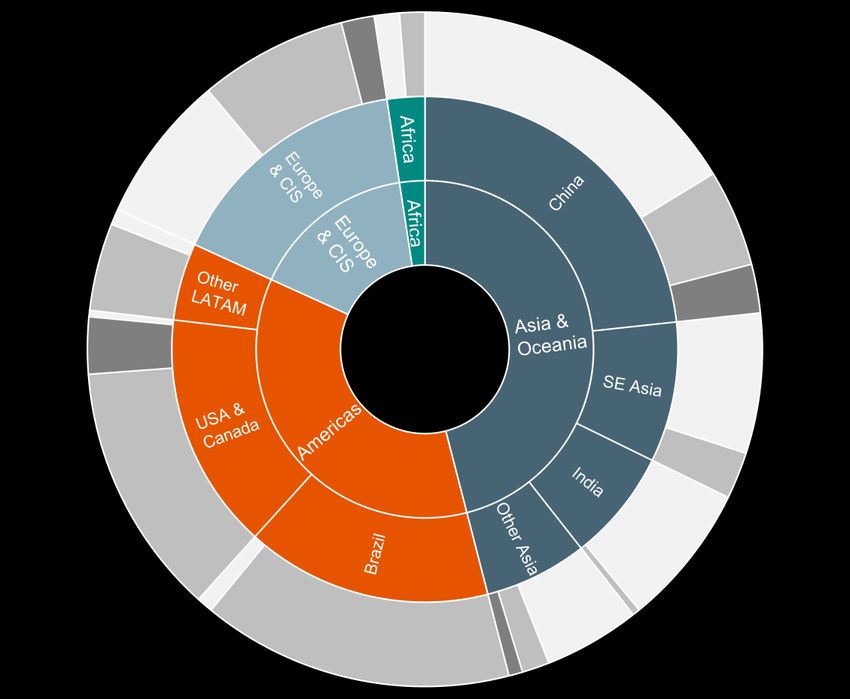
Potash attractiveness parameters
Transitioning towards inducement pricing as consistent demand uplift absorbs today’s excess supply
Favourable supply and demand gap Large market size
Inducement pricing expected to
emerge and sustain once demand
~70 Mt today, 89-97Mt in 20351
growth absorbs current supply excess
Differentiated demand drivers Value creation and return potential
Considerable differentiation from industrial metals Capital intensity of new supply creates
over the course of the development process: steep inducement curve
no global demand peak in prospect Operating margins superior in upstream segment
Thrive in a Paris-aligned world
1. The rounded average of Argus, CRU and IHS is ~89 Mt. ~97 Mt is the level implied by Nutrien’s 2020s range midpoint of 2.25% extrapolated to 2035.
Potash outlook briefing
17 June 2021 5
Downstream potash drivers highly differentiated
Diversification in terms of demand drivers vs. our wider portfolio of steel making, non-ferrous and energy commodities

                           Fertiliser value chain                                                                    Metals value chain                                                                       Energy value chain
                     Population growth and dietary change                                      Urbanisation and industrialisation                                                        Motorisation, electrification, industrialisation

                     Food, feed, fibre, fuel                                                   Buildings, infrastructure, machinery, appliances                                          Transport, power, heat, chemicals

                     Low degree of recycling1                                                  High degree of recycling                                                                  Low degree of recycling2
                     Steady increase in intensity through the entire                           Swift increase in intensity on the way to middle                                          Swift increase in intensity on the way to middle
                     development journey, high income plateau                                  income, where a distinct peak forms                                                       income, flatter beyond, high income plateau
     Crop needs per head

                                                                                             Metal demand per head

                                                                                                                                                                                  Primary energy per head
                                                  GDP per head                                                                        GDP per head                                                                                  GDP per head
                                    Traditional growth drivers                       Major uses by society                                  Degree of Circularity                                           Relationship to living standards

Note: Illustrative only, reflecting stylised empirical path of major societies through time that have reached high income levels.
1. Recycling of nutrients via crop residue or manure occurs, but the food value chain is very inefficient and highly subject to waste.
2. Petroleum value chain specifically features plastics recycling, but this is a very small item in the entire value chain (a sub set of a sub set). Carbon capture use and storage (CCUS) expected to increasingly feature in industrial applications.
Potash outlook briefing
17 June 2021                                                                                                                  6
Fundamental relationships are extremely reliable
Crop production growth has exceeded population growth in the long run: potash has in turn exceeded growth in crop production

Population up ~2.5 fold since 1960, crops ~3.5 fold, potash ~4.5 fold                                                                       CAGR, 1960-1993
(Index, 1960 = 100)                                                                                                                         (%)
500                                                                                                                                         3
                                                                                                                              Potash
                                                                                                                              fertiliser
450                                                                                                                           demand        2

400                                                                                                                                         1
                                                                                                                              Crop
                                                          Collapse of                                                         production             1.9             2.3              2.4
350                                                                                                                                         0
                                                          Eastern Bloc
                                                                                                                                                  Population   Crop production Potash fertiliser

300                                                                                                                                         CAGR, 1993-2020
                                                                                                                                            (%)
250                                                                                                                           Population    3

200                                                                                                                                         2

150                                                                                                                                         1

                                                                                                                                                     1.2            2.1               2.7
100                                                                                                                                         0
   1960 1965 1970 1975 1980 1985 1990 1995 2000 2005 2010 2015 2020                                                                               Population   Crop production Potash fertiliser
Data: UN World Population Prospects 2019; International Fertilizer Association; BHP analysis based on multiple sources.
Note that ‘potash fertiliser demand’ relates to estimated underlying consumption at the farm-level rather than to upstream MOP shipments.
Potash outlook briefing
17 June 2021                                                                                                              7
Potash benefits in a decarbonising world
Rising biofuels production and land use implications of afforestation burnish an already attractive potash demand profile
Cumulative demand in the next 30 years compared to the last 30 years1
(%)
400
1.5°C Scenario
Already compelling
Central Energy View
demand case …
Lower Carbon View
Climate Crisis
300
… potentially amplified under
a 1.5 degree pathway
200
100
0
Nickel 2 Potash Copper 2 Iron ore 3 Metallurgical 3 Oil
coal
Data: BHP; Vivid Economics.
1. Our portfolio is tested across a range of futures. Refer to the BHP Climate Change Report 2020 for more information about these climate-related scenarios and their assumptions.
Scenarios were developed prior to the impacts of the COVID-19 pandemic, and therefore any possible effects of the pandemic were not considered in the modelling.
2. Nickel and copper demand references primary metal.
3. Iron ore and metallurgical coal demand based on Contestable Market (Global seaborne market plus Chinese domestic demand).
Potash outlook briefing
17 June 2021 8The waves that have defined the potash industry
A 4th wave is underway, with demand in catch-up mode. Once it does, an inducement pricing regime is the most likely outcome
Change over 5 years MOP price
(%) (US$/t real)
75 700
Supply led Supply led Demand led
Wave #1 Wave #2 Wave #3 Wave #4
Supply
50 catch-up 525
(late and
Demand excessive)
catch-up
Demand
catch-up
Demand
25 catch-up
350
Inducement
pricing
regime
0 175
Re-orientation
Development of of ex-Soviet capacity Demand boom,
Saskatchewan deposit to the global market price upswing
(25) 0
1960 1970 1980 1990 2000 2010 2020 2030
Demand growth over last 5 years (LHS) Capacity expansion over last 5 years (LHS) Price level (RHS, not smoothed)
Data: BHP analysis based on multiple sources
Note: New supply from FSU is shown in 1990s when existing supply was re-directed from domestic and Eastern Bloc markets after local demand collapsed. Eastern Bloc demand excluded until 1992. 2009 demand excluded.
Potash outlook briefing
17 June 2021 9How soon will demand catch-up in Wave #4?
Consensus view is that demand will catch-up in the late 2020s/early 2030s
MOP demand
(Mt)
110 3% average CAGR
100
2% average CAGR
90 Specialist average (1.7%)1
Achievable production (w/o Jansen)
80 1% average CAGR
Jansen S1
Greenfield under
Spareconstruction
capacity,,
brownfield
70 expansion
Existing supply
60
10 year linear trend (+1.8 Mt/y)
50
40
2010 2015 2020 2025 2030 2035
Historical data: CRU. Nutrien range of 2.0% to 2.5% in the 2020s as disclosed in 2021 Q1 earnings call. Achievable production is BHP analysis based on multiple sources.
Note that the chart shows linear interpolations that result in the same 2020-2035 aggregate tonnage increment as the stated CAGRs.
1. Specialist average based on CRU, Argus, Fertecon (IHS Markit). 2020-2035 CAGR calculated relative to trend level in 2020 (69.5 Mt) not to actual level estimated by CRU (71.6 Mt).
Potash outlook briefing
17 June 2021 10What can be expected under inducement & fly-up pricing?
Forward looking LRMC is broadly in line with through-cycle averages, considerably above SRMC experience of the last few years
MOP price
(US$/t real)
750
500
Upswing average Indicative of multi-year “fly-up” pricing should a strong demand-led
2008-2013 cycle emerge with a delayed supply response from ageing basins
Through cycle average
$470
2008 to date
$350 Long-run marginal cost (LRMC)
at mid case macro assumptions1
250
Short-run marginal cost (SRMC)
across a range of macro assumptions1
Downswing average
2014 to date
$260
0
2000 2005 2010 2015 2020
Data: IHS Markit. Average trade value of Canadian MOP exports.
1. Macro assumptions include items such as FX rates, energy costs, carbon and labour. Shaded boxes are the approximate price range associated with the operating conditions described therein.
Potash outlook briefing
17 June 2021 11Inducing solution mining will provide tilt to the cost curve
SRMC significantly higher than conventional flotation, forward looking LRMC for Canadian solution mining is mid-$300/t
Operating cost curve Inducement cost curve
SRMC conditions LRMC conditions
Solution mines use significantly more energy and more water The inducement curve is steep due to the underlying capital
than conventional mines. Sustaining capex is also higher intensity of projects
This comes at a material operational cost disadvantage that is Solution mining in Canada is expected to set the industry LRMC
expected to amplify under rising carbon pricing • Other candidates are too small, or disparate, to serve as an
• The lowest cost mines1 (~US$100/t FOB), and the vast majority effective “bench” to anchor long run trend pricing
of mines in Q1 of the operating- cost curve, are large scale • This solution mining bench is still “available” because
conventional operations conventional opportunities, with their favourable operating
• Operating solution mines in Canada1 are currently in the range costs, have been rightly prioritised for development
of US$180-$210/t (FOB) • In bulk mining, you do not save the best for last
• We estimate a trend price in the mid-US$300/t region will be
required to induce a material portion of this Canadian bench
into production
1. Source: CRU.
Note: Long Run Marginal Cost (LRMC); Short Run Marginal Cost (SRMC).
Potash outlook briefing
17 June 2021 12Fertiliser and the global food supply chain
Crop yields hold the key to future food security
 Impressive gains in yields have offset declining cropland per head since the 1960s, but there remain major yield gaps between regions
 that could narrow with better farm practice, including scientific fertiliser application

        Competition for global land use                              Global             Global           Crop yields: large gaps between the frontier and the rest is
                                                                    crop use3       dietary profile1     cause for optimism                                Bubble width = yield
                                           Pasture land 24%
                                                                                                                                                                       1960s      1970s
                                                                     Fibre
What governs crop yields?
Potassium availability is just one of a complex web of interacting factors that impact crop yield
Potential yield GEOGRAPHY
Determined by genetics FARM
WEATHER
PRACTICE
YIELD
Attainable yield GENETICS SOIL
Limited by external factors – aspects of climate,
NUTRIENTS
soil type and geography
Nitrogen
Achieved yield (N)
Dependent on farm practice to optimise Phosphorus Potassium
(P) (K)
availability of water and nutrients, to minimise
Secondary
the impact of pests, disease and bad weather, & micro-
and to condition the soil nutrients
Potash outlook briefing
17 June 2021 15Why do plants need potassium?
Potassium works as a chemical regulator – adequate potassium is needed for healthy growth
Liebig's Law of the Minimum
Building block
Potassium is found in cells throughout
Potassium availability is a plant; It regulates critical processes
one of dozens of factors including photosynthesis, enzyme
Soil conditions that influence crop yields activation and temperature control
Water
and other
growth factors
Any one of these factors
YIELD
may be yield-limiting
Iron
Drought tolerance
Phosphorus
Potassium plays a major role in the
Nitrogen
Calcium
Magnesium
Potassium
transport of water, and in the uptake
Sulphur
If potassium availability isn’t
of other nutrients
yield-limiting then applying more
won’t have any effect on yield
Identifying existing or The ‘quality nutrient’
approaching yield limitations, Potassium can improve appearance,
including potassium, is critical in taste, shelf life and nutritive value
closing the gap to Attainable Yield
Potash outlook briefing
17 June 2021 16What is fertiliser?
Fertilisers are materials that contain essential nutrients that are the “building blocks” of plants
Consumption of primary nutrients Consumption of potash Potassium chloride (MOP) is the most
via inorganic fertilisers fertiliser in different forms common type of potash fertiliser
• The primary nutrients are Potash fertilisers
nitrogen (N), phosphorus 20% Purity (KCl / K2O)
account for 20%
(P) and potassium (K) but Agricultural: min 95% KCl (60% K2O)
many other nutrients are Technical: min 98% KCl
also needed Pharmaceutical: 99.9% KCl
Phosphate fertilisers
25%
such as DAP and SSP
• Different nutrients perform
Particle size
different functions in plants 90% Potassium chloride
and are not substitutable (MOP) Fine: 0.2 - 0.5mm
Standard: 0.5 - 1mm
Coarse: 2 - 3mm
• Plants can draw on native
Nitrogen fertilisers such Granular: 3 - 4mm
potassium in the soil, but
55% as urea and
farmers commonly provide ammonium nitrate
additional nutrients by Colour
spreading potash fertiliser Red
and/or organic material like MOP derivatives White
6%
animal manure Other types of potash
4%
(including polyhalite)
Data: BHP; IFA.
Potash outlook briefing
17 June 2021 17Most potash operations fall into three basic types
MOP is extracted from underground ore deposits or recovered from natural brines
Conventional mining Solution mining of ore Natural brines
Solution mining is
more water-intensive
than ore flotation
Sylvinite ore Sylvinite brine Carnallite slurry
Crystallising MOP
Flotation-based Crystallisation- from sylvinite brine is Crystallisation-
Standard MOP
mill based mill more energy-intensive based mill
than flotation
Compaction
Jansen is Fine MOP
plant
designed to
produce MOP
via flotation Granular MOP
Potash outlook briefing
17 June 2021 18How is MOP used?
Most MOP is used as fertiliser, often in combination with other nutrients
Combination Bulk-blend NPKs
into multi-nutrient
~75% Jansen
fertilisers Compound NPKs Most MOPproduct
is used asisfertiliser,
suitable for
eitherstraight
on its ownapplication
or physically or
Fertiliser ~20% combined
combinationwith other
intofertilisers.
multi-nutrient
Straight application
MOP fertilisers (NPKs)
~70%
~92% Conversion Potassium sulphate
~5%
into derivative
fertilisers Potassium nitrate
~30%
MOP
Heavy industry
Animal nutrition
Direct use
~8% ~30% Low-sodium table salt
Non-fertiliser
Water softeners & ice melts
MOP
~90%
~70% Conversion Potassium hydroxide
into derivative
chemicals Other chemicals
Data: BHP analysis based on multiple sources. ~10%
Potash outlook briefing
17 June 2021 19Geography of supply and demand
Production concentrated in Canada, Russia and Belarus; Biggest consumers China, Brazil, United States and India
Supply Demand
Conventional mining (~70%) Surface brines (~25%) Solution mining (~5%) Standard/fine (~45%) Granular (~45%) Industrial (~10%)
Data: BHP analysis based on multiple sources.
Note: 2020, 70 Mt MOP production, 72 Mt MOP sales (CRU). Split by grade is approximate.
Potash outlook briefing
17 June 2021 20Major producers and trade flows
Highly globalised commodity, most major markets have multiple sources of imports
Uralkali
EuroChem
Nutrien
Mosaic Belaruskali
K+S
QSL Potash
ICL
Arab Potash
Area producing:
>10Mtpa MOP
Global overviewPotash supply chain
Supply chains are long with several steps even in-market
Commonly, sales are
made inclusive of
ocean freight (CFR)
Raw potassium ore is processed Product for export is railed …and loaded onto bulk carriers1
into MOP at the mine to port terminals…
Retailer Blender Distributor Importer
Local customers are served Retailers can offer a suite Local blenders mix National and regional
by road, rail, barge of products: fertilisers, bulk-blended NPKs distributors take the
seeds, equipment, product to market
agronomic services
Fertiliser factories
Fertilisers are
transported by rail, use MOP to make NPK Factory
road or barge; farms compound NPKs
Farmers buy from local
may be over 1,000km or other potash
retailers/blenders;
from the point of import fertilisers
larger agribusinesses may buy
directly from distributors
1. MOP is commonly shipped in Handysize, Handymax,
Jansen product will be sold both onshore
Supramax or Panamax vessels (20,000-80,000dwt). and offshore into upstream supply chain
Potash outlook briefing
17 June 2021 22Potash: a low emission, biosphere friendly fertiliser
MOP is a critical nutrient with a modest environmental footprint, with conventional flotation route advantaged over solution mining
MOP MOP Nitrogen Phosphate
(flotation-based) (solution mining) fertilisers fertilisers
Production footprint
Low Scope 1+2 emissions (Pricing realisation calculation
Prices are influenced by grade and volume, but there are also (fluid) variations between prices in different regions
• Most sales are made on a delivered basis US$/t MOP (quarterly average)
Selling price • Sales may be spot or contract (nominal)
Brazil CFR • Transacted prices are monitored by specialist 400
China CFR price-discovery services
US FOB w/house • Prices vary by product (e.g. standard/granular) CFR Brazil
350
‒ CFR China (granular, spot)
(standard, contract)
300
• Sellers may offer volume-based discounts,
Discounts
conditional rebates or extended credit
250
‒ Vancouver netback range
200
Seaborne • For CFR sales, sellers arrange ocean
freight freight either using spot or long-term charter
150
Realised FCA
‒ 100
(Nutrien)
Q1 2016
Q2 2016
Q3 2016
Q4 2016
Q1 2017
Q2 2017
Q3 2017
Q4 2017
Q1 2018
Q2 2018
Q3 2018
Q4 2018
Q1 2019
Q2 2019
Q3 2019
Q4 2019
Q1 2020
Q2 2020
Q3 2020
Q4 2020
Q1 2021
Q2 2021
Port costs and Realised price
inland freight = FOB mine
There is no single “potash price”: for example, this chart shows a 5-yr history of Nutrien’s
FOB Mine
Data: CRU Fertilizer Week; Nutrien. realised price (FCA, offshore sales only) against benchmarks reported by CRU Fertilizer Week
Potash outlook briefing
17 June 2021 24The outlook for potash
Demand drivers: from demographics to fertiliser demand
Forecasting long-term MOP demand is a 3-step process
Potash Potassium
Socio-economic Crop
fertiliser chloride
drivers production
demand demand
Step 1 Step 2 Step 3
From population and income to From crop production to potash From potash fertiliser to
crop production fertiliser potassium chloride
• How much do people eat? • How much potassium nutrient do • How much potash fertiliser
crops take up? comes from other primary
• Which crops are needed to
sources?
meet that requirement? • Where does that nutrient come
from? • What about non-fertiliser
• Where are those crops grown?
applications?
Potash fertilisers
• What about crops for fuel and
fibre? Nutrient recycling
Native potassium
• How much nutrient is lost in-situ?
Potash outlook briefing
17 June 2021 26Forecasting Demand: Step 1 – crop requirements
Estimate the quantity of each crop required to meet demand for the 4Fs: food, feed, fibre, fuel
Food intake
Population x (kcal/person/day)
Wastage1
Animal Animal feed
Global food supply calories requirement
(kcal/yr) Vegetal
calories Global crop
production
Fibres (tonnes)
Biofuels
1. Wastage includes inbound supply-chain losses and post-retail waste.
Potash outlook briefing
17 June 2021 27Forecasting Demand: Step 2 – potash requirements
Estimate the quantity, and source, of potassium nutrient needed to support crop production
Plant biomass Observed K balance
Nutrient recycling
= Observable K input
Yield
– K output
This “equality” is frequently negative as farmers “mine the
Potash Animal Crop Residue soil” for the required potassium and do not provide sufficient
fertiliser manures residues
external sources to maintain soil quality.
K uptake
Inferred K balance
30% 20% 20% 30%
= Observable K input
+ Inferred soil K mining
– K output
Native
Intensity-of-Use = potash use This requires a step up in the supply of external potassium
potassium
crop production (soil K) sources if yields are to be maintained, leading to a rising
intensity of potash use.
Data: BHP analysis based on multiple sources.
Note: Figures are approximate estimated global average; regional/local contributions to K uptake vary widely.
Potash outlook briefing
17 June 2021 28Fundamental relationships are extremely reliable
Crop production growth has exceeded population growth in the long run: potash has in turn exceeded growth in crop production
Population up ~2.5 fold since 1960, crops ~3.5 fold, potash ~4.5 fold CAGR, 1960-1993
(Index, 1960 = 100) (%)
500 3
Potash
fertiliser
450 demand 2
400 1
Crop
Collapse of production 1.9 2.3 2.4
350 0
Eastern Bloc
Population Crop production Potash fertiliser
300 CAGR, 1993-2020
(%)
250 Population 3
200 2
150 1
1.2 2.1 2.7
100 0
1960 1965 1970 1975 1980 1985 1990 1995 2000 2005 2010 2015 2020 Population Crop production Potash fertiliser
Data: UN World Population Prospects 2019; International Fertilizer Association; BHP analysis based on multiple sources.
Note: ‘potash fertiliser demand’ relates to estimated underlying consumption at the farm-level rather than to upstream MOP shipments.
Potash outlook briefing
17 June 2021 29Rising Intensity of Use (IoU): indicative ranges
Historical norm of potash growth exceeding crop growth is not under plausible threat. Attractive upside should IoU accelerate further.
Potash fertiliser demand: both rising crops and rising IoU have/will contribute
(Mt MOP-equivalent)
IoU @ To reduce rates of soil K depletion, Trend annual
1.5% p.a. IoU will have to accelerate; growth of growth of
1.5% p.a. corresponds to
IoU @
0.75% p.a.
incremental demand of 42Mt 2 Mt
IoU @
0% p.a.
+1.1%
+1.3% p.a.
p.a. Trend annual
+0.7% If IoU continues to rise at roughly the
Increase Increase growth of
p.a.
in crop in crop
historical trend, this corresponds to
+1.9%
Increase
in IoU
production production incremental demand of 28Mt 1.5 Mt
p.a.
Increase
in crop
production
We expect crop production to slow
Trend annual
as a result of demographic factors;
growth of
crop production alone is forecast to
require 15Mt incremental potashPotash demand outlook to 2030 by region
Soil depletion a global phenomenon, underscoring our belief that IoU is likely to rise across multiple regions
Additional tonnes 2020-2030
NORTH AMERICA EUROPE & CIS ASIA & OCEANIA
Historical demand growth1 0.2% Historical demand growth1 0.2% Historical demand growth1 4.3%
BHP forecast growth2 1-3% BHP forecast growth2 1-3% BHP forecast growth2 1-4%
External forecast growth3 1.7% External forecast growth3 1.1% External forecast growth3 2.0%
Soil nutrient imbalance4 Poor, deteriorating Soil nutrient imbalance4 Poor Soil nutrient imbalance4 Poor, deteriorating
Potash contribution to K uptake5 30-35%, Potash contribution to K uptake5 20-25%, Potash contribution to K uptake5 30-35%,
recently improving stable improving
CENTRAL & SOUTH AMERICA AFRICA
WORLD
Historical demand growth1 4.4% Historical demand growth1 6.1%
BHP forecast growth2 2-4% BHP forecast growth2 5-10% Historical demand growth1 2.7%
External forecast growth3 2.9% External forecast growth3 2.9%
BHP forecast growth2 1-3%
Soil nutrient imbalance4 Poor, deteriorating Soil nutrient imbalance4 Poor, deteriorating
Potash contribution to K uptake5 35-40%, Potash contribution to K uptake5 5%, External forecast growth3 2.0%
stable improving
1. Average growth per annum of MOP shipments 2000-01 to 2019-20 (CRU).
2. Forecast average growth per annum of MOP shipments 2019-20 to 2030 (BHP range).
3. Forecast average growth per annum of MOP shipments 2019-20 to 2030 (Argus; CRU; IHS).
4. Status of the World’s Soil Resources (FAO and ITPS, 2015).
5. BHP analysis based on multiple sources.
Potash outlook briefing
17 June 2021 31Big picture themes in agriculture
Climate change and “Precision Ag” are both principally opportunities for potash, in our view
Climate change Precision Agriculture
• Rapid decarbonisation: • Leverage advanced tech to
optimise farm practice
− Greater pressure on land use − Intensification positive for potash
IoU − Improve application efficiency − In-situ losses of K are much lower
− Possible resurgence of biofuels
than N+P, so less potential
− Biofuels still heavily dependent on − Better identify nutrient deficiency
efficiency gain
crop-fed 1st-gen tech
− Adopt ‘nutrient-budget’ approach
− Correcting K deficiency, reducing
• Physical impacts of climate change: reliance on N fertiliser, ‘nutrient-
− Harvests vulnerable to extreme − Crop failures may become more budgets’ are all supported by
weather events frequent Precision Ag
− Changing temperatures and − Potassium aids drought tolerance
rainfall
• Rapid decarbonisation offers potential upside for potash • There are many barriers to global adoption of Precision Ag, particularly if
labour is cheap, but even in the US farmers don’t always see positive
• Adaptation (technology and farm practice, cultivated area, crop choice)
cost:benefit in some technologies
expected to prevent supply constraint on crop production
• But for potash, Precision Ag presents net upside and could accelerate
• Any supply constraint would likely push up food prices and potash IoU
potash IoU
Potash outlook briefing
17 June 2021 32Big picture themes in agriculture
If the world cuts its meat intake, it is not a negative for potash demand. Food waste is likely to get worse before it gets better.
Meat consumption Food waste
• Negative aspects of meat • Up to one-third of food supply is lost
consumption are in the headlines: or wasted
− Major emitter of GHGs − Tracking food waste over time is
• Upstream waste is highest in
difficult – not commonly reported
− Uses lots of land and water − Replacing meat calories with plant- developing economies:
− Cutting waste requires both major
− Ethical concerns based calories lowers overall crop − Lack of cold-chain infrastructure
investment and behavioural
• Possible solutions include:
production, but also removes K − Slow / inefficient distribution change
input from animal manure − Often hot / wet climates
− Reduce meat consumption via − Developed economies have not
− Intensification will require greater made significant inroads on
substitutes / flexitarianism • Consumer waste is highest in
use of animal feed crops versus consumer waste
− Intensify livestock production to grazing developed economies:
reduce land use and manage − Diversified diets, including − Can developing economies cut
emissions perishables upstream waste while avoiding
rising consumer waste?
− Food cheap relative to income
− Strict food hygiene regulations
• Pace of dietary change is extremely slow • Cutting food waste would reduce crop production required per capita
• Per capita meat consumption still rising in many parts of the world • Unfortunately global food waste is likely to get worse before/if it gets
better, given the interplay between economic development & food
• When/if meat consumption does start to decline this is not negative for
consumption behaviour
potash: livestock currently supplies tens of millions of tonnes of K into
agriculture that would have to be replaced with potash
Potash outlook briefing
17 June 2021 33Geography of supply
Production concentrated in Canada, Russia and Belarus
Canada (Saskatchewan) Russia and Belarus
• 32% of production in 2020 • 37% of production in 2020
• 3 companies: Nutrien, Mosaic, K+S • 3 companies: Uralkali, Belaruskali,
• 7 conventional mines, 3 solution mines EuroChem
• Industry dates back to 1950s • All conventional mines, but some
refineries use thermal processing
• Industry dates back to 1930s, but
China (Qinghai) only returned to the seaborne trade
• 10% of production in 2020 in the 1990s
• 1 major company: QSL Industry
(+numerous smaller producers) Supply
• Production is based on natural brines
• Industry dates back to 1990s
Germany
Middle East (Dead Sea) • 6% of production
• 9% of production in 2020 • 1 major company: K+S
• 2 companies: ICL, Arab Potash • All conventional mines, most production
• Production is based on natural brines based on Hartsalz ore
• Industry dates back to 1930s • Industry dates back to 19th century
Conventional mining (~70%) Surface brines (~25%) Solution mining (~5%)
Data: 2020, 70Mt MOP production (CRU).
Potash outlook briefing
17 June 2021 34Recent and forthcoming greenfield additions to supply
Centred on the three major basins: other deposits are either small, inaccessible or already extensively developed
Uralkali Ust-Yaiva, Solikamsk-2
Acron Talitsky EuroChem Usolskiy
Mosaic Esterhazy K3 Belaruskali Petrikov Slavkali Nezhinsky
K+S Bethune Belaruskali Darasinsky
EuroChem Volgakaliy
Under construction
North America CIS Under construction
(Mtpa1, MOP) (Mtpa, MOP) (replacement)
30 30 In ramp-up phase
In ramp-up phase
(replacement)
20 20
10 10 Belaruskali
Slavkali
Acron
EuroChem2
Mosaic
K+S Uralkali3
0 0
Existing Incremental Existing Incremental
Data: BHP analysis based on multiple sources.
1. Estimated Achievable Production (after disruption allowance but before voluntary curtailment).
2. Includes Phase I capacities only.
3. Includes new mine to recover lost capacity at Solikamsk-2.
Potash outlook briefing
17 June 2021 35Identifying available capacity
Estimated 76 Mt Achievable Production in 2020, rising to 86 Mt with forthcoming additions
CY2020 capacity
(Mtpa MOP)
100
90
Can be re-utilised in future
80
70
60
50
Nameplate Inaccessible Allowance for Achievable Temporary Expected Shortfall Actual Re-utilisation Capacity Future
capacity capacity unplanned production curtailment production production under ramp-up / achievable
downtime construction production
Data: BHP analysis based on multiple sources.
Potash outlook briefing
17 June 2021 36How soon will demand catch-up in Wave #4?
Consensus view is that demand will catch-up in the late 2020s/early 2030s
MOP demand
(Mt)
110 3% average CAGR
100
2% average CAGR
90 Specialist average (1.7%)1
Achievable production (w/o Jansen)
80 1% average CAGR
Jansen S1
Greenfield under
Spareconstruction
capacity,,
brownfield
70 expansion
Existing supply
60
10 year linear trend (+1.8Mt/y)
50
40
2010 2015 2020 2025 2030 2035
Historical data: CRU. Nutrien range of 2.0 to 2.5% in the 2020s as disclosed in 2021 Q1 earnings call. Achievable production is BHP analysis based on multiple sources.
1. Specialist average based on CRU, Argus, Fertecon (IHS Markit). 2020-2035 CAGR calculated relative to trend level in 2020 (69.5Mt) not to actual level estimated by CRU (71.6Mt).
Note that the chart shows linear interpolations that result in the same 2020-2035 aggregate tonnage increment as the stated CAGRS.
Potash outlook briefing
17 June 2021 37Canada is well placed to meet long-term demand growth
Other deposits are either small, inaccessible or already extensively developed
Canada Deposits in Russia and Belarus
Western Europe are physically much smaller than
Canada is home to more than
Deposits in Western in Canada.
half of global reserve base
60% Europe are lower Russia
Limited greenfield opportunity
Options for conventional of global grade than Canada;
mining and solution mining reserve base some operations date beyond current tranche of
Belarus projects (2 being replacement)
Ore body is generally flat, to early 1900s
thick and high-grade Depletion will be an issue in
United States 2040s and beyond
China
Main salt playa in China is being fully exploited
Middle East
Southeast Asia
Brine operations in
Africa Potash occurrences in Southeast Asia
Middle East limited
and Africa are scattered and small-scale
by physical footprint
and water withdrawal
South America
Production is South America,
mainly from salars, has declined
with focus shifting to lithium.
Inducement cost of greenfield projects1 are typically US$300-500/t
Water stewardship an important
issue, especially in Chile. Large ‘bench’ of resource still available for future development in Canada
Data: USGS (2009). ‘Reserve base’ includes sub-economic reserves that may be developed in the future. USGS has switched to much smaller ‘reserves’ metric in recent years.
1. Greenfield inducement cost is all-in opex plus capital servicing, expressed in real US$ per tonne production, FOB Vancouver-equivalent. (CRU, Argus, Nutrien).
Potash outlook briefing
17 June 2021 38Potash fundamentals: key messages
A future facing commodity with attractive long term fundamentals from multiple angles
• Potash sits at the intersection of global demographic, social and environmental megatrends
A Future Facing • The environmental footprint of potash is considerably more attractive than other major
Commodity chemical fertilisers
• Conventional mining with flotation is more energy and water efficient than other production routes
• Traditional demand drivers of population and diet are reliable and slow moving
Reliable base
• Attractive upside over basic drivers exists due to the rising potash intensity-of-use needed to support
demand with
higher yields and offset depleting soil fertility
attractive upside
• On top of the already compelling case, decarbonisation could amplify demand upside1
The industry’s 4th • Demand is catching up to excess supply, and major supply basins are mature
wave is underway: • Price formation regime accordingly expected to transition from current SRMC to durable inducement
demand to catch-up pricing, with Canada well placed to meet market growth longer term at LRMC in the mid $300s
over the course of • Post the balance point, long-run geological and agronomic arguments skew probabilistic risks upwards
the 2020s (LRMC plus fly-up) rather than downwards (SRMC), in our view
Note: Short Run Marginal Cost (SRMC); Long Run Marginal Cost (LRMC).
1. Based on BHP’s 1.5°C Scenario. Refer to the BHP Climate Change Report 2020 for information about this scenario and its assumptions.
Potash outlook briefing
17 June 2021 39Appendix
Fauna &                   Aspect &
What governs crop yields?                                                                 Flora                    Exposure
                                                                                                                                               Humidity

                                                                          Knowledge
Potassium availability is one of many factors                                                        Topography                    Wind
                                                                          limitations

                                                         Infrastructure                                              Rain
                                                                                         Altitude                                              Sunlight
                                                           limitations

                                                                           Financial
                                                                                                     GEOGRAPHY                  Temperature
                                                                          limitations

There are many interacting factors that influence crop yield                              FARM
                                                                                                                  WEATHER
                                                                                        PRACTICE
Any one factor may be yield-limiting
                                                                            Yield                                                  Micro-
                                                                           potential                  YIELD                      organisms
• The potential yield is determined by genetics              Harvest                                                                           Organic
                                                                                        GENETICS                     SOIL
                                                              Index                                                                            matter
                                                                           Drought
• The attainable yield is limited by external factors                       & flood                  NUTRIENTS
                                                                                                                                  Soil
                                                                                                                                 moisture
  – aspects of climate, soil type and geography                           resistance
                                                                                                                     Soil
                                                              Quick                      Disease
                                                                                                                                                 pH
                                                             maturing                   resistance                temperature

• The achieved yield depends on farm practice                                Pest
                                                                                                         N                      Soil texture
                                                                          resistance
  to optimise availability of water and nutrients, to
                                                                                         Minimal                  Secondary
  minimise the impact of pests, disease and bad                                          lodging                   nutrients
  weather, and to condition the soil
                                                                                                         P                        Salinity

                                                                                                                    Micro
                                                                                            K
                                                                                                                   nutrients

Potash outlook briefing
17 June 2021                                            41
Themes in agriculture
Good or bad for potash demand?
Climate change Precision Ag Food waste Plant-based meat Potash ‘holidays’
Shifts in average temperature and more ‘PA’ is a broad term applied to tools or Up to one-third of upstream food Alternatives to conventional meat, K does not leach out from soils as easily
frequent extreme weather poses a risk to services that leverage advanced production is never eaten. Tackling food including plant-based proteins, cultured as nitrogen and phosphate fertilisers. Soils
future food security. technologies to optimise farm practice. loss and waste (FLW) is part of the UN’s meat and insects have grabbed the also contain ‘native’ K from naturally-
Sustainable Development Goals. headlines. People in some places are occurring minerals.
We expect that adaptation – both through Examples include GPS guidance,
choosing to eat less meat for
biotechnology and farm practice – will telematics, variable-rate technology of • Developed economies have high rates Soils that have been well-maintained may
environmental (as well as ethical) reasons.
avoid food production becoming supply seeds, fertiliser and pesticides, and aerial of wastage at the retail and consumer be able to support several harvests
constrained. imagery. level. Livestock practices vary widely but, on without further application.
average, each meat-based calorie
Water stewardship will be vital – adequate PA technologies seek to reduce the cost of • Developing economies have high rates This gives farmers flexibility to adjust
requires more crop input than each plant-
potassium helps plant tolerate drought. labour and/or crop inputs, or increase of loss in processing and distribution. potash purchases from season to season
based calorie. Usually, beef has more
revenue via the quantity and/or quality of in a way that is not possible with nitrogen
Rapid decarbonisation pathways offer There is little data on FLW over time, but it feed-crop input than pork or lamb, which in
production. (or, to a lesser extent) phosphates. They
potential upside to potash demand, may still be getting worse. Factors that can turn have more than poultry.
can ‘bank’ potash in the soil when it’s
particularly through resurgent growth in Some PA technologies are aimed increase FLW include:
Reduction of meat consumption is thus affordable or skip application when it’s not.
biofuels and the pressure to accelerate specifically at the efficient use of fertilisers.
• Varied diets that include many associated with lower crop production for
yield growth if large-scale afforestation The main focus is the precise and timely Other drivers of demand volatility include
perishable foodstuffs the same calorie intake. However, animal
diminishes available cropland. application of nitrogen and phosphate weather conditions, seasonality of
manure contributes millions of tonnes of K
fertiliser, which are it risk of high in-situ • ’Cheap’ food relative to household to crops every year. The substitution of
application, and stock-change through the
However, outcomes that further decelerate
loss. income and consumer quality supply chain.
population growth and/or depress income animal manure with potash negates the
expectations impact on potash demand of lower crop
growth are negative for crop demand. Potassium is applied in smaller quantities, Farmer response to potash affordability
less often and is less mobile in the soil – • Food hygiene regulations production. is a key driver of short-term demand
Global agriculture will have to adapt to
the potential efficiency gains are thus volatility. However, K is an essential
changing climate, but this does not Tackling FLW should be a global Meat consumption patterns change
much less. ‘building block’ in plants and over the
alter our basic thesis on potash priority and over time will allow the very gradually. Despite temporary dips
long-term, consumption is driven by
demand growth. A 1.5C Paris-aligned Efficient application poses little threat world to feed more people with less resulting from swine fever and the
agronomic requirement. Crop prices
pathway provides potential demand to potash demand. However, regular crop production. But doing so will need COVID-19 pandemic, meat will adjust if necessary to support the
upside. and accurate soil testing will help to both big investment and big shifts in consumption is still on an upward trend
appropriate use of fertiliser needed to
identify under-application of K that behaviour, so progress will likely be globally. However, a reversal of this
achieve required crop yields.
might otherwise be missed. Adoption slow. trend is not negative for potash
of a ‘nutrient-budget’ approach, rather demand.
than depleting native K, provides
further demand upside.
Potash outlook briefing
17 June 2021 42Potash operations fall into 3 basic types
MOP is extracted from underground ore deposits or recovered from natural brines
Conventional mining Solution mining of ore Natural brines
Usually 400m to 1,100m deep and Hot water (or brine) is pumped Potassium-bearing brines are channelled
accessed by shaft underground to dissolve the potash ore into ponds and concentrated by solar
Usually room & pillar with continuous Potash brine is pumped back to the evaporation until potash salts crystallise
mining machines surface for processing Salts are either harvested by cutting
Widely used in Canada, Russia, Employed on a large scale only in Canada dredges or mechanical shovels
Belarus Employed in China, Israel, Jordan and Chile
Potash outlook briefing
17 June 2021 43Food and agriculture in numbers
Global diets dominated by crop and vegetable products
Global dietary profile1 Global crop production2 Global crop use3 Global land use4
Other crops FibrePotash fertiliser use by crop
Global agriculture is fragmented, but top 10 country-crop combinations account for 50%
Potash fertiliser consumption by country
Indonesia and
China Brazil USA EU-28 India RoW
Malaysia
24% 16% 14% 9% 9% 8% 29%
0% 100%
China 12 Brazil Indo/Malay USA USA China China India Brazil China
8% 7% 6% 4% 3% 3% 3% 2% 2%
F&V % Soybeans Oil palm Corn Soybeans Rice Wheat Rice Sugar cane Corn
Sugar cane
Fruit and vegetables Corn Soybeans Rice Oil palm Wheat Other crops and grassland
and beet
19% 14% 12% 11% 8% 7% 6% 22%
0% 100%
Potash fertiliser consumption by crop
International Fertilizer Association “Assessment of Fertilizer Use by Crop at the Global Level” (2017).
Potash outlook briefing
17 June 2021 45Forecasting Demand: Step 1 – crop requirements
Estimate the quantity of each crop required to meet demand for the 4Fs: food, feed, fibre, fuel
Food intake
Population x (kcal/person/day) For a
region/country
Livestock may be fed
on crops (e.g. soybeans, split, need to account
Food intake and corn) or waste products for physical constraints
calorie mix are (e.g. DDGs) or with (land, water, yield),
influenced by incomes fodder pace of development
Wastage2 and cultural practices and projected
trade flows
Animal Animal feed
Global food calories requirement
supply
Vegetal
(kcal/yr) calories Global crop
production
Fibres
(tonnes)
98%1 of biofuels are
produced from food Biofuels
crops like corn,
1. http://www.biofuelstp.eu/feedstocks.html. sugarcane, palm oil
2. This includes inbound supply chain losses (e.g. crops rotting before they reach market due to lack of
cold storage infrastructure) and post-retail waste (e.g. food expiring in homes before consumption, and rapeseed
unfinished portions in restaurants, etc). The former is principally a developing world problem and the
latter is principally a developed world problem.
Potash outlook briefing
17 June 2021 46Forecasting Demand: Step 2 – potash requirements
Estimate the quantity, and source, of potassium nutrient needed to support crop production
Residues have Observed K balance =
alternative uses
including heat/power Observable K input – K output
generation, animal Potash fertiliser Crop K uptake
feed, construction Animal manures
Plant biomass
Crop residues
Nutrient recycling This “equality” is frequently negative. How so? Because
Yield
farmers “mine the soil” for a proportion of the required
potassium, and do not provide sufficient external sources
Potash Animal Crop Residue to maintain soil quality. Which gives the following:
fertiliser manures residues
K uptake
Inferred K balance =
Observable K input +
inferred soil K mining – K output
At some point, the ability to “mine the soil” at historical rates
will decline, perhaps starkly in some regions. That will
require a step up in the supply external sources of
potassium if yields are to be maintained, with rising intensity
K doesn’t leach out of soils as easily as N and P. Healthy soils have a K
‘reserve’ and farmers can “mine” this reserve based on short-term farm Native of potash use being the logical conclusion.
economics, as a trade-off. As reserves are finite and this process degrades potassium
natural soil fertility, it is not sustainable to continuously thrift on external (soil k)
spoil of potassium. Long-term application must be driven by agronomics. Intensity-of-use = potash use
crop production
Potash outlook briefing
17 June 2021 47Forecasting Demand: Step 3
Estimate the contribution of other primary potash fertilisers; Estimate non-fertiliser consumption of MOP
Potassium
Potash fertiliser
chloride
consumption
SOP NOP Demand
(tonnes K2O)
(tonnes MOP)
NPK1 MKP
Secondary
potash fertilisers
Direct use Chemicals
SOP SOPM Secondary Non-fertiliser
Fertilisers applications
are made from include drilling fluids,
Other primary potash fertilisers potassium chloride The principal
animal feed, water
feedstock chemical derivative is
Primary softeners, ice melt, food
potassium hydroxide,
fertilisers additives and
used in batteries, soaps,
are based on pharmaceuticals
biodiesel manufacture
naturally-occurring
and as a precursor to
minerals like kainite,
other potassium
langbeinite and
compounds
polyhalite
1. NPK fertilisers can also be based on other primary potash materials.
Potash outlook briefing
17 June 2021 48Potash: a low emission, biosphere friendly fertiliser
MOP is a critical nutrient with a modest GHG and broader environmental footprint
GHG emissions intensities inform our investment decisions: Not all fertilisers have the same environmental footprint:
Scope 1+2►
Low Medium High
▼Scope 31Jansen fits our strategic framework
Our strategy identifies how to position the portfolio to maximise long-term value and deliver high returns for shareholders
• Future fit, exposure to global mega trends: decarbonisation and land use
Attractive
• Attractive fundamentals, supply-driven market, growing population and diet
commodity
• Durable inducement pricing transition from short-run marginal cost
• High-quality resource, low-cost, high-margin, long-life in a stable mining jurisdiction
World class
• Capital efficient expansion options
asset
• Diversification of commodities, customer base, operating footprint
• Expertise in bulk mining, logistics and product marketing
Operational
• High-performing culture, latest technology enabling top quartile operational performance
excellence
• Low-carbon footprint and lower water intensity
Potash outlook briefing
17 June 2021 50Jansen offers structural, competitive advantages
Hard-to-replicate design, could be leveraged further in future stages
Performance Upfront 60% less Shaft design 40% Leading equipment Continuous,
driven geological equipment highest larger than other and material automated loading
culture information throughput producers handling systems system
Culture to drive higher Leveraged 3D seismic Automation approach Increased ventilation, Advanced predictive Automation maximises
productivity, lower technology to gain resulted in fewer higher capacity for multiple maintenance drives efficiency and removes
operating costs understanding of producing borers brownfield expansions higher plant availability, all interactions between
underground resource operating hours equipment and
personnel
Across the value chain we have built in structural advantages,
incorporated latest proven equipment and digital technologies
Potash outlook briefing
17 June 2021 51You can also read


