REVENUE SERVICES BRITISH COLUMBIA OPERATIONAL RECORDS CLASSIFICATION SYSTEM - GOVERNMENT RECORDS SERVICE
←
→
Page content transcription
If your browser does not render page correctly, please read the page content below
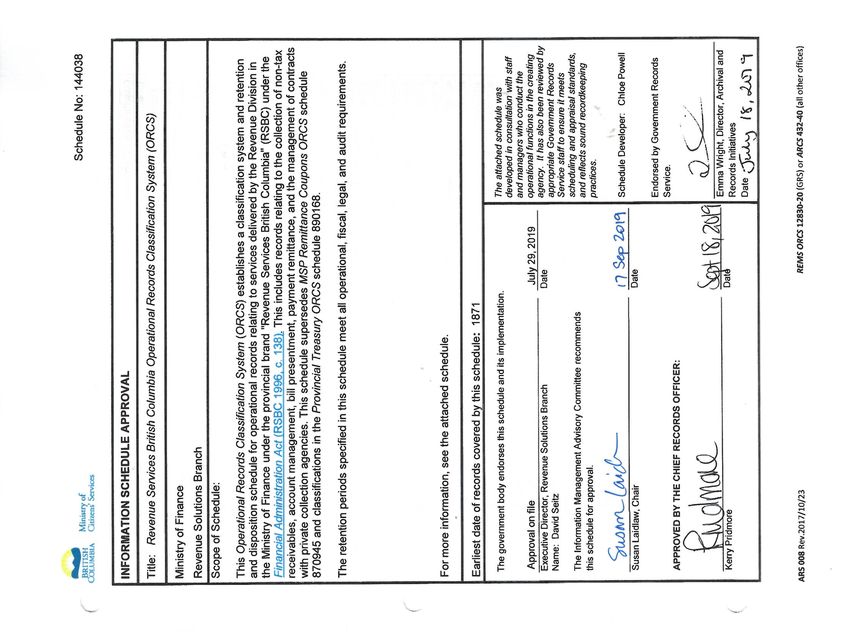
REVENUE SERVICES BRITISH COLUMBIA
     OPERATIONAL RECORDS
     CLASSIFICATION SYSTEM

         GOVERNMENT RECORDS SERVICE
OPERATIONAL RECORDS CLASSIFICATION SYSTEM
This is an approved information schedule, as defined by the Information Management Act (SBC 2015, c. 27). For
more information consult your Records Officer.

                        REVENUE SERVICES BRITISH COLUMBIA

                OPERATIONAL RECORDS CLASSIFICATION SYSTEM

                                      TABLE OF CONTENTS

REGISTER OF AMENDMENTS

USEFUL INFORMATION

EXECUTIVE SUMMARIES

SECTION 1        40000-49999           REVENUE SERVICES

SYSTEMS SECTION

APPENDIX A                            LIST OF ALL ACTIVE AND INACTIVE PROGRAMS IN RMS AS
                                      OF JULY 31, 2019

                                  Key to ARCS/ORCS Codes and Acronyms

2021/05/21                            Schedule: 144038                      RSER ORCS                TOC 1
ORCS REGISTER OF AMENDMENTS
This register lists all approved changes made to the Revenue Services ORCS, in ascending order
(i.e., the most recent changes appear first).
For more information about the changes listed here, see the relevant section, primary, and/or
secondary; the ORCS may also have an appendix that provides a more detailed summary of
changes.
Original schedule approval date: 2019/09/18
Amendment Amendment Date Section/ Changes
Number Type Approved Primary/
Secondary
170440 Administrative 2021/05/21 Entire Amended to reflect that the functions
ORCS and activities previously performed
by the Alternative Service Delivery
(ASD) provider are now being
performed by the Receivables
Management Office (see Executive
Summary for Administrative
Amendment for more details).
ARS 642 Schedule 144038 RSER ORCS AMEND - 1USEFUL INFORMATION
Key to Information Schedule Codes and Acronyms:
Information Schedule titles: ARCS = Administrative Records Classification System
ORCS = Operational Records Classification System
Office information: OPR = Office of Primary Responsibility
Records life cycle: A = Active
SA = Semi-active
FD = Final Disposition
Active and semi-active period codes: CY = Calendar Year
FY = Fiscal Year
NA = Not Applicable
SO = Superseded or Obsolete
w = week
m = month
y = year
Final disposition categories: DE = Destruction
FR = Full Retention
SR = Selective Retention
OD = Other Disposition
NA = Not Applicable
Special flags: FOI = Freedom of Information/Protection of Privacy
PIB = Personal Information Bank
VR = Vital Records
The following links provide additional resources for managing your information:
x ARCS and ORCS User Guide.
x Special schedules for records that are not covered by ARCS and ORCS.
x Legislation, policies, and standards for managing records in the BC Government.
x Tips, guides, and FAQs on related topics.
x Records Officer contact information.OPERATIONAL RECORDS CLASSIFICATION SYSTEM
This is an approved information schedule, as defined by the Information Management Act (SBC 2015, c.
27). For more information consult your Records Officer.
REVENUE SERVICES BRITISH COLUMBIA
Operational Records Classification System (ORCS)
Executive Summary For Amendment 1 - Administrative Amendment
Creating Agency
Ministry of Finance
Revenue Division
Receivables Management Office
Scope
Between 2004 and 2021, certain debt collection and revenue services for some non-tax debts
were provided to client ministries and agencies by an external service provider under an
Alternative Services Delivery (ASD) contract for the Provincial Government. The contract with
the service provider, Advanced Solutions, was not renewed in March 2021.
The purpose of this amendment is to reflect that the Receivables Management Office is now
responsible for the collection activities formerly performed by the ASD provider.
Amendment Change Summary
This administrative amendment:
• removes mention of the contracted service provider throughout the ORCS,
• removes mention of the relationship between the contracted serviced provider and the
ministry throughout the ORCS,
• Office of Primary Responsibility (OPR) updated to Receivables Management Office.
Endorsements
Schedule Number: 144038 Amendment Number: 170440
Schedule Developer: Sarah Shea, 2021-05-17
Approved by Director, Archives and Records Initiatives: Elizabeth Vander Beesen, 2021-05-21
END OF EXECUTIVE SUMMARY
Key to ARCS/ORCS Codes and Acronyms
2021/05/21 Schedule: 144038 RSER ORCS EXEC SUMMARY - 1OPERATIONAL RECORDS CLASSI FICATION SYSTEM
In accordance with the Information Management Act (SBC 2015, c. 27), DO NOT DESTROY ANY RECORDS
covered by this information schedule until it has been approved. For more information consult your Records Officer.
A SA FD
REVENUE SERVICES BRITISH COLUMBIA
OPERATIONAL RECORDS CLASSIFICATION SYSTEM (ORCS)
EXECUTIVE SUMMARY
This Operational Records Classification System (ORCS) establishes a classification system and
retention and disposition schedule for operational records relating to services delivered by the
Revenue Division in the Ministry of Finance under the provincial brand "Revenue Services British
Columbia" (RSBC) under the Financial Administration Act (RSBC 1996, c. 138).
These records document the collection and management of non-tax receivables, including the
collection of both billed and overdue financial obligations. This includes records relating to: collection of
receivables, account management, bill presentment, payment remittance, and the management of
contracts with private collection agencies.
The classifications and retention periods apply to all relevant digital and physical operational records,
including those onsite and in offsite storage. The active and semi-active retention periods specified in
the schedule meet all operational, administrative, legal, fiscal, and audit requirements. The final
dispositions have been reviewed to ensure that records having enduring evidential and informational
values are preserved.
This ORCS covers records relating to non-tax collection of financial obligations created and received
since 1871, which encompasses the centralization of Commercial Loan, Home Mortgages and Student
Loans branch in 1986 and the transfer for the premium billing function for Medical Services Plan in
2002. This schedule supersedes MSP Remittance Coupons ORCS schedule 870945 and
classifications in the Provincial Treasury ORCS schedule 890168. Concordance tables have been
added to these two ORCS to map the superseded classifications to the appropriate classifications in
this ORCS.
The following summary describes the records covered in this ORCS and identifies their retention
periods and final dispositions. The summary only includes records with a retention period of 7 years or
greater and is organized by retention period. Records in the executive summary are linked to the main
body of the ORCS by primary and secondary numbers. Please consult relevant secondaries for further
information.
1) Ambulance billing and collection data
(secondary 40200-25) SO 10y DE
These records document the billing and collection activities undertaken on
accounts with financial obligations related to ambulance services,
including notices, collection letters, interaction records, payment records,
and refunds.
Key to ARCS/ORCS Codes and Acronyms
2019/09/18 Schedule 144038 RSER ORCS EXEC SUMMARY - 3OPERATIONAL RECORDS CLASSI FICATION SYSTEM
In accordance with the Information Management Act (SBC 2015, c. 27), DO NOT DESTROY ANY RECORDS
covered by this information schedule until it has been approved. For more information consult your Records Officer.
A SA FD
Delete ambulance billing and collection data ten years after the account
balance reaches zero and all follow-up actions are completed. The ten
year retention period meets the reference requirements of the client
ministry. The billing account data acts as a back-up in the event of a lost
patient care report, which has ten year retention period under the
Emergency Health Services ORCS, Schedule 123390.
2) Bankruptcy files
(secondary 40100-30) SO 10y DE
(secondary 40100-40) SO 10y DE
(secondary 40100-50) SO 10y DE
These records include general bankruptcy files, pre-defaulted student
loans, bankruptcy settlement services, and related notice of motions and
court orders.
The destruction triggers for files and data vary:
• Bankruptcy files will be destroyed ten years after the bankruptcy is
written off, annulled by the trustee, refunded, paid in full, or
returned to active collections;
• Pre-defaulted Student Loans Bankruptcy Settlement Services will
be destroyed ten years after the bankruptcy is discharged; and
• Pre-defaulted Student Loans Bankruptcy Settlement Services
notice of motions and court orders will be destroyed ten years after
the extinguishment or receipt of court order rejection.
The retention periods are based on the limitation period outlined in the
Limitation Act (SBC 2012, c. 13) for court proceedings to enforce or sue
on judgement.
3) Billing and collection case files and related financial records
(secondary 40200-05) SO 7y DE
(secondary 40200-10) SO 7y DE
(secondary 40200-20) SO 7y DE
(secondary 40200-30) SO 7y DE
(secondary 40200-20) SO+1y 6y DE
These records document the billing and collection activities undertaken on
accounts with financial obligations related to non-tax collection programs
(excluding ambulance services), including notices, collection letters,
interaction records, payment records, and refunds.
The destruction triggers for files and data vary:
• Payment method applications and authorizations are destroyed
seven years after the account balance reaches zero and all follow-
up actions are completed;
• Audio recordings for payment method applications are destroyed
seven years after the recording is created;
Key to ARCS/ORCS Codes and Acronyms
2019/09/18 Schedule 144038 RSER ORCS EXEC SUMMARY - 4OPERATIONAL RECORDS CLASSI FICATION SYSTEM
In accordance with the Information Management Act (SBC 2015, c. 27), DO NOT DESTROY ANY RECORDS
covered by this information schedule until it has been approved. For more information consult your Records Officer.
A SA FD
• Collection case files are destroyed seven years after the account
balance reaches zero and all follow-up actions are completed;
• Batched collection correspondence is destroyed seven years after
it is received; and
• Account management and clarification records are destroyed
seven years after the account is clarified.
The seven year retention periods are based on the six year limitation in
the Financial Administration Act (RSBC 1996, c.138, s. 86.1, (2)(b)) for the
limitation period for government claims, and is consistent with the
retention period for similar financial records classified under ARCS.
4) Contract management statistics and reporting
(secondary 40300-10) SO 7y DE
These records document performance indicators of private collection
agencies, which are contracted annually to collect overdue receivables on
behalf of RSBC.
Destroy records seven years after the records are no longer required for
research and reference. The retention period is based on the six-year
limitation period under the Financial Administration Act (RSBC 1996, c.
138).
5) Program planning
(secondary 40000-10) SO 7y DE
These records document the program coordination and strategies
planned and implemented to improve revenue services.
Destroy program planning records seven years after the determination is
made that the records are no longer required for program planning or
when the project is completed, abandoned or cancelled.
This retention period is consistent with the seven-year retention period for
related program planning files created by the contract management office,
covered under the Revenue and Student Loan Contract Management
ORCS schedule 201395 (see secondary 72000-40).
6) Policies and procedures - final
(secondary 40000-00) SO 5y DE
These records document final operational policies, including procedures,
standards, guidelines, manuals, and recommended practices and
directives used by staff.
Final policies and procedures may be destroyed fives years after the
policy is replaced or becomes irrelevant because records created by the
service provider are procedural in nature. The development and approval
Key to ARCS/ORCS Codes and Acronyms
2019/09/18 Schedule 144038 RSER ORCS EXEC SUMMARY - 5OPERATIONAL RECORDS CLASSI FICATION SYSTEM
In accordance with the Information Management Act (SBC 2015, c. 27), DO NOT DESTROY ANY RECORDS
covered by this information schedule until it has been approved. For more information consult your Records Officer.
A SA FD
of core policy for collection functions is managed by the Office of the
Comptroller General. Core policies and procedures are fully retained
under the Office of the Comptroller General ORCS, schedule 180968.
7) All Other Records DE
All other records are destroyed at the end of their semi-active retention
periods. The retention of these records varies depending on the nature of
the records and the function performed, but does not exceed seven years.
Any information from these records that has ongoing value is adequately
documented under secondaries with longer retentions and/or full or
selective retention appraisals within the ORCS or in ARCS, such as
summary reports, policy records, executive briefing notes (ARCS
secondary 280-20), and annual service plan reports (ARCS secondary
400-02). These records have no enduring value to government at the end
of their scheduled retention period.
END OF EXECUTIVE SUMMARY
Key to ARCS/ORCS Codes and Acronyms
2019/09/18 Schedule 144038 RSER ORCS EXEC SUMMARY - 6OPERATIONAL RECORDS CLASSIFICATION SYSTEM
This is an approved information schedule, as defined by the Information Management Act (SBC 2015, c. 27). For
more information consult your Records Officer.
SECTION 1
REVENUE SERVICES
PRIMARY NUMBERS
40000 – 49999
Section 1 covers records relating to non-tax debt collection and revenue services delivered by the
Receivables Management Office (RMO) in the Ministry of Finance pursuant to the Financial
Administration Act (RSBC 1996, c. 138). Services include account management, bill presentment,
payment remittance, and collection.
Key to ARCS/ORCS Codes and Acronyms
2021/05/21 Schedule: 144038 RSER ORCS SECTION 1 - 1OPERATIONAL RECORDS CLASSIFICATION SYSTEM
This is an approved information schedule, as defined by the Information Management Act (SBC 2015, c. 27). For
more information consult your Records Officer.
SECTION 1 TABLE OF CONTENTS
REVENUE SERVICES
40000 - 49999
40000 COLLECTION AND REVENUE SERVICES - GENERAL
40100 ACCOUNT MANAGEMENT
40200 COLLECTIONS
40300 PRIVATE COLLECTION AGENCIES SERVICES
Key to ARCS/ORCS Codes and Acronyms
2021/05/21 Schedule: 144038 RSER ORCS SECTION 1 - 2OPERATIONAL RECORDS CLASSIFICATION SYSTEM
This is an approved information schedule, as defined by the Information Management Act (SBC 2015, c. 27). For
more information consult your Records Officer.
40000 COLLECTION AND REVENUE SERVICES - GENERAL
Records not shown elsewhere in this schedule that relate generally to non-tax
revenue services and debt collection provided to client ministries and agencies
by the Ministry of Finance, including: account management; billing; payment;
collection; inbound and outbound calling; imaging and remittance processing;
financial processes; and the operations and maintenance of the Revenue
Management System.
This primary covers the records related to development of operational policies,
procedures, and business processes; tracking; non-account specific inquiries
and Canada Revenue Agency (CRA) mismatches; and planning.
NOTE: Only records which cannot be classified in a more specific primary or
secondary may be classified under this primary.
For contracts tendered and managed by the Ministry of Finance, see ARCS
primary 1070.
For core policies created by the Office of the Comptroller General, see Office of
the Comptroller General ORCS (schedule 180968).
For final strategic plans, see ARCS secondary 400-10.
For information technology systems development files, business analysis, and
implementation (systems such as RMS, MavBridge, and Kofax), see
ARCS primary 6450.
For municipal and rural property tax deferment records provided under the Land
Tax Deferment Act (RSBC 1996, c. 249), including property tax
deferment images and data, see the Property Taxation ORCS (schedule
160184, primary 45760).
For reference material/topical files, see ARCS secondary 358-20.
For systems descriptions, see the System Section.
The ministry OPR is Receivables Management Office unless otherwise noted
below. See specific secondaries for OPR retention schedules.
40000 COLLECTION AND REVENUE SERVICES - GENERAL A SA FD
All non-OPR offices will retain these records for: SO nil DE
-00 Policies and Procedures - final SO 5y DE
(covers final/approved policies, procedures, standards, and
guidelines pertaining to the functions and activities
documented in this schedule)
RETENTION STATEMENT
Destroy five years after the policy is replaced or becomes
irrelevant.
SO: when the policy is replaced or becomes irrelevant
Key to ARCS/ORCS Codes and Acronyms
2021/05/21 Schedule: 144038 RSER ORCS SECTION 1 - 3OPERATIONAL RECORDS CLASSIFICATION SYSTEM
This is an approved information schedule, as defined by the Information Management Act (SBC 2015, c. 27). For
more information consult your Records Officer.
40000 COLLECTION AND REVENUE SERVICES - GENERAL A SA FD
DE: Final policies and procedures may be destroyed
because records are procedural in nature. The
development and approval of core policy for
collection functions is managed by the Office of the
Comptroller General. Core policies and procedures
are fully retained under the Office of the Comptroller
General ORCS (schedule 180968).
NOTE: Records relating to information system development
and implementation, including image and payment
processing, are covered under ARCS primary 6450
Information System Development and Changes.
-01 General CY+1y nil DE
RETENTION STATEMENT
Destroy at the end of the second calendar year.
-05 Account inquiries (not covered elsewhere) SO+6m nil DE
(covers general correspondence received from consumers
that cannot be assigned to an account, and CRA mismatches)
(includes correspondence)
RETENTION STATEMENT
Destroy six months after one of the following criteria have
been met:
• for non-account specific inquiries, when the inquiry is
received,
• for CRA mismatches, upon resolution.
SO: when one of the following criteria have been met:
• for non-account specific inquiries, when the inquiry
is received
• for CRA mismatches, upon resolution
NOTE: Received inquiries with identifiable and associated
accounts are classified under secondary 40100-20
collection case files.
NOTE: CRA mismatches resulting in a refund are classified
under ARCS secondary 925-20 account payable
files.
Key to ARCS/ORCS Codes and Acronyms
2021/05/21 Schedule: 144038 RSER ORCS SECTION 1 - 4OPERATIONAL RECORDS CLASSIFICATION SYSTEM
This is an approved information schedule, as defined by the Information Management Act (SBC 2015, c. 27). For
more information consult your Records Officer.
40000 COLLECTION AND REVENUE SERVICES - GENERAL A SA FD
-10 Program planning SO 7y DE
(covers coordination and strategies)
(includes reports, correspondence, and working documents)
RETENTION STATEMENT
Destroy seven years after no longer required for program
planning or seven years after the project is completed,
abandoned or cancelled.
SO: when no longer required for program planning or
when the project is completed, abandoned or
cancelled
7y: The retention period is consistent with the seven-year
retention period for related program planning files.
DE: Program planning files are appraised for destruction
because they contain routine strategies and
campaigns. Final strategic plans are fully retained
under ARCS secondary 400-10, and final core
policies and procedures created by the Office of the
Comptroller General are kept under the Office of the
Comptroller General ORCS (schedule 180968).
NOTE: An example of a function covered under this
secondary includes the planning for revenue
collection strategies.
-15 Tracking SO nil DE
(covers tracking for all revenue services functions)
(includes reports, spreadsheets, and statistics)
RETENTION STATEMENT
Destroy when no longer required for tracking and reporting
purposes.
SO: when no longer required for tracking and reporting
purposes
NOTE: Tracking created for a specific function may be
classified under the specific secondary to which it
relates (e.g. tracking created during the write-off
process may be filed with write-off records and
classified under secondary 40200-60).
Key to ARCS/ORCS Codes and Acronyms
2021/05/21 Schedule: 144038 RSER ORCS SECTION 1 - 5OPERATIONAL RECORDS CLASSIFICATION SYSTEM
This is an approved information schedule, as defined by the Information Management Act (SBC 2015, c. 27). For
more information consult your Records Officer.
40000 COLLECTION AND REVENUE SERVICES - GENERAL A SA FD
-20 Policy development files SO 5y DE
(includes copies of briefing notes, correspondence, drafts and
working materials)
RETENTION STATEMENT
Destroy five years after the policy is approved and distributed,
or abandoned.
SO: when the policy is approved and distributed, or
abandoned
DE: Development files of policies and procedures may be
destroyed because records are procedural in nature.
The development and approval of core policy for
collection functions is determined by the Office of the
Comptroller General. Approved core policies and
procedures are fully retained under the Office of the
Comptroller General ORCS (schedule 180968).
END OF PRIMARY
Key to ARCS/ORCS Codes and Acronyms
2021/05/21 Schedule: 144038 RSER ORCS SECTION 1 - 6OPERATIONAL RECORDS CLASSIFICATION SYSTEM
This is an approved information schedule, as defined by the Information Management Act (SBC 2015, c. 27). For
more information consult your Records Officer.
40100 ACCOUNT MANAGEMENT
Records relating to account adjustment, bankruptcy, refunds, write-offs, legal
action, skip tracing, settlement offers, and set-off. This primary covers records
relating to the administration of financial accounting processes throughout the
revenue management cycle, including account adjustments, sub-ledger
maintenance, and accounts receivable and revenue reporting and
reconciliation.
The account adjustment process includes: the investigation of requests to
adjust accounts, determination of adjustment type, calculation of adjustment
value, adjustment approvals, data entry, adjustment reconciliation, the
transmission of the account file to client ministries, and the generation of
financial reports.
Bankruptcy activities related to the management of individual and corporate
proposals made through the Bankruptcy and Insolvency Act (RSC 1985, c. B-3)
include: communication and correspondence with third parties (including
trustees and lawyers); filing of notice of claims, recommendation and filing
opposition to discharge; monitorization for discharge and dividends; the
extinguishment and write-off of accounts where appropriate; and resuming
collection activities on accounts.
Accounts in default may incur escalated collection actions which could include
the transfer of accounts to a private collection agency (see primary 40300), a
set-off against a provincial or federal refund, a wage or bank demand under the
Financial Administration Act (RSBC 1996, c. 138, s.83), a crown debt charge on
real property under the Land Title Act (RSBC 1996, c. 250, s.204), and/or court
judgements.
The Receivables Management Office (RMO) utilizes skip tracing tools as part of
the collection processes when a debtor is no longer in contact with RSBC.
These tools contribute to RMO's ability to locate and update personal
information about debtors (e.g., addresses, phone numbers and place of
employment) and verify financial information (e.g., assets owned). New
information found by RMO staff using the Skip Tracing Systems and search
engines will be added to the account file in the Revenue Management System.
RMO may also request credit bureaus for credit reports on individuals to gather
and assess additional or updated information.
Accounts can be reviewed, submitted, recommended to client Ministries for
write-off if accounts meet defined criteria. This primary covers records related to
the recommendation, processing, and implementation of write-off decisions and
includes account summaries, memo's, and reports.
This primary also covers records related to the pre-default student loans
bankruptcy settlement services, including the recommendation and processing
of write-offs and extinguishments. Pre-default Student Loans Bankruptcy
Settlement Services are for British Columbian students with loans, not in
Key to ARCS/ORCS Codes and Acronyms
2021/05/21 Schedule: 144038 RSER ORCS SECTION 1 - 7OPERATIONAL RECORDS CLASSIFICATION SYSTEM
This is an approved information schedule, as defined by the Information Management Act (SBC 2015, c. 27). For
more information consult your Records Officer.
default, filing for bankruptcy under the Bankruptcy and Insolvency Act (RSC
1985, c. B-3).
NOTE: See applicable ministry ORCS for records maintained by ministries
relating to debt collection, etc. (e.g. Social Services ORCS (schedule 133400)).
For bank statement reconciliation, see ARCS secondary 985-02.
For financial account analysis and general reconciliation files see ARCS
secondary 920-20.
For journal vouchers see ARCS secondary 1050-04.
For operational policy, see secondary 40000-00.
For reference material/topical files, see ARCS secondary 358-20.
For refunds, see ARCS 925-20.
For tracking, see secondary 40000-15.
The ministry OPR is Receivables Management Office unless otherwise noted
below. See specific secondaries for OPR retention schedules.
40100 ACCOUNT MANAGEMENT A SA FD
All non-OPR offices will retain these records for: SO nil DE
-01 General CY+1y nil DE
RETENTION STATEMENT
Destroy at the end of the second calendar year.
-05 Crown debt charge release confirmation CY 1y DE
(covers communications referred to as requests for
undertaking)
(includes correspondence)
RETENTION STATEMENT
Destroy at the end of the second calendar year.
-20 Account management and clarification SO+1y 6y DE
(arranged by fiscal year in which account is clarified)
(covers clarification of unallocated deposits)
(includes correspondence)
RETENTION STATEMENT
Destroy seven years after account is clarified.
SO: when account is clarified
Key to ARCS/ORCS Codes and Acronyms
2021/05/21 Schedule: 144038 RSER ORCS SECTION 1 - 8OPERATIONAL RECORDS CLASSIFICATION SYSTEM
This is an approved information schedule, as defined by the Information Management Act (SBC 2015, c. 27). For
more information consult your Records Officer.
40100 ACCOUNT MANAGEMENT A SA FD
-30 Bankruptcy SO 10y DE
(covers all provincial bankruptcy, consumer proposals,
receivership, and Companies' Creditors Arrangement Act
activities)
(includes notice of bankruptcy, notice of motions, coversheet,
account details, consumer proposals, and correspondence)
RETENTION STATEMENT
Destroy 10 years after bankruptcy is either written off, annulled
by the trustee, refunded, paid in full, or returned to active
collections.
SO: when bankruptcy is either written off, annulled by the
trustee, refunded, paid in full, or returned to active
collections
10y: This retention is based on the limitation period
outlined in the Limitation Act (SBC 2012, c. 13) for
court proceedings to enforce or sue on judgement.
NOTE: See secondary 40100-40 for bankruptcies associated
with pre-defaulted national student loans and
secondary 40100-50 for national student loans
notices of motions and court orders.
-40 Pre-defaulted Student Loans Bankruptcy Settlement SO 10y DE
Services
(includes creditor's packages, consumer proposals, proof of
claims, annulments, withdrawals, financial information from
National Student Loans Services, statuses, and discharges)
RETENTION STATEMENT
Destroy 10 years after confirmation that the bankruptcy is
discharged.
SO: upon confirmation that the bankruptcy is discharged
10y: This retention is based on the limitation period
outlined in the Limitation Act (SBC 2012, c. 13) for
court proceedings to enforce or sue on judgement.
Key to ARCS/ORCS Codes and Acronyms
2021/05/21 Schedule: 144038 RSER ORCS SECTION 1 - 9OPERATIONAL RECORDS CLASSIFICATION SYSTEM
This is an approved information schedule, as defined by the Information Management Act (SBC 2015, c. 27). For
more information consult your Records Officer.
40100 ACCOUNT MANAGEMENT A SA FD
-50 Pre-defaulted Student Loans Bankruptcy Settlement SO 10y DE
Services notice of motions and court orders
(covers requests to court regarding bankruptcy claims and
corresponding direction issued from court)
RETENTION STATEMENT
Destroy 10 years after extinguishment or receipt of court order
rejection.
SO: upon extinguishment or receipt of court order
rejection
10y: This retention is based on the limitation period
outlined in the Limitation Act (SBC 2012, c. 13) for
court proceedings to enforce or sue on judgement.
-60 Write-offs, legal action, and skip tracing FY+1y 6y DE
(covers skip trace, legal action, and write-off activities)
(includes review file, approval memos, spool reports, rejection
reports, employment verification, credit bureau scrubs)
RETENTION STATEMENT
Destroy at the end of the eighth fiscal year.
7y: The retention period meets the branch's operational
and reference requirements and is consistent with
the retention period for write-offs and financial
records classified under ARCS 935-30.
NOTE: Examples of legal action requests include requests
relating to s. 83 of the Financial Administration Act
(RSBC 1996, c. 138) and s. 204 of the Land Title Act
(RSBC 1996, c. 250).
END OF PRIMARY
Key to ARCS/ORCS Codes and Acronyms
2021/05/21 Schedule: 144038 RSER ORCS SECTION 1 - 10OPERATIONAL RECORDS CLASSIFICATION SYSTEM
This is an approved information schedule, as defined by the Information Management Act (SBC 2015, c. 27). For
more information consult your Records Officer.
40200 COLLECTIONS
Records relating to the early-stage and late-stage collection of amounts owed to
the Province from certain non-tax programs. Early-stage collection includes the
collection of non-past due accounts (billing), whereas late-stage collection
refers to escalated collection activity of past-due accounts (overdue debt). This
primary covers records relating to the collection of both billing (early-stage) and
overdue debt (late-stage collection) amounts.
Client ministries transfer data of financial obligations or delinquent debts to the
Ministry of Finance's Receivables Management Office (RMO) for administration
and management in the Revenue Management System (RMS). Collection
activities include receiving financial obligation information from client ministries,
sending invoices (bill presentment) and/or dunning correspondence, managing
financial activity on the account (e.g. posting of interest, payments, fees,
adjustments, etc.) as applicable, and managing the account file. Additional
activity on past due accounts includes increased interaction with debtors, the
assignment of accounts to Canada Revenue Agency set-off program, the
initiation of legal actions such as bank and wage demands, and the transfer to
private collection agencies (PCAs) for collections and reporting to credit
reporting agencies.
This primary includes records relating to the processing and approval of
applications which authorize the withdrawal of funds against a client's account
with banks or financial institutions, in accordance with the rules of the Canadian
Payments Association. This includes pre-authorization debit plan (PAD)
applications. Applications are currently received either through paper forms,
digital recordings, or online (see Billing and Payment Services in the System
Section). All information recorded on a PAD form or recording is entered into
RMS, where the system tracks the activity and history of each application.
Record types include: application forms and recordings, void cheques or
authorizing documentation from bank/financial institution, and correspondence.
This primary also covers correspondence sent and received to account holders
including documents such as Power of Attorney, Law Office or Notary letters;
and correspondence related to an individual's ability to pay, including financial
reports which may include copies of documentation verifying income and
expenses.
For bank deposits, including copies of cheques that are not duplicated in an end
system (currently Ambulance and Bus Pass programs) see ARCS
secondary 985-03.
For collection case file data created or maintained by a sub-contracted
collection agency, see secondary 40300-30.
For information technology development projects, see ARCS secondary 6450-
20.
For library/reference materials, see ARCS secondary 358-20.
For ministry/agency planning and performance files, see ARCS secondary 400-
20.
For operational policy, see secondary 40000-00.
Key to ARCS/ORCS Codes and Acronyms
2021/05/21 Schedule: 144038 RSER ORCS SECTION 1 - 11OPERATIONAL RECORDS CLASSIFICATION SYSTEM
This is an approved information schedule, as defined by the Information Management Act (SBC 2015, c. 27). For
more information consult your Records Officer.
For records relating to municipal and rural property tax deferment provided
under the Land Tax Deferment Act (RSBC 1996, c. 249), including
property tax deferment images and data, see Property Taxation ORCS
(schedule 890168, primary 45760).
For remittance processing, see ARCS primary 935.
For returned client mail, including returned mail from litigation and skip-tracing
processes, see Transitory Electronic Data Processing (EDP) Records
(schedule 102902).
For system descriptions, see the System Section.
For transitory data files such as raw data tables and data sets, see Transitory
Electronic Data Processing (EDP) Records (schedule 102902).
For transmittal copies of cheques created during payment processing, see
Transitory Electronic Data Processing (EDP) Records (schedule
102902).
The ministry OPR is Receivables Management Office unless otherwise noted
below. See specific secondaries for OPR retention schedules.
40200 COLLECTIONS A SA FD
All non-OPR offices will retain these records for: SO nil DE
-01 General CY+1y nil DE
RETENTION STATEMENT
Destroy at the end of the second calendar year.
-05 Payment method applications and authorizations SO 7y DE
(applications arranged by date batched)
(covers authorizations that are managed independently from
the general collection account file)
(includes PAD applications and authorizations, and recurring
credit card (RCC) authorizations)
(paper authorizations include application forms (FIN 489) and
void cheques or documentation from Bank/Financial
institution; digital authorizations include BPS data)
RETENTION STATEMENT
Destroy seven years after the account balance reaches zero
and all follow-up actions are completed.
SO: when the account balance reaches zero and all
follow-up actions are completed
7y: The seven year retention provides a reasonable
period to resolve disputes relating to pre-
authorizations and terms of agreement, is compliant
with Canadian Payments Association pre-authorized
debit guide and rules, and reflects dispute history.
Key to ARCS/ORCS Codes and Acronyms
2021/05/21 Schedule: 144038 RSER ORCS SECTION 1 - 12OPERATIONAL RECORDS CLASSIFICATION SYSTEM
This is an approved information schedule, as defined by the Information Management Act (SBC 2015, c. 27). For
more information consult your Records Officer.
40200 COLLECTIONS A SA FD
NOTE: For PADs, if the client changes their bank account, a
new authorization must be received, either in the
form of a paper application with a void cheque (or
documentation from a bank/financial institution), or a
new audio recording.
NOTE: For RCC authorizations, credit card information is
transferred to a processing agent designated by the
Ministry of Finance. Data transferred to the agent is
covered under the Banking and Cash Management
ORCS (schedule 191019, secondary 80500-90),
while tokens and profile IDs collected/created during
authorization processes are scheduled under the
Transitory Electronic Data Processing (EDP)
Records (schedule 102902). See systems section
for information on the RCC authorization process.
NOTE: Images of scanned applications and authorizations
may be interfiled with the collection case file. See
secondary 40200-20.
NOTE: See secondary 40200-10 for payment method
applications captured and retained as audio files.
-10 Payment method applications - audio recordings SO 7y DE
(covers PAD by phone applications)
(includes audio recordings only)
RETENTION STATEMENT
Destroy seven years after recording.
SO: upon recording
7y: The seven year retention provides a reasonable
period to resolve disputes relating to pre-
authorizations and terms of agreement, is compliant
with Payments Canada's pre-authorized debit guide,
and reflects dispute history.
NOTE: If the audio recording is found to be incomplete or
unsuccessful, the recording is considered transitory
and can be destroyed according to the Transitory
Records Schedule (schedule 102901).
NOTE: See secondary 40200-05 for payment method
applications and authorizations that are not captured
and retained as audio files.
Key to ARCS/ORCS Codes and Acronyms
2021/05/21 Schedule: 144038 RSER ORCS SECTION 1 - 13OPERATIONAL RECORDS CLASSIFICATION SYSTEM
This is an approved information schedule, as defined by the Information Management Act (SBC 2015, c. 27). For
more information consult your Records Officer.
40200 COLLECTIONS A SA FD
NOTE: For PADs, if the client changes their bank account, a
new authorization must be received, either in the
form of a paper application with a void cheque (or
documentation from bank/financial institution), or a
new audio recording.
-15 Collection audio recordings SO 3m DE
(covers audio files of calls made and/or received for collection
activities, including training and audits)
RETENTION STATEMENT
Destroy three months after recording.
SO: upon recording
-20 Collection case files SO 7y DE
(arrange client ministry files by program, then by account
number)
(covers physical files and data received or created during
billing and overdue collection activities)
(includes notices, demand letters, garnishment orders,
collection letters, financial disclosure documents, interaction
records, account authorization, refunds, copies of loan
agreements, payment records, and invoices)
RETENTION STATEMENT
Destroy seven years after the account balance reaches zero
and all follow-up actions are completed.
SO: when the account balance reaches zero and all
follow-up actions are completed
7y: The seven year retention period is based on the six
year limitation in the Financial Administration Act
(RSBC 1996, c.138, s. 86.1, (2)(b)) for the limitation
period for government claims, and is consistent with
the retention period for similar financial records
classified under ARCS.
NOTE: Policy defines that the account balance reaches zero
when the account has been paid in full, the source
program has recalled or adjusted the account, the
debt has reached the statutory limitation date, or the
debt has been subject to remission or other
extinguishment pursuant to the Financial
Administration Act (RSBC 1996, c.138, s. 18 or 19).
The individual must have no outstanding court fines.
Key to ARCS/ORCS Codes and Acronyms
2021/05/21 Schedule: 144038 RSER ORCS SECTION 1 - 14OPERATIONAL RECORDS CLASSIFICATION SYSTEM
This is an approved information schedule, as defined by the Information Management Act (SBC 2015, c. 27). For
more information consult your Records Officer.
40200 COLLECTIONS A SA FD
NOTE: This secondary covers all programs except for
Ambulance billing. See secondary 40200-25.
NOTE: Payment authorizations managed independently from
the active case file are classified under secondary
40200-05.
-25 Ambulance billing and collection data SO 10y DE
(covers data received or created during billing and collection
activities)
(includes notices, demand letters, garnishment orders,
collection letters, financial disclosure documents, interaction
records, account authorization, refunds, copies of loan
agreements, payment records, and invoices)
RETENTION STATEMENT
Destroy 10 years after the account balance reaches zero and
all follow-up actions are completed.
SO: when the account balance reaches zero and all
follow-up actions are completed
10y: The ten year retention period meets the reference
requirements of the client ministry. The billing
account data acts as a back-up in the event of a lost
patient care report, which has ten year retention
period under the Emergency Health Services ORCS
(schedule 123390).
-30 Batched collection correspondence SO 7y DE
(arranged by date, followed by program, then account)
(covers physical collection correspondence organized by date
only)
RETENTION STATEMENT
Destroy seven years after received.
SO: upon receipt
7y: The seven year retention period is based on the six
year limitation in the Financial Administration Act
(RSBC 1996, c.138, s. 86.1, (2)(b)) for the limitation
period for government claims, and is consistent with
the retention period for similar financial records
classified under ARCS.
Key to ARCS/ORCS Codes and Acronyms
2021/05/21 Schedule: 144038 RSER ORCS SECTION 1 - 15OPERATIONAL RECORDS CLASSIFICATION SYSTEM
This is an approved information schedule, as defined by the Information Management Act (SBC 2015, c. 27). For
more information consult your Records Officer.
40200 COLLECTIONS A SA FD
-40 Billing and Payment Services (BPS) Portal data SO nil DE
(covers data stored only in BPS and not in any other system of
record)
(includes account login information and credit card expiry
dates)
RETENTION STATEMENT
Destroy when no longer required for payment or account
services.
SO: when no longer required for payment or account
services
PIB -50 Collection and Loan Administration Support System SO nil DE
(CLASS) legacy data
RETENTION STATEMENT
Destroy when no longer required for collection or reference
purposes.
SO: when no longer required for collection or reference
purposes
PIB -60 Data warehouse data SO nil DE
(covers data retained in the data warehouse)
RETENTION STATEMENT
Destroy when data is no longer required to support analytical
and statistical reporting.
SO: when data is no longer required to support analytical
and statistical reporting
-70 Invoice images FY 6y DE
RETENTION STATEMENT
Destroy at the end of the seventh fiscal year.
7y: The seven year retention period is based on the six
year limitation in the Financial Administration Act
(RSBC 1996, c.138, s. 86.1, (2)(b)) for the limitation
period for government claims.
NOTE: Images of invoices are currently stored in the RMS
system. The data for the financial obligation remains
in the account file, and the invoice images can be
reproduced on demand while the account case file is
Key to ARCS/ORCS Codes and Acronyms
2021/05/21 Schedule: 144038 RSER ORCS SECTION 1 - 16OPERATIONAL RECORDS CLASSIFICATION SYSTEM
This is an approved information schedule, as defined by the Information Management Act (SBC 2015, c. 27). For
more information consult your Records Officer.
40200 COLLECTIONS A SA FD
retained. See the System Section for information on
the Billing and Payment Services Portal.
-80 Remittance coupons SO 3y DE
(commonly called invoice stubs)
(covers received payment stubs for all non-tax programs)
RETENTION STATEMENT
Destroy three years after the records have been batched.
SO: when the records have been batched
NOTE: This secondary supersedes MSP Remittance
Coupons ORCS (schedule 870945).
END OF PRIMARY
Key to ARCS/ORCS Codes and Acronyms
2021/05/21 Schedule: 144038 RSER ORCS SECTION 1 - 17OPERATIONAL RECORDS CLASSIFICATION SYSTEM
This is an approved information schedule, as defined by the Information Management Act (SBC 2015, c. 27). For
more information consult your Records Officer.
40300 PRIVATE COLLECTION AGENCIES SERVICES
Records relating to managing contracts with private collection agencies. Past-
due accounts can be transferred to PCAs to attempt to collect overdue
receivables. Contract management includes the negotiation, establishment,
administration, remuneration, and management of contracts with PCAs.
Activities related to the management of the contracts include the development
of strategies for account referral to PCAs for collection, the recall of accounts
from the PCAs, and monitoring of PCA activity and performance. Consumer
correspondence received by the PCAs is forwarded to the Receivables
Management Office (RMO) for inclusion in the collection account case file.
For contract management files, including evaluations and audits, see ARCS
secondary 1070-20.
For operational policy, see secondary 40000-00.
For reference material/topical files, see ARCS secondary 358-20.
The ministry OPR is Receivables Management Office unless otherwise noted
below. See specific secondaries for OPR retention schedules.
40300 PRIVATE COLLECTION AGENCIES SERVICES A SA FD
All non-OPR offices will retain these records for: SO nil DE
-01 General CY+1y nil DE
RETENTION STATEMENT
Destroy at the end of the second calendar year.
-05 Call recordings SO 6m DE
(organized by date, then by contractor)
RETENTION STATEMENT
Destroy six months after recording.
SO: upon recording
-10 Contract management statistics and reporting 7y DE
(organized by year) SO
RETENTION STATEMENT
Destroy seven years after no longer required for research and
reference.
SO: when no longer required for research and reference
Key to ARCS/ORCS Codes and Acronyms
2021/05/21 Schedule: 144038 RSER ORCS SECTION 1 - 18OPERATIONAL RECORDS CLASSIFICATION SYSTEM
This is an approved information schedule, as defined by the Information Management Act (SBC 2015, c. 27). For
more information consult your Records Officer.
40300 PRIVATE COLLECTION AGENCIES SERVICES A SA FD
7y: The seven year retention period is based on the six
year limitation in the Financial Administration Act
(RSBC 1996, c.138, s. 86.1, (2)(b)) for the limitation
period for government claims.
-20 PCA interaction records FY+1Y nil DE
(includes correspondence and reports)
(arranged by date received)
RETENTION STATEMENT
Destroy at the end of the second fiscal year.
-30 Sub-contracted collection case file data SO 2y DE
(covers data stored in systems maintained by contracted
collection agencies)
RETENTION STATEMENT
Destroy two years after the account is no longer the
responsibility of the contracted collection agency.
SO: when the account is no longer the responsibility of
the contracted collection agency
END OF PRIMARY
Key to ARCS/ORCS Codes and Acronyms
2021/05/21 Schedule: 144038 RSER ORCS SECTION 1 - 19OPERATIONAL RECORDS CLASSIFICATION SYSTEM
This is an approved information schedule, as defined by the Information Management Act (SBC 2015, c. 27). For
more information consult your Records Officer.
REVENUE SERVICES BRITISH COLUMBIA
OPERATIONAL RECORDS CLASSIFICATION SYSTEM (ORCS)
SYSTEMS SECTION TABLE OF CONTENTS
SECTION AND TITLE PAGE NO.
SYSTEMS SECTION PRIMER 2
BILLING AND PAYMENT SERVICES PORTAL (BPS) 4
COLLECTION AND LOAN ADMINISTRATION SUPPORT SYSTEM (CLASS) 5
DATA WAREHOUSE - REPORTING, ANALYTICS & PERFORMANCE MANAGEMENT (RAPM) 6
REVENUE MANAGEMENT SYSTEM (RMS) 8
Key to ARCS/ORCS Codes and Acronyms
2021/05/21 Schedule: 144038 RSER ORCS SYSTEMS - 1OPERATIONAL RECORDS CLASSIFICATION SYSTEM
This is an approved information schedule, as defined by the Information Management Act (SBC 2015, c. 27). For
more information consult your Records Officer.
SYSTEMS SECTION PRIMER
The purpose of the System Section is to provide system administrators with criteria that they
can use to develop system purge or digital archives transfer routines for data, records, and
other information that is covered by this ORCS, and retained in operational systems.
Frequently Asked Questions
What is a data retention plan?
A data retention plan maps data, records, and other information in a system to classifications in
the ORCS, and describes, based on the retention periods indicated in those classifications, how
long it is to be kept before it’s eligible to be destroyed or transferred to the digital archives. The
data retention plan is part of the system overview.
What is the status of the Digital Archives?
The Corporate Information and Records Management Office (CIRMO) is committed to establishing a digital
archives. Work is underway to meet this commitment, and to implement a solution that meets
client needs. The CRO has issued guidance on the management of digital records during the interim.
Do I need approval before deleting data that is scheduled within my ORCS?
Approval is required before deleting the data. Contact your Government Records Officer for
more information.
Do the retention periods in this ORCS continue to apply if data is migrated to a new system?
If data is subsequently migrated to a new system, the retention periods indicated in the ORCS
for that data should continue to apply, provided the data itself is largely unchanged. However,
if the new system captures data that is not referred to in the system description, for example
as a result of new legislation or significant functional changes, then please consult with your
Government Records Officer.
When can I decommission a system?
Systems can only be decommissioned when one of the following conditions have been met:
• all data on the system has been migrated to another system performing the same
function, or,
• retention schedules covering all the data on the system have elapsed, or,
• the data has been preserved elsewhere (e.g. digital archives).
Before decommissioning a system, please consult with your Government Records Officer.
What are Transitory Electronic Data Processing (EDP) records?
Transitory EDP records cover a variety of input, processing, and output records of temporary
usefulness that are not an integral part of an administrative or operational record or datafile and are
only required for a limited period for the completion of a routine action or the preparation of an
ongoing record or file. These records can be deleted without approval by your ministry’s Records
Officer. A common example is a datafile used to upload data from one system to another. Once the
Key to ARCS/ORCS Codes and Acronyms
2021/05/21 Schedule: 144038 RSER ORCS SYSTEMS - 2OPERATIONAL RECORDS CLASSIFICATION SYSTEM
This is an approved information schedule, as defined by the Information Management Act (SBC 2015, c. 27). For
more information consult your Records Officer.
data is uploaded and verified, the datafile can be destroyed. Refer to the Transitory EDP Records
Schedule to determine if your data falls under the definition of transitory.
How long are back-up data and system logs kept?
Backup data are retained until no longer required for system recovery, and in accordance with
the established backup cycle for the application or system. System logs, used for ongoing
system maintenance and performance purposes, are retained until no longer required. Logs
maintained for security purposes or investigations have longer requirements. See ARCS primary
6820 for more details.
Where do I classify the documentation related to the management of the system?
Because the function of systems management is common across government (e.g., there are
information management branches within each ministry responsible for supporting and
maintaining information systems) these records are classified and scheduled within the
Administrative Records Classification System (ARCS) - ARCS primary 6450. This ensures that
all offices are consistently classifying and scheduling their systems documentation.
Key to ARCS/ORCS Codes and Acronyms
2021/05/21 Schedule: 144038 RSER ORCS SYSTEMS - 3OPERATIONAL RECORDS CLASSIFICATION SYSTEM
This is an approved information schedule, as defined by the Information Management Act (SBC 2015, c. 27). For
more information consult your Records Officer.
BILLING AND PAYMENT SERVICES PORTAL (BPS)
SYSTEM OVERVIEW
Purpose
The purpose of the system is to provide BC citizens with 24-hour access through a web-based platform
to their account, billing, and payment information, as well as enable them to make payments on
accounts.
BILLING AND PAYMENT SERVICES PORTAL (BPS)
DATA RETENTION PLAN
Data Description Data Retention Period
Billing and Payment Services (BPS) Destroy when no longer required for payment or account
Portal data services.
Classification 40200-40
For additional classification details, including retention rationales, click on the links above.
For descriptions of system related records (e.g. back-up data, log files, and transitory electronic data
processing (EDP) records), see the System Section Primer.
END OF OVERVIEW
Key to ARCS/ORCS Codes and Acronyms
2021/05/21 Schedule: 144038 RSER ORCS SYSTEMS - 4OPERATIONAL RECORDS CLASSIFICATION SYSTEM
This is an approved information schedule, as defined by the Information Management Act (SBC 2015, c. 27). For
more information consult your Records Officer.
COLLECTION AND LOAN ADMINISTRATION SUPPORT SYSTEM (CLASS)
SYSTEM OVERVIEW
Purpose
The purpose of this system was to track the collection of overdue receivables and loan administration
on behalf of client ministries. CLASS is no longer supported as a system, and now exists as a
database of legacy account files. The current purpose of the database is to provide account history for
accounts created before June 1, 2006.
Historical Note
In 2006 RMS became the designated system for collection account management, but account data
from CLASS was not transferred in its entirety. Partial information was migrated for accounts with a
balance. Basic account information (e.g. business partner, amount owing, accrued interest, notes on
the account) was migrated, but detailed account history (e.g. previous transactions, acknowledgements
of debt) was not migrated. Accounts with a zero balance were not migrated into RMS. CLASS account
data that was not migrated to RMS is currently accessed through the RMS Data Warehouse
(Reporting, Analytics, and Performance Management system), see detailed system overview.
COLLECTION AND LOAN ADMINISTRATION SUPPORT SYSTEM (CLASS)
DATA RETENTION PLAN
Data Description Data Retention Period
Collection and Loan Administration Destroy when no longer required for collection or reference
Support System (CLASS) legacy data purposes.
Classification 40200-50
For additional classification details, including retention rationales, click on the links above.
For descriptions of system related records (e.g. back-up data, log files, and transitory electronic data
processing (EDP) records), see the System Section Primer.
END OF OVERVIEW
Key to ARCS/ORCS Codes and Acronyms
2021/05/21 Schedule: 144038 RSER ORCS SYSTEMS - 5OPERATIONAL RECORDS CLASSIFICATION SYSTEM
This is an approved information schedule, as defined by the Information Management Act (SBC 2015, c. 27). For
more information consult your Records Officer.
DATA WAREHOUSE - REPORTING, ANALYTICS & PERFORMANCE MANAGEMENT (RAPM)
SYSTEM OVERVIEW
Creating Agency
Ministry of Finance
Revenue Division
Receivables Management Office
Purpose
The purpose of the RAPM Data Warehouse is to provide real-time data analysis on accounts, sourced
from RMS and CLASS. RAPM is comprised of a relational database management system called SAP
High-Performance Analytics Appliance (HANA), and Business Objects (BObj), a presentation layer for
HANA.
RAPM generates reports from account data, which are used to analyze and support RMS and
collection activities. RAPM enables users to formalize reports, or to create their own reports.
Information Content
The data warehouse is sourced from RMS and historical data from CLASS. The data is updated
regularly - daily, weekly, or monthly updates are scheduled by program area, and kept consistent with
RMS for all accounts, partners, and objects. RAPM can also provide "point in time" reporting capability
through snapshots of stored data.
Inputs, Processes, and Outputs
Inputs
The data warehouse collects information from RMS and the CLASS database. The RAPM stores the
data and its associated metadata, and performs calculations and extrapolations based on user queries.
Outputs
Outputs consist of reports and data that can be exported into spreadsheet, PowerPoint, PDF, web
archive and data formats. Main sections of reporting include RMS business reports, MSP reports, and
historical data access reports (information from CLASS). Extracts from the source systems are used to
initially populate reports and scheduled extracts to keep the data up to date.
Historical Note
Prior to November 2018, RMS used the Enterprise Reporting System (ERS). ERS consisted of a SAP
Business Warehouse (BW) with Cognos as the presentation layer providing for various formal (canned)
reports available to users. Data sources were RMS and the CLASS database. The Enterprise
Reporting System was decommissioned in 2018 and replaced by the RAPM system.
Key to ARCS/ORCS Codes and Acronyms
2021/05/21 Schedule: 144038 RSER ORCS SYSTEMS - 6You can also read


