Water, Drought, Climate Change, and Conflict in Syria
←
→
Page content transcription
If your browser does not render page correctly, please read the page content below
JULY 2014                                                        GLEICK                                                              331

                          Water, Drought, Climate Change, and Conflict in Syria

                                                          PETER H. GLEICK
                                                   Pacific Institute, Oakland, California

                                (Manuscript received 18 September 2013, in final form 3 February 2014)

                                                                ABSTRACT

               The devastating civil war that began in Syria in March 2011 is the result of complex interrelated factors. The
             focus of the conflict is regime change, but the triggers include a broad set of religious and sociopolitical factors,
             the erosion of the economic health of the country, a wave of political reform sweeping over the Middle East and
             North Africa (MENA) and Levant region, and challenges associated with climate variability and change and the
             availability and use of freshwater. As described here, water and climatic conditions have played a direct role in
             the deterioration of Syria’s economic conditions. There is a long history of conflicts over water in these regions
             because of the natural water scarcity, the early development of irrigated agriculture, and complex religious and
             ethnic diversity. In recent years, there has been an increase in incidences of water-related violence around the
             world at the subnational level attributable to the role that water plays in development disputes and economic
             activities. Because conflicts are rarely, if ever, attributable to single causes, conflict analysis and concomitant
             efforts at reducing the risks of conflict must consider a multitude of complex relationships and contributing
             factors. This paper assesses the complicated connections between water and conflict in Syria, looks more
             broadly at future climate-related risks for water systems, and offers some water management strategies for
             reducing those risks.

1. Introduction                                                          Kliot 1994; Lonergan 1997). Data and analysis related to
                                                                         water conflicts have been developed by researchers in
  Syria’s political difficulties and the ongoing civil war
                                                                         various places, including the Pacific Institute, Oregon
there are the result of complex interrelated factors, in-
                                                                         State University, Uppsala University, the Peace Research
cluding religious and sociopolitical tensions, the erosion
                                                                         Institute of Oslo, and others. For example, the Pacific
of the economic health of the country, and a wave of
                                                                         Institute maintains an online, searchable chronology of
political reform sweeping over the Middle East and
                                                                         such conflicts going back around 4500 years (the Water
North Africa (MENA) and Levant regions. As described
                                                                         Conflict Chronology can be found at http://www.worldwater.
here, water and climatic conditions are also relevant be-
                                                                         org/conflict.html).
cause of the role they have played in the deterioration of
                                                                            Water-related conflicts occur in many forms, including
Syria’s economic conditions.
                                                                         disputes over access to water and the control of water
  There is a long history of conflicts over water—
                                                                         systems, the targeting of water infrastructure and systems
documented in history, myths, legends, and more mod-
                                                                         during conventional conflicts and terrorist actions, and
ern academic analysis and media reporting. Much of this
                                                                         the use of water as a weapon. In recent years, there has
work focuses on conflict between nation-states (Gleick
                                                                         been an increase in violence over the role that water plays
1993; Yoffe et al. 2003; Toset et al. 2000; Wolf 2007).
                                                                         in development disputes and economic activities. Con-
Early examples of these connections can be found in the
                                                                         flicts of any kind are rarely, if ever, attributable to single
Middle East and Levant region (typically defined as the
                                                                         causes. As such, any analysis or efforts at reducing the
eastern Mediterranean between Turkey and Egypt, in-
                                                                         risks of conflict must consider a multitude of complex
cluding parts of modern southern Turkey, Syria, western
                                                                         relationships and contributing factors, including water.
Lebanon, Jordan, Israel, and Palestine) (Gleick 1994;
                                                                         One recent example of a major conflict with compli-
                                                                         cated but direct connections to water is the unraveling
  Corresponding author address: Peter H. Gleick, Water Program,
                                                                         of Syria and the escalation of massive civil war there.
Pacific Institute, 654 13th Street, Oakland, CA 94612.                   This paper reviews these links, discusses the growing
E-mail: pgleick@pacinst.org                                              threat to regional water systems from climatic changes,

DOI: 10.1175/WCAS-D-13-00059.1

Ó 2014 American Meteorological Society
332 WEATHER, CLIMATE, AND SOCIETY VOLUME 6
and offers strategies for reducing the risks of water- borders (Frenken 2009). All of the country’s major rivers
related violence. (the Tigris, Euphrates, Orontes, and Yarmouk/Jordan)
are shared with neighboring countries. There have been
tensions between Jordan and Syria since the early 1990s
2. Historical background: Mesopotamia, water, and
over the construction and operation of Syrian dams
conflict
on the Yarmouk River. Turkey and Syria have a long-
This is not the first time that water and other envi- standing dispute over the management of the Euphrates
ronmental and resource factors have influenced or River. Those tensions have worsened over the past sev-
played a role in contributing to violent conflict in the eral decades as average annual flows in the Euphrates at
MENA or Levant regions, as well reviewed elsewhere the Turkish–Syrian border have declined substantially
(Gleick 1993, 1994; Homer-Dixon 1999; Gleditsch et al. since 1990, coinciding with both the completion of the
2006; Wolf 2007). The earliest recorded conflict over Ataturk Dam and an apparent decrease in precipitation
water there occurred over 4500 years ago, when a dis- in the region. Figure 1 shows average annual flows of the
pute over access to irrigation water led Urlama, king of Euphrates River (m3 s21) from 1937 to 2010 measured at
the city-state of Lagash in ancient Mesopotamia, to cut Jarabulus, Syria, just downstream of the Turkish–Syrian
off water to deprive neighboring Umma. His son, Il, also border. As this figure shows, average flows have been
diverted water from irrigation systems feeding Umma dropping over this period. Figure 2 shows the standard z
(Jacobsen 1969; Cooper 1983). Lloyd (1961) in his his- score of the flows measured as the deviation of annual
tory of the Tigris and Euphrates region describes nu- flow from the mean discharge, divided by the standard
merous events from around 2700 years ago when water deviation of flows over the full period of record.
was used as a weapon or tool during conflicts. Sargon II, Population dynamics also play an important role in
the Assyrian king from 720 to 705 BC, destroyed a so- climatic and hydrologic vulnerability (V€ or€osmarty et al.
phisticated irrigation system of the Haldians during a 2000), and regional population growth in Syria has been
military campaign. Sennacherib of Assyria intentionally rapid (Fig. 3). Syria’s population has increased from
diverted irrigation canals on the Euphrates River to around 3 million in 1950 to over 22 million in 2012, de-
wash over Babylon around 690 BC (Lloyd 1961). In 612 creasing the country’s total per capita renewable water
BC, a coalition of Egyptian, Persian, and Babylonian availability (excluding water committed to be delivered
forces attacked and destroyed Ninevah, the capital of to downstream parties on shared rivers) from over
Assyria, by diverting the Khosr River to create a flood 5500 m3 per person per year to under 760 by 2012—
(Lloyd 1961). The ancient historian Berossus describes a level categorized as ‘‘scarce.’’
efforts of Nebuchadnessar (605–562 BC) to defend
Babylon by digging canals and preventing the diversion
3. Recent drought, agriculture, water management
of the Euphrates (Burstein 1978), while Herodotus de-
stresses, and links to conflict
scribes how, just a few decades later, Cyrus the Great
successfully invaded Babylon in 539 BC by diverting the In addition to having relatively little overall freshwater
Euphrates into the desert above the city and marching in proportion to demands, Syria, like the region as a whole,
his troops down the dry riverbed (Rawlinson 1933). experiences high natural hydrologic variability. Over the
Other MENA examples where water and conflict are past century (from 1900 to 2005), there were six significant
linked are described in Hatami and Gleick (1994). droughts in Syria, where the average monthly level of
In modern times, we see similar political tensions tied winter precipitation—the major rainfall season—dropped
to water and examples where water has been a target or to around one-third of normal. Five of these droughts las-
tool of conflicts. Pressures on Syrian water resources ted only one season; the sixth lasted two (Mohtadi 2013).
have been growing for a nearly a quarter century. Water Starting in 2006, however, and lasting into 2011, Syria
is a scarce resource in the area—one of the driest in the experienced a multiseason, multiyear period of extreme
world. Syria receives, on average, less than 250 mm of drought that contributed to agricultural failures, economic
rainfall annually and is considered water scarce in as- dislocations, and population displacement (Worth 2010).
sessments of water availability by several different re- This dry period has continued and is now being described as
search groups (Falkenmark 1986; UNEP 2008; Reig the ‘‘worst long-term drought and most severe set of crop
et al. 2013). The Food and Agriculture Organization of failures since agricultural civilizations began in the Fertile
the United Nations (FAO) estimates that total renew- Crescent many millennia ago’’ [Gary Nabhan, as cited by
able water availability, including both renewable surface Femia and Werrell (2012)].
and groundwater, in the country is around 16.8 km3 yr21 In the current civil war, some analysts have argued
of which nearly 60% originates from outside of its that factors related to drought, including agriculturalJULY 2014 GLEICK 333
FIG. 1. Annual average discharge of the Euphrates River measured at Jarabulus just
downstream of the Turkey–Syria border from 1937 to 2010 (UN-ESCWA 2013).
failure, water shortages, and water mismanagement, have deterioration led to very significant dislocation and mi-
played an important role in contributing to the de- gration of rural communities to the cities. These factors
terioration of social structures and spurring violence further contributed to urban unemployment and eco-
(Femia and Werrell 2013; FAO 2012; Mhanna 2013). In nomic dislocations and social unrest.
particular, the combination of very severe drought, per- As early as 2008, a diplomatic cable from the U.S.
sistent multiyear crop failures, and the related economic embassy in Damascus, Syria, to the State Department in
FIG. 2. Standard z score of flows in the Euphrates River measured at Jarabulus calculated as
the difference between annual flow and the mean, normalized by the standard deviation of
discharge, over the full period 1937–2010.334 WEATHER, CLIMATE, AND SOCIETY VOLUME 6
FIG. 3. Population in Syria from 1950 to 2013 (U.S. Department of Commerce 2013).
Washington, D.C., warned of the implications of the rural land to cities and camps on the outskirts of Syria’s
drought, with a summary of local opinions and concerns major cities of Aleppo, Damascus, Dara’a, Deir ez-Zour,
as well as insights from the FAO (these observations Hama, and Homs.
were cited in the diplomatic cable, published at http:// The FAO conducted a series of agricultural and food
wikileaks.org/cable/2008/11/08DAMASCUS847.html; assessments in March and August 2011, and again in
the accuracy of this cable’s contents has not been ver- June 2012. Each found poverty and food insecurity to be
ified but these statements are in the public record). That increasing. The most recent food ‘‘needs assessment’’
cable describes a briefing by FAO Syrian Representative identified three million people in ‘‘urgent need’’ of food
Abdullah bin Yehia on drought impacts, which he de- assistance and concluded that ‘‘agricultural water use is
scribed as a ‘‘perfect storm’’ when combined with other unsustainable’’ (FAO 2012, p. 6).
economic and social pressure. Concerns expressed at that These conditions were further worsened by water
time also noted that the population displacements ‘‘could management decisions, poor planning, and policy errors.
act as a multiplier on social and economic pressures al- The Bashar al-Assad regime traditionally provided large
ready at play and undermine stability in Syria.’’ In July subsidies for the production of water-intensive crops,
2008 the Syrian Minister of Agriculture stated publicly such as wheat and cotton. Most of Syrian irrigated ag-
to United Nations (UN) officials that the economic and riculture is in need of modernization, still relying on
social fallout from the drought was ‘‘beyond our ca- highly inefficient flood irrigation. Overall, less than one-
pacity as a country to deal with.’’ (This quote comes fifth of the irrigated area used modern sprinklers or drip
from the diplomatic cable: http://wikileaks.org/cable/ systems (Fig. 4). Half of all irrigation comes from
2008/11/08DAMASCUS847.html). groundwater systems (Table 1), which are reportedly
Between 2006 and 2009, around 1.3 million inhabitants overpumped (Salman and Mualla 2003), leading to
of eastern Syria were affected by agricultural failures. An dropping groundwater levels and rising production costs.
estimated 800 000 people lost their livelihoods and basic Wada et al. (2012) estimates that 78% of all groundwater
food supports (Solh 2010). During this period, yields of withdrawals in Syria are unsustainable—pumped at a rate
wheat and barley dropped 47% and 67%, respectively, exceeding recharge. Water withdrawals upstream by
and livestock populations plummeted (ACSAD 2011). A Turkey for its own agricultural production in the southern
return of drought in 2011 worsened the situation. By late Anatolia region, and broader changes in regional hy-
2011, the UN estimated that between two million and drology (see Fig. 5a and the discussion below) have fur-
three million people were affected, with a million driven ther contributed to a reduction in surface flows inside of
into food insecurity. More than 1.5 million people—mostly Syria (Fig. 1). All of these factors added to growing
agricultural workers and family farmers—moved from economic and political uncertainty. The early warningsJULY 2014 GLEICK 335
FIG. 4. Syrian irrigated area (ha) by traditional flood, sprinkler, and drip systems. Prior to the
civil war, over 80% of irrigated lands used traditional and often inefficient flood irrigation
(FAO 2012).
were prescient: some of the earliest political unrest began access to water, building water infrastructure that
around the town of Dara’a, which saw a particularly large brought benefits to rural communities, and expanded
influx of farmers and young unemployed men displaced agricultural production. But she also notes that the
off their lands by crop failures. benefits of the expansion of irrigated agriculture in the
Saleeby (2012), writing in Jadaliyya, a magazine from Levant also produced some unanticipated costs, in-
the Arab Studies Institute, further tied together the cluding a worsening of pressures on local water short-
economic and environmental conditions and the sub- ages in rural areas and salinization of farmland.
sequent political unrest. She argued that ‘‘the regime’s These effects and other coupled human–environmental
failure to put in place economic measures to alleviate the factors, such as land development patterns, energy–food–
effects of drought was a critical driver in propelling such water interactions, and effects of industrialization on
massive mobilizations of dissent.’’ Saleeby (2012) notes water quality, are well understood to increase vulnera-
that the Assad regime made great strides in improving bility to climatic variability, such as droughts and floods
TABLE 1. Total irrigated area (ha) in Syria, in 2011, by traditionally irrigated methods and modern methods (FAO 2012).
Flood: Traditionally irrigated area
Pumped Gravity
Government Rivers Modern irrigation area Grand total
Region Private wells projects and springs Total flood Sprinkler Drip Total irrigated area
Daar’a 13 075 20 992 — 34 067 5116 16 891 22 007 56 074
Damascus 44 543 — 16 665 61 208 3329 18 062 21 391 82 599
Homs 22 655 27 518 2693 52 866 6198 13 259 19 457 72 323
Hama 55 798 7979 5001 68 778 32 464 3803 36 267 105 045
Idleb 44 515 11 164 3013 58 692 28 839 10 377 39 216 97 908
Aleppo 101 213 89 358 27 732 218 303 34 478 14 503 48 981 267 284
Al Raqqa 51 407 93 128 43 968 188 503 4715 1351 6066 194 569
Deir Ezzor 25 420 38 173 86 967 150 560 137 1143 1280 151 840
Al Hassake 313 248 — 45 303 358 551 51 925 4412 56 337 414 888
Totals 671 874 288 312 231 342 1 191 528 167 201 83 801 251 002 1 442 530336 WEATHER, CLIMATE, AND SOCIETY VOLUME 6
ez-Zour ‘‘are suffering and complain that they have had
no help from the authorities who tell them what type of
crops they have to plant, and have a monopoly on buying
up what they produce.’’ Also among the cities whose
residents’ livelihoods were most crippled by recent
drought was Daraa, historically a ‘‘bread basket’’ of Syria.
Additionally, Hama remains a major destination for
drought-displaced farmers despite suffering its own water
scarcity woes. In all three centers of popular uprisings lie
important narratives of livelihoods lost and families left
wanting’’ (Saleeby 2012).
Additional connections between water and conflicts
in Syria
In addition to the role that hydrologic conditions and
water availability and use play in contributing to eco-
nomic and political disruptions, there are examples
throughout history of the intentional and incidental
targeting of water systems during conflicts that start for
other reasons, or the use of water and water systems as
weapons and tools of conflict (Gleick 1993). As unrest in
Syria developed, violence worsened and impacts on ur-
ban water distribution systems were reported together
with specific, intentional attacks on water systems be-
cause of their strategic value. During fighting around the
city of Aleppo in 2012, the major pipeline delivering
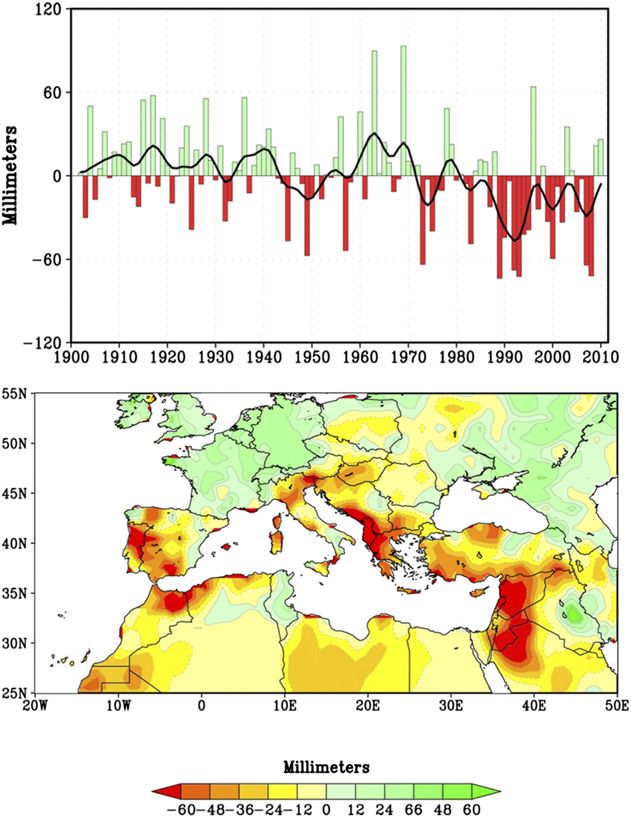
FIG. 5. (a) Millimeters of rain in the winter period from 1902 to
2010, showing a drop in rainfall in the 1971–2010 period (Hoerling
water to the city was badly damaged and in September the
et al. 2012). (b) Reds and oranges highlight the areas around the city of about three million people was suffering shortages
Mediterranean that experienced significantly drier winters during of drinking water (BBC 2013a). In late November 2012,
1971–2010 than the comparison period of 1902–2010 (Hoerling anti-Assad Syrian rebels overran government forces and
et al. 2012). captured the Tishrin hydroelectric dam on the Euphrates
River after heavy clashes (Mroue 2012). The dam supplies
several areas of Syria with electricity and is considered
(Turner et al. 2003). Contributing to the problem was of major strategic importance to the Syrian regime.
extensive exploitation of groundwater (Salman and In February 2013, anti-Assad forces captured the Tabqa/
Mualla 2003), which has led to substantial drops in water al-Thawrah dam, which is the largest hydroelectric dam
levels and in some areas, contamination by salts and ni- in the country and provides much of the electricity to the
trates, making local wells (e.g., in the ar-Raqqah region) city of Aleppo (BBC 2013b). These kinds of secondary
unfit for human use. In all of these cases, trends toward impacts of conflict—the targeting of water systems—
privatization of agricultural lands also ‘‘corroded cus- highlight the strategic value of water supply, hydroelec-
tomary law over boundary rights’’ (Saleeby 2012), further tricity, and flood control in water-short regions.
worsening local tensions. These complex factors con-
tributed to the extent and severity of the unrest:
‘‘It is logical to conclude that escalating pressures on 4. The role of climate change stresses
urban areas due to internal migration, increasing food As early as 2008, there were indications that drought
insecurity, and resultant high rates of unemployment frequency and intensity in the eastern Mediterranean area
have spurred many Syrians to make their political
had changed from historical climatic norms. Mathbout
grievances publically known. One might look to the city
and Skaf (2010) used two drought indices [the standard
of Deir ez-Zor, one of Syria’s most dangerously dry areas,
to locate deeply rooted seeds in the harvest of dissent. The precipitation index (SPI) and the effective drought index
northeastern city experienced one of the strongest sieges (EDI)] to identify an increasing tendency in annual and
by the Syrian army at the beginning of Ramadan after seasonal drought intensity in all regions corresponding
popular uprisings spread across its parched expanse. As with an increasing number of dry days in the rainy sea-
a local activist told Syria Today, the citizens of Deir son. Romanou et al. (2010) show statistically significantJULY 2014 GLEICK 337 increases in evaporative water demand in the eastern between 3.58 and 78C by the period 2070–99, compared Mediterranean region between 1988 and 2006, driven by to the reference period of 1961–90. Rare hot summer apparent increases in sea surface temperatures. A re- conditions are projected to become far more prevalent, search paper published in 2012 further suggested that with a concomitant increase in evapotranspiration water climate change is already beginning to influence droughts demand. Equally worrisome are projected decreases in in the area by reducing winter rainfall and increasing annual precipitation and worsening water scarcity for evapotranspiration (see Figs. 5a,b) (Hoerling et al. 2012). southern Turkey and Syria. Overall, this study projected That study suggested that winter droughts are increasingly increases in water scarcity. common and that human-caused climate change was In a more focused hydrologic assessment, downscaled playing a role. Martin Hoerling, one of the study authors, climate change data from transient experiments with stated, ‘‘The magnitude and frequency of the drying that regional climate models were used to assess the poten- has occurred is too great to be explained by natural vari- tial effects of climate change on water availability in the ability alone’’ (NOAA 2013). area of the Figeh spring system near Damascus (Smiatek Whether current conditions are evidence of human- et al. 2013). This water system is one of the largest induced climate change, the indications for the future wa- springs in the world and serves as the drinking water ter resources of the Middle East and North Africa, source for nearly three million people. The analysis fo- including Syria, are not promising. On top of political un- cused on differences in annual, seasonal, and monthly rest and economic dislocations, the region faces challenges temperature, precipitation, and water availability mea- posed by growing populations, the lack of international sured as spring discharge between present climate (taken agreements over shared water resources, growing with- as the 1961–90 average) and two future periods (2021–50 drawals of water by all the riparians, poor water manage- and 2070–99), and identified potentially serious reduc- ment, and the increasing risks of climate change. Analysis tions in water availability from increased evapotranspi- on the links between possible climatic changes and in- ration demand and decreased precipitation. The relative ternational security and conflict has been developing for change in mean discharge for the climate ensemble more than two decades, including work on the connections showed a decrease during the peak flow from March to between conflict and stresses from population growth, May of up to 220% in the period 2021–50 and almost water scarcity, and agricultural production (see, e.g., 250% in the period 2069–98, compared to the past Gleick 1989, 2010; Barnett and Adgerb 2007; Schmidhuber climatic mean. Decreases of this magnitude would have and Tubiello 2007; Malone 2013). Recently, the U.S. De- dramatic effects on local water availability. partment of Defense assessed these risks as part of the A broader climate assessment for the Tigris–Euphrates Quadrennial Defense Review Report (U.S. Department of River basins evaluated the hydrologic impacts of climate Defense 2010; Parthemore and Rogers 2010). Among their changes under a range of emissions scenarios using dy- conclusions, ‘‘assessments conducted by the intelligence namically downscaled output of three general circulation community indicate that climate change could have sig- models [ECHAM5; Community Climate System Model, nificant geopolitical impacts around the world, contribut- version 3 (CCSM3); and Hadley Centre Coupled Model, ing to poverty, environmental degradation, and the further version 3 (HadCM3)] under three separate IPCC emis- weakening of fragile governments. Climate change will sions scenarios (A1F1, A2, and B1) (Bozkurt and Lutfi contribute to food and water scarcity, will increase the Sen 2013). All simulations resulted in higher tempera- spread of disease, and may spur or exacerbate mass mi- tures and evaporative demand in the basins, with the gration’’ (U.S. Department of Defense 2010, p. 85). greatest increases in the highland areas, where preci- A 2008 assessment from the World Bank warned of pitation is greatest. Precipitation changes were variable, climate risks in the MENA region and links to drought with decreases in the northern portions of the watersheds frequency and intensity (World Bank 2013): ‘‘According and increases in the southern portions. In all the simula- to the latest IPCC [Intergovernmental Panel on Climate tions, decreases in snowfall due to higher temperatures Change] assessment, the climate is predicted to become were noted, consistent with many other studies of the even hotter and drier in most of the MENA region. impacts of climate change on mountain hydrology. Sta- Higher temperatures and reduced precipitation will result tistically significant reductions of 25%–55% in annual in higher frequency and severity of droughts, an effect that surface runoff from the headwaters regions of the is already materializing in the Maghreb.’’ Euphrates–Tigris watersheds were seen in all simulations, A review (Lelieveld et al. 2012) of the implications of along with a shift in the timing of runoff. The authors the intermediate climate scenarios (scenario A1B) de- noted that these runoff changes ‘‘suggest that the terri- veloped for the IPCC for the eastern Mediterranean tories of Turkey and Syria within the basin are most and Levant region further supports strong warming of vulnerable to climate change as they will experience
338                                 WEATHER, CLIMATE, AND SOCIETY                                                    VOLUME 6

significant decreases in the annual surface runoff. Even-      social, economic, or climatic conditions. Negotiations
tually, however, the downstream countries, especially          over the allocation of the Tigris and Euphrates Rivers, for
Iraq, may suffer more as they rely primarily on the water      example, could include adjustable allocations strategies,
released by the upstream countries’’ (Bozkurt and Lutfi        water quality standards, response strategies for extreme
Sen 2013, p. 149).                                             events such as droughts and floods, amendment and re-
   The implications of these hydrological changes for          view procedures in the event of disputes, and joint man-
Syria’s economy and political situation are far more dif-      agement institutions (Cooley and Gleick 2011).
ficult to project, because of the complicating factors of
global trade, agricultural practices and technologies,
                                                               6. Conclusions
management decisions about both water allocations and
agricultural land decisions, and more. One effort to assess       The Syrian conflict that began in 2012 has many roots,
the economic risks to Syria of climatic changes linked         including long-standing political, religious, and social
downscaled global climate models, crop models, global          ideological disputes; economic dislocations from both
economic models, and subnational dynamic equilibrium           global and regional factors; and worsening environmental
tools (Breisinger et al. 2013), and concluded that despite     conditions. This paper argues that key environmental fac-
the ability to adapt to expected changes, the local impacts    tors include both direct and indirect consequences of water
of climate change included declining yields and a re-          shortages, ineffective watershed management, and the im-
duction in both national economic growth and household         pacts of climate variability and change on regional hydrol-
income, even without factoring in the likely changes in        ogy. Severe multiyear drought beginning in the mid-2000s,
water availability described above.                            combined with inefficient and often unmodernized irriga-
                                                               tion systems and water abstractions by other parties in the
                                                               eastern Mediterranean, including especially Syria, contrib-
5. Strategies for reducing climate and water-related
                                                               uted to the displacement of large populations from rural to
   conflict risks
                                                               urban centers, food insecurity for more than a million
   Reducing the risks of water-related conflicts requires      people, and increased unemployment—with subsequent
reducing the pressures on water resources that contribute      effects on political stability. There is some evidence that the
to economic, social, political, and environmental disrup-      recent drought is an early indicator of the climatic changes
tions. In the MENA region, the heavy dependence of local       that are expected for the region, including higher temper-
economies and employment on agricultural production            ature, decreased basin rainfall and runoff, and increased
means that efforts to improve the productivity of water use    water scarcity. Absent any efforts to address population
to produce higher yields and income with less water will       growth rates, these water-related factors are likely to pro-
help cut pressure on the shared waters of the Tigris and       duce even greater risks of local and regional political in-
Euphrates Rivers. In Syria, the added likelihood of rising     stability, unless other mechanisms for reducing water
temperatures and reduced surface flows due to climate          insecurity can be identified and implemented. In the region
changes make it even more urgent that long-term agricul-       as a whole, new dam construction, growing water with-
tural reforms be put in place when some kind of political      drawals, and limited political cooperation on water issues
stability returns, including sustainable groundwater man-      may become even more important in coming years.
agement, more modern irrigation technologies, and a re-        Among the key options available to policy makers are
view of crop types and planting patterns. Overpumping of       improvements in water-use efficiency and productivity
groundwater is not sustainable, but few regions of the world   in agriculture, better management and monitoring of
have managed to bring abstraction and recharge into bal-       groundwater resources, and comprehensive international
ance. Doing so through economic, regulatory, and man-          agreements on managing and sharing the rivers that cross
agement policies is necessary if long-term sustainable water   political borders.
use is going to be a reality. Equally important, however, is
the need for successful negotiation of international agree-      Acknowledgments. I would like to thank my colleagues
ments on allocations and use of the major transnational        at the Pacific Institute for their comments on this work,
rivers and discussions about proposals for new dam and         and the constructive suggestions of three anonymous
irrigation projects on the Tigris and Euphrates Rivers. Few    reviewers. All errors are, of course, my own.
such agreements are in place in the MENA region and
growing demands for these resources will make it pro-
gressively more difficult to reach agreements over time.                               REFERENCES
   As a further complication, few international water          ACSAD, 2011: Drought vulnerability in the Arab Region: Case
agreements include mechanisms for addressing changing             study; Drought in Syria—Ten years of scarce water (2000–2010).
JULY 2014 GLEICK 339
ISDR and the Arab Center for the Studies of Arid Zones and Homer-Dixon, T. F., 1999: Environment, Scarcity, and Violence.
Dry Lands, 74 pp. [Available online at http://www.unisdr.org/ Princeton University Press, 253 pp.
files/23905_droughtsyriasmall.pdf.] Jacobsen, T., 1969: A survey of the Girsu (Tello) region. Sumer, 25,
Barnett, J., and W. N. Adgerb, 2007: Climate change, human secu- 103–108.
rity and violent conflict. Polit. Geogr., 26, 639–655, doi:10.1016/ Kliot, N., 1994: Water Resources and Conflict in the Middle East.
j.polgeo.2007.03.003. Routledge. 309 pp.
BBC, cited 2013a: Aleppo water supply cut as Syrian fighting rages. Lelieveld, J., and Coauthors, 2012: Climate change and impacts in
[Available online at http://www.bbc.co.uk/news/world-middle- the eastern Mediterranean and the Middle East. Climatic
east-19533112.] Change, 114, 667–687, doi:10.1007/s10584-012-0418-4.
——, cited 2013b: Syria crisis: ‘Powerful’ minibus explosion kills 13. Lloyd, S., 1961: Twin Rivers: A Brief History of Iraq from the
[Available online at http://www.bbc.co.uk/news/world-us- Earliest Times to the Present Day. 3rd ed. Oxford University
canada-21409661.] Press, 235 pp.
Bozkurt, D., and O. Lutfi Sen, 2013: Climate change impacts in Lonergan, S., 1997: Water resources and conflict: Examples from
the Euphrates–Tigris basin based on different model and the Middle East. Conflict and the Environment, N. P. Gleditsch,
scenario simulations. J. Hydrol., 480, 149–161, doi:10.1016/ Ed., NATO ASI Series, Vol. 33, Springer, 375–384, doi:10.1007/
j.jhydrol.2012.12.021. 978-94-015-8947-5_22.
Breisinger, C., T. Zhu, P. Al Riffai, G. Nelson, R. Robertson, Malone, E. L., 2013: Climate change and national security. Wea.
J. Funes, and D. Verner, 2013: Economic impacts of climate Climate Soc., 5, 93–95, doi:10.1175/WCAS-D-12-00016.1.
change in Syria. Climate Change Econ., 4, 1350002, doi:10.1142/ Mathbout, S., and M. Skaf, 2010: Drought changes over last
S2010007813500024. five decades in Syria. Economics of Drought and Drought Pre-
Burstein, S., 1978: The Babyloniaca of Berossus. Undena Publica- paredness in a Climate Change Context, A. L opez-Francos, Ed.,
tions, 37 pp. Mediterranean Seminars, 95, CIHEAM, 107–112.
Cooley, H., and P. H. Gleick, 2011: Climate-proofing trans- Mhanna, W., cited 2013: Syria’s climate crisis. [Available online
boundary water agreements. Hydrol. Sci. J., 56, 711–718, at http://www.al-monitor.com/pulse/politics/2013/12/syrian-
doi:10.1080/02626667.2011.576651. drought-and-politics.html#.]
Cooper, J. S., 1983: The Lagash-Umma Border Conflict: Recon- Mohtadi, S., cited 2013: Climate change and the Syrian uprising.
structing History from Ancient Inscriptions. Undena Publ., 61 pp. [Available online at http://thebulletin.org/web-edition/features/
Falkenmark, M., 1986: Fresh waters as a factor in strategic policy climate-change-and-the-syrian-uprising.]
and action. Global Resources and International Conflict: Envi- Mroue, B., 2012: Activists: Syrian rebels seize major dam in North.
ronmental Factors in Strategic Policy and Action, A. H. Westing, Daily Star Lebanon, 26 November 2012. [Available online
Ed., Oxford University Press, 85–113. at http://www.dailystar.com.lb/News/Middle-East/2012/Nov-
FAO, 2012: Syrian Arab Republic Joint Rapid Food Security 26/196180-activists-syrian-rebels-seize-major-dam-in-north.
Needs Assessment (JRFSNA). FAO Rep., 26 pp. [Available ashx#ixzz2KA8TTBbj.]
online at http://www.fao.org/giews/english/otherpub/JRFSNA_ NOAA, cited 2013: NOAA study: Human-caused climate change
Syrian2012.pdf.] a major factor in more frequent Mediterranean droughts.
Femia, F., and C. Werrell, cited 2013: Syria: Climate change, [Available online at http://www.noaanews.noaa.gov/stories2011/
drought, and social unrest. The Center for Climate and Secu- 20111027_drought.html.]
rity. [Available online at http://climateandsecurity.org/2012/02/ Parthemore, C., and W. Rogers, 2010: Promoting the dialogue:
29/syria-climate-change-drought-and-social-unrest/.] Climate change and the quadrennial defense review. Center
Frenken, K., Ed., 2009: Irrigation in the Middle East region in for a New American Security Working Paper, 13 pp. [Available
figures: AQUASTAT survey—2008. FAO Water Rep. 34, online at http://www.cnas.org/files/documents/publications/
402 pp. [Available online at http://www.fao.org/docrep/012/ QDR&ClimateChange_Parthemore_Rogers_Jan2010_code406_
i0936e/i0936e00.htm.] workingpaper_2.pdf.]
Gleditsch, N. P., K. Furlong, H. Hegre, B. Lacina, and T. Owen, Rawlinson, G., Ed., 1933: The History of Herodotus. Dent &
2006: Conflicts over shared rivers: Resource scarcity or Dutton, 365 pp.
fuzzy boundaries? Polit. Geogr., 25, 361–382, doi:10.1016/ Reig, P., T. Shiao, and F. Gassert, 2013: Aqueduct Water Risk
j.polgeo.2006.02.004. Framework. World Resources Institute Working Paper,
Gleick, P. H., 1989: The implications of global climatic changes for 16 pp. [Available online at http://www.wri.org/sites/default/
international security. Climatic Change, 15, 309–325, files/aqueduct_water_risk_framework.pdf.]
doi:10.1007/BF00138857. Romanou, A., G. Tselioudis, C. S. Zerefos, C.-A. Clayson, J. A.
——, 1993: Water and conflict: Fresh water resources and inter- Curry, and A. Andersson, 2010: Evaporation–precipitation
national security. Int. Secur., 18, 79–112, doi:10.2307/2539033. variability over the Mediterranean and the Black Seas from
——, 1994: Water, war, and peace in the Middle East. Environ- satellite and reanalysis estimates. J. Climate, 23, 5268–5287,
ment, 36, 6–12, doi:10.1080/00139157.1994.9929154. doi:10.1175/2010JCLI3525.1.
——, 2010: Climate change, exponential curves, water resources, Saleeby, S., cited 2012: Sowing the seeds of dissent: Economic
and unprecedented threats to humanity. Climatic Change, 100, grievances and the Syrian social contract’s unraveling. [Avail-
125–129, doi:10.1007/s10584-010-9831-8. able online at http://www.jadaliyya.com/pages/index/4383/
Hatami, H., and P. H. Gleick, 1994: Conflicts over water in the sowing-the-seeds-of-dissent_economic-grievances-an.]
myths, legends, and ancient history of the Middle East. En- Salman, M., and W. Mualla, 2003: The utilization of water resources
vironment, 36, 10–11, doi:10.1080/00139157.1994.9929156. for agriculture in Syria: Analysis of current situation and future
Hoerling, M., J. Eischeid, J. Perlwitz, X. Quan, T. Zhang, and challenges. Proc. Int. Seminar on Water Issues of the World Fed-
P. Pegion, 2012: On the increased frequency of Mediterranean eration of Scientists, Erice, Sicily, Italy, IPTRID, 11 pp. [Avail-
drought. J. Climate, 25, 2146–2161, doi:10.1175/JCLI-D-11-00296.1. able online at ftp://ftp.fao.org/agl/IPTRID/conf_italy_03.pdf.]340 WEATHER, CLIMATE, AND SOCIETY VOLUME 6
Schmidhuber, J., and F. N. Tubiello, 2007: Global food security http://www.census.gov/population/international/data/idb/
under climate change. Proc. Natl. Acad. Sci. USA, 104, 19 703– informationGateway.php.]
19 708, doi:10.1073/pnas.0701976104. U.S. Department of Defense, 2010: Quadrennial defense review
Smiatek, G, S. Kaspar, and H. Kunstmann, 2013: Hydrological report. U.S. DOD Rep., 105 pp. [Available online at http://
climate change impact analysis for the Figeh spring near www.defense.gov/qdr/qdr%20as%20of%2026jan10%200700.
Damascus, Syria. J. Hydrometeor., 14, 577–593, doi:10.1175/ pdf.]
JHM-D-12-065.1. V€
or€
osmarty, C. J., P. Green, and R. B. Lammers, 2000: Global
Solh, M., 2010: Tackling the drought in Syria. Nature Middle East, water resources: Vulnerability from climate change and
doi:10.1038/nmiddleeast.2010.206. population growth. Science, 289, 284–288, doi:10.1126/
Toset, H. P. W., N. P. Gleditsch, and H. Hegre, 2000: Shared rivers science.289.5477.284.
and interstate conflict. Polit. Geogr., 19, 971–996, doi:10.1016/ Wada, Y., L. P. H. van Beek, and M. F. P. Bierkens, 2012: Non-
S0962-6298(00)00038-X. sustainable groundwater sustaining irrigation: A global as-
Turner, B. l., and Coauthors, 2003: Illustrating the coupled human– sessment. Water Resour. Res., 48, W00L06, doi:10.1029/
environment system for vulnerability analysis: Three case 2011WR010562.
studies. Proc. Natl. Acad. Sci. USA, 100, 8080–8085, doi:10.1073/ Wolf, A. T., 2007: Shared waters: Conflict and cooperation.
pnas.1231334100. Annu. Rev. Environ. Resour., 32, 241–269, doi:10.1146/
UNEP, 2008: Vital water graphics: An overview of the state of the annurev.energy.32.041006.101434.
world’s fresh and marine waters. 2nd ed. UNEP and UNE/ World Bank, cited 2013: A strategy to address climate change in the
GRID-Arendal. [Available online at http://www.unep.org/ MENA region. [Available online at http://go.worldbank.org/
dewa/vitalwater/index.html.] OIZZFRJZZ0.]
UN-ESCWA, 2013: Inventory of shared water resources in western Worth, R. F., 2010: Earth is parched where Syrian farms thrived.
Asia. UN-ESCWA and German Federal Institute for Geosciences New York Times, 13 October, New York ed., A1.
and Natural Resources, 610 pp. [Available online at http://www. Yoffe, S., A. T. Wolf, and M. Giordano, 2003: Conflict and co-
escwa.un.org/information/pubaction.asp?PubID51362.] operation over international freshwater resources: Indicators
U.S. Department of Commerce, cited 2013: International of basins at risk. J. Amer. Water Res. Assoc., 39, 1109–1126,
data base: Population data for Syria. [Available online at doi:10.1111/j.1752-1688.2003.tb03696.x.You can also read


